
Ruth 4:15

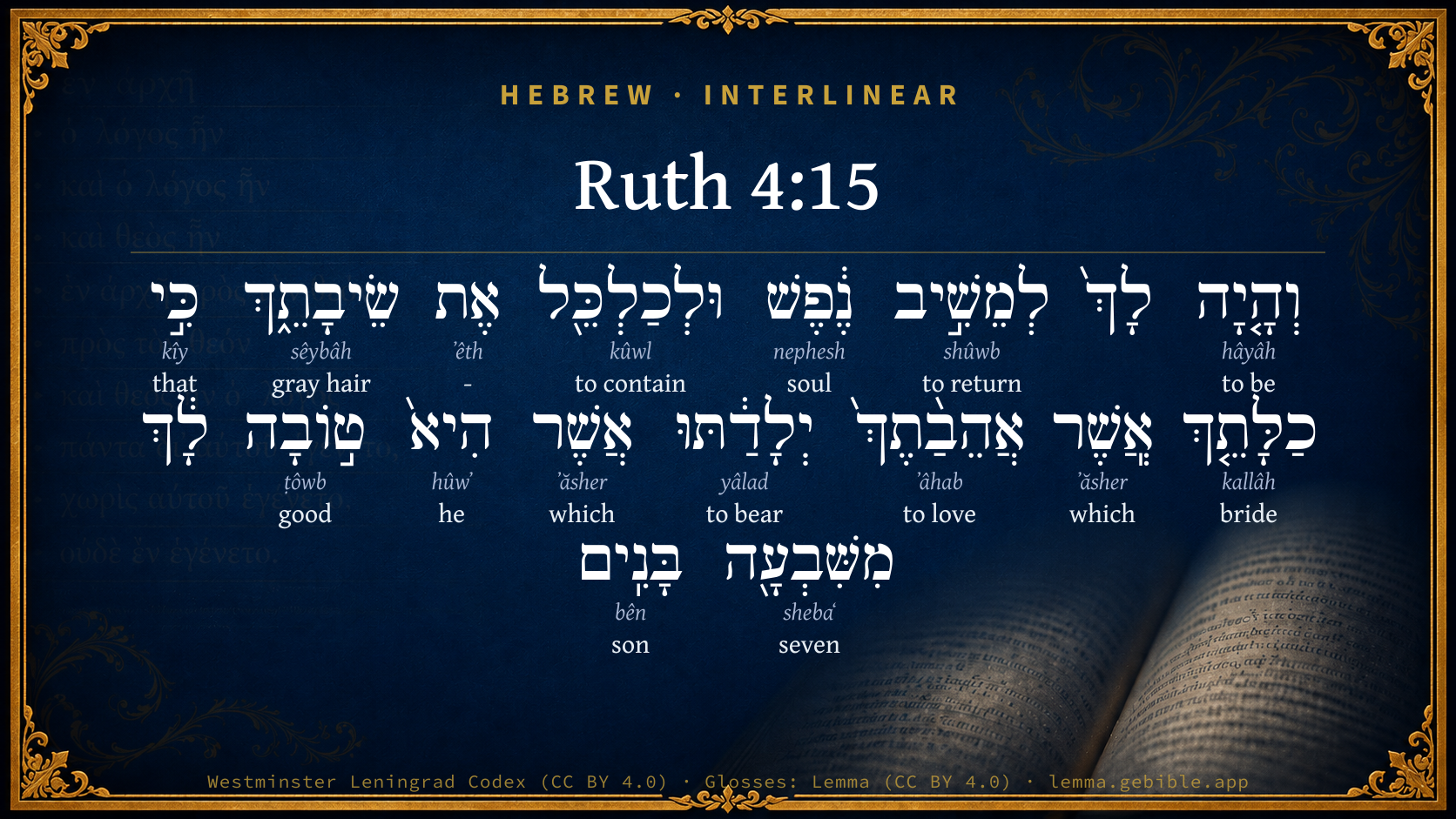
Hebrew (Westminster Leningrad Codex) Ruth 4:15 appears in the Hebrew Old Testament. The text above is from the Westminster Leningrad Codex. Each word links to its Strong’s number, a concise gloss, and parsing drawn from the Open Scriptures Hebrew Bible morphology. Click any word for its full Brown-Driver-Briggs (BDB) entry.
Download image
Cite this verse

Ruth 4:15 (World English Bible). Public Domain. Lemma interlinear Bible study tool, https://lemma.gebible.app/v/ruth/4/15.

Show BibTeX & RIS
BibTeX
RIS
English Translation
He shall be to you a restorer of life, and sustain you in your old age, for your daughter-in-law, who loves you, who is better to you than seven sons, has borne him.
World English Bible · Public Domain
Download a study sheet

One document with this verse’s original text, its word-by-word gloss line, the meaning frame, cross-references with their text, attributed commentary, and full source and license credits — printable, and it pastes into notes with its structure intact.

This verse Autodidact and up

Study sheet (.html) Plain text (.txt)

A passage Seminary Student

Up to 50 verses in one chapter. A passage sheet keeps up to 6 commentary sources and 12 cross-references per verse, in the order this page ranks them, and says so on the sheet whenever that leaves anything out. Ask for a single verse and you get the Autodidact verse sheet above.

Everything on this page stays free to read, with no account — the sheet is a download of what is already on screen, not access to it.

Want to remove ads? Support Godless Engineer
Compare translations 3

The same verse in 3 English versions, stacked beneath the original-language interlinear above. Click any original word for its lexicon entry.

Each is an independent rendering of the whole verse — the interlinear is not word-aligned to these translations.

Highlighted words mark where these versions differ — a whole-verse word diff, not a word-by-word alignment.

  • World English Bible Public Domain
    He shall be to you a restorer of life, and sustain you in your old age, for your daughter-in-law, who loves you, who is better to you than seven sons, has borne him.
  • King James Version Public Domain
    And he shall be unto thee a restorer of thy life, and a nourisher of thine old age: for thy daughter in law, which loveth thee, which is better to thee than seven sons, hath born him.
  • unfoldingWord Literal Text CC BY-SA 4.0
    Now he will be for you a restorer of life and a nourisher of your old age. For your daughter-in-law, who loves you, has borne him—she who is better to you than seven sons.”

unfoldingWord Literal Text — © unfoldingWord, licensed CC BY-SA 4.0. Word-aligned USFM3 via Door43 (git.door43.org/unfoldingWord/en_ult).

Versions to compare (up to 4)

3 of 4 selected

Show all 18 translations

Every available English version of this verse, each an independent rendering of the whole verse.

  • World English Bible Public Domain
    He shall be to you a restorer of life, and sustain you in your old age, for your daughter-in-law, who loves you, who is better to you than seven sons, has borne him.
  • Berean Standard Bible Public Domain
    He will renew your life and sustain you in your old age. For your daughter-in-law, who loves you and is better to you than seven sons, has given him birth.”
  • Majority Standard Bible Public Domain
    He will renew your life and sustain you in your old age. For your daughter-in-law, who loves you and is better to you than seven sons, has given him birth.”
  • King James Version Public Domain
    And he shall be unto thee a restorer of thy life, and a nourisher of thine old age: for thy daughter in law, which loveth thee, which is better to thee than seven sons, hath born him.
  • American Standard Version (1901) Public Domain
    And he shall be unto thee a restorer of life, and a nourisher of thine old age, for thy daughter-in-law, who loveth thee, who is better to thee than seven sons, hath borne him.
  • Revised Version (1885) Public Domain
    And he shall be unto thee a restorer of life, and a nourisher of thine old age: for thy daughter in law, which loveth thee, which is better to thee than seven sons, hath borne him.
  • Geneva Bible (1599) Public Domain
    And this shall bring thy life againe, and cherish thine olde age: for thy daughter in lawe which loueth thee, hath borne vnto him, and she is better to thee then seuen sonnes.
  • Douay-Rheims (1899) Public Domain
    And thou shouldst have one to comfort thy soul, and cherish thy old age. For he is born of thy daughter in law: who loveth thee: and is much better to thee, than if thou hadst seven sons.
  • Young's Literal Translation Public Domain
    and he hath been to thee for a restorer of life, and for a nourisher of thine old age, for thy daughter-in-law who hath loved thee -- who is better to thee than seven sons -- hath borne him.'
  • Literal Standard Version CC BY-SA 4.0
    and he has been to you for a restorer of life, and for a nourisher of your old age, for your daughter-in-law who has loved you—who is better to you than seven sons—has borne him.”
  • Unlocked Literal Bible CC BY-SA 4.0
    May he be for you a restorer of life and a nourisher of your old age, for your daughter-in-law, who loves you, who is better to you than seven sons, has borne him.”
  • unfoldingWord Literal Text CC BY-SA 4.0
    Now he will be for you a restorer of life and a nourisher of your old age. For your daughter-in-law, who loves you, has borne him—she who is better to you than seven sons.”
  • Darby Bible Public Domain
    And he shall be to thee a restorer of thy life, and a nourisher of thine old age; for thy daughter-in-law who loves thee, who is better to thee than seven sons, has borne him.
  • World Messianic Bible Public Domain
    He shall be to you a restorer of life and sustain you in your old age; for your daughter-in-law, who loves you, who is better to you than seven sons, has given birth to him.”
  • Webster's Bible Public Domain
    And he shall be to thee a restorer of thy life, and a nourisher of thy old age: for thy daughter-in-law, who loveth thee, who is better to thee than seven sons, hath borne him.
  • Free Bible Version CC BY-SA 4.0
    He will give you a new lease on life and provide for you in your old age, for your daughter-in-law, who loves you and who is better than seven sons to you, has given birth to him.”
  • Bible in Basic English Public Domain
    He will be a giver of new life to you, and your comforter when you are old, for your daughter-in-law, who, in her love for you, is better than seven sons, has given birth to him.
  • JPS Tanakh (1917) Public Domain
    And he shall be unto thee a restorer of life, and a nourisher of thine old age; for thy daughter-in-law, who loveth thee, who is better to thee than seven sons, hath borne him.'

Literal Standard Version (2020), Covenant Press — licensed CC BY-SA 4.0. Text via the HelloAO Bible API (eBible.org). Unlocked Literal Bible (unfoldingWord) — licensed CC BY-SA 4.0. Text via the HelloAO Bible API (eBible.org). unfoldingWord Literal Text — © unfoldingWord, licensed CC BY-SA 4.0. Word-aligned USFM3 via Door43 (git.door43.org/unfoldingWord/en_ult). Free Bible Version, Dr. Jonathan Gallagher — licensed CC BY-SA 4.0. Text via the HelloAO Bible API (eBible.org).

Word by word

More ways to search: Search by grammar → Find every occurrence → Compare this word →

Practice this passage: Drill this verse → Learn its vocabulary →

שֵׂיבָתֵ֑ךְ
sêybâh
H7872
“gray hair · your”
Noun, Common, Feminine, Singular, Construct + Suffix, Personal, 2nd Person, Feminine, Singular
Part of Speech
Noun
Type
Common
Gender
Feminine
Number
Singular
State
Construct
Full BDB Definition

Origin: from H7869

TWOT: 2253b

age, gray hair, hoary head, old age - gray hair, hoary head - old age
  1. וְהָ֤יָה hâyâh H1961 “and · to be” Conjunction + Verb, Qal, Sequential Perfect, 3rd Person, Masculine, Singular
  2. לְמֵשִׁ֣יב shûwb H7725 “to/for · returning” Preposition + Verb, Hiphil, Participle Active, Masculine, Singular, Absolute
  3. נֶ֔פֶשׁ nephesh H5315 “soul” Noun, Common, Both, Singular, Absolute
  4. וּלְכַלְכֵּ֖ל kûwl H3557 “and · to contain” Conjunction + Preposition + Verb, Pilpel, Infinitive Construct
  5. אֶת ʼêth H853 “-” Particle, Direct Object
  6. כִּ֣י kîy H3588 “that” Conjunction
  7. כַלָּתֵ֤ךְ kallâh H3618 “bride · your” Noun, Common, Feminine, Singular, Construct + Suffix, Personal, 2nd Person, Feminine, Singular
  8. אֲֽשֶׁר ʼăsher H834 “which” Particle, Relative
  9. אֲהֵבַ֨תֶךְ֙ ʼâhab H157 “to love · you” Verb, Qal, Perfect, 3rd Person, Feminine, Singular + Suffix, Personal, 2nd Person, Feminine, Singular
  10. יְלָדַ֔תּוּ yâlad H3205 “to bear · him” Verb, Qal, Perfect, 3rd Person, Feminine, Singular + Suffix, Personal, 3rd Person, Masculine, Singular
  11. אֲשֶׁר ʼăsher H834 “which” Particle, Relative
  12. הִיא֙ hûwʼ H1931 “he” Pronoun, Personal, 3rd Person, Feminine, Singular
  13. ט֣וֹבָה ṭôwb H2896 “good” Adjective, Adjective, Feminine, Singular, Absolute
  14. מִשִּׁבְעָ֖ה shebaʻ H7651 “from · seven” Preposition + Adjective, Cardinal number, Masculine, Singular, Absolute
  15. בָּנִֽים bên H1121 “sons” Noun, Common, Masculine, Plural, Absolute

About this verse

These counts appear in no published source. They are computed here, from the morphology-tagged text and Lemma’s own curated glosses. What Lemma adds →

18
words
15
distinct lemmas
Historical
section

Notable vocabulary

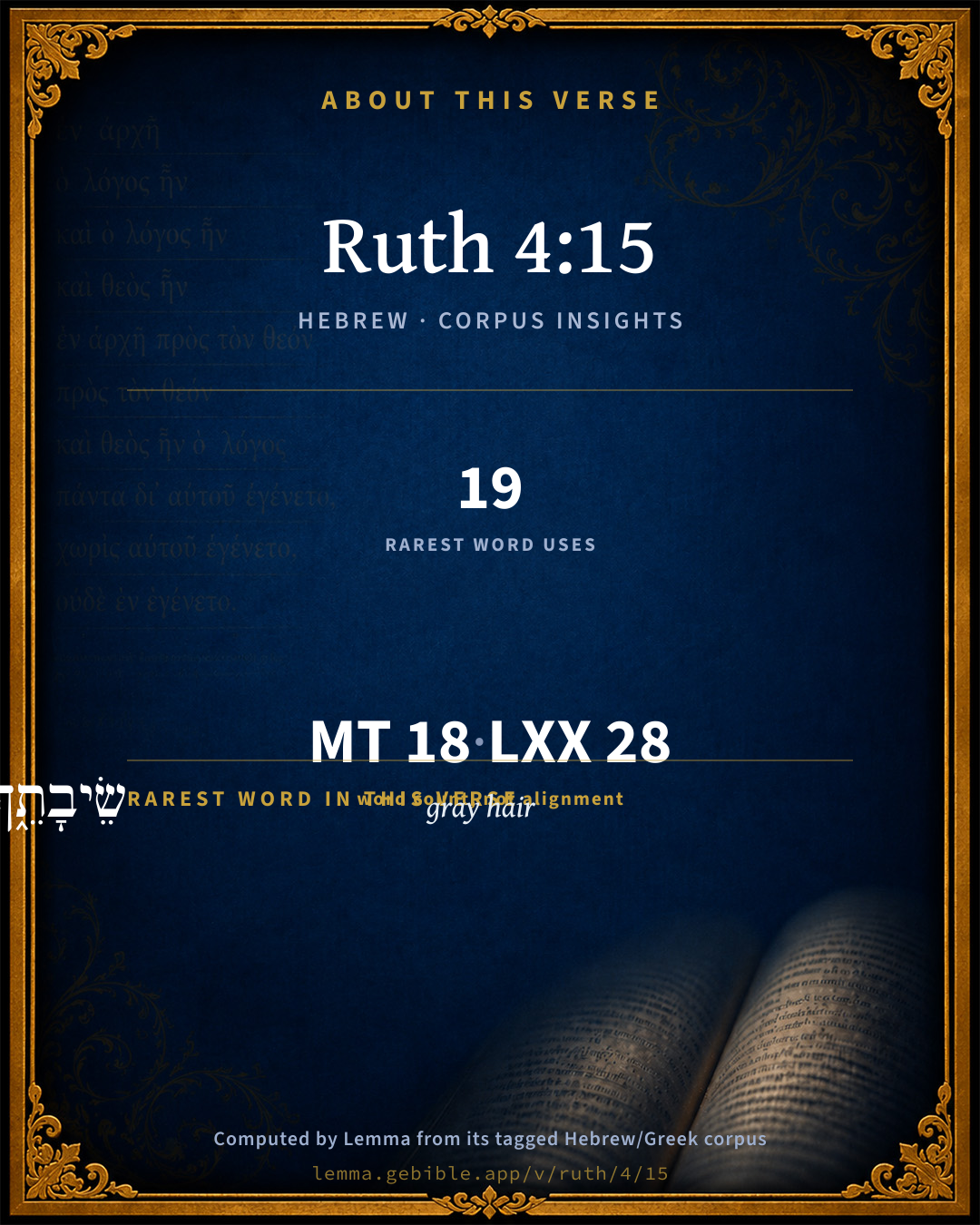
The rarest word here is שֵׂיבָתֵ֑ךְ gray hair H7872 — appearing just 19 times in the whole Hebrew Bible.

Shared distinctive vocabulary

שֵׂיבָתֵ֑ךְ gray hair H7872 occurs in 19 verses of the Hebrew Bible. Also found in:

Grammatical profile

  • 5 verbs
  • 4 nouns
  • 2 adjectives
  • 1 pronoun
  • 2 prepositions
  • 1 conjunction
  • 3 particles

Verb forms

  • וְהָ֤יָה Qal · Sequential Perfect
  • לְמֵשִׁ֣יב Hiphil · Participle Active
  • וּלְכַלְכֵּ֖ל Pilpel · Infinitive Construct
  • אֲהֵבַ֨תֶךְ֙ Qal · Perfect
  • יְלָדַ֔תּוּ Qal · Perfect

Repetition

A word recurs within this verse — often emphatic in Hebrew:

  • אֲֽשֶׁר which H834 ×2

Hebrew & Septuagint length

In English translation the verse runs 33 words from the Hebrew and 36 from the Septuagint (LXX English) — closely comparable.

A rough comparison of the two English renderings, which tokenize alike — not a word-level alignment.

Word counts can differ between the Hebrew and the Greek without any difference in meaning — e.g. the Hebrew direct-object marker אֵת has no separate Greek word, and Greek often adds the article ὁ.

In the original languages it is 18 Hebrew tokens and 28 Greek tokens — but the two are counted differently (Hebrew bundles its prefixes and suffixes into one token; the Greek is in lemma form), so that isn’t a like-for-like length.

Cross-references

8

Topical passages linked to Ruth 4:15 in the Treasury of Scripture Knowledge — connected by theme and wording, ordered by reader-vote popularity; previews shown in the World English Bible.

  • Isaiah 46:4 and even to old age I am he, and even to gray hairs will I carry you. I have made, and I will bear; yes, I will carry, and will deliver.
  • Psalms 55:22 Cast your burden on Yahweh, and he will sustain you. He will never allow the righteous to be moved.
  • Genesis 45:11 There I will nourish you; for there are yet five years of famine; lest you come to poverty, you, and your household, and all that you have."'
  • Ruth 2:11–12 Boaz answered her, It has fully been shown me, all that you have done to your mother-in-law since the death of your husband; and how you have left your father and your mother, and the land of your birth, and have come to a people that you didn't know before.
  • Genesis 47:12 Joseph nourished his father, his brothers, and all of his father's household, with bread, according to their families.
  • 1 Samuel 1:8 Elkanah her husband said to her, Hannah, why weep you? and why don't you eat? and why is your heart grieved? am I not better to you than ten sons?
  • Proverbs 18:24 A man of many companions may be ruined, But there is a friend who sticks closer than a brother.
  • Ruth 1:16–18 Ruth said, "Don't entreat me to leave you, and to return from following after you, for where you go, I will go; and where you lodge, I will lodge; your people shall be my people, and your God my God;

Cross-references courtesy of OpenBible.info (CC BY 4.0).

Hebrew and Greek witnesses Masoretic Hebrew ↔ Greek Septuagint

The same verse in the two great witnesses to the Old Testament, shown verse-for-verse.

These are two independent witnesses, not word-aligned to each other, and the Septuagint is shown in lemma (dictionary) form.

Hebrew Ruth 4:15 Masoretic · Westminster Leningrad Codex

וְהָ֤יָה לָךְ֙ לְמֵשִׁ֣יב נֶ֔פֶשׁ וּלְכַלְכֵּ֖ל אֶת שֵׂיבָתֵ֑ךְ כִּ֣י כַלָּתֵ֤ךְ אֲֽשֶׁר אֲהֵבַ֨תֶךְ֙ יְלָדַ֔תּוּ אֲשֶׁר הִיא֙ ט֣וֹבָה לָ֔ךְ מִשִּׁבְעָ֖ה בָּנִֽים

He shall be to you a restorer of life, and sustain you in your old age, for your daughter-in-law, who loves you, who is better to you than seven sons, has borne him.

World English Bible · Public Domain

Greek LXX Ruth 4:15 Septuagint · lemma form

καί εἰμί σύ εἰς ἐπιστρέφω ψυχή καί ὁ διατρέφω ὁ πολιά σύ ὅτι ὁ νύμφη σύ ὁ ἀγαπάω σύ τίκτω αὐτός ὅς εἰμί ἀγαθός σύ ὑπέρ ἑπτά υἱός

And he shall be to you a restorer of your soul, and one to cherish your old age; for your daughter-in-law which has loved you, who is better to you than seven sons, has born him.

LXX2012 (modern English Septuagint) · Public Domain

Hebrew: Westminster Leningrad Codex (CC BY 4.0). Greek: Septuagint (public domain); English from LXX2012 (modern English Septuagint) (Public Domain). How the Septuagint differs from the Hebrew →

Commentary

Notes on Ruth 4:15 from classic Christian and Jewish commentators (each source and its license shown beneath its notes). The classic Christian expositions comment on the surrounding passage and are grouped to its opening verse, so a note may address several verses; the Jewish commentaries on the Tanakh (Rashi and others) are per-verse, so they appear only where the commentator wrote on this verse.

Lemma curates 59 commentaries, every one of them public domain or Creative Commons licensed, each selected and text-cleaned for this edition rather than reprinted as found. About our sources →

Trapp's Complete Commentary

John Trapp

Rth 4:15 And he shall be unto thee a restorer of [thy] life, and a nourisher of thine old age: for thy daughter in law, which loveth thee, which is better to thee than seven sons, hath born him.

Ver. 15. And he shall be unto thee a restorer of thy life.] A joyless life is a lifeless life. Mortis habet vices quae trahitur vita gemitibus. Such had been Naomi’s life for a long while, till now that God had raised her up a restorer. "Now we live," &c. {1Th 3:8}

And a nourisher of thine old age.] Children should nourish their old parents, and supply their wants, αντι πελαργων. Storks and mice feed their dams when old: boughs incline and bend down toward the root; and in summer, receiving from the root leaves, flowers, and fruit, they let them fall again in winter, to the fatting and nourishing of the root. Unkind and unnatural children are like kites, {bird of prey} which, when grown strong, expel their dams, and with their bills and wings beat them out of the nest.

For thy daughter-in-law, which loveth thee … hath born him.] And it is to be hoped that he will not degenerate, or grow out of kind: for partus sequitur ventrem, the birth followeth the belly, as the proverb is.

John Trapp, A Commentary or Exposition upon All the Books of the Old and New Testament (1647–1656) — public domain. Text from a community e-Sword module.

Joseph Benson's Commentary

Rth 4:15. A restorer of thy life — Of the comfort of thy life, such a comfort as to make thee, in some sort, young again. For they hoped the child would inherit his mother’s virtues, and particularly her affection to Naomi, which was so surpassing, that it made her a greater blessing to her than a great many children of her own body would have been. Better than seven sons — See how God sometimes makes up the want of those relations from whom we expected most comfort, in those from whom we expected least! The bonds of love prove stronger than those of nature.

Joseph Benson's Commentary on the Old and New Testaments (1811–1818) — public domain. Text from a community e-Sword module.

Tyndale Open Study Notes

Tyndale Open Resources

4:15 care for you in your old age (literally cause your old age to be full): With the birth of Obed, Naomi’s life was full again (cp. 1:21).

Tyndale Open Study Notes — © Tyndale Open Resources, licensed CC BY-SA 4.0. Text via the HelloAO Bible API.

Geneva Bible (1599)

Geneva Bible translators

Meaning, many sons.

Geneva Bible (1599) marginal notes — public domain. Text via Bolls.life.

Ellicott's Commentary for English Readers

(15) A nourisher.—(See marginal renderings).

Daughter-in-law.—The position of the nominative is emphatic.

Loveth.—The verb is a perfect, which hath ever loved thee.

A Bible Commentary for English Readers, edited by Charles John Ellicott (1878–1897) — public domain. Text from a community e-Sword module.

The Cambridge Bible for Schools and Colleges

gen. ed. J. J. S. Perowne

15. better to thee than seven sons] Ruth has proved it by her piety towards the dead and the living. Seven is a round number, cf. 1Sa_1:8.

The Cambridge Bible for Schools and Colleges (gen. ed. J. J. S. Perowne; Cambridge University Press, 1878–1918) — public domain. Text from a community e-Sword module.

John Gill's Exposition

And he shall be unto thee a restorer of thy life,.... Of the joys, pleasures, and comforts of it, which she had been deprived of through the death of her husband and her two sons, ever since which she had lived a sorrowful life; all the comfort she had was from her daughter-in-law, and now a grandchild being born to her of her would be a means of restoring comfort to her mourning sorrowful spirit, and give her pleasure in those years in which she did not expect any:

and a nourisher of thine old age; that would when grown up feed her, support her, and supply her with all necessaries of life, being heir to a large and rich estate:

for thy daughter in law which loveth thee; Ruth the wife of Boaz, who had shown her love, in leaving her own country and kindred, to come along with her into a strange land, and who had laboured for her support in it, and still retained the same affection for her:

which is better to thee than seven sons, hath borne him: either which had been so in the time of her widowhood, as the Targum; or rather which was so now, being the wife of so rich a person, and having now brought forth a son, heir to the estate, who would be more capable of doing for her than if she had seven sons living, having no other than their paternal estate.

John Gill's Exposition of the Whole Bible (1746–1763) — public domain (CC PDM 1.0). Text via the HelloAO Bible API.

Haydock's Catholic Bible Commentary

Comfort. Hebrew, "to make thy soul revive."

George Leo Haydock (1774–1849), Haydock's Catholic Family Bible and Commentary, 1859 edition — public domain. Excludes Psalms (Douay-Rheims chapter numbering differs from Protestant) and Deuterocanonical books (Catholic canon only).

Matthew Poole's English Annotations

A restorer of thy life, i.e. of the comfort of thy life, which was in a great measure dead and gone.

Hath born him, to wit, a son; the pronoun for the noun understood, which is frequent in the Hebrew tongue. Or, hath born to him, i.e. to thy kinsman, to wit, a son, which is easily understood; and so the pronoun affix is put for the separate; of which there are instances; as Jos 15:19; 1Ki 19:21; Job 31:37; Eze 29:3.

Matthew Poole's English Annotations on the Holy Bible (1683–1685) — public domain. Text from a community e-Sword/MySword module.

Whedon's Commentary on the Bible

Daniel D. Whedon

15. He shall be — That is, the child shall be. Boaz was the goel or redeemer of Ruth but the child Obed was the goel of the aged Naomi.

Restorer of thy life — He shall make thee feel the glow of youthful life and joy again.

A nourisher of thine old age — A source of comfort, since the birth of this son would take away the reproach of childlessness from her husband’s family.

Better… than seven sons — Because through Ruth “the loss of her own sons had been supplied in her old age, and the prospect was now presented to her of becoming in her childless old age the tribe-mother of a numerous and flourishing family.” — Keil. “It would seem as if there was already a kind of joyous foretaste of the birth and infancy which, in aftertimes, was to be forever associated with the name of Beth-lehem.” — Stanley.

Daniel D. Whedon (gen. ed.), Commentary on the Old and New Testaments (1874–1909) — public domain. Text from a community e-Sword module.

The Pulpit Commentary

And may he be to thee a restorer of life, and for the support of thine old age: for thy daughter-in-law, who loved thee, hath borne him, and she is better to thee than seven sons. The number seven suggested an idea of fullness, completeness, perfection. The whole inhabitants of the city knew that Ruth"s love to her mother-in-law had been indeed transcendent, and also that it had been transcendently returned.

The Pulpit Commentary (1880–1919), ed. H.D.M. Spence-Jones & Joseph S. Exell — public domain. Text from a community e-Sword module.

John Wesley's Explanatory Notes

Thy life - That is, of the comfort of thy life. Born him - Or, hath born to him; that is, to thy kinsman a son. Better than seven sons - See how God sometimes makes up the want of those relations from whom we expected most comfort, in those from whom we expected least! The bonds of love prove stronger than those of nature.

John Wesley, Explanatory Notes Upon the Whole Bible (1754–1765) — public domain. Text via the GEBible commentary corpus.

Lesson kit

Teaching starters — assembled from the data on this page, not authored interpretation. Every prompt links to the verse data it draws on. Edit before teaching.

Ruth, in the Historical, opens this verse with 18 words (15 distinct Hebrew lemmas). Its most distinctive word is sêybâh (“gray hair”). A historical commentator’s framing appears above. Read the whole chapter for the surrounding context.

Discussion questions

  1. How does “gray hair” (sêybâh) shape what this verse is saying?
  2. How does Genesis 15:15, which shares the word «gray hair», read alongside this verse?
  3. What does the repetition of “which” (2× in this one verse) do in this verse?
  4. These translations render this verse differently. What is at stake in choosing one wording over another?
  5. «וְהָ֤יָה» is a Qal Sequential Perfect verb. How does that grammatical form shape the action described?
  6. Compare how Trapp's Complete Commentary and Joseph Benson's Commentary read this verse. Where do they agree or differ?

Things to notice

Reading settings

Reading text

Shown beneath each verse's original-language words.

Old Testament
Old Testament edition

Read the OT as the Masoretic Hebrew (MT) or the Greek Septuagint (LXX).

English shown for the Greek Septuagint (in the Hebrew ↔ Greek comparison).

Comparing translations? Open the Compare panel on any verse page to stack up to four side by side.