Leviticus 23:8

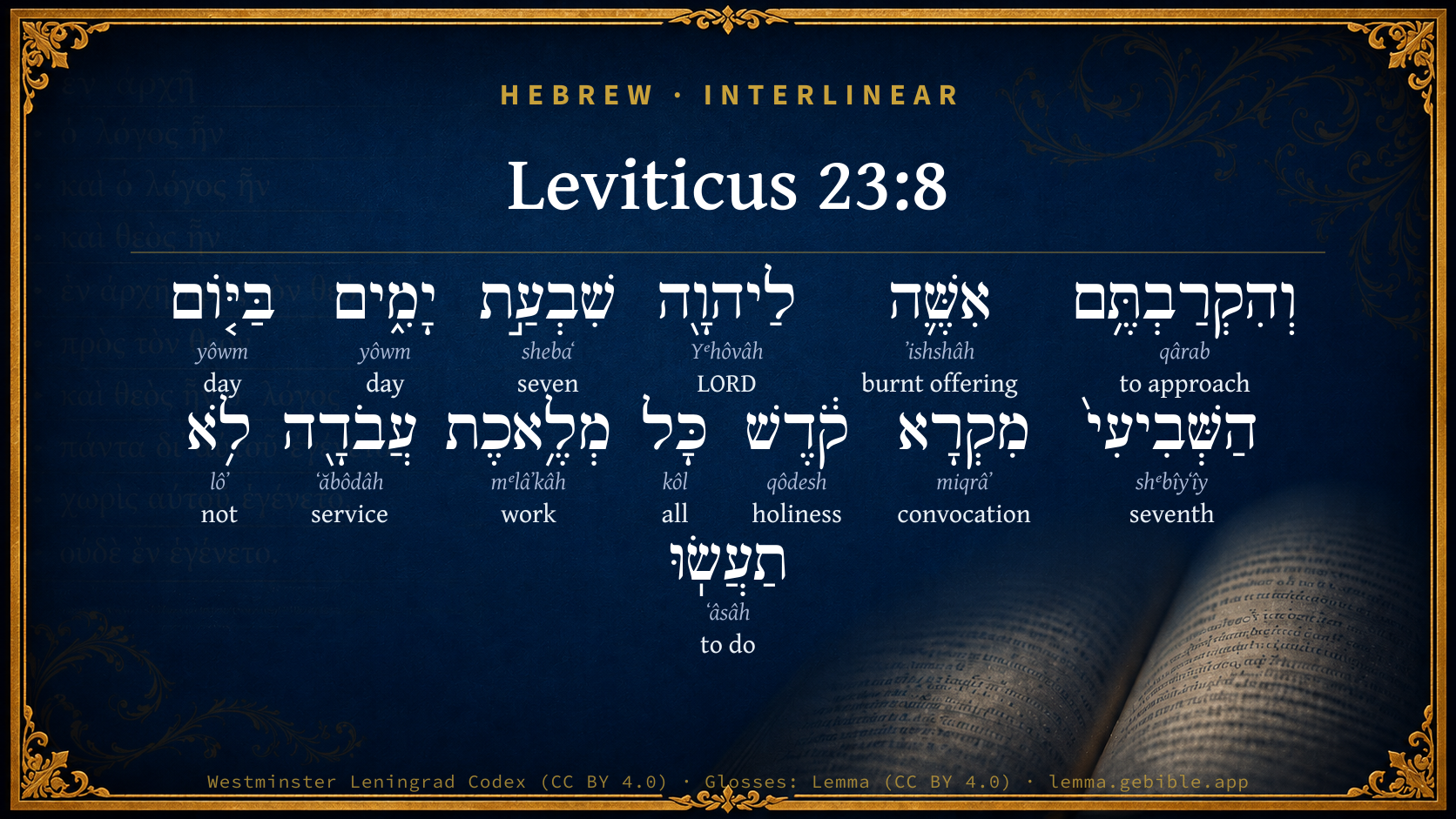
Hebrew (Westminster Leningrad Codex) Leviticus 23:8 appears in the Hebrew Old Testament. The text above is from the Westminster Leningrad Codex. Each word links to its Strong’s number, a concise gloss, and parsing drawn from the Open Scriptures Hebrew Bible morphology. Click any word for its full Brown-Driver-Briggs (BDB) entry.
Download image
Cite this verse

Leviticus 23:8 (World English Bible). Public Domain. Lemma interlinear Bible study tool, https://lemma.gebible.app/v/leviticus/23/8.

Show BibTeX & RIS
BibTeX
RIS
English Translation
But you shall offer an offering made by fire to Yahweh seven days. In the seventh day is a holy convocation: you shall do no regular work.'"
World English Bible · Public Domain
Download a study sheet

One document with this verse’s original text, its word-by-word gloss line, the meaning frame, cross-references with their text, attributed commentary, and full source and license credits — printable, and it pastes into notes with its structure intact.

This verse Autodidact and up

Study sheet (.html) Plain text (.txt)

A passage Seminary Student

Up to 50 verses in one chapter. A passage sheet keeps up to 6 commentary sources and 12 cross-references per verse, in the order this page ranks them, and says so on the sheet whenever that leaves anything out. Ask for a single verse and you get the Autodidact verse sheet above.

Everything on this page stays free to read, with no account — the sheet is a download of what is already on screen, not access to it.

Want to remove ads? Support Godless Engineer
Compare translations 3

The same verse in 3 English versions, stacked beneath the original-language interlinear above. Click any original word for its lexicon entry.

Each is an independent rendering of the whole verse — the interlinear is not word-aligned to these translations.

Highlighted words mark where these versions differ — a whole-verse word diff, not a word-by-word alignment.

  • World English Bible Public Domain
    But you shall offer an offering made by fire to Yahweh seven days. In the seventh day is a holy convocation: you shall do no regular work.'"
  • King James Version Public Domain
    But ye shall offer an offering made by fire unto the LORD seven days: in the seventh day is an holy convocation: ye shall do no servile work therein.
  • unfoldingWord Literal Text CC BY-SA 4.0
    And you shall present a gift to Yahweh seven days. On the seventh day an assembly of holiness. You shall not do any work of labor.’”

unfoldingWord Literal Text — © unfoldingWord, licensed CC BY-SA 4.0. Word-aligned USFM3 via Door43 (git.door43.org/unfoldingWord/en_ult).

Versions to compare (up to 4)

3 of 4 selected

Show all 18 translations

Every available English version of this verse, each an independent rendering of the whole verse.

  • World English Bible Public Domain
    But you shall offer an offering made by fire to Yahweh seven days. In the seventh day is a holy convocation: you shall do no regular work.'"
  • Berean Standard Bible Public Domain
    For seven days you are to present an offering made by fire to the LORD. On the seventh day there shall be a sacred assembly; you must not do any regular work.’”
  • Majority Standard Bible Public Domain
    For seven days you are to present a food offering to the LORD. On the seventh day there shall be a sacred assembly; you must not do any regular work.’”
  • King James Version Public Domain
    But ye shall offer an offering made by fire unto the LORD seven days: in the seventh day is an holy convocation: ye shall do no servile work therein.
  • American Standard Version (1901) Public Domain
    But ye shall offer an offering made by fire unto Jehovah seven days: in the seventh day is a holy convocation; ye shall do no servile work.
  • Revised Version (1885) Public Domain
    But ye shall offer an offering made by fire unto the LORD seven days: in the seventh day is an holy convocation; ye shall do no servile work.
  • Geneva Bible (1599) Public Domain
    Also ye shall offer sacrifice made by fire vnto the Lord seuen daies, and in the seuenth day shalbe an holie conuocation: ye shall do no seruile worke therein.
  • Douay-Rheims (1899) Public Domain
    But you shall offer sacrifice in fire to the Lord seven days. And the seventh day shall be more solemn, and more holy: and you shall do no servile work therein.
  • Young's Literal Translation Public Domain
    and ye have brought near a fire-offering to Jehovah seven days; in the seventh day `is' a holy convocation; ye do no servile work.'
  • Literal Standard Version CC BY-SA 4.0
    and you have brought a fire-offering near to YHWH [for] seven days; in the seventh day [is] a holy convocation; you do no servile work.”
  • Unlocked Literal Bible CC BY-SA 4.0
    You will present a food offering to Yahweh for seven days. The seventh day is an assembly set apart to Yahweh, and on that day you must not do any regular work.'”
  • unfoldingWord Literal Text CC BY-SA 4.0
    And you shall present a gift to Yahweh seven days. On the seventh day an assembly of holiness. You shall not do any work of labor.’”
  • Darby Bible Public Domain
    And ye shall present to Jehovah an offering by fire seven days; on the seventh day is a holy convocation: no manner of servile work shall ye do.
  • World Messianic Bible Public Domain
    But you shall offer an offering made by fire to the LORD seven days. In the seventh day is a holy convocation. You shall do no regular work.’”
  • Webster's Bible Public Domain
    But ye shall offer an offering made by fire to the LORD seven days: in the seventh day is a holy convocation, ye shall do no servile work in it.
  • Free Bible Version CC BY-SA 4.0
    For seven days you shall present food offerings to the Lord. There is to be a holy meeting on the seventh day. You must not do any of your usual work.”
  • Bible in Basic English Public Domain
    And every day for seven days you will give a burned offering to the Lord; and on the seventh day there will be a holy meeting; you may do no field-work.
  • JPS Tanakh (1917) Public Domain
    And ye shall bring an offering made by fire unto the LORD seven days; in the seventh day is a holy convocation; ye shall do no manner of servile work.

Literal Standard Version (2020), Covenant Press — licensed CC BY-SA 4.0. Text via the HelloAO Bible API (eBible.org). Unlocked Literal Bible (unfoldingWord) — licensed CC BY-SA 4.0. Text via the HelloAO Bible API (eBible.org). unfoldingWord Literal Text — © unfoldingWord, licensed CC BY-SA 4.0. Word-aligned USFM3 via Door43 (git.door43.org/unfoldingWord/en_ult). Free Bible Version, Dr. Jonathan Gallagher — licensed CC BY-SA 4.0. Text via the HelloAO Bible API (eBible.org).

Word by word

More ways to search: Search by grammar → Find every occurrence → Compare this word →

Practice this passage: Drill this verse → Learn its vocabulary →

מִקְרָא
miqrâʼ
H4744
“convocation of”
Noun, Common, Masculine, Singular, Construct
Part of Speech
Noun
Type
Common
Gender
Masculine
Number
Singular
State
Construct
Full BDB Definition

Origin: from H7121

TWOT: 2063d

convocation, convoking, reading, a calling together - convocation, sacred assembly - convoking - reading
  1. וְהִקְרַבְתֶּ֥ם qârab H7126 “and · to approach” Conjunction + Verb, Hiphil, Sequential Perfect, 2nd Person, Masculine, Plural
  2. אִשֶּׁ֛ה ʼishshâh H801 “burnt offering” Noun, Common, Masculine, Singular, Absolute
  3. לַיהוָ֖ה Yᵉhôvâh H3068 “to/for · LORD” Preposition + Noun, Proper
  4. שִׁבְעַ֣ת shebaʻ H7651 “seven” Adjective, Cardinal number, Masculine, Singular, Construct
  5. יָמִ֑ים yôwm H3117 “days” Noun, Common, Masculine, Plural, Absolute
  6. בַּיּ֤וֹם yôwm H3117 “in/at the · day” Preposition, Determined + Noun, Common, Masculine, Singular, Absolute
  7. הַשְּׁבִיעִי֙ shᵉbîyʻîy H7637 “the · seventh” Particle, Definite Article + Adjective, Ordinal number, Masculine, Singular, Absolute
  8. קֹ֔דֶשׁ qôdesh H6944 “holiness” Noun, Common, Masculine, Singular, Absolute
  9. כָּל kôl H3605 “all of” Noun, Common, Masculine, Singular, Construct
  10. מְלֶ֥אכֶת mᵉlâʼkâh H4399 “work of” Noun, Common, Feminine, Singular, Construct
  11. עֲבֹדָ֖ה ʻăbôdâh H5656 “service” Noun, Common, Feminine, Singular, Absolute
  12. לֹ֥א lôʼ H3808 “not” Particle, Negative
  13. תַעֲשֽׂוּ ʻâsâh H6213 “to do” Verb, Qal, Imperfect, 2nd Person, Masculine, Plural

About this verse

These counts appear in no published source. They are computed here, from the morphology-tagged text and Lemma’s own curated glosses. What Lemma adds →

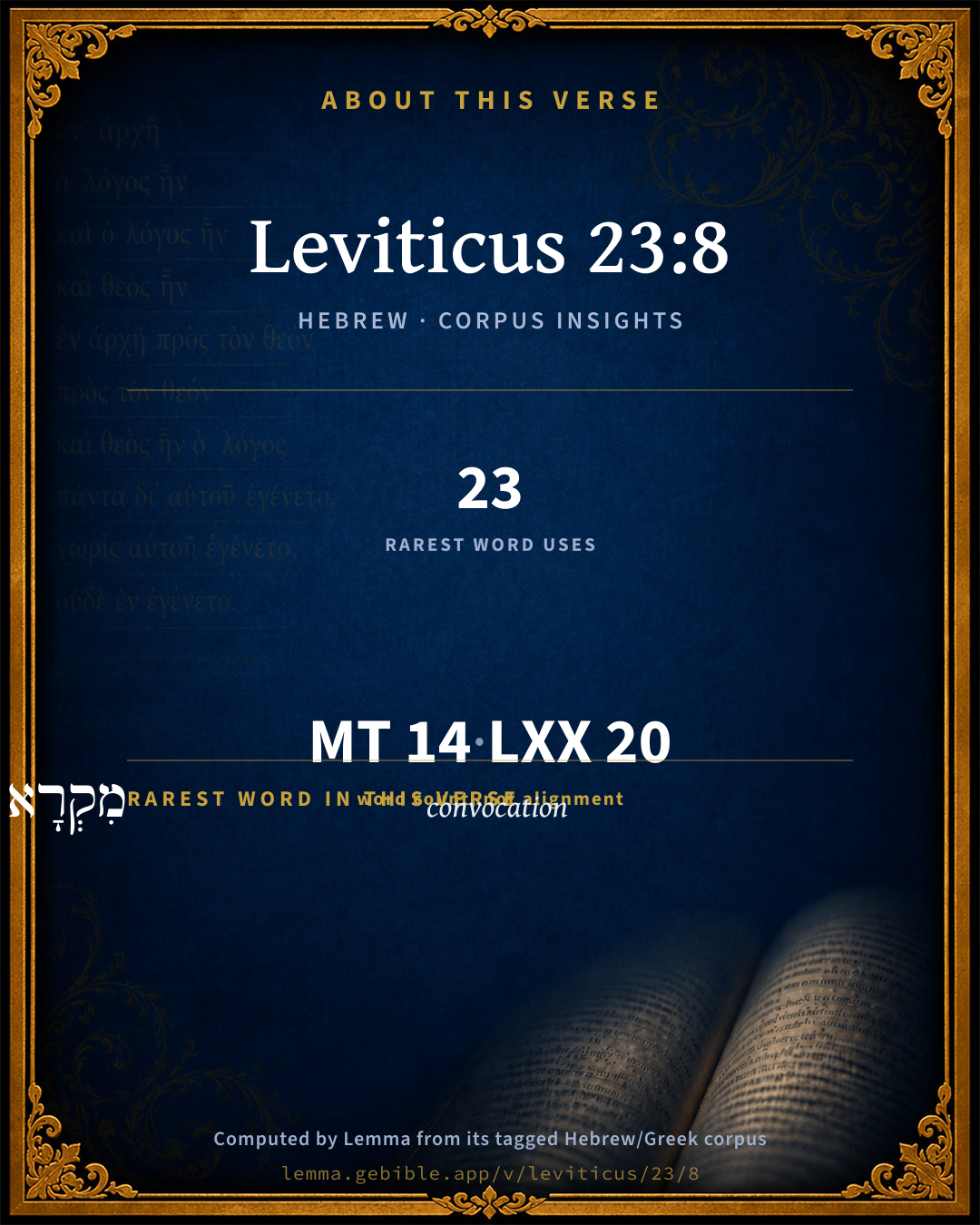
14
words
13
distinct lemmas
Pentateuch
section

Notable vocabulary

The rarest word here is מִקְרָא convocation H4744 — appearing just 23 times in the whole Hebrew Bible.

Shared distinctive vocabulary

מִקְרָא convocation H4744 occurs in 22 verses of the Hebrew Bible. Also found in:

Grammatical profile

  • 2 verbs
  • 9 nouns
  • 2 adjectives
  • 1 particle

Verb forms

  • וְהִקְרַבְתֶּ֥ם Hiphil · Sequential Perfect
  • תַעֲשֽׂוּ Qal · Imperfect

Repetition

A word recurs within this verse — often emphatic in Hebrew:

  • יָמִ֑ים day H3117 ×2

Hebrew & Septuagint length

In English translation the verse runs 27 words from the Hebrew and 29 from the Septuagint (LXX English) — closely comparable.

A rough comparison of the two English renderings, which tokenize alike — not a word-level alignment.

Word counts can differ between the Hebrew and the Greek without any difference in meaning — e.g. the Hebrew direct-object marker אֵת has no separate Greek word, and Greek often adds the article ὁ.

In the original languages it is 14 Hebrew tokens and 20 Greek tokens — but the two are counted differently (Hebrew bundles its prefixes and suffixes into one token; the Greek is in lemma form), so that isn’t a like-for-like length.

Hebrew and Greek witnesses Masoretic Hebrew ↔ Greek Septuagint

The same verse in the two great witnesses to the Old Testament, shown verse-for-verse.

These are two independent witnesses, not word-aligned to each other, and the Septuagint is shown in lemma (dictionary) form.

Hebrew Leviticus 23:8 Masoretic · Westminster Leningrad Codex

וְהִקְרַבְתֶּ֥ם אִשֶּׁ֛ה לַיהוָ֖ה שִׁבְעַ֣ת יָמִ֑ים בַּיּ֤וֹם הַשְּׁבִיעִי֙ מִקְרָא קֹ֔דֶשׁ כָּל מְלֶ֥אכֶת עֲבֹדָ֖ה לֹ֥א תַעֲשֽׂוּ

But you shall offer an offering made by fire to Yahweh seven days. In the seventh day is a holy convocation: you shall do no regular work.'"

World English Bible · Public Domain

Greek LXX Leviticus 23:8 Septuagint · lemma form

καί προςἄγω ὁλοκαύτωμα ὁ κύριος ἑπτά ἡμέρα καί ὁ ἕβδομος ἡμέρα κλητός ἅγιος εἰμί σύ πᾶς ἔργον λατρευτός οὐ ποιέω

And you⌃ shall offer whole burnt offerings to the Lord seven days; and the seventh day shall be a holy convocation to you: you⌃ shall do no servile work.

LXX2012 (modern English Septuagint) · Public Domain

On this verse, Haydock's Catholic Bible Commentary discusses the Septuagint’s reading. Read the note in Commentary ↓

Hebrew: Westminster Leningrad Codex (CC BY 4.0). Greek: Septuagint (public domain); English from LXX2012 (modern English Septuagint) (Public Domain). How the Septuagint differs from the Hebrew →

Targum (Aramaic paraphrase)

2

The Targum is the ancient Jewish Aramaic paraphrase of the Hebrew Scriptures — an interpretive translation, not the Hebrew text itself. Onkelos (literal) and Pseudo-Jonathan (expansive) render the Torah, and Jonathan the Prophets. Coverage is partial: where no permissively-licensed English translation exists for a verse, only the Aramaic is shown. This is verse-level text, not a word-by-word alignment to the Hebrew.

  1. Targum Onkelos Torah (Genesis–Deuteronomy)
    וּתְקָרְבוּן קֻרְבָּנָא קֳדָם יְיָ שִׁבְעָא יוֹמִין בְּיוֹמָא שְׁבִיעָאָה מְעָרַע קַדִישׁ כָּל עִבִידַת פָּלְחָן לָא תַעֲבְּדוּן

    (no public-domain English translation for this verse)

    Targum Onkelos — Aramaic: “Onkelos Genesis” (public domain); “Onkelos Exodus” (public domain); “Onkelos Leviticus” (public domain); “Onkelos Numbers” (public domain); “Onkelos Deuteronomy” (public domain). English: “Sefaria Community Translation” (CC0 1.0 (public-domain dedication)); “J.W. Etheridge. The Targums of Onkelos and Jonathan Ben Uzziel on the Pentateuch. London: Longmans, Green, 1862” (public domain). Text via Sefaria.

  2. Targum Pseudo-Jonathan Torah (Genesis–Deuteronomy)
    וּתְקַרְבוּן קָרְבָּנָא לִשְׁמָא דַיְיָ שִׁבְעָתֵי יוֹמִין בְּיוֹמָא שְׁבִיעָאָה דְחַגָא מְאַרַע קַדִישׁ כָּל עִיבִידַת פּוּלְחָנָא לָא תַעַבְדוּן

    but offer the oblation to the Name of the Lord seven days; in the seventh day of the feast shall be a holy convocation; you shall do no work of labour.

    Targum Pseudo-Jonathan — Aramaic: “Targum Jonathan on Genesis” (public domain); “Targum Jonathan on Exodus” (public domain); “Targum Jonathan on Leviticus” (public domain); “Targum Jonathan on Numbers” (public domain); “Targum Jonathan on Deuteronomy” (public domain). English: “The Targum of Jonathan ben Uzziel, trans. J. W. Etheridge, London, 1862” (public domain). Text via Sefaria.

Commentary

Notes on Leviticus 23:8 from classic Christian and Jewish commentators (each source and its license shown beneath its notes). The classic Christian expositions comment on the surrounding passage and are grouped to its opening verse, so a note may address several verses; the Jewish commentaries on the Tanakh (Rashi and others) are per-verse, so they appear only where the commentator wrote on this verse.

Lemma curates 59 commentaries, every one of them public domain or Creative Commons licensed, each selected and text-cleaned for this edition rather than reprinted as found. About our sources →

Trapp's Complete Commentary

John Trapp

Lev 23:8 But ye shall offer an offering made by fire unto the LORD seven days: in the seventh day [is] an holy convocation: ye shall do no servile work [therein].

Ver. 8. But ye shall offer an offering.] What these offerings must be, see Num 28:18; Num 28:24.

John Trapp, A Commentary or Exposition upon All the Books of the Old and New Testament (1647–1656) — public domain. Text from a community e-Sword module.

Joseph Benson's Commentary

Lev 23:8. Ye shall offer — unto the Lord seven days — Every day of the seven was to have a sacrifice offered upon it, about which there are particular directions, Num 28:10-25; and the first and last days of the week’s festival were to be days of universal assembly for religious duties at the place of public worship.

Joseph Benson's Commentary on the Old and New Testaments (1811–1818) — public domain. Text from a community e-Sword module.

Geneva Bible (1599)

Geneva Bible translators

The first day of the feast and the seventh were kept holy: in the rest they might work, except any feast were intermeddled, as the feast of unleavened bread, the fifteenth day, and the feast of sheaves the sixteenth day.

Geneva Bible (1599) marginal notes — public domain. Text via Bolls.life.

Ellicott's Commentary for English Readers

(8) But ye shall offer.—Better, and ye shall offer. In addition to the daily ordinary sacrifices, there were offered on this day, and on the following six days, two young bullocks, a ram, and seven lambs of the first year, with meat offerings for a burnt offering, and a goat for a sin offering (Num_28:19-23). Be sides these public sacrifices, there were the voluntary offerings which were made by every private individual who appeared before the Lord in Jerusalem (Exo_23:15; Deu_16:16), and which, according to the practice during the second Temple, consisted of (1) a burnt offering of not less in value than sixteen grains of corn; (2) a festive offering called chagigah, the minimum value of which was thirty-two grains of corn; and (3) a peace or joyful offering (Deu_27:7), the value of which was left to be determined by the good will of the offerer in accordance with Deu_27:7. These victims were offered with the ritual prescribed in Lev_3:1-5; Lev_7:16-18; Lev_7:29-34.

In the seventh day . . . ye shall do no servile work.—This was, in all respects, celebrated like the first, with the exception that it did not commence with the paschal meal. During the intervening days the people indulged in public amusements, as dances, songs, games, &c, to fill up the time in harmony with the joyful and solemn character of the festival. They were also allowed to irrigate dry land, dig watercourses, repair conduits, reservoirs, roads, &c.

A Bible Commentary for English Readers, edited by Charles John Ellicott (1878–1897) — public domain. Text from a community e-Sword module.

The Cambridge Bible for Schools and Colleges

gen. ed. J. J. S. Perowne

8. an offering made by fire] The details of this offering are given in Num_28:2 ff.

The Cambridge Bible for Schools and Colleges (gen. ed. J. J. S. Perowne; Cambridge University Press, 1878–1918) — public domain. Text from a community e-Sword module.

John Gill's Exposition

But ye shall offer an offering made by, fire unto the Lord seven days,.... A burnt offering was to be offered unto the Lord on everyone of the seven days, which were two young bullocks, one ram, and seven lambs; besides a meat offering, and a goat for a sin offering, Num 28:19,

in the seventh day is an holy convocation, ye shall do no servile work therein; as on the first day, that was on account of the Israelites going out of Egypt; and this is said, on account of Pharaoh and his host being drowned on it; See Gill on Exo 12:16.

John Gill's Exposition of the Whole Bible (1746–1763) — public domain (CC PDM 1.0). Text via the HelloAO Bible API.

Haydock's Catholic Bible Commentary

In fire. Septuagint, "holocausts," extraordinary ones, besides the daily burnt-offerings, Numbers xxviii. 19. --- More holy than the five intermediate days, on which servile work was allowed. In this and the former verse, more and most are not specified in the Hebrew and Septuagint. (Calmet)

George Leo Haydock (1774–1849), Haydock's Catholic Family Bible and Commentary, 1859 edition — public domain. Excludes Psalms (Douay-Rheims chapter numbering differs from Protestant) and Deuterocanonical books (Catholic canon only).

Matthew Poole's English Annotations

Seven days, the matter and manner whereof, see Num 28:18, &c.

Matthew Poole's English Annotations on the Holy Bible (1683–1685) — public domain. Text from a community e-Sword/MySword module.

Whedon's Commentary on the Bible

Daniel D. Whedon

8. Offering made by fire — See note on chap. Lev_1:9.

The seventh day — This is not the seventh day of the week but of the feast, which, since it must begin on a fixed day of the month, might fall on any day of the week.

Hence there might be three days of holy convocation in the passover week, one of which would be the creation or decalogue sabbath, and the other two the feast sabbaths, the first and seventh days.

Daniel D. Whedon (gen. ed.), Commentary on the Old and New Testaments (1874–1909) — public domain. Text from a community e-Sword module.

Rashi

Rabbi Shlomo Yitzchaki (Rashi)

'והקרבתם אשה וגו‎‎ BUT YE SHALL OFFER A FIRE-OFFERING etc. — This is identical with the additional offerings due on the first day of Passover which are mentioned in the section of פנחס (Numbers 28:19). But why are these referred to here? In order to intimate that the additional offerings do not impede one another (i. e. that if a particular animal of these מוספים cannot be sacrificed, it is still lawful to bring the others) (Menachot 49a), because it states: —

‎'והקרבתם אשה לה‎ YE SHALL BRING THE FIRE-OFFERING OF THE LORD — bring it under any circumstances — if there are no bullocks available as prescribed, offer the prescribed rams; and if there are neither bullocks nor rams, offer the lambs (Sifra, Emor, Chapter 11 5).

שבעת ימים SEVEN DAYS — Wherever the term שבעת is used it is a noun (not a cardinal numeral), so that the words here mean a septaine of days (a period of seven days), in old French Similar is the meaning of all the expressions שמנת,ששת,חמשת,שלשת.

מלאכת עבדה [YOU SHALL DO NO] SERVILE WORK — Not even such labors as are regarded by you as an obligation and a necessity, the neglect of which involves loss of money, as, for instance, a matter that may become lost (that cannot be postponed without irretrievable loss). I understand this (that the above is the meaning of מלאכת עבדה) from Torat Cohanim (on.v 36 of this chapter), since it states there: I might think from what Scripture states (vv. 36, 37) כָּל מְלֶאכֶת עֲבֹדָה לֹא תַעֲשׂוּ אֵלֶּה מוֹעֲדֵי‎ that‎ מלאכת עבדה is forbidden also on the intermediate days of Passover and Tabernacles (lit., the week-days of the festivals). Scripture, however, states, “it (the eighth day) is a festival and ye shall do no מלאכת עבדה” thus intimating that on a day which is not a festival such work is permitted. The intermediate days are not regarded as a festival and the rule is that דבר האבד may be attended to. Hence the very question: “may מלאכת עבדה be done on the intermediate days?”, implies that the term denotes דבר האבד.

Rashi on the Tanakh — English translations: “The Judaica Press complete Tanach with Rashi, translated by A. J. Rosenberg” (CC BY 4.0); “Pentateuch with Rashi's commentary by M. Rosenbaum and A.M. Silbermann, 1929-1934” (public domain); “The Metsudah Tanach series, Lakewood, N.J” (CC BY 4.0); and “The Book of Joshua, Metsudah Publications, 1997” (CC BY 4.0). Text via Sefaria.

Ramban (Nachmanides)

Rabbi Moshe ben Nachman (Ramban / Nachmanides)

AND YE SHALL BRING AN OFFERING MADE BY FIRE UNTO THE ETERNAL SEVEN DAYS. Scripture is stating that all seven days [of Passover] should be a festival to bring an offering made by fire unto the Eternal, but not that they are all equally forbidden as far as doing work, like on the first and seventh days. He did not explain [here the precise nature of] the offering, since He is going to mention it in a special section dealing with all the offerings of the festivals, when it is His wish that they should be binding on the children of Israel, and as I have explained. And the interpretation of our Rabbis 10:5. is that [the intention of the verse here] is to state that we are to bring an offering under all circumstances, even if we do not have all the [required] Additional Offerings. This is a correct [explanation].

Ramban (Nachmanides) on the Tanakh — English translation: “Commentary on the Torah by Ramban (Nachmanides). Translated and annotated by Charles B. Chavel. New York, Shilo Pub. House, 1971-1976” (CC BY 4.0). Text via Sefaria.

Lesson kit

Teaching starters — assembled from the data on this page, not authored interpretation. Every prompt links to the verse data it draws on. Edit before teaching.

Leviticus, in the Pentateuch, opens this verse with 14 words (13 distinct Hebrew lemmas). Its most distinctive word is miqrâʼ (“convocation”). A historical commentator’s framing appears above. Read the whole chapter for the surrounding context.

Discussion questions

  1. How does “convocation” (miqrâʼ) shape what this verse is saying?
  2. How does Exodus 12:16, which shares the word «convocation», read alongside this verse?
  3. What does the repetition of “day” (2× in this one verse) do in this verse?
  4. These translations render this verse differently. What is at stake in choosing one wording over another?
  5. «וְהִקְרַבְתֶּ֥ם» is a Hiphil Sequential Perfect verb. How does that grammatical form shape the action described?
  6. Compare how Trapp's Complete Commentary and Joseph Benson's Commentary read this verse. Where do they agree or differ?

Things to notice

Reading settings

Reading text

Shown beneath each verse's original-language words.

Old Testament
Old Testament edition

Read the OT as the Masoretic Hebrew (MT) or the Greek Septuagint (LXX).

English shown for the Greek Septuagint (in the Hebrew ↔ Greek comparison).

Comparing translations? Open the Compare panel on any verse page to stack up to four side by side.