Genesis 47:28

Hebrew (Westminster Leningrad Codex) Genesis 47:28 appears in the Hebrew Old Testament. The text above is from the Westminster Leningrad Codex. Each word links to its Strong’s number, a concise gloss, and parsing drawn from the Open Scriptures Hebrew Bible morphology. Click any word for its full Brown-Driver-Briggs (BDB) entry.
Download image
Cite this verse

Genesis 47:28 (World English Bible). Public Domain. Lemma interlinear Bible study tool, https://lemma.gebible.app/v/genesis/47/28.

Show BibTeX & RIS
BibTeX
RIS
English Translation
Jacob lived in the land of Egypt seventeen years. So the days of Jacob, the years of his life, were one hundred forty-seven years.
World English Bible · Public Domain
Download a study sheet

One document with this verse’s original text, its word-by-word gloss line, the meaning frame, cross-references with their text, attributed commentary, and full source and license credits — printable, and it pastes into notes with its structure intact.

This verse Autodidact and up

Study sheet (.html) Plain text (.txt)

A passage Seminary Student

Up to 50 verses in one chapter. A passage sheet keeps up to 6 commentary sources and 12 cross-references per verse, in the order this page ranks them, and says so on the sheet whenever that leaves anything out. Ask for a single verse and you get the Autodidact verse sheet above.

Everything on this page stays free to read, with no account — the sheet is a download of what is already on screen, not access to it.

Want to remove ads? Support Godless Engineer
Compare translations 3

The same verse in 3 English versions, stacked beneath the original-language interlinear above. Click any original word for its lexicon entry.

Each is an independent rendering of the whole verse — the interlinear is not word-aligned to these translations.

Highlighted words mark where these versions differ — a whole-verse word diff, not a word-by-word alignment.

  • World English Bible Public Domain
    Jacob lived in the land of Egypt seventeen years. So the days of Jacob, the years of his life, were one hundred forty-seven years.
  • King James Version Public Domain
    And Jacob lived in the land of Egypt seventeen years: so the whole age of Jacob was an hundred forty and seven years.
  • unfoldingWord Literal Text CC BY-SA 4.0
    And Jacob lived in the land of Egypt seventeen years, and the days of Jacob, the years of his life, were 147 years,

unfoldingWord Literal Text — © unfoldingWord, licensed CC BY-SA 4.0. Word-aligned USFM3 via Door43 (git.door43.org/unfoldingWord/en_ult).

Versions to compare (up to 4)

3 of 4 selected

Show all 18 translations

Every available English version of this verse, each an independent rendering of the whole verse.

  • World English Bible Public Domain
    Jacob lived in the land of Egypt seventeen years. So the days of Jacob, the years of his life, were one hundred forty-seven years.
  • Berean Standard Bible Public Domain
    And Jacob lived in the land of Egypt seventeen years, and the length of his life was 147 years.
  • Majority Standard Bible Public Domain
    And Jacob lived in the land of Egypt seventeen years, and the length of his life was 147 years.
  • King James Version Public Domain
    And Jacob lived in the land of Egypt seventeen years: so the whole age of Jacob was an hundred forty and seven years.
  • American Standard Version (1901) Public Domain
    And Jacob lived in the land of Egypt seventeen years: so the days of Jacob, the years of his life, were a hundred forty and seven years.
  • Revised Version (1885) Public Domain
    And Jacob lived in the land of Egypt seventeen years: so the days of Jacob, the years of his life, were an hundred forty and seven years.
  • Geneva Bible (1599) Public Domain
    Moreouer, Iaakob liued in the lande of Egypt seuenteene yeeres, so that the whole age of Iaakob was an hundreth fourtie and seuen yeere.
  • Douay-Rheims (1899) Public Domain
    And he lived in it seventeen years: and all the days of his life came to a hundred and forty-seven years.
  • Young's Literal Translation Public Domain
    and Jacob liveth in the land of Egypt seventeen years, and the days of Jacob, the years of his life, are an hundred and forty and seven years.
  • Literal Standard Version CC BY-SA 4.0
    and Jacob lives in the land of Egypt seventeen years, and the days of Jacob, the years of his life, are one hundred and forty-seven years.
  • Unlocked Literal Bible CC BY-SA 4.0
    Jacob lived in the land of Egypt seventeen years, so the years of Jacob's life were one hundred forty-seven years.
  • unfoldingWord Literal Text CC BY-SA 4.0
    And Jacob lived in the land of Egypt seventeen years, and the days of Jacob, the years of his life, were 147 years,
  • Darby Bible Public Domain
    And Jacob lived in the land of Egypt seventeen years; and the days of Jacob, the years of his life, were a hundred and forty-seven years.
  • World Messianic Bible Public Domain
    Jacob lived in the land of Egypt seventeen years. So the days of Jacob, the years of his life, were one hundred forty-seven years.
  • Webster's Bible Public Domain
    And Jacob lived in the land of Egypt seventeen years: so the whole age of Jacob was a hundred and forty seven years.
  • Free Bible Version CC BY-SA 4.0
    Jacob lived in Egypt for seventeen years, so he lived in total 147 years.
  • Bible in Basic English Public Domain
    And Jacob was living in the land of Goshen for seventeen years; so the years of his life were a hundred and forty-seven.
  • JPS Tanakh (1917) Public Domain
    And Jacob lived in the land of Egypt seventeen years; so the days of Jacob, the years of his life, were a hundred forty and seven years.

Literal Standard Version (2020), Covenant Press — licensed CC BY-SA 4.0. Text via the HelloAO Bible API (eBible.org). Unlocked Literal Bible (unfoldingWord) — licensed CC BY-SA 4.0. Text via the HelloAO Bible API (eBible.org). unfoldingWord Literal Text — © unfoldingWord, licensed CC BY-SA 4.0. Word-aligned USFM3 via Door43 (git.door43.org/unfoldingWord/en_ult). Free Bible Version, Dr. Jonathan Gallagher — licensed CC BY-SA 4.0. Text via the HelloAO Bible API (eBible.org).

Word by word

More ways to search: Search by grammar → Find every occurrence → Compare this word →

Practice this passage: Drill this verse → Learn its vocabulary →

וְאַרְבָּעִ֥ים
ʼarbâʻîym
H705
“and · forty”
Conjunction + Adjective, Cardinal number, Both, Plural, Absolute
Part of Speech
Conjunction + Adjective
Type
Cardinal number
Gender
Both
Number
Plural
State
Absolute
Full BDB Definition

Origin: multiple of H702

TWOT: 2106b

forty
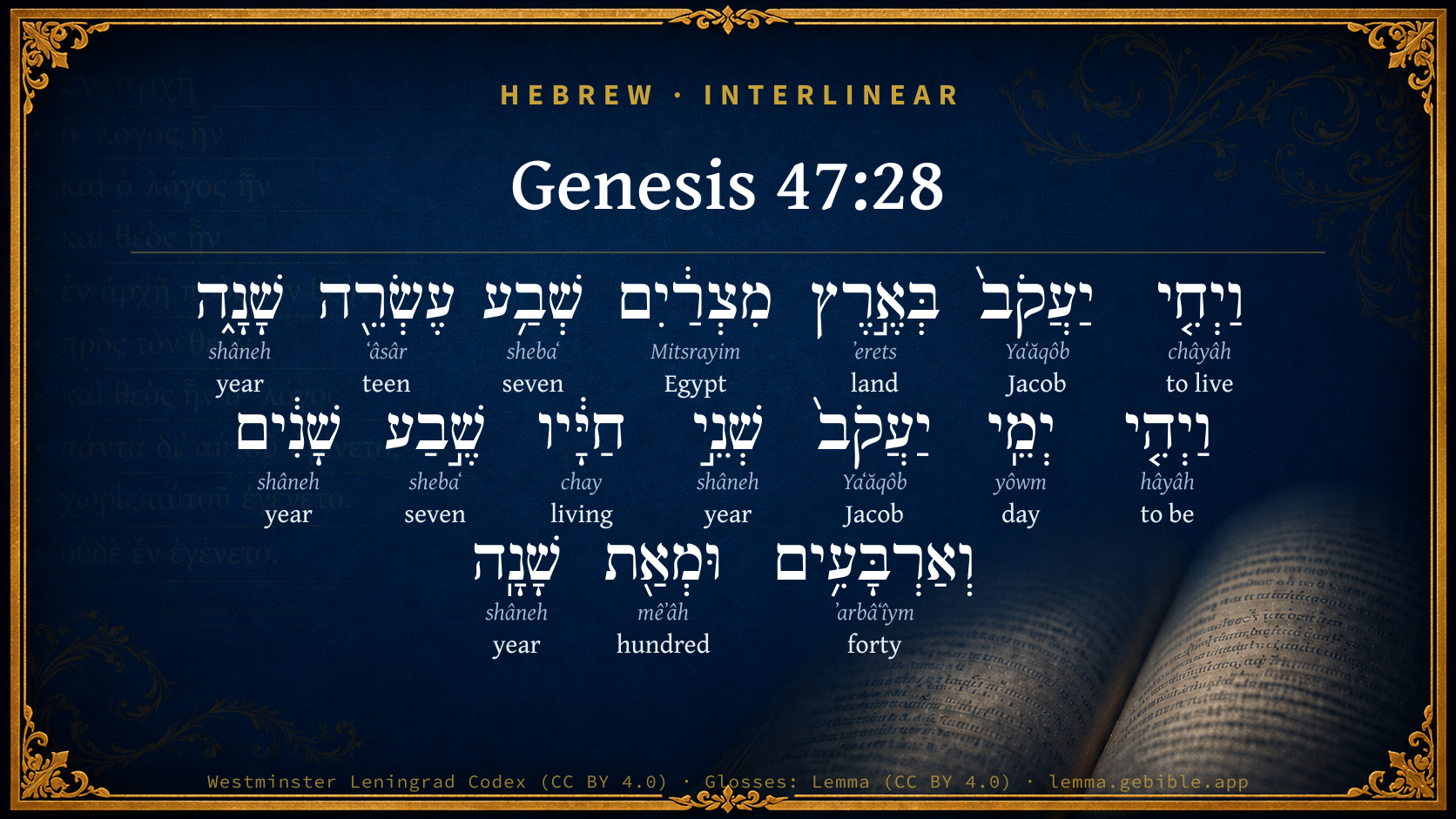
  1. וַיְחִ֤י châyâh H2421 “and · to live” Conjunction + Verb, Qal, Sequential Imperfect, 3rd Person, Masculine, Singular
  2. יַעֲקֹב֙ Yaʻăqôb H3290 “Jacob” Noun, Proper
  3. בְּאֶ֣רֶץ ʼerets H776 “in/at · land of” Preposition + Noun, Common, Both, Singular, Construct
  4. מִצְרַ֔יִם Mitsrayim H4714 “Egypt” Noun, Proper
  5. שְׁבַ֥ע shebaʻ H7651 “seven” Adjective, Cardinal number, Feminine, Singular, Absolute
  6. עֶשְׂרֵ֖ה ʻâsâr H6240 “teen” Adjective, Cardinal number, Feminine, Singular, Absolute
  7. שָׁנָ֑ה shâneh H8141 “year” Noun, Common, Feminine, Singular, Absolute
  8. וַיְהִ֤י hâyâh H1961 “and · to be” Conjunction + Verb, Qal, Sequential Imperfect, 3rd Person, Masculine, Singular
  9. יְמֵֽי yôwm H3117 “days of” Noun, Common, Masculine, Plural, Construct
  10. יַעֲקֹב֙ Yaʻăqôb H3290 “Jacob” Noun, Proper
  11. שְׁנֵ֣י shâneh H8141 “year” Adjective, Cardinal number, Masculine, Dual, Construct
  12. חַיָּ֔יו chay H2416 “living things · his” Noun, Common, Masculine, Plural, Construct + Suffix, Personal, 3rd Person, Masculine, Singular
  13. שֶׁ֣בַע shebaʻ H7651 “seven” Adjective, Cardinal number, Feminine, Singular, Absolute
  14. שָׁנִ֔ים shâneh H8141 “years” Noun, Common, Feminine, Plural, Absolute
  15. וּמְאַ֖ת mêʼâh H3967 “and · hundred” Conjunction + Adjective, Cardinal number, Both, Singular, Construct
  16. שָׁנָֽה shâneh H8141 “year” Noun, Common, Feminine, Singular, Absolute

About this verse

These counts appear in no published source. They are computed here, from the morphology-tagged text and Lemma’s own curated glosses. What Lemma adds →

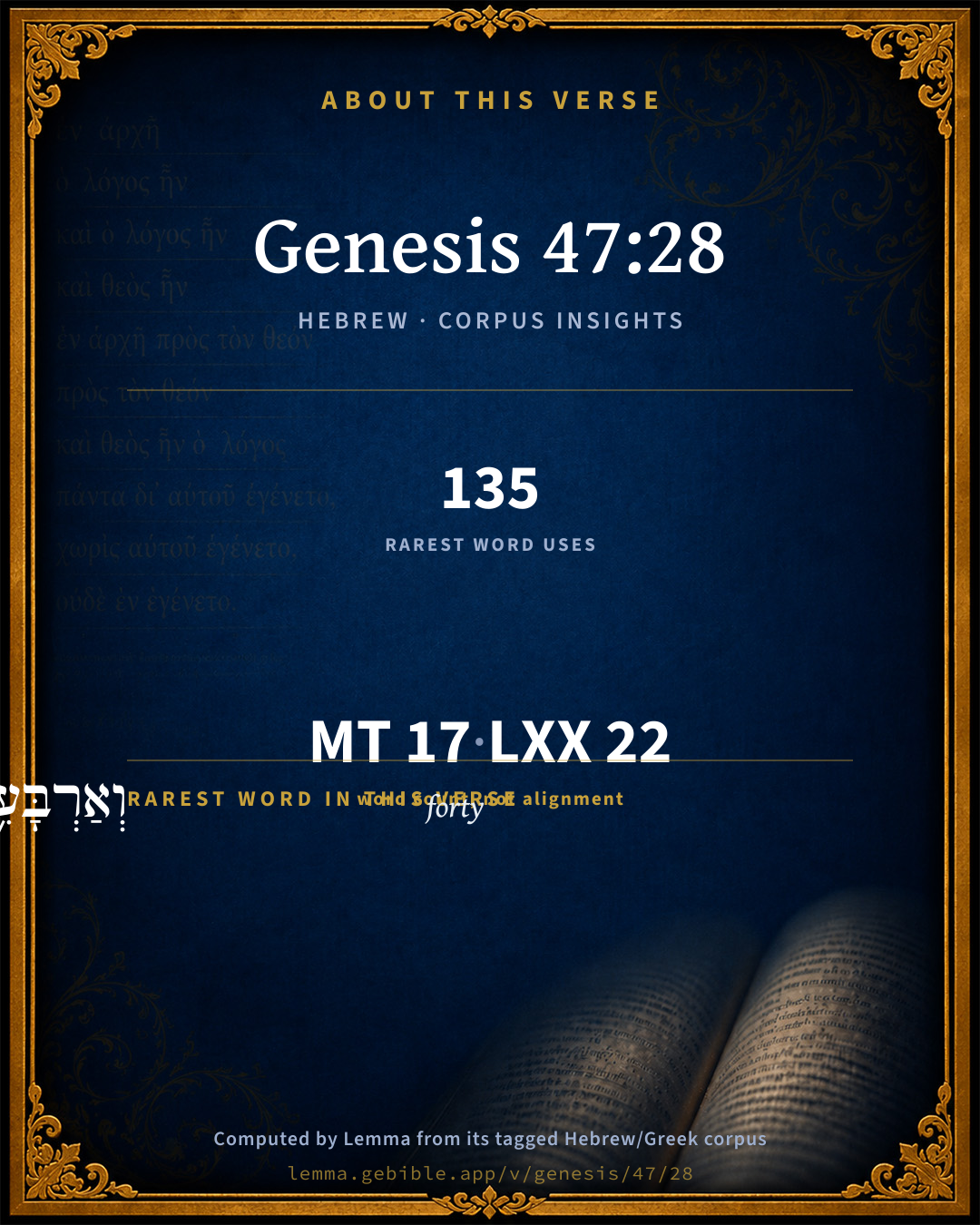
17
words
12
distinct lemmas
Pentateuch
section

Grammatical profile

  • 2 verbs
  • 9 nouns
  • 6 adjectives

Verb forms

  • וַיְחִ֤י Qal · Sequential Imperfect
  • וַיְהִ֤י Qal · Sequential Imperfect

Repetition

Words recur within this verse — often emphatic in Hebrew:

  • שָׁנָ֑ה year H8141 ×4
  • יַעֲקֹב֙ Jacob H3290 ×2
  • שְׁבַ֥ע seven H7651 ×2

Hebrew & Septuagint length

In English translation the verse runs 24 words from the Hebrew and 25 from the Septuagint (LXX English) — closely comparable.

A rough comparison of the two English renderings, which tokenize alike — not a word-level alignment.

Word counts can differ between the Hebrew and the Greek without any difference in meaning — e.g. the Hebrew direct-object marker אֵת has no separate Greek word, and Greek often adds the article ὁ.

In the original languages it is 17 Hebrew tokens and 22 Greek tokens — but the two are counted differently (Hebrew bundles its prefixes and suffixes into one token; the Greek is in lemma form), so that isn’t a like-for-like length.

Cross-references

5

Topical passages linked to Genesis 47:28 in the Treasury of Scripture Knowledge — connected by theme and wording, ordered by reader-vote popularity; previews shown in the World English Bible.

  • Psalms 90:10 The days of our years are seventy, Or even by reason of strength eighty years; Yet their pride is but labor and sorrow, For it passes quickly, and we fly away.
  • Genesis 37:2 This is the history of the generations of Jacob. Joseph, being seventeen years old, was feeding the flock with his brothers. He was a boy with the sons of Bilhah and Zilpah, his father's wives. Joseph brought an evil report of them to their father.
  • Genesis 47:8–9 Pharaoh said to Jacob, "How many are the days of the years of your life?"
  • Psalms 90:12 So teach us to number our days, That we may gain a heart of wisdom.
  • Psalms 119:84 How many are the days of your servant? When will you execute judgment on those who persecute me?

Cross-references courtesy of OpenBible.info (CC BY 4.0).

Hebrew and Greek witnesses Masoretic Hebrew ↔ Greek Septuagint

The same verse in the two great witnesses to the Old Testament, shown verse-for-verse.

These are two independent witnesses, not word-aligned to each other, and the Septuagint is shown in lemma (dictionary) form.

Hebrew Genesis 47:28 Masoretic · Westminster Leningrad Codex

וַיְחִ֤י יַעֲקֹב֙ בְּאֶ֣רֶץ מִצְרַ֔יִם שְׁבַ֥ע עֶשְׂרֵ֖ה שָׁנָ֑ה וַיְהִ֤י יְמֵֽי יַעֲקֹב֙ שְׁנֵ֣י חַיָּ֔יו שֶׁ֣בַע שָׁנִ֔ים וְאַרְבָּעִ֥ים וּמְאַ֖ת שָׁנָֽה

Jacob lived in the land of Egypt seventeen years. So the days of Jacob, the years of his life, were one hundred forty-seven years.

World English Bible · Public Domain

Greek LXX Genesis 47:28 Septuagint · lemma form

ἐπιζάω δέ ἰακώβ ἐν γῆ αἴγυπτος δέκα ἑπτά ἔτος γίγνομαι δέ ὁ ἡμέρα ἰακώβ ἐνιαυτός ὁ ζωή αὐτός ἑκατόν τεσσαράκοντα ἑπτά ἔτος

And Jacob survived seventeen years in the land of Egypt; and Jacob's days of the years of his life were one hundred and forty-seven years.

LXX2012 (modern English Septuagint) · Public Domain

On this verse, Keil & Delitzsch discusses the Septuagint’s reading. Read the note in Commentary ↓

Hebrew: Westminster Leningrad Codex (CC BY 4.0). Greek: Septuagint (public domain); English from LXX2012 (modern English Septuagint) (Public Domain). How the Septuagint differs from the Hebrew →

Targum (Aramaic paraphrase)

2

The Targum is the ancient Jewish Aramaic paraphrase of the Hebrew Scriptures — an interpretive translation, not the Hebrew text itself. Onkelos (literal) and Pseudo-Jonathan (expansive) render the Torah, and Jonathan the Prophets. Coverage is partial: where no permissively-licensed English translation exists for a verse, only the Aramaic is shown. This is verse-level text, not a word-by-word alignment to the Hebrew.

  1. Targum Onkelos Torah (Genesis–Deuteronomy)
    וַחֲיָא יַעֲקֹב בְּאַרְעָא דְמִצְרַיִם שְׁבַע עֶשְׂרֵי שְׁנִין וַהֲווֹ יוֹמֵי יַעֲקֹב שְׁנֵי חַיוֹהִי מְאָה וְאַרְבְּעִין וּשְׁבַע שְׁנִין

    (no public-domain English translation for this verse)

    Targum Onkelos — Aramaic: “Onkelos Genesis” (public domain); “Onkelos Exodus” (public domain); “Onkelos Leviticus” (public domain); “Onkelos Numbers” (public domain); “Onkelos Deuteronomy” (public domain). English: “Sefaria Community Translation” (CC0 1.0 (public-domain dedication)); “J.W. Etheridge. The Targums of Onkelos and Jonathan Ben Uzziel on the Pentateuch. London: Longmans, Green, 1862” (public domain). Text via Sefaria.

  2. Targum Pseudo-Jonathan Torah (Genesis–Deuteronomy)
    ויחי וַחֲיָא יַעֲקב בְּאַרְעָא דְמִצְרַיִם שֶׁבְסְרֵי שְׁנִין וַהֲווֹ יוֹמֵי יַעֲקב סְכוּם יוֹמֵי חֲיוֹי מְאָה וְאַרְבְּעִין וּשְׁבַע שְׁנִין

    And Jakob lived in the land of Mizraim seventeen years. And the sum of the days of Jakob, of the days of his life, was a hundred and forty and seven years.

    Targum Pseudo-Jonathan — Aramaic: “Targum Jonathan on Genesis” (public domain); “Targum Jonathan on Exodus” (public domain); “Targum Jonathan on Leviticus” (public domain); “Targum Jonathan on Numbers” (public domain); “Targum Jonathan on Deuteronomy” (public domain). English: “The Targum of Jonathan ben Uzziel, trans. J. W. Etheridge, London, 1862” (public domain). Text via Sefaria.

Commentary

Notes on Genesis 47:28 from classic Christian and Jewish commentators (each source and its license shown beneath its notes). The classic Christian expositions comment on the surrounding passage and are grouped to its opening verse, so a note may address several verses; the Jewish commentaries on the Tanakh (Rashi and others) are per-verse, so they appear only where the commentator wrote on this verse.

Lemma curates 59 commentaries, every one of them public domain or Creative Commons licensed, each selected and text-cleaned for this edition rather than reprinted as found. About our sources →

Trapp's Complete Commentary

John Trapp

Gen 47:28 And Jacob lived in the land of Egypt seventeen years: so the whole age of Jacob was an hundred forty and seven years.

Ver. 28. Jacob lived in the land of Egypt seventeen years.] So long he had nourished Joseph; and so long Joseph nourished him; paying his αντιθρεπτηρια to the utmost penny. These were the sweetest days that ever Jacob saw. God reserved his best to the last. "Mark the perfect man, and behold the upright, for," be his beginning and his middle never so troublesome, "the end of that man is peace." {Psa 37:37} A Goshen he shall have, either here or in heaven.

John Trapp, A Commentary or Exposition upon All the Books of the Old and New Testament (1647–1656) — public domain. Text from a community e-Sword module.

Joseph Benson's Commentary

Gen 47:28. Jacob lived seventeen years after he came into Egypt, far beyond his own expectation: seventeen years he had nourished Joseph, for so old he was when he was sold from him, and now, seventeen years Joseph nourished him. Observe how kindly Providence ordered Jacob’s affairs; that when he was old, and least able to bear care and fatigue, he had least occasion for it, being well provided for by his son without his own forecast.

Joseph Benson's Commentary on the Old and New Testaments (1811–1818) — public domain. Text from a community e-Sword module.

The Pulpit Commentary

CHAPTER 47:28-31

And Jacob lived in the land of Egypt seventeen years: so the whole age of Jacob was (literally, the days of Jacob, the years of his life, were) a hundred forty and seven years. He had lived seventy-seven years in Canaan, twenty years in Padanaram, thirty-three in Canaan again, and seventeen in Egypt, in all 147 years.

HOMILETICS.

Vers. 28-31.

Jacob"s residence in Egypt.

I JACOB"S PEACEFUL OLD AGE. "And Jacob lived in the land of Egypt seventeen years." After an eventful and checkered pilgrimage of 130 years, during which Jacob had made largo experience of the ills of life, having encountered adversity in forms both more numerous and severe than are allotted to most, he had at length reached a happy harbor of rest in the calm contemplative evening of old age, exchanging the anxieties and toils of his previously wandering condition for a home of ease and comfort in the fat land of Goshen, and bidding farewell to all his past tears and sorrows in the enjoyment of the tender care and rich love of Joseph, Rachel"s son. Verily, with this old weather-beaten traveler it had become light at eventide. It is noticeable that Jacob lived as long a time in Egypt as Joseph had spent in Jacob"s home in Canaan seventeen years thus receiving an ample recompense for the affection he had lavished on his son. Let parents be encouraged thereby to love and care for their children in the tender years of infancy and youth; and let children see in Joseph an example of the rich return which they should give their parents, cherishing amid the infirmities of age those who have watched over them, and loved them, and prayed for them with so much solicitude and affection.

II JACOB"S APPROACHING DISSOLUTION. "The time drew nigh that Israel must die." It was a time that Israel had now for some considerable period been anticipating. When he stood before Pharaoh he informed that august but benevolent monarch that he reckoned his earthly pilgrimage as good as closed. At least his words imply that he had no expectation of living to the ago of his revered ancestors. Consequently he was not surprised, though he perceived that death was rapidly gaining ground upon his feeble steps. Perfectly aware that it was appointed unto all men once to die, he had been piously, while reposing beneath the shadow of Joseph"s wing, reckoning up the number of his own days m particular, and had found that the allotted span was nearly passed. Nor does it appear that he was alarmed by the knowledge of that melancholy fact. The man who had fought with God and prevailed was not likely to be dismayed by the prospect of engaging with the king of terrors. He who had been so long in the enjoyment of Jehovah"s friendship and salvation would scarcely regard it as a hardship to be translated to Jehovah"s presence. Let the saints learn to number their days that so they may apply their hearts to heavenly wisdom; to live in habitual contemplation of the end, that they may not be afraid when death comes, and to cultivate that holy alliance with the God of salvation which will enable them to say, For we know that if our earthly house of this tabernacle were dissolved, we have a building of God, a house not made with hands, eternal in the heavens.

III JACOB"S DYING REQUEST. "Bury me not in Egypt; but I will lie with my fathers, and thou shalt carry me out of Egypt and bury me in their, burying place." This request was addressed to his son Joseph, whom he had hastily summoned to his side. It is not quite certain that at this moment Jacob was confined to bed, or that he was actually so near his decease as he imagined. The probability is that he survived for some little while longer, but that with the knowledge that his departure from the earth could not be long delayed, he desired to leave his last instructions for his funeral with his honored and beloved son. Accordingly, in a conversation, he explained that he was anxious that Joseph should convey his remains to the family vault at Hebron, and lay them beside the dust of Abraham and Isaac. It was a natural desire that the old man should seek to sleep among his kindred; but the wish had a higher origin than simply the instincts of nature. Canaan was the God-given inheritance of himself and his descendants; and though as yet a long interval must elapse before his children could enter on its possession, he would manifest his faith in the Divine promise by laying his bones in the sacred soil. It becomes God"s people to imitate the patriarch in still holding on to God"s sure word of promise, although the fulfillment should be long delayed, and in particular to remember that as with Jacob so with them, God"s best promises will be realized not on earth, but in the better country, even an heavenly.

IV JACOB"S DEEP ANXIETY. "And he said, Swear unto me." It might have been supposed that Joseph"s word of promise, "I will do as thou hast said," would be sufficient to allay the aged patriarch"s apprehensions, but it was not. Remembering the old form of oath which Abraham had employed in connection with Eliszer, he imposed it on his son, as if to bind him by the holiest obligations to fulfill his last request. Joseph, we may be sure, would have honored his aged parent"s wish without the additional ceremony of swearing; but inasmuch as it was not necessarily sinful, and it would tend to dispel his father"s fears, he consented to the proposal, "and he swore unto him." Jacob perhaps might have dispensed with the oath, and certainly Christians should be satisfied with a simple "yea" or "nay," remembering that whatsoever is more than these cometh of evil; but sons may learn from Joseph to bear with an aged parent"s infirmities and to humor his inclinations, when these are not sinful.

V JACOB"S SOLEMN WORSHIP. "And Jacob bowed himself upon the bed"s head," or "worshipped, leaning upon the top of his staff." But whatever was the exact position of the patriarch, his exercise was devotion. With reverent inclination of his aged head he poured out his soul in grateful adoration to his God, who had enabled him so successfully to arrange everything connected with his funeral that he had now nothing left to do but die. And in this too the patriarch might advantageously be followed by his spiritual children. Happy they who before being summoned to put off this tabernacle are able to say, "Father, I have finished the work thou gavest me to do!" It is a special mercy for which they may well give God thanks.

HOMILIES BY W. ROBERTS Vers. 28-31.

Jacob"s apprehension.

I WHAT IT WAS.

1. It was not anxiety about temporal support, for that had been generously made sure to him by his son Joseph.

2. It was not concern about the future fortunes of his family, for these had been graciously taken under God"s protection.

3. It was not uncertainty as to his own personal acceptance with Jehovah, for of that he had long ago been assured.

4. It was scarcely even fear of his approaching death, for besides being a thought with which Jacob had long been familiar, to a weary pilgrim like him the event itself would not be altogether unwelcome.

5. It was dread lest his lifeless body should be interred in Egypt, far from the graves of his ancestors in the holy land.

II WHENCE IT AROSE.

1. From the deeply-seated instinct in human nature, which makes men wish, if possible, to sleep beside their fathers and friends. Though religion teaches us to believe that every spot on earth is in a manner holy ground, yet it does not induce a spirit of indifference as to the last resting-place where we shall lie.

2. From a firm faith in the Divine promise that his descendants should yet return to Canaan. Even if Jacob did not anticipate that this would immediately occur, if, as is probable, he had already dark forebodings that the period of exile and servitude spoken of by Jehovah to Abraham was about to commence, he was yet able to detect a silver lining in the cloud, to see the happy time beyond, when his children, in accordance with the promise "I will surely bring thee up again," should return home to their presently abandoned inheritance.

III HOW IT WAS REMOVED.

1. By Joseph"s promise. Requested by his aged parent to convey his body back to Canaan, when the life had departed, Joseph solemnly, engages to carry out that parent s wishes to the letter. "I will do as thou hast said.

2. By Joseph"s oath. As if to remove every possible ground of apprehension, the old man further binds his son by an appeal to heaven. And he said, Swear unto me; and he (Joseph) sware unto him." The venerable patriarch"s anxieties were at an end. "And Israel bowed himself upon the bed"s head. W.

The Pulpit Commentary (1880–1919), ed. H.D.M. Spence-Jones & Joseph S. Exell — public domain. Text from a community e-Sword module.

F. W. Grant's Numerical Bible

Section 5. (Gen 47:28-31; Gen 48:1-22; Gen 49:1-27.)

The moral conclusion: the end as the way.

The fifth section, well-nigh the close of the whole book, is Deuteronomic in character, giving moral results. Here, Jacob again, rather than Joseph, is the central figure, his day brightening at the end to a serene sunset. He dies at a hundred and forty-seven years old,—a number not without meaning, we may believe, in its 7 X 7 X 3, the number of complete accomplishment intensified, with that of divine manifestation. With him, the single, simple, patriarchal life is ended, the first division of this primitive divine history is over.

In the first place, here we have the vow which Jacob exacts from Joseph—that he shall be buried in Canaan, in the sepulchre of his fathers. He thus links himself with them as waiting, even in death, for the promise to be fulfilled. Thus the promise is a promise of life which death cannot vanquish or undo.

Next, we have the blessing of Ephraim and Manasseh, in whom Joseph receives the double portion of the birthright, Reuben having lost it. (1Ch 5:1-2.) It shows how Joseph fulfills his name, which is, "adding," or "increase." This is, indeed, the beautiful lesson of his life. The law of spiritual increase we find in him, as indicated by the name of his son, "Ephraim." -"fruitfulness." But the way to fruitfulness is by "Manasseh" -"forgetfulness," as with the apostle, "Forgetting that which is behind, I press on." (Php 3:13-14.) Manasseh is the first-born, in fact; but as the end is greater than the means, so Ephraim is, in the mind of God, greater than Manasseh. Nature would often with us, as in Joseph here, resist so simple a conclusion. Manasseh before Ephraim is in truth the very principle of asceticism in all times.

In the third place, we have the blessing of the tribes as a whole, in which, from their characters as already shown, or their names as indicating character, their future is predicted. Thus the government of God shows itself throughout it.

In the enumeration, we have, first, the sons of Leah, then those of the bond-maids intermingled with one another, and then Rachel’s children. These are plainly three divisions.

Of Leah’s, the first-born is Reuben; but just as the might of nature which is fallen, he is necessarily deposed from his primacy: we have seen Joseph getting what Reuben loses here; the two are opposites. Reuben represents, not the flesh, -for God does not bless the flesh; but the dignity of nature, -of man as natural, now indeed fallen, but not necessarily fallen. And man’s nobility lies essentially in that intelligent will, which alone is "will," and without which he would be the mere machine worked by other hands, or the boat adrift without oar or rudder. Reuben -"see a son" -is thus man in that which makes him the "offspring of God," His image, -not merely a cause, but a causer. Sin has come in, alas! and his will has become self-will -an independent energy with "vanity" stamped on it; a "bubbling over," as the word "unstable," said here of Reuben, really means, which scruples not to shame and defile the man himself, the source of it. Thus the will in man has lost its dignity, and become his degradation; and that which is his glory as man lowers him beneath the beast. For indeed his pre-eminence is necessarily connected with this power for self-debasement, which the beast has not.

But one may ask, Where is the blessing of Reuben in all this? for it is said of all, "Every one he blessed according to his own blessing," -that is, according to what would be blessing in each case. For Reuben, it must be found, then, in this very deprivation of his. When the will accepts its humiliation, -when we say, but from a different cause from that which made the Lord say it, "Not my will, but Thine"! then is it blessed, and its glory returns to it.

Dispensationally for Israel, Reuben represents the time of its energetic youth, when upon the ground of the first covenant, -that is, of its own responsibility, when its corruption deposed it from the primacy among the nations with which God had endowed it, and the birthright passed to Him who alone is able to support it; here the blessing could only be attained in their humiliation.

Violence necessarily follows corruption, as Simeon and Levi follow Reuben. They are united together, as brethren well agreed in character, and actually united upon that terrible occasion of which Jacob here so energetically speaks. Notice how the thought of agreement -confederacy -runs through what is said, and how the doom upon them, which, as in Reuben’s case, works for blessing, is to be disunited, "divided," "scattered." To be brought into loneliness, individuality, weakness, would be the reproof and the remedy for that "strength" which comes of "union," and which so constantly manifests itself in deeds of violence. Conscience is individual, and brings in God. The weakness of individuality makes Him our necessary resource. But thus all the highest character of manhood is developed by it. Confederacy annuls the individual conscience, begins in craft, and develops into tyranny as power is acquired. The doom is here the remedy, and is to bring Simeon and Levi back to the true meaning of their names: Simeon -"hearing," to find the answer which God gives to human prayer; and Levi -"joined," to own the ties only which have divine origin and sanction.

Here, then, relationship to others is the question, as in Reuben, what man is in himself. In the divine life both must be met; and one’s associations come only next in importance to the fundamental one, Who is my Master? Indeed, the first question truly answered answers all; but because we answer it so little truly, God would search us out with one upon another, till He has shown us all.

Dispensationally, we find here, as it would seem, the history of Israel during the times of the Judges, and until David. Coalitions and divisions, strife and violence, fill up this period: there is no king, and no real turning to God.

The blessing of Judah comes in the third place. "Judah," as we know, means "praise," Leah saying, when she bore him, "Now will I praise the Lord." It is striking to see in the history of the people of which these blessings give us the general outline, how, when Judah came to power with David, the worship of Jehovah revived. The ark in the days of Saul the Benjamite had never been inquired at. (1Ch 13:3.) David brought it to Jerusalem with rejoicing, and Solomon built the house in which it was enshrined. When the great schism came, and the ten tribes went after the golden calves, Judah remained thus far faithful. David was himself Israel’s sweet psalmist, and has given to the saints of every generation since songs of praise that never grow old. Thus Judah’s name has vindicated its prophetic character, and the rise of the tribe to power is connected with a real revival of spiritual power, which in Israel ever was the basis of political revival. Judah, therefore, was not to lose the sceptre until Shiloh came (the "Man of peace") -Christ springing out of Judah, and to Him would the obedience of the people be. This carries us plainly through the whole of the Old-Testament history, and into the New, while then, (strange as it might seem,) Judah’s sceptre, it is implied, would pass away, just when the coming of Christ would seem to make it permanent. We know well the reason, and see once more how prophecy justifies itself. Messiah comes to His own, and is rejected and cut off.

In its individual application, we find the spirit of praise as that of power -necessarily, because God is exalted in it. It is what the fiftieth psalm challenges on His part from His people: "Offer unto God thanksgiving, and pay thy vows unto the Most High; . . . . whoso offereth praise glorifieth Me." It is this that marks the life which comes from God, that it turns back to God again; and the joy of the Lord is ever its principle of strength. A simple lesson, but, oh, that it were learnt! The "wine" so abundant in the portion of Judah is the sign of a joy in which there can be no excess; and the "milk" may show that here there is not merely stimulus, but nourishment as well, and that in a form in which the merest babe may find it.

In the fourth place, we come to Zebulon; and again his name is plainly referred to. It is a "dwelling with," in intimacy, as Leah’s use of it shows; but Jacob here uses another word, which has, in this place, evidently a bad significance. Its primary meaning is, "to lay one’s self down," and Zebulon does this at the haven of the sea -the haven for ships, and his border is toward Zidon. While the idea of prosperity, or at least the industrious seeking of it, is plain, yet for Israel, we must remember, this commerce with the idolatrous nations was not a good sign, nor in result good, and her border reaching out toward Zidon prophesies dangerous obliteration of what divided Israel from the nations. Coming in the place in which it does also, there is a clear intimation of how the people, having turned from their God-sent Deliverer, would turn to the world.

What is the blessing here for Zebulon? and what is the principle which underlies it, similar to what we have found in the former blessings? Openly, God does not come in at all, either to bless or judge, except it be in this, that his portion comes to him from Him in that which it is evident he chooses. And is not this often for us judgment and blessing in one, when God apportions us the very thing we desire, that we may taste the bitterness of our own ways, and learn, in result, the happiness of His? It is not the best way of learning; but yet it is not seldom the only way in which we can learn, and God means at any rate to teach us. What these nations would be -have been -for Israel, we shall learn in Issachar.

In Issachar, we find Israel content to be the drudge of the Gentiles; one who would not endure God’s yoke tamely accepting that of men. Here, too, the name is dwelt upon: "there is reward;" ease and gain are alone what is sought. How true to the character of unbelieving Israel! And these are the governmental ways of God, who, unknown by them, yet ordains their circumstances; and this is more plainly from Him, and for good, than in the case we were last considering.

This ends the tale of Leah’s sons, who give us, as it appears to me, the history of Israel according to the flesh until the present time of God’s seeming forgetfulness is ended, the Church removed to heaven, and the "end of the (Jewish) age," God’s determined time upon them, in which He brings them back to Himself, begins. The children of the bond-maids represent this, for it is in the time of their lowest degradation that He brings in salvation for them. In the first place here we have Dan; and Dan judges his people as one of the tribes of Israel. This is the prophecy of the restoration of the people to self-government, -Dan as well as the rest, though the least of them all. The rise from Issachar’s burdened condition is very evident. Yet it is just at this time that their worst trouble and their deepest fall are found. Hence the mingled character of the abrupt address. For it is when the Jews, restored, though in unbelief, by Gentile aid, have once more become a nation, at least partially independent, that the last antichrist, claiming to be their Messiah will appear amongst them (long since, from this very prophecy, connected with the tribe of Dan). He will be the "lawless one" of 2Th 2:1-17, and the willful king of Dan 11:1-45. He will be "a serpent in the way, an adder in the path, that biteth the horse-heels, so that the rider falleth backward." Here, satanic character is apparent, and the cry bursts from Jacob -prophetically, the cry of the remnant of grace in those darkest hours before the dawn, -"I have waited for Thy salvation, O Lord." Thus cast upon Him, now the road is upward.

2. Or, "Gad, a troop shall rush upon him, but he shall rush upon the heel." Conflict, with final victory, is depicted here: the assaulting foes are routed and pursued.

3. Quiet possession of the land, and abundance, follow with Asher, the "happy one." And —

4. Naphtali is free as the hind, the female deer, no longer a warrior, with nothing to dread; and giving goodly words: for Israel’s tongue will at last be loosed also, and she shall give forth words of joy and praise and sweetness such as she has never done.

Thus God has come in, and salvation is attained; but we have yet Rachel’s children, as a third series, and we are in no doubt as to the significance of these. Joseph, the One separated from His brethren, and Benjamin, the Son of the right hand: both these we know, -the Christ they knew not, now their joy and boast, and the Christ they clung to, but whose dependence upon the rejected One they knew not. Now they are together, the double witness of a double salvation.

1. Joseph whom they despised is, however, the main figure here, whose fruit, maintained for us by the living power of the Spirit, has run over the Jewish wall; and will run over, that the Gentiles also may rejoice in Him; galled, shot at, hated by the archers, yet His bow abides in strength, and the arms of His hands are made strong by the hands of Jacob’s Mighty One, the God of grace. Resurrection has confirmed in this way His power, and as the Risen One He becomes the Shepherd of Israel, the Stone made the head of the corner. Fullness of all blessings are on the head of Him who was separated from His brethren. What a testimony for the Jew today!

2. Benjamin ravens as a wolf, but the notice is slight as compared with that of Joseph. The Messiah believed in by Israel is but little indeed beside the greater and more glorious figure. Still, Christ will fulfill both types; and judgment also be His needed though "strange work."

F. W. Grant, The Numerical Bible (4th ed., 1903) — public domain. Text from a community e-Sword module.

John Calvin's Commentaries

28. And Jacob lived. It was no common source of temptation to the holy old man, to be an exile from the land of Canaan, for so many years. Be it so, that on account of the famine, he was compelled to go to Egypt; why could he not return when the fifth year was passed? For he did not stupidly lie there in a state of torpor, but he remained quiet, because free egress was not allowed him. Wherefore, also, in this respect, God did not lightly exercise his patience. For, however sweet might be the delights of Egypt, yet he was more than miserable to be deprived of the sight of that land which was the lively figure of his celestial country. With the men of this world, indeed, earthly advantage would have prevailed: but such was the piety of the holy man, that the profit of the flesh weighed nothing against the loss of spiritual good. But he was more deeply wounded, when he saw his death approaching: because, not only was he himself deprived of the inheritance promised to him, but he was leaving his sons, of doubtful, or at least of feeble, faith, buried in Egypt as in a sepulcher. Moreover, his example is proposed to us, that our minds may not languish or become enfeebled by the weariness of a protracted warfare: yea, the more Satan attempts to depress them to the earth, the more fervently let them look and soar towards heaven.

John Calvin's Commentaries (1540-1563) — public domain. Text from the Calvin Translation Society English edition (1840s-50s) via the Christian Classics Ethereal Library (ccel.org). Calvin's coverage is partial (roughly two-thirds of the Bible); uncommented books and verses are honest gaps, never fabricated. The 19th-century editor's footnotes and remarks are omitted so the notes are faithfully Calvin's own voice.

The Cambridge Bible for Schools and Colleges

gen. ed. J. J. S. Perowne

28. seventeen years] This verse, giving the years of Jacob’s life, comes from P: see Gen_47:9. Note that 147 = 7 × 7 × 3, sacred numbers.

The Cambridge Bible for Schools and Colleges (gen. ed. J. J. S. Perowne; Cambridge University Press, 1878–1918) — public domain. Text from a community e-Sword module.

John Gill's Exposition

And the time drew nigh that Israel must die,.... As all men must, by the appointment of God, even good men, the Israel of God; though they shall not die a spiritual death, nor an eternal one, yet a corporeal one, which is for their good, and is a blessing to them; the sting being removed, and so not a penal evil, which is owing to Christ's dying for them, who has abolished death as such; and there is a time fixed for their death, beyond which they must not live, and before which they must not die, but when the time comes there is no avoiding it; the time of Jacob's death was drawing on, as he perceived by the great decline of his natural strength, and perhaps by a divine impulse on his mind:

and he called his son Joseph; sent for him, by a messenger, to come to him:

and said unto him; when he was come:

if now I have found grace in thy sight; which is not spoken in a way of submission, as from an inferior to a superior, as the phrase is sometimes used; or as signifying what would be esteemed as a favour should it be granted, but it is as if he should say, if thou hast any filial affection for me as a parent, and art willing to show love and respect to me, do as follows:

put, I pray thee, thy hand under my thigh: a gesture in swearing, as Jarchi observes, Gen 24:2; adding, for explanation's sake:

and deal kindly and truly with me; "kindly", by promising and swearing to do what he after desires; and "truly", by observing his oath, and fulfilling his promise:

bury me not, I pray thee, in Egypt; not choosing to lie among idolaters at death, with whom he cared not to have any fellowship in life.

John Gill's Exposition of the Whole Bible (1746–1763) — public domain (CC PDM 1.0). Text via the HelloAO Bible API.

Whedon's Commentary on the Bible

Daniel D. Whedon

JACOB’S DESIRE TO BE BURIED WITH HIS FATHERS, Gen_47:27-31.

28. Seventeen years — He survived the famine, and lived twelve years thereafter to see the result of the wise administration of Joseph. Yet the spiritually minded patriarch sees something better for his posterity than the land of Egypt.

Daniel D. Whedon (gen. ed.), Commentary on the Old and New Testaments (1874–1909) — public domain. Text from a community e-Sword module.

John Wesley's Explanatory Notes

Jacob lived seventeen years after he came into Egypt, far beyond his own expectation: seventeen years he had nourished Joseph, for so old he was when he was sold from him, and now, seventeen years Joseph nourished him. Observe how kindly Providence ordered Jacob's affairs; that when he was old, and least able to bear care and fatigue, he had least occasion for it, being well provided for by his son without his own forecast.

John Wesley, Explanatory Notes Upon the Whole Bible (1754–1765) — public domain. Text via the GEBible commentary corpus.

Keil & Delitzsch

C. F. Keil & F. Delitzsch

Jacob lived in Egypt for 17 years. He then sent for Joseph, as he felt that his death was approaching; and having requested him, as a mark of love and faithfulness, not to bury him in Egypt, but near his fathers in Canaan, he made him assure him on oath (by putting his hand under his hip, vid., p. 164) that his wishes should be fulfilled. When Joseph had taken this oath, "Israel bowed (in worship) upon the bed's head." He had talked with Joseph while sitting upon the bed; and when Joseph had promised to fulfil his wish, he turned towards the head of the bed, so as to lie with his face upon the bed, and thus worshipped God, thanking Him for granting his wish, which sprang from living faith in the promises of God; just as David also worshipped upon his bed (Kg1 1:47-48). The Vulgate rendering is correct: adoravit Deum conversus ad lectuli caput. That of the lxx, on the contrary, is προσεκύνησεν Ἰσραὴλ ἐπὶ τὸ ἄδρον τῆς ῥάβδου αὐτοῦ (i.e., המּטּה); and the Syriac and Itala have the same (cf. Heb 11:21). But no fitting sense can be obtained from this rendering, unless we think of the staff with which Jacob had gone through life, and, taking αὐτου therefore in the sense of αὑτοῦ, assume that Jacob made use of the staff to enable him to sit upright in bed, and so prayed, bent upon or over it, though even then the expression המטה ראשׁ remains a strange one; so that unquestionably this rendering arose from a false reading of המטה, and is not proved to be correct by the quotation in Heb 11:21. "Adduxit enim lxx Interpr. versionem Apostolus, quod ea tum usitata esset, non quod lectionem illam praeferendam judicaret (Calovii Bibl. illustr. ad h. l.).

Keil & Delitzsch — Biblical Commentary on the Old Testament (1861–1891) — public domain (CC PDM 1.0). Text via the HelloAO Bible API. (Old Testament only.)

Scofield Reference Notes

C. I. Scofield

whole age Or, days of the years of his life.

The Scofield Reference Bible (1917 edition), notes by C. I. Scofield — public domain. Text from a community e-Sword module.

Rashi

Rabbi Shlomo Yitzchaki (Rashi)

ויחי יעקב AND JACOB LIVED — Why is this section (Sidra) totally closed? Because, comprising as it does an account of the death of Jacob, as soon as our father Jacob departed this life the hearts and eyes of Israel were closed (their eyes became dim and their hearts troubled) because of the misery of the bondage which they then began to impose upon them. Another reason is: because he (Jacob) wished to reveal to his sons the date of the End of Days (i.e. when Israel’s exile would finally end; cf. Rashi on Genesis 49:1), but the vision was closed (concealed) from him (Genesis Rabbah 96:1).

Rashi on the Tanakh — English translations: “The Judaica Press complete Tanach with Rashi, translated by A. J. Rosenberg” (CC BY 4.0); “Pentateuch with Rashi's commentary by M. Rosenbaum and A.M. Silbermann, 1929-1934” (public domain); “The Metsudah Tanach series, Lakewood, N.J” (CC BY 4.0); and “The Book of Joshua, Metsudah Publications, 1997” (CC BY 4.0). Text via Sefaria.

Ramban (Nachmanides)

Rabbi Moshe ben Nachman (Ramban / Nachmanides)

AND JACOB LIVED IN THE LAND OF EGYPT SEVENTEEN YEARS. I have already mentioned that Jacob’s descent into Egypt alludes to our present exile at the hand of the “fourth beast,”. which represents Rome. [There are many parallels,] for it was Jacob’s sons themselves who, by the sale of their brother Joseph, caused their going down there. Jacob, moreover, went there on account of the famine, thinking to find relief with his son in the house of his son’s friend, for Pharaoh loved Joseph and considered him as a son. It was their hope to ascend from there as soon as the famine would cease in the land of Canaan, just as they said, To sojourn in the land we have come, for thy servants have no pasture for their flocks, for the famine is heavy in the land of Canaan. But then they did not come up, but instead the exile prolonged itself upon Jacob and he died there, and his bones ascended from there accompanied by all the elders and courtiers of Pharaoh, who instituted severe lamentation for him. Our relationship with our brothers Rome and Edom is similar. We ourselves have caused our falling into their clutches, as they made a covenant with the Romans, and Agrippa, the last king during the Second Temple, fled to them for help. It was due to famine that Jerusalem was captured by the Romans, and the exile has exceedingly prolonged itself over us, with its end, unlike the other exiles, being unknown. We are in it as the dead, who say, “Our bones are dried up, we are completely cut off.” But in the end they will bring us from all the nations as an offering to the Eternal, and they will be in deep sorrow as they will behold our glory, and we will see the vengeance of the Eternal. May He raise us, that we may live in His presence.

Ramban (Nachmanides) on the Tanakh — English translation: “Commentary on the Torah by Ramban (Nachmanides). Translated and annotated by Charles B. Chavel. New York, Shilo Pub. House, 1971-1976” (CC BY 4.0). Text via Sefaria.

Radak

Rabbi David Kimhi (Radak)

ויחי יעקב בארץ מצרים שבע עשרה שנה, the commentators point out that just as Joseph was under the protection of his father for the first 17 years of his life, so his father was under Joseph’s protection for the last 17 tears of his life.

Radak on the Tanakh — English translations: “Sefaria Community Translation” (CC0 1.0 (public-domain dedication)); “Eliyahu Munk, HaChut Hameshulash” (CC BY 4.0); “Rabbi Mike Feuer, Jerusalem Anthology” (CC BY 4.0); and “R. David Kimhi on the first book of Psalms, Translated by R.G. Finch, London, 1919” (public domain). Text via Sefaria.

Lesson kit

Teaching starters — assembled from the data on this page, not authored interpretation. Every prompt links to the verse data it draws on. Edit before teaching.

Genesis, in the Pentateuch, opens this verse with 17 words (12 distinct Hebrew lemmas). Its most distinctive word is ʼarbâʻîym (“forty”). A historical commentator’s framing appears above. Read the whole chapter for the surrounding context.

Discussion questions

  1. How does “forty” (ʼarbâʻîym) shape what this verse is saying?
  2. How does Psalms 90:10, which shares this passage’s theme, read alongside this verse?
  3. What does the repetition of “year” (4× in this one verse) do in this verse?
  4. These translations render this verse differently. What is at stake in choosing one wording over another?
  5. «וַיְחִ֤י» is a Qal Sequential Imperfect verb. How does that grammatical form shape the action described?
  6. Compare how Trapp's Complete Commentary and Joseph Benson's Commentary read this verse. Where do they agree or differ?

Things to notice

Reading settings

Reading text

Shown beneath each verse's original-language words.

Old Testament
Old Testament edition

Read the OT as the Masoretic Hebrew (MT) or the Greek Septuagint (LXX).

English shown for the Greek Septuagint (in the Hebrew ↔ Greek comparison).

Comparing translations? Open the Compare panel on any verse page to stack up to four side by side.