
Ezekiel 39:14

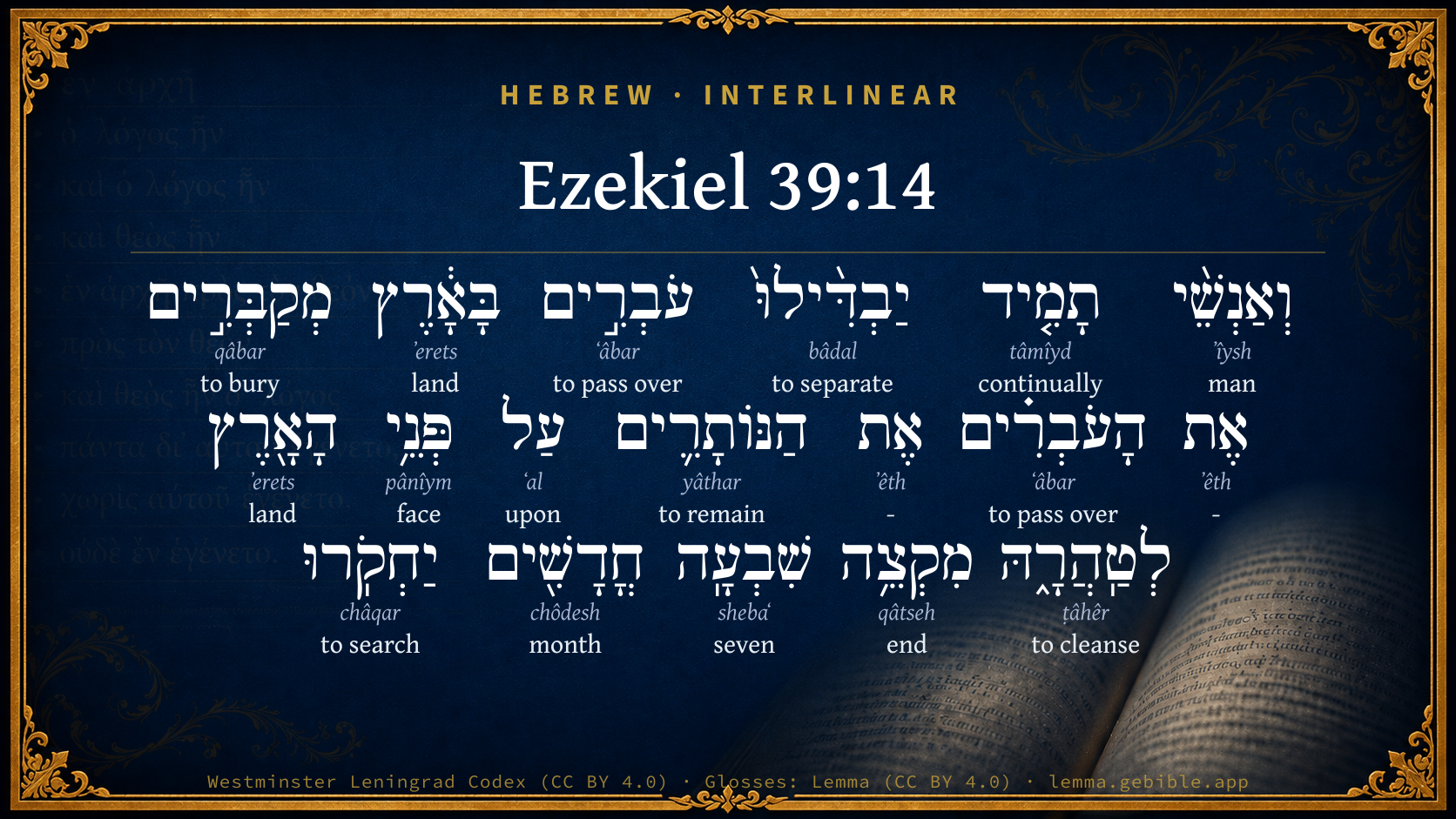
Hebrew (Westminster Leningrad Codex) Ezekiel 39:14 appears in the Hebrew Old Testament. The text above is from the Westminster Leningrad Codex. Each word links to its Strong’s number, a concise gloss, and parsing drawn from the Open Scriptures Hebrew Bible morphology. Click any word for its full Brown-Driver-Briggs (BDB) entry.
Download image
Cite this verse

Ezekiel 39:14 (World English Bible). Public Domain. Lemma interlinear Bible study tool, https://lemma.gebible.app/v/ezekiel/39/14.

Show BibTeX & RIS
BibTeX
RIS
English Translation
They shall set apart men of continual employment, who shall pass through the land, and, with those who pass through, those who bury those who remain on the surface of the land, to cleanse it: after the end of seven months shall they search.
World English Bible · Public Domain
Download a study sheet

One document with this verse’s original text, its word-by-word gloss line, the meaning frame, cross-references with their text, attributed commentary, and full source and license credits — printable, and it pastes into notes with its structure intact.

This verse Autodidact and up

Study sheet (.html) Plain text (.txt)

A passage Seminary Student

Up to 50 verses in one chapter. A passage sheet keeps up to 6 commentary sources and 12 cross-references per verse, in the order this page ranks them, and says so on the sheet whenever that leaves anything out. Ask for a single verse and you get the Autodidact verse sheet above.

Everything on this page stays free to read, with no account — the sheet is a download of what is already on screen, not access to it.

Want to remove ads? Support Godless Engineer
Compare translations 3

The same verse in 3 English versions, stacked beneath the original-language interlinear above. Click any original word for its lexicon entry.

Each is an independent rendering of the whole verse — the interlinear is not word-aligned to these translations.

Highlighted words mark where these versions differ — a whole-verse word diff, not a word-by-word alignment.

  • World English Bible Public Domain
    They shall set apart men of continual employment, who shall pass through the land, and, with those who pass through, those who bury those who remain on the surface of the land, to cleanse it: after the end of seven months shall they search.
  • King James Version Public Domain
    And they shall sever out men of continual employment, passing through the land to bury with the passengers those that remain upon the face of the earth, to cleanse it: after the end of seven months shall they search.
  • unfoldingWord Literal Text CC BY-SA 4.0
    Then they will designate men to continually go through the land, to find those who were traveling through, but who died and their bodies remained on the surface of the land, so that they may bury them, in order to cleanse the land. At the end of the seventh month they will begin their search.

unfoldingWord Literal Text — © unfoldingWord, licensed CC BY-SA 4.0. Word-aligned USFM3 via Door43 (git.door43.org/unfoldingWord/en_ult).

Versions to compare (up to 4)

3 of 4 selected

Show all 18 translations

Every available English version of this verse, each an independent rendering of the whole verse.

  • World English Bible Public Domain
    They shall set apart men of continual employment, who shall pass through the land, and, with those who pass through, those who bury those who remain on the surface of the land, to cleanse it: after the end of seven months shall they search.
  • Berean Standard Bible Public Domain
    And men will be employed to continually pass through the land to cleanse it by burying the invaders who remain on the ground. At the end of the seven months they will begin their search.
  • Majority Standard Bible Public Domain
    And men will be employed to continually pass through the land to cleanse it by burying the invaders who remain on the ground. At the end of the seven months they will begin their search.
  • King James Version Public Domain
    And they shall sever out men of continual employment, passing through the land to bury with the passengers those that remain upon the face of the earth, to cleanse it: after the end of seven months shall they search.
  • American Standard Version (1901) Public Domain
    And they shall set apart men of continual employment, that shall pass through the land, and, with them that pass through, those that bury them that remain upon the face of the land, to cleanse it: after the end of seven months shall they search.
  • Revised Version (1885) Public Domain
    And they shall sever out men of continual employment, that shall pass through the land to bury them that pass through, that remain upon the face of the land, to cleanse it: after the end of seven months shall they search.
  • Geneva Bible (1599) Public Domain
    And they shall chuse out men to goe continually through the lande with them that trauaile, to bury those that remaine vpon ye ground, and clense it: they shall search to the ende of seuen moneths.
  • Douay-Rheims (1899) Public Domain
    And they shall appoint men to go continually about the land, to bury and to seek out them that were remaining upon the face of the earth, that they may cleanse it: and after seven months they shall begin to seek.
  • Young's Literal Translation Public Domain
    And men for continual employment they separate, passing on through the land, burying with those passing by those who are left on the face of the earth, to cleanse it: at the end of seven months they search.
  • Literal Standard Version CC BY-SA 4.0
    And they separate men for continual employment, with those passing through, passing on through the land, burying those who are left on the face of the earth, to cleanse it. At the end of seven months they search.
  • Unlocked Literal Bible CC BY-SA 4.0
    Then they will designate men to continually go through the land, to find those who were traveling through, but who died and their bodies remained on the surface of the land, so that they may bury them, in order to cleanse the land. At the end of the seventh month they will begin their search.
  • unfoldingWord Literal Text CC BY-SA 4.0
    Then they will designate men to continually go through the land, to find those who were traveling through, but who died and their bodies remained on the surface of the land, so that they may bury them, in order to cleanse the land. At the end of the seventh month they will begin their search.
  • Darby Bible Public Domain
    And they shall sever out men of continual employment to go through the land, who, with the passers-by, shall bury those that remain upon the face of the land, to cleanse it: at the end of seven months shall they make a search.
  • World Messianic Bible Public Domain
    “‘“They will set apart men of continual employment who will pass through the land. Those who pass through will go with those who bury those who remain on the surface of the land, to cleanse it. After the end of seven months they will search.
  • Webster's Bible Public Domain
    And they shall sever out men of continual employment, passing through the land to bury with the passengers those that remain upon the face of the earth, to cleanse it: after the end of seven months shall they search.
  • Free Bible Version CC BY-SA 4.0
    Men will be chosen to go repeatedly through the country to make it clean it by burying the bodies of the invaders that are still left lying the ground. They will start doing this at the end of the seven months.
  • Bible in Basic English Public Domain
    And they will put on one side men to do no other work but to go through the land and put in the earth the rest of those who are still on the face of the land, to make it clean: after seven months are ended they are to make a search.
  • JPS Tanakh (1917) Public Domain
    And they shall set apart men of continual employment, that shall pass through the land to bury with them that pass through those that remain upon the face of the land, to cleanse it; after the end of seven months shall they search.

Literal Standard Version (2020), Covenant Press — licensed CC BY-SA 4.0. Text via the HelloAO Bible API (eBible.org). Unlocked Literal Bible (unfoldingWord) — licensed CC BY-SA 4.0. Text via the HelloAO Bible API (eBible.org). unfoldingWord Literal Text — © unfoldingWord, licensed CC BY-SA 4.0. Word-aligned USFM3 via Door43 (git.door43.org/unfoldingWord/en_ult). Free Bible Version, Dr. Jonathan Gallagher — licensed CC BY-SA 4.0. Text via the HelloAO Bible API (eBible.org).

Word by word

More ways to search: Search by grammar → Find every occurrence → Compare this word →

Practice this passage: Drill this verse → Learn its vocabulary →

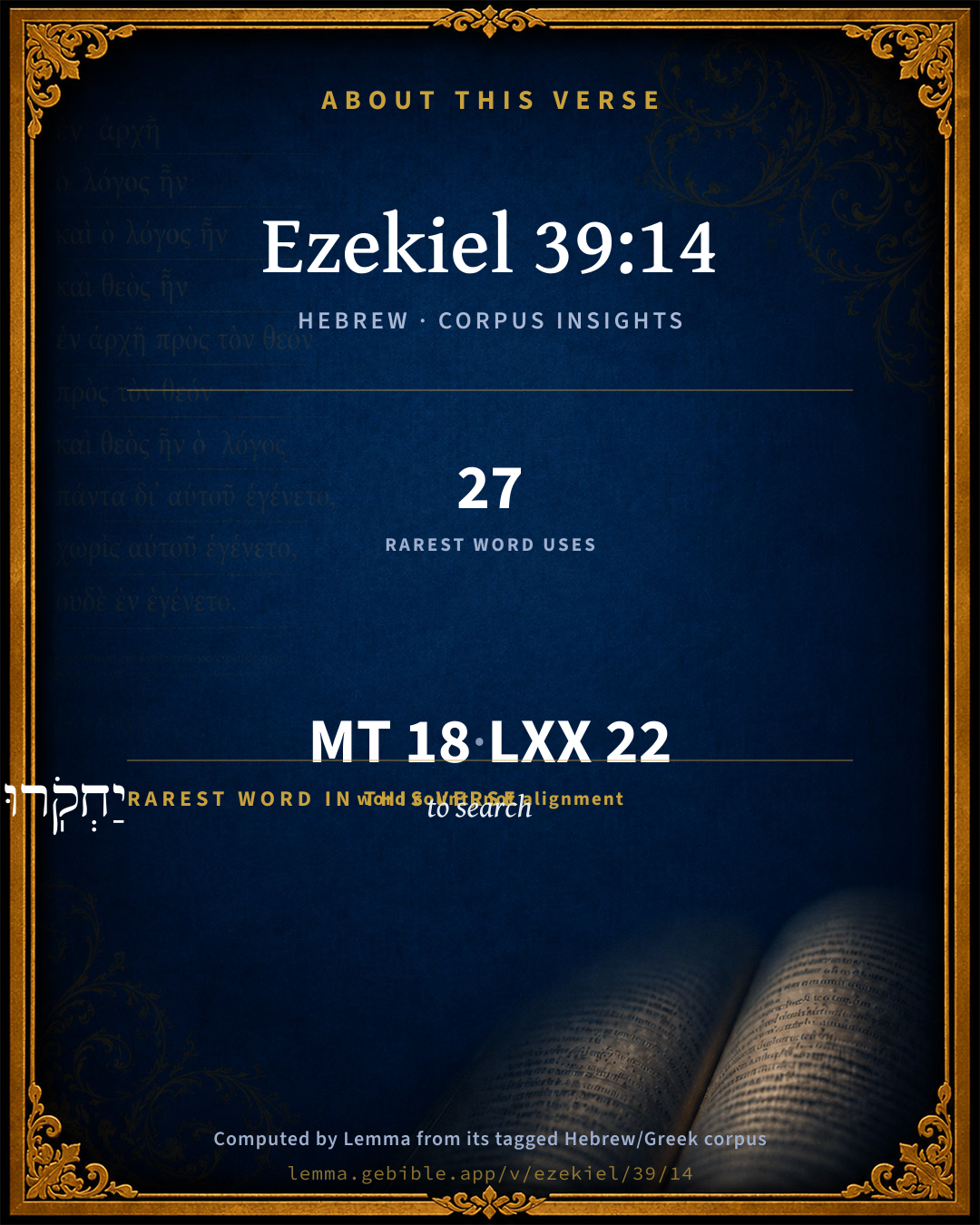
יַחְקֹֽרוּ
châqar
H2713
“to search”
Verb, Qal, Imperfect, 3rd Person, Masculine, Plural
Part of Speech
Verb
Stem
Qal
Form
Imperfect
Person
3rd Person
Gender
Masculine
Number
Plural
Full BDB Definition

Origin: a primitive root

TWOT: 729

to search, search for, search out, examine, investigate - (Qal) - to search (for) - to search through, explore - to examine thoroughly - (Niphal) - to be searched out, be found out, be ascertained, be examined - (Piel) to search out, seek out
  1. וְאַנְשֵׁ֨י ʼîysh H376 “and · men of” Conjunction + Noun, Common, Masculine, Plural, Construct
  2. תָמִ֤יד tâmîyd H8548 “continually” Noun, Common, Masculine, Singular, Absolute
  3. יַבְדִּ֨ילוּ֙ bâdal H914 “to separate” Verb, Hiphil, Imperfect, 3rd Person, Masculine, Plural
  4. עֹבְרִ֣ים ʻâbar H5674 “passing over” Verb, Qal, Participle Active, Masculine, Plural, Absolute
  5. בָּאָ֔רֶץ ʼerets H776 “in/at the · land” Preposition, Determined + Noun, Common, Both, Singular, Absolute
  6. מְקַבְּרִ֣ים qâbar H6912 “burying” Verb, Piel, Participle Active, Masculine, Plural, Absolute
  7. אֶת ʼêth H853 “-” Particle, Direct Object
  8. הָעֹבְרִ֗ים ʻâbar H5674 “the · passing over” Particle, Definite Article + Verb, Qal, Participle Active, Masculine, Plural, Absolute
  9. אֶת ʼêth H853 “-” Particle, Direct Object
  10. הַנּוֹתָרִ֛ים yâthar H3498 “the · remaining” Particle, Definite Article + Verb, Niphal, Participle Active, Masculine, Plural, Absolute
  11. עַל ʻal H5921 “upon” Preposition
  12. פְּנֵ֥י pânîym H6440 “face(s) of” Noun, Common, Both, Plural, Construct
  13. הָאָ֖רֶץ ʼerets H776 “the · land” Particle, Definite Article + Noun, Common, Both, Singular, Absolute
  14. לְטַֽהֲרָ֑הּ ṭâhêr H2891 “to cleanse · her” Preposition + Verb, Piel, Infinitive Construct + Suffix, Personal, 3rd Person, Feminine, Singular
  15. מִקְצֵ֥ה qâtseh H7097 “from · end of” Preposition + Noun, Common, Both, Singular, Construct
  16. שִׁבְעָֽה shebaʻ H7651 “seven” Adjective, Cardinal number, Masculine, Singular, Absolute
  17. חֳדָשִׁ֖ים chôdesh H2320 “months” Noun, Common, Masculine, Plural, Absolute

About this verse

These counts appear in no published source. They are computed here, from the morphology-tagged text and Lemma’s own curated glosses. What Lemma adds →

18
words
15
distinct lemmas
Prophets
section

Shared distinctive vocabulary

יַחְקֹֽרוּ to search H2713 occurs in 26 verses of the Hebrew Bible. Also found in:

Grammatical profile

  • 7 verbs
  • 7 nouns
  • 1 adjective
  • 1 preposition
  • 2 particles

Verb forms

  • יַבְדִּ֨ילוּ֙ Hiphil · Imperfect
  • עֹבְרִ֣ים Qal · Participle Active
  • מְקַבְּרִ֣ים Piel · Participle Active
  • הָעֹבְרִ֗ים Qal · Participle Active
  • הַנּוֹתָרִ֛ים Niphal · Participle Active
  • לְטַֽהֲרָ֑הּ Piel · Infinitive Construct
  • יַחְקֹֽרוּ Qal · Imperfect

Repetition

Words recur within this verse — often emphatic in Hebrew:

  • עֹבְרִ֣ים to pass over H5674 ×2
  • בָּאָ֔רֶץ land H776 ×2

Hebrew & Septuagint length

In English translation the verse runs 44 words from the Hebrew and 39 from the Septuagint (LXX English) — closely comparable.

A rough comparison of the two English renderings, which tokenize alike — not a word-level alignment.

Word counts can differ between the Hebrew and the Greek without any difference in meaning — e.g. the Hebrew direct-object marker אֵת has no separate Greek word, and Greek often adds the article ὁ.

In the original languages it is 18 Hebrew tokens and 22 Greek tokens — but the two are counted differently (Hebrew bundles its prefixes and suffixes into one token; the Greek is in lemma form), so that isn’t a like-for-like length.

Cross-references

2

Topical passages linked to Ezekiel 39:14 in the Treasury of Scripture Knowledge — connected by theme and wording, ordered by reader-vote popularity; previews shown in the World English Bible.

  • Numbers 19:11–19 He who touches the dead body of any man shall be unclean seven days:
  • Ezekiel 39:12 Seven months shall the house of Israel be burying them, that they may cleanse the land.

Cross-references courtesy of OpenBible.info (CC BY 4.0).

Hebrew and Greek witnesses Masoretic Hebrew ↔ Greek Septuagint

The same verse in the two great witnesses to the Old Testament, shown verse-for-verse.

These are two independent witnesses, not word-aligned to each other, and the Septuagint is shown in lemma (dictionary) form.

Hebrew Ezekiel 39:14 Masoretic · Westminster Leningrad Codex

וְאַנְשֵׁ֨י תָמִ֤יד יַבְדִּ֨ילוּ֙ עֹבְרִ֣ים בָּאָ֔רֶץ מְקַבְּרִ֣ים אֶת הָעֹבְרִ֗ים אֶת הַנּוֹתָרִ֛ים עַל פְּנֵ֥י הָאָ֖רֶץ לְטַֽהֲרָ֑הּ מִקְצֵ֥ה שִׁבְעָֽה חֳדָשִׁ֖ים יַחְקֹֽרוּ

They shall set apart men of continual employment, who shall pass through the land, and, with those who pass through, those who bury those who remain on the surface of the land, to cleanse it: after the end of seven months shall they search.

World English Bible · Public Domain

Greek LXX Ezekiel 39:14 Septuagint · lemma form

καί ἀνήρ διά πᾶς διαστέλλω ἐπιπορεύομαι ὁ γῆ θάπτω ὁ καταλείπω ἐπί πρόσωπον ὁ γῆ καθαρίζω αὐτός μετά ὁ ἑπτάμηνος καί ἐκζητέω

And they shall appoint men continually to go over the land, to bury them that have been left on the face of the earth, to cleanse it after the space of seven months, and they shall seek them out.

LXX2012 (modern English Septuagint) · Public Domain

On this verse, The Cambridge Bible for Schools and Colleges discusses the Septuagint’s reading. Read the note in Commentary ↓

Hebrew: Westminster Leningrad Codex (CC BY 4.0). Greek: Septuagint (public domain); English from LXX2012 (modern English Septuagint) (Public Domain). How the Septuagint differs from the Hebrew →

Targum (Aramaic paraphrase)

1

The Targum is the ancient Jewish Aramaic paraphrase of the Hebrew Scriptures — an interpretive translation, not the Hebrew text itself. Onkelos (literal) and Pseudo-Jonathan (expansive) render the Torah, and Jonathan the Prophets. Coverage is partial: where no permissively-licensed English translation exists for a verse, only the Aramaic is shown. This is verse-level text, not a word-by-word alignment to the Hebrew.

  1. Targum Jonathan Prophets (Joshua–Malachi)
    וְגַבְרִין יְמַנוּן תְּדִירָא לְמֶהֱוֵי עָדָן בְּאַרְעָא מְקַבְּרִין עַם דְעָדָן יַת דִי אִשְׁתְּאָרוּ עַל אַפֵּי אַרְעָא לְדַכָּיוּתָהּ מִסוֹף שַׁבְעָא יַרְחִין יִשְׁרוּן לְמִבְדָק:

    (no public-domain English translation for this verse)

    Targum Jonathan — Aramaic: “Mikraot Gedolot” (public domain). English: “Sefaria Community Translation” (CC0 1.0 (public-domain dedication)); “London "Chaldee Paraphrase," 1871” (public domain). Text via Sefaria.

Commentary

Notes on Ezekiel 39:14 from classic Christian and Jewish commentators (each source and its license shown beneath its notes). The classic Christian expositions comment on the surrounding passage and are grouped to its opening verse, so a note may address several verses; the Jewish commentaries on the Tanakh (Rashi and others) are per-verse, so they appear only where the commentator wrote on this verse.

Lemma curates 59 commentaries, every one of them public domain or Creative Commons licensed, each selected and text-cleaned for this edition rather than reprinted as found. About our sources →

Trapp's Complete Commentary

John Trapp

Eze 39:14 And they shall sever out men of continual employment, passing through the land to bury with the passengers those that remain upon the face of the earth, to cleanse it: after the end of seven months shall they search.

Ver. 14. And they shall sever out men of continual employment.] Viros quotidianos; men that shall stick to it, making it their business: Pollinctores: vespillones. So do our public professors and others, to confute Popish tenets, and to decry their customs. In doing whereof, they are assidui et accubui. constant and near.

John Trapp, A Commentary or Exposition upon All the Books of the Old and New Testament (1647–1656) — public domain. Text from a community e-Sword module.

Geneva Bible (1599)

Geneva Bible translators

Partly that the holy land should not be polluted, and partly for the compassion that the children of God have, even on their enemies.

Geneva Bible (1599) marginal notes — public domain. Text via Bolls.life.

Jamieson, Fausset & Brown

Robert Jamieson, A. R. Fausset & David Brown

with the passengers--The men employed continually in the burying were to be helped by those happening to pass by; all were to combine.

after the end of seven months shall they search--to see if the work was complete [MUNSTER].

Jamieson, Fausset & Brown — Commentary Critical and Explanatory on the Whole Bible (1871) — public domain (CC PDM 1.0). Text via the HelloAO Bible API.

Ellicott's Commentary for English Readers

(14) Men of continual employment.—The word for “continual” is the same as that translated always in Eze_38:8, where see Note. It implies that this occupation is to be one of long continuance, and the fact that they are to search the land through for the remains shows that the army of Gog is not conceived of as perishing when collected in one place, but when distributed all over the land. This search is only to begin after the close of the burying for seven months already described.

A Bible Commentary for English Readers, edited by Charles John Ellicott (1878–1897) — public domain. Text from a community e-Sword module.

The Cambridge Bible for Schools and Colleges

gen. ed. J. J. S. Perowne

14. When the remains that are visible shall all have been buried, men shall be appointed whose continual task it shall be to go through the land to search for any bones that may have been overlooked. When they find a bone they shall set up a sign beside it that the buriers may come and inter it (Eze_39:15).

of continual employment] lit. continual men (same phrase as “continual” burnt-offering),—men constantly occupied.

with the passengers] The words should probably be omitted with LXX. Read: to bury those that remain, &c. After seven months have been consumed in burying the masses of the dead everywhere visible, occasional bodies or bones may still be left, having escaped notice. These shall be diligently searched for by the “continual men.” Those who would retain the words “them that pass through” (passengers of A.V.) here read, to bury them that pass through (i.e. the invaders), even those that remain (cf. R.V.). The construction is unnatural, and any play of words between two classes of “passers through,” viz. invaders and searchers, has no probability. In Eze_39:15 “those that pass through,” i.e. the searchers, are distinguished from the buriers, and a reader finding “buriers” in the present verse assumed that they were different from the searchers, and added “with those that pass through” (the searchers) on the margin.

The Cambridge Bible for Schools and Colleges (gen. ed. J. J. S. Perowne; Cambridge University Press, 1878–1918) — public domain. Text from a community e-Sword module.

John Gill's Exposition

And they shall sever out men of continual employment,.... That is, the principal of the house of Israel, their magistrates and governors, shall select certain persons, to be daily employed in the following work, till ended:

passing through the land to bury with the passengers those that remain upon the face of the earth, to cleanse it; these men will be appointed to go through the land of Israel, to gather up such carcasses and bones of dead men as remain anywhere after the seven months' burial before observed; and all passengers or travellers shall be assisting to them in it, both in directing where any such carcasses and bones may lie, and in bringing them to the common place of burial; that so the land may he thoroughly cleansed from such disagreeable objects:

after the end of seven months shall they search or begin to search, as the Targum; when seven months are ended, in which the people in general will be employed in burying the dead; these men before mentioned will be sent out into each part of the land, to search in caves, and dens and ditches; among thickets, thorns, and briers, where the slain may fall; or where soldiers, being wounded, might betake themselves and die; or their carcasses or bones be dragged and left by beasts and fowls; to find them out, and bring them to the place of interment.

John Gill's Exposition of the Whole Bible (1746–1763) — public domain (CC PDM 1.0). Text via the HelloAO Bible API.

Albert Barnes' Notes on the Bible

Men of continual employment - literally, as margin, i. e., men regularly appointed to this business. As the land of Israel represents figuratively the Church of Christ, the purification of that land is a proper part of the figure to indicate such a sanctification and cleansing of His Church, as Paul describes Eph 5:26-27.

Albert Barnes' Notes on the Bible (1834–1885) — public domain. Text from a community e-Sword/MySword module.

Matthew Poole's English Annotations

They, the rulers in Israel,

shall sever out, choose out men who shall make it their work.

Passing through; to go up and down over the whole land, for many of Gog’s wounded, flying soldiers died in thickets, and by corners into which they crept, when they could go no further.

With the passengers; whose assistance they would desire of courtesy, or command by order, and that with reason, all this care and labour for burying the dead tending to their good, that they might unoffended travel whither they were going.

That remain unburied by the public labour of the house of Israel during the seven months.

To cleanse it: a legal cleansing, if-referred to Antiochus Epiphanes’s times, but not so with those that refer it to a season not yet come, for all legal ceremonies are ended: when Gog’s army shall be destroyed and buried, the land shall be cleansed from the stench and noisomeness of these carcasses. These officers begin their work after the first seven months are expired, for during the seven months there would be work for all of them to bury the dead and slain of Gog’s army.

Matthew Poole's English Annotations on the Holy Bible (1683–1685) — public domain. Text from a community e-Sword/MySword module.

The Pulpit Commentary

When the work of burying Gog should have gone on for seven months, at the end of that time the Israelites should sever out (comp. Deu_10:8) men of continual employment; literally, men of contnuance; i.e. persons hired for a continuous work or devoted to a constant occupation, whose business it should be passing through the land to bury with the passengers those that remain or, as the Revised Version reads, to bury them that pass through, that remain upon the face of the land. Here, again, the old play upon the word "passengers" recurs, and with it two or three difficulties.

(1) It is not clear whether the commissioners consisted of two classes of officers, "passers through," or "searchers," who scoured the land in search of unburied skeletons or bones, which, however, they did not bury; and "buriers" proper, who, accompanying these searchers, conducted the interment of suck skeletons or bones as were found (Hengstenberg, Keil); or whether the commissioners were only one body, who both searched and buried (Ewald and Smend).

(2) It is doubtful whether the ta, in should be taken as the sign of the accusative, and the clause translated as in the Revised Version, in which case the "passengers" that should be buried could only be the "invaders" as above (see ver. 11); or as a preposition, in which case the rendering of the Authorized Version must stand, and the "passengers" be regarded as the "searchers.

(3) It is open to debate whether ver. 14 should not close with the initial words of ver. 15, as Ewald proposes, "And the passengers shall search and pass through in the land;" or at least whether the first clause in ver. 15 should not form an independent sentence, thus: "And they that pass through in the land shall pass through," as in the Revised Version, in which case the sighting of unburied bones (ver. 15) would not necessarily be the work of "searchers," but of any one, the verb harw being impersonal. It is impossible to decide dogmatically in a question of so much difficulty; but the Revised Version appears to present the most exact rendering of the Hebrew, and upon the whole the most intelligible account of what was intended to take place, viz. the appointment of a special body of commissioners, who should be designated both "passengers," in ironical allusion to Gog who had meant to pass through the land, and "buffers," from the nature of the task delegated to them, viz. the interment of the "passengers," i.e. the Gogites, and who should begin their work after the main body of the slain had been removed, i.e. at the end of the seven months of burying.

The Pulpit Commentary (1880–1919), ed. H.D.M. Spence-Jones & Joseph S. Exell — public domain. Text from a community e-Sword module.

John Wesley's Explanatory Notes

They - The rulers of Israel. Sever - Chuse out men who shall make it their work. Passing - To go up and down over the whole land; for many of Gog's wounded, flying soldiers, died in thickets, and corners into which they crept. The passengers - Whose assistance they would desire of courtesy. Remain - Unburied by the public labour of the house of Israel during the seven months.

John Wesley, Explanatory Notes Upon the Whole Bible (1754–1765) — public domain. Text via the GEBible commentary corpus.

unfoldingWord translationNotes

Door43 World Missions Community

Connecting Statement:

Yahweh continues to tell Ezekiel what will happen to Gog.

through the land

"through the land of Israel"

those who were traveling through, but who died and their bodies remained on the surface of the land

This refers to the dead bodies of Gog's soldiers whom Yahweh killed as they entered the land.

so that they may bury them

"so that the designated men may bury the dead bodies"

to cleanse the land ... purify the land

In Jewish law, a dead body defiled anything it touched and made it "unclean." Burying these bodies is spoken of as cleansing or purifying the land. (See: Assumed Knowledge and Implicit Information and Metaphor)

seventh month

This "seventh" is the ordinal number for seven. (See: Ordinal Numbers)

any human bone

Bones would be all that remained of the corpses after a period of time.

they will put a marker by it, until gravediggers come and bury it

There are apparently two groups of men. The first will mark the location of corpses, and the second group will bury them.

Hamonah

This name means "Great Army." (See: How to Translate Names)

translationWords

bury

month

pure

unfoldingWord translationNotes — © Distant Shores Media and the Door43 World Missions Community, licensed CC BY-SA 4.0. Source: git.door43.org/Door43/en_tn.

Rashi

Rabbi Shlomo Yitzchaki (Rashi)

Men of continuous employment Men designed to continuously devote themselves to this. Israel will separate out in order to [be able to] pass through the land and gather the scattered [corpses].

burying with those who pass through Burying with (Heb. אֶת) those who pass through; the corpses (אֶת הַנוֹתָרִים) that will block off and hinder the crossing. Those who crossed the ocean will bury them for their own benefit. with those who pass through Heb. אֶת הַעֹבְרִים, with those who pass through. So I heard, and so did Jonathan render.

those who are left on the surface of the land far from the crossing. Those who cross the sea will not occupy themselves with burying them. Those designated to devote themselves to this purpose will bury them.

at the end of seven months the majority of the corpses visible to the eye will have been buried; from then on they will probe through the land in the hidden places, in the briars and among the thorns, and bury whomever find.

Rashi on the Tanakh — English translations: “The Judaica Press complete Tanach with Rashi, translated by A. J. Rosenberg” (CC BY 4.0); “Pentateuch with Rashi's commentary by M. Rosenbaum and A.M. Silbermann, 1929-1934” (public domain); “The Metsudah Tanach series, Lakewood, N.J” (CC BY 4.0); and “The Book of Joshua, Metsudah Publications, 1997” (CC BY 4.0). Text via Sefaria.

Lesson kit

Teaching starters — assembled from the data on this page, not authored interpretation. Every prompt links to the verse data it draws on. Edit before teaching.

Ezekiel, in the Prophets, opens this verse with 18 words (15 distinct Hebrew lemmas). Its most distinctive word is châqar (“to search”). A historical commentator’s framing appears above. Read the whole chapter for the surrounding context.

Discussion questions

  1. The word châqar carries the sense “to search.” How does it shape the verse?
  2. Deuteronomy 13:14 shares the word «to search» with this verse. How do the two illuminate each other?
  3. “to pass over” occurs 2× in this one verse. What is the effect of the repetition?
  4. The translations on this page render this verse differently — a whole-verse word diff, not a word-by-word alignment. What might account for the different wordings?
  5. The verb «יַבְדִּ֨ילוּ֙» is Hiphil Imperfect. How does its form color the action?
  6. Reading how Trapp's Complete Commentary and Geneva Bible (1599) read this verse, where do the two commentators agree and where do they part?

Things to notice

Reading settings

Reading text

Shown beneath each verse's original-language words.

Old Testament
Old Testament edition

Read the OT as the Masoretic Hebrew (MT) or the Greek Septuagint (LXX).

English shown for the Greek Septuagint (in the Hebrew ↔ Greek comparison).

Comparing translations? Open the Compare panel on any verse page to stack up to four side by side.