
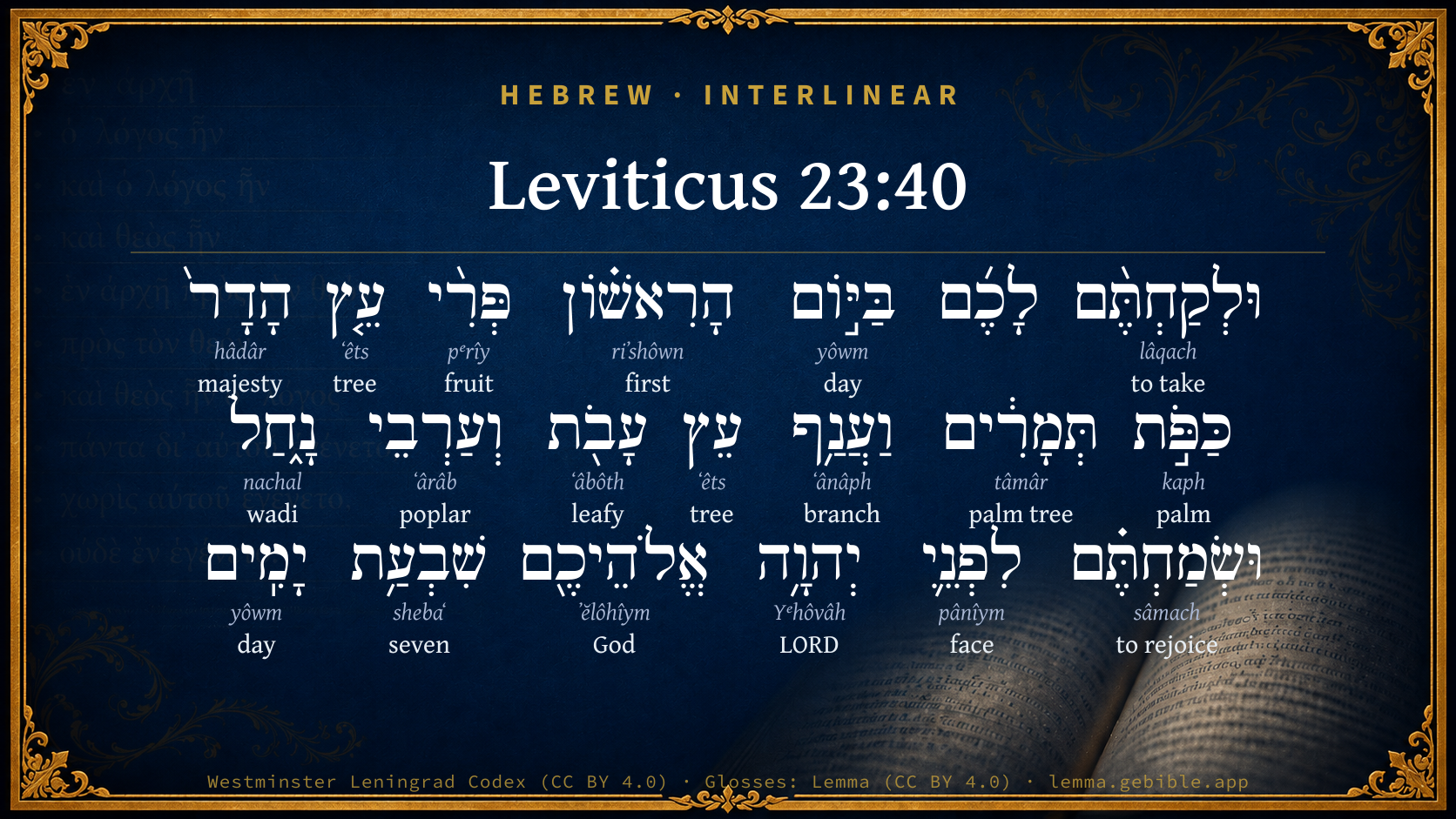
Leviticus 23:40

Hebrew (Westminster Leningrad Codex) Leviticus 23:40 appears in the Hebrew Old Testament. The text above is from the Westminster Leningrad Codex. Each word links to its Strong’s number, a concise gloss, and parsing drawn from the Open Scriptures Hebrew Bible morphology. Click any word for its full Brown-Driver-Briggs (BDB) entry.
Download image
Cite this verse

Leviticus 23:40 (World English Bible). Public Domain. Lemma interlinear Bible study tool, https://lemma.gebible.app/v/leviticus/23/40.

Show BibTeX & RIS
BibTeX
RIS
English Translation
You shall take on the first day the fruit of goodly trees, branches of palm trees, and boughs of thick trees, and willows of the brook; and you shall rejoice before Yahweh your God seven days.
World English Bible · Public Domain
Highlights
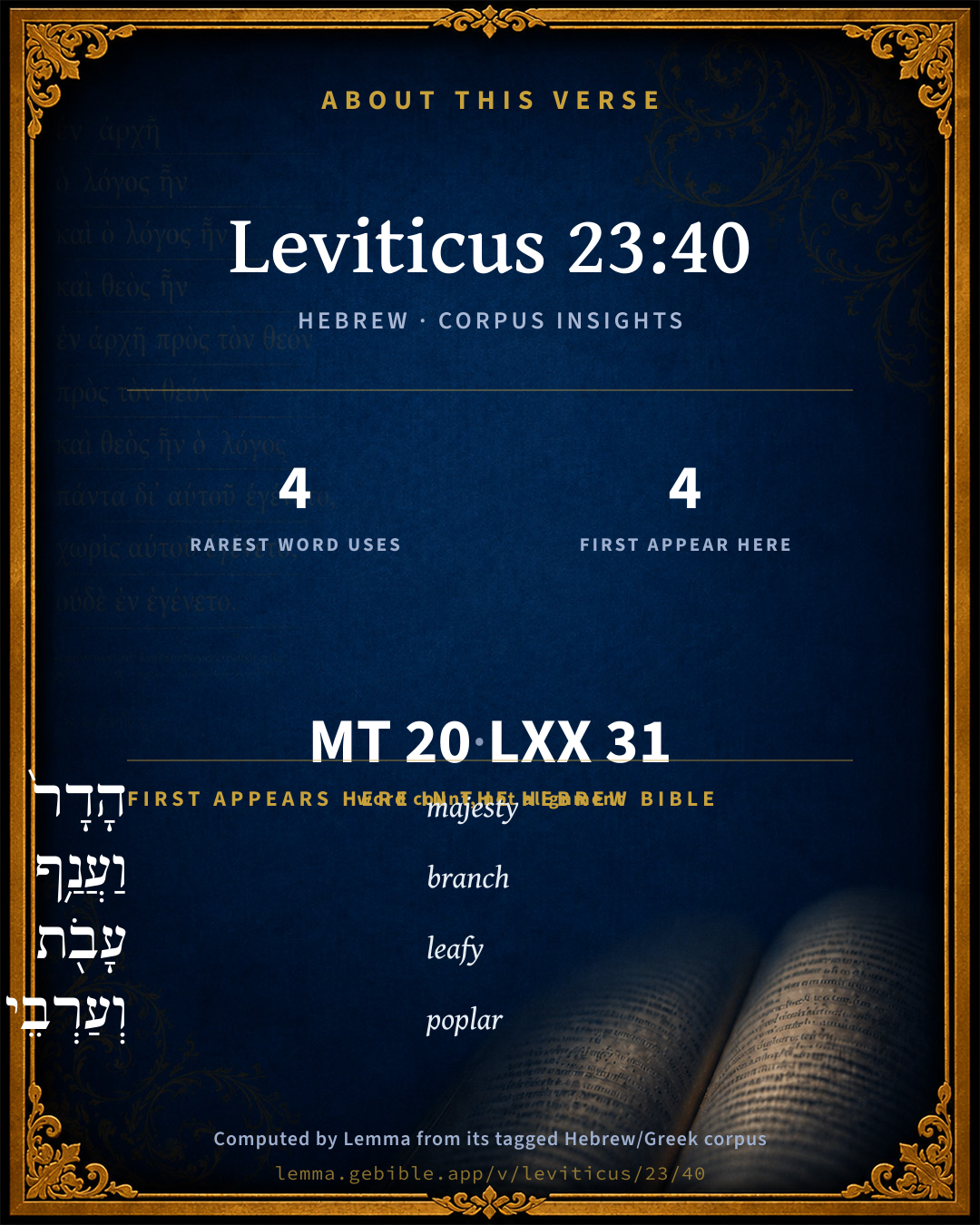
  • 4 first appearances in the Hebrew Bible
Full analysis ↓
Download a study sheet

One document with this verse’s original text, its word-by-word gloss line, the meaning frame, cross-references with their text, attributed commentary, and full source and license credits — printable, and it pastes into notes with its structure intact.

This verse Autodidact and up

Study sheet (.html) Plain text (.txt)

A passage Seminary Student

Up to 50 verses in one chapter. A passage sheet keeps up to 6 commentary sources and 12 cross-references per verse, in the order this page ranks them, and says so on the sheet whenever that leaves anything out. Ask for a single verse and you get the Autodidact verse sheet above.

Everything on this page stays free to read, with no account — the sheet is a download of what is already on screen, not access to it.

Want to remove ads? Support Godless Engineer
Compare translations 3

The same verse in 3 English versions, stacked beneath the original-language interlinear above. Click any original word for its lexicon entry.

Each is an independent rendering of the whole verse — the interlinear is not word-aligned to these translations.

Highlighted words mark where these versions differ — a whole-verse word diff, not a word-by-word alignment.

  • World English Bible Public Domain
    You shall take on the first day the fruit of goodly trees, branches of palm trees, and boughs of thick trees, and willows of the brook; and you shall rejoice before Yahweh your God seven days.
  • King James Version Public Domain
    And ye shall take you on the first day the boughs of goodly trees, branches of palm trees, and the boughs of thick trees, and willows of the brook; and ye shall rejoice before the LORD your God seven days.
  • unfoldingWord Literal Text CC BY-SA 4.0
    And you shall take for yourselves on the first day the fruit of majestic trees, branches of palm trees, and boughs of leafy trees and willows of the river, and you shall rejoice to the face of Yahweh your God seven days.

unfoldingWord Literal Text — © unfoldingWord, licensed CC BY-SA 4.0. Word-aligned USFM3 via Door43 (git.door43.org/unfoldingWord/en_ult).

Versions to compare (up to 4)

3 of 4 selected

Show all 18 translations

Every available English version of this verse, each an independent rendering of the whole verse.

  • World English Bible Public Domain
    You shall take on the first day the fruit of goodly trees, branches of palm trees, and boughs of thick trees, and willows of the brook; and you shall rejoice before Yahweh your God seven days.
  • Berean Standard Bible Public Domain
    On the first day you are to gather the fruit of majestic trees, the branches of palm trees, and the boughs of leafy trees and of willows of the brook. And you are to rejoice before the LORD your God for seven days.
  • Majority Standard Bible Public Domain
    On the first day you are to gather the fruit of majestic trees, the branches of palm trees, and the boughs of leafy trees and of willows of the brook. And you are to rejoice before the LORD your God for seven days.
  • King James Version Public Domain
    And ye shall take you on the first day the boughs of goodly trees, branches of palm trees, and the boughs of thick trees, and willows of the brook; and ye shall rejoice before the LORD your God seven days.
  • American Standard Version (1901) Public Domain
    And ye shall take you on the first day the fruit of goodly trees, branches of palm-trees, and boughs of thick trees, and willows of the brook; and ye shall rejoice before Jehovah your God seven days.
  • Revised Version (1885) Public Domain
    And ye shall take you on the first day the fruit of goodly trees, branches of palm trees, and boughs of thick trees, and willows of the brook; and ye shall rejoice before the LORD your God seven days.
  • Geneva Bible (1599) Public Domain
    And yee shall take you in the first day the fruite of goodly trees, branches of palme trees, and the boughes of thicke trees, and willowes of the brooke, and shall reioyce before the Lord your God seuen daies.
  • Douay-Rheims (1899) Public Domain
    And you shall take to you on the first day the fruits of the fairest tree, and branches of palm trees, and boughs of thick trees, and willows of the brook, and you shall rejoice before the Lord your God.
  • Young's Literal Translation Public Domain
    and ye have taken to yourselves on the first day the fruit of beautiful trees, branches of palms, and boughs of thick trees, and willows of a brook, and have rejoiced before Jehovah your God seven days.
  • Literal Standard Version CC BY-SA 4.0
    and you have taken for yourselves on the first day the fruit of beautiful trees, branches of palms, and boughs of thick trees, and willows of a brook, and have rejoiced before your God YHWH [for] seven days.
  • Unlocked Literal Bible CC BY-SA 4.0
    On the first day you must take the best fruit from the trees, branches of palm trees, and leafy branches of thick trees, and willows from streams, and you will rejoice before Yahweh your God for seven days.
  • unfoldingWord Literal Text CC BY-SA 4.0
    And you shall take for yourselves on the first day the fruit of majestic trees, branches of palm trees, and boughs of leafy trees and willows of the river, and you shall rejoice to the face of Yahweh your God seven days.
  • Darby Bible Public Domain
    And ye shall take on the first day the fruit of beautiful trees, palm branches and the boughs of leafy trees, and willows of the brook; and ye shall rejoice before Jehovah your God seven days.
  • World Messianic Bible Public Domain
    You shall take on the first day the fruit of majestic trees, branches of palm trees, and boughs of thick trees, and willows of the brook; and you shall rejoice before the LORD your God seven days.
  • Webster's Bible Public Domain
    And ye shall take you on the first day the boughs of goodly trees, branches of palm-trees, and the boughs of thick trees, and willows of the brook; and ye shall rejoice before the LORD your God seven days.
  • Free Bible Version CC BY-SA 4.0
    On the first day you are to gather branches from large trees, from palm trees, from leafy trees and of river willows, and celebrate before the Lord your God for seven days.
  • Bible in Basic English Public Domain
    On the first day, take the fruit of fair trees, branches of palm-trees, and branches of thick trees and trees from the riverside, and be glad before the Lord for seven days.
  • JPS Tanakh (1917) Public Domain
    And ye shall take you on the first day the fruit of goodly trees, branches of palm-trees, and boughs of thick trees, and willows of the brook, and ye shall rejoice before the LORD your God seven days.

Literal Standard Version (2020), Covenant Press — licensed CC BY-SA 4.0. Text via the HelloAO Bible API (eBible.org). Unlocked Literal Bible (unfoldingWord) — licensed CC BY-SA 4.0. Text via the HelloAO Bible API (eBible.org). unfoldingWord Literal Text — © unfoldingWord, licensed CC BY-SA 4.0. Word-aligned USFM3 via Door43 (git.door43.org/unfoldingWord/en_ult). Free Bible Version, Dr. Jonathan Gallagher — licensed CC BY-SA 4.0. Text via the HelloAO Bible API (eBible.org).

Word by word

More ways to search: Search by grammar → Find every occurrence → Compare this word →

Practice this passage: Drill this verse → Learn its vocabulary →

עָבֹ֖ת
ʻâbôth
H5687
“leafy”
Adjective, Adjective, Masculine, Singular, Absolute
Part of Speech
Adjective
Type
Adjective
Gender
Masculine
Number
Singular
State
Absolute
Full BDB Definition

Origin: from H5686

TWOT: 1558a

having interwoven foliage, leafy, dense with foliage
  1. וּלְקַחְתֶּ֨ם lâqach H3947 “and · to take” Conjunction + Verb, Qal, Sequential Perfect, 2nd Person, Masculine, Plural
  2. בַּיּ֣וֹם yôwm H3117 “in/at the · day” Preposition, Determined + Noun, Common, Masculine, Singular, Absolute
  3. הָרִאשׁ֗וֹן riʼshôwn H7223 “the · first” Particle, Definite Article + Adjective, Adjective, Masculine, Singular, Absolute
  4. פְּרִ֨י pᵉrîy H6529 “fruit of” Noun, Common, Masculine, Singular, Construct
  5. עֵ֤ץ ʻêts H6086 “tree of” Noun, Common, Masculine, Singular, Construct
  6. הָדָר֙ hâdâr H1926 “majesty” Noun, Common, Masculine, Singular, Absolute
  7. כַּפֹּ֣ת kaph H3709 “palms of” Noun, Common, Feminine, Plural, Construct
  8. תְּמָרִ֔ים tâmâr H8558 “palm trees” Noun, Common, Masculine, Plural, Absolute
  9. וַעֲנַ֥ף ʻânâph H6057 “and · branch of” Conjunction + Noun, Common, Masculine, Singular, Construct
  10. עֵץ ʻêts H6086 “tree” Noun, Common, Masculine, Singular, Absolute
  11. וְעַרְבֵי ʻârâb H6155 “and · poplars of” Conjunction + Noun, Common, Feminine, Plural, Construct
  12. נָ֑חַל nachal H5158 “wadi” Noun, Common, Masculine, Singular, Absolute
  13. וּשְׂמַחְתֶּ֗ם sâmach H8055 “and · to rejoice” Conjunction + Verb, Qal, Sequential Perfect, 2nd Person, Masculine, Plural
  14. לִפְנֵ֛י pânîym H6440 “to/for · face(s) of” Preposition + Noun, Common, Both, Plural, Construct
  15. יְהוָ֥ה Yᵉhôvâh H3068 “LORD” Noun, Proper
  16. אֱלֹהֵיכֶ֖ם ʼĕlôhîym H430 “God(s) · your” Noun, Common, Masculine, Plural, Construct + Suffix, Personal, 2nd Person, Masculine, Plural
  17. שִׁבְעַ֥ת shebaʻ H7651 “seven” Adjective, Cardinal number, Masculine, Singular, Construct
  18. יָמִֽים yôwm H3117 “days” Noun, Common, Masculine, Plural, Absolute

About this verse

These counts appear in no published source. They are computed here, from the morphology-tagged text and Lemma’s own curated glosses. What Lemma adds →

20
words
17
distinct lemmas
Pentateuch
section

Notable vocabulary

The rarest word here is עָבֹ֖ת leafy H5687 — appearing just 4 times in the whole Hebrew Bible.

First appearance in Scripture

These words make their first canonical appearance in the Hebrew Bible here:

  • הָדָר֙ majesty H1926
  • וַעֲנַ֥ף branch H6057
  • עָבֹ֖ת leafy H5687
  • וְעַרְבֵי poplar H6155

Shared distinctive vocabulary

עָבֹ֖ת leafy H5687 occurs in 4 verses of the Hebrew Bible. Also found in:

Grammatical profile

  • 2 verbs
  • 14 nouns
  • 3 adjectives
  • 1 preposition

Verb forms

  • וּלְקַחְתֶּ֨ם Qal · Sequential Perfect
  • וּשְׂמַחְתֶּ֗ם Qal · Sequential Perfect

Repetition

Words recur within this verse — often emphatic in Hebrew:

  • בַּיּ֣וֹם day H3117 ×2
  • עֵ֤ץ tree H6086 ×2

Hebrew & Septuagint length

In English translation the verse runs 36 words from the Hebrew and 43 from the Septuagint (LXX English) — closely comparable.

A rough comparison of the two English renderings, which tokenize alike — not a word-level alignment.

Word counts can differ between the Hebrew and the Greek without any difference in meaning — e.g. the Hebrew direct-object marker אֵת has no separate Greek word, and Greek often adds the article ὁ.

In the original languages it is 20 Hebrew tokens and 31 Greek tokens — but the two are counted differently (Hebrew bundles its prefixes and suffixes into one token; the Greek is in lemma form), so that isn’t a like-for-like length.

Cross-references

13

Topical passages linked to Leviticus 23:40 in the Treasury of Scripture Knowledge — connected by theme and wording, ordered by reader-vote popularity; previews shown in the World English Bible.

  • Revelation 7:9 After these things I looked, and behold, a great multitude, which no man could number, out of every nation and of all tribes, peoples, and languages, standing before the throne and before the Lamb, dressed in white robes, with palm branches in their hands.
  • Philippians 4:4 Rejoice in the Lord always! Again I will say, Rejoice!
  • Deuteronomy 16:14–15 and you shall rejoice in your feast, you, and your son, and your daughter, and your man-servant, and your maid-servant, and the Levite, and the foreigner, and the fatherless, and the widow, who are within your gates.
  • Matthew 21:8 A very great multitude spread their clothes on the road. Others cut branches from the trees, and spread them on the road.
  • Nehemiah 8:14–17 They found written in the law, how that Yahweh had commanded by Moses, that the children of Israel should dwell in booths in the feast of the seventh month;
  • Isaiah 35:10 and the ransomed of Yahweh shall return, and come with singing to Zion; and everlasting joy shall be on their heads: they shall obtain gladness and joy, and sorrow and sighing shall flee away.
  • John 12:13 they took the branches of the palm trees, and went out to meet him, and cried out, "Hosanna! Blessed is he who comes in the name of the Lord, the King of Israel!"
  • John 16:22 Therefore you now have sorrow, but I will see you again, and your heart will rejoice, and no one will take your joy away from you.
  • Romans 5:11 Not only so, but we also rejoice in God through our Lord Jesus Christ, through whom we have now received the reconciliation.
  • Psalms 92:12 The righteous shall flourish like the palm tree. He will grow like a cedar in Lebanon.
  • Philippians 3:3 For we are the circumcision, who worship God in the Spirit, and rejoice in Christ Jesus, and have no confidence in the flesh;
  • 1 Peter 1:8 whom not having known you love; in whom, though now you don't see him, yet believing, you rejoice greatly with joy unspeakable and full of glory--
  • Isaiah 66:10 Rejoice you with Jerusalem, and be glad for her, all you who love her: rejoice for joy with her, all you who mourn over her;

Cross-references courtesy of OpenBible.info (CC BY 4.0).

Hebrew and Greek witnesses Masoretic Hebrew ↔ Greek Septuagint

The same verse in the two great witnesses to the Old Testament, shown verse-for-verse.

These are two independent witnesses, not word-aligned to each other, and the Septuagint is shown in lemma (dictionary) form.

Hebrew Leviticus 23:40 Masoretic · Westminster Leningrad Codex

וּלְקַחְתֶּ֨ם לָכֶ֜ם בַּיּ֣וֹם הָרִאשׁ֗וֹן פְּרִ֨י עֵ֤ץ הָדָר֙ כַּפֹּ֣ת תְּמָרִ֔ים וַעֲנַ֥ף עֵץ עָבֹ֖ת וְעַרְבֵי נָ֑חַל וּשְׂמַחְתֶּ֗ם לִפְנֵ֛י יְהוָ֥ה אֱלֹהֵיכֶ֖ם שִׁבְעַ֥ת יָמִֽים

You shall take on the first day the fruit of goodly trees, branches of palm trees, and boughs of thick trees, and willows of the brook; and you shall rejoice before Yahweh your God seven days.

World English Bible · Public Domain

Greek LXX Leviticus 23:40 Septuagint · lemma form

καί λαμβάνω ὁ ἡμέρα ὁ πρῶτος καρπός ξύλον ὡραῖος καί κάλλυνθρον φοῖνιξ καί κλάδος ξύλον δασύς καί ἰτέα καί ἄγνος κλάδος ἐκ χειμάρρους εὐφραίνω ἔναντι κύριος ὁ θεός σύ ἑπτά ἡμέρα

And on the first day you⌃ shall take goodly fruit of trees, and branches of palm trees, and thick boughs of trees, and willows, and branches of osiers from the brook, to rejoice before the Lord your God seven days in the year.

LXX2012 (modern English Septuagint) · Public Domain

On this verse, Haydock's Catholic Bible Commentary discusses the Septuagint’s reading. Read the note in Commentary ↓

Hebrew: Westminster Leningrad Codex (CC BY 4.0). Greek: Septuagint (public domain); English from LXX2012 (modern English Septuagint) (Public Domain). How the Septuagint differs from the Hebrew →

Targum (Aramaic paraphrase)

2

The Targum is the ancient Jewish Aramaic paraphrase of the Hebrew Scriptures — an interpretive translation, not the Hebrew text itself. Onkelos (literal) and Pseudo-Jonathan (expansive) render the Torah, and Jonathan the Prophets. Coverage is partial: where no permissively-licensed English translation exists for a verse, only the Aramaic is shown. This is verse-level text, not a word-by-word alignment to the Hebrew.

  1. Targum Onkelos Torah (Genesis–Deuteronomy)
    וְתִסְבוּן לְכוֹן בְּיוֹמָא קַדְמָאָה פֵּרֵי אִילָנָא אֶתְרוֹגִין וְלֻלָבִין וַהֲדַסִין וְעַרְבִין דִנְחָל וְתֶחֱדוּן קֳדָם יְיָ אֱלָהֲכוֹן שַׁבְעַת יוֹמִין

    (no public-domain English translation for this verse)

    Targum Onkelos — Aramaic: “Onkelos Genesis” (public domain); “Onkelos Exodus” (public domain); “Onkelos Leviticus” (public domain); “Onkelos Numbers” (public domain); “Onkelos Deuteronomy” (public domain). English: “Sefaria Community Translation” (CC0 1.0 (public-domain dedication)); “J.W. Etheridge. The Targums of Onkelos and Jonathan Ben Uzziel on the Pentateuch. London: Longmans, Green, 1862” (public domain). Text via Sefaria.

  2. Targum Pseudo-Jonathan Torah (Genesis–Deuteronomy)
    וְתִסְבּוּן מִן דִלְכוֹן בְּיוֹמָא קַמָאָה דְחַגָא פֵּירֵי אִילַן מְשֻׁבַּח תְּרוּגִין וְלוּלַבִין וְהַדַסִין וְעַרְבִין דְמַרְבְּיַין עַל נַחֲלִין וְתֵיחְדוּן קֳדָם יְיָ אֱלָהָכוֹן שִׁבְעָתֵי יוֹמִין

    And of your own shall you take on the first day of the feast, the fruits of praiseworthy trees, citrons, and lulabin, and myrtles, and willows that grow by the brooks; and you shall rejoice before the Lord your God seven days.

    Targum Pseudo-Jonathan — Aramaic: “Targum Jonathan on Genesis” (public domain); “Targum Jonathan on Exodus” (public domain); “Targum Jonathan on Leviticus” (public domain); “Targum Jonathan on Numbers” (public domain); “Targum Jonathan on Deuteronomy” (public domain). English: “The Targum of Jonathan ben Uzziel, trans. J. W. Etheridge, London, 1862” (public domain). Text via Sefaria.

Commentary

Notes on Leviticus 23:40 from classic Christian and Jewish commentators (each source and its license shown beneath its notes). The classic Christian expositions comment on the surrounding passage and are grouped to its opening verse, so a note may address several verses; the Jewish commentaries on the Tanakh (Rashi and others) are per-verse, so they appear only where the commentator wrote on this verse.

Lemma curates 59 commentaries, every one of them public domain or Creative Commons licensed, each selected and text-cleaned for this edition rather than reprinted as found. About our sources →

Joseph Benson's Commentary

Lev 23:40. Of goodly trees — Namely, olive, myrtle, and pine, mentioned Neh 8:15-16, which were most plentiful there, and which would best preserve their greenness. Thick trees — Fit for shade and shelter. And willows — To mix with the other, and in some sort bind them together. And as they made their booths of these materials, so they carried some of these boughs in their hands, as is affirmed by Jewish and other ancient writers.

Joseph Benson's Commentary on the Old and New Testaments (1811–1818) — public domain. Text from a community e-Sword module.

Geneva Bible (1599)

Geneva Bible translators

Or, of boughs thick with leaves.

Geneva Bible (1599) marginal notes — public domain. Text via Bolls.life.

Adam Clarke's Commentary

Verse 40. Boughs of goodly trees] The Jews and many critics imagine the citron-tree to be intended, and by boughs of thick tree the myrtle.

Adam Clarke's Commentary on the Bible (1810–1826) — public domain. Text from a community e-Sword/MySword module.

Ellicott's Commentary for English Readers

(40) And ye shall take you on the first day.—The four species of vegetable production here ordered are a distinctive feature of this festival. They have been most minutely defined during the second Temple.

Boughs of goodly trees.—Better, the fruit of goodly trees, as the margin rightly renders it. As this phrase is too indefinite, and may simply denote the fruit of any choice fruit-tree, there can hardly be any doubt that in this instance, as in many other cases, the lawgiver left it to the administrators of the Law to define its precise kind. Basing it therefore upon one of the significations of the term here translated “goodly,” which is to dwell, to rest, the authorities during the second Temple decreed that it means the fruit winch permanently rests upon the tree—i.e., the citron, the paradise-apple. If it came from an uncircumcised tree (see Lev_19:23), from an unclean heave-offering (comp. Num_18:11-12), or exhibited the slightest defect, it was ritually illegal.

Branches of palm trees.—During the second Temple this was defined as the shoot of the palm-tree when budding, before the leaves are spread abroad, and whilst it is yet like a rod. It is technically called lulab, which is the expression whereby it is rendered in the ancient Chaldee version. The lulab must at least be three hands tall, and must be tied together with its own kind.

The boughs of thick trees.—This, according to the same authorities, denotes the myrtle branch, whose leaves thickly cover the wood. To make it ritually legal it must have three or more shoots round the stem, and on the same level with it. If it is in any way damaged it is illegal. This accounts for the ancient Chaldee version rendering it by “myrtle branch.”

Willows of the brook.—That species, the distinguishing marks of which are dark wood and long leaves with smooth margin. The palm, the myrtle, and the willow, when tied together into one bundle, constitute the Lulab. Whilst the psalms are chanted by the Levites during the sacrifices, the pilgrims, who held the Lulabs or palms, shook them thrice, viz., at the singing of Psa_118:1, then again at Lev_23:25, and at Lev_23:29. When the chant was finished, the priests in procession went round the altar once, exclaiming, “Hosanna, O Lord, give us help, O Lord! give prosperity !” (Psa_118:25). Whereupon the solemn benediction was pronounced by the priests, and the people dispersed amidst the repeated exclamations, “How beautiful art thou, O altar !” It is this part of the ritual which explains the welcome that the multitude gave Christ when they went to meet Him with palm-branches and shouts of hosanna (Mat_21:8-9; Mat_21:15; Joh_12:12-13).

A Bible Commentary for English Readers, edited by Charles John Ellicott (1878–1897) — public domain. Text from a community e-Sword module.

The Cambridge Bible for Schools and Colleges

gen. ed. J. J. S. Perowne

40. fruit of goodly trees] i.e. fruit of goodly (ornamental, beautiful) trees, or goodly tree fruit (so Dillm.).

boughs of thick trees] According to Onkelos, myrtle branches, but the expression may have a more general signification. It has been doubted whether this various material was to be used for the construction of the booths, or for the purpose of making a lûlâb or festal bouquet. Among the later Jews the lûlâb (Jos. Ant. iii. 10. 4) consisted of a myrtle, willow, and palm branch, and an ethrôg (orange or citron) carried in the hands. In Nehemiah’s time (Neh_8:15) there is found no more than a general agreement with the text here as to materials. See further in Jos. Ant. xiii. 13. 5, and the Mishna Sukkah iii. 1 ff.

The Cambridge Bible for Schools and Colleges (gen. ed. J. J. S. Perowne; Cambridge University Press, 1878–1918) — public domain. Text from a community e-Sword module.

John Gill's Exposition

And ye shall take you the boughs of goodly trees,.... Which the three Targums interpret, of citrons; and so Jarchi and Aben Ezra; and the Jews are so tenacious of observing this, that in those countries where this fruit grows not, they will send for it from Spain, where there is plenty of it: the Targum of Jonathan, paraphrases it, "ye shall take of yours"; suggesting these boughs must be their own, or the bundle of them, with others they call the "lulab", must be their own property, and not another's; though it is said (u), if it is a gift it will do, even though it is given on condition to be returned again:

branches of palm trees: which were very common in the land of Judea, and especially about Jericho; see Joh 12:13; the Targums of Jonathan and Jerusalem call them "lulabs", which is the name the Jews give to the whole bundle they carried in their hands on this day:

and the boughs of thick trees; which the Targums and Jewish writers in general understand of myrtles, being full of branches and leaves:

and willows of the brook; a sort of trees which delight to grow by brooks and rills of water: these, according to the Jewish writers, were not taken to make their booths of, though that seems to be the use of them, from Neh 8:15; but to tie up in bundles, and carry in hands; the citron in their left hand, and a bundle made of the other three sorts of boughs of trees in the right hand, which they called the "lulab":

and ye shall rejoice before the Lord your God seven days; because of the blessings of his goodness bestowed upon them in the plentiful harvest and vintage they had been favoured with, and in remembrance of past mercies, showed to their fathers in the wilderness, giving them food and drink, and guiding and protecting them with the pillar of cloud and fire; and at the same time, also, thankful for the different circumstances they were in, having cities, towns, and houses to dwell its, and fields and vineyards to possess, when their fathers lived in a wilderness for forty years together; and especially such of them expressed their joy before the Lord, who had any knowledge of this being a type of the Messiah tabernacling in human nature, they had the promise of, to be their spiritual Redeemer and Saviour: these seven days are kept by the Jews now, chiefly in carnal mirth, and so for ages past, as by carrying the above boughs in their hands, and going round about the altar with them, and, shaking them, and crying Hosanna, and by making use of all sorts of music, vocal and instrumental, piping, dancing, leaping, skipping, and various gestures, even by persons of the highest rank, and of the greatest character for sobriety (w); and particularly by fetching water from Siloah, when in their own land, and pouring it with wine upon the altar, which was attended with such expressions of joy, that it is said, that he who never saw the rejoicing of drawing of water, never saw any rejoicing in his life (x): the Jews give this reason of the ceremony, because at this feast was the time of the rains, see Targum of Jonathan on Lev 23:36; and therefore the holy blessed God said, pour water before me, that the rains of the year may be blessed unto you (y); but others have thought there was something more mysterious in it, and that it had respect to the pouring out of the Holy Ghost; for, they say (z), the place of drawing water was so called, because they drew the Holy Ghost, as it is said, "ye shall draw water with joy out of the wells of salvation", Isa 12:3; to this our Lord is thought to allude; see Gill on Joh 7:37, Joh 7:38, some of the ceremonies used at this feast have been imitated by the Heathens: Strabo (a) says, the carrying branches of trees, dances, and sacrifices, were common to the gods, and particularly to Bacchus; and there was such a likeness between these and the rites of Bacchus, that Plutarch (b) thought the Jews at this time kept two feasts to the honour of him; whereas, as Bishop Patrick observes, the profane Bacchanalia of the Gentiles were only a corruption of this festival.

(u) Misn. Succah, c. 3. sect. 13. & Maimon. & Bartenora in ib. R. Alphes, par. 1. Succah, c. 2. fol. 376. 1. (w) Maimon. Hilchot Lulab. c. 7. sect. 10. c. 13, & c. 8. sect. 12, 13, 14, 15. (x) Misn. Succah, c. 5. sect. 1. 4. (y) R. Alphes, par. 1. Roshhashanah, c. 1. fol. 346. 2. (z) T. Hieros. Succah, fol. 55. 1. (a) Geograph. l. 10. p. 322. (b) Sympos. l. 1. prob. 3.

John Gill's Exposition of the Whole Bible (1746–1763) — public domain (CC PDM 1.0). Text via the HelloAO Bible API.

Albert Barnes' Notes on the Bible

The boughs of goodly trees - Or, the fruit (see the margin) of the citron trees. It is said that every Israelite at the Feast of tabernacles carried in one hand a bundle of branches and in the other a citron. The branches seem to have comprised the boughs of palm-trees, “thick trees” and willows here named. See the note to Lev 23:42; Neh 8:15-16.

Albert Barnes' Notes on the Bible (1834–1885) — public domain. Text from a community e-Sword/MySword module.

Haydock's Catholic Bible Commentary

Fairest tree, branches of the orange or citron tree, laden with blossoms and fruit. (Tirinus) --- Josephus ([Antiquities?] iii. 10) says, they took branches of myrtle, willows, and palm trees, on which they fixed oranges. This is the fruit which the Hebrews generally understand to be hereby designated. In the same sense the Arabic and Syriac translate "golden apples." --- Thick trees, of any species; though Josephus, &c., restrain it to the myrtle, which was certainly used on this occasion, 2 Esdras viii. 12. --- Willows. Septuagint adds also, "branches of agnus from the torrent." Perhaps Moses only meant that these branches should be used in forming the tents; but the Jews hold them in their hands, while they go in solemn procession round the pulpit in their synagogues, during every day of the octave, before breakfast, crying out Ana hosiah na, &c., "Save us, we beseech thee, O Lord; we beseech thee, grant us good success." They gave the title of hosannah to those branches; in allusion to which, the children sung in honour of Jesus Christ, Hosanna to the Son of David. --- Rejoice; dancing and singing before the altar of holocausts, 2 Kings vi. 14. The wisdom of God shines forth, in thus attaching to his worship a carnal people, by intermingling with the most solemn ceremonies some relaxation and pleasure. By calling them together so often in the year, they became also better acquainted with one another, and more in love with their religion and country. The ancient lawgivers entertained the like sentiments. (Seneca, Strabo x.) But the pagans generally carried these diversions to excess. (Calmet) --- In this chapter we find six festivals specified: 1. sabbath; 2. Passover; 3. Pentecost; 4. trumpets; 5. expiation; 6. tabernacles, lasting till the octave day of assembly and collection. These three last were celebrated in the 7th month, the 1st of the civil year. There was also a feast on all the new moons, Numbers xxviii. 11. (Haydock)

George Leo Haydock (1774–1849), Haydock's Catholic Family Bible and Commentary, 1859 edition — public domain. Excludes Psalms (Douay-Rheims chapter numbering differs from Protestant) and Deuterocanonical books (Catholic canon only).

Matthew Poole's English Annotations

Boughs, Heb. the fruit, i.e. fruit-bearing boughs, or branches with the fruit on them, as the word fruit seems to be taken, 2Ki 19:30; Eze 19:12. Goodly trees, to wit, the olive, myrtle, and pine, as they are mentioned, Neh 8:15,16, which were most plentiful there, and which would best preserve their greenness or freshness.

Thick trees, fit for shade and shelter.

Willows of the brook, which might do well to mix with the other, and in some sort to bind them together. And as they made their booths of these materials, as is apparent from Ne 8, so it seems they did also carry some of these boughs in their hands, as is affirmed by Jewish and other ancient writers.

Ye shall rejoice; which joy they testified by feasting, thanksgiving, &c.

Matthew Poole's English Annotations on the Holy Bible (1683–1685) — public domain. Text from a community e-Sword/MySword module.

Whedon's Commentary on the Bible

Daniel D. Whedon

40. The boughs of goodly trees — Here the Authorized Version is incorrect, but the marginal reading of fruit, usually citron, instead of boughs, is a proper translation of the Hebrew.

Branches of palm trees — This tree was very abundant in the Holy Land. It is remarkable for its fruitfulness and the perpetual greenness of its foliage, making it an appropriate symbol of victory and peace. Joh_12:13; Rev_7:9. The modern Jews probably reflect the custom of their ancestors in the time of Christ, in marching in procession around the reading desk in their synagogues, bearing palm branches and intoning the Hosanna: —

“For thy sake, O our Creator, Hosanna, (save now.)

For thy sake, O our Redeemer, Hosanna,

For thy sake, O our Seeker, Hosanna.”

This chant, like the priests’ threefold blessing, (Num_6:22-27,) is strikingly suggestive of the work of the Father, Son, and Holy Spirit in human redemption.

Willows — It was customary for each man to bring a sprig for the adorning of the altar.

Ye shall rejoice — Rejoicing was to continue seven days, while affliction of soul was required during only one day in the year, the day of atonement. Judaism, though a dispensation in which the law was predominant, was by no means destitute of grace. How much more joyful should Christians be who, though under the law as the rule of life, are not under it as the ground of salvation, nor as the motive to obedience, but under the delightful constraint of love to the Lawgiver, awakened in their hearts by the Holy Ghost. Rom_5:5; Rom_14:17. The Israelite was commanded to rejoice seven days; the believer in Jesus Christ is commanded to “rejoice evermore.” A sad servant betokens a severe master.

Daniel D. Whedon (gen. ed.), Commentary on the Old and New Testaments (1874–1909) — public domain. Text from a community e-Sword module.

The Pulpit Commentary

Vers. 40-43. The Feast of Tabernacles.

There were three great festivals for the Israelites, the dates for which were plainly marked, and at which times it behooved the males of the nation as far as possible to be present at the sanctuary. It is the last of these we are about to consider. The regulations for its observance were enunciated in fullest detail. Were not the people thus reminded that they assisted in the celebration of the ceremonies of a royal court? The Christian Church has its festivals, prominent among which are its gatherings on the Lord"s day, and the observance of the Lord"s Supper. Much of what can be said with reference to the Israelitish feasts is applicable also to the latter.

I THIS WAS THE MOST JOYOUS OF THE FESTIVALS. "Ye shall rejoice before the Lord your God.

1. See God"s delight in the happiness of his people. He loves to witness their rejoicing. Religion was never intended to be synonymous with gloom or moroseness.

2. This was the crowning festival of the year, and therefore ought to be its climax of joy. For the child of God better days are ever in store; he need never pine for the past to return; each festival shall surpass the preceding. Jesus keeps the best wine till the last; not so with the world"s pleasures.

3. It took place five days after the solemn Day of Atonement, when thenational sin was purged, and Israel"s communion with its God reestablished. To empress sin and obtain pardon is the fitting preparation for gladness of heart. N o man who has not experienced the feeling of relief from the burden of guilt and the emotion caused by restoration to his heavenly Father"s favour, knows the meaning of real joy. Compared with this the delights of sense and. intellect are flavourless.

4. Joy reaches its highest expression in the presence of God. "Rejoice before the Lord, even the holy righteous God who searches the heart and tries the reins. We may without pride know that we have done what was right, and that the Being of beings approves our conduct and graces the festival with the light of his countenance. There is none of the secret misgiving that attends sinful banquets, where the laugh is hollow and the gaiety forced, from a conviction that conscience is being silenced and moral law violated. Cf. the rejoicing of the people, and the terror of Adonijah and his guests. (1Ki_1:40, 1Ki_1:49) David danced for glee before the Lord when the sacred ark was brought into the city of David. "Rejoice, O daughter of Zion, for thy king cometh unto thee." We would fain have the children glad when it is said, "Let us go unto the house of the Lord.

II THIS WAS A FESTIVAL OF GRATITUDE FOR RECENT BLESSINGS.

1. Another name for it was the Feast of Ingathering. All the produce of the ground had been garnered, the Lord had blessed them in all their increase corn, oil, and wine; daily food and luxuries abounded; the booths were constructed of fruit trees and leafy palms. God"s bounteous bestowment was acknowledged. Spiritual and temporal mercies had enriched the people and evoked manifestations of thanksgiving. So visibly dependent is man upon God for the germinating and maturing of the grain and fruit, that a harvest thanksgiving seems peculiarly appropriate, and again at the storing of the harvest, when the work for the year is practically ended, a festival is of evident fitness. The compassions of the Lord, "new every morning," furnish ample matter for devout meditation and praise.

2. This feature of the festival was a reason why all should share in it, not only the wealthy, high-born Israelites, but the strangers, the fatherless, the widow, and the poor. (Deu_16:14) God allows his sun to shine and rain to descend upon all, and he expects those who receive his lavish gifts to invite others to participate in the enjoyment thereof. Anticipating our Lord"s directions to summon to a feast the poor and maimed and blind, the Israelites were accustomed to "send portions to them for whom nothing is prepared." Selfish exclusion was thus prevented, and universal rejoicing made possible.

3. An offering to God from each was essential. "They shall not appear before the Lord empty; every man shall give as he is able". (Deu_16:17) Speech and sentiment without deeds are rightly deemed insincere. It is true of all converts from heathendom that when they give of their substance to God we may infer that they have first given him their hearts. The priests and Levites were in part supported by these national free-will presentations. If we esteem the Master, we shall treat his servants well for his sake.

III THIS WAS A COMMEMORATION OF FORMER BLESSINGS. During seven days the Israelites dwelt in booths made of green boughs to remind them of the days when they sojourned in the wilderness (verse 43).

1. Previous experience may well be remembered.

If it pass into oblivion, its lessons have not been graven on the mind, and our state has not proved the discipline it was designed to be. Stand, O believer, upon the mount of present station, and survey the path with all its windings by which you have ascended to this lofty summit. Much a review will be profitable in the extreme, it will produce deepened humility and thankfulness. Keil says, "the recollection of privation and want can never be an occasion of joy." Surely he forgets the Latin Nine, "haec olim meminisse juvabit." Contrast ever heightens joy, a danger successfully surmounted is one of the most pleasing of memories.

2. The exhibition of God"s protecting grace and love demands particular recollection. Not the might and resources of the Israelites, but the watchful, provident care of Jehovah, had led them safely through the desert. He had been to them "a booth for a shadow in the daytime from the beat, and for a place of refuge, and for a covert from storm and from rain". (Isa_4:6) The honour of God was concerned in having a permanent; memorial of Israel"s stay in the wilderness, and this institution was adapted to preserve the continued confidence of the people in him and consequent freedom from boastful self-assertion. In many ways, "the joy of the Lord is our strength.

3. The deliverances wrought for our forefathers in olden days should excite gratitude to God in our breasts. Can we recall unmoved the triumphs of the early Christians, or the heroism which God"s Spirit enabled martyred Protestants to evince? The wonders of our age become the heirlooms of the ages that follow.

CONCLUSION. The sacrifice of Jesus Christ commemorated in the Lord"s Supper was the Passover of the Church; the descent of the Spirit at Pentecost marked the era of the Church"s Feast of Weeks; the Feast of Tabernacles yet waits its due counterpart, when the elect shall be gathered into the kingdom from every land, to celebrate the cessation of earthly toil, to exult in the complete removal of sinful stain, and to enter upon the undimmed, undying gladness of the eternal sabbath. Not one of God"s people shall be missing through illness or distance of abode, and a retrospect of the pilgrimage of earth shall enhance the bliss of heaven. S.R.A.

The Pulpit Commentary (1880–1919), ed. H.D.M. Spence-Jones & Joseph S. Exell — public domain. Text from a community e-Sword module.

John Wesley's Explanatory Notes

Of goodly trees - Namely, olive, myrtle and pine, mentioned, Neh. viii, 15, 16, which were most plentiful there, and which would best preserve their greenness. Thick trees - Fit for shade and shelter. And willows - To mix with the other, and in some sort bind them together. And as they made their booths of these materials, so they carried some of these boughs in their hands, as is affirmed by Jewish and other ancient writers.

John Wesley, Explanatory Notes Upon the Whole Bible (1754–1765) — public domain. Text via the GEBible commentary corpus.

unfoldingWord translationNotes

Door43 World Missions Community

General Information:

Yahweh continues his instructions for the Festival of Shelters.

branches of palm trees ... willows from streams

Possible uses for these branches are 1) to make temporary shelters or 2) to wave them as part of their joyous celebration. Some translations state their use clearly; other translations leave it implicit. (See: Assumed Knowledge and Implicit Information)

willows

trees with long, narrow leaves, which grow near water (See: Translate Unknowns)

translationWords

palm

joy

Yahweh

God

people group

generation

unfoldingWord translationNotes — © Distant Shores Media and the Door43 World Missions Community, licensed CC BY-SA 4.0. Source: git.door43.org/Door43/en_tn.

Rashi

Rabbi Shlomo Yitzchaki (Rashi)

פרי עץ הדר THE FRUIT OF THE TREE HADAR — a tree the wood of which (עץ) has the same taste as its fruit (פרי) (Sifra, Emor, Chapter 16 4; Sukkah 35a).

הדר — It is called הדר because it is the tree whose fruit remains (הַדָּר) on the tree from one year to another (several years) — and this is the “Ethrog”.

כפת תמרים A BRANCH OF PALM TREES — The word כפת is written defective (without ו, not כפות) to intimate that only one branch is intended (Sukkah 32a).

וענף עץ עבת AND BOUGHS OF THE TREE עבת — i. e. of a tree whose boughs are, as it were, plaited (intertwined one with another) like ropes (עבתות) and cords; this is the myrtle plant which is indeed formed as a plait (three leaves issuing from one point of the branch and covering it) (Sukkah 32b).

Rashi on the Tanakh — English translations: “The Judaica Press complete Tanach with Rashi, translated by A. J. Rosenberg” (CC BY 4.0); “Pentateuch with Rashi's commentary by M. Rosenbaum and A.M. Silbermann, 1929-1934” (public domain); “The Metsudah Tanach series, Lakewood, N.J” (CC BY 4.0); and “The Book of Joshua, Metsudah Publications, 1997” (CC BY 4.0). Text via Sefaria.

Ramban (Nachmanides)

Rabbi Moshe ben Nachman (Ramban / Nachmanides)

AND YE SHALL TAKE YOU ON THE FIRST DAY ‘PRI EITZ HADAR’ (THE FRUIT OF GOODLY TREES). “[That is, a tree] whose bark has the same taste as its fruit. Hadar [a fruit] that ‘remains’ on its tree from one year to another, and this is the ethrog.” This is Rashi’s language. But these interpretations are merely Scriptural supports which our Rabbis taught as a basis for their tradition [that the reference here is to the ethrog]. And Rabbi Abraham ibn Ezra wrote: “And they [i.e., the masters of tradition] have said the truth [that pri eitz hadar refers to the ethrog], for there is no fruit of the tree more beautiful (hadar) than the ethrog. The Rabbis’ interpreted that hadar means [the fruit] that ‘remains’ on its tree [from one year to another], but this is merely a Scriptural support for a matter of tradition.”The correct interpretation appears to me to be that the tree which is called in the Aramaic language ethrog, is called in the Sacred Tongue hadar, for the meaning of the word ethrog is “desirable,” as [Onkelos] rendered: ‘nechmad’ (pleasant) to the sight —” dimrageig to see; “‘lo thachmod’ (Thou shalt not covet) — “thou shalt not theirog.” is given as the translation of the Hebrew ‘lo thithaveh’ (Thou shalt not desire) — in Deuteronomy 5:18. In Exodus 20:14, the Aramaic is the same as the Hebrew: lo thachameid. — The general point, however, is clearly established, that the term theirog means “desire,” “delight” or “pleasant.” The name ethrog is related to this expression. And we also say: “from all the best, arag (most desirable) properties.” And the terms hadar and chemdah are alike in meaning [“desirable”]. Thus the tree and the fruit [ethrog] are both called by one name [as hadar in Aramaic is ethrog], for such is the customary usage of names for most fruits: t’einah [denotes both the fig tree and the fruit]; egoz (nut); rimon (pomegranate); zayith (olive) and other fruits [in all of which cases both the tree and its fruit have the same name], and similarly this tree and fruit are both called in Aramaic ethrog, and in the Sacred Tongue they are called hadar.In line with the plain meaning of Scripture the verse is stating that we should take for ourselves a pri eitz hadar [“the fruit of a tree called hadar” in Hebrew, which is called ethrog in Aramaic], and that we take branches of palm-trees, and one bough of thick trees [known as hadas, the myrtle], and one bough of the willows of the brook [known as aravah]. Thus [we are to take] one of each of the [four] species, for the [plural] expression branches of palm-trees is connected with And ye shall take you, which refers to many people [so that each person is to take only one of these branches], as meaning that the taking of the four species is to be done by each person, therefore Onkelos translated it: “and you [all] shall take ethrogin, lulavin etc. [in the plural] since the Torah is speaking here to all individuals together. Hence even though it is written branches of palm-trees in the plural, yet we only have to take one branch of a palm-tree, the plural being used because the phrase is connected with and ye shall take you, which refers to many people. since the final decision of the law is like Rabbi Akiba who says: “Just as only one palm-branch is needed and only one ethrog, so also [we need only] one myrtle-branch and one willow-branch.” Therefore Onkelos translated all these four species in the plural [ethrogin, lulavin, etc.], since they are all connected with the [preceding] phrase And ye shall take you, which refers to many people. as meaning that the taking of the four species is to be done by each person, therefore Onkelos translated it: “and you [all] shall take ethrogin, lulavin etc. [in the plural] since the Torah is speaking here to all individuals together. Hence even though it is written branches of palm-trees in the plural, yet we only have to take one branch of a palm-tree, the plural being used because the phrase is connected with and ye shall take you, which refers to many people. And in [explanation of] the reason for this commandment, by way of homiletic discourse, the Rabbis have said that these [four] species are used to obtain the favor of G-d that He may give water. And by way of the Truth, [the mystic teachings of the Cabala], ‘pri eitz hadar’ (the fruit of the goodly tree) is the fruit in which there is a great deal of desire, and the first man sinned with it, as it is said, And when the woman saw that the tree was good for food, and that it was a delight to the eyes, and that the tree was to be desired to make one wise, she took of the fruit thereof, and did eat. Thus the sin consisted [of taking the ethrog] alone, in his commentary to Ricanti who quotes the language of Ramban. and we obtain His favor [by means of the ethrog] together with the other species … From here you will understand and know that the ethrog is not bound up with the other three species, and yet it invalidates [the performance of the commandment] if it is not taken together with them, for it is comparable to Atzereth (the eighth day of Tabernacles) which is a festival of its own, and yet is supplementary to the first days. connected with the first seven days. Thus they are one in potentiality but not in actuality. I have already explained the reason for this. Thus the meaning of the whole section is as follows: “Ye shall keep the feast of the Great Name for the seven days of creation, and join on to them the eighth day, Atzereth, similar to what is said, For the leader with strong-music on the ‘sheminith’ [literally: ‘the eighth’]. And also on those seven days ye shall take the fruit of the tree called ‘hadar’ [i.e., the ethrog] together with the palm-branch in union [with the myrtle-branch and the willow]. is not in the union (Abusaula). That is why He mentioned first the ethrog [for it is not tied together with the palm-branch, which is in union with the other two species, since the ethrog alludes to the eighth day of the festival which is a feast of its own], but on the eighth day it is not necessary [to take these four species], for it is itself hadar.” And this is the explanation of the verse, ‘v’chagothem’ (and ye shall keep it a feast) unto the Eternal seven days ‘in the year,’ meaning that you are to keep it seven days “with the year,” that is with the surrounding and circular movement [around the altar in procession with the four species], related to the expressions: ‘v’chug (and the circuit) of heaven; and he marketh it out ‘bam’chugah’ (with the compass), and so also: a multitude ‘chogeig’ (keeping holyday). Our Rabbis have already alluded to this secret. Thus they have said in Vayikra Rabbah: “Pri eitz hadar, this alludes to the Holy One, blessed be He, as it is said, Honor ‘v’hadar’ (and majesty) are before Him. Branches of palm-trees, this refers to the Holy One, blessed be He, as it is said, The Righteous shall flourish like the palm-tree., 92:13. And boughs of thick trees [i.e., the myrtle-branch], this applies to the Holy One, blessed be He, as it is said, and He stood among the myrtle-trees that were in the bottom. ‘V’arvei’ (and willows of) the brook, this refers to the Holy One, blessed be He, as it is said, Extol Him that rideth ‘ba’aravoth’ (in the skies).” And in the Midrash of Rabbi Nechunya ben Hakanah it is stated: “What is meant by pri eitz hadar? It is as we translate it in Onkelos’ Targum: ‘fruits of the tree, ethrogin and lulavin.’ And what is hadar? It is ‘the majesty’ of all, which is ‘the majesty’ referred to in the Song of Songs, as it is said, Who is she that looketh forth as the dawn, etc.? And why is it called hadar? Read not hadar (majesty), but hador (‘who resides therein’), this being the ethrog which is separate from the group of the lulav [and myrtle-branch and willow], and yet the commandment of taking the lulav is not fulfilled without it [the ethrog]; and it is tied to all, since it is with each one, and all together they are combined as one. And what is the lulav? It is symbolic of the spinal cord. And boughs of thick trees, meaning a tree the branches of which cover its larger portion. This may be likened to a person who with his arms protects his head. Thus the bough is to the left, and the thickness to the right, and the tree in the middle., the word eitz (tree) being in the middle, and anaph (bough) and avoth (thickness) at the sides. This in its simplest sense is the meaning of the Midrash of Rabbi Nechunya ben Hakanah: “Thus the bough is to the left etc.” And why is it called eitz (tree)? Because it is the root of the tree. And what are ‘arvei nachal’ (willows of the brook)? They are so called on account of the name of the place wherein they are affixed, which is nachal (brook, river), as it is written, All the rivers run into the sea etc. And what is ‘the sea’? I must say that it alludes to the ethrog. And how do we know that each midah of all these seven, one lulav, three myrtle-branches and two willows, totalling seven, which allude to the seven lower emanations. is called nachal? Because it is said, and from Mattanah to Nachaliel. Read not Nachaliel [the name of a place], but nachalei E-il (the brooks of G-d) etc.” Now this Midrash [referring to “these seven”] is in accordance with the opinion of the Sage who holds that we are to take three myrtle-branches, two willows, one lulav, and one ethrog, which is the final decision of the law according to the words of the Gaonim and all Rishonim., the great scholars of northern Africa and Europe, such as Rabbeinu Chananel of Kairowan, Rabbeinu Gershom, Rashi, etc. It is to them that Ramban refers when he writes in the Introductory Verses to his commentary: “To go forth in the steps of the former ones, the lions of the group, the exalted of the generations” (Vol. I, p. 4).

Ramban (Nachmanides) on the Tanakh — English translation: “Commentary on the Torah by Ramban (Nachmanides). Translated and annotated by Charles B. Chavel. New York, Shilo Pub. House, 1971-1976” (CC BY 4.0). Text via Sefaria.

Ibn Ezra

Rabbi Abraham ibn Ezra

You shall take for yourselves. We accept the words of the Sages [that the four species must belong to you and not be borrowed or stolen], for they do not contradict Scripture, although we find (Shemos 12:3): “They shall take — each man [shall take] a lamb for [his] family” [Here, although it uses the word “take” a large group shares the Pesach offering together, which cannot be with the four species]. They also passed down the Tradition that the “fruit of the beautiful tree” is the esrog (citron), and in truth there is no fruit more beautiful than it. Additionally, they interpreted [הדר, “beautiful,” as] הדר, “that which dwells” — [that remains] on its tree [from year to year], and this is in the way of a Rabbinic support from Scripture (אסמחתא).

Ibn Ezra on the Tanakh — English translations: “Sefaria Community Translation” (CC0 1.0 (public-domain dedication)); “Yalkut, Sifsei Chachomim Chumash, Metsudah Publications, 2009” (CC BY 4.0); and “Commentary of Ibn Ezra on Isaiah - trans. by M. Friedlander, 1873” (public domain). Text via Sefaria.

Lesson kit

Teaching starters — assembled from the data on this page, not authored interpretation. Every prompt links to the verse data it draws on. Edit before teaching.

Leviticus, in the Pentateuch, opens this verse with 20 words (17 distinct Hebrew lemmas). Its most distinctive word is ʻâbôth (“leafy”). A historical commentator’s framing appears above. Read the whole chapter for the surrounding context.

Discussion questions

  1. How does “leafy” (ʻâbôth) shape what this verse is saying?
  2. 4 words make their first appearance in Scripture here. What does this debut establish?
  3. How does Nehemiah 8:15, which shares the word «leafy», read alongside this verse?
  4. What does the repetition of “day” (2× in this one verse) do in this verse?
  5. These translations render this verse differently. What is at stake in choosing one wording over another?
  6. «וּלְקַחְתֶּ֨ם» is a Qal Sequential Perfect verb. How does that grammatical form shape the action described?
  7. Compare how Joseph Benson's Commentary and Geneva Bible (1599) read this verse. Where do they agree or differ?

Things to notice

Reading settings

Reading text

Shown beneath each verse's original-language words.

Old Testament
Old Testament edition

Read the OT as the Masoretic Hebrew (MT) or the Greek Septuagint (LXX).

English shown for the Greek Septuagint (in the Hebrew ↔ Greek comparison).

Comparing translations? Open the Compare panel on any verse page to stack up to four side by side.