Genesis 29:20

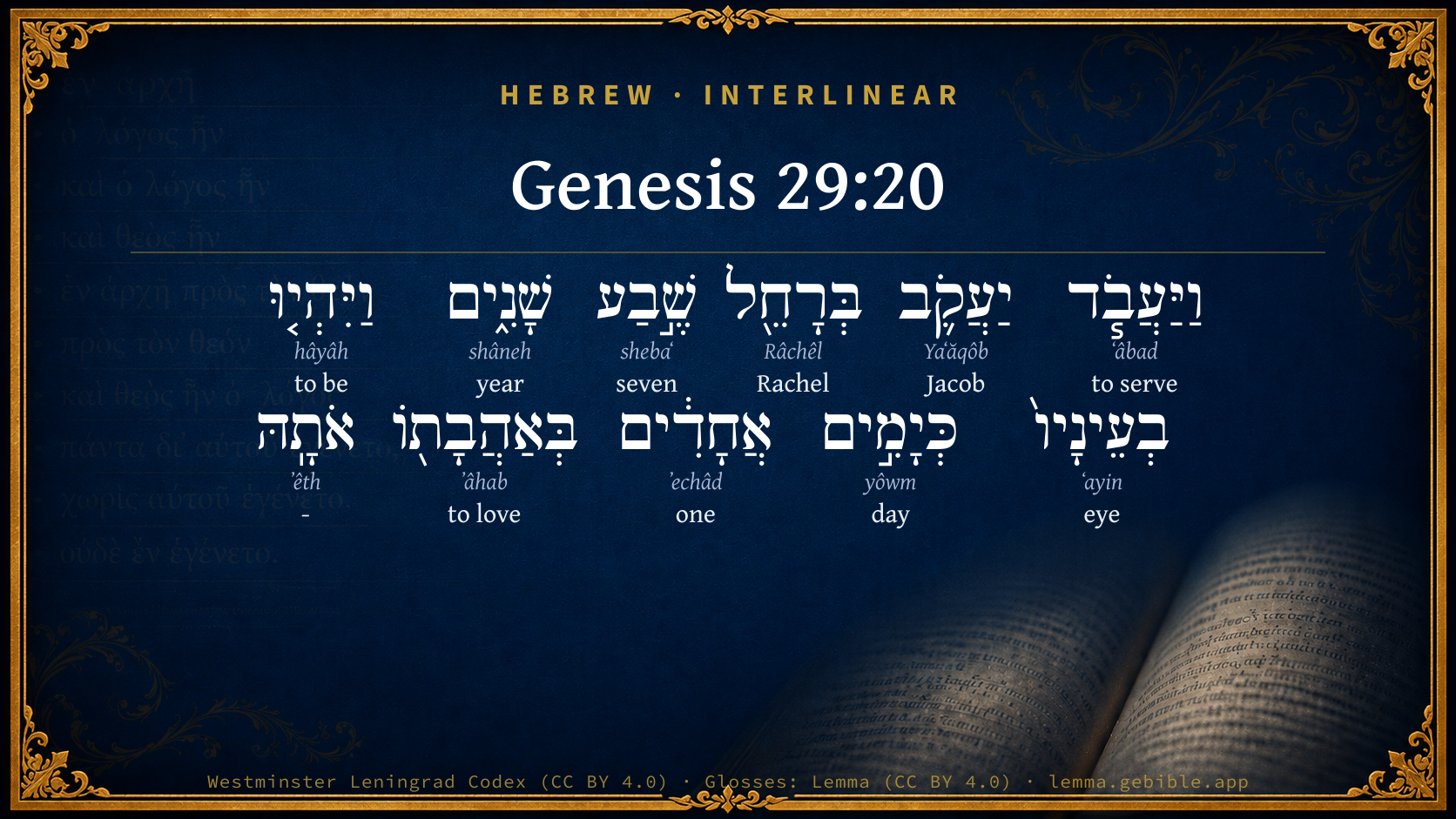
Hebrew (Westminster Leningrad Codex) Genesis 29:20 appears in the Hebrew Old Testament. The text above is from the Westminster Leningrad Codex. Each word links to its Strong’s number, a concise gloss, and parsing drawn from the Open Scriptures Hebrew Bible morphology. Click any word for its full Brown-Driver-Briggs (BDB) entry.
Download image
Cite this verse

Genesis 29:20 (World English Bible). Public Domain. Lemma interlinear Bible study tool, https://lemma.gebible.app/v/genesis/29/20.

Show BibTeX & RIS
BibTeX
RIS
English Translation
Jacob served seven years for Rachel. They seemed to him but a few days, for the love he had for her.
World English Bible · Public Domain
Download a study sheet

One document with this verse’s original text, its word-by-word gloss line, the meaning frame, cross-references with their text, attributed commentary, and full source and license credits — printable, and it pastes into notes with its structure intact.

This verse Autodidact and up

Study sheet (.html) Plain text (.txt)

A passage Seminary Student

Up to 50 verses in one chapter. A passage sheet keeps up to 6 commentary sources and 12 cross-references per verse, in the order this page ranks them, and says so on the sheet whenever that leaves anything out. Ask for a single verse and you get the Autodidact verse sheet above.

Everything on this page stays free to read, with no account — the sheet is a download of what is already on screen, not access to it.

Want to remove ads? Support Godless Engineer
Compare translations 3

The same verse in 3 English versions, stacked beneath the original-language interlinear above. Click any original word for its lexicon entry.

Each is an independent rendering of the whole verse — the interlinear is not word-aligned to these translations.

Highlighted words mark where these versions differ — a whole-verse word diff, not a word-by-word alignment.

  • World English Bible Public Domain
    Jacob served seven years for Rachel. They seemed to him but a few days, for the love he had for her.
  • King James Version Public Domain
    And Jacob served seven years for Rachel; and they seemed unto him but a few days, for the love he had to her.
  • unfoldingWord Literal Text CC BY-SA 4.0
    So Jacob served seven years for Rachel, but in his eyes they were like a few days because of his love for her.

unfoldingWord Literal Text — © unfoldingWord, licensed CC BY-SA 4.0. Word-aligned USFM3 via Door43 (git.door43.org/unfoldingWord/en_ult).

Versions to compare (up to 4)

3 of 4 selected

Show all 18 translations

Every available English version of this verse, each an independent rendering of the whole verse.

  • World English Bible Public Domain
    Jacob served seven years for Rachel. They seemed to him but a few days, for the love he had for her.
  • Berean Standard Bible Public Domain
    So Jacob served seven years for Rachel, yet it seemed but a few days because of his love for her.
  • Majority Standard Bible Public Domain
    So Jacob served seven years for Rachel, yet it seemed but a few days because of his love for her.
  • King James Version Public Domain
    And Jacob served seven years for Rachel; and they seemed unto him but a few days, for the love he had to her.
  • American Standard Version (1901) Public Domain
    And Jacob served seven years for Rachel. And they seemed unto him but a few days, for the love he had to her.
  • Revised Version (1885) Public Domain
    And Jacob served seven years for Rachel; and they seemed unto him but a few days, for the love he had to her.
  • Geneva Bible (1599) Public Domain
    And Iaakob serued seuen yeres for Rahel, and they seemed vnto him but a few dayes, because he loued her.
  • Douay-Rheims (1899) Public Domain
    So Jacob served seven years for Rachel: and they seemed but a few days, because of the greatness of his love.
  • Young's Literal Translation Public Domain
    and Jacob serveth for Rachel seven years; and they are in his eyes as some days, because of his loving her.
  • Literal Standard Version CC BY-SA 4.0
    and Jacob serves for Rachel seven years; and they are in his eyes as some days, because of his loving her.
  • Unlocked Literal Bible CC BY-SA 4.0
    So Jacob served seven years for Rachel; and they seemed to him only a few days, for the love he had for her.
  • unfoldingWord Literal Text CC BY-SA 4.0
    So Jacob served seven years for Rachel, but in his eyes they were like a few days because of his love for her.
  • Darby Bible Public Domain
    And Jacob served seven years for Rachel; and they were in his eyes as single days, because he loved her.
  • World Messianic Bible Public Domain
    Jacob served seven years for Rachel. They seemed to him but a few days, for the love he had for her.
  • Webster's Bible Public Domain
    And Jacob served seven years for Rachel; and they seemed to him but a few days, for the love he had to her.
  • Free Bible Version CC BY-SA 4.0
    Jacob worked for Laban for seven years, but to him they seemed like just a few days because he really loved her.
  • Bible in Basic English Public Domain
    And Jacob did seven years' work for Rachel; and because of his love for her it seemed to him only a very little time.
  • JPS Tanakh (1917) Public Domain
    And Jacob served seven years for Rachel; and they seemed unto him but a few days, for the love he had to her.

Literal Standard Version (2020), Covenant Press — licensed CC BY-SA 4.0. Text via the HelloAO Bible API (eBible.org). Unlocked Literal Bible (unfoldingWord) — licensed CC BY-SA 4.0. Text via the HelloAO Bible API (eBible.org). unfoldingWord Literal Text — © unfoldingWord, licensed CC BY-SA 4.0. Word-aligned USFM3 via Door43 (git.door43.org/unfoldingWord/en_ult). Free Bible Version, Dr. Jonathan Gallagher — licensed CC BY-SA 4.0. Text via the HelloAO Bible API (eBible.org).

Word by word

More ways to search: Search by grammar → Find every occurrence → Compare this word →

Practice this passage: Drill this verse → Learn its vocabulary →

בְּרָחֵ֖ל
Râchêl
H7354
“in/at · Rachel”
Preposition + Noun, Proper
Part of Speech
Preposition + Noun
Type
Proper
Full BDB Definition

Origin: the same as H7353

TWOT: None

Rachel = "ewe" - daughter of Laban, wife of Jacob, and mother of Joseph and Benjamin
  1. וַיַּעֲבֹ֧ד ʻâbad H5647 “and · to serve” Conjunction + Verb, Qal, Sequential Imperfect, 3rd Person, Masculine, Singular
  2. יַעֲקֹ֛ב Yaʻăqôb H3290 “Jacob” Noun, Proper
  3. שֶׁ֣בַע shebaʻ H7651 “seven” Adjective, Cardinal number, Feminine, Singular, Absolute
  4. שָׁנִ֑ים shâneh H8141 “years” Noun, Common, Feminine, Plural, Absolute
  5. וַיִּהְי֤וּ hâyâh H1961 “and · to be” Conjunction + Verb, Qal, Sequential Imperfect, 3rd Person, Masculine, Plural
  6. בְעֵינָיו֙ ʻayin H5869 “in/at · eyes · his” Preposition + Noun, Common, Both, Dual, Construct + Suffix, Personal, 3rd Person, Masculine, Singular
  7. כְּיָמִ֣ים yôwm H3117 “like/as · days” Preposition + Noun, Common, Masculine, Plural, Absolute
  8. אֲחָדִ֔ים ʼechâd H259 “one” Adjective, Cardinal number, Masculine, Plural, Absolute
  9. בְּאַהֲבָת֖וֹ ʼâhab H157 “in/at · love · his” Preposition + Noun, Common, Feminine, Singular, Construct + Suffix, Personal, 3rd Person, Masculine, Singular
  10. אֹתָֽהּ ʼêth H853 “- · her” Particle, Direct Object + Suffix, Personal, 3rd Person, Feminine, Singular

About this verse

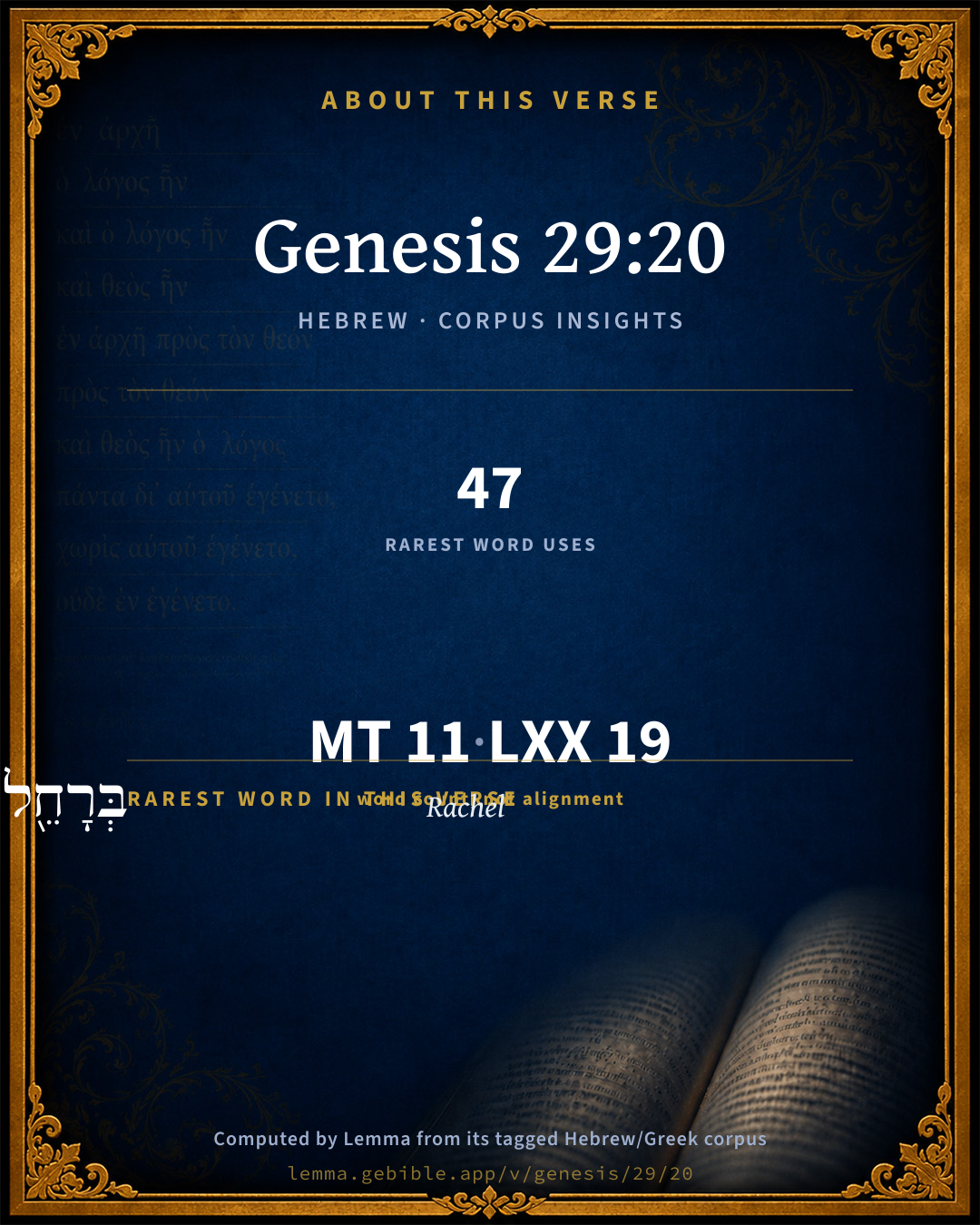
These counts appear in no published source. They are computed here, from the morphology-tagged text and Lemma’s own curated glosses. What Lemma adds →

11
words
11
distinct lemmas
Pentateuch
section

Shared distinctive vocabulary

בְּרָחֵ֖ל Rachel H7354 occurs in 44 verses of the Hebrew Bible. Also found in:

Grammatical profile

  • 2 verbs
  • 6 nouns
  • 2 adjectives
  • 1 particle

Verb forms

  • וַיַּעֲבֹ֧ד Qal · Sequential Imperfect
  • וַיִּהְי֤וּ Qal · Sequential Imperfect

Hebrew & Septuagint length

In English translation the verse runs 21 words from the Hebrew and 22 from the Septuagint (LXX English) — closely comparable.

A rough comparison of the two English renderings, which tokenize alike — not a word-level alignment.

Word counts can differ between the Hebrew and the Greek without any difference in meaning — e.g. the Hebrew direct-object marker אֵת has no separate Greek word, and Greek often adds the article ὁ.

In the original languages it is 11 Hebrew tokens and 19 Greek tokens — but the two are counted differently (Hebrew bundles its prefixes and suffixes into one token; the Greek is in lemma form), so that isn’t a like-for-like length.

Cross-references

7

Topical passages linked to Genesis 29:20 in the Treasury of Scripture Knowledge — connected by theme and wording, ordered by reader-vote popularity; previews shown in the World English Bible.

  • 1 Corinthians 13:7 bears all things, believes all things, hopes all things, endures all things.
  • Hosea 12:12 Jacob fled into the country of Aram, And Israel served to get a wife, And for a wife he tended flocks and herds.
  • Ephesians 5:2 Walk in love, even as Christ also loved you, and gave himself up for us, an offering and a sacrifice to God for a sweet-smelling fragrance.
  • Song of Solomon 8:6–7 Set me as a seal on your heart, As a seal on your arm; For love is strong as death. Jealousy is as cruel as Sheol; Its flashes are flashes of fire, A very flame of Yahweh.
  • Genesis 24:67 Isaac brought her into his mother Sarah's tent, and took Rebekah, and she became his wife. He loved her. Isaac was comforted after his mother's death.
  • Genesis 30:26 Give me my wives and my children for whom I have served you, and let me go: for you know my service with which I have served you."
  • 2 Corinthians 5:14 For the love of Christ constrains us; because we judge thus, that one died for all, therefore all died.

Cross-references courtesy of OpenBible.info (CC BY 4.0).

Hebrew and Greek witnesses Masoretic Hebrew ↔ Greek Septuagint

The same verse in the two great witnesses to the Old Testament, shown verse-for-verse.

These are two independent witnesses, not word-aligned to each other, and the Septuagint is shown in lemma (dictionary) form.

Hebrew Genesis 29:20 Masoretic · Westminster Leningrad Codex

וַיַּעֲבֹ֧ד יַעֲקֹ֛ב בְּרָחֵ֖ל שֶׁ֣בַע שָׁנִ֑ים וַיִּהְי֤וּ בְעֵינָיו֙ כְּיָמִ֣ים אֲחָדִ֔ים בְּאַהֲבָת֖וֹ אֹתָֽהּ

Jacob served seven years for Rachel. They seemed to him but a few days, for the love he had for her.

World English Bible · Public Domain

Greek LXX Genesis 29:20 Septuagint · lemma form

καί δουλεύω ἰακώβ περί ραχηλ ἔτος ἑπτά καί εἰμί ἐναντίον αὐτός ὡς ἡμέρα ὀλίγος παρά ὁ ἀγαπάω αὐτός αὐτός

And Jacob served for Rachel seven years, and they were before him as a few days, by reason of his loving her.

LXX2012 (modern English Septuagint) · Public Domain

Hebrew: Westminster Leningrad Codex (CC BY 4.0). Greek: Septuagint (public domain); English from LXX2012 (modern English Septuagint) (Public Domain). How the Septuagint differs from the Hebrew →

Targum (Aramaic paraphrase)

2

The Targum is the ancient Jewish Aramaic paraphrase of the Hebrew Scriptures — an interpretive translation, not the Hebrew text itself. Onkelos (literal) and Pseudo-Jonathan (expansive) render the Torah, and Jonathan the Prophets. Coverage is partial: where no permissively-licensed English translation exists for a verse, only the Aramaic is shown. This is verse-level text, not a word-by-word alignment to the Hebrew.

  1. Targum Onkelos Torah (Genesis–Deuteronomy)
    וּפְלַח יַעֲקֹב בְּרָחֵל שְׁבַע שְׁנִין וַהֲווֹ בְעֵינוֹהִי כְּיוֹמִין זְעִירִין כַּד רְחֵים יָתַהּ

    (no public-domain English translation for this verse)

    Targum Onkelos — Aramaic: “Onkelos Genesis” (public domain); “Onkelos Exodus” (public domain); “Onkelos Leviticus” (public domain); “Onkelos Numbers” (public domain); “Onkelos Deuteronomy” (public domain). English: “Sefaria Community Translation” (CC0 1.0 (public-domain dedication)); “J.W. Etheridge. The Targums of Onkelos and Jonathan Ben Uzziel on the Pentateuch. London: Longmans, Green, 1862” (public domain). Text via Sefaria.

  2. Targum Pseudo-Jonathan Torah (Genesis–Deuteronomy)
    וּפְלַח יַעֲקב בְּגִין רָחֵל שֵׁב שְׁנִין וַהֲווֹ דַמְיַין בְּעֵינוֹי כְּיוֹמִין קַלִילִין מִדְרָחִים יָתָהּ

    And Jakob served for Rahel seven years; and they seemed in his eyes as a few days, because he loved her.

    Targum Pseudo-Jonathan — Aramaic: “Targum Jonathan on Genesis” (public domain); “Targum Jonathan on Exodus” (public domain); “Targum Jonathan on Leviticus” (public domain); “Targum Jonathan on Numbers” (public domain); “Targum Jonathan on Deuteronomy” (public domain). English: “The Targum of Jonathan ben Uzziel, trans. J. W. Etheridge, London, 1862” (public domain). Text via Sefaria.

Commentary

Notes on Genesis 29:20 from classic Christian and Jewish commentators (each source and its license shown beneath its notes). The classic Christian expositions comment on the surrounding passage and are grouped to its opening verse, so a note may address several verses; the Jewish commentaries on the Tanakh (Rashi and others) are per-verse, so they appear only where the commentator wrote on this verse.

Lemma curates 59 commentaries, every one of them public domain or Creative Commons licensed, each selected and text-cleaned for this edition rather than reprinted as found. About our sources →

Trapp's Complete Commentary

John Trapp

Gen 29:20 And Jacob served seven years for Rachel; and they seemed unto him [but] a few days, for the love he had to her.

Ver. 20. And they seemed unto him but a few days.] And yet lovers’ hours are full of eternity. But love facilitated the service, and made the time seem short. {a} Should anything seem hard or heavy to us, so we may have heaven at length? The affliction is but light and momentary; the glory massive, and for all eternity. Hold out, Faith and Patience. Love is a passion, and seen most in suffering; "much water cannot quench it". {Son 8:7} Nay, like fire, it devours all delays and difficulties, spending and exhaling itself, as it were, in continual wishes to be at home, to be with Christ, which is "far, far the better," (πολλω μαλλον,κρεισσον, Php 1:23). Oh, let the eternal weight of the crown weigh down with us the light and momentary weight of the cross.

{a} Nox longa quibus mentitur amica, diesque longa videtur opus debentibus, et piger annus pupillis.

John Trapp, A Commentary or Exposition upon All the Books of the Old and New Testament (1647–1656) — public domain. Text from a community e-Sword module.

Joseph Benson's Commentary

Gen 29:20. They seemed to him but a few days — That is, the work or service of that time seemed but little in comparison of the worth of Rachel. An age of work will seem but a few days to those that love God, and long for Christ’s appearance.

Joseph Benson's Commentary on the Old and New Testaments (1811–1818) — public domain. Text from a community e-Sword module.

Geneva Bible (1599)

Geneva Bible translators

Meaning, after that the years were accomplished.

Geneva Bible (1599) marginal notes — public domain. Text via Bolls.life.

Adam Clarke's Commentary

Verse 20. And Jacob served seven years for Rachel.] In ancient times it appears to have been a custom among all nations that men should give dowries for their wives; and in many countries this custom still prevails. When Shechem asked Dinah for wife, he said, Ask me never so much - dowry and gift, and I will give according as ye shall say unto me. When Eliezer went to get Rebekah for Isaac, he took a profusion of riches with him, in silver, gold, jewels, and raiment, with other costly things, which, when the contract was made, he gave to Rebekah, her mother, and her brothers. David, in order to be Saul's son-in-law, must, instead of a dowry, kill Goliath; and when this was done, he was not permitted to espouse Michal till he had killed one hundred Philistines. The Prophet Hosea bought his wife for fifteen pieces of silver, and a homer and a half of barley. The same custom prevailed among the ancient Greeks, Indians, and Germans. The Romans also had a sort of marriage entitled per coemptionem, "by purchase." The Tartars and Turks still buy their wives; but among the latter they are bought as a sort of slaves.

Herodotus mentions a very singular custom among the Babylonians, which may serve to throw light on Laban's conduct towards Jacob. "In every district they annually assemble all the marriageable virgins on a certain day; and when the men are come together and stand round the place, the crier rising up sells one after another, always bringing forward the most beautiful first; and having sold her for a great sum of gold, he puts up her who is esteemed second in beauty. On this occasion the richest of the Babylonians used to contend for the fairest wife, and to outbid one another. But the vulgar are content to take the ugly and lame with money; for when all the beautiful virgins are sold, the crier orders the most deformed to stand up; and after he has openly demanded who will marry her with a small sum, she is at length given to the man that is contented to marry her with the least. And in this manner the money arising from the sale of the handsome served for a portion to those whose look was disagreeable, or who had any bodily imperfection. A father was not permitted to indulge his own fancy in the choice of a husband for his daughter; neither might the purchaser carry off the woman which he had bought without giving sufficient security that he would live with her as his own wife. Those also who received a sum of money with such as could bring no price in this market, were obliged also to give sufficient security that they would live with them, and if they did not they were obliged to refund the money." Thus Laban made use of the beauty of Rachel to dispose of his daughter Leah, in the spirit of the Babylonian custom, though not in the letter.

And they seemed unto him but a few days] If Jacob had been obliged to wait seven years before he married Rachel, could it possibly be said that they could appear to him as a few days? Though the letter of the text seems to say the contrary, yet there are eminent men who strongly contend that he received Rachel soon after the month was finished, (see Ge 29:14,) and then served seven years for her, which might really appear but a few days to him, because of his increasing love to her; but others think this quite incompatible with all the circumstances marked down in the text, and on the supposition that Jacob was not now seventy-seven years of age, as most chronologers make him, but only fifty-seven, (See Clarke on Ge 31:55,) there will be time sufficient to allow for all the transactions which are recorded in his history, during his stay with Laban. As to the incredibility of a passionate lover, as some have termed him, waiting patiently for seven years before he could possess the object of his wishes, and those seven years appearing to him as only a few days, it may be satisfactorily accounted for, they think, two ways:

1. He had the continual company of his elect spouse, and this certainly would take away all tedium in the case.

2. Love affairs were not carried to such a pitch of insanity among the patriarchs as they have been in modern times; they were much more sober and sedate, and scarcely ever married before they were forty years of age, and then more for conveniency, and the desire of having an offspring, than for any other purpose.

At the very lowest computation Jacob was now fifty-seven, and consequently must have passed those days in which passion runs away with reason. Still, however, the obvious construction of the text shows that he got Rachel the week after he had married Leah.

Adam Clarke's Commentary on the Bible (1810–1826) — public domain. Text from a community e-Sword/MySword module.

Ellicott's Commentary for English Readers

(20) They seemed unto him but a few days.—Jacob was at least fifty-seven years of age, but the late marriages hitherto of the patriarchs show that they only slowly arrived at manhood. We need not be surprised, then, at the warmth of his affection, nor was it a passing emotion, but lasted all his life through. This, however, is the last of these late marriages; for Jacob’s sons married when young.

A Bible Commentary for English Readers, edited by Charles John Ellicott (1878–1897) — public domain. Text from a community e-Sword module.

The Cambridge Bible for Schools and Colleges

gen. ed. J. J. S. Perowne

20. for the love] These simple and touching words are noticeable for their beauty in a narrative which in many of its details is repulsive to our notions of delicacy.

The Cambridge Bible for Schools and Colleges (gen. ed. J. J. S. Perowne; Cambridge University Press, 1878–1918) — public domain. Text from a community e-Sword module.

John Gill's Exposition

And Jacob served seven years for Rachel,.... The whole term of time, diligently, faithfully, and patiently. Reference is had to this in Hos 11:12,

and they seemed unto him but a few days, for the love he had to her; for though to lovers time seems long ere they enjoy the object beloved; yet Jacob here respects not so much the time as the toil and labour of service he endured in it; he thought that seven years' service was a trifle, like the service of so many days, in comparison of the lovely and worthy person he obtained thereby; all that he endured was nothing in comparison of her, and through the love he bore to her: besides, the many pleasant hours he spent in conversation with her made the time slide on insensibly, so that it seemed to be quickly gone; which shows that his love was pure and constant.

John Gill's Exposition of the Whole Bible (1746–1763) — public domain (CC PDM 1.0). Text via the HelloAO Bible API.

Haydock's Catholic Bible Commentary

For Rachel. It was then the custom to buy or to pay a dowry for a wife. (chap. xxxiv. 12; Osee iii. 2.) Herodotus says, i. 196, that the Babylonians sold their beautiful women as high as possible, and gave part of the price to help off the more deformed. The Turks do the like. (Calmet) --- A few, &c. So highly did he esteem Rachel, that he thought he had obtained her for just nothing, though delays naturally seem long to lovers. (Tirinus) --- Calmet supposes that he was married to her the second month after he arrived at Haran; and on this account, easily explains his words, as love made all labour tolerable, and even easy, in the enjoyment of the beautiful Rachel. Usher also places the birth of Ruben in the first year of Jacob’s service, A. 2246 [in the year of the world 2246]. But Salien and the context decide, that he waited full seven years, and then obtained Lia, by fraud, of Laban; and seven days after, Rachel. (Haydock) --- He was then 84 years old! (Du Hamel)

George Leo Haydock (1774–1849), Haydock's Catholic Family Bible and Commentary, 1859 edition — public domain. Excludes Psalms (Douay-Rheims chapter numbering differs from Protestant) and Deuterocanonical books (Catholic canon only).

Matthew Poole's English Annotations

He speaks not of the time, which in such cases seems long, Pr 13:12, but of the service of that time, which seemed but little, and far below the worth of Rachel.

Matthew Poole's English Annotations on the Holy Bible (1683–1685) — public domain. Text from a community e-Sword/MySword module.

Whedon's Commentary on the Bible

Daniel D. Whedon

20. They seemed unto him but a few days — “Words breathing the purest tenderness, and expressing more emphatically than the flowery hyperboles of romantic phraseology the deep attachment of an affectionate heart. Love capable of shortening seven laborious years into a term of insignificant brevity, is a flame animating and purifying the soul; a sacred longing, forming its own delight and happiness.” — Kalisch.

Daniel D. Whedon (gen. ed.), Commentary on the Old and New Testaments (1874–1909) — public domain. Text from a community e-Sword module.

The Pulpit Commentary

And Jacob served hard service, (Gen_31:40, Gen_31:41) in keeping sheep (Hos_12:12) seven years for Rachel. The purity and intensity of Jacob"s affection was declared not alone by the proposal of a seven years" term of servitude, a long period of waiting for a man of fifty-seven, if not seventy-seven, years of age, but also by the spirit in which he served his avaricious relative. Many as the days were that required to intervene before he obtained possession of his bride, they were rendered happy by the sweet society of Rachel. And they seemed unto him but a few days, for the love he had to her. "Words breathing the purest tenderness, and expressing more emphatically than the flowery hyperboles of romantic phraseology the deep attachment of an affectionate heart" (Kalisch); words too which show the lofty appreciation Jacob had of the personal worth of his future bride.

HOMILIES BY R.A. REDFORD Ver. 20.

The power of true affection.

"And Jacob served seven years for Rachel," &c. ;

I THE INWARD SPRING OF THE OUTWARD LIFE. Power of the heart over the will, over the circumstances, over flesh. Time measured by the motions of our thought. The world needs to be taught that the material rests on the immaterial.

II THE SERVICE OF LOVE THE CONSECRATION AND CONSUMMATION OF HUMAN ENERGY. Christ the highest object of affection. The life of his servant compared with the life of selfish caprice.

III THE GREAT EXAMPLE OF LOVE SUGGESTED. Jacob a type of Christ; Rachel, of his Church. He served for her. His love made obedience, even unto death, his delight.

IV SPECIAL TRIAL HAS ITS SPECIAL REWARD. Jacob served doubly for Rachel; but his service was amply paid afterwards, although for a time the veil of disappointment hid the purpose of God. While Leah, as the mother of Judah, was the true ancestress of Messiah, still it was in Joseph, the son of Rachel, that Jacob"s heart was satisfied, and that the history of the kingdom of God was most manifestly carried on and its glory set forth. As in the case of Sarah and Rebekah, so in that of Rachel, the birth of the representative seed is connected with special bestowments of grace. R.

HOMILIES BY J.F. MONTGOMERY Ver. 20.

Christ"s love for the Church.

"And Jacob served seven years for Rachel." On the surface this is a step in Jacob"s training, in the fulfillment of God"s promise at Bethel. It shows a new feature in his character. We see not the man of cunning devices, but one full of pure, self-sacrificing love. Fourteen years of service willingly given to purchase, according to Eastern custom, his bride. But Jacob"s love suggests the deeper and purer love of Christ for the Church. Rachel a type of the Bride; a shepherdess and "fairest among women"; (Son_1:7, Son_1:8) sharer of the sufferings of the Church (Mat_2:18; Rev_2:17) For the Church"s sake (Eph_5:25) Christ served"; (Php_2:7) became a Shepherd; (Joh_10:11) with his service and life-blood, "obedient unto death," he purchased her, (Act_20:28) to unite her to himself forever.

I THE LORD "SERVED" BECAUSE HE LOVED HIS CHURCH. In condescending to unite himself with human nature; in bearing the infirmities of childhood and state of subjection; in bearing the contradiction of sinners and the wrath of God. And still in standing and knocking; (Rev_3:20) in bearing with half-hearted believers; (2Pe_3:9) in pleading with and for the wayward; (1Jn_2:1 2Co_5:20) in seeking and following individual sheep. The love which led tothis was free, not deserved or purchased. Rachel brought no dowry to Jacob. The Church has of its own no spiritual wealth (Isa_64:6; Rom_3:23) The Bridegroom had to sanctify and cleanse it. By nature unholy, at variance with God"s will; yet, knowing this, he loved it. (Rom_8:35) For love to Rachel Jacob gave the labor of fourteen years. For the Church Christ grudged nothing gave himself. Sacrifice a mark of true love. How many will not sacrifice anything will not leave a gain, a companion, an amusement to "win Christ." In the garden his human nature shrank from the bitterness of the cup, but he persevered. Why?

II THE LORD "SERVED" THAT HE MIGHT UNITE US TO HIMSELF. Marriage, the closest earthly tie, used as a type. No mere removal of condemnation satisfied that love, nor even our being made happy; he became such as we are, that we might become such as he is. The Church is his Bride (Eph_5:27; Rev_21:9) sharer of his kingdom, (Rev_3:21 Rev_20:4) of his blessedness and glory. (Joh_17:22-24) And this belongs to its humblest and weakest member. A union in this life (Son_2:16; Joh_15:4) peace in committingall cares to him, even our own steadfastness (Joh_10:28; Heb_13:6) A union after our departure more close. (Php_1:23) Here we see dimly. (1Co_13:12) The conditions of mortal life hinder clear visions, (Exo_33:20) The law of sin in our members hinders perfect union. Then no impediment (Luk_23:43) Union perfected after the resurrection. (1Th_4:7) The body, which now limits conscious union, shall then minister to its completeness. Not till then shall we be perfectly like him in his human nature.

III HE "SERVED" THAT WE MIGHT HAVE CONFIDENCE IN HIS LOVE. Jacob"s love not shaken by time, or by the deceit practiced upon him, a type of Christ"s. Often forgetful, often faithless, we might well think, How dare I trust to a love so often neglected? But his love is not wearied. (Isa_49:15) He has graven us with the nail-prints on his hands. His word is still, "Look unto me;" trust my love. M. (Psa_37:5)

The Pulpit Commentary (1880–1919), ed. H.D.M. Spence-Jones & Joseph S. Exell — public domain. Text from a community e-Sword module.

John Wesley's Explanatory Notes

They seemed to him but a few days for the love he had to her - An age of work will be but as a few days to those that love God, and long for Christ's appearing.

John Wesley, Explanatory Notes Upon the Whole Bible (1754–1765) — public domain. Text via the GEBible commentary corpus.

Lesson kit

Teaching starters — assembled from the data on this page, not authored interpretation. Every prompt links to the verse data it draws on. Edit before teaching.

Genesis, in the Pentateuch, opens this verse with 11 words (11 distinct Hebrew lemmas). Its most distinctive word is Râchêl (“Rachel”). A historical commentator’s framing appears above. Read the whole chapter for the surrounding context.

Discussion questions

  1. The word Râchêl carries the sense “Rachel.” How does it shape the verse?
  2. How does Genesis 29:6, which shares the word «Rachel», read alongside this verse?
  3. The translations on this page render this verse differently — a whole-verse word diff, not a word-by-word alignment. What might account for the different wordings?
  4. «וַיַּעֲבֹ֧ד» is a Qal Sequential Imperfect verb. How does that grammatical form shape the action described?
  5. Compare how Trapp's Complete Commentary and Joseph Benson's Commentary read this verse. Where do they agree or differ?

Things to notice

Reading settings

Reading text

Shown beneath each verse's original-language words.

Old Testament
Old Testament edition

Read the OT as the Masoretic Hebrew (MT) or the Greek Septuagint (LXX).

English shown for the Greek Septuagint (in the Hebrew ↔ Greek comparison).

Comparing translations? Open the Compare panel on any verse page to stack up to four side by side.