Genesis 41:4

Hebrew (Westminster Leningrad Codex) Genesis 41:4 appears in the Hebrew Old Testament. The text above is from the Westminster Leningrad Codex. Each word links to its Strong’s number, a concise gloss, and parsing drawn from the Open Scriptures Hebrew Bible morphology. Click any word for its full Brown-Driver-Briggs (BDB) entry.
Download image
Cite this verse

Genesis 41:4 (World English Bible). Public Domain. Lemma interlinear Bible study tool, https://lemma.gebible.app/v/genesis/41/4.

Show BibTeX & RIS
BibTeX
RIS
English Translation
The ill-favored and lean-fleshed cattle ate up the seven well-favored and fat cattle. So Pharaoh awoke.
World English Bible · Public Domain
Download a study sheet

One document with this verse’s original text, its word-by-word gloss line, the meaning frame, cross-references with their text, attributed commentary, and full source and license credits — printable, and it pastes into notes with its structure intact.

This verse Autodidact and up

Study sheet (.html) Plain text (.txt)

A passage Seminary Student

Up to 50 verses in one chapter. A passage sheet keeps up to 6 commentary sources and 12 cross-references per verse, in the order this page ranks them, and says so on the sheet whenever that leaves anything out. Ask for a single verse and you get the Autodidact verse sheet above.

Everything on this page stays free to read, with no account — the sheet is a download of what is already on screen, not access to it.

Want to remove ads? Support Godless Engineer
Compare translations 3

The same verse in 3 English versions, stacked beneath the original-language interlinear above. Click any original word for its lexicon entry.

Each is an independent rendering of the whole verse — the interlinear is not word-aligned to these translations.

Highlighted words mark where these versions differ — a whole-verse word diff, not a word-by-word alignment.

  • World English Bible Public Domain
    The ill-favored and lean-fleshed cattle ate up the seven well-favored and fat cattle. So Pharaoh awoke.
  • King James Version Public Domain
    And the ill favored and leanfleshed kine did eat up the seven well favored and fat kine. So Pharaoh awoke.
  • unfoldingWord Literal Text CC BY-SA 4.0
    Then the ugly-looking and thin-fleshed cows ate the seven fine-looking and fat cows, and Pharaoh woke up.

unfoldingWord Literal Text — © unfoldingWord, licensed CC BY-SA 4.0. Word-aligned USFM3 via Door43 (git.door43.org/unfoldingWord/en_ult).

Versions to compare (up to 4)

3 of 4 selected

Show all 18 translations

Every available English version of this verse, each an independent rendering of the whole verse.

  • World English Bible Public Domain
    The ill-favored and lean-fleshed cattle ate up the seven well-favored and fat cattle. So Pharaoh awoke.
  • Berean Standard Bible Public Domain
    And the cows that were sickly and thin devoured the seven sleek, well-fed cows. Then Pharaoh woke up,
  • Majority Standard Bible Public Domain
    And the cows that were sickly and thin devoured the seven sleek, well-fed cows. Then Pharaoh woke up,
  • King James Version Public Domain
    And the ill favored and leanfleshed kine did eat up the seven well favored and fat kine. So Pharaoh awoke.
  • American Standard Version (1901) Public Domain
    And the ill-favored and lean-fleshed kine did eat up the seven well-favored and fat kine. So Pharaoh awoke.
  • Revised Version (1885) Public Domain
    And the ill favoured and leanfleshed kine did eat up the seven well favoured and fat kine. So Pharaoh awoke.
  • Geneva Bible (1599) Public Domain
    And the euilfauoured and leane fleshed kine did eate vp the seuen welfauoured and fatte kine: so Pharaoh awoke.
  • Douay-Rheims (1899) Public Domain
    And they devoured them, whose bodies were very beautiful and well conditioned. So Pharao awoke.
  • Young's Literal Translation Public Domain
    and the kine of bad appearance and lean `in' flesh eat up the seven kine of fair appearance, and fat -- and Pharaoh awaketh.
  • Literal Standard Version CC BY-SA 4.0
    and the cows of bad appearance and lean [in] flesh eat up the seven cows of beautiful appearance, and fat—and Pharaoh awakens.
  • Unlocked Literal Bible CC BY-SA 4.0
    Then the undesirable and thin cows ate the seven desirable and fat cows. Then Pharaoh woke up.
  • unfoldingWord Literal Text CC BY-SA 4.0
    Then the ugly-looking and thin-fleshed cows ate the seven fine-looking and fat cows, and Pharaoh woke up.
  • Darby Bible Public Domain
    And the kine that were bad-looking and lean-fleshed ate up the seven kine that were fine-looking and fat. And Pharaoh awoke.
  • World Messianic Bible Public Domain
    The ugly and thin cattle ate up the seven sleek and fat cattle. So Pharaoh awoke.
  • Webster's Bible Public Domain
    And the ill-favored and lean-fleshed cows ate up the seven well-favored and fat cows. So Pharaoh awoke.
  • Free Bible Version CC BY-SA 4.0
    Then the ugly, skinny cows ate the well-fed, healthy cows. Then Pharaoh woke up.
  • Bible in Basic English Public Domain
    And the seven thin cows made a meal of the seven fat cows. Then Pharaoh came out of his sleep.
  • JPS Tanakh (1917) Public Domain
    And the ill-favoured and lean-fleshed kine did eat up the seven well-favoured and fat kine. So Pharaoh awoke.

Literal Standard Version (2020), Covenant Press — licensed CC BY-SA 4.0. Text via the HelloAO Bible API (eBible.org). Unlocked Literal Bible (unfoldingWord) — licensed CC BY-SA 4.0. Text via the HelloAO Bible API (eBible.org). unfoldingWord Literal Text — © unfoldingWord, licensed CC BY-SA 4.0. Word-aligned USFM3 via Door43 (git.door43.org/unfoldingWord/en_ult). Free Bible Version, Dr. Jonathan Gallagher — licensed CC BY-SA 4.0. Text via the HelloAO Bible API (eBible.org).

Word by word

More ways to search: Search by grammar → Find every occurrence → Compare this word →

Practice this passage: Drill this verse → Learn its vocabulary →

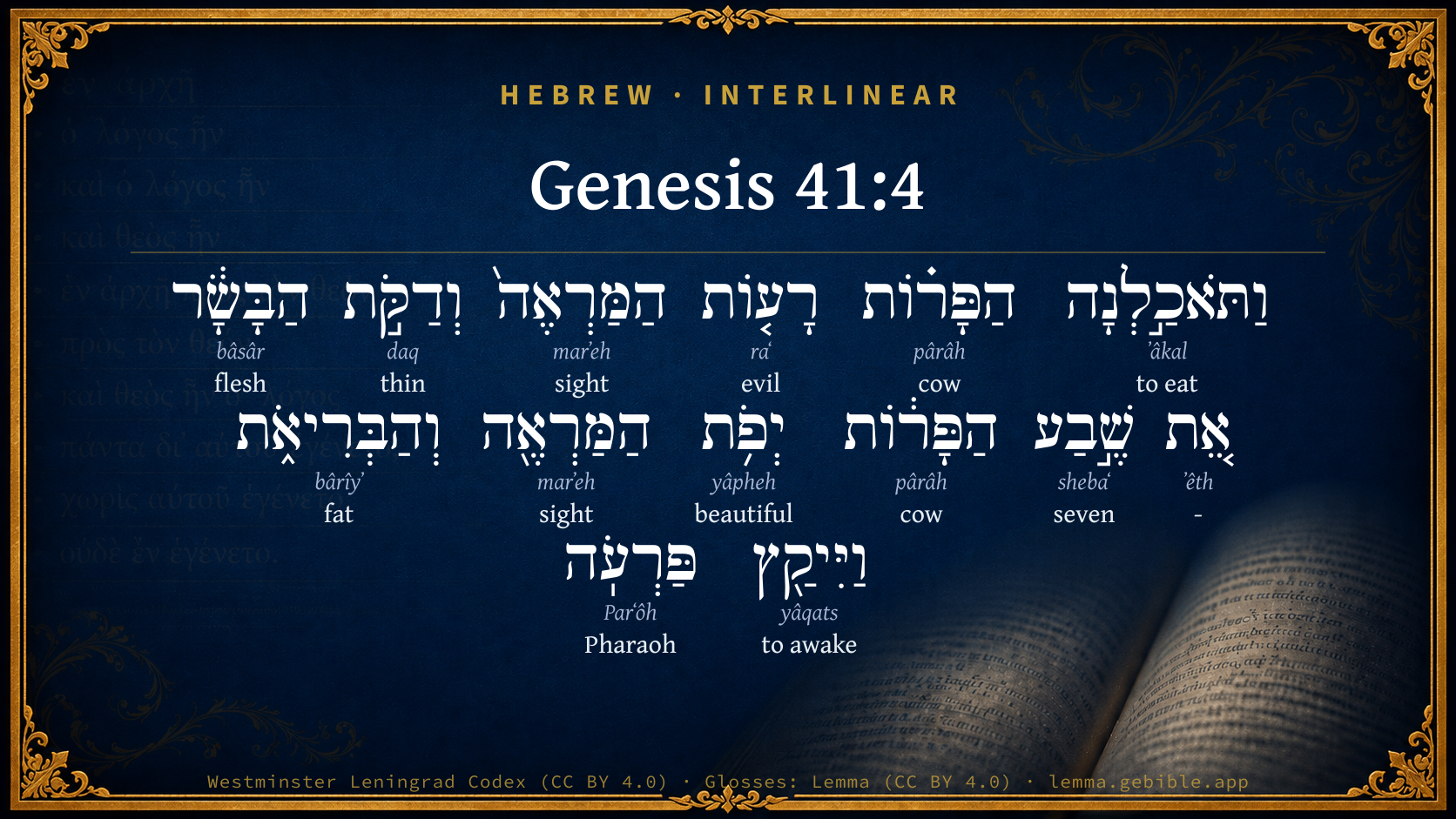
וַיִּיקַ֖ץ
yâqats
H3364
“and · to awake”
Conjunction + Verb, Qal, Sequential Imperfect, 3rd Person, Masculine, Singular
Part of Speech
Conjunction + Verb
Stem
Qal
Form
Sequential Imperfect
Person
3rd Person
Gender
Masculine
Number
Singular
Full BDB Definition

Origin: a primitive root

TWOT: 904

(Qal) to awake, awaken, become active
  1. וַתֹּאכַ֣לְנָה ʼâkal H398 “and · to eat” Conjunction + Verb, Qal, Sequential Imperfect, 3rd Person, Feminine, Plural
  2. הַפָּר֗וֹת pârâh H6510 “the · cows” Particle, Definite Article + Noun, Common, Feminine, Plural, Absolute
  3. רָע֤וֹת raʻ H7451 “evil of” Adjective, Adjective, Feminine, Plural, Construct
  4. הַמַּרְאֶה֙ marʼeh H4758 “the · sight” Particle, Definite Article + Noun, Common, Masculine, Singular, Absolute
  5. וְדַקֹּ֣ת daq H1851 “and · thin of” Conjunction + Adjective, Adjective, Feminine, Plural, Construct
  6. הַבָּשָׂ֔ר bâsâr H1320 “the · flesh” Particle, Definite Article + Noun, Common, Masculine, Singular, Absolute
  7. אֵ֚ת ʼêth H853 “-” Particle, Direct Object
  8. שֶׁ֣בַע shebaʻ H7651 “seven” Adjective, Cardinal number, Feminine, Singular, Absolute
  9. הַפָּר֔וֹת pârâh H6510 “the · cows” Particle, Definite Article + Noun, Common, Feminine, Plural, Absolute
  10. יְפֹ֥ת yâpheh H3303 “beautiful of” Adjective, Adjective, Feminine, Plural, Construct
  11. הַמַּרְאֶ֖ה marʼeh H4758 “the · sight” Particle, Definite Article + Noun, Common, Masculine, Singular, Absolute
  12. וְהַבְּרִיאֹ֑ת bârîyʼ H1277 “and · the · fat” Conjunction + Particle, Definite Article + Adjective, Adjective, Feminine, Plural, Absolute
  13. פַּרְעֹֽה Parʻôh H6547 “Pharaoh” Noun, Proper

About this verse

These counts appear in no published source. They are computed here, from the morphology-tagged text and Lemma’s own curated glosses. What Lemma adds →

14
words
12
distinct lemmas
Pentateuch
section

Notable vocabulary

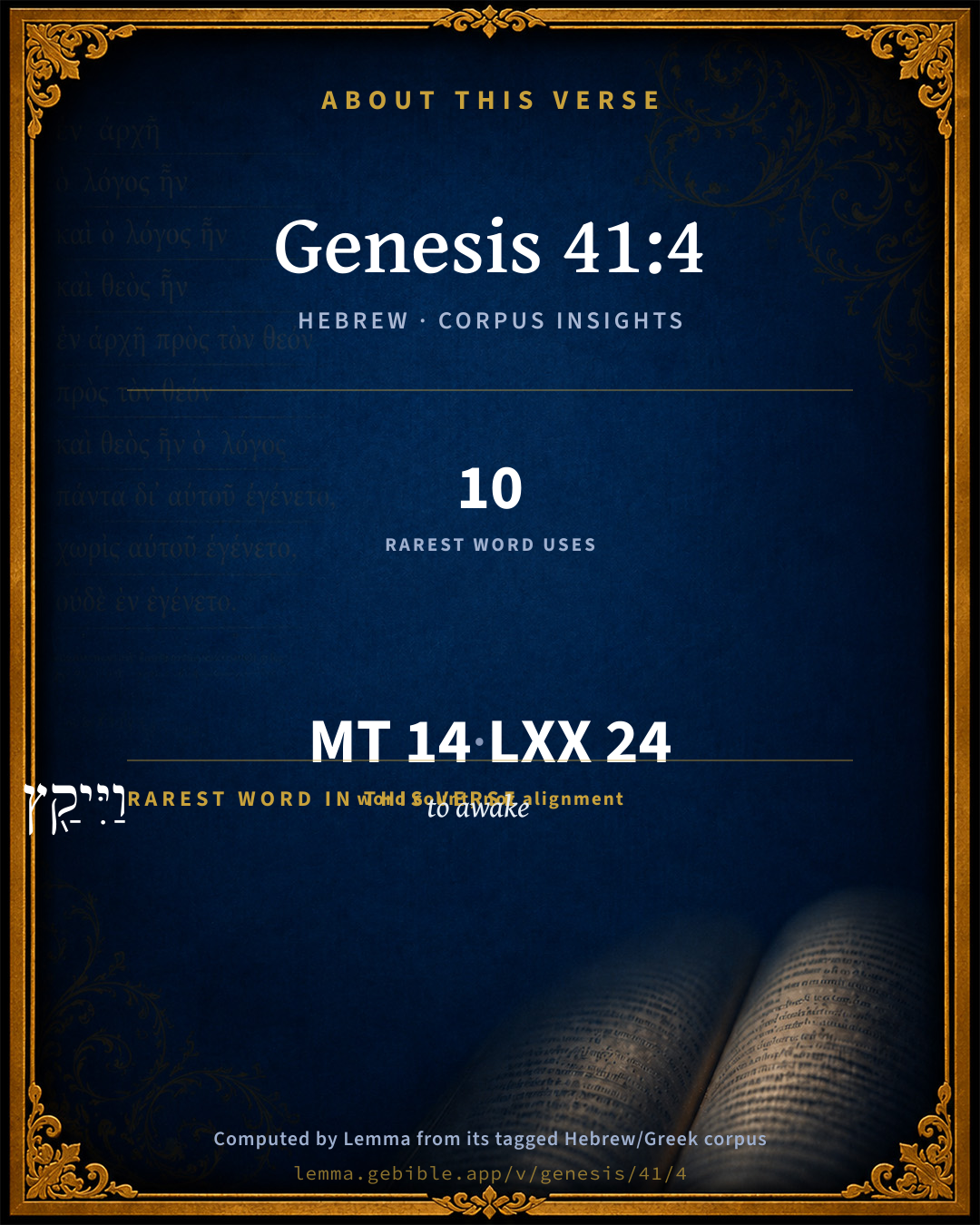
The rarest word here is וַיִּיקַ֖ץ to awake H3364 — appearing just 10 times in the whole Hebrew Bible.

Shared distinctive vocabulary

וַיִּיקַ֖ץ to awake H3364 occurs in 10 verses of the Hebrew Bible. Also found in:

Grammatical profile

  • 2 verbs
  • 6 nouns
  • 5 adjectives
  • 1 particle

Verb forms

  • וַתֹּאכַ֣לְנָה Qal · Sequential Imperfect
  • וַיִּיקַ֖ץ Qal · Sequential Imperfect

Repetition

Words recur within this verse — often emphatic in Hebrew:

  • הַפָּר֗וֹת cow H6510 ×2
  • הַמַּרְאֶה֙ sight H4758 ×2

Hebrew & Septuagint length

In English translation the verse runs 16 words from the Hebrew and 17 from the Septuagint (LXX English) — closely comparable.

A rough comparison of the two English renderings, which tokenize alike — not a word-level alignment.

Word counts can differ between the Hebrew and the Greek without any difference in meaning — e.g. the Hebrew direct-object marker אֵת has no separate Greek word, and Greek often adds the article ὁ.

In the original languages it is 14 Hebrew tokens and 24 Greek tokens — but the two are counted differently (Hebrew bundles its prefixes and suffixes into one token; the Greek is in lemma form), so that isn’t a like-for-like length.

Cross-references

1

Topical passages linked to Genesis 41:4 in the Treasury of Scripture Knowledge — connected by theme and wording, ordered by reader-vote popularity; previews shown in the World English Bible.

  • 1 Kings 3:15 Solomon awoke; and, behold, it was a dream: and he came to Jerusalem, and stood before the ark of the covenant of Yahweh, and offered up burnt offerings, and offered peace-offerings, and made a feast to all his servants.

Cross-references courtesy of OpenBible.info (CC BY 4.0).

Hebrew and Greek witnesses Masoretic Hebrew ↔ Greek Septuagint

The same verse in the two great witnesses to the Old Testament, shown verse-for-verse.

These are two independent witnesses, not word-aligned to each other, and the Septuagint is shown in lemma (dictionary) form.

Hebrew Genesis 41:4 Masoretic · Westminster Leningrad Codex

וַתֹּאכַ֣לְנָה הַפָּר֗וֹת רָע֤וֹת הַמַּרְאֶה֙ וְדַקֹּ֣ת הַבָּשָׂ֔ר אֵ֚ת שֶׁ֣בַע הַפָּר֔וֹת יְפֹ֥ת הַמַּרְאֶ֖ה וְהַבְּרִיאֹ֑ת וַיִּיקַ֖ץ פַּרְעֹֽה

The ill-favored and lean-fleshed cattle ate up the seven well-favored and fat cattle. So Pharaoh awoke.

World English Bible · Public Domain

Greek LXX Genesis 41:4 Septuagint · lemma form

καί καταἐσθίω ὁ ἑπτά βοῦς ὁ αἰσχρός καί λεπτός ὁ σάρξ ὁ ἑπτά βοῦς ὁ καλός ὁ εἶδος καί ὁ ἐκλεκτός ἐγείρω δέ φαραώ

And the seven ill-favoured and lean cows devoured the seven well-favoured and choice-fleshed cows; and Pharao awoke.

LXX2012 (modern English Septuagint) · Public Domain

Hebrew: Westminster Leningrad Codex (CC BY 4.0). Greek: Septuagint (public domain); English from LXX2012 (modern English Septuagint) (Public Domain). How the Septuagint differs from the Hebrew →

Targum (Aramaic paraphrase)

2

The Targum is the ancient Jewish Aramaic paraphrase of the Hebrew Scriptures — an interpretive translation, not the Hebrew text itself. Onkelos (literal) and Pseudo-Jonathan (expansive) render the Torah, and Jonathan the Prophets. Coverage is partial: where no permissively-licensed English translation exists for a verse, only the Aramaic is shown. This is verse-level text, not a word-by-word alignment to the Hebrew.

  1. Targum Onkelos Torah (Genesis–Deuteronomy)
    וַאֲכָלַן תּוֹרְתָּא בִּישָׁן לְמֶחֱזֵי וַחֲסִירַן בְּשַׂר יָת שְׁבַע תּוֹרְתָּא שַׁפִּירָן לְמֶחֱזֵי וּפַטִּימָתָא וְאִתְּעַר פַּרְעֹה

    (no public-domain English translation for this verse)

    Targum Onkelos — Aramaic: “Onkelos Genesis” (public domain); “Onkelos Exodus” (public domain); “Onkelos Leviticus” (public domain); “Onkelos Numbers” (public domain); “Onkelos Deuteronomy” (public domain). English: “Sefaria Community Translation” (CC0 1.0 (public-domain dedication)); “J.W. Etheridge. The Targums of Onkelos and Jonathan Ben Uzziel on the Pentateuch. London: Longmans, Green, 1862” (public domain). Text via Sefaria.

  2. Targum Pseudo-Jonathan Torah (Genesis–Deuteronomy)
    וְאָכְלָא תוֹרָתֵי דְבִישִׁין לְמֵיחְמֵי וַחֲסִירָן בְּבִשְרֵהוֹן יַת שְׁבַע תּוֹרָתֵי דְשַׁפִּירָן לְמֶחֱמֵי וּפַטִימָתָא וְאִתְעַר פַּרְעה מִדַמְכֵיהּ

    And the evil-looking and lean-fleshed oxen devoured the seven good-looking and fat. And Pharoh awoke from his sleep.

    Targum Pseudo-Jonathan — Aramaic: “Targum Jonathan on Genesis” (public domain); “Targum Jonathan on Exodus” (public domain); “Targum Jonathan on Leviticus” (public domain); “Targum Jonathan on Numbers” (public domain); “Targum Jonathan on Deuteronomy” (public domain). English: “The Targum of Jonathan ben Uzziel, trans. J. W. Etheridge, London, 1862” (public domain). Text via Sefaria.

Commentary

Notes on Genesis 41:4 from classic Christian and Jewish commentators (each source and its license shown beneath its notes). The classic Christian expositions comment on the surrounding passage and are grouped to its opening verse, so a note may address several verses; the Jewish commentaries on the Tanakh (Rashi and others) are per-verse, so they appear only where the commentator wrote on this verse.

Lemma curates 59 commentaries, every one of them public domain or Creative Commons licensed, each selected and text-cleaned for this edition rather than reprinted as found. About our sources →

Trapp's Complete Commentary

John Trapp

Gen 41:4 And the ill favoured and leanfleshed kine did eat up the seven well favoured and fat kine. So Pharaoh awoke.

Ver. 4. Did eat up the seven, &c.] In famine is not only outward want, but a greedy dog-like appetite within (Bουλιμια, appetitas caninus), that an ordinary meal sufficeth not, {Isa 9:20} but men are ready to eat one another: as they did at Potidea, in the Peloponnesian war; at Utica, when it was besieged by Hamilcar the father of Hannibal; at Jerusalem, when it was beleaguered by Vespasian; at Tunis, in the African war, when the soldiers were tithed, that is, every tenth man was cut in pieces and devoured. Such a famine there was at Rome in the days of Honorius the Emperor, that they were ready to eat one another; and this voice was heard in the place of public meeting, Pone precium humanae carni. At Antioch in Syria, many of the Christians, in the holy war, through famine, devoured the dead bodies of their recently slain enemies. At the siege of Scodra, they were well-nigh put to this extremity, when horses were dainty meat; yea, they were glad to eat dogs, cats, rats, and the skins of beasts sod. It exceedeth all credit, to tell at what exceeding great price a little mouse was sold, or puddings made of dogs’ guts. {a} And if our relations deceived us not, such things as these we heard of lately, to have happened in Germany. Alterius perditio, tua cautio. Seest thou another man perish? see to thyself.

{a} Thucyd.; Polyb.; Joseph.; Manlii., loc. com. 278; Alsted., Chronol., p. 300; Turk. Hist., fol. 18, 426.

John Trapp, A Commentary or Exposition upon All the Books of the Old and New Testament (1647–1656) — public domain. Text from a community e-Sword module.

The Cambridge Bible for Schools and Colleges

gen. ed. J. J. S. Perowne

4. did eat up] The fantastic side of the dream. Cf. Gen_40:11; Gen_40:17.

The Cambridge Bible for Schools and Colleges (gen. ed. J. J. S. Perowne; Cambridge University Press, 1878–1918) — public domain. Text from a community e-Sword module.

John Gill's Exposition

And the ill favoured and leanfleshed kine did eat up the seven well favoured and fat kine,.... So it seemed in the dream as if this was done, was very strange and surprising that animals should devour one another; and especially that tame ones, cows or heifers, should eat those of their own species, which was never known to be done:

so Pharaoh awoke; through surprise at the strange sight he had in his dream.

John Gill's Exposition of the Whole Bible (1746–1763) — public domain (CC PDM 1.0). Text via the HelloAO Bible API.

The Pulpit Commentary

And the ill-favored and lean fleshed kine did eat up the seven we favored and fat kine without there being any effect to show that they had eaten them (ver. 21). So (literally, and) Pharaoh awoke.

The Pulpit Commentary (1880–1919), ed. H.D.M. Spence-Jones & Joseph S. Exell — public domain. Text from a community e-Sword module.

unfoldingWord translationNotes

Door43 World Missions Community

undesirable and thin

"weak and skinny." See how you translated this phrase in Genesis 41:3.

desirable and fat

"healthy and well-fed." See how you translated this phrase in Genesis 41:2.

woke up

"awakened"

a second time

The word "second" is an ordinal number. AT: "again" (See: Ordinal Numbers)

Behold, seven heads

The word "behold" here shows that Pharaoh was surprised by what he saw.

heads of grain

The heads are parts of the corn plant on which the seeds grow.

came up on one stalk

"grew up on one stem." The stalk is the thick or tall part of a plant.

on one stalk, wholesome and good

"on one stock and they were healthy and beautiful"

thin and scorched by the east wind

This can be stated in active form. AT: "that were thin and burned because of the hot wind from the east" (See: Active or Passive)

the east wind

Wind from the east blew in from the desert. The heat of the east wind was often very destructive.

sprouted up

"grew up" or "developed"

translationWords

cow

Pharaoh

dream

grain

unfoldingWord translationNotes — © Distant Shores Media and the Door43 World Missions Community, licensed CC BY-SA 4.0. Source: git.door43.org/Door43/en_tn.

Rashi

Rabbi Shlomo Yitzchaki (Rashi)

ותאכלנה AND THEY ATE — indicating that all the joy occasioned by the years of plenty would be forgotten in the days of famine.

Rashi on the Tanakh — English translations: “The Judaica Press complete Tanach with Rashi, translated by A. J. Rosenberg” (CC BY 4.0); “Pentateuch with Rashi's commentary by M. Rosenbaum and A.M. Silbermann, 1929-1934” (public domain); “The Metsudah Tanach series, Lakewood, N.J” (CC BY 4.0); and “The Book of Joshua, Metsudah Publications, 1997” (CC BY 4.0). Text via Sefaria.

Ramban (Nachmanides)

Rabbi Moshe ben Nachman (Ramban / Nachmanides)

AND THE COWS ATE UP. In my opinion this is a sign that the years of famine shall consume the years of plenty. It is from this that Joseph inferred that he should tell Pharaoh, And let them store up all the food of those good years, And the food shall serve as a reserve for the land against the seven years of famine, as he saw that the healthy cows and ears of corn were absorbed by the lean ones. This was no mere counsel which Joseph proposed, for was he appointed to be a counselor of the king? It was only in connection with the interpretation of the dream that he said thus: And the plenty shall be forgotten, And the plenty shall not be known. These words of Joseph constitute the interpretation of: It could not be known that they had eaten them up, their appearance being bad as previously, for Joseph saw that by their consumption of the fat cows, the lean ones did not become fine and plump. They served them for subsistence only, for had they not eaten them they would have died in their lean state. This is unlike Rashi, who says that the plenty shall be forgotten is the interpretation of the eating itself., are the interpretation of the aspect of the dream expressed by: It could not be known that they had eaten them up.

Ramban (Nachmanides) on the Tanakh — English translation: “Commentary on the Torah by Ramban (Nachmanides). Translated and annotated by Charles B. Chavel. New York, Shilo Pub. House, 1971-1976” (CC BY 4.0). Text via Sefaria.

Radak

Rabbi David Kimhi (Radak)

ותאכלנה, this is the explanation of the strange behaviour of the seven lean cows, i.e. that during the seven years of famine the seven good years of plenty would be absorbed as if they had never existed. No trace would remain of the seven good years.

Radak on the Tanakh — English translations: “Sefaria Community Translation” (CC0 1.0 (public-domain dedication)); “Eliyahu Munk, HaChut Hameshulash” (CC BY 4.0); “Rabbi Mike Feuer, Jerusalem Anthology” (CC BY 4.0); and “R. David Kimhi on the first book of Psalms, Translated by R.G. Finch, London, 1919” (public domain). Text via Sefaria.

Lesson kit

Teaching starters — assembled from the data on this page, not authored interpretation. Every prompt links to the verse data it draws on. Edit before teaching.

Genesis, in the Pentateuch, opens this verse with 14 words (12 distinct Hebrew lemmas). Its most distinctive word is yâqats (“to awake”). A historical commentator’s framing appears above. Read the whole chapter for the surrounding context.

Discussion questions

  1. The word yâqats carries the sense “to awake.” How does it shape the verse?
  2. How does Genesis 9:24, which shares the word «to awake», read alongside this verse?
  3. What does the repetition of “cow” (2× in this one verse) do in this verse?
  4. These translations render this verse differently; the difference is in the English rendering, not the original. What questions does that raise?
  5. «וַתֹּאכַ֣לְנָה» is a Qal Sequential Imperfect verb. How does that grammatical form shape the action described?
  6. Compare how Trapp's Complete Commentary and The Cambridge Bible for Schools and Colleges read this verse. Where do they agree or differ?

Things to notice

Reading settings

Reading text

Shown beneath each verse's original-language words.

Old Testament
Old Testament edition

Read the OT as the Masoretic Hebrew (MT) or the Greek Septuagint (LXX).

English shown for the Greek Septuagint (in the Hebrew ↔ Greek comparison).

Comparing translations? Open the Compare panel on any verse page to stack up to four side by side.