Genesis 41:7

Hebrew (Westminster Leningrad Codex) Genesis 41:7 appears in the Hebrew Old Testament. The text above is from the Westminster Leningrad Codex. Each word links to its Strong’s number, a concise gloss, and parsing drawn from the Open Scriptures Hebrew Bible morphology. Click any word for its full Brown-Driver-Briggs (BDB) entry.
Download image
Cite this verse

Genesis 41:7 (World English Bible). Public Domain. Lemma interlinear Bible study tool, https://lemma.gebible.app/v/genesis/41/7.

Show BibTeX & RIS
BibTeX
RIS
English Translation
The thin heads of grain swallowed up the seven healthy and full ears. Pharaoh awoke, and, behold, it was a dream.
World English Bible · Public Domain
Highlights
  • 1 first appearance in the Hebrew Bible
Full analysis ↓
Download a study sheet

One document with this verse’s original text, its word-by-word gloss line, the meaning frame, cross-references with their text, attributed commentary, and full source and license credits — printable, and it pastes into notes with its structure intact.

This verse Autodidact and up

Study sheet (.html) Plain text (.txt)

A passage Seminary Student

Up to 50 verses in one chapter. A passage sheet keeps up to 6 commentary sources and 12 cross-references per verse, in the order this page ranks them, and says so on the sheet whenever that leaves anything out. Ask for a single verse and you get the Autodidact verse sheet above.

Everything on this page stays free to read, with no account — the sheet is a download of what is already on screen, not access to it.

Want to remove ads? Support Godless Engineer
Compare translations 3

The same verse in 3 English versions, stacked beneath the original-language interlinear above. Click any original word for its lexicon entry.

Each is an independent rendering of the whole verse — the interlinear is not word-aligned to these translations.

Highlighted words mark where these versions differ — a whole-verse word diff, not a word-by-word alignment.

  • World English Bible Public Domain
    The thin heads of grain swallowed up the seven healthy and full ears. Pharaoh awoke, and, behold, it was a dream.
  • King James Version Public Domain
    And the seven thin ears devoured the seven rank and full ears. And Pharaoh awoke, and, behold, it was a dream.
  • unfoldingWord Literal Text CC BY-SA 4.0
    Then the thin heads of grain swallowed up the seven fat and full heads. Then Pharaoh woke up, and behold, a dream.

unfoldingWord Literal Text — © unfoldingWord, licensed CC BY-SA 4.0. Word-aligned USFM3 via Door43 (git.door43.org/unfoldingWord/en_ult).

Versions to compare (up to 4)

3 of 4 selected

Show all 17 translations

Every available English version of this verse, each an independent rendering of the whole verse.

  • World English Bible Public Domain
    The thin heads of grain swallowed up the seven healthy and full ears. Pharaoh awoke, and, behold, it was a dream.
  • Berean Standard Bible Public Domain
    And the thin heads of grain swallowed up the seven plump, ripe ones. Then Pharaoh awoke and realized it was a dream.
  • Majority Standard Bible Public Domain
    And the thin heads of grain swallowed up the seven plump, ripe ones. Then Pharaoh awoke and realized it was a dream.
  • King James Version Public Domain
    And the seven thin ears devoured the seven rank and full ears. And Pharaoh awoke, and, behold, it was a dream.
  • American Standard Version (1901) Public Domain
    And the thin ears swallowed up the seven rank and full ears. And Pharaoh awoke, and, behold, it was a dream.
  • Revised Version (1885) Public Domain
    And the thin ears swallowed up the seven rank and full ears. And Pharaoh awoke, and, behold, it was a dream.
  • Geneva Bible (1599) Public Domain
    And the thinne eares deuoured the seuen ranke and full eares. then Pharaoh awaked, and loe, it was a dreame.
  • Young's Literal Translation Public Domain
    and the thin ears swallow the seven fat and full ears -- and Pharaoh awaketh, and lo, a dream.
  • Literal Standard Version CC BY-SA 4.0
    and the thin ears swallow the seven fat and full ears—and Pharaoh awakens, and behold, a dream.
  • Unlocked Literal Bible CC BY-SA 4.0
    The thin heads swallowed up the seven wholesome and full heads. Pharaoh woke up, and, behold, it was a dream.
  • unfoldingWord Literal Text CC BY-SA 4.0
    Then the thin heads of grain swallowed up the seven fat and full heads. Then Pharaoh woke up, and behold, a dream.
  • Darby Bible Public Domain
    And the thin ears devoured the seven fat and full ears. And Pharaoh awoke; and behold, it was a dream.
  • World Messianic Bible Public Domain
    The thin heads of grain swallowed up the seven healthy and full ears. Pharaoh awoke, and behold, it was a dream.
  • Webster's Bible Public Domain
    And the seven thin ears devoured the seven rank and full ears. And Pharaoh awoke, and behold, it was a dream.
  • Free Bible Version CC BY-SA 4.0
    The seven thin and dried heads of grain swallowed up the ripe and healthy ones. Then Pharaoh woke up and realized he'd been dreaming.
  • Bible in Basic English Public Domain
    And the seven thin heads made a meal of the good heads. And when Pharaoh was awake he saw it was a dream.
  • JPS Tanakh (1917) Public Domain
    And the thin ears swallowed up the seven rank and full ears. And Pharaoh awoke, and, behold, it was a dream.

Literal Standard Version (2020), Covenant Press — licensed CC BY-SA 4.0. Text via the HelloAO Bible API (eBible.org). Unlocked Literal Bible (unfoldingWord) — licensed CC BY-SA 4.0. Text via the HelloAO Bible API (eBible.org). unfoldingWord Literal Text — © unfoldingWord, licensed CC BY-SA 4.0. Word-aligned USFM3 via Door43 (git.door43.org/unfoldingWord/en_ult). Free Bible Version, Dr. Jonathan Gallagher — licensed CC BY-SA 4.0. Text via the HelloAO Bible API (eBible.org).

Word by word

More ways to search: Search by grammar → Find every occurrence → Compare this word →

Practice this passage: Drill this verse → Learn its vocabulary →

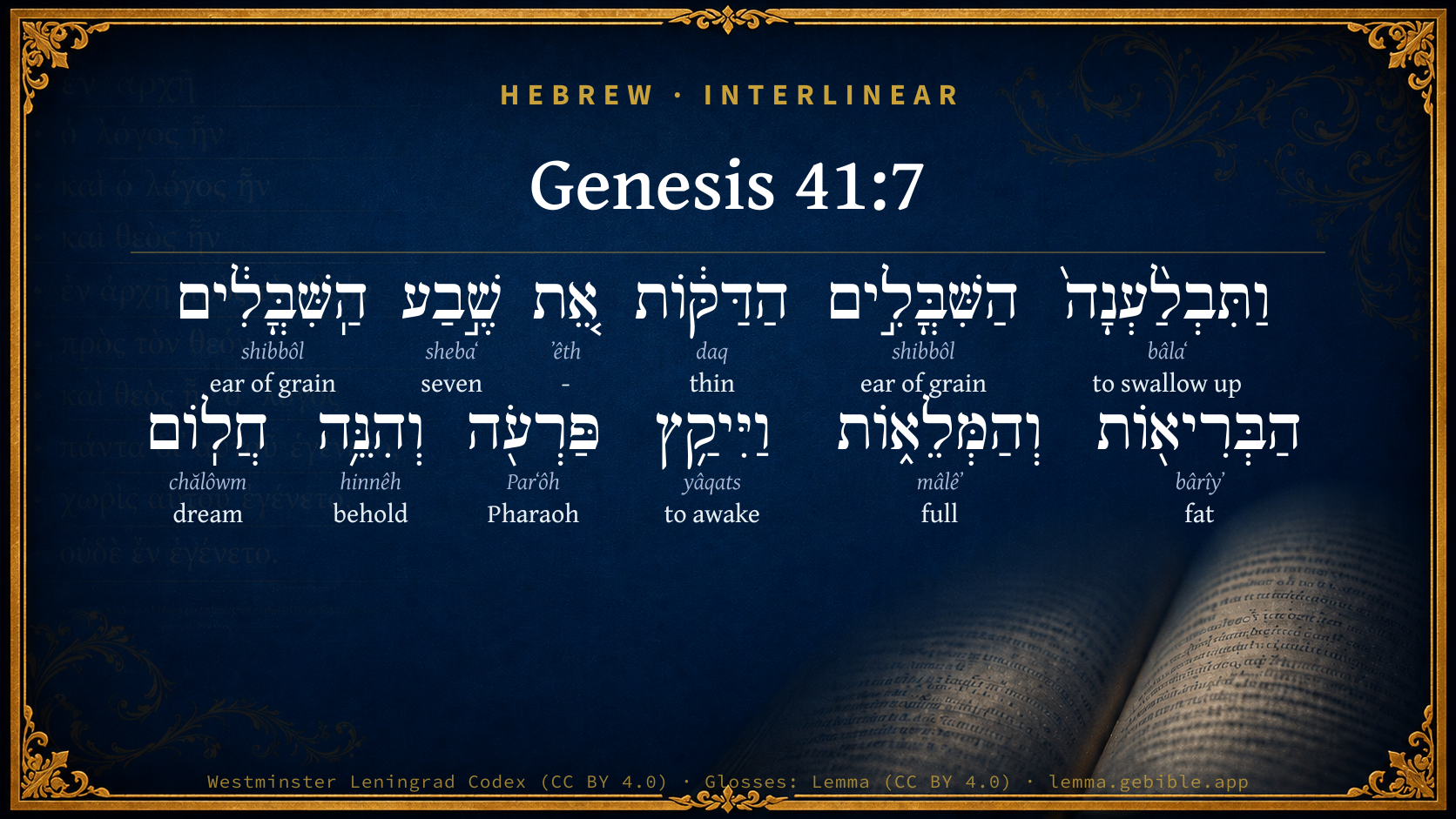
וַיִּיקַ֥ץ
yâqats
H3364
“and · to awake”
Conjunction + Verb, Qal, Sequential Imperfect, 3rd Person, Masculine, Singular
Part of Speech
Conjunction + Verb
Stem
Qal
Form
Sequential Imperfect
Person
3rd Person
Gender
Masculine
Number
Singular
Full BDB Definition

Origin: a primitive root

TWOT: 904

(Qal) to awake, awaken, become active
  1. וַתִּבְלַ֨עְנָה֙ bâlaʻ H1104 “and · to swallow up” Conjunction + Verb, Qal, Sequential Imperfect, 3rd Person, Feminine, Plural
  2. הַשִּׁבֳּלִ֣ים shibbôl H7641 “the · ears of grain” Particle, Definite Article + Noun, Common, Feminine, Plural, Absolute
  3. הַדַּקּ֔וֹת daq H1851 “the · thin” Particle, Definite Article + Adjective, Adjective, Feminine, Plural, Absolute
  4. אֵ֚ת ʼêth H853 “-” Particle, Direct Object
  5. שֶׁ֣בַע shebaʻ H7651 “seven” Adjective, Cardinal number, Feminine, Singular, Absolute
  6. הַֽשִּׁבֳּלִ֔ים shibbôl H7641 “the · ears of grain” Particle, Definite Article + Noun, Common, Feminine, Plural, Absolute
  7. הַבְּרִיא֖וֹת bârîyʼ H1277 “the · fat” Particle, Definite Article + Adjective, Adjective, Feminine, Plural, Absolute
  8. וְהַמְּלֵא֑וֹת mâlêʼ H4392 “and · the · full” Conjunction + Particle, Definite Article + Adjective, Adjective, Feminine, Plural, Absolute
  9. פַּרְעֹ֖ה Parʻôh H6547 “Pharaoh” Noun, Proper
  10. וְהִנֵּ֥ה hinnêh H2009 “and · behold” Conjunction + Particle, Demonstrative
  11. חֲלֽוֹם chălôwm H2472 “dream” Noun, Common, Masculine, Singular, Absolute

About this verse

These counts appear in no published source. They are computed here, from the morphology-tagged text and Lemma’s own curated glosses. What Lemma adds →

12
words
11
distinct lemmas
Pentateuch
section

Notable vocabulary

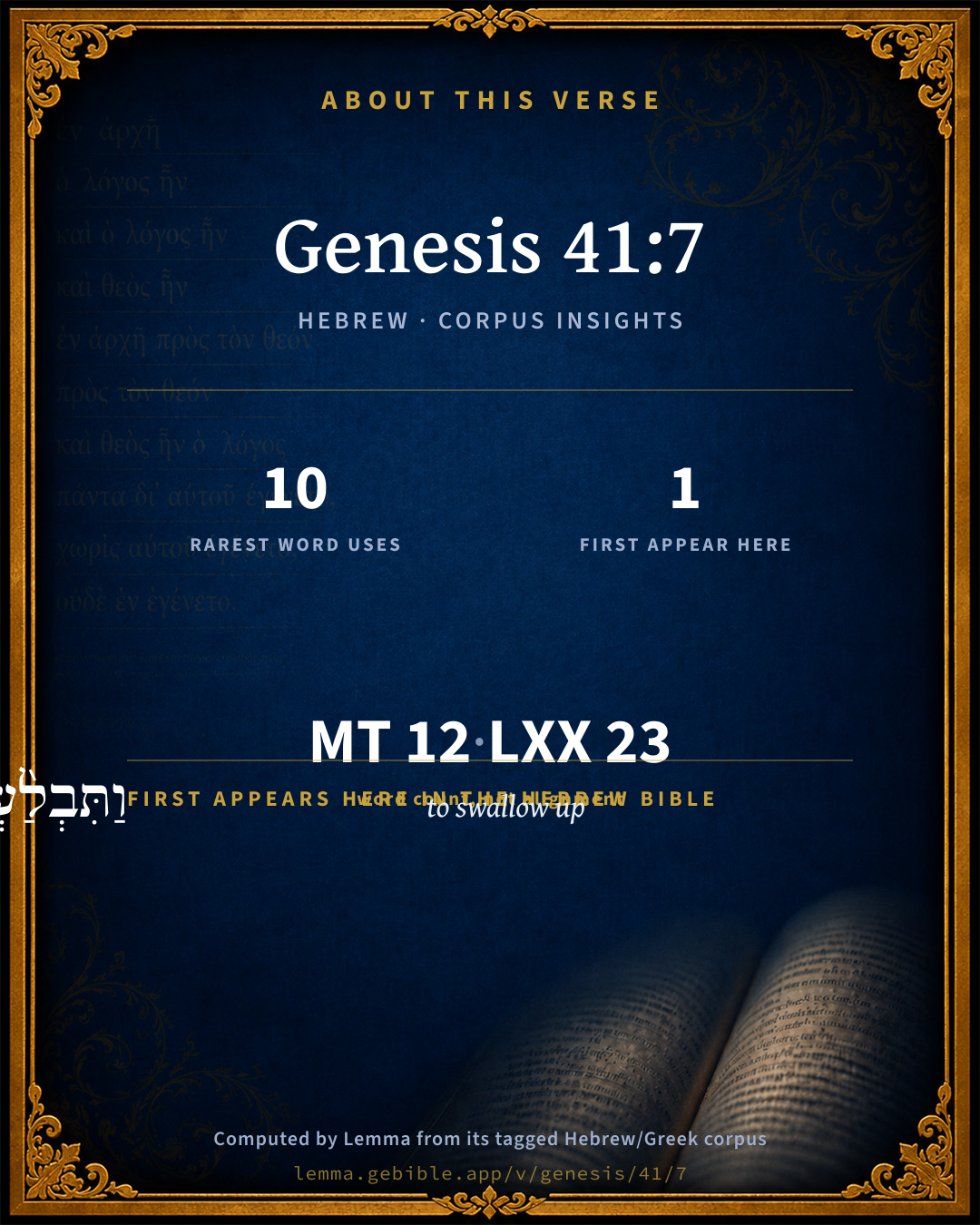
The rarest word here is וַיִּיקַ֥ץ to awake H3364 — appearing just 10 times in the whole Hebrew Bible.

First appearance in Scripture

This word makes its first canonical appearance in the Hebrew Bible here:

  • וַתִּבְלַ֨עְנָה֙ to swallow up H1104

Shared distinctive vocabulary

וַיִּיקַ֥ץ to awake H3364 occurs in 10 verses of the Hebrew Bible. Also found in:

Grammatical profile

  • 2 verbs
  • 4 nouns
  • 4 adjectives
  • 2 particles

Verb forms

  • וַתִּבְלַ֨עְנָה֙ Qal · Sequential Imperfect
  • וַיִּיקַ֥ץ Qal · Sequential Imperfect

Repetition

A word recurs within this verse — often emphatic in Hebrew:

  • הַשִּׁבֳּלִ֣ים ear of grain H7641 ×2

Hebrew & Septuagint length

In English translation the verse runs 21 words from the Hebrew and 25 from the Septuagint (LXX English) — closely comparable.

A rough comparison of the two English renderings, which tokenize alike — not a word-level alignment.

Word counts can differ between the Hebrew and the Greek without any difference in meaning — e.g. the Hebrew direct-object marker אֵת has no separate Greek word, and Greek often adds the article ὁ.

In the original languages it is 12 Hebrew tokens and 23 Greek tokens — but the two are counted differently (Hebrew bundles its prefixes and suffixes into one token; the Greek is in lemma form), so that isn’t a like-for-like length.

Cross-references

2

Topical passages linked to Genesis 41:7 in the Treasury of Scripture Knowledge — connected by theme and wording, ordered by reader-vote popularity; previews shown in the World English Bible.

  • Genesis 20:3 But God came to Abimelech in a dream of the night, and said to him, "Behold, you are a dead man, because of the woman whom you have taken. For she is a man's wife."
  • Genesis 37:5 Joseph dreamed a dream, and he told it to his brothers, and they hated him all the more.

Cross-references courtesy of OpenBible.info (CC BY 4.0).

Hebrew and Greek witnesses Masoretic Hebrew ↔ Greek Septuagint

The same verse in the two great witnesses to the Old Testament, shown verse-for-verse.

These are two independent witnesses, not word-aligned to each other, and the Septuagint is shown in lemma (dictionary) form.

Hebrew Genesis 41:7 Masoretic · Westminster Leningrad Codex

וַתִּבְלַ֨עְנָה֙ הַשִּׁבֳּלִ֣ים הַדַּקּ֔וֹת אֵ֚ת שֶׁ֣בַע הַֽשִּׁבֳּלִ֔ים הַבְּרִיא֖וֹת וְהַמְּלֵא֑וֹת וַיִּיקַ֥ץ פַּרְעֹ֖ה וְהִנֵּ֥ה חֲלֽוֹם

The thin heads of grain swallowed up the seven healthy and full ears. Pharaoh awoke, and, behold, it was a dream.

World English Bible · Public Domain

Greek LXX Genesis 41:7 Septuagint · lemma form

καί καταπίνω ὁ ἑπτά στάχυς ὁ λεπτός καί ἀνεμόφθορος ὁ ἑπτά στάχυς ὁ ἐκλεκτός καί ὁ πλήρης ἐγείρω δέ φαραώ καί εἰμί ἐνύπνιον

And the seven thin ears and blasted with the wind devoured the seven choice and full ears; and Pharao awoke, and it was a dream.

LXX2012 (modern English Septuagint) · Public Domain

Hebrew: Westminster Leningrad Codex (CC BY 4.0). Greek: Septuagint (public domain); English from LXX2012 (modern English Septuagint) (Public Domain). How the Septuagint differs from the Hebrew →

Targum (Aramaic paraphrase)

2

The Targum is the ancient Jewish Aramaic paraphrase of the Hebrew Scriptures — an interpretive translation, not the Hebrew text itself. Onkelos (literal) and Pseudo-Jonathan (expansive) render the Torah, and Jonathan the Prophets. Coverage is partial: where no permissively-licensed English translation exists for a verse, only the Aramaic is shown. This is verse-level text, not a word-by-word alignment to the Hebrew.

  1. Targum Onkelos Torah (Genesis–Deuteronomy)
    וּבְלָעָא שֻׁבְּלַיָּא לָקְיָתָא יָת שְׁבַע שֻׁבְּלַיָּא פַּטִּימָתָא וּמָלְיָתָא וְאִתְּעַר פַּרְעֹה וְהָא חֶלְמָא

    (no public-domain English translation for this verse)

    Targum Onkelos — Aramaic: “Onkelos Genesis” (public domain); “Onkelos Exodus” (public domain); “Onkelos Leviticus” (public domain); “Onkelos Numbers” (public domain); “Onkelos Deuteronomy” (public domain). English: “Sefaria Community Translation” (CC0 1.0 (public-domain dedication)); “J.W. Etheridge. The Targums of Onkelos and Jonathan Ben Uzziel on the Pentateuch. London: Longmans, Green, 1862” (public domain). Text via Sefaria.

  2. Targum Pseudo-Jonathan Torah (Genesis–Deuteronomy)
    וּבָלְעַן תּוּבְלַיָיא לַקְיָיתָא יַת שְׁבַע תּוּבְלַיָיא פַּטִימָתָא וּמַלְיָתָא וְאִיתְעַר פַּרְעה וְהָא הֲוָה חֵילְמָא

    And the seven thin ears devoured the seven fat and full. And Pharoh awoke, and, behold, it was a dream.

    Targum Pseudo-Jonathan — Aramaic: “Targum Jonathan on Genesis” (public domain); “Targum Jonathan on Exodus” (public domain); “Targum Jonathan on Leviticus” (public domain); “Targum Jonathan on Numbers” (public domain); “Targum Jonathan on Deuteronomy” (public domain). English: “The Targum of Jonathan ben Uzziel, trans. J. W. Etheridge, London, 1862” (public domain). Text via Sefaria.

Commentary

Notes on Genesis 41:7 from classic Christian and Jewish commentators (each source and its license shown beneath its notes). The classic Christian expositions comment on the surrounding passage and are grouped to its opening verse, so a note may address several verses; the Jewish commentaries on the Tanakh (Rashi and others) are per-verse, so they appear only where the commentator wrote on this verse.

Lemma curates 59 commentaries, every one of them public domain or Creative Commons licensed, each selected and text-cleaned for this edition rather than reprinted as found. About our sources →

Trapp's Complete Commentary

John Trapp

Gen 41:7 And the seven thin ears devoured the seven rank and full ears. And Pharaoh awoke, and, behold, [it was] a dream.

Ver. 7. Behold, it was a dream.] That is, It was but a dream, and no more; yet a divine dream: whereof, {See Trapp on "Gen 20:3"}

John Trapp, A Commentary or Exposition upon All the Books of the Old and New Testament (1647–1656) — public domain. Text from a community e-Sword module.

John Gill's Exposition

And the seven thin ears devoured the seven rank and full ears,.... So it appeared to Pharaoh in his dream, which must be very amazing to behold, and unaccountable how it should be:

and Pharaoh awoke, and, behold, it was a dream; not a real fact, but a dream; yet not a common dream, but had some important signification in it; it not vanishing from his mind, but abode upon it, which made him conclude there was something more than common in it, and made him very desirous to have the interpretation of it.

John Gill's Exposition of the Whole Bible (1746–1763) — public domain (CC PDM 1.0). Text via the HelloAO Bible API.

Haydock's Catholic Bible Commentary

Rest. Hebrew adds, "and behold a dream" sent by God, like Solomon’s, 3 Kings iii. 15. The king’s mind was quite full of what he had seen.

George Leo Haydock (1774–1849), Haydock's Catholic Family Bible and Commentary, 1859 edition — public domain. Excludes Psalms (Douay-Rheims chapter numbering differs from Protestant) and Deuterocanonical books (Catholic canon only).

Matthew Poole's English Annotations

Not a real thing, as Pharaoh in his sleep imagined it to be. Heb. Behold the dream, i.e. the dream did not vanish, as dreams commonly do, but was fixed in his mind, and he could not shake it off; by which he saw that it was no common or natural, but a Divine and significant dream.

Matthew Poole's English Annotations on the Holy Bible (1683–1685) — public domain. Text from a community e-Sword/MySword module.

The Pulpit Commentary

And the seven thin ears devoured the seven rank (i.e. fat) and full ears. And Pharaoh awoke, and, behold, it was a dream manifestly of the same import as that which had preceded. The dream was doubled because of its certainty and nearness (ver. 32).

The Pulpit Commentary (1880–1919), ed. H.D.M. Spence-Jones & Joseph S. Exell — public domain. Text from a community e-Sword module.

Keil & Delitzsch

C. F. Keil & F. Delitzsch

"Then Pharaoh awoke, and behold it was a dream." The dream was so like reality, that in was only when he woke that he perceived it was a dream.

Keil & Delitzsch — Biblical Commentary on the Old Testament (1861–1891) — public domain (CC PDM 1.0). Text via the HelloAO Bible API. (Old Testament only.)

unfoldingWord translationNotes

Door43 World Missions Community

The thin heads

The words "of grain" are understood. AT: "The thin heads of grain" (See: Ellipsis)

swallowed up

"ate." Pharaoh is dreaming that unhealthy corn could eat healthy corn just like a person eats food.

wholesome and full heads

"healthy and good heads." See how you translated a similar phrase in Genesis 41:5.

woke up

"awakened"

behold

The word "behold" here shows that Pharaoh was surprised by what he had seen.

it was a dream

"he had been dreaming"

It came about

This phrase is used here to mark the beginning of a new part of the story. If your language has a way for doing this, you could consider using it here. (See: Introduction of a New Event)

his spirit was troubled

Here the word "spirit" refers to his inner being or his emotions. AT: "he was troubled in his inner being" or "he was troubled" (See: Synecdoche)

He sent and called

It is understood that he sent servants. AT: "He sent his servants to call" or "He sent his servants to summon" (See: Ellipsis)

all the magicians and wise men of Egypt

Ancient kings and rulers used magicians and wise men as advisers.

translationWords

Pharaoh

dream

spirit

send

call

magic

wise

Egypt

unfoldingWord translationNotes — © Distant Shores Media and the Door43 World Missions Community, licensed CC BY-SA 4.0. Source: git.door43.org/Door43/en_tn.

Rashi

Rabbi Shlomo Yitzchaki (Rashi)

הבריאות sains in old French; English HEALTHY.

והנה חלום AND, BEHOLD. IT WAS A DREAM — and behold a whole dream was completed before him (i.e. representation of what was evidently a completed whole had passed before him as a dream during his sleep) and demanded an interpreter.

Rashi on the Tanakh — English translations: “The Judaica Press complete Tanach with Rashi, translated by A. J. Rosenberg” (CC BY 4.0); “Pentateuch with Rashi's commentary by M. Rosenbaum and A.M. Silbermann, 1929-1934” (public domain); “The Metsudah Tanach series, Lakewood, N.J” (CC BY 4.0); and “The Book of Joshua, Metsudah Publications, 1997” (CC BY 4.0). Text via Sefaria.

Ramban (Nachmanides)

Rabbi Moshe ben Nachman (Ramban / Nachmanides)

AND PHARAOH AWOKE, AND, BEHOLD, IT WAS A DREAM. The meaning thereof is that “there was a complete dream before him.” Thus the language of Rashi.In my opinion the verse alludes to the fact that Pharaoh lay awake, thinking about his dream, wondering whether he will see yet a third manifestation, and when he arose in the morning and had not dreamed again, his spirit was disturbed. This is the meaning of the verse, And it came to pass in the morning that his spirit was troubled. In the case of Nebuchadnezzar, however, it says, And his spirit was troubled, and his sleep broke from him, for even the night brought no rest to his mind. The verse mentions, And Pharaoh awoke, in order to indicate a matter stated in the Book of Sleep, fell down,” thus indicating that books dealing with this topic were prevalent even in Talmudic times. i.e., that a dream which is followed in the same sleep by another dream with different content is not fulfilled. Therefore the verse says that when he awoke it was a dream fit for fulfillment. Yet he thought about it till morning, that perhaps he will have his dream a third time in the manner in which it had been repeated. But Pharaoh himself realized that the two dreams had the same content. This is why the verse states, And behold, it was a dream. So, likewise, did Pharaoh state it: I have dreamed ‘a dream,’ and none can interpret it, and he did not refer to the plural form, “dreams.” This is also the sense of the verse, And I saw in my dream. Scripture however states, But none could interpret ‘them’ to Pharaoh, meaning that none could interpret even one of them.

Ramban (Nachmanides) on the Tanakh — English translation: “Commentary on the Torah by Ramban (Nachmanides). Translated and annotated by Charles B. Chavel. New York, Shilo Pub. House, 1971-1976” (CC BY 4.0). Text via Sefaria.

Radak

Rabbi David Kimhi (Radak)

ויקץ פרעה, he awoke briefly between the first dream and the second dream. Had the dreams been one continuous experience without Pharaoh waking up in between, he himself would have understood immediately that the scenario he saw in the second dream was closely related to the scenario he had seen in the first dream. Seeing that there were two separate dreams, this indicated to Joseph that the events foreshadowed would come to pass without delay. והנה חלום, the dream was complete. He did not dream any more during that night.

Radak on the Tanakh — English translations: “Sefaria Community Translation” (CC0 1.0 (public-domain dedication)); “Eliyahu Munk, HaChut Hameshulash” (CC BY 4.0); “Rabbi Mike Feuer, Jerusalem Anthology” (CC BY 4.0); and “R. David Kimhi on the first book of Psalms, Translated by R.G. Finch, London, 1919” (public domain). Text via Sefaria.

Lesson kit

Teaching starters — assembled from the data on this page, not authored interpretation. Every prompt links to the verse data it draws on. Edit before teaching.

Genesis, in the Pentateuch, opens this verse with 12 words (11 distinct Hebrew lemmas). Its most distinctive word is yâqats (“to awake”). A historical commentator’s framing appears above. Read the whole chapter for the surrounding context.

Discussion questions

  1. The word yâqats carries the sense “to awake.” How does it shape the verse?
  2. The word “to swallow up” first appears here in Scripture. What is being introduced at this debut?
  3. Genesis 9:24 shares the word «to awake» with this verse. How do the two illuminate each other?
  4. “ear of grain” occurs 2× in this one verse. What is the effect of the repetition?
  5. These translations render this verse differently; the difference is in the English rendering, not the original. What questions does that raise?
  6. The verb «וַתִּבְלַ֨עְנָה֙» is Qal Sequential Imperfect. How does its form color the action?
  7. Reading how Trapp's Complete Commentary and John Gill's Exposition read this verse, where do the two commentators agree and where do they part?

Things to notice

Reading settings

Reading text

Shown beneath each verse's original-language words.

Old Testament
Old Testament edition

Read the OT as the Masoretic Hebrew (MT) or the Greek Septuagint (LXX).

English shown for the Greek Septuagint (in the Hebrew ↔ Greek comparison).

Comparing translations? Open the Compare panel on any verse page to stack up to four side by side.