
Judges 8:26

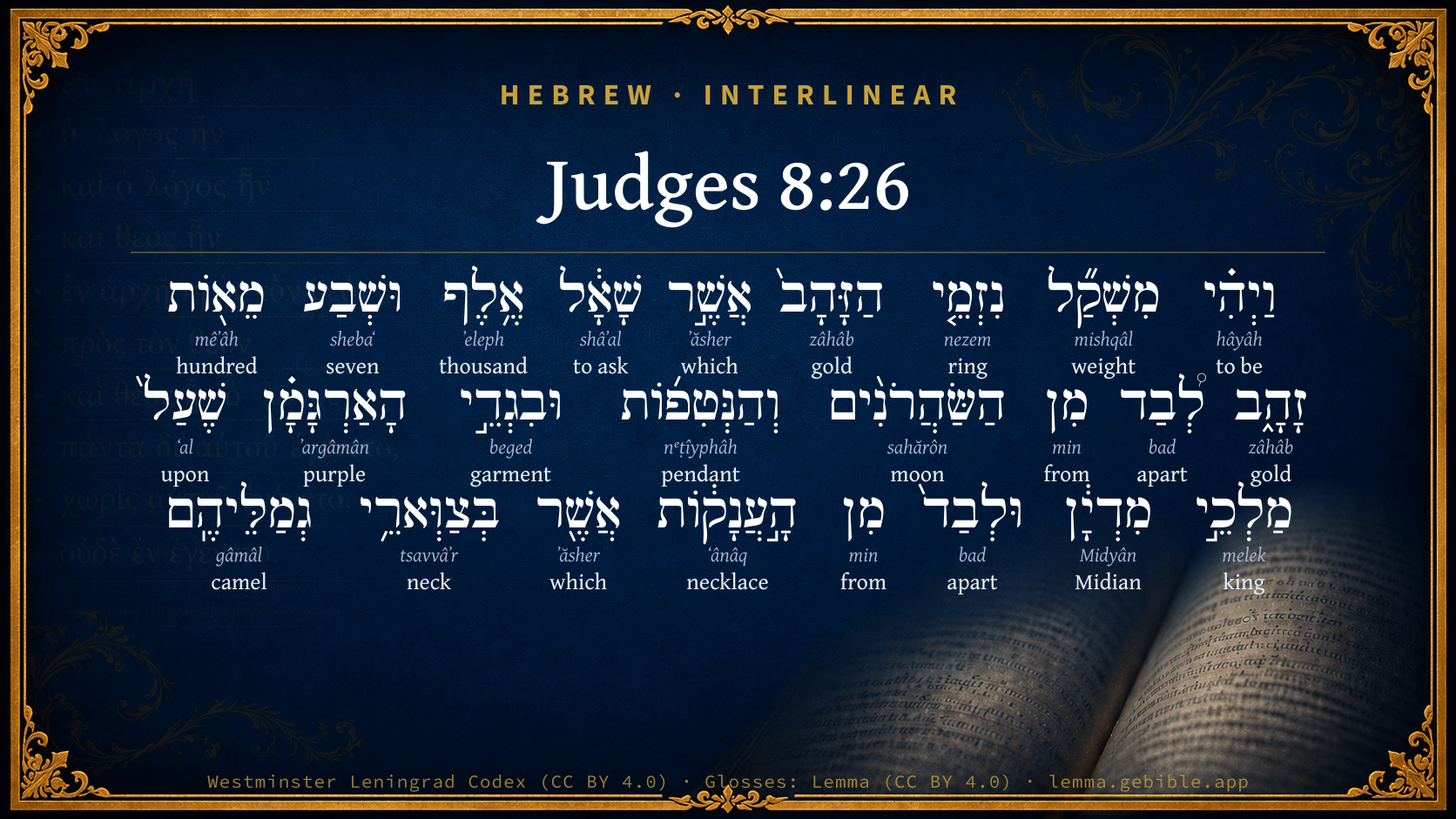
Hebrew (Westminster Leningrad Codex) Judges 8:26 appears in the Hebrew Old Testament. The text above is from the Westminster Leningrad Codex. Each word links to its Strong’s number, a concise gloss, and parsing drawn from the Open Scriptures Hebrew Bible morphology. Click any word for its full Brown-Driver-Briggs (BDB) entry.
Download image
Cite this verse

Judges 8:26 (World English Bible). Public Domain. Lemma interlinear Bible study tool, https://lemma.gebible.app/v/judges/8/26.

Show BibTeX & RIS
BibTeX
RIS
English Translation
The weight of the golden ear-rings that he requested was one thousand and seven hundred [shekels] of gold, besides the crescents, and the pendants, and the purple clothing that was on the kings of Midian, and besides the chains that were about their camels' necks.
World English Bible · Public Domain
Highlights
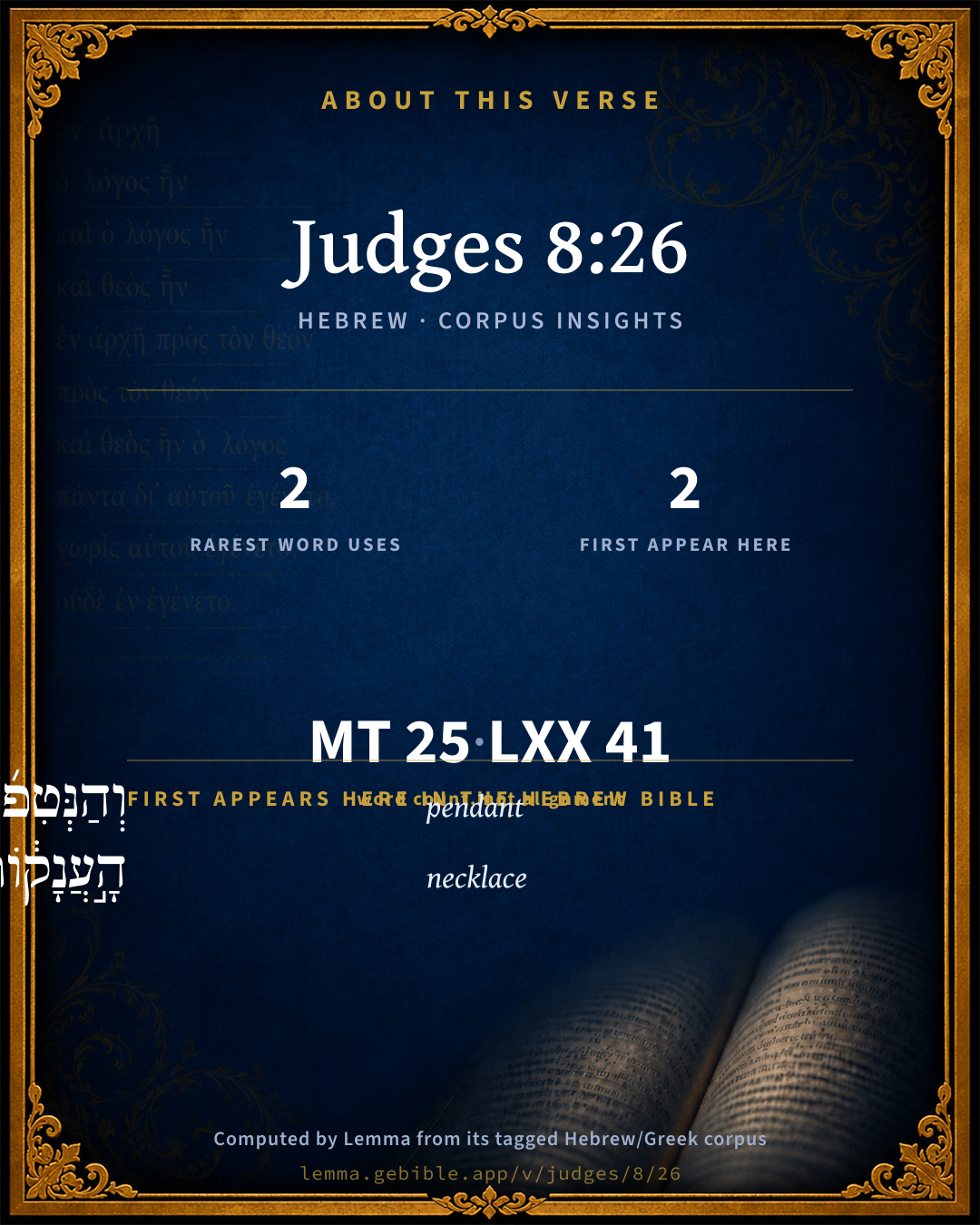
  • 2 first appearances in the Hebrew Bible
Full analysis ↓
Download a study sheet

One document with this verse’s original text, its word-by-word gloss line, the meaning frame, cross-references with their text, attributed commentary, and full source and license credits — printable, and it pastes into notes with its structure intact.

This verse Autodidact and up

Study sheet (.html) Plain text (.txt)

A passage Seminary Student

Up to 50 verses in one chapter. A passage sheet keeps up to 6 commentary sources and 12 cross-references per verse, in the order this page ranks them, and says so on the sheet whenever that leaves anything out. Ask for a single verse and you get the Autodidact verse sheet above.

Everything on this page stays free to read, with no account — the sheet is a download of what is already on screen, not access to it.

Want to remove ads? Support Godless Engineer
Compare translations 3

The same verse in 3 English versions, stacked beneath the original-language interlinear above. Click any original word for its lexicon entry.

Each is an independent rendering of the whole verse — the interlinear is not word-aligned to these translations.

Highlighted words mark where these versions differ — a whole-verse word diff, not a word-by-word alignment.

  • World English Bible Public Domain
    The weight of the golden ear-rings that he requested was one thousand and seven hundred [shekels] of gold, besides the crescents, and the pendants, and the purple clothing that was on the kings of Midian, and besides the chains that were about their camels' necks.
  • King James Version Public Domain
    And the weight of the golden earrings that he requested was a thousand and seven hundred shekels of gold; beside ornaments, and collars, and purple raiment that was on the kings of Midian, and beside the chains that were about their camels' necks.
  • unfoldingWord Literal Text CC BY-SA 4.0
    Now the weight of the earrings of gold that he requested 1,700 gold, apart from the ornaments and the pendants and the purple robes that on the kings of Midian and apart from the chains that were on the necks of their camels.

unfoldingWord Literal Text — © unfoldingWord, licensed CC BY-SA 4.0. Word-aligned USFM3 via Door43 (git.door43.org/unfoldingWord/en_ult).

Versions to compare (up to 4)

3 of 4 selected

Show all 18 translations

Every available English version of this verse, each an independent rendering of the whole verse.

  • World English Bible Public Domain
    The weight of the golden ear-rings that he requested was one thousand and seven hundred [shekels] of gold, besides the crescents, and the pendants, and the purple clothing that was on the kings of Midian, and besides the chains that were about their camels' necks.
  • Berean Standard Bible Public Domain
    The weight of the gold earrings he had requested was 1,700 shekels, in addition to the crescent ornaments, the pendants, the purple garments of the kings of Midian, and the chains from the necks of their camels.
  • Majority Standard Bible Public Domain
    The weight of the gold earrings he had requested was 1,700 shekels, in addition to the crescent ornaments, the pendants, the purple garments of the kings of Midian, and the chains from the necks of their camels.
  • King James Version Public Domain
    And the weight of the golden earrings that he requested was a thousand and seven hundred shekels of gold; beside ornaments, and collars, and purple raiment that was on the kings of Midian, and beside the chains that were about their camels' necks.
  • American Standard Version (1901) Public Domain
    And the weight of the golden ear-rings that he requested was a thousand and seven hundred `shekels' of gold, besides the crescents, and the pendants, and the purple raiment that was on the kings of Midian, and besides the chains that were about their camels' necks.
  • Revised Version (1885) Public Domain
    And the weight of the golden earrings that he requested was a thousand and seven hundred shekels of gold; beside the crescents, and the pendants, and the purple raiment that was on the kings of Midian, and beside the chains that were about their camels’ necks.
  • Geneva Bible (1599) Public Domain
    And the weight of the golden earings that he required, was a thousande and seuen hundreth shekels of golde, beside collers and iewels, and purple rayment that was on the kings of Midian, and beside the cheynes that were about their camels neckes.
  • Douay-Rheims (1899) Public Domain
    And the weight of the earlets that he requested, was a thousand seven hundred sicles of gold, besides the ornaments, and jewels, and purple raiment which the kings of Madian were went to use, and besides the golden chains that were about the camels' necks.
  • Young's Literal Translation Public Domain
    and the weight of the rings of gold which he asked is a thousand and seven hundred `shekels' of gold, apart from the round ornaments, and the drops, and the purple garments, which `are' on the kings of Midian, and apart from the chains which `are' on the necks of their camels,
  • Literal Standard Version CC BY-SA 4.0
    and the weight of the rings of gold which he asked for is one thousand and seven hundred [shekels] of gold, apart from the crescents, and the pendants, and the purple garments, which [are] on the kings of Midian, and apart from the chains which [are] on the necks of their camels,
  • Unlocked Literal Bible CC BY-SA 4.0
    The weight of the golden earrings that he requested was 1,700 shekels of gold. This plunder was in addition to the crescent ornaments, the pendants, the purple clothing that was worn by the kings of Midian, and in addition to the chains that had been around their camels' necks.
  • unfoldingWord Literal Text CC BY-SA 4.0
    Now the weight of the earrings of gold that he requested 1,700 gold, apart from the ornaments and the pendants and the purple robes that on the kings of Midian and apart from the chains that were on the necks of their camels.
  • Darby Bible Public Domain
    And the weight of the golden earrings that he requested was one thousand seven hundred shekels of gold; besides the crescents and the pendants and the purple garments worn by the kings of Mid'ian, and besides the collars that were about the necks of their camels.
  • World Messianic Bible Public Domain
    The weight of the golden earrings that he requested was one thousand and seven hundred shekels of gold, in addition to the crescents, and the pendants, and the purple clothing that was on the kings of Midian, and in addition to the chains that were about their camels’ necks.
  • Webster's Bible Public Domain
    And the weight of the golden ear-rings that he requested, was a thousand and seven hundred shekels of gold; besides ornaments, and collars, and purple raiment that was on the kings of Midian, and besides the chains that were about their camels' necks.
  • Free Bible Version CC BY-SA 4.0
    The weight of the earrings he'd asked for was 1,700 shekels, not including the ornaments, the pendants, and the purple garments worn by the Midianite kings or the chains that were round their camels' necks.
  • Bible in Basic English Public Domain
    The weight of the gold ear-rings which he got from them was one thousand, seven hundred shekels of gold; in addition to the moon-ornaments and jewels and the purple robes which were on the kings of Midian, and the chains on their camels' necks.
  • JPS Tanakh (1917) Public Domain
    And the weight of the golden ear-rings that he requested was a thousand and seven hundred shekels of gold; beside the crescents, and the pendants, and the purple raiment that was on the kings of Midian, and beside the chains that were about their camels' necks.

Literal Standard Version (2020), Covenant Press — licensed CC BY-SA 4.0. Text via the HelloAO Bible API (eBible.org). Unlocked Literal Bible (unfoldingWord) — licensed CC BY-SA 4.0. Text via the HelloAO Bible API (eBible.org). unfoldingWord Literal Text — © unfoldingWord, licensed CC BY-SA 4.0. Word-aligned USFM3 via Door43 (git.door43.org/unfoldingWord/en_ult). Free Bible Version, Dr. Jonathan Gallagher — licensed CC BY-SA 4.0. Text via the HelloAO Bible API (eBible.org).

Word by word

More ways to search: Search by grammar → Find every occurrence → Compare this word →

Practice this passage: Drill this verse → Learn its vocabulary →

וְהַנְּטִפ֜וֹת
nᵉṭîyphâh
H5188
“and · the · pendants”
Conjunction + Particle, Definite Article + Noun, Common, Feminine, Plural, Absolute
Part of Speech
Conjunction + Particle + Noun
Type
Common
Gender
Feminine
Number
Plural
State
Absolute
Full BDB Definition

Origin: from H5197

TWOT: 1355c

drop - pendant, ornament
  1. וַיְהִ֗י hâyâh H1961 “and · to be” Conjunction + Verb, Qal, Sequential Imperfect, 3rd Person, Masculine, Singular
  2. מִשְׁקַ֞ל mishqâl H4948 “weight of” Noun, Common, Masculine, Singular, Construct
  3. נִזְמֵ֤י nezem H5141 “rings of” Noun, Common, Masculine, Plural, Construct
  4. הַזָּהָב֙ zâhâb H2091 “the · gold” Particle, Definite Article + Noun, Common, Masculine, Singular, Absolute
  5. אֲשֶׁ֣ר ʼăsher H834 “which” Particle, Relative
  6. שָׁאָ֔ל shâʼal H7592 “to ask” Verb, Qal, Perfect, 3rd Person, Masculine, Singular
  7. אֶ֥לֶף ʼeleph H505 “thousand” Adjective, Cardinal number, Both, Singular, Absolute
  8. וּשְׁבַע shebaʻ H7651 “and · seven” Conjunction + Adjective, Cardinal number, Feminine, Singular, Absolute
  9. מֵא֖וֹת mêʼâh H3967 “hundred” Adjective, Cardinal number, Both, Plural, Absolute
  10. זָהָ֑ב zâhâb H2091 “gold” Noun, Common, Masculine, Singular, Absolute
  11. לְ֠בַד bad H905 “to/for · apart” Preposition + Noun, Common, Masculine, Singular, Absolute
  12. מִן min H4480 “from” Preposition
  13. הַשַּׂהֲרֹנִ֨ים sahărôn H7720 “the · crescents” Particle, Definite Article + Noun, Common, Masculine, Plural, Absolute
  14. וּבִגְדֵ֣י beged H899 “and · garments of” Conjunction + Noun, Common, Masculine, Plural, Construct
  15. הָאַרְגָּמָ֗ן ʼargâmân H713 “the · purple” Particle, Definite Article + Noun, Common, Masculine, Singular, Absolute
  16. שֶׁעַל֙ ʻal H5921 “who/which · upon” Particle, Relative + Preposition
  17. מַלְכֵ֣י melek H4428 “kings of” Noun, Common, Masculine, Plural, Construct
  18. מִדְיָ֔ן Midyân H4080 “Midian” Noun, Proper
  19. וּלְבַד֙ bad H905 “and · to/for · apart” Conjunction + Preposition + Noun, Common, Masculine, Singular, Absolute
  20. מִן min H4480 “from” Preposition
  21. הָ֣עֲנָק֔וֹת ʻânâq H6060 “the · necklaces” Particle, Definite Article + Noun, Common, Masculine, Plural, Absolute
  22. אֲשֶׁ֖ר ʼăsher H834 “which” Particle, Relative
  23. בְּצַוְּארֵ֥י tsavvâʼr H6677 “in/at · necks of” Preposition + Noun, Common, Masculine, Plural, Construct
  24. גְמַלֵּיהֶֽם gâmâl H1581 “camels · their” Noun, Common, Masculine, Plural, Construct + Suffix, Personal, 3rd Person, Masculine, Plural

About this verse

These counts appear in no published source. They are computed here, from the morphology-tagged text and Lemma’s own curated glosses. What Lemma adds →

25
words
21
distinct lemmas
Historical
section

Notable vocabulary

The rarest word here is וְהַנְּטִפ֜וֹת pendant H5188 — appearing just 2 times in the whole Hebrew Bible.

First appearance in Scripture

These words make their first canonical appearance in the Hebrew Bible here:

  • וְהַנְּטִפ֜וֹת pendant H5188
  • הָ֣עֲנָק֔וֹת necklace H6060

Shared distinctive vocabulary

וְהַנְּטִפ֜וֹת pendant H5188 occurs in 2 verses of the Hebrew Bible. Also found in:

Grammatical profile

  • 2 verbs
  • 15 nouns
  • 3 adjectives
  • 3 prepositions
  • 2 particles

Verb forms

  • וַיְהִ֗י Qal · Sequential Imperfect
  • שָׁאָ֔ל Qal · Perfect

Repetition

Words recur within this verse — often emphatic in Hebrew:

  • הַזָּהָב֙ gold H2091 ×2
  • לְ֠בַד apart H905 ×2
  • אֲשֶׁ֣ר which H834 ×2
  • מִן from H4480 ×2

Hebrew & Septuagint length

In English translation the verse runs 45 words from the Hebrew and 51 from the Septuagint (LXX English) — closely comparable.

A rough comparison of the two English renderings, which tokenize alike — not a word-level alignment.

Word counts can differ between the Hebrew and the Greek without any difference in meaning — e.g. the Hebrew direct-object marker אֵת has no separate Greek word, and Greek often adds the article ὁ.

In the original languages it is 25 Hebrew tokens and 41 Greek tokens — but the two are counted differently (Hebrew bundles its prefixes and suffixes into one token; the Greek is in lemma form), so that isn’t a like-for-like length.

Cross-references

9

Topical passages linked to Judges 8:26 in the Treasury of Scripture Knowledge — connected by theme and wording, ordered by reader-vote popularity; previews shown in the World English Bible.

  • Esther 8:15 Mordecai went forth from the presence of the king in royal clothing of blue and white, and with a great crown of gold, and with a robe of fine linen and purple: and the city of Shushan shouted and was glad.
  • Jeremiah 10:9 There is silver beaten into plates, which is brought from Tarshish, and gold from Uphaz, the work of the artificer and of the hands of the goldsmith; blue and purple for their clothing; they are all the work of skillful men.
  • John 19:2 The soldiers twisted thorns into a crown, and put it on his head, and dressed him in a purple garment.
  • John 19:5 Jesus therefore came out, wearing the crown of thorns and the purple garment. Pilate said to them, "Behold, the man!"
  • Revelation 18:12 merchandise of gold, silver, precious stones, pearls, fine linen, purple, silk, scarlet, all expensive wood, every vessel of ivory, every vessel made of most precious wood, and of brass, and iron, and marble;
  • Revelation 18:16 saying, 'Woe, woe, the great city, she who was dressed in fine linen, purple, and scarlet, and decked with gold and precious stones and pearls!
  • Ezekiel 27:7 Of fine linen with embroidered work from Egypt was your sail, that it might be to you for an ensign; blue and purple from the isles of Elishah was your awning.
  • Revelation 17:4 The woman was dressed in purple and scarlet, and decked with gold and precious stones and pearls, having in her hand a golden cup full of abominations and the impurities of the sexual immorality of the earth.
  • Luke 16:19 "Now there was a certain rich man, and he was clothed in purple and fine linen, living in luxury every day.

Cross-references courtesy of OpenBible.info (CC BY 4.0).

Hebrew and Greek witnesses Masoretic Hebrew ↔ Greek Septuagint

The same verse in the two great witnesses to the Old Testament, shown verse-for-verse.

These are two independent witnesses, not word-aligned to each other, and the Septuagint is shown in lemma (dictionary) form.

Hebrew Judges 8:26 Masoretic · Westminster Leningrad Codex

וַיְהִ֗י מִשְׁקַ֞ל נִזְמֵ֤י הַזָּהָב֙ אֲשֶׁ֣ר שָׁאָ֔ל אֶ֥לֶף וּשְׁבַע מֵא֖וֹת זָהָ֑ב לְ֠בַד מִן הַשַּׂהֲרֹנִ֨ים וְהַנְּטִפ֜וֹת וּבִגְדֵ֣י הָאַרְגָּמָ֗ן שֶׁעַל֙ מַלְכֵ֣י מִדְיָ֔ן וּלְבַד֙ מִן הָ֣עֲנָק֔וֹת אֲשֶׁ֖ר בְּצַוְּארֵ֥י גְמַלֵּיהֶֽם

The weight of the golden ear-rings that he requested was one thousand and seven hundred [shekels] of gold, besides the crescents, and the pendants, and the purple clothing that was on the kings of Midian, and besides the chains that were about their camels' necks.

World English Bible · Public Domain

Greek LXX Judges 8:26 Septuagint · lemma form

καί γίγνομαι ὁ σταθμός ὁ ἐνώτιον ὁ χρυσοῦς ὅς αἰτέω χίλιοι καί πεντακόσιοι χρυσοῦς πάρεξ ὁ μηνίσκος καί ὁ στραγγαλίς καί ὁ ἱμάτιον καί πορφυρίς ὁ ἐπί βασιλεύς μαδιαμ καί ἐκτός ὁ περίθεμα ὅς εἰμί ἐν ὁ τράχηλος ὁ κάμηλος αὐτός

And the weight of the golden earrings which he asked, was a thousand and seven hundred pieces of gold, besides the crescents, and the chains, and the garments, and the purple cloths that were on the kings of Madiam, and besides the chains that were on the necks of their camels.

LXX2012 (modern English Septuagint) · Public Domain

On this verse, Haydock's Catholic Bible Commentary discusses the Septuagint’s reading. Read the note in Commentary ↓

Hebrew: Westminster Leningrad Codex (CC BY 4.0). Greek: Septuagint (public domain); English from LXX2012 (modern English Septuagint) (Public Domain). How the Septuagint differs from the Hebrew →

Targum (Aramaic paraphrase)

1

The Targum is the ancient Jewish Aramaic paraphrase of the Hebrew Scriptures — an interpretive translation, not the Hebrew text itself. Onkelos (literal) and Pseudo-Jonathan (expansive) render the Torah, and Jonathan the Prophets. Coverage is partial: where no permissively-licensed English translation exists for a verse, only the Aramaic is shown. This is verse-level text, not a word-by-word alignment to the Hebrew.

  1. Targum Jonathan Prophets (Joshua–Malachi)
    וַהֲוָה מַתְקַל קָדָשֵׁי דְדַהֲבָא דִשְׁאַל אֶלֶף וּשְׁבַע מְאָה דַהֲבָא בַּר מִן סַהֲרָנַיָא וּכְלִילָא וּלְבוּשֵׁי אַרְגְוָנָא דִי עַל מַלְכֵי מִדְיָן וּבַר מִן עֲנָקַיָא דִי בְּצַוְרֵי גְמַלֵיהוֹן:

    (no public-domain English translation for this verse)

    Targum Jonathan — Aramaic: “Mikraot Gedolot” (public domain). English: “Sefaria Community Translation” (CC0 1.0 (public-domain dedication)); “London "Chaldee Paraphrase," 1871” (public domain). Text via Sefaria.

Commentary

Notes on Judges 8:26 from classic Christian and Jewish commentators (each source and its license shown beneath its notes). The classic Christian expositions comment on the surrounding passage and are grouped to its opening verse, so a note may address several verses; the Jewish commentaries on the Tanakh (Rashi and others) are per-verse, so they appear only where the commentator wrote on this verse.

Lemma curates 59 commentaries, every one of them public domain or Creative Commons licensed, each selected and text-cleaned for this edition rather than reprinted as found. About our sources →

Trapp's Complete Commentary

John Trapp

Jdg 8:26 And the weight of the golden earrings that he requested was a thousand and seven hundred [shekels] of gold; beside ornaments, and collars, and purple raiment that [was] on the kings of Midian, and beside the chains that [were] about their camels’ necks.

Ver. 26. And collars.] Or golden cabinets; wherein they carried balsam to pour into their wounds. {a}

{a} Vatab.

John Trapp, A Commentary or Exposition upon All the Books of the Old and New Testament (1647–1656) — public domain. Text from a community e-Sword module.

Geneva Bible (1599)

Geneva Bible translators

Or, sweet balls.

Geneva Bible (1599) marginal notes — public domain. Text via Bolls.life.

Jamieson, Fausset & Brown

Robert Jamieson, A. R. Fausset & David Brown

ornaments--crescent-like plates of gold suspended from the necks, or placed on the breasts of the camels.

collars--rather, "earrings," or drops of gold or pearl.

purple--a royal color. The ancient, as well as modern Arabs, adorned the necks, breasts, and legs, of their riding animals with sumptuous housing.

Jamieson, Fausset & Brown — Commentary Critical and Explanatory on the Whole Bible (1871) — public domain (CC PDM 1.0). Text via the HelloAO Bible API.

Adam Clarke's Commentary

Verse 26. The weight of the golden ear-rings - was a thousand and seven hundred shekels of gold] Taking the shekel at half an ounce weight, the sum of the gold collected in ear-rings was seventy pounds ten ounces; and worth, as gold now rates, about £3,100 sterling.

This computation of the weight of the golden ear-rings, taken from the slaughtered Ishmaelites, will bring to the reader's mind the slaughter of the Roman knights by the Carthaginians at the battle of Cannae, from whose spoils Hannibal sent three bushels of gold rings to the city of Carthage!

Adam Clarke's Commentary on the Bible (1810–1826) — public domain. Text from a community e-Sword/MySword module.

Ellicott's Commentary for English Readers

(26) A thousand and seven hundred shekels of gold.—About seventy pounds of gold. This would imply a very large number of nose-rings or earrings (Gen_24:22), and therefore a slaughter of many leading Midianites. It is analogous to the “three bushels of knights’ rings” which Mago carried to Carthage, and emptied upon the floor of the Carthaginian Senate, after the massacre of the Romans at Cannae (Liv. xxiii. 12).

Beside ornaments.—Rather, beside the golden crescents (Jdg_8:21). Gideon seems to have gratified his love of vengeance, as goel, before he thought of booty.

And collars.—Marg., sweet jewels. Rather, and the eardrops (netiphoth, Isa_3:19). Wellsted, in his Travels in Arabia, says that the Arab women are accustomed to load themselves and their children with earrings and ornaments, of which he sometimes counted as many as fifteen on each side.

Purple raiment.—Comp. Exo_25:4.

A Bible Commentary for English Readers, edited by Charles John Ellicott (1878–1897) — public domain. Text from a community e-Sword module.

The Cambridge Bible for Schools and Colleges

gen. ed. J. J. S. Perowne

26. And the weight etc.] 1700 shekels of gold by the heavy standard = nearly 75 lbs. Troy = £3485, or by the light standard = nearly 37½ lbs. Troy = 742 10s. A single ring might weigh half a shekel, Gen_24:22.

beside the crescents … necks] The sentence interrupts the account of the ephod, and looks like a later addition. Pendants (Heb. neṭîfôth from naṭaf ‘to drop’) were perhaps single beads or gems attached to the lobe of the ear, cf. Arab. naṭafat ‘a small clear pearl’; the Verss. understood some kind of necklace, so AV. collars; some Jewish interpreters think of small boxes containing fragrant gum (nâṭâf ‘stacte,’ Exo_30:34), hence AVm. sweet jewels. For chains render necklaces, Son_4:9, Pro_1:9, contrast the crescents in Jdg_8:21.

The Cambridge Bible for Schools and Colleges (gen. ed. J. J. S. Perowne; Cambridge University Press, 1878–1918) — public domain. Text from a community e-Sword module.

John Gill's Exposition

And the weight of the golden earrings he requested was one thousand and seven hundred shekels of gold,.... Which, as Schcuchzer (e) computes, was eight hundred and ten ounces, five drachms, one scruple, and ten grains, of the weight of physicians; but as reckoned by Moatanus (f) amounted to eight hundred and fifty ounces, and were of the value of 6800 crowns of gold; and, according to Waserus (g), it amounted to 3400 Hungarian pieces of gold, and of their money at Zurich upwards of 15,413 pounds, and of our money 2,380 pounds:

besides ornaments; such as were upon the necks of the camels, Jdg 8:21 for the same word is used here as there:

and collars; the Targum renders it a crown, and Ben Melech says in the Arabic language the word signifies clear crystal; but Kimchi and Ben Gersom take them to be golden vessels, in which they put "stacte", or some odoriferous liquor, and so were properly smelling bottles:

and purple raiment that was on the kings of Midian; which it seems was the colour that kings wore, as they now do; so Strabo (h) says of the kings of Arabia, that they are clothed in purple:

and besides the chains that were about their camels' necks; which seem to be different from the other ornaments about them, since another word is here used; now all these seem to have been what fell to his share, as the general of the army, and not what were given him by the people.

(e) Physica Sacra, vol. 3. p. 468. (f) Tubal Cain, p. 15. (g) De Numis. Heb. l. 2. c. 10. (h) Geograph. l. 16. p. 539.

John Gill's Exposition of the Whole Bible (1746–1763) — public domain (CC PDM 1.0). Text via the HelloAO Bible API.

Albert Barnes' Notes on the Bible

If the Ishmaelite nose-rings were half a shekel in weight, then 1,700 shekels weight of gold implied that 3,400 persons wearing, gold rings had been slain. The “collars” were rather “ear-drops.”

Albert Barnes' Notes on the Bible (1834–1885) — public domain. Text from a community e-Sword/MySword module.

Haydock's Catholic Bible Commentary

And jewels. Some translate, "crescents (Septuagint, "little moons,") and boxes" (netiphoth, Menochius) of perfumes, such as Alexander found among the spoils of Darius, and reserved to put his Homer in. These ornaments were also used by women, Isaias iii. 18. (Calmet) --- The eastern nations delight in perfumes. (Menochius) --- The ear-rings alone would amount to 3102l. 10s. sterling. (Haydock)

George Leo Haydock (1774–1849), Haydock's Catholic Family Bible and Commentary, 1859 edition — public domain. Excludes Psalms (Douay-Rheims chapter numbering differs from Protestant) and Deuterocanonical books (Catholic canon only).

Whedon's Commentary on the Bible

Daniel D. Whedon

26. A thousand and seven hundred shekels of gold — About seventy pounds, Troy weight.

Ornaments — Note, Jdg_8:21.

Collars — Rather, pendants; probably some sort of drops suspended from the earrings.

Purple raiment — A costly article among the Orientals, and such as only the rich and great might wear.

Chains — Neck ornaments or collars. “Even at the present day the Arabs are accustomed to ornament the necks of their camels with a band of cloth or leather, upon which small shells are strung in the form of a crescent. The sheiks add silver ornaments to these, which make a rich booty in time of war. The women in Oman spend considerable amounts in the purchase of silver ornaments, and their children are literally laden with them. I have sometimes counted fifteen earrings upon each side; and the head, breast, arms, and ankles are adorned with the same profusion.” — Wellsted in Keil.

Daniel D. Whedon (gen. ed.), Commentary on the Old and New Testaments (1874–1909) — public domain. Text from a community e-Sword module.

The Pulpit Commentary

A thousand and seven hundred shekels equal to about fifty pounds weight, and probably to above worth of our money, reckoning a shekel of gold at 16s. 6d. If the rings, like that given to Rebekah, (Gen_24:22) weighed each half a shekel, they would be the spoil of 3400 dead bodies. If they each weighed less it would of course imply a larger number of slain. The ornaments, as in ver. 21, the collars. The word so rendered seems rather to mean drops or pendants. When worn by women (Isa_3:19, chains, A.V) they were often of single pearls. The purple raiment, the famous Tyrian purple, made from the juice of a shellfish which is found in the Mediterranean, which was the distinctive colour of royal and imperial raiment. Chains. Perhaps the ornaments mentioned in ver. 21 as on the camels" necks were suspended to these chains. In Son_4:9 the chain is mentioned as an ornament of a woman"s neck; in Pro_1:9 of a man"s neck. Many interpreters understand these last-mentioned articles as not being part of Gideon"s spoil, but being the people"s portion. But it seems much more probable that the spoil of the kings should be Gideon"s portion, as indeed ver. 21 implies. It is best, therefore, to take all these articles as being the property of the kings, and to understand the writer to tell us that Gideon had the rings, which were the people"s spoil, in addition to all the spoil which naturally fell to his own share.

The Pulpit Commentary (1880–1919), ed. H.D.M. Spence-Jones & Joseph S. Exell — public domain. Text from a community e-Sword module.

unfoldingWord translationNotes

Door43 World Missions Community

1,700 shekels of gold

"one thousand seven hundred shekels of gold." If it is necessary to use modern weight units, here are two ways of doing it. AT: "18.7 kilograms of gold" or "about 20 kilograms of gold" (See: Numbers and Biblical Weight)

crescent ornaments

See how you translated this in Judges 8:21.

pendants

pieces of jewelry that hang at the end of the chains or cords of necklaces

that was worn by the kings of Midian

This can be stated in active form. AT: "that the kings of Midian wore" (See: Active or Passive)

translationWords

king

Midian

camel

unfoldingWord translationNotes — © Distant Shores Media and the Door43 World Missions Community, licensed CC BY-SA 4.0. Source: git.door43.org/Door43/en_tn.

Rashi

Rabbi Shlomo Yitzchaki (Rashi)

The crescent chains and crowns. The neckbands and crowns.

Rashi on the Tanakh — English translations: “The Judaica Press complete Tanach with Rashi, translated by A. J. Rosenberg” (CC BY 4.0); “Pentateuch with Rashi's commentary by M. Rosenbaum and A.M. Silbermann, 1929-1934” (public domain); “The Metsudah Tanach series, Lakewood, N.J” (CC BY 4.0); and “The Book of Joshua, Metsudah Publications, 1997” (CC BY 4.0). Text via Sefaria.

Lesson kit

Teaching starters — assembled from the data on this page, not authored interpretation. Every prompt links to the verse data it draws on. Edit before teaching.

Judges, in the Historical, opens this verse with 25 words (21 distinct Hebrew lemmas). Its most distinctive word is nᵉṭîyphâh (“pendant”). A historical commentator’s framing appears above. Read the whole chapter for the surrounding context.

Discussion questions

  1. How does “pendant” (nᵉṭîyphâh) shape what this verse is saying?
  2. 2 words here appear for the first time in Scripture. What is being introduced at this debut?
  3. Isaiah 3:19 shares the word «pendant» with this verse. How do the two illuminate each other?
  4. “gold” occurs 2× in this one verse. What is the effect of the repetition?
  5. These translations render this verse differently; the difference is in the English rendering, not the original. What questions does that raise?
  6. The verb «וַיְהִ֗י» is Qal Sequential Imperfect. How does its form color the action?
  7. Reading how Trapp's Complete Commentary and Geneva Bible (1599) read this verse, where do the two commentators agree and where do they part?

Things to notice

Reading settings

Reading text

Shown beneath each verse's original-language words.

Old Testament
Old Testament edition

Read the OT as the Masoretic Hebrew (MT) or the Greek Septuagint (LXX).

English shown for the Greek Septuagint (in the Hebrew ↔ Greek comparison).

Comparing translations? Open the Compare panel on any verse page to stack up to four side by side.