
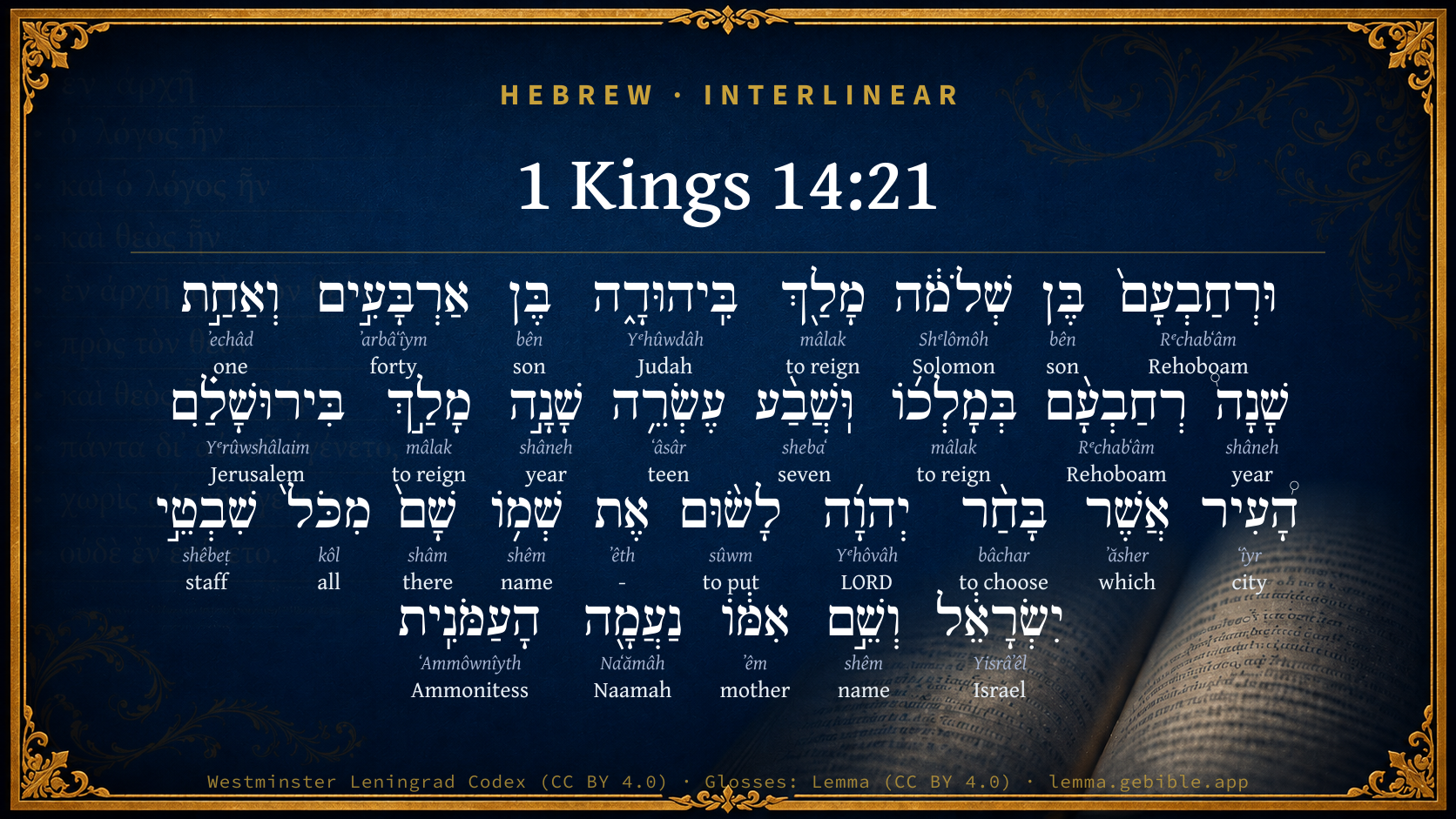
1 Kings 14:21

Hebrew (Westminster Leningrad Codex) 1 Kings 14:21 appears in the Hebrew Old Testament. The text above is from the Westminster Leningrad Codex. Each word links to its Strong’s number, a concise gloss, and parsing drawn from the Open Scriptures Hebrew Bible morphology. Click any word for its full Brown-Driver-Briggs (BDB) entry.
Download image
Cite this verse

1 Kings 14:21 (World English Bible). Public Domain. Lemma interlinear Bible study tool, https://lemma.gebible.app/v/1-kings/14/21.

Show BibTeX & RIS
BibTeX
RIS
English Translation
Rehoboam the son of Solomon reigned in Judah. Rehoboam was forty-one years old when he began to reign, and he reigned seventeen years in Jerusalem, the city which Yahweh had chosen out of all the tribes of Israel, to put his name there: and his mother's name was Naamah the Ammonitess.
World English Bible · Public Domain
Highlights
  • 1 first appearance in the Hebrew Bible
Full analysis ↓
Download a study sheet

One document with this verse’s original text, its word-by-word gloss line, the meaning frame, cross-references with their text, attributed commentary, and full source and license credits — printable, and it pastes into notes with its structure intact.

This verse Autodidact and up

Study sheet (.html) Plain text (.txt)

A passage Seminary Student

Up to 50 verses in one chapter. A passage sheet keeps up to 6 commentary sources and 12 cross-references per verse, in the order this page ranks them, and says so on the sheet whenever that leaves anything out. Ask for a single verse and you get the Autodidact verse sheet above.

Everything on this page stays free to read, with no account — the sheet is a download of what is already on screen, not access to it.

Want to remove ads? Support Godless Engineer
Compare translations 3

The same verse in 3 English versions, stacked beneath the original-language interlinear above. Click any original word for its lexicon entry.

Each is an independent rendering of the whole verse — the interlinear is not word-aligned to these translations.

Highlighted words mark where these versions differ — a whole-verse word diff, not a word-by-word alignment.

  • World English Bible Public Domain
    Rehoboam the son of Solomon reigned in Judah. Rehoboam was forty-one years old when he began to reign, and he reigned seventeen years in Jerusalem, the city which Yahweh had chosen out of all the tribes of Israel, to put his name there: and his mother's name was Naamah the Ammonitess.
  • King James Version Public Domain
    And Rehoboam the son of Solomon reigned in Judah. Rehoboam was forty and one years old when he began to reign, and he reigned seventeen years in Jerusalem, the city which the LORD did choose out of all the tribes of Israel, to put his name there. And his mother's name was Naamah an Ammonitess.
  • unfoldingWord Literal Text CC BY-SA 4.0
    Now Rehoboam, the son of Solomon, reigned in Judah. Rehoboam a son of 41 years when he became king. And he reigned 17 years in Jerusalem, the city where Yahweh had chosen to put his name there from all of the tribes of Israel. And the name of his mother was Naamah the Ammonitess.

unfoldingWord Literal Text — © unfoldingWord, licensed CC BY-SA 4.0. Word-aligned USFM3 via Door43 (git.door43.org/unfoldingWord/en_ult).

Versions to compare (up to 4)

3 of 4 selected

Show all 18 translations

Every available English version of this verse, each an independent rendering of the whole verse.

  • World English Bible Public Domain
    Rehoboam the son of Solomon reigned in Judah. Rehoboam was forty-one years old when he began to reign, and he reigned seventeen years in Jerusalem, the city which Yahweh had chosen out of all the tribes of Israel, to put his name there: and his mother's name was Naamah the Ammonitess.
  • Berean Standard Bible Public Domain
    Meanwhile, Rehoboam son of Solomon reigned in Judah. He was forty-one years old when he became king, and he reigned seventeen years in Jerusalem, the city the LORD had chosen from all the tribes of Israel in which to put His Name. His mother’s name was Naamah the Ammonite.
  • Majority Standard Bible Public Domain
    Meanwhile, Rehoboam son of Solomon reigned in Judah. He was forty-one years old when he became king, and he reigned seventeen years in Jerusalem, the city the LORD had chosen from all the tribes of Israel in which to put His Name. His mother’s name was Naamah the Ammonite.
  • King James Version Public Domain
    And Rehoboam the son of Solomon reigned in Judah. Rehoboam was forty and one years old when he began to reign, and he reigned seventeen years in Jerusalem, the city which the LORD did choose out of all the tribes of Israel, to put his name there. And his mother's name was Naamah an Ammonitess.
  • American Standard Version (1901) Public Domain
    And Rehoboam the son of Solomon reigned in Judah. Rehoboam was forty and one years old when he began to reign, and he reigned seventeen years in Jerusalem, the city which Jehovah had chosen out of all the tribes of Israel, to put his name there: and his mother's name was Naamah the Ammonitess.
  • Revised Version (1885) Public Domain
    And Rehoboam the son of Solomon reigned in Judah, Rehoboam was forty and one years old when he began to reign, and he reigned seventeen years in Jerusalem, the city which the LORD had chosen out of all the tribes of Israel, to put his name there: and his mother’s name was Naamah the Ammonitess.
  • Geneva Bible (1599) Public Domain
    Also Rehoboam the sonne of Salomon reigned in Iudah. Rehoboam was one and fourtie yere olde, when he began to reigne, and reigned seuenteene yere in Ierusalem, the citie which the Lord did chuse out of al the tribes of Israel, to put his Name there: and his mothers name was Naamah an Ammonite.
  • Douay-Rheims (1899) Public Domain
    And Roboam the son of Solomon reigned in Juda: Roboam was one and forty years old when he began to reign: and he reigned seventeen years in Jerusalem the city, which the Lord chose out of all the tribes of Israel to put his name there. And his mother's name wee Naama an Ammonitess.
  • Young's Literal Translation Public Domain
    And Rehoboam son of Solomon hath reigned in Judah; a son of forty and one years `is' Rehoboam in his reigning, and seventeen years he hath reigned in Jerusalem, the city that Jehovah chose to set His name there, out of all the tribes of Israel, and the name of his mother `is' Naamah the Ammonitess.
  • Literal Standard Version CC BY-SA 4.0
    And Rehoboam son of Solomon has reigned in Judah; Rehoboam [is] a son of forty-one years in his reigning, and he has reigned seventeen years in Jerusalem, the city that YHWH chose to set His Name there, out of all the tribes of Israel, and the name of his mother [is] Naamah the Ammonitess.
  • Unlocked Literal Bible CC BY-SA 4.0
    Now Rehoboam son of Solomon was reigning in Judah. Rehoboam was forty-one years old when he became king, and he reigned seventeen years in Jerusalem, the city that Yahweh had chosen out of all the tribes of Israel in which to put his name. His mother's name was Naamah the Ammonite woman.
  • unfoldingWord Literal Text CC BY-SA 4.0
    Now Rehoboam, the son of Solomon, reigned in Judah. Rehoboam a son of 41 years when he became king. And he reigned 17 years in Jerusalem, the city where Yahweh had chosen to put his name there from all of the tribes of Israel. And the name of his mother was Naamah the Ammonitess.
  • Darby Bible Public Domain
    And Rehoboam the son of Solomon reigned in Judah. Rehoboam was forty-one years old when he began to reign, and he reigned seventeen years in Jerusalem, the city that Jehovah had chosen out of all the tribes of Israel to put his name there; and his mother's name was Naamah, an Ammonitess.
  • World Messianic Bible Public Domain
    Rehoboam the son of Solomon reigned in Judah. Rehoboam was forty-one years old when he began to reign, and he reigned seventeen years in Jerusalem, the city which the LORD had chosen out of all the tribes of Israel, to put his name there. His mother’s name was Naamah the Ammonitess.
  • Webster's Bible Public Domain
    And Rehoboam the son of Solomon reigned in Judah. Rehoboam was forty and one years old when he began to reign, and he reigned seventeen years in Jerusalem, the city which the LORD chose out of all the tribes of Israel, to put his name there. And his mother's name was Naamah an Ammonitess.
  • Free Bible Version CC BY-SA 4.0
    Rehoboam, son of Solomon, reigned in Judah. He was forty-one when he became king, and he reigned seventeen years in Jerusalem, the city the Lord had chosen from all the tribes of Israel where he would be honored. The name of his mother was Naamah the Ammonite.
  • Bible in Basic English Public Domain
    And Rehoboam, the son of Solomon, was king in Judah. Rehoboam was forty-one years old when he became king, and he was king for seventeen years in Jerusalem, the town which the Lord had made his out of all the tribes of Israel, to put his name there; his mother's name was Naamah, an Ammonite woman.
  • JPS Tanakh (1917) Public Domain
    And Rehoboam the son of Solomon reigned in Judah. Rehoboam was forty and one years old when he began to reign, and he reigned seventeen years in Jerusalem, the city which the LORD had chosen out of all the tribes of Israel, to put His name there; and his mother's name was Naamah the Ammonitess.

Literal Standard Version (2020), Covenant Press — licensed CC BY-SA 4.0. Text via the HelloAO Bible API (eBible.org). Unlocked Literal Bible (unfoldingWord) — licensed CC BY-SA 4.0. Text via the HelloAO Bible API (eBible.org). unfoldingWord Literal Text — © unfoldingWord, licensed CC BY-SA 4.0. Word-aligned USFM3 via Door43 (git.door43.org/unfoldingWord/en_ult). Free Bible Version, Dr. Jonathan Gallagher — licensed CC BY-SA 4.0. Text via the HelloAO Bible API (eBible.org).

Word by word

More ways to search: Search by grammar → Find every occurrence → Compare this word →

Practice this passage: Drill this verse → Learn its vocabulary →

הָעַמֹּנִֽית
ʻAmmôwnîyth
H5985
“the · Ammonitess”
Particle, Definite Article + Noun, Gentilic, Feminine, Singular, Absolute
Part of Speech
Particle + Noun
Type
Gentilic
Gender
Feminine
Number
Singular
State
Absolute
Full BDB Definition

Origin: fem of H5984

TWOT: None

Ammonitess = see Ammon " tribal" - a woman of Ammon
  1. וּרְחַבְעָם֙ Rᵉchabʻâm H7346 “and · Rehoboam” Conjunction + Noun, Proper
  2. בֶּן bên H1121 “son of” Noun, Common, Masculine, Singular, Construct
  3. שְׁלֹמֹ֔ה Shᵉlômôh H8010 “Solomon” Noun, Proper
  4. מָלַ֖ךְ mâlak H4427 “to reign” Verb, Qal, Perfect, 3rd Person, Masculine, Singular
  5. בִּֽיהוּדָ֑ה Yᵉhûwdâh H3063 “in/at · Judah” Preposition + Noun, Proper
  6. בֶּן bên H1121 “son of” Noun, Common, Masculine, Singular, Construct
  7. אַרְבָּעִ֣ים ʼarbâʻîym H705 “forty” Adjective, Cardinal number, Both, Plural, Absolute
  8. וְאַחַ֣ת ʼechâd H259 “and · one” Conjunction + Adjective, Cardinal number, Feminine, Singular, Absolute
  9. שָׁנָה֩ shâneh H8141 “year” Noun, Common, Feminine, Singular, Absolute
  10. רְחַבְעָ֨ם Rᵉchabʻâm H7346 “Rehoboam” Noun, Proper
  11. בְּמָלְכ֜וֹ mâlak H4427 “in/at · to reign · him” Preposition + Verb, Qal, Infinitive Construct + Suffix, Personal, 3rd Person, Masculine, Singular
  12. וּֽשֲׁבַ֨ע shebaʻ H7651 “and · seven” Conjunction + Adjective, Cardinal number, Feminine, Singular, Absolute
  13. עֶשְׂרֵ֥ה ʻâsâr H6240 “teen” Adjective, Cardinal number, Feminine, Singular, Absolute
  14. שָׁנָ֣ה shâneh H8141 “year” Noun, Common, Feminine, Singular, Absolute
  15. מָלַ֣ךְ mâlak H4427 “to reign” Verb, Qal, Perfect, 3rd Person, Masculine, Singular
  16. בִּירוּשָׁלִַ֗ם Yᵉrûwshâlaim H3389 “in/at · Jerusalem” Preposition + Noun, Proper
  17. הָ֠עִיר ʻîyr H5892 “the · city” Particle, Definite Article + Noun, Common, Feminine, Singular, Absolute
  18. אֲשֶׁר ʼăsher H834 “which” Particle, Relative
  19. בָּחַ֨ר bâchar H977 “to choose” Verb, Qal, Perfect, 3rd Person, Masculine, Singular
  20. יְהוָ֜ה Yᵉhôvâh H3068 “LORD” Noun, Proper
  21. לָשׂ֨וּם sûwm H7760 “to put” Preposition + Verb, Qal, Infinitive Construct
  22. אֶת ʼêth H853 “-” Particle, Direct Object
  23. שְׁמ֥וֹ shêm H8034 “name · his” Noun, Common, Masculine, Singular, Construct + Suffix, Personal, 3rd Person, Masculine, Singular
  24. שָׁם֙ shâm H8033 “there” Adverb
  25. מִכֹּל֙ kôl H3605 “from · all of” Preposition + Noun, Common, Masculine, Singular, Construct
  26. שִׁבְטֵ֣י shêbeṭ H7626 “staffs of” Noun, Common, Masculine, Plural, Construct
  27. יִשְׂרָאֵ֔ל Yisrâʼêl H3478 “Israel” Noun, Proper
  28. וְשֵׁ֣ם shêm H8034 “and · name of” Conjunction + Noun, Common, Masculine, Singular, Construct
  29. אִמּ֔וֹ ʼêm H517 “mother · his” Noun, Common, Feminine, Singular, Construct + Suffix, Personal, 3rd Person, Masculine, Singular
  30. נַעֲמָ֖ה Naʻămâh H5279 “Naamah” Noun, Proper

About this verse

These counts appear in no published source. They are computed here, from the morphology-tagged text and Lemma’s own curated glosses. What Lemma adds →

31
words
25
distinct lemmas
Historical
section

Notable vocabulary

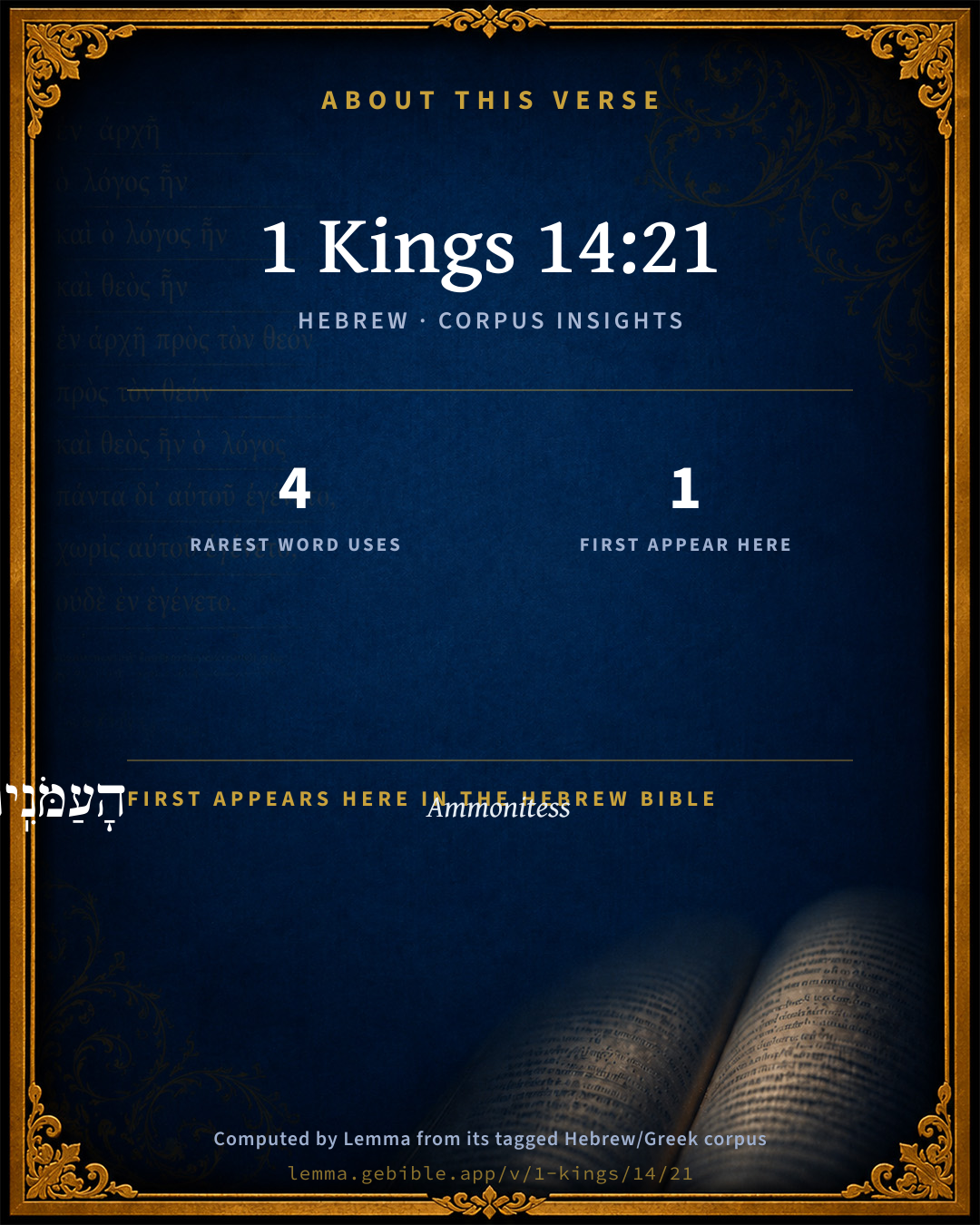
The rarest word here is הָעַמֹּנִֽית Ammonitess H5985 — appearing just 4 times in the whole Hebrew Bible.

First appearance in Scripture

This word makes its first canonical appearance in the Hebrew Bible here:

  • הָעַמֹּנִֽית Ammonitess H5985

Shared distinctive vocabulary

הָעַמֹּנִֽית Ammonitess H5985 occurs in 4 verses of the Hebrew Bible. Also found in:

Grammatical profile

  • 5 verbs
  • 19 nouns
  • 4 adjectives
  • 1 adverb
  • 2 particles

Verb forms

  • מָלַ֖ךְ Qal · Perfect
  • בְּמָלְכ֜וֹ Qal · Infinitive Construct
  • מָלַ֣ךְ Qal · Perfect
  • בָּחַ֨ר Qal · Perfect
  • לָשׂ֨וּם Qal · Infinitive Construct

Repetition

Words recur within this verse — often emphatic in Hebrew:

  • מָלַ֖ךְ to reign H4427 ×3
  • וּרְחַבְעָם֙ Rehoboam H7346 ×2
  • בֶּן son H1121 ×2
  • שָׁנָה֩ year H8141 ×2
  • שְׁמ֥וֹ name H8034 ×2

Hebrew & Septuagint length

In English translation the verse runs 51 words from the Hebrew and 53 from the Septuagint (LXX English) — closely comparable.

A rough comparison of the two English renderings, which tokenize alike — not a word-level alignment.

Word counts can differ between the Hebrew and the Greek without any difference in meaning — e.g. the Hebrew direct-object marker אֵת has no separate Greek word, and Greek often adds the article ὁ.

Cross-references

16

Topical passages linked to 1 Kings 14:21 in the Treasury of Scripture Knowledge — connected by theme and wording, ordered by reader-vote popularity; previews shown in the World English Bible.

  • 2 Chronicles 12:13 So king Rehoboam strengthened himself in Jerusalem, and reigned: for Rehoboam was forty-one years old when he began to reign, and he reigned seventeen years in Jerusalem, the city which Yahweh had chosen out of all the tribes of Israel, to put his name there: and his mother's name was Naamah the Ammonitess.
  • 1 Kings 11:36 To his son will I give one tribe, that David my servant may have a lamp always before me in Jerusalem, the city which I have chosen me to put my name there.
  • 1 Kings 14:31 Rehoboam slept with his fathers, and was buried with his fathers in the city of David: and his mother's name was Naamah the Ammonitess. Abijam his son reigned in his place.
  • Exodus 20:24 You shall make an altar of earth for me, and shall sacrifice on it your burnt offerings and your peace-offerings, your sheep and your oxen. In every place where I record my name I will come to you and I will bless you.
  • Deuteronomy 12:5 But to the place which Yahweh your God shall choose out of all your tribes, to put his name there, even to his habitation shall you seek, and there you shall come;
  • Deuteronomy 12:21 If the place which Yahweh your God shall choose, to put his name there, be too far from you, then you shall kill of your herd and of your flock, which Yahweh has given you, as I have commanded you; and you may eat within your gates, after all the desire of your soul.
  • Deuteronomy 23:3 An Ammonite or a Moabite shall not enter into the assembly of Yahweh; even to the tenth generation shall none belonging to them enter into the assembly of Yahweh forever:
  • 1 Kings 8:16 Since the day that I brought forth my people Israel out of Egypt, I chose no city out of all the tribes of Israel to build a house, that my name might be there; but I chose David to be over my people Israel.
  • 1 Kings 8:44 If your people go out to battle against their enemy, by whatever way you shall send them, and they pray to Yahweh toward the city which you have chosen, and toward the house which I have built for your name;
  • 1 Kings 11:32 (but he shall have one tribe, for my servant David's sake and for Jerusalem's sake, the city which I have chosen out of all the tribes of Israel);
  • 1 Kings 11:43 Solomon slept with his fathers, and was buried in the city of David his father: and Rehoboam his son reigned in his place.
  • 2 Chronicles 13:7 There were gathered to him worthless men, base fellows, who strengthened themselves against Rehoboam the son of Solomon, when Rehoboam was young and tender-hearted, and could not withstand them.
  • Psalms 78:68–69 But chose the tribe of Judah, Mount Zion which he loved.
  • Psalms 87:1–2 His foundation is in the holy mountains.
  • Psalms 132:13–14 For Yahweh has chosen Zion. He has desired it for his habitation.
  • Isaiah 12:6 Cry aloud and shout, you inhabitant of Zion; for great in the midst of you is the Holy One of Israel!"

Cross-references courtesy of OpenBible.info (CC BY 4.0).

Hebrew and Greek witnesses Masoretic Hebrew ↔ Greek Septuagint

The same verse in the two great witnesses to the Old Testament, shown verse-for-verse.

These are two independent witnesses, not word-aligned to each other, and the Septuagint is shown in lemma (dictionary) form.

Hebrew 1 Kings 14:21 Masoretic · Westminster Leningrad Codex

וּרְחַבְעָם֙ בֶּן שְׁלֹמֹ֔ה מָלַ֖ךְ בִּֽיהוּדָ֑ה בֶּן אַרְבָּעִ֣ים וְאַחַ֣ת שָׁנָה֩ רְחַבְעָ֨ם בְּמָלְכ֜וֹ וּֽשֲׁבַ֨ע עֶשְׂרֵ֥ה שָׁנָ֣ה מָלַ֣ךְ בִּירוּשָׁלִַ֗ם הָ֠עִיר אֲשֶׁר בָּחַ֨ר יְהוָ֜ה לָשׂ֨וּם אֶת שְׁמ֥וֹ שָׁם֙ מִכֹּל֙ שִׁבְטֵ֣י יִשְׂרָאֵ֔ל וְשֵׁ֣ם אִמּ֔וֹ נַעֲמָ֖ה הָעַמֹּנִֽית

Rehoboam the son of Solomon reigned in Judah. Rehoboam was forty-one years old when he began to reign, and he reigned seventeen years in Jerusalem, the city which Yahweh had chosen out of all the tribes of Israel, to put his name there: and his mother's name was Naamah the Ammonitess.

World English Bible · Public Domain

Greek LXX 1 Kings 14:21 Septuagint · lemma form
And Roboam son of Solomon ruled over Juda. Roboam was forty and one years old when he began to reign, and he reigned seventeen years in the city Jerusalem, which the Lord chose to put his name there out of all the tribes of Israel: and his mother's name was Naama the Ammonitess.

LXX2012 (modern English Septuagint) · Public Domain

On this verse, Whedon's Commentary on the Bible discusses the Septuagint’s reading. Read the note in Commentary ↓

Hebrew: Westminster Leningrad Codex (CC BY 4.0). Greek: Septuagint (public domain); English from LXX2012 (modern English Septuagint) (Public Domain). How the Septuagint differs from the Hebrew →

Targum (Aramaic paraphrase)

1

The Targum is the ancient Jewish Aramaic paraphrase of the Hebrew Scriptures — an interpretive translation, not the Hebrew text itself. Onkelos (literal) and Pseudo-Jonathan (expansive) render the Torah, and Jonathan the Prophets. Coverage is partial: where no permissively-licensed English translation exists for a verse, only the Aramaic is shown. This is verse-level text, not a word-by-word alignment to the Hebrew.

  1. Targum Jonathan Prophets (Joshua–Malachi)
    וּרְחַבְעָם בַּר שְׁלֹמֹה מְלַךְ עַל דְבֵית יְהוּדָה בַּר אַרְבְּעִין וַחֲדָא שְׁנָא רְחַבְעָם כַּד מְלַךְ וּשְׁבַע עַשְׂרֵי שְׁנִין מְלַךְ בִּירוּשְׁלֵם קַרְתָּא דְאִתְרְעֵי יְיָ לְאַשְׁרָאָה יַת שְׁכִנְתֵּיהּ תַּמָן מִכָּל שִׁבְטַיָא דְיִשְׂרָאֵל וְשׁוּם אִמֵיהּ נַעֲמָה מִבְּנֵי עַמוֹן:

    (no public-domain English translation for this verse)

    Targum Jonathan — Aramaic: “Mikraot Gedolot” (public domain). English: “Sefaria Community Translation” (CC0 1.0 (public-domain dedication)); “London "Chaldee Paraphrase," 1871” (public domain). Text via Sefaria.

Commentary

Notes on 1 Kings 14:21 from classic Christian and Jewish commentators (each source and its license shown beneath its notes). The classic Christian expositions comment on the surrounding passage and are grouped to its opening verse, so a note may address several verses; the Jewish commentaries on the Tanakh (Rashi and others) are per-verse, so they appear only where the commentator wrote on this verse.

Lemma curates 59 commentaries, every one of them public domain or Creative Commons licensed, each selected and text-cleaned for this edition rather than reprinted as found. About our sources →

Matthew Henry's Commentary

Judah's story and Israel's are intermixed in this book. Jeroboam out-lived Rehoboam, four or five years, yet his history is despatched first, that the account of Rehoboam's reign may be laid together; and a sad account it is.

I. Here is no good said of the king. All the account we have of him here is, 1. That he was forty-one years old when he began to reign, by which reckoning he was born in the last year of David, and had his education, and the forming of his mind, in the best days of Solomon; yet he lived not up to these advantages. Solomon's defection at last did more to corrupt him than his wisdom and devotion had done to give him good principles. 2. That he reigned seventeen years in Jerusalem, the city where God put his name, where he had opportunity enough to know his duty, if he had but had a heart to do it. 3. That his mother was Naamah, an Ammonitess; this is twice mentioned, Kg1 14:21, Kg1 14:31. It was strange that David would marry his son Solomon to an Ammonitess (for it was done while he lived), but it is probable that Solomon was in love with her, because she was Naamah, a beauty (so it signifies), and his father was loth to cross him, but it proved to have a very bad influence upon posterity. Probably she was daughter to Shobi the Ammonite, who was kind to David (Sa2 17:27), and David was too willing to requite him by matching his son into his family. None can imagine how lasting and how fatal the consequences may be of being unequally yoked with unbelievers. 4. That he had continual war with Jeroboam (Kg1 14:30), which could not but be a perpetual uneasiness to him. 5. That when he had reigned but seventeen years he died, and left his throne to his son. His father, and grandfather, and grandson, that reigned well, reigned long, forty years apiece. But sin often shortens men's lives and comforts.

II. Here is much evil said of the subjects, both as to their character and their condition.

1. See here how wicked and profane they were. It is a most sad account that is here given of their apostasy from God, Kg1 14:22-24. Judah, the only professing people God had in the world, did evil in his sight, in contempt and defiance of him and the tokens of his special presence with them; they provoked him to jealousy, as the adulterous wife provokes her husband by breaking the marriage-covenant. Their fathers had been bad enough, especially in the times of the judges, but they did abominable things, above all that their fathers had done. The magnificence of their temple, the pomp of their priesthood, and all the secular advantages with which their religion was attended, could not prevail to keep them to it. Nothing less than the pouring out of the Spirit from on high will keep God's Israel in their allegiance to him. The account here given of the wickedness of the Jews agrees with that which the apostle gives of the wickedness of the Gentile world (Rom 1:21, Rom 1:24), so that both Jew and Gentile are alike under sin, Rom 3:9. (1.) They became vain in their imaginations concerning God, and changed his glory into an image, for they built themselves high places, images, and groves (Kg1 14:23), profaning God's name by affixing to it their images, and God's ordinances by serving their idols with them. They foolishly fancies that they exalted God when they worshipped him on high hills and pleased him when they worshipped him under the pleasant shadow of green trees. (2.) They were given up to vile affections (as those idolaters Rom 1:26, Rom 1:27), for there were sodomites in the land (Kg1 14:24), men with men working that which is unseemly, and not to be thought of, much less mentioned, without abhorrence and indignation. They dishonoured God by one sin and then God left them to dishonour themselves by another. They profaned the privileges of a holy nation, therefore God gave them up to their own hearts' lusts, to imitate the abominations of the accursed Canaanites; and herein the Lord was righteous. And, when they did like those that were cast out, how could they expect any other than to be cast out like them?

2. See here how weak and poor they were; and this was the consequence of the former. Sin exposes, impoverishes, and weakens any people. Shishak, king of Egypt, came against them, and so far, either by force or surrender, made himself master of Jerusalem itself that he took away the treasures both of the temple and of the exchequer, of the house of the Lord and of the king's house, which David and Solomon had amassed, Kg1 14:25, Kg1 14:26. These, it is likely, tempted him to make his descent; and, to save the rest, Rehoboam perhaps tamely surrendered them, as Ahab, Kg1 20:4. He also took away the golden shields that were made but in his father's time, Kg1 14:26. These the king of Egypt carried off as trophies of his victory; and, instead of them, Rehoboam made brazen shields, which the life-guard carried before him when he went to church in state, Kg1 14:27, Kg1 14:28. This was an emblem of the diminution of his glory. Sin makes the gold become dim, changes the most fine gold, and turns it into brass. We commend Rehoboam for going to the house of the Lord, perhaps the oftener for the rebuke he had been under, and do not condemn him for going in pomp. Great men should honour God with their honour, and then they are themselves most honoured by it.

Matthew Henry's Commentary on the Whole Bible (1708–1710) — public domain (CC PDM 1.0). Text via the HelloAO Bible API.

Jamieson, Fausset & Brown

Robert Jamieson, A. R. Fausset & David Brown

REHOBOAM'S WICKED REIGN. (Kg1 14:21-24)

he reigned . . . in Jerusalem--Its particular designation as "the city which the Lord did choose out of all the tribes of Israel, to put his name there," seems given here, both as a reflection on the apostasy of the ten tribes, and as a proof of the aggravated wickedness of introducing idolatry and its attendant vices there.

his mother's name was Naamah an Ammonitess--Her heathen extraction and her influence as queen mother are stated to account for Rehoboam's tendency to depart from the true religion. Led by the warning of the prophet (Kg1 12:23), as well as by the large immigration of Israelites into his kingdom (Kg1 12:17; Ch2 11:16), he continued for the first three years of his reign a faithful patron of true religion (Ch2 11:17). But afterwards he began and encouraged a general apostasy; idolatry became the prevailing form of worship, and the religious state of the kingdom in his reign is described by the high places, the idolatrous statues, the groves and impure rites that with unchecked license were observed in them. The description is suited to the character of the Canaanitish worship.

Jamieson, Fausset & Brown — Commentary Critical and Explanatory on the Whole Bible (1871) — public domain (CC PDM 1.0). Text via the HelloAO Bible API.

Trapp's Complete Commentary

John Trapp

1Ki 14:21 And Rehoboam the son of Solomon reigned in Judah. Rehoboam [was] forty and one years old when he began to reign, and he reigned seventeen years in Jerusalem, the city which the LORD did choose out of all the tribes of Israel, to put his name there. And his mother’s name [was] Naamah an Ammonitess.

Ver. 21. His mother’s name was Naamah an Ammonitess.] Mentioned here, and again, 1Ki 14:31, but for no good. Omne malum ex Gynaeceo. She had the breeding of him, and corrupted him likely. His wicked wife also, Maachah, helped after.

John Trapp, A Commentary or Exposition upon All the Books of the Old and New Testament (1647–1656) — public domain. Text from a community e-Sword module.

Joseph Benson's Commentary

1Ki 14:21. Rehoboam was forty and one years old when he began to reign — Although many learned men are of opinion that there is an error in the text here in regard to the age of Rehoboam when he began to reign, and some think the reading should be twenty-one, while Houbigant, following the Seventy, reads sixteen years; yet as they do not seem to give sufficient reasons for the alteration, it is certainly safest to abide by the Hebrew text. According to this, he was born in the last year of David’s life, and certainly had his education, and the forming of his mind, in the best days of Solomon; and yet, with all the advantages he enjoyed, he was a weak and inconsiderate prince, who, instead of being a blessing, proved a curse to his kingdom. Probably Solomon’s defection, in the latter part of his life, did more to corrupt him than his prior wisdom and devotion had done to render him wise and virtuous. He reigned seventeen years in Jerusalem, the city, &c. — Where he had opportunities in abundance to know his duty, had he but had a heart to practice it. His mother was Naamah an Ammonitess — She was probably the daughter of Shobi, the Ammonite, who was so kind to David in Absalom’s rebellion. And as there is reason to think Shobi had become a proselyte to the true religion, it is likely that gratitude, for his kindness moved David to take his daughter, though an Ammonitess, to be the wife of his son Solomon. It is very doubtful, however, whether ever she cordially embraced the religion of the Israelites, and as Solomon worshipped the gods of the Ammonites, among his other idols, it is not improbable that she was concerned in seducing him. None can imagine how lasting and how fatal the consequences may be, of being unequally yoked with an unbeliever.

Joseph Benson's Commentary on the Old and New Testaments (1811–1818) — public domain. Text from a community e-Sword module.

Whedon's Commentary on the Bible

Daniel D. Whedon

REHOBOAM’S EVIL REIGN, AND SHISHAK’S INVASION, 1Ki_14:21-31.

21. Rehoboam — On the beginning of his reign, his unwise policy, and his loss of most of his father’s kingdom, see 1Ki_12:1-24. The various acts and incidents of this king’s reign are given more fully in 2 Chronicles 11, 12.

Forty and one years old — This number, confirmed by 2Ch_12:13, should be followed, rather than conjectures formed from the fact that Rehoboam’s companions are called young men, (ילדים,) 1Ki_12:8, and from the statements of the Septuagint in its addition to 1Ki_12:24. Since Solomon reigned forty years, (1Ki_11:42,) Rehoboam was born one year before his father’s accession.

Naamah — Schultz supposes that his mother’s name is here mentioned because she was the occasion of Rehoboam’s idolatry; and Keil thinks it is because she had, as queen-mother, considerable influence in the government. But the single fact that she was of foreign birth — an Ammonitess — would be a sufficient reason for mentioning her in this connexion, though she may have been dead before Solomon’s marriage with Pharaoh’s daughter. See note on 1Ki_11:43.

Daniel D. Whedon (gen. ed.), Commentary on the Old and New Testaments (1874–1909) — public domain. Text from a community e-Sword module.

The Pulpit Commentary

CHAPTER 14:21-31.

THE REIGN OF REHOBOAM.

And Rehoboam, the son of Solomon, reigned in Judah. Rehoboam was forty or twenty. (See on 1Ki_12:1) and one years old when he began to reign, and he reigned this reign is related at greater length in 2Ch 11:, 12 seventeen years (cf. 1Ki_15:1) in Jerusalem, the city which the Lord did choose (cf. 1 Kings Psa_78:68; Neh_1:9) out of all the tribes of Israel (2Ch_6:6; 2Ki_21:7) to put his name there. The historian reminds us that Jerusalem was by God"s appointment the religious centre of the land; that Bethel and Dan were no sanctuaries of His choosing; and that, however much the realm of Rehoboam was restricted, he still reigned in the capital of God"s choice. It is possible the words have some reference to the next verse, and imply that, though it was the holy city, yet even there they fell away from God (Bahr). And his mother"s name was Naamah or, according to the LXX, Naanan. (See on 1Ki_12:24) an Heb. the, i.e. , the well-known Ammonitess. The name of the mother is given with every king of Judah, principally because of the position of influence she occupied in the kingdom. See on 1Ki_2:13, and ver. 31 below.

HOMILIES BY J.A. MACDONALD. Vers. 21-24.

The Sin of Judah.

Having discoursed of Jeroboam and the kingdom of Israel, the sacred historian now returns to Rehoboam and the sister kingdom of Judah. To have found a better state of things here would have been refreshing, but in this we are disappointed. How fearful was the moral state of the whole world in those days!

I JUDAH HAD FALLEN INTO THE GROSSEST IDOLATRY.

1. He had multiplied high places.

(1) High places were not necessarily for idolatry. They were proper to the worship of the true God in patriarchal times.

(2) Even after God had chosen Jerusalem to put His name there, the patriarchal use of high places was upon special occasions sanctioned by Him. (see 1Ki_18:38)

(3) In Judah there was little need for these, since the extremity of the kingdom was not very remote from Jerusalem. The distance to Beersheba would be about forty British statute miles.

(4) But the high places of Judah were mainly designed for idolatry. Hence their association in the text with" images-and groves" and rites of Sodomites and other Canaanitish abominations.

2. He had built many temples.

(1) The term (twbxm) here translated "images" is elsewhere commonly rendered pillars (see Gen_28:18 Gen_31:51 Gen_35:20; Exo_24:4; Isa_19:19) It is far from evident that this word is ever used for any image or figured thing. In places where it is construed "images," pillars would give as good sense. (see Exo_23:24; 2Ki_10:26, 2Ki_10:27) Marginal readings bear this out. (see Deu_7:5 Deu_16:22)

(2) It is probable these pillars were distributed in ranks, as those of the Druids at Stonehenge and Abiry, to serve as temples in which the powers of the material heavens were worshipped.

3. He had enshrined idols in these.

(1) The Asherim ( are here evidently misrendered "groves;" for how could groves be planted under every green tree? (See Homily on vers. 15, 16, supra.)

(2) They were idols apparently in figure like goats. For Jeroboam "ordained him priests for the high places and for the devils ( goats), and for the calves which he had made". (2Ch_11:15) Here we have no mention of Ashorim; of goats, however, we have mention. But when Josiah destroyed these things, there is mention of the Ashorah, but no mention of the goat. (compare 2Ki_23:15) The Asherah destroyed by Josiah appears, then, to be the goat which Jeroboam had set up.

(3) These Asherim, or Asheroth for they appear to have been male and female idols were supposed to convey blessings to their worshippers, and hence their name (from r to proceed, to bless).

4. His idolatry was attended with shocking cites.

(1) They were the very abominations for which the land had spewed out the Canaanites as with abhorrence. (see Lev_18:28 Lev_20:22, and contexts)

(2) Conspicuous amongst these were the Sodomites, whose orgies were intimately connected with the Asherim, and to encourage which the women wove hangings. (see 2Ki_23:7) How fruitful in inventions is the wickedness of the heart! (Ecc_7:29)

II FOR HIS DEGENERACY HE WAS WITHOUT EXCUSE.

1. He had Jerusalem for his capital.

(1) This was the city chosen of God out of all the tribes of Israel to put His name there. The temple of Jehovah was there, and the Shekinah of Jehovah was in it.

(2) Every appliance for acceptable worship was there at hand. The altars were there; the priesthood was there; the appointed assemblies, festival and ferial, were there.

(3) They sinned, therefore, "before the face of the Lord," as in His very presence. Even more so than Israel, who could not now claim Jerusalem for his capital, though he was still bound to go there to worship. Let us remember that God is ever near us; this thought will restrain our truancy.

2. He had a son of David for his king.

(1) The mother of Rehoboam, indeed, was an Ammonitess. This is emphatically (twice) mentioned. She was one of those strange women who had turned the heart of Solomon from the right way. The abomination of her country was Milcom or Molech, whose rites were most ferocious and demoralizing.

(2) But against these influences were noble traditions on the other side. His father, in the beginning of his reign, was illustrious in wisdom and zeal for the God of Israel. The memories of his grandfather were glorious. To this must be added the most material circumstance that the Covenant was with his house; for Messiah Himself was to be the Son of David.

(3) These things were not without their influence. For three years after the revolution under Jeroboam, Rehoboam governed Judah in the fear of God, and so established his throne. (see 2Ch_11:17)

(4) When, after this, Rehoboam "forsook the law of the Lord," his subjects should have dissuaded him and, if necessary, resisted him. But they went "with him". (2Ch_12:2)

(5) To such excesses,did they go that they "sinned above their fathers in provoking the Lord to jealousy. J.A.M.

HOMILIES BY J. URQUHART Vers. 21-31.

Unfaithfulness and its rebuke.

I JUDAH"S SIN.

1. The nature of the transgression. The grossest idolatry was set side by side with the pure worship of God. The temple and its services were still HIS (ver. 28), but on every high hill and under every green tree were the images and altars of the false gods.

The preservation of the pure worship of God is no proof that all is yielded which God demands. The heart may be full of the world"s idolatries, of its covetousness and lust and manifold sin.

2. Its enormity.

(1) It was wrought in Jerusalem, "the city which the Lord did choose," etc., and this, too, in the face of the defection of the ten tribes. It is high treason against Jehovah when those whom He has called and honoured are faithless to the trust committed to them. It is the darkest crime against God and man to betray the last earthly refuge of the truth.

(2) It was done after an interval of repentance and religious zeal. (2Ch_11:17 2Ch_12:1) They had known and yet forsaken the better way.

(3) Their idolatry was more unrestrained and daring than any that Israel had ever known (ver. 22).

3. Its fruits (ver. 24). Errors in worship become vices in life. The soul that is cut off from the fountain of life must needs break out into corruption.

II JUDAH"S CHASTISEMENT. It inflicted deep humiliation and loudly proclaimed God"s indignation.

1. It was inflicted by an old and beaten foe. Their temple songs, celebrating the ancient triumph over "Rahab," must have deepened their shame.

2. The holy city and the temple itself were spoiled. God loathed their holy things. We need not marvel that rationalism and infidelity are rampant in a faithless, worldly Church. It is God"s way. Israel"s idolatry is punished by Egypt"s triumph.

3. It left its mark in enduring poverty (vers. 26-28). The splendour passed away from the royal pomp, and doubtless also from the temple service. The nation and Church which Egypt has spoiled, whose faith has been shaken by doubt, or swallowed up in unbelief, have lost their strength and glory. They are but the shadows of what a true and pure faith once made them.

J.U.

The Pulpit Commentary (1880–1919), ed. H.D.M. Spence-Jones & Joseph S. Exell — public domain. Text from a community e-Sword module.

The Preacher's Complete Homiletical Commentary

Joseph S. Exell (gen. ed.)

CRITICAL AND EXPLANATORY NOTES.—

1Ki_14:21-31. From incidents associated with the kingdom of ISRAEL, the historian now turns to JUDAH.

1Ki_14:28. Naamah an Ammonitess—Sept. reads: “Daughter of Ana [Hanun?] son of Naas [Nahash], king of the Ammonites. Her heathen extraction is marked as indicating her natural alienation from the religion of Jehovah. As queen-mother, she had great influence in the Government.

1Ki_14:23. Images and groves—On “groves,”vide Note on.

1Ki_14:15. supra. Here מַצְּבַה, “images” or pillars,” from נָצַה, to he firmly set, or made fast; probably stone pillars, or monumental idols, representing the male deity, Baal, as the Ashterahs, wooden idols, represented the female deity.

1Ki_14:24. There were also sodomites in the land—הַקְּדֵשִׁים. These were vicious paramours, detestable persons who practised, as a religious rite, a vile self-desecration. They were male prostitutes, and are ranked in Scripture with harlots (Deu_23:17).

1Ki_14:25. Shishak, king of Egypt—On the Karnak basrelief this Sheshonk (as he is named in Egyptian monuments) is represented as dragging Jewish captives.—W. H. J.

HOMILETICS OF 1Ki_14:21-31

IDOLATRY AS A CAUSE OF NATIONAL DECAY

I. That idolatry is a degradation to the holiest place. “Jerusalem, the city which the Lord did choose out of all the tribes of Israel to put His name there” (1Ki_14:21). The spot was hallowed as the dwelling-place of Jehovah and by manifold revelations of His glory. It was no slight degradation that this holy city should be debased by the idolatrous rites of the heathen. Idolatry pollutes everything it touches. “There was no visible church upon earth but here; and this what a one! O God, how low dost thou sometimes suffer thine own flock to be driven! what woful wanes and eclipses hast thou ordained for this heavenly body. But the gloomy times of corruption shall not last always, the light of truth and peace shall at length break out, and bless the sad hearts of the righteous.”

II. That idolatry is the originator and patron of the most abominable vices.

1. It corrupts a whole nation. “And Judah did evil above all that their fathers had done” (1Ki_14:22-23). It is no longer the individual monarch who is blamed, but the people; the evil practices have become national. One sinner destroyeth much good; one false officer may corrupt an entire army; an idolatrous king is a curse to a country. The mother of Rehoboam was an Ammonitess (1Ki_14:21), a bad wife for a king of Israel; and her son soon partook more of the temper of Ammon, the idolater, than of the spirit of Abraham.

2. It sanctions the most abominable vices (1Ki_14:24). What a strange incongruity is this—Sodom in Jerusalem! idols in Judah! Surely debauched profession proves desperate; admit the idols, you cannot doubt of the sodomy. If they have changed the glory of the uncorruptible God into an image made like to corruptible man, and to birds and four-footed beasts and creeping things, it is no marvel if God gave them up to uncleanness, through the lusts of their own hearts, to dishonour their own bodies between themselves. They dishonoured God by one sin, and God left them to dishonour themselves by another. The most outrageous sins have been committed under the sanction of idolatrous worship.

3. It is specially offensive to God. “They provoked Him to jealousy with their sins” (1Ki_14:22). This expression is a metaphor which views the relation of God and His people as the marriage covenant, in which the people are represented as a faithless wife. No act of infidelity can be so secret as to elude the eyes of God. “Judah did evil in the sight of the Lord.” What emotions must arise in the heart of God as He is a silent and invisible Spectator of the sins of His people!

III. That idolatry destroys the bravery of a nation.

1. It is powerless to repel the invasion of an enemy (1Ki_14:25). It may be that Jeroboam incited the Egyptian king to make war against Judah; but it is a revelation of the condition of weakness into which the kingdom had sunk that Jeroboam saw his rival would become an easy prey to the Egyptian army. How great a change was this to the vigour and bravery of the days of David, when the surrounding nations were kept in awe by his victorious sword, and the Jewish kingdom acquired the position of a first-rate military power! Idolatry emasculates the manhood of a people, and it becomes demoralized and cowed in the presence of an enemy which before it had confronted with bravery.

2. It reduces a nation to poverty (1Ki_14:26-28). Religion promotes the wealth of a nation and guards it from spoliation. While Rehoboam and his people walked in the fear of God (2Ch_11:17), the accumulated riches of Solomon remained undisturbed; but when they forsook the Lord (ib. 1Ki_12:1), then Shishak, the instrument of Divine retribution, was permitted to invade Jerusalem and carry away its immense treasures. And now, instead of the golden shields which glittered in the presence of Solomon on great state occasions, Rehoboam is glad enough to substitute brass—an emblem of the degeneracy of Judah. How soon the mention of the profusion of gold in the age of Solomon is succeeded by this mention of brass in its place! Such are the evanescent vanities of this world’s riches! Idolatry will bring the most prosperous nation to beggary.

IV. That idolatry is a fruitful source of fraternal enmity. “There was war between Rehoboam and Jeroboam all their days” (1Ki_14:30). Not merely a feeling of hostility, but frequent wars. We are not to suppose that the Word of the Lord by Shemaiah (1Ki_12:24) was any more observed in the later history of Rehoboam than it was by his sons. Of all quarrels, those between people of near kindred are the most bitter and disastrous. Where true religion is ignored, the bond of unity and brotherhood is destroyed. Idolatry encourages a restless strife after an unholy and tyrannical supremacy, rather than contends for the honour of God and the supreme authority of His law.

V. That idolatry hurries its votaries to an untimely and dishonoured grave (1Ki_14:31). Brief as was the reign of Rehoboam, that of his son and successor was briefer still (chap. 1Ki_15:2). Sin shortens human life, robs it of many pleasures, and surrounds its close with gloom and misery. Even the pious are impressed with the brevity of life. “Alas!” was the touching lament of Grotius, “I have lost my life in doing nothing with great labour!” What can be said of the close of a life wasted in folly and in wicked opposition to God?

LESSONS:—

1. Religion it the secret of a nation’s greatness.

2. No nation can prosper when it forsakes God.

3. There is no limit to the abominations of a nation when it gives itself up to idolatry.

GERM N0TES ON THE VERSES

1Ki_14:21-30. The deep fall of Judah. I. Whence it came (Deu_32:15; Hos_13:6; Pro_30:9). II. Whither it led (Rom_1:25; Rom_1:28). Amongst individual men, as in entire communities, cities, and nations, revolt against the living God results from haughtiness, over-prosperity, and carnal security, bringing, as inevitable consequences, poverty, ruin, and misfortune in war. High as stood Judah under David and Solomon, so deep in proportion did it sink under Rehoboam.—Lange.

1Ki_14:21-22. Wherever God has a house, the Devil always builds a chapel close at hand. How often does it happen that cities and countries, whence it has been ordained by God that the light of His knowledge should shine forth, have become the seat alike of superstition and of scepticism, and thus infinitely sink below the level of those lands which have never heard His blessed Word.

1Ki_14:22. The enormity of sin. I. Is not unnoticed by the Omniscient One. It is committed “in the sight of God.” II. Is a trial to the love of God. “They provoked Him to jealousy with their sins.” III. Is a flagrant evidence of faithlessness to the Divine Covenant. IV. Earns an unenviable notoriety. “Above all that their fathers had done.”

—Idolatry and immorality rather increased than decreased, and the fall of Judah seems to have been even deeper than that of Israel. However, the condition of Judah was not so bad as the condition of Israel in this respect; as in the latter the breach of the fundamental law had become the state religion and institution of the kingdom, the separate existence of which depended on the new worship; whilst in Judah the apostasy was only permitted, and the lawful worship of Jehovah had always a firm footing at the central sanctuary. Many good elements also still existed in Judah (2Ch_20:12). Judah always repented as often as they fell into idolatry, and they continued to be the guardian of the law; whilst Israel, on the contrary, never completely returned to the right way.—Lange.

1Ki_14:23-24. Wherever profligacy and fornication are in the ascendant, there is true heathendom, how many soever may be the churches. King Rehoboam, too, sinned grievously in this wise he, although not himself an idol-worshipper, yet failed as a servant of God, in that he did not oppose idol worship with all his might, and even regarded it as having equal rights with the service of the true God—even, alas! as we find Christian sovereigns who permit unbelief and revolt from the truth to rank upon a level with faith and confession of God in Christ.—Ibid.

1Ki_14:23. One great object of the Mosaic dispensation was to maintain, in the persons of the Israelites, a living testimony against the polytheism which had overspread the nations; and whatever might directly or indirectly tend to the worship of many gods, or to the associating of other gods of man’s devising with the only real God, Jehovah, the Creator of heaven and earth, was carefully guarded against and discouraged. When, in process of time, the high places and groves of primitive worship became consecrated to divers idols, the danger was that, in adopting the use of them, the Israelites should retain some lingering recollection of the God to whom they had been set apart; and this, gathering strength, would insensibly lead them into idolatry, and to the association of other gods with Jehovah.—Kitto.

1Ki_14:25. Where the carcase is, there will the eagles be gathered together (Mat_24:28). The chastisements of God are never delayed where immorality and godlessness prevail, but they do not always lead, as with Judah, to the humble confession, “The Lord is righteous” (2Ch_22:6). Sovereigns are often only the instruments of God in their undertakings, although they do not or will not recognize the fact.—Calwer.

—So long as Rehoboam continued in a right course, the king of Egypt was restrained by the Lord from the measures he contemplated; but no sooner had the king, with his people, sinned against Jehovah, than the hands of this powerful prince were loosened, and he proceeded to invade the land with a mighty host. This was the first time the Egyptians had appeared in the sacred land with hostile purposes against the Hebrews; and it is probable that so formidable a body of chariots, horsemen, and infantry had never before invaded the country. The appearance of this new enemy, whose power and resources they well knew, must have filled the Judahites with dread—the rather, as their unfaithfulness had disentitled them to the right of looking to the Lord for his protection.—Kitto.

1Ki_14:26. The true treasures of the Temple are the worship of God in spirit and in truth, prayer, faith, love, and obedience: these no thieves nor robbers can steal and without them all the gold and silver in temples and churches is vain and empty show. Golden or copper shields are alike in value if only we can say: “The Lord is our shield, and the Holy One of Israel our King.”

1Ki_14:27-28. The pride of poverty. I. Descends to paltry imitations. II. Delights in pompous parade. III. Exaggerates the value of what it possesses.

—It is better to pray to our Heavenly Father in our closet, rather than to worship with pomp in church to be seen by men. Yet now there are many who ceremoniously frequent the churches, but neglect to maintain the fear of God, discipline, and good morals in their own houses and neighbourhood.

1Ki_14:30-31. It is not to a man’s honour when, at his grave, these words are said: There was life-long enmity between him and his neighbour.—Lange.

1Ki_14:30. Jealousy a fruitful source of mischief. I. Engenders hatred among the nearest kindred. II. Is the cause of the most horrible wars. III. Is very difficult to allay.

1Ki_14:31. We are not to conclude that Rehoboam himself served idols; on the contrary, it is emphatically said, that in solemn procession, accompanied by his whole body-guard, he continually visited the Temple, and thus showed himself publicly to the people as a worshipper of Jehovah. But he forsook the law in so far that he did not obey its injunctions; he suffered idolatrous worship in Jerusalem, and did nothing towards exterminating it. This was the evil he was accused of: he continued Jehovah’s servant, but he wanted firmness and decision. Sometimes fiery and arrogant, sometimes yielding and weak, he was unstable, as he had shown himself in Shechem at the commencement of his reign. He seems also to have been under the influence of his idolatrous mother (1Ki_14:31), and wife (chap. 1Ki_15:13), and of his many wives (2Ch_11:21).—Lange.

The Preacher's Complete Homiletical Commentary (gen. ed. Joseph S. Exell; Funk & Wagnalls, c. 1892) — public domain (pre-1929). A full-Bible homiletical/sermon-outline anthology covering 65 of 66 books (2 John is absent from the source module). Text from a community e-Sword module.

Keil & Delitzsch

C. F. Keil & F. Delitzsch

Reign of Rehoboam in Judah (compare 2 Chron 11:5-12:16). - Kg1 14:21. Rehoboam, who ascended the throne at the age of forty-one, was born a year before the accession of Solomon (see at Kg1 2:24). In the description of Jerusalem as the city chosen by the Lord (cf., Kg1 11:36) there is implied not so much an indirect condemnation of the falling away of the ten tribes, as the striking contrast to the idolatry of Rehoboam referred to in Kg1 14:23. The name of his mother is mentioned (here and in Kg1 14:31), not because she seduced the king to idolatry (Ephr. Syr.), but generally on account of the great influence which the queen-mother appears to have had both upon the king personally and upon his government, as we may infer from the fact that the mother's name is given in the case of every king of Judah (vid., Kg1 15:2, Kg1 15:13; Kg1 22:42, etc.).

Kg1 14:22-24

The general characteristics of Rehoboam's reign are supplied and more minutely defined in the account in the Chronicles. According to 2 Chron 11:5-12:1, he appears to have been brought to reflection by the announcement of the prophet, that the falling away of the ten tribes had come from the Lord as a punishment for Solomon's idolatry (Kg1 12:23-24; Ch2 11:2-4); and in the first years of his reign to have followed the law of God with earnestness, and to have been occupied in the establishment of his government partly by the fortification of different cities (Ch2 11:5-12), and partly by setting in order his domestic affairs, placing his numerous sons, who were born of his many wives and concubines, in the fortified cities of the land, and thus providing for them, and naming Abijam as his successor (Ch2 11:18-22); while his kingdom was still further strengthened by the priests, Levites, and pious Israelites who emigrated to Judah and Jerusalem from the ten tribes (Ch2 11:13-17). But this good beginning only lasted three years (Ch2 11:17). When he thought that he had sufficiently fortified his kingdom, he forsook the law of the Lord, and all Israel (i.e., all the covenant nation) with him (Ch2 12:1). "Judah did that which was displeasing in the sight of the Lord; they provoked Him to jealousy more than all that their fathers (sc., under the Judges) had done with their sins." קנּא, to provoke to jealousy (Num 5:14), is to be explained, when it refers to God, from the fact that the relation in which God stood to His people was regarded under the figure of a marriage, in which Jehovah appears as the husband of the nation, who is angry at the unfaithfulness of his wife, i.e., at the idolatry of the nation. Compare the remarks on קנּא אל in the Comm. on Exo 20:5.

Kg1 14:23

They also (the Judaeans as well as the Israelites) built themselves bamoth, altars of high places (see at Kg1 3:3), monuments and Ashera-idols. מצּבות are not actual images of gods, but stones set up as memorials (Gen 31:13; Gen 35:20; Exo 24:4), more especially stone monuments set up in commemoration of a divine revelation (Gen 28:18, Gen 28:22; Gen 35:14). Like the bamoth, in connection with which they generally occur, they were originally dedicated to Jehovah; but even under the law they were forbidden, partly as places of divine worship of human invention which easily degenerated into idolatry, but chiefly because the Canaanites had erected such monuments to Baal by the side of his altars (Exo 23:24; Exo 34:13; Deu 7:5, etc.), whereby the worship of Jehovah was unconsciously identified with the worship of Baal, even when the mazzeboth were not at first erected to the Canaanitish Baal. As the מצּבות of the Canaanites were dedicated to Baal, so were the אשׁרים to Astarte, the female nature-deity of those tribes. אשׁרה, however, does not mean a grove (see the Comm. on Deu 16:21), but an idol of the Canaanitish nature-goddess, generally most likely a lofty wooden pillar, though sometimes perhaps a straight trunk of a tree, the branches and crown of which were lopped off, and which was planted upon heights and in other places by the side of the altars of Baal. The name אשׁרה was transferred from the idol to the goddess of nature (Kg1 15:13; Kg1 18:19; Kg2 21:7, etc.), and was used of the image or column of the Phoenician Astarte (Kg1 16:33; Kg2 13:6; Kg2 17:16, etc.), just as אשׁרות in Jdg 3:7 alternates with עשׁתּרות in Jdg 2:13. These idols the Israelites (? Judaeans - Tr.) appear to have also associated with the worship of Jehovah; for the external worship of Jehovah was still maintained in the temple, and was performed by Rehoboam himself with princely pomp (Kg1 14:28). "On every high hill," etc.; see at Deu 12:2.

Kg1 14:24

"There were also prostitutes in the land." קדּשׁ is used collectively as a generic name, including both male and female hierodylae, and is exchanged for the plural in Kg1 15:12. The male קדשׁים had emasculated themselves in religious frenzy in honour of the Canaanitish goddess of nature, and were called Galli by the Romans. They were Canaanites, who had found their way into the land of Judah when idolatry gained the upper hand (as indicated by וגם). "They appear here as strangers among the Israelites, and are those notorious Cinaedi more especially of the imperial age of Rome who travelled about in all directions, begging for the Syrian goddess, and even in the time of Augustine went about asking for alms in the streets of Carthage as a remnant of the Phoenician worship (de civ. Dei, vii. 26)." - Movers, p. 679. On the female קדשׁות see the Comm. on Gen 38:21 and Deu 23:18.

This sinking into heathen abominations was soon followed by the punishment, that Judah was given up to the power of the heathen.

Kg1 14:25-27

King Shishak of Egypt invaded the land with a powerful army, conquered all the fortified cities, penetrated to Jerusalem, and would probably have put an end to the kingdom of Judah, if God had not had compassion upon him, and saved him from destruction, in consequence of the humiliation of the king and of the chiefs of the nation, caused by the admonition of the prophet Shemaiah, so that after the conquest of Jerusalem Shishak contented himself with withdrawing, taking with him the treasures of the temple and of the royal palace. Compare the fuller account of this expedition in Ch2 12:2-9. Shishak (שׁישׁק) was the first king of the twenty-second (or Bubastitic) dynasty, called Sesonchis in Jul. Afric., Sesonchosis in Eusebius, and upon the monuments on which Champollion first deciphered his name, Sheshonk or Sheshenk. Shishak has celebrated his expedition against Judah by a bas-relief on the outer wall of the pillar-hall erected by him in the first palace at Karnak, in which more than 130 figures are led in cords by Ammon and the goddess Muth with their hands bound upon their backs. The lower portion of the figures of this long row of prisoners is covered by escutcheons, the border of which being provided with battlements, shows that the prisoners are symbols of conquered cities. About a hundred of these escutcheons are still legible, and in the names upon them a large number of the names of cities in the kingdom of Judah have been deciphered with tolerable certainty.

(Note: Compare Max Duncker, Gesch. des Alterthums, Bd. i. p. 909, ed. 3, and for the different copies of this bas-relief in the more recent works upon Egypt, Reutschi in Herzog's Cycl. (art. Rehoboam). The latest attempts at deciphering are those by Brugsch, Geogr. Inschriften in den gypt. Denkmltern, ii. p. 56ff., and O. Blau, Sisaqs Zug gegen Juda aus dem Denkmale bei Karnak erlutert, in the Deutsch. morgenl. Ztschr. xv. p. 233ff. Champollion's interpretation of one of these escutcheons, in his Prcis du systme hierogl. p. 204, viz., Juda hammalek, "the king of Judah," has been rejected by Lepsius and Brugsch as philologically inadmissible. Brugsch writes the name thus: Judh malk or Joud-hamalok, and identifies Judh with Jehudijeh, which Robinson (Pal. iii. p. 45) supposes to be the ancient Jehud (Jos 19:45). This Jehud in the tribe of Dan, Blau (p. 238) therefore also finds in the name; and it will not mislead any one that this city is reckoned as belonging to the tribe of Dan, since in the very same chapter (Jos 19:42) Ajalon is assigned to Dan, though it was nevertheless a fortress of Rehoboam (Ch2 11:10). But Blau has not given any explanation of the addition malk or malok, whereas Gust. Roesch takes it to be מלך, and supposes it to mean "Jehud of the king, namely, of Rehoboam or of Judah, on account of its being situated in Dan, which belonged to the northern kingdom." But this is certainly incorrect. For where could the Egyptians have obtained this exact knowledge of the relation in which the tribes of the nation of Israel stood to one another?)

Shishak was probably bent chiefly upon the conquest and plundering of the cities. But from Jerusalem, beside other treasures of the temple and palace, he also carried off the golden shields that had been made by Solomon (Kg1 10:16), in the place of which Rehoboam had copper ones made for his body-guard. The guard, רצים, runners, are still further described as המּלך בּית פּתח בּית ה השּׁמרים, "who kept the door of the king's house," i.e., supplied the sentinels for the gate of the royal palace.

Kg1 14:28

Whenever the king went into the house of Jehovah, the runners carried these shields; from which we may see that the king was accustomed to go to the temple with solemn pomp. These shields were not kept in the state-house of the forest of Lebanon (Kg1 10:17) as the golden shields were, but in the guard-chamber (תּא; see at Eze 40:7) of the runners.

Kg1 14:29-30

Further particulars are given in 2 Chron 11 and 12 concerning the rest of the acts of Rehoboam. "There was war between Rehoboam and Jeroboam the whole time (of their reign)." As nothing is said about any open war between them, and the prophet Shemaiah prohibited the attack which Rehoboam was about to make upon the tribes who had fallen away (Kg1 11:23.), מלחמה can only denote the hostile feelings and attitude of the two rulers towards one another.

Kg1 14:31

Death and burial of Rehoboam: as in the case of Solomon (Kg1 11:43). The name of the queen-mother has already been given in Kg1 14:21, and the repetition of it here may be explained on the supposition that in the original sources employed by the author of our books it stood in this position. The son and successor of Rehoboam upon the throne is called Abijam (אביּם) in the account before us; whereas in the Chronicles he is always called Abijah (אביּה, Ch2 12:16; Ch2 13:1, etc., or אביּהוּ, Ch2 13:21). אביּם, i.e., father of the sea, is unquestionably the older form of the name, which was reduced to אביּה, and then identified with the formation from אבי and יה = יהוּ (from יהוה).

Keil & Delitzsch — Biblical Commentary on the Old Testament (1861–1891) — public domain (CC PDM 1.0). Text via the HelloAO Bible API. (Old Testament only.)

Lange's Commentary on the Holy Scriptures

THIRD SECTION

The Kingdom In Judah Under Rehoboam, Abijam, And Asa

(1Ki_14:21 to 1Ki_15:24)

A.—The Rule of Rehoboam

1Ki_14:21-31

21And Rehoboam the son of Solomon reigned in Judah. Rehoboam was forty and one8 years old when he began to reign, and he reigned seventeen years in Jerusalem, the city which the Lord [Jehovah] did choose out of all the tribes of Israel, to put his name there. And his mother’s name was Naamah an Ammonitess. 22And Judah did evil in the sight of the Lord [Jehovah], and they provoked him to jealousy with their sins which they had committed, above all that their 23fathers had done. For they9 also built them high places, and images [pillars]10, and groves, on every high hill, and under every green tree. 24And there were also sodomites in the land: and they did according to all the abominations of the nations which the Lord [Jehovah] cast out before the children of Israel. 25And it came to pass in the fifth year of king Rehoboam, that Shishak king of Egypt came up against Jerusalem: 26and he took away the treasures of the house of the Lord [Jehovah], and the treasures of the king’s house; he even took away all: and he took away all the shields of gold which11 Solomon had made. 27And king Rehoboam made in their stead brazen shields, and committed them unto the hands of the chief12 of the guard, which kept the door of the king’s house. 28And it was so, when the king went into the house of the Lord [Jehovah], that the guard bare them, and brought them back into the guard-chamber. 29Now the rest of the acts of Rehoboam, and all that he did, are they not written in the book of the Chronicles of the kings of Judah? 30And there was war between Rehoboam and Jeroboam all their days. 31And Rehoboam slept with his fathers, and was buried with his fathers in the city of David. And his mother’s name was Naamah an Ammonitess.13 And Abijam his son reigned in his stead.

Exegetical and Critical

1Ki_14:21. Twenty and one years old was Rehoboam. [Rehoboam was forty and one years old.—Eng. Ver.] The usual reading is “forty and one.” Although the Chronicler (2 1Ki_12:13) and all translations give the latter, and only some MSS. give twenty and one, yet this is indisputably the right reading. For (a) in 1Ki_12:8; 1Ki_12:10 (2Ch_10:8; 2Ch_10:10), Rehoboam’s companions at the time of his accession are called יְלָדִים, which generally mean infants, or at most youths, but never men of forty. The older commentators resorted to the very strange and far-fetched supposition that the young men mentioned in chap. 12 were not young in years but in understanding. Thenius thinks that their youth was relative as compared with the age of the “old men;” but men in ripe manhood of one and forty years cannot be called ילדים in any case. (b) Regarding the son of Rehoboam, Abijah, 2Ch_13:7, says, the insurrection of Jeroboam and the separation of the ten tribes took place because his (Abijah’s) father was still a boy, גַעַר, and רַךְ־לֵבָב (of a weak, tender heart, cf. Gen_33:13). The son wishes to explain the conduct of his father by his youthful age; but he could not possibly speak thus of a man forty-one years old. Besides, 1Ki_12:6 sq. agrees perfectly with the description of Rehoboam’s conduct. (c) If Rehoboam were forty-one years old at the death of Solomon, who reigned forty years (1Ki_11:42), Solomon must have married during David’s life-time, and have married an Ammonitess, which was contrary to the law; and, as he calls himself only a נַעַר (1Ki_3:7) when he had become king, he must have had a son in about his 18th year. There is nothing, however, of all this in the history; on the contrary, it says expressly that he married a daughter of Pharaoh after he became king, and she was the real queen (1Ki_3:1; 1Ki_9:24); he did not take Canaanitish wives till later (1Ki_11:1 sq.). All these positive historical evidences for the youth of Rehoboam at his accession cannot be disproved and rejected on account of a mere numerical figure, though it were originally in the text. We must, therefore, believe, like Capellus and Le Clerc, that the numeral signs were changed, as so often happens, viz., that of מ with כ; this obviates all difficulties, and there is no passage that in the least contradicts it. The name and descent of the mother are expressly given, because the queen-mother was very much esteemed and very influential, as the גְּבִירָה, just as the sultana Walida is now in the Turkish empire. The text also subsequently gives the name of the queen-mothers, but only of those belonging to the Judah-kings (1Ki_15:2; 1Ki_15:13; 1Ki_22:42, &c.). The reason of the words, in Jerusalem, the city which the Lord did choose, &c., is found in the following 1Ki_14:22; 1Ki_14:24, in connection with which they mean: the residence of Jeroboam was indeed the city where Jehovah’s dwelling stood, which was the centre of the whole theocracy, but even here the people fell into idolatry. For the expression: put His name there, see above on chap. 6

1Ki_14:23-24. And Judah did evil, &c. Even in the times of the judges the apostasy was never so great in Judah as it was now under Rehoboam. For the expression: provoke to jealousy, see above. For בָּמוֹת see on 1Ki_3:2, and for אֲשֵׁרִים see on 1Ki_14:15. The מַצֵּבוֹת are also mentioned in Exo_34:13; Deu_7:5; Deu_12:3; Deu_16:21 sq., in connection with the Astarte-images; from which passages it appears that the former were made of stone, and the latter of wood. מַצְֹּבָה from נָצַב means something that is made fast or placed firmly, and refers to monuments (Exo_28:18; Exo_28:22; Exo_31:13; Exo_35:14; Exo_35:20; Exo_24:4; 2Sa_18:18). As they were only used to commemorate a divine appearance and revelation (Gen_28:18), men easily came to pay them divine honor, and in the heathen world they passed into regular idols (Lev_26:1). Whilst the wooden monuments (Astarte) represented the female nature-divinity, the stone pillars represented the male deity, i.e., Baal; hence הַבַּעַל מַצֵּבַת (2Ki_3:2; cf. 2Ki_10:26; 2Ki_18:4; 2Ki_23:14). The בָּמות were erected on hills and mountains, the idols of the male and female divinities were placed under thick shady trees, as appears from Hos_4:13, cf. Deu_12:2; Jer_2:20; Jer_3:6; Jer_17:2. That קָדֵשׁ (1Ki_14:24), used collectively, does not mean female (Ewald, Thenius), but only male prostitutes, is quite evident from 1Ki_15:12 (חַקְּדֵשִׁים) and Deu_23:18; the author mentions as the greatest excess of idolatry, that men or boys allowed themselves to be prostituted in honor of the gods. There is no reason to suppose, as Keil does, that they were such “as had castrated themselves in a fit of religious frenzy.” The words “in the land” (cf. with 1Ki_15:12) shows that they were not natives (Israelites or Judeans), but strangers, Canaanites or Phœnicians who had settled in the land for unlawful gain.

1Ki_14:25-26. Shishak came up, 1Ki_14:25. For this king see on 1Ki_11:40. 2Ch_12:2-8 gives a further account of his invasion of Judah. We do not know the cause; the Rabbins think it was only a robber expedition. As Jeroboam had sojourned as a refugee with Shishak (according to an addition of the Sept. to 1Ki_12:24, he had even married the daughter of the latter), it has been supposed that he was induced to undertake the war by Jeroboam. “It can scarcely be doubted that the king with a Jewish countenance on one of the monuments at Carnac (see Winer, R.-W.-B. II. s. 311, 474) was Rehoboam, if Champollion was correct in reading Sheshonk (Précis du syst. hieroglyph, p. 204),” Thenius. וְאֶת־הַכֹּל, i. e., all that he found; took the shields, &c. (1Ki_10:16). These were of peculiarly high value. According to the connection, the author means, “That Judah was given over into the power of the heathen was the punishment that speedily followed their fall into heathen abominations” (Keil).

1Ki_14:27-28. King Rehoboam made, &c., 1Ki_14:27. The רָצִים are the royal guards (see above on 1Ki_1:38), who were also named celeres with Romulus (Liv. 1Ki_1:14). They kept watch at the palace gate (see on 2Ki_11:6) and accompanied the king in solemn procession, as often as he went to the temple; it was only then that they bore these shields, and not on ordinary occasions. תָּא does not mean exactly the “guard-room,” but any place where the runners where staying. The costly golden shields which Solomon had made were in the house of the forest of Lebanon (1Ki_10:17), but it is doubtful whether the brazen shields of Rehoboam were only kept in the תָּא, being considered as “of no value” (Thenius).

1Ki_14:29-31. The rest of the acts, &c. What 2 Chronicles 11 relates of the cities fortified by Rehoboam, of the emigration of priests and those faithful to Jehovah to the Judah-territory, and of the family relations of Rehoboam, is certainly derived from ancient historical sources, probably from those mentioned in 2Ch_12:15 (Thenius). As also the account of the Chronicles gives no details of a regular war of Rehoboam with Jeroboam, מִלְחָמָה here 1Ki_14:30, and מִלְחֲמוֹת2Ch_12:15 only refer “to the hostile position of both kingdoms as manifested in single acts” (Winer), therefore not to a warlike disposition simply.—Thenius thinks that the repetition of the concluding words of 1Ki_14:21 (the name of his mother, &c.) “was caused by a fault in the copyist that cannot be accounted for.” This, however, is very improbable, for why should just these words have been taken by a copyist from 1Ki_14:21, have been repeated here, and then always have remained? The repetition appears rather to have been intentional, in order to show once more at the end of the account of Rehoboam that the mother of this king was descended from that rough heathenish people, the Ammonites, who were always hostile to Israel, and that under Solomon the worship of Moloch, the “abomination of the Ammonites,” was brought by her to Jerusalem (1Ki_11:7) and suffered to remain for her by his son Rehoboam. This appears also to be meant by 2Ch_12:14, in connection with 1Ki_14:13.

Historical and Ethical

1. We learn only a few facts from these books regarding king Rehoboam and his reign, and from those few no certain conclusion can be drawn regarding his relation to the fundamental law of Israel; the general phrase also which expresses the relation to Jehovah, and which always immediately follows the account of the personal circumstances of all the later kings (cf. 1Ki_15:3; 1Ki_15:11; 1Ki_15:25; 1Ki_15:34, &c.) is omitted here. But Chron. concludes its rather more explicit account with the words: “he did evil, because he prepared not his heart to seek the Lord (הֵכִין),” 2Ch_12:14; and the remark is made before (1Ki_14:1), that “he forsook the law of the Lord.” We are not to conclude from this, however, that he himself served idols; on the contrary, it is emphatically said that, in solemn procession, accompanied by his whole body-guard, he continually visited the temple, and thus showed himself publicly to all the people as a worshipper of Jehovah. As such he showed himself also when Shishak made war against him (2Ch_12:6; 2Ch_12:12) But he forsook the law in so far that he did not obey its injunctions; he suffered idolatrous worship in Jerusalem and did nothing towards exterminating it. This was “the evil” he was accused of; he continued Jehovah’s servant, but he wanted firmness and decision. Sometimes fiery and arrogant, sometimes yielding and weak, he was unstable, as he had shown himself in Shechem at the commencement of his reign (1Ki_12:5-9; 1Ki_12:18; 1Ki_12:21); he seems also to have been under the influence of his idolatrous mother (see on 1Ki_14:31) and wife (1Ki_15:13), and of his many wives (2Ch_11:21). Menzel (Staats- und Rel.-Gesch., s. 236) is wholly wrong in referring, in his superficial way, the expression לִדְרוֹשׁ אֶת־יְהוָֹה (2Ch_12:14) which he translates “to ask the Lord,” to “the relation of the king to the priesthood, and in that he is blamed for not inquiring of the Lord, we can perceive that Rehoboam had not been led, by the misfortune which had befallen him, to accord greater consideration to the priesthood than they had enjoyed under his predecessors.” That expression denotes rather, as Dietrich very justly remarks (Zu Gesenius W.-B. s. v.), “the striving of the spirit after God, the inward seeking, especially in prayer, and calling upon Him; cf. Isa_55:6; Isa_58:2; Jer_29:13; 2Ch_15:2; 2Ch_15:14; 2Ch_15:6; Hos_10:12; Psa_14:2.” That the priesthood under Rehoboam strove for greater consideration than they had under David (for instance) is a pure invention; but we see from 1Ki_12:22-24 and 2Ch_12:5-6; 2Ch_12:12, that Rehoboam did not resist or act in opposition to the prophetical word.

2. The idolatrous worship that commenced in Judah under Rehoboam was not begun by the latter but by the people; for 1Ki_14:22 does not say, he did evil in the sight of the Lord, as is said of other kings, but: Judah did, &c. This seems remarkable, because Judah had the central sanctuary in their midst, and the priests and levites; indeed all the true worshippers of Jehovah had left the apostate ten tribes and had gone to Judah, by which the kingdom of Jeroboam was weakened, but that of Rehoboam strengthened (2Ch_11:13-17). That Judah, nevertheless, fell so deeply was owing to an after-influence of the condition of things under Solomon’s reign, and particularly the latter part of the same. Commerce and intercourse with foreign nations, acquaintance with their customs and mode of life, great riches and uninterrupted peace, had exercised an enervating and demoralizing influence. Ease, superfluity, and luxury gradually undermined serious thought, and brought forth lukewarmness, indifference, and even aversion to the strict covenant-law: what was written in Deu_32:15 (Hos_13:6) came to pass. Added to this, Solomon at last removed every obstacle to the strange heathen-worship of his wives, so that although Jerusalem was the centre of the Jehovah-worship, it was at the same time the spot where the most various national gods were adored, and where their unchaste worship found a ready soil (see on 1Ki_11:1-8). Immediately after Solomon’s death this “religious liberty” could only have been abolished by force and iron severity; but the times were not adapted for this task, and still less was his successor, Rehoboam, the son of the Ammonitess, the נַעַר וְרַךְ־לֵבַב (2Ch_13:7); so that idolatry and immorality rather increased than decreased, and the fall of Judah seems to have been even deeper than that of Israel. However, the condition of Judah was not so bad as the condition of Israel in this respect; as in the latter, the breach of the fundamental law had become the State religion and institution of the kingdom, the separate existence of which depended on the new worship; whilst in Judah the apostasy was only permitted, and the lawful worship of Jehovah had always a firm footing at the central sanctuary. Many good elements also still existed in Judah (2Ch_20:12). Judah always repented as often as they fell into idolatry, and they continued to be the guardian of the law, whilst Israel, on the contrary, never completely returned to the right way.

Homiletical and Practical

1Ki_14:21-30. The deep fall of Judah: (a) Whence it came (Deu_32:15; Hos_13:6; Pro_30:9—see Hist. and Ethic. 2); whither it led (Rom_1:25-28). Amongst individual men as in entire communities, cities, and nations, revolt against the living God results from haughtiness, over-prosperity, and carnal security, bringing as inevitable consequences, poverty, ruin, and misfortune in war. High as stood Judah under David and Solomon, so deep in proportion did it sink under Rehoboam.

1Ki_14:21-22. Wherever God has a house, the devil always builds a chapel close at hand. How often does it happen that cities and countries, whence it has been ordained by God that the light of His knowledge should shine forth, have become the seat alike of superstition and of scepticism, and thus infinitely sink below the level of those lands which have never heard His blessed word. When an individual man, or a whole community and people, who have received and acknowledged the truth, again depart from it, then is their last state worse than their first (Isa. 11:26).

1Ki_14:23-24. Wherever profligacy and fornication are in the ascendant, there is true heathendom, how many soever may be the churches. King Rehoboam, too, sinned grievously in this wise—he, although not himself an idol-worshipper, yet failed as a servant of God, in that he did not oppose idol-worship with all his might, and even regarded it as having equal rights with the service of the true God—even, alas, as we find Christian sovereigns who permit unbelief and revolt from the truth to rank upon a level with faith and confession of God in Christ.

1Ki_14:25 sq. Where the carcass is, there will the eagles be gathered together (Mat_24:28). The chastisements of God are never delayed where immorality and godlessness prevail, but they do not always lead, as with Judah, to the humble confession: The Lord is righteous! (2Ch_12:6).—Calw. B.: Sovereigns are often only the instruments of God in their undertakings, although they do not or will not recognize the fact.

1Ki_14:26. The true treasures of the temple are the worship of God in spirit and in truth, prayer, faith, love, and obedience; these no thieves nor robbers can steal, and without them all the gold and silver in temples and churches is vain and empty show. Golden or copper shields are alike in value if only we can say: The Lord is our shield, and the Holy One of Israel our King.

1Ki_14:27-28. It is better to pray to our heavenly Father in our closet, rather than to worship with pomp in church to be seen by men. Yet now there are many who ceremoniously frequent the churches, but neglect to maintain the fear of God, discipline, and good morals in their own houses and neighborhoods.

1Ki_14:30-31. It is not to a man’s honor when, at his grave, these words are said: There was life-long enmity between him and his neighbor.

Footnotes:

[8]1Ki_14:21.—[Our author substitutes the number twenty-one in his translation, the reasons for which see in the Exeg. Com. On the other hand, the entire agreement of the VV. and MSS. is a strong argument for the text as it stands. Keil decides against the proposed alteration.

[9]1Ki_14:23.—[וַיִּבְנוּ גַס־הֵמָּה “and they, even they built,” i. e., the Jews as well as the Israelites.

[10]1Ki_14:23.—[מַצֵּבוֹת = monumental pillars for religious purposes. Sept., στήλας. See the Exeg. Com.

[11]1Ki_14:26.—[The Vat. Sept. thus enlarges the close of 1Ki_14:26 : shields of gold which David received of the hand of the children of Adrazaar, king of Souba, and brought them into Jerusalem, all the things which he received, the arms of gold which Solomon made, and carried them into Egypt.

[12]1Ki_14:27.—[The Heb., followed by all the VV., has the plural. The A. V. must have used “chief” collectively.

[13]1Ki_14:31.—[The Vat. Sept., as also the Syr., omits the foregoing clause, which is repeated from 1Ki_14:21.—F. G.]

Lange's Commentary on the Holy Scriptures (Critical, Doctrinal, and Homiletical), ed. John Peter Lange, English translation edited by Philip Schaff (1864–1880) — public domain. Text from a community e-Sword module.

The Expositor's Bible

THE EARLIER KINGS OF JUDAH

1Ki_14:21-31; 1Ki_15:1-24

THE history of "the Jews" begins, properly speaking, from the reign of Rehoboam, and for four centuries it is mainly the history of the Davidic dynasty.

The only records of the son of Solomon are meager records of disaster and disgrace. He reigned seventeen years, and his mother, the Ammonitess Naamah, occupied the position of queen-mother. She was, doubtless, a worshipper in the shrine which Solomon had built for her national god, Molech of Ammon, who was the same as the Ashtar-Chemosh of the Moabite stone-the male form of Ashtoreth. Whether her son was twenty-one or forty-one when he succeeded to the throne we do not know. His attempted expedition against Jeroboam was forbidden by Shemaiah; but ineffectual and distressing war smoldered on between the Northern and Southern Kingdoms. If Jeroboam sinned by the erection in the old sanctuaries of the two golden calves, Rehoboam surely sinned far more heinously. He not only sanctioned the high places-which in him may have been very venial, since they held their own unchallenged till the days of Hezekiah-but he allowed stone obelisks (Matstseboth) in honor of Baal, and pillars (Chammanim) of the Nature-goddess (Asherah) to be set up on every high hill and under every green tree. Worse than this, and a proof of the abyss of corruption into which the evil example of Solomon had beguiled the nation, there were found in the land the Kedeshim, the infamous eunuch-ministers of a most foul worship. In spite of Temple and priesthood, "they did according to all the abominations of the nations which the Lord drave out before the children of Israel." Since Rehoboam thus sinned so much more heinously than his northern compeer we can hardly admire the conduct of the Levites, who, according to the chronicler, fled southward in swarms from the innovations of the son of Nebat. The Scylla of calf-worship was incomparably less shameful than the Charybdis of these heathen abominations.

Such atrocities could not be left unpunished. Where the carcass is the eagles will gather. In the fifth year of Rehoboam, Shishak, King of Egypt, put an end to the short-lived glories of the age of Solomon. Of his reason for invading Palestine we know nothing. It was probably mere ambition and the love of plunder, stimulated by stories which Jeroboam may have brought to him about the inexhaustible riches of Jerusalem. He is the first Pharaoh whose individuality was so marked as to transcend and replace the common dynastic name. He was astute enough to seize the opportunity of self-aggrandisement which offered itself when Jeroboam took refuge at his court; but the conjecture that former friendly relations induced Jeroboam to invite the services of Shishak for the destruction of his rival, is rendered impossible if Egyptologists have correctly deciphered the splendid memorial of his achievements which he twice carved on the great Temple of Amon at Karnak. There the most conspicuous figure is the colossal likeness of the king. His right hand holds a sword; his left-grasps by the hair a long line which passes round the necks of a troop of thirty-eight mean and diminutive Jewish captives. The smaller figure of the god Amon leads other strings of one hundred and thirty-three captives, and the third king from his left hand bears a name which Champollion deciphered Yudeh-Malk, which he took to mean King of Judah. If the interpretation were correct, we should here have a picture of the son of Solomon. On the other figures are the names of the cities of which they were kings or sheykhs. Among these are not only the names of southern towns, like Ibleam, Gibeon, Bethhoron, Ajalon Mahanaim, but even of Canaanite and Levitic cities in the Northern Kingdom, including Taanach and Megiddo. Shashonq (as the monuments call him) came with a huge and motley army of many nationalities, among whom were Libyans, Troglodyte and Ethiopians. This host was composed of twelve hundred chariots, sixty thousand horsemen, and a numberless infantry of mercenaries. Such an invasion, though it was little more than an insulting military parade and predatory incursion rendered resistance impossible, especially to a people enervated by luxury, Shishak came, saw, and plundered. His chief spoil was taken from the poor dishonored Temple and the kings palace. Judah specially grieved for the loss of the shields of gold which hung on the cedar pillars of the house of the forest of Lebanon, {1Ki_10:17}-apparently both those which Solomon had made, and those which David had consecrated from the spoils of Hadadezer, King of Zobah. Perhaps a great soul would hardly have been consoled by putting mean substitutes m their place. Rehoboam, however, made bronze imitations of them in the guard-room, and marched in pomp to the Temple preceded by his meanly armed runners, "as though everything was the same as before." "The bitter irony with which the sacred historian records the parade of these counterfeits," says Stanley, "may be considered as the keynote to this whole period. They well represent the brazen shields by which fallen churches and kingdoms have endeavored to conceal from their own and their neighbors eyes that the golden shields of Solomon have passed away from them." The age of pinchbeck follows the age of gold, and a Louis XV succeeds Le Grand Monarque.

Rehoboam had many sons, and he "wisely" {2Ch_11:23} gave them, by way of maintenance, the governorship of his fenced cities. That "he sought for them a multitude of wives" was perhaps a stroke of worldly policy, but an unwise and unworthy one. But their little courts and their little harems may have helped to keep them out of mischief. They might otherwise have destroyed each other by mutual jealousies.

Rehoboam was succeeded by his son Abijam. There is a little doubt as to the exact name of this king. The Book of Chronicles calls him Abijah, 1Ki_15:1; 1Ki_15:7-8, he is called Abijam. As the curious form Abijam seems to be unmeaning, it has been precariously conjectured that dislike to his idolatries led the Jews to alter a name which means "Jehovah is my Father." Some doubt also rests on the name of his mother. She is here called "Maacha, the daughter of Abishalom," but in Chronicles "Michaiah, the daughter of Uriel of Gibeah." Maachah was perhaps the granddaughter of Absalom, whose beautiful daughter Tamar (named after his dishonoured sister) may have been the wife of Uriel. In that case her name, Maachah, was a name given her in reminiscence of her royal descent as a great-granddaughter of the princess of Geshur, who was mother of Absalom. All sorts of secrets, however, sometimes lie behind these changes of names. She was the second, but favorite wife of Rehoboam; and Abijam, who was not the eldest son, owed his throne to his fathers preference for all that we are here told of Abijam is that "his heart was not perfect with Jehovah his God," and that "he walked in all the sins of his father"; though "for Davids sake his God gave him a lamp in Jerusalem"; and that, after a brief reign of three years-i.e., of one year and parts of two others-he slept with his fathers. For "the rest of his acts and all that he did," the historian refers us to the Chronicles of the Kings of Judah: he does not trouble himself with military details. The chronicler, referring to the Commentary of Iddo, {2Ch_13:22} adds a great deal more. Jeroboam, he says, went out against him with eight hundred thousand men. Abijam, who had only half the number, stood on Mount Zemaraim in the hill country of Ephraim, and made a speech to Jeroboam and his army.

He reproached him with rebellion against his father when he was "young and tender-hearted," and with his golden calves, and his non-Levitical priests. He vaunted the superiority of the Temple priests with their holocausts and sweet incense and shewbread and golden candlestick, which priests were now with the army. Jeroboam sets an ambuscade, but at the shout of the men of Judah is routed with a loss of five hundred thousand men, after which Abijah recovers "Bethel with the towns thereof," and Jeshanah and Ephron (or "Ephraim") completely humbling the northern king until "the Lord smote him and he died." After this Abijah waxes mighty, has fourteen wives, twenty-two sons, and sixteen daughters.

If we had read two accounts so different, and presenting such insuperable difficulties to the harmonist, in secular historians, we should have made no attempt to reconcile them, but merely have endeavored to find which record was the more trustworthy. If the pious Levitical king of 2 Chronicles 13 be a true picture of the idolater of 1Ki_15:3, it is clear that the accounts are difficult to reconcile, unless we resort to incessant and arbitrary hypotheses. But the earlier authority is clearly to be preferred when the two obviously conflict with each other. As it is we can only say that the kings of whom the chronicler approves are, as it were, clericalised, and seen "through a cloud of incense," all their faults being omitted. The edifying speech of Abijah, and his boast about purity of worship, sounds most strange on the lips of a king who-if he "walked in all the sins of his father"-suffered his people to be guilty of a worship grossly idolatrous, including the toleration of Bamoth, Chammanim, and Asherim on every high hill and under every green tree; and of all the abominations of the neighboring idolaters, -a state of things infinitely worse than the symbolic Jehovah-worship which Jeroboam had set up. Yet such was the strange syncretism of religion in Jerusalem, of which Solomon had set the fatal example, that (as we learn quite incidentally) Abijah seems to have dedicated certain vessels-part of his warlike spoils-to the service of the Temple. {1Ki_15:15} They were perhaps intended to supply the gaps left by the plundering raid of Shishak.

After this brief and perplexing, but apparently eventful reign, Abijah was succeeded by his son Asa, whose long reign of forty-one years was contemporary with the reigns of no less than seven kings of Israel-Nadab, Baasha, Elah, Zimri, Omri, Tibni, and Ahab.

We are told that-aided perhaps by such prophets as Hanani and Azariah, son of Oded (or Iddo)-"he did that which was right in the sight of the Lord." Of this he gave an early, decisive, and courageous proof.

When he succeeded to the throne at an early age his grandmother Maachah still held the high position of queen-mother, This great lady inherited the fame and popularity of Absalom, and was a princess both of the line of David and of Tolmai, King of Geshur. She was, and always had been, an open idolatress. Asa began his reign with a reformation. He took away the contemptible idols (Gilloolim) which his fathers had made, and suppressed the odious Kedeshim; or he at least made a serious, if an unsuccessful, effort to do so. As to the high places we have a direct verbal contradiction. Here we are told that "they were not removed," whereas the chronicler says that "he took them away out of all the cities of Judah," but afterwards that "the high places were not taken away out of Israel," in spite of Asas heart being perfect all his days. The explanation would seem to be that he made a partial attempt to anticipate the subsequent reformation of Hezekiah, but was defeated by the inveteracy of popular custom. He did, however, take the great step of branding with infamy the impure idolatry of the queen-mother, and he degraded her from her rank. She had made an idol, which is significantly called "a fright" or "a horror" (Miphletzeth), to serve as an emblem of the Nature-goddess. It was probably a phallic symbol which he indignantly cut down, and burnt it, where all pollutions were destroyed, in the dry wady of the Kidron. In the fifteenth year of his reign he dedicated in the Temple "silver and gold and vessels," consecrated by his father and himself for this purpose. He also restored the great altar in the porch of the Temple, which in the course of more than sixty years had fallen into neglect and disrepair.

For ten years the land had rest under this pious king, though war was always smouldering between him and Baasha: In the eleventh year, however, according to the chronicler, "Zerach the Ethiopian" attacked him with an army of a million Sushim and Lubim and three hundred chariots, and suffered an immense defeat in the Valley of Zephathah, "the watch-tower" at Mareshah. It was the sole occasion in sacred history in which an Israelite army met and defeated one of the great world powers in open battle, and it was deemed so remarkable a proof of Divine interposition that Asa, encouraged by the prophet Azariah, invited his people to renew their covenant with God.

More alarming to Asa was the action of Baasha in fortifying Ramah in the thirty-sixth year of Asas reign. This was a veritable of the most dangerous kind, for Ramah, in the heart of Benjamin, was only five miles north of Jerusalem. In Abijahs signal defeat of Jeroboam and capture of Bethel, Jeshanah, and Ephron be historical, these towns must not only have been speedily recovered, but Baasha had even pushed towards Jerusalem, five miles south of Bethel. Had Ramah been left undisturbed it would have been a thorn in the side of Judah, as Deceleia was in Attica, and Pylos in Messenia. Ash saw that the demolition of this fortress was a positive necessity. Since he was too weak to effect this, he stripped both his own palace and the Temple of the treasures with which he had himself enriched them, and sent them as a vast bribe to Benhadad I, King of Damascus, begging him to renew the treaty which had existed between their fathers, and to invade the kingdom of Baasha. This step shows to what a depth of weakness Judah had fallen, for Benhadad was a son of Tabrimmon, the son of Hezion (probably Rezon) of Damascus; so that here we have the great-grandson of Solomon stripping Solomons Temple of its consecrated vessels wherewith to bribe the grandson of the petty rebel freebooter, whose whole present kingdom had once been a part of Solomons dominions! The policy was successful. It is easy for us now to condemn it as unpatriotic and short-sighted, but to Asa it seemed a matter of life or death. Benhadad invaded Israel, and mastered its territory in the tribe of Naphtali, from Ijon and Abel-beth-maachah on the waters of Merom down to Chinnereth or the Lake of Gennesareth. {See Num_34:11; Jos_8:27} Baasha in alarm abandoned his attempt to blockade Jerusalem, and retired to Tirzah for the protection of his own kingdom. Thereupon Ash proclaimed a levy of all Judah to seize and dismantle Ramah, and with the ample materials which Baasha had amassed he fortified Geba to the north of Ramah {Jos_21:17; 2Ki_23:8} and Mizpah (probably Neby Samwyl, to the north of the Mount of Olives), where he also sank a deep well for the use of the garrison. He thus effectually protected the frontier of Benjamin. He built, as Bossuet says, "the fortresses of Judah out of the ruins of those of Samaria," and thus set us the example of making holy use of hostile and heretical materials. We should have thought that the invitation of Benhadad was, in a worldly point of view, brilliantly successful, and that it saved the kingdom of Judah from utter ruin. It involved, however, a dangerous precedent, and Hanani rebuked Asa for having done foolishly.

After a powerful and useful reign Asa was attacked with gout in his feet two years before his death. The chronicler reproaches him for seeking "not to Jehovah but to the physicians" in his "exceeding great disease." If this was a sin, it is one of which we are unable to estimate the sinfulness from this meager notice, it has been conjectured that it may have some reference to the name Asa, which, if written Asjah, might mean "whom Jehovah heals." It belongs, however, to the theocratic standpoint of the chronicler, who condemns everything which bears the aspect of a worldly policy. He slept with his fathers in a tomb which he had built for himself, and was buried with unusual magnificence, amid the burning of many spices.

We are not surprised that the historian should not mention the invasion of Zerah, since he refers us for the wars of Asa to the Judaean annals. It is much more remarkable that he wholly omits all reference to the prophetic activity of which the chronicler speaks as exercised in this reign. He had evidently formed a very high estimate of Asa, with none of the shadows and drawbacks which in the later annalist seemed to point to a marked degeneracy of character in his later days. On the favorable side the historian does not mention the high and eulogistic encouragement which the king received from Azariah, the son of Oded; nor the multitude which joined him out of Israel; nor the cities which he took from the hill country of Ephraim; nor his restoration of the altar. He even passes over the solemn league and covenant which he made with Judah and Benjamin and many members of the Ten Tribes in his fifteenth year, at a festival celebrated with an immense sacrifice, and with shouting and trumpets and cornets and a great exultant oath. {2Ch_15:1-15} On the unfavorable side he does not tell us that Hanani the Seer rebuked him for summoning the help of the Syrians instead of relying on Jehovah; and that Asa was in a rage because of this thing, and shut up Hanani in the "House of the Stocks," and "oppressed some of the people at the same time," apparently because they took part with the prophet. {2Ch_16:9-10} For none of these events does the chronicler refer us to any ancient authority. They came from separate records, perhaps written in prophetic commentaries and unknown to the compiler of the Kings. But whatever may have been the failings or shortcomings of Asa it is clear that he must be ranked among the more eminent and righteous sovereigns of Judah.

William Robertson Nicoll, ed., The Expositor's Bible (London: Hodder & Stoughton, 1887–1910) — public domain. 65 of 66 books (1 Corinthians is not separately keyed, as that volume carries no machine-parseable verse references); section-level commentary keyed to the opening verse. Introductory and overview sections not keyed to a specific passage are excluded.

Tyndale Open Study Notes

Tyndale Open Resources

14:21-31 Between the opening and closing details about Rehoboam’s reign (14:21, 29-31), the account focuses on the deteriorating spiritual experience of God’s people in Judah (14:22-24) and on an Egyptian invasion (14:25-28).

14:21 Rather than any city of the northern kingdom, the city the Lord had chosen was Jerusalem. • Naamah, as the queen mother, was highly esteemed in Judah. This role seems to have developed into an official status (15:13), and Judah’s queen mothers are often mentioned in connection with the reigning king (see, e.g., Jer 22:26).

Tyndale Open Study Notes — © Tyndale Open Resources, licensed CC BY-SA 4.0. Text via the HelloAO Bible API.

Geneva Bible (1599)

Geneva Bible translators

And died before Jeroboam about four years.

Geneva Bible (1599) marginal notes — public domain. Text via Bolls.life.

Ellicott's Commentary for English Readers

(21) And Rehoboam.—Here begins the second series of the book—a series of brief annals, touching only the main points of the history of the kings of Israel and Judah, till the appearance of Elijah (1Ki_17:1). In respect of the kingdom of Judah, and of Israel so far as it is connected with Judah, it is largely supplemented by the fuller record of the Chronicles (2 Chronicles 11-17).

During this first epoch of the existence of the two kingdoms, including about sixty years, their relations appear to have been incessantly hostile, the aggression being on the side of the kingdom of Israel. In the reign of Rehoboam the invasion of Shishak was probably instigated, perhaps aided, by Jeroboam; subsequently the attack on Abijah, victoriously repelled, seems a direct attempt at subjugation; the same policy in substance is pursued by Baasha, and only checked by the desperate expedient of calling in the foreign power of Syria; till at last, wearied out by continual war against a superior force, Judah, even under such a king as Jehoshaphat, is forced to ally itself, apparently on a footing of something like dependence, with the kingdom of Israel.

A Bible Commentary for English Readers, edited by Charles John Ellicott (1878–1897) — public domain. Text from a community e-Sword module.

The Cambridge Bible for Schools and Colleges

gen. ed. J. J. S. Perowne

21–24. The sinful reign of Rehoboam in Judah (2Ch_12:13)

21. Rehoboam was forty and one years old] As Solomon’s reign lasted forty years (1Ki_11:42), this son must have been born a year or more before his father came to the throne, and Solomon must have married this Ammonitish wife, Naamah, before Pharaoh’s daughter. The age of Rehoboam makes it strange that he should have been led by the counsels of young men rather than the elders, as we read in chap. 12, and appears to contradict the words of 2Ch_13:7, where Rehoboam is described as ‘young and tender-hearted’ and not able to withstand the rebellion of Jeroboam. Hence the reading of a few MSS. in this passage, of 21 for 41 years, has been thought more probable, though it is not supported either by Josephus or by the narrative of Chronicles (2Ch_12:13). May it not have been that the compilers used different documents and did not try to reconcile them?

the Lord did choose] R.V. ‘the Lord had chosen.’ The choice had been made long before.

his mother’s name] The high position and great influence of the queen-mother in Oriental courts accounts for the regular mention of the mother’s name in the history of each king’s reign. (See above on 1Ki_11:19.) This Ammonitish princess must probably have been an idolatress, so that even in his father’s time, if the chronology of this verse be correct, the heart of Solomon went after strange women. The R.V. notes that the national designation of this princess has the article ‘the Ammonitess’, she was probably well known.

The Cambridge Bible for Schools and Colleges (gen. ed. J. J. S. Perowne; Cambridge University Press, 1878–1918) — public domain. Text from a community e-Sword module.

John Gill's Exposition

And Judah did evil in the sight of the Lord,.... At the end of three years, from the beginning of the reign of Rehoboam:

and they provoked him to jealousy, with their sins which they had committed, above all that their fathers had done; that is, with their idolatries; for they were the sins which moved the Lord to jealousy, and provoked the eyes of his glory; in which they had outdone not the ten tribes, but their fathers, in the times of Moses, Joshua, and the judges, and of their kings before their separation, Saul, David, and Solomon.

John Gill's Exposition of the Whole Bible (1746–1763) — public domain (CC PDM 1.0). Text via the HelloAO Bible API.

Albert Barnes' Notes on the Bible

On the age of Rehoboam at his accession, see 1Ki 12:8 note. The 17 years of his reign must have been complete, or a little more than complete, if Abijam ascended the throne in the “eighteenth” year of Jeroboam 1Ki 15:1.

Albert Barnes' Notes on the Bible (1834–1885) — public domain. Text from a community e-Sword/MySword module.

Haydock's Catholic Bible Commentary

Forty. Some suspect there is a mistake, and that it should be twenty-one. See 1 Paralipomenon xxii. 5. (Grotius) (Du Hamel) --- Hardouin dates from the æra of Solomon. Roboam was young, in the Scripture style. But he might be forty-one years old, chap. xii. 10. (Calmet) --- Ammonitess. She probably perverted her son; (Menochius) so that he only continued three years faithful to the Lord; (2 Paralipomenon xi. 17.) when his people readily imitated the idolatry of Israel, as they had been already staggered in their faith by the conduct of Solomon. (Calmet)

George Leo Haydock (1774–1849), Haydock's Catholic Family Bible and Commentary, 1859 edition — public domain. Excludes Psalms (Douay-Rheims chapter numbering differs from Protestant) and Deuterocanonical books (Catholic canon only).

Matthew Poole's English Annotations

Rehoboam was forty and one years old; therefore he was born a year before Solomon was king, as appears from 1Ki 11:42. This is noted as an aggravation of Rehoboam’s folly, that he was old enough to have been wiser.

An Ammonitess; a people cursed by God, and shut out of the congregation of his people for ever, Deu 23:3; Neh 13:1. This is observed as one cause both of God’s displeasure in punishing Solomon with such a son, and of Rehoboam’s apostacy after his three first years, 2Ch 11:17.

Matthew Poole's English Annotations on the Holy Bible (1683–1685) — public domain. Text from a community e-Sword/MySword module.

John Wesley's Explanatory Notes

Forty one years - Therefore he was born a year before Solomon was king, as appears from chap. xi, 42, this is noted as an aggravation of Rehoboam's folly, that he was old enough to have been wiser. An Ammonitess - A people cursed by God, and shut out of the congregation of his people forever. This is observed as one cause both of God's displeasure in punishing Solomon with such a son, and of Rehoboam's apostacy after his three first years, 2 Chron. xi, 17. None can imagine how fatal and how lasting are the consequence of being unequally yoked with an unbeliever.

John Wesley, Explanatory Notes Upon the Whole Bible (1754–1765) — public domain. Text via the GEBible commentary corpus.

Kretzmann's Popular Commentary

Paul E. Kretzmann

The Rule of Rehoboam

v. 21. And Rehoboam, the son of Solomon, reigned in Judah. Rehoboam was forty and one years old when he began to reign, having thus been born one year before Solomon’s accession to the throne, and he reigned seventeen years in Jerusalem, the city which the Lord did choose out of all the tribes of Israel to put His name there, a fact which is here noted on account of the idolatry which was practiced afterward on the heights of Judah. And his mother’s name was Naamah, an Ammonitess, the individual queen-mothers having a great influence at that time on account of the harem system, which usually brought the children more closely to the mother.

v. 22. And Judah did evil in the sight of the Lord, and they provoked Him to jealousy with their sins which they had committed, above all that their fathers had done. Cf 2Ch 11:5; 2Ch 12:1. This decay set in just as soon as Rehoboain had established his kingdom and fortified its boundaries.

v. 23. For they also built them high places, altars for the purpose of idolatrous worship on prominent hills, and images, memorial stones usually consecrated to the heathen idol Baal, and groves, the wooden monuments of Astarte, the female nature divinity, on every high hill, and under every green tree, thick, shady trees usually being selected for that purpose, Hos 4:13.

v. 24. And there were also Sodomites in the land, men or boys from the surrounding nations who permitted themselves to be prostituted in honor of the gods; and they did according to all the abominations of the nations which the Lord cast out before the children of Israel, the original Canaanitish inhabitants of the land.

v. 25. And it came to pass in the fifth year of King Rehoboam that Shishak, king of Egypt, probably at the suggestion of Jeroboam, came up against Jerusalem;

v. 26. and he took away the treasures of the house of the Lord and the treasures of the king’s house, the great quantities of precious metals stored there; he even took away all; and he took away all the shields of gold which Solomon had made, 1Ki 10:17.

v. 27. And King Rehoboam made in their stead brazen shields, and committed them unto the hands of the chief of the guard, the king’s runners, which kept the door of the king’s house, the watch at the palace gate.

v. 28. And it was so, when the king went into the house of the Lord, that the guard bare them, accompanying the king in solemn procession, and brought them back into the guard-chamber, evidently a room in the house of the forest of Lebanon, 1Ki 10:17. One commentator suggests that the highly polished copper shields, access to which was denied the common people, were intended to deceive them concerning the true state of affairs.

v. 29. Now, the rest of the acts of Rehoboam, and all that he did, are they not written in the Book of the Chronicles of the kings of Judah?

v. 30. And there was war between Rehoboam and Jeroboam all their days, a state of war existed as long as they both lived, which resulted in at least one pitched battle under Abijah.

v. 31. And Rehoboam slept with his fathers, and was buried with his fathers in the city of David, with due honors. And his mother’s name was Naamah, an Ammonitess, the statement being repeated probably on account of the fact that site introduced the idol worship of Moloch in Jerusalem. And Abijam, his son, reigned in his stead. Men who deliberately reject the Lord and His blessings need not be surprised if they find themselves punished by God in various ways.

Paul E. Kretzmann, Popular Commentary of the Bible (1921–1924) — public domain. Text from a community e-Sword module.

unfoldingWord translationNotes

Door43 World Missions Community

forty-one years old ... seventeen years

"41 years old ... 17 years" (See: Numbers)

in which to put his name

Here "put his name" is a metonym for "dwell" and refers to the temple where Yahweh was to be worshiped. AT: "in which to dwell" or "in which to be worshiped" (See: Metonymy)

His mother's name

Here the word "His" refers to Rehoboam.

Naamah

This is a woman's name. (See: How to Translate Names)

Judah did

Here "Judah" represents the people of Judah. AT: "The people of Judah did" (See: Metonymy)

what was evil in the sight of Yahweh

The "sight" of Yahweh represents Yahweh's judgment or evaluation. See how you translated this in 1 Kings 11:6. AT: "what was evil in Yahweh's judgment" or "what Yahweh considered to be evil" (See: Metaphor)

they provoked him to jealousy

The abstract noun "jealousy" can be translated as an adjective. AT: "they made him jealous" (See: Abstract Nouns)

their fathers

"their ancestors"

translationWords

Rehoboam

Solomon

kingdom of Judah

Jerusalem

twelve tribes of Israel

name

Ammon

jealous

ancestor

unfoldingWord translationNotes — © Distant Shores Media and the Door43 World Missions Community, licensed CC BY-SA 4.0. Source: git.door43.org/Door43/en_tn.

Rashi

Rabbi Shlomo Yitzchaki (Rashi)

The city that Adonoy had chosen. Yet, even so,

Rashi on the Tanakh — English translations: “The Judaica Press complete Tanach with Rashi, translated by A. J. Rosenberg” (CC BY 4.0); “Pentateuch with Rashi's commentary by M. Rosenbaum and A.M. Silbermann, 1929-1934” (public domain); “The Metsudah Tanach series, Lakewood, N.J” (CC BY 4.0); and “The Book of Joshua, Metsudah Publications, 1997” (CC BY 4.0). Text via Sefaria.

Lesson kit

Teaching starters — assembled from the data on this page, not authored interpretation. Every prompt links to the verse data it draws on. Edit before teaching.

1 Kings, in the Historical, opens this verse with 31 words (25 distinct Hebrew lemmas). Its most distinctive word is ʻAmmôwnîyth (“Ammonitess”). A historical commentator’s framing appears above. Read the whole chapter for the surrounding context.

Discussion questions

  1. What does “Ammonitess” (ʻAmmôwnîyth) contribute to the verse as a whole?
  2. This is the first place “Ammonitess” appears in Scripture (first appears here). What does its debut here establish?
  3. How does 1 Kings 14:31, which shares the word «Ammonitess», read alongside this verse?
  4. What does the repetition of “to reign” (3× in this one verse) do in this verse?
  5. These translations render this verse differently. What is at stake in choosing one wording over another?
  6. «מָלַ֖ךְ» is a Qal Perfect verb. How does that grammatical form shape the action described?
  7. Compare how Matthew Henry's Commentary and Jamieson, Fausset & Brown read this verse. Where do they agree or differ?

Things to notice

  • 1 word makes its first canonical appearance in Scripture here.
  • These translations choose different wording for 23 words in this verse.
  • “to reign” occurs 3× in this single verse.
  • 25 distinct Hebrew lemmas span 31 words in this verse.

Reading settings

Reading text

Shown beneath each verse's original-language words.

Old Testament
Old Testament edition

Read the OT as the Masoretic Hebrew (MT) or the Greek Septuagint (LXX).

English shown for the Greek Septuagint (in the Hebrew ↔ Greek comparison).

Comparing translations? Open the Compare panel on any verse page to stack up to four side by side.