Esther 9:30

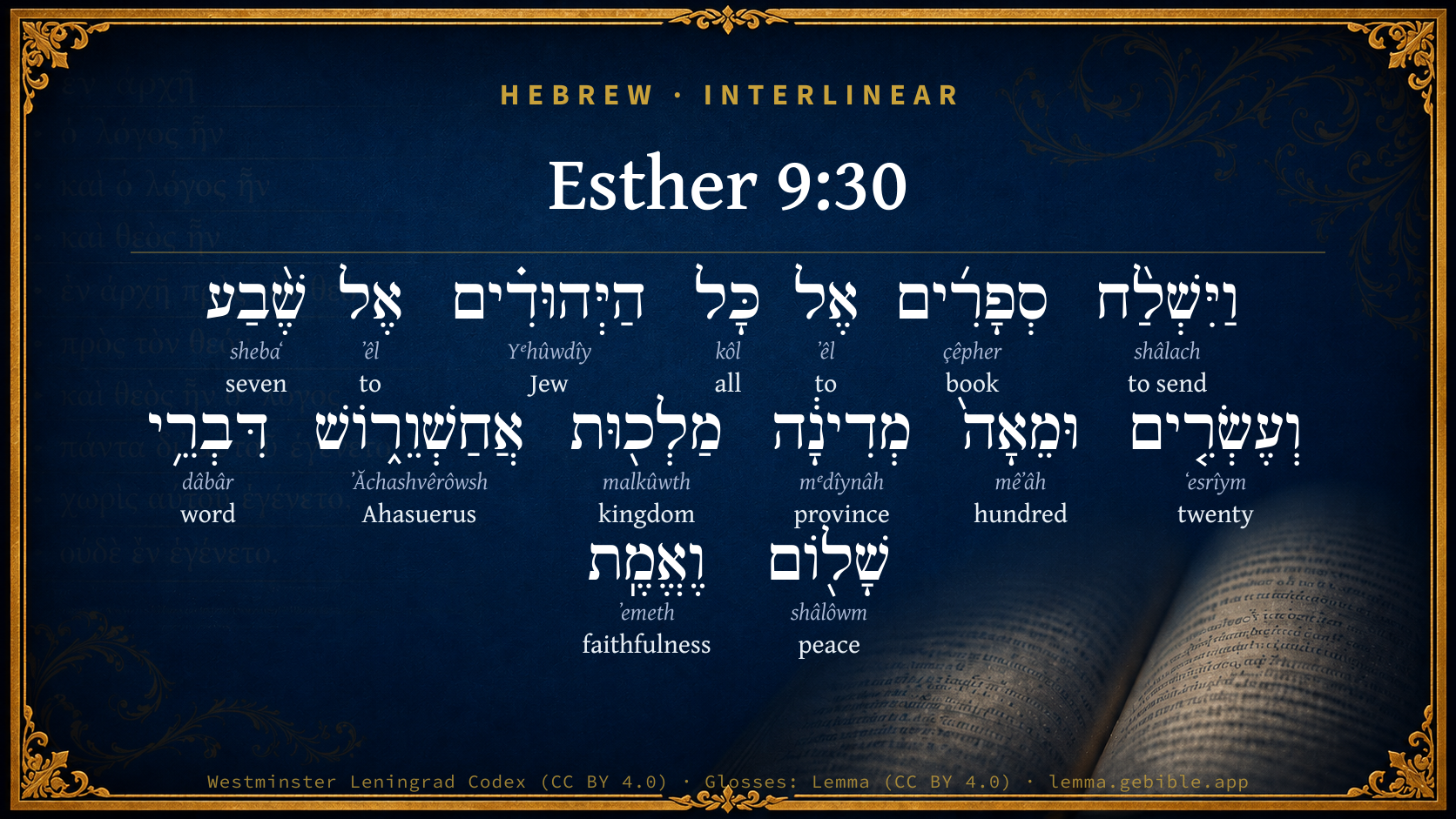
Hebrew (Westminster Leningrad Codex) Esther 9:30 appears in the Hebrew Old Testament. The text above is from the Westminster Leningrad Codex. Each word links to its Strong’s number, a concise gloss, and parsing drawn from the Open Scriptures Hebrew Bible morphology. Click any word for its full Brown-Driver-Briggs (BDB) entry.
Download image
Cite this verse

Esther 9:30 (World English Bible). Public Domain. Lemma interlinear Bible study tool, https://lemma.gebible.app/v/esther/9/30.

Show BibTeX & RIS
BibTeX
RIS
English Translation
He sent letters to all the Jews, to the hundred twenty-seven provinces of the kingdom of Ahasuerus, [with] words of peace and truth,
World English Bible · Public Domain
Download a study sheet

One document with this verse’s original text, its word-by-word gloss line, the meaning frame, cross-references with their text, attributed commentary, and full source and license credits — printable, and it pastes into notes with its structure intact.

This verse Autodidact and up

Study sheet (.html) Plain text (.txt)

A passage Seminary Student

Up to 50 verses in one chapter. A passage sheet keeps up to 6 commentary sources and 12 cross-references per verse, in the order this page ranks them, and says so on the sheet whenever that leaves anything out. Ask for a single verse and you get the Autodidact verse sheet above.

Everything on this page stays free to read, with no account — the sheet is a download of what is already on screen, not access to it.

Want to remove ads? Support Godless Engineer
Compare translations 3

The same verse in 3 English versions, stacked beneath the original-language interlinear above. Click any original word for its lexicon entry.

Each is an independent rendering of the whole verse — the interlinear is not word-aligned to these translations.

Highlighted words mark where these versions differ — a whole-verse word diff, not a word-by-word alignment.

  • World English Bible Public Domain
    He sent letters to all the Jews, to the hundred twenty-seven provinces of the kingdom of Ahasuerus, [with] words of peace and truth,
  • King James Version Public Domain
    And he sent the letters unto all the Jews, to the hundred twenty and seven provinces of the kingdom of Ahasuerus, with words of peace and truth,
  • unfoldingWord Literal Text CC BY-SA 4.0
    And he sent letters to all the Jews, to 127 provinces, the kingdom of Ahasuerus, words of peace and truth

unfoldingWord Literal Text — © unfoldingWord, licensed CC BY-SA 4.0. Word-aligned USFM3 via Door43 (git.door43.org/unfoldingWord/en_ult).

Versions to compare (up to 4)

3 of 4 selected

Show all 18 translations

Every available English version of this verse, each an independent rendering of the whole verse.

  • World English Bible Public Domain
    He sent letters to all the Jews, to the hundred twenty-seven provinces of the kingdom of Ahasuerus, [with] words of peace and truth,
  • Berean Standard Bible Public Domain
    And Mordecai sent letters with words of peace and truth to all the Jews in the 127 provinces of the kingdom of Xerxes,
  • Majority Standard Bible Public Domain
    And Mordecai sent letters with words of peace and truth to all the Jews in the 127 provinces of the kingdom of Xerxes,
  • King James Version Public Domain
    And he sent the letters unto all the Jews, to the hundred twenty and seven provinces of the kingdom of Ahasuerus, with words of peace and truth,
  • American Standard Version (1901) Public Domain
    And he sent letters unto all the Jews, to the hundred twenty and seven provinces of the kingdom of Ahasuerus, `with' words of peace and truth,
  • Revised Version (1885) Public Domain
    And he sent letters unto all the Jews, to the hundred twenty and seven provinces of the kingdom of Ahasuerus, with words of peace and truth,
  • Geneva Bible (1599) Public Domain
    And he sent letters vnto al the Iewes to the hundreth and seuen and twentie prouinces of the kingdome of Ahashuerosh, with words of peace and trueth,
  • Douay-Rheims (1899) Public Domain
    And they sent to all the Jews that were in the hundred and twenty-seven provinces of king Assuerus, that they should have peace, and receive truth,
  • Young's Literal Translation Public Domain
    and he sendeth letters unto all the Jews, unto the seven and twenty and a hundred provinces of the kingdom of Ahasuerus -- words of peace and truth --
  • Literal Standard Version CC BY-SA 4.0
    and he sends letters to all the Jews, to the one hundred twenty-seven provinces of the kingdom of Ahasuerus—words of peace and truth—
  • Unlocked Literal Bible CC BY-SA 4.0
    Letters were sent to all the Jews in the 127 provinces of the kingdom of Ahasuerus, wishing the Jews safety and truth.
  • unfoldingWord Literal Text CC BY-SA 4.0
    And he sent letters to all the Jews, to 127 provinces, the kingdom of Ahasuerus, words of peace and truth
  • Darby Bible Public Domain
    And he sent letters to all the Jews, to the hundred and twenty-seven provinces of the kingdom of Ahasuerus, words of peace and truth,
  • World Messianic Bible Public Domain
    He sent letters to all the Jews in the hundred twenty-seven provinces of the kingdom of Ahasuerus with words of peace and truth,
  • Webster's Bible Public Domain
    And he sent the letters to all the Jews, to the hundred twenty and seven provinces of the kingdom of Ahasuerus, with words of peace and truth,
  • Free Bible Version CC BY-SA 4.0
    Letters expressing peace and reassurance were also sent all the Jews in the 127 provinces of the empire of King Xerxes.
  • Bible in Basic English Public Domain
    And he sent letters to all the Jews in the hundred and twenty-seven divisions of the kingdom of Ahasuerus, with true words of peace,
  • JPS Tanakh (1917) Public Domain
    And he sent letters unto all the Jews, to the hundred twenty and seven provinces of the kingdom of Ahasuerus, with words of peace and truth,

Literal Standard Version (2020), Covenant Press — licensed CC BY-SA 4.0. Text via the HelloAO Bible API (eBible.org). Unlocked Literal Bible (unfoldingWord) — licensed CC BY-SA 4.0. Text via the HelloAO Bible API (eBible.org). unfoldingWord Literal Text — © unfoldingWord, licensed CC BY-SA 4.0. Word-aligned USFM3 via Door43 (git.door43.org/unfoldingWord/en_ult). Free Bible Version, Dr. Jonathan Gallagher — licensed CC BY-SA 4.0. Text via the HelloAO Bible API (eBible.org).

Word by word

More ways to search: Search by grammar → Find every occurrence → Compare this word →

Practice this passage: Drill this verse → Learn its vocabulary →

אֲחַשְׁוֵר֑וֹשׁ
ʼĂchashvêrôwsh
H325
“Ahasuerus”
Noun, Proper
Part of Speech
Noun
Type
Proper
Full BDB Definition

Origin: of Persian origin

TWOT: None

Ahasuerus = "I will be silent and poor" - title of the king of Persia, probably Xerxes
  1. וַיִּשְׁלַ֨ח shâlach H7971 “and · to send” Conjunction + Verb, Qal, Sequential Imperfect, 3rd Person, Masculine, Singular
  2. סְפָרִ֜ים çêpher H5612 “books” Noun, Common, Masculine, Plural, Absolute
  3. אֶל ʼêl H413 “to” Preposition
  4. כָּל kôl H3605 “all of” Noun, Common, Masculine, Singular, Construct
  5. הַיְּהוּדִ֗ים Yᵉhûwdîy H3064 “the · Jews” Particle, Definite Article + Noun, Gentilic, Masculine, Plural, Absolute
  6. אֶל ʼêl H413 “to” Preposition
  7. שֶׁ֨בַע shebaʻ H7651 “seven” Adjective, Cardinal number, Feminine, Singular, Absolute
  8. וְעֶשְׂרִ֤ים ʻesrîym H6242 “and · twenty” Conjunction + Adjective, Cardinal number, Both, Plural, Absolute
  9. וּמֵאָה֙ mêʼâh H3967 “and · hundred” Conjunction + Adjective, Cardinal number, Both, Singular, Absolute
  10. מְדִינָ֔ה mᵉdîynâh H4082 “province” Noun, Common, Feminine, Singular, Absolute
  11. מַלְכ֖וּת malkûwth H4438 “kingdom of” Noun, Common, Feminine, Singular, Construct
  12. דִּבְרֵ֥י dâbâr H1697 “words of” Noun, Common, Masculine, Plural, Construct
  13. שָׁל֖וֹם shâlôwm H7965 “peace” Noun, Common, Masculine, Singular, Absolute
  14. וֶאֱמֶֽת ʼemeth H571 “and · faithfulness” Conjunction + Noun, Common, Feminine, Singular, Absolute

About this verse

These counts appear in no published source. They are computed here, from the morphology-tagged text and Lemma’s own curated glosses. What Lemma adds →

15
words
14
distinct lemmas
Historical
section

Shared distinctive vocabulary

אֲחַשְׁוֵר֑וֹשׁ Ahasuerus H325 occurs in 30 verses of the Hebrew Bible. Also found in:

Grammatical profile

  • 1 verb
  • 9 nouns
  • 3 adjectives
  • 2 prepositions

Verb forms

  • וַיִּשְׁלַ֨ח Qal · Sequential Imperfect

Repetition

A word recurs within this verse — often emphatic in Hebrew:

  • אֶל to H413 ×2

Cross-references

4

Topical passages linked to Esther 9:30 in the Treasury of Scripture Knowledge — connected by theme and wording, ordered by reader-vote popularity; previews shown in the World English Bible.

  • Esther 1:1 Now it happened in the days of Ahasuerus (this is Ahasuerus who reigned from India even to Ethiopia, over one hundred twenty-seven provinces),
  • Esther 8:9 Then were the king's scribes called at that time, in the third month Sivan, on the three and twentieth [day] of it; and it was written according to all that Mordecai commanded to the Jews, and to the satraps, and the governors and princes of the provinces which are from India to Ethiopia, one hundred twenty-seven provinces, to every province according to the writing of it, and to every people after their language, and to the Jews according to their writing, and according to their language.
  • Isaiah 39:8 Then said Hezekiah to Isaiah, Good is the word of Yahweh which you have spoken. He said moreover, For there shall be peace and truth in my days.
  • Zechariah 8:19 Thus says Yahweh of Hosts: "The fasts of the fourth fifth, seventh, and tenth months shall be for the house of Judah joy and gladness, and cheerful feasts. Therefore love truth and peace."

Cross-references courtesy of OpenBible.info (CC BY 4.0).

Hebrew and Greek witnesses Masoretic Hebrew ↔ Greek Septuagint

The same verse in the two great witnesses to the Old Testament, shown verse-for-verse.

These are two independent witnesses, not word-aligned to each other, and the Septuagint is shown in lemma (dictionary) form.

Hebrew Esther 9:30 Masoretic · Westminster Leningrad Codex

וַיִּשְׁלַ֨ח סְפָרִ֜ים אֶל כָּל הַיְּהוּדִ֗ים אֶל שֶׁ֨בַע וְעֶשְׂרִ֤ים וּמֵאָה֙ מְדִינָ֔ה מַלְכ֖וּת אֲחַשְׁוֵר֑וֹשׁ דִּבְרֵ֥י שָׁל֖וֹם וֶאֱמֶֽת

He sent letters to all the Jews, to the hundred twenty-seven provinces of the kingdom of Ahasuerus, [with] words of peace and truth,

World English Bible · Public Domain

Hebrew: Westminster Leningrad Codex (CC BY 4.0). Greek: Septuagint (public domain); English from a public-domain English Septuagint. How the Septuagint differs from the Hebrew →

Commentary

Notes on Esther 9:30 from classic Christian and Jewish commentators (each source and its license shown beneath its notes). The classic Christian expositions comment on the surrounding passage and are grouped to its opening verse, so a note may address several verses; the Jewish commentaries on the Tanakh (Rashi and others) are per-verse, so they appear only where the commentator wrote on this verse.

Lemma curates 59 commentaries, every one of them public domain or Creative Commons licensed, each selected and text-cleaned for this edition rather than reprinted as found. About our sources →

Trapp's Complete Commentary

John Trapp

Est 9:30 And he sent the letters unto all the Jews, to the hundred twenty and seven provinces of the kingdom of Ahasuerus, [with] words of peace and truth,

Ver. 30. And he sent letters to all the Jews] Tremellius readeth it, Which letters Mordecai sent to all the Jews, sc. as monitors and remembrancers.

To the hundred twenty and seven provinces] Among and above the rest, to Judea, which was one of that number.

With words of peace and truth] i.e. Premising words of prosperity and settlement, saith Tremellius, or promising them peaceable enjoyment of the true religion, liberty of conscience, rightly so called; or praying, that they may "follow peace with all men, and holiness, without which no man shall see the Lord," Heb 12:14. Or, he sent letters full of courtesy and truth, that is, of unfeigned courtesy, as Vatablus senseth it. For there is a cut-throat courtesy, such as was that of Joab to Amasa, of Judas to our Saviour, of Julian, the apostate, to Basil, when he wrote unto him, but not with words of peace and truth, φιλος φιλω και αδελφος αδελοω.

John Trapp, A Commentary or Exposition upon All the Books of the Old and New Testament (1647–1656) — public domain. Text from a community e-Sword module.

Joseph Benson's Commentary

Est 9:30. With words of peace and truth — Though they wrote with authority, they wrote also with peace, that is, with friendship, tenderness, and kindness, not in imperious and imposing language, but in an affectionate and conciliating style: and with truth, or sincerity, which is the rather observed, because it was, as it still is, not very usual with great courtiers, such as Mordecai now was, to write so. Or the meaning may be, that he saluted them with hearty wishes for the continuance of those two great blessings of God, truth and peace, among them, namely, the true religion, and peace among themselves, and with all men; or, that they might peaceably and quietly enjoy and profess the truth. Or if the matter, rather than the manner, or form of his writing be intended, the sense is, that he directed and endeavoured to persuade them to keep both peace and truth, that is, both to live peaceably and lovingly one with another, and with all their neighbours, not insulting over them upon a confidence in Mordecai’s great power, or upon this their late and great success, nor giving them any fresh provocation; and yet holding fast the true religion, in spite of all the artifices or hostilities of the Gentiles, among whom they lived.

Joseph Benson's Commentary on the Old and New Testaments (1811–1818) — public domain. Text from a community e-Sword module.

Geneva Bible (1599)

Geneva Bible translators

Which were letters declaring unto them quietness, and assurance and putting them out of doubt and fear.

Geneva Bible (1599) marginal notes — public domain. Text via Bolls.life.

Ellicott's Commentary for English Readers

(30) The letters.—Omit the article.

A Bible Commentary for English Readers, edited by Charles John Ellicott (1878–1897) — public domain. Text from a community e-Sword module.

John Gill's Exposition

And the decree of Esther confirmed these matters of Purim,.... As a festival to be observed by the Jews in future generations:

and it was written in the book; either in this book of Esther; or in the public acts and chronicles of the kings of Persia; or in a book by itself, now lost, as Aben Ezra thinks, as many others are we read of in Scripture, as the books of the chronicles of the kings of Israel and Judah, &c.

Next: Esther Chapter 10

John Gill's Exposition of the Whole Bible (1746–1763) — public domain (CC PDM 1.0). Text via the HelloAO Bible API.

Haydock's Catholic Bible Commentary

Peace: receive these glad tidings, and faithfully observe the injunctions. (Calmet)

George Leo Haydock (1774–1849), Haydock's Catholic Family Bible and Commentary, 1859 edition — public domain. Excludes Psalms (Douay-Rheims chapter numbering differs from Protestant) and Deuterocanonical books (Catholic canon only).

Matthew Poole's English Annotations

Or, even words of peace and truth; which may respect either,

1. The form of the writing, wherein after the custom he saluted them with hearty wishes of their true peace or prosperity, or of the continuance of those two great blessings of God,

truth, i.e. the true religion; and peace, either among themselves, or with all men, that they might peaceably and quietly enjoy and profess the truth. Or,

2. The manner of his writing, which was

with peace, i.e. friendship and kindness to his brethren;

and truth, i.e. sincerity; which is the more noted and commended in him, because it is so unusual in such great courtiers as he now was; compare Est 10:3; or the matter of his writing, which was to direct and persuade them to keep both peace and truth, i.e. both to live peaceably and lovingly both one with another, and with all their neighbours, not insulting over them upon their confidence in Mordecai’s great power, or upon this late and great success, as men naturally and commonly do, nor giving them any fresh provocations, and yet holding fast the true religion in spite of all the artifices or hostilities of the Gentiles among whom they lived.

Matthew Poole's English Annotations on the Holy Bible (1683–1685) — public domain. Text from a community e-Sword/MySword module.

The Pulpit Commentary

And he sent the letters. Rather, "he sent letters." In addition to the formal "letter of Purina," which was of the nature of an ordinance, though not of legal force, Mordecai sent informal letters, which embraced other topics besides the Purim feast, as, for instance, words of salutation, and perhaps a reference to the keeping of a fast before the two Purina days (ver. 31). These he sent to all Jews throughout the whole empire, inclosing with them the formal "letter of Purim." With words of peace and truth. Perhaps beginning thus: "Peace and truth be with you a modification of the usual, "Peace," etc., (Ezr_4:17) or, "All peace" (ibid. 5:7), with which letters ordinarily began.

Words of peace and truth.

Words are of inestimable weight, for evil or for good. Human words move men mightily; and of Christ"s words we know that they shall "never pass away." This description of the message which Mordecai and Esther sent to their countrymen throughout the empire is very significant. It consisted of words which, whilst they were words of truth, concealing nothing, declaring all, were yet words of peace, speaking peace unto Israel.

I WORDS CAN REVEAL TRUTH. The speech uttered is the expression of the inner, the mental, speech.

1. This should be the case in all instruction. Teachers should make it theirfirst concern that their words should be words of truth. Especially should this be so in all religious instruction given and received.

2. This is the case in the best and highest literature. We value language forits beauty; but its highest interest and charm lies in its power to embody truth.

3. This is the case with Divine revelation, which is the truth of God, madeknown to us in him who is the Word, and in all inspired words.

II WORDS CAN DIFFUSE AND RESTORE PEACE. They may do this by

1. Assuring the endangered of protection, as was the case in the narrativebefore us.

2. Removing suspicion and fear, as friendly and gracious words have oftenpower to do.

3. Assuring offenders of reconciliation and favour. It is in this manner thatthe words of Christ"s gospel are emphatically "words of peace.

III WORDS OF TRUTH ARE THE SUREST FOUNDATION FOR WORDS OF PEACE. The peace brought about by false words is hollow, temporary only, and vain. But the full truth being declared, a sound and lasting peace may follow, heralded and assured by appropriate words. The Christian revelation exactly agrees with the description of these words; it brings truth to our understanding and peace to heart and life.

The Pulpit Commentary (1880–1919), ed. H.D.M. Spence-Jones & Joseph S. Exell — public domain. Text from a community e-Sword module.

John Wesley's Explanatory Notes

Peace - With peace, friendship and kindness to his brethren, and truth, sincerity.

John Wesley, Explanatory Notes Upon the Whole Bible (1754–1765) — public domain. Text via the GEBible commentary corpus.

unfoldingWord translationNotes

Door43 World Missions Community

Letters were sent to all the Jews

This can be stated in active form. AT: "They sent letters to all the Jews" (See: Active or Passive)

127 provinces

"one hundred and twenty-seven provinces" (See: Numbers)

wishing the Jews safety and truth

The abstract nouns "safety" and "truth" can be expressed with phrases. AT: "wishing that the Jews would be safe and that people would be faithful to the Jews" (See: Abstract Nouns)

The Jews accepted this obligation for themselves and their descendants

Accepting an obligation is a metaphor for agreeing with the obligation. The abstract noun "obligation" can be expressed with the verb "obligate." AT: "The Jews agreed and said that they and their descendants were obligated to celebrate the days of Purim" (See: Metaphor and Abstract Nouns)

they accepted times of fasting and lamenting

Accepting times of fasting and lamenting is a metaphor for agreeing to fast and lament at certain times. AT: "they agreed to fast and lament at certain times" (See: Metaphor)

translationWords

kingdom

Ahasuerus

true

fast

lament

command

unfoldingWord translationNotes — © Distant Shores Media and the Door43 World Missions Community, licensed CC BY-SA 4.0. Source: git.door43.org/Door43/en_tn.

Lesson kit

Teaching starters — assembled from the data on this page, not authored interpretation. Every prompt links to the verse data it draws on. Edit before teaching.

Esther, in the Historical, opens this verse with 15 words (14 distinct Hebrew lemmas). Its most distinctive word is ʼĂchashvêrôwsh (“Ahasuerus”). A historical commentator’s framing appears above. Read the whole chapter for the surrounding context.

Discussion questions

  1. The word ʼĂchashvêrôwsh carries the sense “Ahasuerus.” How does it shape the verse?
  2. How does Ezra 4:6, which shares the word «Ahasuerus», read alongside this verse?
  3. What does the repetition of “to” (2× in this one verse) do in this verse?
  4. The translations on this page render this verse differently — a whole-verse word diff, not a word-by-word alignment. What might account for the different wordings?
  5. «וַיִּשְׁלַ֨ח» is a Qal Sequential Imperfect verb. How does that grammatical form shape the action described?
  6. Compare how Trapp's Complete Commentary and Joseph Benson's Commentary read this verse. Where do they agree or differ?

Things to notice

Reading settings

Reading text

Shown beneath each verse's original-language words.

Old Testament
Old Testament edition

Read the OT as the Masoretic Hebrew (MT) or the Greek Septuagint (LXX).

English shown for the Greek Septuagint (in the Hebrew ↔ Greek comparison).

Comparing translations? Open the Compare panel on any verse page to stack up to four side by side.