
Leviticus 14:8

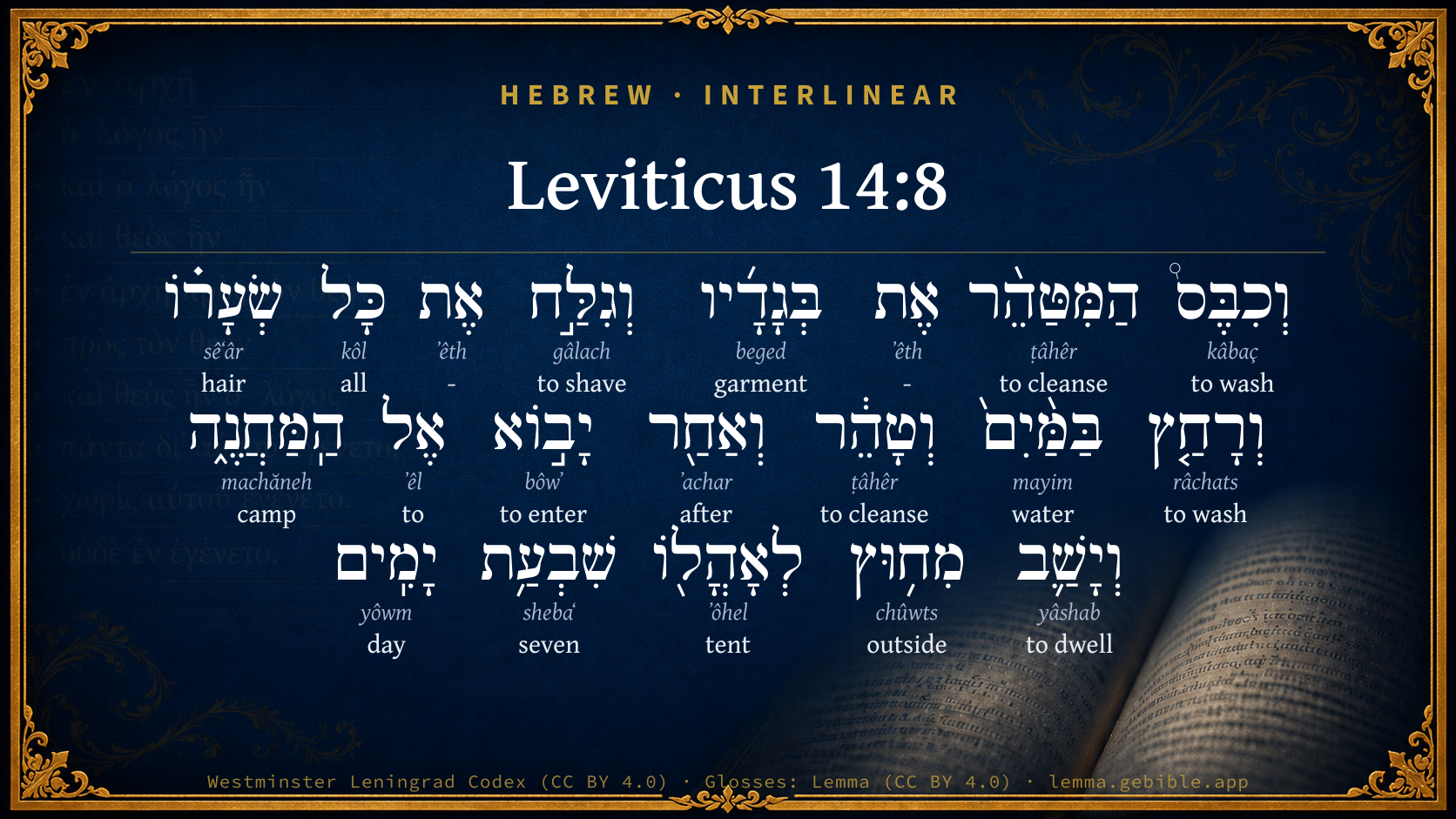
Hebrew (Westminster Leningrad Codex) Leviticus 14:8 appears in the Hebrew Old Testament. The text above is from the Westminster Leningrad Codex. Each word links to its Strong’s number, a concise gloss, and parsing drawn from the Open Scriptures Hebrew Bible morphology. Click any word for its full Brown-Driver-Briggs (BDB) entry.
Download image
Cite this verse

Leviticus 14:8 (World English Bible). Public Domain. Lemma interlinear Bible study tool, https://lemma.gebible.app/v/leviticus/14/8.

Show BibTeX & RIS
BibTeX
RIS
English Translation
"He who is to be cleansed shall wash his clothes, and shave off all his hair, and bathe himself in water; and he shall be clean. After that he shall come into the camp, but shall dwell outside his tent seven days.
World English Bible · Public Domain
Download a study sheet

One document with this verse’s original text, its word-by-word gloss line, the meaning frame, cross-references with their text, attributed commentary, and full source and license credits — printable, and it pastes into notes with its structure intact.

This verse Autodidact and up

Study sheet (.html) Plain text (.txt)

A passage Seminary Student

Up to 50 verses in one chapter. A passage sheet keeps up to 6 commentary sources and 12 cross-references per verse, in the order this page ranks them, and says so on the sheet whenever that leaves anything out. Ask for a single verse and you get the Autodidact verse sheet above.

Everything on this page stays free to read, with no account — the sheet is a download of what is already on screen, not access to it.

Want to remove ads? Support Godless Engineer
Compare translations 3

The same verse in 3 English versions, stacked beneath the original-language interlinear above. Click any original word for its lexicon entry.

Each is an independent rendering of the whole verse — the interlinear is not word-aligned to these translations.

Highlighted words mark where these versions differ — a whole-verse word diff, not a word-by-word alignment.

  • World English Bible Public Domain
    "He who is to be cleansed shall wash his clothes, and shave off all his hair, and bathe himself in water; and he shall be clean. After that he shall come into the camp, but shall dwell outside his tent seven days.
  • King James Version Public Domain
    And he that is to be cleansed shall wash his clothes, and shave off all his hair, and wash himself in water, that he may be clean: and after that he shall come into the camp, and shall tarry abroad out of his tent seven days.
  • unfoldingWord Literal Text CC BY-SA 4.0
    And the person who is being cleansed shall wash his clothes, and he shall shave all his hair, and he shall bathe in the water, and he will be clean. And afterward, he shall enter into the camp, and he shall dwell in outside of his tent seven days.

unfoldingWord Literal Text — © unfoldingWord, licensed CC BY-SA 4.0. Word-aligned USFM3 via Door43 (git.door43.org/unfoldingWord/en_ult).

Versions to compare (up to 4)

3 of 4 selected

Show all 18 translations

Every available English version of this verse, each an independent rendering of the whole verse.

  • World English Bible Public Domain
    "He who is to be cleansed shall wash his clothes, and shave off all his hair, and bathe himself in water; and he shall be clean. After that he shall come into the camp, but shall dwell outside his tent seven days.
  • Berean Standard Bible Public Domain
    The one being cleansed must wash his clothes, shave off all his hair, and bathe with water; then he will be ceremonially clean. Afterward, he may enter the camp, but he must remain outside his tent for seven days.
  • Majority Standard Bible Public Domain
    The one being cleansed must wash his clothes, shave off all his hair, and bathe with water; then he will be ceremonially clean. Afterward, he may enter the camp, but he must remain outside his tent for seven days.
  • King James Version Public Domain
    And he that is to be cleansed shall wash his clothes, and shave off all his hair, and wash himself in water, that he may be clean: and after that he shall come into the camp, and shall tarry abroad out of his tent seven days.
  • American Standard Version (1901) Public Domain
    And he that is to be cleansed shall wash his clothes, and shave off all his hair, and bathe himself in water; and he shall be clean: and after that he shall come into the camp, but shall dwell outside his tent seven days.
  • Revised Version (1885) Public Domain
    And he that is to be cleansed shall wash his clothes, and shave off all his hair, and bathe himself in water, and he shall be clean: and after that he shall come into the camp, but shall dwell outside his tent seven days.
  • Geneva Bible (1599) Public Domain
    Then he that shall be clensed, shall wash his clothes, and shaue off all his heare, and wash himselfe in water, so he shalbe cleane: after that shall he come into the host, but shall tary without his tent seuen dayes.
  • Douay-Rheims (1899) Public Domain
    And when the man hath washed his clothes, he shall shave all the hair of his body, and shall be washed with water: and being purified, he shall enter into the camp, yet so that he tarry without his own tent seven days:
  • Young's Literal Translation Public Domain
    `And he who is to be cleansed hath washed his garments, and hath shaved all his hair, and hath bathed with water, and hath been clean, and afterwards he doth come in unto the camp, and hath dwelt at the outside of his tent seven days.
  • Literal Standard Version CC BY-SA 4.0
    And he who is to be cleansed has washed his garments, and has shaved all his hair, and has bathed with water, and has been clean, and afterward he comes into the camp, and has dwelt at the outside of his tent [for] seven days.
  • Unlocked Literal Bible CC BY-SA 4.0
    The person who is being cleansed will wash his clothes, shave off all his hair, and bathe himself in water, and then he will be clean. After that he must come into the camp, but he will live outside his tent for seven days.
  • unfoldingWord Literal Text CC BY-SA 4.0
    And the person who is being cleansed shall wash his clothes, and he shall shave all his hair, and he shall bathe in the water, and he will be clean. And afterward, he shall enter into the camp, and he shall dwell in outside of his tent seven days.
  • Darby Bible Public Domain
    And he that is to be cleansed shall wash his garments, and shave all his hair, and bathe in water, and he shall be clean; and afterwards shall he come into the camp, and shall abide outside his tent seven days.
  • World Messianic Bible Public Domain
    “He who is to be cleansed shall wash his clothes, and shave off all his hair, and bathe himself in water; and he shall be clean. After that he shall come into the camp, but shall dwell outside his tent seven days.
  • Webster's Bible Public Domain
    And he that is to be cleansed shall wash his clothes, and shave off all his hair, and wash himself in water, that he may be clean: and after that he shall come into the camp, and shall tarry abroad out of his tent seven days.
  • Free Bible Version CC BY-SA 4.0
    The one being made clean must wash their clothes, shave off all their hair, and wash themselves with water; then they will be ceremonially clean. After that they can enter the camp, but they must stay outside their tent for seven days.
  • Bible in Basic English Public Domain
    And he who is to be made clean will have his clothing washed and his hair cut and have a bath, and he will be clean. And after that he will come back to the tent-circle; but he is to keep outside his tent for seven days.
  • JPS Tanakh (1917) Public Domain
    And he that is to be cleansed shall wash his clothes, and shave off all his hair, and bathe himself in water, and he shall be clean; and after that he may come into the camp, but shall dwell outside his tent seven days.

Literal Standard Version (2020), Covenant Press — licensed CC BY-SA 4.0. Text via the HelloAO Bible API (eBible.org). Unlocked Literal Bible (unfoldingWord) — licensed CC BY-SA 4.0. Text via the HelloAO Bible API (eBible.org). unfoldingWord Literal Text — © unfoldingWord, licensed CC BY-SA 4.0. Word-aligned USFM3 via Door43 (git.door43.org/unfoldingWord/en_ult). Free Bible Version, Dr. Jonathan Gallagher — licensed CC BY-SA 4.0. Text via the HelloAO Bible API (eBible.org).

Word by word

More ways to search: Search by grammar → Find every occurrence → Compare this word →

Practice this passage: Drill this verse → Learn its vocabulary →

וְגִלַּ֣ח
gâlach
H1548
“and · to shave”
Conjunction + Verb, Piel, Sequential Perfect, 3rd Person, Masculine, Singular
Part of Speech
Conjunction + Verb
Stem
Piel
Form
Sequential Perfect
Person
3rd Person
Gender
Masculine
Number
Singular
Full BDB Definition

Origin: a primitive root

TWOT: 351

to poll, shave, shave off, be bald - (Piel) - to shave - to shave off - (figuratively of devastation) - (Pual) to be shaven - (Hithpael) to shave oneself
  1. וְכִבֶּס֩ kâbaç H3526 “and · to wash” Conjunction + Verb, Piel, Sequential Perfect, 3rd Person, Masculine, Singular
  2. הַמִּטַּהֵ֨ר ṭâhêr H2891 “the · cleansing” Particle, Definite Article + Verb, Hithpael, Participle Active, Masculine, Singular, Absolute
  3. אֶת ʼêth H853 “-” Particle, Direct Object
  4. בְּגָדָ֜יו beged H899 “garments · his” Noun, Common, Masculine, Plural, Construct + Suffix, Personal, 3rd Person, Masculine, Singular
  5. אֶת ʼêth H853 “-” Particle, Direct Object
  6. כָּל kôl H3605 “all of” Noun, Common, Masculine, Singular, Construct
  7. שְׂעָר֗וֹ sêʻâr H8181 “hair · his” Noun, Common, Masculine, Singular, Construct + Suffix, Personal, 3rd Person, Masculine, Singular
  8. וְרָחַ֤ץ râchats H7364 “and · to wash” Conjunction + Verb, Qal, Sequential Perfect, 3rd Person, Masculine, Singular
  9. בַּמַּ֨יִם֙ mayim H4325 “in/at the · water(s)” Preposition, Determined + Noun, Common, Masculine, Plural, Absolute
  10. וְטָהֵ֔ר ṭâhêr H2891 “and · to cleanse” Conjunction + Verb, Qal, Sequential Perfect, 3rd Person, Masculine, Singular
  11. וְאַחַ֖ר ʼachar H310 “and · after” Conjunction + Adverb
  12. יָב֣וֹא bôwʼ H935 “to enter” Verb, Qal, Imperfect, 3rd Person, Masculine, Singular
  13. אֶל ʼêl H413 “to” Preposition
  14. הַֽמַּחֲנֶ֑ה machăneh H4264 “the · camp” Particle, Definite Article + Noun, Common, Both, Singular, Absolute
  15. וְיָשַׁ֛ב yâshab H3427 “and · to dwell” Conjunction + Verb, Qal, Sequential Perfect, 3rd Person, Masculine, Singular
  16. מִח֥וּץ chûwts H2351 “from · outside” Preposition + Noun, Common, Masculine, Singular, Absolute
  17. לְאָהֳל֖וֹ ʼôhel H168 “to/for · tent · his” Preposition + Noun, Common, Masculine, Singular, Construct + Suffix, Personal, 3rd Person, Masculine, Singular
  18. שִׁבְעַ֥ת shebaʻ H7651 “seven” Adjective, Cardinal number, Masculine, Singular, Construct
  19. יָמִֽים yôwm H3117 “days” Noun, Common, Masculine, Plural, Absolute

About this verse

These counts appear in no published source. They are computed here, from the morphology-tagged text and Lemma’s own curated glosses. What Lemma adds →

20
words
18
distinct lemmas
Pentateuch
section

Notable vocabulary

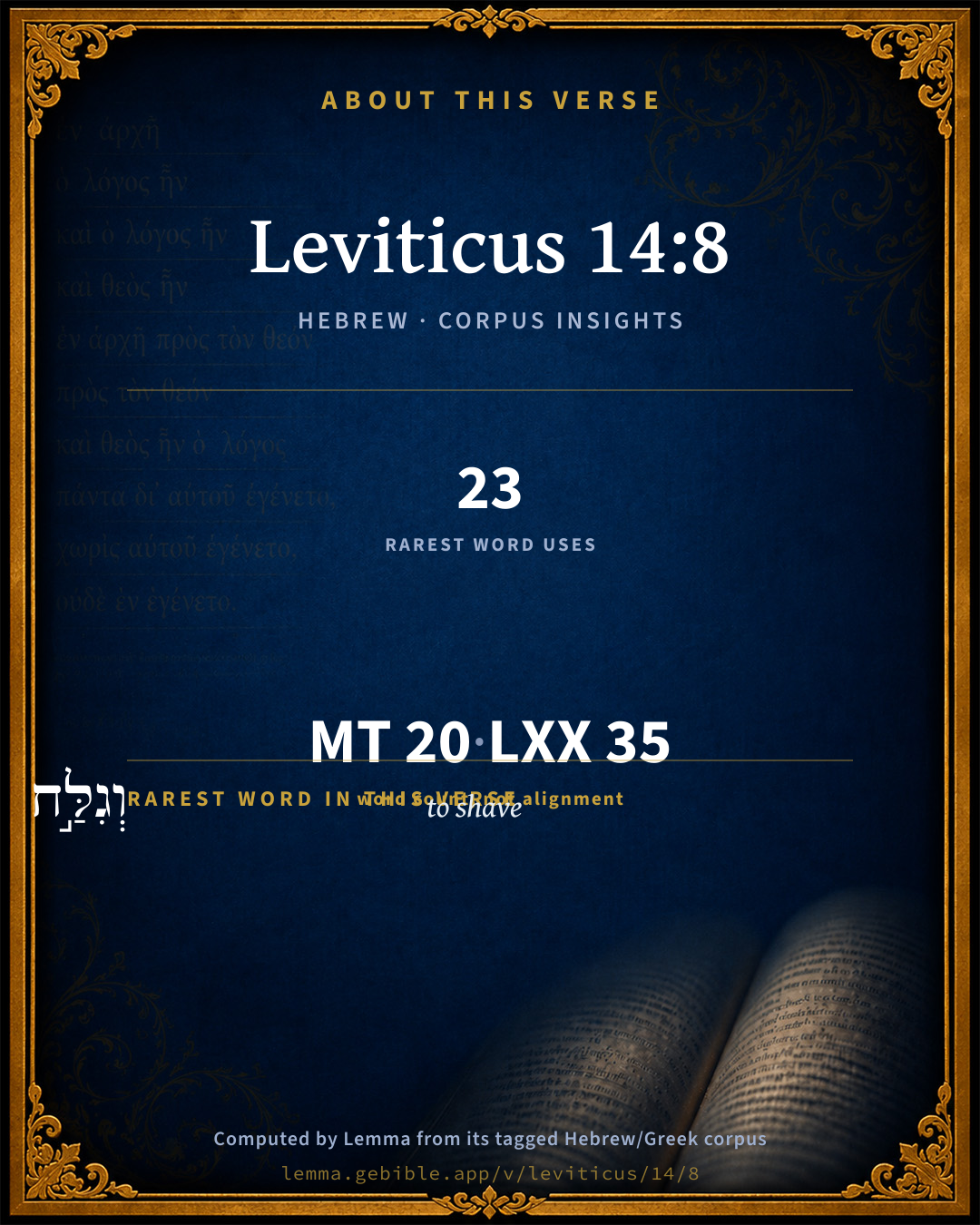
The rarest word here is וְגִלַּ֣ח to shave H1548 — appearing just 23 times in the whole Hebrew Bible.

Shared distinctive vocabulary

וְגִלַּ֣ח to shave H1548 occurs in 18 verses of the Hebrew Bible. Also found in:

Grammatical profile

  • 7 verbs
  • 8 nouns
  • 1 adjective
  • 1 preposition
  • 1 adverb
  • 2 particles

Verb forms

  • וְכִבֶּס֩ Piel · Sequential Perfect
  • הַמִּטַּהֵ֨ר Hithpael · Participle Active
  • וְגִלַּ֣ח Piel · Sequential Perfect
  • וְרָחַ֤ץ Qal · Sequential Perfect
  • וְטָהֵ֔ר Qal · Sequential Perfect
  • יָב֣וֹא Qal · Imperfect
  • וְיָשַׁ֛ב Qal · Sequential Perfect

Repetition

A word recurs within this verse — often emphatic in Hebrew:

  • הַמִּטַּהֵ֨ר to cleanse H2891 ×2

Hebrew & Septuagint length

In English translation the verse runs 42 words from the Hebrew and 46 from the Septuagint (LXX English) — closely comparable.

A rough comparison of the two English renderings, which tokenize alike — not a word-level alignment.

Word counts can differ between the Hebrew and the Greek without any difference in meaning — e.g. the Hebrew direct-object marker אֵת has no separate Greek word, and Greek often adds the article ὁ.

In the original languages it is 20 Hebrew tokens and 35 Greek tokens — but the two are counted differently (Hebrew bundles its prefixes and suffixes into one token; the Greek is in lemma form), so that isn’t a like-for-like length.

Cross-references

16

Topical passages linked to Leviticus 14:8 in the Treasury of Scripture Knowledge — connected by theme and wording, ordered by reader-vote popularity; previews shown in the World English Bible.

  • Leviticus 11:25 Whoever carries any part of their carcass shall wash his clothes, and be unclean until the evening.
  • Numbers 8:7 Thus shall you do to them, to cleanse them: sprinkle the water of cleansing on them, let them shave their whole bodies with a razor, and let them wash their clothes, and cleanse themselves.
  • 1 Peter 3:21 This is a symbol of baptism, which now saves you-- not the putting away of the filth of the flesh, but the answer of a good conscience toward God, through the resurrection of Jesus Christ,
  • Exodus 19:10 Yahweh said to Moses, "Go to the people, and sanctify them today and tomorrow, and let them wash their garments,
  • Exodus 19:14 Moses went down from the mountain to the people, and sanctified the people; and they washed their clothes.
  • Leviticus 8:6 Moses brought Aaron and his sons, and washed them with water.
  • Leviticus 8:33–35 You shall not go out from the door of the Tent of Meeting seven days, until the days of your consecration are fulfilled: for he shall consecrate you seven days.
  • Leviticus 13:5–6 The priest shall examine him on the seventh day, and, behold, if in his eyes the plague is arrested, and the plague hasn't spread in the skin, then the priest shall isolate him for seven more days.
  • Leviticus 14:9 It shall be on the seventh day, that he shall shave all his hair off his head and his beard and his eyebrows, even all his hair he shall shave off. He shall wash his clothes, and he shall bathe his body in water, then he shall be clean.
  • Leviticus 14:20 and the priest shall offer the burnt offering and the meal offering on the altar. The priest shall make atonement for him, and he shall be clean.
  • Leviticus 15:5–8 Whoever touches his bed shall wash his clothes, and bathe himself in water, and be unclean until the evening.
  • Numbers 5:2–3 "Command the children of Israel that they put out of the camp every leper, and everyone who has an issue, and whoever is unclean by the dead.
  • Numbers 12:14–15 Yahweh said to Moses, If her father had but spit in her face, shouldn't she be ashamed seven days? let her be shut up outside of the camp seven days, and after that she shall be brought in again.
  • 2 Chronicles 26:21 Uzziah the king was a leper to the day of his death, and lived in a separate house, being a leper; for he was cut off from the house of Yahweh: and Jotham his son was over the king's house, judging the people of the land.
  • Revelation 1:5–6 and from Jesus Christ, the faithful witness, the firstborn of the dead, and the ruler of the kings of the earth. To him who loves us, and washed us from our sins by his blood;
  • Revelation 7:14 I told him, "My lord, you know." He said to me, "These are those who came out of the great tribulation. They washed their robes, and made them white in the Lamb's blood.

Cross-references courtesy of OpenBible.info (CC BY 4.0).

Hebrew and Greek witnesses Masoretic Hebrew ↔ Greek Septuagint

The same verse in the two great witnesses to the Old Testament, shown verse-for-verse.

These are two independent witnesses, not word-aligned to each other, and the Septuagint is shown in lemma (dictionary) form.

Hebrew Leviticus 14:8 Masoretic · Westminster Leningrad Codex

וְכִבֶּס֩ הַמִּטַּהֵ֨ר אֶת בְּגָדָ֜יו וְגִלַּ֣ח אֶת כָּל שְׂעָר֗וֹ וְרָחַ֤ץ בַּמַּ֨יִם֙ וְטָהֵ֔ר וְאַחַ֖ר יָב֣וֹא אֶל הַֽמַּחֲנֶ֑ה וְיָשַׁ֛ב מִח֥וּץ לְאָהֳל֖וֹ שִׁבְעַ֥ת יָמִֽים

"He who is to be cleansed shall wash his clothes, and shave off all his hair, and bathe himself in water; and he shall be clean. After that he shall come into the camp, but shall dwell outside his tent seven days.

World English Bible · Public Domain

Greek LXX Leviticus 14:8 Septuagint · lemma form

καί πλύνω ὁ καθαρίζω ὁ ἱμάτιον αὐτός καί ξυράω αὐτός πᾶς ὁ θρίξ καί λούω ἐν ὕδωρ καί καθαρός εἰμί καί μετά οὗτος εἰςἔρχομαι εἰς ὁ παρεμβολή καί διατρίβω ἔξω ὁ οἶκος αὐτός ἑπτά ἡμέρα

and the man that has been cleansed shall wash his garments, and shall shave off all his hair, and shall wash himself in water, and shall be clean; and after that he shall go into the camp, and shall remain out of his house seven days.

LXX2012 (modern English Septuagint) · Public Domain

Hebrew: Westminster Leningrad Codex (CC BY 4.0). Greek: Septuagint (public domain); English from LXX2012 (modern English Septuagint) (Public Domain). How the Septuagint differs from the Hebrew →

Targum (Aramaic paraphrase)

2

The Targum is the ancient Jewish Aramaic paraphrase of the Hebrew Scriptures — an interpretive translation, not the Hebrew text itself. Onkelos (literal) and Pseudo-Jonathan (expansive) render the Torah, and Jonathan the Prophets. Coverage is partial: where no permissively-licensed English translation exists for a verse, only the Aramaic is shown. This is verse-level text, not a word-by-word alignment to the Hebrew.

  1. Targum Onkelos Torah (Genesis–Deuteronomy)
    וִיצַבַּע דְמִדַכֵּי יָת לְבוּשׁוֹהִי וִיגַלַח יָת כָּל שַׂעֲרֵהּ וְיַסְחֵי בְמַיָא וְיִדְכֵּי וּבָתַר כֵּן יֵעוֹל לְמַשְׁרִיתָא וִיתֵב מִבָּרָא לְמַשְׁכְּנֵהּ שִׁבְעַת יוֹמִין

    (no public-domain English translation for this verse)

    Targum Onkelos — Aramaic: “Onkelos Genesis” (public domain); “Onkelos Exodus” (public domain); “Onkelos Leviticus” (public domain); “Onkelos Numbers” (public domain); “Onkelos Deuteronomy” (public domain). English: “Sefaria Community Translation” (CC0 1.0 (public-domain dedication)); “J.W. Etheridge. The Targums of Onkelos and Jonathan Ben Uzziel on the Pentateuch. London: Longmans, Green, 1862” (public domain). Text via Sefaria.

  2. Targum Pseudo-Jonathan Torah (Genesis–Deuteronomy)
    וְיִצְבַּע דְמִדְכֵּי יַת לְבוּשׁוֹי וִיסַפֵּר יַת כָּל שְעָרֵיהּ וְיַסְחֵי בְּמַיָא וְיִדְכֵּי וּבָתַר כֵּן יֵיעוֹל לְמַשְׁרִיתָא וְיָתִיב מִבָּרָא לְמַשְׁכַּן בֵּית מוֹתְבֵיהּ וְלָא יִקְרַב לְצַד אִינְתְּתֵיהּ שׁוּבְעָא יוֹמִין

    And he who is cleansed shall wash his clothes, and shave off all his hair, and wash himself in water, and be clean; and afterward he may enter the camp, but shall dwell without his tent, the house of his habitation, and come not to the side of his wife for seven days.

    Targum Pseudo-Jonathan — Aramaic: “Targum Jonathan on Genesis” (public domain); “Targum Jonathan on Exodus” (public domain); “Targum Jonathan on Leviticus” (public domain); “Targum Jonathan on Numbers” (public domain); “Targum Jonathan on Deuteronomy” (public domain). English: “The Targum of Jonathan ben Uzziel, trans. J. W. Etheridge, London, 1862” (public domain). Text via Sefaria.

Commentary

Notes on Leviticus 14:8 from classic Christian and Jewish commentators (each source and its license shown beneath its notes). The classic Christian expositions comment on the surrounding passage and are grouped to its opening verse, so a note may address several verses; the Jewish commentaries on the Tanakh (Rashi and others) are per-verse, so they appear only where the commentator wrote on this verse.

Lemma curates 59 commentaries, every one of them public domain or Creative Commons licensed, each selected and text-cleaned for this edition rather than reprinted as found. About our sources →

Trapp's Complete Commentary

John Trapp

Lev 14:8 And he that is to be cleansed shall wash his clothes, and shave off all his hair, and wash himself in water, that he may be clean: and after that he shall come into the camp, and shall tarry abroad out of his tent seven days.

Ver. 8. Shall wash his clothes, and shave.] This the leper was to do the first day of his cleansing; to teach men to be thorough in the practice of mortification, at the first conversion: "laying a good foundation for the time to come, that they may lay hold on eternal life." {1Ti 6:19}

And shall tarry abroad.] Men must not be too hasty at first to catch at comfort; but let humiliation have her perfect work, and our sorrows be suitable to our sins.

John Trapp, A Commentary or Exposition upon All the Books of the Old and New Testament (1647–1656) — public domain. Text from a community e-Sword module.

Joseph Benson's Commentary

Lev 14:8. All his hair — Partly to discover his perfect soundness, partly to preserve him from a relapse through any relics of it which might remain in his hair or in his clothes. Out of his tent — Out of his former habitation, in some separate place, lest some of his leprosy, yet lurking in him, should break forth to the infection of his family.

Joseph Benson's Commentary on the Old and New Testaments (1811–1818) — public domain. Text from a community e-Sword module.

Adam Clarke's Commentary

Verse 8. And shave off all his hair] That the water by which he was to be washed should reach every part of his body, that he might be cleansed from whatever defilement might remain on any part of the surface of his body. The Egyptian priests shaved the whole body every third day, to prevent all manner of defilement.

Adam Clarke's Commentary on the Bible (1810–1826) — public domain. Text from a community e-Sword/MySword module.

Ellicott's Commentary for English Readers

(8) Shall wash his clothes.—This was done not to disinfect them, for leprosy, as we have seen, was not contagious, but as an act of purification, which was performed after every kind of defilement. (See Lev_6:20; Lev_11:25, &c.)

And shave off all his hair.—The razor had to pass over the whole of his body, even his secret parts. A similar process was undertaken at the consecration of the Levites. (Comp. Num_8:7.)

And shall tarry abroad out of his tent—But though permitted to return to the camp, yet he had to live the first week out of his own house. This the authorities during the second Temple rightly regarded as an euphemism for seclusion from connubial intercourse during the first seven days, in order that he might not contract impurity (see Lev_15:10), and thus interrupt the period of holy preparation. Hence the ancient Chaldee Version of the so-called Jonathan translates it: “He shall sit without the tent of the house of his habitation, and shall not come near to the side of his wife seven days.” With this ended the first stage of purification, which restored the convalescent to his social or civil privileges, but not to the sanctuary.

A Bible Commentary for English Readers, edited by Charles John Ellicott (1878–1897) — public domain. Text from a community e-Sword module.

The Cambridge Bible for Schools and Colleges

gen. ed. J. J. S. Perowne

8. The person to be cleansed now began to take part in the ceremonial. He must wash his clothes, shave and wash himself; he was then admitted into the camp, but not allowed to enter his own dwelling.

The Cambridge Bible for Schools and Colleges (gen. ed. J. J. S. Perowne; Cambridge University Press, 1878–1918) — public domain. Text from a community e-Sword module.

John Gill's Exposition

And he that is to be cleansed shall wash his clothes,.... That there may be no remains of the infection in them, and that they might not convey an ill scent to others: so the conversation garments of the saints are to be washed in the blood of the Lamb, Rev 7:14,

and shave off all his hair; what is here expressed in general is more particularly declared in Lev 14:9; the hair of his head, beard, and eyebrows; according to Gersom, this was done by the priest, and so Maimonides says (g), that none but a priest might shave him; and yet the text seems plainly to ascribe this, as well as the washing of his clothes and himself, to the leper that was to be cleansed; and the same writers say, that if two hairs were left it was no shaving; and so says the Misnah (h): the shaving of the leper's hairs signified the weakening of the strength of sin; the mortification of the deeds of the body, through the Spirit, and the laying aside all superfluity of naughtiness, and the excrescences of the flesh; a parting with every thing that grows out of a man's self, sin or self-righteousness; a laying a man bare and open, that nothing may lie hid and covered, and escape cleansing:

and wash himself in water, that he may be clean: which was to be done by dipping in a collection of water, and not in running water, as Gersom observes, in a quantity of water sufficient to cover the whole body; which, according to the Talmud (i), was forty seahs, and was a cubit square in breadth, and three cubits deep: this may denote the washing of sinful men with the washing of regeneration, but more especially with the blood of Christ, the fountain opened for sin and uncleanness, Zac 13:1,

and after that he shall come into the camp; into the camp of Israel, while in the wilderness, and in after times into the city, where he used to dwell; and may sign try the admittance of such into the church of God again, who appear to be cleansed from sin, to have true repentance towards God for it, and faith in the blood of Christ:

and shall tarry abroad out of his tent seven days; that is, out of his own tent or house, where his wife and family dwelt: this precaution was taken, lest there should be any remains of his disorder lurking, in him that might endanger his wife and family, especially his wife, with whom he was to have no conjugal conversation as yet; so it is said in the Misnah (k), that he was to be separated from his house seven days, and forbid the use of the marriage bed; and this prohibition. Jarchi thinks is intended in this clause, and so Maimonides (l), to which agrees the Targum of Jonathan,"he shall sit without the tent of the house of his habitation, and shall not come near to the side of his wife seven days.''

(g) Hilchot Tumaat Tzarat, c. 11. sect. 3. (h) Negaim, c. 14. sect. 4. (i) T. Bab. Eruvin, fol. 14. 1, 2. (k) Ut supra, (Misn. Negaim, c. 11) sect. 2. (l) Ut supra, (Hilchot Tumaat Tzarat, c. 11.) sect. 1.

John Gill's Exposition of the Whole Bible (1746–1763) — public domain (CC PDM 1.0). Text via the HelloAO Bible API.

Haydock's Catholic Bible Commentary

Body, even to the feet, Isaias vii. 20. (Haydock) --- Probably with a pair of scissors. (Calmet) --- The Egyptians priests did so every third day, that nothing impure might be concealed. (Herod., ii. 37.) The greatest caution was requisite to prevent the return of the leprosy; and therefore, after the first purification, (ver. 4,) the leper is not allowed to go home, till a sufficient time has elapsed to ascertain whether he be radically healed, and then he must offer a sacrifice, ver. 10. (Haydock) --- But why so many prescriptions for a disease so involuntary, (Calmet) which must have caused the unhappy sufferer so much pain? (Haydock) --- The Rabbins assert, that the leprosy was sent to punish some secret transgression, particularly some pride or detraction; as they maintain, that every illness is in punishment of some offence. (Abarbanel.) (Grotius) --- If [It?] was often the effect of intemperance or negligence; and the sacrifices were exacted, to make some reparation to God for remaining in the camp and near the tabernacle, at the commencement of the disorder. (Calmet) --- This foul cutaneous disease was also very infectious, and the law was designed to impress people with a horror of it, and to teach them to prevent its ravages as much as possible. (Haydock) --- A sparrow is slain, and the hair shaved, to indicate that all sinful affections must be cut off by the true penitent, while the sparrow, which is sent away into the desert, reminds him that he must live a stranger to pleasure, and perfectly mortified. (Du Hamel) --- Days; without having any communication with his wife. (Lyranus)

George Leo Haydock (1774–1849), Haydock's Catholic Family Bible and Commentary, 1859 edition — public domain. Excludes Psalms (Douay-Rheims chapter numbering differs from Protestant) and Deuterocanonical books (Catholic canon only).

Matthew Poole's English Annotations

Shave off all his hair; partly, to discover his perfect soundness; partly, to preserve him from relapse through any seeds or relics of it which might remain in his hair, or in his clothes; and partly, to teach him to put off his old lusts, and become a new man.

Out of his tent; out of his former habitation, in some separate place, lest some of his leprosy yet lurking in him should break forth to the infection of his family.

Matthew Poole's English Annotations on the Holy Bible (1683–1685) — public domain. Text from a community e-Sword/MySword module.

Whedon's Commentary on the Bible

Daniel D. Whedon

8. Wash his clothes — Before his cleansing all the efforts of the leper to purify himself by improving his externals were vain, because these would only be put out of harmony with his inward self. But since his purification such efforts are demanded in order that the “outside of the cup and platter” may correspond with the purity within. Good works as means of regeneration are futile, but as fruits of that divine change they are well pleasing unto God. Gal_2:16; Gal_3:2; Tit_2:14; Tit_3:8; Tit_3:14. Washed clothes represent changed habits.

Shave off all his hair — As much as possible of his former self he was to leave behind, in order that he might enter into communion with holy people among whom Jehovah abode.

Tarry abroad out of his tent — This is an euphemism for abstinence from marital rights, viewed as an uncleanness by the ceremonial law. Exo_19:15; chap. Lev_15:18. His cleansing has been initiated but not completed, and hence he is not yet invested with all his personal rights, especially those which prefigure the most intimate communion with God and his people.

Daniel D. Whedon (gen. ed.), Commentary on the Old and New Testaments (1874–1909) — public domain. Text from a community e-Sword module.

The Pulpit Commentary

After the healed leper has washed his clothes, and shaved off all his hair, and washed himself with water, so as to leave no remnant of his former defilement that can be removed, the first stage of his purification is over. He is restored to the camp, but not yet to the sanctuary, nor to his position as head or member of his family. He has still to undergo another week"s purgation, and until that time has elapsed he may not live in his tent.

The Pulpit Commentary (1880–1919), ed. H.D.M. Spence-Jones & Joseph S. Exell — public domain. Text from a community e-Sword module.

John Wesley's Explanatory Notes

All his hair - Partly to discover his perfect soundness; partly to preserve him from a relapse through any relicks of it which might remain in his hair or in his clothes. Out of his tent - Out of his former habitation, in some separate place, lest some of his leprosy yet lurking in him should break forth to the infection of his family.

John Wesley, Explanatory Notes Upon the Whole Bible (1754–1765) — public domain. Text via the GEBible commentary corpus.

unfoldingWord translationNotes

Door43 World Missions Community

General Information:

Yahweh tells Moses and Aaron what the people must do when someone is cleansed of a skin disease.

The person who is being cleansed

This can be translated in active form. AT: "The person whom the priest is cleansing" (See: Active or Passive)

then he will be clean

The person whom other people may touch is spoken of as if he were physically clean. (See: Metaphor)

translationWords

clean

tent

unfoldingWord translationNotes — © Distant Shores Media and the Door43 World Missions Community, licensed CC BY-SA 4.0. Source: git.door43.org/Door43/en_tn.

Rashi

Rabbi Shlomo Yitzchaki (Rashi)

וישב מחוץ לאהלו AND HE SHALL ABIDE OUTSIDE HIS TENT — This informs us that matrimonial intercourse is forbidden to him (מחוץ לאהלו implies outside his home — his family life; cf. Deuteronomy 5:27: שובו לכם לאהליכם) (Sifra, Metzora, Section 2 11).

Rashi on the Tanakh — English translations: “The Judaica Press complete Tanach with Rashi, translated by A. J. Rosenberg” (CC BY 4.0); “Pentateuch with Rashi's commentary by M. Rosenbaum and A.M. Silbermann, 1929-1934” (public domain); “The Metsudah Tanach series, Lakewood, N.J” (CC BY 4.0); and “The Book of Joshua, Metsudah Publications, 1997” (CC BY 4.0). Text via Sefaria.

Lesson kit

Teaching starters — assembled from the data on this page, not authored interpretation. Every prompt links to the verse data it draws on. Edit before teaching.

Leviticus, in the Pentateuch, opens this verse with 20 words (18 distinct Hebrew lemmas). Its most distinctive word is gâlach (“to shave”). A historical commentator’s framing appears above. Read the whole chapter for the surrounding context.

Discussion questions

  1. The word gâlach carries the sense “to shave.” How does it shape the verse?
  2. How does Genesis 41:14, which shares the word «to shave», read alongside this verse?
  3. What does the repetition of “to cleanse” (2× in this one verse) do in this verse?
  4. The translations on this page render this verse differently — a whole-verse word diff, not a word-by-word alignment. What might account for the different wordings?
  5. «וְכִבֶּס֩» is a Piel Sequential Perfect verb. How does that grammatical form shape the action described?
  6. Compare how Trapp's Complete Commentary and Joseph Benson's Commentary read this verse. Where do they agree or differ?

Things to notice

Reading settings

Reading text

Shown beneath each verse's original-language words.

Old Testament
Old Testament edition

Read the OT as the Masoretic Hebrew (MT) or the Greek Septuagint (LXX).

English shown for the Greek Septuagint (in the Hebrew ↔ Greek comparison).

Comparing translations? Open the Compare panel on any verse page to stack up to four side by side.