Genesis 41:30

Hebrew (Westminster Leningrad Codex) Genesis 41:30 appears in the Hebrew Old Testament. The text above is from the Westminster Leningrad Codex. Each word links to its Strong’s number, a concise gloss, and parsing drawn from the Open Scriptures Hebrew Bible morphology. Click any word for its full Brown-Driver-Briggs (BDB) entry.
Download image
Cite this verse

Genesis 41:30 (World English Bible). Public Domain. Lemma interlinear Bible study tool, https://lemma.gebible.app/v/genesis/41/30.

Show BibTeX & RIS
BibTeX
RIS
English Translation
There will arise after them seven years of famine, and all the plenty will be forgotten in the land of Egypt. The famine will consume the land,
World English Bible · Public Domain
Download a study sheet

One document with this verse’s original text, its word-by-word gloss line, the meaning frame, cross-references with their text, attributed commentary, and full source and license credits — printable, and it pastes into notes with its structure intact.

This verse Autodidact and up

Study sheet (.html) Plain text (.txt)

A passage Seminary Student

Up to 50 verses in one chapter. A passage sheet keeps up to 6 commentary sources and 12 cross-references per verse, in the order this page ranks them, and says so on the sheet whenever that leaves anything out. Ask for a single verse and you get the Autodidact verse sheet above.

Everything on this page stays free to read, with no account — the sheet is a download of what is already on screen, not access to it.

Want to remove ads? Support Godless Engineer
Compare translations 3

The same verse in 3 English versions, stacked beneath the original-language interlinear above. Click any original word for its lexicon entry.

Each is an independent rendering of the whole verse — the interlinear is not word-aligned to these translations.

Highlighted words mark where these versions differ — a whole-verse word diff, not a word-by-word alignment.

  • World English Bible Public Domain
    There will arise after them seven years of famine, and all the plenty will be forgotten in the land of Egypt. The famine will consume the land,
  • King James Version Public Domain
    And there shall arise after them seven years of famine; and all the plenty shall be forgotten in the land of Egypt; and the famine shall consume the land;
  • unfoldingWord Literal Text CC BY-SA 4.0
    But seven years of famine will rise up after them, so that all the abundance in the land of Egypt will be forgotten, and the famine will consume the land.

unfoldingWord Literal Text — © unfoldingWord, licensed CC BY-SA 4.0. Word-aligned USFM3 via Door43 (git.door43.org/unfoldingWord/en_ult).

Versions to compare (up to 4)

3 of 4 selected

Show all 18 translations

Every available English version of this verse, each an independent rendering of the whole verse.

  • World English Bible Public Domain
    There will arise after them seven years of famine, and all the plenty will be forgotten in the land of Egypt. The famine will consume the land,
  • Berean Standard Bible Public Domain
    but seven years of famine will follow them. Then all the abundance in the land of Egypt will be forgotten, and the famine will devastate the land.
  • Majority Standard Bible Public Domain
    but seven years of famine will follow them. Then all the abundance in the land of Egypt will be forgotten, and the famine will devastate the land.
  • King James Version Public Domain
    And there shall arise after them seven years of famine; and all the plenty shall be forgotten in the land of Egypt; and the famine shall consume the land;
  • American Standard Version (1901) Public Domain
    and there shall arise after them seven years of famine; and all the plenty shall be forgotten in the land of Egypt; and the famine shall consume the land;
  • Revised Version (1885) Public Domain
    and there shall arise after them seven years of famine; and all the plenty shall be forgotten in the land of Egypt; and the famine shall consume the land;
  • Geneva Bible (1599) Public Domain
    Againe, there shall arise after them seuen yeeres of famine, so that all the plentie shall be forgotten in the land of Egypt, and the famine shall consume the land:
  • Douay-Rheims (1899) Public Domain
    Which shall be fulfilled in this order:
  • Young's Literal Translation Public Domain
    and seven years of famine have arisen after them, and all the plenty is forgotten in the land of Egypt, and the famine hath finished the land,
  • Literal Standard Version CC BY-SA 4.0
    and seven years of famine have arisen after them, and all the plenty is forgotten in the land of Egypt, and the famine has finished the land,
  • Unlocked Literal Bible CC BY-SA 4.0
    Seven years of famine will come after them, and all the abundance will be forgotten in the land of Egypt, and the famine will devastate the land.
  • unfoldingWord Literal Text CC BY-SA 4.0
    But seven years of famine will rise up after them, so that all the abundance in the land of Egypt will be forgotten, and the famine will consume the land.
  • Darby Bible Public Domain
    And there will arise after them seven years of famine; and all the plenty will be forgotten in the land of Egypt, and the famine will waste away the land.
  • World Messianic Bible Public Domain
    Seven years of famine will arise after them, and all the plenty will be forgotten in the land of Egypt. The famine will consume the land,
  • Webster's Bible Public Domain
    And there shall arise after them seven years of famine; and all the plenty shall be forgotten in the land of Egypt; and the famine shall consume the land;
  • Free Bible Version CC BY-SA 4.0
    But after them will come seven years of famine. People will forget the time when there was plenty of food throughout Egypt. Famine will ruin the country.
  • Bible in Basic English Public Domain
    And after that will come seven years when there will not be enough food; and the memory of the good years will go from men's minds; and the land will be made waste by the bad years;
  • JPS Tanakh (1917) Public Domain
    And there shall arise after them seven years of famine; and all the plenty shall be forgotten in the land of Egypt; and the famine shall consume the land;

Literal Standard Version (2020), Covenant Press — licensed CC BY-SA 4.0. Text via the HelloAO Bible API (eBible.org). Unlocked Literal Bible (unfoldingWord) — licensed CC BY-SA 4.0. Text via the HelloAO Bible API (eBible.org). unfoldingWord Literal Text — © unfoldingWord, licensed CC BY-SA 4.0. Word-aligned USFM3 via Door43 (git.door43.org/unfoldingWord/en_ult). Free Bible Version, Dr. Jonathan Gallagher — licensed CC BY-SA 4.0. Text via the HelloAO Bible API (eBible.org).

Word by word

More ways to search: Search by grammar → Find every occurrence → Compare this word →

Practice this passage: Drill this verse → Learn its vocabulary →

הַשָּׂבָ֖ע
sâbâʻ
H7647
“the · plenty”
Particle, Definite Article + Noun, Common, Masculine, Singular, Absolute
Part of Speech
Particle + Noun
Type
Common
Gender
Masculine
Number
Singular
State
Absolute
Full BDB Definition

Origin: from H7646

TWOT: 2231c

plenty, satiety - plenty (of breadstuffs) - satiety
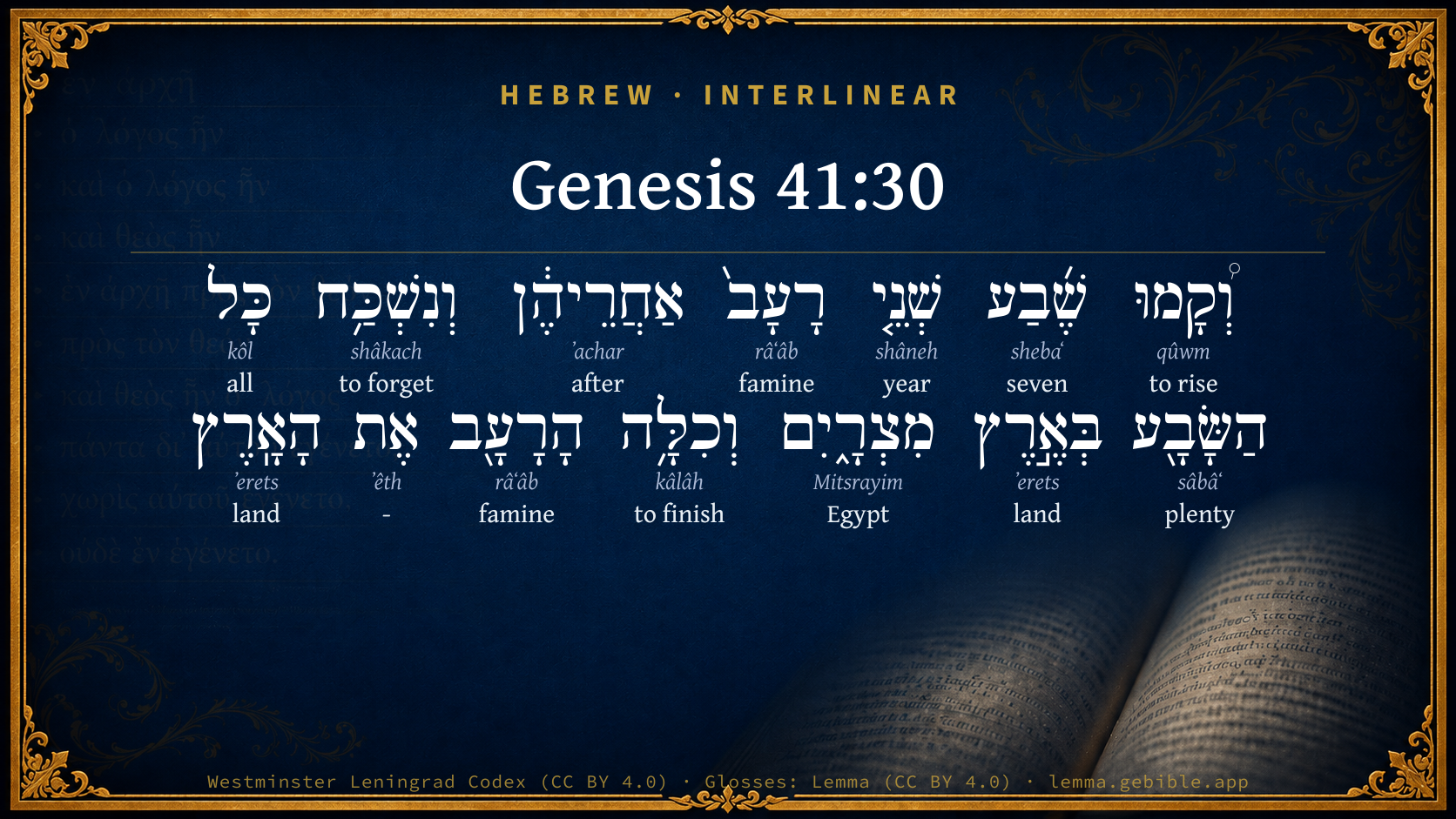
  1. וְ֠קָמוּ qûwm H6965 “and · to rise” Conjunction + Verb, Qal, Sequential Perfect, 3rd Person, Common, Plural
  2. שֶׁ֜בַע shebaʻ H7651 “seven” Adjective, Cardinal number, Feminine, Singular, Absolute
  3. שְׁנֵ֤י shâneh H8141 “year” Adjective, Cardinal number, Masculine, Dual, Construct
  4. רָעָב֙ râʻâb H7458 “famine” Noun, Common, Masculine, Singular, Absolute
  5. אַחֲרֵיהֶ֔ן ʼachar H310 “after · them” Preposition + Suffix, Personal, 3rd Person, Feminine, Plural
  6. וְנִשְׁכַּ֥ח shâkach H7911 “and · to forget” Conjunction + Verb, Niphal, Sequential Perfect, 3rd Person, Masculine, Singular
  7. כָּל kôl H3605 “all of” Noun, Common, Masculine, Singular, Construct
  8. בְּאֶ֣רֶץ ʼerets H776 “in/at · land of” Preposition + Noun, Common, Both, Singular, Construct
  9. מִצְרָ֑יִם Mitsrayim H4714 “Egypt” Noun, Proper
  10. וְכִלָּ֥ה kâlâh H3615 “and · to finish” Conjunction + Verb, Piel, Sequential Perfect, 3rd Person, Masculine, Singular
  11. הָרָעָ֖ב râʻâb H7458 “the · famine” Particle, Definite Article + Noun, Common, Masculine, Singular, Absolute
  12. אֶת ʼêth H853 “-” Particle, Direct Object
  13. הָאָֽרֶץ ʼerets H776 “the · land” Particle, Definite Article + Noun, Common, Both, Singular, Absolute

About this verse

These counts appear in no published source. They are computed here, from the morphology-tagged text and Lemma’s own curated glosses. What Lemma adds →

14
words
12
distinct lemmas
Pentateuch
section

Notable vocabulary

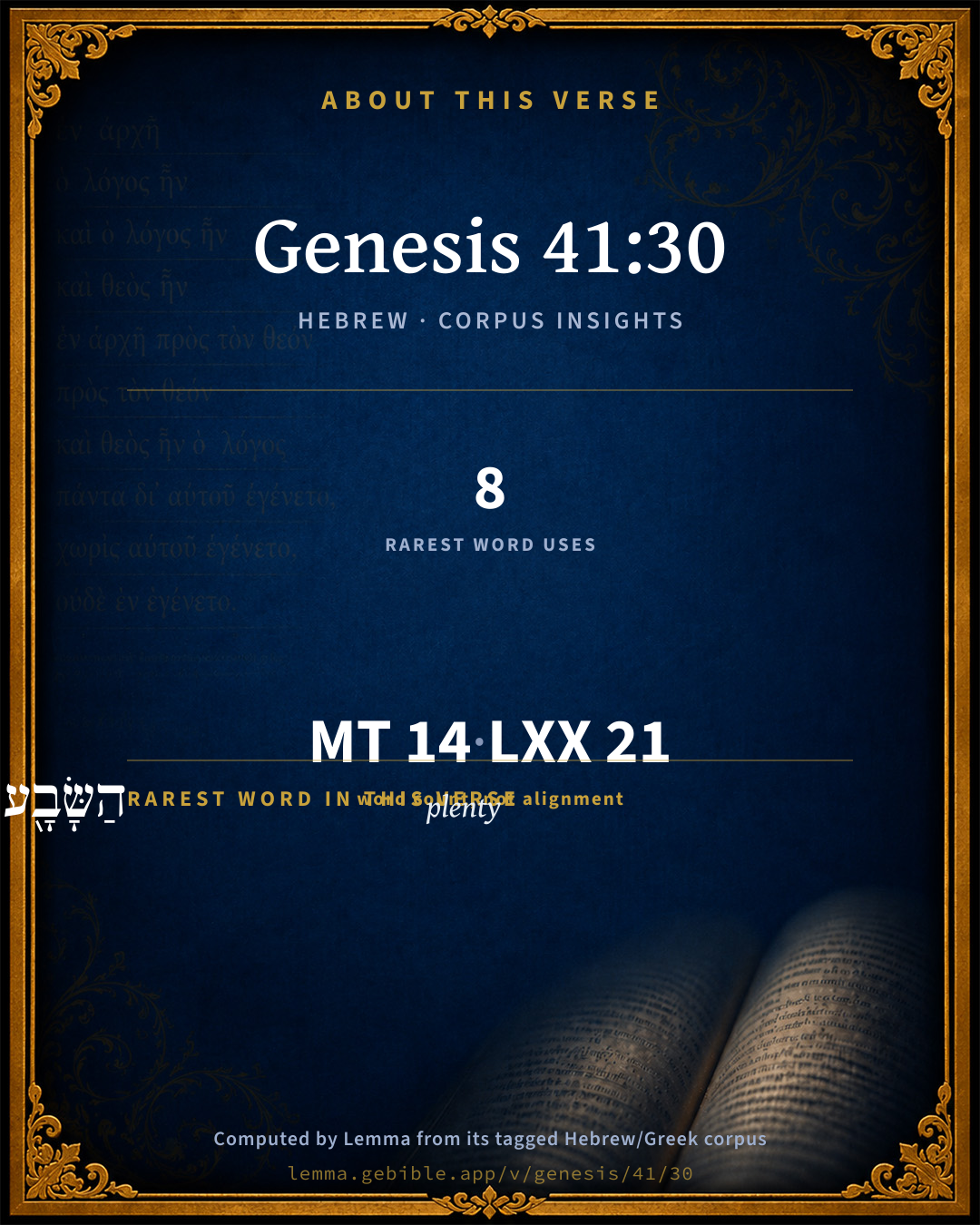
The rarest word here is הַשָּׂבָ֖ע plenty H7647 — appearing just 8 times in the whole Hebrew Bible.

Shared distinctive vocabulary

הַשָּׂבָ֖ע plenty H7647 occurs in 8 verses of the Hebrew Bible. Also found in:

Grammatical profile

  • 3 verbs
  • 7 nouns
  • 2 adjectives
  • 1 preposition
  • 1 particle

Verb forms

  • וְ֠קָמוּ Qal · Sequential Perfect
  • וְנִשְׁכַּ֥ח Niphal · Sequential Perfect
  • וְכִלָּ֥ה Piel · Sequential Perfect

Repetition

Words recur within this verse — often emphatic in Hebrew:

  • רָעָב֙ famine H7458 ×2
  • בְּאֶ֣רֶץ land H776 ×2

Hebrew & Septuagint length

In English translation the verse runs 27 words from the Hebrew and 29 from the Septuagint (LXX English) — closely comparable.

A rough comparison of the two English renderings, which tokenize alike — not a word-level alignment.

Word counts can differ between the Hebrew and the Greek without any difference in meaning — e.g. the Hebrew direct-object marker אֵת has no separate Greek word, and Greek often adds the article ὁ.

In the original languages it is 14 Hebrew tokens and 21 Greek tokens — but the two are counted differently (Hebrew bundles its prefixes and suffixes into one token; the Greek is in lemma form), so that isn’t a like-for-like length.

Cross-references

14

Topical passages linked to Genesis 41:30 in the Treasury of Scripture Knowledge — connected by theme and wording, ordered by reader-vote popularity; previews shown in the World English Bible.

  • Genesis 41:54 The seven years of famine began to come, just as Joseph had said. There was famine in all lands, but in all the land of Egypt there was bread.
  • Genesis 47:13 There was no bread in all the land; for the famine was very severe, so that the land of Egypt and the land of Canaan fainted by reason of the famine.
  • Psalms 105:16 He called for a famine on the land. He destroyed the food supplies.
  • James 5:17 Elijah was a man with a nature like ours, and he prayed earnestly that it might not rain, and it didn't rain on the earth for three years and six months.
  • Genesis 41:21 and when they had eaten them up, it couldn't be known that they had eaten them, but they were still ill-favored, as at the beginning. So I awoke.
  • Genesis 41:27 The seven lean and ill-favored cattle that came up after them are seven years, and also the seven empty heads of grain blasted with the east wind; they will be seven years of famine.
  • Genesis 41:51 Joseph called the name of the firstborn Manasseh, "For," he said, "God has made me forget all my toil, and all my father's house."
  • Genesis 41:56 The famine was over all the surface of the earth. Joseph opened all the store-houses, and sold to the Egyptians. The famine was severe in the land of Egypt.
  • 2 Samuel 24:13 So Gad came to David, and told him, and said to him, Shall seven years of famine come to you in your land? or will you flee three months before your foes while they pursue you? or shall there be three days' pestilence in your land? now advise you, and consider what answer I shall return to him who sent me.
  • 1 Kings 17:1 Elijah the Tishbite, who was of the foreigners of Gilead, said to Ahab, As Yahweh, the God of Israel, lives, before whom I stand, there shall not be dew nor rain these years, but according to my word.
  • 2 Kings 8:1 Now Elisha had spoken to the woman, whose son he had restored to life, saying, Arise, and go you and your household, and sojourn wherever you can sojourn: for Yahweh has called for a famine; and it shall also come on the land seven years.
  • Proverbs 31:7 Let him drink, and forget his poverty, And remember his misery no more.
  • Isaiah 65:16 so that he who blesses himself in the earth shall bless himself in the God of truth; and he who swears in the earth shall swear by the God of truth; because the former troubles are forgotten, and because they are hid from my eyes.
  • Luke 4:25 But truly I tell you, there were many widows in Israel in the days of Elijah, when the sky was shut up three years and six months, when a great famine came over all the land.

Cross-references courtesy of OpenBible.info (CC BY 4.0).

Hebrew and Greek witnesses Masoretic Hebrew ↔ Greek Septuagint

The same verse in the two great witnesses to the Old Testament, shown verse-for-verse.

These are two independent witnesses, not word-aligned to each other, and the Septuagint is shown in lemma (dictionary) form.

Hebrew Genesis 41:30 Masoretic · Westminster Leningrad Codex

וְ֠קָמוּ שֶׁ֜בַע שְׁנֵ֤י רָעָב֙ אַחֲרֵיהֶ֔ן וְנִשְׁכַּ֥ח כָּל הַשָּׂבָ֖ע בְּאֶ֣רֶץ מִצְרָ֑יִם וְכִלָּ֥ה הָרָעָ֖ב אֶת הָאָֽרֶץ

There will arise after them seven years of famine, and all the plenty will be forgotten in the land of Egypt. The famine will consume the land,

World English Bible · Public Domain

Greek LXX Genesis 41:30 Septuagint · lemma form

ἥκω δέ ἑπτά ἔτος λιμός μετά οὗτος καί ἐπιλανθάνω ὁ πλησμονή ἐν ὅλος γῆ αἴγυπτος καί ἀναἁλίσκω ὁ λιμός ὁ γῆ

But there shall come seven years of famine after these, and they shall forget the plenty that shall be in all Egypt, and the famine shall consume the land.

LXX2012 (modern English Septuagint) · Public Domain

Hebrew: Westminster Leningrad Codex (CC BY 4.0). Greek: Septuagint (public domain); English from LXX2012 (modern English Septuagint) (Public Domain). How the Septuagint differs from the Hebrew →

Targum (Aramaic paraphrase)

2

The Targum is the ancient Jewish Aramaic paraphrase of the Hebrew Scriptures — an interpretive translation, not the Hebrew text itself. Onkelos (literal) and Pseudo-Jonathan (expansive) render the Torah, and Jonathan the Prophets. Coverage is partial: where no permissively-licensed English translation exists for a verse, only the Aramaic is shown. This is verse-level text, not a word-by-word alignment to the Hebrew.

  1. Targum Onkelos Torah (Genesis–Deuteronomy)
    וִיקוּמוּן שְׁבַע שְׁנֵי כַפְנָא בַּתְרֵיהֶן וְיִתִנְשֵׁי כָּל שׂוֹבְעָא בְּאַרְעָא דְמִצְרָיִם וִישֵׁיצֵי כַפְנָא יָת (עַמָּא דְ) אַרְעָא

    (no public-domain English translation for this verse)

    Targum Onkelos — Aramaic: “Onkelos Genesis” (public domain); “Onkelos Exodus” (public domain); “Onkelos Leviticus” (public domain); “Onkelos Numbers” (public domain); “Onkelos Deuteronomy” (public domain). English: “Sefaria Community Translation” (CC0 1.0 (public-domain dedication)); “J.W. Etheridge. The Targums of Onkelos and Jonathan Ben Uzziel on the Pentateuch. London: Longmans, Green, 1862” (public domain). Text via Sefaria.

  2. Targum Pseudo-Jonathan Torah (Genesis–Deuteronomy)
    וִיקוּמוּן שְׁבַע שְׁנֵי כַפְנָא מִן בַּתְרֵיהוֹן וְיִתְנְשֵׁי כָּל שׁוֹבְעָא דַהֲוָה בְּאַרְעָא דְמִצְרַיִם וִישֵׁצֵי כַפְנָא יַת דַיְירֵי אַרְעָא

    And after them will arise seven years of famine, which will make all the plenty that was in the land of Mizraim to be forgotten; and the famine will consume the inhabitants of the land;

    Targum Pseudo-Jonathan — Aramaic: “Targum Jonathan on Genesis” (public domain); “Targum Jonathan on Exodus” (public domain); “Targum Jonathan on Leviticus” (public domain); “Targum Jonathan on Numbers” (public domain); “Targum Jonathan on Deuteronomy” (public domain). English: “The Targum of Jonathan ben Uzziel, trans. J. W. Etheridge, London, 1862” (public domain). Text via Sefaria.

Commentary

Notes on Genesis 41:30 from classic Christian and Jewish commentators (each source and its license shown beneath its notes). The classic Christian expositions comment on the surrounding passage and are grouped to its opening verse, so a note may address several verses; the Jewish commentaries on the Tanakh (Rashi and others) are per-verse, so they appear only where the commentator wrote on this verse.

Lemma curates 59 commentaries, every one of them public domain or Creative Commons licensed, each selected and text-cleaned for this edition rather than reprinted as found. About our sources →

Joseph Benson's Commentary

Gen 41:30. Seven years of famine — See the perishing nature of our worldly enjoyments. The great increase of the years of plenty was quite lost and swallowed up in the years of famine; and the over-plus of it, which seemed very much, yet did but just serve to keep men alive.

Joseph Benson's Commentary on the Old and New Testaments (1811–1818) — public domain. Text from a community e-Sword module.

John Gill's Exposition

Now therefore let Pharaoh look out a man discreet and wise,.... Of good judgment and conduct, of abilities equal to the execution of a scheme hereafter proposed: it can scarcely be thought consistent with the great modesty of Joseph that he meant himself, or that indeed, he ventured to give any advice at all, until it was first asked of him by the king; who being so well satisfied with the interpretation of his dreams, thought him a proper person to consult with what to be done in this case; who, as a true father of his country, as every king should be, was concerned for the good of it, and to provide against the worst for them:

and set him over the land of Egypt; not to be governor of it in general, but with a particular respect to the present case, to take care of provision for it.

John Gill's Exposition of the Whole Bible (1746–1763) — public domain (CC PDM 1.0). Text via the HelloAO Bible API.

Haydock's Catholic Bible Commentary

The land of Egypt, and the adjacent countries.

George Leo Haydock (1774–1849), Haydock's Catholic Family Bible and Commentary, 1859 edition — public domain. Excludes Psalms (Douay-Rheims chapter numbering differs from Protestant) and Deuterocanonical books (Catholic canon only).

Matthew Poole's English Annotations

There shall be no relics of it to keep it in men’s minds, which will be so taken up with the contemplation of their present misery and future danger, that they will have neither heart nor leisure to reflect upon their former plenty, the remembrance whereof will but aggravate the present calamity.

Matthew Poole's English Annotations on the Holy Bible (1683–1685) — public domain. Text from a community e-Sword/MySword module.

John Wesley's Explanatory Notes

See the perishing nature of our worldly enjoyments. The great increase of the years of plenty was quite lost and swallowed up in the years of famine; and the overplus of it, which seemed very much, yet did but just serve to keep men alive.

John Wesley, Explanatory Notes Upon the Whole Bible (1754–1765) — public domain. Text via the GEBible commentary corpus.

unfoldingWord translationNotes

Door43 World Missions Community

General Information:

Joseph continues interpreting Pharaoh's dreams.

Seven years of famine will come after them

This speaks about the seven years of famine as if they are something that travels and comes to a place. AT: "Then there will be seven years when there is very little food" (See: Metaphor)

all the abundance will be forgotten ... and the famine will devastate the land. The abundance will not be remembered ... because of the famine that will follow

Joseph expresses an idea in two ways to emphasize its importance. (See: Parallelism)

all the abundance will be forgotten in the land of Egypt

Here "land" refers to the people. This can be stated in active form. AT: "the people of Egypt will forget about the years in which there was plenty of food" (See: Metonymy and Active or Passive)

will devastate the land

Here "land" refers to the soil, the people, and the entire country. (See: Metonymy)

because of the famine that will follow

This speaks about the famine as if it were a thing that travels and follows behind something else. AT: "because of the time of famine that will happen afterwards" (See: Metaphor)

That the dream was repeated to Pharaoh is because the matter has been established by God

This can be stated in active form. AT: "God gave you two dreams to show you that he will certainly cause these things to happen" (See: Active or Passive)

translationWords

famine

Egypt

devastate

dream

Pharaoh

God

unfoldingWord translationNotes — © Distant Shores Media and the Door43 World Missions Community, licensed CC BY-SA 4.0. Source: git.door43.org/Door43/en_tn.

Rashi

Rabbi Shlomo Yitzchaki (Rashi)

ונשכח כל השבע AND ALL THE PLENTY SHALL BE FORGOTTEN — this is the interpretation of the act of swallowing.

Rashi on the Tanakh — English translations: “The Judaica Press complete Tanach with Rashi, translated by A. J. Rosenberg” (CC BY 4.0); “Pentateuch with Rashi's commentary by M. Rosenbaum and A.M. Silbermann, 1929-1934” (public domain); “The Metsudah Tanach series, Lakewood, N.J” (CC BY 4.0); and “The Book of Joshua, Metsudah Publications, 1997” (CC BY 4.0). Text via Sefaria.

Lesson kit

Teaching starters — assembled from the data on this page, not authored interpretation. Every prompt links to the verse data it draws on. Edit before teaching.

Genesis, in the Pentateuch, opens this verse with 14 words (12 distinct Hebrew lemmas). Its most distinctive word is sâbâʻ (“plenty”). A historical commentator’s framing appears above. Read the whole chapter for the surrounding context.

Discussion questions

  1. The word sâbâʻ carries the sense “plenty.” How does it shape the verse?
  2. Genesis 41:29 shares the word «plenty» with this verse. How do the two illuminate each other?
  3. “famine” occurs 2× in this one verse. What is the effect of the repetition?
  4. These translations render this verse differently. What is at stake in choosing one wording over another?
  5. The verb «וְ֠קָמוּ» is Qal Sequential Perfect. How does its form color the action?
  6. Reading how Joseph Benson's Commentary and John Gill's Exposition read this verse, where do the two commentators agree and where do they part?

Things to notice

Reading settings

Reading text

Shown beneath each verse's original-language words.

Old Testament
Old Testament edition

Read the OT as the Masoretic Hebrew (MT) or the Greek Septuagint (LXX).

English shown for the Greek Septuagint (in the Hebrew ↔ Greek comparison).

Comparing translations? Open the Compare panel on any verse page to stack up to four side by side.