Genesis 31:23

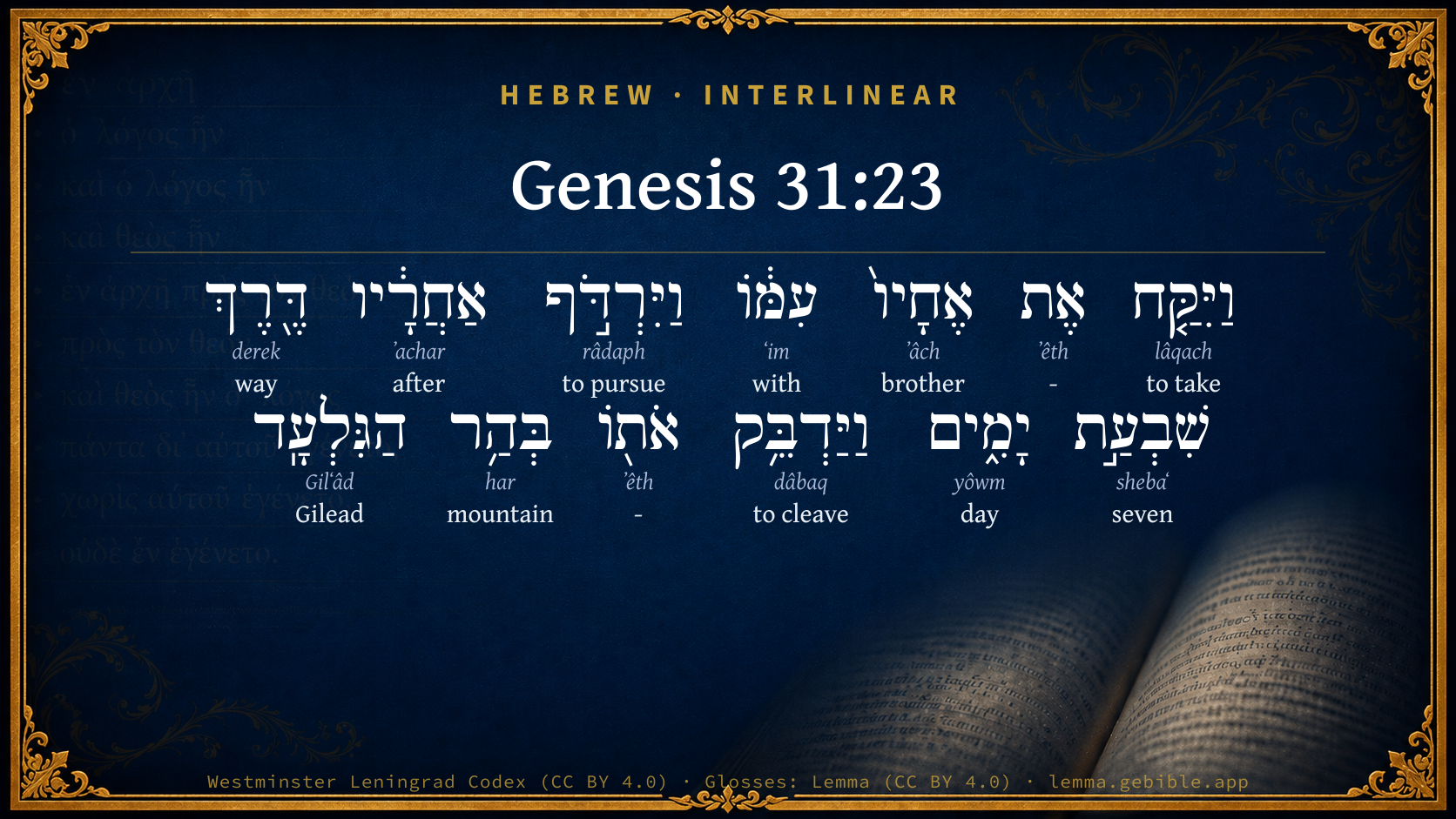
Hebrew (Westminster Leningrad Codex) Genesis 31:23 appears in the Hebrew Old Testament. The text above is from the Westminster Leningrad Codex. Each word links to its Strong’s number, a concise gloss, and parsing drawn from the Open Scriptures Hebrew Bible morphology. Click any word for its full Brown-Driver-Briggs (BDB) entry.
Download image
Cite this verse

Genesis 31:23 (World English Bible). Public Domain. Lemma interlinear Bible study tool, https://lemma.gebible.app/v/genesis/31/23.

Show BibTeX & RIS
BibTeX
RIS
English Translation
He took his relatives with him, and pursued after him seven days' journey. He overtook him in the mountain of Gilead.
World English Bible · Public Domain
Download a study sheet

One document with this verse’s original text, its word-by-word gloss line, the meaning frame, cross-references with their text, attributed commentary, and full source and license credits — printable, and it pastes into notes with its structure intact.

This verse Autodidact and up

Study sheet (.html) Plain text (.txt)

A passage Seminary Student

Up to 50 verses in one chapter. A passage sheet keeps up to 6 commentary sources and 12 cross-references per verse, in the order this page ranks them, and says so on the sheet whenever that leaves anything out. Ask for a single verse and you get the Autodidact verse sheet above.

Everything on this page stays free to read, with no account — the sheet is a download of what is already on screen, not access to it.

Want to remove ads? Support Godless Engineer
Compare translations 3

The same verse in 3 English versions, stacked beneath the original-language interlinear above. Click any original word for its lexicon entry.

Each is an independent rendering of the whole verse — the interlinear is not word-aligned to these translations.

Highlighted words mark where these versions differ — a whole-verse word diff, not a word-by-word alignment.

  • World English Bible Public Domain
    He took his relatives with him, and pursued after him seven days' journey. He overtook him in the mountain of Gilead.
  • King James Version Public Domain
    And he took his brethren with him, and pursued after him seven days' journey; and they overtook him in the mount Gilead.
  • unfoldingWord Literal Text CC BY-SA 4.0
    So he took his relatives with him and pursued after him a seven-day journey and overtook him in the mountain of Gilead.

unfoldingWord Literal Text — © unfoldingWord, licensed CC BY-SA 4.0. Word-aligned USFM3 via Door43 (git.door43.org/unfoldingWord/en_ult).

Versions to compare (up to 4)

3 of 4 selected

Show all 18 translations

Every available English version of this verse, each an independent rendering of the whole verse.

  • World English Bible Public Domain
    He took his relatives with him, and pursued after him seven days' journey. He overtook him in the mountain of Gilead.
  • Berean Standard Bible Public Domain
    So he took his relatives with him, pursued Jacob for seven days, and overtook him in the hill country of Gilead.
  • Majority Standard Bible Public Domain
    So he took his relatives with him, pursued Jacob for seven days, and overtook him in the hill country of Gilead.
  • King James Version Public Domain
    And he took his brethren with him, and pursued after him seven days' journey; and they overtook him in the mount Gilead.
  • American Standard Version (1901) Public Domain
    And he took his brethren with him, and pursued after him seven days' journey; and he overtook him in the mountain of Gilead.
  • Revised Version (1885) Public Domain
    And he took his brethren with him, and pursued after him seven days’ journey; and he overtook him in the mountain of Gilead.
  • Geneva Bible (1599) Public Domain
    Then he tooke his brethren with him, and followed after him seuen dayes iourney, and ouertooke him at mount Gilead.
  • Douay-Rheims (1899) Public Domain
    And he took his brethren with him, and pursued after him seven days; and overtook him in the mount of Galaad.
  • Young's Literal Translation Public Domain
    and he taketh his brethren with him, and pursueth after him a journey of seven days, and overtaketh him in the mount of Gilead.
  • Literal Standard Version CC BY-SA 4.0
    and he takes his brothers with him, and pursues after him a journey of seven days, and overtakes him in the Mount of Gilead.
  • Unlocked Literal Bible CC BY-SA 4.0
    So he took his relatives with him and pursued him for a seven days' journey. He overtook him in the hill country of Gilead.
  • unfoldingWord Literal Text CC BY-SA 4.0
    So he took his relatives with him and pursued after him a seven-day journey and overtook him in the mountain of Gilead.
  • Darby Bible Public Domain
    And he took his brethren with him, and pursued after him seven days' journey, and overtook him on mount Gilead.
  • World Messianic Bible Public Domain
    He took his relatives with him, and pursued him seven days’ journey. He overtook him in the mountain of Gilead.
  • Webster's Bible Public Domain
    And he took his brethren with him, and pursued after him seven days' journey: and they overtook him in the mount Gilead.
  • Free Bible Version CC BY-SA 4.0
    Taking some of his relatives with him, he chased after Jacob and caught up with him seven days later in the hill country of Gilead.
  • Bible in Basic English Public Domain
    And taking the men of his family with him, he went after him for seven days and overtook him in the hill-country of Gilead.
  • JPS Tanakh (1917) Public Domain
    And he took his brethren with him, and pursued after him seven days' journey; and he overtook him in the mountain of Gilead.

Literal Standard Version (2020), Covenant Press — licensed CC BY-SA 4.0. Text via the HelloAO Bible API (eBible.org). Unlocked Literal Bible (unfoldingWord) — licensed CC BY-SA 4.0. Text via the HelloAO Bible API (eBible.org). unfoldingWord Literal Text — © unfoldingWord, licensed CC BY-SA 4.0. Word-aligned USFM3 via Door43 (git.door43.org/unfoldingWord/en_ult). Free Bible Version, Dr. Jonathan Gallagher — licensed CC BY-SA 4.0. Text via the HelloAO Bible API (eBible.org).

Word by word

More ways to search: Search by grammar → Find every occurrence → Compare this word →

Practice this passage: Drill this verse → Learn its vocabulary →

וַיַּדְבֵּ֥ק
dâbaq
H1692
“and · to cleave”
Conjunction + Verb, Hiphil, Sequential Imperfect, 3rd Person, Masculine, Singular
Part of Speech
Conjunction + Verb
Stem
Hiphil
Form
Sequential Imperfect
Person
3rd Person
Gender
Masculine
Number
Singular
Full BDB Definition

Origin: a primitive root

TWOT: 398

to cling, stick, stay close, cleave, keep close, stick to, stick with, follow closely, join to, overtake, catch - (Qal) - to cling, cleave to - to stay with - (Pual) to be joined together - (Hiphil) - to cause to cleave to - to pursue closely - to overtake - (Hophal) to be made to cleave
  1. וַיִּקַּ֤ח lâqach H3947 “and · to take” Conjunction + Verb, Qal, Sequential Imperfect, 3rd Person, Masculine, Singular
  2. אֶת ʼêth H853 “-” Particle, Direct Object
  3. אֶחָיו֙ ʼâch H251 “brothers · his” Noun, Common, Masculine, Plural, Construct + Suffix, Personal, 3rd Person, Masculine, Singular
  4. עִמּ֔וֹ ʻim H5973 “with · him” Preposition + Suffix, Personal, 3rd Person, Masculine, Singular
  5. וַיִּרְדֹּ֣ף râdaph H7291 “and · to pursue” Conjunction + Verb, Qal, Sequential Imperfect, 3rd Person, Masculine, Singular
  6. אַחֲרָ֔יו ʼachar H310 “after · him” Preposition + Suffix, Personal, 3rd Person, Masculine, Singular
  7. דֶּ֖רֶךְ derek H1870 “way of” Noun, Common, Both, Singular, Construct
  8. שִׁבְעַ֣ת shebaʻ H7651 “seven” Adjective, Cardinal number, Masculine, Singular, Construct
  9. יָמִ֑ים yôwm H3117 “days” Noun, Common, Masculine, Plural, Absolute
  10. אֹת֖וֹ ʼêth H853 “- · him” Particle, Direct Object + Suffix, Personal, 3rd Person, Masculine, Singular
  11. בְּהַ֥ר har H2022 “in/at · mountain of” Preposition + Noun, Common, Masculine, Singular, Construct
  12. הַגִּלְעָֽד Gilʻâd H1568 “the · Gilead” Particle, Definite Article + Noun, Proper

About this verse

These counts appear in no published source. They are computed here, from the morphology-tagged text and Lemma’s own curated glosses. What Lemma adds →

13
words
12
distinct lemmas
Pentateuch
section

Shared distinctive vocabulary

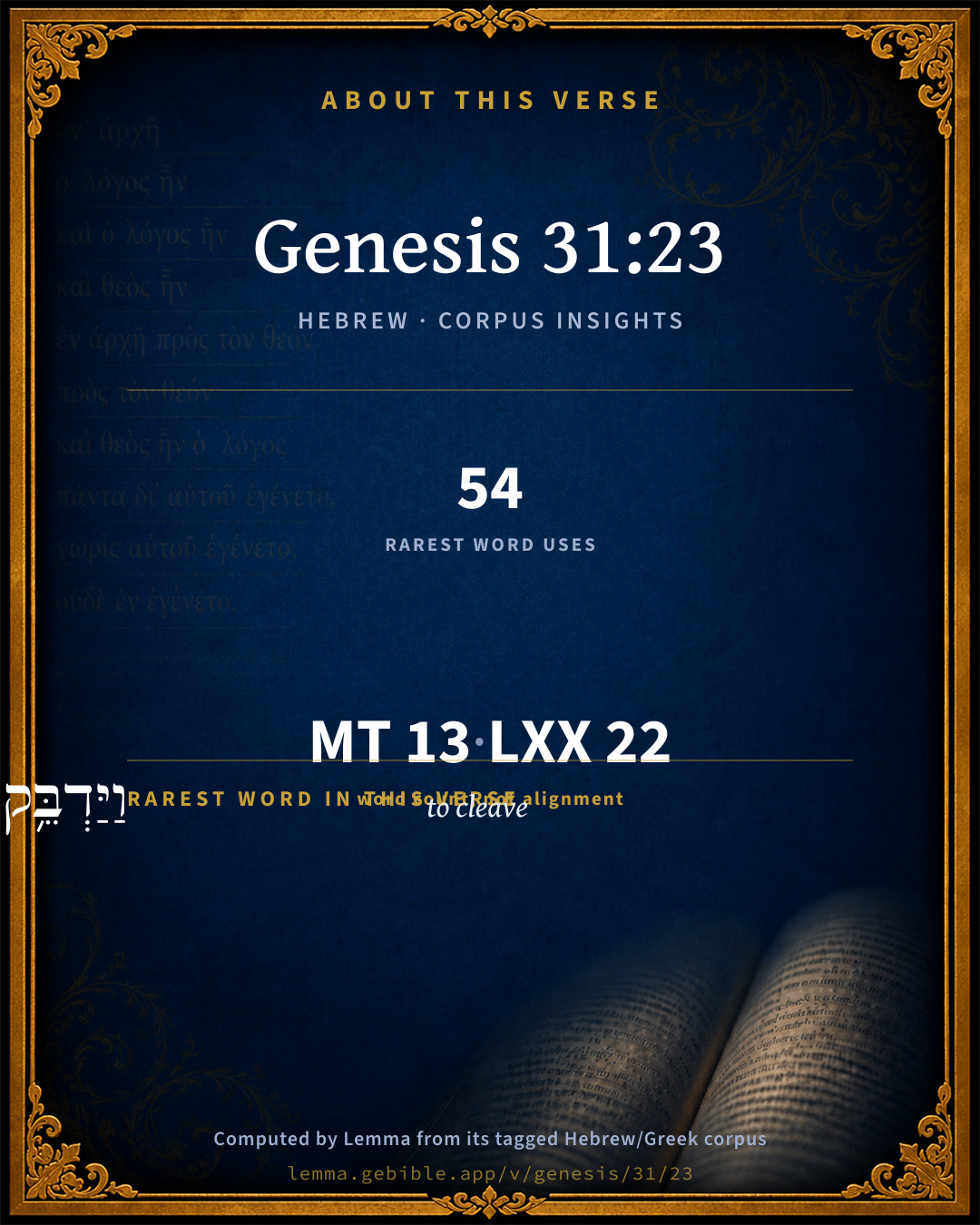
וַיַּדְבֵּ֥ק to cleave H1692 occurs in 52 verses of the Hebrew Bible. Also found in:

Grammatical profile

  • 3 verbs
  • 5 nouns
  • 1 adjective
  • 2 prepositions
  • 2 particles

Verb forms

  • וַיִּקַּ֤ח Qal · Sequential Imperfect
  • וַיִּרְדֹּ֣ף Qal · Sequential Imperfect
  • וַיַּדְבֵּ֥ק Hiphil · Sequential Imperfect

Hebrew & Septuagint length

In English translation the verse runs 21 words from the Hebrew and 20 from the Septuagint (LXX English) — closely comparable.

A rough comparison of the two English renderings, which tokenize alike — not a word-level alignment.

Word counts can differ between the Hebrew and the Greek without any difference in meaning — e.g. the Hebrew direct-object marker אֵת has no separate Greek word, and Greek often adds the article ὁ.

In the original languages it is 13 Hebrew tokens and 22 Greek tokens — but the two are counted differently (Hebrew bundles its prefixes and suffixes into one token; the Greek is in lemma form), so that isn’t a like-for-like length.

Cross-references

4

Topical passages linked to Genesis 31:23 in the Treasury of Scripture Knowledge — connected by theme and wording, ordered by reader-vote popularity; previews shown in the World English Bible.

  • Genesis 13:8 Abram said to Lot, "Please, let there be no strife between me and you, and between my herdsmen and your herdsmen; for we are relatives.
  • Genesis 24:27 He said, "Blessed be Yahweh, the God of my master Abraham, who has not forsaken his loving kindness and his truth toward my master. As for me, Yahweh has led me in the way to the house of my master's relatives."
  • Exodus 2:11 It happened in those days, when Moses had grown up, that he went out to his brothers, and looked at their burdens. He saw an Egyptian striking a Hebrew, one of his brothers.
  • Exodus 2:13 He went out the second day, and, behold, two men of the Hebrews were fighting with each other. He said to him who did the wrong, "Why do you strike your fellow?"

Cross-references courtesy of OpenBible.info (CC BY 4.0).

Hebrew and Greek witnesses Masoretic Hebrew ↔ Greek Septuagint

The same verse in the two great witnesses to the Old Testament, shown verse-for-verse.

These are two independent witnesses, not word-aligned to each other, and the Septuagint is shown in lemma (dictionary) form.

Hebrew Genesis 31:23 Masoretic · Westminster Leningrad Codex

וַיִּקַּ֤ח אֶת אֶחָיו֙ עִמּ֔וֹ וַיִּרְדֹּ֣ף אַחֲרָ֔יו דֶּ֖רֶךְ שִׁבְעַ֣ת יָמִ֑ים וַיַּדְבֵּ֥ק אֹת֖וֹ בְּהַ֥ר הַגִּלְעָֽד

He took his relatives with him, and pursued after him seven days' journey. He overtook him in the mountain of Gilead.

World English Bible · Public Domain

Greek LXX Genesis 31:23 Septuagint · lemma form

καί παραλαμβάνω πᾶς ὁ ἀδελφός αὐτός μετά ἑαυτοῦ διώκω ὀπίσω αὐτός ὁδός ἡμέρα ἑπτά καί καταλαμβάνω αὐτός ἐν ὁ ὄρος ὁ γαλαάδ

And having taken his brethren with him, he pursued after him seven days' journey, and overtook him on Mount Galaad.

LXX2012 (modern English Septuagint) · Public Domain

Hebrew: Westminster Leningrad Codex (CC BY 4.0). Greek: Septuagint (public domain); English from LXX2012 (modern English Septuagint) (Public Domain). How the Septuagint differs from the Hebrew →

Targum (Aramaic paraphrase)

2

The Targum is the ancient Jewish Aramaic paraphrase of the Hebrew Scriptures — an interpretive translation, not the Hebrew text itself. Onkelos (literal) and Pseudo-Jonathan (expansive) render the Torah, and Jonathan the Prophets. Coverage is partial: where no permissively-licensed English translation exists for a verse, only the Aramaic is shown. This is verse-level text, not a word-by-word alignment to the Hebrew.

  1. Targum Onkelos Torah (Genesis–Deuteronomy)
    וּדְבַר יָת אַחוּהִי עִמֵּהּ וּרְדַף בַּתְרוֹהִי מַהֲלַךְ שִׁבְעַת יוֹמִין וְאַדְבֵּק יָתֵהּ בְּטוּרָא דְגִלְעָד

    (no public-domain English translation for this verse)

    Targum Onkelos — Aramaic: “Onkelos Genesis” (public domain); “Onkelos Exodus” (public domain); “Onkelos Leviticus” (public domain); “Onkelos Numbers” (public domain); “Onkelos Deuteronomy” (public domain). English: “Sefaria Community Translation” (CC0 1.0 (public-domain dedication)); “J.W. Etheridge. The Targums of Onkelos and Jonathan Ben Uzziel on the Pentateuch. London: Longmans, Green, 1862” (public domain). Text via Sefaria.

  2. Targum Pseudo-Jonathan Torah (Genesis–Deuteronomy)
    וּדְבַר יַת קְרִיבוֹי עִמֵיהּ וּרְדַף בַּתְרוֹי מַהֲלַךְ שׁוּבְעָא יוֹמִין וַאֲרַע יָתֵיהּ דְשָׁרֵי בְּטַוַור גִלְעָד מוֹדִי וּמַצְלִי קֳדָם אֱלָהֵיהּ

    And he took his kinsmen with him, and pursued after him, going seven days, and overtook him, while sojourning in Mount Gilead offering praise and praying before his God.

    Targum Pseudo-Jonathan — Aramaic: “Targum Jonathan on Genesis” (public domain); “Targum Jonathan on Exodus” (public domain); “Targum Jonathan on Leviticus” (public domain); “Targum Jonathan on Numbers” (public domain); “Targum Jonathan on Deuteronomy” (public domain). English: “The Targum of Jonathan ben Uzziel, trans. J. W. Etheridge, London, 1862” (public domain). Text via Sefaria.

Commentary

Notes on Genesis 31:23 from classic Christian and Jewish commentators (each source and its license shown beneath its notes). The classic Christian expositions comment on the surrounding passage and are grouped to its opening verse, so a note may address several verses; the Jewish commentaries on the Tanakh (Rashi and others) are per-verse, so they appear only where the commentator wrote on this verse.

Lemma curates 59 commentaries, every one of them public domain or Creative Commons licensed, each selected and text-cleaned for this edition rather than reprinted as found. About our sources →

Trapp's Complete Commentary

John Trapp

Gen 31:23 And he took his brethren with him, and pursued after him seven days’ journey; and they overtook him in the mount Gilead.

Ver. 23. And he took his brethren.] The wicked may band themselves, and bend their strength against the saints; but they are bounded by God. He lets them have the ball on their foot many times, till they come to the very goal, and yet then makes them miss the game. He lets out their tether, and then pulls them back again to their task.

John Trapp, A Commentary or Exposition upon All the Books of the Old and New Testament (1647–1656) — public domain. Text from a community e-Sword module.

Joseph Benson's Commentary

Gen 31:23. He took his brethren — That is, his relations, and pursues Jacob to bring him back into bondage, or to strip him of what he had. They overtook him in the mount Gilead — This mount was about two hundred and fifty miles from Haran; so that Jacob travelled twenty-five miles each day, and Laban, in pursuing him, thirty-seven.

Joseph Benson's Commentary on the Old and New Testaments (1811–1818) — public domain. Text from a community e-Sword module.

Geneva Bible (1599)

Geneva Bible translators

Or, kinsfolks and friends.

Or, joined with him.

Geneva Bible (1599) marginal notes — public domain. Text via Bolls.life.

John Calvin's Commentaries

23. And pursued him seven days’ journey. Since the cruelty of Laban was now appeased, or at least bridled, he did not dare severely to threaten; but laying aside his ferocity, he descended to feigned and hypocritical blandishments. He complains that injury had been done him, because he had been kept in ignorance of Jacob’s departure, whom he would rather leave sent forth with customary tokens of joy, in token of his paternal affection. Thus hypocrites, when the power of inflicting injury is taken away from them, heap false complaints upon the good and simple, as if the blame rested with them. Wherefore, if at any time wicked and perfidious men, when they have unjustly harassed us, put forward some pretext of equity on their own part, we must bear with the iniquity; not because a just defense is to be entirely omitted; but because we find it inevitable that perverse men, ever ready to speak evil, will shamelessly cast upon us the blame of crimes of which we are innocent. Meanwhile, we must prudently guard against giving them the occasion against us which they seek.

John Calvin's Commentaries (1540-1563) — public domain. Text from the Calvin Translation Society English edition (1840s-50s) via the Christian Classics Ethereal Library (ccel.org). Calvin's coverage is partial (roughly two-thirds of the Bible); uncommented books and verses are honest gaps, never fabricated. The 19th-century editor's footnotes and remarks are omitted so the notes are faithfully Calvin's own voice.

Ellicott's Commentary for English Readers

(23) His brethren.—As Jacob, who had no relatives with him except his sons, applies this term in Gen_31:46 to his followers, it is, probably, an honourable way of describing retainers, who were freemen and of a higher class than men-servants.

Seven days’ journey.—The route chosen by Jacob was apparently the more easterly one, past Tadmor, and through the Hauran, leaving Damascus to the west. The hill, which subsequently was called Mount Gilead, lay to the south of the Jabbok; but asMahanaim, reached some days after the meeting with Laban, is to the north of that river, the word Gilead was evidently applied to the whole of the region of chalk cliffs on the east of the Jordan. This is made certain by the fact that Laban overtook Jacob in seven days. But as the distance from Haran to the most northerly part of this country (afterwards assigned to the half-tribe of Manasseh) was fully three hundred miles, it would require hard riding on the part of Laban and his brethren to enable them to overtake Jacob, even on the borders of this region. There is no difficulty about Jacob’s movements. His flocks were pastured at so remote a distance from Haran that it would be easy for him to send them in detachments to the ford of the Euphrates, distant about sixty or seventy miles; he would make all the arrangements with his four elder sons and trusty servants, and, probably, even see them across the ford himself, and would return to Haran to fetch his wives and younger children only when all was well advanced. Finally, when Laban goes to a distance, in another direction, for his sheep-shearing, Jacob “sets his sons and his wives upon camels,” and follows with the utmost speed. They would have remained quietly at Haran to the last, to avoid suspicion, and, excepting Leah’s four elder sons, the rest would have been too young to be of much use. When Jacob, with his wives, overtook the cattle, they would, probably, not travel more than ten or twelve miles a day; but three days passed before Laban learned what had taken place, and a couple of days at least must have been spent in returning to Haran and preparing for the pursuit. Thus Jacob had reached Canaanite ground—a matter of very considerable importance—before his father-in-law overtook him.

A Bible Commentary for English Readers, edited by Charles John Ellicott (1878–1897) — public domain. Text from a community e-Sword module.

The Cambridge Bible for Schools and Colleges

gen. ed. J. J. S. Perowne

22–55. The Pursuit of Laban, &c.

23. his brethren] i.e. the men of his kindred and clan, as in Gen_31:25; Gen_31:32. Jacob is similarly attended; cf. Gen_31:37; Gen_31:46; Gen_31:54, Gen_24:60.

seven days’ journey] The distance from Haran to the land of Gilead for a company with flocks and herds would require a longer time. It is computed to be over 300 miles in a straight line. But we do not need to be very exacting about geographical accuracy in old-world popular stories.

The point to notice is that Jacob was encumbered with his flocks and herds and household, and that Laban, travelling without encumbrance in pursuit, overtook him in ten days from his flight.

The Cambridge Bible for Schools and Colleges (gen. ed. J. J. S. Perowne; Cambridge University Press, 1878–1918) — public domain. Text from a community e-Sword module.

John Gill's Exposition

Then Laban overtook Jacob,.... He was come to the mount the overnight, but now in the morning he came nearer to him, so as to hold a conversation with him:

now Jacob had pitched his tent in the mount, and Laban with his brethren pitched in the mount of Gilead; both on the same mount; one perhaps at the bottom, and the other at the top; or one on one hill of it, and the other on another, or right over against one another.

John Gill's Exposition of the Whole Bible (1746–1763) — public domain (CC PDM 1.0). Text via the HelloAO Bible API.

Whedon's Commentary on the Bible

Daniel D. Whedon

23. Took his brethren — Various relatives who were with him at the feast of sheep shearing. Compare the use of this word in Gen_13:8.

Seven days’ journey — From what date and from what place this seven days’ journey is to be reckoned, is not clear. The tidings of Jacob’s flight reached Laban on the third day after its occurrence, (Gen_31:22,) and it would probably take Laban three days more to get ready for the pursuit and to reach the point from which Jacob started; for there were three days’ journeying between them. Gen_30:36. Reckoning the seven days from that point, we give Jacob twelve or thirteen days the start of Laban, in which time he might have travelled three hundred and fifty miles. Both parties, doubtless, made the greatest possible haste; but Laban, unencumbered with flocks and family, would move twice or thrice as rapidly as Jacob, and so, in seven days from the time of his hearing of Jacob’s flight, he might have overtaken him. The Arab post is said to go from Damascus to Bagdad in eight days — a distance of about five hundred miles. The distance between the Euphrates and Gilead is about three hundred miles.

Daniel D. Whedon (gen. ed.), Commentary on the Old and New Testaments (1874–1909) — public domain. Text from a community e-Sword module.

John Wesley's Explanatory Notes

He took his brethren -- that is, his relations, and pursues Jacob to bring him back into bondage, or, to strip him of what he had.

John Wesley, Explanatory Notes Upon the Whole Bible (1754–1765) — public domain. Text via the GEBible commentary corpus.

Rashi

Rabbi Shlomo Yitzchaki (Rashi)

את אחיו HIS BRETHREN — i.e. his kinsmen.

דרך שבעת ימים SEVEN DAY’S JOURNEY — During all the three days during which the messenger had gone to tell Laban Jacob had proceeded on his journey. Consequently Jacob was then six days distance from Laban. On the seventh day i.e. on the day when Jacob covered that stretch of ground which made him seven days distant from Laban’s starting point Laban overtook him. We may infer, therefore, that all the distance that Jacob would have taken seven days to cover Laban covered in one day. And thus it states: “and he pursued after him seven day’s journey” and it does not say “and he pursued after him for seven days” (Genesis Rabbah 74:6).

Rashi on the Tanakh — English translations: “The Judaica Press complete Tanach with Rashi, translated by A. J. Rosenberg” (CC BY 4.0); “Pentateuch with Rashi's commentary by M. Rosenbaum and A.M. Silbermann, 1929-1934” (public domain); “The Metsudah Tanach series, Lakewood, N.J” (CC BY 4.0); and “The Book of Joshua, Metsudah Publications, 1997” (CC BY 4.0). Text via Sefaria.

Ramban (Nachmanides)

Rabbi Moshe ben Nachman (Ramban / Nachmanides)

AND HE OVERTOOK HIM IN THE MOUNTAIN OF GILEAD. For on the eve of the seventh day Laban reached the base of the mountain, and he saw Jacob encamped at a distance. That night he slept below Jacob’s camp and the dream came to him.

Ramban (Nachmanides) on the Tanakh — English translation: “Commentary on the Torah by Ramban (Nachmanides). Translated and annotated by Charles B. Chavel. New York, Shilo Pub. House, 1971-1976” (CC BY 4.0). Text via Sefaria.

Radak

Rabbi David Kimhi (Radak)

ויקח את אחיו, his relatives.

Radak on the Tanakh — English translations: “Sefaria Community Translation” (CC0 1.0 (public-domain dedication)); “Eliyahu Munk, HaChut Hameshulash” (CC BY 4.0); “Rabbi Mike Feuer, Jerusalem Anthology” (CC BY 4.0); and “R. David Kimhi on the first book of Psalms, Translated by R.G. Finch, London, 1919” (public domain). Text via Sefaria.

Lesson kit

Teaching starters — assembled from the data on this page, not authored interpretation. Every prompt links to the verse data it draws on. Edit before teaching.

Genesis, in the Pentateuch, opens this verse with 13 words (12 distinct Hebrew lemmas). Its most distinctive word is dâbaq (“to cleave”). A historical commentator’s framing appears above. Read the whole chapter for the surrounding context.

Discussion questions

  1. The word dâbaq carries the sense “to cleave.” How does it shape the verse?
  2. How does Genesis 2:24, which shares the word «to cleave», read alongside this verse?
  3. The translations on this page render this verse differently — a whole-verse word diff, not a word-by-word alignment. What might account for the different wordings?
  4. «וַיִּקַּ֤ח» is a Qal Sequential Imperfect verb. How does that grammatical form shape the action described?
  5. Compare how Trapp's Complete Commentary and Joseph Benson's Commentary read this verse. Where do they agree or differ?

Things to notice

Reading settings

Reading text

Shown beneath each verse's original-language words.

Old Testament
Old Testament edition

Read the OT as the Masoretic Hebrew (MT) or the Greek Septuagint (LXX).

English shown for the Greek Septuagint (in the Hebrew ↔ Greek comparison).

Comparing translations? Open the Compare panel on any verse page to stack up to four side by side.