
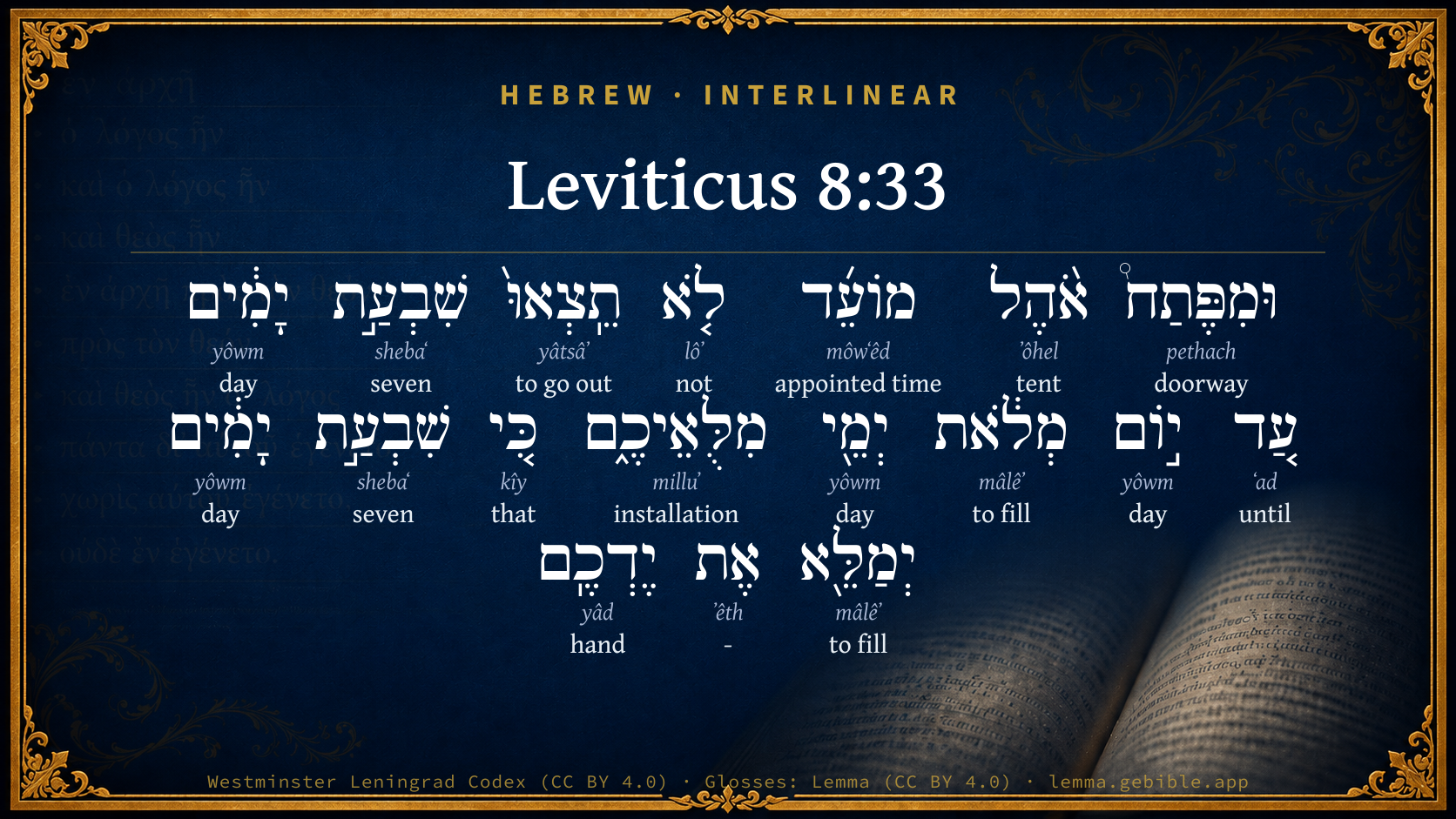
Leviticus 8:33

Hebrew (Westminster Leningrad Codex) Leviticus 8:33 appears in the Hebrew Old Testament. The text above is from the Westminster Leningrad Codex. Each word links to its Strong’s number, a concise gloss, and parsing drawn from the Open Scriptures Hebrew Bible morphology. Click any word for its full Brown-Driver-Briggs (BDB) entry.
Download image
Cite this verse

Leviticus 8:33 (World English Bible). Public Domain. Lemma interlinear Bible study tool, https://lemma.gebible.app/v/leviticus/8/33.

Show BibTeX & RIS
BibTeX
RIS
English Translation
You shall not go out from the door of the Tent of Meeting seven days, until the days of your consecration are fulfilled: for he shall consecrate you seven days.
World English Bible · Public Domain
Download a study sheet

One document with this verse’s original text, its word-by-word gloss line, the meaning frame, cross-references with their text, attributed commentary, and full source and license credits — printable, and it pastes into notes with its structure intact.

This verse Autodidact and up

Study sheet (.html) Plain text (.txt)

A passage Seminary Student

Up to 50 verses in one chapter. A passage sheet keeps up to 6 commentary sources and 12 cross-references per verse, in the order this page ranks them, and says so on the sheet whenever that leaves anything out. Ask for a single verse and you get the Autodidact verse sheet above.

Everything on this page stays free to read, with no account — the sheet is a download of what is already on screen, not access to it.

Want to remove ads? Support Godless Engineer
Compare translations 3

The same verse in 3 English versions, stacked beneath the original-language interlinear above. Click any original word for its lexicon entry.

Each is an independent rendering of the whole verse — the interlinear is not word-aligned to these translations.

Highlighted words mark where these versions differ — a whole-verse word diff, not a word-by-word alignment.

  • World English Bible Public Domain
    You shall not go out from the door of the Tent of Meeting seven days, until the days of your consecration are fulfilled: for he shall consecrate you seven days.
  • King James Version Public Domain
    And ye shall not go out of the door of the tabernacle of the congregation in seven days, until the days of your consecration be at an end: for seven days shall he consecrate you.
  • unfoldingWord Literal Text CC BY-SA 4.0
    And you shall not go out from the entrance of the tent of meeting seven days, until the day of the filling of the days of your ordination, because seven days, he will fill your hand.

unfoldingWord Literal Text — © unfoldingWord, licensed CC BY-SA 4.0. Word-aligned USFM3 via Door43 (git.door43.org/unfoldingWord/en_ult).

Versions to compare (up to 4)

3 of 4 selected

Show all 18 translations

Every available English version of this verse, each an independent rendering of the whole verse.

  • World English Bible Public Domain
    You shall not go out from the door of the Tent of Meeting seven days, until the days of your consecration are fulfilled: for he shall consecrate you seven days.
  • Berean Standard Bible Public Domain
    You must not go outside the entrance to the Tent of Meeting for seven days, until the days of your ordination are complete; for it will take seven days to ordain you.
  • Majority Standard Bible Public Domain
    You must not go outside the entrance to the Tent of Meeting for seven days, until the days of your ordination are complete; for it will take seven days to ordain you.
  • King James Version Public Domain
    And ye shall not go out of the door of the tabernacle of the congregation in seven days, until the days of your consecration be at an end: for seven days shall he consecrate you.
  • American Standard Version (1901) Public Domain
    And ye shall not go out from the door of the tent of meeting seven days, until the days of your consecration be fulfilled: for he shall consecrate you seven days.
  • Revised Version (1885) Public Domain
    And ye shall not go out from the door of the tent of meeting seven days, until the days of your consecration be fulfilled: for he shall consecrate you seven days.
  • Geneva Bible (1599) Public Domain
    And ye shall not depart from the doore of the Tabernacle of the Congregation seuen dayes, vntill the dayes of your consecrations bee at an ende: for seuen dayes, saide the Lord, shall hee consecrate you,
  • Douay-Rheims (1899) Public Domain
    And you shall not go out of the door of the tabernacle for seven days, until the day wherein the time of your consecration shall be expired. For in seven days the consecration is finished:
  • Young's Literal Translation Public Domain
    and from the opening of the tent of meeting ye go not out seven days, till the day of the fulness, the days of your consecration -- for seven days he doth consecrate your hand;
  • Literal Standard Version CC BY-SA 4.0
    and you do not go out from the opening of the Tent of Meeting [for] seven days, until the day of the fullness, the days of your consecration—for seven days he consecrates your hand;
  • Unlocked Literal Bible CC BY-SA 4.0
    You must not go out from the entrance of the tent of meeting for seven days, until the days of your ordination are fulfilled. For Yahweh will consecrate you for seven days.
  • unfoldingWord Literal Text CC BY-SA 4.0
    And you shall not go out from the entrance of the tent of meeting seven days, until the day of the filling of the days of your ordination, because seven days, he will fill your hand.
  • Darby Bible Public Domain
    And ye shall not go out from the entrance of the tent of meeting seven days, until the day when the days of your consecration are at an end: for seven days shall ye be consecrated.
  • World Messianic Bible Public Domain
    You shall not go out from the door of the Tent of Meeting for seven days, until the days of your consecration are fulfilled: for he shall consecrate you seven days.
  • Webster's Bible Public Domain
    And ye shall not go out of the door of the tabernacle of the congregation in seven days, until the days of your consecration shall be at an end: for seven days shall he consecrate you.
  • Free Bible Version CC BY-SA 4.0
    You are not to leave the entrance to the Tent of Meeting for seven days until the ordination ceremony is completed, because your ordination will take seven days.
  • Bible in Basic English Public Domain
    And you are not to go out from the door of the Tent of meeting for seven days, till the days for making you priest are ended; for this will be the work of seven days.
  • JPS Tanakh (1917) Public Domain
    And ye shall not go out from the door of the tent of meeting seven days, until the days of your consecration be fulfilled; for He shall consecrate you seven days.

Literal Standard Version (2020), Covenant Press — licensed CC BY-SA 4.0. Text via the HelloAO Bible API (eBible.org). Unlocked Literal Bible (unfoldingWord) — licensed CC BY-SA 4.0. Text via the HelloAO Bible API (eBible.org). unfoldingWord Literal Text — © unfoldingWord, licensed CC BY-SA 4.0. Word-aligned USFM3 via Door43 (git.door43.org/unfoldingWord/en_ult). Free Bible Version, Dr. Jonathan Gallagher — licensed CC BY-SA 4.0. Text via the HelloAO Bible API (eBible.org).

Word by word

More ways to search: Search by grammar → Find every occurrence → Compare this word →

Practice this passage: Drill this verse → Learn its vocabulary →

מִלֻּאֵיכֶ֑ם
milluʼ
H4394
“installations · your”
Noun, Common, Masculine, Plural, Construct + Suffix, Personal, 2nd Person, Masculine, Plural
Part of Speech
Noun
Type
Common
Gender
Masculine
Number
Plural
State
Construct
Full BDB Definition

Origin: from H4390

TWOT: 1195e

setting, installation - setting, stones for setting - installation (of priests)
  1. וּמִפֶּתַח֩ pethach H6607 “and · from · doorway of” Conjunction + Preposition + Noun, Common, Masculine, Singular, Construct
  2. אֹ֨הֶל ʼôhel H168 “tent of” Noun, Common, Masculine, Singular, Construct
  3. מוֹעֵ֜ד môwʻêd H4150 “appointed time” Noun, Common, Masculine, Singular, Absolute
  4. לֹ֤א lôʼ H3808 “not” Particle, Negative
  5. תֵֽצְאוּ֙ yâtsâʼ H3318 “to go out” Verb, Qal, Imperfect, 2nd Person, Masculine, Plural
  6. שִׁבְעַ֣ת shebaʻ H7651 “seven” Adjective, Cardinal number, Masculine, Singular, Construct
  7. יָמִ֔ים yôwm H3117 “days” Noun, Common, Masculine, Plural, Absolute
  8. עַ֚ד ʻad H5704 “until” Preposition
  9. י֣וֹם yôwm H3117 “day of” Noun, Common, Masculine, Singular, Construct
  10. מְלֹ֔את mâlêʼ H4390 “to fill” Verb, Qal, Infinitive Construct
  11. יְמֵ֖י yôwm H3117 “days of” Noun, Common, Masculine, Plural, Construct
  12. כִּ֚י kîy H3588 “that” Conjunction
  13. שִׁבְעַ֣ת shebaʻ H7651 “seven” Adjective, Cardinal number, Masculine, Singular, Construct
  14. יָמִ֔ים yôwm H3117 “days” Noun, Common, Masculine, Plural, Absolute
  15. יְמַלֵּ֖א mâlêʼ H4390 “to fill” Verb, Piel, Imperfect, 3rd Person, Masculine, Singular
  16. אֶת ʼêth H853 “-” Particle, Direct Object
  17. יֶדְכֶֽם yâd H3027 “hand · your” Noun, Common, Both, Singular, Construct + Suffix, Personal, 2nd Person, Masculine, Plural

About this verse

These counts appear in no published source. They are computed here, from the morphology-tagged text and Lemma’s own curated glosses. What Lemma adds →

18
words
13
distinct lemmas
Pentateuch
section

Notable vocabulary

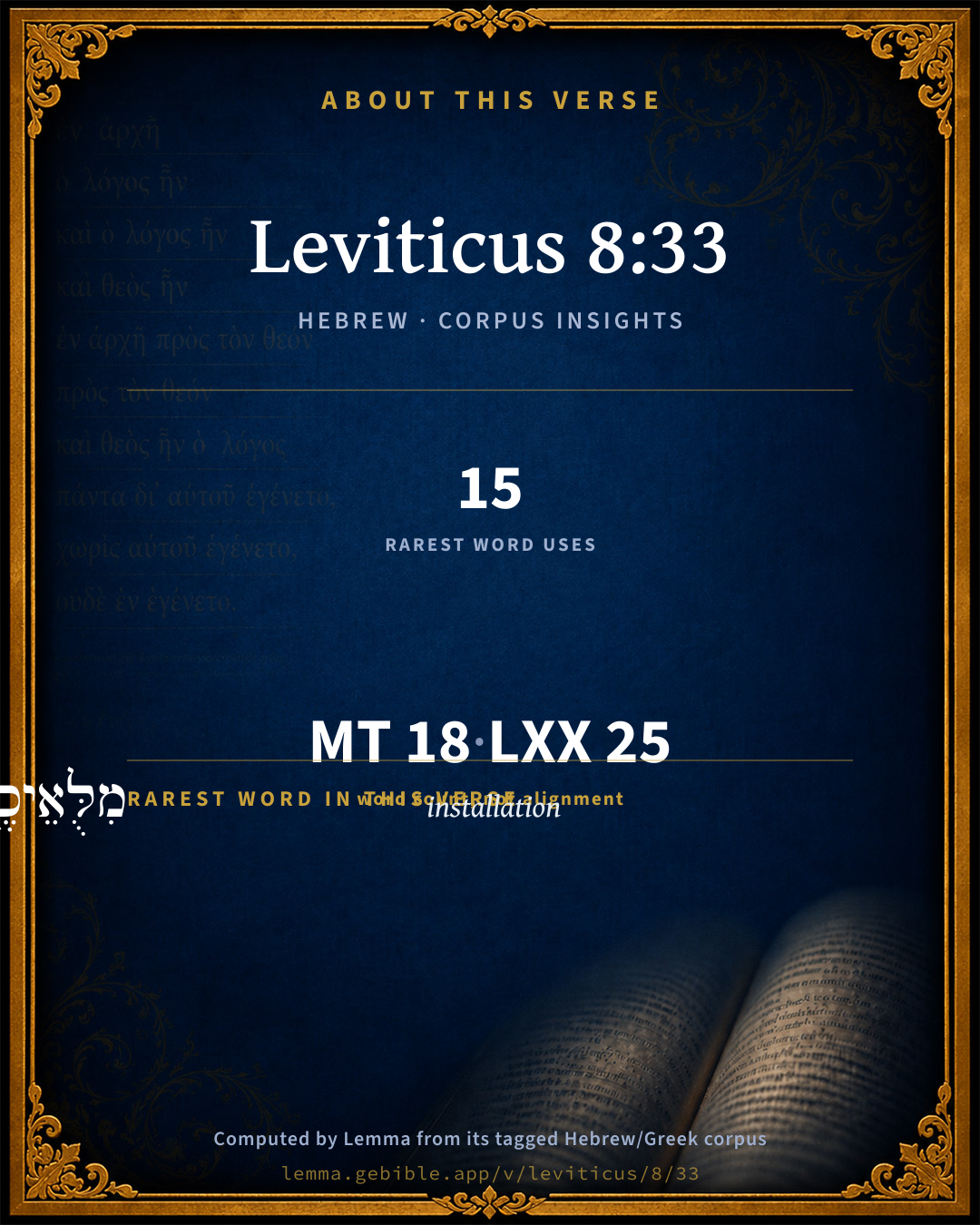
The rarest word here is מִלֻּאֵיכֶ֑ם installation H4394 — appearing just 15 times in the whole Hebrew Bible.

Shared distinctive vocabulary

מִלֻּאֵיכֶ֑ם installation H4394 occurs in 15 verses of the Hebrew Bible. Also found in:

Grammatical profile

  • 3 verbs
  • 9 nouns
  • 2 adjectives
  • 1 preposition
  • 1 conjunction
  • 2 particles

Verb forms

  • תֵֽצְאוּ֙ Qal · Imperfect
  • מְלֹ֔את Qal · Infinitive Construct
  • יְמַלֵּ֖א Piel · Imperfect

Repetition

Words recur within this verse — often emphatic in Hebrew:

  • יָמִ֔ים day H3117 ×4
  • שִׁבְעַ֣ת seven H7651 ×2
  • מְלֹ֔את to fill H4390 ×2

Hebrew & Septuagint length

In English translation the verse runs 30 words from the Hebrew and 35 from the Septuagint (LXX English) — closely comparable.

A rough comparison of the two English renderings, which tokenize alike — not a word-level alignment.

Word counts can differ between the Hebrew and the Greek without any difference in meaning — e.g. the Hebrew direct-object marker אֵת has no separate Greek word, and Greek often adds the article ὁ.

In the original languages it is 18 Hebrew tokens and 25 Greek tokens — but the two are counted differently (Hebrew bundles its prefixes and suffixes into one token; the Greek is in lemma form), so that isn’t a like-for-like length.

Cross-references

5

Topical passages linked to Leviticus 8:33 in the Treasury of Scripture Knowledge — connected by theme and wording, ordered by reader-vote popularity; previews shown in the World English Bible.

  • Exodus 29:35 "Thus shall you do to Aaron, and to his sons, according to all that I have commanded you. Seven days shall you consecrate them.
  • Exodus 29:30 Seven days shall the son who is priest in his place put them on, when he comes into the tent of meeting to minister in the holy place.
  • Leviticus 14:8 "He who is to be cleansed shall wash his clothes, and shave off all his hair, and bathe himself in water; and he shall be clean. After that he shall come into the camp, but shall dwell outside his tent seven days.
  • Numbers 19:12 the same shall purify himself therewith on the third day, and on the seventh day he shall be clean: but if he doesn't purify himself the third day, then the seventh day he shall not be clean.
  • Ezekiel 43:25–27 Seven days shall you prepare every day a goat for a sin-offering: they shall also prepare a young bull, and a ram out of the flock, without blemish.

Cross-references courtesy of OpenBible.info (CC BY 4.0).

Hebrew and Greek witnesses Masoretic Hebrew ↔ Greek Septuagint

The same verse in the two great witnesses to the Old Testament, shown verse-for-verse.

These are two independent witnesses, not word-aligned to each other, and the Septuagint is shown in lemma (dictionary) form.

Hebrew Leviticus 8:33 Masoretic · Westminster Leningrad Codex

וּמִפֶּתַח֩ אֹ֨הֶל מוֹעֵ֜ד לֹ֤א תֵֽצְאוּ֙ שִׁבְעַ֣ת יָמִ֔ים עַ֚ד י֣וֹם מְלֹ֔את יְמֵ֖י מִלֻּאֵיכֶ֑ם כִּ֚י שִׁבְעַ֣ת יָמִ֔ים יְמַלֵּ֖א אֶת יֶדְכֶֽם

You shall not go out from the door of the Tent of Meeting seven days, until the days of your consecration are fulfilled: for he shall consecrate you seven days.

World English Bible · Public Domain

Greek LXX Leviticus 8:33 Septuagint · lemma form

καί ἀπό ὁ θύρα ὁ σκηνή ὁ μαρτύριον οὐ ἐκἔρχομαι ἑπτά ἡμέρα ἕως ἡμέρα πληρόω ἡμέρα τελείωσις σύ ἑπτά γάρ ἡμέρα τελειόω ὁ χείρ σύ

And you⌃ shall not go out from the door of the tabernacle of witness for seven days, until the day be fulfilled, the day of your consecration; for in seven days shall he consecrate you,

LXX2012 (modern English Septuagint) · Public Domain

Hebrew: Westminster Leningrad Codex (CC BY 4.0). Greek: Septuagint (public domain); English from LXX2012 (modern English Septuagint) (Public Domain). How the Septuagint differs from the Hebrew →

Targum (Aramaic paraphrase)

2

The Targum is the ancient Jewish Aramaic paraphrase of the Hebrew Scriptures — an interpretive translation, not the Hebrew text itself. Onkelos (literal) and Pseudo-Jonathan (expansive) render the Torah, and Jonathan the Prophets. Coverage is partial: where no permissively-licensed English translation exists for a verse, only the Aramaic is shown. This is verse-level text, not a word-by-word alignment to the Hebrew.

  1. Targum Onkelos Torah (Genesis–Deuteronomy)
    וּמִתְּרַע מַשְׁכַּן זִמְנָא לָא תִפְּקוּן שִׁבְעָא יוֹמִין עַד יוֹם מִשְׁלַם יוֹמֵי קוּרְבָּנֵיכוֹן אֲרֵי שִׁבְעָא יוֹמִין יְקָרֵב יָת קֻרְבָּנֵיכוֹן

    (no public-domain English translation for this verse)

    Targum Onkelos — Aramaic: “Onkelos Genesis” (public domain); “Onkelos Exodus” (public domain); “Onkelos Leviticus” (public domain); “Onkelos Numbers” (public domain); “Onkelos Deuteronomy” (public domain). English: “Sefaria Community Translation” (CC0 1.0 (public-domain dedication)); “J.W. Etheridge. The Targums of Onkelos and Jonathan Ben Uzziel on the Pentateuch. London: Longmans, Green, 1862” (public domain). Text via Sefaria.

  2. Targum Pseudo-Jonathan Torah (Genesis–Deuteronomy)
    וּמִתְּרַע מַשְׁכְּנָא לָא תִפְקוּן שׁוּבְעָא יוֹמִין עַד יוֹם מִישְׁלַם יוֹמֵי אַשְׁלָמְנוּתְכוֹן אֲרוּם שׁוּבְעָא יוֹמִין יִתוֹקָם מַשְׁכְּנָא וְיִתְפְּרֵק וְיִתְקָרֵב קוּרְבַּנְכוֹן

    And from the door of the tabernacle you shall not go forth seven days, until the day that your consecration be completed, (because in seven days is the tabernacle set up and taken in pieces,) and your oblation be offered.

    Targum Pseudo-Jonathan — Aramaic: “Targum Jonathan on Genesis” (public domain); “Targum Jonathan on Exodus” (public domain); “Targum Jonathan on Leviticus” (public domain); “Targum Jonathan on Numbers” (public domain); “Targum Jonathan on Deuteronomy” (public domain). English: “The Targum of Jonathan ben Uzziel, trans. J. W. Etheridge, London, 1862” (public domain). Text via Sefaria.

Commentary

Notes on Leviticus 8:33 from classic Christian and Jewish commentators (each source and its license shown beneath its notes). The classic Christian expositions comment on the surrounding passage and are grouped to its opening verse, so a note may address several verses; the Jewish commentaries on the Tanakh (Rashi and others) are per-verse, so they appear only where the commentator wrote on this verse.

Lemma curates 59 commentaries, every one of them public domain or Creative Commons licensed, each selected and text-cleaned for this edition rather than reprinted as found. About our sources →

The Biblical Illustrator

Joseph S. Exell

Lev_8:33

The days of your consecration.

Consecration and service

It seams singular and almost frivolous that the priests were commanded not to go out of the door of the Tabernacle of the congregation for seven days. This is our own practice. The accident has changed, but this is the philosophy of all calculated and well-set life. No priesthood is worth accepting that any fool may step into without notice, without preparation, and without thought. The great priesthoods of life are all approached by a seven days consecration. Does the medical priest run into his priesthood without consecration? is he not hidden for many a day in the tabernacle of wisdom--in the tent in which he meets all the authorities of his science? For a long time he may not prescribe; for a considerable period he has but to inquire and to give proof of capacity and industry. A whole week of time--meaning by that some perfect period--must elapse before he goes forth authoritatively to feel a pulse or to prescribe a remedy. Apply this to the preaching of the gospel. The preacher must be long time hidden, during which no man may suspect that he is a preacher; his silence may be almost provoking; people may be driven to inquire what the purpose of his life is: he says nothing; he never reveals himself; he looks as if he might be about to speak, but speak he never does; he is full of books and thoughts, and prayer seems to be written upon his transfigured face. What is the meaning of this? He is in the tent of meeting; he is in conference with the Trinity; he is undergoing consecration--in no merely ceremonial sense; in the sense of acquiring deeper knowledge of God, fuller communion with the truth, and entering into closer fellowship with all the mysteries of human life. (J. Parker, D. D.)

The spiritual application of this abiding of the priests seven days in the Tabernacle

1. Hesychius applieth it to the Pentecost, which was seven times seven days from the resurrection of Christ, and the apostles were commanded not to depart from Jerusalem till they had received the Holy Ghost, as these are not to go out of the door of the Tabernacle during the time of their consecration.

2. Lyranus would have understood by the seven days seven things from which the priests should abstain--long sleep, pleasure in eating, unprofitable actions, multiplicity of distraction, vanity of talking, variety of fiction, vileness of affection.

3. Some hereby would have signified that they which are to receive orders should exercise themselves with spiritual meditations in some retired place.

4. Some would have this a type of baptism, so such as were baptized did use to go seven days apparelled in white.

5. But these are fitter applications: That ministers should learn hereby to frequent the Church and to attend Divine things, or that these seven days may betoken all the time of this life, that we should not day or night, in prosperity or adversity, depart from the faith of the Church, or that the priests, as long as they live, should not depart from the observation of the Divine law, and should be admonished that all their life they are devoted to anothers service; and the staying in the Tabernacle showeth two principal duties of the priest--to learn somewhat of God or to teach the people; but he should teach what he hath learned out of Scripture, not out of his own brain. (A. Willet, D. D.).

The Biblical Illustrator, edited by Joseph S. Exell (c. 1880s–1900s) — public domain. Text from a community e-Sword module.

Joseph Benson's Commentary

Lev 8:33. Seven days — In each of which the same ceremonies were to be repeated, and other rites to be performed. He — Either God or Moses; for the words may be spoken by Moses, either in God’s name or in his own.

Joseph Benson's Commentary on the Old and New Testaments (1811–1818) — public domain. Text from a community e-Sword module.

Geneva Bible (1599)

Geneva Bible translators

Hebrew, fill your hands.

Geneva Bible (1599) marginal notes — public domain. Text via Bolls.life.

Jamieson, Fausset & Brown

Robert Jamieson, A. R. Fausset & David Brown

ye shall not go out of the door of the tabernacle of the congregation, &c.--After all these preliminaries, they had still to undergo a week's probation in the court of the tabernacle before they obtained permission to enter into the interior of the sacred building. During the whole of that period the same sacrificial rites were observed as on the first day, and they were expressly admonished that the smallest breach of any of the appointed observances would lead to the certain forfeiture of their lives [Lev 8:35].

Next: Leviticus Chapter 9

Jamieson, Fausset & Brown — Commentary Critical and Explanatory on the Whole Bible (1871) — public domain (CC PDM 1.0). Text via the HelloAO Bible API.

Adam Clarke's Commentary

Verse 33. For seven days shall he consecrate you.] This number was the number of perfection among the Hebrews; and the seven days' consecration implied a perfect and full consecration to the sacerdotal office. See Clarke on Ex 29:30.

Adam Clarke's Commentary on the Bible (1810–1826) — public domain. Text from a community e-Sword/MySword module.

Ellicott's Commentary for English Readers

(33) And ye shall not go out of the door of the tabernacle.—Better, and ye shall not go from the enclosure of the tent of meeting, that is, Aaron and his sons are not to go out of the court, as the consecration was not performed within but at the entrance of the tent of meeting. This is most distinctly stated in Lev_8:35.

In seven days.—Better, for seven days. As the ceremony of consecration lasted seven days, it was but natural that Aaron and his sons were enjoined not to quit the sacred enclosure for any secular transactions during the whole of this period.

For seven days shall he consecrate you.—That is, on each of these seven days the same sacrifices are to be repeated, the sin offering, the burnt offering, and the consecration offering are to be offered up, and Aaron and his sons, as well as their garments, are to be sprinkled with the sacrificial blood and the anointing oil. (See Exo_29:36.)

A Bible Commentary for English Readers, edited by Charles John Ellicott (1878–1897) — public domain. Text from a community e-Sword module.

The Cambridge Bible for Schools and Colleges

gen. ed. J. J. S. Perowne

33. shall consecrate you] See R.V. mg. for Heb. idiom, meaning to institute to a priestly office. The reference apparently is to filling the hand (see on Lev_8:25) with the joint sacrifices, which they were to offer.

The Cambridge Bible for Schools and Colleges (gen. ed. J. J. S. Perowne; Cambridge University Press, 1878–1918) — public domain. Text from a community e-Sword module.

John Gill's Exposition

And ye shall not go out of the door of the tabernacle of the congregation in seven days,.... Which was the time of their consecration, so long it lasted; and they had provision enough every day from the ram of consecration, whose flesh they were to boil and eat. The Jewish writers (c) are puzzled where they should ease nature, since the place was holy; but the orders are not to be considered as so strict but that they might go in and out, though they were not to stay long, or to attend to any other business; and it was always necessary there should be some upon the spot, keeping the Lord's charge in their turns; and it was always requisite that they should also sleep alternately; for it cannot be thought that they should be all this time without rest, any more than without food:

until the days of your consecration be at an end; which were to continue so long:

for seven days shall he consecrate you; that is, Moses, who here speaks of himself in the third person, as appears from Exo 29:35. Aben Ezra observes, that the word "end" is wanting, and that the sense is, at the end of seven days he shall consecrate you, finish their consecration; all the seven days he was doing it, and at the end of the seventh concluded it.

(c) Aben Ezra, Hiscuni in loc.

John Gill's Exposition of the Whole Bible (1746–1763) — public domain (CC PDM 1.0). Text via the HelloAO Bible API.

Haydock's Catholic Bible Commentary

Finished. During this time, some say they were allowed to go our for a short time, to satisfy the calls of nature; while others say they were to continue always in the tabernacle, or in the court. Afterwards the priests on duty continued all the time in the temple, adorned with their sacred robes. The high priest could not wear his on other occasions, except some very urgent affair require it, as was the case when Jaddus went to meet Alexander. (Calmet)

George Leo Haydock (1774–1849), Haydock's Catholic Family Bible and Commentary, 1859 edition — public domain. Excludes Psalms (Douay-Rheims chapter numbering differs from Protestant) and Deuterocanonical books (Catholic canon only).

Matthew Poole's English Annotations

For seven days the same ceremonies were to be repeated, as the next verse implies, and other rites to be performed.

He consecrate you; either God or Moses; for the words may be spoken by Moses, either in God’s name, or in his own; Moses speaking of himself in the third person, which is very common in Scripture.

Matthew Poole's English Annotations on the Holy Bible (1683–1685) — public domain. Text from a community e-Sword/MySword module.

Whedon's Commentary on the Bible

Daniel D. Whedon

33. Seven days shall he consecrate you — For the significance of the “seven” see Lev_4:6, note. The number was not in the Hebrew conception perfect till it had been repeated seven times. Men are not permitted to go forth into the priesthood at a step, without preparation and without thought. On each of the seven days the sin offering was made, (Exo_29:36;) it is not said whether or not the other two offerings and the anointing were to be repeated. The rabbins assume anointing on each day. See Lev_8:11, note.

Daniel D. Whedon (gen. ed.), Commentary on the Old and New Testaments (1874–1909) — public domain. Text from a community e-Sword module.

The Pulpit Commentary

Vers. 33-36. The sacrificial ceremonies were repeated for seven days, during which Aaron and his sons remained in the court of the tabernacle, but did not enter the holy place, abstaining throughout that time from ministering, as the apostles did during the interval between the Ascension and the day of Pentecost. The words, Ye shall not go out of the door of the tabernacle, should rather be, Ire shall not go away from the entrance of the tabernacle, and for seven days shall he consecrate you, should rather be, during seven days ye shall be consecrated.

Vers. 33-36. The burden of the Lord.

It is in our nature to love distinction, office, power. The instincts and impulses of our humanity enter with us into the service of the Lord; they belong to us as subjects of the kingdom of Christ. (see Mar_10:28, 35, etc.) But here, as elsewhere, distinctions and duties, prizes and perils, honours and anxieties go together. We are reminded

I THAT PROTRACTED PREPARATION MAY BE NECESSARY for high office in the Church (verse 33). Aaron and his sons were required to go through consecration services fur seven days. It seems to us as if they must have become wearisome by exceeding length. But for such services as he and they were to render, such preparation was none too long. Consider how Moses was long in Midian, and Paul in Arabia, preparing for after-work. Our Lord himself went "into the wilderness" and into "desert places," preparing himself for his Divine ministry. In proportion to the seriousness, the greatness of the work we have to do, we may expect to find the extent and severity of the preparatory work.

II THAT UNPALATABLE COMMUNICATIONS MAY HAVE TO BE MADE, in conformity with God"s will. Moses might have shrunk (probably would have done so) from voluntarily imposing such protracted services on Aaron; but he had no option. God"s will was clear, and he had no course but to obey; "so I am commanded," said he (verse 35). Again and again the minister of Christ has to say or do things he would gladly leave unsaid or undone. But in such cases he must "not confer with flesh and blood", (Gal_1:16) but do the will of the Master he serves. (see 1Sa 3)

III THAT DISOBEDIENCE TO THE CLEAR WILL OF GOD INVOLVES great danger: "Keep the charge of the Lord, that ye die not" (verse 35). We cannot undertake great duties without incurring the most serious responsibilities and running grave risks. If we take the post of "watchman unto the house of Israel," we must speak the true and faithful word, or the blood of souls will be required at our hand. (Eze_33:7, Eze_33:8) They who stand in God"s house and speak in his Name, but who depart from his Word, grievously mislead their brethren, and must be answerable to the Lord their Judge at the day of account.

IV THAT AN OBEDIENT HEART NEED NOT, AND WILL NOT, SHRINK FROM THE COMMANDMENTS OF THE LORD. (Verse 36.) Aaron and his sons did not question or hesitate; they obeyed. Doubtless they found, as we shall find, that:

1. What seems formidable in prospect becomes simple and manageable in actual engagement.

2. God helps with his inspiring Spirit those who go with alacrity to their work.

3. There are unsuspected pleasures in sacred service. "His commandments are not grievous;" his "yoke is easy, his burden light;" his statutes are not our complaints but our songs in the house of our pilgrimage. C. (Psa_119:54)

The Pulpit Commentary (1880–1919), ed. H.D.M. Spence-Jones & Joseph S. Exell — public domain. Text from a community e-Sword module.

John Wesley's Explanatory Notes

Seven days - In each of which the same ceremonies were to be repeated, and other rites to be performed. He - Either God or Moses; for the words may be spoken by Moses, either in God's name or in his own; Moses speaking of himself in the third person, which is very common in scripture.

John Wesley, Explanatory Notes Upon the Whole Bible (1754–1765) — public domain. Text via the GEBible commentary corpus.

Keil & Delitzsch

C. F. Keil & F. Delitzsch

(cf. Exo 29:35-37). The consecration was to last seven days, during which time the persons to be consecrated were not to go away from the door of the tabernacle, but to remain there day and night, and watch the watch of the Lord that they might not die. "For the Lord will fill your hand seven days. As they have done on this (the first) day, so has Jehovah commanded to do to make atonement for you" (Lev 8:34). That is to say, the rite of consecration which has been performed upon you to-day, Jehovah has commanded to be performed or repeated for seven days. These words clearly imply that the whole ceremony, in all its details, was to be repeated for seven days; and in Exo 29:36-37, besides the filling of the hand which was to be continued seven days, and which presupposes the daily repetition of the consecration-offering, the preparation of the sin-offering for reconciliation and the expiation or purification and anointing of the altar are expressly commanded for each of the seven days. This repetition of the act of consecration is to be regarded as intensifying the consecration itself; and the limitation of it to seven days is to be accounted for from the signification and holiness of the number seven as the sign of the completion of the works of God. The commandment not to leave the court of the tabernacle during the whole seven days, is of course not to be understood literally (as it is by some of the Rabbins), as meaning that the persons to be consecrated were not even to go away from the spot for the necessities of nature (cf. Lund. jd. Heiligth. p. 448); but when taken in connection with the clause which follows, "and keep the charge of the Lord," it can only be understood as signifying that during these days they were not to leave the sanctuary to attend to any earthly avocation whatever, but uninterruptedly to observe the charge of the Lord, i.e., the consecration commanded by the Lord. משׁמרת שׁמר, lit., to watch the watch of a person or thing, i.e., to attend to them, to do whatever was required for noticing or attending to them (cf. Gen 26:5, and Hengstenberg, Christology).

Keil & Delitzsch — Biblical Commentary on the Old Testament (1861–1891) — public domain (CC PDM 1.0). Text via the HelloAO Bible API. (Old Testament only.)

Ibn Ezra

Rabbi Abraham ibn Ezra

Because for seven days. It means at the end of seven days, although the word “end” is lacking. Some explain that they did not leave the courtyard for seven days during the daytime, but they did leave at night to take care of their needs. But it seems correct to me that they left either in the day or night whenever they needed. This is similar to what it says (Devarim 34:8): “And the sons of Israel wept for Moshe in the plains of Moab for thirty days.” Could it be that there was not one moment when they were not crying? Here too, the Torah means that they sat at the entrance to the Tent of Meeting day and night so they would not be distracted by something else.

Ibn Ezra on the Tanakh — English translations: “Sefaria Community Translation” (CC0 1.0 (public-domain dedication)); “Yalkut, Sifsei Chachomim Chumash, Metsudah Publications, 2009” (CC BY 4.0); and “Commentary of Ibn Ezra on Isaiah - trans. by M. Friedlander, 1873” (public domain). Text via Sefaria.

Lesson kit

Teaching starters — assembled from the data on this page, not authored interpretation. Every prompt links to the verse data it draws on. Edit before teaching.

Leviticus, in the Pentateuch, opens this verse with 18 words (13 distinct Hebrew lemmas). Its most distinctive word is milluʼ (“installation”). A historical commentator’s framing appears above. Read the whole chapter for the surrounding context.

Discussion questions

  1. The word milluʼ carries the sense “installation.” How does it shape the verse?
  2. Exodus 25:7 shares the word «installation» with this verse. How do the two illuminate each other?
  3. “day” occurs 4× in this one verse. What is the effect of the repetition?
  4. The translations on this page render this verse differently — a whole-verse word diff, not a word-by-word alignment. What might account for the different wordings?
  5. The verb «תֵֽצְאוּ֙» is Qal Imperfect. How does its form color the action?
  6. Reading how The Biblical Illustrator and Joseph Benson's Commentary read this verse, where do the two commentators agree and where do they part?

Things to notice

Reading settings

Reading text

Shown beneath each verse's original-language words.

Old Testament
Old Testament edition

Read the OT as the Masoretic Hebrew (MT) or the Greek Septuagint (LXX).

English shown for the Greek Septuagint (in the Hebrew ↔ Greek comparison).

Comparing translations? Open the Compare panel on any verse page to stack up to four side by side.