Deuteronomy 16:9

Hebrew (Westminster Leningrad Codex) Deuteronomy 16:9 appears in the Hebrew Old Testament. The text above is from the Westminster Leningrad Codex. Each word links to its Strong’s number, a concise gloss, and parsing drawn from the Open Scriptures Hebrew Bible morphology. Click any word for its full Brown-Driver-Briggs (BDB) entry.
Download image
Cite this verse

Deuteronomy 16:9 (World English Bible). Public Domain. Lemma interlinear Bible study tool, https://lemma.gebible.app/v/deuteronomy/16/9.

Show BibTeX & RIS
BibTeX
RIS
English Translation
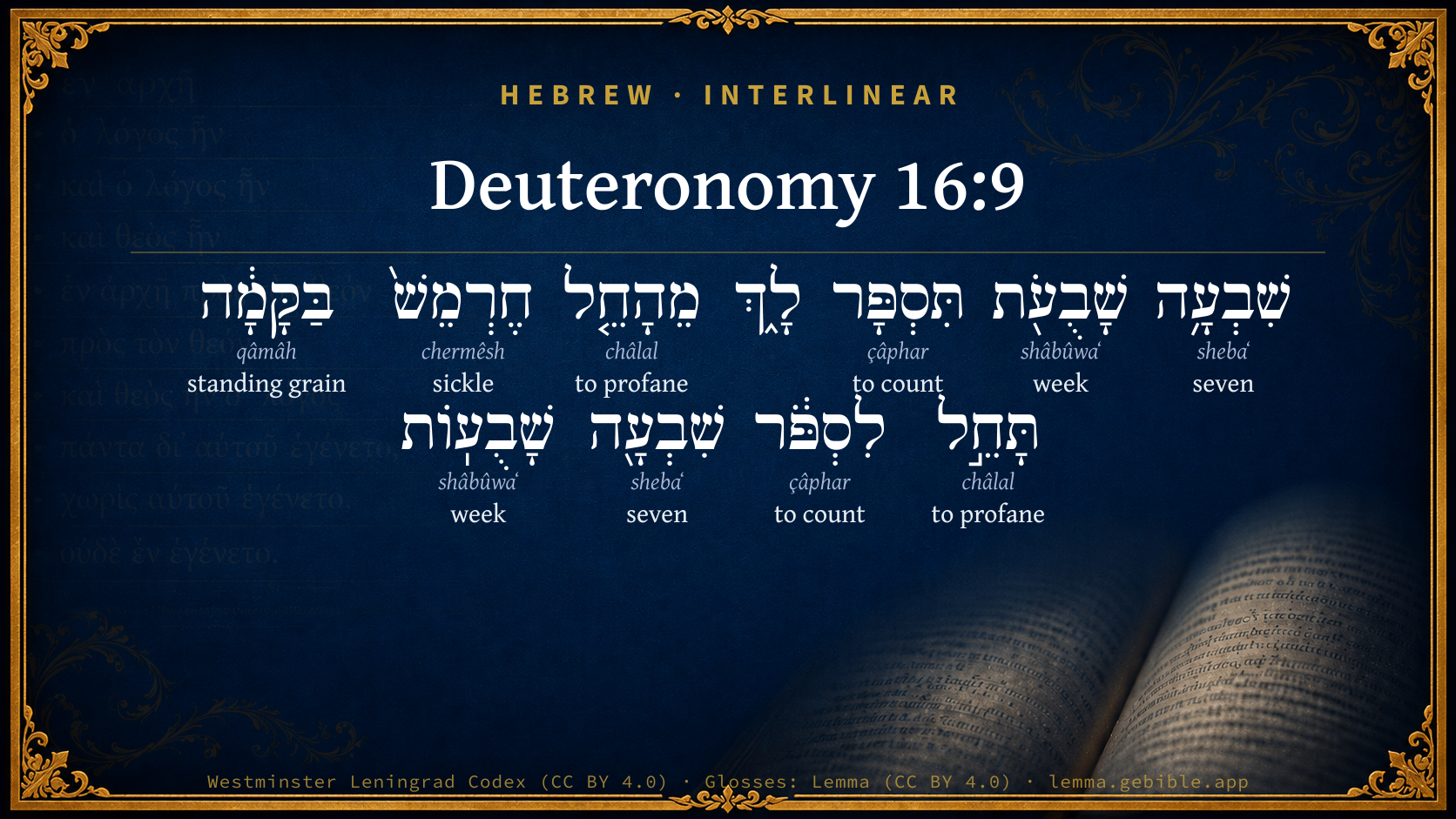
Seven weeks shall you number to you: from the time you begin to put the sickle to the standing grain shall you begin to number seven weeks.
World English Bible · Public Domain
Highlights
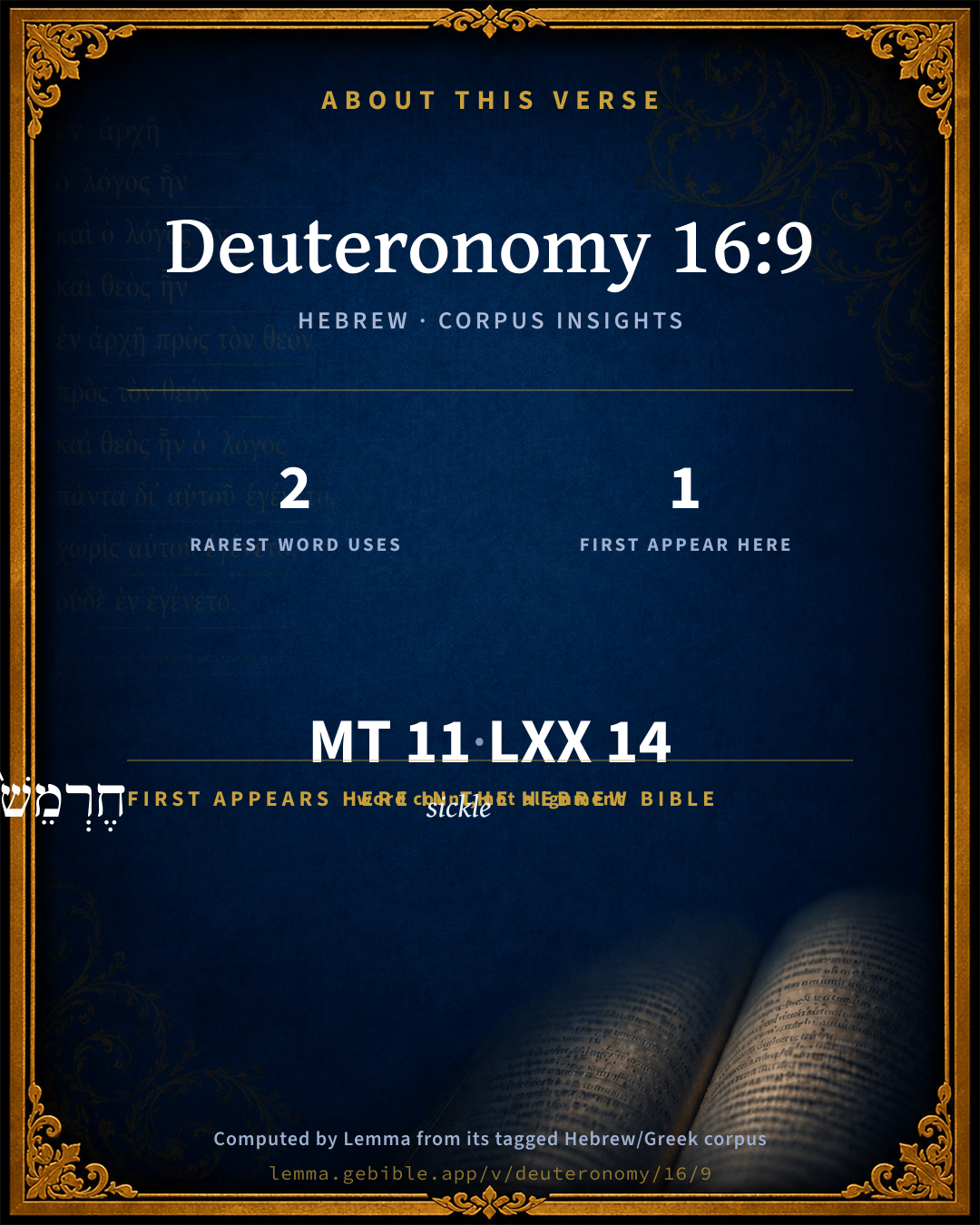
  • 1 first appearance in the Hebrew Bible
Full analysis ↓
Download a study sheet

One document with this verse’s original text, its word-by-word gloss line, the meaning frame, cross-references with their text, attributed commentary, and full source and license credits — printable, and it pastes into notes with its structure intact.

This verse Autodidact and up

Study sheet (.html) Plain text (.txt)

A passage Seminary Student

Up to 50 verses in one chapter. A passage sheet keeps up to 6 commentary sources and 12 cross-references per verse, in the order this page ranks them, and says so on the sheet whenever that leaves anything out. Ask for a single verse and you get the Autodidact verse sheet above.

Everything on this page stays free to read, with no account — the sheet is a download of what is already on screen, not access to it.

Want to remove ads? Support Godless Engineer
Compare translations 3

The same verse in 3 English versions, stacked beneath the original-language interlinear above. Click any original word for its lexicon entry.

Each is an independent rendering of the whole verse — the interlinear is not word-aligned to these translations.

Highlighted words mark where these versions differ — a whole-verse word diff, not a word-by-word alignment.

  • World English Bible Public Domain
    Seven weeks shall you number to you: from the time you begin to put the sickle to the standing grain shall you begin to number seven weeks.
  • King James Version Public Domain
    Seven weeks shalt thou number unto thee: begin to number the seven weeks from such time as thou beginnest to put the sickle to the corn.
  • unfoldingWord Literal Text CC BY-SA 4.0
    You shall count seven weeks for yourself; from the beginning of the sickle on the grain you shall start counting seven weeks.

unfoldingWord Literal Text — © unfoldingWord, licensed CC BY-SA 4.0. Word-aligned USFM3 via Door43 (git.door43.org/unfoldingWord/en_ult).

Versions to compare (up to 4)

3 of 4 selected

Show all 18 translations

Every available English version of this verse, each an independent rendering of the whole verse.

  • World English Bible Public Domain
    Seven weeks shall you number to you: from the time you begin to put the sickle to the standing grain shall you begin to number seven weeks.
  • Berean Standard Bible Public Domain
    You are to count off seven weeks from the time you first put the sickle to the standing grain.
  • Majority Standard Bible Public Domain
    You are to count off seven weeks from the time you first put the sickle to the standing grain.
  • King James Version Public Domain
    Seven weeks shalt thou number unto thee: begin to number the seven weeks from such time as thou beginnest to put the sickle to the corn.
  • American Standard Version (1901) Public Domain
    Seven weeks shalt thou number unto thee: from the time thou beginnest to put the sickle to the standing grain shalt thou begin to number seven weeks.
  • Revised Version (1885) Public Domain
    Seven weeks shalt thou number unto thee: from the time thou beginnest to put the sickle to the standing corn shalt thou begin to number seven weeks.
  • Geneva Bible (1599) Public Domain
    Seuen weekes shalt thou nomber vnto thee, and shalt beginne to nomber ye seuen weekes, when thou beginnest to put the sickel to ye corne:
  • Douay-Rheims (1899) Public Domain
    Thou shalt number unto thee seven weeks from that day, wherein thou didst put the sickle to the corn.
  • Young's Literal Translation Public Domain
    `Seven weeks thou dost number to thee; from the beginning of the sickle among the standing corn thou dost begin to number seven weeks,
  • Literal Standard Version CC BY-SA 4.0
    You number seven weeks for yourself; you begin to number seven weeks from the beginning of the sickle among the standing grain,
  • Unlocked Literal Bible CC BY-SA 4.0
    You will count seven weeks for yourselves; from the time you begin to put the sickle to the standing grain you must start counting seven weeks.
  • unfoldingWord Literal Text CC BY-SA 4.0
    You shall count seven weeks for yourself; from the beginning of the sickle on the grain you shall start counting seven weeks.
  • Darby Bible Public Domain
    Seven weeks shalt thou count: from the beginning of putting the sickle into the corn shalt thou begin to count seven weeks.
  • World Messianic Bible Public Domain
    You shall count for yourselves seven weeks. From the time you begin to put the sickle to the standing grain you shall begin to count seven weeks.
  • Webster's Bible Public Domain
    Seven weeks shalt thou number to thee: begin to number the seven weeks from the time when thou beginnest to put the sickle to the corn.
  • Free Bible Version CC BY-SA 4.0
    Count off seven weeks from when you start the grain harvest.
  • Bible in Basic English Public Domain
    Let seven weeks be numbered from the first day when the grain is cut.
  • JPS Tanakh (1917) Public Domain
    Seven weeks shalt thou number unto thee; from the time the sickle is first put to the standing corn shalt thou begin to number seven weeks.

Literal Standard Version (2020), Covenant Press — licensed CC BY-SA 4.0. Text via the HelloAO Bible API (eBible.org). Unlocked Literal Bible (unfoldingWord) — licensed CC BY-SA 4.0. Text via the HelloAO Bible API (eBible.org). unfoldingWord Literal Text — © unfoldingWord, licensed CC BY-SA 4.0. Word-aligned USFM3 via Door43 (git.door43.org/unfoldingWord/en_ult). Free Bible Version, Dr. Jonathan Gallagher — licensed CC BY-SA 4.0. Text via the HelloAO Bible API (eBible.org).

Word by word

More ways to search: Search by grammar → Find every occurrence → Compare this word →

Practice this passage: Drill this verse → Learn its vocabulary →

חֶרְמֵשׁ֙
chermêsh
H2770
“sickle”
Noun, Common, Masculine, Singular, Absolute
Part of Speech
Noun
Type
Common
Gender
Masculine
Number
Singular
State
Absolute
Full BDB Definition

Origin: from H2763

TWOT: 746

sickle
  1. שִׁבְעָ֥ה shebaʻ H7651 “seven” Adjective, Cardinal number, Masculine, Singular, Absolute
  2. שָׁבֻעֹ֖ת shâbûwaʻ H7620 “weeks” Noun, Common, Masculine, Plural, Absolute
  3. תִּסְפָּר çâphar H5608 “to count” Verb, Qal, Imperfect, 2nd Person, Masculine, Singular
  4. מֵהָחֵ֤ל châlal H2490 “from · to profane” Preposition + Verb, Hiphil, Infinitive Construct
  5. בַּקָּמָ֔ה qâmâh H7054 “in/at the · standing grain” Preposition, Determined + Noun, Common, Feminine, Singular, Absolute
  6. תָּחֵ֣ל châlal H2490 “to profane” Verb, Hiphil, Imperfect, 2nd Person, Masculine, Singular
  7. לִסְפֹּ֔ר çâphar H5608 “to count” Preposition + Verb, Qal, Infinitive Construct
  8. שִׁבְעָ֖ה shebaʻ H7651 “seven” Adjective, Cardinal number, Masculine, Singular, Absolute
  9. שָׁבֻעֽוֹת shâbûwaʻ H7620 “weeks” Noun, Common, Masculine, Plural, Absolute

About this verse

These counts appear in no published source. They are computed here, from the morphology-tagged text and Lemma’s own curated glosses. What Lemma adds →

11
words
6
distinct lemmas
Pentateuch
section

Notable vocabulary

The rarest word here is חֶרְמֵשׁ֙ sickle H2770 — appearing just 2 times in the whole Hebrew Bible.

First appearance in Scripture

This word makes its first canonical appearance in the Hebrew Bible here:

  • חֶרְמֵשׁ֙ sickle H2770

Shared distinctive vocabulary

חֶרְמֵשׁ֙ sickle H2770 occurs in 2 verses of the Hebrew Bible. Also found in:

Grammatical profile

  • 4 verbs
  • 4 nouns
  • 2 adjectives
  • 1 preposition

Verb forms

  • תִּסְפָּר Qal · Imperfect
  • מֵהָחֵ֤ל Hiphil · Infinitive Construct
  • תָּחֵ֣ל Hiphil · Imperfect
  • לִסְפֹּ֔ר Qal · Infinitive Construct

Repetition

Words recur within this verse — often emphatic in Hebrew:

  • שִׁבְעָ֥ה seven H7651 ×2
  • שָׁבֻעֹ֖ת week H7620 ×2
  • תִּסְפָּר to count H5608 ×2
  • מֵהָחֵ֤ל to profane H2490 ×2

Hebrew & Septuagint length

In English translation the verse runs 27 words from the Hebrew and 25 from the Septuagint (LXX English) — closely comparable.

A rough comparison of the two English renderings, which tokenize alike — not a word-level alignment.

Word counts can differ between the Hebrew and the Greek without any difference in meaning — e.g. the Hebrew direct-object marker אֵת has no separate Greek word, and Greek often adds the article ὁ.

In the original languages it is 11 Hebrew tokens and 14 Greek tokens — but the two are counted differently (Hebrew bundles its prefixes and suffixes into one token; the Greek is in lemma form), so that isn’t a like-for-like length.

Cross-references

10

Topical passages linked to Deuteronomy 16:9 in the Treasury of Scripture Knowledge — connected by theme and wording, ordered by reader-vote popularity; previews shown in the World English Bible.

  • Exodus 23:16 And the feast of harvest, the first fruits of your labors, which you sow in the field: and the feast of harvest, at the end of the year, when you gather in your labors out of the field.
  • Exodus 34:22 You shall observe the feast of weeks with the first fruits of wheat harvest, and the feast of harvest at the year's end.
  • Acts 2:1 Now when the day of Pentecost had come, they were all with one accord in one place.
  • Leviticus 23:15–16 "'You shall count from the next day after the Sabbath, from the day that you brought the sheaf of the wave offering; seven Sabbaths shall be completed:
  • Numbers 28:26–30 Also in the day of the first fruits, when you offer a new meal-offering to Yahweh in your [feast of] weeks, you shall have a holy convocation; you shall do no servile work;
  • Deuteronomy 16:10 You shall keep the feast of weeks to Yahweh your God with a tribute of a freewill-offering of your hand, which you shall give, according as Yahweh your God blesses you:
  • Deuteronomy 16:16 Three times in a year shall all your males appear before Yahweh your God in the place which he shall choose: in the feast of unleavened bread, and in the feast of weeks, and in the feast of tents; and they shall not appear before Yahweh empty:
  • 2 Chronicles 8:13 even as the duty of every day required, offering according to the commandment of Moses, on the Sabbaths, and on the new moons, and on the set feasts, three times in the year, [even] in the feast of unleavened bread, and in the feast of weeks, and in the feast of tents.
  • 1 Corinthians 16:8 But I will stay at Ephesus until Pentecost,
  • Hebrews 2:1 Therefore we ought to pay greater attention to the things that were heard, lest perhaps we drift away.

Cross-references courtesy of OpenBible.info (CC BY 4.0).

Hebrew and Greek witnesses Masoretic Hebrew ↔ Greek Septuagint

The same verse in the two great witnesses to the Old Testament, shown verse-for-verse.

These are two independent witnesses, not word-aligned to each other, and the Septuagint is shown in lemma (dictionary) form.

Hebrew Deuteronomy 16:9 Masoretic · Westminster Leningrad Codex

שִׁבְעָ֥ה שָׁבֻעֹ֖ת תִּסְפָּר לָ֑ךְ מֵהָחֵ֤ל חֶרְמֵשׁ֙ בַּקָּמָ֔ה תָּחֵ֣ל לִסְפֹּ֔ר שִׁבְעָ֖ה שָׁבֻעֽוֹת

Seven weeks shall you number to you: from the time you begin to put the sickle to the standing grain shall you begin to number seven weeks.

World English Bible · Public Domain

Greek LXX Deuteronomy 16:9 Septuagint · lemma form

ἑπτά ἑβδομάς ὁλόκληρος ἐκἀριθμέω σεαυτοῦ ἄρχω σύ δρέπανον ἐπί ἀμητός ἄρχω ἐκἀριθμέω ἑπτά ἑβδομάς

Seven weeks shall you number to yourself; when you have begun to put the sickle to the corn, you shall begin to number seven weeks.

LXX2012 (modern English Septuagint) · Public Domain

Hebrew: Westminster Leningrad Codex (CC BY 4.0). Greek: Septuagint (public domain); English from LXX2012 (modern English Septuagint) (Public Domain). How the Septuagint differs from the Hebrew →

Targum (Aramaic paraphrase)

2

The Targum is the ancient Jewish Aramaic paraphrase of the Hebrew Scriptures — an interpretive translation, not the Hebrew text itself. Onkelos (literal) and Pseudo-Jonathan (expansive) render the Torah, and Jonathan the Prophets. Coverage is partial: where no permissively-licensed English translation exists for a verse, only the Aramaic is shown. This is verse-level text, not a word-by-word alignment to the Hebrew.

  1. Targum Onkelos Torah (Genesis–Deuteronomy)
    שִׁבְעָא שָׁבוּעִין תִּמְנֵי לָךְ מִדְשַׁרְיוּת מַגְלָא בַּחֲצַד עוּמְרָא דַאֲרָמוּתָא תִּשְׁרֵי לְמִמְנֵּי שִׁבְעָא שָׁבוּעִין

    (no public-domain English translation for this verse)

    Targum Onkelos — Aramaic: “Onkelos Genesis” (public domain); “Onkelos Exodus” (public domain); “Onkelos Leviticus” (public domain); “Onkelos Numbers” (public domain); “Onkelos Deuteronomy” (public domain). English: “Sefaria Community Translation” (CC0 1.0 (public-domain dedication)); “J.W. Etheridge. The Targums of Onkelos and Jonathan Ben Uzziel on the Pentateuch. London: Longmans, Green, 1862” (public domain). Text via Sefaria.

  2. Targum Pseudo-Jonathan Torah (Genesis–Deuteronomy)
    שׁוּבְעָא שְׁבוּעִין תִּימְנוּן לְכוֹן מִזְמַן דְּתִשְׁרוּן לְמִשְׁלַח מַגְלָא לְמַחֲצוֹד בְּחַקְלָא בָּתַר חֲצַד עוֹמְרָא תֵּישְׁרוּן לְמִמְנֵי שׁוּבְעָא שְׁבוּעִין

    Seven weeks number to you; from the time when you begin to put the sickle to the harvest of the field after the reaping of the omer you shall begin to number the seven weeks.

    Targum Pseudo-Jonathan — Aramaic: “Targum Jonathan on Genesis” (public domain); “Targum Jonathan on Exodus” (public domain); “Targum Jonathan on Leviticus” (public domain); “Targum Jonathan on Numbers” (public domain); “Targum Jonathan on Deuteronomy” (public domain). English: “The Targum of Jonathan ben Uzziel, trans. J. W. Etheridge, London, 1862” (public domain). Text via Sefaria.

Commentary

Notes on Deuteronomy 16:9 from classic Christian and Jewish commentators (each source and its license shown beneath its notes). The classic Christian expositions comment on the surrounding passage and are grouped to its opening verse, so a note may address several verses; the Jewish commentaries on the Tanakh (Rashi and others) are per-verse, so they appear only where the commentator wrote on this verse.

Lemma curates 59 commentaries, every one of them public domain or Creative Commons licensed, each selected and text-cleaned for this edition rather than reprinted as found. About our sources →

Ellicott's Commentary for English Readers

Deu_16:9-12. THE FEAST OF WEEKS, OR PENTECOST.

See also Exo_23:16; Exo_34:18-23; Lev_23:15-22; Num_28:26-31. The feast itself is ordained in Exodus; the time is given in Leviticus; and the sacrifices in Numbers.

(9) From such time as thou beginnest to put the sickle to the corn.—The word for sickle only occurs here and in Deu_23:25. In Leviticus the weeks are ordered to be reckoned from the offering of the wave sheaf on the sixteenth day of the first month, two days after the Passover. This sheaf was of barley, the first ripe corn. A different view is sometimes taken of the word “Sabbath “in Lev_23:11; but the view given here is correct according to the Talmud.

(10) A tribute.—This word (missah) occurs nowhere else in the Bible. The marginal rendering, “sufficiency,” is its Aramaic or Chaldæan sense. The idea seems to be “a proportionate offering “—i.e., a free will offering, proportioned to a man’s means and prosperity. In Exo_34:20; Exo_23:15, we read, “None shall appear before me empty.” The command is made general for all the three feasts in Deu_16:16-17 further on.

(11) Thou shalt rejoice before the Lord thy God.—This aspect of the feast of weeks is specially insisted upon in Deuteronomy. Its relation to the poor appears also in the command connected with this feast in Lev_23:22, to leave the corners of the fields un-reaped for them.

A Bible Commentary for English Readers, edited by Charles John Ellicott (1878–1897) — public domain. Text from a community e-Sword module.

The Cambridge Bible for Schools and Colleges

gen. ed. J. J. S. Perowne

9. Seven weeks shalt thou number unto thee] Hence the name of the Feast, Weeks, Shabu‘ôth, Deu_16:10; Deu_16:16, also in J, Exo_34:22. H, Lev_23:16, prescribes fifty days from the sabbath after the presentation before the Altar of the first sheaf of the harvest; hence the Hellenistic name Pentecost, ‘the fiftieth’ (day) or the day after the conclusion of the seven weeks. The name given by E, Exo_23:16, Harvest, implies that the harvest was by that time concluded. In the warmest parts of Palestine barley ripens in April, wheat later; but in colder districts the harvest is not finished for at least seven weeks more. The present writer has seen wheat reaped in Ḥauran as late as the second half of June.

from the time thou beginnest, etc.] Lit. from the start of the sickle (only here and Deu_23:25) on the standing corn, a variable date; so H, Lev_23:15 f., Lev_23:50 days from the sabbath after the presentation of the first sheaf. It is significant that while D’s date starts from Maṣṣoth, he says nothing to date Weeks from the Passover: another indication that when the original code of D was drawn up the Passover and Maṣṣoth were not yet amalgamated. See introd. to Deu_16:1-8.

9–12. The Feast of Weeks

To be joyfully celebrated after seven weeks from the beginning of harvest, with free-will offering, by each Israelite, along with his household and the local Levites and other poor at the One Altar (Deu_16:9-11). Whether Deu_16:12 is original is doubtful; see below. For corresponding laws in other codes see introd. to Deu_16:1-17. This is the only feast not associated in the O. T. with a memorable event in Israel’s history. Later Judaism assigned to it the giving of the Law on Sinai.

The Cambridge Bible for Schools and Colleges (gen. ed. J. J. S. Perowne; Cambridge University Press, 1878–1918) — public domain. Text from a community e-Sword module.

The Biblical Illustrator

Joseph S. Exell

Deu_16:9-12

Keep the feast of weeks.

The Feast of Pentecost

(a Harvest Thanksgiving sermon):--

I. The sacred character of the harvest. Indicated by time appointed for it--fiftieth day after Passover. As God hallowed the seventh day, so He hallowed the harvest fields of the world.

II. The great trouble God took to impress His people with the significance and meaning of common things. We walk along streets of gold, set with jewels, as though they were granite cubes. In the hand of Him who saw the kingdom of God everywhere and in everything, a grain of corn contained in its suggestiveness the deepest mysteries of the kingdom.

III. This feast was a providential mirror in which to see again all the way in which the Lord their God had led them. Happy, thrice happy, is the man who, in the land of plenty, has a wilderness history on which to look back. There is nothing more sublime to the mariner in the haven of rest than the conflicts with the tempests in mid-ocean through which he passed.

IV. This feast was a new bond of brotherhood forged in the fires of the ever-new and never-ceasing love of God. They were to call the Levite, the stranger, the fatherless, and the widow. Plenty in some natures petrifies, but this is not its legitimate effect. It should enlarge the heart, and broaden and deepen the sympathies of a man.

V. This feast was to be a time of great moral and spiritual rectification on the part of the people. Repentance. Thanksgiving. (H. Simon, Ph. D.)

Harvest home a national festival

Harvest to the Jews was an event of great and general interest. It was the occasion of one of their grand national festivals. This feast was called by different names--the Feast of Weeks, the Feast of Harvest, and the Feast of First-fruits. From commencement to close, their harvest festivities included seven weeks.

I. The harvest home was a season for national gratitude. What they offered conferred no favour on God, it was His own; but it expressed the sense of their obligation and the depth of their gratitude. Three things are necessary to the very existence of gratitude towards the giver.

1. That the gift should be felt to be valuable.

2. A belief that the favour is benevolently bestowed.

3. A consciousness that the favour is undeserved.

II. The harvest home is a season for national rejoicing. Where there is gratitude, there is joy, will be joy; gratitude is praise, and praise is heaven. The revelation of the Creator in the harvest field may well make human hearts exult. The God of the harvest there appears, mercifully considerate of the wants of His creatures; as a loving Father, with a bountiful hand, furnishing the table with abundant supplies for His children. There He appears punctual to the fulfilment of His promise. There He appears rewarding human labour.

III. The harvest home is a season for national philanthropy (see Deu_24:19-21).

1. Where God gives liberally, He demands liberality.

2. The liberality demanded is to be shown to the poor. God has planted the poor amongst all peoples, in order that the benevolence of the rich may have scope for development. (Homilist.)

Rejoice before the Lord thy God.

Thanksgiving Day

I. We may be thankful for this day of thanksgiving, on account of its happy religious influence. It is a day which, in all its appropriate exercises and enjoyments, presents to us our life as a blessing, and our God as a Benefactor; the seasons as a circle of elemental adaptations to our comfort, and the Regulator of the seasons as the Almighty Being who takes care for our varied good; the course of our rolling days, as a series of lessons and opportunities, and the Everlasting and Uncreated One as the Friend who crowns our days with His loving kindness. Thus a great deal is done every year, by a common and hearty expression of thankfulness, to break up, or at least to modify the alliance brought about by several causes in many minds, between religion and great strictness and gloominess. We find that it is a good thing to give thanks unto the Lord; yea, a joyful and a pleasant thing it is to be thankful; for when we dwell on the causes of thankfulness, our gratitude must needs flow naturally and spontaneously out of our bosoms, and go to swell the general stream of praise and gladness which spreads over the land. And we find that it is not at all inconsistent with thankfulness to God for the bounties of His providence, that we should enjoy those bounties freely and honestly and smilingly.

II. We have reason to rejoice in our feast, on account of its happy domestic influence. The day is peculiarly a domestic day; a day for the reunion of families. The houses of the land are glad on this day.

III. Our festival is to be honoured, on account of its happy political influence. If it exerts a happy influence on our religions sentiments and on our domestic relations, it cannot but act with a benign power on those relations which hold us all together in one community. A genial nationality is fostered by that mingling together of prayers, and common interests, and pleasant hospitalities, which occurs on this day. And so far as our nationality is brought about in this manner, there is nothing repulsive or exclusive in it. (F. W. P. Greenwood, D. D.)

The Biblical Illustrator, edited by Joseph S. Exell (c. 1880s–1900s) — public domain. Text from a community e-Sword module.

Joseph Benson's Commentary

Deu 16:9-10. Thou beginnest to put the sickle to the corn — To reap the first-fruits of the barley-harvest, the wave sheaf in particular, which was offered to the Lord on the sixteenth day of that month. Thou shalt keep the feast of weeks — So called, because it was seven weeks after the bringing the sheaf at the passover, that is, fifty days, whence it was termed pentecost: see on Lev 23:16. It was also called the feast of first- fruits, Num 28:26. With a tribute of free-will-offering — Over and besides the sacrifice for the day, and the two loaves and sacrifices with them, Num 28:27-31; Lev 23:17-20. God here directs that they should make some voluntary oblation.

Joseph Benson's Commentary on the Old and New Testaments (1811–1818) — public domain. Text from a community e-Sword module.

Geneva Bible (1599)

Geneva Bible translators

Beginning at the next morning after the Passover, Lev. 23:15; Exod. 13:4.

Geneva Bible (1599) marginal notes — public domain. Text via Bolls.life.

Jamieson, Fausset & Brown

Robert Jamieson, A. R. Fausset & David Brown

Seven weeks shalt thou number--The feast of weeks, or a WEEK OF WEEKS: the feast of pentecost (see on Lev 23:10; also see Exo 34:22; Act 2:1). As on the second day of the passover a sheaf of new barley, reaped on purpose, was offered, so on the second day of pentecost a sheaf of new wheat was presented as first-fruits (Exo 23:16; Num 28:26), a freewill, spontaneous tribute of gratitude to God for His temporal bounties. This feast was instituted in memory of the giving of the law, that spiritual food by which man's soul is nourished (Deu 8:3).

Jamieson, Fausset & Brown — Commentary Critical and Explanatory on the Whole Bible (1871) — public domain (CC PDM 1.0). Text via the HelloAO Bible API.

John Gill's Exposition

Seven weeks then shalt thou number unto thee,.... And then another feast was to take place, called from hence the feast of weeks, and sometimes Pentecost, from its being the fiftieth day:

begin to number the seven weeks from such time as thou beginnest to put the sickle to the corn; for the sheaf of the wave offering, as the first fruits of barley harvest, which was done on the morrow after the sabbath in the passover week, and from thence seven weeks or fifty days were reckoned, and the fiftieth day was the feast here ordered to be kept; so the Targum of Jonathan,"after the reaping of the sheaf ye shall begin to number seven weeks;''see Lev 23:15.

John Gill's Exposition of the Whole Bible (1746–1763) — public domain (CC PDM 1.0). Text via the HelloAO Bible API.

Albert Barnes' Notes on the Bible

Feast of Weeks; and Deu 16:13-17, Feast of Tabernacles. Nothing is here added to the rules given in Leviticus and Numbers except the clauses so often recurring in Deuteronomy and so characteristic of it, which restrict the public celebration of the festivals to the sanctuary, and enjoin that the enjoyments of them should be extended to the Levites, widows, orphans, etc.

Albert Barnes' Notes on the Bible (1834–1885) — public domain. Text from a community e-Sword/MySword module.

Haydock's Catholic Bible Commentary

Corn: that is, from the 16th of Nisan, (Menochius) the second day of the paschal solemnity, on which new barley was presented before the Lord, as new wheat was on the second day of Pentecost, Leviticus xxiii. 10.

George Leo Haydock (1774–1849), Haydock's Catholic Family Bible and Commentary, 1859 edition — public domain. Excludes Psalms (Douay-Rheims chapter numbering differs from Protestant) and Deuterocanonical books (Catholic canon only).

Matthew Poole's English Annotations

Seven weeks; of which see on Exo 34:22; Lev 23:10,15.

To put the sickle to the corn, i.e. to reap thy corn, thy barley, when the first-fruits were offered, Lev 23:10,11.

Matthew Poole's English Annotations on the Holy Bible (1683–1685) — public domain. Text from a community e-Sword/MySword module.

Whedon's Commentary on the Bible

Daniel D. Whedon

THE FEAST OF WEEKS, OR PENTECOST.

No additional legislation is given in reference to this festival besides what is in Leviticus and Numbers, except that its public celebration was to be at the central sanctuary, and its festivities were to be participated in by the servants, the Levites, the foreigners, the widows, and the fatherless.

9. Seven weeks shalt thou number — It was called the feast of weeks from the fact that a week of weeks intervened between the passover and this festival. It was called Pentecost from its occurring on the fiftieth day from the second day of the passover. It was eminently a feast of gladness over the firstfruits of the principal harvest. It differed from the other two great national festivals in being confined to a single day. It came to be viewed as a commemoration of the giving of the law. There is, however, no allusion to this in connexion with the rules for its observance, either in the Old Testament or in Josephus.

Daniel D. Whedon (gen. ed.), Commentary on the Old and New Testaments (1874–1909) — public domain. Text from a community e-Sword module.

The Pulpit Commentary

Vers. 9-12. The Feast of Weeks. (cf. Exo_23:16)

From such time as thou beginnest to put the sickle to the corn; i.e. from the commencement of the corn harvest. The seven weeks were to be counted from this terminus; and as the corn harvest began by the presentation of the sheaf of the firstfruits on the second day of the Passover, this regulation as to time coincides with that in Lev_23:15.

Vers. 9-12. The Feast of Weeks, or of Harvest.

(For the varied names given to this Feast of Weeks, see Kurtz, Sacrificial Worship of the Old Testament," pp. 3 7 6, et seq. For an interesting statement as to the value to Israel of these national gatherings, see Wine"s "Commentaries on the Laws of Moses," bk. 2: De

1) This Feast of Weeks was not commemorative in the same sense as that of the Passover; it was connected, not with a great national epoch, but with the seasons of the year and the times of harvest. The method in which it was to be observed is stated in Leo. 23. 10, et seq. We find there, and in the various Scripture references to this festival, the following principles indicated.

1. That the Hebrews were to regard the produce of the soil as given to them by the bounty of God.

2. That they were to honor Jehovah by a public thanksgiving for his goodness.

3. That they were to yield the firstfruits to him.

4. That they were to rejoice and be glad before him, for what he was and for what he gave.

5. That they were to recognize the equality before God of master and servant. National festivals were holidays for the laborer, and times when good will and kindliness towards the "stranger, the fatherless, and widow" were to be specially manifested.

6. They were thus to recognize their national unity by showing their joint thankfulness for a common mercy. These festivals would strengthen Israel"s feeling of kinship, and these united gatherings before the Lord their God would proclaim, as often as they were held, their separation unto him.

7. Though this was a harvest festival, and as such chiefly expressive of thankfulness for the bounty of God as seen in nature, yet it was not to be observed without the sin offering, the burnt offering, and the meat offering. (Lev_23:18-20) Other offerings were to be presented along with the offering for sin. Natural blessings are given to sinful men only under a dispensation of mercy which comes through a bleeding sacrifice.

Now all these forms have passed away. But the principles which underlay them are of eternal obligation. We trust we can see, by means of these signs, the everlasting truths signified by them. In each of the particulars named above some permanent principle is enclosed.

I THE FRUITS OF THE EARTH ARE TO BE RECEIVED BY US AS GRANTED TO US BY THE BOUNTY OF A GRACIOUS GOD. So commonplace, or rather so well-known, a truth is this, that it is not easy for us to picture to ourselves a time when a nation needed to have it engraved on its heart and conscience by such means as these divinely appointed festivals. Still, we cannot be unconscious of forces around us being at work which, if we succumbed to them, would lead us to think of the ordinary products of the harvest-field as coming simply in due course of law, and to regard the Supreme Being as so remotely concerned in earth"s fruitfulness, that it would be but a slight step to take to think of him as not concerned therein at all! But in no part of the sacred records is any such thinking warranted. Reason itself would lead us to suppose that, if one order of creation is higher than another, the lower was made to serve it; and consequently, that if man be the highest of all, that the rest is ordered to serve him. The Psalmist expressed this when he sang, "Thou hast put all things under his feet." Our Lord Jesus Christ points us to the most common blessings, even to the sun and the rain, in proof of the good will of a heavenly Father. And this is at once the philosophy and the faith of a Christian. It is the conclusion of sober sense; it is the dictum of devoutness, piety, and love. "Whoso is wise and will observe these things, even they shall understand the loving-kindness of the Lord.

II THE FRUITS OF THE EARTH SHOULD THEREFORE BE RECEIVED WITH THANKSGIVING. The doctrine that God is the benevolent Author of all our mercies is not to be a barren and unfruitful dogma. It is meant to call forth thankfulness. It is said of the heathen, "neither were they thankful." They did not know enough of God to understand what true thankfulness meant. But we do. He is revealed in Scripture as having such watchful concern for our good, that we may well feel an exuberance of thankful delight that our daily joys come to us from a fountain of love. And it behooves us to pay our God the homage of grateful hearts.

III THIS THANKFULNESS SHOULD BE EXPRESSED PRACTICALLY. The truly loyal heart will need no reminder of this. Cela va sans dire. Jacob needed no precept to lead him to say, "Of all that thou givest me, I wilt surely give the tenth unto thee." Nor, if our hearts are as sensitive as they should be to our own unworthiness and to God"s loving-kindness, shall we fail to "honor the Lord with our substance, and with the firstfruits of all our increase.

IV OUR GRATITUDE TO GOD SHOULD TAKE THE FORM OF UNITED WORSHIP AND SONG. We may set apart special seasons for harvest festivals, or no, as circumstances dictate; but certainly the Divine provision for the temporal wants of man should find gladsome acknowledgment in the social worship of a thankful people.

V A UNITED ACKNOWLEDGMENT OF GOD"S KINDNESS TO US ALL SHOULD HAVE THE EFFECT OF PROMOTING KINDLINESS AMONG EACH OTHER. If God makes us glad with his loving goodness, we should make others glad with our radiant kindness. (1Jn_3:17 1Jn_4:11) The love streaming from heaven is revealed for the purpose of creating benevolence upon earth. The blessings that come to us, unworthy as we are, from the pure benevolence of God, should make us eager, as much as in us is, to emulate the goodness of heaven!

VI For, lastly, NOT EVEN IN THANKFULNESS TO GOD FOR COMMON MERCIES MAY WE FORGET THEIR RELATION TO THAT DIVINE REDEMPTIVE PLAN WROUGHT OUT BY THE GREAT SON OF GOD. Israel"s rejoicing was to be sanctified by a sin offering; by which we see

(1) that it is only because of God"s mighty redeeming work that even the natural blessings of this earthly life are ensured to us. And

(2) that it is only through the sin offering that our thank offerings are accepted before God. All our thanksgiving services must take the form and hue thrown on them by the fact that we are guilty men, living on the mercy of a forgiving and redeeming God. God expects the acknowledgment of this on our part. It would be unrighteous of him not to ask it, and unjust and ungrateful of us not to give it. Sin is in the world; and our sin has helped to make the world what it is, as to the infusion of bitterness into it; it is only through the Divine redeeming energy of love which through and by our Lord Jesus Christ is being put forth, that the world still yields its treasures to the rebellious and ungrateful sons of men. So that with the praises for mercies so undeserved there should be a confession of sin, a turning anew unto the Lord, and a reconsecration of heart and life to him. For when we think how soon a slightly adverse action of God towards us might crush us; yea, that even the bare withholding of mercy would consume us; and when we add to that the thought of our innumerable provocations of One who cannot bear that which is evil, surely we must needs confess that there are no greater wonders than the patience, the love, the bounty of God!

Vers. 9-13. Pentecost.

I A SACRED RECKONING. Seven weeks shall thou number," etc. (ver. 9). A week of weeks, seven times seven, hence the name, "Feast of Weeks "(ver. 10). The count began with the offering of the sheaf of firstfruits on Nisan 16, the second day of the Feast of Unleavened Bread. (Lev_23:11) Till that sheaf was offered, no Israelite was permitted to eat of the new corn (ver. 14). With the arrival of the fiftieth day, inclusive of the second of Unleavened Bread, the labors of the harvest were presumed to be ended, and this festival ensued, at which baked loaves were presented to Jehovah, (Lev_23:17) in token of consecration to him of the fruits of the harvest, and of dedication of the life which bread sustained. There is, intended or unintended, a beautiful symbolism in this sacred count, the divinely allotted period for the labors of the harvest, its days reckoned by heaven"s calendar, the end, an "appearing before God" in the sanctuary. The harvest began with consecration (in the Passover sheaf), it ended with it (in the presentation of the wave loaves). So has the Christian his allotted work-time in the world, a sacred cycle of weeks, rounded off in God"s wisdom for the work he means to be accomplished; (Joh_9:4) work in the Christian harvest-field, a work beginning in consecration, carried on in the spirit of consecration, and the termination of which is "entrance into the joy of the Lord.

II A HARVEST THANKSGIVING. This was distinctly the idea of the Pentecostal festival. It was characterized:

1. By a devout recognition of the Divine bounty in the fruits of the earth.

2. By a voluntary dedication to God of part of what he had given. There was the public ceremony of the two wave loaves. But the Israelite was required in addition to keep the feast with "a tribute of a free-will offering of his hand" (ver. 10). The offering was to be voluntary, yet not without rule, but "according as the Lord thy God hath blessed thee.

3. By a willing sharing of God"s bounty with the needy (ver. 11). The stranger, the fatherless, the widow, were, as usual, not to be neglected. The remembrance of former bondage in Egypt was to furnish the "touch of nature" which would make this duty easy (ver. 12).

Note:

(1) Our gifts to God are worthless, save as they are the expression of a willing mind. (2Co_8:7-16 2Co_9:6-14)

(2) Our gifts to God ought to be proportionate to our prosperity. (1Co_16:2)

(3) God"s goodness to us (in harvests, in trade, in business generally) ought to be acknowledged by liberal gifts for his service.

(4) God"s goodness to us (in deliverances, etc.) should open our hearts in sympathy for others.

III A GOSPEL TYPE. The figure of the firstfruits finds an abundance of applications in the New Testament. It is employed of the Jews, (Rom_11:16) sanctified in their covenant heads; of Christ, the "Firstfruits" of them that sleep; (1Co_15:20-23) of first converts in a particular district; (1Co_16:15) of believers generally, as "a kind of firstfruits" of the redeemed creation; (Jam_1:18) of the 144, 000 of the Apocalypse, (Rev_14:4) possibly "all the Church of Christ at any time on the earth; a limited company at any one time, capable of being numbered". (Rev_7:1-9) A more direct relation must be traced between the presentation of the firstfruits at Pentecost and the events consequent upon the Pentecostal effusion of the Spirit (Acts it.). It is surely not to be ascribed to accident that, as our Lord died on the Friday of the Passover probably on the 14th of Nisan so the disciples were kept waiting for the promised effusion of the Spirit till "the day of Pentecost was fully come;" and that on this day the great ingathering of three thousand took place, embracing representatives from "every nation under heaven a truly glorious offering of "firstfruits." May we pursue the coincidence further, and see in Christ, the solitary sheaf, raised from the dead on the same day that the first-cut sheaf was presented in the sanctuary (Nisan 16), the firstfruits of the harvest in prospect; while in the Church constituted and consecrated at Pentecost, the day of the offering of the wave loaves, we have the firstfruits of the harvest as realized. The wave loaves correspond in significance to the meat offering, and still more nearly to the showbread. Bread, as the staff of life, the nourishing principle, stands for the presentation to God of the life so nourished, involving the recognition of him as the Nourisher of it. In the possession of the believing heart by the Spirit of God, as the indwelling and abiding principle of spiritual life, we have the full realization of this thought, the fulfillment of the types of meat offering. The passage, Jam_1:18, suggests the deeper idea that the Church constituted at Pentecost is itself only a kind of firstfruits of redemption. It is so in relation:

1. To the latter-day effusion of the Spirit. (Act_2:17-20)

2. To creation as a whole. (Rom_8:19-24)

Other two points may be noted:

1. If our dates be correct, Pentecost, like the Resurrection, fell on the first day of the week the Spirit was given on the Lord"s day.

2. As Pentecost was held by the Jews in commemoration of the giving of the Law, so God signalized it as the day of the giving of the Spirit, thus superseding the old dispensation by the new. J.O.

Vers. 9-12. Pentecost, the Feast of Firstfruits.

Fifty days after the Passover, or a week of weeks, came the second great national festival, when offerings were presented unto God of the firstfruits of the harvest, and a people already blessed recorded their thankfulness. It was also made a celebration of the giving of the Law from Sinai, which took place, according to calculation, exactly fifty days after the Passover. In consequence of this twofold reference to the harvest and to the giving of the Law, this Pentecostal festival acquired more popularity than was to be expected. In fact, from Acts 2., it seems to have drawn Jews and proselytes from all lands. These two references suggest a moral and a typical lesson respectively from the feast.

I IT WAS THE EXPRESSION OF HARVEST THANKSGIVING. Here we have its moral meaning. It was an acknowledgment that God is the Author of the harvest, and should have the firstfruits. We never shall prosper unless we are grateful to the bountiful Giver. And the joy of harvest will be all the deeper when it is entertained before God. In harvest homes there should be the religious element continually. If God be forgotten, it is sheer and base ingratitude.

II IT WAS TYPICAL OF THE PENTECOST OF THE CHRISTIAN CHURCH. The Jews celebrated on this festival the giving of the Law, and the blessings attending it. An interesting parallel may be traced between the Pentecost at Sinai and the Pentecost at Jerusalem.

1. The Jews celebrated the giving of the Law, while we celebrate the proclamation at Pentecost of the gospel. We have here a parallel and also a contrast. The gospel is the Law magnified and delivered as love.

2. The Jews received the Law as the rule of life after their deliverance through the Paschal sacrifice, as we receive the message of love on the foundation of Christ our Passover sacrificed fifty days before.

3. There were wonderful works attending both the Pentecosts: the fearful thunderings and lightnings at Sinai, and the rushing mighty wind and fire in the upper room at Jerusalem; the sound of the trumpet at Sinai, the sound of the gospel in many languages at Jerusalem.

4. There were important effects following both Pentecosts: thus the fear of the Israelites at Sinai, and the conviction of sin at Jerusalem; the separation and ceremonial at Sinai, Moses being constituted mediator, and the fellowship resulting at Jerusalem, when the three thousand were added unto the Church.

III SYSTEMATIC BENEFICENCE WAS FOSTERED BY THE FESTIVAL. In giving to God "according as the Lord thy God hath blessed thee," servants, Levites, strangers, and the widow and fatherless are sure to be considered. This was the case too after Pentecost. The Christian commune was tried, which was a mighty though unsuccessful effort of beneficence. This law of beneficence must be obeyed by all Christian men. R.M.E.

Vers. 9-17. The Feasts of Weeks and of Tabernacles.

For the moral improvement of the Hebrews, it was desirable to keep alive among them the recollection of their early history. Prior to the invention of printing, and when written records would be scarce, memory and affection and conscience were impressed by the annual festivals. The Passover commemorated the national birth; the Feast of Tabernacles commemorated the tent life of the desert. The joys of harvest and of vintage were things unknown in the wilderness.

I MATERIAL BLESSINGS AFFORD PREGNANT REASONS FOR RELIGIOUS JOY, A frequent effect upon the mind of some large influx of wealth is to produce a sense of independence and self-sufficiency. The very event which ought, most of all, to lead men"s thoughts up to God, leads to self-gratulation and self-trust. Now present need is met. We have stores of abundance. We can say to ourselves, "Soul, thou hast much goods laid up for many years." Therefore we must counteract this tendency. In very kindness to men"s souls, God ordained this festival. He would have us to look from the gift to the Giver. It is his will that we should rejoice abundantly, but that our joy should be religious joy a joy consecrated at the temple gate.

II THE FESTIVE SEASONS ARE FIXED ACCORDING TO A RELIGIOUS MEASUREMENT. (Ver. 9.) The year is a measurement of time fixed by a natural cycle. So also is the month, so also the day. But there is nothing in nature that marks the commencement and the close of the week. This is a measurement specially ordained of God. The visible universe is not the whole of existence. Another voice breaks upon the ear, softer than the music of nature, and more full of authority than the voice of Caesar a voice which makes a new boundary in time, and bids us to count our days by sevens.

III RECEIVING SHOULD PROMPT US TO A PROPORTIONATE GIVING. (Ver. 10.) The gift to be brought to the temple is not specified. It might be a gift of corn, or of fruit, or of wine, or of money. The form of the gift was left to the option of the husbandman; but some tribute was required, and the amount must be proportionate to the abundance of his crops. If plain and imperative law could make the Jews generous-hearted, God did his utmost to cultivate in them this excellence. Avarice was scouted by Divine Law.

IV RELIGIOUS JOY SHOULD BE DIFFUSIVE. This giving to God was to be an act of gladness. It was not allowed to be with grudging or with gloom (ver. 11). God had no personal need for these material presents. They were expended at once in new blessing and joy. Not only was the household to share in the festive gladness, in the banquet and the song; but the servant, the stranger, the poor Levite, the widow, and the orphan also. God"s copious goodness in the harvest was designed to enlarge all narrow affections, and to thaw, in streams of kindness, all frozen sympathies. At such a season, they were reminded that they were not proprietors of anything, but put in offices of trust as the stewards of God.

V A SENSE OF OBLIGATION SHOULD INSPIRE OBEDIENCE. (Ver. 12.) The hour of prosperity is the hour of reflection. By the law of associated ideas, the contrast is suggested. The mind, free from the pressure of care, retraces the past. We think of the "rock whence we were hewn, the hole of the pit whence we were digged." The recollection of our lowly origin the dust of the ground ought to affect us tenderly; and our sense of devout obligation should stimulate new and larger obedience. If I owe so much to God, what can I otherwise do than keep his commandments with mind and heart and soul? Complete obedience is a dictate of earliest intelligence. D.

The Pulpit Commentary (1880–1919), ed. H.D.M. Spence-Jones & Joseph S. Exell — public domain. Text from a community e-Sword module.

John Wesley's Explanatory Notes

To put the sickle - That is, to reap thy corn, thy barley, when the first-fruits were offered.

John Wesley, Explanatory Notes Upon the Whole Bible (1754–1765) — public domain. Text via the GEBible commentary corpus.

Kretzmann's Popular Commentary

Paul E. Kretzmann

Of Pentecost

v. 9. Seven weeks shalt thou number unto thee, namely, from the sixteenth of Abib, or Nisan. Lev 23:15; begin to number the seven weeks from such time as thou beginnest to put the sickle to the corn, which was done on the sixteenth of Nisan, when the first-fruits of barley were offered to the Lord.

v. 10. And thou shalt keep the Feast of Weeks, or Pentecost, unto the Lord, thy God, with a tribute, or measure, of a free-will offering of thine hand, which thou shalt give unto the lord, thy god, according as the Lord, thy God, hath blessed thee, the offering thus being as rich as the worshiper desired, in proportion to the blessing which he had received at the Lord’s hand. Exo 23:15; Exo 34:20;

v. 11. and thou shalt rejoice before the lord, thy god, Deu 12:7 to Deu 12:18, thou, and thy son, and thy daughter, and thy man-servant, and thy maidservant, and the Levite that is within thy gates, and the stranger, and the fatherless, and the widow that are among you, in the place which the Lord, thy God, hath chosen to place His name there. though only a one-day festival, Pentecost was celebrated with great joy, and the needs of the poor and forsaken were particularly stressed.

v. 12. and thou shalt remember that thou wast a bondman in Egypt; and thou shalt observe and do these statutes, always spurred on in these efforts by the remembrance of the wonderful redemption from the serfdom of Egypt. note that only that side of the festival is here touched upon which concerned the Israelite personally, the public sacrifices being described Numbers 28, 29.

Paul E. Kretzmann, Popular Commentary of the Bible (1921–1924) — public domain. Text from a community e-Sword module.

unfoldingWord translationNotes

Door43 World Missions Community

General Information:

Moses continues speaking to the people of Israel.

count seven weeks

"count 7 weeks" (See: Numbers)

from the time you begin to put the sickle to the standing grain

The phrase "put the sickle to the standing grain" is a way of referring to the beginning of harvest time. AT: "from the time that you begin harvesting the grain" (See: Idiom)

sickle

a tool with a curved blade used for cutting grass, grain, and vines (See: Translate Unknowns)

with the contribution of a freewill offering from your hand that you will give

Here "hand" represents the whole person. AT: "and you will give your free will offering" (See: Synecdoche)

according as Yahweh your God has blessed you

"according to the harvest which Yahweh your God has given you" This means that the people will base how much they offer on how much they harvested that year.

translationWords

week

grain

Pentecost

Yahweh

God

freewill offering

bless

unfoldingWord translationNotes — © Distant Shores Media and the Door43 World Missions Community, licensed CC BY-SA 4.0. Source: git.door43.org/Door43/en_tn.

Rashi

Rabbi Shlomo Yitzchaki (Rashi)

מהחל חרמש בקמה [BEGIN TO NUMBER SEVEN WEEKS] FROM THE TIME THOU BEGINNEST TO PUT THE SICKLE TO THE CORN — i.e. from when the “Omer” has been cut (from the sixteenth of Nisan) which is the first produce to be harvested (Leviticus 23:10) (cf. Sifrei Devarim 136:2-3; Menachot 71a).

Rashi on the Tanakh — English translations: “The Judaica Press complete Tanach with Rashi, translated by A. J. Rosenberg” (CC BY 4.0); “Pentateuch with Rashi's commentary by M. Rosenbaum and A.M. Silbermann, 1929-1934” (public domain); “The Metsudah Tanach series, Lakewood, N.J” (CC BY 4.0); and “The Book of Joshua, Metsudah Publications, 1997” (CC BY 4.0). Text via Sefaria.

Ramban (Nachmanides)

Rabbi Moshe ben Nachman (Ramban / Nachmanides)

FROM THE TIME THE SICKLE IS FIRST PUT TO THE STANDING CORN. The meaning thereof is “from the time you begin to put the sickle to the standing corn,” seeing that He has already mentioned when we are to begin to raise the sickle upon the standing corn in bringing the omer [a measure of the new barley brought as a meal-offering on the second day of Passover] which is the first-fruit of our harvest. and the Midrash [of this verse] is: 316. “It teaches that the omer be reaped only with a sickle.”

Ramban (Nachmanides) on the Tanakh — English translation: “Commentary on the Torah by Ramban (Nachmanides). Translated and annotated by Charles B. Chavel. New York, Shilo Pub. House, 1971-1976” (CC BY 4.0). Text via Sefaria.

Lesson kit

Teaching starters — assembled from the data on this page, not authored interpretation. Every prompt links to the verse data it draws on. Edit before teaching.

Deuteronomy, in the Pentateuch, opens this verse with 11 words (6 distinct Hebrew lemmas). Its most distinctive word is chermêsh (“sickle”). A historical commentator’s framing appears above. Read the whole chapter for the surrounding context.

Discussion questions

  1. The word chermêsh carries the sense “sickle.” How does it shape the verse?
  2. This is the first place “sickle” appears in Scripture (first appears here). What does its debut here establish?
  3. How does Deuteronomy 23:25, which shares the word «sickle», read alongside this verse?
  4. What does the repetition of “seven” (2× in this one verse) do in this verse?
  5. The translations on this page render this verse differently — a whole-verse word diff, not a word-by-word alignment. What might account for the different wordings?
  6. «תִּסְפָּר» is a Qal Imperfect verb. How does that grammatical form shape the action described?
  7. Compare how Ellicott's Commentary for English Readers and The Cambridge Bible for Schools and Colleges read this verse. Where do they agree or differ?

Things to notice

Reading settings

Reading text

Shown beneath each verse's original-language words.

Old Testament
Old Testament edition

Read the OT as the Masoretic Hebrew (MT) or the Greek Septuagint (LXX).

English shown for the Greek Septuagint (in the Hebrew ↔ Greek comparison).

Comparing translations? Open the Compare panel on any verse page to stack up to four side by side.