
Jeremiah 15:9

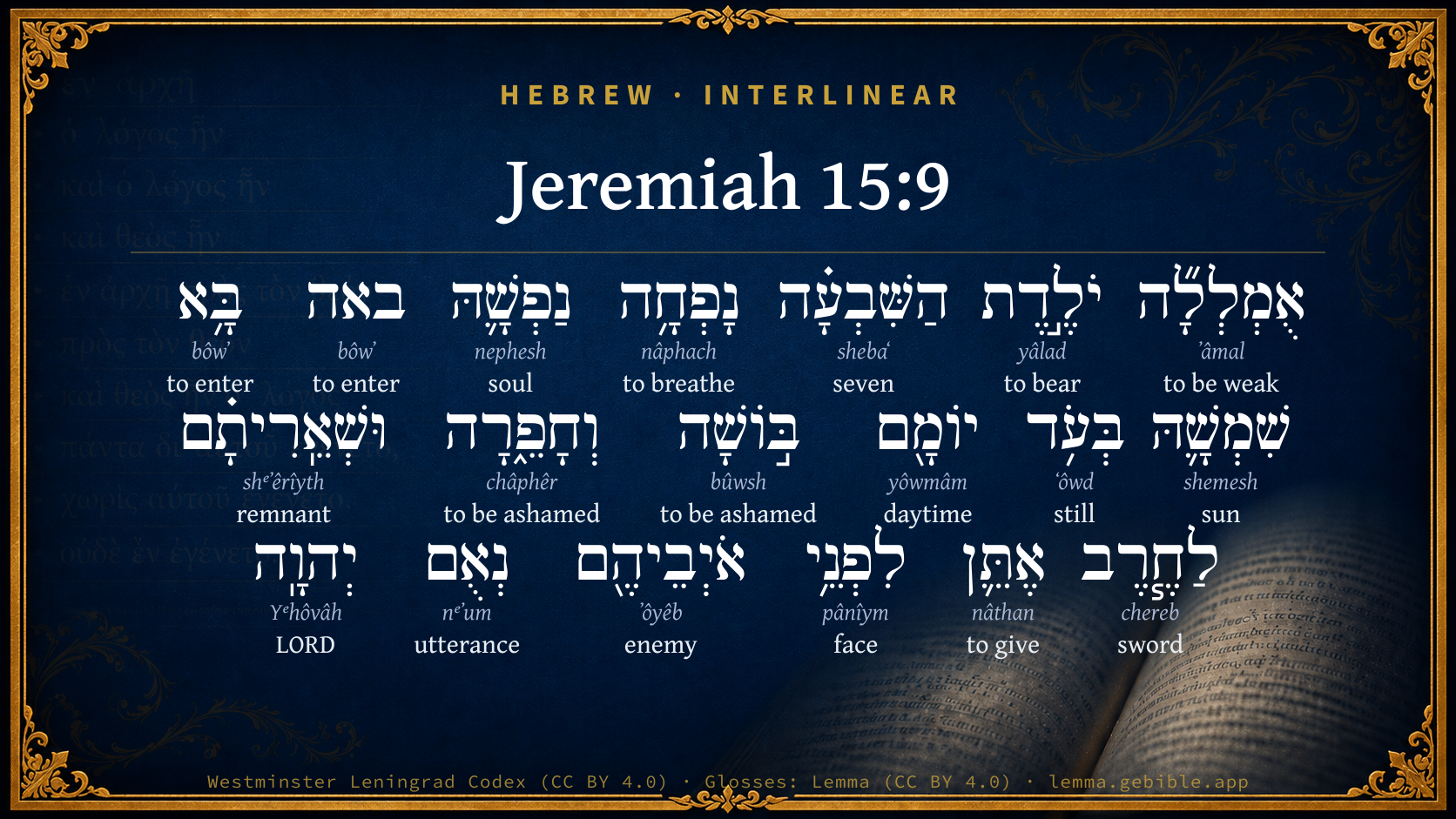
Hebrew (Westminster Leningrad Codex) Jeremiah 15:9 appears in the Hebrew Old Testament. The text above is from the Westminster Leningrad Codex. Each word links to its Strong’s number, a concise gloss, and parsing drawn from the Open Scriptures Hebrew Bible morphology. Click any word for its full Brown-Driver-Briggs (BDB) entry.
Download image
Cite this verse

Jeremiah 15:9 (World English Bible). Public Domain. Lemma interlinear Bible study tool, https://lemma.gebible.app/v/jeremiah/15/9.

Show BibTeX & RIS
BibTeX
RIS
English Translation
She who has borne seven languishes; she has given up the spirit; her sun is gone down while it was yet day; she has been disappointed and confounded: and the residue of them will I deliver to the sword before their enemies, says Yahweh.
World English Bible · Public Domain
Download a study sheet

One document with this verse’s original text, its word-by-word gloss line, the meaning frame, cross-references with their text, attributed commentary, and full source and license credits — printable, and it pastes into notes with its structure intact.

This verse Autodidact and up

Study sheet (.html) Plain text (.txt)

A passage Seminary Student

Up to 50 verses in one chapter. A passage sheet keeps up to 6 commentary sources and 12 cross-references per verse, in the order this page ranks them, and says so on the sheet whenever that leaves anything out. Ask for a single verse and you get the Autodidact verse sheet above.

Everything on this page stays free to read, with no account — the sheet is a download of what is already on screen, not access to it.

Want to remove ads? Support Godless Engineer
Compare translations 3

The same verse in 3 English versions, stacked beneath the original-language interlinear above. Click any original word for its lexicon entry.

Each is an independent rendering of the whole verse — the interlinear is not word-aligned to these translations.

Highlighted words mark where these versions differ — a whole-verse word diff, not a word-by-word alignment.

  • World English Bible Public Domain
    She who has borne seven languishes; she has given up the spirit; her sun is gone down while it was yet day; she has been disappointed and confounded: and the residue of them will I deliver to the sword before their enemies, says Yahweh.
  • King James Version Public Domain
    She that hath borne seven languisheth: she hath given up the ghost; her sun is gone down while it was yet day: she hath been ashamed and confounded: and the residue of them will I deliver to the sword before their enemies, saith the LORD.
  • unfoldingWord Literal Text CC BY-SA 4.0
    She who has borne seven will grow faint. She will breath out her life. Her sun will go down while yet day. She will be ashamed and disgraced, and the remnant of them I will deliver to the sword before the face of their enemies,” the declaration of Yahweh.

unfoldingWord Literal Text — © unfoldingWord, licensed CC BY-SA 4.0. Word-aligned USFM3 via Door43 (git.door43.org/unfoldingWord/en_ult).

Versions to compare (up to 4)

3 of 4 selected

Show all 18 translations

Every available English version of this verse, each an independent rendering of the whole verse.

  • World English Bible Public Domain
    She who has borne seven languishes; she has given up the spirit; her sun is gone down while it was yet day; she has been disappointed and confounded: and the residue of them will I deliver to the sword before their enemies, says Yahweh.
  • Berean Standard Bible Public Domain
    The mother of seven will grow faint; she will breathe her last breath. Her sun will set while it is still day; she will be disgraced and humiliated. And the rest I will put to the sword in the presence of their enemies,” declares the LORD.
  • Majority Standard Bible Public Domain
    The mother of seven will grow faint; she will breathe her last breath. Her sun will set while it is still day; she will be disgraced and humiliated. And the rest I will put to the sword in the presence of their enemies,” declares the LORD.
  • King James Version Public Domain
    She that hath borne seven languisheth: she hath given up the ghost; her sun is gone down while it was yet day: she hath been ashamed and confounded: and the residue of them will I deliver to the sword before their enemies, saith the LORD.
  • American Standard Version (1901) Public Domain
    She that hath borne seven languisheth; she hath given up the ghost; her sun is gone down while it was yet day; she hath been put to shame and confounded: and the residue of them will I deliver to the sword before their enemies, saith Jehovah.
  • Revised Version (1885) Public Domain
    She that hath borne seven languisheth; she hath given up the ghost; her sun is gone down while it was yet day; she hath been ashamed and confounded: and the residue of them will I deliver to the sword before their enemies, saith the LORD.
  • Geneva Bible (1599) Public Domain
    Shee that hath borne seuen, hath bene made weake: her heart hath failed: the sunne hath failed her, whiles it was day: she hath bene confounded, and ashamed, and the residue of them will I deliuer vnto the sworde before their enemies, sayth the Lord.
  • Douay-Rheims (1899) Public Domain
    She that hath borne seven is become weak, her soul hath fainted away: her sun is gone down, while it was yet day: she is confounded, and ashamed: and the residue of them I will give up to the sword in the sight of their enemies, saith the Lord.
  • Young's Literal Translation Public Domain
    Languished hath the bearer of seven, She hath breathed out her spirit, Gone in hath her sun while yet day, It hath been ashamed and confounded, And their residue to the sword I give up before their enemies, An affirmation of Jehovah.
  • Literal Standard Version CC BY-SA 4.0
    The bearer of seven has languished, || She has breathed out her spirit, || Her sun has gone in while yet day, || It has been ashamed and confounded, || And I give up their remnant to the sword before their enemies,” || A declaration of YHWH.
  • Unlocked Literal Bible CC BY-SA 4.0
    The mother who has borne seven children will waste away. She will gasp. Her sun will set while it is still day. She will be ashamed and embarrassed, for I will give those who remain to the sword in the presence of their enemies —this is Yahweh's declaration.”
  • unfoldingWord Literal Text CC BY-SA 4.0
    She who has borne seven will grow faint. She will breath out her life. Her sun will go down while yet day. She will be ashamed and disgraced, and the remnant of them I will deliver to the sword before the face of their enemies,” the declaration of Yahweh.
  • Darby Bible Public Domain
    She that hath borne seven languisheth, she hath given up the ghost; her sun is gone down while it is yet day; she is put to shame and confounded. And the residue of them will I give up to the sword before their enemies, saith Jehovah.
  • World Messianic Bible Public Domain
    She who has borne seven languishes. She has given up the spirit. Her sun has gone down while it was yet day. She has been disappointed and confounded. I will deliver their residue to the sword before their enemies,” says the LORD.
  • Webster's Bible Public Domain
    She that hath borne seven languisheth: she hath resigned her breath; her sun is gone down while it was yet day: she hath been ashamed and confounded: and the residue of them will I deliver to the sword before their enemies, saith the LORD.
  • Free Bible Version CC BY-SA 4.0
    A mother of seven children will collapse; she will gasp for breath. Her sun will set while it's still daytime; she will be ashamed and humiliated. I will let the enemies kill the rest of them, declares the Lord.
  • Bible in Basic English Public Domain
    The mother of seven is without strength; her spirit is gone from her, her sun has gone down while it is still day: she has been shamed and overcome: and the rest of them I will give up to the sword before their haters, says the Lord.
  • JPS Tanakh (1917) Public Domain
    She that hath borne seven languisheth; her spirit droopeth; her sun is gone down while it was yet day, she is ashamed and confounded; and the residue of them will I deliver to the sword before their enemies, saith the LORD.'

Literal Standard Version (2020), Covenant Press — licensed CC BY-SA 4.0. Text via the HelloAO Bible API (eBible.org). Unlocked Literal Bible (unfoldingWord) — licensed CC BY-SA 4.0. Text via the HelloAO Bible API (eBible.org). unfoldingWord Literal Text — © unfoldingWord, licensed CC BY-SA 4.0. Word-aligned USFM3 via Door43 (git.door43.org/unfoldingWord/en_ult). Free Bible Version, Dr. Jonathan Gallagher — licensed CC BY-SA 4.0. Text via the HelloAO Bible API (eBible.org).

Word by word

More ways to search: Search by grammar → Find every occurrence → Compare this word →

Practice this passage: Drill this verse → Learn its vocabulary →

נָפְחָ֥ה
nâphach
H5301
“to breathe”
Verb, Qal, Perfect, 3rd Person, Feminine, Singular
Part of Speech
Verb
Stem
Qal
Form
Perfect
Person
3rd Person
Gender
Feminine
Number
Singular
Full BDB Definition

Origin: a primitive root

TWOT: 1390

to breathe, blow, sniff at, seethe, give up or lose (life) - (Qal) to breathe, blow - (Pual) to be blown - (Hiphil) to cause to breathe out
  1. אֻמְלְלָ֞ה ʼâmal H535 “to be weak” Verb, Pulal, Perfect, 3rd Person, Feminine, Singular
  2. יֹלֶ֣דֶת yâlad H3205 “bearing” Verb, Qal, Participle Active, Feminine, Singular, Construct
  3. הַשִּׁבְעָ֗ה shebaʻ H7651 “the · seven” Particle, Definite Article + Adjective, Cardinal number, Masculine, Singular, Absolute
  4. נַפְשָׁ֛הּ nephesh H5315 “soul · her” Noun, Common, Both, Singular, Construct + Suffix, Personal, 3rd Person, Feminine, Singular
  5. באה bôwʼ H935 “to enter” Verb, Qal, Perfect, 3rd Person, Feminine, Singular
  6. בָּ֥א bôwʼ H935 “to enter” Verb, Qal, Perfect, 3rd Person, Masculine, Singular
  7. שִׁמְשָׁ֛הּ shemesh H8121 “sun · her” Noun, Common, Both, Singular, Construct + Suffix, Personal, 3rd Person, Feminine, Singular
  8. בְּעֹ֥ד ʻôwd H5750 “in/at · still” Preposition + Adverb
  9. יוֹמָ֖ם yôwmâm H3119 “daytime” Adverb
  10. בּ֣וֹשָׁה bûwsh H954 “to be ashamed” Verb, Qal, Perfect, 3rd Person, Feminine, Singular
  11. וְחָפֵ֑רָה châphêr H2659 “and · to be ashamed” Conjunction + Verb, Qal, Perfect, 3rd Person, Feminine, Singular
  12. וּשְׁאֵֽרִיתָ֗ם shᵉʼêrîyth H7611 “and · remnant · their” Conjunction + Noun, Common, Feminine, Singular, Construct + Suffix, Personal, 3rd Person, Masculine, Plural
  13. לַחֶ֧רֶב chereb H2719 “to/for the · sword” Preposition, Determined + Noun, Common, Feminine, Singular, Absolute
  14. אֶתֵּ֛ן nâthan H5414 “to give” Verb, Qal, Imperfect, 1st Person, Common, Singular
  15. לִפְנֵ֥י pânîym H6440 “to/for · face(s) of” Preposition + Noun, Common, Both, Plural, Construct
  16. אֹיְבֵיהֶ֖ם ʼôyêb H341 “enemy · them” Verb, Qal, Participle Active, Masculine, Plural, Construct + Suffix, Personal, 3rd Person, Masculine, Plural
  17. נְאֻם nᵉʼum H5002 “utterance of” Noun, Common, Masculine, Singular, Construct
  18. יְהוָֽה Yᵉhôvâh H3068 “LORD” Noun, Proper

About this verse

These counts appear in no published source. They are computed here, from the morphology-tagged text and Lemma’s own curated glosses. What Lemma adds →

19
words
18
distinct lemmas
Prophets
section

Notable vocabulary

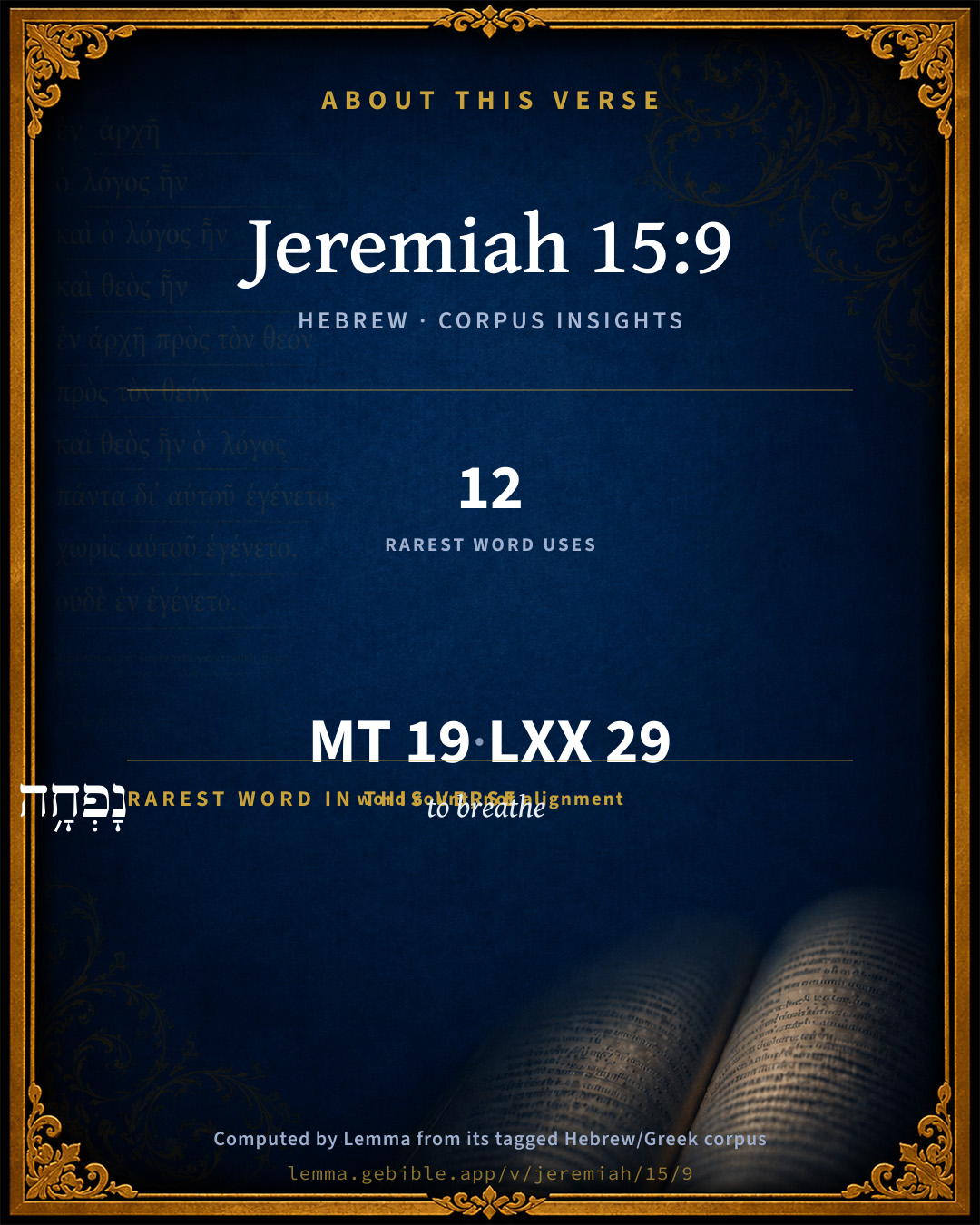
The rarest word here is נָפְחָ֥ה to breathe H5301 — appearing just 12 times in the whole Hebrew Bible.

Shared distinctive vocabulary

נָפְחָ֥ה to breathe H5301 occurs in 12 verses of the Hebrew Bible. Also found in:

Grammatical profile

  • 9 verbs
  • 7 nouns
  • 1 adjective
  • 2 adverbs

Verb forms

  • אֻמְלְלָ֞ה Pulal · Perfect
  • יֹלֶ֣דֶת Qal · Participle Active
  • נָפְחָ֥ה Qal · Perfect
  • באה Qal · Perfect
  • בָּ֥א Qal · Perfect
  • בּ֣וֹשָׁה Qal · Perfect
  • וְחָפֵ֑רָה Qal · Perfect
  • אֶתֵּ֛ן Qal · Imperfect
  • אֹיְבֵיהֶ֖ם Qal · Participle Active

Repetition

A word recurs within this verse — often emphatic in Hebrew:

  • באה to enter H935 ×2

Hebrew & Septuagint length

In the original languages it is 19 Hebrew tokens and 29 Greek tokens — but the two are counted differently (Hebrew bundles its prefixes and suffixes into one token; the Greek is in lemma form), so that isn’t a like-for-like length.

Cross-references

9

Topical passages linked to Jeremiah 15:9 in the Treasury of Scripture Knowledge — connected by theme and wording, ordered by reader-vote popularity; previews shown in the World English Bible.

  • 1 Samuel 2:5 Those who were full have hired out themselves for bread; Those who were hungry have ceased [to hunger]: Yes, the barren has borne seven; She who has many children languishes.
  • Isaiah 47:9 but these two things shall come to you in a moment in one day, the loss of children, and widowhood; in their full measure shall they come on you, in the multitude of your sorceries, and the great abundance of your enchantments.
  • Lamentations 1:1 How does the city sit solitary, that was full of people! She has become as a widow, who was great among the nations! She who was a princess among the provinces is become tributary!
  • Amos 8:9–10 "It will happen in that day," says the Lord Yahweh, "That I will cause the sun to go down at noon, And I will darken the earth in the clear day.
  • Jeremiah 15:2–3 It shall happen, when they tell you, Where shall we go forth? then you shall tell them, Thus says Yahweh: Such as are for death, to death; and such as are for the sword, to the sword; and such as are for the famine, to the famine; and such as are for captivity, to captivity.
  • Jeremiah 21:7 Afterward, says Yahweh, I will deliver Zedekiah king of Judah, and his servants, and the people, even such as are left in this city from the pestilence, from the sword, and from the famine, into the hand of Nebuchadrezzar king of Babylon, and into the hand of their enemies, and into the hand of those who seek their life: and he shall strike them with the edge of the sword; he shall not spare them, neither have pity, nor have mercy.
  • Jeremiah 44:27 Behold, I watch over them for evil, and not for good; and all the men of Judah who are in the land of Egypt shall be consumed by the sword and by the famine, until there be an end of them.
  • Lamentations 4:10 The hands of the pitiful women have boiled their own children; They were their food in the destruction of the daughter of my people.
  • Ezekiel 5:12 A third part of you shall die with the pestilence, and with famine shall they be consumed in the midst of you; and a third part shall fall by the sword round about you; and a third part I will scatter to all the winds, and will draw out a sword after them.

Cross-references courtesy of OpenBible.info (CC BY 4.0).

Hebrew and Greek witnesses Masoretic Hebrew ↔ Greek Septuagint

The same verse in the two great witnesses to the Old Testament, shown verse-for-verse.

These are two independent witnesses, not word-aligned to each other, and the Septuagint is shown in lemma (dictionary) form.

Hebrew Jeremiah 15:9 Masoretic · Westminster Leningrad Codex

אֻמְלְלָ֞ה יֹלֶ֣דֶת הַשִּׁבְעָ֗ה נָפְחָ֥ה נַפְשָׁ֛הּ באה בָּ֥א שִׁמְשָׁ֛הּ בְּעֹ֥ד יוֹמָ֖ם בּ֣וֹשָׁה וְחָפֵ֑רָה וּשְׁאֵֽרִיתָ֗ם לַחֶ֧רֶב אֶתֵּ֛ן לִפְנֵ֥י אֹיְבֵיהֶ֖ם נְאֻם יְהוָֽה

She who has borne seven languishes; she has given up the spirit; her sun is gone down while it was yet day; she has been disappointed and confounded: and the residue of them will I deliver to the sword before their enemies, says Yahweh.

World English Bible · Public Domain

Greek LXX Structure differs

In the Septuagint, Jeremiah is about an eighth shorter than the Hebrew and arranges its material differently — the Oracles Against the Nations (Hebrew chapters 46–51) appear in the middle of the Greek book, after 25:13. Because the chapter and verse boundaries do not line up, a verse-for-verse comparison with the Hebrew is not shown.

A verse-for-verse comparison isn’t shown here because the chapters and verses don’t line up. Switch to the LXX edition with the MT / LXX toggle above to read the Greek directly.

Hebrew: Westminster Leningrad Codex (CC BY 4.0). Greek: Septuagint (public domain); English from a public-domain English Septuagint. How the Septuagint differs from the Hebrew →

Targum (Aramaic paraphrase)

1

The Targum is the ancient Jewish Aramaic paraphrase of the Hebrew Scriptures — an interpretive translation, not the Hebrew text itself. Onkelos (literal) and Pseudo-Jonathan (expansive) render the Torah, and Jonathan the Prophets. Coverage is partial: where no permissively-licensed English translation exists for a verse, only the Aramaic is shown. This is verse-level text, not a word-by-word alignment to the Hebrew.

  1. Targum Jonathan Prophets (Joshua–Malachi)
    צְדִיאַת אַרְעֲהוֹן מִבְּלִי עַמָא הֲווֹ לְמַפְּחַת נְפַשׁ גְלָא יְקַרְהוֹן בְּחַיֵיהוֹן וְעַד דְאִינוּן קַיְמִין בְּהִיתוּ וְאִתְכְּנָעוּ וּשְׁאַרְהוֹן לְחַרְבָּא אֶמְסַר קֳדָם בַּעֲלֵי דְבָבֵיהוֹן אֲמַר יְיָ:

    (no public-domain English translation for this verse)

    Targum Jonathan — Aramaic: “Mikraot Gedolot” (public domain). English: “Sefaria Community Translation” (CC0 1.0 (public-domain dedication)); “London "Chaldee Paraphrase," 1871” (public domain). Text via Sefaria.

Commentary

Notes on Jeremiah 15:9 from classic Christian and Jewish commentators (each source and its license shown beneath its notes). The classic Christian expositions comment on the surrounding passage and are grouped to its opening verse, so a note may address several verses; the Jewish commentaries on the Tanakh (Rashi and others) are per-verse, so they appear only where the commentator wrote on this verse.

Lemma curates 59 commentaries, every one of them public domain or Creative Commons licensed, each selected and text-cleaned for this edition rather than reprinted as found. About our sources →

Trapp's Complete Commentary

John Trapp

Jer 15:9 She that hath borne seven languisheth: she hath given up the ghost; her sun is gone down while [it was] yet day: she hath been ashamed and confounded: and the residue of them will I deliver to the sword before their enemies, saith the LORD.

Ver. 9. She that hath born seven languisheth.] Jerusalem, that mater multipara, a fruitful mother.

She hath given up the ghost.] Heb., She putteth out her soul. {as Job 11:20} We read of some mothers who, hearing of their sons to be slain in battle, have fallen down dead in the place.

Her sun is gone down.] See on Amo 8:9. A Christian, when at worst, can sing, Non omnium dierum sol occidit, Not on all days the sun sets. I look for better days yet.

John Trapp, A Commentary or Exposition upon All the Books of the Old and New Testament (1647–1656) — public domain. Text from a community e-Sword module.

The Biblical Illustrator

Joseph S. Exell

Jer_15:9

Her sun is gone down while it is yet day.

Beautiful, but brief

I. Her life was like the sun in its shining.

1. Gloriously bright with faith and joy.

2. Blessedly useful in diffusing light.

3. Constantly comforting, by its warmth of love and hope.

4. Christianly generous, always giving.

5. A centre of attraction, in the house, in the class, in the social circle, and in the Church.

II. Her death was like the sun in its setting.

1. Gradual

2. Beautiful.

3. Peaceful.

4. To rise again.

III. Her sunset was early in the day of life.

1. In the prime and beauty of being.

2. In the midst of work.

3. It seems unnatural, and suggests questions.

4. It is an interposition of God in His providence, doubtless wise and loving.

5. It leads us from the creature to the. Creator.

6. It suggests that we be all ready, always ready. (W. Whale.)

Premature sunset

I. In nature.

1. Would be unnatural.

2. Would be injurious to all life.

3. Would make us less confident as to the unerring regularity of natures law.

II. In history. Many cases in which nations have fallen, not with decrepitude of age, but through early and self-wrought ruin.

III. In individual life. The young, the immoral, the unprincipled in character generally. Obedience to God gives a long day and beautiful sunset. (W. Whale.)

The Christians sun

I. The Christian has a sun. A Sun is a globe which keeps other globes in connection with it in their proper spheres and at their assigned work, and which imports light and heat to them and to all the creatures which inhabit them. In a sense, all men have a sun to which they look for present and future good. But it differs with different men. With some it is nature; some, the traditions of their fathers; some, fancied superior morality; and the portion of good to every man, with regard to its character and intent, is determined by the capability and quality of his sun. Oh, how miserably off must be all who depend on the finite! The Christian does not. His sun is Jesus as set forth in Holy Writ. From Him every true believer has the light and heat of spiritual life, and through Him he gets into his place, and is put to his appropriate work in creation (Joh_1:1-14; Joh_8:12; Joh_12:46). Receptivity is the beginning of that state of mind which, if rightly followed up, issues in the likeness, love, and enjoyment of God; and as Jesus, the source to which the Christian looks for lasting, ennobling good, is infinite, his felicity and glory will be forever enlarging.

II. The Christian is sunnified by his sun. He is a retainer, as well as a receiver, of its beneficent outflow. All the colours, and all the shades of colours, and every form of animal and vegetable life, are owing to the retention and appropriation of solar rays. The wealth, and beauty, and blessed activity of earth arise in this way. In like manner, the rays of the worlds spiritual Sun--the divinely inspired record of the history of incarnate Deity--must be kept and fittingly used if His fruits are to be enjoyed.

III. The Christian sunnifies others. He is a reflector and spreader of the brightness and goodness of his sun. Ye are the light of the world. The globes which emit light and heat as well as have them, the animals which add usefulness to life, and the flowers which are fragrant besides being beautiful, are highest in the scale of existence and of greatest worth. To those Christians who are active besides being pious, who spread the Gospel in addition to living it, who enrich and bless others as well as seek to be enriched and blessed themselves, are the most like Jesus, the most dear to the Father, the most useful to men, the most honoured in the Church. Their death is a calamity to others, but auspicious to themselves. Apply the subject--

1. To sinners. Get spiritual light and life while you can.

2. To saints. Prize and make good use of your privileges. Diffuse your light.

3. To Christian workers.

Be not weary in works of faith and labours of love. The more light you spread, and the more men you illumine, the greater your joy now, the greater your blessedness hereafter. (W. J. Stuart.)

Death the setting of the sun

I. The sun, in setting, disappears from view. As the great central orb is lost to our part of the world as he sinks beneath the horizon, so man is lost to the view of earth as he descends to the grave. The places that knew him know him no more.

II. The sun in setting obeys its law. The sun knoweth his going down. Death is a law of nature. It is as natural for the body to die as for the sun to go down.

III. The sun in setting is often gorgeous. Often have we seen the monarch of the day ride down in a chariot of glittering gold. Many a man has died under a halo of moral splendour. Like Stephen, they have seen the heavens open, and reflected the celestial rays as they came down.

IV. The setting sun will rise again. So with man in death. He does not go out of existence: he only sinks from view, and sinks to rise again in new splendour. Conclusion--Let us fulfil our mission as the sun does his, move in our little circle in harmony with Divine law, enlightening, vivifying, and beautifying all, and then death need have no terror for us. Our path will be as a shining light, etc. (Homilist.)

Sunset at noonday

These words are illustrative of death in lifes meridian. They remind us of--

I. Premature darkness. Sunsetting is the harbinger of night.

1. In nature. We do not expect sunset until eventide.

2. In morals. The departure of moral integrity. This sun should never set.

3. In physical life. Death is sunset to the aged, at night; to the young, at noon.

4. Unexpected darkness is unanticipated sorrow to community, family, individual.

II. Uncompleted work. Man goeth forth unto his work. Ordinarily, man has work enough to last all day; when called away prematurely, he leaves part untouched. So in lifes aggregation. In lifes morning his work is largely preparatory for mightier accomplishments of his post meridian.

III. Frustrated design. Man lives in the future--

(1) intellectually,

(2) socially,

(3) religiously.

Setting suns of life. Permanently overwrought powers. Commercial disasters. Succumbing to evil. In each case failure to realise the hope.

IV. A speedier enjoyment of rest. Darkness suggests night; night suggests repose. As in the physical, so in the souls life. Blessed are the dead, etc. There remaineth therefore, etc. (Homiletic Monthly.)

Death in the midst of life

I. The sun as an emblem of the saints of God. When we contemplate the great orb of day we are impressed--

1. With his greatness and elevation. This greatness and elevation fitly represents the true character of the Christian, contrasted with what he was, with what others are around him. Knowledge makes a man great. Grace of God elevates and lifts up to heaven. I will set him on high, etc.

2. Natural glory and magnificence. The most glorious of all the heavenly bodies. The kings daughter, etc. (Psa_45:13). See this strikingly set forth (2Co_3:18).

3. As the great diffuser of light and beauty. The Christian is first the recipient of light, and then he is called to shine. Arise, shine, etc. So let your light shine, etc.

4. As the chief source of fertility and fruitfulness. Where Christians live there is knowledge, benevolence, happiness, and life. Look at all our institutions of temporal and moral goodness.

II. The setting of the sun as a striking representation of the morality of the Christian.

1. The going down of the sun is a usual and therefore expected event. So sure as he arises we know he will go down. Man is born to die, etc. I know that Thou wilt bring me to death, etc. The living know, etc.

2. The period of the going down of the sun is very diversified. Look at the short winters day and the long summers day. So in life,--every age is alike mortal, etc. But the text speaks of the sun going down while it is yet day--prematurely. How often is this the case.

3. The going down of the sun is often peculiarly splendid and beautiful. How characteristic of the good mans death!

4. The sun goes down to arise and shine on another horizon. (J. Burn, D. D.)

The Biblical Illustrator, edited by Joseph S. Exell (c. 1880s–1900s) — public domain. Text from a community e-Sword module.

Joseph Benson's Commentary

Jer 15:9. She that hath borne seven languisheth — Seven is put for many, (see 1Sa 2:5,) and the multitude of the inhabitants of Jerusalem, the mother-city, is here alluded to; the prophet pursuing the metaphor of the former verse, and describing the mother-city under the figure of a woman that had been fruitful, but was now become feeble, and bore no children. He means that the people of Judah, which had been very numerous, were now greatly diminished. Her sun is gone down while it was yet day — In the midst of her prosperity she is reduced to this state of misery, being of a sudden overwhelmed with the greatest calamities, when she might have expected a long continuance of happiness. The expression is extremely strong, and denotes a sudden change from the highest dignity to the lowest abasement. She hath been ashamed and confounded — The judgments of God oppressed and confounded a part of the Jews before their captivity. And the residue of them — The remainder of them, saith God, shall be destroyed by the sword of the enemy.

Joseph Benson's Commentary on the Old and New Testaments (1811–1818) — public domain. Text from a community e-Sword module.

Geneva Bible (1599)

Geneva Bible translators

She was destroyed in the midst of her prosperity.

She that had many, lost all her children.

Geneva Bible (1599) marginal notes — public domain. Text via Bolls.life.

Jamieson, Fausset & Brown

Robert Jamieson, A. R. Fausset & David Brown

borne seven-- (Sa1 2:5). Seven being the perfect number indicates full fruitfulness.

languisheth--because not even one is left of all her sons (Jer 15:8).

sun is gone down while . . . yet day--Fortune deserts her at the very height of her prosperity (Amo 8:9).

she . . . ashamed--The mothers (she being collective) are put to the shame of disappointed hopes through the loss of all their children.

Jamieson, Fausset & Brown — Commentary Critical and Explanatory on the Whole Bible (1871) — public domain (CC PDM 1.0). Text via the HelloAO Bible API.

Adam Clarke's Commentary

Verse 9. She that hath borne seven] She that hath had a numerous offspring; Jerusalem, the parent of so many cities, villages, and families in the land. Seven signifies a complete or full number.

Adam Clarke's Commentary on the Bible (1810–1826) — public domain. Text from a community e-Sword/MySword module.

John Calvin's Commentaries

He proceeds with his narrative; he says, that fruitful women had been weakened, not as we see to be often the case, for by frequent child — bearing we know the strength of women is diminished; but here he speaks of the strength which mothers derive from their children; for a numerous offspring is the support of mothers. She then who has many children seems strong, as she is by so many shields defended. As then mothers were wont to place much dependence on their offspring, he says that they were weakened as to their strength when they were bereaved of all their children, as though they had been barren.

He afterwards adds, that the soul, the people, had expired; for he speaks not here of women, but of the whole people. For it afterwards follows, Set hath her sun while it was yet day; that is, when prosperity seemed certain, God suddenly involved them in adversity, and as it were surrounded them with darkness, when they thought that prosperous fortune was slhining on them. He at last says, that they were confounded and ashamed; and at the same time he declares, that he would give all who remained to the sword before their enemies; as though he had said, “They have not yet suffered all the punishment allotted to them, for they are not subdued, though I have heavily and severely chastised them; as then they are incurable, the sword shall destroy the remainder; for my vengeance shall not cease to pursue them, until I shall utterly consume them.

John Calvin's Commentaries (1540-1563) — public domain. Text from the Calvin Translation Society English edition (1840s-50s) via the Christian Classics Ethereal Library (ccel.org). Calvin's coverage is partial (roughly two-thirds of the Bible); uncommented books and verses are honest gaps, never fabricated. The 19th-century editor's footnotes and remarks are omitted so the notes are faithfully Calvin's own voice.

Ellicott's Commentary for English Readers

(9) She that hath borne seven.—In the picture of the previous verse the glory of the mother was found in the valour of her son, here in the number of her children. “Seven,” as the perfect number, represented, as in 1Sa_2:5, Rth_4:15, the typical completeness of the family.

Her sun is gone down while it was yet day.—The image of this eclipse of all joy and brightness may possibly have been suggested by the actual eclipse of the sun (total in Palestine), Sept. 30; B.C. 610, the year of the battle of Megiddo, just as the earthquake in the reign of Uzziah suggested much of the imagery of Isaiah and Amos (Isa_2:19; Amo_1:1-2; Amo_4:11; Zec_14:5). A like image meets us in Amo_8:9.

A Bible Commentary for English Readers, edited by Charles John Ellicott (1878–1897) — public domain. Text from a community e-Sword module.

The Cambridge Bible for Schools and Colleges

gen. ed. J. J. S. Perowne

9. She that hath borne seven] and therefore, from the Jewish point of view, might have thought herself secure and prosperous. Seven was the perfect number. Cp. 1Sa_2:5.

hath given up the ghost] hath died.

while it was yet day] before she had reached the evening of her life. Cp. Amo_8:9.

The Cambridge Bible for Schools and Colleges (gen. ed. J. J. S. Perowne; Cambridge University Press, 1878–1918) — public domain. Text from a community e-Sword module.

John Gill's Exposition

She that hath borne seven languisheth,.... Either the mother that has borne many children, seven being put for a large number, now being able to bear no more, and being bereaved of what she had, and who were her staff and support, and from whom she had her expectation, faints away, and dies through grief and trouble; or Jerusalem, which formerly abounded with young men, is now in a forlorn and destitute state; her children, the inhabitants of it, being slain with the sword, or dying of famine and the pestilence. In the Talmud (i), this is interpreted of seven wicked kings of Israel, as Jeroboam, Baasha, Ahab, Jehu, Pekah, Menahem, and Hoshea; and elsewhere of seven kings of Judah, thus reckoned, Jehoram, Joash, Ahaz, Manasseh, Amon, Jehoiakim, and Zedekiah (k):

she hath given up the ghost; or, "blew out her soul (l)"; her breath departs; no life can be kept in her; she faints away at the calamities coming on her:

her sun is gone down while it was yet day; the darkness of affliction, and the evening of distress and calamity came upon her sooner than was expected, while in the midst of peace and prosperity that was promised, and hoped to be enjoyed for a long time to come; see Amo 8:9,

she hath been ashamed and confounded; of her vain hope, trust, and confidence:

and the residue of them will I deliver to the sword before their enemies, saith the Lord; that is; such who died not of the famine and pestilence, but at the breaking up of the city endeavoured to make their escape, these fell into the hands of the enemy, and perished by the sword, as the Lord here predicts; for whatsoever he says certainly comes to pass.

(i) T. Bab. Gittin, fol. 88. 1. (k) Vid. Jarchi & Abendana in loc. (l) "efflabit animam suam", Junius & Tremellius, Piscator; "exspiravit animam suam", Cocceius.

John Gill's Exposition of the Whole Bible (1746–1763) — public domain (CC PDM 1.0). Text via the HelloAO Bible API.

Albert Barnes' Notes on the Bible

She hath been ashamed - Or, “is ashamed.” To a Hebrew mother to be childless was a disgrace. Many consider that Jer 15:7-9 refer to the battle of Megiddo, and depict the consternation of Jerusalem at that sad event. If so, in the sun going down while it was day, there will be a reference to the eclipse on September 30, 610 b.c.

Albert Barnes' Notes on the Bible (1834–1885) — public domain. Text from a community e-Sword/MySword module.

Haydock's Catholic Bible Commentary

Seven: many. It is not common for a mother to lose so numerous a family; yet such shall be the misfortune of Jewish parents. The synagogues shall decrease. --- Day. Her prosperity shall end on a sudden. (Calmet)

George Leo Haydock (1774–1849), Haydock's Catholic Family Bible and Commentary, 1859 edition — public domain. Excludes Psalms (Douay-Rheims chapter numbering differs from Protestant) and Deuterocanonical books (Catholic canon only).

Matthew Poole's English Annotations

Seven signifies many, 1Sa 2:5; Job 5:19. The prophet complains that Jerusalem, or the country of Judah, that had been very numerous in people, now grew feeble, neither able to maintain those she had borne, nor yet to bear more.

Her sun is gone down while it was yet day; in the midst of her prosperity she became thus miserable.

She hath been ashamed and confounded: a part of them were confounded by the judgments of God, which came upon them before their captivity. For the remainder of them, (saith God,) they shall be destroyed by the sword of the enemy.

Matthew Poole's English Annotations on the Holy Bible (1683–1685) — public domain. Text from a community e-Sword/MySword module.

The Pulpit Commentary

That hath borne seven; a proverbial expression. (comp. 1Sa_2:5 Rth_4:15) Her sun is gone down, etc. The figure is that of an eclipse. (comp. Amo_9:9) She hath been ashamed, etc.; rather, she ashamed, etc. Ewald supposes the sun, which is sometimes feminine in Hebrew, to be the subject; (comp. Isa_24:23) but the view of the Authorized Version is more probable. The shame of childlessness is repeatedly referred to. (comp. Jer_1:12 Isa_54:4 Gen_16:4 Gen_30:1, Gen_30:23)

Sunset at noon.

A premature ending of any human affairs may be compared to sunset at noon.

I THIS IS A COMMON OCCURRENCE. A nation suddenly collapses; a sovereign is overthrown in the height of his power; a life is cut off in middle age. How often do we see these things?

II THIS IS AN UNNATURAL OCCURRENCE. No such event could occur in the physical world. Therefore it proves that the human world is deranged.

III THIS IS A CALAMITOUS OCCURRENCE. National modifications may be both peaceful and profitable. Empires are slowly welded together, colonies gradually assume powers and rights of independence, internal reforms are quietly effacing the old order. To the individual natural death in old age is painless. It is the violent and premature end that causes disaster.

IV THIS IS AN OCCURRENCE RESULTING FROM ERROR OR WRONGDOING. We cannot say that the cause is always to be traced immediately to the sufferers. With nations it may be generally so, but not with individuals. But still a law of morality, of social order of nature, has been broken, if not by the sufferers still by some agent.

V THIS IS AN OCCURRENCE THAT MAY COME AS AN ACT OF DIVINE JUDGMENT. It is not universally so, particularly in regard to individuals. But it often is the case. Thus it was with the Jews, with Rome, in the dark ages, etc. Therefore let us beware of presuming on the apparent distance of the day of judgment.

The darkened home.

"She that hath borne... was yet day." Perhaps in all the range of human sorrows there is none greater than that which befalls a home when the dearly beloved mother of many children, yet needing sorely her care, is early cut off. Such a piteous case is described here. The prophet, bewailing the coming calamities of his country, adopts the heartbroken language of a husband bitterly mourning the death of his wife and the mother of his many children. He seems to think of her who is gone, and all her sweetness and grace and goodness rise up before him. He thinks of their children and how they will need their mother"s care, terribly need it, though never more can they have it, and his heart dies down within him. He thinks of himself and how utterly lonely his lot must be. At such times heart and mind almost give way, and faith and love Godward receive a blow beneath which they reel and sometimes never recover themselves, But this verse is as a holy angel of God, and enters that darkened home; and

I IT CALLS TO MEMORY WHAT THE LOST ONE WAS. Her life was as the shining of the sun bright, cheerful, generous, inspiriting, attracting, healthful, and joy-giving to all.

II IT DENIES NOT THE FACT WHICH IS so BITTERLY MOURNED. Her premature death, her sun went down, etc. Nothing can alter that fact. And perhaps, as the very words indicate, circumstances of peculiar sorrow may have surrounded her death. Like her told of in this verse, "she may have breathed out her life as if in labored sighs, expiring in heavy heart-breaths of grief." Not a calm, gradual, bright sunset, but the very reverse, the sun going down in dark clouds. The power to utter those blessed parting words of counsel and comfort taken from her, and in darkness and silence she had to wend her way to the unseen. But amid all this depth of gloom this verse

III SUGGESTS MOST BLESSED TRUTH. The sun of her life has not perished but shines elsewhere. We know that when the sun sinks below our horizon it has gone to gladden and bless other shores. And so with the life of the blessed dead. They all live unto God. All that in them which was so pure, so sweet, so full of the grace of God, has not perished; it is shining elsewhere, it has risen on another shore, flue eternal and the blessed. And on us it shall rise again, as the sunrise follows in due time the sunset. That life is not lost but is hidden with Christ in God, and so "when he who is our life shall appear" then shall that now hidden life "appear with him in glory, C.

The Pulpit Commentary (1880–1919), ed. H.D.M. Spence-Jones & Joseph S. Exell — public domain. Text from a community e-Sword module.

John Wesley's Explanatory Notes

Seven - Seven signifies many: the prophet complains, that the country of Judah, that had been very numerous in people, now grew feeble. While - In the midst of her prosperity. Confounded - A part of them were confounded by the judgments of God which came upon them before their captivity.

John Wesley, Explanatory Notes Upon the Whole Bible (1754–1765) — public domain. Text via the GEBible commentary corpus.

Rashi

Rabbi Shlomo Yitzchaki (Rashi)

She who bore seven Samaria and the nation of the Ten Tribes, from whom rose seven dynasties of wicked kings, has already been cut off and exiled.

and their remnant These are Judah and part of Benjamin, who remained in Israel. I shall deliver them to the sword. These are the seven dynasties: Jeroboam son of Nebat and his dynasty, Baasha and his dynasty, Omri and his dynasty, Jehu and his dynasty, Menahem and his dynasty, Pekah and his dynasty, Hoshea and his dynasty.

her soul grieves an expression of ‘her soul grieves.’ We translate (Deut. 28:65) “And grieving of the soul (וְדַאֲבוֹן נֶפֶֹש)” as וּמַפְּחַן נְפָֹש.

when it is still day Before its time, they hastened to fall. In this manner it is expounded in Tractate Gittin. [See Gittin 88a]. And in the Midrash of Rabbi Tanhuma (Tanhuma Buber, Vayetze p. 153) it is expounded as referring to Jerusalem, and he counts seven wicked men: Jehoram, Jehoash, Ahaz, Manasseh, Amon, Jehoiakim, and Zedekiah. But there are yet to count Rehoboam, Abijah, Amaziah, and Ahaziah.

and confounded an expression of shame.

Rashi on the Tanakh — English translations: “The Judaica Press complete Tanach with Rashi, translated by A. J. Rosenberg” (CC BY 4.0); “Pentateuch with Rashi's commentary by M. Rosenbaum and A.M. Silbermann, 1929-1934” (public domain); “The Metsudah Tanach series, Lakewood, N.J” (CC BY 4.0); and “The Book of Joshua, Metsudah Publications, 1997” (CC BY 4.0). Text via Sefaria.

Lesson kit

Teaching starters — assembled from the data on this page, not authored interpretation. Every prompt links to the verse data it draws on. Edit before teaching.

Jeremiah, in the Prophets, opens this verse with 19 words (18 distinct Hebrew lemmas). Its most distinctive word is nâphach (“to breathe”). A historical commentator’s framing appears above. Read the whole chapter for the surrounding context.

Discussion questions

  1. What does “to breathe” (nâphach) contribute to the verse as a whole?
  2. Genesis 2:7 shares the word «to breathe» with this verse. How do the two illuminate each other?
  3. “to enter” occurs 2× in this one verse. What is the effect of the repetition?
  4. These translations render this verse differently; the difference is in the English rendering, not the original. What questions does that raise?
  5. The verb «אֻמְלְלָ֞ה» is Pulal Perfect. How does its form color the action?
  6. Reading how Trapp's Complete Commentary and The Biblical Illustrator read this verse, where do the two commentators agree and where do they part?

Things to notice

Reading settings

Reading text

Shown beneath each verse's original-language words.

Old Testament
Old Testament edition

Read the OT as the Masoretic Hebrew (MT) or the Greek Septuagint (LXX).

English shown for the Greek Septuagint (in the Hebrew ↔ Greek comparison).

Comparing translations? Open the Compare panel on any verse page to stack up to four side by side.