
Leviticus 16:14

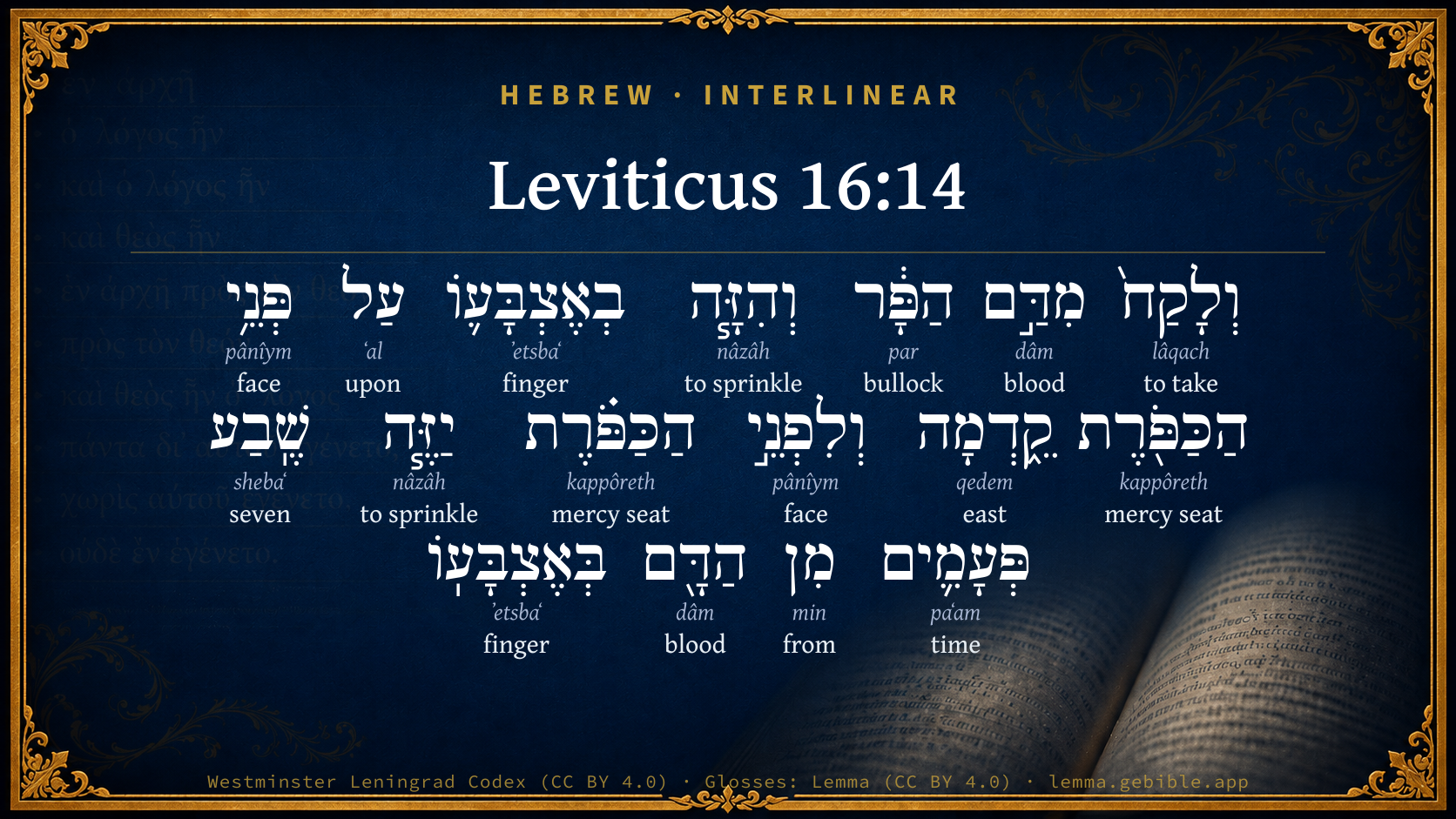
Hebrew (Westminster Leningrad Codex) Leviticus 16:14 appears in the Hebrew Old Testament. The text above is from the Westminster Leningrad Codex. Each word links to its Strong’s number, a concise gloss, and parsing drawn from the Open Scriptures Hebrew Bible morphology. Click any word for its full Brown-Driver-Briggs (BDB) entry.
Download image
Cite this verse

Leviticus 16:14 (World English Bible). Public Domain. Lemma interlinear Bible study tool, https://lemma.gebible.app/v/leviticus/16/14.

Show BibTeX & RIS
BibTeX
RIS
English Translation
He shall take some of the blood of the bull, and sprinkle it with his finger on the mercy seat on the east; and before the mercy seat he shall sprinkle some of the blood with his finger seven times.
World English Bible · Public Domain
Download a study sheet

One document with this verse’s original text, its word-by-word gloss line, the meaning frame, cross-references with their text, attributed commentary, and full source and license credits — printable, and it pastes into notes with its structure intact.

This verse Autodidact and up

Study sheet (.html) Plain text (.txt)

A passage Seminary Student

Up to 50 verses in one chapter. A passage sheet keeps up to 6 commentary sources and 12 cross-references per verse, in the order this page ranks them, and says so on the sheet whenever that leaves anything out. Ask for a single verse and you get the Autodidact verse sheet above.

Everything on this page stays free to read, with no account — the sheet is a download of what is already on screen, not access to it.

Want to remove ads? Support Godless Engineer
Compare translations 3

The same verse in 3 English versions, stacked beneath the original-language interlinear above. Click any original word for its lexicon entry.

Each is an independent rendering of the whole verse — the interlinear is not word-aligned to these translations.

Highlighted words mark where these versions differ — a whole-verse word diff, not a word-by-word alignment.

  • World English Bible Public Domain
    He shall take some of the blood of the bull, and sprinkle it with his finger on the mercy seat on the east; and before the mercy seat he shall sprinkle some of the blood with his finger seven times.
  • King James Version Public Domain
    And he shall take of the blood of the bullock, and sprinkle it with his finger upon the mercy seat eastward; and before the mercy seat shall he sprinkle of the blood with his finger seven times.
  • unfoldingWord Literal Text CC BY-SA 4.0
    And he shall take some of the blood of the bull, and he shall sprinkle with his finger on the face of the atonement lid to the east. And to the face of the atonement lid, he shall sprinkle some of the blood with his finger seven times.

unfoldingWord Literal Text — © unfoldingWord, licensed CC BY-SA 4.0. Word-aligned USFM3 via Door43 (git.door43.org/unfoldingWord/en_ult).

Versions to compare (up to 4)

3 of 4 selected

Show all 18 translations

Every available English version of this verse, each an independent rendering of the whole verse.

  • World English Bible Public Domain
    He shall take some of the blood of the bull, and sprinkle it with his finger on the mercy seat on the east; and before the mercy seat he shall sprinkle some of the blood with his finger seven times.
  • Berean Standard Bible Public Domain
    And he is to take some of the bull’s blood and sprinkle it with his finger on the east side of the mercy seat; then he shall sprinkle some of it with his finger seven times before the mercy seat.
  • Majority Standard Bible Public Domain
    And he is to take some of the bull’s blood and sprinkle it with his finger on the east side of the mercy seat; then he shall sprinkle some of it with his finger seven times before the mercy seat.
  • King James Version Public Domain
    And he shall take of the blood of the bullock, and sprinkle it with his finger upon the mercy seat eastward; and before the mercy seat shall he sprinkle of the blood with his finger seven times.
  • American Standard Version (1901) Public Domain
    and he shall take of the blood of the bullock, and sprinkle it with his finger upon the mercy-seat on the east; and before the mercy-seat shall he sprinkle of the blood with his finger seven times.
  • Revised Version (1885) Public Domain
    and he shall take of the blood of the bullock, and sprinkle it with his finger upon the mercy-seat on the east; and before the mercy-seat shall he sprinkle of the blood with his finger seven times.
  • Geneva Bible (1599) Public Domain
    And hee shall take of the blood of the bullocke, and sprinkle it with his finger vpon the Merciseat Eastward: and before the Merciseate shall he sprinkle of the blood with his finger seuen times.
  • Douay-Rheims (1899) Public Domain
    He shall take also of the blood of the calf, and sprinkle with his finger seven times towards the propitiatory to the east.
  • Young's Literal Translation Public Domain
    `And he hath taken of the blood of the bullock, and hath sprinkled with his finger on the front of the mercy-seat eastward; even at the front of the mercy-seat he doth sprinkle seven times of the blood with his finger.
  • Literal Standard Version CC BY-SA 4.0
    And he has taken of the blood of the bullock, and has sprinkled with his finger on the front of the propitiatory covering eastward; even at the front of the propitiatory covering he sprinkles seven times of the blood with his finger.
  • Unlocked Literal Bible CC BY-SA 4.0
    Then he must take some of the blood of the bull and sprinkle it with his finger on the front of the atonement lid. He must sprinkle some of the blood with his finger seven times before the atonement lid.
  • unfoldingWord Literal Text CC BY-SA 4.0
    And he shall take some of the blood of the bull, and he shall sprinkle with his finger on the face of the atonement lid to the east. And to the face of the atonement lid, he shall sprinkle some of the blood with his finger seven times.
  • Darby Bible Public Domain
    And he shall take of the blood of the bullock, and sprinkle with his finger upon the front of the mercy-seat eastward; and before the mercy-seat shall he sprinkle of the blood seven times with his finger.
  • World Messianic Bible Public Domain
    He shall take some of the blood of the bull, and sprinkle it with his finger on the mercy seat on the east; and before the mercy seat he shall sprinkle some of the blood with his finger seven times.
  • Webster's Bible Public Domain
    And he shall take of the blood of the bullock, and sprinkle it with his finger upon the mercy-seat eastward: and before the mercy-seat shall he sprinkle of the blood with his finger seven times.
  • Free Bible Version CC BY-SA 4.0
    He will take some of the bull's blood and with his finger sprinkle it on the east side of the atonement cover. He shall also sprinkle some of it with his finger seven times in front of the atonement cover.
  • Bible in Basic English Public Domain
    And let him take some of the blood of the ox, shaking drops of it from his finger on the cover of the ark on the east side, and before it, seven times.
  • JPS Tanakh (1917) Public Domain
    And he shall take of the blood of the bullock, and sprinkle it with his finger upon the ark-cover on the east; and before the ark-cover shall he sprinkle of the blood with his finger seven times.

Literal Standard Version (2020), Covenant Press — licensed CC BY-SA 4.0. Text via the HelloAO Bible API (eBible.org). Unlocked Literal Bible (unfoldingWord) — licensed CC BY-SA 4.0. Text via the HelloAO Bible API (eBible.org). unfoldingWord Literal Text — © unfoldingWord, licensed CC BY-SA 4.0. Word-aligned USFM3 via Door43 (git.door43.org/unfoldingWord/en_ult). Free Bible Version, Dr. Jonathan Gallagher — licensed CC BY-SA 4.0. Text via the HelloAO Bible API (eBible.org).

Word by word

More ways to search: Search by grammar → Find every occurrence → Compare this word →

Practice this passage: Drill this verse → Learn its vocabulary →

וְהִזָּ֧ה
nâzâh
H5137
“and · to sprinkle”
Conjunction + Verb, Hiphil, Sequential Perfect, 3rd Person, Masculine, Singular
Part of Speech
Conjunction + Verb
Stem
Hiphil
Form
Sequential Perfect
Person
3rd Person
Gender
Masculine
Number
Singular
Full BDB Definition

Origin: a primitive root

TWOT: 1335 , 1336

to spurt, spatter, sprinkle - (Qal) to spurt, spatter - (Hiphil) to cause to spurt, sprinkle upon - to spring, leap - (Hiphil) to cause to leap, startle
  1. וְלָקַח֙ lâqach H3947 “and · to take” Conjunction + Verb, Qal, Sequential Perfect, 3rd Person, Masculine, Singular
  2. מִדַּ֣ם dâm H1818 “from · blood of” Preposition + Noun, Common, Masculine, Singular, Construct
  3. הַפָּ֔ר par H6499 “the · bullock” Particle, Definite Article + Noun, Common, Masculine, Singular, Absolute
  4. בְאֶצְבָּע֛וֹ ʼetsbaʻ H676 “in/at · finger · his” Preposition + Noun, Common, Feminine, Singular, Construct + Suffix, Personal, 3rd Person, Masculine, Singular
  5. עַל ʻal H5921 “upon” Preposition
  6. פְּנֵ֥י pânîym H6440 “face(s) of” Noun, Common, Both, Plural, Construct
  7. הַכַּפֹּ֖רֶת kappôreth H3727 “the · mercy seat” Particle, Definite Article + Noun, Common, Feminine, Singular, Absolute
  8. קֵ֑דְמָה qedem H6924 “east · toward” Noun, Common, Masculine, Singular, Absolute + Suffix, Demonstrative
  9. וְלִפְנֵ֣י pânîym H6440 “and · to/for · face(s) of” Conjunction + Preposition + Noun, Common, Both, Plural, Construct
  10. הַכַּפֹּ֗רֶת kappôreth H3727 “the · mercy seat” Particle, Definite Article + Noun, Common, Feminine, Singular, Absolute
  11. יַזֶּ֧ה nâzâh H5137 “to sprinkle” Verb, Hiphil, Imperfect, 3rd Person, Masculine, Singular
  12. שֶֽׁבַע shebaʻ H7651 “seven” Adjective, Cardinal number, Feminine, Singular, Absolute
  13. פְּעָמִ֛ים paʻam H6471 “times” Noun, Common, Feminine, Plural, Absolute
  14. מִן min H4480 “from” Preposition
  15. הַדָּ֖ם dâm H1818 “the · blood” Particle, Definite Article + Noun, Common, Masculine, Singular, Absolute
  16. בְּאֶצְבָּעֽוֹ ʼetsbaʻ H676 “in/at · finger · his” Preposition + Noun, Common, Feminine, Singular, Construct + Suffix, Personal, 3rd Person, Masculine, Singular

About this verse

These counts appear in no published source. They are computed here, from the morphology-tagged text and Lemma’s own curated glosses. What Lemma adds →

17
words
12
distinct lemmas
Pentateuch
section

Notable vocabulary

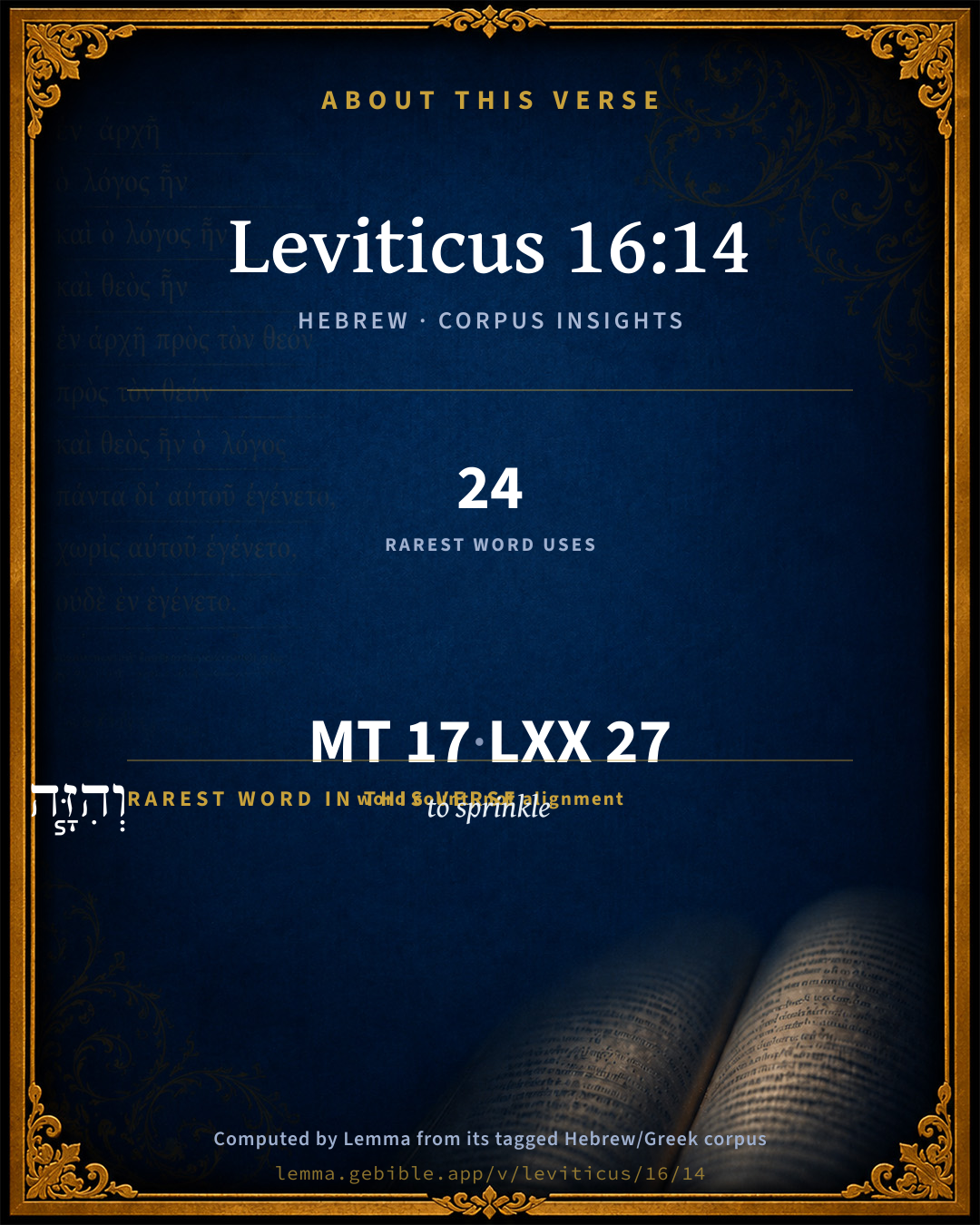
The rarest word here is וְהִזָּ֧ה to sprinkle H5137 — appearing just 24 times in the whole Hebrew Bible.

Shared distinctive vocabulary

וְהִזָּ֧ה to sprinkle H5137 occurs in 22 verses of the Hebrew Bible. Also found in:

Grammatical profile

  • 3 verbs
  • 11 nouns
  • 1 adjective
  • 2 prepositions

Verb forms

  • וְלָקַח֙ Qal · Sequential Perfect
  • וְהִזָּ֧ה Hiphil · Sequential Perfect
  • יַזֶּ֧ה Hiphil · Imperfect

Repetition

Words recur within this verse — often emphatic in Hebrew:

  • מִדַּ֣ם blood H1818 ×2
  • וְהִזָּ֧ה to sprinkle H5137 ×2
  • בְאֶצְבָּע֛וֹ finger H676 ×2
  • פְּנֵ֥י face H6440 ×2
  • הַכַּפֹּ֖רֶת mercy seat H3727 ×2

Hebrew & Septuagint length

In English translation the verse runs 40 words from the Hebrew and 33 from the Septuagint (LXX English) — closely comparable.

A rough comparison of the two English renderings, which tokenize alike — not a word-level alignment.

Word counts can differ between the Hebrew and the Greek without any difference in meaning — e.g. the Hebrew direct-object marker אֵת has no separate Greek word, and Greek often adds the article ὁ.

In the original languages it is 17 Hebrew tokens and 27 Greek tokens — but the two are counted differently (Hebrew bundles its prefixes and suffixes into one token; the Greek is in lemma form), so that isn’t a like-for-like length.

Cross-references

11

Topical passages linked to Leviticus 16:14 in the Treasury of Scripture Knowledge — connected by theme and wording, ordered by reader-vote popularity; previews shown in the World English Bible.

  • Leviticus 4:5–6 The anointed priest shall take some of the blood of the bull, and bring it to the Tent of Meeting.
  • Hebrews 9:25 nor yet that he should offer himself often, as the high priest enters into the holy place year by year with blood not his own,
  • Hebrews 9:13 For if the blood of goats and bulls, and the ashes of a heifer sprinkling those who have been defiled, sanctify to the cleanness of the flesh:
  • Leviticus 4:17 and the priest shall dip his finger in the blood, and sprinkle it seven times before Yahweh, before the veil.
  • Leviticus 8:11 He sprinkled it on the altar seven times, and anointed the altar and all its vessels, and the basin and its base, to sanctify them.
  • Hebrews 9:7 but into the second the high priest alone, once in the year, not without blood, which he offers for himself, and for the errors of the people.
  • Hebrews 10:4 For it is impossible that the blood of bulls and goats should take away sins.
  • Romans 3:24–26 being justified freely by his grace through the redemption that is in Christ Jesus;
  • Hebrews 10:10–12 by which will we have been sanctified through the offering of the body of Jesus Christ once for all.
  • Hebrews 10:19 Having therefore, brothers, boldness to enter into the holy place by the blood of Jesus,
  • Hebrews 12:24 to Jesus, the mediator of a new covenant, and to the blood of sprinkling that speaks better than that of Abel.

Cross-references courtesy of OpenBible.info (CC BY 4.0).

Hebrew and Greek witnesses Masoretic Hebrew ↔ Greek Septuagint

The same verse in the two great witnesses to the Old Testament, shown verse-for-verse.

These are two independent witnesses, not word-aligned to each other, and the Septuagint is shown in lemma (dictionary) form.

Hebrew Leviticus 16:14 Masoretic · Westminster Leningrad Codex

וְלָקַח֙ מִדַּ֣ם הַפָּ֔ר וְהִזָּ֧ה בְאֶצְבָּע֛וֹ עַל פְּנֵ֥י הַכַּפֹּ֖רֶת קֵ֑דְמָה וְלִפְנֵ֣י הַכַּפֹּ֗רֶת יַזֶּ֧ה שֶֽׁבַע פְּעָמִ֛ים מִן הַדָּ֖ם בְּאֶצְבָּעֽוֹ

He shall take some of the blood of the bull, and sprinkle it with his finger on the mercy seat on the east; and before the mercy seat he shall sprinkle some of the blood with his finger seven times.

World English Bible · Public Domain

Greek LXX Leviticus 16:14 Septuagint · lemma form

καί λαμβάνω ἀπό ὁ αἷμα ὁ μόσχος καί ῥαίνω ὁ δάκτυλος ἐπί ὁ ἱλαστήριον κατά ἀνατολή κατά πρόσωπον ὁ ἱλαστήριον ῥαίνω ἑπτάκις ἀπό ὁ αἷμα ὁ δάκτυλος

And he shall take of the blood of the calf, and sprinkle with his finger on the mercy-seat eastward: before the mercy-seat shall he sprinkle seven times of the blood with his finger.

LXX2012 (modern English Septuagint) · Public Domain

Hebrew: Westminster Leningrad Codex (CC BY 4.0). Greek: Septuagint (public domain); English from LXX2012 (modern English Septuagint) (Public Domain). How the Septuagint differs from the Hebrew →

Targum (Aramaic paraphrase)

2

The Targum is the ancient Jewish Aramaic paraphrase of the Hebrew Scriptures — an interpretive translation, not the Hebrew text itself. Onkelos (literal) and Pseudo-Jonathan (expansive) render the Torah, and Jonathan the Prophets. Coverage is partial: where no permissively-licensed English translation exists for a verse, only the Aramaic is shown. This is verse-level text, not a word-by-word alignment to the Hebrew.

  1. Targum Onkelos Torah (Genesis–Deuteronomy)
    וְיִסַב מִדְמָא דְתוֹרָא וְיַדֵי בְאֶצְבְּעֵהּ עַל אַפֵּי כַּפּוּרְתָּא קִדוּמָא וְלָקֳדָם כַּפֻּרְתָּא יַדִי שְׁבַע זִמְנִין מִן דְמָא בְּאֶצְבְּעֵהּ

    (no public-domain English translation for this verse)

    Targum Onkelos — Aramaic: “Onkelos Genesis” (public domain); “Onkelos Exodus” (public domain); “Onkelos Leviticus” (public domain); “Onkelos Numbers” (public domain); “Onkelos Deuteronomy” (public domain). English: “Sefaria Community Translation” (CC0 1.0 (public-domain dedication)); “J.W. Etheridge. The Targums of Onkelos and Jonathan Ben Uzziel on the Pentateuch. London: Longmans, Green, 1862” (public domain). Text via Sefaria.

  2. Targum Pseudo-Jonathan Torah (Genesis–Deuteronomy)
    וְיִסַב מִן אַדְמָא דְתוֹרָא וְיַדֵי בְּאַדְבְּעֵיהּ יְמִינָא עַל אַפֵּי כַּפּוּרְתָּא לְרוּחַ קִידוּמָא וְלִקְדָם כַּפּוּרְתָּא יַדֵי שְׁבַע זִמְנִין מִן אַדְמָהּ בְּאַדְבְּעֵיהּ יַמִינָא

    And he shall take of the blood of the bullock, and sprinkle with his right finger upon the face of the mercy-seat eastward, and before the mercyseat he shall sprinkle the blood seven times with his right finger.

    Targum Pseudo-Jonathan — Aramaic: “Targum Jonathan on Genesis” (public domain); “Targum Jonathan on Exodus” (public domain); “Targum Jonathan on Leviticus” (public domain); “Targum Jonathan on Numbers” (public domain); “Targum Jonathan on Deuteronomy” (public domain). English: “The Targum of Jonathan ben Uzziel, trans. J. W. Etheridge, London, 1862” (public domain). Text via Sefaria.

Commentary

Notes on Leviticus 16:14 from classic Christian and Jewish commentators (each source and its license shown beneath its notes). The classic Christian expositions comment on the surrounding passage and are grouped to its opening verse, so a note may address several verses; the Jewish commentaries on the Tanakh (Rashi and others) are per-verse, so they appear only where the commentator wrote on this verse.

Lemma curates 59 commentaries, every one of them public domain or Creative Commons licensed, each selected and text-cleaned for this edition rather than reprinted as found. About our sources →

Trapp's Complete Commentary

John Trapp

Lev 16:14 And he shall take of the blood of the bullock, and sprinkle [it] with his finger upon the mercy seat eastward; and before the mercy seat shall he sprinkle of the blood with his finger seven times.

Ver. 14. Upon the mercy seat eastward.] This and the following verses signify, saith one, that even heaven itself is defiled unto us by our sins; until it be made clean by the blood and obedience of Christ, who is entered thither, "not by the blood of goats and calves, but by his own blood," and thereby hath "purified the heavenly things themselves." {Heb 9:12; Heb 9:23}

John Trapp, A Commentary or Exposition upon All the Books of the Old and New Testament (1647–1656) — public domain. Text from a community e-Sword module.

Joseph Benson's Commentary

Lev 16:14. He shall take of the blood — He went out of the holy place, and then entered it a second time. We must observe, that as the burning of the incense preceded the sprinkling of the blood, it was hereby signified that he was to be prepared for entering into the most holy place by prayer, and was to enter it in a spirit of prayer, which was figured by incense, and which the offering of incense accompanied, Rev 8:3-4. A lively emblem this of the intercession of our great High-Priest, and the efficacy of his merits. He shall sprinkle it upon the mercy-seat — To teach us, that God is merciful to sinners only through and for the blood of Christ. With his face eastward, or upon the eastern part, toward the people, who were in the court which lay eastward from the holy of holies, which was the most western part of the tabernacle. This signified that the high-priest in this act represented the people, and that God accepted it on their behalf; before the mercy-seat — On the ground.

Joseph Benson's Commentary on the Old and New Testaments (1811–1818) — public domain. Text from a community e-Sword module.

Geneva Bible (1599)

Geneva Bible translators

That is, on the side which was toward the people: for the head of the Sanctuary stood Westward.

Geneva Bible (1599) marginal notes — public domain. Text via Bolls.life.

Ellicott's Commentary for English Readers

(14) And he shall take of the blood.—Having left the Holy place and returned to the court, where the priest stood with the bowl of the blood of the bullock, stirring it, to prevent it coagulating (see Lev_16:11), the high priest took it, and went back to the Holy of Holies, to the same place where he stood on his first entry.

Sprinkle it with his finger.—During the second Temple the high priest sprinkled the blood once upwards and seven times downwards, in such a manner that the eight sprinklings formed a continuous line on the ground. As he sprinkled he was obliged to count one, two, three, &c, lest he should make a mistake.

A Bible Commentary for English Readers, edited by Charles John Ellicott (1878–1897) — public domain. Text from a community e-Sword module.

John Gill's Exposition

And he shall take of the blood of the bullock,.... When the high priest slew the bullock, the blood was received in a basin, and given to another priest, that he might keep stirring it on a foursquare bench in the temple, that so it might not thicken and congeal (n), but by a continual motion might become thin and liquid, and fit for sprinkling; and this was doing, while the high priest was gone into the most holy place to offer the incense; which being done, he came out again and took the basin of blood out of the hand of the priest, and went in a second time, and did with it as follows:

and sprinkle it with his finger upon the mercy seat, eastward; with his right finger, or forefinger, as the Targum of Jonathan; and the blood sprinkled with it did not fall upon the mercy seat, as our version seems to intimate, but it was sprinkled over against it, towards the upper part of it. Aben Ezra says, that according to their interpreters, "upon the face of the mercy seat", as the words may be literally rendered, signifies above, between the two bars, and here it was the high priest stood; for, according to the Misnah (o), he went in to the place where he had gone in, and stood in the place where he had stood, and then sprinkled, that is, in the same place where he had been and offered the incense; See Gill on Lev 16:13; and here he stood, not with his face to the east, for then his back must have been to the mercy seat, but he stood with his face to the eastern part of the mercy seat, and there sprinkled the blood upwards:

and before the mercy seat shall he sprinkle of the blood with his finger seven times; besides the first sprinkling that was upward, and those downward; so says the Misnah (p), he sprinkled of it (the blood) once above, and seven times below; the same Jarchi observes; and the tradition adds, and he did not look in sprinkling neither above nor below; that is, he did not look to the mercy seat, nor was there any need of it, since the blood did not reach the mercy seat, but fell upon the ground; it was enough that it was done before it, and over against it, and with a respect unto it; or otherwise, had it, fallen on it, it would have been besmeared with it, and would not have been so comely and decent: the mystery of this was to represent the blood of Christ, and perfect purification and atonement by it, and that mercy and justice are reconciled to each other, and agree together in the forgiveness of sinners; and that there is no mercy but in a way of justice, no remission of sin, no justification of persons, no salvation for any of the sons of men, but through the blood of Christ, and the complete atonement made thereby.

(n) Misn. Yoma, c. 4. sect. 3. (o) Ibid. c. 5. sect. 3. (p) Misn. Yoma, c. 5. sect. 3.

John Gill's Exposition of the Whole Bible (1746–1763) — public domain (CC PDM 1.0). Text via the HelloAO Bible API.

Matthew Poole's English Annotations

He shall sprinkle it upon the mercy-seat, to teach us that God is merciful to sinners only through and for the blood of Christ.

Eastward, i.e. with his face eastward, or upon the eastern part of it, towards the people, who were in the court, which lay eastward from the holy of holies, which was the most western part of the tabernacle. This signified that the high priest in this act represented the people, and that God accepted it on their behalf.

Before the mercy-seat; on the ground.

Matthew Poole's English Annotations on the Holy Bible (1683–1685) — public domain. Text from a community e-Sword/MySword module.

Whedon's Commentary on the Bible

Daniel D. Whedon

14. Upon the mercy seat — Eastward. Luther’s version is very literal, “Gegen den Gnadenstuhl sprengen vorn an,” Sprinkle against the mercy seat in front. Our English version is opposed to every Jewish authority. Ewald, however, supports it, while the Vulgate omits these words. Outram and Murphy insist that “the blood did not come upon the mercy seat, but fell upon the ground.” The “Seventy” follows the ambiguity of the Hebrew, which is, “upon the face of the mercy seat eastward.” This may direct that the eastern or front side of the ark and the front edge of its cover, the mercy-seat, be stained with blood, or that the blood drops be sprinkled on the east side of the ark, between it and the vail. If the latter be the meaning the last clause of the verse is a repetition for the purpose of emphasizing the seven times to denote the perfection of the expiation. “The bearing of the blood of expiation into the most holy place, where no Israelite ever entered save the high priest, taught that the true expiation could only be effected by one who should pass into the presence of God, and leave the door wide open for all to enter.” — Dr. A. McLaren. “The anti-typal correlative of the presentation of the blood before the mercy seat was our Lord’s appearance before God the Father, bearing in his glorified body (identical with that which suffered) his own precious blood, now glorified, yet still identical with that which had been shed. That high-priestly self-presentation of the Redeemer is the eternal conclusion and ratifying seal of the work of redemption.” — Delitzsch on the Epistle to the Hebrews. See Lev_6:27, note, on the blood of Christ in heaven.

Daniel D. Whedon (gen. ed.), Commentary on the Old and New Testaments (1874–1909) — public domain. Text from a community e-Sword module.

The Pulpit Commentary

The second entry of the high priest into the holy of holies took place very soon after the first entry. Immediately that he had returned after lighting the incense, and perhaps offering a prayer, he took of the blood of the bullock, which he had previously killed, went back without delay, and sprinkled it with his finger upon the mercy seat eastward, that is, on the front of the ark beneath the Presence enthroned upon the mercy seat, and shrouded by the smoke of the incense; and before the mercy seat, that is, on the ground in front of it, he sprinkled of the blood with his finger seven times. In after times, when the ark was gone, the high priest sprinkled upwards once and downwards seven times.

The Pulpit Commentary (1880–1919), ed. H.D.M. Spence-Jones & Joseph S. Exell — public domain. Text from a community e-Sword module.

John Wesley's Explanatory Notes

Upon the mercy-seat - To teach us, that God is merciful to sinners only through and for the blood of Christ. With his face east-ward, or upon the eastern part, towards the people, who were in the court which lay east-ward from the holy of holies, which was the most western part of the tabernacle. This signified that the high-priest in this act represented the people, and that God accepted it on their behalf. Before the mercy-seat - On the ground.

John Wesley, Explanatory Notes Upon the Whole Bible (1754–1765) — public domain. Text via the GEBible commentary corpus.

unfoldingWord translationNotes

Door43 World Missions Community

the blood of the bull

This is the blood Aaron caught with a bowl in Leviticus 16:11.

sprinkle it with his finger

He used his finger to splash the blood.

on the front of the atonement lid

He put the blood on the top part of the lid. He also put it on the side of the lid that was towards him as he entered the most holy place.

before the atonement lid

Possible meanings are 1) "below the atonement lid onto the chest" or 2) "onto the ground in front of the atonement lid."

translationWords

blood

unfoldingWord translationNotes — © Distant Shores Media and the Door43 World Missions Community, licensed CC BY-SA 4.0. Source: git.door43.org/Door43/en_tn.

Rashi

Rabbi Shlomo Yitzchaki (Rashi)

והזה באצבעו AND HE SHALL SPRINKLE IT WITH THE FINGER — One sprinkling only is implied (since the next phrase mentions a definite number),

ולפני הכפרת יזה שבע AND BEFORE THE COVERING SHALL HE SPRINKLE [OF THE BLOOD] SEVEN TIMES — Thus we have one sprinkling upwards and seven downwards (Yoma 53b).

Rashi on the Tanakh — English translations: “The Judaica Press complete Tanach with Rashi, translated by A. J. Rosenberg” (CC BY 4.0); “Pentateuch with Rashi's commentary by M. Rosenbaum and A.M. Silbermann, 1929-1934” (public domain); “The Metsudah Tanach series, Lakewood, N.J” (CC BY 4.0); and “The Book of Joshua, Metsudah Publications, 1997” (CC BY 4.0). Text via Sefaria.

Lesson kit

Teaching starters — assembled from the data on this page, not authored interpretation. Every prompt links to the verse data it draws on. Edit before teaching.

Leviticus, in the Pentateuch, opens this verse with 17 words (12 distinct Hebrew lemmas). Its most distinctive word is nâzâh (“to sprinkle”). A historical commentator’s framing appears above. Read the whole chapter for the surrounding context.

Discussion questions

  1. What does “to sprinkle” (nâzâh) contribute to the verse as a whole?
  2. Exodus 29:21 shares the word «to sprinkle» with this verse. How do the two illuminate each other?
  3. “blood” occurs 2× in this one verse. What is the effect of the repetition?
  4. These translations render this verse differently. What is at stake in choosing one wording over another?
  5. The verb «וְלָקַח֙» is Qal Sequential Perfect. How does its form color the action?
  6. Reading how Trapp's Complete Commentary and Joseph Benson's Commentary read this verse, where do the two commentators agree and where do they part?

Things to notice

Reading settings

Reading text

Shown beneath each verse's original-language words.

Old Testament
Old Testament edition

Read the OT as the Masoretic Hebrew (MT) or the Greek Septuagint (LXX).

English shown for the Greek Septuagint (in the Hebrew ↔ Greek comparison).

Comparing translations? Open the Compare panel on any verse page to stack up to four side by side.