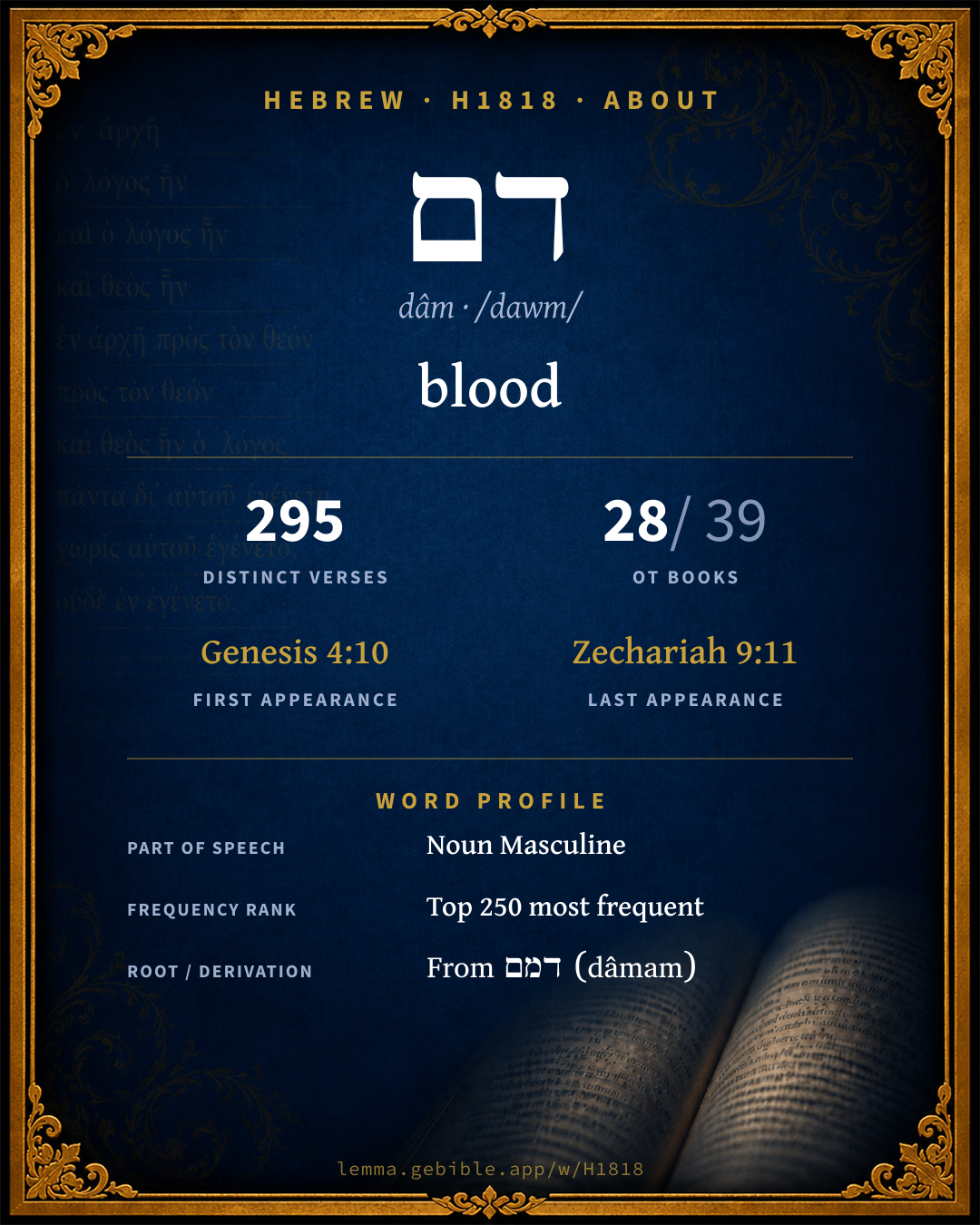
דָּם
blood
‘blood’ is one of 2 main senses fuller range ↓
Full lexicon entry — Brown-Driver-Briggs (BDB)
From Brown-Driver-Briggs (BDB)
Where this word appears
See every Absolute-state word in the Hebrew Bible →
Grammar key — what these labels mean
Part of speech
- Noun
- A naming word — a person, place, thing, or idea.
Noun type
- Common
- A common noun — a general class of person, place, or thing (“king,” “city,” “water”), not a specific name.
State
- Absolute
- The independent form of a noun, not bound to a following word.
- Construct
- A noun bound to a following noun in a possessive / “of” relationship (the construct chain).
Gender
- Masculine
- Grammatically masculine.
Number
- Singular
- One.
- Plural
- More than one (in Hebrew, generally three or more).
Grammatical forms
- Noun, Common, Masculine, Singular, Absolute 157 times (43%)
- Noun, Common, Masculine, Singular, Construct 131 times (36%)
- Noun, Common, Masculine, Plural, Construct 37 times (10%)
- Noun, Common, Masculine, Plural, Absolute 36 times (10%)
Parsed forms decoded from the imported morphology (morphhb / Westminster Leningrad Codex — WLC text public domain, morphhb tagging CC BY 4.0), counted across 361 parsed occurrences — not distinct verses.
Page 1 of 2 — showing verses 1–200 of 295 distinct verses where H1818 appears, across 28 books. Click any verse to open its interlinear word-by-word view. Verse text shown in the World English Bible for context — . Each verse’s Hebrew form is shown with its reference; the English is not keyword-highlighted, since the data carries no word-level English alignment. Use “Compare translations” on any verse to read it across multiple English versions. This concordance covers the Hebrew Bible; Septuagint (Greek Old Testament) occurrences are not indexed here.
Genesis 10 verses
- Genesis 4:10 דְּמֵ֣י n c mp cs Yahweh said, "What have you done? The voice of your brother's blood cries to me from the ground.
- Genesis 4:11 דְּמֵ֥י n c mp cs Now you are cursed because of the ground, which has opened its mouth to receive your brother's blood from your hand.
- Genesis 9:4 דָמ֖/וֹ n c ms cs + sfx pers 3ms But flesh with the life of it, the blood of it, you shall not eat.
- Genesis 9:5 דִּמְ/כֶ֤ם n c ms cs + sfx pers 2mp I will surely require your blood of your lives. At the hand of every animal I will require it. At the hand of man, even at the hand of every man's brother, I will require the life of man.
- Genesis 9:6 דַּ֣ם דָּמ֣/וֹ n c ms cs n c ms cs + sfx pers 3ms Whoever sheds man's blood, by man will his blood be shed, for in the image of God made he man.
- Genesis 37:22 דָם֒ n c ms Reuben said to them, "Shed no blood. Throw him into this pit that is in the wilderness, but lay no hand on him"-- that he might deliver him out of their hand, to restore him to his father.
- Genesis 37:26 דָּמֽ/וֹ n c ms cs + sfx pers 3ms Judah said to his brothers, "What profit is it if we kill our brother and conceal his blood?
- Genesis 37:31 בַּ/דָּֽם prep det + n c ms They took Joseph's coat, and killed a male goat, and dipped the coat in the blood.
- Genesis 42:22 דָּמ֖/וֹ n c ms cs + sfx pers 3ms Reuben answered them, saying, "Didn't I tell you, saying, 'Don't sin against the child,' and you wouldn't listen? Therefore also, behold, his blood is required."
- Genesis 49:11 וּ/בְ/דַם conj + prep + n c ms cs Binding his foal to the vine, His donkey's colt to the choice vine; He has washed his garments in wine, His robes in the blood of grapes:
Exodus 22 verses
- Exodus 4:9 לְ/דָ֖ם prep + n c ms It will happen, if they will not believe even these two signs, neither listen to your voice, that you shall take of the water of the river, and pour it on the dry land. The water which you take out of the river will become blood on the dry land."
- Exodus 4:25 דָּמִ֛ים n c mp Then Zipporah took a flint, and cut off the foreskin of her son, and cast it at his feet; and she said, "Surely you are a bridegroom of blood to me."
- Exodus 4:26 דָּמִ֖ים n c mp So he let him alone. Then she said, "You are a bridegroom of blood," because of the circumcision.
- Exodus 7:17 לְ/דָֽם prep + n c ms Thus says Yahweh, "In this you shall know that I am Yahweh. Behold, I will strike with the rod that is in my hand on the waters which are in the river, and they shall be turned to blood.
- Exodus 7:19 דָ֑ם דָם֙ n c ms n c ms Yahweh said to Moses, "Tell Aaron, 'Take your rod, and stretch out your hand over the waters of Egypt, over their rivers, over their streams, and over their pools, and over all their ponds of water, that they may become blood; and there shall be blood throughout all the land of Egypt, both in vessels of wood and in vessels of stone.'"
- Exodus 7:20 לְ/דָֽם prep + n c ms Moses and Aaron did so, as Yahweh commanded; and he lifted up the rod, and struck the waters that were in the river, in the sight of Pharaoh, and in the sight of his servants; and all the waters that were in the river were turned to blood.
- Exodus 7:21 הַ/דָּ֖ם ptcl def.art + n c ms The fish that were in the river died; and the river became foul, and the Egyptians couldn't drink water from the river; and the blood was throughout all the land of Egypt.
- Exodus 12:7 הַ/דָּ֔ם ptcl def.art + n c ms They shall take some of the blood, and put it on the two side-posts and on the lintel, on the houses in which they shall eat it.
- Exodus 12:13 הַ/דָּ֨ם הַ/דָּ֔ם ptcl def.art + n c ms ptcl def.art + n c ms The blood shall be to you for a token on the houses where you are: and when I see the blood, I will pass over you, and there shall no plague be on you to destroy you, when I strike the land of Egypt.
- Exodus 12:22 בַּ/דָּ֣ם הַ/דָּ֖ם prep det + n c ms ptcl def.art + n c ms You shall take a bunch of hyssop, and dip it in the blood that is in the basin, and strike the lintel and the two side-posts with the blood that is in the basin; and none of you shall go out of the door of his house until the morning.
- Exodus 12:23 הַ/דָּם֙ ptcl def.art + n c ms For Yahweh will pass through to strike the Egyptians; and when he sees the blood on the lintel, and on the two side-posts, Yahweh will pass over the door, and will not allow the destroyer to come in to your houses to strike you.
- Exodus 22:2 דָּמִֽים n c mp If the thief is found breaking in, and is struck so that he dies, there shall be no guilt of bloodshed for him.
- Exodus 22:3 דָּמִ֣ים n c mp If the sun has risen on him, there shall be guilt of bloodshed for him; he shall make restitution. If he has nothing, then he shall be sold for his theft.
- Exodus 23:18 דַּם n c ms cs "You shall not offer the blood of my sacrifice with leavened bread, neither shall the fat of my feast remain all night until the morning.
- Exodus 24:6 הַ/דָּ֔ם הַ/דָּ֔ם ptcl def.art + n c ms ptcl def.art + n c ms Moses took half of the blood and put it in basins, and half of the blood he sprinkled on the altar.
- Exodus 24:8 הַ/דָּ֔ם דַֽם ptcl def.art + n c ms n c ms cs Moses took the blood, and sprinkled it on the people, and said, "Look, this is the blood of the covenant, which Yahweh has made with you concerning all these words."
- Exodus 29:12 מִ/דַּ֣ם הַ/דָּ֣ם prep + n c ms cs ptcl def.art + n c ms You shall take of the blood of the bull, and put it on the horns of the altar with your finger; and you shall pour out all the blood at the base of the altar.
- Exodus 29:16 דָּמ֔/וֹ n c ms cs + sfx pers 3ms You shall kill the ram, and you shall take its blood, and sprinkle it around on the altar.
- Exodus 29:20 מִ/דָּמ/וֹ֙ הַ/דָּ֛ם prep + n c ms cs + sfx pers 3ms ptcl def.art + n c ms Then you shall kill the ram, and take some of its blood, and put it on the tip of the right ear of Aaron, and on the tip of the right ear of his sons, and on the thumb of their right hand, and on the big toe of their right foot, and sprinkle the blood on the altar round about.
- Exodus 29:21 הַ/דָּ֨ם ptcl def.art + n c ms You shall take of the blood that is on the altar, and of the anointing oil, and sprinkle it on Aaron, and on his garments, and on his sons, and on the garments of his sons with him: and he shall be made holy, and his garments, and his sons, and his sons' garments with him.
- Exodus 30:10 מִ/דַּ֞ם prep + n c ms cs Aaron shall make atonement on its horns once in the year; with the blood of the sin offering of atonement once in the year he shall make atonement for it throughout your generations. It is most holy to Yahweh."
- Exodus 34:25 דַּם n c ms cs "You shall not offer the blood of my sacrifice with leavened bread; neither shall the sacrifice of the feast of the Passover be left to the morning.
Leviticus 66 verses
- Leviticus 1:5 הַ/דָּ֔ם הַ/דָּ֤ם ptcl def.art + n c ms ptcl def.art + n c ms He shall kill the bull before Yahweh. Aaron's sons, the priests, shall present the blood and sprinkle the blood around on the altar that is at the door of the Tent of Meeting.
- Leviticus 1:11 דָּמ֛/וֹ n c ms cs + sfx pers 3ms He shall kill it on the north side of the altar before Yahweh. Aaron's sons, the priests, shall sprinkle its blood around on the altar.
- Leviticus 1:15 דָמ֔/וֹ n c ms cs + sfx pers 3ms The priest shall bring it to the altar, and wring off its head, and burn it on the altar; and its blood shall be drained out on the side of the altar;
- Leviticus 3:2 הַ/דָּ֛ם ptcl def.art + n c ms He shall lay his hand on the head of his offering, and kill it at the door of the tent of meeting: and Aaron's sons the priests shall sprinkle the blood on the altar round about.
- Leviticus 3:8 דָּמ֛/וֹ n c ms cs + sfx pers 3ms and he shall lay his hand on the head of his offering, and kill it before the tent of meeting: and Aaron's sons shall sprinkle its blood on the altar round about.
- Leviticus 3:13 דָּמ֛/וֹ n c ms cs + sfx pers 3ms and he shall lay his hand on its head, and kill it before the tent of meeting; and the sons of Aaron shall sprinkle its blood on the altar round about.
- Leviticus 3:17 דָּ֖ם n c ms "'It shall be a perpetual statute throughout your generations in all your dwellings, that you shall eat neither fat nor blood.'"
- Leviticus 4:5 מִ/דַּ֣ם prep + n c ms cs The anointed priest shall take some of the blood of the bull, and bring it to the Tent of Meeting.
- Leviticus 4:6 בַּ/דָּ֑ם הַ/דָּ֜ם prep det + n c ms ptcl def.art + n c ms The priest shall dip his finger in the blood, and sprinkle some of the blood seven times before Yahweh, before the veil of the sanctuary.
- Leviticus 4:7 הַ/דָּ֜ם דַּ֣ם ptcl def.art + n c ms n c ms cs The priest shall put some of the blood on the horns of the altar of sweet incense before Yahweh, which is in the tent of meeting; and he shall pour out all the blood of the bull out at the base of the altar of burnt offering, which is at the door of the Tent of Meeting.
- Leviticus 4:16 מִ/דַּ֣ם prep + n c ms cs The anointed priest shall bring of the blood of the bull to the Tent of Meeting:
- Leviticus 4:17 הַ/דָּ֑ם ptcl def.art + n c ms and the priest shall dip his finger in the blood, and sprinkle it seven times before Yahweh, before the veil.
- Leviticus 4:18 הַ/דָּ֞ם הַ/דָּ֗ם ptcl def.art + n c ms ptcl def.art + n c ms He shall put some of the blood on the horns of the altar which is before Yahweh, that is in the Tent of Meeting; and the rest of the blood he shall pour out at the base of the altar of burnt offering, which is at the door of the Tent of Meeting.
- Leviticus 4:25 מִ/דַּ֤ם דָּמ֣/וֹ prep + n c ms cs n c ms cs + sfx pers 3ms The priest shall take some of the blood of the sin offering with his finger, and put it on the horns of the altar of burnt offering. He shall pour out the rest of its blood at the base of the altar of burnt offering.
- Leviticus 4:30 מִ/דָּמָ/הּ֙ דָּמָ֣/הּ prep + n c ms cs + sfx pers 3fs n c ms cs + sfx pers 3fs The priest shall take some of its blood with his finger, and put it on the horns of the altar of burnt offering; and the rest of its blood he shall pour out at the base of the altar.
- Leviticus 4:34 מִ/דַּ֤ם דָּמָ֣/הּ prep + n c ms cs n c ms cs + sfx pers 3fs The priest shall take some of the blood of the sin offering with his finger, and put it on the horns of the altar of burnt offering; and all the rest of its blood he shall pour out at the base of the altar.
- Leviticus 5:9 מִ/דַּ֤ם בַּ/דָּ֔ם prep + n c ms cs prep det + n c ms He shall sprinkle some of the blood of the sin offering on the side of the altar; and the rest of the blood shall be drained out at the base of the altar. It is a sin offering.
- Leviticus 6:27 מִ/דָּמָ/הּ֙ prep + n c ms cs + sfx pers 3fs Whatever shall touch its flesh shall be holy. When there is any of its blood sprinkled on a garment, you shall wash that on which it was sprinkled in a holy place.
- Leviticus 6:30 מִ/דָּמָ֜/הּ prep + n c ms cs + sfx pers 3fs No sin offering, of which any of the blood is brought into the Tent of Meeting to make atonement in the Holy Place, shall be eaten: it shall be burned with fire.
- Leviticus 7:2 דָּמ֛/וֹ n c ms cs + sfx pers 3ms In the place where they kill the burnt offering, he shall kill the trespass offering; and its blood he shall sprinkle on the altar round about.
- Leviticus 7:14 דַּ֥ם n c ms cs Of it he shall offer one out of each offering for a heave offering to Yahweh. It shall be the priest's who sprinkles the blood of the peace offerings.
- Leviticus 7:26 דָּם֙ n c ms You shall not eat any blood, whether it is of bird or of animal, in any of your dwellings.
- Leviticus 7:27 דָּ֑ם n c ms Whoever it is who eats any blood, that soul shall be cut off from his people.'"
- Leviticus 7:33 דַּ֧ם n c ms cs He among the sons of Aaron who offers the blood of the peace offerings, and the fat, shall have the right thigh for a portion.
- Leviticus 8:15 הַ/דָּם֙ הַ/דָּ֗ם ptcl def.art + n c ms ptcl def.art + n c ms He killed it; and Moses took the blood, and put it on the horns of the altar round about with his finger, and purified the altar, and poured out the blood at the base of the altar, and sanctified it, to make atonement for it.
- Leviticus 8:19 הַ/דָּ֛ם ptcl def.art + n c ms He killed it; and Moses sprinkled the blood on the altar round about.
- Leviticus 8:23 מִ/דָּמ֔/וֹ prep + n c ms cs + sfx pers 3ms He killed it; and Moses took some of its blood, and put it on the tip of Aaron's right ear, and on the thumb of his right hand, and on the great toe of his right foot.
- Leviticus 8:24 הַ/דָּם֙ הַ/דָּ֛ם ptcl def.art + n c ms ptcl def.art + n c ms He brought Aaron's sons; and Moses put some of the blood on the tip of their right ear, and on the thumb of their right hand, and on the great toe of their right foot; and Moses sprinkled the blood on the altar round about.
- Leviticus 8:30 הַ/דָּם֮ ptcl def.art + n c ms Moses took some of the anointing oil, and some of the blood which was on the altar, and sprinkled it on Aaron, on his garments, and on his sons, and on his sons' garments with him, and sanctified Aaron, his garments, and his sons, and his sons' garments with him.
- Leviticus 9:9 הַ/דָּם֮ בַּ/דָּ֔ם הַ/דָּ֣ם ptcl def.art + n c ms prep det + n c ms ptcl def.art + n c ms The sons of Aaron presented the blood to him; and he dipped his finger in the blood, and put it on the horns of the altar, and poured out the blood at the base of the altar:
- Leviticus 9:12 הַ/דָּ֔ם ptcl def.art + n c ms He killed the burnt offering; and Aaron's sons delivered the blood to him, and he sprinkled it on the altar round about.
- Leviticus 9:18 הַ/דָּם֙ ptcl def.art + n c ms He also killed the ox and the ram, the sacrifice of peace offerings, which was for the people: and Aaron's sons delivered to him the blood, which he sprinkled on the altar round about,
- Leviticus 10:18 דָּמָ֔/הּ n c ms cs + sfx pers 3fs Behold, its blood was not brought into the inner part of the sanctuary: you certainly should have eaten it in the sanctuary, as I commanded."
- Leviticus 12:4 בִּ/דְמֵ֣י prep + n c mp cs She shall continue in the blood of purification thirty-three days. She shall not touch any holy thing, nor come into the sanctuary, until the days of her purifying are completed.
- Leviticus 12:5 דְּמֵ֥י n c mp cs But if she bears a female child, then she shall be unclean two weeks, as in her period; and she shall continue in the blood of purification sixty-six days.
- Leviticus 12:7 דָּמֶ֑י/הָ n c mp cs + sfx pers 3fs and he shall offer it before Yahweh, and make atonement for her; and she shall be cleansed from the fountain of her blood. "'This is the law for her who bears, whether a male or a female.
- Leviticus 14:6 בְּ/דַם֙ prep + n c ms cs As for the living bird, he shall take it, and the cedar wood, and the scarlet, and the hyssop, and shall dip them and the living bird in the blood of the bird that was killed over the running water.
- Leviticus 14:14 מִ/דַּ֣ם prep + n c ms cs The priest shall take some of the blood of the trespass offering, and the priest shall put it on the tip of the right ear of him who is to be cleansed, and on the thumb of his right hand, and on the big toe of his right foot.
- Leviticus 14:17 דַּ֥ם n c ms cs The priest shall put some of the rest of the oil that is in his hand on the tip of the right ear of him who is to be cleansed, and on the thumb of his right hand, and on the big toe of his right foot, upon the blood of the trespass offering.
- Leviticus 14:25 מִ/דַּ֣ם prep + n c ms cs He shall kill the lamb of the trespass offering. The priest shall take some of the blood of the trespass offering and put it on the tip of the right ear of him who is to be cleansed, and on the thumb of his right hand, and on the big toe of his right foot.
- Leviticus 14:28 דַּ֥ם n c ms cs Then the priest shall put some of the oil that is in his hand on the tip of the right ear of him who is to be cleansed, and on the thumb of his right hand, and on the big toe of his right foot, on the place of the blood of the trespass offering.
- Leviticus 14:51 בְּ/דַם֙ prep + n c ms cs He shall take the cedar wood, and the hyssop, and the scarlet, and the living bird, and dip them in the blood of the slain bird, and in the running water, and sprinkle the house seven times.
- Leviticus 14:52 בְּ/דַם֙ prep + n c ms cs He shall cleanse the house with the blood of the bird, and with the running water, with the living bird, with the cedar wood, with the hyssop, and with the scarlet;
- Leviticus 15:19 דָּ֛ם n c ms "'If a woman has a discharge, and her discharge in her flesh is blood, she shall be in her impurity seven days: and whoever touches her shall be unclean until the evening.
- Leviticus 15:25 דָּמָ֜/הּ n c ms cs + sfx pers 3fs "'If a woman has a discharge of her blood many days not in the time of her period, or if she has a discharge beyond the time of her period; all the days of the discharge of her uncleanness shall be as in the days of her period: she is unclean.
- Leviticus 16:14 מִ/דַּ֣ם הַ/דָּ֖ם prep + n c ms cs ptcl def.art + n c ms He shall take some of the blood of the bull, and sprinkle it with his finger on the mercy seat on the east; and before the mercy seat he shall sprinkle some of the blood with his finger seven times.
- Leviticus 16:15 דָּמ֔/וֹ דָּמ֗/וֹ לְ/דַ֣ם n c ms cs + sfx pers 3ms n c ms cs + sfx pers 3ms prep + n c ms cs "Then he shall kill the goat of the sin offering, that is for the people, and bring his blood within the veil, and do with his blood as he did with the blood of the bull, and sprinkle it on the mercy seat, and before the mercy seat:
- Leviticus 16:18 מִ/דַּ֤ם וּ/מִ/דַּ֣ם prep + n c ms cs conj + prep + n c ms cs "He shall go out to the altar that is before Yahweh and make atonement for it, and shall take some of the bull's blood, and some of the goat's blood, and put it on the horns of the altar round about.
- Leviticus 16:19 הַ/דָּ֛ם ptcl def.art + n c ms He shall sprinkle some of the blood on it with his finger seven times, and cleanse it, and make it holy from the uncleanness of the children of Israel.
- Leviticus 16:27 דָּמָ/ם֙ n c ms cs + sfx pers 3mp The bull for the sin offering, and the goat for the sin offering, whose blood was brought in to make atonement in the Holy Place, shall be carried forth outside the camp; and they shall burn their skins, their flesh, and their dung with fire.
- Leviticus 17:4 דָּ֣ם דָּ֣ם n c ms n c ms and hasn't brought it to the door of the Tent of Meeting, to offer it as an offering to Yahweh before the tabernacle of Yahweh: blood shall be imputed to that man. He has shed blood; and that man shall be cut off from among his people.
- Leviticus 17:6 הַ/דָּם֙ ptcl def.art + n c ms The priest shall sprinkle the blood on the altar of Yahweh at the door of the Tent of Meeting, and burn the fat for a sweet savor to Yahweh.
- Leviticus 17:10 דָּ֑ם הַ/דָּ֔ם n c ms ptcl def.art + n c ms "'Any man of the house of Israel, or of the strangers who live as foreigners among them, who eats any kind of blood, I will set my face against that soul who eats blood, and will cut him off from among his people.
- Leviticus 17:11 בַּ/דָּ֣ם הַ/דָּ֥ם prep det + n c ms ptcl def.art + n c ms For the life of the flesh is in the blood; and I have given it to you on the altar to make atonement for your souls: for it is the blood that makes atonement by reason of the life.
- Leviticus 17:12 דָּ֑ם דָּֽם n c ms n c ms Therefore I have said to the children of Israel, "No person among you shall eat blood, neither shall any stranger who lives as a foreigner among you eat blood."
- Leviticus 17:13 דָּמ֔/וֹ n c ms cs + sfx pers 3ms "'Whatever man there is of the children of Israel, or of the strangers who live as foreigners among them, who takes in hunting any animal or bird that may be eaten; he shall pour out its blood, and cover it with dust.
- Leviticus 17:14 דָּמ֣/וֹ דַּ֥ם דָּמ֣/וֹ n c ms cs + sfx pers 3ms n c ms cs n c ms cs + sfx pers 3ms For as to the life of all flesh, its blood is with its life: therefore I said to the children of Israel, "You shall not eat the blood of any kind of flesh; for the life of all flesh is its blood. Whoever eats it shall be cut off."
- Leviticus 19:16 דַּ֣ם n c ms cs "'You shall not go up and down as a slanderer among your people; neither shall you stand against the life of your neighbor. I am Yahweh.
- Leviticus 19:26 הַ/דָּ֑ם ptcl def.art + n c ms "'You shall not eat any meat with the blood still in it; neither shall you use enchantments, nor practice sorcery.
- Leviticus 20:9 דָּמָ֥י/ו n c mp cs + sfx pers 3ms "'For everyone who curses his father or his mother shall surely be put to death: he has cursed his father or his mother; his blood shall be upon him.
- Leviticus 20:11 דְּמֵי/הֶ֥ם n c mp cs + sfx pers 3mp The man who lies with his father's wife has uncovered his father's nakedness: both of them shall surely be put to death; their blood shall be upon them.
- Leviticus 20:12 דְּמֵי/הֶ֥ם n c mp cs + sfx pers 3mp "'If a man lies with his daughter-in-law, both of them shall surely be put to death: they have committed a perversion; their blood shall be upon them.
- Leviticus 20:13 דְּמֵי/הֶ֥ם n c mp cs + sfx pers 3mp If a man lies with a male, as with a woman, both of them have committed an abomination: they shall surely be put to death; their blood shall be upon them.
- Leviticus 20:16 דְּמֵי/הֶ֥ם n c mp cs + sfx pers 3mp "'If a woman approaches any animal, and lies down with it, you shall kill the woman, and the animal: they shall surely be put to death; their blood shall be upon them.
- Leviticus 20:18 דָּמֶ֑י/הָ n c mp cs + sfx pers 3fs "'If a man lies with a woman having her monthly period, and uncovers her nakedness; he has made naked her fountain, and she has uncovered the fountain of her blood: and both of them shall be cut off from among their people.
- Leviticus 20:27 דְּמֵי/הֶ֥ם n c mp cs + sfx pers 3mp "'A man or a woman that is a medium, or is a wizard, shall surely be put to death: they shall stone them with stones; their blood shall be upon them.'"
Numbers 10 verses
- Numbers 18:17 דָּמָ֞/ם n c ms cs + sfx pers 3mp But the firstborn of a cow, or the firstborn of a sheep, or the firstborn of a goat, you shall not redeem; they are holy: you shall sprinkle their blood on the altar, and shall burn their fat for an offering made by fire, for a sweet savor to Yahweh.
- Numbers 19:4 מִ/דָּמָ֖/הּ מִ/דָּמָ֖/הּ prep + n c ms cs + sfx pers 3fs prep + n c ms cs + sfx pers 3fs and Eleazar the priest shall take of her blood with his finger, and sprinkle her blood toward the front of the tent of meeting seven times.
- Numbers 19:5 דָּמָ֔/הּ n c ms cs + sfx pers 3fs One shall burn the heifer in his sight; her skin, and her flesh, and her blood, with her dung, shall he burn:
- Numbers 23:24 וְ/דַם conj + n c ms cs Behold, the people rises up as a lioness, As a lion does he lift himself up: He shall not lie down until he eat of the prey, Drink the blood of the slain.
- Numbers 35:19 הַ/דָּ֔ם ptcl def.art + n c ms The avenger of blood shall himself put the murderer to death: when he meets him, he shall put him to death.
- Numbers 35:21 הַ/דָּ֗ם ptcl def.art + n c ms or in enmity struck him with his hand, so that he died; he who struck him shall surely be put to death; he is a murderer: the avenger of blood shall put the murderer to death, when he meets him.
- Numbers 35:24 הַ/דָּ֑ם ptcl def.art + n c ms then the congregation shall judge between the striker and the avenger of blood according to these ordinances;
- Numbers 35:25 הַ/דָּם֒ ptcl def.art + n c ms and the congregation shall deliver the manslayer out of the hand of the avenger of blood, and the congregation shall restore him to his city of refuge, where he was fled: and he shall dwell therein until the death of the high priest, who was anointed with the holy oil.
- Numbers 35:27 הַ/דָּ֔ם הַ/דָּם֙ דָּֽם ptcl def.art + n c ms ptcl def.art + n c ms n c ms and the avenger of blood find him outside of the border of his city of refuge, and the avenger of blood kill the manslayer; he shall not be guilty of blood,
- Numbers 35:33 הַ/דָּ֔ם לַ/דָּם֙ בְּ/דַ֥ם ptcl def.art + n c ms prep det + n c ms prep + n c ms cs So you shall not pollute the land in which you are: for blood, it pollutes the land; and no expiation can be made for the land for the blood that is shed therein, but by the blood of him who shed it.
Deuteronomy 17 verses
- Deuteronomy 12:16 הַ/דָּ֖ם ptcl def.art + n c ms Only you shall not eat the blood; you shall pour it out on the earth as water.
- Deuteronomy 12:23 הַ/דָּ֔ם הַ/דָּ֖ם ptcl def.art + n c ms ptcl def.art + n c ms Only be sure that you don't eat the blood: for the blood is the life; and you shall not eat the life with the flesh.
- Deuteronomy 12:27 וְ/הַ/דָּ֔ם וְ/דַם conj + ptcl def.art + n c ms conj + n c ms cs and you shall offer your burnt offerings, the flesh and the blood, on the altar of Yahweh your God; and the blood of your sacrifices shall be poured out on the altar of Yahweh your God; and you shall eat the flesh.
- Deuteronomy 15:23 דָּמ֖/וֹ n c ms cs + sfx pers 3ms Only you shall not eat its blood; you shall pour it out on the ground as water.
- Deuteronomy 17:8 דָּ֨ם לְ/דָ֜ם n c ms prep + n c ms If there arise a matter too hard for you in judgment, between blood and blood, between plea and plea, and between stroke and stroke, being matters of controversy within your gates; then shall you arise, and go up to the place which Yahweh your God shall choose;
- Deuteronomy 19:6 הַ/דָּ֜ם ptcl def.art + n c ms lest the avenger of blood pursue the manslayer, while his heart is hot, and overtake him, because the way is long, and strike him mortally; whereas he was not worthy of death, inasmuch as he didn't hate him in time past.
- Deuteronomy 19:10 דָּ֣ם דָּמִֽים n c ms n c mp that innocent blood not be shed in the midst of your land, which Yahweh your God gives you for an inheritance, and so blood be on you.
- Deuteronomy 19:12 הַ/דָּ֖ם ptcl def.art + n c ms then the elders of his city shall send and bring him there, and deliver him into the hand of the avenger of blood, that he may die.
- Deuteronomy 19:13 דַֽם n c ms cs Your eye shall not pity him, but you shall put away the innocent blood from Israel, that it may go well with you.
- Deuteronomy 21:7 הַ/דָּ֣ם ptcl def.art + n c ms and they shall answer and say, Our hands have not shed this blood, neither have our eyes seen it.
- Deuteronomy 21:8 דָּ֣ם הַ/דָּֽם n c ms ptcl def.art + n c ms Forgive, Yahweh, your people Israel, whom you have redeemed, and don't allow innocent blood [to remain] in the midst of your people Israel. The blood shall be forgiven them.
- Deuteronomy 21:9 הַ/דָּ֥ם ptcl def.art + n c ms So shall you put away the innocent blood from the midst of you, when you shall do that which is right in the eyes of Yahweh.
- Deuteronomy 22:8 דָּמִים֙ n c mp When you build a new house, then you shall make a battlement for your roof, that you don't bring blood on your house, if any man fall from there.
- Deuteronomy 27:25 דָּ֣ם n c ms Cursed be he who takes a bribe to kill an innocent person. All the people shall say, Amen.
- Deuteronomy 32:14 וְ/דַם conj + n c ms cs Butter of the herd, and milk of the flock, With fat of lambs, Rams of the breed of Bashan, and goats, With the finest of the wheat; Of the blood of the grape you drank wine.
- Deuteronomy 32:42 מִ/דָּ֔ם מִ/דַּ֤ם prep + n c ms prep + n c ms cs I will make my arrows drunk with blood, My sword shall devour flesh; With the blood of the slain and the captives, From the head of the leaders of the enemy.
- Deuteronomy 32:43 דַם n c ms cs Rejoice, you nations, [with] his people: For he will avenge the blood of his servants, Will render vengeance to his adversaries, Will make expiation for his land, for his people.
Joshua 4 verses
- Joshua 2:19 דָּמ֥/וֹ דָּמ֣/וֹ n c ms cs + sfx pers 3ms n c ms cs + sfx pers 3ms It shall be, that whoever shall go out of the doors of your house into the street, his blood shall be on his head, and we shall be guiltless: and whoever shall be with you in the house, his blood shall be on our head, if any hand be on him.
- Joshua 20:3 הַ/דָּֽם ptcl def.art + n c ms that the manslayer who kills any person unwittingly [and] unawares may flee there: and they shall be to you for a refuge from the avenger of blood.
- Joshua 20:5 הַ/דָּם֙ ptcl def.art + n c ms If the avenger of blood pursue after him, then they shall not deliver up the manslayer into his hand; because he struck his neighbor unawares, and didn't hate him before.
- Joshua 20:9 הַ/דָּ֔ם ptcl def.art + n c ms These were the appointed cities for all the children of Israel, and for the stranger who sojourns among them, that whoever kills any person unwittingly might flee there, and not die by the hand of the avenger of blood, until he stood before the congregation.
Judges 1 verse
1 Samuel 8 verses
- 1 Samuel 14:32 הַ/דָּֽם ptcl def.art + n c ms and the people flew on the spoil, and took sheep, and oxen, and calves, and killed them on the ground; and the people ate them with the blood.
- 1 Samuel 14:33 הַ/דָּ֑ם ptcl def.art + n c ms Then they told Saul, saying, Behold, the people sin against Yahweh, in that they eat with the blood. He said, you have dealt treacherously: roll a great stone to me this day.
- 1 Samuel 14:34 הַ/דָּ֑ם ptcl def.art + n c ms Saul said, Disperse yourselves among the people, and tell them, Bring me here every man his ox, and every man his sheep, and kill them here, and eat; and don't sin against Yahweh in eating with the blood. All the people brought every man his ox with him that night, and killed them there.
- 1 Samuel 19:5 בְּ/דָ֣ם prep + n c ms for he put his life in his hand, and struck the Philistine, and Yahweh worked a great victory for all Israel: you saw it, and did rejoice; why then will you sin against innocent blood, to kill David without a cause?
- 1 Samuel 25:26 בְ/דָמִ֔ים prep + n c mp Now therefore, my lord, as Yahweh lives, and as your soul lives, seeing Yahweh has withheld you from blood guiltiness, and from avenging yourself with your own hand, now therefore let your enemies, and those who seek evil to my lord, be as Nabal.
- 1 Samuel 25:31 דָּם֙ n c ms that this shall be no grief to you, nor offense of heart to my lord, either that you have shed blood without cause, or that my lord has avenged himself. When Yahweh shall have dealt well with my lord, then remember your handmaid.
- 1 Samuel 25:33 בְ/דָמִ֔ים prep + n c mp and blessed be your discretion, and blessed be you, that have kept me this day from blood guiltiness, and from avenging myself with my own hand.
- 1 Samuel 26:20 דָּֽמִ/י֙ n c ms cs + sfx pers 1cs Now therefore, don't let my blood fall to the earth away from the presence of Yahweh: for the king of Israel is come out to seek a flea, as when one does hunt a partridge in the mountains.
2 Samuel 11 verses
- 2 Samuel 1:16 דמי/ך דָּמְ/ךָ֖ n c mp cs + sfx pers 2ms n c ms cs + sfx pers 2ms David said to him, Your blood be on your head; for your mouth has testified against you, saying, I have slain Yahweh's anointed.
- 2 Samuel 1:22 מִ/דַּ֣ם prep + n c ms cs From the blood of the slain, from the fat of the mighty, The bow of Jonathan didn't turn back, The sword of Saul didn't return empty.
- 2 Samuel 3:27 בְּ/דַ֖ם prep + n c ms cs When Abner was returned to Hebron, Joab took him aside into the midst of the gate to speak with him quietly, and struck him there in the body, so that he died, for the blood of Asahel his brother.
- 2 Samuel 3:28 מִ/דְּמֵ֖י prep + n c mp cs Afterward, when David heard it, he said, I and my kingdom are guiltless before Yahweh forever of the blood of Abner the son of Ner:
- 2 Samuel 4:11 דָּמ/וֹ֙ n c ms cs + sfx pers 3ms How much more, when wicked men have slain a righteous person in his own house on his bed, shall I not now require his blood of your hand, and take you away from the earth?
- 2 Samuel 14:11 הַ/דָּם֙ ptcl def.art + n c ms Then said she, Please let the king remember Yahweh your God, that the avenger of blood destroy not any more, lest they destroy my son. He said, As Yahweh lives, there shall not one hair of your son fall to the earth.
- 2 Samuel 16:7 הַ/דָּמִ֖ים ptcl def.art + n c mp Thus said Shimei when he cursed, Be gone, be gone, you man of blood, and base fellow:
- 2 Samuel 16:8 דְּמֵ֣י דָּמִ֖ים n c mp cs n c mp Yahweh has returned on you all the blood of the house of Saul, in whose place you have reigned; and Yahweh has delivered the kingdom into the hand of Absalom your son; and, behold, you are [taken] in your own mischief, because you are a man of blood.
- 2 Samuel 20:12 בַּ/דָּ֖ם prep det + n c ms Amasa lay wallowing in his blood in the midst of the highway. When the man saw that all the people stood still, he carried Amasa out of the highway into the field, and cast a garment over him, when he saw that everyone who came by him stood still.
- 2 Samuel 21:1 הַ/דָּמִ֔ים ptcl def.art + n c mp There was a famine in the days of David three years, year after year; and David sought the face of Yahweh. Yahweh said, It is for Saul, and for his bloody house, because he put to death the Gibeonites.
- 2 Samuel 23:17 הֲ/דַ֤ם ptcl inter + n c ms cs He said, Be it far from me, Yahweh, that I should do this: [shall I drink] the blood of the men who went in jeopardy of their lives? therefore he would not drink it. These things did the three mighty men.
1 Kings 10 verses
- 1 Kings 2:5 דְּמֵֽי דְּמֵ֣י n c mp cs n c mp cs Moreover you know also what Joab the son of Zeruiah did to me, even what he did to the two captains of the hosts of Israel, to Abner the son of Ner, and to Amasa the son of Jether, whom he killed, and shed the blood of war in peace, and put the blood of war on his sash that was about his loins, and in his shoes that were on his feet.
- 1 Kings 2:9 בְּ/דָ֖ם prep + n c ms Now therefore don't hold him guiltless, for you are a wise man; and you will know what you ought to do to him, and you shall bring his gray head down to Sheol with blood.
- 1 Kings 2:31 דְּמֵ֣י n c mp cs The king said to him, Do as he has said, and fall on him, and bury him; that you may take away the blood, which Joab shed without cause, from me and from my father's house.
- 1 Kings 2:32 דָּמ֜/וֹ n c ms cs + sfx pers 3ms Yahweh will return his blood on his own head, because he fell on two men more righteous and better than he, and killed them with the sword, and my father David didn't know it, [to wit], Abner the son of Ner, captain of the host of Israel, and Amasa the son of Jether, captain of the host of Judah.
- 1 Kings 2:33 דְמֵי/הֶם֙ n c mp cs + sfx pers 3mp So shall their blood return on the head of Joab, and on the head of his seed forever: but to David, and to his seed, and to his house, and to his throne, shall there be peace for ever from Yahweh.
- 1 Kings 2:37 דָּמְ/ךָ֖ n c ms cs + sfx pers 2ms For on the day you go out, and pass over the brook Kidron, know you for certain that you shall surely die: your blood shall be on your own head.
- 1 Kings 18:28 דָּ֖ם n c ms They cried aloud, and cut themselves after their manner with knives and lances, until the blood gushed out on them.
- 1 Kings 21:19 דַּ֣ם דָּמְ/ךָ֖ n c ms cs n c ms cs + sfx pers 2ms You shall speak to him, saying, Thus says Yahweh, Have you killed and also taken possession? You shall speak to him, saying, Thus says Yahweh, In the place where dogs licked the blood of Naboth shall dogs lick your blood, even yours.
- 1 Kings 22:35 דַּֽם n c ms cs The battle increased that day: and the king was stayed up in his chariot against the Syrians, and died at even; and the blood ran out of the wound into the bottom of the chariot.
- 1 Kings 22:38 דָּמ֔/וֹ n c ms cs + sfx pers 3ms They washed the chariot by the pool of Samaria; and the dogs licked up his blood (now the prostitutes washed themselves [there]); according to the word of Yahweh which he spoke.
2 Kings 9 verses
- 2 Kings 3:22 כַּ/דָּֽם prep det + n c ms They rose up early in the morning, and the sun shone on the water, and the Moabites saw the water over against them as red as blood:
- 2 Kings 3:23 דָּ֣ם n c ms and they said, This is blood; the kings are surely destroyed, and they have struck each man his fellow: now therefore, Moab, to the spoil.
- 2 Kings 9:7 דְּמֵ֣י וּ/דְמֵ֛י n c mp cs conj + n c mp cs You shall strike the house of Ahab your master, that I may avenge the blood of my servants the prophets, and the blood of all the servants of Yahweh, at the hand of Jezebel.
- 2 Kings 9:26 דְּמֵ֣י דְּמֵ֨י n c mp cs n c mp cs Surely I have seen yesterday the blood of Naboth, and the blood of his sons, says Yahweh; and I will requite you in this plat, says Yahweh. Now therefore take and cast him into the plat [of ground], according to the word of Yahweh.
- 2 Kings 9:33 מִ/דָּמָ֧/הּ prep + n c ms cs + sfx pers 3fs He said, Throw her down. So they threw her down; and some of her blood was sprinkled on the wall, and on the horses: and he trod her under foot.
- 2 Kings 16:13 דַּֽם n c ms cs He burnt his burnt offering and his meal-offering, and poured his drink-offering, and sprinkled the blood of his peace-offerings, on the altar.
- 2 Kings 16:15 דַּ֥ם דַּם n c ms cs n c ms cs King Ahaz commanded Urijah the priest, saying, On the great altar burn the morning burnt offering, and the evening meal-offering, and the king's burnt offering, and his meal-offering, with the burnt offering of all the people of the land, and their meal-offering, and their drink-offerings; and sprinkle on it all the blood of the burnt offering, and all the blood of the sacrifice: but the brazen altar shall be for me to inquire by.
- 2 Kings 21:16 דָּ֨ם n c ms Moreover Manasseh shed innocent blood very much, until he had filled Jerusalem from one end to another; besides his sin with which he made Judah to sin, in doing that which was evil in the sight of Yahweh.
- 2 Kings 24:4 דַּֽם דָּ֣ם n c ms cs n c ms and also for the innocent blood that he shed; for he filled Jerusalem with innocent blood: and Yahweh would not pardon.
1 Chronicles 3 verses
- 1 Chronicles 11:19 הֲ/דַ֣ם ptcl inter + n c ms cs and said, My God forbid it me, that I should do this: shall I drink the blood of these men who have put their lives in jeopardy? for with [the jeopardy of] their lives they brought it. Therefore he would not drink it. These things did the three mighty men.
- 1 Chronicles 22:8 דָּ֤ם דָּמִ֣ים n c ms n c mp But the word of Yahweh came to me, saying, You have shed blood abundantly, and have made great wars: you shall not build a house to my name, because you have shed much blood on the earth in my sight.
- 1 Chronicles 28:3 וְ/דָמִ֥ים conj + n c mp But God said to me, You shall not build a house for my name, because you are a man of war, and have shed blood.
2 Chronicles 5 verses
- 2 Chronicles 19:10 דָּ֣ם לְ/דָם֮ n c ms prep + n c ms Whenever any controversy shall come to you from your brothers who dwell in their cities, between blood and blood, between law and commandment, statutes and ordinances, you shall warn them, that they not be guilty towards Yahweh, and so wrath come on you and on your brothers: this do, and you shall not be guilty.
- 2 Chronicles 24:25 בִּ/דְמֵי֙ prep + n c mp cs When they were departed for him (for they left him very sick), his own servants conspired against him for the blood of the sons of Jehoiada the priest, and killed him on his bed, and he died; and they buried him in the city of David, but they didn't bury him in the tombs of the kings.
- 2 Chronicles 29:22 הַ/דָּ֔ם הַ/דָּם֙ הַ/דָּ֖ם ptcl def.art + n c ms ptcl def.art + n c ms ptcl def.art + n c ms So they killed the bulls, and the priests received the blood, and sprinkled it on the altar: and they killed the rams, and sprinkled the blood on the altar: they killed also the lambs, and sprinkled the blood on the altar.
- 2 Chronicles 29:24 דָּמָ/ם֙ n c ms cs + sfx pers 3mp and the priests killed them, and they made a sin-offering with their blood on the altar, to make atonement for all Israel; for the king commanded [that] the burnt offering and the sin-offering [should be made] for all Israel.
- 2 Chronicles 30:16 הַ/דָּ֔ם ptcl def.art + n c ms They stood in their place after their order, according to the law of Moses the man of God: the priests sprinkled the blood [which they received] of the hand of the Levites.
Job 2 verses
Psalms 19 verses
- Psalms 5:6 דָּמִ֥ים n c mp You will destroy those who speak lies. Yahweh abhors the blood-thirsty and deceitful man.
- Psalms 9:12 דָּ֭מִים n c mp For he who avenges blood remembers them. He doesn't forget the cry of the afflicted.
- Psalms 16:4 מִ/דָּ֑ם prep + n c ms Their sorrows shall be multiplied who give gifts to another god. Their drink-offerings of blood I will not offer, Nor take their names on my lips.
- Psalms 26:9 דָמִ֣ים n c mp Don't gather my soul with sinners, Nor my life with bloodthirsty men;
- Psalms 30:9 בְּ/דָמִ/י֮ prep + n c ms cs + sfx pers 1cs "What profit is there in my destruction, if I go down to the pit? Shall the dust praise you? Shall it declare your truth?
- Psalms 50:13 וְ/דַ֖ם conj + n c ms cs Will I eat the flesh of bulls, Or drink the blood of goats?
- Psalms 51:14 מִ/דָּמִ֨ים prep + n c mp Deliver me from bloodguiltiness, O God, the God of my salvation. My tongue shall sing aloud of your righteousness.
- Psalms 55:23 דָמִ֣ים n c mp But you, God, will bring them down into the pit of destruction. Bloodthirsty and deceitful men shall not live out half their days, But I will trust in you.
- Psalms 58:10 בְּ/דַ֣ם prep + n c ms cs The righteous shall rejoice when he sees the vengeance. He shall wash his feet in the blood of the wicked;
- Psalms 59:2 דָ֝מִ֗ים n c mp Deliver me from the workers of iniquity. Save me from the bloodthirsty men.
- Psalms 68:23 בְּ֫/דָ֥ם prep + n c ms That you may crush them, dipping your foot in blood, That the tongues of your dogs may have their portion from your enemies."
- Psalms 72:14 דָּמָ֣/ם n c ms cs + sfx pers 3mp He will redeem their soul from oppression and violence. Their blood will be precious in his sight.
- Psalms 78:44 לְ֭/דָם prep + n c ms Turned their rivers into blood, And their streams, so that they could not drink.
- Psalms 79:3 דָמָ֨/ם n c ms cs + sfx pers 3mp Their blood they have shed like water around Jerusalem. There was no one to bury them.
- Psalms 79:10 דַּֽם n c ms cs Why should the nations say, "Where is their God?" Let it be known among the nations, before our eyes, That vengeance for your servants' blood is being poured out.
- Psalms 94:21 וְ/דָ֖ם conj + n c ms They gather themselves together against the soul of the righteous, And condemn the innocent blood.
- Psalms 105:29 לְ/דָ֑ם prep + n c ms He turned their waters into blood, And killed their fish.
- Psalms 106:38 דָ֪ם דַּם בַּ/דָּמִֽים n c ms n c ms cs prep det + n c mp They shed innocent blood, Even the blood of their sons and of their daughters, Whom they sacrificed to the idols of Canaan. The land was polluted with blood.
- Psalms 139:19 דָ֝מִ֗ים n c mp If only you, God, would kill the wicked. Get away from me, you bloodthirsty men!
Proverbs 8 verses
- Proverbs 1:11 לְ/דָ֑ם prep + n c ms If they say, "Come with us, Let's lay in wait for blood; Let's lurk secretly for the innocent without cause;
- Proverbs 1:16 דָּֽם n c ms For their feet run to evil. They hurry to shed blood.
- Proverbs 1:18 לְ/דָמָ֣/ם prep + n c ms cs + sfx pers 3mp But these lay wait for their own blood. They lurk secretly for their own lives.
About this entry
At a glance — auto-summarized from this page’s data, not written by a person. Every figure links to its source below. This summary describes the numbers; it doesn’t interpret them.
דם (dâm) is a Hebrew noun most often rendered “blood.” Debuting at Genesis 4:10, it then recurs through the corpus. With 295 verses in 28 books, it is a common word in the Hebrew Bible. It is not a single-sense word — see its full sense range. From the same root come דמם, דומם and דממה. For the data behind this summary, explore the sense tree and the renderings breakdown below.
Gloss history
Strong's 1890 vs modern scholarship
About this word
Strong's H1818 catalogs a Hebrew word from the Hebrew Old Testament.
These counts are not copied from any lexicon or concordance. They are computed here, from the morphology-tagged Hebrew Old Testament. What Lemma adds →
- 295
- distinct verses
- The word appears in 295 distinct verses.
- 28 / 39
- OT books
- The word appears in 28 of 39 Old Testament books.
- #137
- by frequency
- Top 250 most frequent Hebrew words (rank 137 of 8,640 Hebrew words by occurrence).
View all 295 occurrences in the concordance →
By section of the Old Testament
By traditional corpus
Conventional, traditional groupings — biblical authorship is debated, so this is a traditional corpus grouping, not an authorship claim. Each share is this word’s portion of its verses in that division of the Hebrew canon. Each figure is a share of the word’s 295 distinct verses.
- Prophets (Nevi'im) 131 verses · 44%
- Torah (Pentateuch) 125 verses · 42%
- Writings (Ketuvim) 39 verses · 13%
How translations render this word
Counts come from each version’s own published word-to-Strong’s tagging or interlinear alignment — an approximate guide to how each version renders this word, not a word-level alignment the data otherwise carries. Because each total is that version’s own tagged count, the per-version totals vary from one another and need not match the appearance or distinct-verse counts above. These counts may also differ from a printed concordance because Lemma counts each distinctly tagged rendering and does not collapse phrase taggings into a single head-word total. This is a fixed set of word-tagged versions (KJV, ASV, BSB, ULT) and does not change with the reading translation you choose elsewhere. Each version’s license is shown beside its name below (and on Sources).
- King James Version: Blood 285×, Bloody 11×, All the blood 7×
- American Standard Version: Blood 263×, All the blood 7×, Bloody 6×
- Berean Standard Bible: Blood 247×, Bloodshed 34×, Some of the blood 6×
- unfoldingWord Literal Text: Blood 241×, Blood of 55×, Bloodshed 18×
King James Version Public Domain
Renders H1818 across 358 tagged occurrences — most commonly:
Plus 39 renderings that appear only once — usually multi-word phrases or single function words the recovered tagging swept in, not distinct renderings. Not rendered by a distinct English word in 3 further occurrences.
American Standard Version Public Domain
Renders H1818 across 357 tagged occurrences — most commonly:
Plus 56 renderings that appear only once — usually multi-word phrases or single function words the recovered tagging swept in, not distinct renderings.
Berean Standard Bible Public Domain
Renders H1818 across 347 tagged occurrences — most commonly:
Plus 31 renderings that appear only once — usually multi-word phrases or single function words the recovered tagging swept in, not distinct renderings. Not rendered by a distinct English word in 13 further occurrences.
unfoldingWord Literal Text CC BY-SA 4.0
Renders H1818 across 373 tagged occurrences — most commonly:
Plus other, less common renderings. Plus 19 renderings that appear only once — usually multi-word phrases or single function words the recovered tagging swept in, not distinct renderings.
16 senses and sub-senses in the full BDB
What do BDB’s symbols mean?
BDB uses these scholarly abbreviations:
| Symbol | Meaning |
|---|---|
| 𝔊 | the Septuagint (the ancient Greek translation, LXX) |
| 𝔙 | the Vulgate (the Latin translation) |
| 𝔖 | the Syriac version (the Peshitta) |
| 𝔗 | the Targum (the Aramaic translation) |
| ψ | the Psalms |
| √ | root (the underlying root or stem) |
| ‖ | parallel passage (a synonymous or contrasted parallel) |
| † | the dagger: every passage where the word occurs is cited |
The 16 senses and sub-senses the full Brown-Driver-Briggs lexicon distinguishes for this word, in lexicon order (not ranked by frequency), with BDB’s own verbatim wording and sub-sense lettering. Shown in Hebrew script with BDB’s own scholarly abbreviations. The condensed entry is in the Lexicon Entry tab. See also the Forms in the corpus table below.
- 1. blood of man or animal, = the life (נֶפֶשׁ) Gn 9:4 (P) Dt 12:23; Lv 17:14(×2) (H); cf. נֶפֶשׁ הַבָּשָׂר בַּדָּם הִוא v 11 (H & דִּמְכֶם לְנַפְשֹׁתֵיכֶם Gn 9:5 (P); see also ψ 72:14 וְיֵיקַר דָּמָם בְּעֵינָיו; hence blood of animals not to be eaten Lv 3:17; 7:26, 27 (all P) 17:10(×2), 12(×2), 14; 19:26 (all H) Dt 12:16, 23; 15:23; 1 S 14:32, 33, 34; Ez 33:25 (cf. RSK 310), but to be poured out & covered with dust Lv 17:13 (cf. RSSem i. 216 f.). e.g. Genesis 9:4
- 2. usually blood become visible,
- a. as from a wound ד׳ הַמַּכָּה 1 K 22:35 (cf. חֲתַן דָּמִים Ex 4:25, 26 v. infr. h); licked by dogs 1 K 21:19(×2); 22:38; Ex 32:6; from the nose Pr 30:33; bloody issue of a woman Lv 15:19 cf. v 25; pl. דְּמֵי טָֽהֳרָה 12:4, 5, & מְקֹר דָּמֶיהָ v 7 (all P) 20:18 (H); blood in which child welters Ez 16:6(×2), 22 + v 6 (del. A B 𝔖 Co al.); of goat Gn 37:31 (JE); of slain bird Lv 14:6, 51, 52. e.g. 1 Kings 22:35
- b. often obj. of שָׁפַךְ spill, shed Gn 9:6 (P); 37:22 (E); Nu 35:33 (P); Lv 17:4 (H); Dt 21:7; 1 S 25:31; 1 K 18:28; 2 K 21:16; 24:4; 1 Ch 22:8; Ez 16:38; 22:4, 6, 9, 12, 27; 23:45; 33:25; 36:18 (del. B Co) Pr 1:16; also ψ 79:3 שָֽׁפְכוּ דָמָם כַּמַּיִם; שֹׁפֵךְ דָּם a blood-shedder Ez 18:10; עִיר שֹׁפֶכֶת דָּם Ez 22:3 cf. v 4 (also 1 K 2:31; Je 22:3, 17; 1 Ch 22:8; 28:3; Pr 6:17; La 4:13); less often subj. of pass. שָׁפוּךְ, נִשְׁפָּךְ, etc. Gn 9:6; Nu 35:33 (both P); Dt 19:10; Zp 1:17; ψ 79:10. e.g. Genesis 9:6
- c. דַּם חָלָל Dt 32:42 (song) blood of slain; ד׳ חֲלָלִים 2 S 1:22 so Nu 23:24 (JE), obj. of שָׁתָה, of Isr. under fig. of lion; cf. also Ez 39:17, 18, 19, & 2 S 23:27 = 1 Ch 11:19 (דַּם הָאֲנָשִׁים hyperbol. for imperilled life); as food of young eagles Jb 39:30. e.g. Deuteronomy 32:42
- d. often of innocent blood, i.e. blood shed with injustice & cruelty, דָּם נָקִי Dt 21:8, 9; 1 S 19:5; 2 K 21:16; 24:4 ψ 94:21; 106:38 cf. v 38 Pr 6:17; Is 59:7; Je 7:6; 22:3 (also 26:15); דָּם נָקִיא Jo 4:19; Jon 1:14; also in cstr. דַּם נָקִי Dt 19:10; cf. 27:25 לְהַכּוֹת נֶפֶשׁ ד׳ נ׳; דַּם הַנָּקִי Dt 19:13; Je 22:17; 2 K 24:4; דַּם נְקִיִּים Je 19:4; דַּם נַפְשׁוֹת אֶבְיוֹנִים נְקִיִּים Je 2:34; further דַּם צַדִּיקִים La 4:13; דְּמֵי חִנָּם 1 K 2:31; in ψ 30:10 דָּמִי = my death (‖ רִדְתִּי אֶל־שַׁחַת e.g. Deuteronomy 21:8
- e. avenger of blood גֹּאֵל הַדָּם Nu 35:19, 21, 24, 25, 27(×2) (all P); Dt 19:6, 12; Jos 20:3, 5, 9; 2 S 14:11. e.g. Numbers 35:19
- f. pl. דָּמִים of abundance, blood in quantity, hence sometimes of blood shed by rude violence, and of blood-stains;—Gn 4:10, 11 (J) as crying from the ground for vengeance (cf. RSSem i. 397), comp. also 2 S 3:28; 16:8; 2 K 9:26(×2); Is 1:15; 9:4; 26:21; Ez 16:6(×3), 9, 36 (on text of v 6 vid. supr.) Zc 9:7; 2 Ch 24:25; דְּמֵי אָדָם Hb 2:8, 17, and in other connexions; but interchangeably with sg. 2 S 3:27; 20:12; 2 K 9:33; Is 34:3, 6,(×2), 7; Ez 21:37; 22:13 (pl. Co) 24:8(×2) al.; v. especially אֶרֶץ אַל־תְּכַסִּי דָמִי Jb 16:18; דְּמֵי ירושׁלם blood-stains of Jerusalem Is 4:4; = slaughter, sg. Gn 37:26 (J); Je 48:10; Ez 5:17; 28:23 (‖ דֶּבֶר) 38:22 (‖ id.); דַּם־עֲבָדָיו Dt 32:43 (song: cf. ψ 79:10); pl. דְּמֵי עֲבָדַי 2 K 9:7(×2); דְּמֵי יִזְרְעֶאל Ho 1:4 bloodshed at Jezreel; cf. דָּמִים בְּדָמִים נָנָ֑עוּ Ho 4:2; דְּמֵי מִלְחָמָה 1 K 2:5(×2); in Ez 9:9 וַתִּמָּלֵא הָאָרֶץ חָמָם (Bear) read דָּמִים for חָמָס v. d. H Vrss Co Comm.; אָרַב לְדָם lie in wait for blood Pr 1:11 cf. v 18; 12:6; Mi 7:2; דָּמִים of a plan of murder Is 33:15 (obj. of שׁמע); מִשְׁפַּט דָּמִים Ez 7:23 bloody crime; as symbol of oppression, violence Mi 3:10 (‖ עַוְלָה), Hb 2:12 (‖ id.) e.g. Genesis 4:10
- g. דָּמִים = guilt of bloodshed, blood-guiltiness Ex 22:1, then more generally, mortal sin (RSOTJC 417, 2nd ed. 441, cf. Ez 18:13) ψ 51:16 (cf. Ho 12:15); also בּוֹא בְדָמִים 1 S 25:26, 33. e.g. Exodus 22:1
- h. pl. also in phrases: חֲתַן דָּמִים bloody bridegroom Ex 4:25, 26; also those denoting character, chiefly poet., אִישׁ הַדָּמִים bloody man (sanguinary) 2 S 16:8 ψ 5:7 אִישׁ הַדָּמִים 2 S 16:7; אַנְשֵׁי דָּמִים, ψ 26:9; 55:24; 59:3; 139:19; Pr 29:10; ואל־בֵּית הַדָּמִים bloody house 2 S 21:1 but read with 𝔊 We Dr ואל בֵּיתֹה דמים, & on his house is blood; עִיר דָּמִים Na 3:1; עִיר הַדָּמִים Ez 22:2; 24:6 + v 9 (del. B Co). e.g. Exodus 4:25
- i. דָּמָיו בּוֹ his blood is in (upon) him, he is responsible for his own death Lv 20:9 cf. v 11, 12, 13, 16, 27 (all H), Ez 18:13 (+ יִהְיֶה); דָּמוֹ בּוֹ Ez 33:5; דָּמוֹ בְּרֹאשׁוֹ Jos 2:19(×2); so with שָׁבוּ 1 K 2:33 יִהְיֶה v 37; Ez 33:4; דָּֽמְי֯ךָ עַל רֹאשֶׁ֑ךָ 2 S 1:16, and הֵשִׁיב י׳ אֶת־דָּמוֹ עַל־רֹאשׁוֹ 1 K 2:32; also לֹא תָשִׂים דָּמִים בְּבֵיתְךָ Dt 22:8; and דָּמָם לָשׁוּם עַל אֲבִימֶלֶךְ Ju 9:24; (אל) נָתַן דָּם על Je 26:15; Jon 1:14; וְהָיָה עָלֶיךָ דָּמִים Dt 19:10, v 2 S 21:1 supr.; also sg. Ez 22:4 בְּדָמֵךְ אָשַׁמְתְּ, and as subj. of יֵחָשֵׁב לְ shall be imputed to Lv 17:4 (H); אֵין לוֹ דָמִים Ex 22:1 cf. v 2 (both JE) & (sg.) Nu 35:27 (P) e.g. Leviticus 20:9
- j. of judicial process in case of bloodshed דָּבָר לַמִּשְׁפָּט בֵּין־דָּם לְדָם Dt 17:8 cf. 2 Ch 19:10; לֹא תַּעֲמֹד עַל־דַּם רֵעֶ֑ךָ Lv 19:16 (H). k. in phrase require blood at the hand of, exact vengeance (for it) from, דָּרַשׁ דָּמוֹ מִיַד Ez 33:6; Gn 9:5; דָּמוֹ נִדְרָשׁ Gn 42:22 (E); abs. דֹּרשׁ דמים ψ 9:13; אֲבַקֵּשׁ אֶת־דָּמוֹ מִיֶּדְכֶם 2 S 4:11 cf. Ez 3:18, 20; 33:8; פָּקַד ד׳ עַל־ Ho 1:4; וְנִקֵּיתִי ד׳ Jo 4:21; Ez 35:6(×4); cf. on the other hand אַל־יִפֹּל דָּמִי אַרְצָה מִנֶּגֶד פְּנֵי י׳ 1 S 26:20 i.e. let it not be unavenged. l. of blood as defiling a land Nu 35:33 (P) cf. ψ 106:38 (pl. בדמים); עֲקֻבָּה מִדָּם Ho 6:8 of a city foot-printed (VB) with blood; defiling hands Is 1:15; 59:3; La 4:14 cf. Ez 23:37, 45; further, of blood as oppressing one who has shed it עָשֻׁק בְּדַם נֶפֶשׁ Pr 28:17. m. atonement for blood-guilt is expressed by וְנִכַּפֵּר לָהֶם הַדָּם Dt 21:8 (on form of vb. cf. Ges§ 55.9 & Di). n. blood (-shedding) as connected with divine wrath וְשָׁפַכְתִּ֫י חֲמָתִי עָלֶיהָ בְּדָם Ez 14:19; דַּם חֵמָה וְקִנְאָה Ez 16:38; v. further אַשְׁכִּיר חִצַּי מִדָּם Dt 32:42, cf. Je 46:10; cf. also of human vengeance by divine help יִרְחַץ בְּדַם הָרָשָׁע ψ 58:11; תִּמֲחַץ רַגְלְךָ בְּדָם 68:24; note further Is 49:26; Ez 39:19 (in both fig. of being drunk with blood); then of simple human vengeance וְהוֹרַדְתָּ֫ אֶת־שֵׂיבָתוֹ בְּדָם שְׁאוֹל 1 K 2:9. o. of water turned into blood (sg.) in Egypt, by divine power Ex 4:9 (J); 7:17, 20 (JE); v 19(×2), 21 (P) ψ 78:44; 105:29; cf. Is. 15:9 & Ez 32:6; further, of appearance of blood in sky Jo 3:3, & of colour of moon v 4; specifically of red colour of water אֲדֻמִּים כַּדָּם 2 K 3:22; cf. v 23. e.g. Deuteronomy 17:8
- 3. blood used with religious significance,
- a. blood of passover-lamb Ex 12:7, 13(×2) (all P) v 22(×2), 23 (all JE); note also דַּם הַבְּרִית i.e. blood by which a covenant was ratified Ex 24:8 (JE) Zc 9:11. e.g. Exodus 12:7
- b. blood used in ritual, Lv 17:11 הַדָּם הוּא בַּנֶּפֶשׁ יְכַפֵּר (H); cf. 2 Ch 29:24; also Ez 44:7, 15 (both ‖ חֵלֶב); further Lv 1:5; Is 1:11 ψ 50:13; thrown on altar, vb. זָרַק usually c. עַל Ex 24:6 (JE); 29:16, 20; Lv 1:5, 11; 3:2, 8, 13; 7:2, 14; 8:19, 24; 9:12, 18 (all P); 17:6 (H); Nu 18:17 (P) Ez 43:18; 2 K 16:13, 15(×2) 2 Ch 29:22(×3) cf. 30:16; sprinkled, vb. הִזָּה Lv 5:9; 16:19 (both P); sprinkled toward tent of meeting (vb. הִזָּה) Nu 19:4(×2) (P); brought into tent of meeting Lv 4:5, 16; 6:23; cf. 10:18 (all P); sprinkled toward the holy of holies (vb. הִזָּה) Lv 4:6(×2), 17; 16:14(×2) (all P); brought within the veil on day of atonement Lv 16:15(×3) (cf. v 14) v 27 (all P); thrown on people Ex 24:8 (JE; זָרַק); sprinkled on priests (הִזָּה) Ex 29:21; Lv 8:30 (both P); on garment (in sanctuary, הִזָּה) Lv 6:20 (P); applied with finger to horns of altar Ex 29:12; Lv 4:7, 18, 25, 30, 34; 8:15; 9:9(×3); 16:18(×2) (all P; cf. also Ez 45:19) Ez 43:20; applied to tip of right ear of priest Ex 29:20; Lv 8:23, 24 (all P; also Lv 14:14, 25 P); poured out at base of altar (שָׁפַךְ אֶל־) Ex 29:12; Lv 4:7, 18, 25, 30, 34 (all P); cf. with מָצָה (Niph.) Lv 1:15; 5:9; with יָצַק 8:15 (all P); half of blood put in basons Ex 24:6 (JE); blood poured out on altar Dt 12:27(×2); blood of red heifer burned Nu 19:5 (P); vid. further such terms as דַּם זִבְחִי Ex 23:18; 34:25 (both JE) (cf. Dt 12:27; 2 K 16:15); דַּם הַשְּׁלָמִים Lv 7:33 (P; cf. v 14); דַּם חַטָּאת הַכִּפֻּרִים Ex 30:10 (P) cf. Ez 45:19; דּם הָאָשָׁם Lv 14:14, 17, 25, 28; (v זֶבַח, שֶׁלֶם, חַטָּאת, אָשָׁם); דַּם־חֲזִיר, swine’s blood, as heathen offering Is 66:3; cf. נִסְכֵּיהֶם מִדָּם ψ 16:4 (v. Che). e.g. Leviticus 17:11
- 4. fig. of wine דַּם־עֲנָבִים Gn 49:11 (blessing of Jacob ‖ יַיִן); cf. Dt 32:14 (song) דַּם עֵנָב תִּשְׁתֶּה־הָ֑מֶר—בְּדָֽמְךָ Ez 19:10 prob. text. error cf. VB; Da proposes בְּרוּמָהּ in her height. e.g. Genesis 49:11
Senses from the full Brown-Driver-Briggs lexicon (Brown, Driver, Briggs; Oxford 1906 — public domain), digitized via Sefaria, supplemented by the OpenScriptures HebrewLexicon (CC BY 4.0). Full attribution on Sources.
Word origin
n.m. Gn 9:6 blood (NH id. Arabic دَمٌ, Ethiopic ደም: Assyrian damu Nor 239 ZimBP 72, 76; Aramaic דַּם, דְּמָא, ܕܶܡ, ܕܡܳܐ )—abs. ד׳ Gn 37:22 + 154 times; cstr. דַּם Gn 9:6 + 62 times; sf. דָּמִי 1 S 26:20 + 3 times; דָּֽמְךָ 2 S 1:16 (Qr; Kt דמיך) + 4 times; דָּמֵךְ Ez 16:22 + 3 times; דָּמוֹ Gn 9:4 + 30 times דָּמָהּ Lv 4:30(×2) + 11 times; דִּמְכֶם Gn 9:5; דָּמָם Lv 16:27 + 11 times; pl. דָּמִים Ex 4:25 + 35 times; cstr. דְּמֵי Gn 4:10 + 18 times; sf. דָּמֶיךָ 2 S 1:16 Kt (Qr דָּֽמְךָ); דָּמַיִךְ Ez 16:6(×3), 9; דָּמָיו Lv 20:9 + 3 times; דָּמֶיהָ Lv 12:7 + 2 times; דְּמֵיהֶם Lv 20:11 + 5 times;—
— Brown-Driver-Briggs (Oxford 1906, public domain), digitized via Sefaria, supplemented by the OpenScriptures HebrewLexicon (CC BY 4.0). See Sources.
Derived from דמם (dâmam) (H1826) — to be silent.
Jastrow Dictionary
A second Hebrew/Aramaic lexicon for comparison, covering Aramaic and post-biblical (Talmudic, Targumic, Midrashic) usage that the biblical-Hebrew BDB does not. Matched by lemma rather than by Strong’s number, so a lemma may carry more than one Jastrow headword (shown separately below), and the entries cover usage well beyond the Bible.
דָּם
- , constr. דַּם (b. h.; דום or דמם, cmp. דבב) liquid; blood; life. Men. 44ᵃ בדָמוֹ (not בדמה, v. Rabb. D. S. a. l. note) with the juice of the purple shell.—Sabb. 31ᵇ רביעית ד׳ וכ׳ one fourth of a Log of blood did I (the Lord) put in your body (the smallest quantity required to sustain life, v. Sot. 5ᵃ). Snh. 72ᵇ (ref. to Gen. IX, 6) הצל דָּמוֹ וכ׳ save the life of the one (who is pursued) at the expense of the life of the other (the pursuer).—דַּם ברית = ד׳ של מילה the blood lost at circumcision. Tosef. Sabb. XV (XVI), 9 צריך להטיף … ד׳ ב׳ he must cause the blood of the covenant to flow from him (even if born without preputium). Ib. 8; a. fr.—Pes. 16ᵇ ד׳ שהנפש וכ׳ the blood with which life escapes when cutting the animal’s throat is called a fluid (with regard to levitical purity, v. כָּשַׁר); a. v. fr.—Pl. דָּמִים. Keth. 9ᵇ טענת ד׳ complaint of absence of the token of virginity.—שְׁפִיכוּת ד׳ (abbr. ש"ד) murder. Yoma 67ᵇ; a. fr.—Midd. III, 1, a. e. ד׳ העליונים blood sprinkled against the upper part of the altar, opp. ד׳ התחתונים.—Snh. VIII, 6, a. fr. (with ref. to Ex. XXII, 1) יש לו ד׳ his blood is revenged, אין לו ד׳ may be killed with impunity. Ib. 72ᵃ בד׳ קננהו he acquired possession of them by risking his life.—[דָּמִים equivalent, v. דָּמִים.) e.g. Genesis 9:6
דָּם ²
- 1. blood; life. Targ. O. Gen. IV, 10. Targ. ib. IX, 6; a. fr.—B. Bath. 58ᵇ בריש כל מרעין אנא ד׳ וכ׳ at the head of all diseases (chief cause of physical disorders) am I, the blood. Yoma 82ᵇ, a. e. מאי חזית דד׳ דידך וכ׳ what right hast thou to assume that thy blood is redder than thy neighbor’s (you have no right to commit murder even under compulsion). Kidd. 81ᵃ נשויתיה (שויתי) לָדָמָךְ וכ׳ I should have valued thy life two M’ah, i.e. I should not have spared thee; Pes. 112ᵇ Ms. M. (ed. סכנתיך, v. Rabb. D. S. a. l. note 200, a. note 3). Keth. 60ᵇ bot. על דמא דחמרא Ar. s. v. גרדן (ed. רמא) on the blood of an ass.—Pl. דְּמֶי. Targ. Gen. IV, 11; a. fr.—Gitt. 57ᵇ, v. דְּמֵי I.
- 2. congestion. Ab. Zar. 28ᵇ; Bets. 22ᵃ ד׳ דמעתא וכ׳ congestion of the eye, tears &c. Gitt. 68ᵇ לד׳ דרישא for congestion of the head (head-ache). [דְּמֵי equivalent, v. דָּמִין.] V. אִדְמָא.
A Dictionary of the Targumim, the Talmud Babli and Yerushalmi, and the Midrashic Literature (Marcus Jastrow; London, Luzac, 1903) — Public Domain. Digitized via Sefaria. Digitized via Sefaria. Full attribution on Sources.
Forms in the corpus
The 180 distinct written forms H1818 takes in the Hebrew Bible, most frequent first — each parse links to that state’s occurrences in the concordance. Hebrew forms include their vowel points and cantillation, so a single lemma takes many written forms.
The 60 most common forms are shown; 120 rarer forms follow in the full concordance.
Same root — word family
Other BDB entries built from the same root as H1818, grouped by Strong’s listed origin. These share a root / origin per the lexicon — not necessarily a shared meaning. Each links to that word’s own entry.
Derives from
Shares the same root
Compare all same-root words → They share a root, not necessarily a meaning.
Septuagint verse parallels
This word appears in 282 verses that also exist in the Greek Old Testament (Septuagint), out of the 295 Hebrew verses it occurs in. You can read those verses in Greek by switching the Old Testament edition to the Septuagint.
Read these verses in the Septuagint
- Genesis 4:10
- Exodus 4:9
- Leviticus 1:5
- Numbers 18:17
- Deuteronomy 12:16
- Joshua 2:19
- Judges 9:24
- 1 Samuel 14:32
- 2 Samuel 1:16
- 1 Kings 2:5
- 2 Kings 3:22
- 1 Chronicles 11:19
This is a verse-level parallel only — the same verses exist in both the Hebrew and Greek Old Testaments. No word-level Hebrew↔Greek correspondence is claimed: the data carries no such alignment, so no Greek word is shown as this Hebrew word’s translation. Coverage is not total — the Septuagint omits the deuterocanon and renumbers the Psalms, so some Hebrew verses have no direct Greek parallel.