
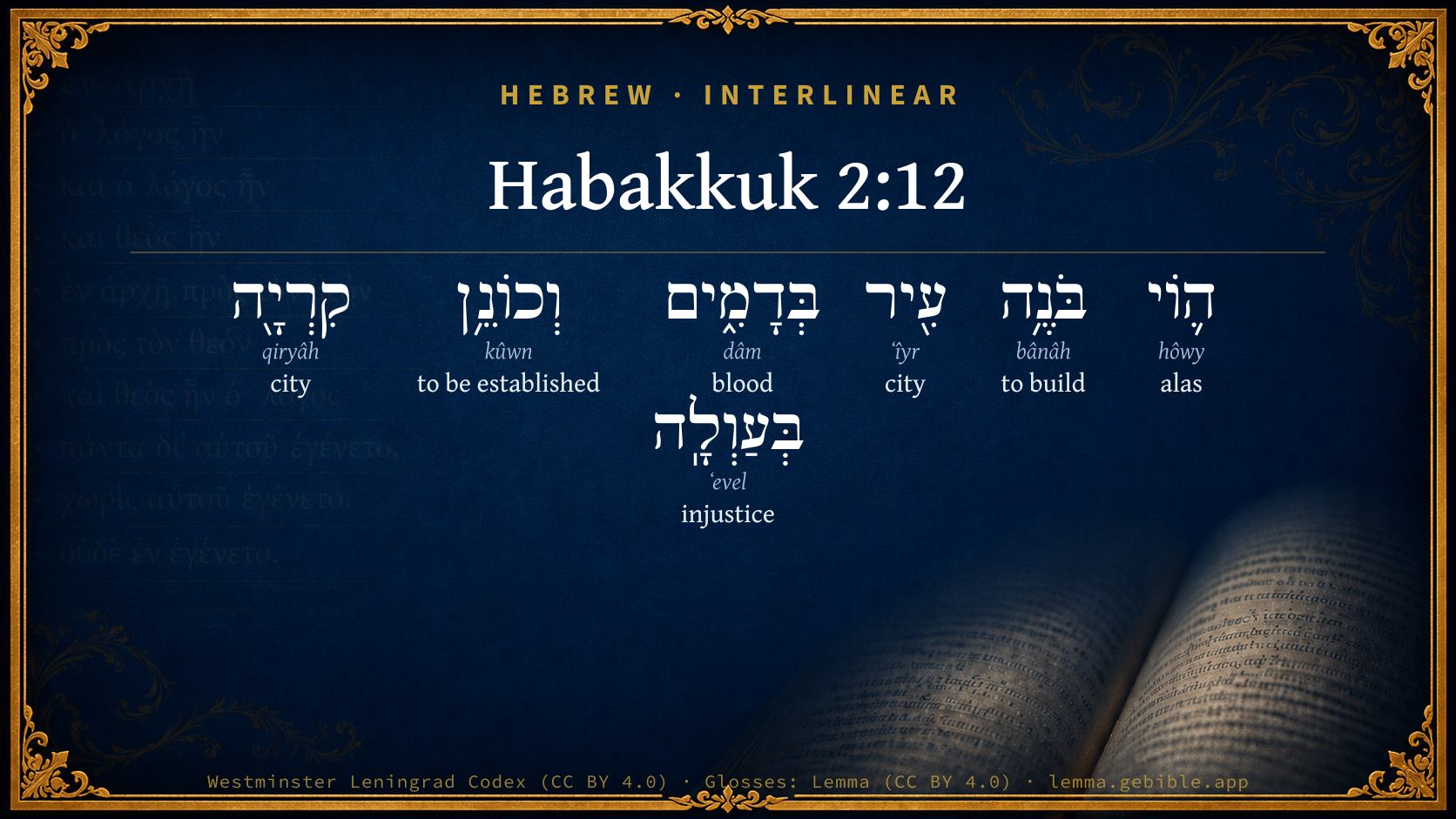
Habakkuk 2:12

Hebrew (Westminster Leningrad Codex) Habakkuk 2:12 appears in the Hebrew Old Testament. The text above is from the Westminster Leningrad Codex. Each word links to its Strong’s number, a concise gloss, and parsing drawn from the Open Scriptures Hebrew Bible morphology. Click any word for its full Brown-Driver-Briggs (BDB) entry.
Download image
Cite this verse

Habakkuk 2:12 (World English Bible). Public Domain. Lemma interlinear Bible study tool, https://lemma.gebible.app/v/habakkuk/2/12.

Show BibTeX & RIS
BibTeX
RIS
English Translation
Woe to him who builds a town with blood, and establishes a city by iniquity!
World English Bible · Public Domain
Download a study sheet

One document with this verse’s original text, its word-by-word gloss line, the meaning frame, cross-references with their text, attributed commentary, and full source and license credits — printable, and it pastes into notes with its structure intact.

This verse Autodidact and up

Study sheet (.html) Plain text (.txt)

A passage Seminary Student

Up to 50 verses in one chapter. A passage sheet keeps up to 6 commentary sources and 12 cross-references per verse, in the order this page ranks them, and says so on the sheet whenever that leaves anything out. Ask for a single verse and you get the Autodidact verse sheet above.

Everything on this page stays free to read, with no account — the sheet is a download of what is already on screen, not access to it.

Want to remove ads? Support Godless Engineer
Compare translations 3

The same verse in 3 English versions, stacked beneath the original-language interlinear above. Click any original word for its lexicon entry.

Each is an independent rendering of the whole verse — the interlinear is not word-aligned to these translations.

Highlighted words mark where these versions differ — a whole-verse word diff, not a word-by-word alignment.

  • World English Bible Public Domain
    Woe to him who builds a town with blood, and establishes a city by iniquity!
  • King James Version Public Domain
    Woe to him that buildeth a town with blood, and stablisheth a city by iniquity!
  • unfoldingWord Literal Text CC BY-SA 4.0
    ‘Woe to the one building a city with bloodshed, and establishes a town with injustice.’

unfoldingWord Literal Text — © unfoldingWord, licensed CC BY-SA 4.0. Word-aligned USFM3 via Door43 (git.door43.org/unfoldingWord/en_ult).

Versions to compare (up to 4)

3 of 4 selected

Show all 18 translations

Every available English version of this verse, each an independent rendering of the whole verse.

  • World English Bible Public Domain
    Woe to him who builds a town with blood, and establishes a city by iniquity!
  • Berean Standard Bible Public Domain
    Woe to him who builds a city with bloodshed and establishes a town by iniquity!
  • Majority Standard Bible Public Domain
    Woe to him who builds a city with bloodshed and establishes a town by iniquity!
  • King James Version Public Domain
    Woe to him that buildeth a town with blood, and stablisheth a city by iniquity!
  • American Standard Version (1901) Public Domain
    Woe to him that buildeth a town with blood, and establisheth a city by iniquity!
  • Revised Version (1885) Public Domain
    Woe to him that buildeth a town with blood, and stablisheth a city by iniquity!
  • Geneva Bible (1599) Public Domain
    Wo vnto him that buildeth a towne with blood, and erecteth a citie by iniquitie.
  • Douay-Rheims (1899) Public Domain
    Woe to him that buildeth a town with blood, and prepareth a city by iniquity.
  • Young's Literal Translation Public Domain
    Wo `to' him who is building a city by blood, And establishing a city by iniquity.
  • Literal Standard Version CC BY-SA 4.0
    Woe [to] him who is building a city by blood, || And establishing a city by iniquity.
  • Unlocked Literal Bible CC BY-SA 4.0
    'Woe to the one who builds a city with blood, and who establishes a town in iniquity.'
  • unfoldingWord Literal Text CC BY-SA 4.0
    ‘Woe to the one building a city with bloodshed, and establishes a town with injustice.’
  • Darby Bible Public Domain
    Woe to him that buildeth a town with blood, and establisheth a city by unrighteousness!
  • World Messianic Bible Public Domain
    Woe to him who builds a town with blood, and establishes a city by iniquity!
  • Webster's Bible Public Domain
    Woe to him that buildeth a town with blood, and establisheth a city by iniquity!
  • Free Bible Version CC BY-SA 4.0
    What disaster is coming to you who build cities with bloodshed, who found cities built on wickedness!
  • Bible in Basic English Public Domain
    A curse on him who is building a place with blood, and basing a town on evil-doing!
  • JPS Tanakh (1917) Public Domain
    Woe to him that buildeth a town with blood, and establisheth a city by iniquity!

Literal Standard Version (2020), Covenant Press — licensed CC BY-SA 4.0. Text via the HelloAO Bible API (eBible.org). Unlocked Literal Bible (unfoldingWord) — licensed CC BY-SA 4.0. Text via the HelloAO Bible API (eBible.org). unfoldingWord Literal Text — © unfoldingWord, licensed CC BY-SA 4.0. Word-aligned USFM3 via Door43 (git.door43.org/unfoldingWord/en_ult). Free Bible Version, Dr. Jonathan Gallagher — licensed CC BY-SA 4.0. Text via the HelloAO Bible API (eBible.org).

Word by word

More ways to search: Search by grammar → Find every occurrence → Compare this word →

Practice this passage: Drill this verse → Learn its vocabulary →

About this verse

These counts appear in no published source. They are computed here, from the morphology-tagged text and Lemma’s own curated glosses. What Lemma adds →

7
words
7
distinct lemmas
Prophets
section

Shared distinctive vocabulary

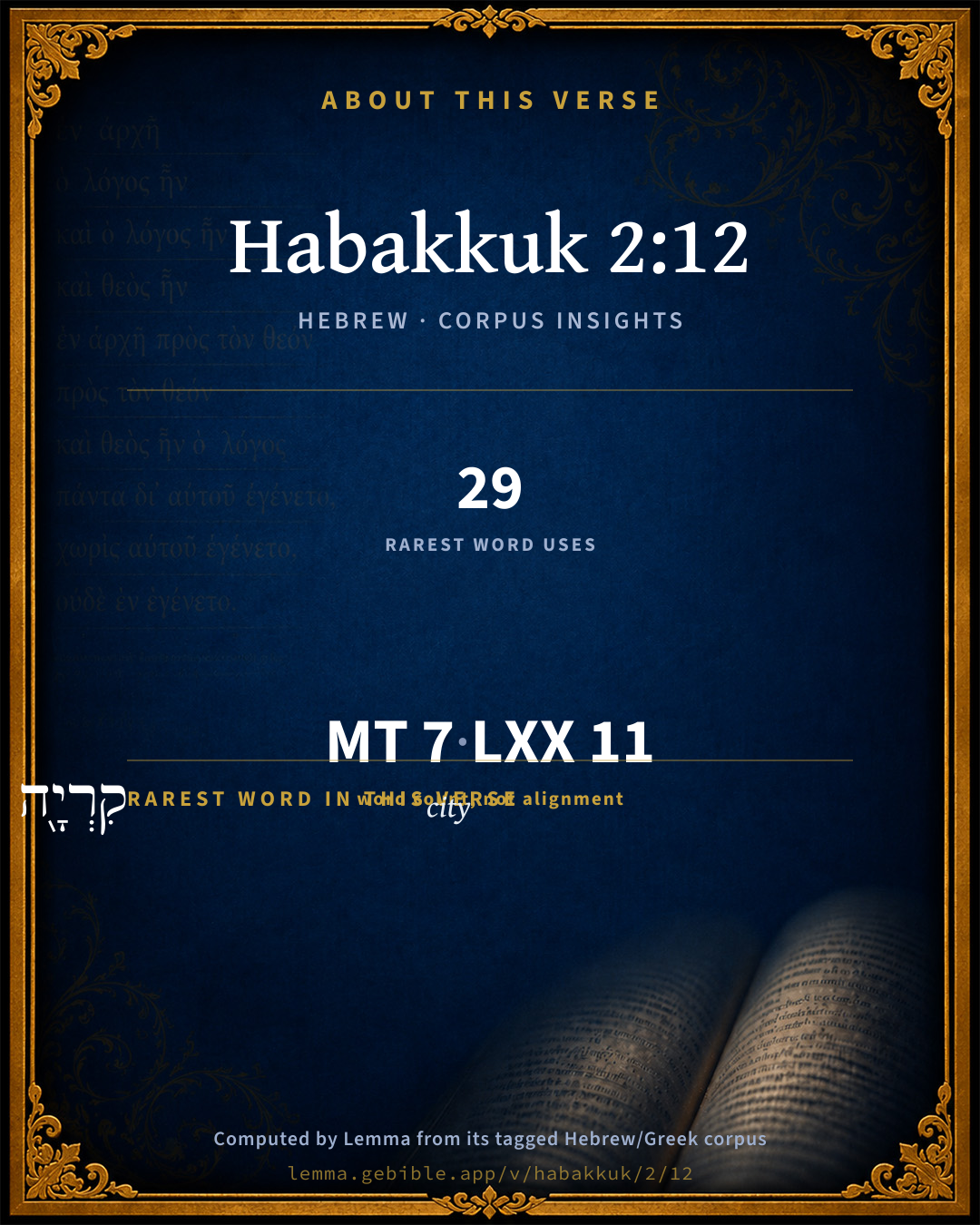
קִרְיָ֖ה city H7151 occurs in 29 verses of the Hebrew Bible. Also found in:

Grammatical profile

  • 2 verbs
  • 4 nouns
  • 1 particle

Verb forms

  • בֹּנֶ֥ה Qal · Participle Active
  • וְכוֹנֵ֥ן Polel · Sequential Perfect

Hebrew & Septuagint length

In English translation the verse runs 15 words from the Hebrew and 15 from the Septuagint (LXX English) — the same length.

A rough comparison of the two English renderings, which tokenize alike — not a word-level alignment.

Word counts can differ between the Hebrew and the Greek without any difference in meaning — e.g. the Hebrew direct-object marker אֵת has no separate Greek word, and Greek often adds the article ὁ.

In the original languages it is 7 Hebrew tokens and 11 Greek tokens — but the two are counted differently (Hebrew bundles its prefixes and suffixes into one token; the Greek is in lemma form), so that isn’t a like-for-like length.

Cross-references

10

Topical passages linked to Habakkuk 2:12 in the Treasury of Scripture Knowledge — connected by theme and wording, ordered by reader-vote popularity; previews shown in the World English Bible.

  • Micah 3:10 They build up Zion with blood, And Jerusalem with iniquity.
  • Daniel 4:27–31 Therefore, O king, let my counsel be acceptable to you, and break off your sins by righteousness, and your iniquities by showing mercy to the poor; if there may be a lengthening of your tranquillity.
  • Nahum 3:1 Woe to the bloody city! It is all full of lies and robbery. The prey doesn't depart.
  • Joshua 6:26 Joshua charged them with an oath at that time, saying, Cursed be the man before Yahweh, that rises up and builds this city Jericho: with the loss of his firstborn shall he lay the foundation of it, and with the loss of his youngest son shall he set up the gates of it.
  • Jeremiah 22:13–17 Woe to him who builds his house by unrighteousness, and his chambers by injustice; who uses his neighbor's service without wages, and doesn't give him his hire;
  • Revelation 17:6 I saw the woman drunken with the blood of the saints, and with the blood of the martyrs of Jesus. When I saw her, I wondered with great amazement.
  • Genesis 4:11–17 Now you are cursed because of the ground, which has opened its mouth to receive your brother's blood from your hand.
  • 1 Kings 16:34 In his days did Hiel the Bethelite build Jericho: he laid the foundation of it with the loss of Abiram his firstborn, and set up the gates of it with the loss of his youngest son Segub, according to the word of Yahweh, which he spoke by Joshua the son of Nun.
  • Ezekiel 24:9 Therefore thus says the Lord Yahweh: Woe to the bloody city! I also will make the pile great.
  • John 11:47–50 The chief priests therefore and the Pharisees gathered a council, and said, "What are we doing? For this man does many signs.

Cross-references courtesy of OpenBible.info (CC BY 4.0).

Hebrew and Greek witnesses Masoretic Hebrew ↔ Greek Septuagint

The same verse in the two great witnesses to the Old Testament, shown verse-for-verse.

These are two independent witnesses, not word-aligned to each other, and the Septuagint is shown in lemma (dictionary) form.

Hebrew Habakkuk 2:12 Masoretic · Westminster Leningrad Codex

ה֛וֹי בֹּנֶ֥ה עִ֖יר בְּדָמִ֑ים וְכוֹנֵ֥ן קִרְיָ֖ה בְּעַוְלָֽה

Woe to him who builds a town with blood, and establishes a city by iniquity!

World English Bible · Public Domain

Greek LXX Habakkuk 2:12 Septuagint · lemma form

οὐαί ὁ οἰκοδομέω πόλις ἐν αἷμα καί ἑτοιμάζω πόλις ἐν ἀδικία

Woe to him that builds a city with blood, and establishes a city by unrighteousness.

LXX2012 (modern English Septuagint) · Public Domain

Hebrew: Westminster Leningrad Codex (CC BY 4.0). Greek: Septuagint (public domain); English from LXX2012 (modern English Septuagint) (Public Domain). How the Septuagint differs from the Hebrew →

Targum (Aramaic paraphrase)

1

The Targum is the ancient Jewish Aramaic paraphrase of the Hebrew Scriptures — an interpretive translation, not the Hebrew text itself. Onkelos (literal) and Pseudo-Jonathan (expansive) render the Torah, and Jonathan the Prophets. Coverage is partial: where no permissively-licensed English translation exists for a verse, only the Aramaic is shown. This is verse-level text, not a word-by-word alignment to the Hebrew.

  1. Targum Jonathan Prophets (Joshua–Malachi)
    וַי דִבְנֵי קַרְתָּא בְּדַם אֲשִׁיד וּמְשַׁכְלֵיל קִרְיָא בְּנָכְלִין:

    (no public-domain English translation for this verse)

    Targum Jonathan — Aramaic: “Mikraot Gedolot” (public domain). English: “Sefaria Community Translation” (CC0 1.0 (public-domain dedication)); “London "Chaldee Paraphrase," 1871” (public domain). Text via Sefaria.

Commentary

Notes on Habakkuk 2:12 from classic Christian and Jewish commentators (each source and its license shown beneath its notes). The classic Christian expositions comment on the surrounding passage and are grouped to its opening verse, so a note may address several verses; the Jewish commentaries on the Tanakh (Rashi and others) are per-verse, so they appear only where the commentator wrote on this verse.

Lemma curates 59 commentaries, every one of them public domain or Creative Commons licensed, each selected and text-cleaned for this edition rather than reprinted as found. About our sources →

John Gill's Exposition

Woe to him that buildeth a town with blood, and establisheth a city by iniquity! This is what the stone and beam should say, if others were silent. The town and city are the church of Rome, mystical Babylon, the great city, called spiritually Egypt and Sodom; the builder of this is the pope of Rome, the bishops of it in succession, who built it with blood: the pope of Rome received his title as head of the church from Phocas, that murdered the emperor Mauritius; the foundation of the church of Rome is the blood of the saints, shed in persecutions and wars; hence she is said to be drunk with the blood of them, and to have the blood of prophets and saints found in her, Rev 17:5 and it is established by unjust exactions of tribute from all countries subject to it, and by indulgences, processions, and various methods taken to extort money from the people, to support its pageantry, pomp, and grandeur; but there is a "woe" denounced against such that are concerned herein, and which will take place in due time, nor can it be awarded, as follows:

and it is established by unjust exactions of tribute from all countries subject to it, and by indulgences, processions, and various methods taken to extort money from the people, to support its pageantry, pomp, and grandeur; but there is a "woe" denounced against such that are concerned herein, and which will take place in due time, nor can it be awarded, as follows:

Habakkuk 2:13

hab 2:13

hab 2:13

hab 2:13Behold, is it not of the Lord of hosts?.... That which follows; the judgments of God upon the bloody city, which they that labour to prevent labour in vain. So the Targum,

"lo, strong and mighty blows or judgments come from the Lord of hosts;''

the mighty God, the Lord of armies, whose hand when stretched out none can turn back; he does what he pleases, and none can hinder him; when the decree is gone forth from him, it is in vain to attempt to stop it:

that the people shall labour in the very fire, and the people shall weary themselves for very vanity? words of the same import, and expressed in much the same language, were used of the destruction of literal Babylon by fire, and of the vain attempts of the Chaldeans in labouring and wearying themselves to quench it, Jer 51:58 and here of mystical Babylon, and the vanity of the people of it, in labouring to support it by their wars, for recovering the holy land from the Turks, and against the Waldenses, Hussites, and Bohemians; for, notwithstanding all their successes, and the vast number of persons slain by them, yet they could never prevail so as to root out the kingdom and interest of Christ: and their city and state shall fall, and they will not be able to uphold it; and a considerable blow and shock it received at the time of the Reformation; and this great city Babylon will be destroyed by fire, which its best friends cannot prevent; even the ten kings that have given their kingdom to the beast will hate the whore, and burn her with fire; and those antichristian kings that will continue friends to her, when they see her burning, will find it in vain to attempt to help her, and will stand afar off lamenting her case, Rev 17:16. Kimchi begins here to see that this section and paragraph does not belong to Nebuchadnezzar and the Chaldeans, but to the times of the Messiah; and interprets it of the vengeance of God that shall come upon all the nations that come along with Gog against Jerusalem in the latter day; but he is mistaken: it designs what will come on mystical Babylon; so Abarbinel owns, that, from Hab 2:12, what is said belongs to the Roman empire, which he calls the kingdom of Edom.

John Gill's Exposition of the Whole Bible (1746–1763) — public domain (CC PDM 1.0). Text via the HelloAO Bible API.

Trapp's Complete Commentary

John Trapp

Hab 2:12 Woe to him that buildeth a town with blood, and stablisheth a city by iniquity!

Ver. 12. Woe to him that buildeth a town with blood] This seemeth to be the senseless creatures, black Cantus Song, (as they call it), chanted out against the wrong doer, by God’s own appointment, cui obscura clarent, muta respondent, silentium confitetur, saith an ancient (Juvonal),

- “ cui servi ut taceant, iumenta loquentur, ”

The very beasts have a verdict to pass upon oppressors; as the dumb ass did upon Balaam: yea, the lifeless creatures shall ring a doleful knell of woe and alas in their ears, and cry them guilty; as the earth did Cain, and the heaven did Phocas; and as the tignum e ligno logs of wood, doth here Nebuchadnezzar. His town of Babylon was built in blood by Semiramis, who slew her husband, so was Rome by Romulus, so was Alexandria, in Egypt, by Alexander, that great manslayer, the founder of populous No, of whose woe read Nah 3:8; Nah 3:10. {See Trapp on "Nah 3:8"} {See Trapp on "Nah 3:10"} And for Alexander himself, he lay unburied thirty days together, neither did his bloody conquest above ground purchase him any title for a habitation underground. The like befell our conqueror William, who laid his foundation here upon fireworks; and was punished in his posterity for his depopulations at New Forest and elsewhere.

And stablisheth a city by iniquity] That thinketh so to establish it, but it proveth otherwise. Josephus telleth us that Nebuchadnezzar set three different walls of brick about his Babylon, one within another; but all would not do when once God took it to do. Oppression is a bony sin, Amo 5:12-13.

John Trapp, A Commentary or Exposition upon All the Books of the Old and New Testament (1647–1656) — public domain. Text from a community e-Sword module.

The Biblical Illustrator

Joseph S. Exell

Hab_2:12

Woe to him that buildeth a town with blood.

A curse denounced against bloodshed

I. The ground or cause of this curse. The crying, crimson sin of bloodshed. In all generations it has been the care of providence, both by civil and religions means, to extinguish all principles of savageness in the minds of men, and to make friendship and tenderness over mens lives a great part of religion. By nothing has this been so highly endeavoured as by the rules and constitution of Christianity.

II. The condition of the person against whom this woe or curse is denounced. He was such an one as had actually established a government and built a city with blood. As soon as Cain had murdered his brother he presently betook himself to the building of a city. Bloodiness has usually a connection with building, which represents the setting up of government. Nebuchadnezzar seems to be the person here spoken of.

III. The latitude and extent of this woe or curse, and what is comprehended in it. It includes the miseries of both worlds, present and future.

1. It fastens a general hatred and detestation upon such men as persons. Cruelty alarms and calls up all the passions of human nature, and puts them into a posture of hostility and defiance. The tyrant is universally hated and scorned.

2. The torment of continual jealousy and suspicion.

3. The shortness and certain dissolution of the government that endeavours to establish itself with blood.

4. The sad and dismal end that usually attends such persons.

IV. The reasons why a curse or woe is so peculiarly denounced against this sin.

1. It makes the most direct breach upon human society.

2. Because of the malignity of those sins that go in conjunction with it.

V. Apply to the present occasion. All unjust bloodshed is twofold. Either public, and acted by or upon a community, as in a war. Or personal, in the assassination of any particular man. (R. South, D. D.)

The Biblical Illustrator, edited by Joseph S. Exell (c. 1880s–1900s) — public domain. Text from a community e-Sword module.

Joseph Benson's Commentary

Hab 2:12-14. Wo to him that buildeth a town with blood — Wo to those mighty conquerors who have augmented Babylon by unjustly spoiling and ruining many other cities, and destroying their inhabitants. Here we see that God does not approve of those mighty conquerors who ravage the world, or carry their arms into divers countries. Though he makes use of them for the wise purposes of his providence, in chastising or punishing the wicked, yet, amidst all the pomp of their victories, they are often hateful in his sight; and, while they are in the midst of their triumphs, he is preparing the sword to cut them off. What is said in this verse is applicable to all covetous, unjust, and oppressive methods whatever of raising a fortune. Behold, is it not of the Lord that the people shall labour in the very fire? &c. — The latter part of the verse occurs with very little alteration Jer 51:58, where the destruction of Babylon is described: see the note there. The sense is, All the pains which the Chaldeans have taken, in enlarging and beautifying their city, shall be lost in the flames, which shall consume their stately buildings; and nothing of all that they have obtained, or collected, by their toilsome victories, shall be of any use to them. For the earth shall be filled — For God’s power and providence, in governing the world, shall conspicuously appear, and be widely displayed in the humiliation of Nebuchadnezzar, (Dan 4:37,) in the downfall of the Chaldean empire, and the destruction of Babylon; especially as it is described in the prophets as an earnest and type of the fall of mystical Babylon, which will be a decisive stroke of divine justice, that will thoroughly vindicate oppressed truth and innocence, and open the way for the universal spread of true religion: see note on Isa 11:9.

Joseph Benson's Commentary on the Old and New Testaments (1811–1818) — public domain. Text from a community e-Sword module.

The Preacher's Complete Homiletical Commentary

Joseph S. Exell (gen. ed.)

CRITICAL NOTES.]

Hab_2:12. Woe] the third. Town] Babylon, rebuilt and enlarged by spoils of blood (Dan_4:30).

Hab_2:13. Fire] Lit. to suffice the fire; conflagration and depopulation the result of all labour and fatigue.

Hab_2:14. For] God has determined this result; usurped glory must be destroyed that his glory may spread (Isa_11:9). Waters] Surpassing abundance. This predictive of the gospel times.

HOMILETICS

THE CITY OF BLOOD.—Hab_2:12-14

The third stanza, naturally suggested by the preceding verse, describes the method by which they carried out their ambitious ends. They might pretend public good, and seek to establish popular government; but the wealth of the kingdom was gained by bloody wars, and the city enlarged by captive tribes from other nations. “They build up Zion with blood, and Jerusalem with iniquity.”

I. The city was built with wrong materials. It was built with blood. God’s people and heathen nations were oppressed, compelled to serve the king, and labour on the fortifications. All private fortunes gained by cruelty, all empires and greatness built and defended in contempt for God, and by the blood of men, are established by iniquity. They may impose upon the outward eye, seem strong and majestic, but they are inwardly rotten; will decay and fall to ruins. “Woe to the bloody city! it is all full of lies and robbery; the prey departeth not.”

II. The builders of the city laboured in vain.

1. God frustrated their aims. Human skill cannot succeed when God is opposed. In the Church and in the world, nothing can hinder his purposes. He is Lord of Hosts, whom the armies of heaven and the agencies of earth obey. As in building Babel of old so now can he confound the design, and frustrate the efforts, of men. “Behold, is it not of the Lord of Hosts?”

2. God consumed their materials. They toiled and were disappointed. They built the city, and reared splendid palaces, only for the fire. They laboured, with intense energy and pride, to accomplish their own ends, but they “wearied themselves for very vanity.” Men fatigue themselves in pursuit of wealth and honour, weary themselves in sin, and the result is consumed in the fire. “The people shall labour in vain (for vanity) and the folk in (for) the fire, and they shall be weary.”

III. The city shall eventually be destroyed. “For the earth shall be filled with the knowledge of the glory of the Lord.” God will be known by the judgments which he executes upon wrong-doers. All violence and injustice, like that of Babylon and Antichrist, will be overturned. The name of God will be read in the punishment of the wicked, and the deliverance of his people. The glory of God, obscured by oppression and cruelty, in due time will shine forth from the clouds, and fill the earth with its splendour. “As truly as I live, all the earth shall be filled with the glory of the Lord.”

A GLORIOUS DAY.—Hab_2:14

“For” indicates the reason for the sentence pronounced. God had determined to manifest his glory in the judgment and overthrow of all ungodly powers (cf. Isa_2:12-21; Isa_6:3; Num_14:21).

I. The blessing predicted. “The knowledge of the glory of the Lord.” God is glorious in character and procedure. And of this glory he is so jealous that he will not give it to another (Isa_42:8). The glory here is the revelation of impartial justice and irresistible power; a manifestation condemning sin and honouring truth. Not only the glory, but the knowledge of it, shall fill the earth. Men shall recognize it, see mercy and judgment, and learn that, “verily, there is a reward for the righteous: verily, he is a God that judgeth in the earth.”

II. The method of revealing this blessing. In the connection of the words, we learn that God reveals and magnifies his glory, when sin is prevalent, and human glory is decayed. In the destruction of Babylon and all the powers that resemble it, and in the deliverance and restoration of the Jews, we see the glory of God. But this is only a type of the destruction of error and the spread of Gospel truth. Both judgment and mercy are requisite to fill the earth with the glory of the Lord. Everything hostile to him, and the interests of his people, must be destroyed. The kingdom of Christ set up. and the earth illuminated with his glory (Rev_18:1).

III. The measure in which this blessing is bestowed. “As the waters cover the sea.” This indicates—

1. Depth. God’s judgments are a mighty deep, and the knowledge of them shall not be superficial. The nations shall feel them, and be convicted by the revelation of the Divine glory.

2. Abundance. The waters cover the sea, and spread far and wide. This knowledge will fill the earth.

3. Permanence. The waters of the sea abide, can never be exhausted nor diminished. Knowledge is increasing, the Gospel is spreading, and the bright day is predicted when “the earth shall be full of the knowledge of the Lord, as the waters cover the sea” (Psa_72:19; Isa_11:9).

HOMILETIC HINTS AND SUGGESTIONS

Hab_2:13. Labour in the very fire. Labour which fatigues; labour in vain; labour opposed to God. Sin is labour—the gain is vanity. Then why not observe who causes this? “It is the Lord that bringeth all the labours of the ungodly to loss and vanity, that when they come to thrash their crop of travail, they find nothing but straw and chaff. To express his power to do this he is here called the God of Hosts, for all things serve him, and he resisteth the proud. He layeth their honours in the dust; he disperseth their riches; he spoileth them of all their treasures: he that exalted them made them low; he that gave to them taketh away. They had need to be made to see this; therefore he saith, Is it not of the Lord?” [Marbury].

Hab_2:14. The words of God in this text are full of marrow and fatness, for God is rich in mercy, so he dilateth his favours.

1. In the latitude, all the earth over.

2. In the plenitude, the earth shall be filled.

3. In the magnitude, the knowledge of God’s glory.

4. In the profundity, as the waters cover the sea.

I. The thing to be done. The earth to be filled with the knowledge of the glory of God. His moral excellences—holiness, righteousness, and grace: his natural perfections—power, wisdom, omniscience, and omnipotence to be made known. II. The necessity of doing it. God is seen in the physical universe, and in the powers of the human mind; but sin, like a mist, hides the glory. No intellectual effort, no human light whatever, can do the work. God must shine in Christ, shine into the world, and into the soul, “to give the light of the knowledge of the glory of God” (2Co_4:6). III. Will it ever be done? How dark the days of the prophet! How improbable the present signs! Yet how much has been done already! Sufficient to guarantee future success. God himself has pledged his word. “The glory of the Lord shall be revealed, and all flesh shall see it together, for the mouth of the Lord hath spoken it.”

“So, Jesus, let thy kingdom come;

Then sin and hell’s terrific gloom

Shall at its brightness flee away,—

The dawn of an eternal day.”

ILLUSTRATIONS TO CHAPTER 2

Hab_2:12-13. Vanity. To so small a purpose is it to have an erected face towards heaven, and a perpetual grovelling spirit upon earth, eating dust, as doth the serpent [Bacon]. The empire of the world is but a crust to be thrown to a dog [Luther].

Hab_2:14. Glory. It is one of the greatest praises of God’s wisdom, that he can turn the evil of men to his own glory [Bp. Hall].

The Preacher's Complete Homiletical Commentary (gen. ed. Joseph S. Exell; Funk & Wagnalls, c. 1892) — public domain (pre-1929). A full-Bible homiletical/sermon-outline anthology covering 65 of 66 books (2 John is absent from the source module). Text from a community e-Sword module.

Keil & Delitzsch

C. F. Keil & F. Delitzsch

The third woe refers to the building of cities with the blood and property of strangers. Hab 2:12. "Woe to him who buildeth cities with blood, and foundeth castles with injustice. Hab 2:14. For the earth will be filled with knowledge of the glory of Jehovah, as the waters cover the sea." The earnest endeavour of the Chaldaean to found his dynasty in permanency through evil gain, manifested itself also in the building of cities with the blood and sweat of the subjugated nations. עיר and קריה are synonymous, and are used in the singular with indefinite generality, like קריה in Hab 2:8. The preposition ב, attached to דּמים and עולה, denotes the means employed to attain the end, as in Mic 3:10 and Jer 22:13. This was murder, bloodshed, transportation, and tyranny of every kind. Kōnēn is not a participle with the Mem dropped, but a perfect; the address, which was opened with a participle, being continued in the finite tense (cf. Ewald, 350, a). With Hab 2:13 the address takes a different turn from that which it has in the preceding woes. Whereas there the woe is always more fully expanded in the central verse by an exposition of the wrong, we have here a statement that it is of Jehovah, i.e., is ordered or inflicted by Him, that the nations weary themselves for the fire. The ו before יינעוּ introduces the declaration of what it is that comes from Jehovah. הלוא הנּה (is it not? behold!) are connected together, as in Ch2 25:26, to point to what follows as something great that was floating before the mind of the prophet. בּדי אשׁ, literally, for the need of the fire (compare Nah 2:13 and Isa 40:16). They labour for the fire, i.e., that the fire may devour the cities that have been built with severe exertion, which exhausts the strength of the nations. So far they weary themselves for vanity, since the buildings are one day to fall into ruins, or be destroyed. Jeremiah (Jer 51:58) has very suitably applied these words to the destruction of Babylon. This wearying of themselves for vanity is determined by Jehovah, for (Hab 2:14) the earth shall be filled with the knowledge of the glory of Jehovah. That this may be the case, the kingdom of the world, which is hostile to the Lord and His glory, must be destroyed. This promise therefore involves a threat directed against the Chaldaean. His usurped glory shall be destroyed, that the glory of Jehovah of Sabaoth, i.e., of the God of the universe, may fill the whole earth. The thought in Hab 2:14 is formed after Isa 11:9, with trifling alterations, partly substantial, partly only formal. The choice of the niphal תּפּלא instead of the מלאה of Isaiah refers to the actual fact, and is induced in both passages by the different turn given to the thought. In Isaiah, for example, this thought closes the description of the glory and blessedness of the Messianic kingdom in its perfected state. The earth is then full of the knowledge of the Lord, and the peace throughout all nature which has already been promised is one fruit of that knowledge. In Habakkuk, on the other hand, this knowledge is only secured through the overthrow of the kingdom of the world, and consequently only thereby will the earth be filled with it, and that not with the knowledge of Jehovah (as in Isaiah), but with the knowledge of His glory (כּבוד יי), which is manifested in the judgment and overthrow of all ungodly powers (Isa 2:12-21; Isa 6:3, compared with the primary passage, Num 14:21). כּבוד יי is "the δόξα of Jehovah, which includes His right of majesty over the whole earth" (Delitzsch). יכסּוּ על־ים is altered in form, but not in sense, from the ליּם מכסּים of Isaiah; and יכסּוּ is to be taken relatively, since כ is only used as a preposition before a noun or participle, and not like a conjunction before a whole sentence (comp. Ewald, 360, a, with 337, c). לדער is an infinitive, not a noun, with the preposition ל; for מלא, ימּלא is construed with the accus. rei, lit., the earth will be filled with the acknowledging. The water of the sea is a figure denoting overflowing abundance.

Keil & Delitzsch — Biblical Commentary on the Old Testament (1861–1891) — public domain (CC PDM 1.0). Text via the HelloAO Bible API. (Old Testament only.)

Tyndale Open Study Notes

Tyndale Open Resources

2:12-14 In the third taunt song, the Babylonians are condemned for the murder and corruption of human life and society that brought wealth to build their cities. God would make their apparent gain prove to be a total loss. • earth will be filled: The antithesis of violence and ill-gotten wealth is the awareness of the glory of the Lord, which God promises to make as pervasive as water in the ocean (Isa 11:9).

Tyndale Open Study Notes — © Tyndale Open Resources, licensed CC BY-SA 4.0. Text via the HelloAO Bible API.

Jamieson, Fausset & Brown

Robert Jamieson, A. R. Fausset & David Brown

buildeth a town with blood--namely, Babylon rebuilt and enlarged by blood-bought spoils (compare Dan 4:30).

Jamieson, Fausset & Brown — Commentary Critical and Explanatory on the Whole Bible (1871) — public domain (CC PDM 1.0). Text via the HelloAO Bible API.

Adam Clarke's Commentary

Verse 12. Wo to him that buildeth a town with blood] At the expense of much slaughter. This is the answer of the beam to the stone. And these things will refer to the vast fortunes gained, and the buildings erected, by means of the slave-trade; where, to a considerate and humane mind, the walls appear as if composed of the bones of negroes, and cemented by their blood! But the towns or houses established by this iniquity soon come to ruin; and the fortunes made have, in most cases, become as chaff and dust before the whirlwind of God's indignation. But where are the dealers in the souls and bodies of men? Ask him who has them in his keeping. He can tell.

Adam Clarke's Commentary on the Bible (1810–1826) — public domain. Text from a community e-Sword/MySword module.

John Calvin's Commentaries

The stone, then, from the wall shall cry, and the wood shall answer —what will it answer?—Woe to him who builds a city by blood, and who adorns his city by iniquity. By blood and by iniquity he understands the same thing; for though the avaricious do not kill innocent men, they yet suck their blood, and what else is this but to kill them by degrees, by a slow tormenting process? For it is easier at once to undergo death than to pine away in want, as it happens to helpless men when spoiled and deprived of all their property. Wherever there is wanton plundering, there is murder committed in the sight of God; for as it has been said, he who spares not the helpless, but drinks up their blood, doubtless sins no less than if he were to kill them.

But if this personification seems to any one strange, he must consider how incredible seemed to be what the Prophet here teaches, and how difficult it was to produce a conviction on the subject. We indeed confess that God is the judge of the world; nay, there is no one who does not anticipate his judgement by condemning avarice and cruelty; the very name of avarice is infamous and hated by all: the same may be said of cruelty. But yet when we see the avaricious in splendor and in esteem, we are astounded, and no one is able to foresee by faith what the Prophet here declares. Since, then our dullness is so great, or rather our sottishness, it is no wonder that the Prophet should here set before us the stones and the wood, as though he said, “When all prophecies and all warnings become frigid, and God himself obtains no credit, while openly declaring what he will do, and when his servants consume their labor in vain by warning and crying, let now the stones come forth, and be teachers to you who will not give ear to the voice of God himself, and let the wood also cry out in its turn.” This, then, is the reason why the Prophet introduces here mute things as the speakers, even to awaken our insensibility.

John Calvin's Commentaries (1540-1563) — public domain. Text from the Calvin Translation Society English edition (1840s-50s) via the Christian Classics Ethereal Library (ccel.org). Calvin's coverage is partial (roughly two-thirds of the Bible); uncommented books and verses are honest gaps, never fabricated. The 19th-century editor's footnotes and remarks are omitted so the notes are faithfully Calvin's own voice.

Ellicott's Commentary for English Readers

(12-14) “Woe on the extension of Babylon by oppression and enforced labour.

A Bible Commentary for English Readers, edited by Charles John Ellicott (1878–1897) — public domain. Text from a community e-Sword module.

The Cambridge Bible for Schools and Colleges

gen. ed. J. J. S. Perowne

12–14. Third woe: his oppression of the peoples to gratify his architectural pride

12. buildeth a town with blood] The meaning appears to be that the means of building the city are acquired through bloodshed, conquest and slaughter of the nations, and deportation of them to be employed in forced labour. Comp. Mic_3:10, “They build up Zion with blood,” i.e. by the goods of those slain by judicial murder (1 Kings 21).

by iniquity] Cf. Jer_22:13, where the iniquity consists in the forced labour; here it may be more general. The terms “town” and “city” refer to any city or to many. Isa_14:21.

The Cambridge Bible for Schools and Colleges (gen. ed. J. J. S. Perowne; Cambridge University Press, 1878–1918) — public domain. Text from a community e-Sword module.

Albert Barnes' Notes on the Bible

Woe to him that buildeth a town with blood, and establisheth a city by iniquity! - Nebuchadnezzar “encircled the inner city with three walls and the outer city also with three, all of burnt brick. And having fortified the city with wondrous works, and adorned the gates like temples, he built another palace near the palace of his fathers, surpassing it in height and its great magnificence.” He seemed to strengthen the city, and to establish it by outward defenses. But it was built through cruelty to conquered nations, and especially God’s people, and by oppression, against His holy Will. So there was an inward rottenness and decay in what seemed strong and majestic, and which imposed on the outward eye; it would not stand, but fell. Babylon, which had stood since the flood, being enlarged contrary to the eternal laws of God, fell in the reign of his son. Such is all empire and greatness, raised on the neglect of God’s laws, by unlawful conquests, and by the toil and sweat and hard service of the poor. Its aggrandizement and seeming strength is its fall. Daniel’s exhortation to Nebuchadnezzar Dan 4:27, “Redeem thy sins by righteousness, and thine iniquities by showing mercy on the poor,” implies that oppressiveness had been one of his chief sins.

Albert Barnes' Notes on the Bible (1834–1885) — public domain. Text from a community e-Sword/MySword module.

Haydock's Catholic Bible Commentary

Wo. This might be explained of Nabuchodonosor; but we rather understand the king of Tyre, whose pride was intolerable, Ezechiel xxviii. It seems useless to repeat so often the same threats against one king. (Calmet)

George Leo Haydock (1774–1849), Haydock's Catholic Family Bible and Commentary, 1859 edition — public domain. Excludes Psalms (Douay-Rheims chapter numbering differs from Protestant) and Deuterocanonical books (Catholic canon only).

Matthew Poole's English Annotations

Whosoever he be that lays foundations in blood, is here threatened, and none so great as to keep Off the woe, deserved and menaced.

A town, Heb. city.

With blood; in the guilt and with the cruelty of murdering the innocents it is the worst cement which is tempered with blood of murdered men, women, and children.

And stablisheth; goeth about or thinketh to establish the foundations of a city.

A city; Babylon in particular.

By iniquity; by force and fraud, by riches extorted from the just possessor.

Matthew Poole's English Annotations on the Holy Bible (1683–1685) — public domain. Text from a community e-Sword/MySword module.

Whedon's Commentary on the Bible

Daniel D. Whedon

12. Town… city — Synonymous; they cannot be restricted to the capital, but include cities scattered throughout the empire, wherever building enterprises were carried on.

Blood,… iniquity — Blood was shed and iniquity done in subduing the nations, in tearing them from their homes and transporting them to Babylonia, and in compelling them to assist in the extensive building enterprises of which the inscriptions of Nebuchadnezzar give a fair idea. The sentiment expressed here is of universal application, but the prophet has in mind primarily the Chaldeans (compare Mic_3:10; Jer_22:13).

Daniel D. Whedon (gen. ed.), Commentary on the Old and New Testaments (1874–1909) — public domain. Text from a community e-Sword module.

The Pulpit Commentary

Vers. 12-1410. The third woe: for founding their power in blood and devastation.

The Chaldeans are denounced for the use they make of the wealth acquired by violence. That buildeth a town with blood. (Mic 3, where see note) They used the riches gained by the murder of conquered nations in enlarging and beautifying their own city. By iniquity. To get means for these buildings, and to carry on their construction, they used injustice and tyranny of every kind. That mercy was not an attribute of Nebuchadnezzar we learn from Daniel"s advice to him. (Dan_4:27) The captives and deported inhabitants of conquered countries were used as slaves in these public works (see an illustration of this from Koyunjik, Rawlinson"s "Anc. Men.," 1:497). What was true of Assyria was no less true of Babylon. Professor Rawlinson (2:528, etc.) tells of the extreme misery and almost entire ruin of subject kingdoms. Not only are lands wasted, cattle and effects carried off, the people punished by the beheading or impalement of hundreds or thousands, but sometimes wholesale deportation of the inhabitants is practised, tons or hundreds of thousands being carried away captive. "The military successes of the Babylonians," he says (3:332), "were accompanied with needless violence, and with outrages not unusual in the East, which the historian must nevertheless regard as at once crimes and follies. The transplantation of conquered races may, perhaps, have been morally defensible, notwithstanding the sufferings which it involved. But the mutilations of prisoners, the weary imprisonments, the massacre of non-combatants, the refinement of cruelty shown in the execution of children before the eyes of their fathers, these and similar atrocities, which are recorded of the Babylonians, are wholly without excuse, since they did not so much terrify as exasperate the conquered nations, and thus rather endangered than added strength or security to the empire. A savage and inhuman temper is betrayed by these harsh punishments, one that led its possessors to sacrifice interest to vengeance, and the peace of a kingdom to a tiger-like thirst for blood we cannot be surprised that, when final judgment was denounced against Babylon, it was declared to be sent in a great measure "because of men"s blood, and for the violence of the land, of the city, and of all that dwelt therein.

Vers. 12-14A parable of woes: 3. Woe to the ambitious!

I THE CRIMINALITY OF THEIR AMBITION.

1. The object aimed at. To build towns and establish cities. Not necessarily a sinful project, unless the motive or the means be bad. City building may have originated in a spirit of defiance against Jehovah, (Gen_4:17) though this is not certain; but cities may be, as they often are, centres and sources of incalculable blessing to mankind. If they help to multiply the forces of evil, they also serve to intensify those of good. Cities promote the good order of society, stimulate intellectual life, increase the privileges, opportunities, and comforts of individuals, and so tend to accelerate the march of civilization, by quickening movements of reform and combining against public evils. Hence, though God made the country," and man made the town" (Cowper), it need not be assumed that city founding is against the Divine will it can hardly be, since he himself has prepared for us a city. (Heb_11:16) Only as there are cities and cities, so are there diversities in the modes of their construction.

2. The means resorted to. Blood and iniquity. Murder, bloodshed, transportation, and tyranny of every kind the Babylonian sovereigns employed to enrich their capital and strengthen their empire; and one is not sure whether in modern times cities are not sometimes built and kingdoms strengthened by similar methods, viz. by wars of aggression against foreign peoples, and by the enforcement of sinful treaties upon unwilling but weak governments. With regard to individuals, there is no room for doubt that often they build the houses of which a city consists in the way here indicated, if not by bloodshed exactly, at least by iniquity, paying for them by ill-gotten gains, and erecting them by means of under paid labour.

II THE VANITY OF THEIR AMBITION.

1. The fact of it. They, i.e. the peoples (nations or individuals), who build towns and cities as above described, "labour for the fire" and "weary themselves for vanity;" i.e. exert themselves to erect buildings that the fire will one day consume, and weary themselves in producing structures that will one day be laid in ruins. What is here said about Babylon is true of all earthly things, (2Pe_3:10) and ought to moderate the strength of men"s desires in running after them.

2. The certainty of it. It is already determined of the Lord of hosts. It is part of his counsel that permanence shall not attach to anything here below, (1Jn_2:17) and least of all to the productions of iniquity. Individuals may be allowed to wait for their ultimate overthrow till the day of death or the end of the world, but cities and nations, having no future, are usually visited with doom in the present. The overthrow in time of nations and empires that are built up by bloodshed and iniquity may be safely counted on. Nineveh, Babylon, Rome, are examples.

3. The reason of it. "The earth shall be filled with the knowledge of the glory of God." That is to say, because this is the destiny of the world, the goal towards which all things terrestrial are moving, it is impossible that the ambitious projects of man should be allowed permanently to succeed. All superstructures, however solidly built, must be overthrown, all organizations, however compactly formed, must be broken up, that hinder the advancement of that happy era which Jehovah has promised. Hence the triumph of Babylon will come to an end, and with that the glory of Jehovah will shine forth with a brighter degree of effulgence. Men will see in that a display of Jehovah"s character and power never witnessed before. The knowledge of his glory will take a wider sweep and extend over a larger area than before. The same principle demanded the overthrow of Rome, and demands the final destruction of all God"s enemies, that the knowledge of his glory may cover the earth as the waters cover the sea.

Learn:

1. The sin and folly of ambition.

2. The beauty and wisdom of humility.

Vers. 12-14The two kingdoms: a contrast.

Reference is made in these verses to two kingdoms the kingdom of Babylon and the kingdom of God; and this association serves to indicate several points of contrast.

I THE GLORY OF THE KINGDOMS OF THIS WORLD IS MATERIAL; THE GLORY OF THE KINGDOM OF GOD IS SPIRITUAL. The glory of Chaldea centred in its magnificent city of Babylon, so grand in its situation, its edifices, it defences, and in the stores of treasure it contained, its greatness consisting thus in its material resources; but the glory of the kingdom of God is spiritual. It is "the glory of the Lord" that constitutes its excellence all moral beauty and spiritual grace abounding therein.

II THE KINGDOMS OF THIS WORLD HAVE OFTEN BEEN FOUNDED AND ESTABLISHED BY MEANS OF WRONG DOING; THE KINGDOM OF GOD IS FOUNDED AND ESTABLISHED IN PURE RIGHTEOUSNESS AND TRUE HOLINESS. The Chaldeans, by their superior might and powers, conquered other tribes, and with the spoils of war and the forced labour of the conquered they reared their cities. They "built a town with blood, and established a city by iniquity" (ver. 12); but "a sceptre of righteousness is the sceptre of God"s kingdom.

III HUMAN TOIL IS INVOLVED IN THE INTERESTS OF BOTH; yet notice, by way of contrast;

1. Toil in the interests of earthly kingdoms is often compulsory and isrendered reluctantly aliens who had fallen as captives into the power of the Chaldeans were made to labour and serve; but toil in the interests of God"s kingdom is ever voluntary and is rendered lovingly and without constraint.

2. Toil in the interests of earthly kingdoms is often toil for that which shall be destroyed, and which shall come to nought. "The people shall labour in the very fire, and the people shall weary themselves for very vanity" (ver. 13), i.e. they should labour in erecting edifices which should be consumed by fire, and thus their toil prove in vain; but toil in the interests of Gods kingdom shall prove abiding and eternal in its results.

3. The workers of iniquity, no matter how earnest their toil, should be covered eventually with dishonour and shame to him!" etc. (ver. 12) but all true toilers for God and righteousness shall be divinely approved and honoured.

IV THE PROSPERITY OF MATERIAL KINGDOMS IS UNCERTAIN; WHEREAS THE TRIUMPH OF GOD"S SPIRITUAL KINGDOM IS ASSURED. "The knowledge of the glory of the Lord shall cover the earth.

V EARTHLY KINGDOMS ARE LIMITED IN EXTENT; BUT THE SPIRITUAL KINGDOM OF OUR GOD SHALL ATTAIN UNTO UNIVERSAL DOMINION. "The earth shall be filled with the knowledge of the glory of the Lord as the waters cover the sea. S.D.H.

Vers. 12-14National wrongs ending in national woes. No. 3.

"Woe to him that buildeth a town with blood, and stablisheth a city by iniquity! Behold, is it not of the Lord of hosts that the people shall labour in the very fire, and the people shall weary themselves for very vanity? For the earth shall be filled with the knowledge of the glory of the Lord, as the waters cover the sea." Notice

I THE NATIONAL WRONGS INDICATED IN THESE VERSES. The great wrong referred to in these verses is the accumulation of gain by wicked means. "Woe to him that buildeth a town with blood, and stablisheth a city by iniquity!" In itself there is nothing improper in building towns, establishing cities, and accumulating wealth. Indeed, all these things are both legitimate and desirable. But it is stated that these Babylonians did it:

1. By violence. "With blood." Men"s lives were sacrificed for the purpose. "By iniquity." Justice was outraged in the effort.

2. By cruelty. "Labour in the very fire." These wrongs we have already explained in the preceding sections. (But see a different explanation of "labour in the fire" in the Exposition.)

II THE NATIONAL WOES INDICATED IN THESE WORDS. What is the woe? Disapprobation of. God.

1. These wrongs are contrary to his nature. "Is it not of the Lord of hosts?" or, as Keil renders it, "Is it not beheld from Jehovah of hosts that the people weary themselves for fire, and nations exhaust themselves from vanity?" He does not desire it. Nay, it is hostile to his will, it is displeasing to his nature. The benevolent Creator is against all social injustice and cruelty. His will is that men should "do unto others as they would that men should do unto them.

2. These wrongs are contrary to his purpose for the world. His purpose is that the "earth shall be filled with the knowledge of the glory of the Lord." To this end the kingdom of the world which is hostile to him must be destroyed. "This promise," says Keil, "involves a threat directed against the Chaldean, whose usurped glory must be destroyed in order that the glory of the universe may fill the whole earth." What a glorious prospect!

(1) This world, in the future, is to enjoy the greatest blessing. What is that? The knowledge of the glory of God. Knowledge in itself is a blessing. The soul without it is not good. (Pro_19:2) It is not the mere knowledge of the works of God. This is of unspeakable value. Not merely the knowledge of some of the attributes of God. This is of greater value still. But the knowledge of the glory of God, which means the knowledge of God himself, "whom to know is life eternal.

(2) This world, in the future, is to enjoy the greatest blessing in the greatest abundance. "As the waters cover the sea." He shall flood all souls with its celestial and transporting radiance. D.T.

The Pulpit Commentary (1880–1919), ed. H.D.M. Spence-Jones & Joseph S. Exell — public domain. Text from a community e-Sword module.

unfoldingWord translationNotes

Door43 World Missions Community

General Information:

Yahweh continues to answer Habakkuk and to speak of the Chaldeans as if they were one man. (See: Metaphor)

Woe to the one who builds a city with blood, and who establishes a town in iniquity

These two phrases are saying the same thing in different ways. AT: "A warning to the Chaldeans who built their cities with what they have stolen from the people they have killed" (See: Parallelism)

the one who builds a city with blood

Here the word "blood" is a metonym for murder. It is implicit that the person builds a city by means of the goods that he stole from those whom he has killed. AT: "the one who kills people and steals their goods in order to build a city" (See: Metonymy and Assumed Knowledge and Implicit Information)

who establishes a town in iniquity

It is implicit that the person builds a city by means of the goods that he stole from those whom he has killed. Here the word "establishes" means "to begin." AT: "who starts a town by means of the profit that he has acquired through evil behavior" (See: Assumed Knowledge and Implicit Information)

Is it not from Yahweh of hosts that peoples labor for fire and all the other nations weary themselves for nothing?

This negative rhetorical question emphasizes the positive answer that it anticipates. The two clauses share similar meanings that the work that people do will not last. The question can be translated as a statement. AT: "Yahweh is the one who has determined that the things that people work hard to build will be destroyed by fire and result in nothing." (See: Rhetorical Question and Parallelism)

peoples labor for fire

This means that the things that people labor to build are ultimately destined to be fuel for fire. AT: "peoples labor to build things that will be used as fuel for fire" (See: Assumed Knowledge and Implicit Information)

the land will be filled with the knowledge of the glory of Yahweh as the waters cover the sea

This simile compares the way in which people everywhere will know of Yahweh's glory with how water fills every part of the sea. (See: Simile)

the land will be filled with the knowledge of the glory of Yahweh

The word "knowledge" can be translated with a verbal phrase. This can be stated in active form. AT: "people throughout the land will know the glory of Yahweh" (See: Abstract Nouns and Active or Passive)

translationWords

woe

blood

iniquity

Yahweh of hosts

labor

fire

nation

know

glory

Yahweh

water

unfoldingWord translationNotes — © Distant Shores Media and the Door43 World Missions Community, licensed CC BY-SA 4.0. Source: git.door43.org/Door43/en_tn.

Lesson kit

Teaching starters — assembled from the data on this page, not authored interpretation. Every prompt links to the verse data it draws on. Edit before teaching.

Habakkuk, in the Prophets, opens this verse with 7 words (7 distinct Hebrew lemmas). Its most distinctive word is qiryâh (“city”). A historical commentator’s framing appears above. Read the whole chapter for the surrounding context.

Discussion questions

  1. How does “city” (qiryâh) shape what this verse is saying?
  2. How does Numbers 21:28, which shares the word «city», read alongside this verse?
  3. These translations render this verse differently. What is at stake in choosing one wording over another?
  4. «בֹּנֶ֥ה» is a Qal Participle Active verb. How does that grammatical form shape the action described?
  5. Compare how John Gill's Exposition and Trapp's Complete Commentary read this verse. Where do they agree or differ?

Things to notice

Reading settings

Reading text

Shown beneath each verse's original-language words.

Old Testament
Old Testament edition

Read the OT as the Masoretic Hebrew (MT) or the Greek Septuagint (LXX).

English shown for the Greek Septuagint (in the Hebrew ↔ Greek comparison).

Comparing translations? Open the Compare panel on any verse page to stack up to four side by side.