
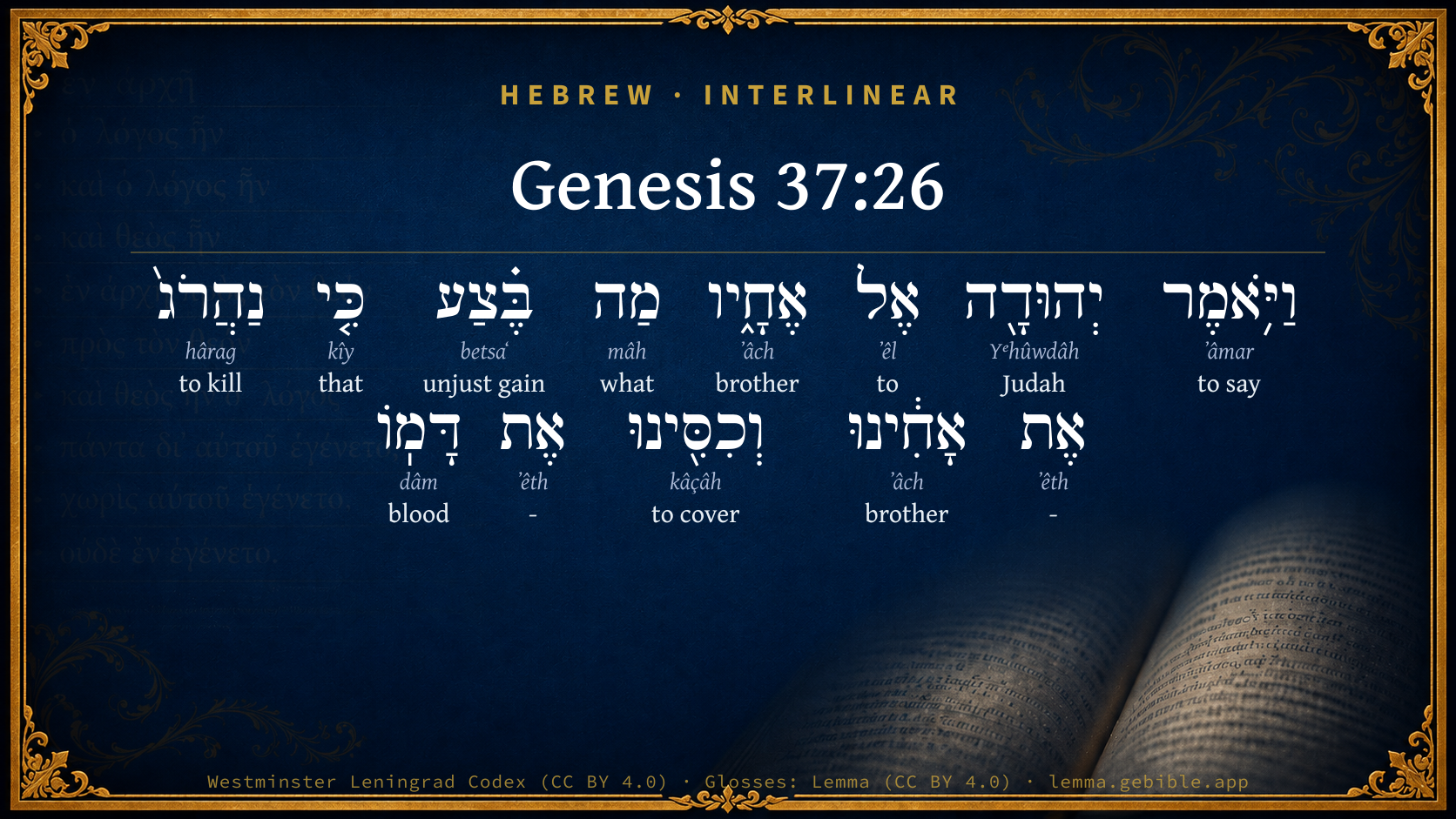
Genesis 37:26

Hebrew (Westminster Leningrad Codex) Genesis 37:26 appears in the Hebrew Old Testament. The text above is from the Westminster Leningrad Codex. Each word links to its Strong’s number, a concise gloss, and parsing drawn from the Open Scriptures Hebrew Bible morphology. Click any word for its full Brown-Driver-Briggs (BDB) entry.
Download image
Cite this verse

Genesis 37:26 (World English Bible). Public Domain. Lemma interlinear Bible study tool, https://lemma.gebible.app/v/genesis/37/26.

Show BibTeX & RIS
BibTeX
RIS
English Translation
Judah said to his brothers, "What profit is it if we kill our brother and conceal his blood?
World English Bible · Public Domain
Highlights
  • 1 first appearance in the Hebrew Bible
Full analysis ↓
Download a study sheet

One document with this verse’s original text, its word-by-word gloss line, the meaning frame, cross-references with their text, attributed commentary, and full source and license credits — printable, and it pastes into notes with its structure intact.

This verse Autodidact and up

Study sheet (.html) Plain text (.txt)

A passage Seminary Student

Up to 50 verses in one chapter. A passage sheet keeps up to 6 commentary sources and 12 cross-references per verse, in the order this page ranks them, and says so on the sheet whenever that leaves anything out. Ask for a single verse and you get the Autodidact verse sheet above.

Everything on this page stays free to read, with no account — the sheet is a download of what is already on screen, not access to it.

Want to remove ads? Support Godless Engineer
Compare translations 3

The same verse in 3 English versions, stacked beneath the original-language interlinear above. Click any original word for its lexicon entry.

Each is an independent rendering of the whole verse — the interlinear is not word-aligned to these translations.

Highlighted words mark where these versions differ — a whole-verse word diff, not a word-by-word alignment.

  • World English Bible Public Domain
    Judah said to his brothers, "What profit is it if we kill our brother and conceal his blood?
  • King James Version Public Domain
    And Judah said unto his brethren, What profit is it if we slay our brother, and conceal his blood?
  • unfoldingWord Literal Text CC BY-SA 4.0
    Then Judah said to his brothers, “What gain if we kill our brother and cover up his blood?

unfoldingWord Literal Text — © unfoldingWord, licensed CC BY-SA 4.0. Word-aligned USFM3 via Door43 (git.door43.org/unfoldingWord/en_ult).

Versions to compare (up to 4)

3 of 4 selected

Show all 18 translations

Every available English version of this verse, each an independent rendering of the whole verse.

  • World English Bible Public Domain
    Judah said to his brothers, "What profit is it if we kill our brother and conceal his blood?
  • Berean Standard Bible Public Domain
    Then Judah said to his brothers, “What profit will we gain if we kill our brother and cover up his blood?
  • Majority Standard Bible Public Domain
    Then Judah said to his brothers, “What profit will we gain if we kill our brother and cover up his blood?
  • King James Version Public Domain
    And Judah said unto his brethren, What profit is it if we slay our brother, and conceal his blood?
  • American Standard Version (1901) Public Domain
    And Judah said unto his brethren, What profit is it if we slay our brother and conceal his blood?
  • Revised Version (1885) Public Domain
    And Judah said unto his brethren, What profit is it if we slay our brother and conceal his blood?
  • Geneva Bible (1599) Public Domain
    Then Iudah said vnto his brethren, What auaileth it, if we slay our brother, though wee keepe his blood secret?
  • Douay-Rheims (1899) Public Domain
    And Juda said to his brethren: What will it profit us to kill our brother, and conceal his blood?
  • Young's Literal Translation Public Domain
    And Judah saith unto his brethren, `What gain when we slay our brother, and have concealed his blood?
  • Literal Standard Version CC BY-SA 4.0
    And Judah says to his brothers, “What gain when we slay our brother, and have concealed his blood?
  • Unlocked Literal Bible CC BY-SA 4.0
    Judah said to his brothers, “What profit is it if we kill our brother and cover up his blood?
  • unfoldingWord Literal Text CC BY-SA 4.0
    Then Judah said to his brothers, “What gain if we kill our brother and cover up his blood?
  • Darby Bible Public Domain
    And Judah said to his brethren, What profit is it that we kill our brother and secrete his blood?
  • World Messianic Bible Public Domain
    Judah said to his brothers, “What profit is it if we kill our brother and conceal his blood?
  • Webster's Bible Public Domain
    And Judah said to his brethren, What profit is it if we slay our brother, and conceal his blood.
  • Free Bible Version CC BY-SA 4.0
    “What's the point of killing our brother?” Judah asked his brothers. “Then we'd have to cover up his death!
  • Bible in Basic English Public Domain
    And Judah said to his brothers, What profit is there in putting our brother to death and covering up his blood?
  • JPS Tanakh (1917) Public Domain
    And Judah said unto his brethren: 'What profit is it if we slay our brother and conceal his blood?

Literal Standard Version (2020), Covenant Press — licensed CC BY-SA 4.0. Text via the HelloAO Bible API (eBible.org). Unlocked Literal Bible (unfoldingWord) — licensed CC BY-SA 4.0. Text via the HelloAO Bible API (eBible.org). unfoldingWord Literal Text — © unfoldingWord, licensed CC BY-SA 4.0. Word-aligned USFM3 via Door43 (git.door43.org/unfoldingWord/en_ult). Free Bible Version, Dr. Jonathan Gallagher — licensed CC BY-SA 4.0. Text via the HelloAO Bible API (eBible.org).

Word by word

More ways to search: Search by grammar → Find every occurrence → Compare this word →

Practice this passage: Drill this verse → Learn its vocabulary →

בֶּ֗צַע
betsaʻ
H1215
“unjust gain”
Noun, Common, Masculine, Singular, Absolute
Part of Speech
Noun
Type
Common
Gender
Masculine
Number
Singular
State
Absolute
Full BDB Definition

Origin: from H1214

TWOT: 267a

profit, unjust gain, gain (profit) acquired by violence
  1. וַיֹּ֥אמֶר ʼâmar H559 “and · to say” Conjunction + Verb, Qal, Sequential Imperfect, 3rd Person, Masculine, Singular
  2. יְהוּדָ֖ה Yᵉhûwdâh H3063 “Judah” Noun, Proper
  3. אֶל ʼêl H413 “to” Preposition
  4. אֶחָ֑יו ʼâch H251 “brothers · his” Noun, Common, Masculine, Plural, Construct + Suffix, Personal, 3rd Person, Masculine, Singular
  5. מַה mâh H4100 “what” Particle, Interrogative
  6. כִּ֤י kîy H3588 “that” Conjunction
  7. נַהֲרֹג֙ hârag H2026 “to kill” Verb, Qal, Imperfect, 1st Person, Common, Plural
  8. אֶת ʼêth H853 “-” Particle, Direct Object
  9. אָחִ֔ינוּ ʼâch H251 “brother · our” Noun, Common, Masculine, Singular, Construct + Suffix, Personal, 1st Person, Common, Plural
  10. וְכִסִּ֖ינוּ kâçâh H3680 “and · to cover” Conjunction + Verb, Piel, Sequential Perfect, 1st Person, Common, Plural
  11. אֶת ʼêth H853 “-” Particle, Direct Object
  12. דָּמֽוֹ dâm H1818 “blood · his” Noun, Common, Masculine, Singular, Construct + Suffix, Personal, 3rd Person, Masculine, Singular

About this verse

These counts appear in no published source. They are computed here, from the morphology-tagged text and Lemma’s own curated glosses. What Lemma adds →

13
words
11
distinct lemmas
Pentateuch
section

Notable vocabulary

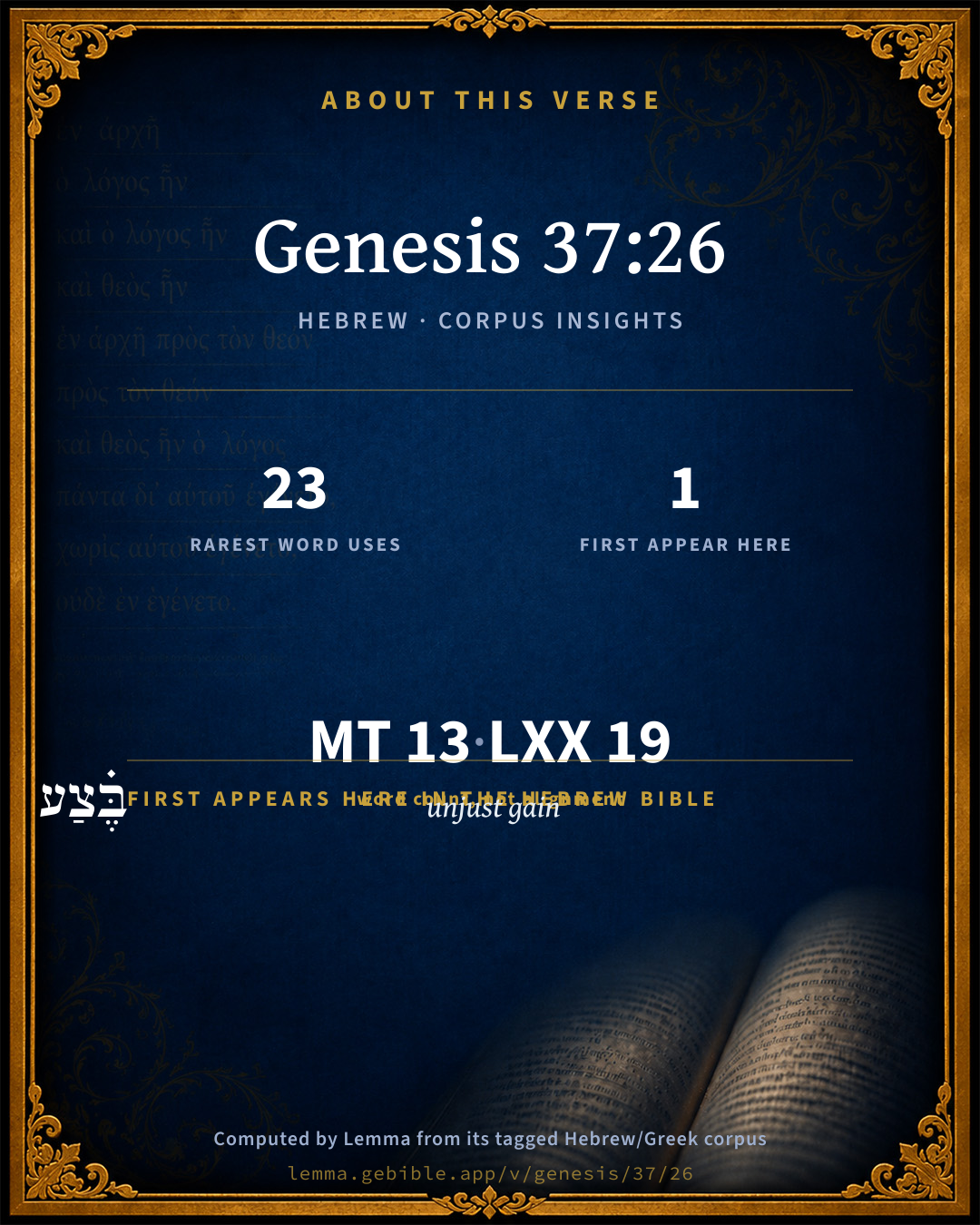
The rarest word here is בֶּ֗צַע unjust gain H1215 — appearing just 23 times in the whole Hebrew Bible.

First appearance in Scripture

This word makes its first canonical appearance in the Hebrew Bible here:

  • בֶּ֗צַע unjust gain H1215

Shared distinctive vocabulary

בֶּ֗צַע unjust gain H1215 occurs in 23 verses of the Hebrew Bible. Also found in:

Grammatical profile

  • 3 verbs
  • 5 nouns
  • 1 preposition
  • 1 conjunction
  • 3 particles

Verb forms

  • וַיֹּ֥אמֶר Qal · Sequential Imperfect
  • נַהֲרֹג֙ Qal · Imperfect
  • וְכִסִּ֖ינוּ Piel · Sequential Perfect

Repetition

A word recurs within this verse — often emphatic in Hebrew:

  • אֶחָ֑יו brother H251 ×2

Hebrew & Septuagint length

In English translation the verse runs 18 words from the Hebrew and 19 from the Septuagint (LXX English) — closely comparable.

A rough comparison of the two English renderings, which tokenize alike — not a word-level alignment.

Word counts can differ between the Hebrew and the Greek without any difference in meaning — e.g. the Hebrew direct-object marker אֵת has no separate Greek word, and Greek often adds the article ὁ.

In the original languages it is 13 Hebrew tokens and 19 Greek tokens — but the two are counted differently (Hebrew bundles its prefixes and suffixes into one token; the Greek is in lemma form), so that isn’t a like-for-like length.

Cross-references

11

Topical passages linked to Genesis 37:26 in the Treasury of Scripture Knowledge — connected by theme and wording, ordered by reader-vote popularity; previews shown in the World English Bible.

  • Genesis 37:20 Come now therefore, and let's kill him, and cast him into one of the pits, and we will say, 'An evil animal has devoured him.' We will see what will become of his dreams."
  • Genesis 4:10 Yahweh said, "What have you done? The voice of your brother's blood cries to me from the ground.
  • Genesis 25:32 Esau said, "Behold, I am about to die. What good is the birthright to me?"
  • Deuteronomy 17:8 If there arise a matter too hard for you in judgment, between blood and blood, between plea and plea, and between stroke and stroke, being matters of controversy within your gates; then shall you arise, and go up to the place which Yahweh your God shall choose;
  • 2 Samuel 1:16 David said to him, Your blood be on your head; for your mouth has testified against you, saying, I have slain Yahweh's anointed.
  • Job 16:18 "Earth, don't cover my blood, Let my cry have no place to rest.
  • Psalms 30:9 "What profit is there in my destruction, if I go down to the pit? Shall the dust praise you? Shall it declare your truth?
  • Jeremiah 41:8 But ten men were found among those who said to Ishmael, Don't kill us; for we have stores hidden in the field, of wheat, and of barley, and of oil, and of honey. So he stopped, and didn't kill them among their brothers.
  • Ezekiel 24:7 For her blood is in the midst of her; she set it on the bare rock; she didn't pour it on the ground, to cover it with dust.
  • Matthew 16:26 For what will it profit a man, if he gains the whole world, and forfeits his life? Or what will a man give in exchange for his life?
  • Romans 6:21 What fruit then did you have at that time in the things of which you are now ashamed? For the end of those things is death.

Cross-references courtesy of OpenBible.info (CC BY 4.0).

Hebrew and Greek witnesses Masoretic Hebrew ↔ Greek Septuagint

The same verse in the two great witnesses to the Old Testament, shown verse-for-verse.

These are two independent witnesses, not word-aligned to each other, and the Septuagint is shown in lemma (dictionary) form.

Hebrew Genesis 37:26 Masoretic · Westminster Leningrad Codex

וַיֹּ֥אמֶר יְהוּדָ֖ה אֶל אֶחָ֑יו מַה בֶּ֗צַע כִּ֤י נַהֲרֹג֙ אֶת אָחִ֔ינוּ וְכִסִּ֖ינוּ אֶת דָּמֽוֹ

Judah said to his brothers, "What profit is it if we kill our brother and conceal his blood?

World English Bible · Public Domain

Greek LXX Genesis 37:26 Septuagint · lemma form

εἶπον δέ ἰούδας πρός ὁ ἀδελφός αὐτός τίς χρήσιμος ἐάν ἀποκτείνω ὁ ἀδελφός ἐγώ καί κρύπτω ὁ αἷμα αὐτός

And Judas said to his brethren, What profit is it if we kill our brother, and conceal his blood?

LXX2012 (modern English Septuagint) · Public Domain

Hebrew: Westminster Leningrad Codex (CC BY 4.0). Greek: Septuagint (public domain); English from LXX2012 (modern English Septuagint) (Public Domain). How the Septuagint differs from the Hebrew →

Targum (Aramaic paraphrase)

2

The Targum is the ancient Jewish Aramaic paraphrase of the Hebrew Scriptures — an interpretive translation, not the Hebrew text itself. Onkelos (literal) and Pseudo-Jonathan (expansive) render the Torah, and Jonathan the Prophets. Coverage is partial: where no permissively-licensed English translation exists for a verse, only the Aramaic is shown. This is verse-level text, not a word-by-word alignment to the Hebrew.

  1. Targum Onkelos Torah (Genesis–Deuteronomy)
    וַאֲמַר יְהוּדָה לַאֲחוֹהִי מָה מָמוֹן נִתְהֲנֵי לָנָא אֲרֵי נִקְטּוֹל יָתּ אָחוּנָא וּנְכַסֵי עַל דְּמֵהּ

    (no public-domain English translation for this verse)

    Targum Onkelos — Aramaic: “Onkelos Genesis” (public domain); “Onkelos Exodus” (public domain); “Onkelos Leviticus” (public domain); “Onkelos Numbers” (public domain); “Onkelos Deuteronomy” (public domain). English: “Sefaria Community Translation” (CC0 1.0 (public-domain dedication)); “J.W. Etheridge. The Targums of Onkelos and Jonathan Ben Uzziel on the Pentateuch. London: Longmans, Green, 1862” (public domain). Text via Sefaria.

  2. Targum Pseudo-Jonathan Torah (Genesis–Deuteronomy)
    וַאֲמַר יְהוּדָה לַאֲחוֹהִי מַה הַנְיַית מָמוֹן יְהִי לָן אֲרוּם נִקְטוֹל יַת אֲחוּנָא וּנְכַסֵי עַל דְמֵיהּ

    And Jehuda said to his brethren, What profit of mammon should we have if we killed our brother, and covered his blood?

    Targum Pseudo-Jonathan — Aramaic: “Targum Jonathan on Genesis” (public domain); “Targum Jonathan on Exodus” (public domain); “Targum Jonathan on Leviticus” (public domain); “Targum Jonathan on Numbers” (public domain); “Targum Jonathan on Deuteronomy” (public domain). English: “The Targum of Jonathan ben Uzziel, trans. J. W. Etheridge, London, 1862” (public domain). Text via Sefaria.

Commentary

Notes on Genesis 37:26 from classic Christian and Jewish commentators (each source and its license shown beneath its notes). The classic Christian expositions comment on the surrounding passage and are grouped to its opening verse, so a note may address several verses; the Jewish commentaries on the Tanakh (Rashi and others) are per-verse, so they appear only where the commentator wrote on this verse.

Lemma curates 59 commentaries, every one of them public domain or Creative Commons licensed, each selected and text-cleaned for this edition rather than reprinted as found. About our sources →

Trapp's Complete Commentary

John Trapp

Gen 37:26 And Judah said unto his brethren, What profit [is it] if we slay our brother, and conceal his blood?

Ver. 26. What profit is it? &c.] Cui bono said that old judge in Rome. {a} This is a song that most men will listen to. As the Jassians in Strabo, delighted with the music of an excellent harper, ran all away, when once they heard the market bell ring, save a deaf old man, that could take little delight in the harper’s ditties. But it were to be wished, that whenever we are tempted to sin, we would ask ourselves this question, What profit is it? &c.

{a} Cic., Orat. pro. C. Rabir.

John Trapp, A Commentary or Exposition upon All the Books of the Old and New Testament (1647–1656) — public domain. Text from a community e-Sword module.

Joseph Benson's Commentary

Gen 37:26. What profit is it if we slay our brother? — It will be less guilt and more gain to sell him. They all agreed to this. And as Joseph was sold by the contrivance of Judah for twenty pieces of silver, so was our Lord Jesus for thirty, and by one of the same name too, Judas. Reuben, it seems, was gone away from his brethren when they sold Joseph, intending to come round some other way to the pit, and to help Joseph out of it. But had this taken effect, what had become of God’s purpose concerning his preferment in Egypt? There are many devices of the enemies of God’s people to destroy them, and of their friends to help them, which perhaps are both disappointed, as these here; but the counsel of the Lord, that shall stand. Reuben thought himself undone because the child was sold; I, whither shall I go? — He being the eldest, his father would expect from him an account of him; but it proved they had all been undone, if he had not been sold.

Joseph Benson's Commentary on the Old and New Testaments (1811–1818) — public domain. Text from a community e-Sword module.

The Pulpit Commentary

CHAPTER 37:26-36

EXPOSITION.

Vers. 26, 27. And Judah (apparently shrinking from the idea of murder) said unto his brethren, What profit is it if (literally, what of advantage that) we slay our brother, and conceal his blood? (i.e. and hide the fact of his murder). Come, and let us sell him to the Ishmaelites, and let not our hand be upon him (literally, and our hand, let it not be upon him, i.e. to slay him); for he is our brother and our flesh or, more expressly, our brother and our flesh he (cf. Gen_29:14) And his brethren were content literally, hearkened, viz., to the proposal.

Vers. 26-36.

Joseph carried by Midianites to Egypt.

I THE INFAMOUS SALE.

1. The wicked proposal. "Come, and let us sell him. By whatever motives Judah was actuated, the notion that either he or his brethren had a right thus to dispose of Joseph"s life was not simply an open violation of the Divine law which constituted all men with equal fights, and in particular made every man his brother"s keeper, not his brother"s destroyer or proprietor, but a hideous discovery of the utter perversion of moral nature which had taken place in the case of Joseph"s brethren. So low had they now sunk, that they were become not alone without humanity, but without natural affection as well.

2. The double reason.

(1) The advantageous character of the proposed transaction is exhibited by Judah, who doubtless understood the sort of arguments that would weigh most powerfully with his brethren. Simply to assassinate the hated stripling and conceal his blood might indeed gratify their feelings of revenge, but would not do much to enrich them. Might it not be possible to dispose of him more profitably than by the coarse way of killing him? Then

(2) the humane aspect of the proposed transaction is pathetically dwelt upon by Judah, is our brother and our flesh, in which perhaps may also be detected Judah"s subtle knowledge of human nature, in reasoning that men who cared nothing for the claims of humanity and brotherhood in themselves might be induced to do a little cheap philanthropy by sparing Joseph, after they had first been made to see that it would likewise be profitable. Judah"s last remark was a master-stroke which overbore every vestige of opposition: "his brethren were content.

1. The favorable opportunity. Many wicked schemes are happily never carried through because the opportunity is wanting thanks to Divine providence! But, on the other hand, thousands of nefarious crimes are born of the opportunity thanks to the sinful ingenuity of the fallen heart I The scheme of Judah was clearly suggested by the providential circumstance that at the moment an Ishmaelitish caravan was passing by on its way with gums and spicery to Egypt. That caravan was God"s chariot sent to convey Joseph to the throne of Egypt. Judah asked his brethren to see in it a prison van to take their brother into slavery in Egypt. Wicked men and God may often seem to play at cross purposes with one another, but God always triumphs. Man proposes; God disposes.

1. The accomplished transaction. "They drew and lifted Joseph up out of the pit, and sold him to the Midianites for thirty pieces of silver." The first recorded specimen of a transaction which has frequently been repeated in the history of mankind. Slave markets have often imitated, but seldom surpassed, the wickedness of which Joseph"s brethren were guilty. It was not simply a fellow-creature that they sold, but a brother; and they had not even the poor apology of getting a good bargain, as they sold him for twenty shekels little over forty shillings!

3. The unforeseen result. Joseph"s purchasers conveyed him into Egypt, and sold him, as probably his brethren expected; it is scarcely likely they anticipated he would find his way into so honorable service as that of a high officer of state. But God was taking Joseph thereby a step nearer to his predicted elevation.

II THE DOLEFUL TIDINGS.

1. The ominous symbol. The coat of ends, the token of a father"s love for his darling son, the insensate ruffians, after dipping it in blood, caused to be conveyed into their father"s presence by the hands of a swift-footed messenger. This was rather a proof of their cowardice than of their consideration for Jacob"s feelings.

2. The pretended discovery. The bearer of the blood-stained tunic was directed to say that the brethren had found the robe, and to ask, with expressions of their deep concern, whether or not it was the coat of his beloved son. Their intention we cannot think was to stab their father"s heart, but to mislead his judgment.

3. The expected inference. As they designed, the old man concluded that his son was devoured: "Joseph is without doubt rent in pieces." Seldom do villains" plots succeed so well.

III THE SORROWING PARENT.

1. The bitter grief. The depth and tenderness of Jacob"s mourning for his lost son was

(1) visibly expressed: "he rent his clothes, and put sackcloth on his loins;

(2) long continued: "he mourned for his son many days;" and, if we accept a proposed reading of the last clause of ver. 35,

(3) lovingly shared: "his father," the blind Isaac, who still survived, "wept for him for Rachel"s dead child and Jacob"s lost son.

2. The ineffectual consolation. "All his sons and all his daughters rose up to comfort him; but he refused to be comforted." For this Jacob was

(1) to be excused, since his comforters were mostly hypocrites, whose proffered consolations must have sounded strangely hollow in his ears; but also

(2) to be blamed, since although God in his providence had taken away Joseph, that was no reason why he should give way to despairing grief. Not so did Abraham when he thought of losing Isaac.

The Pulpit Commentary (1880–1919), ed. H.D.M. Spence-Jones & Joseph S. Exell — public domain. Text from a community e-Sword module.

Tyndale Open Study Notes

Tyndale Open Resources

37:26 Judah began to exercise leadership that he would continue to develop as events unfolded (see 43:8-10).

Tyndale Open Study Notes — © Tyndale Open Resources, licensed CC BY-SA 4.0. Text via the HelloAO Bible API.

Jamieson, Fausset & Brown

Robert Jamieson, A. R. Fausset & David Brown

Judah said, . . . What profit is it if we slay our brother?--The sight of these travelling merchants gave a sudden turn to the views of the conspirators; for having no wish to commit a greater degree of crime than was necessary for the accomplishment of their end, they readily approved of Judah's suggestion to dispose of their obnoxious brother as a slave. The proposal, of course, was founded on their knowledge that the Arabian merchants trafficked in slaves; and there is the clearest evidence furnished by the monuments of Egypt that the traders who were in the habit of bringing slaves from the countries through which they passed, found a ready market in the cities of the Nile.

they . . . lifted up Joseph out of the pit, and sold him--Acting impulsively on Judah's advice, they had their poor victim ready by the time the merchants reached them; and money being no part of their object, they sold him for

twenty pieces of silver--The money was probably in rings or pieces (shekels), and silver is always mentioned in the records of that early age before gold, on account of its rarity. The whole sum, if in shekel weight, did not exceed £3.

they brought Joseph into Egypt--There were two routes to Egypt: the one was overland by Hebron, where Jacob dwelt, and by taking which, the fate of his hapless son would likely have reached the paternal ears; the other was directly westward across the country from Dothan to the maritime coast, and in this, the safest and most expeditious way, the merchants carried Joseph to Egypt. Thus did an overruling Providence lead this murderous conclave of brothers, as well as the slave merchants both following their own free courses--to be parties in an act by which He was to work out, in a marvellous manner, the great purposes of His wisdom and goodness towards His ancient Church and people.

Jamieson, Fausset & Brown — Commentary Critical and Explanatory on the Whole Bible (1871) — public domain (CC PDM 1.0). Text via the HelloAO Bible API.

The Cambridge Bible for Schools and Colleges

gen. ed. J. J. S. Perowne

26. conceal his blood] Referring to the superstition that blood, which was not covered, would cry for vengeance: see note on Gen_4:10. Cf. Job_16:18; Isa_26:21; Eze_24:7.

The Cambridge Bible for Schools and Colleges (gen. ed. J. J. S. Perowne; Cambridge University Press, 1878–1918) — public domain. Text from a community e-Sword module.

John Gill's Exposition

Come, and let us sell him to the Ishmaelites,.... For a slave, and that will defeat his dream; and as these were going down to Egypt, where they would sell him, he would be far enough from them, and there would be no probability of his ever being lord over them:

and let not our hand be upon him; to take away his life, either by stabbing or starving him:

for he is our brother, and our flesh; they had all one father, though different mothers, and therefore, as the relation was so near, some sympathy and compassion should be shown; some degree of tenderness at least, and not savageness and cruelty:

and his brethren were content; they agreed to the motion, inasmuch as they supposed it would answer their end as well, which was to prevent his dominion over them.

John Gill's Exposition of the Whole Bible (1746–1763) — public domain (CC PDM 1.0). Text via the HelloAO Bible API.

Matthew Poole's English Annotations

If we suffer him to perish in the pit, when we may sell him with advantage,

and conceal his blood, i.e. his death, as the word blood is often used. See Deu 17:8; 2Sa 1:16; 3:28.

Matthew Poole's English Annotations on the Holy Bible (1683–1685) — public domain. Text from a community e-Sword/MySword module.

John Wesley's Explanatory Notes

What profit is it if we slay our brother? - It will be less guilt and more gain to sell him. They all agreed to this. And as Joseph was sold by the contrivance of Judah for twenty pieces of silver, so was our Lord Jesus for thirty, and by one of the same name too, Judas. Reuben it seems, was gone away from his brethren when they sold Joseph, intending to come round some other way to the pit, and to help Joseph out of it. But had this taken effect, what had become of God's purpose concerning his preferment, in Egypt? There are many devices of the enemies of God's people to destroy them, and of their friends to help them, which perhaps are both disappointed, as these here; but the counsel of the Lord that shall stand. Reuben thought himself undone because the child was sold; I, whither shall I go? He being the eldest, his father would expect from him an account of him; but it proved they had all been undone, if he had not been sold.

John Wesley, Explanatory Notes Upon the Whole Bible (1754–1765) — public domain. Text via the GEBible commentary corpus.

Rashi

Rabbi Shlomo Yitzchaki (Rashi)

מה בצע means WHAT PROFIT— just as the Targum renders it.

וכסינו את דמו AND CONCEAL HIS BLOOD — this signifies and we hide the fact of his death (for they had not shed his blood, but had cast him into a pit to die).

Rashi on the Tanakh — English translations: “The Judaica Press complete Tanach with Rashi, translated by A. J. Rosenberg” (CC BY 4.0); “Pentateuch with Rashi's commentary by M. Rosenbaum and A.M. Silbermann, 1929-1934” (public domain); “The Metsudah Tanach series, Lakewood, N.J” (CC BY 4.0); and “The Book of Joshua, Metsudah Publications, 1997” (CC BY 4.0). Text via Sefaria.

Ramban (Nachmanides)

Rabbi Moshe ben Nachman (Ramban / Nachmanides)

AND WE SHALL CONCEAL HIS BLOOD. “We shall hide the fact of his death.” This is Rashi’s language. And Onkelos similarly says, “and we shall cover up his blood.”The correct interpretation is as its literal sense indicates. It is the custom of those who kill in secret to slay the victim, bury him, and conceal his blood in the earth, even as it says, And he hid him in the sand. This was why Judah said to them, “By casting him into the pit we shall kill our brother and cover his blood with dust, for it will so be accounted to us.” Now Reuben had instructed them not to spill blood with their hands. Rather, they should throw him into the pit and let him perish there, since the punishment of he who causes bloodshed is not the same as the punishment of one who actually commits the murder. Judah now came and said, “This too will be accounted to us as murder, as if we had killed him.” Such indeed is the truth, as the verse says, And him [Uriah] thou hast slain with the sword of the children of Ammon. The difference between actual murder and causing death is that there is a greater punishment for a murderer and a lesser punishment for the one who indirectly causes death. Thus, the two of them [Reuben and Judah] spoke the truth.

Ramban (Nachmanides) on the Tanakh — English translation: “Commentary on the Torah by Ramban (Nachmanides). Translated and annotated by Charles B. Chavel. New York, Shilo Pub. House, 1971-1976” (CC BY 4.0). Text via Sefaria.

Sforno

Rabbi Ovadia Sforno

What will we gain. By this we will do harm not only to Yoseif but to ourselves, because we will be filled with remorse.

And cover up his blood. Moreover, the deed will not even serve as a deterrent to our other adversaries because we will have to conceal it for our own honor and out of fear of our father.

Sforno on the Tanakh — English translation: “Yalkut, Sifsei Chachomim Chumash, Metsudah Publications, 2009” (CC BY 4.0). Text via Sefaria.

Radak

Rabbi David Kimhi (Radak)

?מה בצע, “what financial advantage,” as per Onkelos.

כי נהרוג את אחינו, what does this mean seeing Reuven had already prevented them from killing their brother outright? We must therefore understand Yehudah’s words as meaning: “what are we going to do with him? If we leave him in the pit this is just as bad as having killed him.”

וכסינו את דמו, and cover his blood. He meant they had to conceal his death from their father.

Radak on the Tanakh — English translations: “Sefaria Community Translation” (CC0 1.0 (public-domain dedication)); “Eliyahu Munk, HaChut Hameshulash” (CC BY 4.0); “Rabbi Mike Feuer, Jerusalem Anthology” (CC BY 4.0); and “R. David Kimhi on the first book of Psalms, Translated by R.G. Finch, London, 1919” (public domain). Text via Sefaria.

Lesson kit

Teaching starters — assembled from the data on this page, not authored interpretation. Every prompt links to the verse data it draws on. Edit before teaching.

Genesis, in the Pentateuch, opens this verse with 13 words (11 distinct Hebrew lemmas). Its most distinctive word is betsaʻ (“unjust gain”). A historical commentator’s framing appears above. Read the whole chapter for the surrounding context.

Discussion questions

  1. How does “unjust gain” (betsaʻ) shape what this verse is saying?
  2. The word “unjust gain” first appears here in Scripture. What is being introduced at this debut?
  3. Exodus 18:21 shares the word «unjust gain» with this verse. How do the two illuminate each other?
  4. “brother” occurs 2× in this one verse. What is the effect of the repetition?
  5. The translations on this page render this verse differently — a whole-verse word diff, not a word-by-word alignment. What might account for the different wordings?
  6. The verb «וַיֹּ֥אמֶר» is Qal Sequential Imperfect. How does its form color the action?
  7. Reading how Trapp's Complete Commentary and Joseph Benson's Commentary read this verse, where do the two commentators agree and where do they part?

Things to notice

Reading settings

Reading text

Shown beneath each verse's original-language words.

Old Testament
Old Testament edition

Read the OT as the Masoretic Hebrew (MT) or the Greek Septuagint (LXX).

English shown for the Greek Septuagint (in the Hebrew ↔ Greek comparison).

Comparing translations? Open the Compare panel on any verse page to stack up to four side by side.