
Exodus 30:10

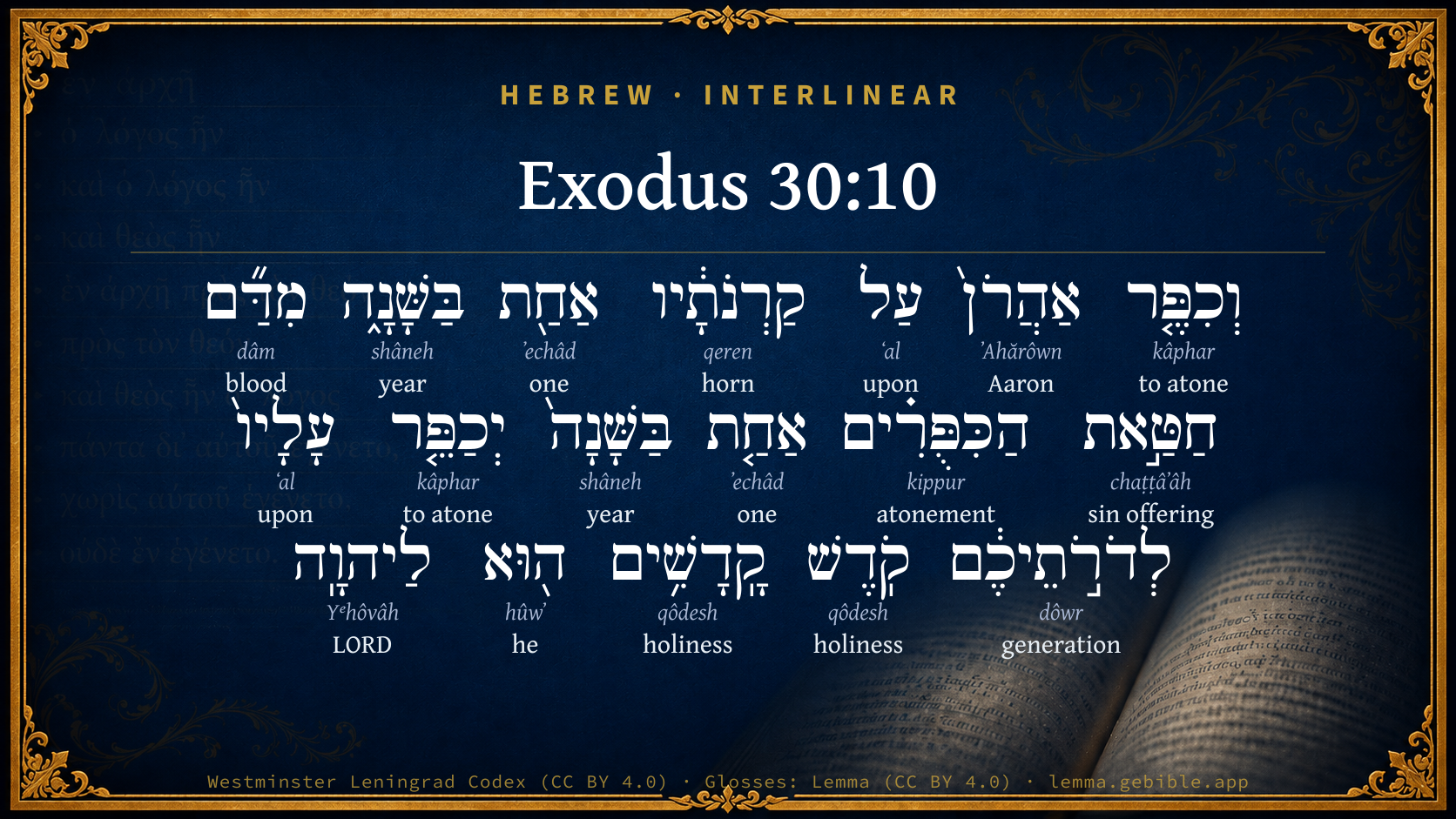
Hebrew (Westminster Leningrad Codex) Exodus 30:10 appears in the Hebrew Old Testament. The text above is from the Westminster Leningrad Codex. Each word links to its Strong’s number, a concise gloss, and parsing drawn from the Open Scriptures Hebrew Bible morphology. Click any word for its full Brown-Driver-Briggs (BDB) entry.
Download image
Cite this verse

Exodus 30:10 (World English Bible). Public Domain. Lemma interlinear Bible study tool, https://lemma.gebible.app/v/exodus/30/10.

Show BibTeX & RIS
BibTeX
RIS
English Translation
Aaron shall make atonement on its horns once in the year; with the blood of the sin offering of atonement once in the year he shall make atonement for it throughout your generations. It is most holy to Yahweh."
World English Bible · Public Domain
Download a study sheet

One document with this verse’s original text, its word-by-word gloss line, the meaning frame, cross-references with their text, attributed commentary, and full source and license credits — printable, and it pastes into notes with its structure intact.

This verse Autodidact and up

Study sheet (.html) Plain text (.txt)

A passage Seminary Student

Up to 50 verses in one chapter. A passage sheet keeps up to 6 commentary sources and 12 cross-references per verse, in the order this page ranks them, and says so on the sheet whenever that leaves anything out. Ask for a single verse and you get the Autodidact verse sheet above.

Everything on this page stays free to read, with no account — the sheet is a download of what is already on screen, not access to it.

Want to remove ads? Support Godless Engineer
Compare translations 3

The same verse in 3 English versions, stacked beneath the original-language interlinear above. Click any original word for its lexicon entry.

Each is an independent rendering of the whole verse — the interlinear is not word-aligned to these translations.

Highlighted words mark where these versions differ — a whole-verse word diff, not a word-by-word alignment.

  • World English Bible Public Domain
    Aaron shall make atonement on its horns once in the year; with the blood of the sin offering of atonement once in the year he shall make atonement for it throughout your generations. It is most holy to Yahweh."
  • King James Version Public Domain
    And Aaron shall make an atonement upon the horns of it once in a year with the blood of the sin offering of atonements: once in the year shall he make atonement upon it throughout your generations: it is most holy unto the LORD.
  • unfoldingWord Literal Text CC BY-SA 4.0
    And Aaron shall make atonement on its horns once a year. From the blood of the purification of the atonement once a year he shall make atonement for it throughout your generations. It is a holiest holy thing to Yahweh.”

unfoldingWord Literal Text — © unfoldingWord, licensed CC BY-SA 4.0. Word-aligned USFM3 via Door43 (git.door43.org/unfoldingWord/en_ult).

Versions to compare (up to 4)

3 of 4 selected

Show all 18 translations

Every available English version of this verse, each an independent rendering of the whole verse.

  • World English Bible Public Domain
    Aaron shall make atonement on its horns once in the year; with the blood of the sin offering of atonement once in the year he shall make atonement for it throughout your generations. It is most holy to Yahweh."
  • Berean Standard Bible Public Domain
    Once a year Aaron shall make atonement on the horns of the altar. Throughout your generations he shall make atonement on it annually with the blood of the sin offering of atonement. The altar is most holy to the LORD.”
  • Majority Standard Bible Public Domain
    Once a year Aaron shall make atonement on the horns of the altar. Throughout your generations he shall make atonement on it annually with the blood of the sin offering of atonement. The altar is most holy to the LORD.”
  • King James Version Public Domain
    And Aaron shall make an atonement upon the horns of it once in a year with the blood of the sin offering of atonements: once in the year shall he make atonement upon it throughout your generations: it is most holy unto the LORD.
  • American Standard Version (1901) Public Domain
    And Aaron shall make atonement upon the horns of it once in the year; with the blood of the sin-offering of atonement once in the year shall he make atonement for it throughout your generations: it is most holy unto Jehovah.
  • Revised Version (1885) Public Domain
    And Aaron shall make atonement upon the horns of it once in the year: with the blood of the sin offering of atonement once in the year shall he make atonement for it throughout your generations: it is most holy unto the LORD.
  • Geneva Bible (1599) Public Domain
    And Aaron shall make reconciliation vpon the hornes of it once in a yere with the blood of the sinne offring in the day of reconciliation: once in the yeere shall hee make reconciliation vpon it throughout your generations: this is most holy vnto the Lord.
  • Douay-Rheims (1899) Public Domain
    And Aaron shall pray upon the horns thereof once a year, with the blood of that which was offered for sin, and shall make atonement upon it in your generations. It shall be most holy to the Lord.
  • Young's Literal Translation Public Domain
    and Aaron hath made atonement on its horns, once in a year, by the blood of the sin-offering of atonements; once in a year doth he make atonement for it, to your generations; it `is' most holy to Jehovah.'
  • Literal Standard Version CC BY-SA 4.0
    and Aaron has made atonement on its horns once in a year, by the blood of the sin-offering of atonements; once in a year he makes atonement for it, throughout your generations; it [is] most holy to YHWH.”
  • Unlocked Literal Bible CC BY-SA 4.0
    Aaron must make atonement on its horns once a year. With the blood of the sin offering he will make atonement for it once a year throughout your generations. It is completely set apart to Yahweh.”
  • unfoldingWord Literal Text CC BY-SA 4.0
    And Aaron shall make atonement on its horns once a year. From the blood of the purification of the atonement once a year he shall make atonement for it throughout your generations. It is a holiest holy thing to Yahweh.”
  • Darby Bible Public Domain
    And Aaron shall make atonement for its horns once in the year: with the blood of the sin-offering of atonement shall he make atonement for it, once in the year, throughout your generations: it is most holy to Jehovah.
  • World Messianic Bible Public Domain
    Aaron shall make atonement on its horns once in the year; with the blood of the sin offering of atonement once in the year he shall make atonement for it throughout your generations. It is most holy to the LORD.”
  • Webster's Bible Public Domain
    And Aaron shall make an atonement upon the horns of it once in a year, with the blood of the sin-offering of atonements: once in a year shall he make atonement upon it throughout your generations: it is most holy to the LORD.
  • Free Bible Version CC BY-SA 4.0
    Once a year Aaron must perform the atonement ritual by placing blood on the horns of the altar from the sin offering for atonement. This yearly atonement ritual must be carried out for generations to come. This is the Lord's holy altar.”
  • Bible in Basic English Public Domain
    And once every year Aaron is to make its horns clean: with the blood of the sin-offering he is to make it clean once every year from generation to generation: it is most holy to the Lord.
  • JPS Tanakh (1917) Public Domain
    And Aaron shall make atonement upon the horns of it once in the year; with the blood of the sin-offering of atonement once in the year shall he make atonement for it throughout your generations; it is most holy unto the LORD.'

Literal Standard Version (2020), Covenant Press — licensed CC BY-SA 4.0. Text via the HelloAO Bible API (eBible.org). Unlocked Literal Bible (unfoldingWord) — licensed CC BY-SA 4.0. Text via the HelloAO Bible API (eBible.org). unfoldingWord Literal Text — © unfoldingWord, licensed CC BY-SA 4.0. Word-aligned USFM3 via Door43 (git.door43.org/unfoldingWord/en_ult). Free Bible Version, Dr. Jonathan Gallagher — licensed CC BY-SA 4.0. Text via the HelloAO Bible API (eBible.org).

Word by word

More ways to search: Search by grammar → Find every occurrence → Compare this word →

Practice this passage: Drill this verse → Learn its vocabulary →

הַכִּפֻּרִ֗ים
kippur
H3725
“the · atonement”
Particle, Definite Article + Noun, Common, Masculine, Plural, Absolute
Part of Speech
Particle + Noun
Type
Common
Gender
Masculine
Number
Plural
State
Absolute
Full BDB Definition

Origin: from H3722

TWOT: 1023b

atonement
  1. וְכִפֶּ֤ר kâphar H3722 “and · to atone” Conjunction + Verb, Piel, Sequential Perfect, 3rd Person, Masculine, Singular
  2. אַהֲרֹן֙ ʼAhărôwn H175 “Aaron” Noun, Proper
  3. עַל ʻal H5921 “upon” Preposition
  4. קַרְנֹתָ֔יו qeren H7161 “horns · his” Noun, Common, Both, Plural, Construct + Suffix, Personal, 3rd Person, Masculine, Singular
  5. אַחַ֖ת ʼechâd H259 “one” Adjective, Cardinal number, Feminine, Singular, Absolute
  6. בַּשָּׁנָ֑ה shâneh H8141 “in/at the · year” Preposition, Determined + Noun, Common, Feminine, Singular, Absolute
  7. מִדַּ֞ם dâm H1818 “from · blood of” Preposition + Noun, Common, Masculine, Singular, Construct
  8. חַטַּ֣את chaṭṭâʼâh H2403 “sin offering of” Noun, Common, Feminine, Singular, Construct
  9. אַחַ֤ת ʼechâd H259 “one” Adjective, Cardinal number, Feminine, Singular, Absolute
  10. בַּשָּׁנָה֙ shâneh H8141 “in/at the · year” Preposition, Determined + Noun, Common, Feminine, Singular, Absolute
  11. יְכַפֵּ֤ר kâphar H3722 “to atone” Verb, Piel, Imperfect, 3rd Person, Masculine, Singular
  12. עָלָיו֙ ʻal H5921 “upon · him” Preposition + Suffix, Personal, 3rd Person, Masculine, Singular
  13. לְדֹרֹ֣תֵיכֶ֔ם dôwr H1755 “to/for · generations · your” Preposition + Noun, Common, Masculine, Plural, Construct + Suffix, Personal, 2nd Person, Masculine, Plural
  14. קֹֽדֶשׁ qôdesh H6944 “holiness of” Noun, Common, Masculine, Singular, Construct
  15. קָֽדָשִׁ֥ים qôdesh H6944 “holy things” Noun, Common, Masculine, Plural, Absolute
  16. ה֖וּא hûwʼ H1931 “he” Pronoun, Personal, 3rd Person, Masculine, Singular
  17. לַיהוָֽה Yᵉhôvâh H3068 “to/for · LORD” Preposition + Noun, Proper

About this verse

These counts appear in no published source. They are computed here, from the morphology-tagged text and Lemma’s own curated glosses. What Lemma adds →

18
words
13
distinct lemmas
Pentateuch
section

Notable vocabulary

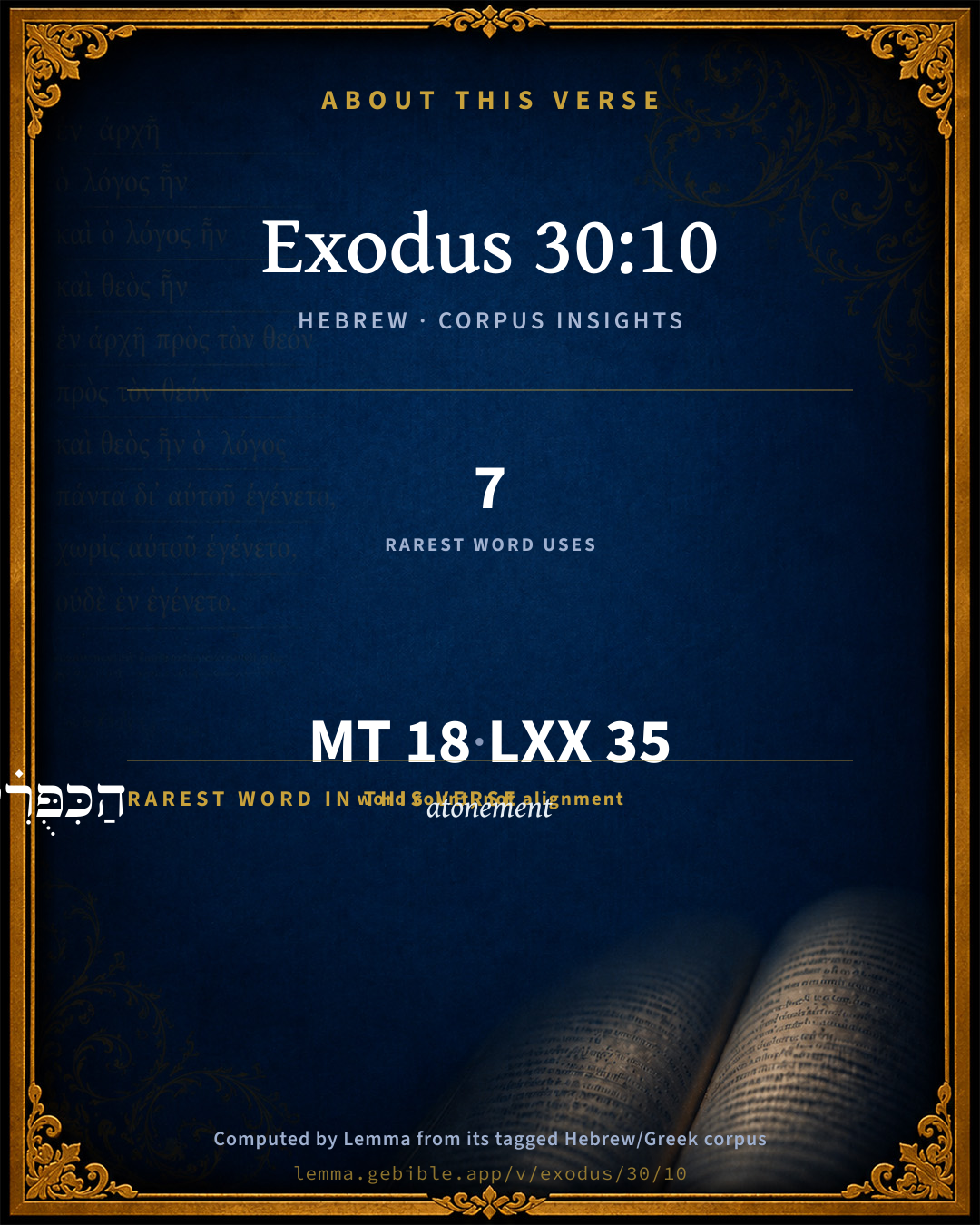
The rarest word here is הַכִּפֻּרִ֗ים atonement H3725 — appearing just 7 times in the whole Hebrew Bible.

Shared distinctive vocabulary

הַכִּפֻּרִ֗ים atonement H3725 occurs in 7 verses of the Hebrew Bible. Also found in:

Grammatical profile

  • 2 verbs
  • 11 nouns
  • 2 adjectives
  • 1 pronoun
  • 2 prepositions

Verb forms

  • וְכִפֶּ֤ר Piel · Sequential Perfect
  • יְכַפֵּ֤ר Piel · Imperfect

Repetition

Words recur within this verse — often emphatic in Hebrew:

  • וְכִפֶּ֤ר to atone H3722 ×2
  • עַל upon H5921 ×2
  • אַחַ֖ת one H259 ×2
  • בַּשָּׁנָ֑ה year H8141 ×2
  • קֹֽדֶשׁ holiness H6944 ×2

Hebrew & Septuagint length

In English translation the verse runs 39 words from the Hebrew and 31 from the Septuagint (LXX English) — closely comparable.

A rough comparison of the two English renderings, which tokenize alike — not a word-level alignment.

Word counts can differ between the Hebrew and the Greek without any difference in meaning — e.g. the Hebrew direct-object marker אֵת has no separate Greek word, and Greek often adds the article ὁ.

In the original languages it is 18 Hebrew tokens and 35 Greek tokens — but the two are counted differently (Hebrew bundles its prefixes and suffixes into one token; the Greek is in lemma form), so that isn’t a like-for-like length.

Cross-references

9

Topical passages linked to Exodus 30:10 in the Treasury of Scripture Knowledge — connected by theme and wording, ordered by reader-vote popularity; previews shown in the World English Bible.

  • Leviticus 16:18 "He shall go out to the altar that is before Yahweh and make atonement for it, and shall take some of the bull's blood, and some of the goat's blood, and put it on the horns of the altar round about.
  • Hebrews 9:22–23 According to the law, nearly everything is cleansed with blood, and apart from shedding of blood there is no remission.
  • Exodus 29:36–37 Every day shall you offer the bull of sin-offering for atonement: and you shall cleanse the altar, when you make atonement for it; and you shall anoint it, to sanctify it.
  • Leviticus 16:5–6 He shall take from the congregation of the children of Israel two male goats for a sin offering, and one ram for a burnt offering
  • Leviticus 16:29–30 "It shall be a statute to you forever: in the seventh month, on the tenth day of the month, you shall afflict your souls, and shall do no manner of work, the native-born, or the stranger who lives as a foreigner among you:
  • Leviticus 23:27 "However on the tenth day of this seventh month is the day of atonement: it shall be a holy convocation to you, and you shall afflict yourselves; and you shall offer an offering made by fire to Yahweh.
  • Hebrews 9:25 nor yet that he should offer himself often, as the high priest enters into the holy place year by year with blood not his own,
  • Hebrews 1:3 His Son is the radiance of his glory, the very image of his substance, and upholding all things by the word of his power, when he had by himself made purification for our sins, sat down on the right hand of the Majesty on high;
  • Hebrews 9:7 but into the second the high priest alone, once in the year, not without blood, which he offers for himself, and for the errors of the people.

Cross-references courtesy of OpenBible.info (CC BY 4.0).

Hebrew and Greek witnesses Masoretic Hebrew ↔ Greek Septuagint

The same verse in the two great witnesses to the Old Testament, shown verse-for-verse.

These are two independent witnesses, not word-aligned to each other, and the Septuagint is shown in lemma (dictionary) form.

Hebrew Exodus 30:10 Masoretic · Westminster Leningrad Codex

וְכִפֶּ֤ר אַהֲרֹן֙ עַל קַרְנֹתָ֔יו אַחַ֖ת בַּשָּׁנָ֑ה מִדַּ֞ם חַטַּ֣את הַכִּפֻּרִ֗ים אַחַ֤ת בַּשָּׁנָה֙ יְכַפֵּ֤ר עָלָיו֙ לְדֹרֹ֣תֵיכֶ֔ם קֹֽדֶשׁ קָֽדָשִׁ֥ים ה֖וּא לַיהוָֽה

Aaron shall make atonement on its horns once in the year; with the blood of the sin offering of atonement once in the year he shall make atonement for it throughout your generations. It is most holy to Yahweh."

World English Bible · Public Domain

Greek LXX Exodus 30:10 Septuagint · lemma form

καί ἐκἱλάσκομαι ἐπί αὐτός ααρων ἐπί ὁ κέρας αὐτός ἅπαξ ὁ ἐνιαυτός ἀπό ὁ αἷμα ὁ καθαρισμός ὁ ἁμαρτία ὁ ἐξιλασμός ἅπαξ ὁ ἐνιαυτός καθαρίζω αὐτός εἰς ὁ γενεά αὐτός ἅγιος ὁ ἅγιος εἰμί κύριος

And once in the year Aaron shall make atonement on its horns, he shall purge it with the blood of purification for their generations: it is most holy to the Lord.

LXX2012 (modern English Septuagint) · Public Domain

On this verse, The Cambridge Bible for Schools and Colleges discusses the Septuagint’s reading. Read the note in Commentary ↓

Hebrew: Westminster Leningrad Codex (CC BY 4.0). Greek: Septuagint (public domain); English from LXX2012 (modern English Septuagint) (Public Domain). How the Septuagint differs from the Hebrew →

Targum (Aramaic paraphrase)

2

The Targum is the ancient Jewish Aramaic paraphrase of the Hebrew Scriptures — an interpretive translation, not the Hebrew text itself. Onkelos (literal) and Pseudo-Jonathan (expansive) render the Torah, and Jonathan the Prophets. Coverage is partial: where no permissively-licensed English translation exists for a verse, only the Aramaic is shown. This is verse-level text, not a word-by-word alignment to the Hebrew.

  1. Targum Onkelos Torah (Genesis–Deuteronomy)
    וִיכַפֵר אַהֲרֹן עַל קַרְנוֹהִי חֲדָא בְּשַׁתָּא מִדְמָא חַטַאת כִּפּוּרַיָא חֲדָא בְשַׁתָּא יְכַפֵּר עֲלוֹהִי לְדָרֵיכוֹן קֹדֶשׁ קוּדְשִׁין הוּא קֳדָם יְיָ:

    (no public-domain English translation for this verse)

    Targum Onkelos — Aramaic: “Onkelos Genesis” (public domain); “Onkelos Exodus” (public domain); “Onkelos Leviticus” (public domain); “Onkelos Numbers” (public domain); “Onkelos Deuteronomy” (public domain). English: “Sefaria Community Translation” (CC0 1.0 (public-domain dedication)); “J.W. Etheridge. The Targums of Onkelos and Jonathan Ben Uzziel on the Pentateuch. London: Longmans, Green, 1862” (public domain). Text via Sefaria.

  2. Targum Pseudo-Jonathan Torah (Genesis–Deuteronomy)
    וִיכַפֵּר אַהֲרן עַל קַרְנוֹי חֲדָא בְּשַׁתָּא מִן אֲדָם חַטָּאתָא דְכִפּוּרַיָא חֲדָא זִמְנָא בְּשַׁתָּא יְכַפֵּר עֲלוֹי בְּיוֹמָא דְכִפּוּרֵי לְדָרֵיכוֹן קוֹדֶשׁ קוּדְשִׁין הוּא קֳדָם יְיָ

    And Aharon shall expiate upon its horns once in the year with the blood of the sin offering for an expiation: once in the year shall he make atonement upon it on the day of atonement in your generations: it shall be most holy before the Lord.

    Targum Pseudo-Jonathan — Aramaic: “Targum Jonathan on Genesis” (public domain); “Targum Jonathan on Exodus” (public domain); “Targum Jonathan on Leviticus” (public domain); “Targum Jonathan on Numbers” (public domain); “Targum Jonathan on Deuteronomy” (public domain). English: “The Targum of Jonathan ben Uzziel, trans. J. W. Etheridge, London, 1862” (public domain). Text via Sefaria.

Commentary

Notes on Exodus 30:10 from classic Christian and Jewish commentators (each source and its license shown beneath its notes). The classic Christian expositions comment on the surrounding passage and are grouped to its opening verse, so a note may address several verses; the Jewish commentaries on the Tanakh (Rashi and others) are per-verse, so they appear only where the commentator wrote on this verse.

Lemma curates 59 commentaries, every one of them public domain or Creative Commons licensed, each selected and text-cleaned for this edition rather than reprinted as found. About our sources →

Trapp's Complete Commentary

John Trapp

Exo 30:10 And Aaron shall make an atonement upon the horns of it once in a year with the blood of the sin offering of atonements: once in the year shall he make atonement upon it throughout your generations: it [is] most holy unto the LORD.

Ver. 10. An atonement upon the horns of it.] Pardon must be sought for the defects found in prayers; as Nehemiah craved mercy for his reformations.

John Trapp, A Commentary or Exposition upon All the Books of the Old and New Testament (1647–1656) — public domain. Text from a community e-Sword module.

Joseph Benson's Commentary

Exo 30:10. Aaron shall make an atonement upon the horns of it once in a year — Namely, upon the day of atonement, (see Lev 16:18-19,) when the high-priest was to take it in his way as he came out from the holy of holies. This was to intimate, that the sins of the priests who ministered at this altar, and of the people for whom they ministered, put a ceremonial impurity upon it, from which it must be cleansed by the blood of atonement. This altar typified the mediation of Christ: the brazen altar in the court was a type of Christ dying on earth; the golden altar in the sanctuary was a type of Christ interceding in heaven. This altar was before the mercy-seat, for Christ always appears in the presence of God for us; and his intercession is unto God of a sweet-smelling savour. And it typified the devotions of the saints, whose prayers are said to be set forth before God as incense, Psa 141:2. As the smoke of the incense ascended, so must our desires, being kindled with the fire of holy love. When the priest was burning incense, the people were praying, (Luk 1:10,) to signify that prayer is the true incense. This incense was a perpetual incense, for we must pray always. The lamps were dressed or lighted at the same time that the incense was burned, to teach us that the reading of the Scriptures (which are our light and lamp) is a part of our daily work, and should ordinarily accompany our prayers and praises. The devotions of sanctified souls are well-pleasing to God, of a sweet-smelling savour; the prayers of saints are compared to sweet odours, Rev 5:8; but it is the incense which Christ adds to them that makes them acceptable; and his blood that atones for the guilt which cleaves to our best services. Yet, if the heart and life be not holy, even incense is an abomination, Isa 1:13.

Joseph Benson's Commentary on the Old and New Testaments (1811–1818) — public domain. Text from a community e-Sword module.

Adam Clarke's Commentary

Verse 10. An atonement - once in a year] On the tenth day of the seventh month. See Le 16:18, &c., and the notes there. See Clarke on Le 16:21, &c.

Adam Clarke's Commentary on the Bible (1810–1826) — public domain. Text from a community e-Sword/MySword module.

Ellicott's Commentary for English Readers

(10) Aaron shall make an atonement upon the horns of it once in a year.—This passage seems to determine the sense of Lev_16:18, where some have supposed that “the altar that is before the Lord” is the brazen altar. Once in the year, on the great day of atonement, the high priest, after entering within the vail and sprinkling the blood of the offerings upon the mercy seat (Lev_16:14-15), was to “go out unto the altar that was before the Lord, and put of the blood of the bullock, and of the blood of the goat, upon the horns of the altar round about, and sprinkle of the blood upon it with his finger seven times,” and so “cleanse it, and hallow it,” and “make an atonement for it” (Lev_16:18-19).

A Bible Commentary for English Readers, edited by Charles John Ellicott (1878–1897) — public domain. Text from a community e-Sword module.

The Cambridge Bible for Schools and Colleges

gen. ed. J. J. S. Perowne

10. An annual rite of atonement to be performed for it. The law presupposes Leviticus 16 (which prescribes the ceremonial of the annual Day of Atonement), and is thus later than it. Lev_16:16; Lev_16:18; Lev_16:20 prescribes a rite of atonement for the Holy place, the Tent of Meeting, and the altar of burnt-offering, but none for the altar of incense: the present verse supplies the deficiency.

upon the horns of it] by putting some of the blood of the sin-offering of atonement (the goat for the people of Lev_16:5; Lev_16:15-19) upon them: cf. Lev_4:7; Lev_4:18. The marg. for may be disregarded.

for it] to preserve it, like the other sacred objects, in its ideal holiness: cf. Exo_29:36, with the note.

most holy] see on Exo_29:37.

make atonement] both here and elsewhere make propitiation would be a better rend. of kipper, and propitiation, &c., of its derivatives (cf. propitiatory, suggested on Exo_25:17 for kappôreth): not only is this the idea of the word, but kipper and its derivatives are usually represented in LXX. by (ἐξ)ιλάσκομαι‚ ἱλασμός, &c., which in the NT. are expressed in English by ‘(make) propitiation’ (Rom_3:25; 1Jn_2:2; 1Jn_4:10; Heb_2:17 RV.): an important link of connexion between OT. and NT. is thus lost, when, of the two corresponding terms, the rend. is atonement in the OT. and propitiation in the NT. (note that in NT. ‘atonement’ occurs in AV. Rom_5:11 only, RV. reconciliation; in RV. never). For a fuller discussion of the meaning and use of the Heb. term, reference must be made to the notes on Leviticus 4, and to the writer’s art. Propitiation in DB.; see also H. M. P. Smith’s arts. in the Biblical World (Chicago), Jan., Feb., Mar., 1908. Here it can only be briefly explained that kipper is used in two applications: (1) with a human subject, to make appeasement or propitiation, Exo_32:30 (see the note), Gen_32:20, 2Sa_21:3 (cf. in the passive, the implicit subject being some act or rite, 1Sa_3:14, Deu_21:8 b, Isa_6:7; Isa_22:14; Isa_27:9, Pro_16:6); so in P, where the subject is always either the priest, or (rarely) an offering, and the means of effecting the propitiation usually a sacrifice (as ch. Exo_29:36-37, Lev_1:4), but occasionally some other act or offering (as below, vv. 15, 16, Num_25:13 : see further details in DB. iv. 130); (2) with God as subject, to treat propitiously (EVV. to be merciful, forgive, &c.) either an offender (Deu_21:8 a, Deu_32:43, Eze_16:63, 2Ch_30:18) or an offence (Jer_18:23, Psa_65:3; Psa_78:38; Psa_79:9, Dan_9:24). The actual meanings, and usages, of kipper can be determined from the OT. itself (see DB. l.c.). Whether, however, as used to be supposed, its primary meaning was either (Arab.) to cover, or (Syr.) to wipe away, is very doubtful. In Ass. kapâru, it seems, means properly to remove; kuppuru is to remove ritual impurity from a person or thing; and the word appears to have come into Heb. with the sense of ritual purgation attaching to it, and to have been developed there so as to express the ideas of purge away (sin) ritually, declare purged, remove guilt or cause of offence, appease, &c. See Langdon, Exp. Times, April 1911, p. 320 ff.; cf. Zimmern, KAT.3[212] 601 f.

[212] Die Keilinschriften und das A T., 1903, by H. Zimmern (pp. 345–653) and H. Winckler (pp. 1–342).

11–16 (cf. Exo_38:24-31). The ransom of souls at a census. When a census of the people is taken, every man is to pay half a (silver) shekel to Jehovah as a ransom for his life, that no ‘plague’ break out among the people: the proceeds of the tax to be applied to the maintenance of the daily services in the sanctuary. It must have been a popular belief, current at the time when this law was drawn up, that a census was dangerous to the lives of the persons numbered (cf. 2 Samuel 24), whether because it was likely to give rise to feelings of self-satisfaction and pride, or because it tended to bring the sins and imperfections of individuals prominently before God’s notice: every adult male of the community was therefore to pay a ‘ransom’ (Exo_21:30) for his life, by which he, as it were, purchased it for himself and secured it against peril of death. The Gallas of E. Africa believe that to count their cattle impedes the increase of the flock; and the Lapps, at least formerly, would not count themselves, for fear of the great mortality which they supposed would ensue (Frazer, p. 174 of the volume cited on Exo_23:19 b). And an Arab is averse to counting the tents, or horsemen, or cattle of his tribe, lest some misfortune befal them (Burckhardt, Travels, p. 74 f.). In 2Ch_24:6; 2Ch_24:9 (in two passages added by the Chronicler to the original narrative of 2Ki_12:7-9) it is stated that the tax here imposed was enforced—though not apparently upon occasion of a census—by Joash.

The Cambridge Bible for Schools and Colleges (gen. ed. J. J. S. Perowne; Cambridge University Press, 1878–1918) — public domain. Text from a community e-Sword module.

John Gill's Exposition

And Aaron shall make an atonement upon the horns of it once in a year,.... On the day of atonement, as the Targum of Jonathan, and so Jarchi and Aben Ezra explain it; and the atonement here referred to seems to be an atonement for the altar itself, see Lev 16:18 and as the altar of burnt offering was first expiated and then used, Exo 29:36 so it seems the altar of incense had not only an atonement made on it, but for it: and this was done

with the blood of the sin offering of atonement; by sprinkling the blood of that offering upon the horns of it, as we learn from the afore mentioned place; and this shows that Christ's mediation and intercession is founded upon the virtue of his blood, and the efficacy of his atoning sacrifice, see Jo1 2:1.

once in the year shall he make atonement upon it, throughout your generations; which proves the insufficiency of all legal sacrifices of themselves to take away sin, since every year, as the apostle observes, there was a remembrance of it, Heb 10:3.

it is most holy unto the Lord; either the atonement made on the day of atonement, which was a most holy part of service, and pointed at the great atonement made by the most Holy One, the Son of God; or this altar thus expiated, and devoted to sacred use, was reckoned a most sacred one to the Lord, and so was to have nothing offered upon it but what he ordered; with which Jarchi agrees in his note,"the altar is sanctified to these things only, and not to any other service.''

John Gill's Exposition of the Whole Bible (1746–1763) — public domain (CC PDM 1.0). Text via the HelloAO Bible API.

Haydock's Catholic Bible Commentary

It. This altar, or this rite; all deserve a singular respect.

George Leo Haydock (1774–1849), Haydock's Catholic Family Bible and Commentary, 1859 edition — public domain. Excludes Psalms (Douay-Rheims chapter numbering differs from Protestant) and Deuterocanonical books (Catholic canon only).

Matthew Poole's English Annotations

Once in a year, on the day of expiation, Lev 16:19; Num 29:7.

With the blood of the sin-offering of atonements; to note, that the prayers of the saints are acceptable to God no otherwise but through the blood of Christ, who was offered for the expiation of our sins.

Matthew Poole's English Annotations on the Holy Bible (1683–1685) — public domain. Text from a community e-Sword/MySword module.

Whedon's Commentary on the Bible

Daniel D. Whedon

10. Once in the year shall he make atonement — The absolute holiness of Jehovah was further enhanced in the minds of the people by the thought that altars and holy places would after a time be liable to contract some defilement, and hence the solemn purifications of all once in the year, on the great day of atonement. See on Leviticus 16, where the ceremonies of this day are given in detail.

Daniel D. Whedon (gen. ed.), Commentary on the Old and New Testaments (1874–1909) — public domain. Text from a community e-Sword module.

The Pulpit Commentary

Aaron shall make an atonement upon the horns of it once in the year. Once in the year, on the great day of atonement the tenth day of the seventh month the high priest, after burning incense within the veil, and sprinkling the blood of a bullock and a ram towards the mercy seat, was to take of the blood, and put it on the horns of the altar of incense "to make an atonement for it to cleanse it and hallow it from the uncleanness of the children of Israel". (Lev_16:18, Lev_16:19) This was not making it an altar of expiation, but merely expiating it. There was, however, another use for the altar, where it seems to have served for an altar of expiation. When the high priest had sinned in his official character, and offered a sin-offering for his cleansing, (Lev_4:3-12) or when the whole congregation had committed an offence through inadvertence, and did the same (ib, 13-21), the high priest was to put of the blood of the sacrifice on the horns of the altar of incense, "for the expiation of his own sin and the sin of the people" (Keil). In these two cases, the altar of incense served the purpose of the altar of burnt-offering, on which was put the blood of private sin-offerings (ib, 22-35). It is most holy. There seems to be sufficient reason for considering the altar of incense as, next to the ark and mercy seat, the most sacred object in the furniture of the tabernacle. This precedence indicates the extreme value which God sets upon prayer.

The Pulpit Commentary (1880–1919), ed. H.D.M. Spence-Jones & Joseph S. Exell — public domain. Text from a community e-Sword module.

John Wesley's Explanatory Notes

This altar was purified with the blood of the sin-offering put upon the horns of it every year, upon the day of atonement. See Lev. xvi, 18,

John Wesley, Explanatory Notes Upon the Whole Bible (1754–1765) — public domain. Text via the GEBible commentary corpus.

Scofield Reference Notes

C. I. Scofield

atonement

(See Scofield "Exo 29:33").

The Scofield Reference Bible (1917 edition), notes by C. I. Scofield — public domain. Text from a community e-Sword module.

unfoldingWord translationNotes

Door43 World Missions Community

General Information:

Yahweh continues speaking to Moses.

horns

These were projections that looked like ox horns attached to the four corners of the altar. See how you translated this in Exodus 27:2.

throughout your generations

"through all the generations of your descendants." See how you translated this in Exodus 12:14.

translationWords

Aaron

atonement

altar of incense

blood

sin offering

high priest

generation

set apart

Yahweh

unfoldingWord translationNotes — © Distant Shores Media and the Door43 World Missions Community, licensed CC BY-SA 4.0. Source: git.door43.org/Door43/en_tn.

Rashi

Rabbi Shlomo Yitzchaki (Rashi)

וכפר אהרן AND AARON SHALL MAKE EXPIATION — This refers to the placing of the blood upon the horns of the altar.

אחת בשנה ONCE IN THE YEAR — On the Day of Atonement. This is what is said in the section אחרי מות, which describes the sacrificial service on that day, (Leviticus 16:18) “And he shall go out unto the altar that is before the Lord and make an expiation upon it”.

חטאת הכפרים SIN-OFFERING OF EXPIATION — These are the bullock and goat of the Day of Atonement which atone for the uncleanness of the Sanctuary and its holy offerings (Shevuot 2b; cf. Rashi on Leviticus 16:11).

קדש קדשים [IT IS] MOST HOLY — the altar is sanctified for offering on it these things alone and not for any other sacrificial service.

Rashi on the Tanakh — English translations: “The Judaica Press complete Tanach with Rashi, translated by A. J. Rosenberg” (CC BY 4.0); “Pentateuch with Rashi's commentary by M. Rosenbaum and A.M. Silbermann, 1929-1934” (public domain); “The Metsudah Tanach series, Lakewood, N.J” (CC BY 4.0); and “The Book of Joshua, Metsudah Publications, 1997” (CC BY 4.0). Text via Sefaria.

Lesson kit

Teaching starters — assembled from the data on this page, not authored interpretation. Every prompt links to the verse data it draws on. Edit before teaching.

Exodus, in the Pentateuch, opens this verse with 18 words (13 distinct Hebrew lemmas). Its most distinctive word is kippur (“atonement”). A historical commentator’s framing appears above. Read the whole chapter for the surrounding context.

Discussion questions

  1. How does “atonement” (kippur) shape what this verse is saying?
  2. Exodus 29:36 shares the word «atonement» with this verse. How do the two illuminate each other?
  3. “to atone” occurs 2× in this one verse. What is the effect of the repetition?
  4. These translations render this verse differently; the difference is in the English rendering, not the original. What questions does that raise?
  5. The verb «וְכִפֶּ֤ר» is Piel Sequential Perfect. How does its form color the action?
  6. Reading how Trapp's Complete Commentary and Joseph Benson's Commentary read this verse, where do the two commentators agree and where do they part?

Things to notice

Reading settings

Reading text

Shown beneath each verse's original-language words.

Old Testament
Old Testament edition

Read the OT as the Masoretic Hebrew (MT) or the Greek Septuagint (LXX).

English shown for the Greek Septuagint (in the Hebrew ↔ Greek comparison).

Comparing translations? Open the Compare panel on any verse page to stack up to four side by side.