
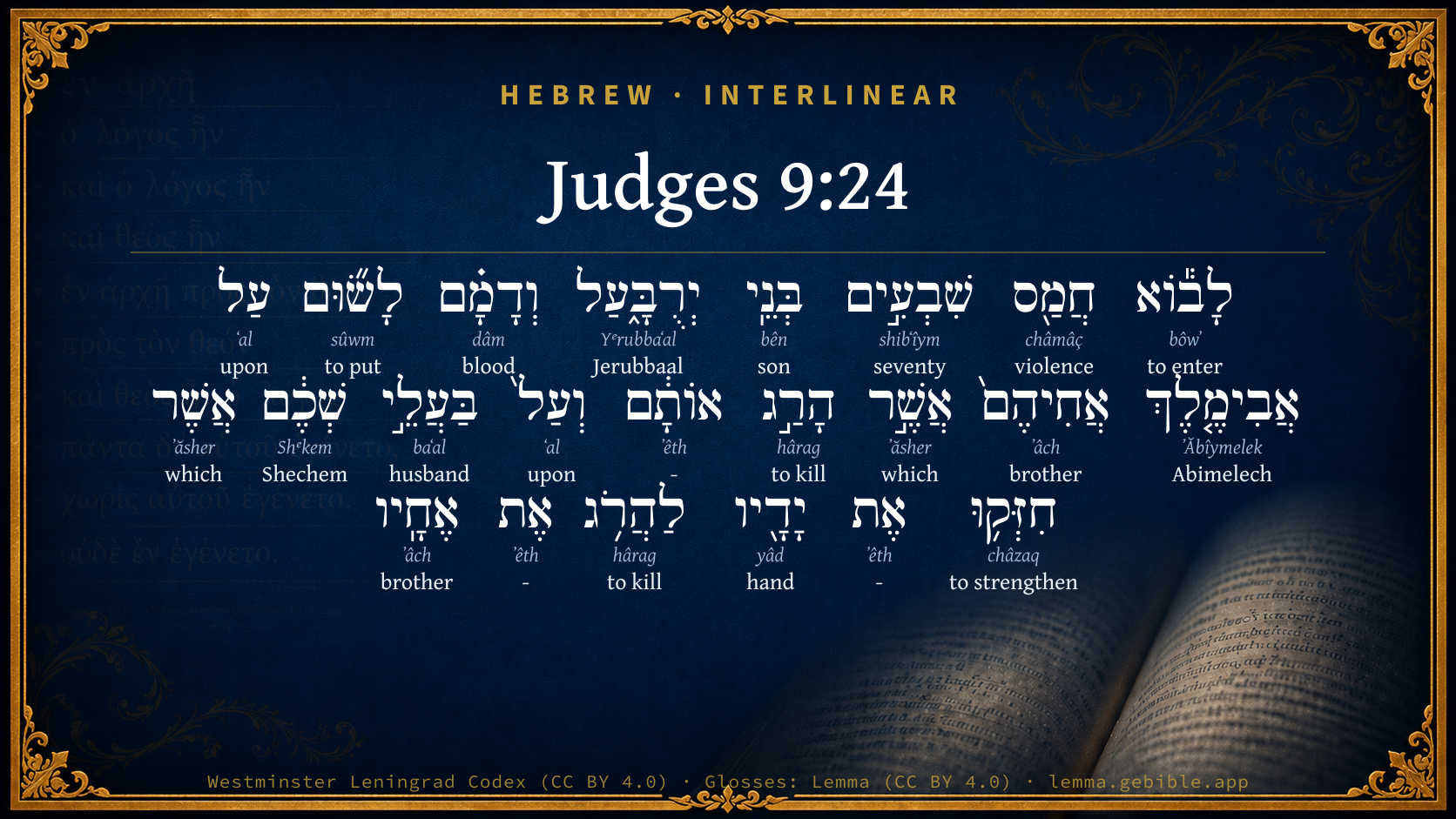
Judges 9:24

Hebrew (Westminster Leningrad Codex) Judges 9:24 appears in the Hebrew Old Testament. The text above is from the Westminster Leningrad Codex. Each word links to its Strong’s number, a concise gloss, and parsing drawn from the Open Scriptures Hebrew Bible morphology. Click any word for its full Brown-Driver-Briggs (BDB) entry.
Download image
Cite this verse

Judges 9:24 (World English Bible). Public Domain. Lemma interlinear Bible study tool, https://lemma.gebible.app/v/judges/9/24.

Show BibTeX & RIS
BibTeX
RIS
English Translation
that the violence done to the seventy sons of Jerubbaal might come, and that their blood might be laid on Abimelech their brother, who killed them, and on the men of Shechem, who strengthened his hands to kill his brothers.
World English Bible · Public Domain
Download a study sheet

One document with this verse’s original text, its word-by-word gloss line, the meaning frame, cross-references with their text, attributed commentary, and full source and license credits — printable, and it pastes into notes with its structure intact.

This verse Autodidact and up

Study sheet (.html) Plain text (.txt)

A passage Seminary Student

Up to 50 verses in one chapter. A passage sheet keeps up to 6 commentary sources and 12 cross-references per verse, in the order this page ranks them, and says so on the sheet whenever that leaves anything out. Ask for a single verse and you get the Autodidact verse sheet above.

Everything on this page stays free to read, with no account — the sheet is a download of what is already on screen, not access to it.

Want to remove ads? Support Godless Engineer
Compare translations 3

The same verse in 3 English versions, stacked beneath the original-language interlinear above. Click any original word for its lexicon entry.

Each is an independent rendering of the whole verse — the interlinear is not word-aligned to these translations.

Highlighted words mark where these versions differ — a whole-verse word diff, not a word-by-word alignment.

  • World English Bible Public Domain
    that the violence done to the seventy sons of Jerubbaal might come, and that their blood might be laid on Abimelech their brother, who killed them, and on the men of Shechem, who strengthened his hands to kill his brothers.
  • King James Version Public Domain
    That the cruelty done to the threescore and ten sons of Jerubbaal might come, and their blood be laid upon Abimelech their brother, which slew them; and upon the men of Shechem, which aided him in the killing of his brethren.
  • unfoldingWord Literal Text CC BY-SA 4.0
    the violence of the 70 sons of Jerubbaal to come, and their blood to put, upon Abimelech their brother who killed them and upon the lords of Shechem who strengthened his hands to kill his brothers.

unfoldingWord Literal Text — © unfoldingWord, licensed CC BY-SA 4.0. Word-aligned USFM3 via Door43 (git.door43.org/unfoldingWord/en_ult).

Versions to compare (up to 4)

3 of 4 selected

Show all 18 translations

Every available English version of this verse, each an independent rendering of the whole verse.

  • World English Bible Public Domain
    that the violence done to the seventy sons of Jerubbaal might come, and that their blood might be laid on Abimelech their brother, who killed them, and on the men of Shechem, who strengthened his hands to kill his brothers.
  • Berean Standard Bible Public Domain
    in order that the crime against the seventy sons of Jerubbaal might come to justice and their blood be avenged on their brother Abimelech and on the leaders of Shechem, who had helped him murder his brothers.
  • Majority Standard Bible Public Domain
    in order that the crime against the seventy sons of Jerubbaal might come to justice and their blood be avenged on their brother Abimelech and on the leaders of Shechem, who had helped him murder his brothers.
  • King James Version Public Domain
    That the cruelty done to the threescore and ten sons of Jerubbaal might come, and their blood be laid upon Abimelech their brother, which slew them; and upon the men of Shechem, which aided him in the killing of his brethren.
  • American Standard Version (1901) Public Domain
    that the violence done to the threescore and ten sons of Jerubbaal might come, and that their blood might be laid upon Abimelech their brother, who slew them, and upon the men of Shechem, who strengthened his hands to slay his brethren.
  • Revised Version (1885) Public Domain
    that the violence done to the threescore and ten sons of Jerubbaal might come, and that their blood might be laid upon Abimelech their brother, which slew them, and upon the men of Shechem, which strengthened his hands to slay his brethren.
  • Geneva Bible (1599) Public Domain
    That the crueltie toward the seuentie sonnes of Ierubbaal and their blood might come and be laide vpon Abimelech their brother, which had slayne them, and vpon the men of Shechem, which had ayded him to kill his brethren.
  • Douay-Rheims (1899) Public Domain
    And to leave the crime of the murder of the seventy sons of Jerobaal, and the shedding of their blood upon Abimelech their brother, and upon the rest of the princes of the Sichemites, who aided him.
  • Young's Literal Translation Public Domain
    for the coming in of the violence `to' the seventy sons of Jerubbaal, and of their blood to place `it' on Abimelech their brother, who slew them, and on the masters of Shechem, who strengthened his hands to slay his brethren.
  • Literal Standard Version CC BY-SA 4.0
    for [the] coming in of [the] violence [against] seventy sons of Jerubba‘al, and to place their blood on their brother Abimelech, who slew them, and on the masters of Shechem, who strengthened his hands to slay his brothers.
  • Unlocked Literal Bible CC BY-SA 4.0
    God did this so the violence done to the seventy sons of Jerub Baal might be avenged, and Abimelech their brother would be held responsible for murdering them, and the men of Shechem would be held responsible because they helped him murder his brothers.
  • unfoldingWord Literal Text CC BY-SA 4.0
    the violence of the 70 sons of Jerubbaal to come, and their blood to put, upon Abimelech their brother who killed them and upon the lords of Shechem who strengthened his hands to kill his brothers.
  • Darby Bible Public Domain
    that the violence done to the seventy sons of Jerubba'al might come and their blood be laid upon Abim'elech their brother, who slew them, and upon the men of Shechem, who strengthened his hands to slay his brothers.
  • World Messianic Bible Public Domain
    that the violence done to the seventy sons of Jerubbaal might come, and that their blood might be laid on Abimelech their brother who killed them, and on the men of Shechem who strengthened his hands to kill his brothers.
  • Webster's Bible Public Domain
    That the cruelty done to the seventy sons of Jerubbaal might come, and their blood be laid upon Abimelech their brother who slew them, and upon the men of Shechem who aided him in the killing of his brethren.
  • Free Bible Version CC BY-SA 4.0
    This happened because of the murder of the seventy sons of Jerub-baal and that responsibility for their blood be placed on Abimelech their brother, who killed them, and on the leaders of Shechem, who provided the means to kill his brothers.
  • Bible in Basic English Public Domain
    So that punishment for the violent attack made on the seventy sons of Jerubbaal, and for their blood, might come on Abimelech, their brother, who put them to death, and on the townsmen of Shechem who gave him their help in putting his brothers to death.
  • JPS Tanakh (1917) Public Domain
    that the violence done to the threescore and ten sons of Jerubbaal might come, and that their blood might be laid upon Abimelech their brother, who slew them, and upon the men of Shechem, who strengthened his hands to slay his brethren.

Literal Standard Version (2020), Covenant Press — licensed CC BY-SA 4.0. Text via the HelloAO Bible API (eBible.org). Unlocked Literal Bible (unfoldingWord) — licensed CC BY-SA 4.0. Text via the HelloAO Bible API (eBible.org). unfoldingWord Literal Text — © unfoldingWord, licensed CC BY-SA 4.0. Word-aligned USFM3 via Door43 (git.door43.org/unfoldingWord/en_ult). Free Bible Version, Dr. Jonathan Gallagher — licensed CC BY-SA 4.0. Text via the HelloAO Bible API (eBible.org).

Word by word

More ways to search: Search by grammar → Find every occurrence → Compare this word →

Practice this passage: Drill this verse → Learn its vocabulary →

יְרֻבָּ֑עַל
Yᵉrubbaʻal
H3378
“Jerubbaal”
Noun, Proper
Part of Speech
Noun
Type
Proper
Full BDB Definition

Origin: from H7378 and H1168

TWOT: None

Jerubbaal = "let Baal contend" - name given to Gideon by his father when he destroyed the altar of Baal
  1. לָב֕וֹא bôwʼ H935 “to enter” Preposition + Verb, Qal, Infinitive Construct
  2. חֲמַ֖ס châmâç H2555 “violence of” Noun, Common, Masculine, Singular, Construct
  3. שִׁבְעִ֣ים shibʻîym H7657 “seventy” Adjective, Cardinal number, Both, Plural, Absolute
  4. בְּנֵֽי bên H1121 “sons of” Noun, Common, Masculine, Plural, Construct
  5. וְדָמָ֗ם dâm H1818 “and · blood · their” Conjunction + Noun, Common, Masculine, Singular, Construct + Suffix, Personal, 3rd Person, Masculine, Plural
  6. לָשׂ֞וּם sûwm H7760 “to put” Preposition + Verb, Qal, Infinitive Construct
  7. עַל ʻal H5921 “upon” Preposition
  8. אֲבִימֶ֤לֶךְ ʼĂbîymelek H40 “Abimelech” Noun, Proper
  9. אֲחִיהֶם֙ ʼâch H251 “brother · their” Noun, Common, Masculine, Singular, Construct + Suffix, Personal, 3rd Person, Masculine, Plural
  10. אֲשֶׁ֣ר ʼăsher H834 “which” Particle, Relative
  11. הָרַ֣ג hârag H2026 “to kill” Verb, Qal, Perfect, 3rd Person, Masculine, Singular
  12. אוֹתָ֔ם ʼêth H853 “- · them” Particle, Direct Object + Suffix, Personal, 3rd Person, Masculine, Plural
  13. וְעַל֙ ʻal H5921 “and · upon” Conjunction + Preposition
  14. בַּעֲלֵ֣י baʻal H1167 “husbands of” Noun, Common, Masculine, Plural, Construct
  15. שְׁכֶ֔ם Shᵉkem H7927 “Shechem” Noun, Proper
  16. אֲשֶׁר ʼăsher H834 “which” Particle, Relative
  17. חִזְּק֥וּ châzaq H2388 “to strengthen” Verb, Piel, Perfect, 3rd Person, Common, Plural
  18. אֶת ʼêth H853 “-” Particle, Direct Object
  19. יָדָ֖יו yâd H3027 “hands · his” Noun, Common, Both, Dual, Construct + Suffix, Personal, 3rd Person, Masculine, Singular
  20. לַהֲרֹ֥ג hârag H2026 “to kill” Preposition + Verb, Qal, Infinitive Construct
  21. אֶת ʼêth H853 “-” Particle, Direct Object
  22. אֶחָֽיו ʼâch H251 “brothers · his” Noun, Common, Masculine, Plural, Construct + Suffix, Personal, 3rd Person, Masculine, Singular

About this verse

These counts appear in no published source. They are computed here, from the morphology-tagged text and Lemma’s own curated glosses. What Lemma adds →

23
words
17
distinct lemmas
Historical
section

Notable vocabulary

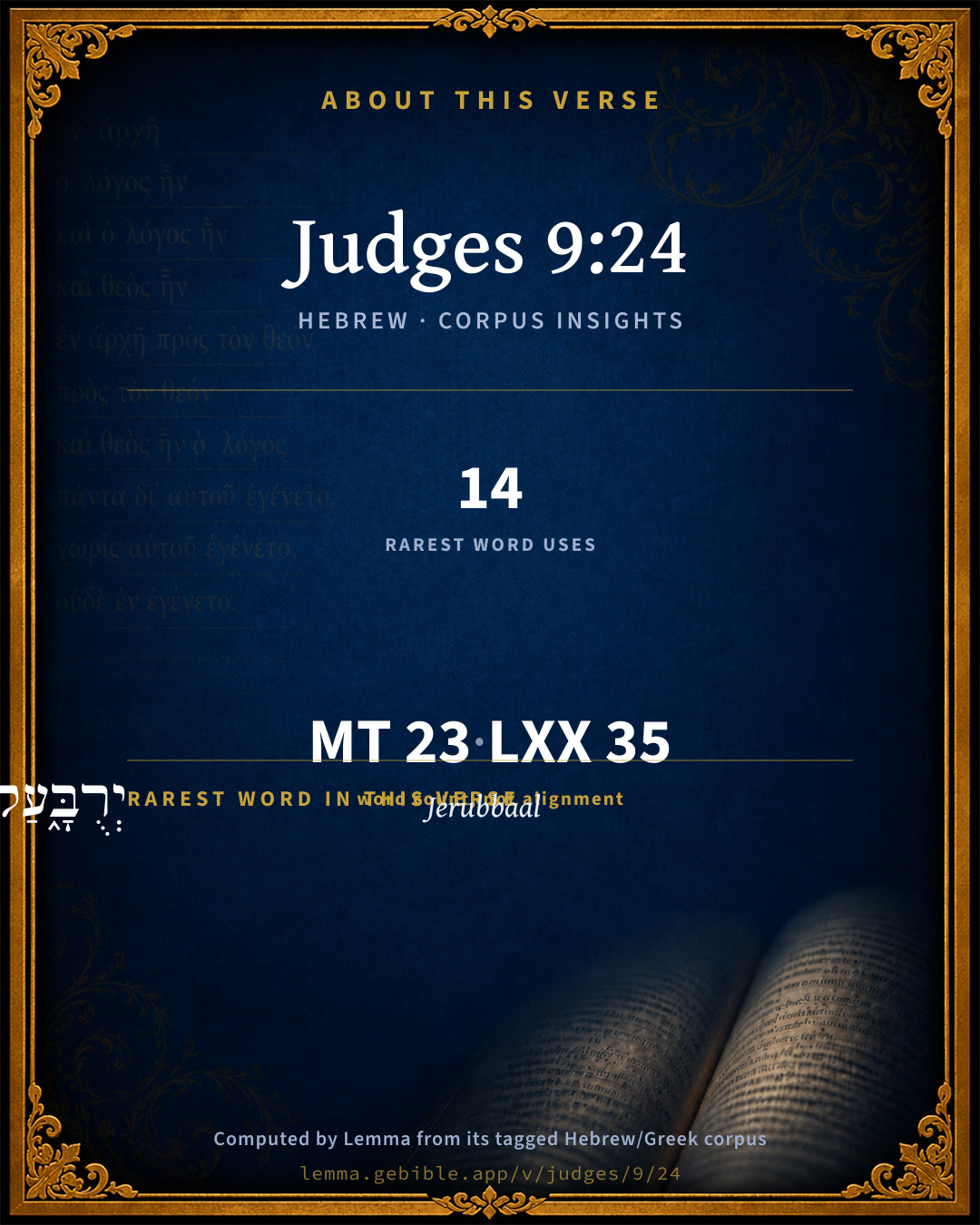
The rarest word here is יְרֻבָּ֑עַל Jerubbaal H3378 — appearing just 14 times in the whole Hebrew Bible.

Shared distinctive vocabulary

יְרֻבָּ֑עַל Jerubbaal H3378 occurs in 13 verses of the Hebrew Bible. Also found in:

Grammatical profile

  • 5 verbs
  • 10 nouns
  • 1 adjective
  • 2 prepositions
  • 5 particles

Verb forms

  • לָב֕וֹא Qal · Infinitive Construct
  • לָשׂ֞וּם Qal · Infinitive Construct
  • הָרַ֣ג Qal · Perfect
  • חִזְּק֥וּ Piel · Perfect
  • לַהֲרֹ֥ג Qal · Infinitive Construct

Repetition

Words recur within this verse — often emphatic in Hebrew:

  • עַל upon H5921 ×2
  • אֲחִיהֶם֙ brother H251 ×2
  • הָרַ֣ג to kill H2026 ×2
  • אֲשֶׁ֣ר which H834 ×2

Hebrew & Septuagint length

In English translation the verse runs 40 words from the Hebrew and 38 from the Septuagint (LXX English) — closely comparable.

A rough comparison of the two English renderings, which tokenize alike — not a word-level alignment.

Word counts can differ between the Hebrew and the Greek without any difference in meaning — e.g. the Hebrew direct-object marker אֵת has no separate Greek word, and Greek often adds the article ὁ.

In the original languages it is 23 Hebrew tokens and 35 Greek tokens — but the two are counted differently (Hebrew bundles its prefixes and suffixes into one token; the Greek is in lemma form), so that isn’t a like-for-like length.

Cross-references

8

Topical passages linked to Judges 9:24 in the Treasury of Scripture Knowledge — connected by theme and wording, ordered by reader-vote popularity; previews shown in the World English Bible.

  • 1 Kings 2:32 Yahweh will return his blood on his own head, because he fell on two men more righteous and better than he, and killed them with the sword, and my father David didn't know it, [to wit], Abner the son of Ner, captain of the host of Israel, and Amasa the son of Jether, captain of the host of Judah.
  • Psalms 7:16 The trouble he causes shall return to his own head. His violence shall come down on the crown of his own head.
  • Esther 9:25 but when [the matter] came before the king, he commanded by letters that his wicked device, which he had devised against the Jews, should return on his own head, and that he and his sons should be hanged on the gallows.
  • Numbers 35:33 So you shall not pollute the land in which you are: for blood, it pollutes the land; and no expiation can be made for the land for the blood that is shed therein, but by the blood of him who shed it.
  • Deuteronomy 27:25 Cursed be he who takes a bribe to kill an innocent person. All the people shall say, Amen.
  • Judges 9:56–57 Thus God requited the wickedness of Abimelech, which he did to his father, in killing his seventy brothers;
  • 1 Samuel 15:33 Samuel said, As your sword has made women childless, so shall your mother be childless among women. Samuel hewed Agag in pieces before Yahweh in Gilgal.
  • Matthew 23:34–36 Therefore, behold, I send to you prophets, wise men, and scribes. Some of them you will kill and crucify; and some of them you will scourge in your synagogues, and persecute from city to city;

Cross-references courtesy of OpenBible.info (CC BY 4.0).

Hebrew and Greek witnesses Masoretic Hebrew ↔ Greek Septuagint

The same verse in the two great witnesses to the Old Testament, shown verse-for-verse.

These are two independent witnesses, not word-aligned to each other, and the Septuagint is shown in lemma (dictionary) form.

Hebrew Judges 9:24 Masoretic · Westminster Leningrad Codex

לָב֕וֹא חֲמַ֖ס שִׁבְעִ֣ים בְּנֵֽי יְרֻבָּ֑עַל וְדָמָ֗ם לָשׂ֞וּם עַל אֲבִימֶ֤לֶךְ אֲחִיהֶם֙ אֲשֶׁ֣ר הָרַ֣ג אוֹתָ֔ם וְעַל֙ בַּעֲלֵ֣י שְׁכֶ֔ם אֲשֶׁר חִזְּק֥וּ אֶת יָדָ֖יו לַהֲרֹ֥ג אֶת אֶחָֽיו

that the violence done to the seventy sons of Jerubbaal might come, and that their blood might be laid on Abimelech their brother, who killed them, and on the men of Shechem, who strengthened his hands to kill his brothers.

World English Bible · Public Domain

Greek LXX Judges 9:24 Septuagint · lemma form

ὁ ἐπιἄγω ὁ ἀδικία ὁ ἑβδομήκοντα υἱός ιεροβααλ καί ὁ αἷμα αὐτός ὁ τίθημι ἐπί αβιμελεχ ὁ ἀδελφός αὐτός ὅς ἀποκτείνω αὐτός καί ἐπί ἀνήρ σικιμα ὅτι ἐνἰσχύω ὁ χείρ αὐτός ἀποκτείνω ὁ ἀδελφός αὐτός

to bring the injury done to the seventy sons of Jerobaal, and to lay their blood upon their brother Abimelech, who killed them, and upon the men of Sicima, because they strengthened his hands to kill his brethren.

LXX2012 (modern English Septuagint) · Public Domain

Hebrew: Westminster Leningrad Codex (CC BY 4.0). Greek: Septuagint (public domain); English from LXX2012 (modern English Septuagint) (Public Domain). How the Septuagint differs from the Hebrew →

Targum (Aramaic paraphrase)

1

The Targum is the ancient Jewish Aramaic paraphrase of the Hebrew Scriptures — an interpretive translation, not the Hebrew text itself. Onkelos (literal) and Pseudo-Jonathan (expansive) render the Torah, and Jonathan the Prophets. Coverage is partial: where no permissively-licensed English translation exists for a verse, only the Aramaic is shown. This is verse-level text, not a word-by-word alignment to the Hebrew.

  1. Targum Jonathan Prophets (Joshua–Malachi)
    לְמֵיתֵי חֲטוֹף שַׁבְעִין בְּנֵי יְרֻבַּעַל וּדְמֵיהוֹן לְשַׁוָאָה עַל אֲבִימֶלֶךְ אֲחוּהוֹן דִקְטַל יַתְהוֹן וְעַל יַתְבֵי שְׁכֶם דְתַקִיפוּ יַת יְדוֹהִי לְמִקְטַל יַת אֲחוֹהִי:

    (no public-domain English translation for this verse)

    Targum Jonathan — Aramaic: “Mikraot Gedolot” (public domain). English: “Sefaria Community Translation” (CC0 1.0 (public-domain dedication)); “London "Chaldee Paraphrase," 1871” (public domain). Text via Sefaria.

Commentary

Notes on Judges 9:24 from classic Christian and Jewish commentators (each source and its license shown beneath its notes). The classic Christian expositions comment on the surrounding passage and are grouped to its opening verse, so a note may address several verses; the Jewish commentaries on the Tanakh (Rashi and others) are per-verse, so they appear only where the commentator wrote on this verse.

Lemma curates 59 commentaries, every one of them public domain or Creative Commons licensed, each selected and text-cleaned for this edition rather than reprinted as found. About our sources →

Trapp's Complete Commentary

John Trapp

Jdg 9:24 That the cruelty [done] to the threescore and ten sons of Jerubbaal might come, and their blood be laid upon Abimelech their brother, which slew them; and upon the men of Shechem, which aided him in the killing of his brethren.

Ver. 24. That the cruelty done.] God maketh inquisition for blood, and suffereth not murder, but especially parricide, to pass unpunished: for it ever bleedeth fresh in his eyes. {2Ki 9:26}

John Trapp, A Commentary or Exposition upon All the Books of the Old and New Testament (1647–1656) — public domain. Text from a community e-Sword module.

Ellicott's Commentary for English Readers

(24) That the cruelty . . . might come . . . upon Abimelech.—Scripture is always most emphatic in the recognition of the Divine Nemesis upon wickedness, especially upon bloodshed.

Their blood be laid upon Abimelech.—Comp. 1Ki_2:5, Mat_23:35, and the cry of the Jews in Mat_27:25.

A Bible Commentary for English Readers, edited by Charles John Ellicott (1878–1897) — public domain. Text from a community e-Sword module.

John Gill's Exposition

And the men of Shechem set liers in wait for him in the top of the mountains,.... Of Ebal and Gerizim, which were near Shechem, by the way of which he passed when he came to that city, and these they set there, either to slay him, or to seize his person, and bring him to them:

and they robbed all that came along that way by them; that belonged to Abimelech and others also; and this they did to show their contempt of his government, and that they were no longer under it, and every man did what was right in his own eyes, as if they had no governor over them; though some think this was done to draw him thither to secure his subjects from such rapine and violence, that they might have an opportunity to lay hold upon him, or this they did on purpose to begin a civil war:

and it was told Abimelech; that they lay in wait for him, and so he kept himself from them.

John Gill's Exposition of the Whole Bible (1746–1763) — public domain (CC PDM 1.0). Text via the HelloAO Bible API.

Matthew Poole's English Annotations

The cruelty, i.e. the punishment of the cruelty.

Matthew Poole's English Annotations on the Holy Bible (1683–1685) — public domain. Text from a community e-Sword/MySword module.

John Wesley's Explanatory Notes

The cruelty - That is, the punishment of the cruelty.

John Wesley, Explanatory Notes Upon the Whole Bible (1754–1765) — public domain. Text via the GEBible commentary corpus.

Lesson kit

Teaching starters — assembled from the data on this page, not authored interpretation. Every prompt links to the verse data it draws on. Edit before teaching.

Judges, in the Historical, opens this verse with 23 words (17 distinct Hebrew lemmas). Its most distinctive word is Yᵉrubbaʻal (“Jerubbaal”). A historical commentator’s framing appears above. Read the whole chapter for the surrounding context.

Discussion questions

  1. How does “Jerubbaal” (Yᵉrubbaʻal) shape what this verse is saying?
  2. How does Judges 6:32, which shares the word «Jerubbaal», read alongside this verse?
  3. What does the repetition of “upon” (2× in this one verse) do in this verse?
  4. The translations on this page render this verse differently — a whole-verse word diff, not a word-by-word alignment. What might account for the different wordings?
  5. «לָב֕וֹא» is a Qal Infinitive Construct verb. How does that grammatical form shape the action described?
  6. Compare how Trapp's Complete Commentary and Ellicott's Commentary for English Readers read this verse. Where do they agree or differ?

Things to notice

Reading settings

Reading text

Shown beneath each verse's original-language words.

Old Testament
Old Testament edition

Read the OT as the Masoretic Hebrew (MT) or the Greek Septuagint (LXX).

English shown for the Greek Septuagint (in the Hebrew ↔ Greek comparison).

Comparing translations? Open the Compare panel on any verse page to stack up to four side by side.