
Leviticus 5:9

Hebrew (Westminster Leningrad Codex) Leviticus 5:9 appears in the Hebrew Old Testament. The text above is from the Westminster Leningrad Codex. Each word links to its Strong’s number, a concise gloss, and parsing drawn from the Open Scriptures Hebrew Bible morphology. Click any word for its full Brown-Driver-Briggs (BDB) entry.
Download image
Cite this verse

Leviticus 5:9 (World English Bible). Public Domain. Lemma interlinear Bible study tool, https://lemma.gebible.app/v/leviticus/5/9.

Show BibTeX & RIS
BibTeX
RIS
English Translation
He shall sprinkle some of the blood of the sin offering on the side of the altar; and the rest of the blood shall be drained out at the base of the altar. It is a sin offering.
World English Bible · Public Domain
Download a study sheet

One document with this verse’s original text, its word-by-word gloss line, the meaning frame, cross-references with their text, attributed commentary, and full source and license credits — printable, and it pastes into notes with its structure intact.

This verse Autodidact and up

Study sheet (.html) Plain text (.txt)

A passage Seminary Student

Up to 50 verses in one chapter. A passage sheet keeps up to 6 commentary sources and 12 cross-references per verse, in the order this page ranks them, and says so on the sheet whenever that leaves anything out. Ask for a single verse and you get the Autodidact verse sheet above.

Everything on this page stays free to read, with no account — the sheet is a download of what is already on screen, not access to it.

Want to remove ads? Support Godless Engineer
Compare translations 3

The same verse in 3 English versions, stacked beneath the original-language interlinear above. Click any original word for its lexicon entry.

Each is an independent rendering of the whole verse — the interlinear is not word-aligned to these translations.

Highlighted words mark where these versions differ — a whole-verse word diff, not a word-by-word alignment.

  • World English Bible Public Domain
    He shall sprinkle some of the blood of the sin offering on the side of the altar; and the rest of the blood shall be drained out at the base of the altar. It is a sin offering.
  • King James Version Public Domain
    And he shall sprinkle of the blood of the sin offering upon the side of the altar; and the rest of the blood shall be wrung out at the bottom of the altar: it is a sin offering.
  • unfoldingWord Literal Text CC BY-SA 4.0
    And he shall sprinkle some of the blood of the sin offering on the side of the altar. And the remainder in the blood he shall squeeze out toward the base of the altar. It a sin offering.

unfoldingWord Literal Text — © unfoldingWord, licensed CC BY-SA 4.0. Word-aligned USFM3 via Door43 (git.door43.org/unfoldingWord/en_ult).

Versions to compare (up to 4)

3 of 4 selected

Show all 18 translations

Every available English version of this verse, each an independent rendering of the whole verse.

  • World English Bible Public Domain
    He shall sprinkle some of the blood of the sin offering on the side of the altar; and the rest of the blood shall be drained out at the base of the altar. It is a sin offering.
  • Berean Standard Bible Public Domain
    then he is to sprinkle some of the blood of the sin offering on the side of the altar, while the rest of the blood is drained out at the base of the altar. It is a sin offering.
  • Majority Standard Bible Public Domain
    then he is to sprinkle some of the blood of the sin offering on the side of the altar, while the rest of the blood is drained out at the base of the altar. It is a sin offering.
  • King James Version Public Domain
    And he shall sprinkle of the blood of the sin offering upon the side of the altar; and the rest of the blood shall be wrung out at the bottom of the altar: it is a sin offering.
  • American Standard Version (1901) Public Domain
    and he shall sprinkle of the blood of the sin-offering upon the side of the altar; and the rest of the blood shall be drained out at the base of the altar: it is a sin-offering.
  • Revised Version (1885) Public Domain
    and he shall sprinkle of the blood of the sin offering upon the side of the altar; and the rest of the blood shall be drained out at the base of the altar: it is a sin offering.
  • Geneva Bible (1599) Public Domain
    After he shall sprinkle of the blood of the sinne offring vpon the side of the altar, and the rest of the blood shall be shed at the foote of the altar: for it is a sinne offering.
  • Douay-Rheims (1899) Public Domain
    And of its blood he shall sprinkle the side of the altar, and whatsoever is left, he shall let it drop at the bottom thereof, because it is for sin.
  • Young's Literal Translation Public Domain
    and he hath sprinkled of the blood of the sin-offering on the side of the altar, and that which is left of the blood is wrung out at the foundation of the altar; it `is' a sin-offering.
  • Literal Standard Version CC BY-SA 4.0
    and he has sprinkled of the blood of the sin-offering on the side of the altar, and that which is left of the blood is wrung out at the foundation of the altar; it [is] a sin-offering.
  • Unlocked Literal Bible CC BY-SA 4.0
    Then he will sprinkle some of the blood of the sin offering on the side of the altar, and he will drain the rest of the blood out at the base of the altar. This is a sin offering.
  • unfoldingWord Literal Text CC BY-SA 4.0
    And he shall sprinkle some of the blood of the sin offering on the side of the altar. And the remainder in the blood he shall squeeze out toward the base of the altar. It a sin offering.
  • Darby Bible Public Domain
    and he shall sprinkle of the blood of the sin-offering on the wall of the altar; and the rest of the blood shall be wrung out at the bottom of the altar: it is a sin-offering.
  • World Messianic Bible Public Domain
    He shall sprinkle some of the blood of the sin offering on the side of the altar; and the rest of the blood shall be drained out at the base of the altar. It is a sin offering.
  • Webster's Bible Public Domain
    And he shall sprinkle of the blood of the sin-offering upon the side of the altar; and the rest of the blood shall be wrung out at the bottom of the altar: it is a sin-offering.
  • Free Bible Version CC BY-SA 4.0
    Then he is to sprinkle some of the blood of the sin offering on the side of the altar while the rest of the blood is poured out at the bottom of the altar. It is a sin offering.
  • Bible in Basic English Public Domain
    And he is to put drops of the blood of the offering on the side of the altar, and the rest of the blood is to be drained out at the base of the altar; it is a sin-offering.
  • JPS Tanakh (1917) Public Domain
    And he shall sprinkle of the blood of the sin-offering upon the side of the altar; and the rest of the blood shall be drained out at the base of the altar; it is a sin-offering.

Literal Standard Version (2020), Covenant Press — licensed CC BY-SA 4.0. Text via the HelloAO Bible API (eBible.org). Unlocked Literal Bible (unfoldingWord) — licensed CC BY-SA 4.0. Text via the HelloAO Bible API (eBible.org). unfoldingWord Literal Text — © unfoldingWord, licensed CC BY-SA 4.0. Word-aligned USFM3 via Door43 (git.door43.org/unfoldingWord/en_ult). Free Bible Version, Dr. Jonathan Gallagher — licensed CC BY-SA 4.0. Text via the HelloAO Bible API (eBible.org).

Word by word

More ways to search: Search by grammar → Find every occurrence → Compare this word →

Practice this passage: Drill this verse → Learn its vocabulary →

יִמָּצֵ֖ה
mâtsâh
H4680
“to drain”
Verb, Niphal, Imperfect, 3rd Person, Masculine, Singular
Part of Speech
Verb
Stem
Niphal
Form
Imperfect
Person
3rd Person
Gender
Masculine
Number
Singular
Full BDB Definition

Origin: a primitive root

TWOT: 1232

to drain, drain out - (Qal) to drain, drain out - (Niphal) to be drained out
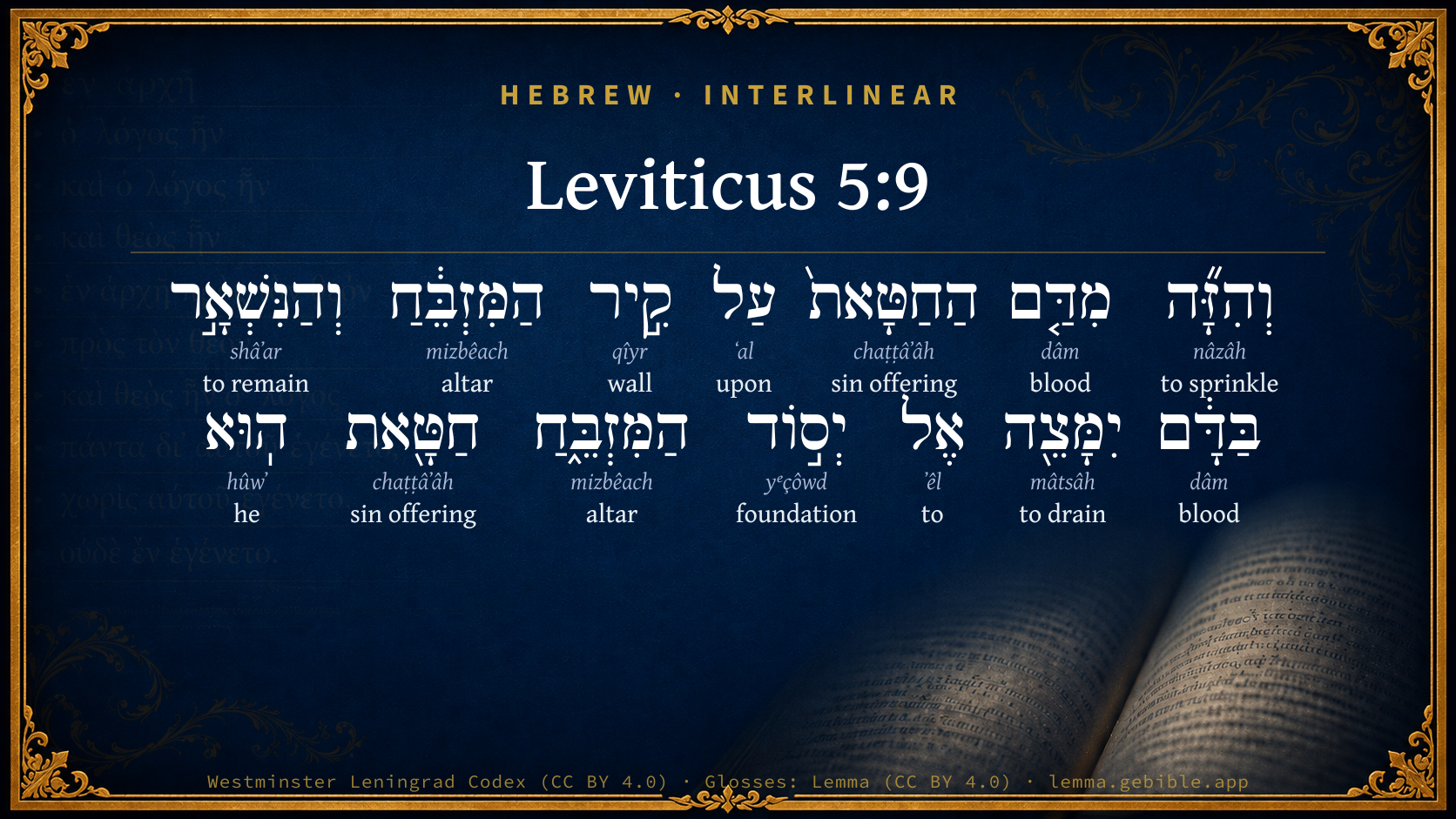
  1. וְהִזָּ֞ה nâzâh H5137 “and · to sprinkle” Conjunction + Verb, Hiphil, Sequential Perfect, 3rd Person, Masculine, Singular
  2. מִדַּ֤ם dâm H1818 “from · blood of” Preposition + Noun, Common, Masculine, Singular, Construct
  3. הַחַטָּאת֙ chaṭṭâʼâh H2403 “the · sin offering” Particle, Definite Article + Noun, Common, Feminine, Singular, Absolute
  4. עַל ʻal H5921 “upon” Preposition
  5. קִ֣יר qîyr H7023 “wall of” Noun, Common, Masculine, Singular, Construct
  6. הַמִּזְבֵּ֔חַ mizbêach H4196 “the · altar” Particle, Definite Article + Noun, Common, Masculine, Singular, Absolute
  7. וְהַנִּשְׁאָ֣ר shâʼar H7604 “and · the · remaining” Conjunction + Particle, Definite Article + Verb, Niphal, Participle Active, Masculine, Singular, Absolute
  8. בַּדָּ֔ם dâm H1818 “in/at the · blood” Preposition, Determined + Noun, Common, Masculine, Singular, Absolute
  9. אֶל ʼêl H413 “to” Preposition
  10. יְס֣וֹד yᵉçôwd H3247 “foundation of” Noun, Common, Masculine, Singular, Construct
  11. הַמִּזְבֵּ֑חַ mizbêach H4196 “the · altar” Particle, Definite Article + Noun, Common, Masculine, Singular, Absolute
  12. חַטָּ֖את chaṭṭâʼâh H2403 “sin offering” Noun, Common, Feminine, Singular, Absolute
  13. הֽוּא hûwʼ H1931 “he” Pronoun, Personal, 3rd Person, Masculine, Singular

About this verse

These counts appear in no published source. They are computed here, from the morphology-tagged text and Lemma’s own curated glosses. What Lemma adds →

14
words
11
distinct lemmas
Pentateuch
section

Notable vocabulary

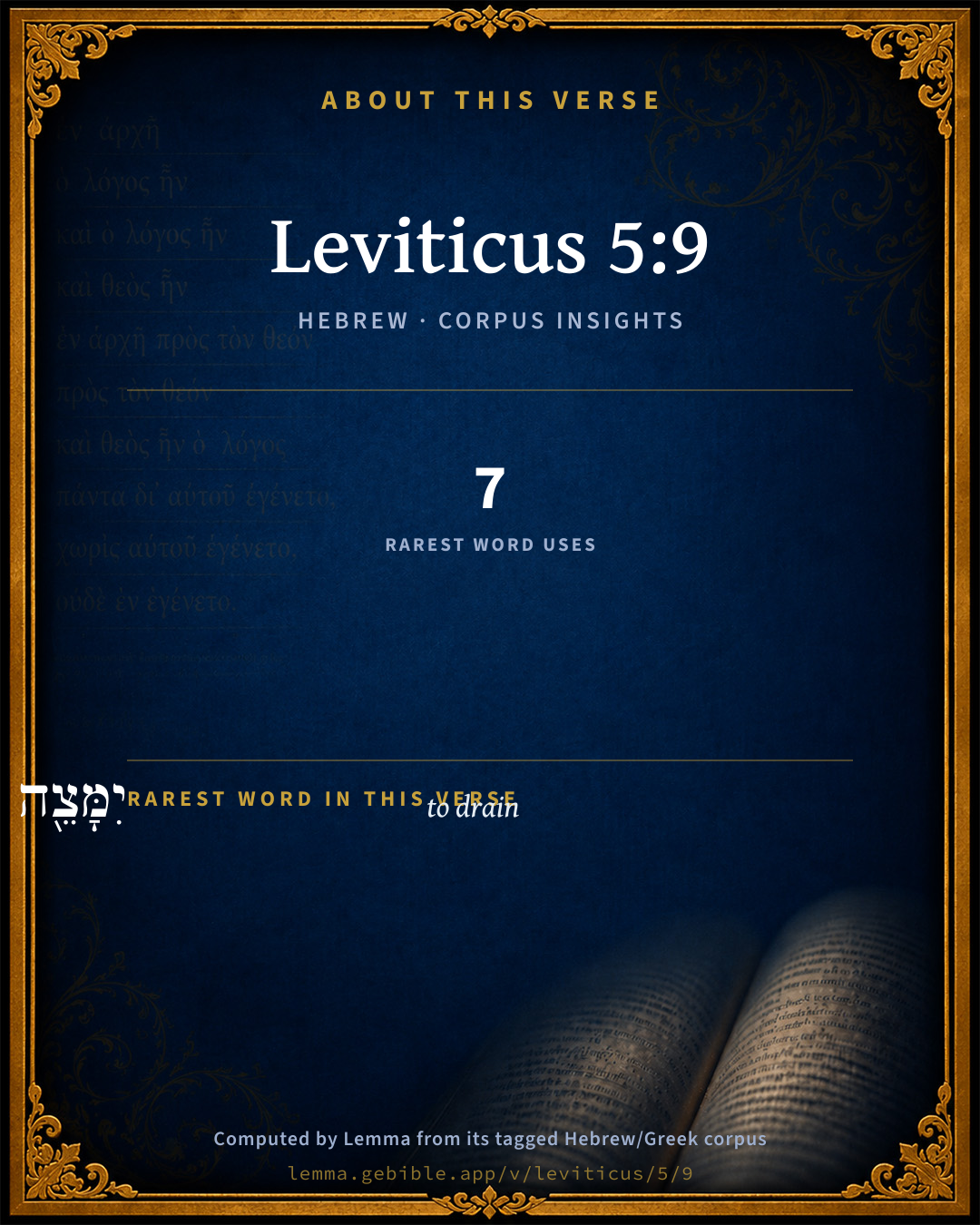
The rarest word here is יִמָּצֵ֖ה to drain H4680 — appearing just 7 times in the whole Hebrew Bible.

Shared distinctive vocabulary

יִמָּצֵ֖ה to drain H4680 occurs in 7 verses of the Hebrew Bible. Also found in:

Grammatical profile

  • 3 verbs
  • 8 nouns
  • 1 pronoun
  • 2 prepositions

Verb forms

  • וְהִזָּ֞ה Hiphil · Sequential Perfect
  • וְהַנִּשְׁאָ֣ר Niphal · Participle Active
  • יִמָּצֵ֖ה Niphal · Imperfect

Repetition

Words recur within this verse — often emphatic in Hebrew:

  • מִדַּ֤ם blood H1818 ×2
  • הַחַטָּאת֙ sin offering H2403 ×2
  • הַמִּזְבֵּ֔חַ altar H4196 ×2

Hebrew & Septuagint length

In English translation the verse runs 38 words from the Hebrew and 36 from the Septuagint (LXX English) — closely comparable.

A rough comparison of the two English renderings, which tokenize alike — not a word-level alignment.

Word counts can differ between the Hebrew and the Greek without any difference in meaning — e.g. the Hebrew direct-object marker אֵת has no separate Greek word, and Greek often adds the article ὁ.

Cross-references

12

Topical passages linked to Leviticus 5:9 in the Treasury of Scripture Knowledge — connected by theme and wording, ordered by reader-vote popularity; previews shown in the World English Bible.

  • Leviticus 4:7 The priest shall put some of the blood on the horns of the altar of sweet incense before Yahweh, which is in the tent of meeting; and he shall pour out all the blood of the bull out at the base of the altar of burnt offering, which is at the door of the Tent of Meeting.
  • Leviticus 4:18 He shall put some of the blood on the horns of the altar which is before Yahweh, that is in the Tent of Meeting; and the rest of the blood he shall pour out at the base of the altar of burnt offering, which is at the door of the Tent of Meeting.
  • Leviticus 4:30 The priest shall take some of its blood with his finger, and put it on the horns of the altar of burnt offering; and the rest of its blood he shall pour out at the base of the altar.
  • Leviticus 4:34 The priest shall take some of the blood of the sin offering with his finger, and put it on the horns of the altar of burnt offering; and all the rest of its blood he shall pour out at the base of the altar.
  • Leviticus 4:25 The priest shall take some of the blood of the sin offering with his finger, and put it on the horns of the altar of burnt offering. He shall pour out the rest of its blood at the base of the altar of burnt offering.
  • Isaiah 42:21 It pleased Yahweh, for his righteousness' sake, to magnify the law, and make it honorable.
  • Hebrews 2:10 For it became him, for whom are all things, and through whom are all things, in bringing many children to glory, to make the author of their salvation perfect through sufferings.
  • Hebrews 12:24 to Jesus, the mediator of a new covenant, and to the blood of sprinkling that speaks better than that of Abel.
  • Exodus 12:22–23 You shall take a bunch of hyssop, and dip it in the blood that is in the basin, and strike the lintel and the two side-posts with the blood that is in the basin; and none of you shall go out of the door of his house until the morning.
  • Leviticus 1:5 He shall kill the bull before Yahweh. Aaron's sons, the priests, shall present the blood and sprinkle the blood around on the altar that is at the door of the Tent of Meeting.
  • Leviticus 1:15 The priest shall bring it to the altar, and wring off its head, and burn it on the altar; and its blood shall be drained out on the side of the altar;
  • Leviticus 7:2 In the place where they kill the burnt offering, he shall kill the trespass offering; and its blood he shall sprinkle on the altar round about.

Cross-references courtesy of OpenBible.info (CC BY 4.0).

Hebrew and Greek witnesses Masoretic Hebrew ↔ Greek Septuagint

The same verse in the two great witnesses to the Old Testament, shown verse-for-verse.

These are two independent witnesses, not word-aligned to each other, and the Septuagint is shown in lemma (dictionary) form.

Hebrew Leviticus 5:9 Masoretic · Westminster Leningrad Codex

וְהִזָּ֞ה מִדַּ֤ם הַחַטָּאת֙ עַל קִ֣יר הַמִּזְבֵּ֔חַ וְהַנִּשְׁאָ֣ר בַּדָּ֔ם יִמָּצֵ֖ה אֶל יְס֣וֹד הַמִּזְבֵּ֑חַ חַטָּ֖את הֽוּא

He shall sprinkle some of the blood of the sin offering on the side of the altar; and the rest of the blood shall be drained out at the base of the altar. It is a sin offering.

World English Bible · Public Domain

Greek LXX Leviticus 5:9 Septuagint · lemma form

καί ῥαίνω ἀπό ὁ αἷμα ὁ περί ὁ ἁμαρτία ἐπί ὁ τοῖχος ὁ θυσιαστήριον ὁ δέ κατάλοιπος ὁ αἷμα καταστραγγίζω ἐπί ὁ βάσις ὁ θυσιαστήριον ἁμαρτία γάρ εἰμί

And he shall sprinkle of the blood of the sin-offering on the side of the altar, but the rest of the blood he shall drop at the foot of the altar, for it is a sin-offering.

LXX2012 (modern English Septuagint) · Public Domain

Hebrew: Westminster Leningrad Codex (CC BY 4.0). Greek: Septuagint (public domain); English from LXX2012 (modern English Septuagint) (Public Domain). How the Septuagint differs from the Hebrew →

Targum (Aramaic paraphrase)

2

The Targum is the ancient Jewish Aramaic paraphrase of the Hebrew Scriptures — an interpretive translation, not the Hebrew text itself. Onkelos (literal) and Pseudo-Jonathan (expansive) render the Torah, and Jonathan the Prophets. Coverage is partial: where no permissively-licensed English translation exists for a verse, only the Aramaic is shown. This is verse-level text, not a word-by-word alignment to the Hebrew.

  1. Targum Onkelos Torah (Genesis–Deuteronomy)
    וְיַדִי מִדְמָא דְחַטָּאתָא עַל כֹּתֶל מַדְבְּחָא וּדְאִשְׁתָּאַר בִּדְמָא יִתִּמְצֵי לִיסוֹדָא דְמַדְבְּחָא חַטָאתָא הוּא

    (no public-domain English translation for this verse)

    Targum Onkelos — Aramaic: “Onkelos Genesis” (public domain); “Onkelos Exodus” (public domain); “Onkelos Leviticus” (public domain); “Onkelos Numbers” (public domain); “Onkelos Deuteronomy” (public domain). English: “Sefaria Community Translation” (CC0 1.0 (public-domain dedication)); “J.W. Etheridge. The Targums of Onkelos and Jonathan Ben Uzziel on the Pentateuch. London: Longmans, Green, 1862” (public domain). Text via Sefaria.

  2. Targum Pseudo-Jonathan Torah (Genesis–Deuteronomy)
    וְיַדֵי מִן אֲדַם חַטָאתָא עַל כּוֹתַל מַדְבְּחָא וּדְאִשְׁתַּיֵיר בְּאַדְמָא יִתְמְצֵי לִיסוֹדָא דְמַדְבְּחָא חַטָאתָא הוּא

    and he shall sprinkle some of the blood upon the side of the altar, and pour out the remainder of the blood at the foot of the altar: it is a sin offering.

    Targum Pseudo-Jonathan — Aramaic: “Targum Jonathan on Genesis” (public domain); “Targum Jonathan on Exodus” (public domain); “Targum Jonathan on Leviticus” (public domain); “Targum Jonathan on Numbers” (public domain); “Targum Jonathan on Deuteronomy” (public domain). English: “The Targum of Jonathan ben Uzziel, trans. J. W. Etheridge, London, 1862” (public domain). Text via Sefaria.

Commentary

Notes on Leviticus 5:9 from classic Christian and Jewish commentators (each source and its license shown beneath its notes). The classic Christian expositions comment on the surrounding passage and are grouped to its opening verse, so a note may address several verses; the Jewish commentaries on the Tanakh (Rashi and others) are per-verse, so they appear only where the commentator wrote on this verse.

Lemma curates 59 commentaries, every one of them public domain or Creative Commons licensed, each selected and text-cleaned for this edition rather than reprinted as found. About our sources →

Trapp's Complete Commentary

John Trapp

Lev 5:9 And he shall sprinkle of the blood of the sin offering upon the side of the altar; and the rest of the blood shall be wrung out at the bottom of the altar: it [is] a sin offering.

Ver. 9. Upon the side of the altar.] The north side, and not upon the east: (1.) that Israel might not symbolise with the heathens, who worshipped toward the east; (2.) To signify that they had no more under the law than dark "shadows of good things to come," {Heb 10:1} "until the time of reformation." {Heb 9:10}

John Trapp, A Commentary or Exposition upon All the Books of the Old and New Testament (1647–1656) — public domain. Text from a community e-Sword module.

Joseph Benson's Commentary

Lev 5:9-10. It is a sin-offering — This is added as the reason why its blood was so sprinkled and spilt. According to the manner — Or order, appointed by God. The priest shall make an atonement — Either declaratively, he shall pronounce him to be pardoned; or typically, with respect to Christ.

Joseph Benson's Commentary on the Old and New Testaments (1811–1818) — public domain. Text from a community e-Sword module.

Geneva Bible (1599)

Geneva Bible translators

Or, poured.

Geneva Bible (1599) marginal notes — public domain. Text via Bolls.life.

Ellicott's Commentary for English Readers

(9) And he shall sprinkle.—Here again there is a striking difference between the ritual in the sacrifice before us and that in the case of the regular sin offering described in the previous chapters. The blood is simply to be thrown on the walls of the altar, whilst in the ordinary sin offering, the priest had not only to dip his finger seven times in the blood of the victim, but had to put it on the horns of the altar (Lev_4:6-7; Lev_4:17-18; Lev_4:25; Lev_4:30; Lev_4:34).

A Bible Commentary for English Readers, edited by Charles John Ellicott (1878–1897) — public domain. Text from a community e-Sword module.

The Cambridge Bible for Schools and Colleges

gen. ed. J. J. S. Perowne

9. he shall sprinkle] The same word as in Lev_4:6; Lev_4:17, but the sprinkling is not done with the finger, nor is the blood put on the horns of the altar, but upon the side of it. Two birds are brought; the one that is burnt represents the part of the Sin-Offering offered to the Lord, the other the remainder which was the priest’s portion.

The Cambridge Bible for Schools and Colleges (gen. ed. J. J. S. Perowne; Cambridge University Press, 1878–1918) — public domain. Text from a community e-Sword module.

John Gill's Exposition

And he shall sprinkle of the blood of the sin offering upon the side of the altar,.... Or "wall" (c) it is asked (d),"what is the wall at which the rest of the blood is wrung out? this is the lower wall, namely, the half of the height of the altar below, under the thread (of scarlet that goes round the middle of the altar) that the rest of the blood may be squeezed at the bottom of the altar, and because of this the sin offering of the fowl is below,''that is, the sprinkling of its blood. And so Ben Gersom observes; from hence we learn, says he, that the sprinkling of the sin offering of the fowl was in the lower part of the altar; and I think this sprinkling, adds he, was not in the length, but in the breadth:

and the rest of the blood shall be wrung out at the bottom of the altar; the blood sprinkled was that which dropped from it when nipped by the priest; this here was squeezed out by him, and was shed at the foot of the altar; so that the altar had all the blood, and nothing but the blood of the fowl, all the rest belonged to the priest (e): this might be an emblem both of the drops of blood which fell from Christ in the garden, and of the shedding of his blood upon the cross, whereby remission of sin was obtained, and atonement made:

it is a sin offering; an offering whereby sin was typically expiated and stoned.

(c) , Sept. "super parietem", Pagninus, Montanus, Junius & Tremellius, Piscator, Drusius; "ad parietem", Tigurine version. (d) Maimon. in Misn. Zebachim, c. 6. sect. 4. (e) Misn. ib.

John Gill's Exposition of the Whole Bible (1746–1763) — public domain (CC PDM 1.0). Text via the HelloAO Bible API.

Haydock's Catholic Bible Commentary

Sin. The flesh belonged to the priest, chap. vi. 26.

George Leo Haydock (1774–1849), Haydock's Catholic Family Bible and Commentary, 1859 edition — public domain. Excludes Psalms (Douay-Rheims chapter numbering differs from Protestant) and Deuterocanonical books (Catholic canon only).

Matthew Poole's English Annotations

This is added as the reason why its blood was so sprinkled and spilt. See Lev 4:7,8,30,34.

Matthew Poole's English Annotations on the Holy Bible (1683–1685) — public domain. Text from a community e-Sword/MySword module.

John Wesley's Explanatory Notes

It is a sin-offering - This is added as the reason why its blood was so sprinkled and spilt.

John Wesley, Explanatory Notes Upon the Whole Bible (1754–1765) — public domain. Text via the GEBible commentary corpus.

Rashi

Rabbi Shlomo Yitzchaki (Rashi)

והזה מדם החטאת AND HE SHALL SPRINKLE OF THE BLOOD OF THE SIN-OFFERING [… AND THE REMAINDER OF THE BLOOD SHALL BE WRUNG OUT] — In the case of a burnt-offering of a fowl Scripture requires only the wringing out of the blood (Leviticus 1:15), whilst in the case of the sin-offering it requires sprinkling and wringing out: standing quite near to the altar, he grasps the nape and makes the blood spurt out and thus the blood spurts forth in a jet and goes in the direction of the altar (cf. Zevachim 64b).

חטאת הוא IT IS A SIN-OFFERING — These apparently redundant words intimate: if the sprinkling and wringing of the blood are done for the purpose of (i.e. having in mind that it is) a sin-offering it is valid; if it is not done for this purpose (i.‎e. that the officiating priest has another sacrifice in mind) it is invalid (cf. Sifra, Vayikra Dibbura d'Chovah, Chapter 18 9 and Rashi on Leviticus 4:24).

Rashi on the Tanakh — English translations: “The Judaica Press complete Tanach with Rashi, translated by A. J. Rosenberg” (CC BY 4.0); “Pentateuch with Rashi's commentary by M. Rosenbaum and A.M. Silbermann, 1929-1934” (public domain); “The Metsudah Tanach series, Lakewood, N.J” (CC BY 4.0); and “The Book of Joshua, Metsudah Publications, 1997” (CC BY 4.0). Text via Sefaria.

Lesson kit

Teaching starters — assembled from the data on this page, not authored interpretation. Every prompt links to the verse data it draws on. Edit before teaching.

Leviticus, in the Pentateuch, opens this verse with 14 words (11 distinct Hebrew lemmas). Its most distinctive word is mâtsâh (“to drain”). A historical commentator’s framing appears above. Read the whole chapter for the surrounding context.

Discussion questions

  1. The word mâtsâh carries the sense “to drain.” How does it shape the verse?
  2. Leviticus 1:15 shares the word «to drain» with this verse. How do the two illuminate each other?
  3. “blood” occurs 2× in this one verse. What is the effect of the repetition?
  4. The translations on this page render this verse differently — a whole-verse word diff, not a word-by-word alignment. What might account for the different wordings?
  5. The verb «וְהִזָּ֞ה» is Hiphil Sequential Perfect. How does its form color the action?
  6. Reading how Trapp's Complete Commentary and Joseph Benson's Commentary read this verse, where do the two commentators agree and where do they part?

Things to notice

Reading settings

Reading text

Shown beneath each verse's original-language words.

Old Testament
Old Testament edition

Read the OT as the Masoretic Hebrew (MT) or the Greek Septuagint (LXX).

English shown for the Greek Septuagint (in the Hebrew ↔ Greek comparison).

Comparing translations? Open the Compare panel on any verse page to stack up to four side by side.