
1 Samuel 19:5

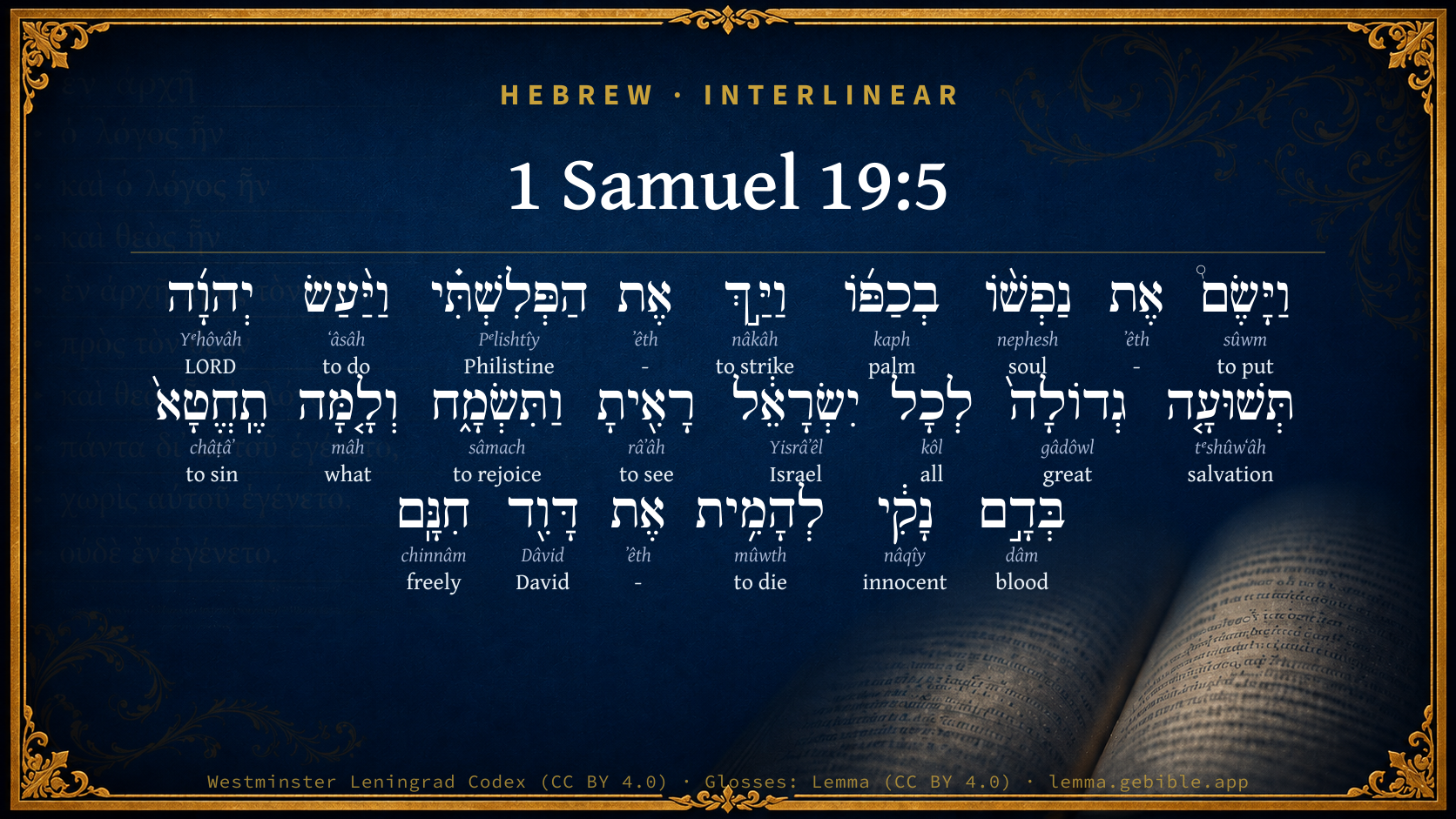
Hebrew (Westminster Leningrad Codex) 1 Samuel 19:5 appears in the Hebrew Old Testament. The text above is from the Westminster Leningrad Codex. Each word links to its Strong’s number, a concise gloss, and parsing drawn from the Open Scriptures Hebrew Bible morphology. Click any word for its full Brown-Driver-Briggs (BDB) entry.
Download image
Cite this verse

1 Samuel 19:5 (World English Bible). Public Domain. Lemma interlinear Bible study tool, https://lemma.gebible.app/v/1-samuel/19/5.

Show BibTeX & RIS
BibTeX
RIS
English Translation
for he put his life in his hand, and struck the Philistine, and Yahweh worked a great victory for all Israel: you saw it, and did rejoice; why then will you sin against innocent blood, to kill David without a cause?
World English Bible · Public Domain
Download a study sheet

One document with this verse’s original text, its word-by-word gloss line, the meaning frame, cross-references with their text, attributed commentary, and full source and license credits — printable, and it pastes into notes with its structure intact.

This verse Autodidact and up

Study sheet (.html) Plain text (.txt)

A passage Seminary Student

Up to 50 verses in one chapter. A passage sheet keeps up to 6 commentary sources and 12 cross-references per verse, in the order this page ranks them, and says so on the sheet whenever that leaves anything out. Ask for a single verse and you get the Autodidact verse sheet above.

Everything on this page stays free to read, with no account — the sheet is a download of what is already on screen, not access to it.

Want to remove ads? Support Godless Engineer
Compare translations 3

The same verse in 3 English versions, stacked beneath the original-language interlinear above. Click any original word for its lexicon entry.

Each is an independent rendering of the whole verse — the interlinear is not word-aligned to these translations.

Highlighted words mark where these versions differ — a whole-verse word diff, not a word-by-word alignment.

  • World English Bible Public Domain
    for he put his life in his hand, and struck the Philistine, and Yahweh worked a great victory for all Israel: you saw it, and did rejoice; why then will you sin against innocent blood, to kill David without a cause?
  • King James Version Public Domain
    For he did put his life in his hand, and slew the Philistine, and the LORD wrought a great salvation for all Israel: thou sawest it, and didst rejoice: wherefore then wilt thou sin against innocent blood, to slay David without a cause?
  • unfoldingWord Literal Text CC BY-SA 4.0
    And he put his life in his palm and struck the Philistine, and Yahweh made a great salvation for all of Israel. You saw and rejoiced. So why would you sin against innocent blood by killing David without cause?”

unfoldingWord Literal Text — © unfoldingWord, licensed CC BY-SA 4.0. Word-aligned USFM3 via Door43 (git.door43.org/unfoldingWord/en_ult).

Versions to compare (up to 4)

3 of 4 selected

Show all 18 translations

Every available English version of this verse, each an independent rendering of the whole verse.

  • World English Bible Public Domain
    for he put his life in his hand, and struck the Philistine, and Yahweh worked a great victory for all Israel: you saw it, and did rejoice; why then will you sin against innocent blood, to kill David without a cause?
  • Berean Standard Bible Public Domain
    He took his life in his hands when he struck down the Philistine, and the LORD worked a great salvation for all Israel. You saw it and rejoiced, so why would you sin against innocent blood by killing David for no reason?”
  • Majority Standard Bible Public Domain
    He took his life in his hands when he struck down the Philistine, and the LORD worked a great salvation for all Israel. You saw it and rejoiced, so why would you sin against innocent blood by killing David for no reason?”
  • King James Version Public Domain
    For he did put his life in his hand, and slew the Philistine, and the LORD wrought a great salvation for all Israel: thou sawest it, and didst rejoice: wherefore then wilt thou sin against innocent blood, to slay David without a cause?
  • American Standard Version (1901) Public Domain
    for he put his life in his hand, and smote the Philistine, and Jehovah wrought a great victory for all Israel: thou sawest it, and didst rejoice; wherefore then wilt thou sin against innocent blood, to slay David without a cause?
  • Revised Version (1885) Public Domain
    for he put his life in his hand, and smote the Philistine, and the LORD wrought a great victory for all Israel: thou sawest it, and didst rejoice: wherefore then wilt thou sin against innocent blood, to slay David without a cause?
  • Geneva Bible (1599) Public Domain
    For he did put his life in daunger, and slew the Philistim, and the Lord wrought a great saluation for al Israel: thou sawest it, and thou reioycedst: wherefore then wilt thou sinne against innocent blood, and slay Dauid without a cause?
  • Douay-Rheims (1899) Public Domain
    And he put his life in his hand, and slew the Philistine, and the Lord wrought great salvation for all Israel. Thou sawest it and didst rejoice. Why therefore wilt thou sin against innocent blood by killing David, who is without fault?
  • Young's Literal Translation Public Domain
    yea, he putteth his life in his hand, and smiteth the Philistine, and Jehovah worketh a great salvation for all Israel; thou hast seen, and dost rejoice, and why dost thou sin against innocent blood, to put David to death for nought?'
  • Literal Standard Version CC BY-SA 4.0
    indeed, he puts his life in his hand, and strikes the Philistine, and YHWH works a great salvation for all Israel; you have seen, and rejoice, and why do you sin against innocent blood, to put David to death for nothing?”
  • Unlocked Literal Bible CC BY-SA 4.0
    For he took his life in his hand and killed the Philistine. Yahweh brought about a great victory for all Israel. You saw it and rejoiced. Why would you sin against innocent blood by killing David for no reason?”
  • unfoldingWord Literal Text CC BY-SA 4.0
    And he put his life in his palm and struck the Philistine, and Yahweh made a great salvation for all of Israel. You saw and rejoiced. So why would you sin against innocent blood by killing David without cause?”
  • Darby Bible Public Domain
    for he put his life in hand, and smote the Philistine, and Jehovah wrought a great salvation for all Israel: thou didst see [it], and didst rejoice; why then wilt thou sin against innocent blood, in slaying David without cause?
  • World Messianic Bible Public Domain
    for he put his life in his hand and struck the Philistine, and the LORD worked a great victory for all Israel. You saw it and rejoiced. Why then will you sin against innocent blood, to kill David without a cause?”
  • Webster's Bible Public Domain
    For he put his life in his hand, and slew the Philistine, and the LORD wrought a great salvation for all Israel: thou sawest it, and didst rejoice: Why then wilt thou sin against innocent blood, to slay David without a cause?
  • Free Bible Version CC BY-SA 4.0
    He took his life in his hands when he killed the Philistine, and the Lord brought about great salvation for the whole of Israel. You saw it and you were delighted, so why would you sin and spill innocent blood by killing David without having any reason?”
  • Bible in Basic English Public Domain
    For he put his life in danger and overcame the Philistine, and the Lord gave all Israel salvation: you saw it and were glad: why then are you sinning against him who has done no wrong, desiring the death of David without cause?
  • JPS Tanakh (1917) Public Domain
    for he put his life in his hand, and smote the Philistine, and the LORD wrought a great victory for all Israel; thou sawest it, and didst rejoice; wherefore then wilt thou sin against innocent blood, to slay David without a cause?'

Literal Standard Version (2020), Covenant Press — licensed CC BY-SA 4.0. Text via the HelloAO Bible API (eBible.org). Unlocked Literal Bible (unfoldingWord) — licensed CC BY-SA 4.0. Text via the HelloAO Bible API (eBible.org). unfoldingWord Literal Text — © unfoldingWord, licensed CC BY-SA 4.0. Word-aligned USFM3 via Door43 (git.door43.org/unfoldingWord/en_ult). Free Bible Version, Dr. Jonathan Gallagher — licensed CC BY-SA 4.0. Text via the HelloAO Bible API (eBible.org).

Word by word

More ways to search: Search by grammar → Find every occurrence → Compare this word →

Practice this passage: Drill this verse → Learn its vocabulary →

חִנָּֽם
chinnâm
H2600
“freely”
Adverb
Part of Speech
Adverb
Full BDB Definition

Origin: from H2580

TWOT: 694b

freely, for nothing, without cause - gratis, gratuitously, for nothing - for no purpose, in vain - gratuitously, without cause, undeservedly
  1. וַיָּשֶׂם֩ sûwm H7760 “and · to put” Conjunction + Verb, Qal, Sequential Imperfect, 3rd Person, Masculine, Singular
  2. אֶת ʼêth H853 “-” Particle, Direct Object
  3. נַפְשׁ֨וֹ nephesh H5315 “soul · his” Noun, Common, Both, Singular, Construct + Suffix, Personal, 3rd Person, Masculine, Singular
  4. בְכַפּ֜וֹ kaph H3709 “in/at · palm · his” Preposition + Noun, Common, Feminine, Singular, Construct + Suffix, Personal, 3rd Person, Masculine, Singular
  5. וַיַּ֣ךְ nâkâh H5221 “and · to strike” Conjunction + Verb, Hiphil, Sequential Imperfect, 3rd Person, Masculine, Singular
  6. אֶת ʼêth H853 “-” Particle, Direct Object
  7. הַפְּלִשְׁתִּ֗י Pᵉlishtîy H6430 “the · Philistine” Particle, Definite Article + Noun, Gentilic, Masculine, Singular, Absolute
  8. וַיַּ֨עַשׂ ʻâsâh H6213 “and · to do” Conjunction + Verb, Qal, Sequential Imperfect, 3rd Person, Masculine, Singular
  9. יְהוָ֜ה Yᵉhôvâh H3068 “LORD” Noun, Proper
  10. תְּשׁוּעָ֤ה tᵉshûwʻâh H8668 “salvation” Noun, Common, Feminine, Singular, Absolute
  11. גְדוֹלָה֙ gâdôwl H1419 “great” Adjective, Adjective, Feminine, Singular, Absolute
  12. לְכָל kôl H3605 “to/for · all of” Preposition + Noun, Common, Masculine, Singular, Construct
  13. יִשְׂרָאֵ֔ל Yisrâʼêl H3478 “Israel” Noun, Proper
  14. רָאִ֖יתָ râʼâh H7200 “to see” Verb, Qal, Perfect, 2nd Person, Masculine, Singular
  15. וַתִּשְׂמָ֑ח sâmach H8055 “and · to rejoice” Conjunction + Verb, Qal, Sequential Imperfect, 2nd Person, Masculine, Singular
  16. וְלָ֤מָּה mâh H4100 “and · to/for · what” Conjunction + Preposition + Particle, Interrogative
  17. תֶֽחֱטָא֙ châṭâʼ H2398 “to sin” Verb, Qal, Imperfect, 2nd Person, Masculine, Singular
  18. בְּדָ֣ם dâm H1818 “in/at · blood” Preposition + Noun, Common, Masculine, Singular, Absolute
  19. נָקִ֔י nâqîy H5355 “innocent” Adjective, Adjective, Masculine, Singular, Absolute
  20. לְהָמִ֥ית mûwth H4191 “to die” Preposition + Verb, Hiphil, Infinitive Construct
  21. אֶת ʼêth H853 “-” Particle, Direct Object
  22. דָּוִ֖ד Dâvid H1732 “David” Noun, Proper

About this verse

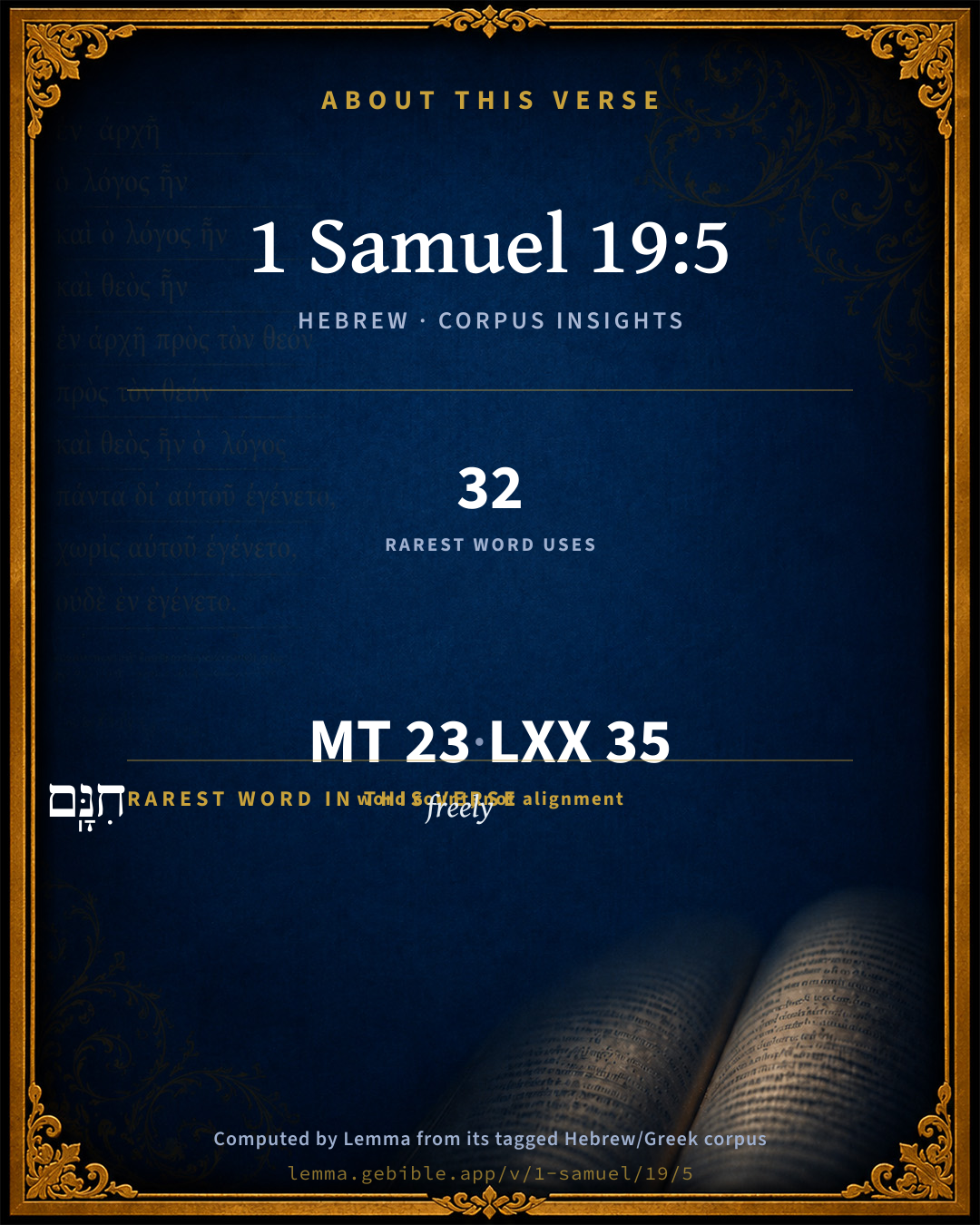
These counts appear in no published source. They are computed here, from the morphology-tagged text and Lemma’s own curated glosses. What Lemma adds →

23
words
21
distinct lemmas
Historical
section

Shared distinctive vocabulary

חִנָּֽם freely H2600 occurs in 31 verses of the Hebrew Bible. Also found in:

Grammatical profile

  • 7 verbs
  • 9 nouns
  • 2 adjectives
  • 1 adverb
  • 4 particles

Verb forms

  • וַיָּשֶׂם֩ Qal · Sequential Imperfect
  • וַיַּ֣ךְ Hiphil · Sequential Imperfect
  • וַיַּ֨עַשׂ Qal · Sequential Imperfect
  • רָאִ֖יתָ Qal · Perfect
  • וַתִּשְׂמָ֑ח Qal · Sequential Imperfect
  • תֶֽחֱטָא֙ Qal · Imperfect
  • לְהָמִ֥ית Hiphil · Infinitive Construct

Hebrew & Septuagint length

In English translation the verse runs 41 words from the Hebrew and 39 from the Septuagint (LXX English) — closely comparable.

A rough comparison of the two English renderings, which tokenize alike — not a word-level alignment.

Word counts can differ between the Hebrew and the Greek without any difference in meaning — e.g. the Hebrew direct-object marker אֵת has no separate Greek word, and Greek often adds the article ὁ.

In the original languages it is 23 Hebrew tokens and 35 Greek tokens — but the two are counted differently (Hebrew bundles its prefixes and suffixes into one token; the Greek is in lemma form), so that isn’t a like-for-like length.

Cross-references

20

Topical passages linked to 1 Samuel 19:5 in the Treasury of Scripture Knowledge — connected by theme and wording, ordered by reader-vote popularity; previews shown in the World English Bible.

  • 1 Samuel 11:13 Saul said, There shall not a man be put to death this day; for today Yahweh has worked deliverance in Israel.
  • 1 Chronicles 11:14 They stood in the midst of the plot, and defended it, and killed the Philistines; and Yahweh saved them by a great victory.
  • Judges 9:17 (for my father fought for you, and adventured his life, and delivered you out of the hand of Midian:
  • 1 Samuel 20:32 Jonathan answered Saul his father, and said to him, "Why should he be put to death? What has he done?"
  • Matthew 27:4 saying, "I have sinned in that I betrayed innocent blood." But they said, "What is that to us? You see to it."
  • 1 Samuel 28:21 The woman came to Saul, and saw that he was sore troubled, and said to him, Behold, your handmaid has listened to your voice, and I have put my life in my hand, and have listened to your words which you spoke to me.
  • Psalms 119:109 My soul is continually in my hand, Yet I won't forget your law.
  • Acts 20:24 But these things don't count; nor do I hold my life dear to myself, so that I may finish my race with joy, and the ministry which I received from the Lord Jesus, to fully testify to the Gospel of the grace of God.
  • Jeremiah 26:15 Only know for certain that, if you put me to death, you will bring innocent blood on yourselves, and on this city, and on the inhabitants of it; for of a truth Yahweh has sent me to you to speak all these words in your ears.
  • Matthew 27:24 So when Pilate saw that nothing was being gained, but rather that a disturbance was starting, he took water, and washed his hands before the multitude, saying, "I am innocent of the blood of this righteous person. You see to it."
  • John 15:25 But this happened so that the word may be fulfilled which was written in their law, 'They hated me without a cause.'
  • Philippians 2:30 because for the work of Christ he came near to death, risking his life to supply that which was lacking in your service toward me.
  • Deuteronomy 19:10–13 that innocent blood not be shed in the midst of your land, which Yahweh your God gives you for an inheritance, and so blood be on you.
  • Judges 12:3 When I saw that you didn't save me, I put my life in my hand, and passed over against the children of Ammon, and Yahweh delivered them into my hand: why then are you come up to me this day, to fight against me?
  • 1 Samuel 14:45 The people said to Saul, Shall Jonathan die, who has worked this great salvation in Israel? Far from it: as Yahweh lives, there shall not one hair of his head fall to the ground; for he has worked with God this day. So the people rescued Jonathan, that he didn't die.
  • 1 Samuel 17:49–53 David put his hand in his bag, and took there a stone, and slang it, and struck the Philistine in his forehead; and the stone sank into his forehead, and he fell on his face to the earth.
  • Psalms 69:4 Those who hate me without a cause are more than the hairs of my head. Those who want to cut me off, being my enemies wrongfully, are mighty. I have to restore what I didn't take away.
  • Exodus 14:13 Moses said to the people, "Don't be afraid. Stand still, and see the salvation of Yahweh, which he will work for you today: for the Egyptians whom you have seen today, you shall never see them again.
  • Hebrews 2:3 how will we escape if we neglect so great a salvation-- which at the first having been spoken through the Lord, was confirmed to us by those who heard;
  • Psalms 25:3 Yes, no one who waits for you shall be shamed. They shall be shamed who deal treacherously without cause.

Cross-references courtesy of OpenBible.info (CC BY 4.0).

Hebrew and Greek witnesses Masoretic Hebrew ↔ Greek Septuagint

The same verse in the two great witnesses to the Old Testament, shown verse-for-verse.

These are two independent witnesses, not word-aligned to each other, and the Septuagint is shown in lemma (dictionary) form.

Hebrew 1 Samuel 19:5 Masoretic · Westminster Leningrad Codex

וַיָּשֶׂם֩ אֶת נַפְשׁ֨וֹ בְכַפּ֜וֹ וַיַּ֣ךְ אֶת הַפְּלִשְׁתִּ֗י וַיַּ֨עַשׂ יְהוָ֜ה תְּשׁוּעָ֤ה גְדוֹלָה֙ לְכָל יִשְׂרָאֵ֔ל רָאִ֖יתָ וַתִּשְׂמָ֑ח וְלָ֤מָּה תֶֽחֱטָא֙ בְּדָ֣ם נָקִ֔י לְהָמִ֥ית אֶת דָּוִ֖ד חִנָּֽם

for he put his life in his hand, and struck the Philistine, and Yahweh worked a great victory for all Israel: you saw it, and did rejoice; why then will you sin against innocent blood, to kill David without a cause?

World English Bible · Public Domain

Greek LXX 1 Samuel 19:5 Septuagint · lemma form

καί τίθημι ὁ ψυχή αὐτός ἐν ὁ χείρ αὐτός καί πατάσσω ὁ ἀλλόφυλος καί ποιέω κύριος σωτηρία μέγας καί πᾶς ἰσραήλ ὁράω καί χαίρω καί ἵνα τίς ἁμαρτάνω εἰς αἷμα ἀθῷος θανατόω ὁ δαυίδ δωρεά

And he put his life in his hand, and struck the Philistine, and the Lord wrought a great deliverance; and all Israel saw, and rejoined: why then do you sin against innocent blood, to kill David without a cause?

LXX2012 (modern English Septuagint) · Public Domain

Hebrew: Westminster Leningrad Codex (CC BY 4.0). Greek: Septuagint (public domain); English from LXX2012 (modern English Septuagint) (Public Domain). How the Septuagint differs from the Hebrew →

Targum (Aramaic paraphrase)

1

The Targum is the ancient Jewish Aramaic paraphrase of the Hebrew Scriptures — an interpretive translation, not the Hebrew text itself. Onkelos (literal) and Pseudo-Jonathan (expansive) render the Torah, and Jonathan the Prophets. Coverage is partial: where no permissively-licensed English translation exists for a verse, only the Aramaic is shown. This is verse-level text, not a word-by-word alignment to the Hebrew.

  1. Targum Jonathan Prophets (Joshua–Malachi)
    וּמְסַר יַת נַפְשֵׁיהּ כְּעַל גַב לְאִתְקְטָלָא וּקְטַל יַת פְלִשְׁתָּאָה וַעֲבַד יְיָ פּוּרְקָנָא רַבָּא לְכָל יִשְׂרָאֵל חֲזֵיתָא וַחֲדֵיתָא וּלְמָא תִּתְחַיֵב בְּדַם זַכַּאי לְמִקְטַל יַת דָוִד מַגָן:

    (no public-domain English translation for this verse)

    Targum Jonathan — Aramaic: “Mikraot Gedolot” (public domain). English: “Sefaria Community Translation” (CC0 1.0 (public-domain dedication)); “London "Chaldee Paraphrase," 1871” (public domain). Text via Sefaria.

Commentary

Notes on 1 Samuel 19:5 from classic Christian and Jewish commentators (each source and its license shown beneath its notes). The classic Christian expositions comment on the surrounding passage and are grouped to its opening verse, so a note may address several verses; the Jewish commentaries on the Tanakh (Rashi and others) are per-verse, so they appear only where the commentator wrote on this verse.

Lemma curates 59 commentaries, every one of them public domain or Creative Commons licensed, each selected and text-cleaned for this edition rather than reprinted as found. About our sources →

Trapp's Complete Commentary

John Trapp

1Sa 19:5 For he did put his life in his hand, and slew the Philistine, and the LORD wrought a great salvation for all Israel: thou sawest [it], and didst rejoice: wherefore then wilt thou sin against innocent blood, to slay David without a cause?

Ver. 5. For he did put his life in his hand.] offered it, as it were, to Goliath to take away if he could: like as the King of Sweden said of Queen Elizabeth when she took upon her the protection of the Netherlands, that she took the crown from her own head, and set it upon the head of fortune.

And the Lord wrought, &c.] And shall he be murdered who hath so highly merited? Absit nefas.

John Trapp, A Commentary or Exposition upon All the Books of the Old and New Testament (1647–1656) — public domain. Text from a community e-Sword module.

Geneva Bible (1599)

Geneva Bible translators

Hebrew, he put his soul in his hand.

Geneva Bible (1599) marginal notes — public domain. Text via Bolls.life.

Adam Clarke's Commentary

Verse 5. For he did put his life in his hand] The pleadings in this verse, though short, are exceedingly cogent; and the argument is such as could not be resisted.

Adam Clarke's Commentary on the Bible (1810–1826) — public domain. Text from a community e-Sword/MySword module.

The Cambridge Bible for Schools and Colleges

gen. ed. J. J. S. Perowne

5. put his life in his hand] i.e. voluntarily exposed himself to peril of death. The figure seems to be that of taking a treasure out of a safe place, and carrying it about with the risk of losing it Cp. ch. 1Sa_28:21; Jdg_12:3; Psa_119:109.

wrought a great salvation] See 1Sa_11:9 (note), 13.

sin against innocent blood] Incur bloodguiltiness by the murder of an innocent man. Cp. Deu_19:10-13; Psa_94:21.

The Cambridge Bible for Schools and Colleges (gen. ed. J. J. S. Perowne; Cambridge University Press, 1878–1918) — public domain. Text from a community e-Sword module.

John Gill's Exposition

For he did put his life in his hand,.... Exposed himself to the utmost danger, when no one in all the camp of Israel would do the like:

and slew the Philistine; Goliath of Gath, who defied the armies of Israel; against him he went unarmed, only with his sling and stones, and fought him, and slew him:

and the Lord wrought a great salvation for all Israel; by his hand, so that they were delivered from their enemies, who fled before them, and they pursued them, and got a complete victory over them:

thou sawest it, and didst rejoice; he was an eyewitness of David's going forth against the Philistine, and slaying him, and of all the happy effects of it, which then greatly affected him, and he could not forbear expressing great joy on that occasion:

wherefore then wilt thou sin against innocent blood, to slay David without a cause? and so entail the guilt of it on himself and family.

John Gill's Exposition of the Whole Bible (1746–1763) — public domain (CC PDM 1.0). Text via the HelloAO Bible API.

Matthew Poole's English Annotations

He did put his life in his hand, i.e. he exposed his life to eminent hazard. See Poole "Jdg 12:3".

Matthew Poole's English Annotations on the Holy Bible (1683–1685) — public domain. Text from a community e-Sword/MySword module.

Lesson kit

Teaching starters — assembled from the data on this page, not authored interpretation. Every prompt links to the verse data it draws on. Edit before teaching.

1 Samuel, in the Historical, opens this verse with 23 words (21 distinct Hebrew lemmas). Its most distinctive word is chinnâm (“freely”). A historical commentator’s framing appears above. Read the whole chapter for the surrounding context.

Discussion questions

  1. The word chinnâm carries the sense “freely.” How does it shape the verse?
  2. How does Genesis 29:15, which shares the word «freely», read alongside this verse?
  3. These translations render this verse differently; the difference is in the English rendering, not the original. What questions does that raise?
  4. «וַיָּשֶׂם֩» is a Qal Sequential Imperfect verb. How does that grammatical form shape the action described?
  5. Compare how Trapp's Complete Commentary and Geneva Bible (1599) read this verse. Where do they agree or differ?

Things to notice

Reading settings

Reading text

Shown beneath each verse's original-language words.

Old Testament
Old Testament edition

Read the OT as the Masoretic Hebrew (MT) or the Greek Septuagint (LXX).

English shown for the Greek Septuagint (in the Hebrew ↔ Greek comparison).

Comparing translations? Open the Compare panel on any verse page to stack up to four side by side.