
Psalms 105:29

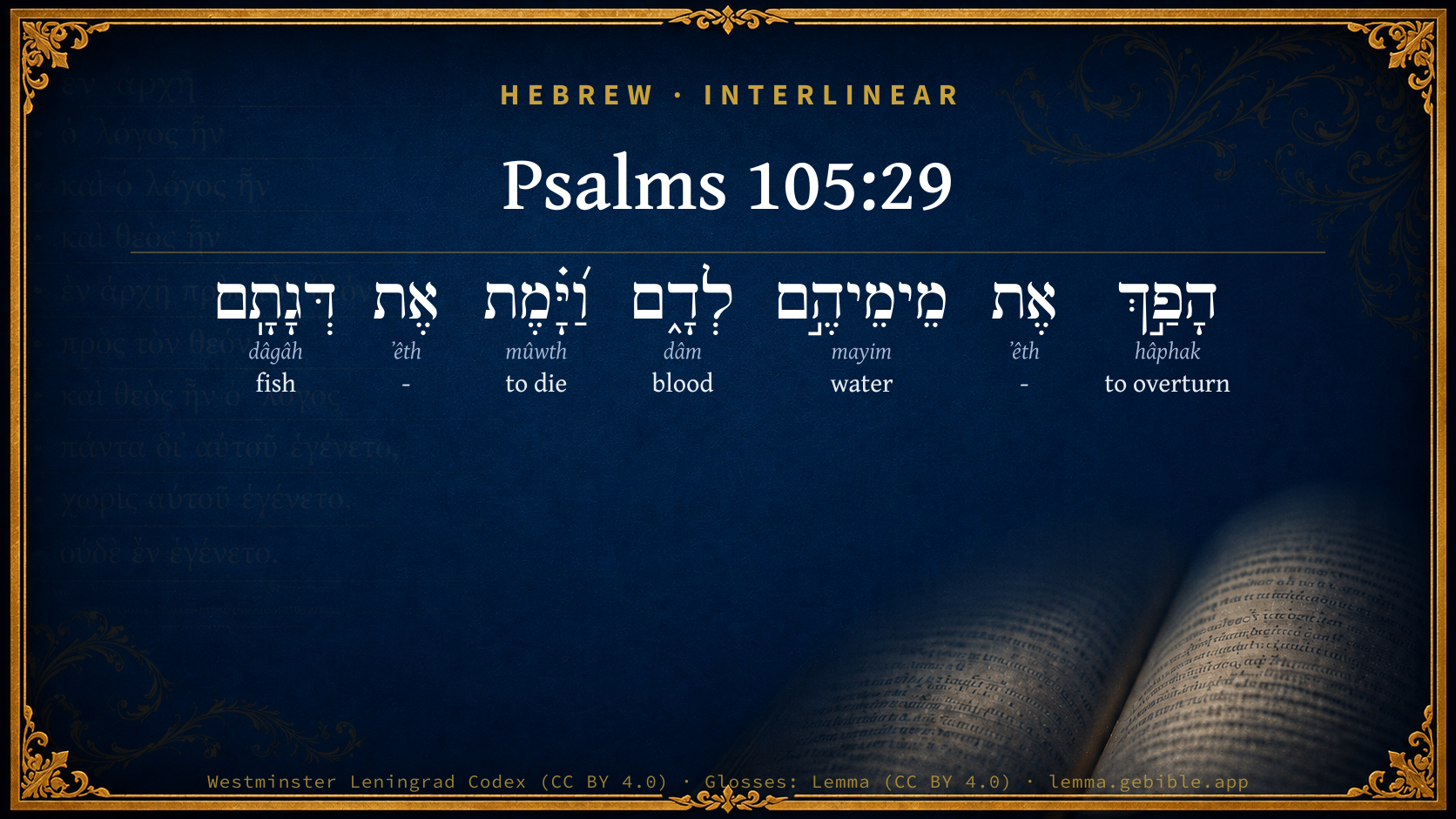
Hebrew (Westminster Leningrad Codex) Psalms 105:29 appears in the Hebrew Old Testament. The text above is from the Westminster Leningrad Codex. Each word links to its Strong’s number, a concise gloss, and parsing drawn from the Open Scriptures Hebrew Bible morphology. Click any word for its full Brown-Driver-Briggs (BDB) entry.
Download image
Cite this verse

Psalms 105:29 (World English Bible). Public Domain. Lemma interlinear Bible study tool, https://lemma.gebible.app/v/psalms/105/29.

Show BibTeX & RIS
BibTeX
RIS
English Translation
He turned their waters into blood, And killed their fish.
World English Bible · Public Domain
Download a study sheet

One document with this verse’s original text, its word-by-word gloss line, the meaning frame, cross-references with their text, attributed commentary, and full source and license credits — printable, and it pastes into notes with its structure intact.

This verse Autodidact and up

Study sheet (.html) Plain text (.txt)

A passage Seminary Student

Up to 50 verses in one chapter. A passage sheet keeps up to 6 commentary sources and 12 cross-references per verse, in the order this page ranks them, and says so on the sheet whenever that leaves anything out. Ask for a single verse and you get the Autodidact verse sheet above.

Everything on this page stays free to read, with no account — the sheet is a download of what is already on screen, not access to it.

Want to remove ads? Support Godless Engineer
Compare translations 3

The same verse in 3 English versions, stacked beneath the original-language interlinear above. Click any original word for its lexicon entry.

Each is an independent rendering of the whole verse — the interlinear is not word-aligned to these translations.

Highlighted words mark where these versions differ — a whole-verse word diff, not a word-by-word alignment.

  • World English Bible Public Domain
    He turned their waters into blood, And killed their fish.
  • King James Version Public Domain
    He turned their waters into blood, and slew their fish.
  • unfoldingWord Literal Text CC BY-SA 4.0
    He turned their water into blood and killed their fish.

unfoldingWord Literal Text — © unfoldingWord, licensed CC BY-SA 4.0. Word-aligned USFM3 via Door43 (git.door43.org/unfoldingWord/en_ult).

Versions to compare (up to 4)

3 of 4 selected

Show all 18 translations

Every available English version of this verse, each an independent rendering of the whole verse.

  • World English Bible Public Domain
    He turned their waters into blood, And killed their fish.
  • Berean Standard Bible Public Domain
    He turned their waters to blood and caused their fish to die.
  • Majority Standard Bible Public Domain
    He turned their waters to blood and caused their fish to die.
  • King James Version Public Domain
    He turned their waters into blood, and slew their fish.
  • American Standard Version (1901) Public Domain
    He turned their waters into blood, And slew their fish.
  • Revised Version (1885) Public Domain
    He turned their waters into blood, and slew their fish.
  • Geneva Bible (1599) Public Domain
    He turned their waters into blood, and slewe their fish.
  • Douay-Rheims (1899) Public Domain
    He turned their waters into blood, and destroyed their fish.
  • Young's Literal Translation Public Domain
    He hath turned their waters to blood, And putteth to death their fish.
  • Literal Standard Version CC BY-SA 4.0
    He has turned their waters to blood, || And puts their fish to death.
  • Unlocked Literal Bible CC BY-SA 4.0
    He turned their water into blood and killed their fish.
  • unfoldingWord Literal Text CC BY-SA 4.0
    He turned their water into blood and killed their fish.
  • Darby Bible Public Domain
    He turned their waters into blood, and caused their fish to die.
  • World Messianic Bible Public Domain
    He turned their waters into blood, and killed their fish.
  • Webster's Bible Public Domain
    He turned their waters into blood, and slew their fish.
  • Free Bible Version CC BY-SA 4.0
    He turned their water into blood, killing all the fish.
  • Bible in Basic English Public Domain
    At his word their waters were turned to blood, and he sent death on all their fish.
  • JPS Tanakh (1917) Public Domain
    He turned their waters into blood, and slew their fish.

Literal Standard Version (2020), Covenant Press — licensed CC BY-SA 4.0. Text via the HelloAO Bible API (eBible.org). Unlocked Literal Bible (unfoldingWord) — licensed CC BY-SA 4.0. Text via the HelloAO Bible API (eBible.org). unfoldingWord Literal Text — © unfoldingWord, licensed CC BY-SA 4.0. Word-aligned USFM3 via Door43 (git.door43.org/unfoldingWord/en_ult). Free Bible Version, Dr. Jonathan Gallagher — licensed CC BY-SA 4.0. Text via the HelloAO Bible API (eBible.org).

Word by word

More ways to search: Search by grammar → Find every occurrence → Compare this word →

Practice this passage: Drill this verse → Learn its vocabulary →

About this verse

These counts appear in no published source. They are computed here, from the morphology-tagged text and Lemma’s own curated glosses. What Lemma adds →

7
words
6
distinct lemmas
Wisdom
section

Notable vocabulary

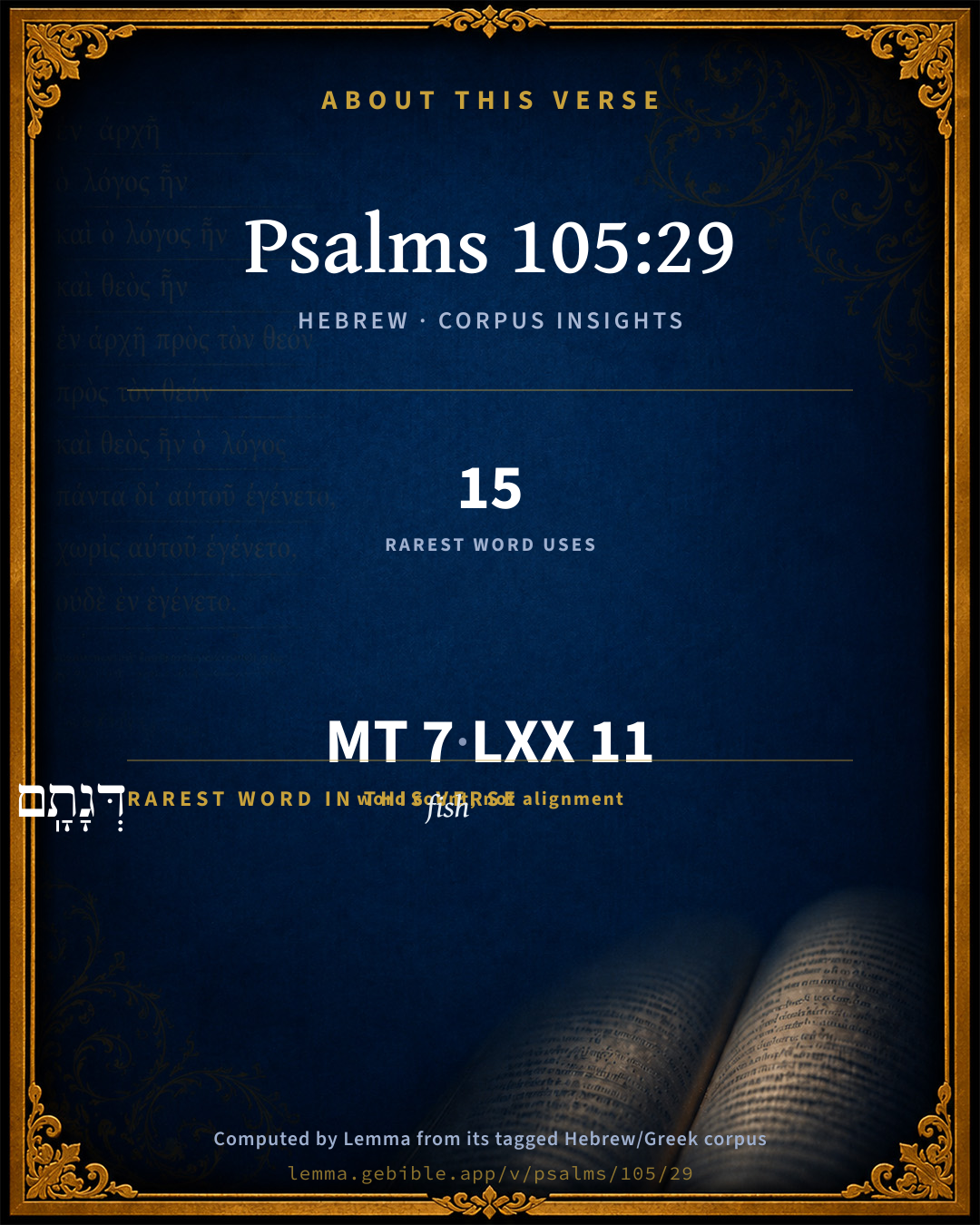
The rarest word here is דְּגָתָֽם fish H1710 — appearing just 15 times in the whole Hebrew Bible.

Shared distinctive vocabulary

דְּגָתָֽם fish H1710 occurs in 13 verses of the Hebrew Bible. Also found in:

Grammatical profile

  • 2 verbs
  • 3 nouns
  • 2 particles

Verb forms

  • הָפַ֣ךְ Qal · Perfect
  • וַ֝יָּ֗מֶת Hiphil · Sequential Imperfect

Hebrew & Septuagint length

In English translation the verse runs 10 words from the Hebrew and 10 from the Septuagint (LXX English) — the same length.

A rough comparison of the two English renderings, which tokenize alike — not a word-level alignment.

Word counts can differ between the Hebrew and the Greek without any difference in meaning — e.g. the Hebrew direct-object marker אֵת has no separate Greek word, and Greek often adds the article ὁ.

In the original languages it is 7 Hebrew tokens and 11 Greek tokens — but the two are counted differently (Hebrew bundles its prefixes and suffixes into one token; the Greek is in lemma form), so that isn’t a like-for-like length.

Cross-references

5

Topical passages linked to Psalms 105:29 in the Treasury of Scripture Knowledge — connected by theme and wording, ordered by reader-vote popularity; previews shown in the World English Bible.

  • Exodus 7:20–21 Moses and Aaron did so, as Yahweh commanded; and he lifted up the rod, and struck the waters that were in the river, in the sight of Pharaoh, and in the sight of his servants; and all the waters that were in the river were turned to blood.
  • Psalms 78:44 Turned their rivers into blood, And their streams, so that they could not drink.
  • Revelation 16:3 The second angel poured out his bowl into the sea, and it became blood as of a dead man. Every living thing in the sea died.
  • Isaiah 50:2 Why, when I came, was there no man? when I called, was there none to answer? Is my hand shortened at all, that it can't redeem? or have I no power to deliver? Behold, at my rebuke I dry up the sea, I make the rivers a wilderness: their fish stink, because there is no water, and die for thirst.
  • Ezekiel 29:4–5 I will put hooks in your jaws, and I will cause the fish of your rivers to stick to your scales; and I will bring you up out of the midst of your rivers, with all the fish of your rivers which stick to your scales.

Cross-references courtesy of OpenBible.info (CC BY 4.0).

Hebrew and Greek witnesses Masoretic Hebrew ↔ Greek Septuagint

The same verse in the two great witnesses to the Old Testament, shown verse-for-verse.

You’re reading Greek Psalm 104 (Hebrew Psalm 105). The Septuagint counts the superscription, so verse numbers can differ from the Hebrew — chapter-level alignment, not verse-by-verse. Numbering follows Rahlfs.

These are two independent witnesses, not word-aligned to each other, and the Septuagint is shown in lemma (dictionary) form.

Hebrew Psalms 105:29 Masoretic · Westminster Leningrad Codex

הָפַ֣ךְ אֶת מֵימֵיהֶ֣ם לְדָ֑ם וַ֝יָּ֗מֶת אֶת דְּגָתָֽם

He turned their waters into blood, And killed their fish.

World English Bible · Public Domain

Greek LXX Greek Psalm 104:29 Septuagint · lemma form

μεταστρέφω ὁ ὕδωρ αὐτός εἰς αἷμα καί ἀποκτείνω ὁ ἰχθύς αὐτός

He turned their waters into blood, and killed their fish.

LXX2012 (modern English Septuagint) · Public Domain

Hebrew: Westminster Leningrad Codex (CC BY 4.0). Greek: Septuagint (public domain); English from LXX2012 (modern English Septuagint) (Public Domain). How the Septuagint differs from the Hebrew →

Commentary

Notes on Psalms 105:29 from classic Christian and Jewish commentators (each source and its license shown beneath its notes). The classic Christian expositions comment on the surrounding passage and are grouped to its opening verse, so a note may address several verses; the Jewish commentaries on the Tanakh (Rashi and others) are per-verse, so they appear only where the commentator wrote on this verse.

Lemma curates 59 commentaries, every one of them public domain or Creative Commons licensed, each selected and text-cleaned for this edition rather than reprinted as found. About our sources →

Trapp's Complete Commentary

John Trapp

Psa 105:29 He turned their waters into blood, and slew their fish.

Ver. 29. And he turned their waters into blood] A just hand of God upon them for their cruelty in drowning the Hebrew infants, and a real forewarning, if they could have seen it, of the death of their firstborn, and their final overthrow at the Red Sea.

And slew their fish] Which was a great part of their food; piscis a pascendo dictus.

John Trapp, A Commentary or Exposition upon All the Books of the Old and New Testament (1647–1656) — public domain. Text from a community e-Sword module.

J. A. Alexander on Psalms

Joseph Addison Alexander

29. (Psa 105:29) He turned their waters to blood and killed their fish. Here begins the moreparticular enumeration of the plagues of Egypt. Compare Psa 78:44, where the inconvenience specified is that they could not drink the water, whereas here it is the loss of their accustomed food. This last word is used as a collective in both langnages.

Joseph Addison Alexander, The Psalms Translated and Explained (1850) — public domain. Text from a community e-Sword module.

John Calvin's Commentaries

29. He turned their waters into blood How grievous this plague was to the Egyptians may be conjectured from the consideration, that the element of water is one of the two great means of supporting life. And the power of God shines forth the brighter, from the fact, that although the land of Egypt is well irrigated, yet the Egyptians were parched with drought amidst abundance of water. It is afterwards said, that frogs were brought forth, and entered even into the chambers of the kings; by which God manifestly evinced that he was the author of the miracle; for although all Egypt swarmed with frogs, the courts of the kings ought to have been exempt from this nuisance. By the term kings, is denoted either the nobles of the realm, or the king’s sons, who were brought up in the expectation of the royal power; for at that time, as is well known, one king alone reigned over all Egypt. From this we learn how easily, and as it were by a kind of mockery, God humbles those who pride themselves in the flesh. He did not gather together an army to fight against the Egyptians, nor did he forthwith arm his angels, or thunder out of heaven, but brought forth frogs, which contemptuously trampled upon the pride of that haughty nation, who held in contempt the whole world beside. It would have been no disgrace for them to have been conquered by powerful enemies; but how dishonorable was it to be vanquished by frogs? God thus intended to show that he has no need of powerful hosts to destroy the wicked; for he can do this, as it were in sport, whenever he pleases.

John Calvin's Commentaries (1540-1563) — public domain. Text from the Calvin Translation Society English edition (1840s-50s) via the Christian Classics Ethereal Library (ccel.org). Calvin's coverage is partial (roughly two-thirds of the Bible); uncommented books and verses are honest gaps, never fabricated. The 19th-century editor's footnotes and remarks are omitted so the notes are faithfully Calvin's own voice.

Ellicott's Commentary for English Readers

(29) For the various terms used in describing the plagues, see Notes to the historical account in Exodus.

A Bible Commentary for English Readers, edited by Charles John Ellicott (1878–1897) — public domain. Text from a community e-Sword module.

The Cambridge Bible for Schools and Colleges

gen. ed. J. J. S. Perowne

29. After mentioning the crucial plague of the darkness, the Psalmist refers briefly to the other plagues, omitting however the fifth and sixth, and inverting the order of the third and fourth.

he turned &c.] The first plague, Exo_7:14 ff., Exo_7:21.

The Cambridge Bible for Schools and Colleges (gen. ed. J. J. S. Perowne; Cambridge University Press, 1878–1918) — public domain. Text from a community e-Sword module.

John Gill's Exposition

He turned their waters into blood,.... With which Egypt abounded; their streams, rivers, ponds, and pools, so that they had no water to drink; a just judgment upon them for shedding the innocent blood of infants, by drowning them in their rivers; this was the first of the ten plagues, Exo 7:19, with this compare the second and third vials poured out on spiritual Egypt, whereby blood will be given to antichrist, and to the antichristian states, for they are worthy, having shed so much of the blood of the saints, Rev 16:3.

And slew their fish; which showed that the miracle was real, that the waters were really turned into blood, since the fish could not live in them, as they might if it had been only in appearance; the rivers of Egypt abounded with fish, this was a principal part of their food, and therefore must greatly distress them; see Num 11:5.

John Gill's Exposition of the Whole Bible (1746–1763) — public domain (CC PDM 1.0). Text via the HelloAO Bible API.

Albert Barnes' Notes on the Bible

See an account of these plagues in Exo. 6–11. Compare Psa 78:43-51. This is mostly a mere enumeration of the plagues in the order in which they occurred, but without, of course, the details of the circumstances attending them. There are no circumstances mentioned here which require particular explanation.

Albert Barnes' Notes on the Bible (1834–1885) — public domain. Text from a community e-Sword/MySword module.

The Treasury of David

Charles H. Spurgeon

Ver. 29. He turned their waters into blood, and slew their fish. So that the plague was not a mere colouring of the water with red earth, as some suppose, but the river was offensive and fatal to the fish. The beloved Nile and other streams were all equally tainted and ensanguined. Their commonest mercy became their greatest curse. Water is one of the greatest blessings, and the more plentiful it is the better, but blood is a hideous sight to look upon, and to see rivers and pools of it is frightful indeed. Fish in Egypt furnished a large part of the food supply, and it was no small affliction to see them floating dead and white upon a stream of crimson. The hand of the Lord thus smote them where all classes of the people would become aware of it and suffer from it.

Ver. 29. He turned their waters into blood, etc. The Nile begins to rise about the end of June, and attains its highest point at the end of September. About the commencement of the rise it assumes a greenish hue, is disagreeable to the taste, unwholesome, and often totally unfit for drinking. It soon, however, becomes red and turbid, and continues in this state for three or more weeks. In this condition it is again healthy and fit for use. The miracle now performed was totally different from this annual change. For, 1. It occurred after the winter, not the summer, solstice; 2. The water was turned into blood, and not merely reddened by an admixture of red clay or animalcule; 3. The fish died, a result which did not follow from the periodical change of colour; 4. The river stank, and became offensive, which it ceased to be when the ordinary redness made its appearance;

5. The stroke was arrested at the end of seven days, whereas the natural redness continued for at least three weeks; and 6. The change was brought on instantly at the word of command before the eyes of Pharaoh. The calamity was appalling. The sweet waters of the Nile were the common beverage of Egypt. It abounded in all kinds of fish, which formed a principal article of diet for the inhabitants. It was revered as a god by Egypt. But now it was a putrid flood, from which they turned away with loathing. James G. Murphy.

Ver. 29. He turned their waters into blood. By the miraculous change of the waters into blood, a practical rebuke was given to their superstitious. This sacred and beautiful river, the benefactor and preserver of the country, this birthplace of their chief gods, this abode of their lesser deities, this source of all their prosperity, this centre of all their devotion, is turned to blood: the waters stink; the canals and pools, the vessels of wood and vessels of stone, which were replenished from the river, all are alike polluted. The Nile, according to Pliny, was the "only source from whence the Egyptians obtained water for drinking" (Hist. Nat. 76, c. 33). This water was considered particularly sweet and refreshing; so much so that the people were in the habit of provoking thirst in order that they might partake more freely of its soft and pleasant draughts. Now it was become abominable to them, and they loathed to drink of it. Thomas S. Millington.

Ver. 29. And slew their fish. Besides the fish cured, or sent to market for the table, a very great quantity was set apart expressly for feeding the sacred animals and birds, as the cats, crocodiles, ibises, and others; and some of the large reservoirs, attached to the temples, were used as well for keeping fish as for the necessary ablutions of the devout and for various purposes connected with religion. The quantity of fish in Egypt was a very great boon to the poor classes, and when the Nile overflowed the country inhabitants of the inland villages benefited by this annual gift of the river, as the land did by the fertilizing mud deposited upon it. The canals, ponds, and pools, on the low lands, continued to abound in fish, even after the inundation had ceased; and it was then that their return to the Nile was intercepted by closing the mouths of the canals. Sir J. Gardner Wilkinson, in "A Popular Account of the Ancient Egyptians, "1854.

Psalms 105:30*

Charles H. Spurgeon's The Treasury of David (1869–1885) — public domain. Psalms only. Text from a community e-Sword/MySword module.

Whedon's Commentary on the Bible

Daniel D. Whedon

29-36. For an explanation of these verses see notes on Psa_78:44-51

Daniel D. Whedon (gen. ed.), Commentary on the Old and New Testaments (1874–1909) — public domain. Text from a community e-Sword module.

The Pulpit Commentary

He turned their waters into blood, and slew their fish. (comp. Exo_7:20, Exo_7:21)

The Pulpit Commentary (1880–1919), ed. H.D.M. Spence-Jones & Joseph S. Exell — public domain. Text from a community e-Sword module.

Lesson kit

Teaching starters — assembled from the data on this page, not authored interpretation. Every prompt links to the verse data it draws on. Edit before teaching.

Psalms, in the Wisdom, opens this verse with 7 words (6 distinct Hebrew lemmas). Its most distinctive word is dâgâh (“fish”). A historical commentator’s framing appears above. Read the whole chapter for the surrounding context.

Discussion questions

  1. The word dâgâh carries the sense “fish.” How does it shape the verse?
  2. How does Genesis 1:26, which shares the word «fish», read alongside this verse?
  3. These translations render this verse differently; the difference is in the English rendering, not the original. What questions does that raise?
  4. «הָפַ֣ךְ» is a Qal Perfect verb. How does that grammatical form shape the action described?
  5. Compare how Trapp's Complete Commentary and J. A. Alexander on Psalms read this verse. Where do they agree or differ?

Things to notice

Reading settings

Reading text

Shown beneath each verse's original-language words.

Old Testament
Old Testament edition

Read the OT as the Masoretic Hebrew (MT) or the Greek Septuagint (LXX).

English shown for the Greek Septuagint (in the Hebrew ↔ Greek comparison).

Comparing translations? Open the Compare panel on any verse page to stack up to four side by side.