2 Kings 3:22

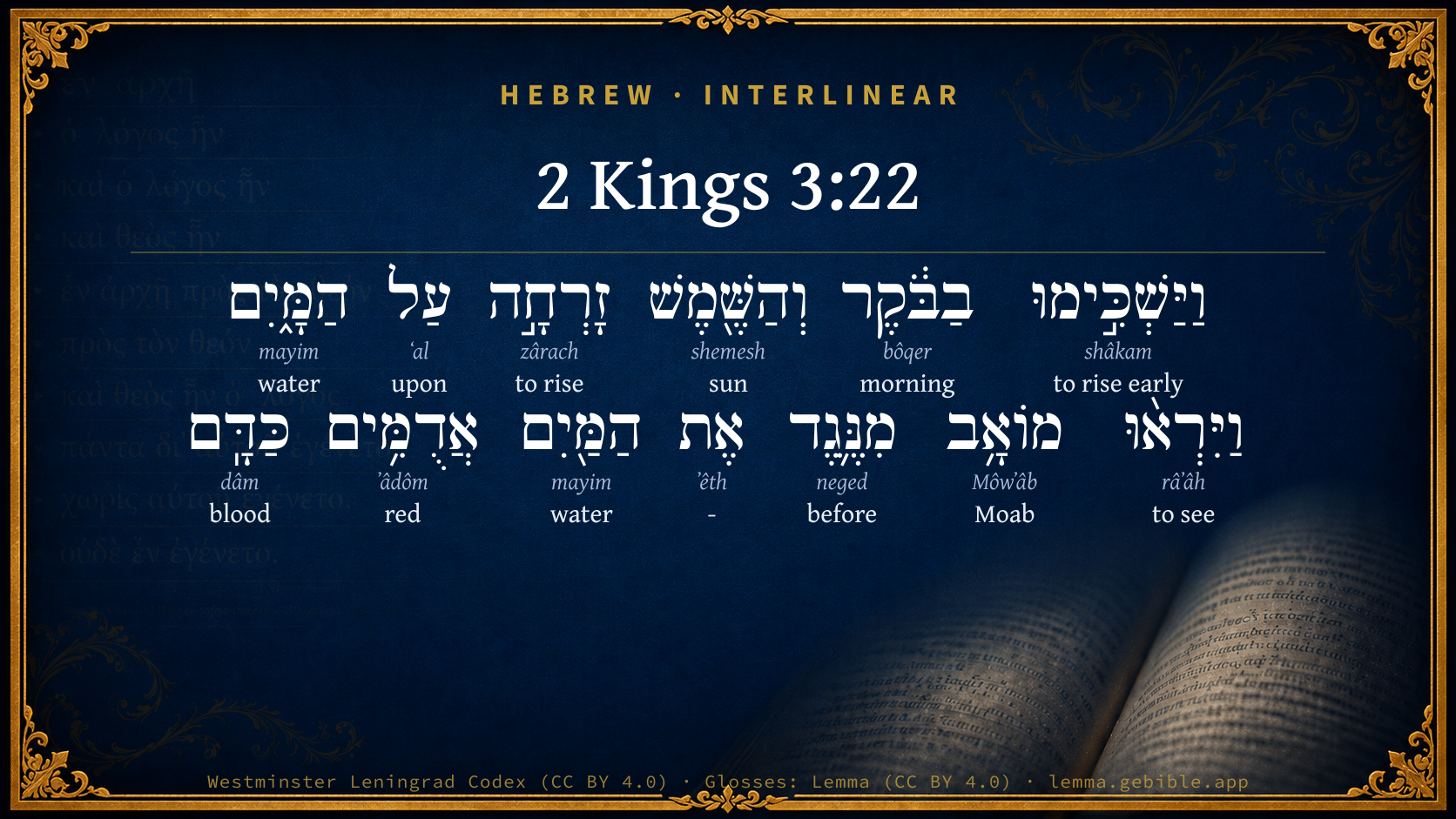
Hebrew (Westminster Leningrad Codex) 2 Kings 3:22 appears in the Hebrew Old Testament. The text above is from the Westminster Leningrad Codex. Each word links to its Strong’s number, a concise gloss, and parsing drawn from the Open Scriptures Hebrew Bible morphology. Click any word for its full Brown-Driver-Briggs (BDB) entry.
Download image
Cite this verse

2 Kings 3:22 (World English Bible). Public Domain. Lemma interlinear Bible study tool, https://lemma.gebible.app/v/2-kings/3/22.

Show BibTeX & RIS
BibTeX
RIS
English Translation
They rose up early in the morning, and the sun shone on the water, and the Moabites saw the water over against them as red as blood:
World English Bible · Public Domain
Download a study sheet

One document with this verse’s original text, its word-by-word gloss line, the meaning frame, cross-references with their text, attributed commentary, and full source and license credits — printable, and it pastes into notes with its structure intact.

This verse Autodidact and up

Study sheet (.html) Plain text (.txt)

A passage Seminary Student

Up to 50 verses in one chapter. A passage sheet keeps up to 6 commentary sources and 12 cross-references per verse, in the order this page ranks them, and says so on the sheet whenever that leaves anything out. Ask for a single verse and you get the Autodidact verse sheet above.

Everything on this page stays free to read, with no account — the sheet is a download of what is already on screen, not access to it.

Want to remove ads? Support Godless Engineer
Compare translations 3

The same verse in 3 English versions, stacked beneath the original-language interlinear above. Click any original word for its lexicon entry.

Each is an independent rendering of the whole verse — the interlinear is not word-aligned to these translations.

Highlighted words mark where these versions differ — a whole-verse word diff, not a word-by-word alignment.

  • World English Bible Public Domain
    They rose up early in the morning, and the sun shone on the water, and the Moabites saw the water over against them as red as blood:
  • King James Version Public Domain
    And they rose up early in the morning, and the sun shone upon the water, and the Moabites saw the water on the other side as red as blood:
  • unfoldingWord Literal Text CC BY-SA 4.0
    And they arose early in the morning, and the sun rose over the waters. And Moab saw the waters from opposite, red like blood.

unfoldingWord Literal Text — © unfoldingWord, licensed CC BY-SA 4.0. Word-aligned USFM3 via Door43 (git.door43.org/unfoldingWord/en_ult).

Versions to compare (up to 4)

3 of 4 selected

Show all 18 translations

Every available English version of this verse, each an independent rendering of the whole verse.

  • World English Bible Public Domain
    They rose up early in the morning, and the sun shone on the water, and the Moabites saw the water over against them as red as blood:
  • Berean Standard Bible Public Domain
    When they got up early in the morning, the sun was shining on the water, and it looked as red as blood to the Moabites across the way.
  • Majority Standard Bible Public Domain
    When they got up early in the morning, the sun was shining on the water, and it looked as red as blood to the Moabites across the way.
  • King James Version Public Domain
    And they rose up early in the morning, and the sun shone upon the water, and the Moabites saw the water on the other side as red as blood:
  • American Standard Version (1901) Public Domain
    And they rose up early in the morning, and the sun shone upon the water, and the Moabites saw the water over against them as red as blood:
  • Revised Version (1885) Public Domain
    And they rose up early in the morning, and the sun shone upon the water, and the Moabites saw the water over against them as red as blood:
  • Geneva Bible (1599) Public Domain
    And they rose earely in the morning, when the sunne arose vpon the water, and the Moabites saw the water ouer against them, as red as blood.
  • Douay-Rheims (1899) Public Domain
    And they rose early in the morning, and the sun being now up, and shining upon the waters, the Moabites saw the waters over against them red, like blood,
  • Young's Literal Translation Public Domain
    And they rise early in the morning, and the sun hath shone on the waters, and the Moabites see, from over-against, the waters red as blood,
  • Literal Standard Version CC BY-SA 4.0
    And they rise early in the morning, and the sun has shone on the waters, and the Moabites see, from opposite [them], [that] the waters [are] red as blood,
  • Unlocked Literal Bible CC BY-SA 4.0
    They awakened early in the morning and the sun reflected on the water. When the Moabites saw the water opposite them, it looked as red as blood.
  • unfoldingWord Literal Text CC BY-SA 4.0
    And they arose early in the morning, and the sun rose over the waters. And Moab saw the waters from opposite, red like blood.
  • Darby Bible Public Domain
    And they rose up early in the morning, and the sun rose upon the water, and the Moabites saw the water on the other side red as blood.
  • World Messianic Bible Public Domain
    They rose up early in the morning, and the sun shone on the water, and the Moabites saw the water opposite them as red as blood.
  • Webster's Bible Public Domain
    And they rose early in the morning, and the sun shone upon the water, and the Moabites saw the water on the other side as red as blood:
  • Free Bible Version CC BY-SA 4.0
    But the next morning when they got up the sun was shining on the water, and to the Moabites on the other side it looked blood red.
  • Bible in Basic English Public Domain
    And early in the morning they got up, when the sun was shining on the water, and they saw the water facing them as red as blood.
  • JPS Tanakh (1917) Public Domain
    And they rose up early in the morning, and the sun shone upon the water, and the Moabites saw the water some way off as red as blood;

Literal Standard Version (2020), Covenant Press — licensed CC BY-SA 4.0. Text via the HelloAO Bible API (eBible.org). Unlocked Literal Bible (unfoldingWord) — licensed CC BY-SA 4.0. Text via the HelloAO Bible API (eBible.org). unfoldingWord Literal Text — © unfoldingWord, licensed CC BY-SA 4.0. Word-aligned USFM3 via Door43 (git.door43.org/unfoldingWord/en_ult). Free Bible Version, Dr. Jonathan Gallagher — licensed CC BY-SA 4.0. Text via the HelloAO Bible API (eBible.org).

Word by word

More ways to search: Search by grammar → Find every occurrence → Compare this word →

Practice this passage: Drill this verse → Learn its vocabulary →

אֲדֻמִּ֥ים
ʼâdôm
H122
“red”
Adjective, Adjective, Masculine, Plural, Absolute
Part of Speech
Adjective
Type
Adjective
Gender
Masculine
Number
Plural
State
Absolute
Full BDB Definition

Origin: from H119

TWOT: 26b

red, ruddy (of man, horse, heifer, garment, water, lentils)
  1. וַיַּשְׁכִּ֣ימוּ shâkam H7925 “and · to rise early” Conjunction + Verb, Hiphil, Sequential Imperfect, 3rd Person, Masculine, Plural
  2. בַבֹּ֔קֶר bôqer H1242 “in/at the · morning” Preposition, Determined + Noun, Common, Masculine, Singular, Absolute
  3. וְהַשֶּׁ֖מֶשׁ shemesh H8121 “and · the · sun” Conjunction + Particle, Definite Article + Noun, Common, Both, Singular, Absolute
  4. זָרְחָ֣ה zârach H2224 “to rise” Verb, Qal, Perfect, 3rd Person, Feminine, Singular
  5. עַל ʻal H5921 “upon” Preposition
  6. הַמָּ֑יִם mayim H4325 “the · water(s)” Particle, Definite Article + Noun, Common, Masculine, Plural, Absolute
  7. וַיִּרְא֨וּ râʼâh H7200 “and · to see” Conjunction + Verb, Qal, Sequential Imperfect, 3rd Person, Masculine, Plural
  8. מוֹאָ֥ב Môwʼâb H4124 “Moab” Noun, Proper
  9. מִנֶּ֛גֶד neged H5048 “from · before” Preposition + Preposition
  10. אֶת ʼêth H853 “-” Particle, Direct Object
  11. הַמַּ֖יִם mayim H4325 “the · water(s)” Particle, Definite Article + Noun, Common, Masculine, Plural, Absolute
  12. כַּדָּֽם dâm H1818 “like/as the · blood” Preposition, Determined + Noun, Common, Masculine, Singular, Absolute

About this verse

These counts appear in no published source. They are computed here, from the morphology-tagged text and Lemma’s own curated glosses. What Lemma adds →

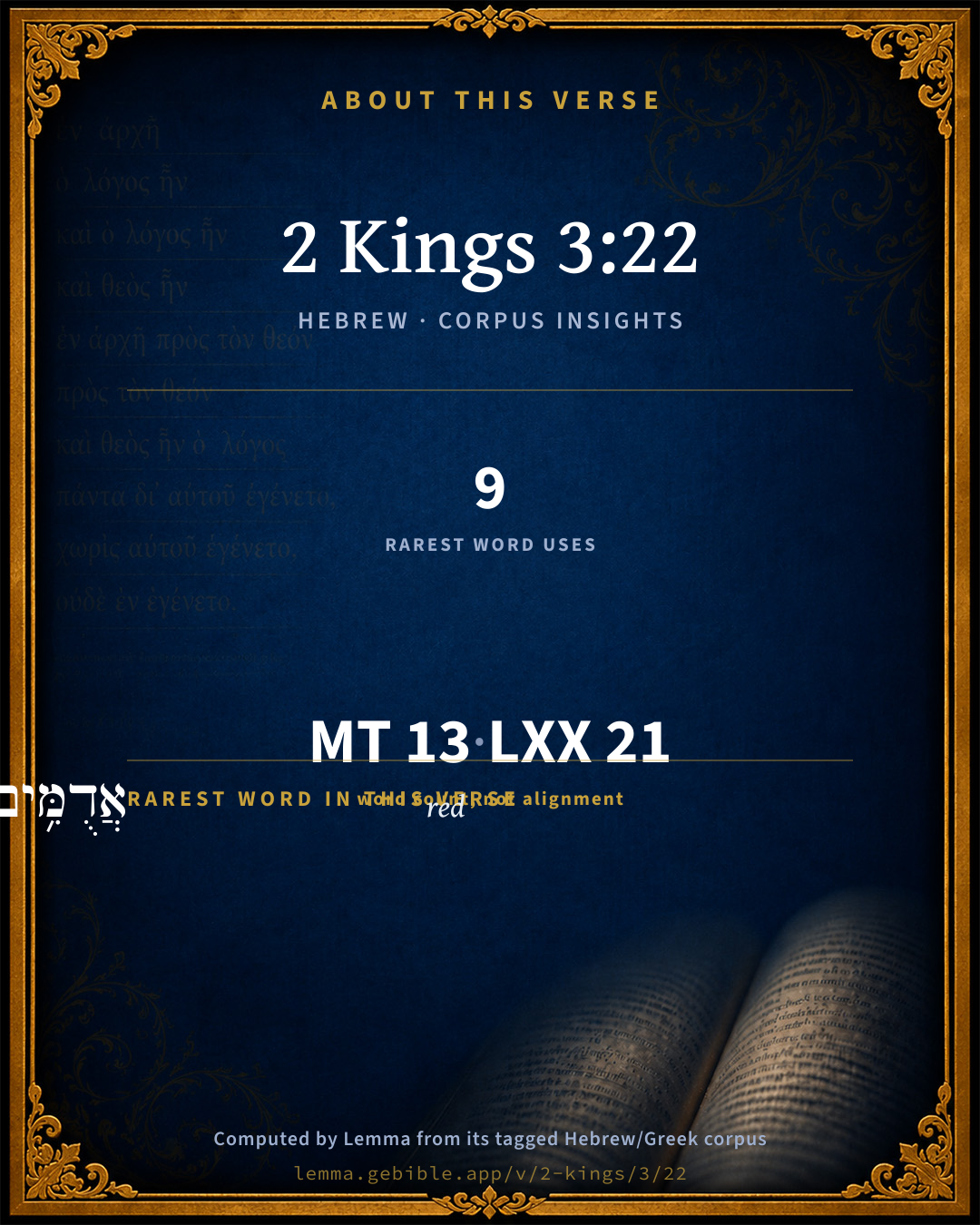
13
words
12
distinct lemmas
Historical
section

Notable vocabulary

The rarest word here is אֲדֻמִּ֥ים red H122 — appearing just 9 times in the whole Hebrew Bible.

Shared distinctive vocabulary

אֲדֻמִּ֥ים red H122 occurs in 7 verses of the Hebrew Bible. Also found in:

Grammatical profile

  • 3 verbs
  • 6 nouns
  • 1 adjective
  • 2 prepositions
  • 1 particle

Verb forms

  • וַיַּשְׁכִּ֣ימוּ Hiphil · Sequential Imperfect
  • זָרְחָ֣ה Qal · Perfect
  • וַיִּרְא֨וּ Qal · Sequential Imperfect

Repetition

A word recurs within this verse — often emphatic in Hebrew:

  • הַמָּ֑יִם water H4325 ×2

Hebrew & Septuagint length

In English translation the verse runs 27 words from the Hebrew and 26 from the Septuagint (LXX English) — closely comparable.

A rough comparison of the two English renderings, which tokenize alike — not a word-level alignment.

Word counts can differ between the Hebrew and the Greek without any difference in meaning — e.g. the Hebrew direct-object marker אֵת has no separate Greek word, and Greek often adds the article ὁ.

In the original languages it is 13 Hebrew tokens and 21 Greek tokens — but the two are counted differently (Hebrew bundles its prefixes and suffixes into one token; the Greek is in lemma form), so that isn’t a like-for-like length.

Hebrew and Greek witnesses Masoretic Hebrew ↔ Greek Septuagint

The same verse in the two great witnesses to the Old Testament, shown verse-for-verse.

These are two independent witnesses, not word-aligned to each other, and the Septuagint is shown in lemma (dictionary) form.

Hebrew 2 Kings 3:22 Masoretic · Westminster Leningrad Codex

וַיַּשְׁכִּ֣ימוּ בַבֹּ֔קֶר וְהַשֶּׁ֖מֶשׁ זָרְחָ֣ה עַל הַמָּ֑יִם וַיִּרְא֨וּ מוֹאָ֥ב מִנֶּ֛גֶד אֶת הַמַּ֖יִם אֲדֻמִּ֥ים כַּדָּֽם

They rose up early in the morning, and the sun shone on the water, and the Moabites saw the water over against them as red as blood:

World English Bible · Public Domain

Greek LXX 2 Kings 3:22 Septuagint · lemma form

καί ὀρθρίζω ὁ πρωΐ καί ὁ ἥλιος ἀνατέλλω ἐπί ὁ ὕδωρ καί ὁράω μωαβ ἐκ ἐναντίος ὁ ὕδωρ πυρρός ὡσεί αἷμα

And they rose early in the morning, and the sun rose upon the waters, and Moab saw the waters on the opposite side red as blood.

LXX2012 (modern English Septuagint) · Public Domain

Hebrew: Westminster Leningrad Codex (CC BY 4.0). Greek: Septuagint (public domain); English from LXX2012 (modern English Septuagint) (Public Domain). How the Septuagint differs from the Hebrew →

Targum (Aramaic paraphrase)

1

The Targum is the ancient Jewish Aramaic paraphrase of the Hebrew Scriptures — an interpretive translation, not the Hebrew text itself. Onkelos (literal) and Pseudo-Jonathan (expansive) render the Torah, and Jonathan the Prophets. Coverage is partial: where no permissively-licensed English translation exists for a verse, only the Aramaic is shown. This is verse-level text, not a word-by-word alignment to the Hebrew.

  1. Targum Jonathan Prophets (Joshua–Malachi)
    וְאַקְדִימוּ בְּצַפְרָא וְשִׁמְשָׁא נְחַת עַל מַיָא וַחֲזוֹ מוֹאֲבָאֵי מִקֳבֵל יַת מַיָא סוּמָקִין כִּדְמָא:

    (no public-domain English translation for this verse)

    Targum Jonathan — Aramaic: “Mikraot Gedolot” (public domain). English: “Sefaria Community Translation” (CC0 1.0 (public-domain dedication)); “London "Chaldee Paraphrase," 1871” (public domain). Text via Sefaria.

Commentary

Notes on 2 Kings 3:22 from classic Christian and Jewish commentators (each source and its license shown beneath its notes). The classic Christian expositions comment on the surrounding passage and are grouped to its opening verse, so a note may address several verses; the Jewish commentaries on the Tanakh (Rashi and others) are per-verse, so they appear only where the commentator wrote on this verse.

Lemma curates 59 commentaries, every one of them public domain or Creative Commons licensed, each selected and text-cleaned for this edition rather than reprinted as found. About our sources →

Trapp's Complete Commentary

John Trapp

2Ki 3:22 And they rose up early in the morning, and the sun shone upon the water, and the Moabites saw the water on the other side [as] red as blood:

Ver. 22. And the Moabites saw the water … as red as blood.] So they seemed to be, by reason of the sunbeams, which met with the vapours that arose out of the waters, and could not dispel them.

John Trapp, A Commentary or Exposition upon All the Books of the Old and New Testament (1647–1656) — public domain. Text from a community e-Sword module.

Joseph Benson's Commentary

2Ki 3:22-23. The sun shone upon the water, &c. — They stood in such a situation, when they looked at the water, that those rays of the sun which gave a red colour, were reflected from the water to their eyes; or the light of the morning sun shining upon the water, through the vapours that arose from the earth, gave it a reddish appearance; so that they imagined it to be blood, which they were the more inclined to suppose, because they knew very well there was no water there before. And they said — The kings are surely slain, &c. — As they concluded what they saw could be nothing but blood, so they could not conceive it could be any other blood than that of the army of the three kings, who they thought had fallen out among themselves, vexed at the straits into which they had brought one another. Now therefore, Moab, to the spoil — Easily believing what they wished, they imagined they had nothing to do but to go and take the spoil, having no need to fight at all. Therefore they sent no scouts, but marched thither with their whole army, and that in great disorder: wherein, also, there was a divine hand, strengthening them in their mistakes, and hardening them to their destruction.

Joseph Benson's Commentary on the Old and New Testaments (1811–1818) — public domain. Text from a community e-Sword module.

Adam Clarke's Commentary

Verse 22. Saw the water on the other side as red as blood] This might have been an optical deception; I have seen the like sight when there was no reason to suspect supernatural agency. The Moabites had never seen that valley full of water, and therefore did not suspect that their eyes deceived them, but took it for the blood of the confederate hosts, who they thought might have fallen into confusion in the darkness of night and destroyed each other, as the Midianites had formerly done, Jdg 7:22, and the Philistines lately, 1Sa 14:20.

Adam Clarke's Commentary on the Bible (1810–1826) — public domain. Text from a community e-Sword/MySword module.

Ellicott's Commentary for English Readers

(22) They rose up early.—The Moabite camp on the frontier mountains.

And the sun shone upon the water.—A parenthesis (now the sun had risen upon the water). The red sunrise tinged the water with the same colour.

On the other side.—Min-nèged, “opposite,” “over against them” (2Ki_2:7; 2Ki_2:15). The sun rose behind the Moabites.

Red.—’Adôm. There may be an allusion to the red earth of the locality (Edom), which would further redden the water.

A Bible Commentary for English Readers, edited by Charles John Ellicott (1878–1897) — public domain. Text from a community e-Sword module.

The Cambridge Bible for Schools and Colleges

gen. ed. J. J. S. Perowne

22. they rose up early in the morning] When the rays of the sun would be shining obliquely on the water, and would cause it to have an unusual colour.

the water on the other side] R.V. over against them. See above on 2Ki_2:7

as red as blood] This would be partly due to the slanting rays of the sun, and partly perhaps to the redness of the land through which the water had flowed. It was impossible for the Moabites to think what they saw to be water, for no signs of rain had been observable.

The Cambridge Bible for Schools and Colleges (gen. ed. J. J. S. Perowne; Cambridge University Press, 1878–1918) — public domain. Text from a community e-Sword module.

John Gill's Exposition

And they beat down the cities,.... Demolished the walls of them, and houses in them, wherever they came:

and on every good piece of land cast every man his stone, and filled it; which they had taken out of the walls and houses they pulled down; or which they picked up in the highway, as they passed along, being a stony country; or which being laid in heaps, gathered out of the fields, they took and scattered them all over them:

and they stopped all the wells of water; with stones and dirt:

and felled all the good trees; fruit bearing ones; See Gill on Kg2 3:19,

only in Kirharaseth left they the stones thereof; not able to demolish it, it being a strong fortified city, the principal of the kingdom, and into which the king of Moab had thrown himself, and the remains of his forces; of which see Isa 16:7,

howbeit, the slingers went about it, and smote it; smote the soldiers that appeared upon the walls of it; though Kimchi, and other Jewish writers, understand it of engineers, who cast out large stones from a sort of machines then in use, to batter down and break through the walls of cities.

John Gill's Exposition of the Whole Bible (1746–1763) — public domain (CC PDM 1.0). Text via the HelloAO Bible API.

Haydock's Catholic Bible Commentary

Blood. The clouds have frequently a reddish colour at sun-rise, which would be reflected in the waters: the sand might also be red. As the Moabites knew that no water could be expected there at that season of the year, and as some examples had occurred of people turning their arms one against another in the night, (Judges vii. 11., and 1 Kings xiv. 20.) they concluded that what they saw was blood. (Calmet) --- God had also destined them for slaughter, (Abulensis, q. 21.) and suffered their imagination and judgment to be deluded. (Haydock)

George Leo Haydock (1774–1849), Haydock's Catholic Family Bible and Commentary, 1859 edition — public domain. Excludes Psalms (Douay-Rheims chapter numbering differs from Protestant) and Deuterocanonical books (Catholic canon only).

Matthew Poole's English Annotations

Because of the morning sun, which meeting with the vapours that arose from the earth, and shining through them upon the water, gave it a reddish tincture. God also so ordered things, that their senses and fancies were disturbed, or the air so disposed, that it might seem of this colour. And they might more easily mistake this for blood, because they knew that that ground was generally dry, and without any trenches or streams of water, now especially in this dry season, there being no noise of wind and rain, 2Ki 3:17. And they might justly think that the three kings being divided in their religion and interests, and discontented for want of water, might fall into dissensions, and heats, and mutual slaughters, of which they had a late example, 2Ch 20:22,23.

Matthew Poole's English Annotations on the Holy Bible (1683–1685) — public domain. Text from a community e-Sword/MySword module.

Whedon's Commentary on the Bible

Daniel D. Whedon

22. Saw the water… red as blood — “As the suddenly appearing mass of waters was effected in a natural way by a violent rain in the distance, so also the illusion, that was so fatal to the Moabites, is explained in a natural way, indicated even in the text. From the red earth of the pits the water collected in them had assumed a reddish colour, which was considerably increased by the rays of the rising sun falling upon it, so that, seen from the distance, it must have appeared like blood. But the Moabites might be the less disposed to think of an optical illusion, as by their familiar acquaintance with the region they knew that the wady had at that time no water, and they had seen or learned nothing of the rain which had fallen far from them in the Edomite mountains.” — Keil.

Daniel D. Whedon (gen. ed.), Commentary on the Old and New Testaments (1874–1909) — public domain. Text from a community e-Sword module.

The Pulpit Commentary

And they rose up early in the morning, and the sun shone upon the water, and the Moabites saw the water on the other side as red as blood. The red hue of the water is ascribed by Ewald to "the red tinge of the soil" in the part of Edom where the rain had fallen ("History of Israel," vol. 4. p. 88); by Keil, to "the reddish earth of the freshly dug trenches," or pits ("Commentary on 2 Kings," p. 305); but the only cause of the redness mentioned either in Kings or in Josephus is the ruddy hue of the sunrise. A ruddy sunrise is common in the East, more especially in stormy weather; (see Mat_16:3) and the red light, falling upon the water in the pits, and reflected thence to the opposite side of the wady, would quite sufficiently account for the mistake of the Moabites, without supposing that the water was actually stained and discolored. The Moabites concluded that the red-looking liquid was blood, from knowing that the wady was dry the day before, and from not suspecting that there had been any change in the night, as the storm which had caused the change was at such a distance.

The Pulpit Commentary (1880–1919), ed. H.D.M. Spence-Jones & Joseph S. Exell — public domain. Text from a community e-Sword module.

Rashi

Rabbi Shlomo Yitzchaki (Rashi)

Red as blood. Such is the nature of water; when the sun shines on it in the morning, causes it to appear red.

From a distance. At a distance, but because they had never seen water in that valley, they, therefore, thought that it was blood.

Rashi on the Tanakh — English translations: “The Judaica Press complete Tanach with Rashi, translated by A. J. Rosenberg” (CC BY 4.0); “Pentateuch with Rashi's commentary by M. Rosenbaum and A.M. Silbermann, 1929-1934” (public domain); “The Metsudah Tanach series, Lakewood, N.J” (CC BY 4.0); and “The Book of Joshua, Metsudah Publications, 1997” (CC BY 4.0). Text via Sefaria.

Lesson kit

Teaching starters — assembled from the data on this page, not authored interpretation. Every prompt links to the verse data it draws on. Edit before teaching.

2 Kings, in the Historical, opens this verse with 13 words (12 distinct Hebrew lemmas). Its most distinctive word is ʼâdôm (“red”). A historical commentator’s framing appears above. Read the whole chapter for the surrounding context.

Discussion questions

  1. The word ʼâdôm carries the sense “red.” How does it shape the verse?
  2. How does Genesis 25:30, which shares the word «red», read alongside this verse?
  3. What does the repetition of “water” (2× in this one verse) do in this verse?
  4. These translations render this verse differently; the difference is in the English rendering, not the original. What questions does that raise?
  5. «וַיַּשְׁכִּ֣ימוּ» is a Hiphil Sequential Imperfect verb. How does that grammatical form shape the action described?
  6. Compare how Trapp's Complete Commentary and Joseph Benson's Commentary read this verse. Where do they agree or differ?

Things to notice

Reading settings

Reading text

Shown beneath each verse's original-language words.

Old Testament
Old Testament edition

Read the OT as the Masoretic Hebrew (MT) or the Greek Septuagint (LXX).

English shown for the Greek Septuagint (in the Hebrew ↔ Greek comparison).

Comparing translations? Open the Compare panel on any verse page to stack up to four side by side.