
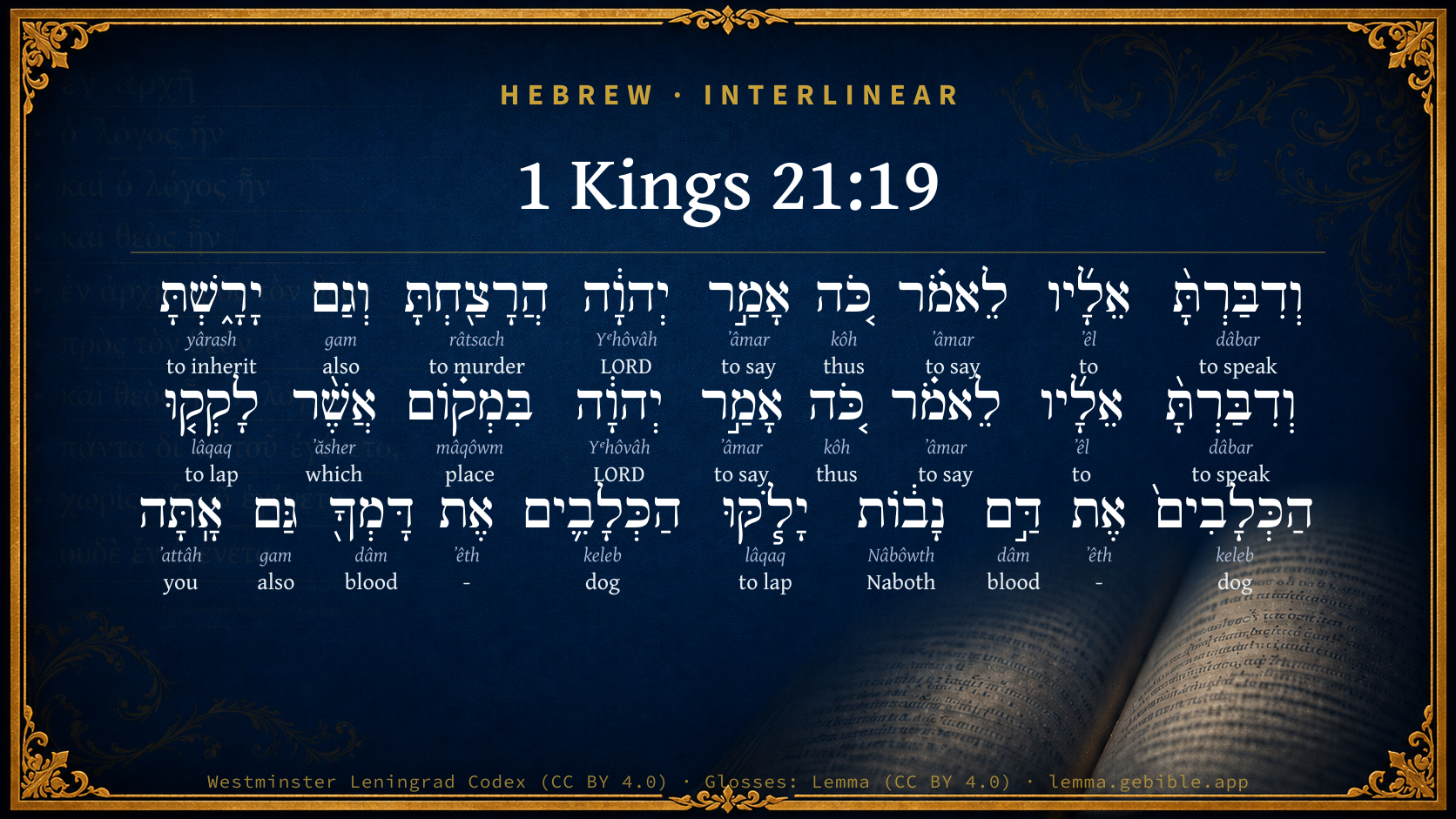
1 Kings 21:19

Hebrew (Westminster Leningrad Codex) 1 Kings 21:19 appears in the Hebrew Old Testament. The text above is from the Westminster Leningrad Codex. Each word links to its Strong’s number, a concise gloss, and parsing drawn from the Open Scriptures Hebrew Bible morphology. Click any word for its full Brown-Driver-Briggs (BDB) entry.
Download image
Cite this verse

1 Kings 21:19 (World English Bible). Public Domain. Lemma interlinear Bible study tool, https://lemma.gebible.app/v/1-kings/21/19.

Show BibTeX & RIS
BibTeX
RIS
English Translation
You shall speak to him, saying, Thus says Yahweh, Have you killed and also taken possession? You shall speak to him, saying, Thus says Yahweh, In the place where dogs licked the blood of Naboth shall dogs lick your blood, even yours.
World English Bible · Public Domain
Download a study sheet

One document with this verse’s original text, its word-by-word gloss line, the meaning frame, cross-references with their text, attributed commentary, and full source and license credits — printable, and it pastes into notes with its structure intact.

This verse Autodidact and up

Study sheet (.html) Plain text (.txt)

A passage Seminary Student

Up to 50 verses in one chapter. A passage sheet keeps up to 6 commentary sources and 12 cross-references per verse, in the order this page ranks them, and says so on the sheet whenever that leaves anything out. Ask for a single verse and you get the Autodidact verse sheet above.

Everything on this page stays free to read, with no account — the sheet is a download of what is already on screen, not access to it.

Want to remove ads? Support Godless Engineer
Compare translations 3

The same verse in 3 English versions, stacked beneath the original-language interlinear above. Click any original word for its lexicon entry.

Each is an independent rendering of the whole verse — the interlinear is not word-aligned to these translations.

Highlighted words mark where these versions differ — a whole-verse word diff, not a word-by-word alignment.

  • World English Bible Public Domain
    You shall speak to him, saying, Thus says Yahweh, Have you killed and also taken possession? You shall speak to him, saying, Thus says Yahweh, In the place where dogs licked the blood of Naboth shall dogs lick your blood, even yours.
  • King James Version Public Domain
    And thou shalt speak unto him, saying, Thus saith the LORD, Hast thou killed, and also taken possession? And thou shalt speak unto him, saying, Thus saith the LORD, In the place where dogs licked the blood of Naboth shall dogs lick thy blood, even thine.
  • unfoldingWord Literal Text CC BY-SA 4.0
    And you shall speak to him, saying, ‘Thus says Yahweh, “Have you murdered and also taken possession?”’ And you shall speak to him, saying, ‘Thus says Yahweh, “In the place where the dogs licked the blood of Naboth, the dogs will lick your blood, even you.”’”

unfoldingWord Literal Text — © unfoldingWord, licensed CC BY-SA 4.0. Word-aligned USFM3 via Door43 (git.door43.org/unfoldingWord/en_ult).

Versions to compare (up to 4)

3 of 4 selected

Show all 18 translations

Every available English version of this verse, each an independent rendering of the whole verse.

  • World English Bible Public Domain
    You shall speak to him, saying, Thus says Yahweh, Have you killed and also taken possession? You shall speak to him, saying, Thus says Yahweh, In the place where dogs licked the blood of Naboth shall dogs lick your blood, even yours.
  • Berean Standard Bible Public Domain
    Tell him that this is what the LORD says: ‘Have you not murdered a man and seized his land?’ Then tell him that this is also what the LORD says: ‘In the place where the dogs licked up the blood of Naboth, there also the dogs will lick up your blood—yes, yours!’”
  • Majority Standard Bible Public Domain
    Tell him that this is what the LORD says: ‘Have you not murdered a man and seized his land?’ Then tell him that this is also what the LORD says: ‘In the place where the dogs licked up the blood of Naboth, there also the dogs will lick up your blood—yes, yours!’”
  • King James Version Public Domain
    And thou shalt speak unto him, saying, Thus saith the LORD, Hast thou killed, and also taken possession? And thou shalt speak unto him, saying, Thus saith the LORD, In the place where dogs licked the blood of Naboth shall dogs lick thy blood, even thine.
  • American Standard Version (1901) Public Domain
    And thou shalt speak unto him, saying, Thus saith Jehovah, Hast thou killed and also taken possession? And thou shalt speak unto him, saying, Thus saith Jehovah, In the place where dogs licked the blood of Naboth shall dogs lick thy blood, even thine.
  • Revised Version (1885) Public Domain
    And thou shalt speak unto him, saying, Thus saith the LORD, Hast thou killed, and also taken possession? and thou shalt speak unto him, saying, Thus saith the LORD, In the place where dogs licked the blood of Naboth shall dogs lick thy blood, even thine.
  • Geneva Bible (1599) Public Domain
    Therefore shalt thou say vnto him, Thus sayth the Lord, Hast thou killed, and also gotten possession? And thou shalt speake vnto him, saying, Thus sayth the Lord, In the place where dogs licked the blood of Naboth, shall dogs licke euen thy blood also.
  • Douay-Rheims (1899) Public Domain
    And thou shalt speak to him, saying: Thus saith the Lord: Thou hast slain, moreover also thou hast taken possession. And after these words thou shalt add: Thus saith the Lord: In this place, wherein the dogs have licked the blood of Naboth, they shall lick thy blood also.
  • Young's Literal Translation Public Domain
    and thou hast spoken unto him, saying, Thus said Jehovah, Hast thou murdered, and also possessed? and thou hast spoken unto him, saying, Thus said Jehovah, In the place where the dogs licked the blood of Naboth, do the dogs lick thy blood, even thine.'
  • Literal Standard Version CC BY-SA 4.0
    and you have spoken to him, saying, Thus said YHWH: Have you murdered, and also possessed? And you have spoken to him, saying, Thus said YHWH: In the place where the dogs licked the blood of Naboth, the dogs lick your blood, even yours.”
  • Unlocked Literal Bible CC BY-SA 4.0
    You must speak to him and say that Yahweh says, 'Have you killed and also taken possession?' Then you will tell him that Yahweh says, 'In the place where dogs licked the blood of Naboth, the dogs will lick your blood, yes, your blood.'”
  • unfoldingWord Literal Text CC BY-SA 4.0
    And you shall speak to him, saying, ‘Thus says Yahweh, “Have you murdered and also taken possession?”’ And you shall speak to him, saying, ‘Thus says Yahweh, “In the place where the dogs licked the blood of Naboth, the dogs will lick your blood, even you.”’”
  • Darby Bible Public Domain
    And thou shalt speak unto him saying, Thus saith Jehovah: Hast thou killed, and also taken possession? And thou shalt speak unto him saying, Thus saith Jehovah: In the place where the dogs licked the blood of Naboth shall the dogs lick thy blood, even thine.
  • World Messianic Bible Public Domain
    You shall speak to him, saying, ‘The LORD says, “Have you killed and also taken possession?”’ You shall speak to him, saying, ‘The LORD says, “In the place where dogs licked the blood of Naboth, dogs will lick your blood, even yours.”’”
  • Webster's Bible Public Domain
    And thou shalt speak to him, saying, Thus saith the LORD, Hast thou killed, and also taken possession? And thou shalt speak to him, saying, Thus saith the LORD, In the place where dogs licked the blood of Naboth shall dogs lick thy blood, even thine.
  • Free Bible Version CC BY-SA 4.0
    Tell him: This is what the Lord says: Have you murdered a man and robbed him? Then tell him: This is what the Lord says: In the very spot where dogs licked up Naboth's blood, dogs will lick up your own blood.”
  • Bible in Basic English Public Domain
    Say to him, The Lord says, Have you put a man to death and taken his heritage? Then say to him, The Lord says, In the place where dogs have been drinking the blood of Naboth, there will your blood become the drink of dogs.
  • JPS Tanakh (1917) Public Domain
    And thou shalt speak unto him, saying: Thus saith the LORD: Hast thou killed, and also taken possessions? and thou shalt speak unto him, saying: Thus saith the LORD: In the place where dogs licked the blood of Naboth shall dogs lick thy blood, even thine.'

Literal Standard Version (2020), Covenant Press — licensed CC BY-SA 4.0. Text via the HelloAO Bible API (eBible.org). Unlocked Literal Bible (unfoldingWord) — licensed CC BY-SA 4.0. Text via the HelloAO Bible API (eBible.org). unfoldingWord Literal Text — © unfoldingWord, licensed CC BY-SA 4.0. Word-aligned USFM3 via Door43 (git.door43.org/unfoldingWord/en_ult). Free Bible Version, Dr. Jonathan Gallagher — licensed CC BY-SA 4.0. Text via the HelloAO Bible API (eBible.org).

Word by word

More ways to search: Search by grammar → Find every occurrence → Compare this word →

Practice this passage: Drill this verse → Learn its vocabulary →

לָקְק֤וּ
lâqaq
H3952
“to lap”
Verb, Qal, Perfect, 3rd Person, Common, Plural
Part of Speech
Verb
Stem
Qal
Form
Perfect
Person
3rd Person
Gender
Common
Number
Plural
Full BDB Definition

Origin: a primitive root

TWOT: 1126

to lap, lick, lap up - (Qal) to lap, lap up - (Piel) to lap up
  1. וְדִבַּרְתָּ֨ dâbar H1696 “and · to speak” Conjunction + Verb, Piel, Sequential Perfect, 2nd Person, Masculine, Singular
  2. אֵלָ֜יו ʼêl H413 “to · him” Preposition + Suffix, Personal, 3rd Person, Masculine, Singular
  3. לֵאמֹ֗ר ʼâmar H559 “to say” Preposition + Verb, Qal, Infinitive Construct
  4. כֹּ֚ה kôh H3541 “thus” Adverb
  5. אָמַ֣ר ʼâmar H559 “to say” Verb, Qal, Perfect, 3rd Person, Masculine, Singular
  6. יְהוָ֔ה Yᵉhôvâh H3068 “LORD” Noun, Proper
  7. הֲרָצַ֖חְתָּ râtsach H7523 “to murder” Particle, Interrogative + Verb, Qal, Perfect, 2nd Person, Masculine, Singular
  8. וְגַם gam H1571 “and · also” Conjunction + Particle, Accusative
  9. יָרָ֑שְׁתָּ yârash H3423 “to inherit” Verb, Qal, Perfect, 2nd Person, Masculine, Singular
  10. וְדִבַּרְתָּ֨ dâbar H1696 “and · to speak” Conjunction + Verb, Piel, Sequential Perfect, 2nd Person, Masculine, Singular
  11. אֵלָ֜יו ʼêl H413 “to · him” Preposition + Suffix, Personal, 3rd Person, Masculine, Singular
  12. לֵאמֹ֗ר ʼâmar H559 “to say” Preposition + Verb, Qal, Infinitive Construct
  13. כֹּ֚ה kôh H3541 “thus” Adverb
  14. אָמַ֣ר ʼâmar H559 “to say” Verb, Qal, Perfect, 3rd Person, Masculine, Singular
  15. יְהוָ֔ה Yᵉhôvâh H3068 “LORD” Noun, Proper
  16. בִּמְק֗וֹם mâqôwm H4725 “in/at · place of” Preposition + Noun, Common, Masculine, Singular, Construct
  17. אֲשֶׁ֨ר ʼăsher H834 “which” Particle, Relative
  18. הַכְּלָבִים֙ keleb H3611 “the · dogs” Particle, Definite Article + Noun, Common, Masculine, Plural, Absolute
  19. אֶת ʼêth H853 “-” Particle, Direct Object
  20. דַּ֣ם dâm H1818 “blood of” Noun, Common, Masculine, Singular, Construct
  21. נָב֔וֹת Nâbôwth H5022 “Naboth” Noun, Proper
  22. יָלֹ֧קּוּ lâqaq H3952 “to lap” Verb, Qal, Imperfect, 3rd Person, Masculine, Plural
  23. הַכְּלָבִ֛ים keleb H3611 “the · dogs” Particle, Definite Article + Noun, Common, Masculine, Plural, Absolute
  24. אֶת ʼêth H853 “-” Particle, Direct Object
  25. דָּמְךָ֖ dâm H1818 “blood · your” Noun, Common, Masculine, Singular, Construct + Suffix, Personal, 2nd Person, Masculine, Singular
  26. גַּם gam H1571 “also” Particle, Accusative
  27. אָֽתָּה ʼattâh H859 “you” Pronoun, Personal, 2nd Person, Masculine, Singular

About this verse

These counts appear in no published source. They are computed here, from the morphology-tagged text and Lemma’s own curated glosses. What Lemma adds →

28
words
16
distinct lemmas
Historical
section

Notable vocabulary

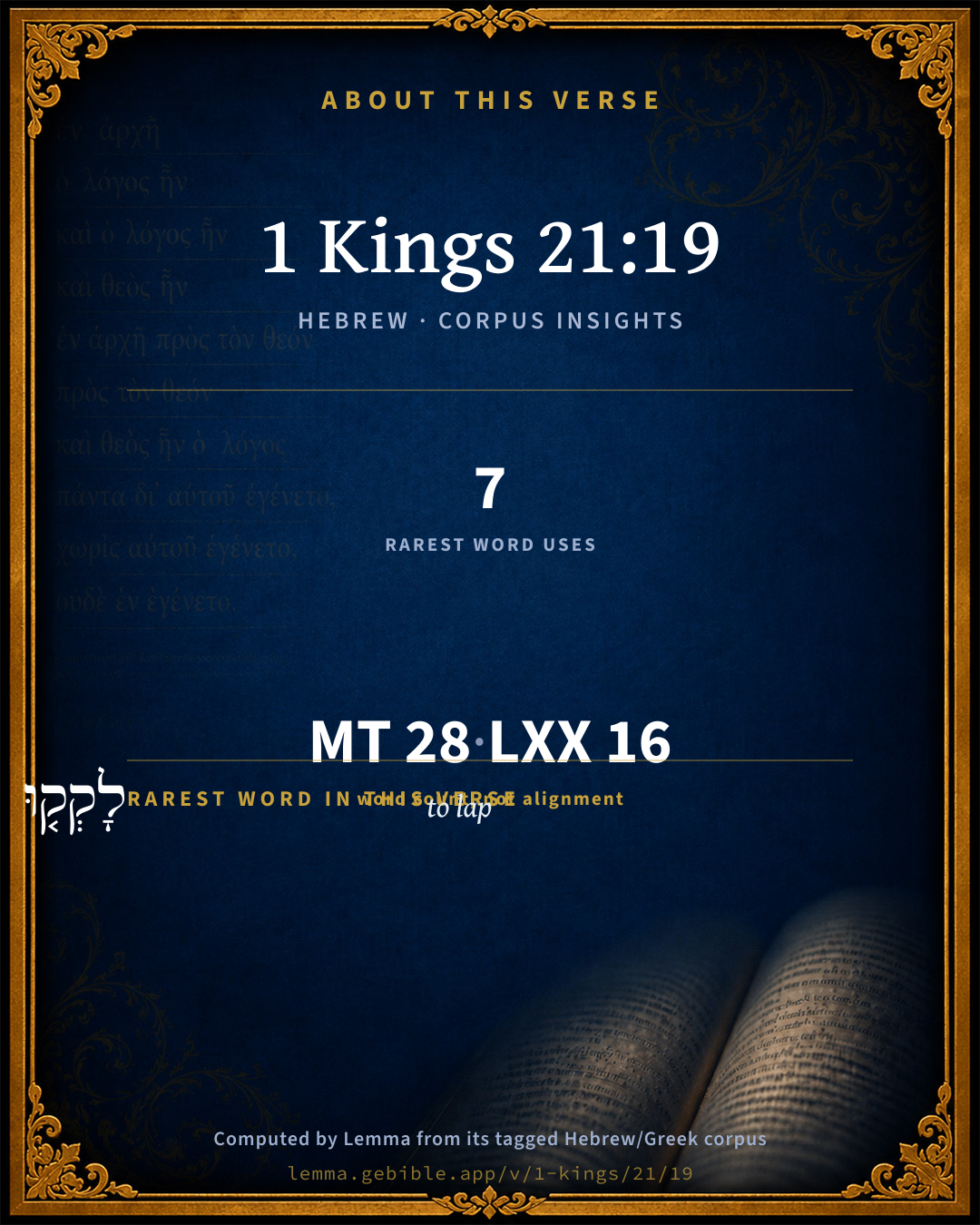
The rarest word here is לָקְק֤וּ to lap H3952 — appearing just 7 times in the whole Hebrew Bible.

Shared distinctive vocabulary

לָקְק֤וּ to lap H3952 occurs in 5 verses of the Hebrew Bible. Also found in:

Grammatical profile

  • 10 verbs
  • 8 nouns
  • 1 pronoun
  • 2 prepositions
  • 2 adverbs
  • 5 particles

Verb forms

  • וְדִבַּרְתָּ֨ Piel · Sequential Perfect
  • לֵאמֹ֗ר Qal · Infinitive Construct
  • אָמַ֣ר Qal · Perfect
  • הֲרָצַ֖חְתָּ Qal · Perfect
  • יָרָ֑שְׁתָּ Qal · Perfect
  • וְדִבַּרְתָּ֨ Piel · Sequential Perfect
  • לֵאמֹ֗ר Qal · Infinitive Construct
  • אָמַ֣ר Qal · Perfect
  • לָקְק֤וּ Qal · Perfect
  • יָלֹ֧קּוּ Qal · Imperfect

Repetition

Words recur within this verse — often emphatic in Hebrew:

  • לֵאמֹ֗ר to say H559 ×4
  • וְדִבַּרְתָּ֨ to speak H1696 ×2
  • כֹּ֚ה thus H3541 ×2
  • יְהוָ֔ה LORD H3068 ×2
  • וְגַם also H1571 ×2
  • לָקְק֤וּ to lap H3952 ×2
  • הַכְּלָבִים֙ dog H3611 ×2
  • דַּ֣ם blood H1818 ×2
  • אֵלָ֜יו to H413 ×2

Hebrew & Septuagint length

In English translation the verse runs 42 words from the Hebrew and 23 from the Septuagint (LXX English) — the Septuagint runs noticeably shorter here. See the side-by-side →

A rough comparison of the two English renderings, which tokenize alike — not a word-level alignment.

Word counts can differ between the Hebrew and the Greek without any difference in meaning — e.g. the Hebrew direct-object marker אֵת has no separate Greek word, and Greek often adds the article ὁ.

In the original languages it is 28 Hebrew tokens and 16 Greek tokens — but the two are counted differently (Hebrew bundles its prefixes and suffixes into one token; the Greek is in lemma form), so that isn’t a like-for-like length.

Cross-references

15

Topical passages linked to 1 Kings 21:19 in the Treasury of Scripture Knowledge — connected by theme and wording, ordered by reader-vote popularity; previews shown in the World English Bible.

  • 1 Kings 22:38 They washed the chariot by the pool of Samaria; and the dogs licked up his blood (now the prostitutes washed themselves [there]); according to the word of Yahweh which he spoke.
  • 2 Samuel 12:9 Why have you despised the word of Yahweh, to do that which is evil in his sight? You have struck Uriah the Hittite with the sword, and have taken his wife to be your wife, and have slain him with the sword of the children of Ammon.
  • Genesis 3:11 God said, "Who told you that you were naked? Have you eaten from the tree that I commanded you not to eat from?"
  • Genesis 4:9–10 Yahweh said to Cain, "Where is Abel, your brother?" He said, "I don't know. Am I my brother's keeper?"
  • Judges 1:7 Adoni-bezek said, "Seventy kings, having their thumbs and their great toes cut off, gathered [their food] under my table: as I have done, so God has requited me." They brought him to Jerusalem, and he died there.
  • 2 Samuel 12:11 This is what Yahweh says: 'Behold, I will raise up evil against you out of your own house; and I will take your wives before your eyes, and give them to your neighbor, and he will lie with your wives in the sight of this sun.
  • 2 Kings 9:25–26 Then said [Jehu] to Bidkar his captain, Take up, and cast him in the portion of the field of Naboth the Jezreelite; for remember how that, when I and you rode together after Ahab his father, Yahweh laid this burden on him:
  • Esther 7:10 So they hanged Haman on the gallows that he had prepared for Mordecai. Then was the king's wrath pacified.
  • Psalms 7:15–16 He has dug a hole, And has fallen into the pit which he made.
  • Psalms 9:16 Yahweh has made himself known. He has executed judgment. The wicked is snared by the work of his own hands. Meditation. Selah.
  • Psalms 58:10–11 The righteous shall rejoice when he sees the vengeance. He shall wash his feet in the blood of the wicked;
  • Micah 3:1–4 I said, "Please listen, you heads of Jacob, And rulers of the house of Israel: Isn't it for you to know justice?
  • Habakkuk 2:9 Woe to him who gets an evil gain for his house, that he may set his nest on high, that he may be delivered from the hand of evil!
  • Habakkuk 2:12 Woe to him who builds a town with blood, and establishes a city by iniquity!
  • Matthew 7:2 For with whatever judgment you judge, you will be judged; and with whatever measure you measure, it will be measured to you.

Cross-references courtesy of OpenBible.info (CC BY 4.0).

Hebrew and Greek witnesses Masoretic Hebrew ↔ Greek Septuagint

The same verse in the two great witnesses to the Old Testament, shown verse-for-verse.

Here the Septuagint runs noticeably shorter than the Hebrew — LXX2012 (modern English Septuagint) 23 words vs World English Bible 42. A rough length comparison of the two English translations, not a word-level alignment — read both below.

These are two independent witnesses, not word-aligned to each other, and the Septuagint is shown in lemma (dictionary) form.

Hebrew 1 Kings 21:19 Masoretic · Westminster Leningrad Codex

וְדִבַּרְתָּ֨ אֵלָ֜יו לֵאמֹ֗ר כֹּ֚ה אָמַ֣ר יְהוָ֔ה הֲרָצַ֖חְתָּ וְגַם יָרָ֑שְׁתָּ וְדִבַּרְתָּ֨ אֵלָ֜יו לֵאמֹ֗ר כֹּ֚ה אָמַ֣ר יְהוָ֔ה בִּמְק֗וֹם אֲשֶׁ֨ר לָקְק֤וּ הַכְּלָבִים֙ אֶת דַּ֣ם נָב֔וֹת יָלֹ֧קּוּ הַכְּלָבִ֛ים אֶת דָּמְךָ֖ גַּם אָֽתָּה

You shall speak to him, saying, Thus says Yahweh, Have you killed and also taken possession? You shall speak to him, saying, Thus says Yahweh, In the place where dogs licked the blood of Naboth shall dogs lick your blood, even yours.

World English Bible · Public Domain

Greek LXX 1 Kings 21:19 Septuagint · lemma form

καί μή ἐκἔρχομαι ἐκ ὁ πόλις ὁ παιδάριον ἄρχων ὁ χώρα καί ὁ δύναμις ὀπίσω αὐτός

and let not the young men the heads of the districts go forth of the city. And the force that was behind them

LXX2012 (modern English Septuagint) · Public Domain

On this verse, The Cambridge Bible for Schools and Colleges discusses the Septuagint’s reading. Read the note in Commentary ↓

Hebrew: Westminster Leningrad Codex (CC BY 4.0). Greek: Septuagint (public domain); English from LXX2012 (modern English Septuagint) (Public Domain). How the Septuagint differs from the Hebrew →

Targum (Aramaic paraphrase)

1

The Targum is the ancient Jewish Aramaic paraphrase of the Hebrew Scriptures — an interpretive translation, not the Hebrew text itself. Onkelos (literal) and Pseudo-Jonathan (expansive) render the Torah, and Jonathan the Prophets. Coverage is partial: where no permissively-licensed English translation exists for a verse, only the Aramaic is shown. This is verse-level text, not a word-by-word alignment to the Hebrew.

  1. Targum Jonathan Prophets (Joshua–Malachi)
    וּתְמַלֵיל עִמֵיהּ לְמֵימַר כִּדְנַן אֲמַר יְיָ הַקְטַלְתָּא וְאַף אַחְסֵנְתָּא וּתְמַלֵיל עִמֵיהּ לְמֵימַר כִּדְנַן אֲמַר יְיָ בְּאַתְרָא דִלְחִיכוּ כַּלְבַיָא יַת דְמָא דְנָבוֹת יְלַחֲכוּן כַּלְבַיָא יַת דְמָךְ אַף דִילָךְ:

    (no public-domain English translation for this verse)

    Targum Jonathan — Aramaic: “Mikraot Gedolot” (public domain). English: “Sefaria Community Translation” (CC0 1.0 (public-domain dedication)); “London "Chaldee Paraphrase," 1871” (public domain). Text via Sefaria.

Commentary

Notes on 1 Kings 21:19 from classic Christian and Jewish commentators (each source and its license shown beneath its notes). The classic Christian expositions comment on the surrounding passage and are grouped to its opening verse, so a note may address several verses; the Jewish commentaries on the Tanakh (Rashi and others) are per-verse, so they appear only where the commentator wrote on this verse.

Lemma curates 59 commentaries, every one of them public domain or Creative Commons licensed, each selected and text-cleaned for this edition rather than reprinted as found. About our sources →

Trapp's Complete Commentary

John Trapp

1Ki 21:19 And thou shalt speak unto him, saying, Thus saith the LORD, Hast thou killed, and also taken possession? And thou shalt speak unto him, saying, Thus saith the LORD, In the place where dogs licked the blood of Naboth shall dogs lick thy blood, even thine.

Ver. 19. Hast thou killed, and also taken possession?] So Chrysostom thundered against Eudoxia the Empress for seeking after the vineyard of Callitrope, a widow; for the which she banished him, and punished him with hunger and thirst, and various other vexations, to the loss of his life: so that he may well be reckoned among the martyrs.

And thou shalt speak unto him.] Not secretly, and in his ear, but openly, and in the hearing of his servants and courtiers; which also he did. {2Ki 9:25-26}

In the place where dogs licked, &c.] So Aristobulus, king of Jewry, vomited abundance of blood - and therewith soon after breathed his last - in the very place where he had slain his brother Antigonus, and acknowledged it to be the just hand of God upon himself. {a} So Selymus, the great Turk, struck with a most loathsome and incurable disease, ended his days at Chiurlus with an untimely and tormenting death, where he had joined battle with his own father Bajazet, A.D. 1511; God, as is to be thought, saith the historian, in the same place with revenging hand taking just punishment for his former disloyalty toward his aged father. {b} So the Lady Rochford - who, as it is said, had forged a letter against her own husband and Queen Anne Boleyn, his sister, accusing them of incest, for the which they were both beheaded - was afterwards herself also beheaded in the same place with Queen Katharine Howard, for her deserts, {c} So Babington’s confederates were executed in Lincoln’s-Inn-fields, even in the fields where they had often conferred for the execution of their treasons against Queen Elizabeth. {d} So Henry III, king of France, was stabbed to death by a Jacobin friar in that very chamber where he and his bloody brother, Charles IX, had, some few years before, plotted the Parisian massacre. Thus the Jews who had sold Christ for thirty pence - "a goodly price!" {Zec 11:13} - were, at the sack of Jerusalem, sold for thirty a penny, ad illudendum, saith Hegesippus; {e} and in the place where they had cried out, "Crucify him, crucify him," they were miserably cut in pieces by the Roman soldiers. And thus, as one observeth, the Lord Hastings was beheaded at London that very selfsame day twelve months later, yea, the same hour, yea, the same minute, wherein he had conspired the death of the queen’s children, at Pomefret Castle. {f}

Shall dogs lick thy blood, even thine,] sc., As it runneth in the veins of thy son Joram. {2Ki 9:25}

“ Proiece tela manu sanguis meus … hoc est, O fill mi Iule. ” - Virg. Aeneid, lib. vi.

Or else we must hold that the pool of Samaria reached as far as Jezreel; so that Ahab’s blood, running out of his chariot, was carried down to Jezreel, and there licked by dogs. {g}

{a} Joseph., Antiq., lib. xiii. cap. 19.

{b} Turk. Hist.

{c} Act. and Mon., fol. 1104.

{d} Speed, 1181.

{e} De Excid. Hieros., p. 680.

{f} Sclat., on Judges v. 31.

{g} Piscat. in loco.

John Trapp, A Commentary or Exposition upon All the Books of the Old and New Testament (1647–1656) — public domain. Text from a community e-Sword module.

Geneva Bible (1599)

Geneva Bible translators

This was fulfilled in Jehoram his son, as 2 Kings 9:25, 26.

Dost thou think to have any advantage by murdering of an innocent?

Geneva Bible (1599) marginal notes — public domain. Text via Bolls.life.

Jamieson, Fausset & Brown

Robert Jamieson, A. R. Fausset & David Brown

In the place where dogs licked, &c.--a righteous retribution of Providence. The prediction was accomplished, not in Jezreel, but in Samaria; and not on Ahab personally, in consequence of his repentance (Kg1 21:29), but on his son (Kg2 9:25). The words "in the place where" might be rendered "in like manner as."

Jamieson, Fausset & Brown — Commentary Critical and Explanatory on the Whole Bible (1871) — public domain (CC PDM 1.0). Text via the HelloAO Bible API.

Adam Clarke's Commentary

Verse 19. In the place where dogs licked, c.] It is in vain to look for a literal fulfillment of this prediction. Thus it would have been fulfilled, but the humiliation of Ahab induced the merciful God to say, I will not bring the evil in his days, but in the days of his son, 1Kg 21:29. Now dogs did lick the blood of Ahab but it was at the pool of Samaria, where his chariot and his armour were washed, after he had received his death wound at Ramoth-gilead; but some think this was the place where Naboth was stoned: see 1Kg 22:38. And how literally the prediction concerning his son was fulfilled, see 2Kg 9:25, where we find that the body of Jehoram his son, just then slain by an arrow that had passed through his heart, was thrown into the portion of the field of Naboth the Jezreelite; and there, doubtless, the dogs licked his blood, if they did not even devour his body. There is a similar idea of the propriety of punishment overtaking the culprit in the place where he had committed the crime, expressed by Orestes to AEgisthus, SOPH. Elect. 1495.

______ Χωρει δ ' ενθαπερ κατεκτανες

Πατερα τον αμον, ὡς εν ταυτῳ θανῃς.

______ Go where thou slew'st my father,

That in the self-same place thou too may'st die.

Adam Clarke's Commentary on the Bible (1810–1826) — public domain. Text from a community e-Sword/MySword module.

Ellicott's Commentary for English Readers

(19) Hast thou killed, and also taken possession?—The stern, indignant brevity of the accusation, at once shaming the subterfuge by which Ahab shifts his guilt to Jezebel, and unmasking the real object of the whole crime, leaves the king speechless as to defence, unable to stay the sentence which at once follows. The marked particularity and emphasis of that sentence, “In the place where the dogs licked the blood of Naboth shall dogs lick thy blood, even thine,” preclude all explanations, which would seek its fulfilment in the fate of Jehoram (2Ki_9:25); nor can such explanations be justified by reference to 1Ki_21:29, for it is not this part of the sentence which is deferred by Ahab’s repentance. (See Note on 1Ki_22:38.)

A Bible Commentary for English Readers, edited by Charles John Ellicott (1878–1897) — public domain. Text from a community e-Sword module.

The Cambridge Bible for Schools and Colleges

gen. ed. J. J. S. Perowne

19. Hast thou killed, and also taken possession?] The guilt of all that had been done is at once laid at Ahab’s door. He had neither known nor cared to know (as it seems) what Jezebel’s plans were and only thought of the end which they accomplished. He was willing by taking possession to reap the advantage, as he thought it; God lays on him the first penalty.

and thou shalt speak unto him, saying] The LXX. omits these words. See above on 1Ki_21:15.

In the place where dogs licked the blood of Naboth] From the history of Ahab’s death, in 1Ki_22:38, it appears that his blood was thus licked by the dogs, not at Jezreel, but near Samaria. The best explanation of this is that the word ‘place’ does not here mean ‘precise locality’. Naboth’s blood was shed outside the gate of Jezreel, and the pool of Samaria, from the description in the next chapter, and from what we know of the conduits and reservoirs of Eastern cities, was apparently outside the gate of that city. Thus there was a similarity between the two cases. We must also bear in mind that the sentence on Ahab was modified and its exact fulfilment deferred. When Jehoram was killed (2Ki_9:25) a much more definite phrase is used for the place where his body was cast out. There it is, ‘in the portion of the field of Naboth the Jezreelite’.

Instead of ‘dogs’ simply, the LXX. (Vat.) has ‘the swine and the dogs’ and (Alex.) ‘the dogs and the swine’. It is not easy to decide how the swine came to be mentioned in the Greek Versions, but as neither text makes any mention of them in the second part of this clause, the words must be taken as the insertion of some one who desired to give a touch of greater horror to the picture.

The Vat. LXX. adds to the close of this verse ‘and the harlots shall wash in thy blood’, and in 1Ki_22:38 both Alex. and Vat. have the statement that this was done. Moreover the true rendering in that place, of the words which in A.V. read, ‘and they washed his armour’, is ‘Now the harlots washed themselves there’. See notes on 1Ki_22:38.

The Cambridge Bible for Schools and Colleges (gen. ed. J. J. S. Perowne; Cambridge University Press, 1878–1918) — public domain. Text from a community e-Sword module.

John Gill's Exposition

And of Jezebel also spake the Lord,.... To Elijah, and by him:

saying, the dogs shall eat Jezebel by the wall of Jezreel or in the inheritance or portion of Jezreel, as the Targum; Jarchi interprets it, the valley of Jezreel; the fulfilment of this see in Kg2 9:30.

John Gill's Exposition of the Whole Bible (1746–1763) — public domain (CC PDM 1.0). Text via the HelloAO Bible API.

Albert Barnes' Notes on the Bible

Hast thou killed, and also taken possession? - These words rebuke especially Ahab’s indecent haste. He went to Jezreel the very day after Naboth’s execution 2Ki 9:26.

The prophecy following had a double fulfillment. The main fulfillment was by the casting of the dead body of Jehoram into Naboth’s plot of ground at Jezreel, where, like Naboth’s, it was left for the dogs to eat 2Ki 9:25. This spot, which was just outside the city wall, and close to a gate 2Ki 9:31, was probably the actual scene of Naboth’s execution. Here did dogs lick Ahab’s blood, that is, his son’s blood, the execution of the full retaliatory sentence having been deferred to the days of his son, formally and explicitly, on Ahab’s repentance 1Ki 21:29. But, besides this, there was a secondary fulfillment of the prophecy, when, not at Jezreel but at Samaria (marginal reference), the actual blood of Ahab himself, was licked by dogs, only in a way that implied no disgrace. These two fulfillments are complementary to each other.

Albert Barnes' Notes on the Bible (1834–1885) — public domain. Text from a community e-Sword/MySword module.

Haydock's Catholic Bible Commentary

Possession, by desire; though he was yet only on the road. (Menochius) --- Perhaps he had sent his servants before. (Haydock) --- Place, not precisely, as Achab was slain in Samaria. (Menochius) --- But Naboth’s vineyard, perhaps, was not far distant from the pool, where dogs licked the blood of the king. (Haydock) --- On account of Achab’s repentance, the sentence was (ver. 29.; Calmet) rather changed, and his son Joram was substituted in his stead, 4 Kings ix. 25. Jehu, and his captain, Badacer, were present, when Elias denounced this sentence upon the family of Achab; and they concluded that the prediction regarded Joram. He had, perhaps, taken part with his impious parents, and promoted the same crimes. (Haydock)

George Leo Haydock (1774–1849), Haydock's Catholic Family Bible and Commentary, 1859 edition — public domain. Excludes Psalms (Douay-Rheims chapter numbering differs from Protestant) and Deuterocanonical books (Catholic canon only).

Matthew Poole's English Annotations

Hast thou killed, and also taken possession? Thou hast murdered an innocent and righteous man; and instead of repenting for it, thou hast added another piece of injustice and violence to it, and art going confidently and cheerfully to reap the fruit of thy wickedness. He ascribes Jezebel’s fact to Ahab, because Jezebel did it by his connivance, and consent, and authority, and for the satisfaction of his inordinate appetite.

Quest. How was this prophecy fulfilled, when Ahab’s blood was not licked in Jezreel, which was in the tribe of Issachar, but in the pool of Samaria, 1Ki 22:38, which was in the tribe of Ephraim?

Answ. First, This was done, though not in the same individual place, yet in the same general place, i.e. in the territory of Samaria, within which Jezreel was; and in a place of the same nature, a public and common place; for such was both the place of Naboth’s execution, and the pool of Samaria. Secondly, This was particularly accomplished in his son Joram, as is affirmed, 2Ki 9:25,26; whose blood is not improperly called Ahab’s blood, because children are said to be born of their parents’ blood. See Joh 1:13; Act 17:26.

Object. These words,

thy blood, even thine, show that it is meant of Ahab’s person.

Answ. True, the threatening was so directed and designed at first; but afterwards, upon his humiliation, the punishment was transferred from him to his son, as is expressed, 1Ki 21:29.

Object. This is said to be fulfilled in Ahab’s person, 1Ki 22:38.

Answ. Either that may be referred to some other prediction or commination not elsewhere mentioned; or rather, it intimates that it was in part and in some sort fulfilled in him, though not so severely and opprobriously, nor with such characters of the curse, as it was in his son; whence he there mentions only the thing, without any regard unto the place here designed. But it may further be observed, that although upon Ahab’s humiliation the curse here threatened might seem to be wholly translated from his person to his posterity; yet upon Ahab’s return to sin, in the next chapter, he brings back the curse upon himself, and so it is no wonder if it be in some sort fulfilled in him also. Thirdly, The Hebrew word, rendered in

the place where, may be, and is by some learned men, otherwise rendered; either thus instead of this that; that being frequently said to be done in another’s place which was only done in his stead; or, like as; or, because that. So it doth not design the place, but the cause and reason of this judgment. And in this sense the same word is used Zec 2:1.

Matthew Poole's English Annotations on the Holy Bible (1683–1685) — public domain. Text from a community e-Sword/MySword module.

Whedon's Commentary on the Bible

Daniel D. Whedon

19. Hast thou killed — This interrogative form of expression is here equivalent to an emphatic affirmation.

In the place where dogs licked the blood of Naboth — Because of Ahab’s repentance and humiliation, (1Ki_21:29,) this prophecy was not literally fulfilled in him, though at the pool of Samaria dogs did lick up his blood that fell on his chariot; (1Ki_22:38;) but it was afterwards fulfilled in his son, on whom Jehovah laid the burden. See 2Ki_9:25.

Daniel D. Whedon (gen. ed.), Commentary on the Old and New Testaments (1874–1909) — public domain. Text from a community e-Sword module.

The Pulpit Commentary

And thou shalt speak unto him; saying, Thus saith the Lord, Hast thou killed Tjxrh a rare and expressive word. We might render, slaughtered, and also this word suggests that Jezebel"s programme, which he had accepted, was fast being accomplished. But in the very hour of its completion it should be interrupted taken possession? And thou shalt speak unto him, saying, Thus saith the Lord For the repetition, (see on 1Ki_20:13, 1Ki_20:14) In the place where dogs LXX aiJ u=ev kainev licked the blood of Naboth shall dogs lick thy blood according to the lex talionis, (as in 1Ki_20:42) even thine. Heb. even thou . The LXX adds, "And the harlots shall bathe in thy blood." For the construction see Gesen., Gram. 3; and cf. Gen_27:34 Pro_23:15; Psa_9:7. Thenius contends that there is a contradiction between this ver. and 1Ki_22:38 (together 2Ki_9:25) which is absolutely insuperable. But as Bahr observes, "How thoughtless our author must have been if in two consecutive chaptersi.e., on the same leaf, as it were he had inadvertently inserted direct contradictions." And the following considerations will show that the discrepancy is only apparent.

(1) The sentence here pronounced against Ahab was, on his repentance, stayed in its execution. God said distinctly, "I will not bring the evil in his days," and as distinctly added that He would "bring the evil in his son"s days, upon his house" (ver. 29). And

(2) with the prophecy, as thus modified, the facts exactly record. The body of Jehoram was "cast into the portion of the field of Naboth the Jezreelite". And if it be objected

(3) that our historian sees in the death of Ahab in Samaria (ch. 20. l.c. ) a fulfilment of this prophecy, the answer is that that death was a partial fulfilment of Elijah"s words. The repentance of Ahab, having secured him immunity from this sentence, his subsequent folly and sin (cf. 1Ki_22:27) nevertheless brought down upon him a judgment of God strikingly similar, as we might expect it would be, to that originally denounced against him, which was now reserved for his son. In ether words, the prophecy was fulfilled to the letter in the person of his son, but it had a secondary fulfilment in its spirit on himself.

The Pulpit Commentary (1880–1919), ed. H.D.M. Spence-Jones & Joseph S. Exell — public domain. Text from a community e-Sword module.

John Wesley's Explanatory Notes

Saying - Thou hast murdered an innocent man; and instead of repenting for it, hast added another piece of injustice and violence to it, and art going confidently and cheerfully to reap the fruit of thy wickedness. Thy blood - The threatening was so directed at first; but afterwards, upon his humiliation, the punishment was transferred from him to his son, as is expressed, ver. 29, yet upon Ahab's returning to sin, in the next chapter, he brings back the curse upon himself, and so it is no wonder if it be in some sort fulfilled in him also.

John Wesley, Explanatory Notes Upon the Whole Bible (1754–1765) — public domain. Text via the GEBible commentary corpus.

unfoldingWord translationNotes

Door43 World Missions Community

Have you killed and also taken possession?

Yahweh asks this question to scold Ahab. AT: "You have killed Naboth and stolen his vineyard!" (See: Rhetorical Question)

your blood, yes, your blood

This is repeated for emphasis.

Have you found me, my enemy?

Ahab uses this question to express anger toward Elijah. That Elijah "found" Ahab likely refers to Elijah discovering Ahab's actions, not to finding his physical location. AT: "You have found me, my enemy!" or "You have discovered what I have done, my enemy!" (See: Rhetorical Question and Assumed Knowledge and Implicit Information)

you have sold yourself to do what is evil

A person being committed to doing what is evil is spoken of as if that person had sold himself to evil. AT: "you have dedicated yourself to doing what is evil" (See: Metaphor)

what is evil in the sight of Yahweh

The phrase, "in the sight of" refers to someone's opinion. See how you translated this in 1 Kings 11:6. AT: "what Yahweh considers to be evil" (See: Metaphor)

translationWords

Yahweh

blood

adversary

evil

unfoldingWord translationNotes — © Distant Shores Media and the Door43 World Missions Community, licensed CC BY-SA 4.0. Source: git.door43.org/Door43/en_tn.

Lesson kit

Teaching starters — assembled from the data on this page, not authored interpretation. Every prompt links to the verse data it draws on. Edit before teaching.

1 Kings, in the Historical, opens this verse with 28 words (16 distinct Hebrew lemmas). Its most distinctive word is lâqaq (“to lap”). The Greek Septuagint runs shorter here. A historical commentator’s framing appears above. Read the whole chapter for the surrounding context.

Discussion questions

  1. What does “to lap” (lâqaq) contribute to the verse as a whole?
  2. Judges 7:5 shares the word «to lap» with this verse. How do the two illuminate each other?
  3. “to say” occurs 4× in this one verse. What is the effect of the repetition?
  4. Compared with the Hebrew, the Septuagint runs shorter here. What questions does that raise?
  5. These translations render this verse differently. What is at stake in choosing one wording over another?
  6. The verb «וְדִבַּרְתָּ֨» is Piel Sequential Perfect. How does its form color the action?
  7. Reading how Trapp's Complete Commentary and Geneva Bible (1599) read this verse, where do the two commentators agree and where do they part?

Things to notice

Reading settings

Reading text

Shown beneath each verse's original-language words.

Old Testament
Old Testament edition

Read the OT as the Masoretic Hebrew (MT) or the Greek Septuagint (LXX).

English shown for the Greek Septuagint (in the Hebrew ↔ Greek comparison).

Comparing translations? Open the Compare panel on any verse page to stack up to four side by side.