
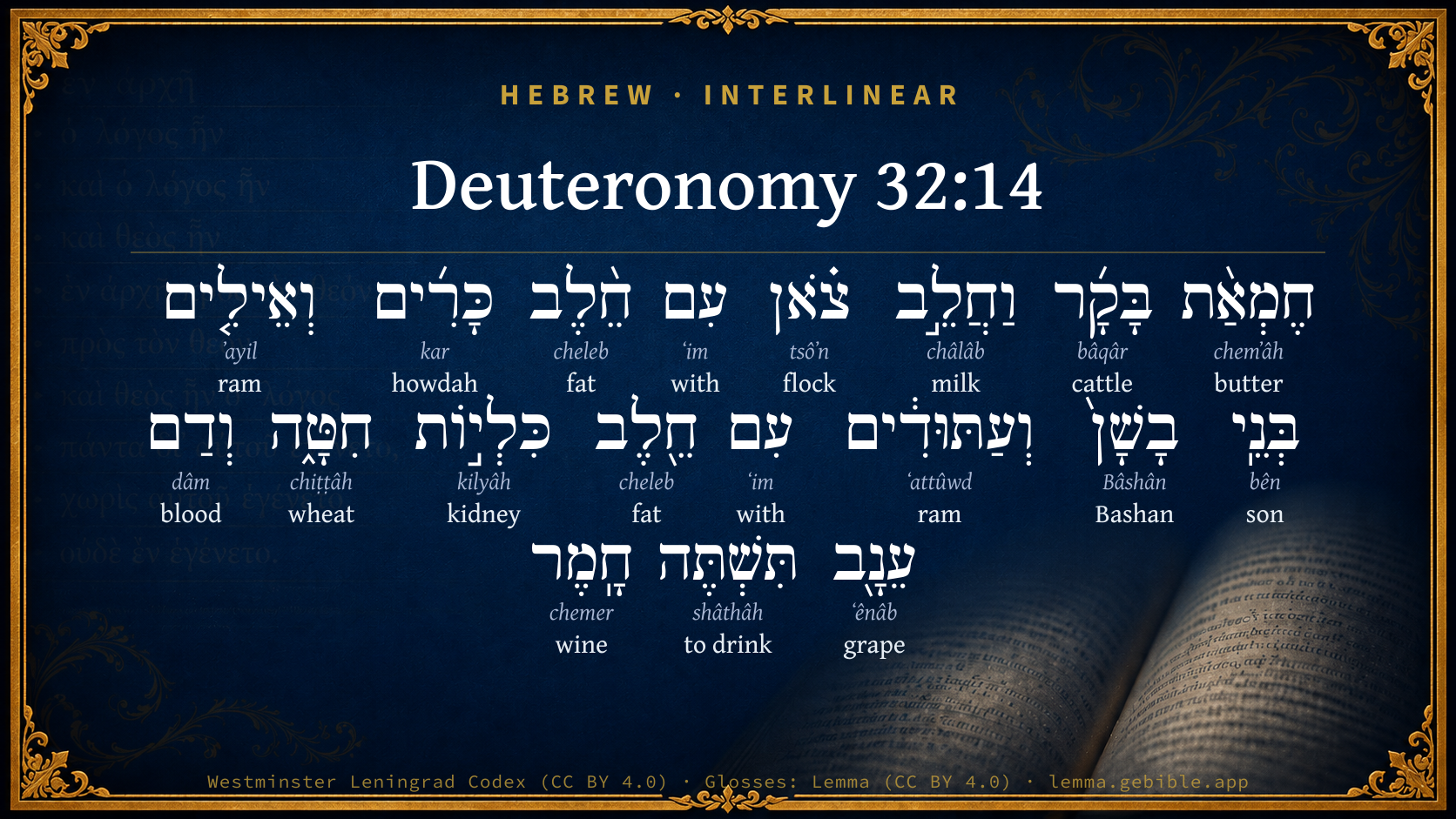
Deuteronomy 32:14

Hebrew (Westminster Leningrad Codex) Deuteronomy 32:14 appears in the Hebrew Old Testament. The text above is from the Westminster Leningrad Codex. Each word links to its Strong’s number, a concise gloss, and parsing drawn from the Open Scriptures Hebrew Bible morphology. Click any word for its full Brown-Driver-Briggs (BDB) entry.
Download image
Cite this verse

Deuteronomy 32:14 (World English Bible). Public Domain. Lemma interlinear Bible study tool, https://lemma.gebible.app/v/deuteronomy/32/14.

Show BibTeX & RIS
BibTeX
RIS
English Translation
Butter of the herd, and milk of the flock, With fat of lambs, Rams of the breed of Bashan, and goats, With the finest of the wheat; Of the blood of the grape you drank wine.
World English Bible · Public Domain
Highlights
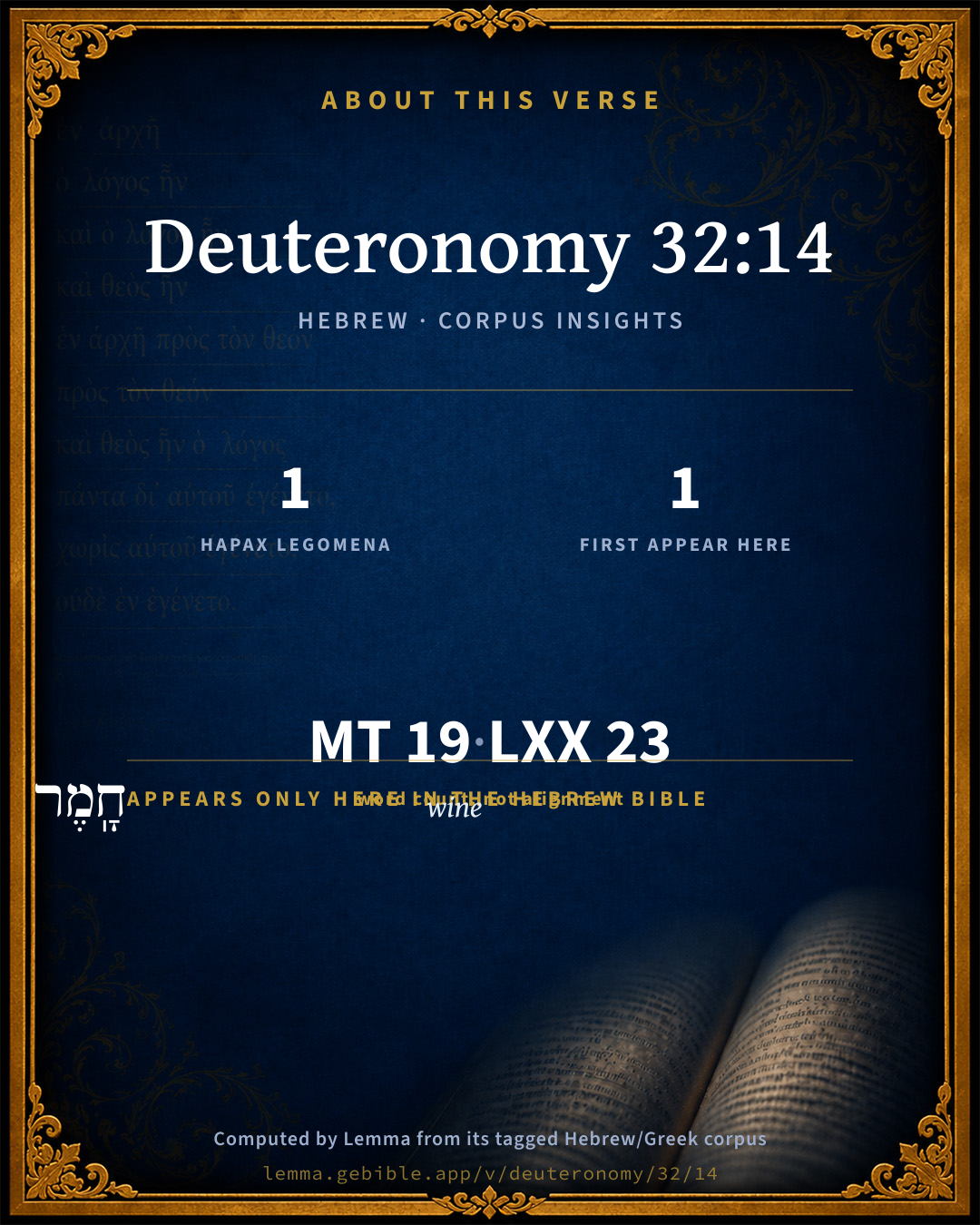
  • 1 hapax legomenon — only here in the Hebrew Bible
  • 1 first appearance in the Hebrew Bible
Full analysis ↓
Download a study sheet

One document with this verse’s original text, its word-by-word gloss line, the meaning frame, cross-references with their text, attributed commentary, and full source and license credits — printable, and it pastes into notes with its structure intact.

This verse Autodidact and up

Study sheet (.html) Plain text (.txt)

A passage Seminary Student

Up to 50 verses in one chapter. A passage sheet keeps up to 6 commentary sources and 12 cross-references per verse, in the order this page ranks them, and says so on the sheet whenever that leaves anything out. Ask for a single verse and you get the Autodidact verse sheet above.

Everything on this page stays free to read, with no account — the sheet is a download of what is already on screen, not access to it.

Want to remove ads? Support Godless Engineer
Compare translations 3

The same verse in 3 English versions, stacked beneath the original-language interlinear above. Click any original word for its lexicon entry.

Each is an independent rendering of the whole verse — the interlinear is not word-aligned to these translations.

Highlighted words mark where these versions differ — a whole-verse word diff, not a word-by-word alignment.

  • World English Bible Public Domain
    Butter of the herd, and milk of the flock, With fat of lambs, Rams of the breed of Bashan, and goats, With the finest of the wheat; Of the blood of the grape you drank wine.
  • King James Version Public Domain
    Butter of kine, and milk of sheep, with fat of lambs, and rams of the breed of Bashan, and goats, with the fat of kidneys of wheat; and thou didst drink the pure blood of the grape.
  • unfoldingWord Literal Text CC BY-SA 4.0
    curd of cattle and milk of flocks, with fat of lambs, and rams, sons of Bashan, and goats, with fat kernels of wheat, and the blood of grapes you drank wine. ts\*

unfoldingWord Literal Text — © unfoldingWord, licensed CC BY-SA 4.0. Word-aligned USFM3 via Door43 (git.door43.org/unfoldingWord/en_ult).

Versions to compare (up to 4)

3 of 4 selected

Show all 18 translations

Every available English version of this verse, each an independent rendering of the whole verse.

  • World English Bible Public Domain
    Butter of the herd, and milk of the flock, With fat of lambs, Rams of the breed of Bashan, and goats, With the finest of the wheat; Of the blood of the grape you drank wine.
  • Berean Standard Bible Public Domain
    with curds from the herd and milk from the flock, with the fat of lambs, with rams from Bashan, and goats, with the choicest grains of wheat. From the juice of the finest grapes you drank the wine.
  • Majority Standard Bible Public Domain
    with curds from the herd and milk from the flock, with the fat of lambs, with rams from Bashan, and goats, with the choicest grains of wheat. From the juice of the finest grapes you drank the wine.
  • King James Version Public Domain
    Butter of kine, and milk of sheep, with fat of lambs, and rams of the breed of Bashan, and goats, with the fat of kidneys of wheat; and thou didst drink the pure blood of the grape.
  • American Standard Version (1901) Public Domain
    Butter of the herd, and milk of the flock, With fat of lambs, And rams of the breed of Bashan, and goats, With the finest of the wheat; And of the blood of the grape thou drankest wine.
  • Revised Version (1885) Public Domain
    Butter of kine, and milk of sheep, With fat of lambs, And rams of the breed of Bashan, and goats, With the fat of kidneys of wheat; And of the blood of the grape thou drankest wine.
  • Geneva Bible (1599) Public Domain
    Butter of kine, and milke of sheepe with fat of the lambes, and rammes fed in Bashan, and goates, with the fat of the graines of wheat, and the red licour of the grape hast thou drunke.
  • Douay-Rheims (1899) Public Domain
    Butter of the herd, and milk of the sheep with the fat of lambs, and of the rams of the breed of Basan: and goats with the marrow of wheat, and might drink the purest blood of the grape.
  • Young's Literal Translation Public Domain
    Butter of the herd, and milk of the flock, With fat of lambs, and rams, sons of Bashan, And he-goats, with fat of kidneys of wheat; And of the blood of the grape thou dost drink wine!
  • Literal Standard Version CC BY-SA 4.0
    Butter of the herd, and milk of the flock, || With fat of lambs, and rams of sons of Bashan, || And male goats, with fat of kidneys of wheat; And of the blood of the grape you drink wine!
  • Unlocked Literal Bible CC BY-SA 4.0
    He ate butter from the herd and drank milk from the flock, with fat of lambs, rams of Bashan and goats, with the finest of the wheat— and you drank foaming wine made from the juice of grapes.
  • unfoldingWord Literal Text CC BY-SA 4.0
    curd of cattle and milk of flocks, with fat of lambs, and rams, sons of Bashan, and goats, with fat kernels of wheat, and the blood of grapes you drank wine. ts\*
  • Darby Bible Public Domain
    Cream of kine, and milk of sheep, With the fat of lambs, And rams of the breed of Bashan, and he-goats, With the fat of kidneys of wheat; And thou didst drink pure wine, the blood of the grape.
  • World Messianic Bible Public Domain
    butter from the herd, and milk from the flock, with fat of lambs, rams of the breed of Bashan, and goats, with the finest of the wheat. From the blood of the grape, you drank wine.
  • Webster's Bible Public Domain
    Butter of cows, and milk of sheep, with fat of lambs, and rams of the breed of Bashan, and goats, with the fat of kidneys of wheat; and thou didst drink the pure blood of the grape.
  • Free Bible Version CC BY-SA 4.0
    with yogurt from the herd and milk from the flock, with the fat of lambs, with rams from Bashan, and goats, along with the best wheat. You drank the wine made from the best grapes.
  • Bible in Basic English Public Domain
    Butter from his cows and milk from his sheep, with fat of lambs and sheep of Bashan, and goats, and the heart of the grain; and for your drink, wine from the blood of the grape.
  • JPS Tanakh (1917) Public Domain
    Curd of kine, and milk of sheep, with fat of lambs, and rams of the breed of Bashan, and he-goats, with the kidney-fat of wheat; and of the blood of the grape thou drankest foaming wine.

Literal Standard Version (2020), Covenant Press — licensed CC BY-SA 4.0. Text via the HelloAO Bible API (eBible.org). Unlocked Literal Bible (unfoldingWord) — licensed CC BY-SA 4.0. Text via the HelloAO Bible API (eBible.org). unfoldingWord Literal Text — © unfoldingWord, licensed CC BY-SA 4.0. Word-aligned USFM3 via Door43 (git.door43.org/unfoldingWord/en_ult). Free Bible Version, Dr. Jonathan Gallagher — licensed CC BY-SA 4.0. Text via the HelloAO Bible API (eBible.org).

Word by word

More ways to search: Search by grammar → Find every occurrence → Compare this word →

Practice this passage: Drill this verse → Learn its vocabulary →

חָֽמֶר
chemer
H2561
“wine”
Noun, Common, Masculine, Singular, Absolute
Part of Speech
Noun
Type
Common
Gender
Masculine
Number
Singular
State
Absolute
Full BDB Definition

Origin: from H2560

TWOT: TWOT- 683a

wine
  1. חֶמְאַ֨ת chemʼâh H2529 “butter of” Noun, Common, Feminine, Singular, Construct
  2. בָּקָ֜ר bâqâr H1241 “cattle” Noun, Common, Both, Singular, Absolute
  3. וַחֲלֵ֣ב châlâb H2461 “and · milk of” Conjunction + Noun, Common, Masculine, Singular, Construct
  4. צֹ֗אן tsôʼn H6629 “flock” Noun, Common, Both, Singular, Absolute
  5. עִם ʻim H5973 “with” Preposition
  6. חֵ֨לֶב cheleb H2459 “fat of” Noun, Common, Masculine, Singular, Construct
  7. כָּרִ֜ים kar H3733 “howdahs” Noun, Common, Masculine, Plural, Absolute
  8. וְאֵילִ֤ים ʼayil H352 “and · rams” Conjunction + Noun, Common, Masculine, Plural, Absolute
  9. בְּנֵֽי bên H1121 “sons of” Noun, Common, Masculine, Plural, Construct
  10. בָשָׁן֙ Bâshân H1316 “Bashan” Noun, Proper
  11. וְעַתּוּדִ֔ים ʻattûwd H6260 “and · rams” Conjunction + Noun, Common, Masculine, Plural, Absolute
  12. עִם ʻim H5973 “with” Preposition
  13. חֵ֖לֶב cheleb H2459 “fat of” Noun, Common, Masculine, Singular, Construct
  14. כִּלְי֣וֹת kilyâh H3629 “kidneys of” Noun, Common, Feminine, Plural, Construct
  15. חִטָּ֑ה chiṭṭâh H2406 “wheat” Noun, Common, Feminine, Singular, Absolute
  16. וְדַם dâm H1818 “and · blood of” Conjunction + Noun, Common, Masculine, Singular, Construct
  17. עֵנָ֖ב ʻênâb H6025 “grape” Noun, Common, Masculine, Singular, Absolute
  18. תִּשְׁתֶּה shâthâh H8354 “to drink” Verb, Qal, Imperfect, 2nd Person, Masculine, Singular

About this verse

These counts appear in no published source. They are computed here, from the morphology-tagged text and Lemma’s own curated glosses. What Lemma adds →

19
words
17
distinct lemmas
Pentateuch
section

Notable vocabulary

1 hapax legomenon — a word that appears only here in the entire Hebrew Bible:

  • חָֽמֶר wine H2561

First appearance in Scripture

This word makes its first canonical appearance in the Hebrew Bible here:

  • חָֽמֶר wine H2561

Shared distinctive vocabulary

חֶמְאַ֨ת butter H2529 occurs in 9 verses of the Hebrew Bible. Also found in:

Grammatical profile

  • 1 verb
  • 16 nouns
  • 2 prepositions

Verb forms

  • תִּשְׁתֶּה Qal · Imperfect

Repetition

Words recur within this verse — often emphatic in Hebrew:

  • חֵ֨לֶב fat H2459 ×2
  • עִם with H5973 ×2

Hebrew & Septuagint length

In English translation the verse runs 36 words from the Hebrew and 33 from the Septuagint (LXX English) — closely comparable.

A rough comparison of the two English renderings, which tokenize alike — not a word-level alignment.

Word counts can differ between the Hebrew and the Greek without any difference in meaning — e.g. the Hebrew direct-object marker אֵת has no separate Greek word, and Greek often adds the article ὁ.

In the original languages it is 19 Hebrew tokens and 23 Greek tokens — but the two are counted differently (Hebrew bundles its prefixes and suffixes into one token; the Greek is in lemma form), so that isn’t a like-for-like length.

Cross-references

15

Topical passages linked to Deuteronomy 32:14 in the Treasury of Scripture Knowledge — connected by theme and wording, ordered by reader-vote popularity; previews shown in the World English Bible.

  • Genesis 49:11 Binding his foal to the vine, His donkey's colt to the choice vine; He has washed his garments in wine, His robes in the blood of grapes:
  • Psalms 81:16 But he would have also fed them with the finest of the wheat. I will satisfy you with honey out of the rock."
  • Psalms 147:14 He makes peace in your borders. He fills you with the finest of the wheat.
  • Genesis 18:8 He took butter, milk, and the calf which he had dressed, and set it before them. He stood by them under the tree, and they ate.
  • Judges 5:25 He asked water, [and] she gave him milk; She brought him butter in a lordly dish.
  • 2 Samuel 17:29 and honey, and butter, and sheep, and cheese of the herd, for David, and for the people who were with him, to eat: for they said, The people are hungry, and weary, and thirsty, in the wilderness.
  • Job 20:17 He shall not look at the rivers, The flowing streams of honey and butter.
  • Psalms 22:12 Many bulls have surrounded me. Strong bulls of Bashan have encircled me.
  • Isaiah 7:15 He shall eat butter and honey when he knows to refuse the evil, and choose the good.
  • Isaiah 7:22 and it shall happen, that because of the abundance of milk which they shall give he shall eat butter: for everyone will eat butter and honey that is left in the midst of the land.
  • Ezekiel 39:18 You shall eat the flesh of the mighty, and drink the blood of the princes of the earth, of rams, of lambs, and of goats, of bulls, all of them fatlings of Bashan.
  • Amos 4:1 Listen to this word, you cows of Bashan, who are on the mountain of Samaria, who oppress the poor, who crush the needy, who tell their lords, "Bring, and let us drink."
  • Micah 7:14 Shepherd your people with your staff, The flock of your heritage, Who dwell by themselves in a forest, In the midst of fertile pasture land, let them feed; In Bashan and Gilead, as in the days of old.
  • Matthew 26:28–29 for this is my blood of the new covenant, which is poured out for many for the remission of sins.
  • John 6:55–56 For my flesh is food indeed, and my blood is drink indeed.

Cross-references courtesy of OpenBible.info (CC BY 4.0).

Hebrew and Greek witnesses Masoretic Hebrew ↔ Greek Septuagint

The same verse in the two great witnesses to the Old Testament, shown verse-for-verse.

These are two independent witnesses, not word-aligned to each other, and the Septuagint is shown in lemma (dictionary) form.

Hebrew Deuteronomy 32:14 Masoretic · Westminster Leningrad Codex

חֶמְאַ֨ת בָּקָ֜ר וַחֲלֵ֣ב צֹ֗אן עִם חֵ֨לֶב כָּרִ֜ים וְאֵילִ֤ים בְּנֵֽי בָשָׁן֙ וְעַתּוּדִ֔ים עִם חֵ֖לֶב כִּלְי֣וֹת חִטָּ֑ה וְדַם עֵנָ֖ב תִּשְׁתֶּה חָֽמֶר

Butter of the herd, and milk of the flock, With fat of lambs, Rams of the breed of Bashan, and goats, With the finest of the wheat; Of the blood of the grape you drank wine.

World English Bible · Public Domain

Greek LXX Deuteronomy 32:14 Septuagint · lemma form

βούτυρον βοῦς καί γάλα πρόβατον μετά στέαρ ἀρνός καί κριός υἱός ταῦρος καί τράγος μετά στέαρ νεφρός πυρός καί αἷμα σταφυλή πίνω οἶνος

Butter of cows, and milk of sheep, with the fat of lambs and rams, of calves and kids, with fat of kidneys of wheat; and he drank wine, the blood of the grape.

LXX2012 (modern English Septuagint) · Public Domain

On this verse, The Cambridge Bible for Schools and Colleges discusses the Septuagint’s reading. Read the note in Commentary ↓

Hebrew: Westminster Leningrad Codex (CC BY 4.0). Greek: Septuagint (public domain); English from LXX2012 (modern English Septuagint) (Public Domain). How the Septuagint differs from the Hebrew →

Targum (Aramaic paraphrase)

2

The Targum is the ancient Jewish Aramaic paraphrase of the Hebrew Scriptures — an interpretive translation, not the Hebrew text itself. Onkelos (literal) and Pseudo-Jonathan (expansive) render the Torah, and Jonathan the Prophets. Coverage is partial: where no permissively-licensed English translation exists for a verse, only the Aramaic is shown. This is verse-level text, not a word-by-word alignment to the Hebrew.

  1. Targum Onkelos Torah (Genesis–Deuteronomy)
    יְהַב לְהוֹן בִּזַת מַלְכֵיהוֹן וְשַׁלִיטֵיהוֹן עִם עוֹתַר רַבְרְבֵיהוֹן וְתַקִפֵיהוֹן עַמָא דְאַרְעֲהוֹן וְאַחֲסַנְתְּהוֹן עִם בִּזַת חֵילֵיהוֹן וּמַשִׁרְיָתְהוֹן וְדַם גִבָּרֵיהוֹן יִתָּשַׁד כְּמַיָא

    (no public-domain English translation for this verse)

    Targum Onkelos — Aramaic: “Onkelos Genesis” (public domain); “Onkelos Exodus” (public domain); “Onkelos Leviticus” (public domain); “Onkelos Numbers” (public domain); “Onkelos Deuteronomy” (public domain). English: “Sefaria Community Translation” (CC0 1.0 (public-domain dedication)); “J.W. Etheridge. The Targums of Onkelos and Jonathan Ben Uzziel on the Pentateuch. London: Longmans, Green, 1862” (public domain). Text via Sefaria.

  2. Targum Pseudo-Jonathan Torah (Genesis–Deuteronomy)
    יְהַב לְהוֹן לְוָואִי שְׁמֵינֵי תוֹרִין מִן בִּיזַת מַלְכֵיהוֹן וְחֶלְבָּא מִבַּכִּירֵי עַנִין מִן עָדֵי שִׁלְטוֹנֵיהוֹן עִם טוּב פְּטִימִין וְדִכְרִין בְּנֵי דְעָנִין שְׁמֵנִין מִמַתְנָן וְגַדָאִין אָמַר משֶׁה נְבִיָא אִין נַטְרִין הִינוּן עַמָא בֵּית יִשְרָאֵל מִצְוָותָא דְאוֹרַיְיתָא אִתְאַמַר עָלַי בִּנְבוּאָה דִיְהֶוְיָן גַרְגִרֵי חִיטֵיהוֹן הֵיךְ כּוּלְיַין דְתוֹרֵי וַחֲמַר סוּמַק מִן עִנְבָא חָד מַפְקִין כּוֹר חָד

    He gave them rich butter of kine from the spoil of their kings, and the fat of the firstlings of the sheep from the prey of their sultans, with the choice rams and goats of the flocks of Mathnan. Mosheh the prophet said: If the people of Israel will observe the precepts of the law, it is foretold that their wheat granary shall be like the kidneys of oxen, and that from one bunch of grapes shall come forth a kor of red wine.

    Targum Pseudo-Jonathan — Aramaic: “Targum Jonathan on Genesis” (public domain); “Targum Jonathan on Exodus” (public domain); “Targum Jonathan on Leviticus” (public domain); “Targum Jonathan on Numbers” (public domain); “Targum Jonathan on Deuteronomy” (public domain). English: “The Targum of Jonathan ben Uzziel, trans. J. W. Etheridge, London, 1862” (public domain). Text via Sefaria.

Commentary

Notes on Deuteronomy 32:14 from classic Christian and Jewish commentators (each source and its license shown beneath its notes). The classic Christian expositions comment on the surrounding passage and are grouped to its opening verse, so a note may address several verses; the Jewish commentaries on the Tanakh (Rashi and others) are per-verse, so they appear only where the commentator wrote on this verse.

Lemma curates 59 commentaries, every one of them public domain or Creative Commons licensed, each selected and text-cleaned for this edition rather than reprinted as found. About our sources →

Trapp's Complete Commentary

John Trapp

Deu 32:14 Butter of kine, and milk of sheep, with fat of lambs, and rams of the breed of Bashan, and goats, with the fat of kidneys of wheat; and thou didst drink the pure blood of the grape.

Ver. 14. With the fat of kidneys of wheat.] With the very best of the best; figuring heavenly dainties, that full feast. {Isa 25:6} Judea, for its admirable fertility, is called, Sumen totius orbis: how basely soever Strabo speaks of it, as of a dry barren country, wherein he shows less ingenuity than railing Rabshakeh did.

John Trapp, A Commentary or Exposition upon All the Books of the Old and New Testament (1647–1656) — public domain. Text from a community e-Sword module.

Joseph Benson's Commentary

Deu 32:14. Milk of sheep — Le Clerc renders it, Milk of sheep and goats; the Hebrew word signifying both. With fat of lambs — Or, lambs well fatted. The fat, indeed, wherewith the inwards were covered was not to be eaten by them, but offered to God; yet that fat which was mixed with the flesh they might eat. Bashan — A place famous for excellent cattle. Fat of kidneys of wheat — With the finest of the grains of wheat, compared to kidneys in their shape and colour; or with large and plump corn, affording a plenty of flour. The pure blood of the grape — This metaphor, as well as the preceding, is very elegant and natural, on account of the great resemblance between red wine and blood; and it is also a very animated expression.

Joseph Benson's Commentary on the Old and New Testaments (1811–1818) — public domain. Text from a community e-Sword module.

Tyndale Open Study Notes

Tyndale Open Resources

32:14 rams from Bashan, and goats: This high plateau east of the Sea of Galilee was famous for such livestock (see study note on 1:4; see also Ps 22:12; Ezek 39:18; Amos 4:1).

Tyndale Open Study Notes — © Tyndale Open Resources, licensed CC BY-SA 4.0. Text via the HelloAO Bible API.

Geneva Bible (1599)

Geneva Bible translators

Hebrew, blood.

Geneva Bible (1599) marginal notes — public domain. Text via Bolls.life.

Adam Clarke's Commentary

Verse 14. Fat of kidneys of wheat] Almost every person knows that the kidney is enveloped in a coat of the purest fat in the body of the animal, for which several anatomical reasons might be given. As the kidney itself is to the abundantly surrounding fat, so is the germ of the grain to the lobes or farinaceous parts. The expression here may be considered as a very strong and peculiarly happy figure to point out the finest wheat, containing the healthiest and most vigorous germ, growing in a very large and nutritive grain; and consequently the whole figure points out to us a species of wheat, equally excellent both for seed and bread. This beautiful metaphor seems to have escaped the notice of every commentator.

Pure blood of the grape.] Red wine, or the pure juice of whatever colour, expressed from the grapes, without any adulteration or mixture with water: blood here is synonymous with juice. This intimates that their vines should be of the best kind, and their wine in abundance, and of the most delicious flavour.

Adam Clarke's Commentary on the Bible (1810–1826) — public domain. Text from a community e-Sword/MySword module.

Ellicott's Commentary for English Readers

(14) Kidneys of wheat.—The metaphor is literally translated from the Hebrew. The kidneys are enclosed in the very best of the fat of the animal, fat that was strictly reserved for God’s altar by the Levitical Law.

A Bible Commentary for English Readers, edited by Charles John Ellicott (1878–1897) — public domain. Text from a community e-Sword module.

The Cambridge Bible for Schools and Colleges

gen. ed. J. J. S. Perowne

14. Curd of kine] Fermented milk, Ar. leben.

fat of lambs and of rams] So LXX, bringing forward rams from next line.

Bulls of Bashán] Lit. the sons, or breed, of Bashán (Deu_3:1), celebrated for its steers, Psa_22:12 (13), etc.

fat of the kidneys] The richest fat, Lev_3:4, Isa_34:6; here figuratively of the richest wheat.

blood of the grape thou drankest in foam] There is no need to read with the LXX he drank (so Steuern. to harmonise with the next line), nor to take the line as a gloss (Marti), though it be an odd line and not one of a couplet. This is the climax of the passage of Israel from the nomadic to the agricultural stage of life, and is still regarded as the last distinction of the fellaḥ from the Bedawee; cp. Deu_33:28, Gen_49:11 f. Foam (EVV. wine), Heb. ḥemer from root ḥmr, to ferment or foam; cp. Psa_46:3 (4), Psa_75:8 (9).

The Cambridge Bible for Schools and Colleges (gen. ed. J. J. S. Perowne; Cambridge University Press, 1878–1918) — public domain. Text from a community e-Sword module.

John Gill's Exposition

But Jeshurun waxed fat, and kicked,.... This is undoubtedly a name of the people of Israel; it is to be met with only in three places more, in Deu 33:5; it is generally thought to come from a word (d) which signifies upright and righteous, such these people ought to have been, and some among them were; and they generally professed themselves, and outwardly appeared to be upright, just, and righteous persons, and were desirous of being reckoned so; which was their character in the times of Christ, when they rejected him: others derive it from a word (e) which signifies to behold, to see, and so describes them as seeing ones; and such they had been in the times of Moses, saw extraordinary sights and wonders in Egypt, the great salvation at the Red sea, the Lord going before them in a pillar of cloud and life; the manna every day falling about their tents; twice rocks smitten, and waters flowing from them, and had often very uncommon sights of the glory of God: and in the times of Christ, to which this song refers, they saw him in the flesh, preaching in their synagogues, doing miracles, riding on an ass to Jerusalem, according to one of their prophecies, and expiring on the cross, and yet rejected him. They are said to "wax fat", enjoy great outward prosperity, to abound in temporal good things, as they also did in spiritual, privileges; enjoying, or they might have enjoyed, such a ministry of the word, as never was before or since, the ministry of John the Baptist, the forerunner of Christ, of Christ himself, and of his apostles, yet they "kicked"; which may denote their disobedience to the laws of God, moral and ceremonial, see Sa1 2:29; and particularly the introduction of idolatry among them, which was kicking against God, and his worship; first among the ten tribes, in the times of Jeroboam, and among the two tribes, more especially in the times of Manasseh; and this kicking was particularly verified in Judas's lifting up his heel against Christ, and betraying him; which was not merely the sin of him only, but what the whole body of the people were involved in, see Psa 41:9,

thou art waxen fat, thou art grown thick, thou art covered with fatness; which is repeated and expressed by different words, both for the certainty of it, and to denote their great affluence of good things, and so the more to aggravate their impiety and ingratitude, next observed:

then he forsook God which made him; the worship of God, as the Targum of Jonathan, giving into idolatry in times past; and the written word of God, by giving heed to the traditions of the elders, to the making void and of none effect the word of God; or Christ, the essential Word of God; so the Targum of Jonathan,"and left the Word of God, who created them;''that Word of God which was in the beginning of all things, and by whom all things were made, and they also; who in the fulness of time was made flesh, and dwelt among men, Joh 1:1,

and lightly esteemed the rock of his salvation; the same divine Person, described in Deu 32:4; and there called "the Rock"; see Gill on Deu 32:4; here "the rock of salvation"; because salvation flows from him: he is the author of it, and it is to be had of him, and no other; and this epithet shows not only his ability and strength to effect it, but the security of it in him, which being wrought out is an everlasting one. He is said to be the rock of "his" salvation, Jeshurun or Israel, he being of the Jews, raised up among them, and sent unto them, and was the Saviour of some of them actually, even of the lost sheep of the house of Israel, and on account of his salvation deserving of universal esteem. But the Jews "lightly esteemed" him, had no value for him, set this rock and stone at nought; he was refused and rejected by the builders, who is now the head of the corner; they despised him, mocked at him, and treated him with the utmost contempt and disdain, yea, with abhorrence; all which, and more, is signified by the word here used: they traduced him as a vile and wicked person, and charged and, treated him as such, so some render the word (f); and, as others (g), they made a dead carcass of him, they crucified and slew him; this is the crime of ingratitude hinted at in Deu 32:6; and all between is an enumeration of instances of divine goodness to this people, mentioned with a view to aggravate this unheard of sin.

(d) "rectum esse". (e) "cernere, intueri", Cocceius, Van Till. (f) "pro scelerato tractavit", Cocceius. (g) "Cadaver fecit", Van Till.

John Gill's Exposition of the Whole Bible (1746–1763) — public domain (CC PDM 1.0). Text via the HelloAO Bible API.

Haydock's Catholic Bible Commentary

Butter, or "cream," as the former article was probably not yet discovered, Genesis xviii. 8. (Calmet) --- The proofs of this assertion, from the original, chemath, and from the Scripture, frequently representing butter as a liquid, seem not, however, very solid. See Judges v. 25., and Proverbs xxx. 33. The Septuagint have literally, "the butter of oxen," but the latter name includes all of the species. (Haydock) --- Basan. The Septuagint have, "the young of bulls and of he-goats;" though they generally translate "fat sheep." See St. Jerome in Isaias liii. --- Wheat. Hebrew, "fat of the kidneys of wheat." --- Grape. See Genesis xlix. 11. Androcides wrote to Alexander, who loved wine too much, "when thou art about to drink wine, remember, O king, that thou art drinking the blood of the earth." (Pliny, [Natural History?] xiv. 15.)

George Leo Haydock (1774–1849), Haydock's Catholic Family Bible and Commentary, 1859 edition — public domain. Excludes Psalms (Douay-Rheims chapter numbering differs from Protestant) and Deuterocanonical books (Catholic canon only).

Matthew Poole's English Annotations

With fat of lambs; for though the fat wherewith the inward parts were covered was not to be eaten by them, but offered to God, Lev 3:9,10, yet that fat which was fast joined to and mixed with the flesh they might eat, as the Jewish doctors note.

Bashan; a place famous for excellent cattle, Num 32:4,33.

With the fat of kidneys of wheat, i.e. with the finest of the grains or kernels of wheat, compared to kidneys for their shape, and plumpness, and largeness. Compare Psa 81:16; 147:14.

The pure blood of the grape; wine not mixed with water, but pure as it comes from the grape, which was of a red or bloody colour. See Psa 75:8; Isa 27:2.

Matthew Poole's English Annotations on the Holy Bible (1683–1685) — public domain. Text from a community e-Sword/MySword module.

Whedon's Commentary on the Bible

Daniel D. Whedon

14. Of the breed of Bashan — בני בשׁן. This expression is used for the best kind. Bashan was celebrated not merely for its oxen, but for all other cattle used for food by the Hebrews. Comp. Eze_39:18.

In Deu_32:15-18 Moses turns again to the time of the nation’s apostasy, when with base ingratitude they will forsake the worship of Jehovah and bow down to the gods of the nations.

Daniel D. Whedon (gen. ed.), Commentary on the Old and New Testaments (1874–1909) — public domain. Text from a community e-Sword module.

The Pulpit Commentary

Butter of kine. The Hebrew word (hamj) here used designates milk in a solid or semi-solid state, as thick cream, curd, or butter. As distinguished from this is the milk of sheep; where the word used (blj) properly denotes fresh milk, milk in a fluid state, and with all its richness (blj, fatness) in it (cf. Gen_18:8; Isa_7:22) Fat of lambs; lambs of the best, "fat" being a figurative expression for the best. (Num_18:12) Rams of the breed of Bashan; literally, rams, sons of Bashan; i.e. reared in Bashan, a district famous for its cattle. With the fat of kidneys of wheat; with the kidney-fat of wheat; i.e . the richest fat, the best and most nutritious wheat. And thou didst drink the pure blood of the grape. The blood of the grape is the expressed juice of the grape, which, being red, is compared to blood. The rendering "pure" here is not inapt. The original word (rmj from rmj to boil up, to foam, to rise in bubbles) describes this juice as it appears when pressed into a vessel, when the surface of the liquid is covered with froth or foam. There is no ground for the explanation "fery wine" (Keil); wine in such a state was never among the Hebrews counted a blessing. That they had and used fermented wine is certain; but what they specially esteemed as a luxury was the pure unadulterated juice of the grape freshly pressed out and drunk with the foam on it.

The Pulpit Commentary (1880–1919), ed. H.D.M. Spence-Jones & Joseph S. Exell — public domain. Text from a community e-Sword module.

John Wesley's Explanatory Notes

Fat of lambs - For though the fat wherewith the inward parts were covered was not to be eaten by them, but offered to God, yet that fat which was mixed with the flesh they might eat, as the Jewish doctors note. Basham - A place famous for excellent cattle. Fat of kidneys of wheat - With the finest of the grains of wheat; compared to kidneys for their shape and largeness.

John Wesley, Explanatory Notes Upon the Whole Bible (1754–1765) — public domain. Text via the GEBible commentary corpus.

unfoldingWord translationNotes

Door43 World Missions Community

General Information:

Moses speaks a poetic song to the people of Israel. He speaks to the Israelites as if they were one man, so the word "you" here is singular. (See: Parallelism and Forms of You)

He ate

Moses continues to speak of the Israelites as "Jacob" (Deuteronomy 32:9-10). You may need to translate as though Moses were speaking of the Israelites as many people. "Our ancestors ate" (See: Pronouns)

fat of lambs, rams of Bashan and goats

The people of Israel had many healthy herd animals.

translationWords

flocks

lamb

ewe

Bashan

goat

wheat

wine

grape

unfoldingWord translationNotes — © Distant Shores Media and the Door43 World Missions Community, licensed CC BY-SA 4.0. Source: git.door43.org/Door43/en_tn.

Rashi

Rabbi Shlomo Yitzchaki (Rashi)

חמאת בקר וחלב צאן [AND HE GAVE THEM TO EAT] CLOTTED CREAM OF THE HERD AND MILK OF THE FLOCK — This was in the days of Solomon, as it states (1 Kings 5:2—3): “[And Solomon’s provision for one day was …] ten fat oxen, and twenty oxen (בקר) out of the pasture, and an hundred sheep (צאן)(Sifrei Devarim 317:1).

עם חלב כרים WITH FAT OF FATTENED LAMBS — This was in the days of the “Ten Tribes” (the period of the Northern Kingdom). as it is said, (Amos. 6:4) “Who eat lambs (כרים) of the flock” (Sifrei Devarim 317:1).

חלב כליות חטה [WITH] THE FAT OF KIDNEYS OF WHEAT — This again was in the days of Solomon, as it is said, (1 Kings 5:2) “And Solomon's provision for one day was [thirty measures of fine flour etc.]” (Sifrei Devarim 317:1).

ודם ענב תשתה חמר AND THOU SHALT DRINK THE FOAMING BLOOD OF THE GRAPE — this again was in the days of the “Ten Tribes” as it is said, (Amos 6:6) “That drink wine in bowls” (Sifrei Devarim 317:1).

חמאת בקר is the cream that is gathered from the surface of the milk.

וחלב צאן means, and milk of sheep (i.e. the first word is in the construct state); whenever it is connected with the following word it is vowelled חֲלַב, as in (Deuteronomy 14:21) “in the milk of (בַּחֲלֵב) its mother”.

כרים are SHEEP.

ואילים has its ordinary meaning: RAMS.

בני בשן RAMS OF THE BREED OF BASHAN — These were very fat.

כליות חטה KIDNEYS OF WHEAT — wheat that is fat as is the fat of kidneys and the kernels of which are as large as kidneys.

ודם ענב AND THE BLOOD OF THE GRAPE [THOU SHALT DRINK חמר] — This means: Thou shalt drink good wine, and taste wine of a fine and good quality.

חמר — This word means wine in general in the Aramaic language, but this (the word חמר in our verse) is not a noun but it means excellent in taste, vinos in old French, (English = vinous). — One may also expound these two verses according to the Targum of Onkelos which has: אשרינון על תקפי ארעא וגו׳, He made them dwell upon the strong places of the earth etc.

Rashi on the Tanakh — English translations: “The Judaica Press complete Tanach with Rashi, translated by A. J. Rosenberg” (CC BY 4.0); “Pentateuch with Rashi's commentary by M. Rosenbaum and A.M. Silbermann, 1929-1934” (public domain); “The Metsudah Tanach series, Lakewood, N.J” (CC BY 4.0); and “The Book of Joshua, Metsudah Publications, 1997” (CC BY 4.0). Text via Sefaria.

Sforno

Rabbi Ovadia Sforno

The wine-flavored blood of the grapes. Grape juice can be drunk without requiring much labor. Similarly, they will earn their livelihood without effort. Hashem will do all of this for them so that they would have time to involve themselves with Torah and mitzvos.

Sforno on the Tanakh — English translation: “Yalkut, Sifsei Chachomim Chumash, Metsudah Publications, 2009” (CC BY 4.0). Text via Sefaria.

Lesson kit

Teaching starters — assembled from the data on this page, not authored interpretation. Every prompt links to the verse data it draws on. Edit before teaching.

Deuteronomy, in the Pentateuch, opens this verse with 19 words (17 distinct Hebrew lemmas). Its most distinctive word is chemer (“wine”). A historical commentator’s framing appears above. Read the whole chapter for the surrounding context.

Discussion questions

  1. The word chemer carries the sense “wine.” How does it shape the verse?
  2. 1 word here appears nowhere else in the Hebrew Bible. Why might the author reach for such rare wording?
  3. This is the first place “wine” appears in Scripture (first appears here). What does its debut here establish?
  4. How does Genesis 18:8, which shares the word «butter», read alongside this verse?
  5. What does the repetition of “fat” (2× in this one verse) do in this verse?
  6. These translations render this verse differently; the difference is in the English rendering, not the original. What questions does that raise?
  7. «תִּשְׁתֶּה» is a Qal Imperfect verb. How does that grammatical form shape the action described?
  8. Compare how Trapp's Complete Commentary and Joseph Benson's Commentary read this verse. Where do they agree or differ?

Things to notice

  • 1 word in this verse appears nowhere else in the Hebrew Bible.
  • 1 word makes its first canonical appearance in Scripture here.
  • This verse counts 19 Hebrew ↔ 23 Greek words.
  • These translations choose different wording for 22 words in this verse.
  • “fat” occurs 2× in this single verse.

Reading settings

Reading text

Shown beneath each verse's original-language words.

Old Testament
Old Testament edition

Read the OT as the Masoretic Hebrew (MT) or the Greek Septuagint (LXX).

English shown for the Greek Septuagint (in the Hebrew ↔ Greek comparison).

Comparing translations? Open the Compare panel on any verse page to stack up to four side by side.