
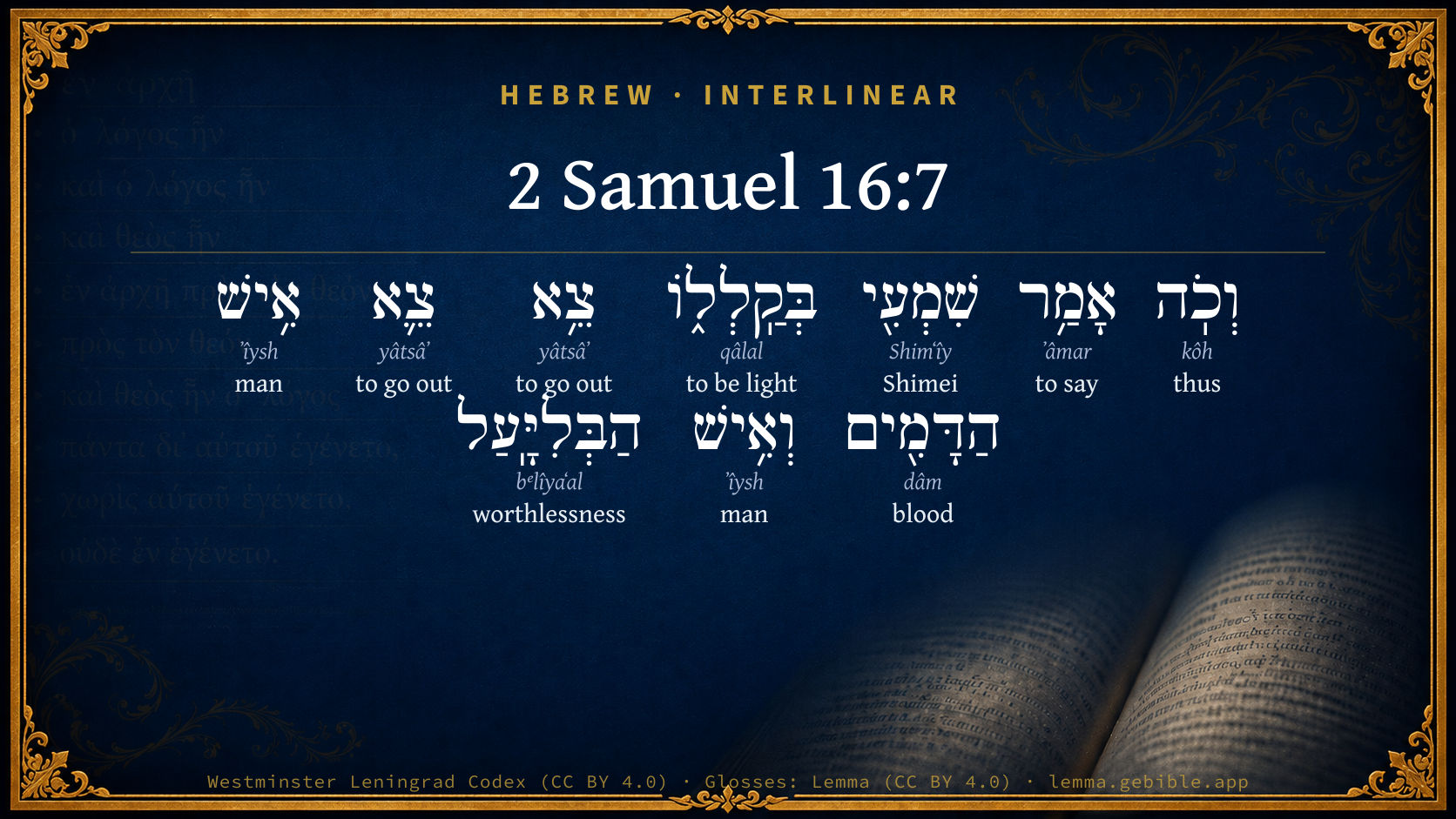
2 Samuel 16:7

Hebrew (Westminster Leningrad Codex) 2 Samuel 16:7 appears in the Hebrew Old Testament. The text above is from the Westminster Leningrad Codex. Each word links to its Strong’s number, a concise gloss, and parsing drawn from the Open Scriptures Hebrew Bible morphology. Click any word for its full Brown-Driver-Briggs (BDB) entry.
Download image
Cite this verse

2 Samuel 16:7 (World English Bible). Public Domain. Lemma interlinear Bible study tool, https://lemma.gebible.app/v/2-samuel/16/7.

Show BibTeX & RIS
BibTeX
RIS
English Translation
Thus said Shimei when he cursed, Be gone, be gone, you man of blood, and base fellow:
World English Bible · Public Domain
Download a study sheet

One document with this verse’s original text, its word-by-word gloss line, the meaning frame, cross-references with their text, attributed commentary, and full source and license credits — printable, and it pastes into notes with its structure intact.

This verse Autodidact and up

Study sheet (.html) Plain text (.txt)

A passage Seminary Student

Up to 50 verses in one chapter. A passage sheet keeps up to 6 commentary sources and 12 cross-references per verse, in the order this page ranks them, and says so on the sheet whenever that leaves anything out. Ask for a single verse and you get the Autodidact verse sheet above.

Everything on this page stays free to read, with no account — the sheet is a download of what is already on screen, not access to it.

Want to remove ads? Support Godless Engineer
Compare translations 3

The same verse in 3 English versions, stacked beneath the original-language interlinear above. Click any original word for its lexicon entry.

Each is an independent rendering of the whole verse — the interlinear is not word-aligned to these translations.

Highlighted words mark where these versions differ — a whole-verse word diff, not a word-by-word alignment.

  • World English Bible Public Domain
    Thus said Shimei when he cursed, Be gone, be gone, you man of blood, and base fellow:
  • King James Version Public Domain
    And thus said Shimei when he cursed, Come out, come out, thou bloody man, and thou man of Belial:
  • unfoldingWord Literal Text CC BY-SA 4.0
    And thus Shimei said in his cursing, “Get out, get out, man of blood, man of wickedness!

unfoldingWord Literal Text — © unfoldingWord, licensed CC BY-SA 4.0. Word-aligned USFM3 via Door43 (git.door43.org/unfoldingWord/en_ult).

Versions to compare (up to 4)

3 of 4 selected

Show all 18 translations

Every available English version of this verse, each an independent rendering of the whole verse.

  • World English Bible Public Domain
    Thus said Shimei when he cursed, Be gone, be gone, you man of blood, and base fellow:
  • Berean Standard Bible Public Domain
    And as he yelled curses, Shimei said, “Get out, get out, you worthless man of bloodshed!
  • Majority Standard Bible Public Domain
    And as he yelled curses, Shimei said, “Get out, get out, you worthless man of bloodshed!
  • King James Version Public Domain
    And thus said Shimei when he cursed, Come out, come out, thou bloody man, and thou man of Belial:
  • American Standard Version (1901) Public Domain
    And thus said Shimei when he cursed, Begone, begone, thou man of blood, and base fellow:
  • Revised Version (1885) Public Domain
    And thus said Shimei when he cursed, Begone, begone, thou man of blood, and man of Belial:
  • Geneva Bible (1599) Public Domain
    And thus sayde Shimei when hee cursed, Come forth, come foorth thou murtherer, and wicked man.
  • Douay-Rheims (1899) Public Domain
    And thus said Semei when he cursed the king: Come out, come out, thou man of blood, and thou man of Belial.
  • Young's Literal Translation Public Domain
    And thus said Shimei in his reviling, `Go out, go out, O man of blood, and man of worthlessness!
  • Literal Standard Version CC BY-SA 4.0
    And thus said Shimei in his reviling: “Go out, go out, O man of blood, and man of worthlessness!
  • Unlocked Literal Bible CC BY-SA 4.0
    Shimei called out in cursing, “Go away, get out of here, you villain, you man of blood!
  • unfoldingWord Literal Text CC BY-SA 4.0
    And thus Shimei said in his cursing, “Get out, get out, man of blood, man of wickedness!
  • Darby Bible Public Domain
    And thus said Shimei as he cursed: Away, away, thou man of blood and man of Belial!
  • World Messianic Bible Public Domain
    Shimei said when he cursed, “Be gone, be gone, you man of blood, and wicked fellow!
  • Webster's Bible Public Domain
    And thus said Shimei when he cursed, Come out, come out, thou bloody man, and thou man of Belial:
  • Free Bible Version CC BY-SA 4.0
    “Get out of here, just get out, you murderer, you wicked man!” Shimei said as he cursed.
  • Bible in Basic English Public Domain
    And Shimei said, with curses, Be gone, be gone, you man of blood, you good-for-nothing:
  • JPS Tanakh (1917) Public Domain
    And thus said Shimei when he cursed: 'Begone, begone, thou man of blood, and base fellow;

Literal Standard Version (2020), Covenant Press — licensed CC BY-SA 4.0. Text via the HelloAO Bible API (eBible.org). Unlocked Literal Bible (unfoldingWord) — licensed CC BY-SA 4.0. Text via the HelloAO Bible API (eBible.org). unfoldingWord Literal Text — © unfoldingWord, licensed CC BY-SA 4.0. Word-aligned USFM3 via Door43 (git.door43.org/unfoldingWord/en_ult). Free Bible Version, Dr. Jonathan Gallagher — licensed CC BY-SA 4.0. Text via the HelloAO Bible API (eBible.org).

Word by word

More ways to search: Search by grammar → Find every occurrence → Compare this word →

Practice this passage: Drill this verse → Learn its vocabulary →

הַבְּלִיָּֽעַל
bᵉlîyaʻal
H1100
“the · worthlessness”
Particle, Definite Article + Noun, Common, Masculine, Singular, Absolute
Part of Speech
Particle + Noun
Type
Common
Gender
Masculine
Number
Singular
State
Absolute
Full BDB Definition

Origin: from H1097 and H3276

TWOT: 246g

worthlessness - worthless, good for nothing, unprofitable, base fellow - wicked - ruin, destruction (construct)
  1. וְכֹֽה kôh H3541 “and · thus” Conjunction + Adverb
  2. אָמַ֥ר ʼâmar H559 “to say” Verb, Qal, Perfect, 3rd Person, Masculine, Singular
  3. שִׁמְעִ֖י Shimʻîy H8096 “Shimei” Noun, Proper
  4. בְּקַֽלְל֑וֹ qâlal H7043 “in/at · to be light · him” Preposition + Verb, Piel, Infinitive Construct + Suffix, Personal, 3rd Person, Masculine, Singular
  5. צֵ֥א yâtsâʼ H3318 “go out” Verb, Qal, Imperative, 2nd Person, Masculine, Singular
  6. צֵ֛א yâtsâʼ H3318 “go out” Verb, Qal, Imperative, 2nd Person, Masculine, Singular
  7. אִ֥ישׁ ʼîysh H376 “man of” Noun, Common, Masculine, Singular, Construct
  8. הַדָּמִ֖ים dâm H1818 “the · blood” Particle, Definite Article + Noun, Common, Masculine, Plural, Absolute
  9. וְאִ֥ישׁ ʼîysh H376 “and · man of” Conjunction + Noun, Common, Masculine, Singular, Construct

About this verse

These counts appear in no published source. They are computed here, from the morphology-tagged text and Lemma’s own curated glosses. What Lemma adds →

10
words
8
distinct lemmas
Historical
section

Shared distinctive vocabulary

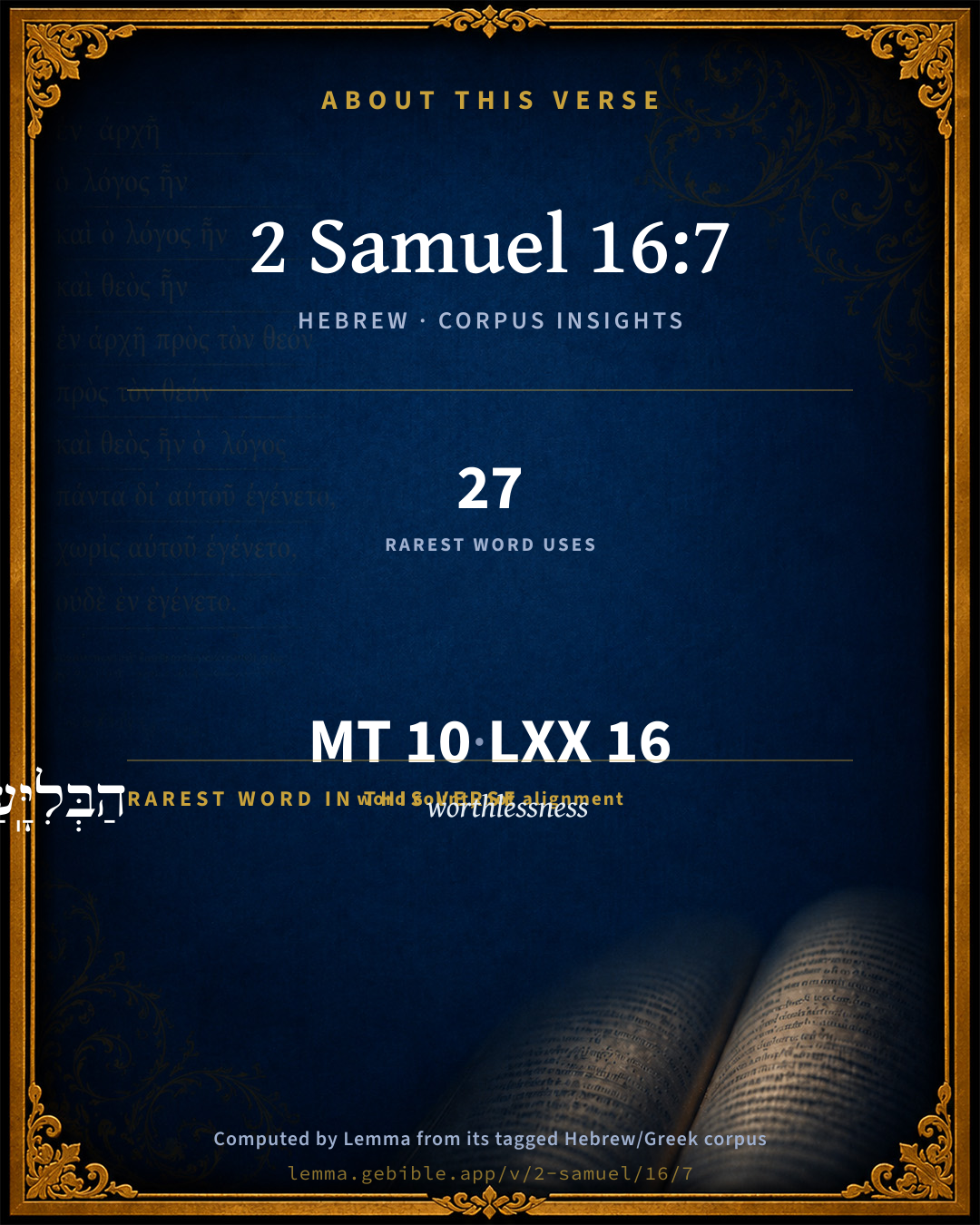
הַבְּלִיָּֽעַל worthlessness H1100 occurs in 26 verses of the Hebrew Bible. Also found in:

Grammatical profile

  • 4 verbs
  • 5 nouns
  • 1 adverb

Verb forms

  • אָמַ֥ר Qal · Perfect
  • בְּקַֽלְל֑וֹ Piel · Infinitive Construct
  • צֵ֥א Qal · Imperative
  • צֵ֛א Qal · Imperative

Repetition

Words recur within this verse — often emphatic in Hebrew:

  • צֵ֥א to go out H3318 ×2
  • אִ֥ישׁ man H376 ×2

Hebrew & Septuagint length

In English translation the verse runs 17 words from the Hebrew and 19 from the Septuagint (LXX English) — closely comparable.

A rough comparison of the two English renderings, which tokenize alike — not a word-level alignment.

Word counts can differ between the Hebrew and the Greek without any difference in meaning — e.g. the Hebrew direct-object marker אֵת has no separate Greek word, and Greek often adds the article ὁ.

In the original languages it is 10 Hebrew tokens and 16 Greek tokens — but the two are counted differently (Hebrew bundles its prefixes and suffixes into one token; the Greek is in lemma form), so that isn’t a like-for-like length.

Cross-references

10

Topical passages linked to 2 Samuel 16:7 in the Treasury of Scripture Knowledge — connected by theme and wording, ordered by reader-vote popularity; previews shown in the World English Bible.

  • Deuteronomy 13:13 Certain base fellows are gone out from the midst of you, and have drawn away the inhabitants of their city, saying, Let us go and serve other gods, which you have not known;
  • 1 Samuel 2:12 Now the sons of Eli were base men; they didn't know Yahweh.
  • 1 Samuel 25:17 Now therefore know and consider what you will do; for evil is determined against our master, and against all his house: for he is such a worthless fellow that one can't speak to him.
  • 2 Samuel 3:37 So all the people and all Israel understood that day that it was not of the king to kill Abner the son of Ner.
  • 2 Samuel 11:15–17 He wrote in the letter, saying, Set Uriah in the forefront of the hottest battle, and retire you from him, that he may be struck, and die.
  • 2 Samuel 12:9 Why have you despised the word of Yahweh, to do that which is evil in his sight? You have struck Uriah the Hittite with the sword, and have taken his wife to be your wife, and have slain him with the sword of the children of Ammon.
  • 1 Kings 21:10 and set two men, base fellows, before him, and let them testify against him, saying, You did curse God and the king. Then carry him out, and stone him to death.
  • 1 Kings 21:13 The two men, the base fellows, came in and sat before him: and the base fellows bore witness against him, even against Naboth, in the presence of the people, saying, Naboth did curse God and the king. Then they carried him forth out of the city, and stoned him to death with stones.
  • Psalms 5:6 You will destroy those who speak lies. Yahweh abhors the blood-thirsty and deceitful man.
  • Psalms 51:14 Deliver me from bloodguiltiness, O God, the God of my salvation. My tongue shall sing aloud of your righteousness.

Cross-references courtesy of OpenBible.info (CC BY 4.0).

Hebrew and Greek witnesses Masoretic Hebrew ↔ Greek Septuagint

The same verse in the two great witnesses to the Old Testament, shown verse-for-verse.

These are two independent witnesses, not word-aligned to each other, and the Septuagint is shown in lemma (dictionary) form.

Hebrew 2 Samuel 16:7 Masoretic · Westminster Leningrad Codex

וְכֹֽה אָמַ֥ר שִׁמְעִ֖י בְּקַֽלְל֑וֹ צֵ֥א צֵ֛א אִ֥ישׁ הַדָּמִ֖ים וְאִ֥ישׁ הַבְּלִיָּֽעַל

Thus said Shimei when he cursed, Be gone, be gone, you man of blood, and base fellow:

World English Bible · Public Domain

Greek LXX 2 Samuel 16:7 Septuagint · lemma form

καί οὕτως λέγω σεμεϊ ἐν ὁ καταἀράομαι αὐτός ἐκἔρχομαι ἐκἔρχομαι ἀνήρ αἷμα καί ἀνήρ ὁ παράνομος

And thus Semei said when he cursed him, Go out, go out, you bloody man, and man of sin.

LXX2012 (modern English Septuagint) · Public Domain

Hebrew: Westminster Leningrad Codex (CC BY 4.0). Greek: Septuagint (public domain); English from LXX2012 (modern English Septuagint) (Public Domain). How the Septuagint differs from the Hebrew →

Targum (Aramaic paraphrase)

1

The Targum is the ancient Jewish Aramaic paraphrase of the Hebrew Scriptures — an interpretive translation, not the Hebrew text itself. Onkelos (literal) and Pseudo-Jonathan (expansive) render the Torah, and Jonathan the Prophets. Coverage is partial: where no permissively-licensed English translation exists for a verse, only the Aramaic is shown. This is verse-level text, not a word-by-word alignment to the Hebrew.

  1. Targum Jonathan Prophets (Joshua–Malachi)
    וּכְדֵין אֲמַר שִׁמְעִי בְּלַטְטוּתֵיהּ פּוּק פּוּק גְבַר חַיָיב קְטוֹל וּגְבַר רַשִׁיעָא:

    (no public-domain English translation for this verse)

    Targum Jonathan — Aramaic: “Mikraot Gedolot” (public domain). English: “Sefaria Community Translation” (CC0 1.0 (public-domain dedication)); “London "Chaldee Paraphrase," 1871” (public domain). Text via Sefaria.

Commentary

Notes on 2 Samuel 16:7 from classic Christian and Jewish commentators (each source and its license shown beneath its notes). The classic Christian expositions comment on the surrounding passage and are grouped to its opening verse, so a note may address several verses; the Jewish commentaries on the Tanakh (Rashi and others) are per-verse, so they appear only where the commentator wrote on this verse.

Lemma curates 59 commentaries, every one of them public domain or Creative Commons licensed, each selected and text-cleaned for this edition rather than reprinted as found. About our sources →

Trapp's Complete Commentary

John Trapp

2Sa 16:7 And thus said Shimei when he cursed, Come out, come out, thou bloody man, and thou man of Belial:

Ver. 7. Come out, come out, &c.] Prima semper irarum tela maledicta aunt: et quod non possumus imbecilli, optamus irati. {a} Calvin {b} maketh mention of an insolent heretic, who, though he had as fair language given him as was possible, yet would never vouchsafe to speak better to that most worthy man than if he had had to deal with a dog.

Thou bloody man, and thou man of Belial.] Facundia plane canina. With what eagerness barketh this dead dog, no otherwise than if he had fetched every word as far as hell! Such a rabiosus canis was Porphyrie, Genebrard, Scioppius, &c.

{a} Sallust.

{b} Epist. ad Farell.

John Trapp, A Commentary or Exposition upon All the Books of the Old and New Testament (1647–1656) — public domain. Text from a community e-Sword module.

Joseph Benson's Commentary

2Sa 16:7-9. Come out — Or rather, go out, as the Hebrew properly means: begone out of thy kingdom, from which thou deservest to be expelled. Thou bloody man, and thou man of Belial — Probably he says this with a reference to David’s adultery with Bath-sheha, and the killing of Uriah. All the blood of the house of Saul — Either, 1st, The blood of Abner and Ish- bosheth; which he imputes to David, as if they had been killed by David’s contrivance: or, 2d, The death of Saul’s seven sons, 2Sa 21:8, which, though related after this, seems to have taken place before. Thou art taken — The same mischief thou didst bring upon others is now returned upon thy own head. “This surely,” says Delaney, “was one of the severest trials of patience that ever human magnanimity endured. The accusation was notoriously false, and the king could, for that reason, bear it the better; but his servants saw it not in the light of their master’s equanimity, but of his enemy’s insolence. Abishai, David’s nephew, could not bear it; but begged the king’s permission to take off the traitor’s head that uttered it,” saying, Why should this dead dog (an expression of the utmost contempt) curse my lord the king?

Joseph Benson's Commentary on the Old and New Testaments (1811–1818) — public domain. Text from a community e-Sword module.

Tyndale Open Study Notes

Tyndale Open Resources

16:7-8 Shimei cursed David, holding him responsible for the violent death of Saul and his clan.

Tyndale Open Study Notes — © Tyndale Open Resources, licensed CC BY-SA 4.0. Text via the HelloAO Bible API.

Geneva Bible (1599)

Geneva Bible translators

Hebrew, man of Belial.

Hebrew, man of blood.

Geneva Bible (1599) marginal notes — public domain. Text via Bolls.life.

Ellicott's Commentary for English Readers

(7) Come out, come out.—Rather, Go out, go out. It is doubtful whether by the words, “thou bloody man,” Shimei meant anything more than that he considered David responsible for “the blood of the house of Saul”, (2Sa_16:8), especially in the case of Ishbosheth and of Abner, and the execution of Saul’s seven descendants at the demand of the Gibeonites (2Sa_21:1-9). Yet he may have known of the crime in regard to Uriah, and have wished to point his curse with the charge of shedding that innocent blood.

A Bible Commentary for English Readers, edited by Charles John Ellicott (1878–1897) — public domain. Text from a community e-Sword module.

The Cambridge Bible for Schools and Colleges

gen. ed. J. J. S. Perowne

7. Come out, come out] Out! out! from the land and from thy kingdom into exile.

thou bloody man] Thou man of blood, thou murderer. Shimei seems to have supplied Cromwell’s army with the terms of its resolution “to call Charles Stuart, that man of blood, to account for the blood he has shed and the mischief he has done to the utmost against the Lord’s cause and people in this poor nation.” Green’s Short History, p. 552.

thou man of Belial] Thou wicked man. See note on 1Sa_1:16.

The Cambridge Bible for Schools and Colleges (gen. ed. J. J. S. Perowne; Cambridge University Press, 1878–1918) — public domain. Text from a community e-Sword module.

John Gill's Exposition

And thus said Shimei, when he cursed, come out, come out,.... Or rather, "go out, go out" (t); that is, out of the nation, where he deserved not to live, as he judged, and out of the kingdom, which he had usurped, as he supposed; and the repeating the words not only denotes his vehement desire to have him gone, but the haste he should make to get out, or he was liable to be overtaken by Absalom and his forces; upbraiding him also with the hurry he was in, and the speedy flight he was making:

thou bloody man, and thou man of Belial; or wicked man; perhaps referring by these characters in the one to the murder of Uriah, and in the other to his adultery with Bathsheba; and these crimes coming fresh into David's mind hereby, might make him more mild and humble under his reproaches.

(t) "egredere, egredere", Pagninus, Montanus, &c.

John Gill's Exposition of the Whole Bible (1746–1763) — public domain (CC PDM 1.0). Text via the HelloAO Bible API.

Albert Barnes' Notes on the Bible

Come out - Rather, “Go out,” namely, of the land, into banishment. Compare Jer 29:16.

Thou bloody man - See the margin. The Lord’s word to David 1Ch 22:8 was probably known to Shimei and now cast in David’s teeth by him, with special reference to the innocent blood of Uriah.

Albert Barnes' Notes on the Bible (1834–1885) — public domain. Text from a community e-Sword/MySword module.

Haydock's Catholic Bible Commentary

Belial; contemner of the laws, and murderer. (Menochius)

George Leo Haydock (1774–1849), Haydock's Catholic Family Bible and Commentary, 1859 edition — public domain. Excludes Psalms (Douay-Rheims chapter numbering differs from Protestant) and Deuterocanonical books (Catholic canon only).

Matthew Poole's English Annotations

Or rather, go out, as the word properly signifies. Be gone out of thy kingdom, as thou deservest.

Matthew Poole's English Annotations on the Holy Bible (1683–1685) — public domain. Text from a community e-Sword/MySword module.

Whedon's Commentary on the Bible

Daniel D. Whedon

7. Come out, come out — Rather, Go! go! That is, Away with thee!

Bloody man — So called for the reason given in the following verse.

Daniel D. Whedon (gen. ed.), Commentary on the Old and New Testaments (1874–1909) — public domain. Text from a community e-Sword module.

The Pulpit Commentary

Come out; rather, out, out; that is, "get out; begone, begone, thou murderer and worthless man." Shimei could scarcely have referred to the murders of Ishbosheth and Abner, which were too remote to have so rankled in his memory; hut as ch. 21. is not in its chronological order, what probably called forth his anger was the surrender of Saul"s sons and grandsons into the hands of the Gibeonites. Shimei, probably, even resented David"s taking the side of the Gibeonites, and treating as a crime to be severely punished what he and all Saul"s partisans regarded as righteous zeal for Israel. The three years" famine, followed by the execution of Saul"s sons, made more tragic by the noble conduct of Rizpah, contributed largely to the revolt of the nation from David, and helps to explain that abandonment of him by the people, which otherwise seems so hard to understand (on the date of the famine, see note on ch. 21.).

The Pulpit Commentary (1880–1919), ed. H.D.M. Spence-Jones & Joseph S. Exell — public domain. Text from a community e-Sword module.

Keil & Delitzsch

C. F. Keil & F. Delitzsch

Shimei cursed thus: "Out, out (away, away), thou man of blood, and worthless man! Jehovah hath repaid thee (now) for all the blood of the house of Saul, in whose stead thou hast become king, and hath given the kingdom into the hand of Absalom thy son. Behold, now thou art in thy misfortune, for thou art a man of blood." דּמים אישׁ, a man of drops of blood, i.e., one who has shed blood or committed murder. What Shimei meant by "all the blood of the house of Saul," which David had shed, and because of which he was a man of blood, it is impossible to determine with certainty. He may possibly have attributed to David the murder of Ishbosheth and Abner, notwithstanding the fact that David was innocent of the death of both (see Sa2 3:27., and Sa2 4:6.). By "in whose stead thou hast reigned," he meant whose throne thou hast forcibly usurped; and by בּרעתך הנּך, "it is for this that punishment hat overtaken thee now."

Keil & Delitzsch — Biblical Commentary on the Old Testament (1861–1891) — public domain (CC PDM 1.0). Text via the HelloAO Bible API. (Old Testament only.)

unfoldingWord translationNotes

Door43 World Missions Community

villain

someone who is evil, a criminal or lawbreaker

man of blood

Here "blood" refers to all of men he was responsible for killing in battle. AT: "murderer" (See: Metonymy)

Yahweh has repaid

Yahweh repays them by punishing them. This can be stated clearly. AT: "Yahweh has punished" (See: Assumed Knowledge and Implicit Information)

for the blood you shed within the family of Saul

Here "blood" refer to people who were killed from Saul's family. The king was responsible for them dying. AT: "for killing many of Saul's family" (See: Metonymy)

in whose place you have reigned

David reigned as king over the same people whom Saul had previously reigned. AT: "in whose place you have reigned as king" (See: Assumed Knowledge and Implicit Information)

into the hand of Absalom

Here "hand" refers to control. AT: "into the control of Absalom" (See: Metonymy)

translationWords

curse

blood

Yahweh

reign

kingdom

Absalom

ruin

unfoldingWord translationNotes — © Distant Shores Media and the Door43 World Missions Community, licensed CC BY-SA 4.0. Source: git.door43.org/Door43/en_tn.

Lesson kit

Teaching starters — assembled from the data on this page, not authored interpretation. Every prompt links to the verse data it draws on. Edit before teaching.

2 Samuel, in the Historical, opens this verse with 10 words (8 distinct Hebrew lemmas). Its most distinctive word is bᵉlîyaʻal (“worthlessness”). A historical commentator’s framing appears above. Read the whole chapter for the surrounding context.

Discussion questions

  1. What does “worthlessness” (bᵉlîyaʻal) contribute to the verse as a whole?
  2. How does Deuteronomy 13:13, which shares the word «worthlessness», read alongside this verse?
  3. What does the repetition of “to go out” (2× in this one verse) do in this verse?
  4. These translations render this verse differently; the difference is in the English rendering, not the original. What questions does that raise?
  5. «אָמַ֥ר» is a Qal Perfect verb. How does that grammatical form shape the action described?
  6. Compare how Trapp's Complete Commentary and Joseph Benson's Commentary read this verse. Where do they agree or differ?

Things to notice

Reading settings

Reading text

Shown beneath each verse's original-language words.

Old Testament
Old Testament edition

Read the OT as the Masoretic Hebrew (MT) or the Greek Septuagint (LXX).

English shown for the Greek Septuagint (in the Hebrew ↔ Greek comparison).

Comparing translations? Open the Compare panel on any verse page to stack up to four side by side.