Exodus 24:6

Hebrew (Westminster Leningrad Codex) Exodus 24:6 appears in the Hebrew Old Testament. The text above is from the Westminster Leningrad Codex. Each word links to its Strong’s number, a concise gloss, and parsing drawn from the Open Scriptures Hebrew Bible morphology. Click any word for its full Brown-Driver-Briggs (BDB) entry.
Download image
Cite this verse

Exodus 24:6 (World English Bible). Public Domain. Lemma interlinear Bible study tool, https://lemma.gebible.app/v/exodus/24/6.

Show BibTeX & RIS
BibTeX
RIS
English Translation
Moses took half of the blood and put it in basins, and half of the blood he sprinkled on the altar.
World English Bible · Public Domain
Highlights
  • 1 first appearance in the Hebrew Bible
Full analysis ↓
Download a study sheet

One document with this verse’s original text, its word-by-word gloss line, the meaning frame, cross-references with their text, attributed commentary, and full source and license credits — printable, and it pastes into notes with its structure intact.

This verse Autodidact and up

Study sheet (.html) Plain text (.txt)

A passage Seminary Student

Up to 50 verses in one chapter. A passage sheet keeps up to 6 commentary sources and 12 cross-references per verse, in the order this page ranks them, and says so on the sheet whenever that leaves anything out. Ask for a single verse and you get the Autodidact verse sheet above.

Everything on this page stays free to read, with no account — the sheet is a download of what is already on screen, not access to it.

Want to remove ads? Support Godless Engineer
Compare translations 3

The same verse in 3 English versions, stacked beneath the original-language interlinear above. Click any original word for its lexicon entry.

Each is an independent rendering of the whole verse — the interlinear is not word-aligned to these translations.

Highlighted words mark where these versions differ — a whole-verse word diff, not a word-by-word alignment.

  • World English Bible Public Domain
    Moses took half of the blood and put it in basins, and half of the blood he sprinkled on the altar.
  • King James Version Public Domain
    And Moses took half of the blood, and put it in basins; and half of the blood he sprinkled on the altar.
  • unfoldingWord Literal Text CC BY-SA 4.0
    And Moses took half of the blood and put it into basins and sprinkled half of the blood onto the altar.

unfoldingWord Literal Text — © unfoldingWord, licensed CC BY-SA 4.0. Word-aligned USFM3 via Door43 (git.door43.org/unfoldingWord/en_ult).

Versions to compare (up to 4)

3 of 4 selected

Show all 18 translations

Every available English version of this verse, each an independent rendering of the whole verse.

  • World English Bible Public Domain
    Moses took half of the blood and put it in basins, and half of the blood he sprinkled on the altar.
  • Berean Standard Bible Public Domain
    Moses took half of the blood and put it in bowls, and the other half he sprinkled on the altar.
  • Majority Standard Bible Public Domain
    Moses took half of the blood and put it in bowls, and the other half he splattered on the altar.
  • King James Version Public Domain
    And Moses took half of the blood, and put it in basins; and half of the blood he sprinkled on the altar.
  • American Standard Version (1901) Public Domain
    And Moses took half of the blood, and put it in basins; and half of the blood he sprinkled on the altar.
  • Revised Version (1885) Public Domain
    And Moses took half of the blood, and put it in basons; and half of the blood he sprinkled on the altar.
  • Geneva Bible (1599) Public Domain
    Then Moses tooke halfe of the blood, and put it in basens, and halfe of the blood he sprinckled on the altar.
  • Douay-Rheims (1899) Public Domain
    Then Moses took half of the blood, and put it into bowls: and the rest he poured upon the altar.
  • Young's Literal Translation Public Domain
    And Moses taketh half of the blood, and putteth in basins, and half of the blood hath he sprinkled on the altar;
  • Literal Standard Version CC BY-SA 4.0
    And Moses takes half of the blood and puts [it] in basins, and he has sprinkled half of the blood on the altar;
  • Unlocked Literal Bible CC BY-SA 4.0
    Moses took half of the blood and put it into basins; he sprinkled the other half onto the altar.
  • unfoldingWord Literal Text CC BY-SA 4.0
    And Moses took half of the blood and put it into basins and sprinkled half of the blood onto the altar.
  • Darby Bible Public Domain
    And Moses took half the blood, and put [it] in basons; and half of the blood he sprinkled on the altar.
  • World Messianic Bible Public Domain
    Moses took half of the blood and put it in basins, and half of the blood he sprinkled on the altar.
  • Webster's Bible Public Domain
    And Moses took half of the blood, and put it in basins; and half of the blood he sprinkled on the altar.
  • Free Bible Version CC BY-SA 4.0
    Moses put half of the blood into bowls, and sprinkled the other half on the altar.
  • Bible in Basic English Public Domain
    And Moses took half the blood and put it in basins; draining out half of the blood over the altar.
  • JPS Tanakh (1917) Public Domain
    And Moses took half of the blood, and put it in basins; and half of the blood he dashed against the altar.

Literal Standard Version (2020), Covenant Press — licensed CC BY-SA 4.0. Text via the HelloAO Bible API (eBible.org). Unlocked Literal Bible (unfoldingWord) — licensed CC BY-SA 4.0. Text via the HelloAO Bible API (eBible.org). unfoldingWord Literal Text — © unfoldingWord, licensed CC BY-SA 4.0. Word-aligned USFM3 via Door43 (git.door43.org/unfoldingWord/en_ult). Free Bible Version, Dr. Jonathan Gallagher — licensed CC BY-SA 4.0. Text via the HelloAO Bible API (eBible.org).

Word by word

More ways to search: Search by grammar → Find every occurrence → Compare this word →

Practice this passage: Drill this verse → Learn its vocabulary →

בָּאַגָּנֹ֑ת
ʼaggân
H101
“in/at the · bowls”
Preposition, Determined + Noun, Common, Masculine, Plural, Absolute
Part of Speech
Preposition + Noun
Type
Common
Gender
Masculine
Number
Plural
State
Absolute
Full BDB Definition

Origin: probably from H5059

TWOT: 20a

bowl, basins - basins used in ritual - human body (metaphorically), curves of the body (simile) - of family of Eliakim (metaphorically)
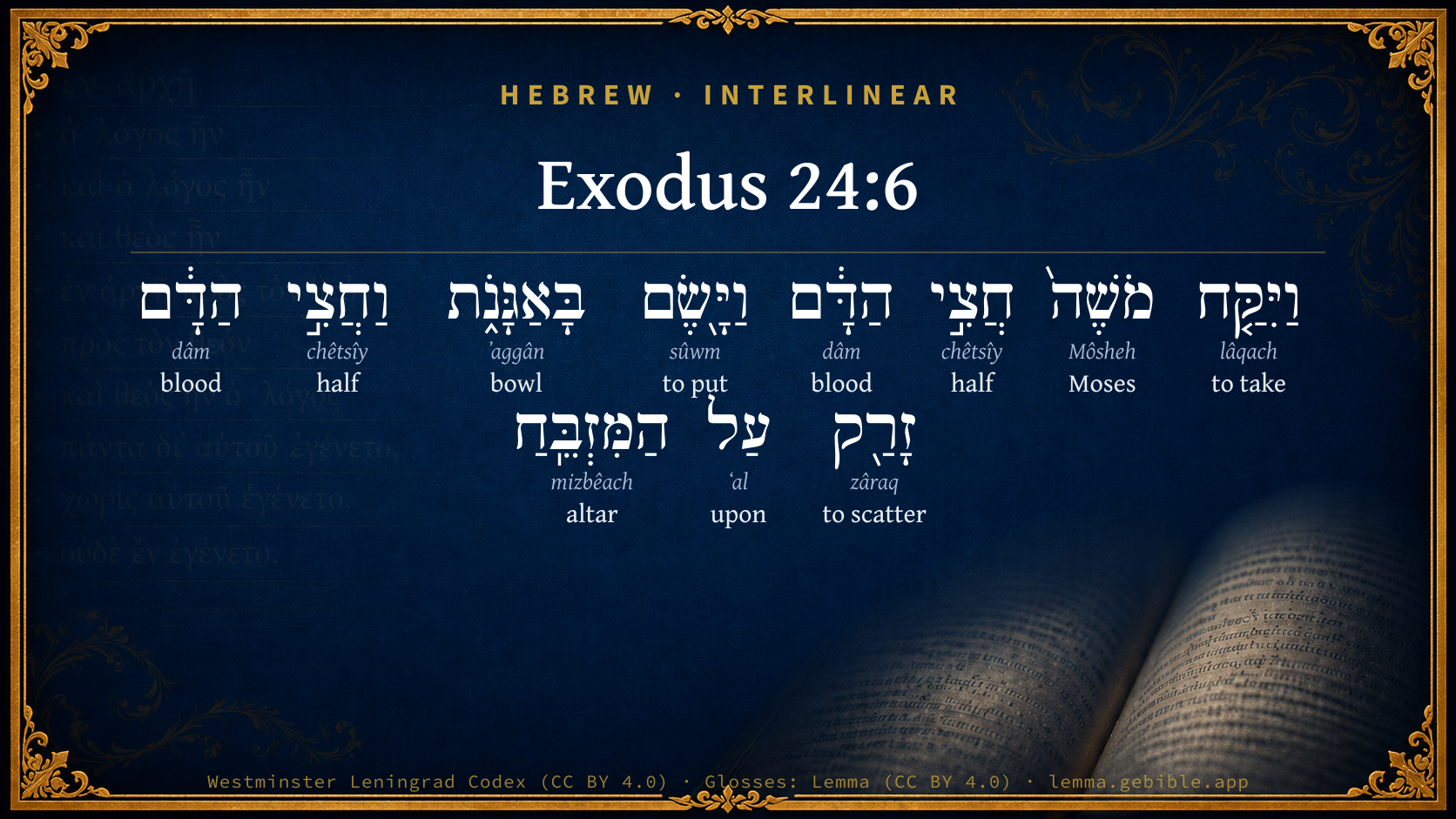
  1. וַיִּקַּ֤ח lâqach H3947 “and · to take” Conjunction + Verb, Qal, Sequential Imperfect, 3rd Person, Masculine, Singular
  2. מֹשֶׁה֙ Môsheh H4872 “Moses” Noun, Proper
  3. חֲצִ֣י chêtsîy H2677 “half of” Noun, Common, Masculine, Singular, Construct
  4. הַדָּ֔ם dâm H1818 “the · blood” Particle, Definite Article + Noun, Common, Masculine, Singular, Absolute
  5. וַיָּ֖שֶׂם sûwm H7760 “and · to put” Conjunction + Verb, Qal, Sequential Imperfect, 3rd Person, Masculine, Singular
  6. וַחֲצִ֣י chêtsîy H2677 “and · half of” Conjunction + Noun, Common, Masculine, Singular, Construct
  7. הַדָּ֔ם dâm H1818 “the · blood” Particle, Definite Article + Noun, Common, Masculine, Singular, Absolute
  8. זָרַ֖ק zâraq H2236 “to scatter” Verb, Qal, Perfect, 3rd Person, Masculine, Singular
  9. עַל ʻal H5921 “upon” Preposition
  10. הַמִּזְבֵּֽחַ mizbêach H4196 “the · altar” Particle, Definite Article + Noun, Common, Masculine, Singular, Absolute

About this verse

These counts appear in no published source. They are computed here, from the morphology-tagged text and Lemma’s own curated glosses. What Lemma adds →

11
words
9
distinct lemmas
Pentateuch
section

Notable vocabulary

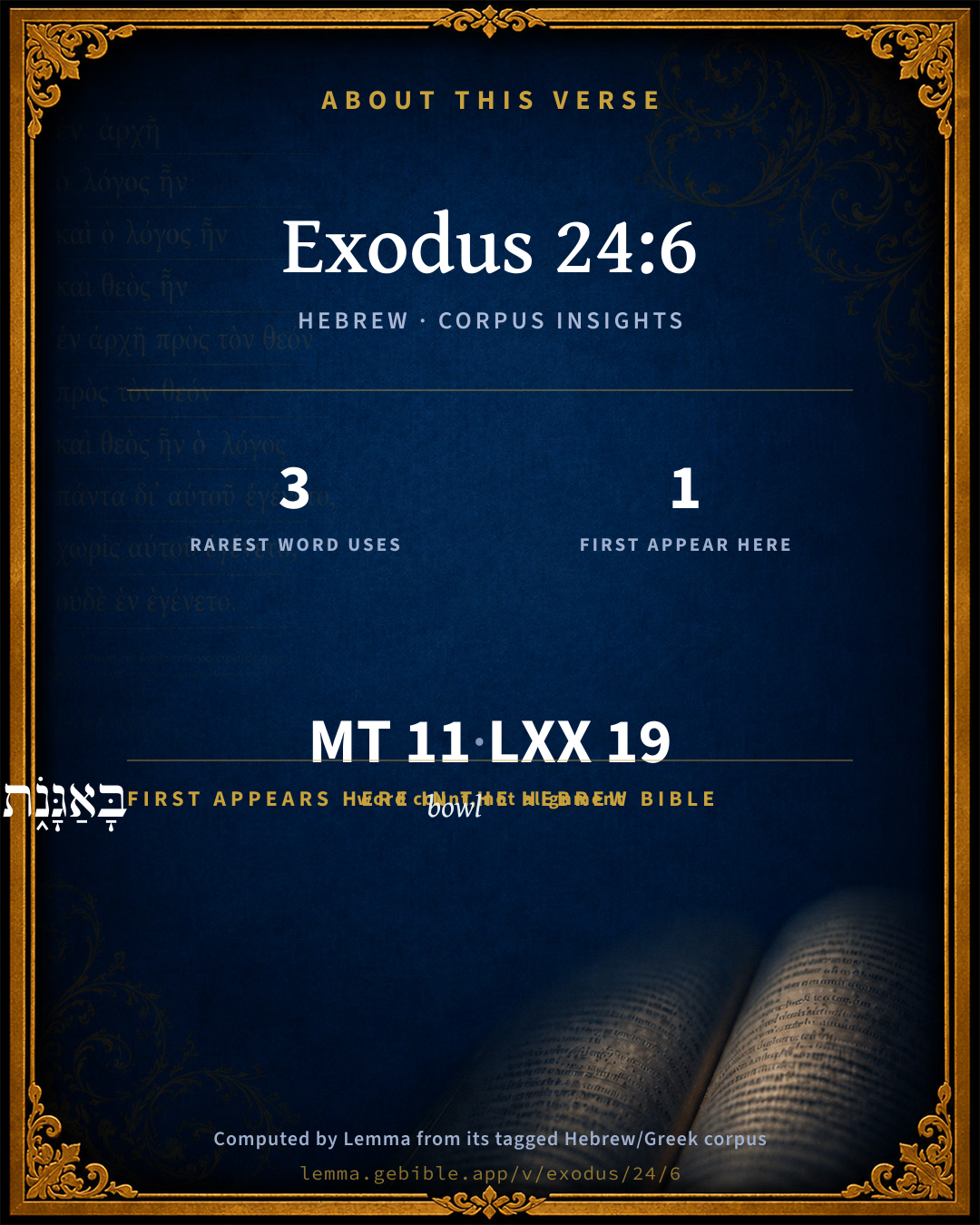
The rarest word here is בָּאַגָּנֹ֑ת bowl H101 — appearing just 3 times in the whole Hebrew Bible.

First appearance in Scripture

This word makes its first canonical appearance in the Hebrew Bible here:

  • בָּאַגָּנֹ֑ת bowl H101

Shared distinctive vocabulary

בָּאַגָּנֹ֑ת bowl H101 occurs in 3 verses of the Hebrew Bible. Also found in:

Grammatical profile

  • 3 verbs
  • 7 nouns
  • 1 preposition

Verb forms

  • וַיִּקַּ֤ח Qal · Sequential Imperfect
  • וַיָּ֖שֶׂם Qal · Sequential Imperfect
  • זָרַ֖ק Qal · Perfect

Repetition

Words recur within this verse — often emphatic in Hebrew:

  • חֲצִ֣י half H2677 ×2
  • הַדָּ֔ם blood H1818 ×2

Hebrew & Septuagint length

In English translation the verse runs 21 words from the Hebrew and 21 from the Septuagint (LXX English) — the same length.

A rough comparison of the two English renderings, which tokenize alike — not a word-level alignment.

Word counts can differ between the Hebrew and the Greek without any difference in meaning — e.g. the Hebrew direct-object marker אֵת has no separate Greek word, and Greek often adds the article ὁ.

In the original languages it is 11 Hebrew tokens and 19 Greek tokens — but the two are counted differently (Hebrew bundles its prefixes and suffixes into one token; the Greek is in lemma form), so that isn’t a like-for-like length.

Cross-references

15

Topical passages linked to Exodus 24:6 in the Treasury of Scripture Knowledge — connected by theme and wording, ordered by reader-vote popularity; previews shown in the World English Bible.

  • 1 Peter 1:19 but with precious blood, as of a lamb without spot, the blood of Christ;
  • Exodus 24:8 Moses took the blood, and sprinkled it on the people, and said, "Look, this is the blood of the covenant, which Yahweh has made with you concerning all these words."
  • Hebrews 9:18 Therefore even the first covenant has not been dedicated without blood.
  • Leviticus 4:6 The priest shall dip his finger in the blood, and sprinkle some of the blood seven times before Yahweh, before the veil of the sanctuary.
  • Exodus 12:7 They shall take some of the blood, and put it on the two side-posts and on the lintel, on the houses in which they shall eat it.
  • Exodus 12:22 You shall take a bunch of hyssop, and dip it in the blood that is in the basin, and strike the lintel and the two side-posts with the blood that is in the basin; and none of you shall go out of the door of his house until the morning.
  • Exodus 29:16 You shall kill the ram, and you shall take its blood, and sprinkle it around on the altar.
  • Exodus 29:20 Then you shall kill the ram, and take some of its blood, and put it on the tip of the right ear of Aaron, and on the tip of the right ear of his sons, and on the thumb of their right hand, and on the big toe of their right foot, and sprinkle the blood on the altar round about.
  • Leviticus 1:5 He shall kill the bull before Yahweh. Aaron's sons, the priests, shall present the blood and sprinkle the blood around on the altar that is at the door of the Tent of Meeting.
  • Leviticus 1:11 He shall kill it on the north side of the altar before Yahweh. Aaron's sons, the priests, shall sprinkle its blood around on the altar.
  • Leviticus 3:2 He shall lay his hand on the head of his offering, and kill it at the door of the tent of meeting: and Aaron's sons the priests shall sprinkle the blood on the altar round about.
  • Leviticus 3:8 and he shall lay his hand on the head of his offering, and kill it before the tent of meeting: and Aaron's sons shall sprinkle its blood on the altar round about.
  • Colossians 1:20 and through him to reconcile all things to himself, by him, whether things on the earth, or things in the heavens, having made peace through the blood of his cross.
  • Hebrews 12:24 to Jesus, the mediator of a new covenant, and to the blood of sprinkling that speaks better than that of Abel.
  • 1 Peter 1:2 according to the foreknowledge of God the Father, in sanctification of the Spirit, that you may obey Jesus Christ and be sprinkled in his blood: Grace to you and peace be multiplied.

Cross-references courtesy of OpenBible.info (CC BY 4.0).

Hebrew and Greek witnesses Masoretic Hebrew ↔ Greek Septuagint

The same verse in the two great witnesses to the Old Testament, shown verse-for-verse.

These are two independent witnesses, not word-aligned to each other, and the Septuagint is shown in lemma (dictionary) form.

Hebrew Exodus 24:6 Masoretic · Westminster Leningrad Codex

וַיִּקַּ֤ח מֹשֶׁה֙ חֲצִ֣י הַדָּ֔ם וַיָּ֖שֶׂם בָּאַגָּנֹ֑ת וַחֲצִ֣י הַדָּ֔ם זָרַ֖ק עַל הַמִּזְבֵּֽחַ

Moses took half of the blood and put it in basins, and half of the blood he sprinkled on the altar.

World English Bible · Public Domain

Greek LXX Exodus 24:6 Septuagint · lemma form

λαμβάνω δέ μωυσῆς ὁ ἥμισυς ὁ αἷμα ἐνχέω εἰς κρατήρ ὁ δέ ἥμισυς ὁ αἷμα προςχέω πρός ὁ θυσιαστήριον

And Moses took half the blood and poured it into bowls, and half the blood he poured out upon the altar.

LXX2012 (modern English Septuagint) · Public Domain

Hebrew: Westminster Leningrad Codex (CC BY 4.0). Greek: Septuagint (public domain); English from LXX2012 (modern English Septuagint) (Public Domain). How the Septuagint differs from the Hebrew →

Targum (Aramaic paraphrase)

2

The Targum is the ancient Jewish Aramaic paraphrase of the Hebrew Scriptures — an interpretive translation, not the Hebrew text itself. Onkelos (literal) and Pseudo-Jonathan (expansive) render the Torah, and Jonathan the Prophets. Coverage is partial: where no permissively-licensed English translation exists for a verse, only the Aramaic is shown. This is verse-level text, not a word-by-word alignment to the Hebrew.

  1. Targum Onkelos Torah (Genesis–Deuteronomy)
    וּנְסִיב משֶׁה פַּלְגוּת דְמָא וְשַׁוִי בְּמִזְרְקַיָא וּפַלְגוּת דְמָא זְרַק עַל מַדְבְּחָא:

    (no public-domain English translation for this verse)

    Targum Onkelos — Aramaic: “Onkelos Genesis” (public domain); “Onkelos Exodus” (public domain); “Onkelos Leviticus” (public domain); “Onkelos Numbers” (public domain); “Onkelos Deuteronomy” (public domain). English: “Sefaria Community Translation” (CC0 1.0 (public-domain dedication)); “J.W. Etheridge. The Targums of Onkelos and Jonathan Ben Uzziel on the Pentateuch. London: Longmans, Green, 1862” (public domain). Text via Sefaria.

  2. Targum Pseudo-Jonathan Torah (Genesis–Deuteronomy)
    וּנְסֵיב משֶׁה פַּלְגוּת אֲדָם נִכְסָא וְשַׁוִי בְּמִזְרְקַיָא וּפַלְגוּת אֲדָם נִכְסָא דָרַק עַל מַדְבְּחָא

    And Mosheh took half of the blood of the offering, and put it in basins, and half of the blood of the offering he sprinkled upon the altar.

    Targum Pseudo-Jonathan — Aramaic: “Targum Jonathan on Genesis” (public domain); “Targum Jonathan on Exodus” (public domain); “Targum Jonathan on Leviticus” (public domain); “Targum Jonathan on Numbers” (public domain); “Targum Jonathan on Deuteronomy” (public domain). English: “The Targum of Jonathan ben Uzziel, trans. J. W. Etheridge, London, 1862” (public domain). Text via Sefaria.

Commentary

Notes on Exodus 24:6 from classic Christian and Jewish commentators (each source and its license shown beneath its notes). The classic Christian expositions comment on the surrounding passage and are grouped to its opening verse, so a note may address several verses; the Jewish commentaries on the Tanakh (Rashi and others) are per-verse, so they appear only where the commentator wrote on this verse.

Lemma curates 59 commentaries, every one of them public domain or Creative Commons licensed, each selected and text-cleaned for this edition rather than reprinted as found. About our sources →

Trapp's Complete Commentary

John Trapp

Exo 24:6 And Moses took half of the blood, and put [it] in basons; and half of the blood he sprinkled on the altar.

Ver. 6. Half of the blood.] Having mingled it first with water {Heb 9:19} See 1Jn 5:6, {See Trapp on "1Jn 5:6"}

John Trapp, A Commentary or Exposition upon All the Books of the Old and New Testament (1647–1656) — public domain. Text from a community e-Sword module.

Joseph Benson's Commentary

Exodus 24:6. 1st, The blood of the sacrifice which the people offered, was (part of it) sprinkled upon the altar — Which signified the people’s dedicating themselves to God, and his honour. In the blood of the sacrifices, all the Israelites were presented unto God as living sacrifices, Rom 12:1. 2d, The blood of the sacrifice which God owned and accepted was (the remainder of it) sprinkled, either upon the people themselves, or upon the pillars that represented them, which signified God’s conferring his favour upon them, and all the fruits of that favour, and his giving them all the gifts they could desire from a God reconciled to them, and in covenant with them. Thus our Lord Jesus, the Mediator of the new covenant, (of whom Moses was a type,) having offered up himself a sacrifice upon the cross, that his blood might be indeed the blood of the covenant, sprinkles it upon the altar in his intercession, (Heb 9:12,) and sprinkles it upon his church by his word and ordinance, and operations of the Spirit of promise, by whom we are sealed to be to him a people.

Joseph Benson's Commentary on the Old and New Testaments (1811–1818) — public domain. Text from a community e-Sword module.

Tyndale Open Study Notes

Tyndale Open Resources

24:6 When Moses splattered half of the blood of the sacrificial animals against the altar, he symbolized God’s formal oath to keep the covenant (see Gen 15:9-18; Heb 6:13).

Tyndale Open Study Notes — © Tyndale Open Resources, licensed CC BY-SA 4.0. Text via the HelloAO Bible API.

Jamieson, Fausset & Brown

Robert Jamieson, A. R. Fausset & David Brown

Moses took half of the blood . . . sprinkled--Preliminary to this was the public reading of the law and the renewed acceptance of the terms by the people; then the sprinkling of the blood was the sign of solemn ratification--half on each party in the transaction.

Jamieson, Fausset & Brown — Commentary Critical and Explanatory on the Whole Bible (1871) — public domain (CC PDM 1.0). Text via the HelloAO Bible API.

Ellicott's Commentary for English Readers

(6) Put it in basons.—Reserving it for the purpose stated in Exo_24:8.

Half of the blood he sprinkled on the altar.—This was the most essential part of every sacrifice—the act by which the victim, the representative of the offerer, was made over and delivered up to God. Usually all the blood was thus devoted; here there was need of some for another purpose.

A Bible Commentary for English Readers, edited by Charles John Ellicott (1878–1897) — public domain. Text from a community e-Sword module.

The Cambridge Bible for Schools and Colleges

gen. ed. J. J. S. Perowne

6. Half of the blood was thrown against the altar; the other half (v. 8) was thrown over the people. Covenants were ratified in different ways: sometimes, for instance, the contracting parties were held to be bound by eating salt together (cf. Lev_2:13, Num_18:19, 2Ch_13:5), sometimes by partaking together in a sacrificial meal (Gen_31:54; cf. v. 11 here), in Genesis 15, Jer_34:18 f., by passing between the divided pieces of slaughtered animals; and especially by the use, still prevalent in many parts of the world, of blood, as by each of the parties tasting the other’s blood, or smearing himself with it, or letting it be mingled with his own, &c., or by both jointly dipping their hands in the blood of a slaughtered animal, &c. (cf. Hdt. iii. 8, iv. 70, Aesch. Theb. 43–48, Xen. Anab. ii. 2. 9: see very fully Trumbull, The Blood Covenant, 1885, pp. 4–65). So analogously here: Jehovah and the people are symbolically joined together by the sacrificial blood being thrown over the altar (representing Jehovah) and the people; and thus the ‘covenant,’ or agreement, between them is ratified (cf. Psa_50:5).

basons] Heb. ’aggânôth, elsewhere only Isa_22:24, Son_7:3. Not the technical priestly term (mizrâḳ) used in Exo_27:3.

sprinkled] tossed (or threw): see on Exo_29:16. So v. 8.

on] or against,—at least, if the later sense of the expression (see on Exo_29:16) may be here presupposed.

The Cambridge Bible for Schools and Colleges (gen. ed. J. J. S. Perowne; Cambridge University Press, 1878–1918) — public domain. Text from a community e-Sword module.

John Gill's Exposition

And Moses took half of the blood, and put it in basins,.... Half of the blood of the above sacrifices, this he put into basins, and set by, in order to sprinkle on the people:

and half of the blood he sprinkled on the altar; the Targum of Onkelos adds, to atone for the people. But the altar here seems to represent the Lord, who was one of the parties covenanting, and therefore is sprinkled with blood as a ratification of the covenant on his part, and the promises of it.

John Gill's Exposition of the Whole Bible (1746–1763) — public domain (CC PDM 1.0). Text via the HelloAO Bible API.

Albert Barnes' Notes on the Bible

He sprinkled - Rather, he cast. See Lev 1:5.

Albert Barnes' Notes on the Bible (1834–1885) — public domain. Text from a community e-Sword/MySword module.

Matthew Poole's English Annotations

Half of the blood of the beasts killed, which for conveniency of sprinkling was mixed with a little water, Heb 9:19, whereby also Christ was most fitly represented, who came by water and blood, 1Jo 5:6.

Half of the blood he sprinkled on the altar, to signify, as well that God was appeased and atoned by this blood, as it represented the blood of Christ, as also that Christ was sanctified with his own blood, Heb 9:12.

Matthew Poole's English Annotations on the Holy Bible (1683–1685) — public domain. Text from a community e-Sword/MySword module.

Whedon's Commentary on the Bible

Daniel D. Whedon

6. Half of the blood… in basins, and half… on the altar — As the same drops of blood could not be sprinkled both on the altar and on the people, the whole was divided into two parts, part for the altar and part for the people, and yet the two portions were regarded as one blood, serving to seal this holy covenant between Jehovah and his people. The blood which was sprinkled on the altar symbolized the life of Israel consecrated to Jehovah; that in basins, which was “sprinkled on the people,” (Exo_24:8,) served to intensify in them the solemn conviction that they were set apart to be a holy nation. It was the seal of union with God, a covenant of blood.

Daniel D. Whedon (gen. ed.), Commentary on the Old and New Testaments (1874–1909) — public domain. Text from a community e-Sword module.

The Pulpit Commentary

Moses took half of the blood. The blood, which symbolised the life of the victim, was the essential part of every sacrifice, and was usually poured over the altar, or at any rate sprinkled upon it, as the very crowning act of offering. (see Lev_1:5 Lev_3:8; etc.) On this occasion Moses retained half of the blood, and put it in basins, for the purpose of so uniting all the people in the sacrifice, and thereby the more solemnly pledging them to the covenant, which the sacrifice at once consecrated and consummated. (see Heb_9:18-20) The other half of the blood was, according to the usual practice, sprinkled upon the altar.

The Pulpit Commentary (1880–1919), ed. H.D.M. Spence-Jones & Joseph S. Exell — public domain. Text from a community e-Sword module.

John Wesley's Explanatory Notes

1. The blood of the sacrifice which the people offered was (part of it) sprinkled upon the altar, which signified the people's dedicating themselves to God, and his honour. In the blood of the sacrifices, all the Israelites were presented unto God as living sacrifices, Rom. xii, 1.

2. The blood of the sacrifice which God had owned and accepted was (the remainder of it) sprinkled, either upon the people themselves, or upon the pillars that represented them, which signified God's conferring his favour upon them, and all the fruits of that favour, and his giving them all the gifts they could desire from a God reconciled to them, and in covenant with them. This part of the ceremony was thus explained, Behold the blood of the covenant; see here how God sealed to you to be a God, and you seal to be to him a people; his promises to you, and yours to him, are yea and amen. Thus our Lord Jesus, the Mediator of the new covenant (of whom Moses was a type) having offered up himself a sacrifice upon the cross, that his blood might be indeed the blood of the covenant, sprinkled it upon the altar in his intercession (Heb. ix, 12,) and sprinkles it upon his church by his word and ordinances, and the influences and operations of the Spirit of promise by whom we are sealed.

John Wesley, Explanatory Notes Upon the Whole Bible (1754–1765) — public domain. Text via the GEBible commentary corpus.

Keil & Delitzsch

C. F. Keil & F. Delitzsch

The blood was divided into two parts. One half was swung by Moses upon the altar (זרק to swing, shake, or pour out of the vessel, in distinction from הזּה to sprinkle) the other half he put into basins, and after he had read the book of the covenant to the people, and they had promised to do and follow all the words of Jehovah, he sprinkled it upon the people with these words: "Behold the blood of the covenant, which Jehovah has made with you over all these words." As several animals were slaughtered, and all of them young oxen, there must have been a considerable quantity of blood obtained, so that the one half would fill several basins, and many persons might be sprinkled with it as it was being swung about. The division of the blood had reference to the two parties to the covenant, who were to be brought by the covenant into a living unity; but it had no connection whatever with the heathen customs adduced by Bhr and Knobel, in which the parties to a treaty mixed their own blood together. For this was not a mixture of different kinds of blood, but it was a division of one blood, and that sacrificial blood, in which animal life was offered instead of human life, making expiation as a pure life for sinful man, and by virtue of this expiation restoring the fellowship between God and man which had been destroyed by sin. But the sacrificial blood itself only acquired this signification through the sprinkling or swinging upon the altar, by virtue of which the human soul was received, in the soul of the animal sacrificed for man, into the fellowship of the divine grace manifested upon the altar, in order that, through the power of this sin-forgiving and sin-destroying grace, it might be sanctified to a new and holy life. In this way the sacrificial blood acquired the signification of a vital principle endued with the power of divine grace; and this was communicated to the people by means of the sprinkling of the blood. As the only reason for dividing the sacrificial blood into two parts was, that the blood sprinkled upon the altar could not be taken off again and sprinkled upon the people; the two halves of the blood are to be regarded as one blood, which was first of all sprinkled upon the altar, and then upon the people. In the blood sprinkled upon the altar, the natural life of the people was given up to God, as a life that had passed through death, to be pervaded by His grace; and then through the sprinkling upon the people it was restored to them again, as a life renewed by the grace of God. In this way the blood not only became a bond of union between Jehovah and His people, but as the blood of the covenant, it became a vital power, holy and divine, uniting Israel and its God; and the sprinkling of the people with this blood was an actual renewal of life, a transposition of Israel into the kingdom of God, in which it was filled with the powers of God's spirit of grace, and sanctified into a kingdom of priests, a holy nation of Jehovah (Exo 19:6). And this covenant was made "upon all the words" which Jehovah had spoken, and the people had promised to observe. Consequently it had for its foundation the divine law and right, as the rule of life for Israel.

Keil & Delitzsch — Biblical Commentary on the Old Testament (1861–1891) — public domain (CC PDM 1.0). Text via the HelloAO Bible API. (Old Testament only.)

Rashi

Rabbi Shlomo Yitzchaki (Rashi)

ויקח משה חצי הדם AND MOSES TOOK THE HALF OF THE BLOOD — Who divided it into halves? An angel came down and divided it (Leviticus Rabbah 6:5).

באגנת IN BASONS — There were two basons, one for holding the half of the blood of the burnt offering and the other for holding the half of the blood of the peace offerings, in order to sprinkle it (both bloods) on the people. From here have our Rabbis inferred (Keritot 9a) that our ancestors entered into the covenant with God by means of circumcision, immersion and sprinkling of blood — and although immersion is not mentioned in this paragraph it must have taken place, for no sprinkling is effective without immersion preceding it (cf. Tosafot Yevamot 46b ד"ה דאין הזאה בלא טבילה).‎

Rashi on the Tanakh — English translations: “The Judaica Press complete Tanach with Rashi, translated by A. J. Rosenberg” (CC BY 4.0); “Pentateuch with Rashi's commentary by M. Rosenbaum and A.M. Silbermann, 1929-1934” (public domain); “The Metsudah Tanach series, Lakewood, N.J” (CC BY 4.0); and “The Book of Joshua, Metsudah Publications, 1997” (CC BY 4.0). Text via Sefaria.

Ramban (Nachmanides)

Rabbi Moshe ben Nachman (Ramban / Nachmanides)

AND MOSES TOOK HALF OF THE BLOOD AND HE PLACED IT ‘BA’AGANOTH.’ These are vessels made unlike the shape of the regular basins of the altar. Hence Scripture states that half of the blood of the sacrifices which Moses intended to sprinkle on the people, he put into these vessels, and the other half he sprinkled upon the altar from the regular basins in which he had received the blood, as is the customary way with all offerings. But Rabbi Abraham ibn Ezra said that ba’aganoth served for both halves, [and thus the word signifies the regular basins of the altar]. Such is also the opinion of Onkelos, who translated ba’aganoth as b’mizr’kaya [a term referring to the regular basins].

Ramban (Nachmanides) on the Tanakh — English translation: “Commentary on the Torah by Ramban (Nachmanides). Translated and annotated by Charles B. Chavel. New York, Shilo Pub. House, 1971-1976” (CC BY 4.0). Text via Sefaria.

Lesson kit

Teaching starters — assembled from the data on this page, not authored interpretation. Every prompt links to the verse data it draws on. Edit before teaching.

Exodus, in the Pentateuch, opens this verse with 11 words (9 distinct Hebrew lemmas). Its most distinctive word is ʼaggân (“bowl”). A historical commentator’s framing appears above. Read the whole chapter for the surrounding context.

Discussion questions

  1. The word ʼaggân carries the sense “bowl.” How does it shape the verse?
  2. The word “bowl” first appears here in Scripture. What is being introduced at this debut?
  3. Song of Solomon 7:2 shares the word «bowl» with this verse. How do the two illuminate each other?
  4. “half” occurs 2× in this one verse. What is the effect of the repetition?
  5. The translations on this page render this verse differently — a whole-verse word diff, not a word-by-word alignment. What might account for the different wordings?
  6. The verb «וַיִּקַּ֤ח» is Qal Sequential Imperfect. How does its form color the action?
  7. Reading how Trapp's Complete Commentary and Joseph Benson's Commentary read this verse, where do the two commentators agree and where do they part?

Things to notice

Reading settings

Reading text

Shown beneath each verse's original-language words.

Old Testament
Old Testament edition

Read the OT as the Masoretic Hebrew (MT) or the Greek Septuagint (LXX).

English shown for the Greek Septuagint (in the Hebrew ↔ Greek comparison).

Comparing translations? Open the Compare panel on any verse page to stack up to four side by side.