
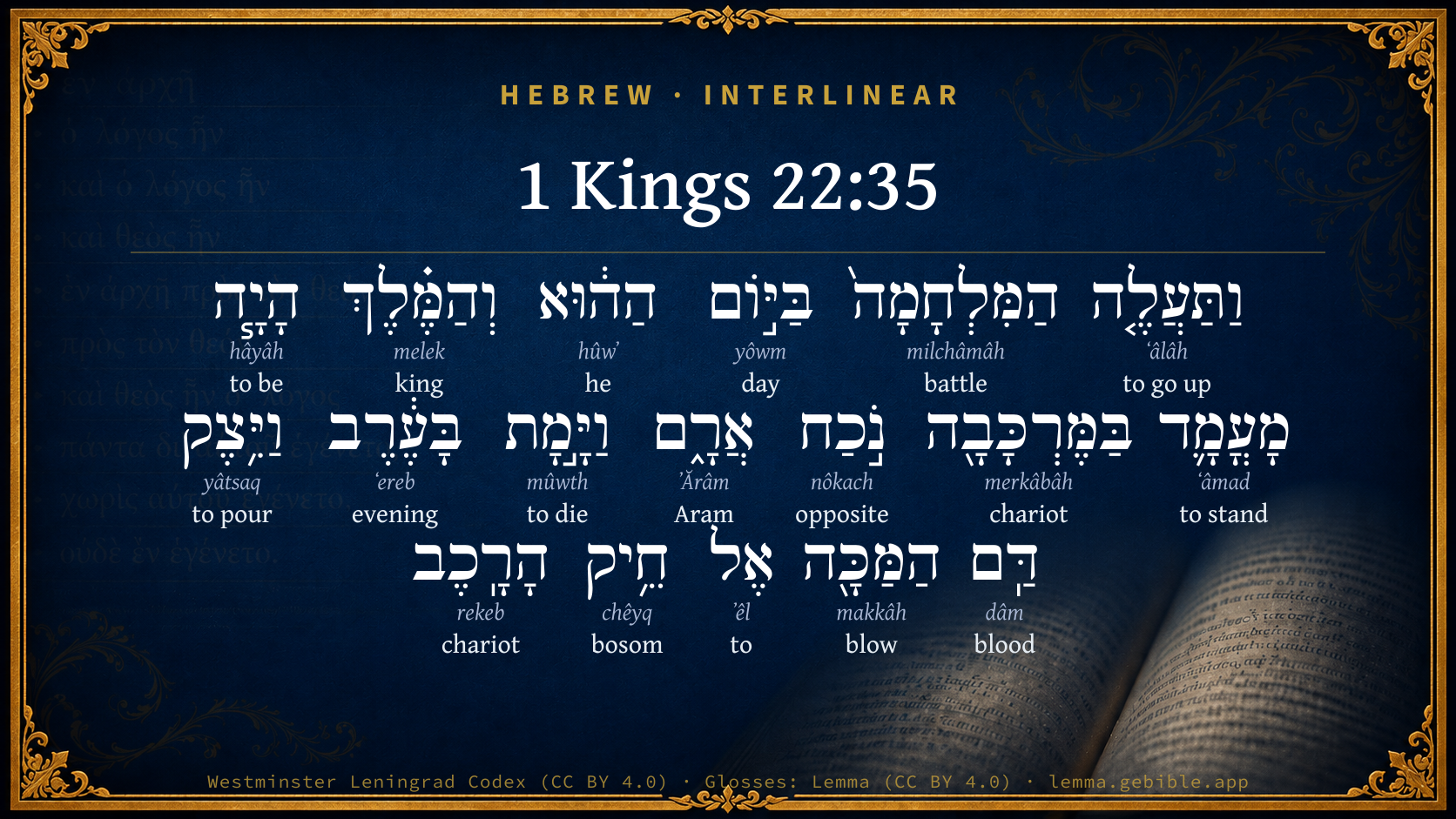
1 Kings 22:35

Hebrew (Westminster Leningrad Codex) 1 Kings 22:35 appears in the Hebrew Old Testament. The text above is from the Westminster Leningrad Codex. Each word links to its Strong’s number, a concise gloss, and parsing drawn from the Open Scriptures Hebrew Bible morphology. Click any word for its full Brown-Driver-Briggs (BDB) entry.
Download image
Cite this verse

1 Kings 22:35 (World English Bible). Public Domain. Lemma interlinear Bible study tool, https://lemma.gebible.app/v/1-kings/22/35.

Show BibTeX & RIS
BibTeX
RIS
English Translation
The battle increased that day: and the king was stayed up in his chariot against the Syrians, and died at even; and the blood ran out of the wound into the bottom of the chariot.
World English Bible · Public Domain
Download a study sheet

One document with this verse’s original text, its word-by-word gloss line, the meaning frame, cross-references with their text, attributed commentary, and full source and license credits — printable, and it pastes into notes with its structure intact.

This verse Autodidact and up

Study sheet (.html) Plain text (.txt)

A passage Seminary Student

Up to 50 verses in one chapter. A passage sheet keeps up to 6 commentary sources and 12 cross-references per verse, in the order this page ranks them, and says so on the sheet whenever that leaves anything out. Ask for a single verse and you get the Autodidact verse sheet above.

Everything on this page stays free to read, with no account — the sheet is a download of what is already on screen, not access to it.

Want to remove ads? Support Godless Engineer
Compare translations 3

The same verse in 3 English versions, stacked beneath the original-language interlinear above. Click any original word for its lexicon entry.

Each is an independent rendering of the whole verse — the interlinear is not word-aligned to these translations.

Highlighted words mark where these versions differ — a whole-verse word diff, not a word-by-word alignment.

  • World English Bible Public Domain
    The battle increased that day: and the king was stayed up in his chariot against the Syrians, and died at even; and the blood ran out of the wound into the bottom of the chariot.
  • King James Version Public Domain
    And the battle increased that day: and the king was stayed up in his chariot against the Syrians, and died at even: and the blood ran out of the wound into the midst of the chariot.
  • unfoldingWord Literal Text CC BY-SA 4.0
    And the battle went up on that day, and the king was propped up in the chariot opposite Aram. And he died in the evening, and the blood of the wound poured out onto the bosom of the chariot.

unfoldingWord Literal Text — © unfoldingWord, licensed CC BY-SA 4.0. Word-aligned USFM3 via Door43 (git.door43.org/unfoldingWord/en_ult).

Versions to compare (up to 4)

3 of 4 selected

Show all 18 translations

Every available English version of this verse, each an independent rendering of the whole verse.

  • World English Bible Public Domain
    The battle increased that day: and the king was stayed up in his chariot against the Syrians, and died at even; and the blood ran out of the wound into the bottom of the chariot.
  • Berean Standard Bible Public Domain
    The battle raged throughout that day, and the king was propped up in his chariot facing the Arameans. And the blood from his wound ran out onto the floor of the chariot, and that evening he died.
  • Majority Standard Bible Public Domain
    The battle raged throughout that day, and the king was propped up in his chariot facing the Arameans. And the blood from his wound ran out onto the floor of the chariot, and that evening he died.
  • King James Version Public Domain
    And the battle increased that day: and the king was stayed up in his chariot against the Syrians, and died at even: and the blood ran out of the wound into the midst of the chariot.
  • American Standard Version (1901) Public Domain
    And the battle increased that day: and the king was stayed up in his chariot against the Syrians, and died at even; and the blood ran out of the wound into the bottom of the chariot.
  • Revised Version (1885) Public Domain
    And the battle increased that day: and the king was stayed up in his chariot against the Syrians, and died at even: and the blood ran out of the wound into the bottom of the chariot.
  • Geneva Bible (1599) Public Domain
    And the battel encreased that day, and the King stoode still in his charet against the Aramites, and dyed at euen: and the blood ran out of the wound into the middes of the charet.
  • Douay-Rheims (1899) Public Domain
    And the battle was fought that day, and the king of Israel stood in his chariot against the Syrians, and he died in the evening: and the blood ran out of the wound into the midst of the chariot.
  • Young's Literal Translation Public Domain
    And the battle increaseth on that day, and the king hath been caused to stand in the chariot, over-against Aram, and he dieth in the evening, and the blood of the wound runneth out unto the midst of the chariot,
  • Literal Standard Version CC BY-SA 4.0
    And the battle increases on that day, and the king has been caused to stand in the chariot, in front of Aram, and he dies in the evening, and the blood of the wound runs out to the midst of the chariot,
  • Unlocked Literal Bible CC BY-SA 4.0
    The battle grew worse that day and the king was held up in his chariot facing the Arameans. He died in the evening. The blood ran out from his wound into the bottom of the chariot.
  • unfoldingWord Literal Text CC BY-SA 4.0
    And the battle went up on that day, and the king was propped up in the chariot opposite Aram. And he died in the evening, and the blood of the wound poured out onto the bosom of the chariot.
  • Darby Bible Public Domain
    And the battle increased that day; and the king was stayed up in his chariot against the Syrians, and he died at even; and the blood of the wound ran out into the hollow of the chariot.
  • World Messianic Bible Public Domain
    The battle increased that day. The king was propped up in his chariot facing the Syrians, and died at evening. The blood ran out of the wound into the bottom of the chariot.
  • Webster's Bible Public Domain
    And the battle increased that day: and the king was stayed up in his chariot against the Syrians, and died at evening: and the blood ran out of the wound into the midst of the chariot.
  • Free Bible Version CC BY-SA 4.0
    The battle lasted all day. The king of Israel was propped up in his chariot to face the Arameans, but in the evening he died. The blood had poured out of his wound onto the floor of the chariot.
  • Bible in Basic English Public Domain
    But the fight became more violent while the day went on; and the king was supported in his war-carriage facing the Aramaeans, and the floor of the carriage was covered with the blood from his wound, and by evening he was dead.
  • JPS Tanakh (1917) Public Domain
    And the battle increased that day; and the king was stayed up in his chariot against the Arameans, and died at even; and the blood ran out of the wound into the bottom of the chariot.

Literal Standard Version (2020), Covenant Press — licensed CC BY-SA 4.0. Text via the HelloAO Bible API (eBible.org). Unlocked Literal Bible (unfoldingWord) — licensed CC BY-SA 4.0. Text via the HelloAO Bible API (eBible.org). unfoldingWord Literal Text — © unfoldingWord, licensed CC BY-SA 4.0. Word-aligned USFM3 via Door43 (git.door43.org/unfoldingWord/en_ult). Free Bible Version, Dr. Jonathan Gallagher — licensed CC BY-SA 4.0. Text via the HelloAO Bible API (eBible.org).

Word by word

More ways to search: Search by grammar → Find every occurrence → Compare this word →

Practice this passage: Drill this verse → Learn its vocabulary →

נֹ֣כַח
nôkach
H5227
“opposite”
Preposition
Part of Speech
Preposition
Full BDB Definition

Origin: from the same as H5226

TWOT: 1365a

be in front of - in front of, opposite to, in the sight of, before, to the front, right on - towards the front of, in front of, on behalf of, as far as in front of
  1. וַתַּעֲלֶ֤ה ʻâlâh H5927 “and · to go up” Conjunction + Verb, Qal, Sequential Imperfect, 3rd Person, Feminine, Singular
  2. הַמִּלְחָמָה֙ milchâmâh H4421 “the · battle” Particle, Definite Article + Noun, Common, Feminine, Singular, Absolute
  3. בַּיּ֣וֹם yôwm H3117 “in/at the · day” Preposition, Determined + Noun, Common, Masculine, Singular, Absolute
  4. הַה֔וּא hûwʼ H1931 “the · he” Particle, Definite Article + Pronoun, Personal, 3rd Person, Masculine, Singular
  5. וְהַמֶּ֗לֶךְ melek H4428 “and · the · king” Conjunction + Particle, Definite Article + Noun, Common, Masculine, Singular, Absolute
  6. הָיָ֧ה hâyâh H1961 “to be” Verb, Qal, Perfect, 3rd Person, Masculine, Singular
  7. מָעֳמָ֛ד ʻâmad H5975 “stood” Verb, Hophal, Participle Passive, Masculine, Singular, Absolute
  8. בַּמֶּרְכָּבָ֖ה merkâbâh H4818 “in/at the · chariot” Preposition, Determined + Noun, Common, Feminine, Singular, Absolute
  9. אֲרָ֑ם ʼĂrâm H758 “Aram” Noun, Proper
  10. וַיָּ֣מָת mûwth H4191 “and · to die” Conjunction + Verb, Qal, Sequential Imperfect, 3rd Person, Masculine, Singular
  11. בָּעֶ֔רֶב ʻereb H6153 “in/at the · evening” Preposition, Determined + Noun, Common, Masculine, Singular, Absolute
  12. וַיִּ֥צֶק yâtsaq H3332 “and · to pour” Conjunction + Verb, Qal, Sequential Imperfect, 3rd Person, Masculine, Singular
  13. דַּֽם dâm H1818 “blood of” Noun, Common, Masculine, Singular, Construct
  14. הַמַּכָּ֖ה makkâh H4347 “the · blow” Particle, Definite Article + Noun, Common, Feminine, Singular, Absolute
  15. אֶל ʼêl H413 “to” Preposition
  16. חֵ֥יק chêyq H2436 “bosom of” Noun, Common, Masculine, Singular, Construct
  17. הָרָֽכֶב rekeb H7393 “the · chariot” Particle, Definite Article + Noun, Common, Masculine, Singular, Absolute

About this verse

These counts appear in no published source. They are computed here, from the morphology-tagged text and Lemma’s own curated glosses. What Lemma adds →

18
words
18
distinct lemmas
Historical
section

Notable vocabulary

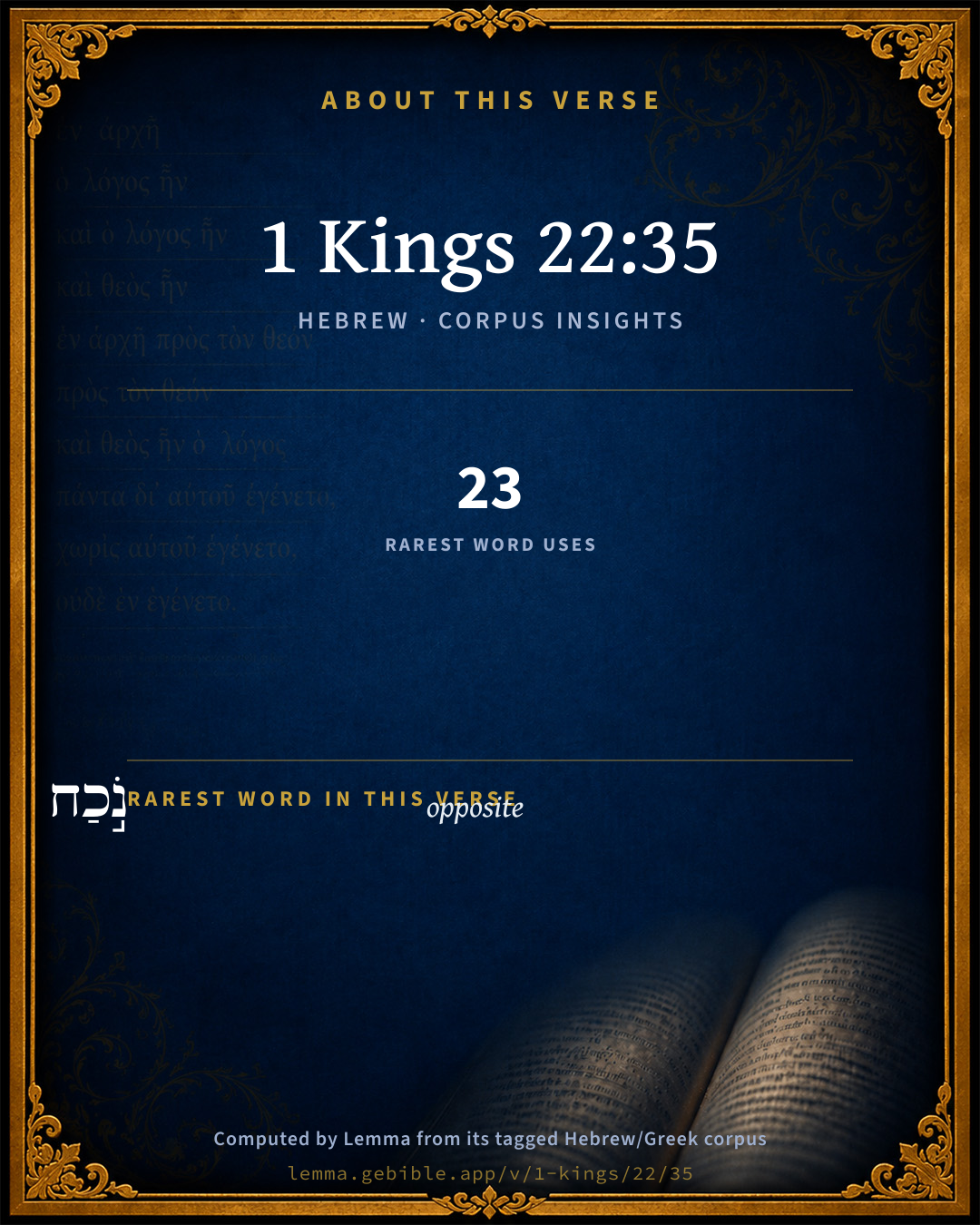
The rarest word here is נֹ֣כַח opposite H5227 — appearing just 23 times in the whole Hebrew Bible.

Shared distinctive vocabulary

נֹ֣כַח opposite H5227 occurs in 22 verses of the Hebrew Bible. Also found in:

Grammatical profile

  • 5 verbs
  • 10 nouns
  • 1 pronoun
  • 2 prepositions

Verb forms

  • וַתַּעֲלֶ֤ה Qal · Sequential Imperfect
  • הָיָ֧ה Qal · Perfect
  • מָעֳמָ֛ד Hophal · Participle Passive
  • וַיָּ֣מָת Qal · Sequential Imperfect
  • וַיִּ֥צֶק Qal · Sequential Imperfect

Hebrew & Septuagint length

In English translation the verse runs 35 words from the Hebrew and 55 from the Septuagint (LXX English) — the Septuagint runs noticeably longer here. See the side-by-side →

A rough comparison of the two English renderings, which tokenize alike — not a word-level alignment.

Word counts can differ between the Hebrew and the Greek without any difference in meaning — e.g. the Hebrew direct-object marker אֵת has no separate Greek word, and Greek often adds the article ὁ.

Cross-references

2

Topical passages linked to 1 Kings 22:35 in the Treasury of Scripture Knowledge — connected by theme and wording, ordered by reader-vote popularity; previews shown in the World English Bible.

  • 1 Kings 22:28 Micaiah said, If you return at all in peace, Yahweh has not spoken by me. He said, Hear, you peoples, all of you.
  • 1 Kings 20:42 He said to him, Thus says Yahweh, Because you have let go out of your hand the man whom I had devoted to destruction, therefore your life shall go for his life, and your people for his people.

Cross-references courtesy of OpenBible.info (CC BY 4.0).

Hebrew and Greek witnesses Masoretic Hebrew ↔ Greek Septuagint

The same verse in the two great witnesses to the Old Testament, shown verse-for-verse.

Here the Septuagint runs noticeably longer than the Hebrew — LXX2012 (modern English Septuagint) 55 words vs World English Bible 35. A rough length comparison of the two English translations, not a word-level alignment — read both below.

These are two independent witnesses, not word-aligned to each other, and the Septuagint is shown in lemma (dictionary) form.

Hebrew 1 Kings 22:35 Masoretic · Westminster Leningrad Codex

וַתַּעֲלֶ֤ה הַמִּלְחָמָה֙ בַּיּ֣וֹם הַה֔וּא וְהַמֶּ֗לֶךְ הָיָ֧ה מָעֳמָ֛ד בַּמֶּרְכָּבָ֖ה נֹ֣כַח אֲרָ֑ם וַיָּ֣מָת בָּעֶ֔רֶב וַיִּ֥צֶק דַּֽם הַמַּכָּ֖ה אֶל חֵ֥יק הָרָֽכֶב

The battle increased that day: and the king was stayed up in his chariot against the Syrians, and died at even; and the blood ran out of the wound into the bottom of the chariot.

World English Bible · Public Domain

Greek LXX 1 Kings 22:35 Septuagint · lemma form

καί τροπόω ὁ πόλεμος ἐν ὁ ἡμέρα ἐκεῖνος καί ὁ βασιλεύς εἰμί ἵστημι ἐπί ὁ ἅρμα ἐκ ἐναντίος συρία ἀπό πρωΐ ἕως ἑσπέρα καί ἀποχέω ὁ αἷμα ἐκ ὁ πληγή εἰς ὁ κόλπος ὁ ἅρμα καί ἀποθνήσκω ἑσπέρα καί ἐκπορεύομαι ὁ αἷμα ὁ τροπή ἕως ὁ κόλπος ὁ ἅρμα

And the war was turned in that day, and the king was standing on the chariot, against Syria from morning till evening; and he shed the blood out of his wound, into the bottom of the chariot, and died at even, and the blood ran out of the wound into the bottom of the chariot.

LXX2012 (modern English Septuagint) · Public Domain

On this verse, The Cambridge Bible for Schools and Colleges discusses the Septuagint’s reading. Read the note in Commentary ↓

Hebrew: Westminster Leningrad Codex (CC BY 4.0). Greek: Septuagint (public domain); English from LXX2012 (modern English Septuagint) (Public Domain). How the Septuagint differs from the Hebrew →

Targum (Aramaic paraphrase)

1

The Targum is the ancient Jewish Aramaic paraphrase of the Hebrew Scriptures — an interpretive translation, not the Hebrew text itself. Onkelos (literal) and Pseudo-Jonathan (expansive) render the Torah, and Jonathan the Prophets. Coverage is partial: where no permissively-licensed English translation exists for a verse, only the Aramaic is shown. This is verse-level text, not a word-by-word alignment to the Hebrew.

  1. Targum Jonathan Prophets (Joshua–Malachi)
    וּסְלִיקוּ עָבְדֵי קְרָבָא בְּיוֹמָא הַהוּא וּמַלְכָּא הֲוָה מַתְקֵיף וְקָאִים בִּרְתִיכָא לִקֳבֵיל אֱנַשׁ אֲרָם וּמִית בְּרַמְשָׁא וְאִתְרִיק דְמָא דִמְחָתָא לְגוֹ רְתִיכָא:

    (no public-domain English translation for this verse)

    Targum Jonathan — Aramaic: “Mikraot Gedolot” (public domain). English: “Sefaria Community Translation” (CC0 1.0 (public-domain dedication)); “London "Chaldee Paraphrase," 1871” (public domain). Text via Sefaria.

Commentary

Notes on 1 Kings 22:35 from classic Christian and Jewish commentators (each source and its license shown beneath its notes). The classic Christian expositions comment on the surrounding passage and are grouped to its opening verse, so a note may address several verses; the Jewish commentaries on the Tanakh (Rashi and others) are per-verse, so they appear only where the commentator wrote on this verse.

Lemma curates 59 commentaries, every one of them public domain or Creative Commons licensed, each selected and text-cleaned for this edition rather than reprinted as found. About our sources →

Trapp's Complete Commentary

John Trapp

1Ki 22:35 And the battle increased that day: and the king was stayed up in his chariot against the Syrians, and died at even: and the blood ran out of the wound into the midst of the chariot.

Ver. 35. And the battle increased that day.] Heb., Ascended. Josephus then is out sure, who saith that Ahab only was slain that day, and all the army escaped.

John Trapp, A Commentary or Exposition upon All the Books of the Old and New Testament (1647–1656) — public domain. Text from a community e-Sword module.

Joseph Benson's Commentary

1Ki 22:35-36. The battle increased that day — There was a sharp fight after this; insomuch that the king, for fear his soldiers should give way, would return into the field, notwithstanding his wounds, and be supported in his chariot, to encourage his army. And died at even — Finding, too late, the truth of Micaiah’s words; and Zedekiah’s horns of iron pushing, not the Syrians, but himself into destruction. And there went a proclamation throughout the host — Probably by Jehoshaphat’s order, with the consent of the chief captains of Israel. Saying, Every man to his city, &c. — It is to no purpose to attempt any thing more: the king is dead, and the battle ended; and therefore every man has liberty to return to his own city and habitation. The Syrians also, it is likely, were content to be gone, having slain their capital enemy. By this proclamation the prediction of Micaiah was exactly fulfilled, according to his vision, 1Ki 22:17.

Joseph Benson's Commentary on the Old and New Testaments (1811–1818) — public domain. Text from a community e-Sword module.

Geneva Bible (1599)

Geneva Bible translators

To wit, Ahab, king of Israel.

Geneva Bible (1599) marginal notes — public domain. Text via Bolls.life.

Adam Clarke's Commentary

Verse 35. The king was stayed up] He did not wish his misfortune should be known, lest his troops should be discouraged.

Adam Clarke's Commentary on the Bible (1810–1826) — public domain. Text from a community e-Sword/MySword module.

Ellicott's Commentary for English Readers

(35) The king was stayed up . . .—Ahab’s repentance, imperfect as it was, has at least availed to secure him a warrior’s death, before “the evil came” on his house and on Israel. Evidently he conceals the deadliness of his hurt, though it disables him from action, and bravely sustains the battle, till his strength fails. Then the news spreads, and the army disperses; but the subsequent history seems to show that no fatal defeat was incurred. This union of desperate physical bravery with moral feebleness and cowardice is common enough in history, and (as Shakespeare has delighted to show in his Macbeth) most true to nature.

A Bible Commentary for English Readers, edited by Charles John Ellicott (1878–1897) — public domain. Text from a community e-Sword module.

The Cambridge Bible for Schools and Colleges

gen. ed. J. J. S. Perowne

35. the king was stayed up in his chariot] Some attempt was doubtless made to stop the bleeding, and it was thought best that though not in the fight, Ahab should not withdraw from the field. The LXX. says ‘from morning till evening,’ thus giving the impression that the king was wounded at the very beginning of the fight. The Chronicler says ‘he stayed himself up … until the even.’ This would be inferred from our verse. There is nothing to warrant the expression of the LXX.

into the midst [R.V. bottom] of the chariot] As will be seen from the margin of A.V. the literal meaning is ‘bosom.’ The knowledge of how to stop the bleeding of a wound was not great in those days, and Ahab’s wound must have been fatal whatever had been done. At this point we are left by the Chronicler who closes his notice of these events with the death of Ahab. Israel’s history was no subject of concern for him, except where it touched on that of Judah.

The Cambridge Bible for Schools and Colleges (gen. ed. J. J. S. Perowne; Cambridge University Press, 1878–1918) — public domain. Text from a community e-Sword module.

John Gill's Exposition

Now the rest of the acts of Ahab, and all that he did, and the ivory house which he made,.... Which, being a very curious and extraordinary thing, is particularly mentioned; though perhaps it might not be made wholly of ivory, but inlaid with it; we read of ivory houses in Amo 3:15,

and all the cities that he built, are they not written in the book of the chronicles of the kings of Israel? in which the acts of his predecessors were recorded, see Kg1 14:19 not the Scripture book of Chronicles, for there none of these things are related.

John Gill's Exposition of the Whole Bible (1746–1763) — public domain (CC PDM 1.0). Text via the HelloAO Bible API.

Albert Barnes' Notes on the Bible

The battle increased - See the margin; i. e. the tide of battle rose higher. Compare Isa 8:7-8.

The king was stayed up in his chariot - The king’s wound made it impossible for him to remain standing without help; he therefore had himself supported in his chariot by attendants, in order that his soldiers might not lose heart, as they would be sure to do, if they knew of his peril. Ahab must not be denied the credit of right princely fortitude on this occasion.

The midst of the chariot - literally, as in the margin. The “bosom” of the chariot is the rounded front, with the portion of the standing board that adjoined it. Here the blood would naturally collect, forming a pool, in which the king and his charioteer must have stood.

Albert Barnes' Notes on the Bible (1834–1885) — public domain. Text from a community e-Sword/MySword module.

Haydock's Catholic Bible Commentary

Evening. Achab had only retired to the hinder ranks, while Josaphat, by his valour, maintained the day, till the death of the former put an end to the war.

George Leo Haydock (1774–1849), Haydock's Catholic Family Bible and Commentary, 1859 edition — public domain. Excludes Psalms (Douay-Rheims chapter numbering differs from Protestant) and Deuterocanonical books (Catholic canon only).

Matthew Poole's English Annotations

The battle increased, i.e. grew hot and violent.

Was stayed up; was supported by cordials, or by his servants, that by his presence he might encourage his soldiers to fight more courageously, and that he might see the event of the battle.

Matthew Poole's English Annotations on the Holy Bible (1683–1685) — public domain. Text from a community e-Sword/MySword module.

Whedon's Commentary on the Bible

Daniel D. Whedon

35. The king was stayed up — Contrary to his first directions to be carried out of the host. The first order was probably partially obeyed; but as the king on retiring saw the battle waxing hotter and hotter, he thought it better for him to stay and witness the fight, and encourage his own troops as far as his disguised presence might serve to do so.

The midst — Or, bosom, of the chariot; the hollow place inside where the warriors stood.

Daniel D. Whedon (gen. ed.), Commentary on the Old and New Testaments (1874–1909) — public domain. Text from a community e-Sword module.

The Pulpit Commentary

And the battle increased Heb. went up. Marg. ascended. The tide of warfare rose higher and higher. Both Keil and Bahr think that the image is taken from a swelling river and cite Isa_8:7. The object of this verse is to explain how it was that the king"s request was not complied with that day: and the king was stayed up in his chariot Heb. made to stand. LXX hjn ejsthkwv. He was supported in his chariot by some of his servants, and maintained in an erect posture. Chariots were destitute of seats. According to Thenius and Keil, he maintained himself erect, by his own strength. But the word is passive against the Syrians Heb. in the face of the Syrians. jk"nO, coram . His back was not turned to them, as he had desired. The idea that he was in any way fighting against the Syrians is altogether foreign to the text. It is at first sight somewhat difficult to reconcile this statement with the direction given to the charioteer in the preceding verse, and some have been led, though without sufficient warrant, to conclude that Ahab left the field, had he wound bound up, and then returned to take his part in the battle. But the explanation is very simple. As the battle increased, it became impossible to comply with the king"s desire. So thick was the fight that retreat was impossible. Hence the wounded king, who would otherwise have sunk down to the bottom of the chariot, had to be "stayed up in the presence of the Syrians." This circumstance may also account for the fact that he died at even. Had it been possible to remove him and staunch his wounds, he might have lingered for some time. As it was, he bled to death. It is not clear, therefore, that "his death was kingly" (Kitto), or that we must concede to Ahab "the credit of right princely fortitude on this occasion" (Rawlinson). He would have left the host could he have done so. It was his set-rants propped up the dying man in his chariot, to encourage the army. What a picture for an artist the king with the pallor of death spreading over his face, the anxious faces of the attendants, the pool of blood, the sun sinking to the horizon, etc., and died at even: and the blood ran out of the wound Heb. the blood of the wound poured into the midst Heb. bosom; LXX kolpon, the hollow part, or "well." The same word is used of the concave part of the altar of the chariot.

The Pulpit Commentary (1880–1919), ed. H.D.M. Spence-Jones & Joseph S. Exell — public domain. Text from a community e-Sword module.

unfoldingWord translationNotes

Door43 World Missions Community

the king was held up in his chariot

This can be stated in active form. AT: "someone held the king up in his chariot" (See: Active or Passive)

a cry went up

Here "a cry" represents the soldiers who were shouting. AT: "soldiers began to shout" (See: Metonymy)

Every man should go back to his city; and every man should go back to his region

These two phrases mean basically the same thing and are combined for emphasis. (See: Parallelism)

translationWords

die

blood

unfoldingWord translationNotes — © Distant Shores Media and the Door43 World Missions Community, licensed CC BY-SA 4.0. Source: git.door43.org/Door43/en_tn.

Rashi

Rabbi Shlomo Yitzchaki (Rashi)

Stood up in the chariot. He exerted himself and stood so that the [Bnei] Yisroel would not become aware of his wound and flee, for flight is the beginning of defeat.

Rashi on the Tanakh — English translations: “The Judaica Press complete Tanach with Rashi, translated by A. J. Rosenberg” (CC BY 4.0); “Pentateuch with Rashi's commentary by M. Rosenbaum and A.M. Silbermann, 1929-1934” (public domain); “The Metsudah Tanach series, Lakewood, N.J” (CC BY 4.0); and “The Book of Joshua, Metsudah Publications, 1997” (CC BY 4.0). Text via Sefaria.

Lesson kit

Teaching starters — assembled from the data on this page, not authored interpretation. Every prompt links to the verse data it draws on. Edit before teaching.

1 Kings, in the Historical, opens this verse with 18 words (18 distinct Hebrew lemmas). Its most distinctive word is nôkach (“opposite”). The Greek Septuagint runs longer here. A historical commentator’s framing appears above. Read the whole chapter for the surrounding context.

Discussion questions

  1. How does “opposite” (nôkach) shape what this verse is saying?
  2. How does Genesis 25:21, which shares the word «opposite», read alongside this verse?
  3. The Septuagint runs longer here than the Hebrew. What might account for the difference?
  4. The translations on this page render this verse differently — a whole-verse word diff, not a word-by-word alignment. What might account for the different wordings?
  5. «וַתַּעֲלֶ֤ה» is a Qal Sequential Imperfect verb. How does that grammatical form shape the action described?
  6. Compare how Trapp's Complete Commentary and Joseph Benson's Commentary read this verse. Where do they agree or differ?

Things to notice

Reading settings

Reading text

Shown beneath each verse's original-language words.

Old Testament
Old Testament edition

Read the OT as the Masoretic Hebrew (MT) or the Greek Septuagint (LXX).

English shown for the Greek Septuagint (in the Hebrew ↔ Greek comparison).

Comparing translations? Open the Compare panel on any verse page to stack up to four side by side.