Deuteronomy 21:9

Hebrew (Westminster Leningrad Codex) Deuteronomy 21:9 appears in the Hebrew Old Testament. The text above is from the Westminster Leningrad Codex. Each word links to its Strong’s number, a concise gloss, and parsing drawn from the Open Scriptures Hebrew Bible morphology. Click any word for its full Brown-Driver-Briggs (BDB) entry.
Download image
Cite this verse

Deuteronomy 21:9 (World English Bible). Public Domain. Lemma interlinear Bible study tool, https://lemma.gebible.app/v/deuteronomy/21/9.

Show BibTeX & RIS
BibTeX
RIS
English Translation
So shall you put away the innocent blood from the midst of you, when you shall do that which is right in the eyes of Yahweh.
World English Bible · Public Domain
Download a study sheet

One document with this verse’s original text, its word-by-word gloss line, the meaning frame, cross-references with their text, attributed commentary, and full source and license credits — printable, and it pastes into notes with its structure intact.

This verse Autodidact and up

Study sheet (.html) Plain text (.txt)

A passage Seminary Student

Up to 50 verses in one chapter. A passage sheet keeps up to 6 commentary sources and 12 cross-references per verse, in the order this page ranks them, and says so on the sheet whenever that leaves anything out. Ask for a single verse and you get the Autodidact verse sheet above.

Everything on this page stays free to read, with no account — the sheet is a download of what is already on screen, not access to it.

Want to remove ads? Support Godless Engineer
Compare translations 3

The same verse in 3 English versions, stacked beneath the original-language interlinear above. Click any original word for its lexicon entry.

Each is an independent rendering of the whole verse — the interlinear is not word-aligned to these translations.

Highlighted words mark where these versions differ — a whole-verse word diff, not a word-by-word alignment.

  • World English Bible Public Domain
    So shall you put away the innocent blood from the midst of you, when you shall do that which is right in the eyes of Yahweh.
  • King James Version Public Domain
    So shalt thou put away the guilt of innocent blood from among you, when thou shalt do that which is right in the sight of the LORD.
  • unfoldingWord Literal Text CC BY-SA 4.0
    And you shall remove the blood of the innocent from your midst, when you do right in the eyes of Yahweh.

unfoldingWord Literal Text — © unfoldingWord, licensed CC BY-SA 4.0. Word-aligned USFM3 via Door43 (git.door43.org/unfoldingWord/en_ult).

Versions to compare (up to 4)

3 of 4 selected

Show all 18 translations

Every available English version of this verse, each an independent rendering of the whole verse.

  • World English Bible Public Domain
    So shall you put away the innocent blood from the midst of you, when you shall do that which is right in the eyes of Yahweh.
  • Berean Standard Bible Public Domain
    So you shall purge from among you the guilt of shedding innocent blood, since you have done what is right in the eyes of the LORD.
  • Majority Standard Bible Public Domain
    So you shall purge from among you the guilt of shedding innocent blood, since you have done what is right in the eyes of the LORD.
  • King James Version Public Domain
    So shalt thou put away the guilt of innocent blood from among you, when thou shalt do that which is right in the sight of the LORD.
  • American Standard Version (1901) Public Domain
    So shalt thou put away the innocent blood from the midst of thee, when thou shalt do that which is right in the eyes of Jehovah.
  • Revised Version (1885) Public Domain
    So shalt thou put away the innocent blood from the midst of thee, when thou shalt do that which is right in the eyes of the LORD.
  • Geneva Bible (1599) Public Domain
    So shalt thou take away the cry of innocet blood from thee, when thou shalt do that which is right in the sight of the Lord.
  • Douay-Rheims (1899) Public Domain
    And thou shalt be free from the innocent's blood, that was shed, when thou shalt have done what the Lord hath commanded thee.
  • Young's Literal Translation Public Domain
    and thou dost put away the innocent blood out of thy midst, for thou dost that which `is' right in the eyes of Jehovah.
  • Literal Standard Version CC BY-SA 4.0
    and you put away the innocent blood out of your midst, for you do that which [is] right in the eyes of YHWH.
  • Unlocked Literal Bible CC BY-SA 4.0
    In this way you will put away the innocent blood from your midst, when you do what is right in the eyes of Yahweh.
  • unfoldingWord Literal Text CC BY-SA 4.0
    And you shall remove the blood of the innocent from your midst, when you do right in the eyes of Yahweh.
  • Darby Bible Public Domain
    So shalt thou put away innocent blood from thy midst, when thou shalt do what is right in the eyes of Jehovah.
  • World Messianic Bible Public Domain
    So you shall put away the innocent blood from among you, when you shall do that which is right in the LORD’s eyes.
  • Webster's Bible Public Domain
    So shalt thou remove the guilt of innocent blood from among you, when thou shalt do that which is right in the sight of the LORD.
  • Free Bible Version CC BY-SA 4.0
    This is how you are to remove from yourselves the guilt of shedding innocent blood, since you have done what is right in the Lord's sight.
  • Bible in Basic English Public Domain
    So you will take away the crime of a death without cause from among you, when you do what is right in the eyes of the Lord.
  • JPS Tanakh (1917) Public Domain
    So shalt thou put away the innocent blood from the midst of thee, when thou shalt do that which is right in the eyes of the LORD.

Literal Standard Version (2020), Covenant Press — licensed CC BY-SA 4.0. Text via the HelloAO Bible API (eBible.org). Unlocked Literal Bible (unfoldingWord) — licensed CC BY-SA 4.0. Text via the HelloAO Bible API (eBible.org). unfoldingWord Literal Text — © unfoldingWord, licensed CC BY-SA 4.0. Word-aligned USFM3 via Door43 (git.door43.org/unfoldingWord/en_ult). Free Bible Version, Dr. Jonathan Gallagher — licensed CC BY-SA 4.0. Text via the HelloAO Bible API (eBible.org).

Word by word

More ways to search: Search by grammar → Find every occurrence → Compare this word →

Practice this passage: Drill this verse → Learn its vocabulary →

הַנָּקִ֖י
nâqîy
H5355
“the · innocent”
Particle, Definite Article + Adjective, Adjective, Masculine, Singular, Absolute
Part of Speech
Particle + Adjective
Type
Adjective
Gender
Masculine
Number
Singular
State
Absolute
Full BDB Definition

Origin: from H5352

TWOT: 1412a , 1412b

clean, free from, exempt, clear, innocent - free from guilt, clean, innocent - free from punishment - free or exempt from obligations - innocent
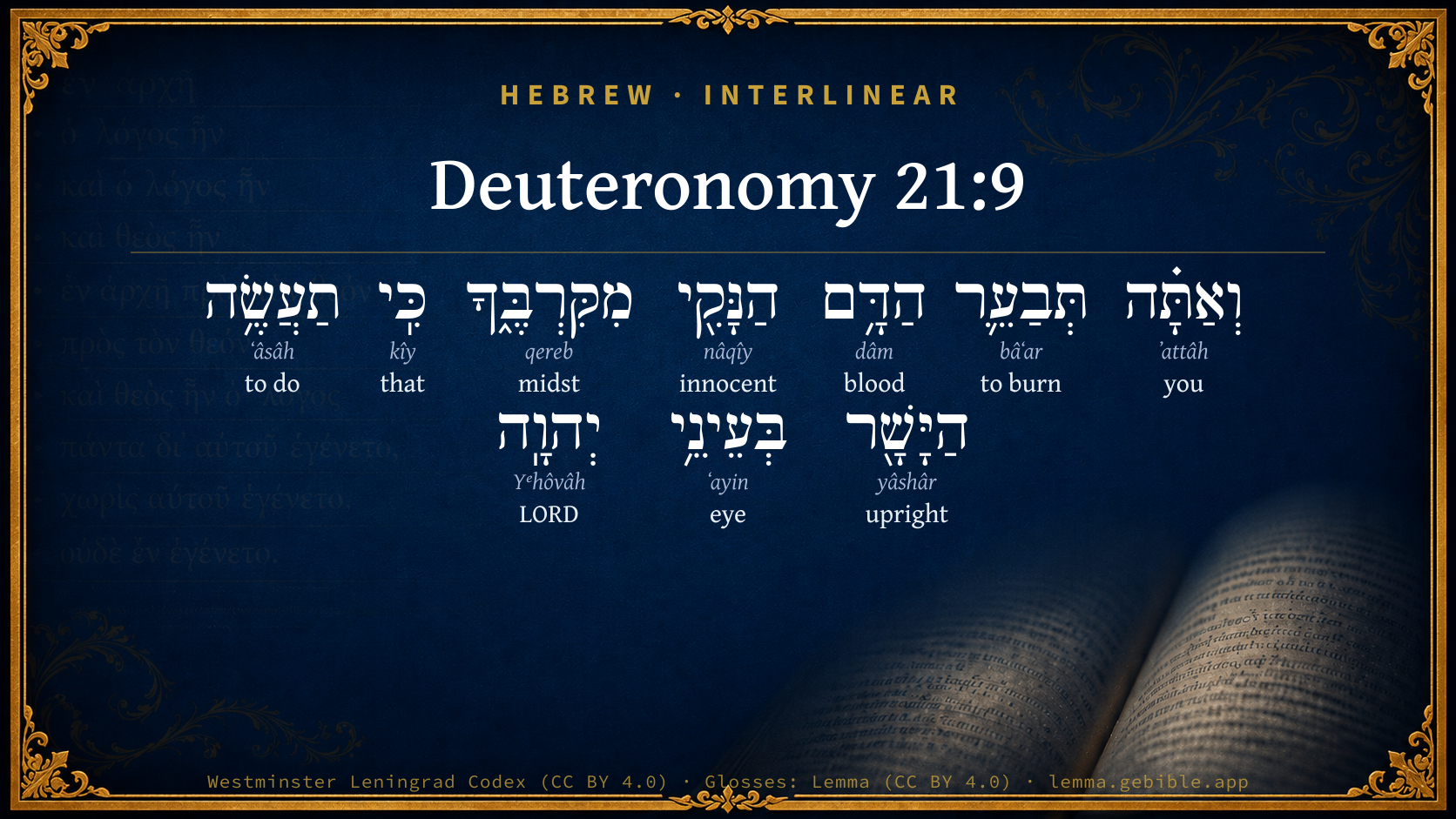
  1. וְאַתָּ֗ה ʼattâh H859 “and · you” Conjunction + Pronoun, Personal, 2nd Person, Masculine, Singular
  2. תְּבַעֵ֛ר bâʻar H1197 “to burn” Verb, Piel, Imperfect, 2nd Person, Masculine, Singular
  3. הַדָּ֥ם dâm H1818 “the · blood” Particle, Definite Article + Noun, Common, Masculine, Singular, Absolute
  4. מִקִּרְבֶּ֑ךָ qereb H7130 “from · midst · your” Preposition + Noun, Common, Masculine, Singular, Construct + Suffix, Personal, 2nd Person, Masculine, Singular
  5. כִּֽי kîy H3588 “that” Conjunction
  6. תַעֲשֶׂ֥ה ʻâsâh H6213 “to do” Verb, Qal, Imperfect, 2nd Person, Masculine, Singular
  7. הַיָּשָׁ֖ר yâshâr H3477 “the · upright” Particle, Definite Article + Adjective, Adjective, Masculine, Singular, Absolute
  8. בְּעֵינֵ֥י ʻayin H5869 “in/at · eyes of” Preposition + Noun, Common, Both, Dual, Construct
  9. יְהוָֽה Yᵉhôvâh H3068 “LORD” Noun, Proper

About this verse

These counts appear in no published source. They are computed here, from the morphology-tagged text and Lemma’s own curated glosses. What Lemma adds →

10
words
10
distinct lemmas
Pentateuch
section

Shared distinctive vocabulary

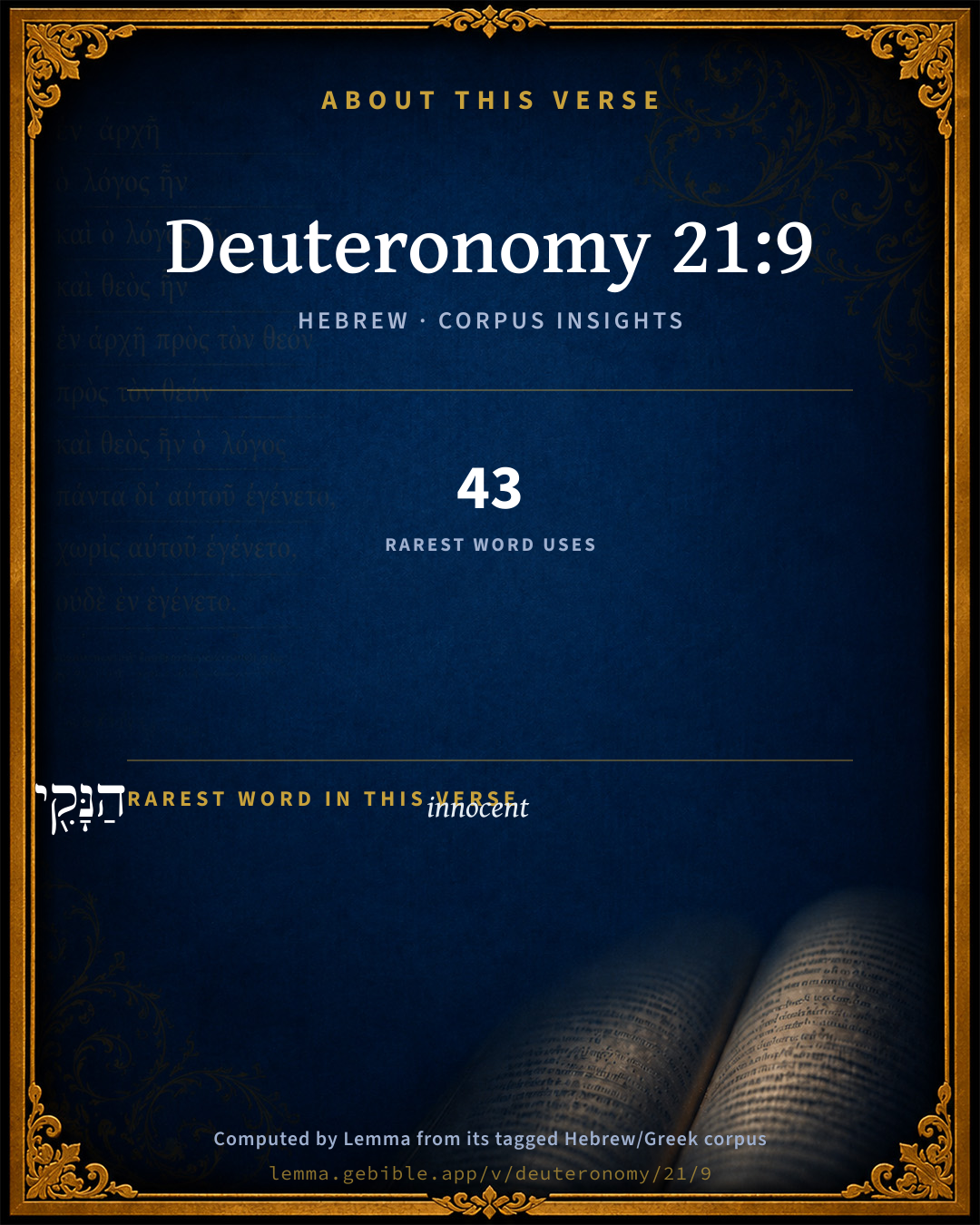
הַנָּקִ֖י innocent H5355 occurs in 42 verses of the Hebrew Bible. Also found in:

Grammatical profile

  • 2 verbs
  • 4 nouns
  • 2 adjectives
  • 1 pronoun
  • 1 conjunction

Verb forms

  • תְּבַעֵ֛ר Piel · Imperfect
  • תַעֲשֶׂ֥ה Qal · Imperfect

Hebrew & Septuagint length

In English translation the verse runs 26 words from the Hebrew and 25 from the Septuagint (LXX English) — closely comparable.

A rough comparison of the two English renderings, which tokenize alike — not a word-level alignment.

Word counts can differ between the Hebrew and the Greek without any difference in meaning — e.g. the Hebrew direct-object marker אֵת has no separate Greek word, and Greek often adds the article ὁ.

Cross-references

3

Topical passages linked to Deuteronomy 21:9 in the Treasury of Scripture Knowledge — connected by theme and wording, ordered by reader-vote popularity; previews shown in the World English Bible.

  • Deuteronomy 13:18 when you shall listen to the voice of Yahweh your God, to keep all his commandments which I command you this day, to do that which is right in the eyes of Yahweh your God.
  • Deuteronomy 19:12–13 then the elders of his city shall send and bring him there, and deliver him into the hand of the avenger of blood, that he may die.
  • 2 Kings 10:30–31 Yahweh said to Jehu, Because you have done well in executing that which is right in my eyes, [and] have done to the house of Ahab according to all that was in my heart, your sons of the fourth generation shall sit on the throne of Israel.

Cross-references courtesy of OpenBible.info (CC BY 4.0).

Hebrew and Greek witnesses Masoretic Hebrew ↔ Greek Septuagint

The same verse in the two great witnesses to the Old Testament, shown verse-for-verse.

These are two independent witnesses, not word-aligned to each other, and the Septuagint is shown in lemma (dictionary) form.

Hebrew Deuteronomy 21:9 Masoretic · Westminster Leningrad Codex

וְאַתָּ֗ה תְּבַעֵ֛ר הַדָּ֥ם הַנָּקִ֖י מִקִּרְבֶּ֑ךָ כִּֽי תַעֲשֶׂ֥ה הַיָּשָׁ֖ר בְּעֵינֵ֥י יְהוָֽה

So shall you put away the innocent blood from the midst of you, when you shall do that which is right in the eyes of Yahweh.

World English Bible · Public Domain

Greek LXX Deuteronomy 21:9 Septuagint · lemma form

σύ δέ ἐκαἴρω ὁ αἷμα ὁ ἀναίτιος ἐκ σύ αὐτός ἐάν ποιέω ὁ καλός καί ὁ ἀρεστός ἔναντι κύριος ὁ θεός σύ

And you shall take away innocent blood from among you, if you should do that which is good and pleasing before the Lord your God.

LXX2012 (modern English Septuagint) · Public Domain

Hebrew: Westminster Leningrad Codex (CC BY 4.0). Greek: Septuagint (public domain); English from LXX2012 (modern English Septuagint) (Public Domain). How the Septuagint differs from the Hebrew →

Targum (Aramaic paraphrase)

2

The Targum is the ancient Jewish Aramaic paraphrase of the Hebrew Scriptures — an interpretive translation, not the Hebrew text itself. Onkelos (literal) and Pseudo-Jonathan (expansive) render the Torah, and Jonathan the Prophets. Coverage is partial: where no permissively-licensed English translation exists for a verse, only the Aramaic is shown. This is verse-level text, not a word-by-word alignment to the Hebrew.

  1. Targum Onkelos Torah (Genesis–Deuteronomy)
    וְאַתְּ תְּפַלֵי אַשְׁדִי דַם זַכַּי מִבֵּינָךְ אֲרֵי תַעְבֵּד דְכָשַׁר קֳדָם יְיָ: ססס

    (no public-domain English translation for this verse)

    Targum Onkelos — Aramaic: “Onkelos Genesis” (public domain); “Onkelos Exodus” (public domain); “Onkelos Leviticus” (public domain); “Onkelos Numbers” (public domain); “Onkelos Deuteronomy” (public domain). English: “Sefaria Community Translation” (CC0 1.0 (public-domain dedication)); “J.W. Etheridge. The Targums of Onkelos and Jonathan Ben Uzziel on the Pentateuch. London: Longmans, Green, 1862” (public domain). Text via Sefaria.

  2. Targum Pseudo-Jonathan Torah (Genesis–Deuteronomy)
    וְאַתּוּן בֵּית יִשְרָאֵל תְּפַלוּן מִשְׁדֵי דַם זַכַּאי מִבֵּינֵיכוֹן אֲרוּם תַּעַבְדוּן דְכָשַׁר קֳדָם יְיָ

    So shall you, O house of Israel, put away from among you whosoever sheddeth innocent blood, that you may do what is right before the Lord.

    Targum Pseudo-Jonathan — Aramaic: “Targum Jonathan on Genesis” (public domain); “Targum Jonathan on Exodus” (public domain); “Targum Jonathan on Leviticus” (public domain); “Targum Jonathan on Numbers” (public domain); “Targum Jonathan on Deuteronomy” (public domain). English: “The Targum of Jonathan ben Uzziel, trans. J. W. Etheridge, London, 1862” (public domain). Text via Sefaria.

Commentary

Notes on Deuteronomy 21:9 from classic Christian and Jewish commentators (each source and its license shown beneath its notes). The classic Christian expositions comment on the surrounding passage and are grouped to its opening verse, so a note may address several verses; the Jewish commentaries on the Tanakh (Rashi and others) are per-verse, so they appear only where the commentator wrote on this verse.

Lemma curates 59 commentaries, every one of them public domain or Creative Commons licensed, each selected and text-cleaned for this edition rather than reprinted as found. About our sources →

Joseph Benson's Commentary

Deu 21:9. So shalt thou put away the guilt of innocent blood — Till this was done, the guilt was to be looked upon as national; but upon this being solemnly performed, the government was deemed to have done its duty, and the nation cleared of all guilt in this matter. No doubt the chief end of the appointment of this ceremony was to beget and preserve in the minds of men an abhorrence of murder, and a care to prevent or detect it.

Joseph Benson's Commentary on the Old and New Testaments (1811–1818) — public domain. Text from a community e-Sword module.

The Cambridge Bible for Schools and Colleges

gen. ed. J. J. S. Perowne

9. So shalt thou put away] Heb. and thou, thou shalt put away, an emphatic variation of the formula with which D usually closes similar laws (see Deu_13:5, (6), Deu_19:13, etc.), as if he only now resumed his own words.

when thou shalt do, etc.] To make the construction right we should prefix to this clause, the words that it may be well with thee. See Deu_6:18.

The Cambridge Bible for Schools and Colleges (gen. ed. J. J. S. Perowne; Cambridge University Press, 1878–1918) — public domain. Text from a community e-Sword module.

John Gill's Exposition

So shalt thou put away the guilt of innocent blood from among you,.... Which otherwise, the person not being found out, and brought to just punishment for it, would devolve upon the whole. Aben Ezra interprets it the punishment of innocent blood, which, by the above method being taken, would not be inflicted on them:

when thou shalt do that which is right in the sight of the Lord; as it was to observe this law concerning the beheading of the heifer, with all the rites and ceremonies belonging to it here enjoined; as well as every other command, statute, and ordinance of the Lord, which are all right to be done, Psa 19:8.

John Gill's Exposition of the Whole Bible (1746–1763) — public domain (CC PDM 1.0). Text via the HelloAO Bible API.

Haydock's Catholic Bible Commentary

And, &c. Hebrew, "Thou shalt put away," (Haydock) or "extinguish the voice of innocent blood," which otherwise would cry to heaven for vengeance, Genesis iv. 10. In this sacrifice, (Calmet) though it deserves not the name, (Menochius) we may consider Jesus Christ suffering for the sins of others. (Calmet)

George Leo Haydock (1774–1849), Haydock's Catholic Family Bible and Commentary, 1859 edition — public domain. Excludes Psalms (Douay-Rheims chapter numbering differs from Protestant) and Deuterocanonical books (Catholic canon only).

The Pulpit Commentary

In this way they were to deliver themselves as a nation from blood-guiltiness. "Expiation was made by the killing of the transgressor when he could be found (Deu_19:13; Num_35:33) when he was not known, by the process here described. Of course, if afterwards he were apprehended, he would suffer the penalty he had incurred" (Knobel); so also Keil, Herxheimer, etc., after the Talmud ("Sota," 9:7).

The Pulpit Commentary (1880–1919), ed. H.D.M. Spence-Jones & Joseph S. Exell — public domain. Text from a community e-Sword module.

Rashi

Rabbi Shlomo Yitzchaki (Rashi)

ואתה תבער BUT THOU SHALT PUT AWAY [THE GUILT OF INNOCENT BLOOD FROM AMONG YOU] — This teaches that if the murderer is found after the heifer’s neck was broken he must nevertheless be put to death, — and this is what Scripture describes as הישר בעיני ה׳ RIGHT IN THE EYES OF THE LORD (cf. Sotah 47b; Ketubot 37b and Tosafot on Ketubot 37b:16.1 ואח"כ נמצא ההורג).

Rashi on the Tanakh — English translations: “The Judaica Press complete Tanach with Rashi, translated by A. J. Rosenberg” (CC BY 4.0); “Pentateuch with Rashi's commentary by M. Rosenbaum and A.M. Silbermann, 1929-1934” (public domain); “The Metsudah Tanach series, Lakewood, N.J” (CC BY 4.0); and “The Book of Joshua, Metsudah Publications, 1997” (CC BY 4.0). Text via Sefaria.

Lesson kit

Teaching starters — assembled from the data on this page, not authored interpretation. Every prompt links to the verse data it draws on. Edit before teaching.

Deuteronomy, in the Pentateuch, opens this verse with 10 words (10 distinct Hebrew lemmas). Its most distinctive word is nâqîy (“innocent”). A historical commentator’s framing appears above. Read the whole chapter for the surrounding context.

Discussion questions

  1. How does “innocent” (nâqîy) shape what this verse is saying?
  2. How does Genesis 24:41, which shares the word «innocent», read alongside this verse?
  3. These translations render this verse differently; the difference is in the English rendering, not the original. What questions does that raise?
  4. «תְּבַעֵ֛ר» is a Piel Imperfect verb. How does that grammatical form shape the action described?
  5. Compare how Joseph Benson's Commentary and The Cambridge Bible for Schools and Colleges read this verse. Where do they agree or differ?

Things to notice

Reading settings

Reading text

Shown beneath each verse's original-language words.

Old Testament
Old Testament edition

Read the OT as the Masoretic Hebrew (MT) or the Greek Septuagint (LXX).

English shown for the Greek Septuagint (in the Hebrew ↔ Greek comparison).

Comparing translations? Open the Compare panel on any verse page to stack up to four side by side.