
2 Samuel 23:17

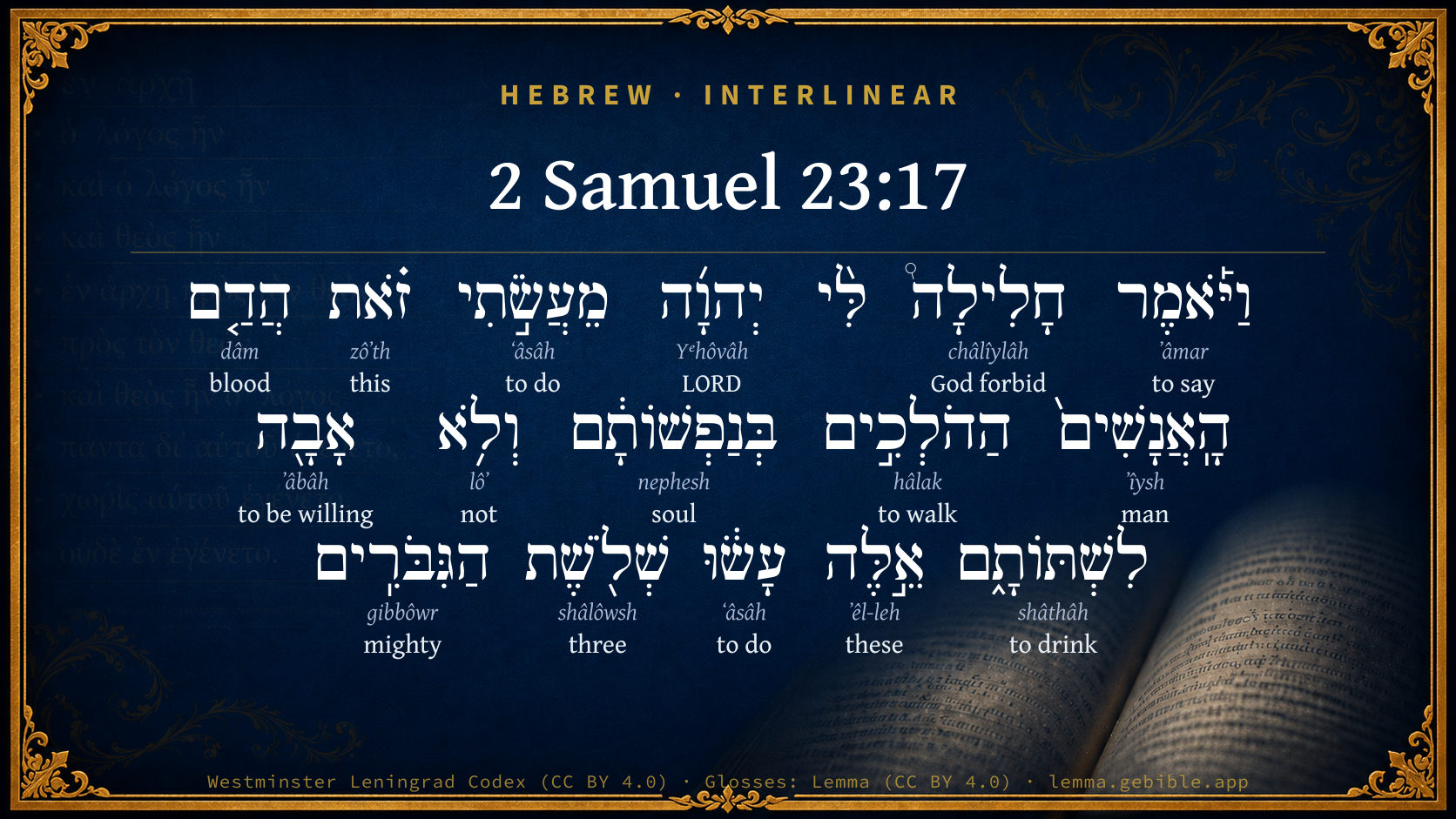
Hebrew (Westminster Leningrad Codex) 2 Samuel 23:17 appears in the Hebrew Old Testament. The text above is from the Westminster Leningrad Codex. Each word links to its Strong’s number, a concise gloss, and parsing drawn from the Open Scriptures Hebrew Bible morphology. Click any word for its full Brown-Driver-Briggs (BDB) entry.
Download image
Cite this verse

2 Samuel 23:17 (World English Bible). Public Domain. Lemma interlinear Bible study tool, https://lemma.gebible.app/v/2-samuel/23/17.

Show BibTeX & RIS
BibTeX
RIS
English Translation
He said, Be it far from me, Yahweh, that I should do this: [shall I drink] the blood of the men who went in jeopardy of their lives? therefore he would not drink it. These things did the three mighty men.
World English Bible · Public Domain
Download a study sheet

One document with this verse’s original text, its word-by-word gloss line, the meaning frame, cross-references with their text, attributed commentary, and full source and license credits — printable, and it pastes into notes with its structure intact.

This verse Autodidact and up

Study sheet (.html) Plain text (.txt)

A passage Seminary Student

Up to 50 verses in one chapter. A passage sheet keeps up to 6 commentary sources and 12 cross-references per verse, in the order this page ranks them, and says so on the sheet whenever that leaves anything out. Ask for a single verse and you get the Autodidact verse sheet above.

Everything on this page stays free to read, with no account — the sheet is a download of what is already on screen, not access to it.

Want to remove ads? Support Godless Engineer
Compare translations 3

The same verse in 3 English versions, stacked beneath the original-language interlinear above. Click any original word for its lexicon entry.

Each is an independent rendering of the whole verse — the interlinear is not word-aligned to these translations.

Highlighted words mark where these versions differ — a whole-verse word diff, not a word-by-word alignment.

  • World English Bible Public Domain
    He said, Be it far from me, Yahweh, that I should do this: [shall I drink] the blood of the men who went in jeopardy of their lives? therefore he would not drink it. These things did the three mighty men.
  • King James Version Public Domain
    And he said, Be it far from me, O LORD, that I should do this: is not this the blood of the men that went in jeopardy of their lives? therefore he would not drink it. These things did these three mighty men.
  • unfoldingWord Literal Text CC BY-SA 4.0
    And he said, “Profane to me, Yahweh, from my doing this, the blood of the men having gone with their lives!” And he was not willing to drink it. These the three warriors did.

unfoldingWord Literal Text — © unfoldingWord, licensed CC BY-SA 4.0. Word-aligned USFM3 via Door43 (git.door43.org/unfoldingWord/en_ult).

Versions to compare (up to 4)

3 of 4 selected

Show all 18 translations

Every available English version of this verse, each an independent rendering of the whole verse.

  • World English Bible Public Domain
    He said, Be it far from me, Yahweh, that I should do this: [shall I drink] the blood of the men who went in jeopardy of their lives? therefore he would not drink it. These things did the three mighty men.
  • Berean Standard Bible Public Domain
    saying, “Far be it from me, O LORD, to do this! Is this not the blood of the men who risked their lives?” So he refused to drink it. Such were the exploits of the three mighty men.
  • Majority Standard Bible Public Domain
    saying, “Far be it from me, O LORD, to do this! Is this not the blood of the men who risked their lives?” So he refused to drink it. Such were the exploits of the three mighty men.
  • King James Version Public Domain
    And he said, Be it far from me, O LORD, that I should do this: is not this the blood of the men that went in jeopardy of their lives? therefore he would not drink it. These things did these three mighty men.
  • American Standard Version (1901) Public Domain
    And he said, Be it far from me, O Jehovah, that I should do this: `shall I drink' the blood of the men that went in jeopardy of their lives? therefore he would not drink it. These things did the three mighty men.
  • Revised Version (1885) Public Domain
    And he said, Be it far from me, O LORD, that I should do this: shall I drink the blood of the men that went in jeopardy of their lives? therefore he would not drink it. These things did the three mighty men.
  • Geneva Bible (1599) Public Domain
    And said, O Lord, be it farre from me, that I should doe this. Is not this the blood of the men that went in ieopardie of their liues? therefore he woulde not drinke it. These things did these three mightie men.
  • Douay-Rheims (1899) Public Domain
    Saying: The Lord be merciful to me, that I may not do this: shall I drink the blood of these men that went, and the peril of their lives? therefore he would not drink. These things did these three mighty men.
  • Young's Literal Translation Public Domain
    and saith, `Far be it from me, O Jehovah, to do this; is it the blood of the men who are going with their lives?' and he was not willing to drink it; these `things' did the three mighty ones.
  • Literal Standard Version CC BY-SA 4.0
    and says, “Far be it from me, O YHWH, to do this; is it the blood of the men who are going with their lives?” And he was not willing to drink it; the three mighty ones did these [things].
  • Unlocked Literal Bible CC BY-SA 4.0
    Then he said, “Yahweh, far be it from me, that I should do this. Should I drink the blood of men who have risked their lives?” So he refused to drink it. These things were done by the three mighty.
  • unfoldingWord Literal Text CC BY-SA 4.0
    And he said, “Profane to me, Yahweh, from my doing this, the blood of the men having gone with their lives!” And he was not willing to drink it. These the three warriors did.
  • Darby Bible Public Domain
    And he said, Be it far from me, Jehovah, that I should do this thing! is it not the blood of the men that went at the risk of their lives? Therefore he would not drink it. These things did the three mighty men.
  • World Messianic Bible Public Domain
    He said, “Be it far from me, LORD, that I should do this! Isn’t this the blood of the men who risked their lives to go?” Therefore he would not drink it. The three mighty men did these things.
  • Webster's Bible Public Domain
    And he said, Be it far from me, O LORD, that I should do this: is not this the blood of the men that went in jeopardy of their lives? therefore he would not drink it. These things did these three mighty men.
  • Free Bible Version CC BY-SA 4.0
    “Lord, never let me do this!” he said. “Isn't it like drinking the blood of these men who risked their lives?” So he did not drink it. These are just some of the things the Three leading warriors did.
  • Bible in Basic English Public Domain
    And he said, Far be it from me, O Lord, to do this; how may I take as my drink the life-blood of men who have put their lives in danger? So he would not take it. These things did the three great men of war.
  • JPS Tanakh (1917) Public Domain
    And he said: 'Be it far from me, O LORD, that I should do this; shall I drink the blood of the men that went in jeopardy of their lives?' therefore he would not drink it. These things did the three mighty men.

Literal Standard Version (2020), Covenant Press — licensed CC BY-SA 4.0. Text via the HelloAO Bible API (eBible.org). Unlocked Literal Bible (unfoldingWord) — licensed CC BY-SA 4.0. Text via the HelloAO Bible API (eBible.org). unfoldingWord Literal Text — © unfoldingWord, licensed CC BY-SA 4.0. Word-aligned USFM3 via Door43 (git.door43.org/unfoldingWord/en_ult). Free Bible Version, Dr. Jonathan Gallagher — licensed CC BY-SA 4.0. Text via the HelloAO Bible API (eBible.org).

Word by word

More ways to search: Search by grammar → Find every occurrence → Compare this word →

Practice this passage: Drill this verse → Learn its vocabulary →

חָלִילָה֩
châlîylâh
H2486
“God forbid”
Particle, Interjection + Suffix, h
Part of Speech
Particle
Type
Interjection
Full BDB Definition

Origin: a directive from H2490

TWOT: 661c

far be it (from me), God forbid that, let it not be
  1. וַיֹּ֡אמֶר ʼâmar H559 “and · to say” Conjunction + Verb, Qal, Sequential Imperfect, 3rd Person, Masculine, Singular
  2. יְהוָ֜ה Yᵉhôvâh H3068 “LORD” Noun, Proper
  3. מֵעֲשֹׂ֣תִי ʻâsâh H6213 “from · to do · me” Preposition + Verb, Qal, Infinitive Construct + Suffix, Personal, 1st Person, Common, Singular
  4. זֹ֗את zôʼth H2063 “this” Pronoun, Demonstrative, Feminine, Singular
  5. הֲדַ֤ם dâm H1818 “blood of” Particle, Interrogative + Noun, Common, Masculine, Singular, Construct
  6. הָֽאֲנָשִׁים֙ ʼîysh H376 “the · men” Particle, Definite Article + Noun, Common, Masculine, Plural, Absolute
  7. הַהֹלְכִ֣ים hâlak H1980 “the · walking” Particle, Definite Article + Verb, Qal, Participle Active, Masculine, Plural, Absolute
  8. בְּנַפְשׁוֹתָ֔ם nephesh H5315 “in/at · souls · their” Preposition + Noun, Common, Both, Plural, Construct + Suffix, Personal, 3rd Person, Masculine, Plural
  9. וְלֹ֥א lôʼ H3808 “and · not” Conjunction + Particle, Negative
  10. אָבָ֖ה ʼâbâh H14 “to be willing” Verb, Qal, Perfect, 3rd Person, Masculine, Singular
  11. לִשְׁתּוֹתָ֑ם shâthâh H8354 “to drink · them” Preposition + Verb, Qal, Infinitive Construct + Suffix, Personal, 3rd Person, Masculine, Plural
  12. אֵ֣לֶּה ʼêl-leh H428 “these” Pronoun, Demonstrative, Common, Plural
  13. עָשׂ֔וּ ʻâsâh H6213 “to do” Verb, Qal, Perfect, 3rd Person, Common, Plural
  14. שְׁלֹ֖שֶׁת shâlôwsh H7969 “three” Adjective, Cardinal number, Masculine, Singular, Construct
  15. הַגִּבֹּרִֽים gibbôwr H1368 “the · mighty” Particle, Definite Article + Adjective, Adjective, Masculine, Plural, Absolute

About this verse

These counts appear in no published source. They are computed here, from the morphology-tagged text and Lemma’s own curated glosses. What Lemma adds →

17
words
15
distinct lemmas
Historical
section

Notable vocabulary

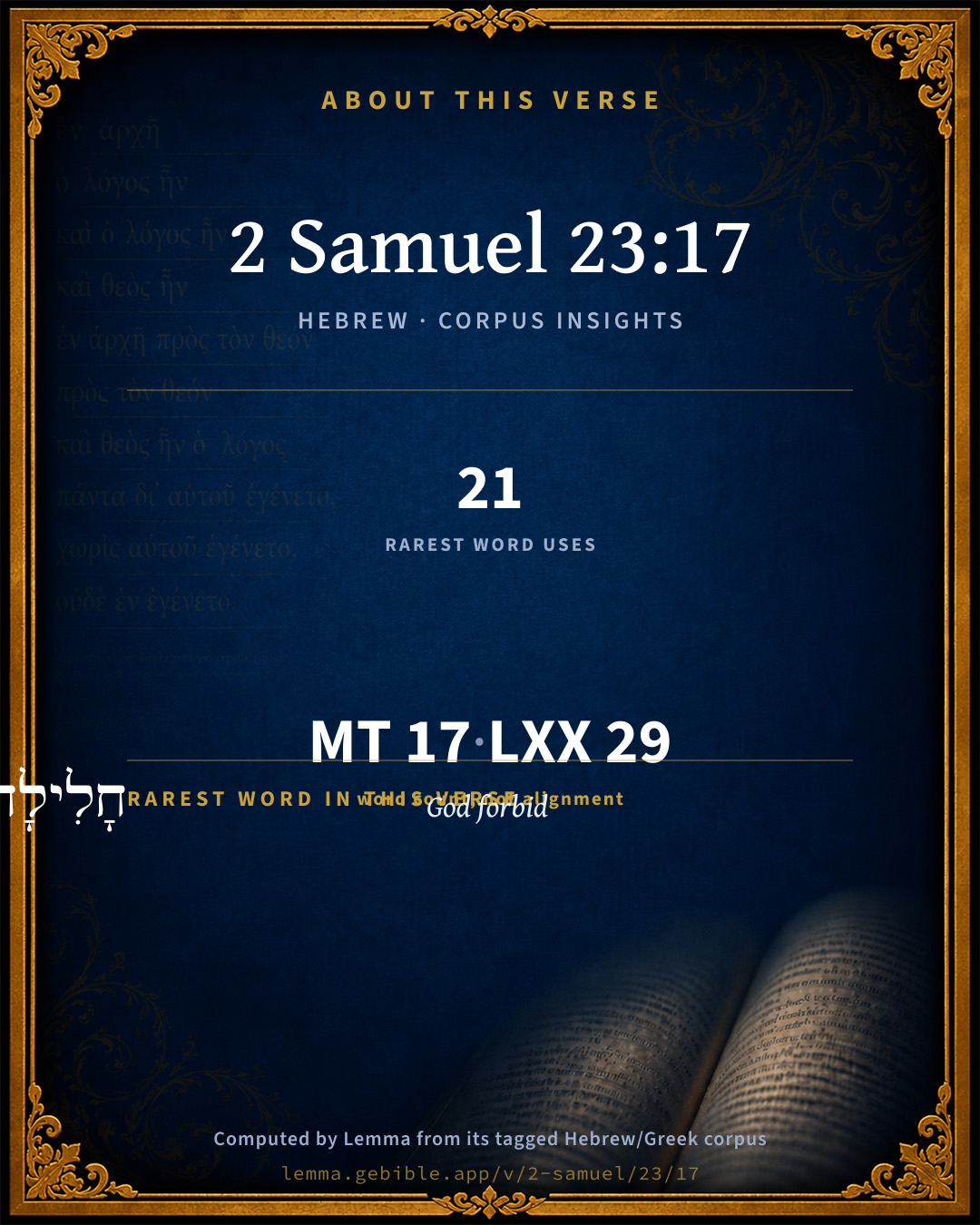
The rarest word here is חָלִילָה֩ God forbid H2486 — appearing just 21 times in the whole Hebrew Bible.

Shared distinctive vocabulary

חָלִילָה֩ God forbid H2486 occurs in 19 verses of the Hebrew Bible. Also found in:

Grammatical profile

  • 6 verbs
  • 4 nouns
  • 2 adjectives
  • 2 pronouns
  • 1 preposition
  • 2 particles

Verb forms

  • וַיֹּ֡אמֶר Qal · Sequential Imperfect
  • מֵעֲשֹׂ֣תִי Qal · Infinitive Construct
  • הַהֹלְכִ֣ים Qal · Participle Active
  • אָבָ֖ה Qal · Perfect
  • לִשְׁתּוֹתָ֑ם Qal · Infinitive Construct
  • עָשׂ֔וּ Qal · Perfect

Repetition

A word recurs within this verse — often emphatic in Hebrew:

  • מֵעֲשֹׂ֣תִי to do H6213 ×2

Hebrew & Septuagint length

In English translation the verse runs 41 words from the Hebrew and 42 from the Septuagint (LXX English) — closely comparable.

A rough comparison of the two English renderings, which tokenize alike — not a word-level alignment.

Word counts can differ between the Hebrew and the Greek without any difference in meaning — e.g. the Hebrew direct-object marker אֵת has no separate Greek word, and Greek often adds the article ὁ.

In the original languages it is 17 Hebrew tokens and 29 Greek tokens — but the two are counted differently (Hebrew bundles its prefixes and suffixes into one token; the Greek is in lemma form), so that isn’t a like-for-like length.

Cross-references

14

Topical passages linked to 2 Samuel 23:17 in the Treasury of Scripture Knowledge — connected by theme and wording, ordered by reader-vote popularity; previews shown in the World English Bible.

  • Leviticus 17:10 "'Any man of the house of Israel, or of the strangers who live as foreigners among them, who eats any kind of blood, I will set my face against that soul who eats blood, and will cut him off from among his people.
  • Genesis 9:4 But flesh with the life of it, the blood of it, you shall not eat.
  • Genesis 44:17 He said, "Far be it from me that I should do so. The man in whose hand the cup is found, he will be my bondservant; but as for you, go up in peace to your father."
  • Judges 5:18 Zebulun was a people that jeopardized their lives to the death, Naphtali, on the high places of the field.
  • 1 Samuel 2:30 Therefore Yahweh, the God of Israel, says, I said indeed that your house, and the house of your father, should walk before me forever: but now Yahweh says, Be it far from me; for those who honor me I will honor, and those who despise me shall be lightly esteemed.
  • 1 Samuel 26:11 Yahweh forbid that I should put forth my hand against Yahweh's anointed: but now please take the spear that is at his head, and the jar of water, and let us go.
  • 2 Samuel 20:20 Joab answered, Far be it, far be it from me, that I should swallow up or destroy.
  • 1 Kings 21:3 Naboth said to Ahab, Yahweh forbid it me, that I should give the inheritance of my fathers to you.
  • Psalms 72:14 He will redeem their soul from oppression and violence. Their blood will be precious in his sight.
  • Matthew 26:28 for this is my blood of the new covenant, which is poured out for many for the remission of sins.
  • Mark 14:24 He said to them, "This is my blood of the new covenant, which is poured out for many.
  • John 6:52–54 The Jews therefore contended with one another, saying, "How can this man give us his flesh to eat?"
  • 1 Corinthians 15:30 Why do we also stand in jeopardy every hour?
  • 1 Chronicles 11:19 and said, My God forbid it me, that I should do this: shall I drink the blood of these men who have put their lives in jeopardy? for with [the jeopardy of] their lives they brought it. Therefore he would not drink it. These things did the three mighty men.

Cross-references courtesy of OpenBible.info (CC BY 4.0).

Hebrew and Greek witnesses Masoretic Hebrew ↔ Greek Septuagint

The same verse in the two great witnesses to the Old Testament, shown verse-for-verse.

These are two independent witnesses, not word-aligned to each other, and the Septuagint is shown in lemma (dictionary) form.

Hebrew 2 Samuel 23:17 Masoretic · Westminster Leningrad Codex

וַיֹּ֡אמֶר חָלִילָה֩ לִּ֨י יְהוָ֜ה מֵעֲשֹׂ֣תִי זֹ֗את הֲדַ֤ם הָֽאֲנָשִׁים֙ הַהֹלְכִ֣ים בְּנַפְשׁוֹתָ֔ם וְלֹ֥א אָבָ֖ה לִשְׁתּוֹתָ֑ם אֵ֣לֶּה עָשׂ֔וּ שְׁלֹ֖שֶׁת הַגִּבֹּרִֽים

He said, Be it far from me, Yahweh, that I should do this: [shall I drink] the blood of the men who went in jeopardy of their lives? therefore he would not drink it. These things did the three mighty men.

World English Bible · Public Domain

Greek LXX 2 Samuel 23:17 Septuagint · lemma form

καί εἶπον ἵλεως ἐγώ κύριος ὁ ποιέω οὗτος εἰ αἷμα ὁ ἀνήρ ὁ πορεύομαι ἐν ὁ ψυχή αὐτός πίνω καί οὐ θέλω πίνω αὐτός οὗτος ποιέω ὁ τρεῖς δυνατός

And he said, O Lord, forbid that I should do this, that I should drink of the blood of the men who went at the risk of their lives: and he would not drink it. These things did these three mighty men.

LXX2012 (modern English Septuagint) · Public Domain

On this verse, Ellicott's Commentary for English Readers discusses the Septuagint’s reading. Read the note in Commentary ↓

Hebrew: Westminster Leningrad Codex (CC BY 4.0). Greek: Septuagint (public domain); English from LXX2012 (modern English Septuagint) (Public Domain). How the Septuagint differs from the Hebrew →

Targum (Aramaic paraphrase)

1

The Targum is the ancient Jewish Aramaic paraphrase of the Hebrew Scriptures — an interpretive translation, not the Hebrew text itself. Onkelos (literal) and Pseudo-Jonathan (expansive) render the Torah, and Jonathan the Prophets. Coverage is partial: where no permissively-licensed English translation exists for a verse, only the Aramaic is shown. This is verse-level text, not a word-by-word alignment to the Hebrew.

  1. Targum Jonathan Prophets (Joshua–Malachi)
    וַאֲמַר חַס לִי מִן קֳדָם יְיָ מִלְמֶעְבַּד דָא הֲדַס גִבָּרַיָא דַאֲזַלוּ בְנַפְשַׁתְהוֹן וְלָא אֲבָא לְמִשְׁתֵּיהוֹן אִלֵין עֲבָדוּ תְּלָתָא גִבָּרַיָא:

    (no public-domain English translation for this verse)

    Targum Jonathan — Aramaic: “Mikraot Gedolot” (public domain). English: “Sefaria Community Translation” (CC0 1.0 (public-domain dedication)); “London "Chaldee Paraphrase," 1871” (public domain). Text via Sefaria.

Commentary

Notes on 2 Samuel 23:17 from classic Christian and Jewish commentators (each source and its license shown beneath its notes). The classic Christian expositions comment on the surrounding passage and are grouped to its opening verse, so a note may address several verses; the Jewish commentaries on the Tanakh (Rashi and others) are per-verse, so they appear only where the commentator wrote on this verse.

Lemma curates 59 commentaries, every one of them public domain or Creative Commons licensed, each selected and text-cleaned for this edition rather than reprinted as found. About our sources →

Trapp's Complete Commentary

John Trapp

2Sa 23:17 And he said, Be it far from me, O LORD, that I should do this: [is not this] the blood of the men that went in jeopardy of their lives? therefore he would not drink it. These things did these three mighty men.

Ver. 17. Is not this the blood of the men?] So, say we; Is not this the blood of the souls of our servants whom we keep from the ordinances, for our pleasure? It is reported of Dr Chatterton, master of Emmanuel College, that he was married fifty-three years, and yet in all that time he never kept any of his servants from church to prepare his dinner. {a}

{a} Mr Clark, in his life.

John Trapp, A Commentary or Exposition upon All the Books of the Old and New Testament (1647–1656) — public domain. Text from a community e-Sword module.

Joseph Benson's Commentary

2Sa 23:17. He said, Far be it from me — He looked upon it no longer as water, but as the blood of those men who fetched it with the peril of their lives; and the blood of every thing belonged to the Lord, and therefore he poured it out before him. If the generosity of David’s worthies was great, David’s generosity was no less so. Such actions as these dignify human nature, and manifest an excellence and grandeur which one should not otherwise think it capable of. These things did these three — They all joined in this hazardous exploit. But now follows what they did singly.

Joseph Benson's Commentary on the Old and New Testaments (1811–1818) — public domain. Text from a community e-Sword module.

Tyndale Open Study Notes

Tyndale Open Resources

23:17 This water . . . these men: When David poured the hard-won water on the ground, it did not signal ingratitude. Rather, he regarded the water as equivalent to the warriors’ blood; it represented life that only God was worthy to receive (Lev 17:10-13; Deut 12:23-24).

Tyndale Open Study Notes — © Tyndale Open Resources, licensed CC BY-SA 4.0. Text via the HelloAO Bible API.

Ellicott's Commentary for English Readers

(17) Is not this the blood . . .?—The Hebrew here is simply an interrogative exclamation, “the blood of the men?” but in 1Ch_11:19 the text reads, “Shall I drink the blood of these men?” &c., and so the LXX. and Vulg. translate here. To David the water gained only at the risk of life, “seemed the very blood in which the life resides” (Lev_17:10-11).

These three.—Rather, the three.

A Bible Commentary for English Readers, edited by Charles John Ellicott (1878–1897) — public domain. Text from a community e-Sword module.

The Cambridge Bible for Schools and Colleges

gen. ed. J. J. S. Perowne

17. is not this the blood] As the text stands, the sentence is simply an interrogative exclamation: The blood of the men …? But Sept., Vulg. and Chron. read: Shall I drink the blood …? The water fetched at the risk of his comrades’ lives seemed to him the very blood in which the life resides (Lev_17:10-11).

The Cambridge Bible for Schools and Colleges (gen. ed. J. J. S. Perowne; Cambridge University Press, 1878–1918) — public domain. Text from a community e-Sword module.

John Gill's Exposition

And he said, be it far from me, O Lord, that one should do this,.... Drink of the water these men had brought him:

is not this the blood of the men that went in jeopardy of their lives? who risked the shedding of their blood, and went in danger of their lives to get it:

therefore he would not drink it: some compare with this the story of Alexander (d) to whom a vessel of water was offered when in extreme thirst, which he refused, because he could not bear to drink it alone, and so small a quantity could not be divided among all about him; but the reasons are not the same:

these things did these three mighty men; which made them very famous.

(d) Curt. Hist. l. 7. c. 5.

John Gill's Exposition of the Whole Bible (1746–1763) — public domain (CC PDM 1.0). Text via the HelloAO Bible API.

Albert Barnes' Notes on the Bible

Better as in 1Ch 11:19.

Albert Barnes' Notes on the Bible (1834–1885) — public domain. Text from a community e-Sword/MySword module.

Haydock's Catholic Bible Commentary

Drink. This word is acknowledged in 1 Paralipomenon and in all the ancient versions. (Kennicott) --- Protestants supply, "Is not this the blood of the men that went in jeopardy of their lives?" Instead of Jehova, (Haydock) which ought to have m prefixed, we find maleim; (1 Paralipomenon) a word never used in such solemn appeals to the Lord. This seems owing to the superstition of the Jews, who would not pronounce the former name, perhaps in imitation of the heathens, who kept the names of their tutelar gods secret, lest the enemy might call them out, and thus obtain possession of their country. See Macrobius iii. 9. No mention is made of the Romans making use of this mode of evocation at the last siege of Jerusalem, as they were unacquainted with the true name of God. Virgil (ii. 351,) writes,--- Excessere omnes Adytis Arisque relictis,

Dii quibus imperium hoc steterat.----- See Servius; Kennicott.

George Leo Haydock (1774–1849), Haydock's Catholic Family Bible and Commentary, 1859 edition — public domain. Excludes Psalms (Douay-Rheims chapter numbering differs from Protestant) and Deuterocanonical books (Catholic canon only).

Matthew Poole's English Annotations

Is not this the blood of the men, i.e. the price of their blood or lives, which they rashly exposed to manifest hazard?

These things did these three mighty men; either one of these three are here omitted, as one of the first three is not named, 1Ch 11; or Abishai, who follows next, was one of these three.

Matthew Poole's English Annotations on the Holy Bible (1683–1685) — public domain. Text from a community e-Sword/MySword module.

Whedon's Commentary on the Bible

Daniel D. Whedon

17. Be it far from me — The tender hearted chieftain felt that it would be like drinking the blood of his men. The event shows both the affection and devotion of David’s soldiers for their leader, and his tenderness towards them.

Daniel D. Whedon (gen. ed.), Commentary on the Old and New Testaments (1874–1909) — public domain. Text from a community e-Sword module.

John Wesley's Explanatory Notes

These three - Jointly: then two of them are mentioned severally.

John Wesley, Explanatory Notes Upon the Whole Bible (1754–1765) — public domain. Text via the GEBible commentary corpus.

Rashi

Rabbi Shlomo Yitzchaki (Rashi)

[Do I want] the blood of [these] men. Language denoting astonishment.

Rashi on the Tanakh — English translations: “The Judaica Press complete Tanach with Rashi, translated by A. J. Rosenberg” (CC BY 4.0); “Pentateuch with Rashi's commentary by M. Rosenbaum and A.M. Silbermann, 1929-1934” (public domain); “The Metsudah Tanach series, Lakewood, N.J” (CC BY 4.0); and “The Book of Joshua, Metsudah Publications, 1997” (CC BY 4.0). Text via Sefaria.

Lesson kit

Teaching starters — assembled from the data on this page, not authored interpretation. Every prompt links to the verse data it draws on. Edit before teaching.

2 Samuel, in the Historical, opens this verse with 17 words (15 distinct Hebrew lemmas). Its most distinctive word is châlîylâh (“God forbid”). A historical commentator’s framing appears above. Read the whole chapter for the surrounding context.

Discussion questions

  1. The word châlîylâh carries the sense “God forbid.” How does it shape the verse?
  2. Genesis 18:25 shares the word «God forbid» with this verse. How do the two illuminate each other?
  3. “to do” occurs 2× in this one verse. What is the effect of the repetition?
  4. These translations render this verse differently; the difference is in the English rendering, not the original. What questions does that raise?
  5. The verb «וַיֹּ֡אמֶר» is Qal Sequential Imperfect. How does its form color the action?
  6. Reading how Trapp's Complete Commentary and Joseph Benson's Commentary read this verse, where do the two commentators agree and where do they part?

Things to notice

Reading settings

Reading text

Shown beneath each verse's original-language words.

Old Testament
Old Testament edition

Read the OT as the Masoretic Hebrew (MT) or the Greek Septuagint (LXX).

English shown for the Greek Septuagint (in the Hebrew ↔ Greek comparison).

Comparing translations? Open the Compare panel on any verse page to stack up to four side by side.