
Leviticus 19:26

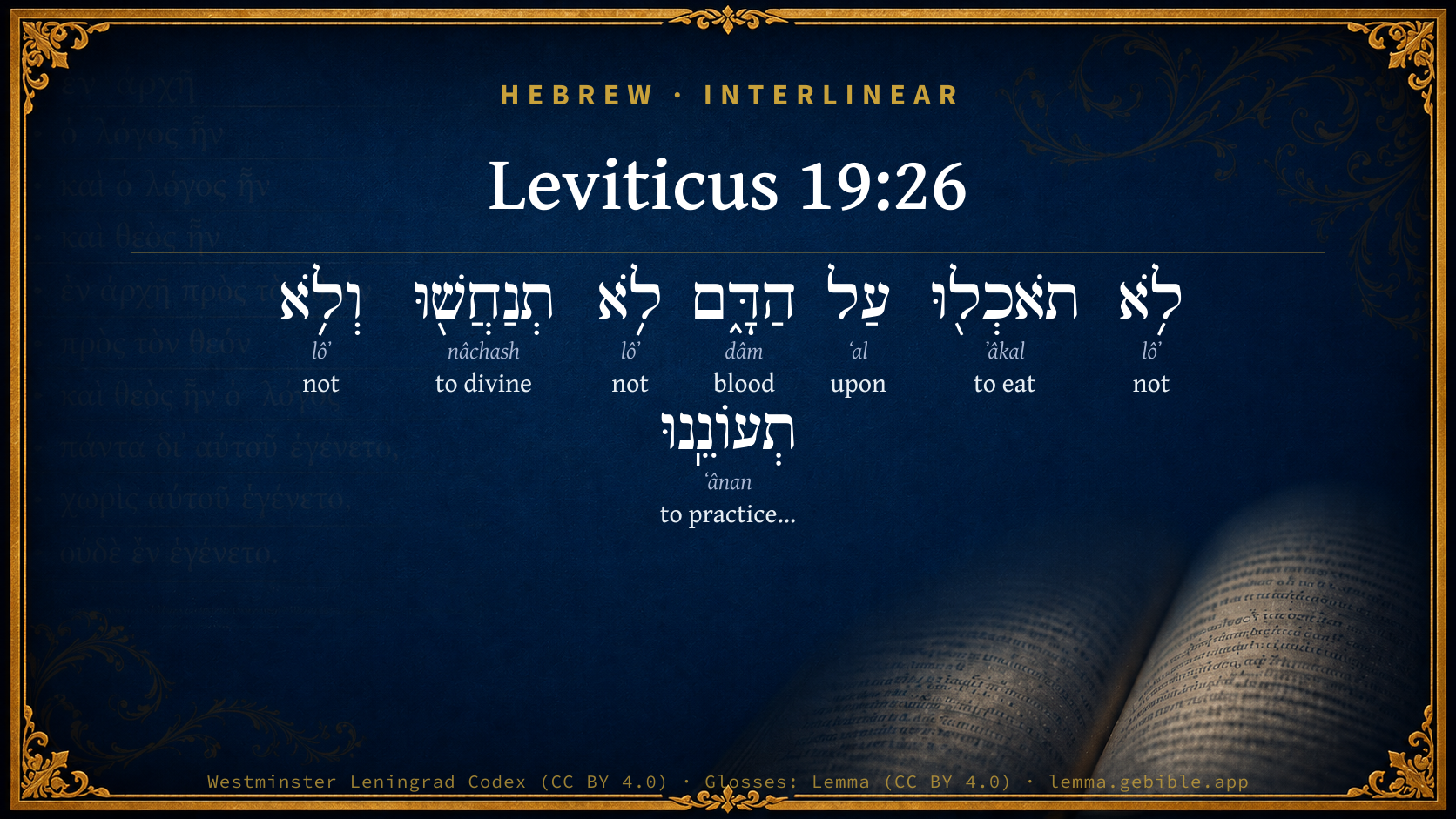
Hebrew (Westminster Leningrad Codex) Leviticus 19:26 appears in the Hebrew Old Testament. The text above is from the Westminster Leningrad Codex. Each word links to its Strong’s number, a concise gloss, and parsing drawn from the Open Scriptures Hebrew Bible morphology. Click any word for its full Brown-Driver-Briggs (BDB) entry.
Download image
Cite this verse

Leviticus 19:26 (World English Bible). Public Domain. Lemma interlinear Bible study tool, https://lemma.gebible.app/v/leviticus/19/26.

Show BibTeX & RIS
BibTeX
RIS
English Translation
"'You shall not eat any meat with the blood still in it; neither shall you use enchantments, nor practice sorcery.
World English Bible · Public Domain
Download a study sheet

One document with this verse’s original text, its word-by-word gloss line, the meaning frame, cross-references with their text, attributed commentary, and full source and license credits — printable, and it pastes into notes with its structure intact.

This verse Autodidact and up

Study sheet (.html) Plain text (.txt)

A passage Seminary Student

Up to 50 verses in one chapter. A passage sheet keeps up to 6 commentary sources and 12 cross-references per verse, in the order this page ranks them, and says so on the sheet whenever that leaves anything out. Ask for a single verse and you get the Autodidact verse sheet above.

Everything on this page stays free to read, with no account — the sheet is a download of what is already on screen, not access to it.

Want to remove ads? Support Godless Engineer
Compare translations 3

The same verse in 3 English versions, stacked beneath the original-language interlinear above. Click any original word for its lexicon entry.

Each is an independent rendering of the whole verse — the interlinear is not word-aligned to these translations.

Highlighted words mark where these versions differ — a whole-verse word diff, not a word-by-word alignment.

  • World English Bible Public Domain
    "'You shall not eat any meat with the blood still in it; neither shall you use enchantments, nor practice sorcery.
  • King James Version Public Domain
    Ye shall not eat any thing with the blood: neither shall ye use enchantment, nor observe times.
  • unfoldingWord Literal Text CC BY-SA 4.0
    You shall not eat with the blood. You shall not practice divination, and you shall not practice soothsaying.

unfoldingWord Literal Text — © unfoldingWord, licensed CC BY-SA 4.0. Word-aligned USFM3 via Door43 (git.door43.org/unfoldingWord/en_ult).

Versions to compare (up to 4)

3 of 4 selected

Show all 18 translations

Every available English version of this verse, each an independent rendering of the whole verse.

  • World English Bible Public Domain
    "'You shall not eat any meat with the blood still in it; neither shall you use enchantments, nor practice sorcery.
  • Berean Standard Bible Public Domain
    You must not eat anything with blood still in it. You must not practice divination or sorcery.
  • Majority Standard Bible Public Domain
    You must not eat anything with blood still in it. You must not practice divination or sorcery.
  • King James Version Public Domain
    Ye shall not eat any thing with the blood: neither shall ye use enchantment, nor observe times.
  • American Standard Version (1901) Public Domain
    Ye shall not eat anything with the blood: neither shall ye use enchantments, nor practise augury.
  • Revised Version (1885) Public Domain
    Ye shall not eat any thing with the blood: neither shall ye use enchantments, nor practise augury.
  • Geneva Bible (1599) Public Domain
    Ye shall not eat the flesh with the blood, ye shall not vse witchcraft, nor obserue times.
  • Douay-Rheims (1899) Public Domain
    You shall not eat with blood. You shall not divine nor observe dreams.
  • Young's Literal Translation Public Domain
    `Ye do not eat with the blood; ye do not enchant, nor observe clouds.
  • Literal Standard Version CC BY-SA 4.0
    You do not eat with the blood. You do not enchant, nor observe clouds.
  • Unlocked Literal Bible CC BY-SA 4.0
    Do not eat any meat with blood still in it. Do not consult spirits about the future, and do not seek to control others by supernatural powers.
  • unfoldingWord Literal Text CC BY-SA 4.0
    You shall not eat with the blood. You shall not practice divination, and you shall not practice soothsaying.
  • Darby Bible Public Domain
    Ye shall eat nothing with the blood. -- Ye shall not practise enchantment, nor use auguries.
  • World Messianic Bible Public Domain
    “‘You shall not eat any meat with the blood still in it. You shall not use enchantments, nor practice sorcery.
  • Webster's Bible Public Domain
    Ye shall not eat any thing with the blood: neither shall ye use enchantment, nor observe times.
  • Free Bible Version CC BY-SA 4.0
    Don't eat meat with blood in it. Don't use fortune-telling or witchcraft.
  • Bible in Basic English Public Domain
    Nothing may be used for food with its blood in it; you may not make use of strange arts, or go in search of signs and wonders.
  • JPS Tanakh (1917) Public Domain
    Ye shall not eat with the blood; neither shall ye practise divination nor soothsaying.

Literal Standard Version (2020), Covenant Press — licensed CC BY-SA 4.0. Text via the HelloAO Bible API (eBible.org). Unlocked Literal Bible (unfoldingWord) — licensed CC BY-SA 4.0. Text via the HelloAO Bible API (eBible.org). unfoldingWord Literal Text — © unfoldingWord, licensed CC BY-SA 4.0. Word-aligned USFM3 via Door43 (git.door43.org/unfoldingWord/en_ult). Free Bible Version, Dr. Jonathan Gallagher — licensed CC BY-SA 4.0. Text via the HelloAO Bible API (eBible.org).

Word by word

More ways to search: Search by grammar → Find every occurrence → Compare this word →

Practice this passage: Drill this verse → Learn its vocabulary →

About this verse

These counts appear in no published source. They are computed here, from the morphology-tagged text and Lemma’s own curated glosses. What Lemma adds →

8
words
6
distinct lemmas
Pentateuch
section

Notable vocabulary

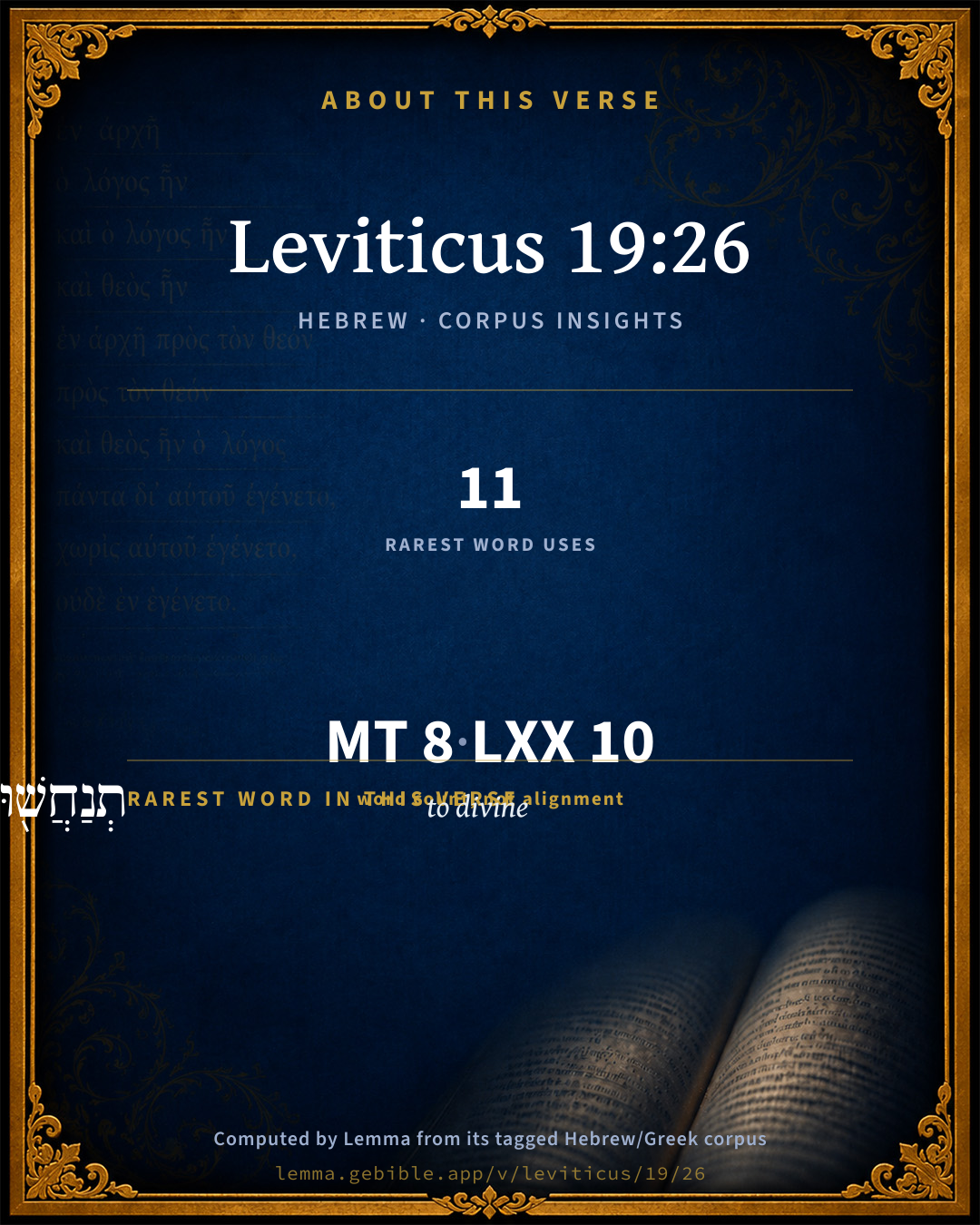
The rarest word here is תְנַחֲשׁ֖וּ to divine H5172 — appearing just 11 times in the whole Hebrew Bible.

Shared distinctive vocabulary

תְנַחֲשׁ֖וּ to divine H5172 occurs in 9 verses of the Hebrew Bible. Also found in:

Grammatical profile

  • 3 verbs
  • 1 noun
  • 1 preposition
  • 3 particles

Verb forms

  • תֹאכְל֖וּ Qal · Imperfect
  • תְנַחֲשׁ֖וּ Piel · Imperfect
  • תְעוֹנֵֽנוּ Poel · Imperfect

Repetition

A word recurs within this verse — often emphatic in Hebrew:

Hebrew & Septuagint length

In English translation the verse runs 20 words from the Hebrew and 16 from the Septuagint (LXX English) — closely comparable.

A rough comparison of the two English renderings, which tokenize alike — not a word-level alignment.

Word counts can differ between the Hebrew and the Greek without any difference in meaning — e.g. the Hebrew direct-object marker אֵת has no separate Greek word, and Greek often adds the article ὁ.

In the original languages it is 8 Hebrew tokens and 10 Greek tokens — but the two are counted differently (Hebrew bundles its prefixes and suffixes into one token; the Greek is in lemma form), so that isn’t a like-for-like length.

Cross-references

14

Topical passages linked to Leviticus 19:26 in the Treasury of Scripture Knowledge — connected by theme and wording, ordered by reader-vote popularity; previews shown in the World English Bible.

  • Deuteronomy 18:10–14 There shall not be found with you anyone who makes his son or his daughter to pass through the fire, one who uses divination, one who practices sorcery, or an enchanter, or a sorcerer,
  • 2 Kings 17:17 They caused their sons and their daughters to pass through the fire, and used divination and enchantments, and sold themselves to do that which was evil in the sight of Yahweh, to provoke him to anger.
  • 2 Chronicles 33:6 He also made his children to pass through the fire in the valley of the son of Hinnom; and he practiced sorcery, and used enchantments, and practiced sorcery, and dealt with those who had familiar spirits, and with wizards: he worked much evil in the sight of Yahweh, to provoke him to anger.
  • 2 Kings 21:6 He made his son to pass through the fire, and practiced sorcery, and used enchantments, and dealt with those who had familiar spirits, and with wizards: he worked much evil in the sight of Yahweh, to provoke him to anger.
  • Leviticus 3:17 "'It shall be a perpetual statute throughout your generations in all your dwellings, that you shall eat neither fat nor blood.'"
  • Leviticus 7:26 You shall not eat any blood, whether it is of bird or of animal, in any of your dwellings.
  • Leviticus 17:10–14 "'Any man of the house of Israel, or of the strangers who live as foreigners among them, who eats any kind of blood, I will set my face against that soul who eats blood, and will cut him off from among his people.
  • Deuteronomy 12:23 Only be sure that you don't eat the blood: for the blood is the life; and you shall not eat the life with the flesh.
  • Jeremiah 10:2 Thus says Yahweh, "Don't learn the way of the nations, and don't be dismayed at the signs of the sky; for the nations are dismayed at them.
  • Exodus 7:11 Then Pharaoh also called for the wise men and the sorcerers. They also, the magicians of Egypt, did in like manner with their enchantments.
  • Exodus 8:7 The magicians did in like manner with their enchantments, and brought up frogs on the land of Egypt.
  • 1 Samuel 15:23 For rebellion is as the sin of witchcraft, and stubbornness is as idolatry and teraphim. Because you have rejected the word of Yahweh, he has also rejected you from being king.
  • Daniel 2:10 The Chaldeans answered before the king, and said, There is not a man on the earth who can show the king's matter, because no king, lord, or ruler, has asked such a thing of any magician, or enchanter, or Chaldean.
  • Malachi 3:5 I will come near to you to judgment; and I will be a swift witness against the sorcerers, and against the adulterers, and against the perjurers, and against those who oppress the hireling in his wages, the widow, and the fatherless, and who deprive the foreigner of justice, and don't fear me," says Yahweh of Hosts.

Cross-references courtesy of OpenBible.info (CC BY 4.0).

Hebrew and Greek witnesses Masoretic Hebrew ↔ Greek Septuagint

The same verse in the two great witnesses to the Old Testament, shown verse-for-verse.

These are two independent witnesses, not word-aligned to each other, and the Septuagint is shown in lemma (dictionary) form.

Hebrew Leviticus 19:26 Masoretic · Westminster Leningrad Codex

לֹ֥א תֹאכְל֖וּ עַל הַדָּ֑ם לֹ֥א תְנַחֲשׁ֖וּ וְלֹ֥א תְעוֹנֵֽנוּ

"'You shall not eat any meat with the blood still in it; neither shall you use enchantments, nor practice sorcery.

World English Bible · Public Domain

Greek LXX Leviticus 19:26 Septuagint · lemma form

μή ἐσθίω ἐπί ὁ ὄρος καί οὐ οἰωνίζομαι οὐδέ ὀρνιθοσκοπέομαι

Eat not on the mountains, nor shall you⌃ employ auguries, nor divine by inspection of birds.

LXX2012 (modern English Septuagint) · Public Domain

On this verse, The Cambridge Bible for Schools and Colleges discusses the Septuagint’s reading. Read the note in Commentary ↓

Hebrew: Westminster Leningrad Codex (CC BY 4.0). Greek: Septuagint (public domain); English from LXX2012 (modern English Septuagint) (Public Domain). How the Septuagint differs from the Hebrew →

Targum (Aramaic paraphrase)

2

The Targum is the ancient Jewish Aramaic paraphrase of the Hebrew Scriptures — an interpretive translation, not the Hebrew text itself. Onkelos (literal) and Pseudo-Jonathan (expansive) render the Torah, and Jonathan the Prophets. Coverage is partial: where no permissively-licensed English translation exists for a verse, only the Aramaic is shown. This is verse-level text, not a word-by-word alignment to the Hebrew.

  1. Targum Onkelos Torah (Genesis–Deuteronomy)
    לָא תֵיכְלוּן עַל דְמָא לָא תְנַחֲשׁוּן וְלָא תְעוֹנוּן

    (no public-domain English translation for this verse)

    Targum Onkelos — Aramaic: “Onkelos Genesis” (public domain); “Onkelos Exodus” (public domain); “Onkelos Leviticus” (public domain); “Onkelos Numbers” (public domain); “Onkelos Deuteronomy” (public domain). English: “Sefaria Community Translation” (CC0 1.0 (public-domain dedication)); “J.W. Etheridge. The Targums of Onkelos and Jonathan Ben Uzziel on the Pentateuch. London: Longmans, Green, 1862” (public domain). Text via Sefaria.

  2. Targum Pseudo-Jonathan Torah (Genesis–Deuteronomy)
    לָא תֵיכְלוּן מִבְּשַר כָּל נִכְסְתָא עַד דְאַדְמָא קְיַם בְּמִזְרְקַיָא לָא תֶהֱווֹן נַטְרֵי נַחְשִׁין וְלָא (ס"א אֲחוֹדֵי עַיְינִין עיין דברים י"ח פסוק ט"ז בת"י) אֲחוֹרֵי סַנְהֶדְרִין עַיְינִין

    You shall not eat the flesh of any sacrifice while the blood remaineth in the veins. You shall not be observers of auguries, after the sanhedrin of the speculators.

    Targum Pseudo-Jonathan — Aramaic: “Targum Jonathan on Genesis” (public domain); “Targum Jonathan on Exodus” (public domain); “Targum Jonathan on Leviticus” (public domain); “Targum Jonathan on Numbers” (public domain); “Targum Jonathan on Deuteronomy” (public domain). English: “The Targum of Jonathan ben Uzziel, trans. J. W. Etheridge, London, 1862” (public domain). Text via Sefaria.

Commentary

Notes on Leviticus 19:26 from classic Christian and Jewish commentators (each source and its license shown beneath its notes). The classic Christian expositions comment on the surrounding passage and are grouped to its opening verse, so a note may address several verses; the Jewish commentaries on the Tanakh (Rashi and others) are per-verse, so they appear only where the commentator wrote on this verse.

Lemma curates 59 commentaries, every one of them public domain or Creative Commons licensed, each selected and text-cleaned for this edition rather than reprinted as found. About our sources →

Trapp's Complete Commentary

John Trapp

Lev 19:26 Ye shall not eat [any thing] with the blood: neither shall ye use enchantment, nor observe times.

Ver. 26. Neither shall ye use enchantment.] Or, observe fortunes, conjecture by signs of good or evil luck, as some render it.

John Trapp, A Commentary or Exposition upon All the Books of the Old and New Testament (1647–1656) — public domain. Text from a community e-Sword module.

Albert Barnes' Notes on the Bible

Certain pagan customs, several of them connected with magic, are here grouped together. The prohibition to eat anything with the blood may indeed refer to the eating of meat which had not been properly bled in slaughtering (Lev 7:26; Lev 17:10, etc.): but it is not improbable that there may be a special reference to some sort of magical or idolatrous rites. Compare Eze 33:25.

Lev 19:26

Observe times - It is not clear whether the original word refers to the fancied distinction between lucky and unlucky days, to some mode of drawing omens from the clouds, or to the exercise of “the evil eye.”

Lev 19:27

Round the corners of your heads - This may allude to such a custom as that of the Arabs described by Herodotus. They used to show honor to their deity Orotal by cutting the hair away from the temples in a circular form. Compare the margin reference.

Mar the corners of thy beard - It has been conjectured that this also relates to a custom which existed among the Arabs, but we are not informed that it had any idolatrous or magical association. As the same, or very similar customs, are mentioned in Lev 21:5, and in Deu 14:1, as well as here, it would appear that they may have been signs of mourning.

Lev 19:28

Cuttings in your flesh for the dead - Compare the margin reference. Among the excitable races of the East this custom appears to have been very common.

Print any marks - Tattooing was probably practiced in ancient Egypt, as it is now by the lower classes of the modern Egyptians, and was connected with superstitious notions. Any voluntary disfigurement of the person was in itself an outrage upon God’s workmanship, and might well form the subject of a law.

Albert Barnes' Notes on the Bible (1834–1885) — public domain. Text from a community e-Sword/MySword module.

Joseph Benson's Commentary

Lev 19:26. Any thing with the blood — Any flesh out of which the blood is not first poured. Neither shall ye use enchantments — It was unpardonable in them, to whom were committed the oracles of God, to ask counsel of the devil. And yet worse in Christians, to whom the Son of God is manifested, to destroy the works of the devil. For Christians to have their nativities cast, or their fortunes told, or to use charms for the cure of diseases, is an intolerable affront to the Lord Jesus, a support of idolatry, and a reproach both to themselves and to that worthy name by which they are called. Nor observe times — Superstitiously, esteeming some days lucky, others unlucky.

Joseph Benson's Commentary on the Old and New Testaments (1811–1818) — public domain. Text from a community e-Sword module.

Tyndale Open Study Notes

Tyndale Open Resources

19:26 blood: See study note on 7:22-27. • Priests were permitted to consult the Urim and Thummim (Exod 28:30) or to cast lots (Lev 16:8) to help decide cases not covered by Mosaic regulations. However, those who practiced fortune-telling or witchcraft were actually consulting a power apart from the Lord, which was forbidden under the first commandment (Exod 20:3).

Tyndale Open Study Notes — © Tyndale Open Resources, licensed CC BY-SA 4.0. Text via the HelloAO Bible API.

Geneva Bible (1599)

Geneva Bible translators

Whether it be strangled, or otherwise.

To measure lucky or unlucky days.

Geneva Bible (1599) marginal notes — public domain. Text via Bolls.life.

Jamieson, Fausset & Brown

Robert Jamieson, A. R. Fausset & David Brown

shall not eat any thing with the blood--(See on Lev 17:10).

neither . . . use enchantment, nor observe times--The former refers to divination by serpents--one of the earliest forms of enchantment, and the other means the observation, literally, of clouds, as a study of the appearance and motion of clouds was a common way of foretelling good or bad fortune. Such absurd but deep-rooted superstitions often put a stop to the prosecution of serious and important transactions, but they were forbidden especially as implying a want of faith in the being, or of reliance on the providence of God.

Jamieson, Fausset & Brown — Commentary Critical and Explanatory on the Whole Bible (1871) — public domain (CC PDM 1.0). Text via the HelloAO Bible API.

Adam Clarke's Commentary

Verse 26. Neither shall ye use enchantment] לא תנחשו lo thenachashu. Conjecture itself can do little towards a proper explanation of the terms used in this verse. נחש nachash; See Clarke on Ge 3:1, we translate serpent, and with very little propriety; but though the word may not signify a serpent in that place, it has that signification in others. Possibly, therefore, the superstition here prohibited may be what the Greeks called Ophiomanteia, or divination by serpents.

Nor observe times.] ולא תעוננו velo teonenu, ye shall not divine by clouds, which was also a superstition much in practice among the heathens, as well as divination by the flight of birds. What these prohibitions may particularly refer to, we know not. See Clarke on Ge 41:8.

Adam Clarke's Commentary on the Bible (1810–1826) — public domain. Text from a community e-Sword/MySword module.

Ellicott's Commentary for English Readers

(26) Ye shall not eat any thing with the blood.—According to the administrators of the law during the second Temple, there are no less than five different things forbidden here. It prohibits (1) eating the flesh of a legally slaughtered animal as long as its life is not quite gone, or whilst the flesh is still trembling; (2) eating the flesh of sacrificial animals whilst the blood is still in the sprinkling bowl, and before it has been sprinkled on the altar; (3) eating the meat of mourners by the relatives when a member of the family has been publicly executed, and his blood has been shed; (4) eating anything by the judicial court on the day when their sentence of death is being executed on the criminal; and (5) it warns the rebellious and gluttonous son not to eat immoderately by the penalty of blood.” The ancient Chaldee Version, therefore, which translates it “Ye shall not eat the flesh of any sacrifice whilst the blood is in the basin unsprinkled,” exhibits the second of these prohibitions involved in this interpretation; and all the five premise the rendering of this phrase, “Ye shall not eat by the blood,” which has the merit of being literal; whilst the Authorised Version follows the first of these five prohibitions. Others, again, who also translate it “Ye shall not eat by the blood,” take it as a prohibition of the idolatrous practice which obtained among the Zabii, who, to obtain favour from the demons, gathered the blood of the sacrifices which they offered to them into a vessel or a hole dug in the earth, and then sat around it to consume the sacrificial meal by the blood, thinking that thereby they fraternised with these demons. This seems to be favoured by the next clause.

Neither shall ye use enchantment.- Better, ye shall use no enchantment. According to the authorities during the second Temple, this consisted in any one saying, “A morsel has dropped out of my mouth; the staff has fallen out of my hand; my child has called out behind me; a crow has cawed to me; a deer has crossed my path; a serpent crept on my right hand; a fox has gone by on my left;” and regarding these as bad omens for the day which has now began or for the work which he has just commenced. Or if he says to the man who raises the taxes, “Do not begin with me; it is still early in the day; it is the first of the month; it is the beginning of the week; I shall be unlucky the whole day, week, or month to be the first to be burdened;” this is enchantment.

Nor observe times.—This, according to the same authorities, consists in “taking notice of the seasons and days, and in saying this is a good day to begin a journey, to-morrow will be lucky to make a purchase.”

A Bible Commentary for English Readers, edited by Charles John Ellicott (1878–1897) — public domain. Text from a community e-Sword module.

The Cambridge Bible for Schools and Colleges

gen. ed. J. J. S. Perowne

26. with the blood] The LXX. has here instead ‘upon the mountains,’ probably influenced by the phrase in Eze_18:6; Eze_22:9, which, however, according to Rob.-Sm. (Kinship, p. 312), should be assimilated to accord with Eze_33:25.

use enchantments] Employ divination. See e.g. Gen_44:5, where the method was by hydromancy (Driver ad loc.).

practise augury] The original meaning of the Heb. verb is uncertain, but probably its sense is to hum (as insects) or whisper (as leaves), and hence is applied to the low murmuring made by diviners. Augury in the etymological sense (inferences from marking the flight of birds) was practised in the East. See Driver, Deut. p. 225.

The Cambridge Bible for Schools and Colleges (gen. ed. J. J. S. Perowne; Cambridge University Press, 1878–1918) — public domain. Text from a community e-Sword module.

John Gill's Exposition

Ye shall not eat anything with the blood,.... Or upon, over, or by the blood (s), for this law seems different from that in Gen 9:4, and from those in Lev 3:17; and is variously interpreted by the Jewish writers; some of not eating flesh, the blood not being rightly let out of it, as not being thoroughly cleared of it (t), and so comes under the notion of things strangled; others of not eating of sacrifices until the blood stands in the basin (u); and others of not eating any flesh whose blood is not sprinkled on the altar, if near the holy place (w): some think it refers to the custom of murderers who eat over the person slain, that the avengers of the slain may not take vengeance on them, supposing something superstitious in it, because of what follows (x); though it rather has respect to an idolatrous practice of the Zabians, as Maimonides (y) informs us, who took blood to be the food of devils, and who used to take the blood of a slain beast and put it in a vessel, or in a hole dug in the earth, and eat the flesh sitting round about the blood; fancying by this means they had communion with devils, and contracted friendship and familiarity with them, whereby they might get knowledge of future things; See Gill on Eze 33:25,

neither shall ye use enchantment; soothsaying or divination by various creatures, as by the weasel, birds, or fishes, as the Talmudists (z); or rather by serpents, as the word used is thought to have the signification of; or by any odd accidents, as a man's food falling out of his mouth, or his staff out of his hand, or his son calling after him behind, or a crow cawing to him, or a hart passing by him, or a serpent on his right hand and a fox on his left, or one says, do not begin (any work) tomorrow, it is the new moon, or the going out of the sabbath (a):

nor observe times; saying, such a day is a lucky day to begin any business, or such an hour an unlucky hour to go out in, as Jarchi, taking the word to have the signification of times, days, and hours, as our version and others; but Aben Ezra derives it from a word which signifies a cloud, and it is well known, he says, that soothsayers view and consult the clouds, their likeness and motion; but some of the ancient writers, as Gersom observes, derive it from a word which signifies an eye, and suppose that such persons are intended who hold the eyes of people, cast a mist before them, or use some juggling tricks whereby they deceive their sight.

(s) "super sanguine", Montanus, Munster; "super sanguinem", Fagius. (t) Joseph. Antiqu. l. 6. c. 6. sect. 4. T. Bab. Sanhedrin, fol. 63. 1. (u) Targum Jon. in loc. T. Bab. Sanhedrin, ib. (w) Aben Ezra in loc. (x) Baal Hatturim in loc. (y) Moreh Nevochim, par. 3. c. 46. (z) T. Bab. Sanhedrin, fol. 66. 1. Jarchi in loc. (a) Kimchi, Sepher Shorash. rad.

John Gill's Exposition of the Whole Bible (1746–1763) — public domain (CC PDM 1.0). Text via the HelloAO Bible API.

Haydock's Catholic Bible Commentary

Blood. The flesh of any animal. The blood must belong to God. The members of the Sanhedrim eat nothing on the day that a criminal is executed, supposing that this is the meaning of the precept. The Septuagint read erim, "on the mountains;" and another version has, "on the roof," as if the worship of idols on high places were forbidden. (Haydock) --- Divine. Perhaps by means of "serpents," or "plates of brass," as the Hebrew ness, may insinuate. These methods were known to the ancients. (Horace, Ode iii. 37.; Pliny xxx. 2.) (Calmet) --- Dreams. Hebrew, times. See Galatians iv. 10. (Haydock)

George Leo Haydock (1774–1849), Haydock's Catholic Family Bible and Commentary, 1859 edition — public domain. Excludes Psalms (Douay-Rheims chapter numbering differs from Protestant) and Deuterocanonical books (Catholic canon only).

Matthew Poole's English Annotations

With the blood, i. e. any flesh out of which the blood is not first poured. See 1Sa 14:32. The Jews write, that the Egyptians and other nations, when they offered sacrifices to the devils, did eat part of the sacrifices, beside the blood which was kept in basons for that end, which also they believed to be as it were the special food of the devils.

Nor observe times, to wit, superstitiously, by the observation of the clouds, or stars, or otherwise, by esteeming some days lucky, others unlucky. See Deu 18:10,11; Es 3:7.

Matthew Poole's English Annotations on the Holy Bible (1683–1685) — public domain. Text from a community e-Sword/MySword module.

Whedon's Commentary on the Bible

Daniel D. Whedon

26. Neither… use enchantment — Literally, Ye shall not whisper, hence, divine, or give oracles. The magical practices against which the Hebrews are here warned were borrowed from the nations around, for they had no magic of their own. Yet from the conquest of Canaan until the destruction of Jerusalem we have constant glimpses of magic practised in secret, not only by the ignoble, but by the great. Whether or not there is any reality in the art, it is clearly incompatible with a calm and firm trust in God alone to order future events for our good. “Israel is directed to the word of revelation (Deu_18:9-22) in contrast to all heathen mantic, which has searched through heaven and earth to find signs of the divine counsel, but finding no help, falls into dissolution. The exorcism of the dead, and other forms of mantic, are a horror, and astrology is a folly. Isa_47:13.” — Oehler.

Nor observe times — Practise soothsaying by regarding the aspect of the clouds. Jeremiah (Jer_10:2) exhorts the people not to be “dismayed at the signs of heaven,” at which the heathen are “dismayed.” The practice of regarding some days as lucky and others as unlucky, and of foretelling the future by seeing the new moon over the right or left shoulder, are relics of this species of divination. Keil, with certain rabbins, derives the Hebrew term from ayin — an eye; hence, literally, “to ogle, to bewitch with an evil eye.”

Daniel D. Whedon (gen. ed.), Commentary on the Old and New Testaments (1874–1909) — public domain. Text from a community e-Sword module.

The Pulpit Commentary

Vers. 26-28. After a repetition of the fundamental ceremonial law against eating things which have the blood in them (the LXX rendering, epi twn orewn , "upon the mountains," arises from a mistaken reading), follow prohibitions

(1) to use enchantment, literally, to whisper or mutter after holding communication with serpents (if the word nichesh be derived from nachash, a serpent);

(2) to observe times, or rather, according to a more probable etymology, exercise the evil eye;

(3) to round the corners of your heads, that is, use a sort of tonsure, as was done by some Arabian tribes (Herod., 3:3) in honour of their god Orotal, and by the Israelites as a form of mourning; (Deu_14:1 Isa_22:12)

(4) to mar the corners of thy beard, a fashion of mourning which accompanied the tonsure of the head; (see Lev_21:5 Isa_15:2 Jer_48:37)

(5) to make any cuttings in your flesh for the dead, another form of mourning, associated with the two previously mentioned practices; (see Lev_21:5 Deu_14:1 Jer_16:6 Jer_41:3 Jer_48:37)

(6) to print any marks upon you, that is, tattoo themselves in memory of the dead. All these customs were unbecoming the dignity of God"s people, and had been connected with idolatrous practices.

The Pulpit Commentary (1880–1919), ed. H.D.M. Spence-Jones & Joseph S. Exell — public domain. Text from a community e-Sword module.

John Wesley's Explanatory Notes

Any thing with the blood - Any flesh out of which the blood is poured. Neither shall ye use enchantments - It was unpardonable in them, to whom were committed the oracles of God, to ask counsel of the devil. And yet worse in Christians, to whom the son of God is manifested, to destroy the works of the devil. For Christians to have their nativities cast, or their fortunes told, or to use charms for the cure of diseases, is an intolerable affront to the Lord Jesus, a support of idolatry, and a reproach both to themselves, and to that worthy name by which they are called. Nor observe times - Superstitiously, esteeming some days lucky, others unlucky.

John Wesley, Explanatory Notes Upon the Whole Bible (1754–1765) — public domain. Text via the GEBible commentary corpus.

unfoldingWord translationNotes

Door43 World Missions Community

translationWords

blood

spirit

power

unfoldingWord translationNotes — © Distant Shores Media and the Door43 World Missions Community, licensed CC BY-SA 4.0. Source: git.door43.org/Door43/en_tn.

Rashi

Rabbi Shlomo Yitzchaki (Rashi)

לא תאכלו על הדם YE SHALL NOT EAT ANYTHING על הדם — This text is interpreted in many different ways in Treatise Sanhedrin 63a: It is taken as a prohibition of eating the flesh of the sacrifices before their blood has been sprinkled; and as a prohibition addressed to him who eats of the flesh of a non-consecrated animal (חולין) before life has entirely left it; and many other interpretations are there given.

לא תנחשו YE SHALL NOT DIVINE — as do those who draw prognostications from the cry of a weasel or the twittering of birds (Sifra, Kedoshim, Chapter 6 2; Sanhedrin 66a), or from the fact that the bread falls from his mouth or that a stag crosses his path (Sanhedrin 65b).

ולא תעוננו The verb is connected in meaning with “period" (עונה) and “hours"; thus a מעונן is one who says: “This or that day is auspicious for beginning a work, this or that hour is inauspicious for starting on a journey (Sanhedrin 66a).

Rashi on the Tanakh — English translations: “The Judaica Press complete Tanach with Rashi, translated by A. J. Rosenberg” (CC BY 4.0); “Pentateuch with Rashi's commentary by M. Rosenbaum and A.M. Silbermann, 1929-1934” (public domain); “The Metsudah Tanach series, Lakewood, N.J” (CC BY 4.0); and “The Book of Joshua, Metsudah Publications, 1997” (CC BY 4.0). Text via Sefaria.

Ramban (Nachmanides)

Rabbi Moshe ben Nachman (Ramban / Nachmanides)

YE SHALL NOT EAT WITH THE BLOOD. “This passage has been explained in many different ways in Tractate Sanhedrin.” This is the language of Rashi. Now the conclusion of that discussion in the Talmud is that all those interpretations [of the verse before us] are Torah-ordained, since Scripture included all manner of “eating with the blood” in one negative commandment. And if so, that which Scripture states in the case of Saul, Behold, the people sin against the Eternal, in that they eat with the blood, means that they transgressed one of the prohibitions included in this negative commandment, since they were eating of an animal [slaughtered properly] before its life had entirely left it. It is with reference to this that Scripture states there, And the people flew upon the spoil, Verse 32. like a bird of prey that tears its victim and eats it, and they took sheep, and oxen, and calves, and slew them on the ground; and the people did eat them with the blood., Verse 32. Because of the abundance of spoil of cattle [that they had taken from the Philistines], as soon as [they were slaughtered properly and] their blood was spilled on the ground, they tore off their limbs and ate them before life had entirely left the animals.In line with the plain meaning of Scripture, this seems to have been a kind of witchcraft or divination, since [the meaning of this passage] may be deduced from its context; [i.e., from the second half of this verse which states, neither shall ye practice divination nor soothsaying, we may deduce that the first half of the verse, Ye shall not eat with the blood also refers to some form of witchcraft, as will be explained]. Thus they used to spill the blood [of the cattle] and gather it in a hollow, which was then attended, according to their opinion, by the satyrs, and they would eat at their tables to tell them future events. Now when the Israelites were at that time camping with Saul, they were very much afraid of the Philistines, and Saul did nothing except for inquiring of the Urim and Thummim, as it is said, Let us draw near hither unto G-d, while the people were inquiring of the satyrs or of witchcraft to know their way and what to do, and they were eating with the blood in order to perform that craft [mentioned above]. It is for this reason that Scripture there states, Then they told Saul, saying: ‘Behold, the people sin against the Eternal, in that they eat with the blood.’ And he said: ‘Ye have dealt treacherously,’, Verse 33. meaning to say: “Behold, G-d has wrought for you this day this great salvation, and you inquire of no-gods! It is treachery!” I will yet explain the prohibition against soothsaying and enchanting.

Ramban (Nachmanides) on the Tanakh — English translation: “Commentary on the Torah by Ramban (Nachmanides). Translated and annotated by Charles B. Chavel. New York, Shilo Pub. House, 1971-1976” (CC BY 4.0). Text via Sefaria.

Lesson kit

Teaching starters — assembled from the data on this page, not authored interpretation. Every prompt links to the verse data it draws on. Edit before teaching.

Leviticus, in the Pentateuch, opens this verse with 8 words (6 distinct Hebrew lemmas). Its most distinctive word is nâchash (“to divine”). A historical commentator’s framing appears above. Read the whole chapter for the surrounding context.

Discussion questions

  1. The word nâchash carries the sense “to divine.” How does it shape the verse?
  2. Genesis 30:27 shares the word «to divine» with this verse. How do the two illuminate each other?
  3. “not” occurs 3× in this one verse. What is the effect of the repetition?
  4. The translations on this page render this verse differently — a whole-verse word diff, not a word-by-word alignment. What might account for the different wordings?
  5. The verb «תֹאכְל֖וּ» is Qal Imperfect. How does its form color the action?
  6. Reading how Trapp's Complete Commentary and Albert Barnes' Notes on the Bible read this verse, where do the two commentators agree and where do they part?

Things to notice

Reading settings

Reading text

Shown beneath each verse's original-language words.

Old Testament
Old Testament edition

Read the OT as the Masoretic Hebrew (MT) or the Greek Septuagint (LXX).

English shown for the Greek Septuagint (in the Hebrew ↔ Greek comparison).

Comparing translations? Open the Compare panel on any verse page to stack up to four side by side.