
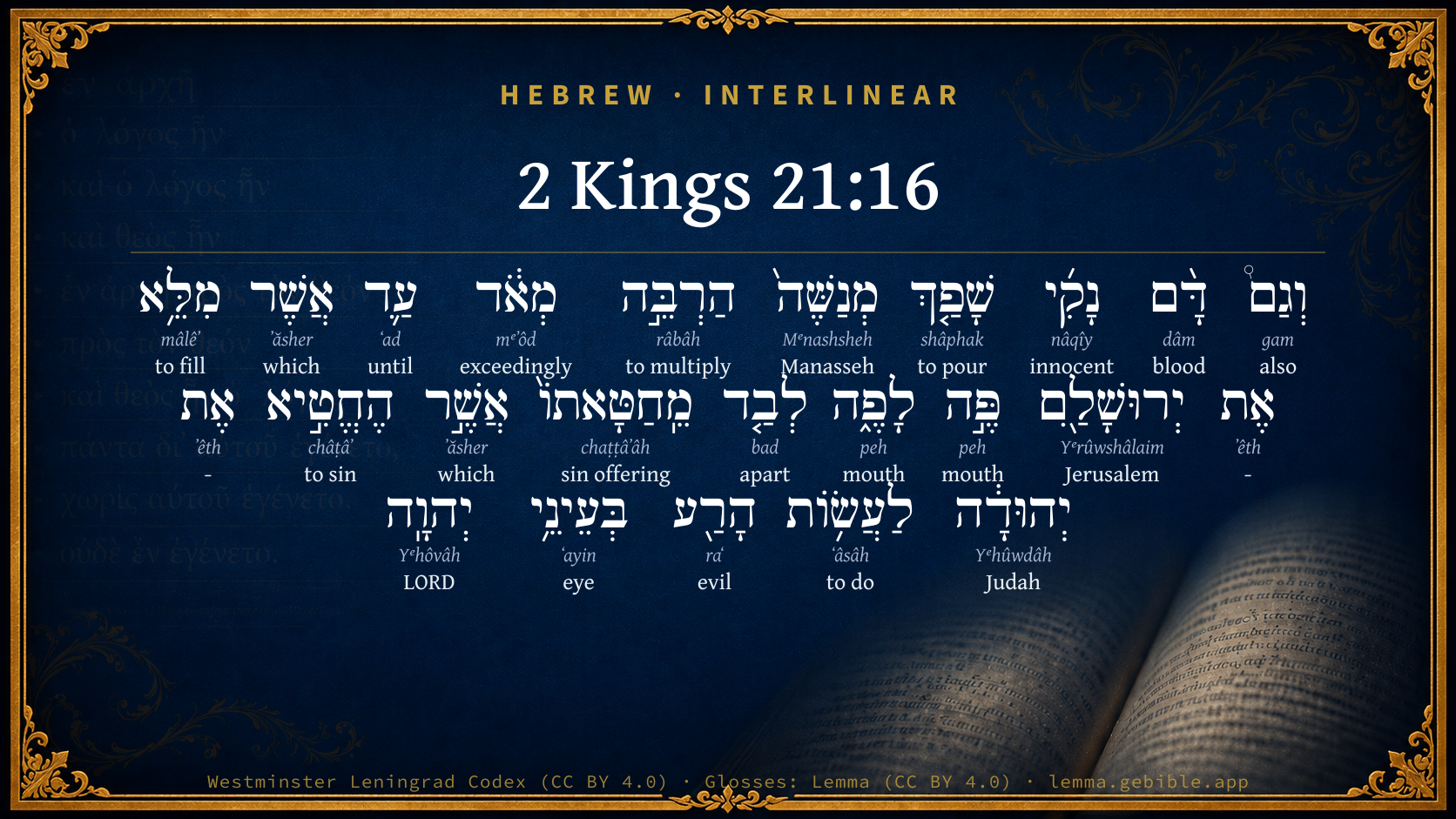
2 Kings 21:16

Hebrew (Westminster Leningrad Codex) 2 Kings 21:16 appears in the Hebrew Old Testament. The text above is from the Westminster Leningrad Codex. Each word links to its Strong’s number, a concise gloss, and parsing drawn from the Open Scriptures Hebrew Bible morphology. Click any word for its full Brown-Driver-Briggs (BDB) entry.
Download image
Cite this verse

2 Kings 21:16 (World English Bible). Public Domain. Lemma interlinear Bible study tool, https://lemma.gebible.app/v/2-kings/21/16.

Show BibTeX & RIS
BibTeX
RIS
English Translation
Moreover Manasseh shed innocent blood very much, until he had filled Jerusalem from one end to another; besides his sin with which he made Judah to sin, in doing that which was evil in the sight of Yahweh.
World English Bible · Public Domain
Download a study sheet

One document with this verse’s original text, its word-by-word gloss line, the meaning frame, cross-references with their text, attributed commentary, and full source and license credits — printable, and it pastes into notes with its structure intact.

This verse Autodidact and up

Study sheet (.html) Plain text (.txt)

A passage Seminary Student

Up to 50 verses in one chapter. A passage sheet keeps up to 6 commentary sources and 12 cross-references per verse, in the order this page ranks them, and says so on the sheet whenever that leaves anything out. Ask for a single verse and you get the Autodidact verse sheet above.

Everything on this page stays free to read, with no account — the sheet is a download of what is already on screen, not access to it.

Want to remove ads? Support Godless Engineer
Compare translations 3

The same verse in 3 English versions, stacked beneath the original-language interlinear above. Click any original word for its lexicon entry.

Each is an independent rendering of the whole verse — the interlinear is not word-aligned to these translations.

Highlighted words mark where these versions differ — a whole-verse word diff, not a word-by-word alignment.

  • World English Bible Public Domain
    Moreover Manasseh shed innocent blood very much, until he had filled Jerusalem from one end to another; besides his sin with which he made Judah to sin, in doing that which was evil in the sight of Yahweh.
  • King James Version Public Domain
    Moreover Manasseh shed innocent blood very much, till he had filled Jerusalem from one end to another; beside his sin wherewith he made Judah to sin, in doing that which was evil in the sight of the LORD.
  • unfoldingWord Literal Text CC BY-SA 4.0
    And Manasseh also poured out very much innocent blood, until he filled Jerusalem mouth to mouth, besides his sin which he made Judah sin by doing evil in the eyes of Yahweh.

unfoldingWord Literal Text — © unfoldingWord, licensed CC BY-SA 4.0. Word-aligned USFM3 via Door43 (git.door43.org/unfoldingWord/en_ult).

Versions to compare (up to 4)

3 of 4 selected

Show all 18 translations

Every available English version of this verse, each an independent rendering of the whole verse.

  • World English Bible Public Domain
    Moreover Manasseh shed innocent blood very much, until he had filled Jerusalem from one end to another; besides his sin with which he made Judah to sin, in doing that which was evil in the sight of Yahweh.
  • Berean Standard Bible Public Domain
    Moreover, Manasseh shed so much innocent blood that he filled Jerusalem from end to end, in addition to the sin that he had caused Judah to commit, doing evil in the sight of the LORD.
  • Majority Standard Bible Public Domain
    Moreover, Manasseh shed so much innocent blood that he filled Jerusalem from end to end, in addition to the sin that he had caused Judah to commit, doing evil in the sight of the LORD.
  • King James Version Public Domain
    Moreover Manasseh shed innocent blood very much, till he had filled Jerusalem from one end to another; beside his sin wherewith he made Judah to sin, in doing that which was evil in the sight of the LORD.
  • American Standard Version (1901) Public Domain
    Moreover Manasseh shed innocent blood very much, till he had filled Jerusalem from one end to another; besides his sin wherewith he made Judah to sin, in doing that which was evil in the sight of Jehovah.
  • Revised Version (1885) Public Domain
    Moreover Manasseh shed innocent blood very much, till he had filled Jerusalem from one end to another; beside his sin wherewith he made Judah to sin, in doing that which was evil in the sight of the LORD,
  • Geneva Bible (1599) Public Domain
    Moreouer Manasseh shed innocent blood exceeding much, till hee replenished Ierusalem from corner to corner, beside his sinne wherwith he made Iudah to sinne, and to doe euill in the sight of the Lord.
  • Douay-Rheims (1899) Public Domain
    Moreover Manasses shed also very much innocent blood, till he filled Jerusalem up to the mouth: besides his sins, wherewith he made Juda to sin, to do evil before the Lord.
  • Young's Literal Translation Public Domain
    And also, innocent blood hath Manasseh shed very much, till that he hath filled Jerusalem -- mouth to mouth; apart from his sin that he hath caused Judah to sin, to do the evil thing in the eyes of Jehovah.
  • Literal Standard Version CC BY-SA 4.0
    And also, Manasseh has shed very much innocent blood, until he has filled Jerusalem mouth to mouth, apart from his sin that he has caused Judah to sin, to do evil in the eyes of YHWH.
  • Unlocked Literal Bible CC BY-SA 4.0
    Moreover, Manasseh shed much innocent blood, until he had filled Jerusalem from one end to another with death. This was in addition to the sin by which he made Judah to sin, when they did what was evil in the sight of Yahweh.
  • unfoldingWord Literal Text CC BY-SA 4.0
    And Manasseh also poured out very much innocent blood, until he filled Jerusalem mouth to mouth, besides his sin which he made Judah sin by doing evil in the eyes of Yahweh.
  • Darby Bible Public Domain
    And Manasseh shed very much innocent blood, till he had filled Jerusalem [with it] from one end to another; beside his sin with which he made Judah to sin, in doing evil in the sight of Jehovah.
  • World Messianic Bible Public Domain
    Moreover Manasseh shed innocent blood very much, until he had filled Jerusalem from one end to another; in addition to his sin with which he made Judah to sin, in doing that which was evil in the LORD’s sight.
  • Webster's Bible Public Domain
    Moreover, Manasseh shed innocent blood very much, till he had filled Jerusalem from one end to another; besides his sin with which he made Judah to sin, in doing evil in the sight of the LORD.
  • Free Bible Version CC BY-SA 4.0
    On top of that, Manasseh murdered so many innocent people that Jerusalem was filled from one side to the other with their blood. This was in addition to the sin that he had made Judah commit, doing evil in the Lord's sight.
  • Bible in Basic English Public Domain
    More than this, Manasseh took the lives of upright men, till Jerusalem from one end to the other was full of blood; in addition to his sin in making Judah do evil in the eyes of the Lord.
  • JPS Tanakh (1917) Public Domain
    Moreover Manasseh shed innocent blood very much, till he had filled Jerusalem from one end to another; beside his sin wherewith he made Judah to sin, in doing that which was evil in the sight of the LORD.

Literal Standard Version (2020), Covenant Press — licensed CC BY-SA 4.0. Text via the HelloAO Bible API (eBible.org). Unlocked Literal Bible (unfoldingWord) — licensed CC BY-SA 4.0. Text via the HelloAO Bible API (eBible.org). unfoldingWord Literal Text — © unfoldingWord, licensed CC BY-SA 4.0. Word-aligned USFM3 via Door43 (git.door43.org/unfoldingWord/en_ult). Free Bible Version, Dr. Jonathan Gallagher — licensed CC BY-SA 4.0. Text via the HelloAO Bible API (eBible.org).

Word by word

More ways to search: Search by grammar → Find every occurrence → Compare this word →

Practice this passage: Drill this verse → Learn its vocabulary →

נָקִ֜י
nâqîy
H5355
“innocent”
Adjective, Adjective, Masculine, Singular, Absolute
Part of Speech
Adjective
Type
Adjective
Gender
Masculine
Number
Singular
State
Absolute
Full BDB Definition

Origin: from H5352

TWOT: 1412a , 1412b

clean, free from, exempt, clear, innocent - free from guilt, clean, innocent - free from punishment - free or exempt from obligations - innocent
  1. וְגַם֩ gam H1571 “and · also” Conjunction + Particle, Accusative
  2. דָּ֨ם dâm H1818 “blood” Noun, Common, Masculine, Singular, Absolute
  3. שָׁפַ֤ךְ shâphak H8210 “to pour” Verb, Qal, Perfect, 3rd Person, Masculine, Singular
  4. מְנַשֶּׁה֙ Mᵉnashsheh H4519 “Manasseh” Noun, Proper
  5. הַרְבֵּ֣ה râbâh H7235 “to multiply” Verb, Hiphil, Infinitive Absolute
  6. מְאֹ֔ד mᵉʼôd H3966 “exceedingly” Adverb
  7. עַ֛ד ʻad H5704 “until” Preposition
  8. אֲשֶׁר ʼăsher H834 “which” Particle, Relative
  9. מִלֵּ֥א mâlêʼ H4390 “to fill” Verb, Piel, Perfect, 3rd Person, Masculine, Singular
  10. אֶת ʼêth H853 “-” Particle, Direct Object
  11. יְרוּשָׁלִַ֖ם Yᵉrûwshâlaim H3389 “Jerusalem” Noun, Proper
  12. פֶּ֣ה peh H6310 “mouth” Noun, Common, Masculine, Singular, Absolute
  13. לָפֶ֑ה peh H6310 “to/for · mouth” Preposition + Noun, Common, Masculine, Singular, Absolute
  14. לְבַ֤ד bad H905 “to/for · apart” Preposition + Noun, Common, Masculine, Singular, Absolute
  15. מֵֽחַטָּאתוֹ֙ chaṭṭâʼâh H2403 “from · sin offering · his” Preposition + Noun, Common, Feminine, Singular, Construct + Suffix, Personal, 3rd Person, Masculine, Singular
  16. אֲשֶׁ֣ר ʼăsher H834 “which” Particle, Relative
  17. הֶחֱטִ֣יא châṭâʼ H2398 “to sin” Verb, Hiphil, Perfect, 3rd Person, Masculine, Singular
  18. אֶת ʼêth H853 “-” Particle, Direct Object
  19. יְהוּדָ֔ה Yᵉhûwdâh H3063 “Judah” Noun, Proper
  20. לַעֲשׂ֥וֹת ʻâsâh H6213 “to do” Preposition + Verb, Qal, Infinitive Construct
  21. הָרַ֖ע raʻ H7451 “the · evil” Particle, Definite Article + Adjective, Adjective, Masculine, Singular, Absolute
  22. בְּעֵינֵ֥י ʻayin H5869 “in/at · eyes of” Preposition + Noun, Common, Both, Dual, Construct
  23. יְהוָֽה Yᵉhôvâh H3068 “LORD” Noun, Proper

About this verse

These counts appear in no published source. They are computed here, from the morphology-tagged text and Lemma’s own curated glosses. What Lemma adds →

24
words
21
distinct lemmas
Historical
section

Shared distinctive vocabulary

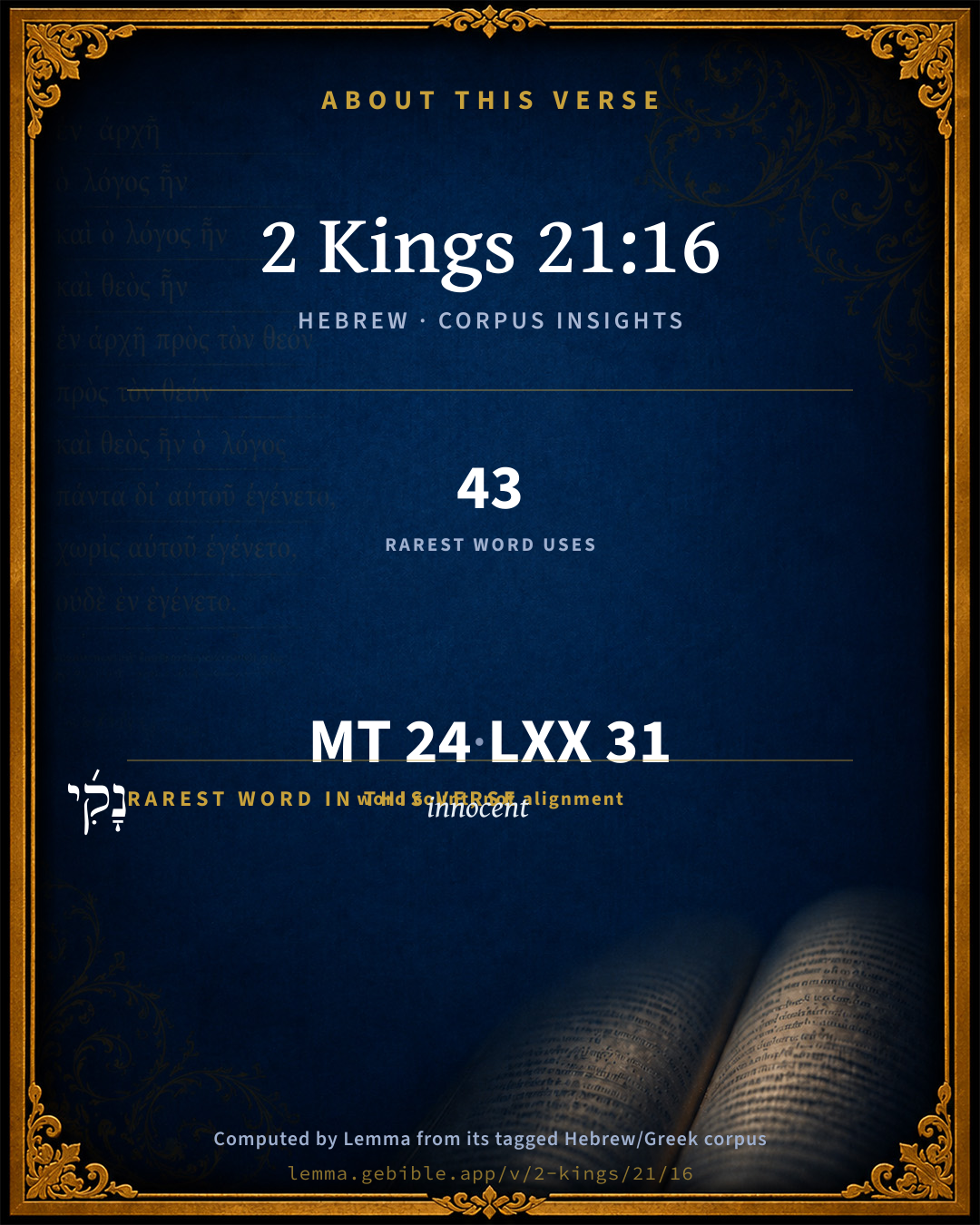
נָקִ֜י innocent H5355 occurs in 42 verses of the Hebrew Bible. Also found in:

Grammatical profile

  • 5 verbs
  • 10 nouns
  • 2 adjectives
  • 1 preposition
  • 1 adverb
  • 5 particles

Verb forms

  • שָׁפַ֤ךְ Qal · Perfect
  • הַרְבֵּ֣ה Hiphil · Infinitive Absolute
  • מִלֵּ֥א Piel · Perfect
  • הֶחֱטִ֣יא Hiphil · Perfect
  • לַעֲשׂ֥וֹת Qal · Infinitive Construct

Repetition

Words recur within this verse — often emphatic in Hebrew:

  • פֶּ֣ה mouth H6310 ×2
  • אֲשֶׁר which H834 ×2

Hebrew & Septuagint length

In English translation the verse runs 38 words from the Hebrew and 38 from the Septuagint (LXX English) — the same length.

A rough comparison of the two English renderings, which tokenize alike — not a word-level alignment.

Word counts can differ between the Hebrew and the Greek without any difference in meaning — e.g. the Hebrew direct-object marker אֵת has no separate Greek word, and Greek often adds the article ὁ.

In the original languages it is 24 Hebrew tokens and 31 Greek tokens — but the two are counted differently (Hebrew bundles its prefixes and suffixes into one token; the Greek is in lemma form), so that isn’t a like-for-like length.

Cross-references

16

Topical passages linked to 2 Kings 21:16 in the Treasury of Scripture Knowledge — connected by theme and wording, ordered by reader-vote popularity; previews shown in the World English Bible.

  • Numbers 35:33 So you shall not pollute the land in which you are: for blood, it pollutes the land; and no expiation can be made for the land for the blood that is shed therein, but by the blood of him who shed it.
  • 2 Kings 21:11 Because Manasseh king of Judah has done these abominations, and has done wickedly above all that the Amorites did, who were before him, and has made Judah also to sin with his idols;
  • 2 Chronicles 33:9 Manasseh seduced Judah and the inhabitants of Jerusalem, so that they did evil more than did the nations whom Yahweh destroyed before the children of Israel.
  • Exodus 32:21 Moses said to Aaron, "What did these people do to you, that you have brought a great sin on them?"
  • Deuteronomy 21:8–9 Forgive, Yahweh, your people Israel, whom you have redeemed, and don't allow innocent blood [to remain] in the midst of your people Israel. The blood shall be forgiven them.
  • 1 Kings 14:15–16 For Yahweh will strike Israel, as a reed is shaken in the water; and he will root up Israel out of this good land which he gave to their fathers, and will scatter them beyond the River, because they have made their Asherim, provoking Yahweh to anger.
  • 2 Kings 21:7 He set the engraved image of Asherah, that he had made, in the house of which Yahweh said to David and to Solomon his son, In this house, and in Jerusalem, which I have chosen out of all the tribes of Israel, will I put my name forever;
  • 2 Kings 24:3–4 Surely at the commandment of Yahweh came this on Judah, to remove them out of his sight, for the sins of Manasseh, according to all that he did,
  • Jeremiah 2:34 Also in your skirts is found the blood of the souls of the innocent poor: you did not find them breaking in; but it is because of all these things.
  • Jeremiah 7:6 if you don't oppress the foreigner, the fatherless, and the widow, and don't shed innocent blood in this place, neither walk after other gods to your own hurt:
  • Jeremiah 15:4 I will cause them to be tossed back and forth among all the kingdoms of the earth, because of Manasseh, the son of Hezekiah, king of Judah, for that which he did in Jerusalem.
  • Jeremiah 19:4 Because they have forsaken me, and have estranged this place, and have burned incense in it to other gods, that they didn't know, they and their fathers and the kings of Judah; and have filled this place with the blood of innocents,
  • Matthew 23:30–31 and say, 'If we had lived in the days of our fathers, we wouldn't have been partakers with them in the blood of the prophets.'
  • Matthew 27:6 The chief priests took the pieces of silver, and said, "It's not lawful to put them into the treasury, since it is the price of blood."
  • Luke 13:34 "Jerusalem, Jerusalem, that kills the prophets, and stones those who are sent to her! How often I wanted to gather your children together, like a hen gathers her own brood under her wings, and you refused!
  • Hebrews 11:37 They were stoned. They were sawn apart. They were tempted. They were slain with the sword. They went around in sheep skins and in goat skins; being destitute, afflicted, ill-treated

Cross-references courtesy of OpenBible.info (CC BY 4.0).

Hebrew and Greek witnesses Masoretic Hebrew ↔ Greek Septuagint

The same verse in the two great witnesses to the Old Testament, shown verse-for-verse.

These are two independent witnesses, not word-aligned to each other, and the Septuagint is shown in lemma (dictionary) form.

Hebrew 2 Kings 21:16 Masoretic · Westminster Leningrad Codex

וְגַם֩ דָּ֨ם נָקִ֜י שָׁפַ֤ךְ מְנַשֶּׁה֙ הַרְבֵּ֣ה מְאֹ֔ד עַ֛ד אֲשֶׁר מִלֵּ֥א אֶת יְרוּשָׁלִַ֖ם פֶּ֣ה לָפֶ֑ה לְבַ֤ד מֵֽחַטָּאתוֹ֙ אֲשֶׁ֣ר הֶחֱטִ֣יא אֶת יְהוּדָ֔ה לַעֲשׂ֥וֹת הָרַ֖ע בְּעֵינֵ֥י יְהוָֽה

Moreover Manasseh shed innocent blood very much, until he had filled Jerusalem from one end to another; besides his sin with which he made Judah to sin, in doing that which was evil in the sight of Yahweh.

World English Bible · Public Domain

Greek LXX 2 Kings 21:16 Septuagint · lemma form

καί γέ αἷμα ἀθῷος ἐκχέω μανασσῆς πολύς σφόδρα ἕως ὅς πίμπλημι ὁ ἰερουσαλήμ στόμα εἰς στόμα πλήν ὁ ἁμαρτία αὐτός ὅς ἐκἁμαρτάνω ὁ ἰούδας ὁ ποιέω ὁ πονηρός ἐν ὀφθαλμός κύριος

Moreover Manasses shed very much innocent blood, until he filled Jerusalem with it from one end to the other, beside his sins with which he caused Juda to sin, in doing evil in the eyes of the Lord.

LXX2012 (modern English Septuagint) · Public Domain

Hebrew: Westminster Leningrad Codex (CC BY 4.0). Greek: Septuagint (public domain); English from LXX2012 (modern English Septuagint) (Public Domain). How the Septuagint differs from the Hebrew →

Targum (Aramaic paraphrase)

1

The Targum is the ancient Jewish Aramaic paraphrase of the Hebrew Scriptures — an interpretive translation, not the Hebrew text itself. Onkelos (literal) and Pseudo-Jonathan (expansive) render the Torah, and Jonathan the Prophets. Coverage is partial: where no permissively-licensed English translation exists for a verse, only the Aramaic is shown. This is verse-level text, not a word-by-word alignment to the Hebrew.

  1. Targum Jonathan Prophets (Joshua–Malachi)
    וְאַף דַם זַכַּאי דַאֲשַׁד מְנַשֶׁה סַגִי לַחֲדָא עַד דִי מַלֵא יַת יְרוּשְׁלֵם סֵיפָא בְּסֵיפָא בַּר מְחוֹבוֹהִי דְחַיֵב יַת דְבֵית יְהוּדָה לְמֶעְבַּד דְבִישׁ קֳדָם יְיָ:

    (no public-domain English translation for this verse)

    Targum Jonathan — Aramaic: “Mikraot Gedolot” (public domain). English: “Sefaria Community Translation” (CC0 1.0 (public-domain dedication)); “London "Chaldee Paraphrase," 1871” (public domain). Text via Sefaria.

Commentary

Notes on 2 Kings 21:16 from classic Christian and Jewish commentators (each source and its license shown beneath its notes). The classic Christian expositions comment on the surrounding passage and are grouped to its opening verse, so a note may address several verses; the Jewish commentaries on the Tanakh (Rashi and others) are per-verse, so they appear only where the commentator wrote on this verse.

Lemma curates 59 commentaries, every one of them public domain or Creative Commons licensed, each selected and text-cleaned for this edition rather than reprinted as found. About our sources →

Trapp's Complete Commentary

John Trapp

2Ki 21:16 Moreover Manasseh shed innocent blood very much, till he had filled Jerusalem from one end to another; beside his sin wherewith he made Judah to sin, in doing [that which was] evil in the sight of the LORD.

Ver. 16. Moreover, Manasseh shed innocent blood very much.] This tiger laid hold with his teeth on all the excellent spirits of his time, as one {a} well saith of Tiberius Stimulatus est ab insurgente diabolo, saith an ancient, He was spurred on by that old man-slayer the devil, to murder the prophets and other godly people that disliked his sinful courses. Epiphanius saith that the prophet Isaiah suffered death under him; and the Rabbis tell us why: sc., because (1.) He said he had seen the Lord upon his throne; {Isa 6:1} and, (2.) Because he called the great ones of Judah princes of Sodom and rulers of Gomorrah. {Isa 1:10} {b} More likely it was for his bold inveighing against the sins of both the king and people, calling them {as Isa 57:3} witches’ children, and a bastardly brood; as "Esaias was very bold," saith St Paul. {Rom 10:20}

Till he had filled Jerusalem from one end to another.] A metaphor from vessels brim full: or from a flood that overfloweth all. And now "how was the faithful city become a harlot! it was full of judgment," sc., in good Hezekiah’s days "righteonsness lodged in it, but now murderers," Manasseh and his bloody assassins. {Isa 1:21}

Besides his sin.] His idolatry, whereto he first persuaded the people, and afterwards compelled them: so did Julian.

{a} Author imperfecti operis Hom. i. in Mat.

{b} Jerome, in Isa. i.

John Trapp, A Commentary or Exposition upon All the Books of the Old and New Testament (1647–1656) — public domain. Text from a community e-Sword module.

Joseph Benson's Commentary

2Ki 21:16. Moreover, Manasseh shed innocent blood — The blood of those prophets, and other righteous men, who either reproved his sinful practices, or refused to comply with his wicked commands. The tradition of the Jews is, that he caused Isaiah, in particular, to be sawn asunder, and that by a wooden saw, to which the author of the epistle to the Hebrews is thought to allude, Heb 11:37. Besides his sin, wherewith he made Judah to sin — That is, his idolatry, which is elsewhere called evil and corruption, and here sin, by way of eminency; which is the more remarkable, because it is here compared with horrid cruelty, and implied to be worse than it, and more abominable in God’s sight, because it more directly and immediately struck at the glory and the purity of the Divine Majesty, by respect unto which all sins are to be measured.

Joseph Benson's Commentary on the Old and New Testaments (1811–1818) — public domain. Text from a community e-Sword module.

Tyndale Open Study Notes

Tyndale Open Resources

21:16 innocent blood: Beyond his loathsome spiritual sin, Manasseh was guilty of murder. Jewish tradition holds that Isaiah was one of many prophets that Manasseh put to death.

Tyndale Open Study Notes — © Tyndale Open Resources, licensed CC BY-SA 4.0. Text via the HelloAO Bible API.

Geneva Bible (1599)

Geneva Bible translators

The Hebrews write that he slew Isaiah the Prophet, who was his father-in-law.

Geneva Bible (1599) marginal notes — public domain. Text via Bolls.life.

Jamieson, Fausset & Brown

Robert Jamieson, A. R. Fausset & David Brown

Moreover Manasseh shed innocent blood--Not content with the patronage and the practice of idolatrous abomination, he was a cruel persecutor of all who did not conform. The land was deluged with the blood of good men; among whom it is traditionally said Isaiah suffered a horrid death, by being sawn asunder (see on Heb 11:37).

Jamieson, Fausset & Brown — Commentary Critical and Explanatory on the Whole Bible (1871) — public domain (CC PDM 1.0). Text via the HelloAO Bible API.

Adam Clarke's Commentary

Verse 16. Shed innocent blood very much] Like the deities he worshipped, he was fierce and cruel; an unprincipled, merciless tyrant: he slew innocent people and God's prophets.

Adam Clarke's Commentary on the Bible (1810–1826) — public domain. Text from a community e-Sword/MySword module.

Ellicott's Commentary for English Readers

(16) Moreover Manasseh shed innocent blood . . .—The narrative is taken up again from 2Ki_21:9. The “innocent blood” shed by Manasseh was that of the prophets of Jehovah and their followers. “As the nation fell back into the grooves of its old existence, ancient customs began to reassert their sway. The worship which the prophets condemned, and which Hezekiah had proscribed, was too deeply interwoven with all parts of life to be uprooted by royal decree, and the old prejudice of the country folk against the capital, so clearly apparent in (the pages of the prophet) Micah, must have co-operated with superstition to bring about the strong revulsion against the new reforms which took place under Hezekiah’s son, Manasseh. A bloody struggle ensued between the conservative party and the followers of the prophets, and the new king was on the side of the reaction (Robertson Smith). Talmudic tradition relates that Isaiah himself was sawn asunder in the trunk of a cedar tree in which he had taken refuge. (Comp. Heb_11:37. This is, perhaps, not impossible, but hardly probable. Ewald considers that Jer_2:30, Psa_141:7, and Isaiah 53, allude to the persecution of the prophets by Manasseh.

A Bible Commentary for English Readers, edited by Charles John Ellicott (1878–1897) — public domain. Text from a community e-Sword module.

The Cambridge Bible for Schools and Colleges

gen. ed. J. J. S. Perowne

16–18. Other wickedness of Manasseh. His death (2Ch_33:18-20)

16. Manasseh shed innocent blood very much] This is alluded to again in 2Ki_24:4 as the cause of God’s continued anger against Judah. It is singular that the Chronicler makes no special mention of this particular offence. Josephus on the contrary (Ant. x. 3, 1) says ‘He did not even spare the prophets, but even of these he slew some daily (καθʼ ἡμέραν) so that Jerusalem ran with blood’. The tradition that Isaiah himself was one of the sufferers in this slaughter was current among early Christian legends, and some have taken the mention of ‘sawing asunder’ (Heb_11:37) as an allusion to his fate.

from one end to another] Lit. ‘from mouth to mouth’. See note on 2Ki_10:21.

The Cambridge Bible for Schools and Colleges (gen. ed. J. J. S. Perowne; Cambridge University Press, 1878–1918) — public domain. Text from a community e-Sword module.

John Gill's Exposition

Moreover, Manasseh shed innocent blood very much,.... Putting to death the prophets that reproved him and his people for their idolatries, and such who would not comply therewith; and it is commonly said, both by Jewish and Christian writers, that Isaiah was slain, and even sawn asunder by him; see Gill on Heb 11:37,

till he had filled Jerusalem from one end to another; a metaphor taken from filling a vessel brimful:

beside his sin wherewith he made Judah to sin, in doing that which was evil in the sight of the Lord; the sin of idolatry he drew them into, and even obliged them to commit.

John Gill's Exposition of the Whole Bible (1746–1763) — public domain (CC PDM 1.0). Text via the HelloAO Bible API.

Albert Barnes' Notes on the Bible

Compare Jer 2:30; Heb 11:37; Isa 57:1-4. According to tradition, Isaiah was among the first to perish. More than a century afterward, the final judgment upon Jerusalem was felt to be in an special way the punishment of Manasseh’s bloody persecution of God’s people (marginal reference).

Albert Barnes' Notes on the Bible (1834–1885) — public domain. Text from a community e-Sword/MySword module.

Haydock's Catholic Bible Commentary

Mouth. Chaldean, "extremity." All was full of blood, and impure idols, ver. 11. --- Besides, (absque) "without" mentioning his other scandalous sins of idolatry.

George Leo Haydock (1774–1849), Haydock's Catholic Family Bible and Commentary, 1859 edition — public domain. Excludes Psalms (Douay-Rheims chapter numbering differs from Protestant) and Deuterocanonical books (Catholic canon only).

Matthew Poole's English Annotations

Innocent blood; the blood of those prophets and righteous men who either reproved his sinful practices, or refused to comply with his wicked commands and worship.

Beside his sin, i.e. his idolatry, which is elsewhere called evil, and corruption, and here sin, by way of eminency; which is the more considerable, because it is here compared with horrid cruelty, and implied to be worse than that, and more abominable in God’s sight, because it doth more directly and immediately strike at the glory and purity of the Divine Majesty, by respect unto which all sins are to be measured. And this expression God here useth in opposition to the gross error of most men, who look upon idolatry as a small sin, as a mere mistake of the mind, as the fruit of a good intention, and as an excess proceeding from zeal in religion.

Matthew Poole's English Annotations on the Holy Bible (1683–1685) — public domain. Text from a community e-Sword/MySword module.

Whedon's Commentary on the Bible

Daniel D. Whedon

16. Shed innocent blood — Probably of those prophets (comp. 2Ki_21:10) who reproved his sins and uttered the word of the Lord against him. Josephus says, “He barbarously slew all the righteous men that were among the Hebrews; nor would he spare the prophets, for he every day slew some of them, till Jerusalem was overflown with blood.” It was during the reign of Manasseh, according to Jewish tradition, that Isaiah was sawn asunder. Heb_11:37.

Besides his sin — That is, especially, his abominable idolatry.

Daniel D. Whedon (gen. ed.), Commentary on the Old and New Testaments (1874–1909) — public domain. Text from a community e-Sword module.

The Pulpit Commentary

Moreover Manasseh shed innocent blood very much. We must not understand this of his own offerings to Moloch, for these have been already put on record against him (ver. 6), and this is something additional (note the strong expression, nor even of the multitudinous sacrifices of the same kind which were the result of his influence on the people. Some culminating horror is required, something not touched upon before, and something specially attaching to the monarch himself. These conditions are answered by supposing a bloody persecution of the faithful to be intended. Josephus declares positively that Manasseh "cruelly put to death all the righteous among the Hebrews, and did not even spare the prophets" ("Ant. Jud:," 10:3. A tradition, very widely received, declared Isaiah to have been one of the victims ("Gemara Jebam.," 4:13; "Sanhedr.," f. 103; Tertullian, "De Patientia," Augustine, "De Cir. Dei," 18:24, etc.). Stanley says, "A reign of terror commenced against all who ventured to resist the reaction. Day by day a fresh batch of the prophetic order were ordered for execution. It seemed as if a devouring lion were let loose against them. From end to end of Jerusalem were to be seen traces of their blood. The nobles who took their part were thrown headlong from the rocky cliffs of Jerusalem" ("Lectures on the Jewish Church," pt. 2. p. 492). The persecution has been compared to that of Anglicans under Mary Tudor. Till he had filled Jerusalem from one end to another i.e. "till he had filled it with blood and slaughter". (comp. 2Ki_24:4) beside his sin wherewith he made Judah to sin, in doing that which was evil in the sight of the Lord (see ver. 9).

The Pulpit Commentary (1880–1919), ed. H.D.M. Spence-Jones & Joseph S. Exell — public domain. Text from a community e-Sword module.

John Wesley's Explanatory Notes

Blood - The blood of those prophets and righteous men who either reproved his sinful practices, or refused to comply with his wicked commands. His sin - His idolatry, which is called sin, by way of eminency. The tradition of the Jews is, that he caused Isaiah in particular to be sawn asunder.

John Wesley, Explanatory Notes Upon the Whole Bible (1754–1765) — public domain. Text via the GEBible commentary corpus.

unfoldingWord translationNotes

Door43 World Missions Community

Moreover, Manasseh

"Also, Manasseh" or "In addition, Manasseh"

Manasseh shed much innocent blood

The words "shed much innocent blood" are a metonym for killing people violently. It might be best to translate this so the reader understands that other people helped Manasseh do this. AT: "Manasseh ordered his soldiers to kill many innocent people" (See: Metonymy)

he had filled Jerusalem from one end to another with death

This hyperbole emphasizes the great number of people Manasseh had killed throughout Jerusalem. The abstract noun "death" can be stated as "dead people." AT: "there were very many dead people throughout Jerusalem" (See: Hyperbole and Generalization and Abstract Nouns)

what was evil in the sight of Yahweh

The sight of Yahweh represents Yahweh's judgment or evaluation. See how you translated this in 2 Kings 3:2. AT: "what was evil in Yahweh's judgment" or "what Yahweh considers to be evil" (See: Metaphor)

are they not written ... Judah?

This can be expressed in active form and assumes that the answer is positive. The question is rhetorical and is used for emphasis. See how this phrase is translated in 2 Kings 8:23. AT: "they are written ... Judah." or "you can find them ... Judah." (See: Active or Passive and Rhetorical Question)

slept with his ancestors and

This is a polite way of saying he "died, as his ancestors had, and" (See: Euphemism)

the garden of Uzza

Possible meanings are 1) "the garden that had once belonged to a man named Uzza" or 2) "Uzza Garden." (See: How to Translate Names)

Amon

This is a man's name (See: How to Translate Names)

translationWords

innocent

blood

die

asleep

bury

unfoldingWord translationNotes — © Distant Shores Media and the Door43 World Missions Community, licensed CC BY-SA 4.0. Source: git.door43.org/Door43/en_tn.

Lesson kit

Teaching starters — assembled from the data on this page, not authored interpretation. Every prompt links to the verse data it draws on. Edit before teaching.

2 Kings, in the Historical, opens this verse with 24 words (21 distinct Hebrew lemmas). Its most distinctive word is nâqîy (“innocent”). A historical commentator’s framing appears above. Read the whole chapter for the surrounding context.

Discussion questions

  1. What does “innocent” (nâqîy) contribute to the verse as a whole?
  2. Genesis 24:41 shares the word «innocent» with this verse. How do the two illuminate each other?
  3. “mouth” occurs 2× in this one verse. What is the effect of the repetition?
  4. The translations on this page render this verse differently — a whole-verse word diff, not a word-by-word alignment. What might account for the different wordings?
  5. The verb «שָׁפַ֤ךְ» is Qal Perfect. How does its form color the action?
  6. Reading how Trapp's Complete Commentary and Joseph Benson's Commentary read this verse, where do the two commentators agree and where do they part?

Things to notice

Reading settings

Reading text

Shown beneath each verse's original-language words.

Old Testament
Old Testament edition

Read the OT as the Masoretic Hebrew (MT) or the Greek Septuagint (LXX).

English shown for the Greek Septuagint (in the Hebrew ↔ Greek comparison).

Comparing translations? Open the Compare panel on any verse page to stack up to four side by side.