
Leviticus 6:27

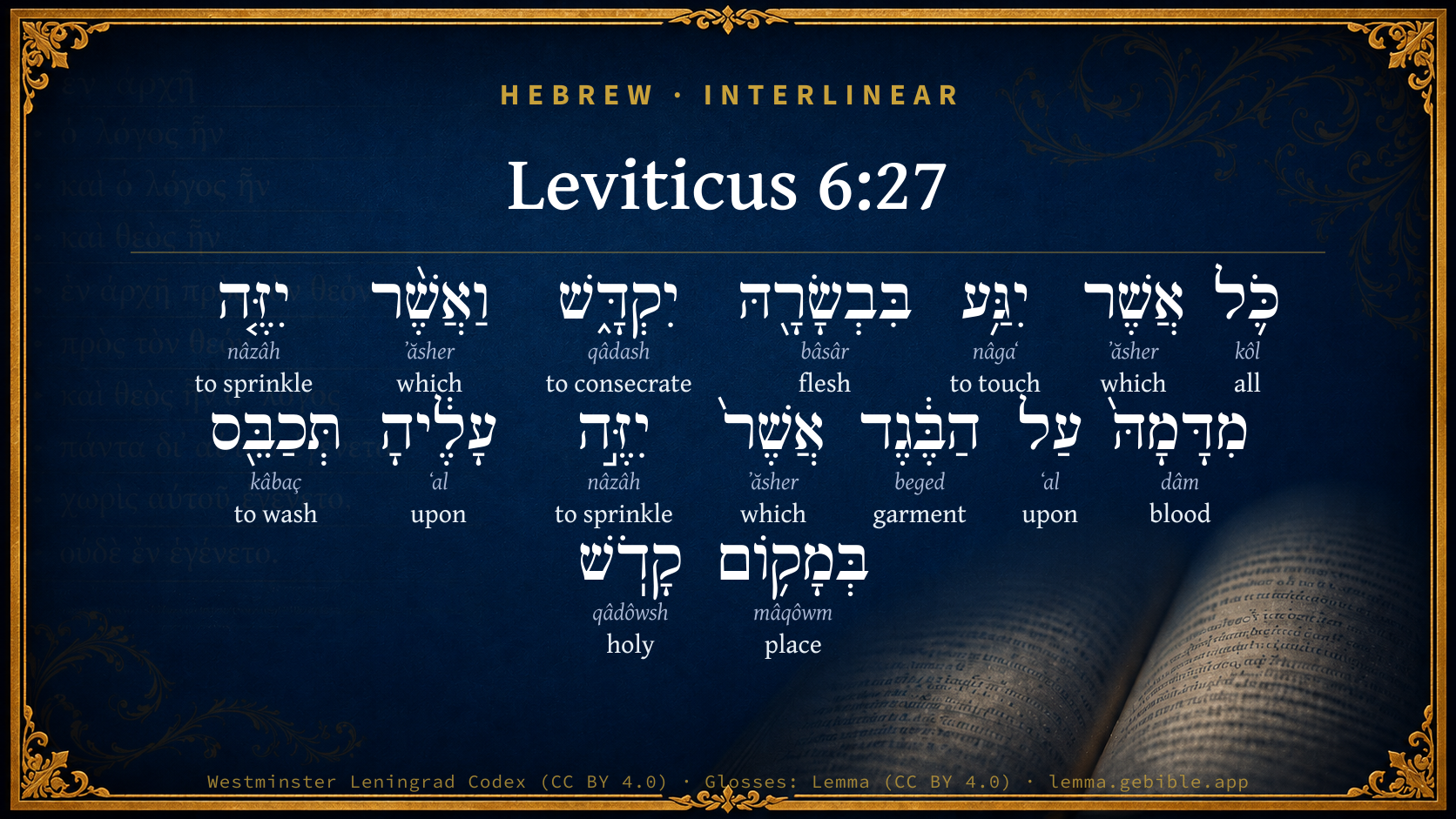
Hebrew (Westminster Leningrad Codex) Leviticus 6:27 appears in the Hebrew Old Testament. The text above is from the Westminster Leningrad Codex. Each word links to its Strong’s number, a concise gloss, and parsing drawn from the Open Scriptures Hebrew Bible morphology. Click any word for its full Brown-Driver-Briggs (BDB) entry.
Download image
Cite this verse

Leviticus 6:27 (World English Bible). Public Domain. Lemma interlinear Bible study tool, https://lemma.gebible.app/v/leviticus/6/27.

Show BibTeX & RIS
BibTeX
RIS
English Translation
Whatever shall touch its flesh shall be holy. When there is any of its blood sprinkled on a garment, you shall wash that on which it was sprinkled in a holy place.
World English Bible · Public Domain
Download a study sheet

One document with this verse’s original text, its word-by-word gloss line, the meaning frame, cross-references with their text, attributed commentary, and full source and license credits — printable, and it pastes into notes with its structure intact.

This verse Autodidact and up

Study sheet (.html) Plain text (.txt)

A passage Seminary Student

Up to 50 verses in one chapter. A passage sheet keeps up to 6 commentary sources and 12 cross-references per verse, in the order this page ranks them, and says so on the sheet whenever that leaves anything out. Ask for a single verse and you get the Autodidact verse sheet above.

Everything on this page stays free to read, with no account — the sheet is a download of what is already on screen, not access to it.

Want to remove ads? Support Godless Engineer
Compare translations 3

The same verse in 3 English versions, stacked beneath the original-language interlinear above. Click any original word for its lexicon entry.

Each is an independent rendering of the whole verse — the interlinear is not word-aligned to these translations.

Highlighted words mark where these versions differ — a whole-verse word diff, not a word-by-word alignment.

  • World English Bible Public Domain
    Whatever shall touch its flesh shall be holy. When there is any of its blood sprinkled on a garment, you shall wash that on which it was sprinkled in a holy place.
  • King James Version Public Domain
    Whatsoever shall touch the flesh thereof shall be holy: and when there is sprinkled of the blood thereof upon any garment, thou shalt wash that whereon it was sprinkled in the holy place.
  • unfoldingWord Literal Text CC BY-SA 4.0
    Everything that touches its flesh will be holy. And whoever sprinkles some of the blood on the clothing, wherever he sprinkles on it, you shall wash in a holy place.

unfoldingWord Literal Text — © unfoldingWord, licensed CC BY-SA 4.0. Word-aligned USFM3 via Door43 (git.door43.org/unfoldingWord/en_ult).

Versions to compare (up to 4)

3 of 4 selected

Show all 16 translations

Every available English version of this verse, each an independent rendering of the whole verse.

  • World English Bible Public Domain
    Whatever shall touch its flesh shall be holy. When there is any of its blood sprinkled on a garment, you shall wash that on which it was sprinkled in a holy place.
  • Berean Standard Bible Public Domain
    Anything that touches its flesh will become holy, and if any of the blood is spattered on a garment, you must wash it in a holy place.
  • Majority Standard Bible Public Domain
    Anything that touches its flesh will become holy, and if any of the blood is spattered on a garment, you must wash it in a holy place.
  • King James Version Public Domain
    Whatsoever shall touch the flesh thereof shall be holy: and when there is sprinkled of the blood thereof upon any garment, thou shalt wash that whereon it was sprinkled in the holy place.
  • American Standard Version (1901) Public Domain
    Whatsoever shall touch the flesh thereof shall be holy; and when there is sprinkled of the blood thereof upon any garment, thou shalt wash that whereon it was sprinkled in a holy place.
  • Revised Version (1885) Public Domain
    Whatsoever shall touch the flesh thereof shall be holy: and when there is sprinkled of the blood thereof upon any garment, thou shalt wash that whereon it was sprinkled in a holy place.
  • Geneva Bible (1599) Public Domain
    Whatsoeuer shall touch the flesh thereof shalbe holy: and when there droppeth of the blood thereof vpon a garment, thou shalt wash that whereon it droppeth in the holy place.
  • Douay-Rheims (1899) Public Domain
    Whatsoever shall touch the flesh thereof, shall be sanctified. If a garment be sprinkled with the blood thereof, it shall be washed in a holy place.
  • Young's Literal Translation Public Domain
    all that cometh against its flesh is holy, and when `any' of its blood is sprinkled on the garment, that on which it is sprinkled thou dost wash in the holy place;
  • Literal Standard Version CC BY-SA 4.0
    all that comes against its flesh is holy, and when [any] of its blood is sprinkled on the garment, that on which it is sprinkled you wash in the holy place;
  • Unlocked Literal Bible CC BY-SA 4.0
    Whatever touches its meat will become holy, and if the blood is sprinkled on any garment, you must wash it, the part that was sprinkled on, in a holy place.
  • unfoldingWord Literal Text CC BY-SA 4.0
    Everything that touches its flesh will be holy. And whoever sprinkles some of the blood on the clothing, wherever he sprinkles on it, you shall wash in a holy place.
  • Darby Bible Public Domain
    Everything that toucheth the flesh thereof shall be holy; and if there be splashed of the blood thereof on a garment -- that whereon it is sprinkled shalt thou wash in a holy place.
  • World Messianic Bible Public Domain
    Whatever shall touch its flesh shall be holy. When there is any of its blood sprinkled on a garment, you shall wash that on which it was sprinkled in a holy place.
  • Free Bible Version CC BY-SA 4.0
    Whatever touches it shall become holy and if any of the blood is splashed on clothing, you must wash it in a holy place.
  • JPS Tanakh (1917) Public Domain
    (6-20) Whatsoever shall touch the flesh thereof shall be holy; and when there is sprinkled of the blood thereof upon any garment, thou shalt wash that whereon it was sprinkled in a holy place.

Literal Standard Version (2020), Covenant Press — licensed CC BY-SA 4.0. Text via the HelloAO Bible API (eBible.org). Unlocked Literal Bible (unfoldingWord) — licensed CC BY-SA 4.0. Text via the HelloAO Bible API (eBible.org). unfoldingWord Literal Text — © unfoldingWord, licensed CC BY-SA 4.0. Word-aligned USFM3 via Door43 (git.door43.org/unfoldingWord/en_ult). Free Bible Version, Dr. Jonathan Gallagher — licensed CC BY-SA 4.0. Text via the HelloAO Bible API (eBible.org).

Word by word

More ways to search: Search by grammar → Find every occurrence → Compare this word →

Practice this passage: Drill this verse → Learn its vocabulary →

יִזֶּ֤ה
nâzâh
H5137
“to sprinkle”
Verb, Qal, Imperfect, 3rd Person, Masculine, Singular
Part of Speech
Verb
Stem
Qal
Form
Imperfect
Person
3rd Person
Gender
Masculine
Number
Singular
Full BDB Definition

Origin: a primitive root

TWOT: 1335 , 1336

to spurt, spatter, sprinkle - (Qal) to spurt, spatter - (Hiphil) to cause to spurt, sprinkle upon - to spring, leap - (Hiphil) to cause to leap, startle
  1. כֹּ֛ל kôl H3605 “all” Noun, Common, Masculine, Singular, Absolute
  2. אֲשֶׁר ʼăsher H834 “which” Particle, Relative
  3. יִגַּ֥ע nâgaʻ H5060 “to touch” Verb, Qal, Imperfect, 3rd Person, Masculine, Singular
  4. בִּבְשָׂרָ֖הּ bâsâr H1320 “in/at · flesh · her” Preposition + Noun, Common, Masculine, Singular, Construct + Suffix, Personal, 3rd Person, Feminine, Singular
  5. יִקְדָּ֑שׁ qâdash H6942 “to consecrate” Verb, Qal, Imperfect, 3rd Person, Masculine, Singular
  6. וַאֲשֶׁ֨ר ʼăsher H834 “and · which” Conjunction + Particle, Relative
  7. מִדָּמָהּ֙ dâm H1818 “from · blood · her” Preposition + Noun, Common, Masculine, Singular, Construct + Suffix, Personal, 3rd Person, Feminine, Singular
  8. עַל ʻal H5921 “upon” Preposition
  9. הַבֶּ֔גֶד beged H899 “the · garment” Particle, Definite Article + Noun, Common, Masculine, Singular, Absolute
  10. אֲשֶׁר֙ ʼăsher H834 “which” Particle, Relative
  11. יִזֶּ֣ה nâzâh H5137 “to sprinkle” Verb, Qal, Imperfect, 3rd Person, Masculine, Singular
  12. עָלֶ֔יהָ ʻal H5921 “upon · her” Preposition + Suffix, Personal, 3rd Person, Feminine, Singular
  13. תְּכַבֵּ֖ס kâbaç H3526 “to wash” Verb, Piel, Imperfect, 2nd Person, Masculine, Singular
  14. בְּמָק֥וֹם mâqôwm H4725 “in/at · place” Preposition + Noun, Common, Masculine, Singular, Absolute
  15. קָדֹֽשׁ qâdôwsh H6918 “holy” Adjective, Adjective, Masculine, Singular, Absolute

About this verse

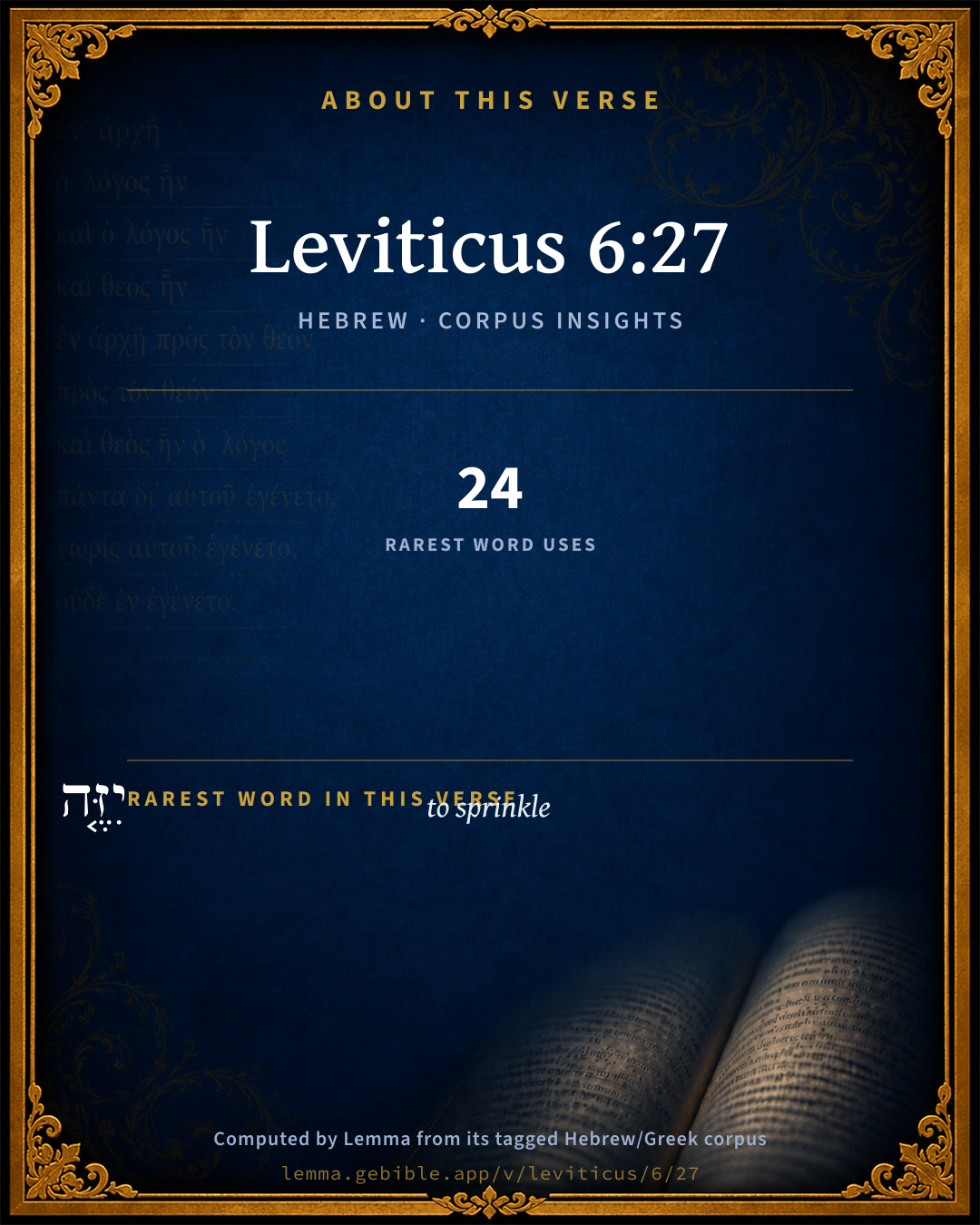
These counts appear in no published source. They are computed here, from the morphology-tagged text and Lemma’s own curated glosses. What Lemma adds →

16
words
12
distinct lemmas
Pentateuch
section

Notable vocabulary

The rarest word here is יִזֶּ֤ה to sprinkle H5137 — appearing just 24 times in the whole Hebrew Bible.

Shared distinctive vocabulary

יִזֶּ֤ה to sprinkle H5137 occurs in 22 verses of the Hebrew Bible. Also found in:

Grammatical profile

  • 5 verbs
  • 5 nouns
  • 1 adjective
  • 2 prepositions
  • 3 particles

Verb forms

  • יִגַּ֥ע Qal · Imperfect
  • יִקְדָּ֑שׁ Qal · Imperfect
  • יִזֶּ֤ה Qal · Imperfect
  • יִזֶּ֣ה Qal · Imperfect
  • תְּכַבֵּ֖ס Piel · Imperfect

Repetition

Words recur within this verse — often emphatic in Hebrew:

  • יִזֶּ֤ה to sprinkle H5137 ×2
  • עַל upon H5921 ×2
  • אֲשֶׁר which H834 ×3

Hebrew & Septuagint length

In English translation the verse runs 32 words from the Hebrew and 35 from the Septuagint (LXX English) — closely comparable.

A rough comparison of the two English renderings, which tokenize alike — not a word-level alignment.

Word counts can differ between the Hebrew and the Greek without any difference in meaning — e.g. the Hebrew direct-object marker אֵת has no separate Greek word, and Greek often adds the article ὁ.

Cross-references

9

Topical passages linked to Leviticus 6:27 in the Treasury of Scripture Knowledge — connected by theme and wording, ordered by reader-vote popularity; previews shown in the World English Bible.

  • Exodus 29:37 Seven days you shall make atonement for the altar, and sanctify it: and the altar shall be most holy; whatever touches the altar shall be holy.
  • Exodus 30:29 You shall sanctify them, that they may be most holy. Whatever touches them shall be holy.
  • Leviticus 6:18 Every male among the children of Aaron shall eat of it, as their portion forever throughout your generations, from the offerings of Yahweh made by fire. Whoever touches them shall be holy.'"
  • Leviticus 11:32 On whatever any of them falls when they are dead, it shall be unclean; whether it is any vessel of wood, or clothing, or skin, or sack, whatever vessel it is, with which any work is done, it must be put into water, and it shall be unclean until the evening; then it will be clean.
  • Haggai 2:12 'If someone carries holy meat in the fold of his garment, and with his fold touches bread, stew, wine, oil, or any food, will it become holy?'" The priests answered, "No."
  • Matthew 9:21 for she said within herself, "If I just touch his garment, I will be made well."
  • 2 Corinthians 7:1 Having therefore these promises, beloved, let us cleanse ourselves from all defilement of flesh and spirit, perfecting holiness in the fear of God.
  • 2 Corinthians 7:11 For behold, this same thing, that you were made sorry in a godly way, what earnest care it worked in you. Yes, what defense, indignation, fear, longing, zeal, and vengeance! In everything you demonstrated yourselves to be pure in the matter.
  • Matthew 14:36 and they begged him that they might just touch the fringe of his garment. As many as touched it were made whole.

Cross-references courtesy of OpenBible.info (CC BY 4.0).

Hebrew and Greek witnesses Masoretic Hebrew ↔ Greek Septuagint

The same verse in the two great witnesses to the Old Testament, shown verse-for-verse.

These are two independent witnesses, not word-aligned to each other, and the Septuagint is shown in lemma (dictionary) form.

Hebrew Leviticus 6:27 Masoretic · Westminster Leningrad Codex

כֹּ֛ל אֲשֶׁר יִגַּ֥ע בִּבְשָׂרָ֖הּ יִקְדָּ֑שׁ וַאֲשֶׁ֨ר יִזֶּ֤ה מִדָּמָהּ֙ עַל הַבֶּ֔גֶד אֲשֶׁר֙ יִזֶּ֣ה עָלֶ֔יהָ תְּכַבֵּ֖ס בְּמָק֥וֹם קָדֹֽשׁ

Whatever shall touch its flesh shall be holy. When there is any of its blood sprinkled on a garment, you shall wash that on which it was sprinkled in a holy place.

World English Bible · Public Domain

Greek LXX Leviticus 6:27 Septuagint · lemma form
Every one that touches the flesh of it shall be holy, and on whoever’s garment any of its blood shall have been sprinkled, whoever shall have it sprinkled, shall be washed in the holy place.

LXX2012 (modern English Septuagint) · Public Domain

On this verse, The Cambridge Bible for Schools and Colleges discusses the Septuagint’s reading. Read the note in Commentary ↓

Hebrew: Westminster Leningrad Codex (CC BY 4.0). Greek: Septuagint (public domain); English from LXX2012 (modern English Septuagint) (Public Domain). How the Septuagint differs from the Hebrew →

Commentary

Notes on Leviticus 6:27 from classic Christian and Jewish commentators (each source and its license shown beneath its notes). The classic Christian expositions comment on the surrounding passage and are grouped to its opening verse, so a note may address several verses; the Jewish commentaries on the Tanakh (Rashi and others) are per-verse, so they appear only where the commentator wrote on this verse.

Lemma curates 59 commentaries, every one of them public domain or Creative Commons licensed, each selected and text-cleaned for this edition rather than reprinted as found. About our sources →

Trapp's Complete Commentary

John Trapp

Lev 6:27 Whatsoever shall touch the flesh thereof shall be holy: and when there is sprinkled of the blood thereof upon any garment, thou shalt wash that whereon it was sprinkled in the holy place.

Ver. 27. Shall be holy.] This taught a holy use of the mystery of our redemption: for the sin offering in special sort figured Christ.

John Trapp, A Commentary or Exposition upon All the Books of the Old and New Testament (1647–1656) — public domain. Text from a community e-Sword module.

Joseph Benson's Commentary

Lev 6:27. Upon any garment — Upon the priest’s garments; for it was he only that sprinkled it, and in so doing he might easily sprinkle his garments. In the holy place — Partly out of reverence to the blood of sacrifices, which hereby was kept from a profane or common touch; and partly that such garments might be decent, and fit for sacred administrations.

Joseph Benson's Commentary on the Old and New Testaments (1811–1818) — public domain. Text from a community e-Sword module.

Geneva Bible (1599)

Geneva Bible translators

Meaning, the garment of the Priest.

Geneva Bible (1599) marginal notes — public domain. Text via Bolls.life.

Adam Clarke's Commentary

Verse 27. Whatsoever shall touch the flesh thereof shall be holy] The following note of Mr. Ainsworth is not less judicious than it is pious:-

"All this rite was peculiar to the sin-offering, (whether it were that which was to be eaten, or that which was to be burnt,) above all the other most holy things. As the sin-offering in special sort figured Christ, who was made sin for us, (2Co 5:21), so this ordinance for all that touched the flesh of the sin-offering to be holy, the garments sprinkled with the blood to be washed, the vessels wherein the flesh was boiled to be broken, or scoured and rinsed-taught a holy use of this mystery of our redemption, whereof they that are made partakers ought to be washed, cleansed, and sanctified by the Spirit of God; that we possess our vessels in holiness and honour, and yield not our members as instruments of unrighteousness unto sin," 1Th 4:4; Ro 6:13.

Adam Clarke's Commentary on the Bible (1810–1826) — public domain. Text from a community e-Sword/MySword module.

Ellicott's Commentary for English Readers

(27) Whatsoever shall touch the flesh thereof.—Better, every one that toucheth the flesh thereof, as the Authorised Version rightly renders this phrase in Lev_6:18 of this very chapter, where it is explained.

And when there is sprinkled . . . . —So peculiarly sacred was the sin offering, that when any of its blood chanced to spurt upon the garment of the officiating priest, or the one who brought the sacrifice, the spot which received the stain had to be washed in the room of the court provided for this purpose, wherein was a well which supplied the water for the sanctuary, thus preventing the blood from being profaned outside the holy place.

Thou shalt wash.—That is, Aaron, to whom the command was first given, and then his descendants, the priests, not the Israelite or layman.

A Bible Commentary for English Readers, edited by Charles John Ellicott (1878–1897) — public domain. Text from a community e-Sword module.

The Cambridge Bible for Schools and Colleges

gen. ed. J. J. S. Perowne

27. Whatsoever] As rules for contact with a garment or vessels follow, the clause should probably be rendered as R.V. mg. Whosoever. So the LXX.

shall be holy] shall become holy, as in Lev_6:18, where see note.

The Cambridge Bible for Schools and Colleges (gen. ed. J. J. S. Perowne; Cambridge University Press, 1878–1918) — public domain. Text from a community e-Sword module.

John Gill's Exposition

But the earthen vessel wherein it is sodden shall be broken,.... That being porous, the liquor in which the sin offering was boiled might soak into it, and the smell of it be retained, and therefore, as such vessels were not very costly, they were ordered to be broken; but where the broken pieces were carried and laid, the Jewish writers are at a loss about; for, that vessels, which had served for holy uses, should be laid in an open public place and exposed, they thought was indecent; and as there might be in a course of time great quantities broken, it would look very disagreeable and unseemly to have them lie in heaps in the sanctuary; they therefore have framed a miracle, and conceit that they were swallowed up in the ground where they were laid (x):

and if it be sodden in a brazen it shall be both scoured and rinsed in water; brass, being more valuable, must not be destroyed; and besides the liquor could not soak into that, and whatever scent it retained was easily and soon removed by scouring and rinsing; the former was with hot water, and the latter with cold, as Ben Gersom affirms.

(x) T. Bab. Yoma, fol. 21. 1.

John Gill's Exposition of the Whole Bible (1746–1763) — public domain (CC PDM 1.0). Text via the HelloAO Bible API.

Haydock's Catholic Bible Commentary

Place, in the court, that so it may be worn again. (Menochius)

George Leo Haydock (1774–1849), Haydock's Catholic Family Bible and Commentary, 1859 edition — public domain. Excludes Psalms (Douay-Rheims chapter numbering differs from Protestant) and Deuterocanonical books (Catholic canon only).

Matthew Poole's English Annotations

Whatsoever shall touch the flesh; of which See Poole "Lev 6:18".

Upon any garment; upon the priest’s garment; for it was he only that sprinkled it, and in so doing he might easily sprinkle his garments.

Thou shalt wash that whereon it was sprinkled in the holy place; partly out of reverence to the blood of sacrifices, which hereby was kept from a profane or common touch; and partly that such garments might be decent, and fit for sacred administrations.

Matthew Poole's English Annotations on the Holy Bible (1683–1685) — public domain. Text from a community e-Sword/MySword module.

Whedon's Commentary on the Bible

Daniel D. Whedon

27. Whatsoever shall touch the flesh thereof — Of this “most holy” sacrifice. No one but a consecrated person was knowingly allowed “to touch” or handle the offering.

Shall be holy — Be deemed devoted to God’s service.

When there is sprinkled upon any garment — Not intentionally, but accidentally, in the slaying of the sacrifice or otherwise. So sacred was the blood of the sin offering that not a drop was to be treated as common.

Thou shalt wash… in the holy place — So that nothing connected with, or any wise belonging to, this holy service should be contaminated by contact with unsanctified persons or things. “As the sin offering in special sort figured Christ, who was made sin for us, (2Co_5:21,) so this ordinance taught a holy use of the mystery of our redemption.” The sacredness which was deemed to appertain to “the blood” of this most holy offering is strikingly typical of that most “precious blood” of our great sacrificial Victim of which Peter speaks in his epistle. 1Pe_1:18-19.

Daniel D. Whedon (gen. ed.), Commentary on the Old and New Testaments (1874–1909) — public domain. Text from a community e-Sword module.

The Pulpit Commentary

Vers. 27-29. Communicated sanctity.

When any victim had been presented in sacrifice to God, and had been slain, its blood (the "blood of atonement"), and also its flesh, became "most holy" (verse 29). And whatsoever was touched by the one or the other received, in virtue of such contact, a communicated sanctity (verses 27, 28). The lesson here conveyed is that whatsoever comes into close association with a holy one or a holy thing does thereby acquire a measure of sacredness, and should be treated accordingly by us. This imparted sanctity gives back again to that which acts upon it some additional importance; it reflects that which it receives on the object from which it comes. We have abundant illustration of this truth; sanctity is communicated

I FROM THE GOD-MAN TO HUMAN NATURE. Man is far more to Got and to the spiritual universe now that the "Word was made flesh," that "himself" was "partaker of flesh and blood." In Jesus Christ the Divine touched the human, and henceforth the human is holy.

II FROM THE LIFE AND DEATH OF JESUS CHRIST TO THE LIFE AND DEATH OF MEN. Poverty, shame, sorrow, tears, the grave, are not these other than they were, sacred things, since he "had not where to lay his head;" since the crown of thorns rested on that sacred head; since the Man of sorrows bore his burden; since "Jesus wept;" since they "laid him in a sepulcher"?

III FROM THE SERVICE TO THE SANCTUARY. "This is none other than the house of God.

IV FROM THE FUNCTION TO THE MINISTER. "Esteem them very highly in love for their work"s sake.

V FROM THE SPIRIT TO THE BODY. The exceeding preciousness of the human spirit imparts a sanctity to the body which is its residence and organ.

VI FROM THE TRUTH TO THE WORD. We must deal reverently with the words in which the eternal truth of God is uttered. C.

The Pulpit Commentary (1880–1919), ed. H.D.M. Spence-Jones & Joseph S. Exell — public domain. Text from a community e-Sword module.

John Wesley's Explanatory Notes

Upon any garment - Upon the priest's garment; for it was he only that sprinkled it, and in so doing he might easily sprinkle his garments. In the holy place - Partly out of reverence to the blood of sacrifices, which hereby was kept from a profane or common touch; and partly that such garments might be decent, and fit for sacred administrations.

John Wesley, Explanatory Notes Upon the Whole Bible (1754–1765) — public domain. Text via the GEBible commentary corpus.

unfoldingWord translationNotes

Door43 World Missions Community

Whatever touches its meat will become holy

This is an implied warning that no one besides the priests should touch the meat of the sin offering. The full meaning of this statement can be made clear. (See: Assumed Knowledge and Implicit Information)

if the blood is sprinkled on

This can be translated in active form. AT: "if the blood sprinkles on" (See: Active or Passive)

the clay pot in which it is boiled must be broken

This can be stated in active form. AT: "you must break the clay pot in which you boiled the meat" (See: Active or Passive)

If it is boiled in a bronze pot, it must be scrubbed and rinsed clean in water

This can be stated in active form. AT: "If you boiled the meat in a bronze pot, then you must scrub the pot and rinse it with clean water" (See: Active or Passive)

translationWords

holy

blood

bronze

clean

unfoldingWord translationNotes — © Distant Shores Media and the Door43 World Missions Community, licensed CC BY-SA 4.0. Source: git.door43.org/Door43/en_tn.

Lesson kit

Teaching starters — assembled from the data on this page, not authored interpretation. Every prompt links to the verse data it draws on. Edit before teaching.

Leviticus, in the Pentateuch, opens this verse with 16 words (12 distinct Hebrew lemmas). Its most distinctive word is nâzâh (“to sprinkle”). A historical commentator’s framing appears above. Read the whole chapter for the surrounding context.

Discussion questions

  1. How does “to sprinkle” (nâzâh) shape what this verse is saying?
  2. How does Exodus 29:21, which shares the word «to sprinkle», read alongside this verse?
  3. What does the repetition of “to sprinkle” (2× in this one verse) do in this verse?
  4. The translations on this page render this verse differently — a whole-verse word diff, not a word-by-word alignment. What might account for the different wordings?
  5. «יִגַּ֥ע» is a Qal Imperfect verb. How does that grammatical form shape the action described?
  6. Compare how Trapp's Complete Commentary and Joseph Benson's Commentary read this verse. Where do they agree or differ?

Things to notice

Reading settings

Reading text

Shown beneath each verse's original-language words.

Old Testament
Old Testament edition

Read the OT as the Masoretic Hebrew (MT) or the Greek Septuagint (LXX).

English shown for the Greek Septuagint (in the Hebrew ↔ Greek comparison).

Comparing translations? Open the Compare panel on any verse page to stack up to four side by side.