
1 Samuel 14:33

Hebrew (Westminster Leningrad Codex) 1 Samuel 14:33 appears in the Hebrew Old Testament. The text above is from the Westminster Leningrad Codex. Each word links to its Strong’s number, a concise gloss, and parsing drawn from the Open Scriptures Hebrew Bible morphology. Click any word for its full Brown-Driver-Briggs (BDB) entry.
Download image
Cite this verse

1 Samuel 14:33 (World English Bible). Public Domain. Lemma interlinear Bible study tool, https://lemma.gebible.app/v/1-samuel/14/33.

Show BibTeX & RIS
BibTeX
RIS
English Translation
Then they told Saul, saying, Behold, the people sin against Yahweh, in that they eat with the blood. He said, you have dealt treacherously: roll a great stone to me this day.
World English Bible · Public Domain
Download a study sheet

One document with this verse’s original text, its word-by-word gloss line, the meaning frame, cross-references with their text, attributed commentary, and full source and license credits — printable, and it pastes into notes with its structure intact.

This verse Autodidact and up

Study sheet (.html) Plain text (.txt)

A passage Seminary Student

Up to 50 verses in one chapter. A passage sheet keeps up to 6 commentary sources and 12 cross-references per verse, in the order this page ranks them, and says so on the sheet whenever that leaves anything out. Ask for a single verse and you get the Autodidact verse sheet above.

Everything on this page stays free to read, with no account — the sheet is a download of what is already on screen, not access to it.

Want to remove ads? Support Godless Engineer
Compare translations 3

The same verse in 3 English versions, stacked beneath the original-language interlinear above. Click any original word for its lexicon entry.

Each is an independent rendering of the whole verse — the interlinear is not word-aligned to these translations.

Highlighted words mark where these versions differ — a whole-verse word diff, not a word-by-word alignment.

  • World English Bible Public Domain
    Then they told Saul, saying, Behold, the people sin against Yahweh, in that they eat with the blood. He said, you have dealt treacherously: roll a great stone to me this day.
  • King James Version Public Domain
    Then they told Saul, saying, Behold, the people sin against the LORD, in that they eat with the blood. And he said, Ye have transgressed: roll a great stone unto me this day.
  • unfoldingWord Literal Text CC BY-SA 4.0
    Then they declared to Saul, saying, “Behold, the people are sinning against Yahweh by eating with the blood!” And he said, “You have acted unfaithfully. Roll a great stone to me today.”

unfoldingWord Literal Text — © unfoldingWord, licensed CC BY-SA 4.0. Word-aligned USFM3 via Door43 (git.door43.org/unfoldingWord/en_ult).

Versions to compare (up to 4)

3 of 4 selected

Show all 18 translations

Every available English version of this verse, each an independent rendering of the whole verse.

  • World English Bible Public Domain
    Then they told Saul, saying, Behold, the people sin against Yahweh, in that they eat with the blood. He said, you have dealt treacherously: roll a great stone to me this day.
  • Berean Standard Bible Public Domain
    Then someone reported to Saul: “Look, the troops are sinning against the LORD by eating meat with the blood still in it.” “You have broken faith,” said Saul. “Roll a large stone over here at once.”
  • Majority Standard Bible Public Domain
    Then someone reported to Saul: “Look, the troops are sinning against the LORD by eating meat with the blood still in it.” “You have broken faith,” said Saul. “Roll a large stone over here at once.”
  • King James Version Public Domain
    Then they told Saul, saying, Behold, the people sin against the LORD, in that they eat with the blood. And he said, Ye have transgressed: roll a great stone unto me this day.
  • American Standard Version (1901) Public Domain
    Then they told Saul, saying, Behold, the people sin against Jehovah, in that they eat with the blood. And he said, ye have dealt treacherously: roll a great stone unto me this day.
  • Revised Version (1885) Public Domain
    Then they told Saul, saying, Behold, the people sin against the LORD, in that they eat with the blood. And he said, Ye have dealt treacherously: roll a great stone unto me this day.
  • Geneva Bible (1599) Public Domain
    Then men tolde Saul, saying, Beholde, the people sinne against the Lord, in that they eate with the blood. And he saide, Ye haue trespassed: roule a great stone vnto me this day.
  • Douay-Rheims (1899) Public Domain
    And they told Saul that the people had sinned against the Lord, eating with the blood. And he said: You have transgressed: roll here to me now a great stone.
  • Young's Literal Translation Public Domain
    And they declare to Saul, saying, `Lo, the people are sinning against Jehovah, to eat with the blood.' And he saith, `Ye have dealt treacherously, roll unto me to-day a great stone.'
  • Literal Standard Version CC BY-SA 4.0
    And they declare to Saul, saying, “Behold, the people are sinning against YHWH, to eat with the blood.” And he says, “You have dealt treacherously, roll a great stone to me today.”
  • Unlocked Literal Bible CC BY-SA 4.0
    Then they told Saul, “Look, the people are sinning against Yahweh by eating with the blood.” Saul said, “You have acted unfaithfully. Now, roll a big stone here to me.”
  • unfoldingWord Literal Text CC BY-SA 4.0
    Then they declared to Saul, saying, “Behold, the people are sinning against Yahweh by eating with the blood!” And he said, “You have acted unfaithfully. Roll a great stone to me today.”
  • Darby Bible Public Domain
    And they told Saul, saying, Behold, the people sin against Jehovah, in that they eat with the blood. And he said, Ye have acted perversely: roll me now a great stone.
  • World Messianic Bible Public Domain
    Then they told Saul, saying, “Behold, the people are sinning against the LORD, in that they eat meat with the blood.” He said, “You have dealt treacherously. Roll a large stone to me today!”
  • Webster's Bible Public Domain
    Then they told Saul, saying, Behold, the people sin against the LORD, in that they eat with the blood. And he said, Ye have transgressed: roll a great stone to me this day.
  • Free Bible Version CC BY-SA 4.0
    Saul was told, “Look, the men are sinning against the Lord by eating meat with the blood.” “Law-breakers!” said Saul. “Roll a large stone over here right now!”
  • Bible in Basic English Public Domain
    Then it was said to Saul, See, the people are sinning against the Lord, taking the blood with the flesh. And he said to those who gave him the news, Now let a great stone be rolled to me here.
  • JPS Tanakh (1917) Public Domain
    Then they told Saul, saying: 'Behold, the people sin against the LORD, in that they eat with the blood.' And he said: 'Ye have dealt treacherously; roll a great stone unto me this day.'

Literal Standard Version (2020), Covenant Press — licensed CC BY-SA 4.0. Text via the HelloAO Bible API (eBible.org). Unlocked Literal Bible (unfoldingWord) — licensed CC BY-SA 4.0. Text via the HelloAO Bible API (eBible.org). unfoldingWord Literal Text — © unfoldingWord, licensed CC BY-SA 4.0. Word-aligned USFM3 via Door43 (git.door43.org/unfoldingWord/en_ult). Free Bible Version, Dr. Jonathan Gallagher — licensed CC BY-SA 4.0. Text via the HelloAO Bible API (eBible.org).

Word by word

More ways to search: Search by grammar → Find every occurrence → Compare this word →

Practice this passage: Drill this verse → Learn its vocabulary →

גֹּֽלּוּ
gâlal
H1556
“roll”
Verb, Qal, Imperative, 2nd Person, Masculine, Plural
Part of Speech
Verb
Stem
Qal
Form
Imperative
Person
2nd Person
Gender
Masculine
Number
Plural
Full BDB Definition

Origin: a primitive root

TWOT: 353

to roll, roll away, roll down, roll together - (Qal) to roll - (Niphal) - to roll up - to flow down - (Pilpel) to roll - (Poal) to be rolled - (Hithpoel) to roll oneself - (Hithpalpel) to roll oneself - (Hiphil) to roll away
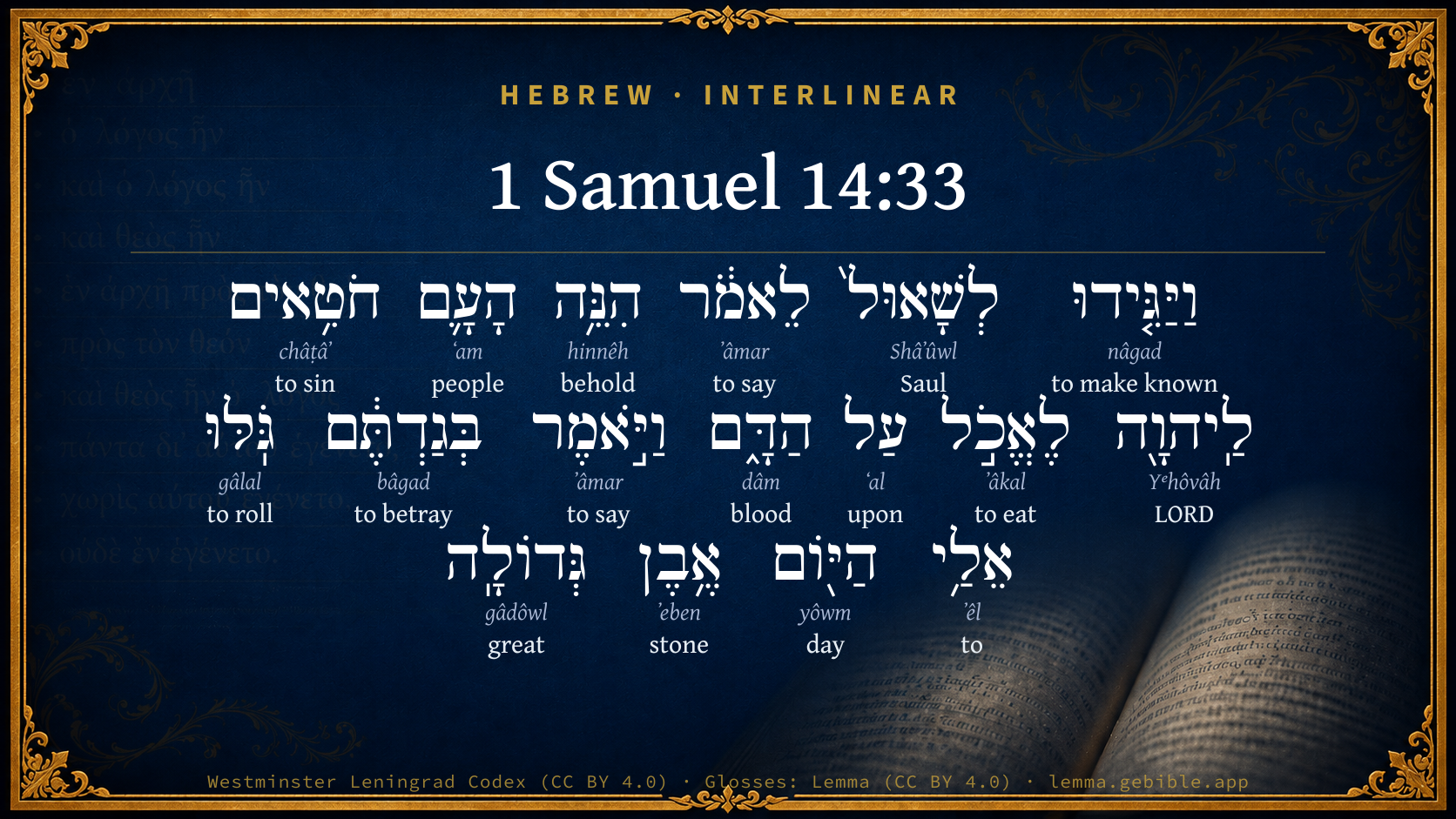
  1. וַיַּגִּ֤ידוּ nâgad H5046 “and · to make known” Conjunction + Verb, Hiphil, Sequential Imperfect, 3rd Person, Masculine, Plural
  2. לְשָׁאוּל֙ Shâʼûwl H7586 “to/for · Saul” Preposition + Noun, Proper
  3. לֵאמֹ֔ר ʼâmar H559 “to say” Preposition + Verb, Qal, Infinitive Construct
  4. הִנֵּ֥ה hinnêh H2009 “behold” Particle, Demonstrative
  5. הָעָ֛ם ʻam H5971 “the · people” Particle, Definite Article + Noun, Common, Masculine, Singular, Absolute
  6. חֹטִ֥אים châṭâʼ H2398 “sinning” Verb, Qal, Participle Active, Masculine, Plural, Absolute
  7. לַֽיהוָ֖ה Yᵉhôvâh H3068 “to/for · LORD” Preposition + Noun, Proper
  8. לֶאֱכֹ֣ל ʼâkal H398 “to eat” Preposition + Verb, Qal, Infinitive Construct
  9. עַל ʻal H5921 “upon” Preposition
  10. הַדָּ֑ם dâm H1818 “the · blood” Particle, Definite Article + Noun, Common, Masculine, Singular, Absolute
  11. וַיֹּ֣אמֶר ʼâmar H559 “and · to say” Conjunction + Verb, Qal, Sequential Imperfect, 3rd Person, Masculine, Singular
  12. בְּגַדְתֶּ֔ם bâgad H898 “to betray” Verb, Qal, Perfect, 2nd Person, Masculine, Plural
  13. אֵלַ֥י ʼêl H413 “to · me” Preposition + Suffix, Personal, 1st Person, Common, Singular
  14. הַיּ֖וֹם yôwm H3117 “the · day” Particle, Definite Article + Noun, Common, Masculine, Singular, Absolute
  15. אֶ֥בֶן ʼeben H68 “stone” Noun, Common, Feminine, Singular, Absolute
  16. גְּדוֹלָֽה gâdôwl H1419 “great” Adjective, Adjective, Feminine, Singular, Absolute

About this verse

These counts appear in no published source. They are computed here, from the morphology-tagged text and Lemma’s own curated glosses. What Lemma adds →

17
words
16
distinct lemmas
Historical
section

Notable vocabulary

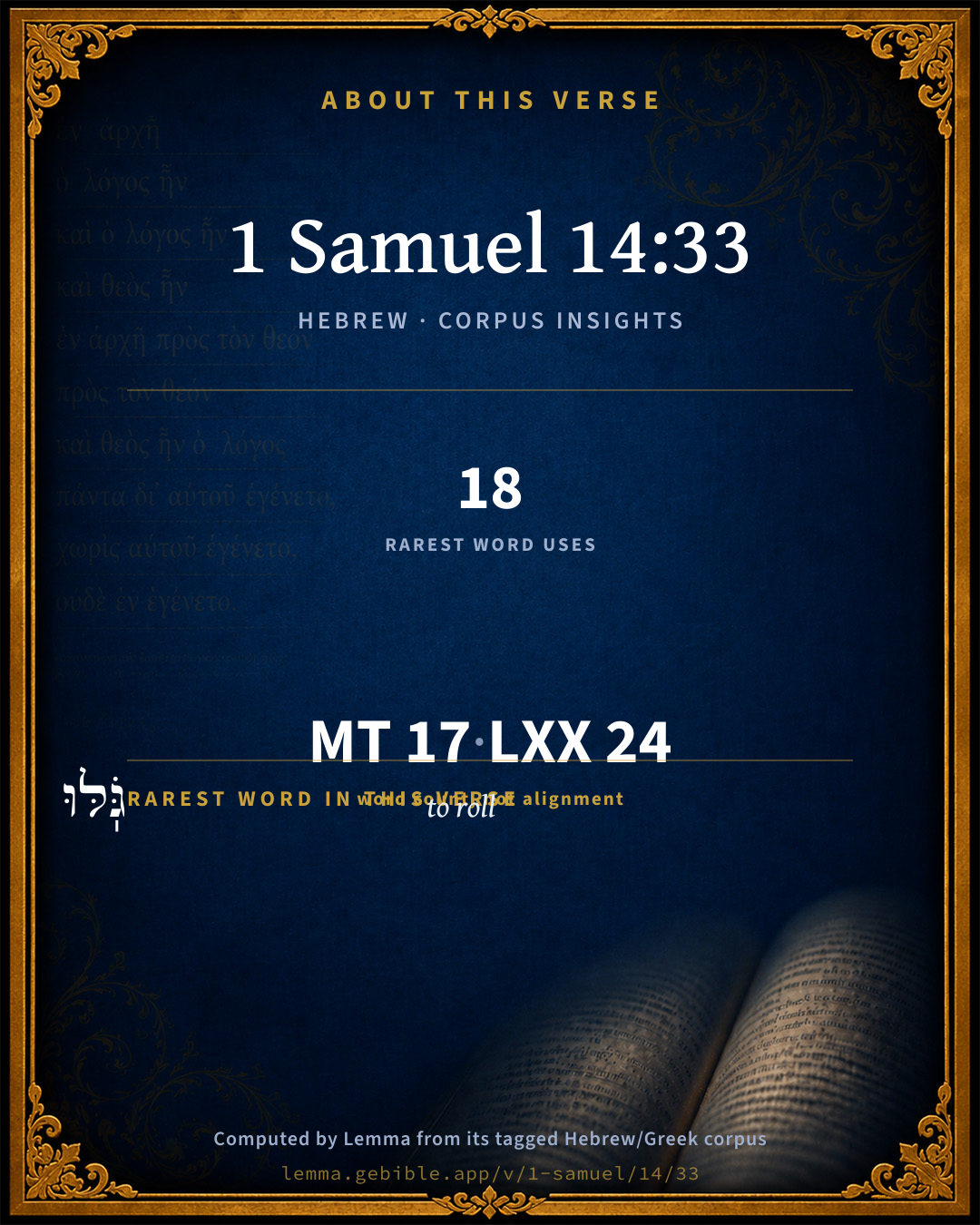
The rarest word here is גֹּֽלּוּ to roll H1556 — appearing just 18 times in the whole Hebrew Bible.

Shared distinctive vocabulary

גֹּֽלּוּ to roll H1556 occurs in 18 verses of the Hebrew Bible. Also found in:

Grammatical profile

  • 7 verbs
  • 6 nouns
  • 1 adjective
  • 2 prepositions
  • 1 particle

Verb forms

  • וַיַּגִּ֤ידוּ Hiphil · Sequential Imperfect
  • לֵאמֹ֔ר Qal · Infinitive Construct
  • חֹטִ֥אים Qal · Participle Active
  • לֶאֱכֹ֣ל Qal · Infinitive Construct
  • וַיֹּ֣אמֶר Qal · Sequential Imperfect
  • בְּגַדְתֶּ֔ם Qal · Perfect
  • גֹּֽלּוּ Qal · Imperative

Repetition

A word recurs within this verse — often emphatic in Hebrew:

  • לֵאמֹ֔ר to say H559 ×2

Hebrew & Septuagint length

In English translation the verse runs 32 words from the Hebrew and 31 from the Septuagint (LXX English) — closely comparable.

A rough comparison of the two English renderings, which tokenize alike — not a word-level alignment.

Word counts can differ between the Hebrew and the Greek without any difference in meaning — e.g. the Hebrew direct-object marker אֵת has no separate Greek word, and Greek often adds the article ὁ.

In the original languages it is 17 Hebrew tokens and 24 Greek tokens — but the two are counted differently (Hebrew bundles its prefixes and suffixes into one token; the Greek is in lemma form), so that isn’t a like-for-like length.

Hebrew and Greek witnesses Masoretic Hebrew ↔ Greek Septuagint

The same verse in the two great witnesses to the Old Testament, shown verse-for-verse.

These are two independent witnesses, not word-aligned to each other, and the Septuagint is shown in lemma (dictionary) form.

Hebrew 1 Samuel 14:33 Masoretic · Westminster Leningrad Codex

וַיַּגִּ֤ידוּ לְשָׁאוּל֙ לֵאמֹ֔ר הִנֵּ֥ה הָעָ֛ם חֹטִ֥אים לַֽיהוָ֖ה לֶאֱכֹ֣ל עַל הַדָּ֑ם וַיֹּ֣אמֶר בְּגַדְתֶּ֔ם גֹּֽלּוּ אֵלַ֥י הַיּ֖וֹם אֶ֥בֶן גְּדוֹלָֽה

Then they told Saul, saying, Behold, the people sin against Yahweh, in that they eat with the blood. He said, you have dealt treacherously: roll a great stone to me this day.

World English Bible · Public Domain

Greek LXX 1 Samuel 14:33 Septuagint · lemma form

καί ἀποἀγγέλλω ὁ σαούλ λέγω ἁμαρτάνω ὁ λαός ὁ κύριος ἐσθίω σύν ὁ αἷμα καί εἶπον σαούλ ἐν γεθθεμ κυλίω ἐγώ λίθος ἐνταῦθα μέγας

And it was reported to Saul, saying, The people have sinned against the Lord, eating with the blood: and Saul said, Out of Getthaim roll a great stone to me hither.

LXX2012 (modern English Septuagint) · Public Domain

Hebrew: Westminster Leningrad Codex (CC BY 4.0). Greek: Septuagint (public domain); English from LXX2012 (modern English Septuagint) (Public Domain). How the Septuagint differs from the Hebrew →

Targum (Aramaic paraphrase)

1

The Targum is the ancient Jewish Aramaic paraphrase of the Hebrew Scriptures — an interpretive translation, not the Hebrew text itself. Onkelos (literal) and Pseudo-Jonathan (expansive) render the Torah, and Jonathan the Prophets. Coverage is partial: where no permissively-licensed English translation exists for a verse, only the Aramaic is shown. This is verse-level text, not a word-by-word alignment to the Hebrew.

  1. Targum Jonathan Prophets (Joshua–Malachi)
    וְחַוִיאוּ לְשָׁאוּל לְמֵימַר הָא עַמָא חַיְבִין קֳדָם יְיָ לְמֵיכַל עַל דְמָא וַאֲמַר שְׁקַרְתּוּן קְרִיבוּ לְוָתִי יוֹמָא דֵין אַבְנָא רַבְּתָא:

    (no public-domain English translation for this verse)

    Targum Jonathan — Aramaic: “Mikraot Gedolot” (public domain). English: “Sefaria Community Translation” (CC0 1.0 (public-domain dedication)); “London "Chaldee Paraphrase," 1871” (public domain). Text via Sefaria.

Commentary

Notes on 1 Samuel 14:33 from classic Christian and Jewish commentators (each source and its license shown beneath its notes). The classic Christian expositions comment on the surrounding passage and are grouped to its opening verse, so a note may address several verses; the Jewish commentaries on the Tanakh (Rashi and others) are per-verse, so they appear only where the commentator wrote on this verse.

Lemma curates 59 commentaries, every one of them public domain or Creative Commons licensed, each selected and text-cleaned for this edition rather than reprinted as found. About our sources →

Trapp's Complete Commentary

John Trapp

1Sa 14:33 Then they told Saul, saying, Behold, the people sin against the LORD, in that they eat with the blood. And he said, Ye have transgressed: roll a great stone unto me this day.

Ver. 33. Ye have transgressed.] But whose fault was it that they thus transgressed? Was not his rash edict or ordinance the occasion of the people’s trasgressing God’s ordinance? This was never thought on by him.

Roll a great stone unto me this day.] That I may see the blood clean drained out of the flesh before it be eaten. But he that maketh so much ado about eating with the blood, makes nothing of spilling the blood of innocent Jonathan, and of swearing bloody oaths at the same time.

John Trapp, A Commentary or Exposition upon All the Books of the Old and New Testament (1647–1656) — public domain. Text from a community e-Sword module.

Joseph Benson's Commentary

1Sa 14:33-34. Ye have transgressed — He sees their fault, but not his own, in giving the occasion of it. Disperse yourselves among the people — Saul sends out his officers to charge the people that, when any more beasts were to be killed by or for any of them, they should bring them to a particular place, where he had fixed a stone for the purpose, and slay them under the inspection of proper officers.

Joseph Benson's Commentary on the Old and New Testaments (1811–1818) — public domain. Text from a community e-Sword module.

Geneva Bible (1599)

Geneva Bible translators

That the blood of the beast that shall be slain, may be pressed out upon it.

Geneva Bible (1599) marginal notes — public domain. Text via Bolls.life.

Adam Clarke's Commentary

Verse 33. Roll a great stone unto me] Probably this means that they should set up an altar to the Lord, on which the animals might be properly slain, and the blood poured out upon the earth; and a large stone was erected for an altar.

Adam Clarke's Commentary on the Bible (1810–1826) — public domain. Text from a community e-Sword/MySword module.

Ellicott's Commentary for English Readers

(33) Roll a great stone unto me this day.—The object of this was that the people should kill their beasts upon the stone, and the blood could run off upon the ground. It was a rough expedient, but it showed the wild soldiers that their king and general determined that the Law of Moses should be kept and honoured, even under circumstances of the direst necessity. This scrupulous care for the “Law of the Lord” at such a time as the evening of the battle of Michmash shows us what a strange complex character was Saul’s: now superstitiously watchful lest the letter of the Law should be broken; now recklessly careless whether or not the most solemn commands of God were executed.

A Bible Commentary for English Readers, edited by Charles John Ellicott (1878–1897) — public domain. Text from a community e-Sword module.

The Cambridge Bible for Schools and Colleges

gen. ed. J. J. S. Perowne

33. this day] Rather, forthwith. But the Sept. reads “here,” perhaps rightly.

The Cambridge Bible for Schools and Colleges (gen. ed. J. J. S. Perowne; Cambridge University Press, 1878–1918) — public domain. Text from a community e-Sword module.

John Gill's Exposition

Then they told Saul,.... Some that were more conscientious and religious, were more circumspect, and strictly attended to the laws forbidding the eating of blood, and were concerned at the indecent behaviour of others, and therefore thought fit to acquaint Saul with it, to restrain it:

behold, the people sin against the Lord, in that they eat with the blood; by breaking the laws of God respecting the eating of blood in Gen 9:4, especially in Lev 19:26.

and he said, ye have transgressed; the above laws of God; that is, Saul said to some persons who were accused of the breach of them, and were ordered to come before him, and did come:

roll a great stone unto me this day; pointing, perhaps, at one which lay at some distance from him, and which he ordered to be rolled to him; this was done, that the creatures might be slain on it, and their blood drawn out from them, or to offer sacrifice upon, and indeed for both.

John Gill's Exposition of the Whole Bible (1746–1763) — public domain (CC PDM 1.0). Text via the HelloAO Bible API.

Albert Barnes' Notes on the Bible

Sin against the Lord - See the marginal reference “u.” But the prohibition was older than the Law of Moses Gen 9:4. Compare Act 15:20, Act 15:29.

Albert Barnes' Notes on the Bible (1834–1885) — public domain. Text from a community e-Sword/MySword module.

Matthew Poole's English Annotations

He sees their fault, but not his own, in giving the occasion to it.

Roll a great stone unto me; that the cattle might be all killed in one place, under the inspection of Saul, or some other appointed by him for that work; and upon the stone, that the blood may sooner and better flow out.

Matthew Poole's English Annotations on the Holy Bible (1683–1685) — public domain. Text from a community e-Sword/MySword module.

Whedon's Commentary on the Bible

Daniel D. Whedon

33. Roll a great stone unto me — For the purpose of building an altar, whereon the peace offerings of sheep and oxen might be properly slain.

Daniel D. Whedon (gen. ed.), Commentary on the Old and New Testaments (1874–1909) — public domain. Text from a community e-Sword module.

The Pulpit Commentary

Vers. 33, 34. Ye have transgressed. Better as in the margin, "dealt treacherously," i.e. faithlessly, to the covenant between Israel and Jehovah. Roll a great stone unto me this day. Or, as we should say, this minute; but the Hebrew uses "this day" for anything to be done at once (see on ch. 2:16). The purpose of this stone was to raise up the caresses of the slaughtered animals from the ground, so that the blood might drain away from them. On tidings of this arrangement being dispersed throughout the army, the people obey Saul with the same unquestioning devotion as they had shown to his command to abstain from food.

The Pulpit Commentary (1880–1919), ed. H.D.M. Spence-Jones & Joseph S. Exell — public domain. Text from a community e-Sword module.

John Wesley's Explanatory Notes

Transgressed - He sees their fault, but not his own, in giving the occasion of it.

John Wesley, Explanatory Notes Upon the Whole Bible (1754–1765) — public domain. Text via the GEBible commentary corpus.

unfoldingWord translationNotes

Door43 World Missions Community

by eating with the blood

This was a violation of the Law which was given to Moses for the nation of Israel. This can be made explicit. AT: "by eating meat without draining the blood first as required by the law" (See: Assumed Knowledge and Implicit Information)

You have acted unfaithfully

Saul is accusing his whole army of acting unfaithfully though this is a generalization because not every soldier acted unfaithfully. (See: Hyperbole and Generalization)

Now, roll a big stone here to me

The stone would hold the animals up and make it easier to drain the blood from them. (See: Assumed Knowledge and Implicit Information)

kill them here, and eat

This would allow Saul to observe if the blood was properly drained from the animals.

translationWords

Saul (OT)

sin

Yahweh

faithful

blood

unfoldingWord translationNotes — © Distant Shores Media and the Door43 World Missions Community, licensed CC BY-SA 4.0. Source: git.door43.org/Door43/en_tn.

Rashi

Rabbi Shlomo Yitzchaki (Rashi)

Roll over to me. An expression of גַּלְּלוּ [roll].

Today. While it is yet daytime, and below it stated, "and all the people brought near, each man his ox in his hand that night." Our Rabbis had different views at the end of Maseches Zevochim; some of them explain that [Scripture is referring to] ordinary animals, while here [the Scripture is referring to] sacrificial animals. Others explained that here [Scripture is referring to] sacrificial animals which were sanctified to be offered at the large high place in Nov, while here [Scripture is referring to] sacrificial animals which were sanctified to be offered at a small high place. Scripture thereby teaches us that a private burnt-offering may be slaughtered at night [on a small, i.e., private high place].

A boulder. He made it a high place upon which to sprinkle the blood and for the burning of the fatty parts.

Rashi on the Tanakh — English translations: “The Judaica Press complete Tanach with Rashi, translated by A. J. Rosenberg” (CC BY 4.0); “Pentateuch with Rashi's commentary by M. Rosenbaum and A.M. Silbermann, 1929-1934” (public domain); “The Metsudah Tanach series, Lakewood, N.J” (CC BY 4.0); and “The Book of Joshua, Metsudah Publications, 1997” (CC BY 4.0). Text via Sefaria.

Lesson kit

Teaching starters — assembled from the data on this page, not authored interpretation. Every prompt links to the verse data it draws on. Edit before teaching.

1 Samuel, in the Historical, opens this verse with 17 words (16 distinct Hebrew lemmas). Its most distinctive word is gâlal (“to roll”). A historical commentator’s framing appears above. Read the whole chapter for the surrounding context.

Discussion questions

  1. What does “to roll” (gâlal) contribute to the verse as a whole?
  2. How does Genesis 29:3, which shares the word «to roll», read alongside this verse?
  3. What does the repetition of “to say” (2× in this one verse) do in this verse?
  4. These translations render this verse differently. What is at stake in choosing one wording over another?
  5. «וַיַּגִּ֤ידוּ» is a Hiphil Sequential Imperfect verb. How does that grammatical form shape the action described?
  6. Compare how Trapp's Complete Commentary and Joseph Benson's Commentary read this verse. Where do they agree or differ?

Things to notice

Reading settings

Reading text

Shown beneath each verse's original-language words.

Old Testament
Old Testament edition

Read the OT as the Masoretic Hebrew (MT) or the Greek Septuagint (LXX).

English shown for the Greek Septuagint (in the Hebrew ↔ Greek comparison).

Comparing translations? Open the Compare panel on any verse page to stack up to four side by side.