
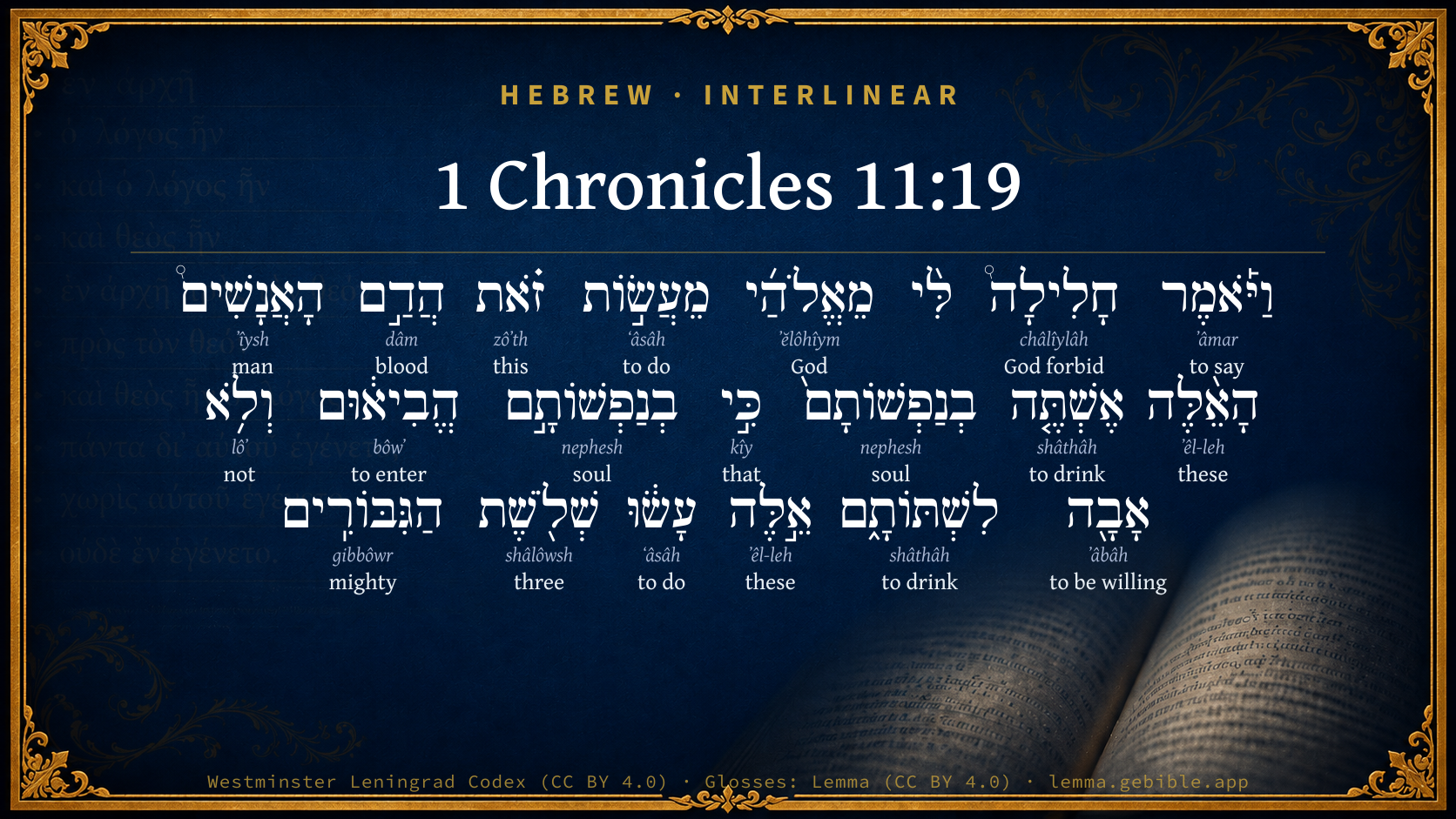
1 Chronicles 11:19

Hebrew (Westminster Leningrad Codex) 1 Chronicles 11:19 appears in the Hebrew Old Testament. The text above is from the Westminster Leningrad Codex. Each word links to its Strong’s number, a concise gloss, and parsing drawn from the Open Scriptures Hebrew Bible morphology. Click any word for its full Brown-Driver-Briggs (BDB) entry.
Download image
Cite this verse

1 Chronicles 11:19 (World English Bible). Public Domain. Lemma interlinear Bible study tool, https://lemma.gebible.app/v/1-chronicles/11/19.

Show BibTeX & RIS
BibTeX
RIS
English Translation
and said, My God forbid it me, that I should do this: shall I drink the blood of these men who have put their lives in jeopardy? for with [the jeopardy of] their lives they brought it. Therefore he would not drink it. These things did the three mighty men.
World English Bible · Public Domain
Download a study sheet

One document with this verse’s original text, its word-by-word gloss line, the meaning frame, cross-references with their text, attributed commentary, and full source and license credits — printable, and it pastes into notes with its structure intact.

This verse Autodidact and up

Study sheet (.html) Plain text (.txt)

A passage Seminary Student

Up to 50 verses in one chapter. A passage sheet keeps up to 6 commentary sources and 12 cross-references per verse, in the order this page ranks them, and says so on the sheet whenever that leaves anything out. Ask for a single verse and you get the Autodidact verse sheet above.

Everything on this page stays free to read, with no account — the sheet is a download of what is already on screen, not access to it.

Want to remove ads? Support Godless Engineer
Compare translations 3

The same verse in 3 English versions, stacked beneath the original-language interlinear above. Click any original word for its lexicon entry.

Each is an independent rendering of the whole verse — the interlinear is not word-aligned to these translations.

Highlighted words mark where these versions differ — a whole-verse word diff, not a word-by-word alignment.

  • World English Bible Public Domain
    and said, My God forbid it me, that I should do this: shall I drink the blood of these men who have put their lives in jeopardy? for with [the jeopardy of] their lives they brought it. Therefore he would not drink it. These things did the three mighty men.
  • King James Version Public Domain
    And said, My God forbid it me, that I should do this thing: shall I drink the blood of these men that have put their lives in jeopardy? for with the jeopardy of their lives they brought it. Therefore he would not drink it. These things did these three mightiest.
  • unfoldingWord Literal Text CC BY-SA 4.0
    And he said, “Profane to me from God from doing this! Shall I drink the blood of these men with their lives? For they brought them with their lives.” And he was not willing to drink them. The three warriors did these.

unfoldingWord Literal Text — © unfoldingWord, licensed CC BY-SA 4.0. Word-aligned USFM3 via Door43 (git.door43.org/unfoldingWord/en_ult).

Versions to compare (up to 4)

3 of 4 selected

Show all 18 translations

Every available English version of this verse, each an independent rendering of the whole verse.

  • World English Bible Public Domain
    and said, My God forbid it me, that I should do this: shall I drink the blood of these men who have put their lives in jeopardy? for with [the jeopardy of] their lives they brought it. Therefore he would not drink it. These things did the three mighty men.
  • Berean Standard Bible Public Domain
    saying, “Far be it from me, my God, to do this! How can I drink the blood of these men who risked their lives?” Because they had brought it at the risk of their lives, David refused to drink it. Such were the exploits of the three mighty men.
  • Majority Standard Bible Public Domain
    saying, “Far be it from me, my God, to do this! How can I drink the blood of these men who risked their lives?” Because they had brought it at the risk of their lives, David refused to drink it. Such were the exploits of the three mighty men.
  • King James Version Public Domain
    And said, My God forbid it me, that I should do this thing: shall I drink the blood of these men that have put their lives in jeopardy? for with the jeopardy of their lives they brought it. Therefore he would not drink it. These things did these three mightiest.
  • American Standard Version (1901) Public Domain
    and said, My God forbid it me, that I should do this: shall I drink the blood of these men that have put their lives in jeopardy? for with `the jeopardy of' their lives they brought it. Therefore he would not drink it. These things did the three mighty men.
  • Revised Version (1885) Public Domain
    and said, My God forbid it me, that I should do this: shall I drink the blood of these men that have put their lives in jeopardy? for with the jeopardy of their lives they brought it. Therefore he would not drink it. These things did the three mighty men.
  • Geneva Bible (1599) Public Domain
    And said, Let not my God suffer me to do this: should I drinke the blood of these mens liues? for they haue brought it with the ieopardie of their liues: therefore he would not drinke it: these things did these three mightie men.
  • Douay-Rheims (1899) Public Domain
    Saying: God forbid that I should do this in the sight of my God, and should drink the blood of these men: for with the danger of their lives they have brought me the water. And therefore he would not drink. These things did the three most valiant.
  • Young's Literal Translation Public Domain
    and saith, `Far be it from me, by my God, to do this; the blood of these men do I drink with their lives? for with their lives they have brought it;' and he was not willing to drink it; these `things' did the three mighty ones.
  • Literal Standard Version CC BY-SA 4.0
    and says, “Far be it from me, by my God, to do this; do I drink the blood of these men with their lives? For with their lives they have brought it”; and he was not willing to drink it; these [things] the three mighty ones did.
  • Unlocked Literal Bible CC BY-SA 4.0
    Then he said, “May it be that I should never do this! Should I drink the blood of these men who have risked their lives?” Because they had put their lives at risk, David refused to drink it. These were the deeds of the three mighty men.
  • unfoldingWord Literal Text CC BY-SA 4.0
    And he said, “Profane to me from God from doing this! Shall I drink the blood of these men with their lives? For they brought them with their lives.” And he was not willing to drink them. The three warriors did these.
  • Darby Bible Public Domain
    And he said, My God forbid it me, that I should do this thing! should I drink the blood of these men [who went] at the risk of their lives? for at the risk of their lives they brought it. Therefore he would not drink it. These things did the three mighty men.
  • World Messianic Bible Public Domain
    and said, “My God forbid me, that I should do this! Shall I drink the blood of these men who have put their lives in jeopardy?” For they risked their lives to bring it. Therefore he would not drink it. The three mighty men did these things.
  • Webster's Bible Public Domain
    And said, My God forbid it me, that I should do this thing: shall I drink the blood of these men that have put their lives in jeopardy? for with the jeopardy of their lives they brought it. Therefore he would not drink it. These things did these three mightiest.
  • Free Bible Version CC BY-SA 4.0
    “God forbid that I should do this!” he said. “It would be like drinking the blood of these men who risked their lives! They risked their lives to bring me a drink.” So he did not drink it. This is just some of the things the Three leading warriors did.
  • Bible in Basic English Public Domain
    Saying, By my God, far be it from me to do this! How may I take as drink the life-blood of these men who have put their lives in danger? so he did not take it. These things did the three great men of war.
  • JPS Tanakh (1917) Public Domain
    and said: 'My God forbid it me, that I should do this; shall I drink the blood of these men that have put their lives in jeopardy? for with the jeopardy of their lives they brought it.' Therefore he would not drink it. These things did the three mighty men.

Literal Standard Version (2020), Covenant Press — licensed CC BY-SA 4.0. Text via the HelloAO Bible API (eBible.org). Unlocked Literal Bible (unfoldingWord) — licensed CC BY-SA 4.0. Text via the HelloAO Bible API (eBible.org). unfoldingWord Literal Text — © unfoldingWord, licensed CC BY-SA 4.0. Word-aligned USFM3 via Door43 (git.door43.org/unfoldingWord/en_ult). Free Bible Version, Dr. Jonathan Gallagher — licensed CC BY-SA 4.0. Text via the HelloAO Bible API (eBible.org).

Word by word

More ways to search: Search by grammar → Find every occurrence → Compare this word →

Practice this passage: Drill this verse → Learn its vocabulary →

חָלִילָה֩
châlîylâh
H2486
“God forbid”
Particle, Interjection + Suffix, h
Part of Speech
Particle
Type
Interjection
Full BDB Definition

Origin: a directive from H2490

TWOT: 661c

far be it (from me), God forbid that, let it not be
  1. וַיֹּ֡אמֶר ʼâmar H559 “and · to say” Conjunction + Verb, Qal, Sequential Imperfect, 3rd Person, Masculine, Singular
  2. מֵאֱלֹהַ֜י ʼĕlôhîym H430 “from · God(s) · my” Preposition + Noun, Common, Masculine, Plural, Construct + Suffix, Personal, 1st Person, Common, Singular
  3. מֵעֲשׂ֣וֹת ʻâsâh H6213 “from · to do” Preposition + Verb, Qal, Infinitive Construct
  4. זֹ֗את zôʼth H2063 “this” Pronoun, Demonstrative, Feminine, Singular
  5. הֲדַ֣ם dâm H1818 “blood of” Particle, Interrogative + Noun, Common, Masculine, Singular, Construct
  6. הָאֲנָשִׁים֩ ʼîysh H376 “the · men” Particle, Definite Article + Noun, Common, Masculine, Plural, Absolute
  7. הָאֵ֨לֶּה ʼêl-leh H428 “the · these” Particle, Definite Article + Pronoun, Demonstrative, Common, Plural
  8. אֶשְׁתֶּ֤ה shâthâh H8354 “to drink” Verb, Qal, Imperfect, 1st Person, Common, Singular
  9. בְנַפְשׁוֹתָם֙ nephesh H5315 “in/at · souls · their” Preposition + Noun, Common, Both, Plural, Construct + Suffix, Personal, 3rd Person, Masculine, Plural
  10. כִּ֣י kîy H3588 “that” Conjunction
  11. בְנַפְשׁוֹתָ֣ם nephesh H5315 “in/at · souls · their” Preposition + Noun, Common, Both, Plural, Construct + Suffix, Personal, 3rd Person, Masculine, Plural
  12. הֱבִיא֔וּם bôwʼ H935 “to enter · them” Verb, Hiphil, Perfect, 3rd Person, Common, Plural + Suffix, Personal, 3rd Person, Masculine, Plural
  13. וְלֹ֥א lôʼ H3808 “and · not” Conjunction + Particle, Negative
  14. אָבָ֖ה ʼâbâh H14 “to be willing” Verb, Qal, Perfect, 3rd Person, Masculine, Singular
  15. לִשְׁתּוֹתָ֑ם shâthâh H8354 “to drink · them” Preposition + Verb, Qal, Infinitive Construct + Suffix, Personal, 3rd Person, Masculine, Plural
  16. אֵ֣לֶּה ʼêl-leh H428 “these” Pronoun, Demonstrative, Common, Plural
  17. עָשׂ֔וּ ʻâsâh H6213 “to do” Verb, Qal, Perfect, 3rd Person, Common, Plural
  18. שְׁלֹ֖שֶׁת shâlôwsh H7969 “three” Adjective, Cardinal number, Masculine, Singular, Construct
  19. הַגִּבּוֹרִֽים gibbôwr H1368 “the · mighty” Particle, Definite Article + Adjective, Adjective, Masculine, Plural, Absolute

About this verse

These counts appear in no published source. They are computed here, from the morphology-tagged text and Lemma’s own curated glosses. What Lemma adds →

21
words
16
distinct lemmas
Historical
section

Notable vocabulary

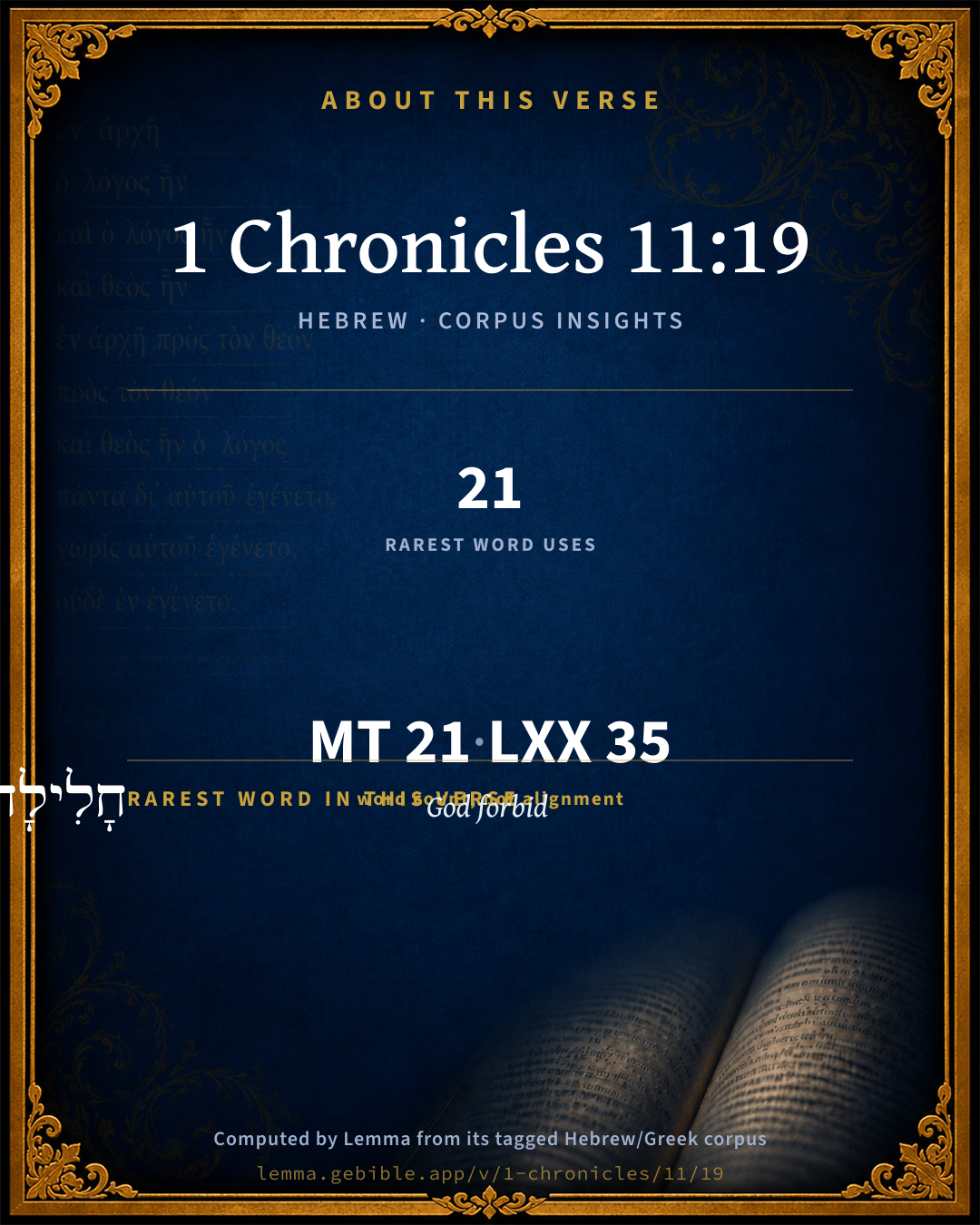
The rarest word here is חָלִילָה֩ God forbid H2486 — appearing just 21 times in the whole Hebrew Bible.

Shared distinctive vocabulary

חָלִילָה֩ God forbid H2486 occurs in 19 verses of the Hebrew Bible. Also found in:

Grammatical profile

  • 7 verbs
  • 5 nouns
  • 2 adjectives
  • 3 pronouns
  • 1 preposition
  • 1 conjunction
  • 2 particles

Verb forms

  • וַיֹּ֡אמֶר Qal · Sequential Imperfect
  • מֵעֲשׂ֣וֹת Qal · Infinitive Construct
  • אֶשְׁתֶּ֤ה Qal · Imperfect
  • הֱבִיא֔וּם Hiphil · Perfect
  • אָבָ֖ה Qal · Perfect
  • לִשְׁתּוֹתָ֑ם Qal · Infinitive Construct
  • עָשׂ֔וּ Qal · Perfect

Repetition

Words recur within this verse — often emphatic in Hebrew:

  • מֵעֲשׂ֣וֹת to do H6213 ×2
  • אֶשְׁתֶּ֤ה to drink H8354 ×2
  • בְנַפְשׁוֹתָם֙ soul H5315 ×2
  • הָאֵ֨לֶּה these H428 ×2

Hebrew & Septuagint length

In English translation the verse runs 50 words from the Hebrew and 42 from the Septuagint (LXX English) — closely comparable.

A rough comparison of the two English renderings, which tokenize alike — not a word-level alignment.

Word counts can differ between the Hebrew and the Greek without any difference in meaning — e.g. the Hebrew direct-object marker אֵת has no separate Greek word, and Greek often adds the article ὁ.

In the original languages it is 21 Hebrew tokens and 35 Greek tokens — but the two are counted differently (Hebrew bundles its prefixes and suffixes into one token; the Greek is in lemma form), so that isn’t a like-for-like length.

Cross-references

13

Topical passages linked to 1 Chronicles 11:19 in the Treasury of Scripture Knowledge — connected by theme and wording, ordered by reader-vote popularity; previews shown in the World English Bible.

  • 2 Samuel 23:17 He said, Be it far from me, Yahweh, that I should do this: [shall I drink] the blood of the men who went in jeopardy of their lives? therefore he would not drink it. These things did the three mighty men.
  • Psalms 72:14 He will redeem their soul from oppression and violence. Their blood will be precious in his sight.
  • Leviticus 17:10 "'Any man of the house of Israel, or of the strangers who live as foreigners among them, who eats any kind of blood, I will set my face against that soul who eats blood, and will cut him off from among his people.
  • Judges 5:18 Zebulun was a people that jeopardized their lives to the death, Naphtali, on the high places of the field.
  • Judges 9:17 (for my father fought for you, and adventured his life, and delivered you out of the hand of Midian:
  • 1 Samuel 19:5 for he put his life in his hand, and struck the Philistine, and Yahweh worked a great victory for all Israel: you saw it, and did rejoice; why then will you sin against innocent blood, to kill David without a cause?
  • 1 Kings 21:3 Naboth said to Ahab, Yahweh forbid it me, that I should give the inheritance of my fathers to you.
  • Job 31:31 If the men of my tent have not said, 'Who can find one who has not been filled with his meat?'
  • Mark 14:24 He said to them, "This is my blood of the new covenant, which is poured out for many.
  • John 6:55 For my flesh is food indeed, and my blood is drink indeed.
  • Romans 6:1–2 What shall we say then? Shall we continue in sin, that grace may abound?
  • Romans 16:4 who for my life, laid down their own necks; to whom not only I give thanks, but also all the assemblies of the Gentiles.
  • 1 Corinthians 15:30 Why do we also stand in jeopardy every hour?

Cross-references courtesy of OpenBible.info (CC BY 4.0).

Hebrew and Greek witnesses Masoretic Hebrew ↔ Greek Septuagint

The same verse in the two great witnesses to the Old Testament, shown verse-for-verse.

These are two independent witnesses, not word-aligned to each other, and the Septuagint is shown in lemma (dictionary) form.

Hebrew 1 Chronicles 11:19 Masoretic · Westminster Leningrad Codex

וַיֹּ֡אמֶר חָלִילָה֩ לִּ֨י מֵאֱלֹהַ֜י מֵעֲשׂ֣וֹת זֹ֗את הֲדַ֣ם הָאֲנָשִׁים֩ הָאֵ֨לֶּה אֶשְׁתֶּ֤ה בְנַפְשׁוֹתָם֙ כִּ֣י בְנַפְשׁוֹתָ֣ם הֱבִיא֔וּם וְלֹ֥א אָבָ֖ה לִשְׁתּוֹתָ֑ם אֵ֣לֶּה עָשׂ֔וּ שְׁלֹ֖שֶׁת הַגִּבּוֹרִֽים

and said, My God forbid it me, that I should do this: shall I drink the blood of these men who have put their lives in jeopardy? for with [the jeopardy of] their lives they brought it. Therefore he would not drink it. These things did the three mighty men.

World English Bible · Public Domain

Greek LXX 1 Chronicles 11:19 Septuagint · lemma form

καί εἶπον ἵλεως ἐγώ ὁ θεός ὁ ποιέω ὁ ῥῆμα οὗτος εἰ αἷμα ἀνήρ οὗτος πίνω ἐν ψυχή αὐτός ὅτι ἐν ψυχή αὐτός φέρω αὐτός καί οὐ βούλομαι πίνω αὐτός οὗτος ποιέω ὁ τρεῖς δυνατός

God forbid that I should do this thing: shall I drink the blood of these men with their lives? for with the peril of their lives they brought it. So he would not drink it. These things did the three mighty men.

LXX2012 (modern English Septuagint) · Public Domain

Hebrew: Westminster Leningrad Codex (CC BY 4.0). Greek: Septuagint (public domain); English from LXX2012 (modern English Septuagint) (Public Domain). How the Septuagint differs from the Hebrew →

Commentary

Notes on 1 Chronicles 11:19 from classic Christian and Jewish commentators (each source and its license shown beneath its notes). The classic Christian expositions comment on the surrounding passage and are grouped to its opening verse, so a note may address several verses; the Jewish commentaries on the Tanakh (Rashi and others) are per-verse, so they appear only where the commentator wrote on this verse.

Lemma curates 59 commentaries, every one of them public domain or Creative Commons licensed, each selected and text-cleaned for this edition rather than reprinted as found. About our sources →

Trapp's Complete Commentary

John Trapp

1Ch 11:19 And said, My God forbid it me, that I should do this thing: shall I drink the blood of these men that have put their lives in jeopardy? for with [the jeopardy of] their lives they brought it. Therefore he would not drink it. These things did these three mightiest.

Ver. 19. These things did these three mightiest.] See on 1Ch 11:15.

John Trapp, A Commentary or Exposition upon All the Books of the Old and New Testament (1647–1656) — public domain. Text from a community e-Sword module.

Geneva Bible (1599)

Geneva Bible translators

That is, this water, for the which they ventured their blood.

Geneva Bible (1599) marginal notes — public domain. Text via Bolls.life.

Ellicott's Commentary for English Readers

(19) Shall I drink the blood of these men?—Literally, the blood of these men should I drink in their lives (souls)?

Their lives appears to be spurious here, as it occurs again immediately, and is read only once in Samuel. David regards the water as blood: it had been obtained at the hazard of life, and “the life is the blood” (Gen_9:4). The question in Samuel runs: “The blood of the men who went in (= at the risk of) their lives?” The verb seems to have fallen out by accident.

For with the jeopardy of their lives they brought it.—Literally, in their lives. This remark is not found in Samuel, and looks like an explanation of the words, “shall I drink the blood of these men?”

These things did these three mightiest.—Rather, these things did the three mighty men (or, warriors). The Hebrew text of this narrative presents only a few verbal differences from 2Sa_23:13-17.

A Bible Commentary for English Readers, edited by Charles John Ellicott (1878–1897) — public domain. Text from a community e-Sword module.

The Cambridge Bible for Schools and Colleges

gen. ed. J. J. S. Perowne

19. these men that … brought it] Render, these men? With the jeopardy of their lives, yea, of their lives they brought it.

three mightiest] R.V. three mighty men (so Sam.).

The Cambridge Bible for Schools and Colleges (gen. ed. J. J. S. Perowne; Cambridge University Press, 1878–1918) — public domain. Text from a community e-Sword module.

Haydock's Catholic Bible Commentary

In the. Hebrew, "thing! Shall I drink the blood of these men, with their lives? for at the hazard of their lives they have brought it! And he would not drink it. These things did these three mighty men," (Kennicott) forming the first ternary. (Tirinus) --- Among these heroes there were different degrees of excellence. (Calmet) --- Protestants acknowledge the superlative, "mightiest:" but "mighty" would do better, as they were not still equal to Joab. (Haydock)

George Leo Haydock (1774–1849), Haydock's Catholic Family Bible and Commentary, 1859 edition — public domain. Excludes Psalms (Douay-Rheims chapter numbering differs from Protestant) and Deuterocanonical books (Catholic canon only).

Matthew Poole's English Annotations

Heb. these three mighties, to wit, last mentioned, whereof one was Abishai, 1Ch 11:20; for the acts of two of the first three are here passed over, being recorded 2Sa 23.

Matthew Poole's English Annotations on the Holy Bible (1683–1685) — public domain. Text from a community e-Sword/MySword module.

The Pulpit Commentary

My God forbid it me. Compare the Hebrew of this with that of the expression in the parallel, (2Sa_23:17) where hwOhy is found in the place of our yh"loa"me. It is probable that the preposition nieni is lost from before "Jehovah." Shall I drink the blood, etc.? i.e. the water which has been obtained at the imminent peril of the life of these three brave men (Gen_4:10, 11 9:4-6; Joh_6:53, Joh_6:54)

The Pulpit Commentary (1880–1919), ed. H.D.M. Spence-Jones & Joseph S. Exell — public domain. Text from a community e-Sword module.

John Wesley's Explanatory Notes

Shall I drink the blood, &c. - It put him into the utmost confusion, to think three brave men should hazard their lives, to fetch water for him. In his account, it turns the water into blood. It is to the honour of great men, not to be prodigal of the blood of those they employ.

John Wesley, Explanatory Notes Upon the Whole Bible (1754–1765) — public domain. Text via the GEBible commentary corpus.

Rashi

Rabbi Shlomo Yitzchaki (Rashi)

for they brought it with their lives for they risked being killed for the water.

Rashi on the Tanakh — English translations: “The Judaica Press complete Tanach with Rashi, translated by A. J. Rosenberg” (CC BY 4.0); “Pentateuch with Rashi's commentary by M. Rosenbaum and A.M. Silbermann, 1929-1934” (public domain); “The Metsudah Tanach series, Lakewood, N.J” (CC BY 4.0); and “The Book of Joshua, Metsudah Publications, 1997” (CC BY 4.0). Text via Sefaria.

Lesson kit

Teaching starters — assembled from the data on this page, not authored interpretation. Every prompt links to the verse data it draws on. Edit before teaching.

1 Chronicles, in the Historical, opens this verse with 21 words (16 distinct Hebrew lemmas). Its most distinctive word is châlîylâh (“God forbid”). A historical commentator’s framing appears above. Read the whole chapter for the surrounding context.

Discussion questions

  1. What does “God forbid” (châlîylâh) contribute to the verse as a whole?
  2. How does Genesis 18:25, which shares the word «God forbid», read alongside this verse?
  3. What does the repetition of “to do” (2× in this one verse) do in this verse?
  4. The translations on this page render this verse differently — a whole-verse word diff, not a word-by-word alignment. What might account for the different wordings?
  5. «וַיֹּ֡אמֶר» is a Qal Sequential Imperfect verb. How does that grammatical form shape the action described?
  6. Compare how Trapp's Complete Commentary and Geneva Bible (1599) read this verse. Where do they agree or differ?

Things to notice

Reading settings

Reading text

Shown beneath each verse's original-language words.

Old Testament
Old Testament edition

Read the OT as the Masoretic Hebrew (MT) or the Greek Septuagint (LXX).

English shown for the Greek Septuagint (in the Hebrew ↔ Greek comparison).

Comparing translations? Open the Compare panel on any verse page to stack up to four side by side.