2 Kings 3:23

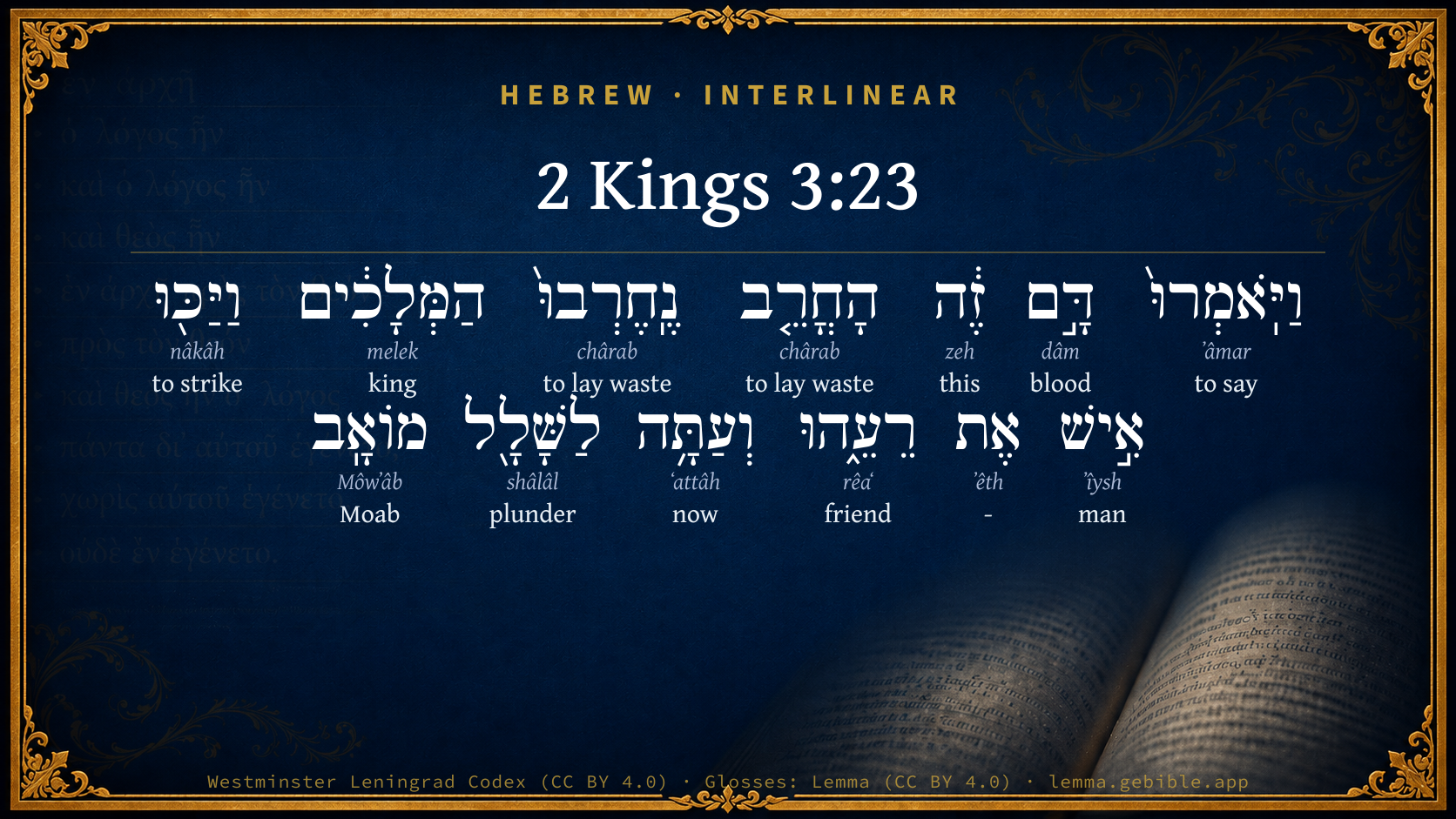
Hebrew (Westminster Leningrad Codex) 2 Kings 3:23 appears in the Hebrew Old Testament. The text above is from the Westminster Leningrad Codex. Each word links to its Strong’s number, a concise gloss, and parsing drawn from the Open Scriptures Hebrew Bible morphology. Click any word for its full Brown-Driver-Briggs (BDB) entry.
Download image
Cite this verse

2 Kings 3:23 (World English Bible). Public Domain. Lemma interlinear Bible study tool, https://lemma.gebible.app/v/2-kings/3/23.

Show BibTeX & RIS
BibTeX
RIS
English Translation
and they said, This is blood; the kings are surely destroyed, and they have struck each man his fellow: now therefore, Moab, to the spoil.
World English Bible · Public Domain
Download a study sheet

One document with this verse’s original text, its word-by-word gloss line, the meaning frame, cross-references with their text, attributed commentary, and full source and license credits — printable, and it pastes into notes with its structure intact.

This verse Autodidact and up

Study sheet (.html) Plain text (.txt)

A passage Seminary Student

Up to 50 verses in one chapter. A passage sheet keeps up to 6 commentary sources and 12 cross-references per verse, in the order this page ranks them, and says so on the sheet whenever that leaves anything out. Ask for a single verse and you get the Autodidact verse sheet above.

Everything on this page stays free to read, with no account — the sheet is a download of what is already on screen, not access to it.

Want to remove ads? Support Godless Engineer
Compare translations 3

The same verse in 3 English versions, stacked beneath the original-language interlinear above. Click any original word for its lexicon entry.

Each is an independent rendering of the whole verse — the interlinear is not word-aligned to these translations.

Highlighted words mark where these versions differ — a whole-verse word diff, not a word-by-word alignment.

  • World English Bible Public Domain
    and they said, This is blood; the kings are surely destroyed, and they have struck each man his fellow: now therefore, Moab, to the spoil.
  • King James Version Public Domain
    And they said, This is blood: the kings are surely slain, and they have smitten one another: now therefore, Moab, to the spoil.
  • unfoldingWord Literal Text CC BY-SA 4.0
    And they said, “This blood! Destroying, the kings have destroyed themselves, and they have struck, a man his fellow. And now, to the spoil, Moab!”

unfoldingWord Literal Text — © unfoldingWord, licensed CC BY-SA 4.0. Word-aligned USFM3 via Door43 (git.door43.org/unfoldingWord/en_ult).

Versions to compare (up to 4)

3 of 4 selected

Show all 18 translations

Every available English version of this verse, each an independent rendering of the whole verse.

  • World English Bible Public Domain
    and they said, This is blood; the kings are surely destroyed, and they have struck each man his fellow: now therefore, Moab, to the spoil.
  • Berean Standard Bible Public Domain
    “This is blood!” they exclaimed. “The kings have clashed swords and slaughtered one another. Now to the plunder, Moab!”
  • Majority Standard Bible Public Domain
    “This is blood!” they exclaimed. “The kings have clashed swords and slaughtered one another. Now to the plunder, Moab!”
  • King James Version Public Domain
    And they said, This is blood: the kings are surely slain, and they have smitten one another: now therefore, Moab, to the spoil.
  • American Standard Version (1901) Public Domain
    and they said, This is blood; the kings are surely destroyed, and they have smitten each man his fellow: now therefore, Moab, to the spoil.
  • Revised Version (1885) Public Domain
    and they said, This is blood; the kings are surely destroyed, and they have smitten each man his fellow: now therefore, Moab, to the spoil.
  • Geneva Bible (1599) Public Domain
    And they saide, This is blood the Kings are surely slaine, and one hath smitten another: now therefore, Moab, to the spoyle.
  • Douay-Rheims (1899) Public Domain
    And they said: It is the blood of the sword: the kings have fought among themselves, and they have killed one another: go now, Moab, to the spoils.
  • Young's Literal Translation Public Domain
    and say, `Blood this `is'; the kings have been surely destroyed, and they smite each his neighbour; and now for spoil, Moab!'
  • Literal Standard Version CC BY-SA 4.0
    and say, “This [is] blood; the kings have been surely destroyed, and they each strike his neighbor; and now for spoil, Moab!”
  • Unlocked Literal Bible CC BY-SA 4.0
    They exclaimed, “This is blood! The kings have certainly been destroyed, and they have killed each other! So now, Moab, let us go plunder them!”
  • unfoldingWord Literal Text CC BY-SA 4.0
    And they said, “This blood! Destroying, the kings have destroyed themselves, and they have struck, a man his fellow. And now, to the spoil, Moab!”
  • Darby Bible Public Domain
    And they said, This is blood: the kings are entirely destroyed, and have smitten one another; and now, Moab, to the spoil!
  • World Messianic Bible Public Domain
    They said, “This is blood. The kings are surely destroyed, and they have struck each other. Now therefore, Moab, to the plunder!”
  • Webster's Bible Public Domain
    And they said, This is blood: the kings are surely slain, and they have smitten one another: now therefore, Moab, to the spoil.
  • Free Bible Version CC BY-SA 4.0
    “This is blood!” they said. “The kings and their armies must have attacked and killed each other! Moabites, let's grab the plunder!”
  • Bible in Basic English Public Domain
    Then they said, This is blood: it is clear that destruction has come on the kings; they have been fighting one another: now come, Moab, let us take their goods.
  • JPS Tanakh (1917) Public Domain
    and they said: 'This is blood: the kings have surely fought together, and they have smitten each man his fellow; now therefore, Moab, to the spoil.'

Literal Standard Version (2020), Covenant Press — licensed CC BY-SA 4.0. Text via the HelloAO Bible API (eBible.org). Unlocked Literal Bible (unfoldingWord) — licensed CC BY-SA 4.0. Text via the HelloAO Bible API (eBible.org). unfoldingWord Literal Text — © unfoldingWord, licensed CC BY-SA 4.0. Word-aligned USFM3 via Door43 (git.door43.org/unfoldingWord/en_ult). Free Bible Version, Dr. Jonathan Gallagher — licensed CC BY-SA 4.0. Text via the HelloAO Bible API (eBible.org).

Word by word

More ways to search: Search by grammar → Find every occurrence → Compare this word →

Practice this passage: Drill this verse → Learn its vocabulary →

הָחֳרֵ֤ב
chârab
H2717
“to lay waste”
Verb, Hophal, Infinitive Absolute
Part of Speech
Verb
Stem
Hophal
Form
Infinitive Absolute
Full BDB Definition

Origin: a primitive root

TWOT: 731 , 732

to be waste, lay waste, make desolate, be desolate, be in ruins - (Qal) to be waste, be desolate - (Niphal) - to be made desolate - desolate (participle) - (Hiphil) to lay waste, make desolate - (Hophal) to be laid waste - to be dry, be dried up - (Qal) to be dried, be dried up - (Pual) to be dried - (Hiphil) to dry up - (Hophal) to be dried up - to attack, smite down, slay, fight
  1. וַיֹּֽאמְרוּ֙ ʼâmar H559 “and · to say” Conjunction + Verb, Qal, Sequential Imperfect, 3rd Person, Masculine, Plural
  2. דָּ֣ם dâm H1818 “blood” Noun, Common, Masculine, Singular, Absolute
  3. זֶ֔ה zeh H2088 “this” Pronoun, Demonstrative, Masculine, Singular
  4. נֶֽחֶרְבוּ֙ chârab H2717 “to lay waste” Verb, Niphal, Perfect, 3rd Person, Common, Plural
  5. הַמְּלָכִ֔ים melek H4428 “the · kings” Particle, Definite Article + Noun, Common, Masculine, Plural, Absolute
  6. וַיַּכּ֖וּ nâkâh H5221 “and · to strike” Conjunction + Verb, Hiphil, Sequential Imperfect, 3rd Person, Masculine, Plural
  7. אִ֣ישׁ ʼîysh H376 “man” Noun, Common, Masculine, Singular, Absolute
  8. אֶת ʼêth H853 “-” Particle, Direct Object
  9. רֵעֵ֑הוּ rêaʻ H7453 “friend · his” Noun, Common, Masculine, Singular, Construct + Suffix, Personal, 3rd Person, Masculine, Singular
  10. וְעַתָּ֥ה ʻattâh H6258 “and · now” Conjunction + Adverb
  11. לַשָּׁלָ֖ל shâlâl H7998 “to/for the · plunder” Preposition, Determined + Noun, Common, Masculine, Singular, Absolute
  12. מוֹאָֽב Môwʼâb H4124 “Moab” Noun, Proper

About this verse

These counts appear in no published source. They are computed here, from the morphology-tagged text and Lemma’s own curated glosses. What Lemma adds →

13
words
12
distinct lemmas
Historical
section

Shared distinctive vocabulary

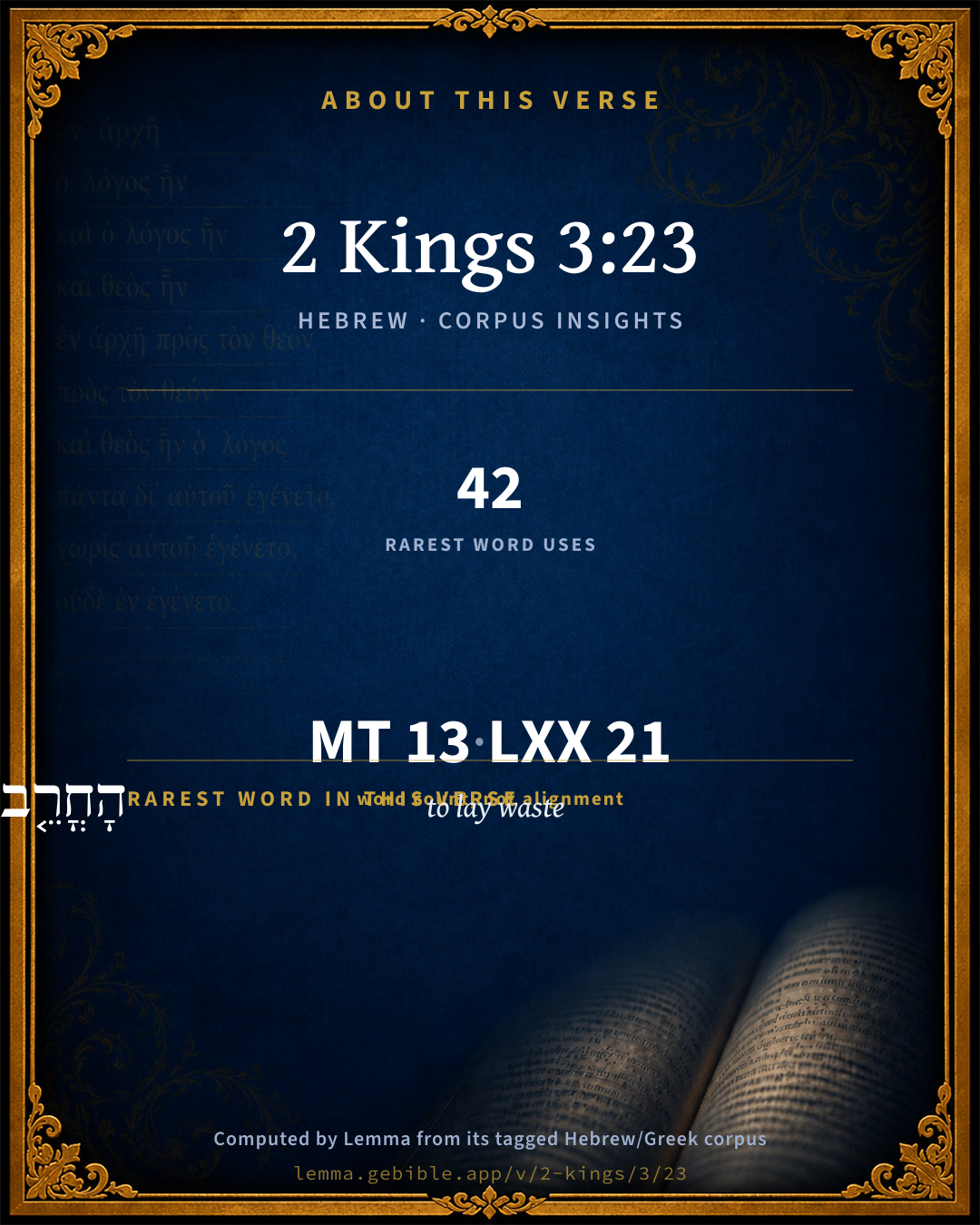
הָחֳרֵ֤ב to lay waste H2717 occurs in 38 verses of the Hebrew Bible. Also found in:

Grammatical profile

  • 4 verbs
  • 6 nouns
  • 1 pronoun
  • 1 adverb
  • 1 particle

Verb forms

  • וַיֹּֽאמְרוּ֙ Qal · Sequential Imperfect
  • הָחֳרֵ֤ב Hophal · Infinitive Absolute
  • נֶֽחֶרְבוּ֙ Niphal · Perfect
  • וַיַּכּ֖וּ Hiphil · Sequential Imperfect

Repetition

A word recurs within this verse — often emphatic in Hebrew:

  • הָחֳרֵ֤ב to lay waste H2717 ×2

Hebrew & Septuagint length

In English translation the verse runs 25 words from the Hebrew and 28 from the Septuagint (LXX English) — closely comparable.

A rough comparison of the two English renderings, which tokenize alike — not a word-level alignment.

Word counts can differ between the Hebrew and the Greek without any difference in meaning — e.g. the Hebrew direct-object marker אֵת has no separate Greek word, and Greek often adds the article ὁ.

In the original languages it is 13 Hebrew tokens and 21 Greek tokens — but the two are counted differently (Hebrew bundles its prefixes and suffixes into one token; the Greek is in lemma form), so that isn’t a like-for-like length.

Cross-references

6

Topical passages linked to 2 Kings 3:23 in the Treasury of Scripture Knowledge — connected by theme and wording, ordered by reader-vote popularity; previews shown in the World English Bible.

  • Exodus 15:9 The enemy said, 'I will pursue, I will overtake, I will divide the spoil. My desire shall be satisfied on them. I will draw my sword, my hand shall destroy them.'
  • Judges 5:30 Have they not found, have they not divided the spoil? A lady, two ladies to every man; To Sisera a spoil of dyed garments, A spoil of dyed garments embroidered, Of dyed garments embroidered on both sides, on the necks of the spoil?
  • 2 Kings 6:18–20 When they came down to him, Elisha prayed to Yahweh, and said, Please smite this people with blindness. He struck them with blindness according to the word of Elisha.
  • 2 Kings 7:6 For the Lord had made the host of the Syrians to hear a noise of chariots, and a noise of horses, even the noise of a great host: and they said one to another, Behold, the king of Israel has hired against us the kings of the Hittites, and the kings of the Egyptians, to come on us.
  • 2 Chronicles 20:25 When Jehoshaphat and his people came to take the spoil of them, they found among them in abundance both riches and dead bodies, and precious jewels, which they stripped off for themselves, more than they could carry away: and they were three days in taking the spoil, it was so much.
  • Isaiah 10:14 and my hand has found as a nest the riches of the peoples; and as one gathers eggs that are forsaken, have I gathered all the earth: and there was none that moved the wing, or that opened the mouth, or chirped.

Cross-references courtesy of OpenBible.info (CC BY 4.0).

Hebrew and Greek witnesses Masoretic Hebrew ↔ Greek Septuagint

The same verse in the two great witnesses to the Old Testament, shown verse-for-verse.

These are two independent witnesses, not word-aligned to each other, and the Septuagint is shown in lemma (dictionary) form.

Hebrew 2 Kings 3:23 Masoretic · Westminster Leningrad Codex

וַיֹּֽאמְרוּ֙ דָּ֣ם זֶ֔ה הָחֳרֵ֤ב נֶֽחֶרְבוּ֙ הַמְּלָכִ֔ים וַיַּכּ֖וּ אִ֣ישׁ אֶת רֵעֵ֑הוּ וְעַתָּ֥ה לַשָּׁלָ֖ל מוֹאָֽב

and they said, This is blood; the kings are surely destroyed, and they have struck each man his fellow: now therefore, Moab, to the spoil.

World English Bible · Public Domain

Greek LXX 2 Kings 3:23 Septuagint · lemma form

καί εἶπον αἷμα οὗτος ὁ ῥομφαία μάχομαι ὁ βασιλεύς καί πατάσσω ἀνήρ ὁ πλησίον αὐτός καί νῦν ἐπί ὁ σκῦλον μωαβ

And they said, This is the blood of the sword; and the kings have fought, and each man has struck his neighbor; now then to the spoils, Moab.

LXX2012 (modern English Septuagint) · Public Domain

On this verse, Ellicott's Commentary for English Readers discusses the Septuagint’s reading. Read the note in Commentary ↓

Hebrew: Westminster Leningrad Codex (CC BY 4.0). Greek: Septuagint (public domain); English from LXX2012 (modern English Septuagint) (Public Domain). How the Septuagint differs from the Hebrew →

Targum (Aramaic paraphrase)

1

The Targum is the ancient Jewish Aramaic paraphrase of the Hebrew Scriptures — an interpretive translation, not the Hebrew text itself. Onkelos (literal) and Pseudo-Jonathan (expansive) render the Torah, and Jonathan the Prophets. Coverage is partial: where no permissively-licensed English translation exists for a verse, only the Aramaic is shown. This is verse-level text, not a word-by-word alignment to the Hebrew.

  1. Targum Jonathan Prophets (Joshua–Malachi)
    וַאֲמַרוּ דַם דֵין אִתְגְרָאָה אִתְגְרִיאוּ מַלְכַיָא וּקְטַלוּ גְבַר יַת חַבְרֵיהּ וּכְעַן פּוּקוּ לְבִּיזְתָא מוֹאֲבָאֵי:

    (no public-domain English translation for this verse)

    Targum Jonathan — Aramaic: “Mikraot Gedolot” (public domain). English: “Sefaria Community Translation” (CC0 1.0 (public-domain dedication)); “London "Chaldee Paraphrase," 1871” (public domain). Text via Sefaria.

Commentary

Notes on 2 Kings 3:23 from classic Christian and Jewish commentators (each source and its license shown beneath its notes). The classic Christian expositions comment on the surrounding passage and are grouped to its opening verse, so a note may address several verses; the Jewish commentaries on the Tanakh (Rashi and others) are per-verse, so they appear only where the commentator wrote on this verse.

Lemma curates 59 commentaries, every one of them public domain or Creative Commons licensed, each selected and text-cleaned for this edition rather than reprinted as found. About our sources →

Trapp's Complete Commentary

John Trapp

2Ki 3:23 And they said, This [is] blood: the kings are surely slain, and they have smitten one another: now therefore, Moab, to the spoil.

Ver. 23. This is blood.] For water they were confident there could be none.

They have smitten one another.] Here they mused as themselves had used; {2Ch 20:23} for why might not others fall out, and fall foul on one another, as they had done?

John Trapp, A Commentary or Exposition upon All the Books of the Old and New Testament (1647–1656) — public domain. Text from a community e-Sword module.

Geneva Bible (1599)

Geneva Bible translators

The sudden joy of the wicked is but a preparation to their destruction, which is at hand.

Geneva Bible (1599) marginal notes — public domain. Text via Bolls.life.

Adam Clarke's Commentary

Verse 23. Therefore, Moab, to the spoil.] Thus they came on in a disorderly manner, and fell an easy prey to their enemies.

Adam Clarke's Commentary on the Bible (1810–1826) — public domain. Text from a community e-Sword/MySword module.

Ellicott's Commentary for English Readers

(23) The kings are surely slain.—Have surely fought with (or destroyed) one another. LXX., ἐμαχέσαντο. The supposition was not improbable. Confederates of different races not seldom had been known to fall out among themselves (comp. Jdg_7:22; 2Ch_20:23, and Note), and in this case the old enmity of Edom towards Israel, and the suppressed jealousies between Israel and Judah, made such a result very likely. The Moabites would know also that the wady had been waterless, so that their mistake was natural. When once their instinct for plunder was aroused they did not stop to think, but with a wild cry of “Moab, to the spoil !” they rushed in disorder upon the Israelite camp.

A Bible Commentary for English Readers, edited by Charles John Ellicott (1878–1897) — public domain. Text from a community e-Sword module.

The Cambridge Bible for Schools and Colleges

gen. ed. J. J. S. Perowne

23. the kings are surely slain [R.V. destroyed], and they have smitten one another] R.V. each man his fellow. The Moabites knew of the contests which had been between Israel and Judah in times past, and might readily fancy that the peace which had been made between Ahab and Jehoshaphat had now been broken through some difference during the expedition. They would also know that the Edomite vassal of Judah was likely to seize the first opportunity to strike a blow for independence. Their own wish too was no doubt father to the thought. Hence their impetuous rush down upon the enemy.

The Cambridge Bible for Schools and Colleges (gen. ed. J. J. S. Perowne; Cambridge University Press, 1878–1918) — public domain. Text from a community e-Sword module.

John Gill's Exposition

And when the king of Moab saw that the battle was too sore for him,.... The siege was so close, the slingers or engineers did so much execution, that he saw the city would soon be taken, and he be obliged to deliver it up:

he took with him seven hundred men that drew swords; men expert in war, bold and daring:

to break through even unto the king of Edom; through his quarters, and so escape, he lying nearest to the city, and perhaps the weakest body of men with him; or he might think he was not so hearty in the cause of the kings, and would make but a feeble resistance, and let him pass:

but they could not; break through they met with a greater opposition than was expected perhaps the Edomites remembered how they had lately used them, which made them fight more desperately against them, see Ch2 20:23.

John Gill's Exposition of the Whole Bible (1746–1763) — public domain (CC PDM 1.0). Text via the HelloAO Bible API.

Albert Barnes' Notes on the Bible

The sun had risen with a ruddy light, as is frequently the case after a storm (compare Mat 16:3), nearly over the Israelite camp, and the pits, deep but with small mouths, gleaming redly through the haze which would lie along the newly moistened valley, seemed to the Moabites like pools of blood. The preceding year, they and their allies had mutually destroyed each other 2Ch 20:23. It seemed to them, from their knowledge of the jealousies between Judah, Israel, and Edom, not unlikely that a similar calamity had now befallen their foes.

Albert Barnes' Notes on the Bible (1834–1885) — public domain. Text from a community e-Sword/MySword module.

Matthew Poole's English Annotations

They were so highly confident, that they send no scouts, but march thither with their whole army, and that in great disorder; wherein there was also a Divine hand, strengthening them in their mistakes, and hardening them to their destruction.

Matthew Poole's English Annotations on the Holy Bible (1683–1685) — public domain. Text from a community e-Sword/MySword module.

Whedon's Commentary on the Bible

Daniel D. Whedon

23. They have smitten one another — The self-destruction of the allied armies of Moab, Ammon, and Edom, (see 2Ch_20:22-25,) was still fresh in the minds of the Moabites; and knowing the enmity and jealousy existing between Judah and Israel, and confident that the Edomites were no fast friends of either party, they very naturally imagined, from the sight of what appeared so much blood, that the different kings had fallen out among themselves and destroyed each other.

To the spoil — They supposed it only remained for them to go, as did Jehoshaphat on that former occasion, (2Ch_20:25,) and gather up the precious jewels and other spoil from among the dead bodies.

Daniel D. Whedon (gen. ed.), Commentary on the Old and New Testaments (1874–1909) — public domain. Text from a community e-Sword module.

The Pulpit Commentary

And they said, This is blood. Even Ewald recognizes here "a historical background for the narrative." The idea of such a mistake could scarcely have occurred to a romancer. The kings are surely slain, and they have smitten one another. There were rivalries and jealousies subsisting between Judah, Israel, and Edom, which made it quite possible that at any time open quarrel might break out among them. Edom especially was, it is probable, a reluctant member of the confederacy, forced to take her part in it by her suzerain, Jehoshaphat. The Moabites, moreover, had recently had personal experience how easily the swords of confederates might be turned against each other, since their last expedition against Judah (2Ch_20:1-25) had completely failed through such a sudden disagreement and contention. Now therefore, Moab, to the spoil. If their supposition were correct, and the kings had come to blows, and the hosts destroyed each ether, Moab would have nothing to do but to fly upon the spoil, to strip the slain, and plunder the camp of the confederates. A disorderly rush took place for this purpose (see Josephus, "Ant. Jud:," 9:3.

The Pulpit Commentary (1880–1919), ed. H.D.M. Spence-Jones & Joseph S. Exell — public domain. Text from a community e-Sword module.

Lesson kit

Teaching starters — assembled from the data on this page, not authored interpretation. Every prompt links to the verse data it draws on. Edit before teaching.

2 Kings, in the Historical, opens this verse with 13 words (12 distinct Hebrew lemmas). Its most distinctive word is chârab (“to lay waste”). A historical commentator’s framing appears above. Read the whole chapter for the surrounding context.

Discussion questions

  1. What does “to lay waste” (chârab) contribute to the verse as a whole?
  2. Genesis 8:13 shares the word «to lay waste» with this verse. How do the two illuminate each other?
  3. “to lay waste” occurs 2× in this one verse. What is the effect of the repetition?
  4. These translations render this verse differently. What is at stake in choosing one wording over another?
  5. The verb «וַיֹּֽאמְרוּ֙» is Qal Sequential Imperfect. How does its form color the action?
  6. Reading how Trapp's Complete Commentary and Geneva Bible (1599) read this verse, where do the two commentators agree and where do they part?

Things to notice

Reading settings

Reading text

Shown beneath each verse's original-language words.

Old Testament
Old Testament edition

Read the OT as the Masoretic Hebrew (MT) or the Greek Septuagint (LXX).

English shown for the Greek Septuagint (in the Hebrew ↔ Greek comparison).

Comparing translations? Open the Compare panel on any verse page to stack up to four side by side.