Psalms 55:23

Hebrew (Westminster Leningrad Codex) Psalms 55:23 appears in the Hebrew Old Testament. The text above is from the Westminster Leningrad Codex. Each word links to its Strong’s number, a concise gloss, and parsing drawn from the Open Scriptures Hebrew Bible morphology. Click any word for its full Brown-Driver-Briggs (BDB) entry.
Download image
Cite this verse

Psalms 55:23 (World English Bible). Public Domain. Lemma interlinear Bible study tool, https://lemma.gebible.app/v/psalms/55/23.

Show BibTeX & RIS
BibTeX
RIS
English Translation
But you, God, will bring them down into the pit of destruction. Bloodthirsty and deceitful men shall not live out half their days, But I will trust in you.
World English Bible · Public Domain
Download a study sheet

One document with this verse’s original text, its word-by-word gloss line, the meaning frame, cross-references with their text, attributed commentary, and full source and license credits — printable, and it pastes into notes with its structure intact.

This verse Autodidact and up

Study sheet (.html) Plain text (.txt)

A passage Seminary Student

Up to 50 verses in one chapter. A passage sheet keeps up to 6 commentary sources and 12 cross-references per verse, in the order this page ranks them, and says so on the sheet whenever that leaves anything out. Ask for a single verse and you get the Autodidact verse sheet above.

Everything on this page stays free to read, with no account — the sheet is a download of what is already on screen, not access to it.

Want to remove ads? Support Godless Engineer
Compare translations 3

The same verse in 3 English versions, stacked beneath the original-language interlinear above. Click any original word for its lexicon entry.

Each is an independent rendering of the whole verse — the interlinear is not word-aligned to these translations.

Highlighted words mark where these versions differ — a whole-verse word diff, not a word-by-word alignment.

  • World English Bible Public Domain
    But you, God, will bring them down into the pit of destruction. Bloodthirsty and deceitful men shall not live out half their days, But I will trust in you.
  • King James Version Public Domain
    But thou, O God, shalt bring them down into the pit of destruction: bloody and deceitful men shall not live out half their days; but I will trust in thee.
  • unfoldingWord Literal Text CC BY-SA 4.0
    But you, God, will make them go down to the pit of the grave. Men of blood and treachery will not halve their days. But I, I will trust in you.

unfoldingWord Literal Text — © unfoldingWord, licensed CC BY-SA 4.0. Word-aligned USFM3 via Door43 (git.door43.org/unfoldingWord/en_ult).

Versions to compare (up to 4)

3 of 4 selected

Show all 18 translations

Every available English version of this verse, each an independent rendering of the whole verse.

  • World English Bible Public Domain
    But you, God, will bring them down into the pit of destruction. Bloodthirsty and deceitful men shall not live out half their days, But I will trust in you.
  • Berean Standard Bible Public Domain
    But You, O God, will bring them down to the Pit of destruction; men of bloodshed and deceit will not live out half their days. But I will trust in You.
  • Majority Standard Bible Public Domain
    But You, O God, will bring them down to the Pit of destruction; men of bloodshed and deceit will not live out half their days. But I will trust in You.
  • King James Version Public Domain
    But thou, O God, shalt bring them down into the pit of destruction: bloody and deceitful men shall not live out half their days; but I will trust in thee.
  • American Standard Version (1901) Public Domain
    But thou, O God, wilt bring them down into the pit of destruction: Bloodthirsty and deceitful men shall not live out half their days; But I will trust in thee. Psalm 56 For the Chief Musician; set to Jonath elem rehokim. `A Psalm' of David. Michtam: when the Philistines took him in Gath.
  • Revised Version (1885) Public Domain
    But thou, O God, shalt bring them down into the pit of destruction: bloodthirsty and deceitful men shall not live out half their days; but I will trust in thee.
  • Geneva Bible (1599) Public Domain
    And thou, O God, shalt bring them downe into the pitte of corruption: the bloudie, and deceitfull men shall not liue halfe their dayes: but I will trust in thee.
  • Douay-Rheims (1899) Public Domain
    he hath stretched forth his hand to repay. They have defiled his covenant,
  • Young's Literal Translation Public Domain
    And Thou, O God, dost bring them down To a pit of destruction, Men of blood and deceit reach not to half their days, And I -- I do trust in Thee!
  • Literal Standard Version CC BY-SA 4.0
    And You, O God, bring them down || To a pit of destruction, || Men of blood and deceit do not reach to half their days, || And I trust in You!
  • Unlocked Literal Bible CC BY-SA 4.0
    But you, God, will bring the wicked down into the pit of destruction; bloodthirsty and deceitful men will not live even half as long as others, but I will trust in you.
  • unfoldingWord Literal Text CC BY-SA 4.0
    But you, God, will make them go down to the pit of the grave. Men of blood and treachery will not halve their days. But I, I will trust in you.
  • Darby Bible Public Domain
    And thou, O God, wilt bring them down into the pit of destruction: bloody and deceitful men shall not live out half their days. But as for me, I will confide in thee.
  • World Messianic Bible Public Domain
    But you, God, will bring them down into the pit of destruction. Bloodthirsty and deceitful men shall not live out half their days, but I will trust in you.
  • Webster's Bible Public Domain
    \\55:22\\Cast thy burden upon the LORD, and he will sustain thee: he will never suffer the righteous to be moved.
  • Free Bible Version CC BY-SA 4.0
    But you, God, will bring down murderers and liars, throwing them into the pit of destruction before they have even lived half their lives. As for me, I will trust in you.
  • Bible in Basic English Public Domain
    But you, O God, will send them down into the underworld; the cruel and the false will be cut off before half their days are ended; but I will have faith in you.
  • JPS Tanakh (1917) Public Domain
    (55-24) But Thou, O God, wilt bring them down into the nethermost pit; men of blood and deceit shall not live out half their days; but as for me, I will trust in Thee.

Literal Standard Version (2020), Covenant Press — licensed CC BY-SA 4.0. Text via the HelloAO Bible API (eBible.org). Unlocked Literal Bible (unfoldingWord) — licensed CC BY-SA 4.0. Text via the HelloAO Bible API (eBible.org). unfoldingWord Literal Text — © unfoldingWord, licensed CC BY-SA 4.0. Word-aligned USFM3 via Door43 (git.door43.org/unfoldingWord/en_ult). Free Bible Version, Dr. Jonathan Gallagher — licensed CC BY-SA 4.0. Text via the HelloAO Bible API (eBible.org).

Word by word

More ways to search: Search by grammar → Find every occurrence → Compare this word →

Practice this passage: Drill this verse → Learn its vocabulary →

יֶחֱצ֣וּ
châtsâh
H2673
“to divide”
Verb, Qal, Imperfect, 3rd Person, Masculine, Plural
Part of Speech
Verb
Stem
Qal
Form
Imperfect
Person
3rd Person
Gender
Masculine
Number
Plural
Full BDB Definition

Origin: a primitive root [compare H2686 ])

TWOT: 719

to divide, cut in two, cut short, live half (of one's life) - (Qal) - to divide - to half, cut in two - (Niphal) to be divided
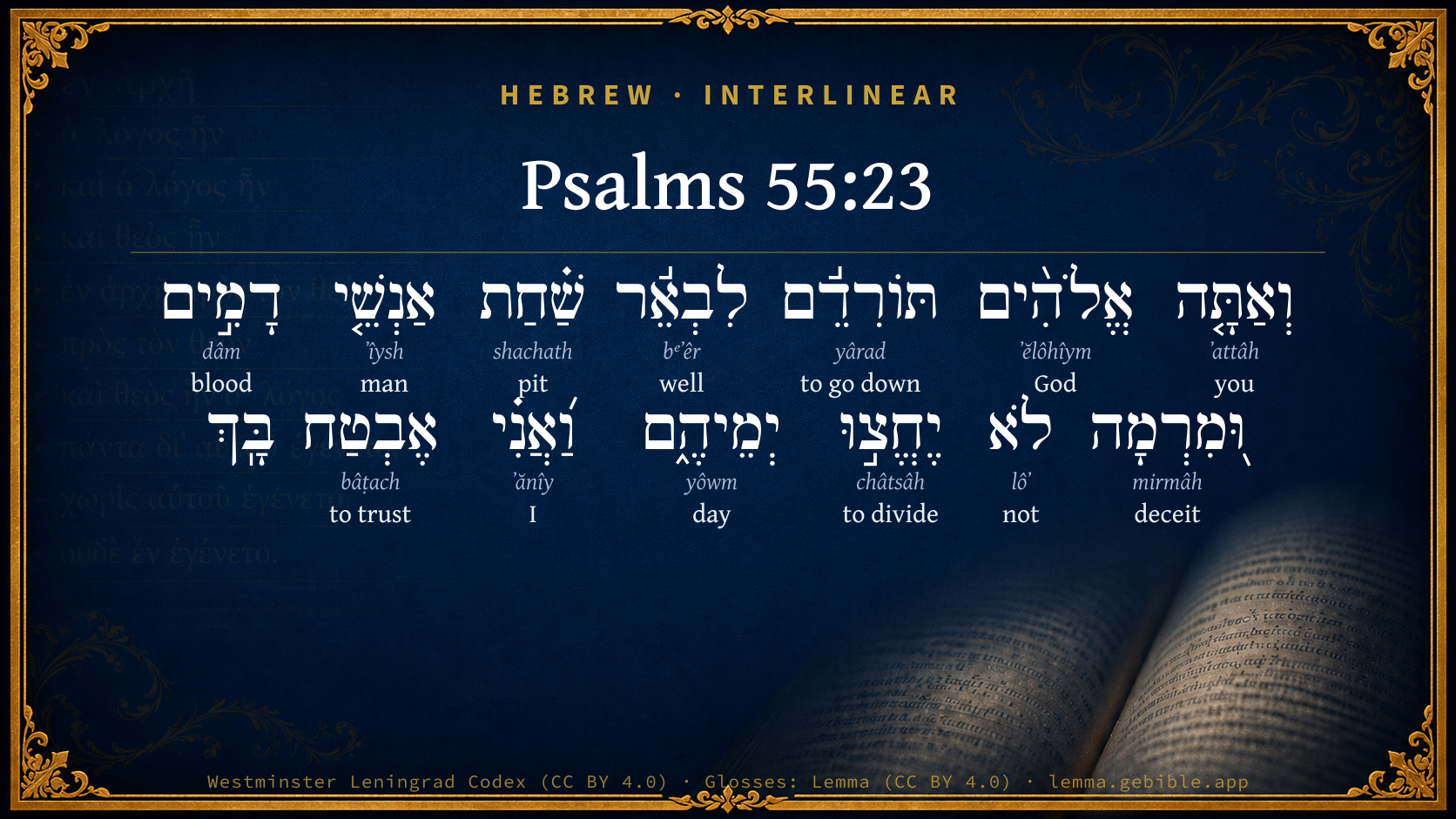
  1. וְאַתָּ֤ה ʼattâh H859 “and · you” Conjunction + Pronoun, Personal, 2nd Person, Masculine, Singular
  2. אֱלֹהִ֨ים ʼĕlôhîym H430 “God(s)” Noun, Common, Masculine, Plural, Absolute
  3. תּוֹרִדֵ֬ם yârad H3381 “to go down · them” Verb, Hiphil, Imperfect, 2nd Person, Masculine, Singular + Suffix, Personal, 3rd Person, Masculine, Plural
  4. לִבְאֵ֬ר bᵉʼêr H875 “to/for · well of” Preposition + Noun, Common, Feminine, Singular, Construct
  5. שַׁ֗חַת shachath H7845 “pit” Noun, Common, Feminine, Singular, Absolute
  6. אַנְשֵׁ֤י ʼîysh H376 “men of” Noun, Common, Masculine, Plural, Construct
  7. דָמִ֣ים dâm H1818 “blood” Noun, Common, Masculine, Plural, Absolute
  8. וּ֭מִרְמָה mirmâh H4820 “and · deceit” Conjunction + Noun, Common, Feminine, Singular, Absolute
  9. לֹא lôʼ H3808 “not” Particle, Negative
  10. יְמֵיהֶ֑ם yôwm H3117 “days · their” Noun, Common, Masculine, Plural, Construct + Suffix, Personal, 3rd Person, Masculine, Plural
  11. וַ֝אֲנִ֗י ʼănîy H589 “and · I” Conjunction + Pronoun, Personal, 1st Person, Common, Singular
  12. אֶבְטַח bâṭach H982 “to trust” Verb, Qal, Imperfect, 1st Person, Common, Singular

About this verse

These counts appear in no published source. They are computed here, from the morphology-tagged text and Lemma’s own curated glosses. What Lemma adds →

14
words
13
distinct lemmas
Wisdom
section

Notable vocabulary

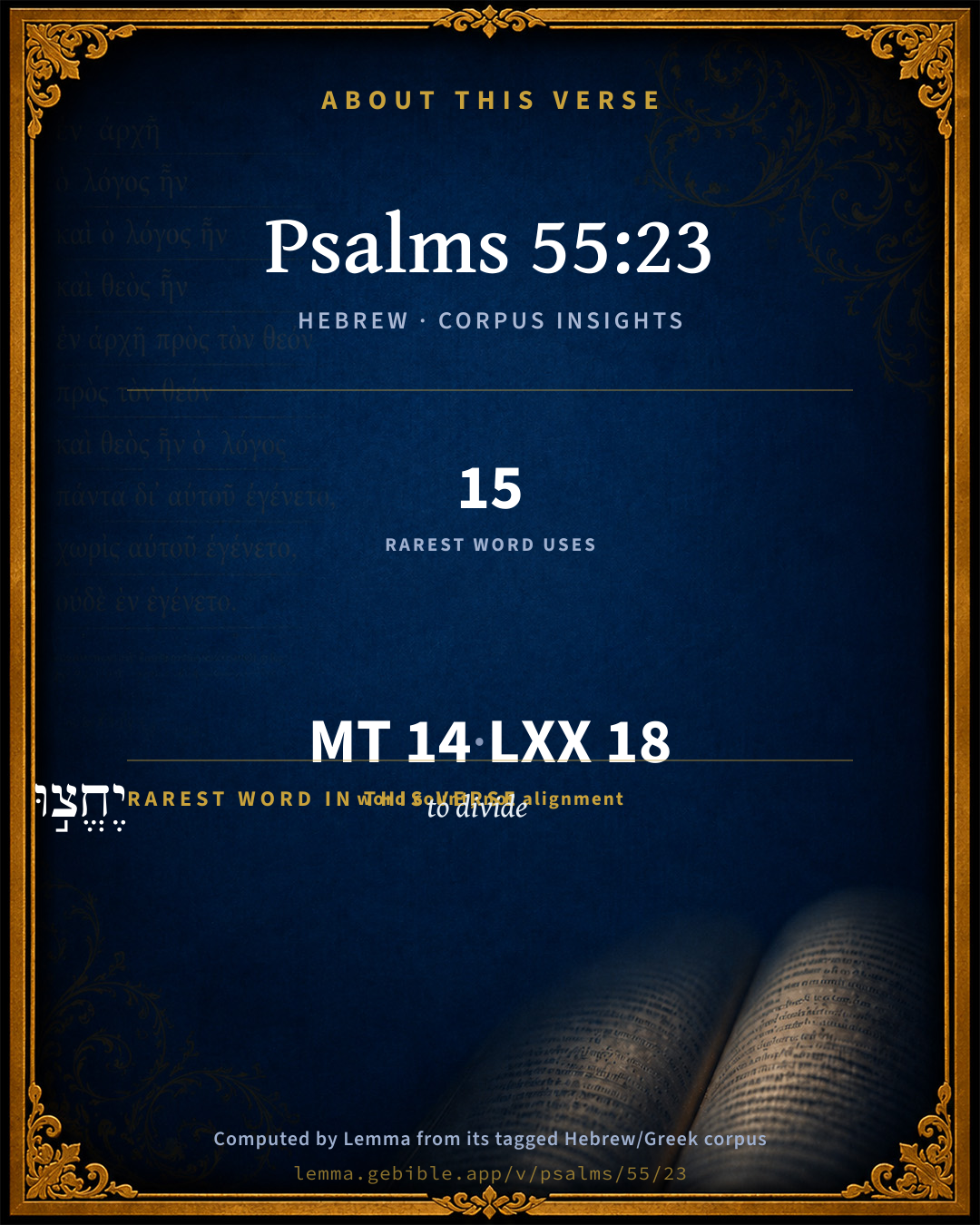
The rarest word here is יֶחֱצ֣וּ to divide H2673 — appearing just 15 times in the whole Hebrew Bible.

Shared distinctive vocabulary

יֶחֱצ֣וּ to divide H2673 occurs in 14 verses of the Hebrew Bible. Also found in:

Grammatical profile

  • 3 verbs
  • 7 nouns
  • 2 pronouns
  • 1 preposition
  • 1 particle

Verb forms

  • תּוֹרִדֵ֬ם Hiphil · Imperfect
  • יֶחֱצ֣וּ Qal · Imperfect
  • אֶבְטַח Qal · Imperfect

Hebrew & Septuagint length

In English translation the verse runs 29 words from the Hebrew and 32 from the Septuagint (LXX English) — closely comparable.

A rough comparison of the two English renderings, which tokenize alike — not a word-level alignment.

Word counts can differ between the Hebrew and the Greek without any difference in meaning — e.g. the Hebrew direct-object marker אֵת has no separate Greek word, and Greek often adds the article ὁ.

In the original languages it is 14 Hebrew tokens and 18 Greek tokens — but the two are counted differently (Hebrew bundles its prefixes and suffixes into one token; the Greek is in lemma form), so that isn’t a like-for-like length.

Cross-references

16

Topical passages linked to Psalms 55:23 in the Treasury of Scripture Knowledge — connected by theme and wording, ordered by reader-vote popularity; previews shown in the World English Bible.

  • Proverbs 10:27 The fear of Yahweh prolongs days, But the years of the wicked shall be shortened.
  • Job 15:32 It shall be accomplished before his time. His branch shall not be green.
  • Psalms 5:6 You will destroy those who speak lies. Yahweh abhors the blood-thirsty and deceitful man.
  • Psalms 7:15–16 He has dug a hole, And has fallen into the pit which he made.
  • Psalms 73:18 Surely you set them in slippery places. You throw them down to destruction.
  • Ecclesiastes 7:17 Don't be too wicked, neither be foolish. Why should you die before your time?
  • Isaiah 38:17 Behold, [it was] for [my] peace [that] I had great bitterness: But you have in love to my soul delivered it from the pit of corruption; For you have cast all my sins behind your back.
  • 2 Samuel 3:27 When Abner was returned to Hebron, Joab took him aside into the midst of the gate to speak with him quietly, and struck him there in the body, so that he died, for the blood of Asahel his brother.
  • 2 Samuel 20:9–10 Joab said to Amasa, Is it well with you, my brother? Joab took Amasa by the beard with his right hand to kiss him.
  • 1 Kings 2:5–6 Moreover you know also what Joab the son of Zeruiah did to me, even what he did to the two captains of the hosts of Israel, to Abner the son of Ner, and to Amasa the son of Jether, whom he killed, and shed the blood of war in peace, and put the blood of war on his sash that was about his loins, and in his shoes that were on his feet.
  • Psalms 25:2 My God, I have trusted in you, Don't let me be shamed. Don't let my enemies triumph over me.
  • Psalms 58:9 Before your pots can feel the heat of the thorns, He will sweep away the green and the burning alike.
  • Psalms 59:12–13 For the sin of their mouth, and the words of their lips, Let them be caught in their pride, For the curses and lies which they utter.
  • Proverbs 15:11 Sheol and Abaddon are before Yahweh-- How much more then the hearts of the children of men!
  • Proverbs 27:20 Sheol and Abaddon are never satisfied; And a man's eyes are never satisfied.
  • Matthew 27:4–5 saying, "I have sinned in that I betrayed innocent blood." But they said, "What is that to us? You see to it."

Cross-references courtesy of OpenBible.info (CC BY 4.0).

Hebrew and Greek witnesses Masoretic Hebrew ↔ Greek Septuagint

The same verse in the two great witnesses to the Old Testament, shown verse-for-verse.

You’re reading Greek Psalm 54 (Hebrew Psalm 55). The Septuagint counts the superscription, so verse numbers can differ from the Hebrew — chapter-level alignment, not verse-by-verse. Numbering follows Rahlfs.

These are two independent witnesses, not word-aligned to each other, and the Septuagint is shown in lemma (dictionary) form.

Hebrew Psalms 55:23 Masoretic · Westminster Leningrad Codex

וְאַתָּ֤ה אֱלֹהִ֨ים תּוֹרִדֵ֬ם לִבְאֵ֬ר שַׁ֗חַת אַנְשֵׁ֤י דָמִ֣ים וּ֭מִרְמָה לֹא יֶחֱצ֣וּ יְמֵיהֶ֑ם וַ֝אֲנִ֗י אֶבְטַח בָּֽךְ

But you, God, will bring them down into the pit of destruction. Bloodthirsty and deceitful men shall not live out half their days, But I will trust in you.

World English Bible · Public Domain

Greek LXX Greek Psalm 54:23 Septuagint · lemma form

ἐπιῥίπτω ἐπί κύριος ὁ μέριμνα σύ καί αὐτός σύ διατρέφω οὐ δίδωμι εἰς ὁ αἰών σάλος ὁ δίκαιος

But you, O God, shall bring them down to the pit of destruction; bloody and crafty men shall not live out half their days; but I will hope in you, O Lord.

LXX2012 (modern English Septuagint) · Public Domain

On this verse, J. A. Alexander on Psalms discusses the Septuagint’s reading. Read the note in Commentary ↓

Hebrew: Westminster Leningrad Codex (CC BY 4.0). Greek: Septuagint (public domain); English from LXX2012 (modern English Septuagint) (Public Domain). How the Septuagint differs from the Hebrew →

Commentary

Notes on Psalms 55:23 from classic Christian and Jewish commentators (each source and its license shown beneath its notes). The classic Christian expositions comment on the surrounding passage and are grouped to its opening verse, so a note may address several verses; the Jewish commentaries on the Tanakh (Rashi and others) are per-verse, so they appear only where the commentator wrote on this verse.

Lemma curates 59 commentaries, every one of them public domain or Creative Commons licensed, each selected and text-cleaned for this edition rather than reprinted as found. About our sources →

Trapp's Complete Commentary

John Trapp

Psa 55:23 But thou, O God, shalt bring them down into the pit of destruction: bloody and deceitful men shall not live out half their days; but I will trust in thee.

Ver. 23. But thou, O God, shalt bring them down into the pit of destruction] Into the deep Gehenna, saith the Chaldee; thou shalt hurl them into hell, from their lofty tops here.

Bloody and deceitful men shall not live out half their days] Heb. shall not half their days; that is, shall be soon cut off, die in the flower of their age, come to an untimely end ( Ad generum Cereris, &c.); either the sword in battle or the sword of justice shall cut them off; or some treachery of men, or their own intemperance, or God’s immediate hand, shall make an end of them betimes, and before they come to the full age of a man, or before they have effected their evil designs (Luther rendereth it, Non dimidiabunt negotia), or before they are in fit case to die, Tempore non sue, Ecc 7:17, then when it were better for them to do anything than to die. Our Richard III and Queen Mary reigned the shortest while of any other since the conquest. Charles IX of France, that bloody prince, died young, of a bloody disease, &c. Absalom and Ahithophel came to tragic and unhappy ends; so did all the primitive persecutors, those cruel crafties.

But I will trust in thee] For safety here and for salvation hereafter.

John Trapp, A Commentary or Exposition upon All the Books of the Old and New Testament (1647–1656) — public domain. Text from a community e-Sword module.

Joseph Benson's Commentary

Psa 55:23. Thou shalt bring them — My wicked enemies, of whom I have hitherto spoken; down into the pit of destruction — Not only to the dust, but to hell, called destruction, Job 26:6. God afflicted them, Psa 55:19, to humble and reform them, but as that effect was not produced by their afflictions, he will at last bring them to ruin. Those that are not reclaimed by the rod of correction will certainly be brought into the pit of destruction. Bloody and deceitful men — That colour their cruel intentions with specious and deceitful pretences; which are most hateful to God and all men; shall not live out half their days — Not half so long as men ordinarily live, and as they, by the course of nature, might have lived, and as they themselves expected to live, but shall be cut off by God’s just judgment, by an untimely and violent death. But I will trust in thee — In thy providence, power, and mercy; and not in my own prudence, strength, or merit. When the wicked are cut off in the midst of their days, I shall still live by faith in thee. And in this confidence I will quietly and patiently wait on thee for their downfall, and for my deliverance.

Joseph Benson's Commentary on the Old and New Testaments (1811–1818) — public domain. Text from a community e-Sword module.

J. A. Alexander on Psalms

Joseph Addison Alexander

24. (Psa 55:23). And thou, God, wilt bring them down to the pit of corruption; men of blood and fraud shall not live out half their days. The first verb is a causative, and as such may be rendered, thou wilt cause them to descend. The word translated pit is the common term in Hebrew for a well, but is here used in a wile sense, including all such excavations. The next word is a derivative of the verb which means to corrupt or destroy. The sense of pit, as if derived from the verb which means to sink, would convert the phrase into a weak tautology. See above, on Psa 16:10. Men of bloods and deceit, i.e. bloody (or murderous) and deceitful men, as in Psa 5:6 above. The literal translation of the last words is, they shall not halve their days, a form of expression copied in the margin of the English Bible, as well as in the Septuagint and Vulgate. The meaning of course is, that they shall not live half so long as they might have lived, but for their bloody and deceitful acts. This is not asserted as a general fact, but uttered as a threatening to the murderers and traitors whom the Psalmist had directly in his eye.

Joseph Addison Alexander, The Psalms Translated and Explained (1850) — public domain. Text from a community e-Sword module.

Tyndale Open Study Notes

Tyndale Open Resources

55:23 To die young means that one fails to experience God’s full blessing (cp. Prov 3:2, 16).

Tyndale Open Study Notes — © Tyndale Open Resources, licensed CC BY-SA 4.0. Text via the HelloAO Bible API.

Geneva Bible (1599)

Geneva Bible translators

Though they sometimes live longer, yet their life is cursed of God, unquiet, and worse than any death.

Geneva Bible (1599) marginal notes — public domain. Text via Bolls.life.

Jamieson, Fausset & Brown

Robert Jamieson, A. R. Fausset & David Brown

bloody . . . days--(compare Psa 5:6; Psa 51:14), deceit and murderous dispositions often united. The threat is directed specially (not as a general truth) against the wicked, then in the writer's view.

Next: Psalms Chapter 56

Jamieson, Fausset & Brown — Commentary Critical and Explanatory on the Whole Bible (1871) — public domain (CC PDM 1.0). Text via the HelloAO Bible API.

Adam Clarke's Commentary

Verse 23. But thou, O God, shalt bring them down into the pit of destruction] The Chaldee is emphatic: "And thou, O Lord, by thy WORD (במימרך bemeymerach) shalt thrust them into the deep gehenna, the bottomless pit, whence they shall never come out; the pit of destruction, where all is amazement, horror, anguish, dismay, ruin, endless loss, and endless suffering."

Bloody and deceitful men shall not live out half their days] So we find, if there be an appointed time to man upon earth, beyond which he cannot pass; yet he may so live as to provoke the justice of God to cut him off before he arrives at that period; yea, before he has reached half way to that limit. According to the decree of God, he might have lived the other half; but he has not done it.

But I will trust in thee.] Therefore I shall not be moved, and shall live out all the days of my appointed time.

The fathers in general apply the principal passages of this Psalm to our Lord's sufferings, the treason of Judas, and the wickedness of the Jews; but these things do not appear to me fairly deducible from the text. It seems to refer plainly enough to the rebellion of Absalom. "The consternation and distress expressed in Ps 55:4-8, describe the king's state of mind when he fled from Jerusalem, and marched up the mount of Olives, weeping. The iniquity cast upon the psalmist answers to the complaints artfully laid against the king by his son of a negligent administration of justice: and to the reproach of cruelty cast upon him by Shimei, 2Sa 15:2; 2Sa 15:4; 2Sa 16:7-8. The equal, the guide, and the familiar friend, we find in Ahithophel, the confidential counsellor, first of David, afterwards of his son Absalom. The buttery mouth and oily words describe the insidious character of Absalom, as it is delineated, 2Sa 15:5-9. Still the believer, accustomed to the double edge of the prophetic style, in reading this Psalm, notwithstanding its agreement with the occurrences of David's life, will be led to think of David's great descendant, who endured a bitter agony, and was the victim of a baser treachery, in the same spot where David is supposed to have uttered these complaints." - Bishop Horsley.

ANALYSIS OF THE FIFTY-FIFTH PSALM

There are five general parts in this Psalm: -

I. The psalmist entreats God to hear his prayer, Ps 55:1-2.

II. He complains of his trouble, Ps 55:3-8.

II. He prays against his enemies, and shows the causes, Ps 55:8-15.

IV. He takes courage upon assurance of God's help, and his enemies' overthrow, Ps 55:15-21.

V. An epilogue, in which he exhorts all men to rely upon God, Ps 55:22-23.

I. He begs audience.

1. "Give ear - hide not thyself - attend - hear me."

2. "My prayer - supplication - that I mourn - complain - make a noise." Affected he was with the sense of what he prayed for, and he was therefore earnest in it.

II. This in general; but next, in particular, he mentions the causes of his complaint, and earnestness to God, that he might be heard both in regard of his enemies, and the condition he was now in. The danger he was in was very great; escape he could not without God's help, for his enemies persecuted him very sore.

1. They slandered and calumniated him, and threatened him: "Because of the voice," c.

2. They vexed, pressed upon him, and oppressed him: "Because of the oppression of the wicked."

3. They plotted his ruin, devolved, and cast iniquity upon him - charged him home.

4. They were implacable, angry, and hated him: "In wrath they hate me."

Then, as to his own person, he was in a sad, heavy, doleful condition.

1. "My heart is sore pained within me." His grief was inward.

2. "The terrors of death are fallen upon me." He saw nothing but death before him.

3. "Fearfulness and trembling are come upon me." Which are the outward effects of fear.

4. "And a horrible dread within hath overwhelmed me." Amazement followed his fear.

And he illustrates this his condition by the counsel he took with his own heart. Upon the deliberation the result was, that he would speedily fly away, fly into the wilderness, as if he might be safer among beasts than such men.

1. "And I said." That was the result upon his debate with himself.

2. "O that I had wings like a dove!" It is a fearful creature of a swift wing. In fear he was, and he would fly as fast and as far as the dove from the eagle.

3. As far, even to some remote land, where I should have rest from these wicked men.

And he amplifies and explains himself again: -

1. That he would fly far away, even to some desolate place out of their reach: "Lo, then would I wander far off, and remain in the wilderness."

2. That he would do it with speed: "I would hasten my escape from the windy storm and tempest." Such turbulent and impetuous creatures his enemies were that threw down all before them, as a wind, storm, and tempest.

III. To his prayer he adds an imprecation: -

1. "Destroy them, O Lord destroy them in their own counsels."

2. Or else, "divide their tongue." Let them not agree in their counsels.

Of this he gives the reason in the following words: viz., that they were a band of violent, contentious, ungodly, troublesome, crafty, and fraudulent people.

1. Violent they were, and litigious: "I have seen violence and strife in the city."

2. Ungodly, and workers of iniquity they were; and incessant in it: "Day and night they go about it upon the walls thereof: mischief also and sorrow are in the midst of it."

3. Crafty and fraudulent also: "Deceit and guile depart not from her streets." It was then a city, a corporation, a society of evil doers.

And of this he produces an instance, which whether it were some bosom friend of David who stole out of the city of Keilah, and betrayed his counsels to Saul; or else Ahithophel, who, being formerly his great favourite and counsellor, fell to Absalom, it is uncertain. Whoever it was, such a treacherous person there was, and of him he complains: and well he might; for ουδεν μειζον ελκος η φιλος αδικων, "there is not a greater sore than a treacherous friend." This treachery he exaggerates most eloquently by an incrementum and apostrophe, drawing his aggravation from the laws of friendship, which he had broken. Had it been an enemy, he could have borne it; but that it was a friend was intolerable, and also inexcusable. Thus the climax stands: -

1. "For it was not an enemy that reproached me; then I could have borne it."

2. "Neither was it he that hated me that did magnify himself," that is, arise and insult me; "then I would have hid myself from him," never admitted him to my bosom.

But mark this emphatic adversative, for now he turns his speech to the man: -

1. "It was thou," emphatically thou, principally and beyond all others. None but thou.

2. "A man," according to my own rank, mine equal; my guide or counsellor; my acquaintance, my own familiar friend.

3. "We took sweet counsel together." One to whom I communicated my secrets.

4. "And walked unto the house of God in company." Professors we were of the same religion.

Now all these circumstances much heighten and aggravate the treachery: that thou, my equal, my director, my familiar friend, one whom I made the master of all my secrets, one who was a great professor of the same religion with me, that thou shouldst betray me, even break my heart. συ τεκνον; Judas - betrayest thou?

Being thus much wronged and moved, as he had just reason, he begins again with an imprecation, not only on him, but on all who believed him, even upon the whole faction: "Let death seize upon them, and let them go down quick into hell," have Korah, Dathan, and Abiram's wages. And he adds the reason. They are signally and incorrigibly wicked: "For wickedness is in their dwellings, and among them."

IV. Hitherto hath David prayed, complained, imprecated; but now he shows how he recovered courage again, being certain of God's help, and a revenge to be taken on his enemies.

1. "As for me, I will call upon God fervently, and the Lord shall save me."

2. "Evening, and morning, and at noon-day," incessantly, "will I pray and cry aloud; and he shall hear me."

3. And I pray in faith; experience I have of his deliverance; he hath done it, and he will do it again. "He hath redeemed my soul in peace from the battle which was against me.'' Even in the midst of the battle, I was as safe as in a time of peace; miraculously delivered, as if there had been no danger.

4. "For there were many with me." Many enemies, say some; others, many angels. Those refer it to the danger; these, to the protection. Many enemies round about me, and then it is a wonder I should be delivered. Many angels press to help me, and then it was no wonder that my life was saved. But as for the ungodly, it was not so with them; for this verse is opposed to the former.

1. "God shall hear," viz., me and my prayers, and the wrongs they do me.

2. "And shall afflict them," i.e., my enemies.

3. "Even he that abideth of old. Selah." Mark that, for He is immutable. His power and strength is the same, and his care and love to his people; therefore, he will afflict them.

And, besides, there are those who will provoke him to it, -

1. Because "they have no changes." Obstinate they are, impertinent, and change not their ways. Or else they prosper, they have perpetual success, and meet with no alteration; this makes them secure and proud.

2. "They fear not God." They ask, "Who is the Lord, that we should let Israel go?"

3. They are truce-breakers, violators of oaths, leagues, covenants, articles of war. "He (that is, some chief commander among them) hath put forth his hands, made war, imbrued his hands in blood, against such as are at peace with him." He hath broken and profaned his covenant - his oath.

4. He is a gross hypocrite; his deeds answer not to his words: "The words of his mouth were smoother than butter, but war was in his heart; his words were softer than oil, yet they were drawn swords."

V. In the epilogue of the Psalm he exhorts good men to rely upon God: "Cast thy burden (the cares, troubles, c., with which thou art loaded) on the Lord" and he fits it to his present purpose, both as it concerns the godly and the ungodly.

1. To the godly he gives this comfort: 1. "He (that is, God) shall sustain thee." He will uphold thee, and give thee strength under the heaviest burdens. "Come unto me, all ye that are heavy laden." 2. "He shall never suffer the righteous to be moved." With the temptation he will also give the issue; pressed they may be, but not oppressed so as finally to be overthrown.

2. To the ungodly. 1. Overthrown they shall be, and utterly destroyed: "Thou, O God, shalt bring them down into the pit of destruction;" the grave - hell. 2. "Bloody and deceitful men shall not live out half their days." They come commonly to some untimely death, as Absalom and Ahithophel, concerning whom the Psalm was composed.

He concludes with the use he would make of it; as if he had said: Let these bloody and deceitful men repose their confidence in their armies, in their violence, in their crafty and subtle ways; I will take another course: "But I will trust in thee."

Adam Clarke's Commentary on the Bible (1810–1826) — public domain. Text from a community e-Sword/MySword module.

John Calvin's Commentaries

23 Thou, O God! shalt cast them into the pit of corruption. He returns to speak of his enemies, designing to show the very different end which awaits them, from that which may be expected by the righteous. The only reflection which comforts the latter, when cast down at the feet of their oppressors, is, that they can confidently look for a peaceful issue to the dangers which encompass them; while, on the other hand, they can discern by faith the certain destruction which impends the wicked. The Hebrew word שחת, shachath, signifies the grave, and as there seems an impropriety in saying that they are cast into the pit of the grave, some read in preference the pit of corruption, the word being derived from שחת, shachath, to corrupt, or destroy. It is a matter of little consequence which signification be adopted; one thing is obvious, that David means to assert that they would be overtaken not only by a temporary, but everlasting destruction. And here he points at a distinction between them and the righteous. These may sink into many a deep pit of worldly calamity, but they arise again. The ruin which awaits their enemies is here declared to be deadly, as God will cast them into the grave, that they may rot there. In calling them bloody men, he adverts to a reason which confirmed the assertion he had made. The vengeance of God is certain to overtake the cruel and the deceitful; and this being the character of his adversaries, he infers that their punishment would be inevitable. “But does it consist,” may some ask, “with what passes under our observation, that bloody men live not half their days? If the character apply to any, it must with peculiar force to tyrants, who consign their fellow-creatures to slaughter, for the mere gratification of their licentious passions. To such very evidently, and not to common murderers, does the Psalmist refer in this place; and yet will not tyrants, who have butchered their hundreds of thousands, reach frequently an advanced period of life?” They may; but notwithstanding instances of this description, where God has postponed the execution of judgment, the assertion of the Psalmist is borne out by many considerations. With regard to temporal judgments, it is enough that we see them executed upon the wicked, in the generality of cases, for a strict or perfect distribution in this matter is not to be expected, as I have shown at large upon the thirty-seventh psalm. Then the life of the wicked, however long it may be protracted, is agitated by so many fears and disquietudes, that it scarcely merits the name, and may be said to be death rather than life. Nay, that life is worse than death which is spent under the curse of God, and under the accusations of a conscience which torments its victim more than the most barbarous executioner. Indeed, if we take a right estimate of what the course of this life is, none can be said to have reached its goal, but such as have lived and died in the Lord, for to them, and them alone, death as well as life is gain. When assailed, therefore, by the violence or fraud of the wicked, it may comfort us to know that their career shall be short, — that they shall be driven away, as by a whirlwind, and their schemes, which seemed to meditate the destruction of the whole world, dissipated in a moment. The short clause which is subjoined, and which closes the psalm, suggests that this judgment of the wicked must be waked for in the exercise of faith and patience, for the Psalmist rests in hope for his deliverance. From this it appears that the wicked are not cut off so suddenly from the earth, as not to afford us hope for the exhibition of patience under the severity of long-continued injuries.

John Calvin's Commentaries (1540-1563) — public domain. Text from the Calvin Translation Society English edition (1840s-50s) via the Christian Classics Ethereal Library (ccel.org). Calvin's coverage is partial (roughly two-thirds of the Bible); uncommented books and verses are honest gaps, never fabricated. The 19th-century editor's footnotes and remarks are omitted so the notes are faithfully Calvin's own voice.

The Cambridge Bible for Schools and Colleges

gen. ed. J. J. S. Perowne

23. shalt bring them down] Namely, the foes, who are still in the Psalmist’s mind: their end is the pit of the grave: a premature death awaits bloodthirsty and deceitful men, whom God abhors (Psa_5:6). Cp. Psa_37:35 f; Psa_109:8, and many passages which speak of the penal death of the wicked.

But I &c.] But as for me, I will trust in thee. The same God who destroys the wicked is the object of the Psalmist’s trust: and in truth the extermination of the wicked is but the converse of the reward and exaltation of the righteous: the one is the necessary preliminary to the other: and the earth, be it remembered, is the stage upon which the Psalmist expects to see the dénouement of the drama of life, the vindication of God’s moral government of the world. See Introd. p. xci ff.

The Cambridge Bible for Schools and Colleges (gen. ed. J. J. S. Perowne; Cambridge University Press, 1878–1918) — public domain. Text from a community e-Sword module.

Albert Barnes' Notes on the Bible

But thou, O God, shalt bring them down into the pit of destruction - The word “them,” here evidently refers to the enemies of the psalmist; the wicked people who were arrayed against him, and who sought his life. The “pit of destruction” refers here to the grave, or to death, considered with reference to the fact that they would be “destroyed” or “cut off,” or would not die in the usual course of nature. The meaning is, that God would come forth in his displeasure, and cut them down for their crimes. The word “pit” usually denotes “a well,” or “cavern” Gen 14:10; Gen 37:20; Exo 21:34, but is often used to denote the grave (Job 17:16; Job 33:18, Job 33:24; Psa 9:15; Psa 28:1; Psa 30:3, Psa 30:9, et al.); and the idea here is that they would be cut off for their sins. The word “destruction” is added to denote that this would be by some direct act, or by punishment inflicted by the hand of God.

Bloody and deceitful men - Margin, as in Hebrew, “Men of bloods and deceit.” The allusion is to people of violence; people who live by plunder and rapine; and especially to such people considered as false, unfaithful, and treacherous - as they commonly are. The special allusion here is to the enemies of David, and particularly to such as Ahithophel - men who not only sought his life, but who had proved themselves to be treacherous and false to him.

Shall not live out half their days - Margin, as in Hebrew, “shall not halve their days.” So the Septuagint, and the Latin Vulgate. The statement is general, not universal. The meaning is, that they do not live half as long as they might do, and would do, if they were “not” bloody and deceitful. Beyond all question this is true. Such people are either cut off in strife and conflict, in personal affrays in duels, or in battle; or they are arrested for their crimes, and punished by an ignominious death. Thousands and tens of thousands thus die every year, who, “but” for their evil deeds, might have doubled the actual length of their lives; who might have passed onward to old age respected, beloved, happy, useful. There is to all, indeed, an outer limit of life. There is a bound which we cannot pass. That natural limit, however, is one that in numerous cases is much “beyond” what people actually reach, though one to which they “might” have come by a course of temperance, prudence, virtue, and piety.

God has fixed a limit beyond which we cannot pass; but, wherever that may be, as arranged in his providence, it is our duty not to cut off our lives “before” that natural limit is reached; or, in other words, it is our duty to live on the earth just as long as we can. Whatever makes us come short of this is self-murder, for there is no difference in principle between a man’s cutting off his life by the pistol, by poison, or by the halter, and cutting it off by vice, by crime, by dissipation, by the neglect of health, or by those habits of indolence and self-indulgence which undermine the constitution, and bring the body down to the grave. Thousands die each year whose proper record on their graves would be “self-murderers.” Thousands of young people are indulging in habits which, unless arrested, “must” have such a result, and who are destined to an early grave - who will not live out half their days - unless their mode of life is changed, and they become temperate, chaste, and virtuous. One of the ablest lawyers that I have ever known - an example of what often occurs - was cut down in middle life by the use of tobacco. How many thousands perish each year, in a similar manner, by indulgence in intoxicating drinks!

Albert Barnes' Notes on the Bible (1834–1885) — public domain. Text from a community e-Sword/MySword module.

Matthew Poole's English Annotations

Shalt bring them down; my wicked enemies, of whom I have hitherto spoken.

Bloody and

deceitful men; that colour their cruel intentions with specious and deceitful pretences; which are most hateful to God and all men.

Shall not live out half their days; not half of what others live, and they by the course of nature might live; but shall be cut off by God’s just judgment, by an untimely and violent death.

But I will trust in thee; and in this confidence I will quietly and patiently wait upon thee, for their downfall, and for my deliverance.

Matthew Poole's English Annotations on the Holy Bible (1683–1685) — public domain. Text from a community e-Sword/MySword module.

The Treasury of David

Charles H. Spurgeon

Ver. 23. For the ungodly a sure, terrible, and fatal overthrow is appointed. Climb as they may, the pit yawns for them, God himself will cause them to descend into it, and destruction there shall be their portion.

Bloody and deceitful men, with double iniquity of cruelty and craft upon them,

shall not live out half their days; they shall be cut off in their quarrels, or being disappointed in their artifices, vexation shall end them. They were in heart murderers of others, and they became in reality self murderers. Doubt not that virtue lengthens life, and that vice tends to shorten it.

But I will trust in thee. A very wise, practical conclusion. We can have no better ground of confidence. The Lord is all, and more than all that faith can need as the foundation of peaceful dependence. Lord, increase our faith evermore.

Ver. 23. Shalt bring them down. Indicating a violent death, like that of the slain ox, which is said to descend, when it falls under the stroke. The pit of putrefaction is meant, in which the corpse decays, nor does it here merely denote the sepulchre, but the ignominious condition of a corpse cast forth, as when it is thrown into a pit. Hermann Venema.

Ver. 23. Bloody and deceitful men shall not live out half their days. A wicked man never lives out half his days; for either he is cut off before he hath lived half the course of nature, or he is cut off before he hath lived a quarter of the course of his desires; either he lives not half so long as he would; and therefore let him die when he will, his death is full of terror, trouble, and confusion, because he dies out of season. He never kept time or season with God, and surely God will not keep or regard his time or season. Joseph Caryl.

Ver. 23. Half their days. In the Jewish account threescore years was the age of a man, and death at any time before that was looked upon as untimely, and deemed and styled trd excision, of which they made thirty-six degrees; so that not to live out half one's days, is in their style to die before thirty years old. Henry Hammond.

Ver. 23. (second clause). The more sins we do commit, the more we hasten our own death; because as the wise man saith, "The fear of the Lord prolongeth days, but the years of the wicked shall be shortened" (Pr 10:27); and the prophet David saith, Bloody and deceitful men shall not live out half their days; for sin is an epitomiser or shortener of everything: it consumes our wealth, it confines our liberty, it impeaches our health, and it abbreviates our life, and brings us speedily unto our grave. Griffith Williams, 1636.

Ver. 23. (last clause). The grand "I WILL." Sum up the Psalm. --

I. When I pray, Ps 55:1-3.

II. When I faint, Ps 55:4-7.

III. When I am sore beset, Ps 55:9-11.

IV. When I am betrayed, Ps 55:12-14, 20-21.

V. When others perish, Ps 55:15.

VI. After I am delivered, Ps 55:18.

VII. In every condition, Ps 55:22.

Charles H. Spurgeon's The Treasury of David (1869–1885) — public domain. Psalms only. Text from a community e-Sword/MySword module.

Whedon's Commentary on the Bible

Daniel D. Whedon

23. Thou… shalt bring them down into the pit of destruction—This verse must be taken as a repetition of the sense and intention of Psa_55:15, “pit of destruction,” here, being equal to sheol there. The Hebrew words admit it, and the unity of the psalm requires it. The verbs should be translated in both cases declaratively, not optatively, as in our English version in Psa_55:15. “Pit,” here, has allusion to the snare pit in which animals were entrapped and taken. The destruction of a conspiracy would follow from any cause which broke their harmony of counsel or unity of action as surely as a beast is taken when fallen into a snare pit. This conspiracy was virtually destroyed when Ahithophel withdrew. See 2Sa_17:14. The word translated “shall bring them down,” denotes an set of violence, as in Psa_56:7, (where see note,) and this accords with what follows of “bloody and deceitful men.” But in Psa_59:11 (where see note) it stands directly opposed to the death penalty. It is always right, while we trust alone in God for vindication and defence, to pray that wicked men may be brought to justice, but never from a feeling of revenge. See more on imprecations in Psalms 109.

Daniel D. Whedon (gen. ed.), Commentary on the Old and New Testaments (1874–1909) — public domain. Text from a community e-Sword module.

The Pulpit Commentary

But thou, O God, shalt bring them down into the pit of destruction. We must understand by "them" the ungodly, the thought of whom is associated with that of the righteous by the law of contrast. While God sustains and supports the righteous, he "brings down" and crushes the ungodly. The "pit of destruction" is the grave. Bloody and deceitful men shall not live out half their days. (comp. Jer_17:1) Of course, the statement is not intended for a universal law, and indeed was probably pointed especially at the "bloody and deceitful men" of whom the psalmist had been speaking. The suicide of Ahithophel, and the slaughter of Absalom with so many of his followers, furnished a striking commentary on the statement. But I will trust in thee; i.e. but I, for my part, will put no trust in violence or deceit I will trust in nothing and no one but God. (comp. Psa_7:1 Psa_11:1, etc.)

The Pulpit Commentary (1880–1919), ed. H.D.M. Spence-Jones & Joseph S. Exell — public domain. Text from a community e-Sword module.

John Wesley's Explanatory Notes

Them - The wicked. Not live - But shall be cut off by an untimely and violent death. Trust in thee - And in this confidence I will quietly wait for deliverance.

John Wesley, Explanatory Notes Upon the Whole Bible (1754–1765) — public domain. Text via the GEBible commentary corpus.

Rashi

Rabbi Shlomo Yitzchaki (Rashi)

your burden Heb. יהבך, your burden. The Holy Spirit answers him thus.

and He will bear you Heb. יכלכלך. He will bear your burden, as (I Kings 8:27): “the heaven and the heaven of heavens cannot contain You (יכלכלוך). The expression of כלכול is rendered מסובר, bearing, in Targum Jonathan ben Uzziel.

to falter Heb. מוט, the faltering of the foot.

Rashi on the Tanakh — English translations: “The Judaica Press complete Tanach with Rashi, translated by A. J. Rosenberg” (CC BY 4.0); “Pentateuch with Rashi's commentary by M. Rosenbaum and A.M. Silbermann, 1929-1934” (public domain); “The Metsudah Tanach series, Lakewood, N.J” (CC BY 4.0); and “The Book of Joshua, Metsudah Publications, 1997” (CC BY 4.0). Text via Sefaria.

Lesson kit

Teaching starters — assembled from the data on this page, not authored interpretation. Every prompt links to the verse data it draws on. Edit before teaching.

Psalms, in the Wisdom, opens this verse with 14 words (13 distinct Hebrew lemmas). Its most distinctive word is châtsâh (“to divide”). A historical commentator’s framing appears above. Read the whole chapter for the surrounding context.

Discussion questions

  1. The word châtsâh carries the sense “to divide.” How does it shape the verse?
  2. How does Genesis 32:7, which shares the word «to divide», read alongside this verse?
  3. The translations on this page render this verse differently — a whole-verse word diff, not a word-by-word alignment. What might account for the different wordings?
  4. «תּוֹרִדֵ֬ם» is a Hiphil Imperfect verb. How does that grammatical form shape the action described?
  5. Compare how Trapp's Complete Commentary and Joseph Benson's Commentary read this verse. Where do they agree or differ?

Things to notice

Reading settings

Reading text

Shown beneath each verse's original-language words.

Old Testament
Old Testament edition

Read the OT as the Masoretic Hebrew (MT) or the Greek Septuagint (LXX).

English shown for the Greek Septuagint (in the Hebrew ↔ Greek comparison).

Comparing translations? Open the Compare panel on any verse page to stack up to four side by side.