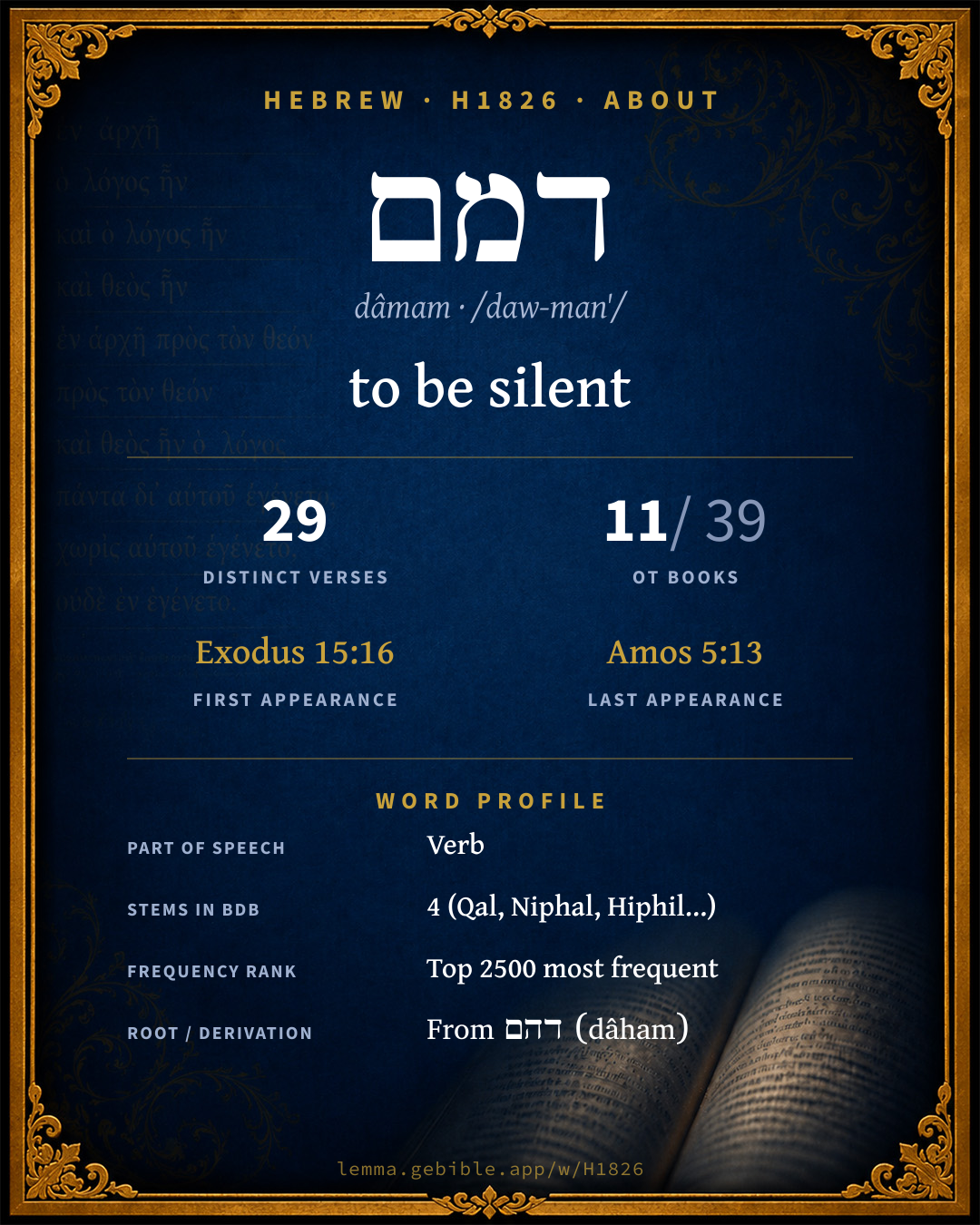
דָּמַם
to be silent
also: be still, wait, be dumb, grow dumb fuller range ↓
Full lexicon entry — Brown-Driver-Briggs (BDB)
From Brown-Driver-Briggs (BDB)
Where this word appears
See every Qal verb in the Hebrew Bible →
Grammar key — what these labels mean
Part of speech
- Verb
- An action or state-of-being word.
Stem
- Niphal
- Usually the simple passive or reflexive of the Qal (“he was written”).
- Qal
- The basic, simple active stem — the plain form of the verb (“he wrote”). Here: ‘be silent ψ 4’
- Polel
- A stem of hollow/geminate roots functioning like the Piel — intensive active.
- Hiphil
- The causative active stem (“he caused / brought about”).
Form
- Imperfect
- An incomplete, ongoing, or future action (“he will / would write”).
- Imperative
- A direct command (“write!”).
- Sequential Imperfect
- An imperfect with prefixed waw — the standard past-narrative form (waw-consecutive imperfect).
- Perfect
- A completed action or state — Hebrew marks aspect (completeness) more than strict tense (“he wrote”).
- Sequential Perfect
- A perfect with prefixed waw continuing a preceding imperfect or command (waw-consecutive perfect).
- Cohortative
- A first-person volitional form expressing wish or resolve (“let me / let us write”).
- Jussive
- A third- or second-person volitional form expressing wish or command (“let him write”).
Person
- 3rd Person
- The one spoken about (“he / she / it / they”).
- 2nd Person
- The one addressed (“you”).
- 1st Person
- The speaker (“I / we”).
Gender
- Masculine
- Grammatically masculine.
- Common
- Either gender — not distinguished for this form.
- Feminine
- Grammatically feminine.
Number
- Plural
- More than one (in Hebrew, generally three or more).
- Singular
- One.
Grammatical forms 17 distinct
- Verb, Qal, Imperfect, 3rd Person, Masculine, Plural 4 times (13%)
- Verb, Niphal, Imperfect, 3rd Person, Masculine, Plural 3 times (10%)
- Verb, Qal, Imperative, 2nd Person, Masculine, Singular 3 times (10%)
- Verb, Qal, Imperative, 2nd Person, Masculine, Plural 3 times (10%)
- Verb, Qal, Sequential Imperfect, 3rd Person, Masculine, Singular 2 times (7%)
- Verb, Qal, Imperfect, 3rd Person, Masculine, Singular 2 times (7%)
- Verb, Qal, Perfect, 3rd Person, Common, Plural 2 times (7%)
- Verb, Qal, Imperative, 2nd Person, Feminine, Singular 2 times (7%)
+9 more forms (9 occurrences)
Parsed forms decoded from the imported morphology (morphhb / Westminster Leningrad Codex — WLC text public domain, morphhb tagging CC BY 4.0), counted across 30 parsed occurrences — not distinct verses.
Every verse where H1826 appears — 29 distinct verses across 11 books. Click any verse to open its interlinear word-by-word view. Verse text shown in the World English Bible for context — . Each verse’s Hebrew form is shown with its reference; the English is not keyword-highlighted, since the data carries no word-level English alignment. Use “Compare translations” on any verse to read it across multiple English versions. This concordance covers the Hebrew Bible; Septuagint (Greek Old Testament) occurrences are not indexed here.
Exodus 1 verse
Leviticus 1 verse
Joshua 2 verses
- Joshua 10:12 דּ֔וֹם Qal impv 2ms Then spoke Joshua to Yahweh in the day when Yahweh delivered up the Amorites before the children of Israel; and he said in the sight of Israel, Sun, stand you still on Gibeon; You, Moon, in the valley of Aijalon.
- Joshua 10:13 וַ/יִּדֹּ֨ם conj + Qal wimpf 3ms The sun stood still, and the moon stayed, Until the nation had avenged themselves of their enemies. Isn't this written in the book of Jashar? The sun stayed in the midst of the sky, and didn't hurry to go down about a whole day.
1 Samuel 2 verses
- 1 Samuel 2:9 יִדָּ֑מּוּ Niphal impf 3mp He will keep the feet of his holy ones; But the wicked shall be put to silence in darkness; For by strength shall no man prevail.
- 1 Samuel 14:9 דֹּ֕מּוּ Qal impv 2mp If they say thus to us, Wait until we come to you; then we will stand still in our place, and will not go up to them.
Job 3 verses
- Job 29:21 וְ֝/יִדְּמ֗וּ conj + Qal impf 3mp "Men listened to me, waited, And kept silence for my counsel.
- Job 30:27 דָ֗מּוּ Qal pf 3cp My heart is troubled, and doesn't rest. Days of affliction have come on me.
- Job 31:34 וָ֝/אֶדֹּ֗ם conj + Qal wimpf 1cs Because I feared the great multitude, And the contempt of families terrified me, So that I kept silence, and didn't go out of the door--
Psalms 7 verses
- Psalms 4:4 וְ/דֹ֣מּוּ conj + Qal impv 2mp Stand in awe, and don't sin. Search your own heart on your bed, and be still. Selah.
- Psalms 30:12 יִדֹּ֑ם Qal impf 3ms To the end that my heart may sing praise to you, and not be silent. Yahweh my God, I will give thanks to you forever!
- Psalms 31:17 יִדְּמ֥וּ Qal impf 3mp Let me not be disappointed, Yahweh, for I have called on you. Let the wicked be disappointed. Let them be silent in Sheol.
- Psalms 35:15 דָֽמּוּ Qal pf 3cp But in my adversity, they rejoiced, and gathered themselves together. The attackers gathered themselves together against me, and I didn't know it. They tore at me, and didn't cease.
- Psalms 37:7 דּ֤וֹם Qal impv 2ms Rest in Yahweh, and wait patiently for him. Don't fret because of him who prospers in his way, Because of the man who makes wicked plots happen.
- Psalms 62:5 דּ֣וֹמִּי Qal impv 2fs My soul, wait in silence for God alone, For my expectation is from him.
- Psalms 131:2 וְ/דוֹמַ֗מְתִּי conj + Polel pf 1cs Surely I have stilled and quieted my soul, Like a weaned child with his mother, Like a weaned child is my soul within me.
Isaiah 1 verse
Jeremiah 7 verses
- Jeremiah 8:14 וְ/נִדְּמָה הֲדִמָּ֨/נוּ֙ conj + Qal coh 1cp Hiphil pf 3ms + sfx pers 1cp Why do we sit still? assemble yourselves, and let us enter into the fortified cities, and let us be silent there; for Yahweh our God has put us to silence, and given us water of gall to drink, because we have sinned against Yahweh.
- Jeremiah 25:37 וְ/נָדַ֖מּוּ conj + Niphal wpf 3cp The peaceable folds are brought to silence because of the fierce anger of Yahweh.
- Jeremiah 47:6 וָ/דֹֽמִּי conj + Qal impv 2fs You sword of Yahweh, how long will it be before you be quiet? put up yourself into your scabbard; rest, and be still.
- Jeremiah 48:2 תִּדֹּ֔מִּי Qal impf 2fs The praise of Moab is no more; in Heshbon they have devised evil against her: Come, and let us cut her off from being a nation. You also, Madmen, shall be brought to silence: the sword shall pursue you.
- Jeremiah 49:26 יִדַּ֨מּוּ֙ Niphal impf 3mp Therefore her young men shall fall in her streets, and all the men of war shall be brought to silence in that day, says Yahweh of Hosts.
- Jeremiah 50:30 יִדַּ֛מּוּ Niphal impf 3mp Therefore shall her young men fall in her streets, and all her men of war shall be brought to silence in that day, says Yahweh.
- Jeremiah 51:6 תִּדַּ֖מּוּ Niphal juss 2mp Flee out of the midst of Babylon, and save every man his life; don't be cut off in her iniquity: for it is the time of Yahweh's vengeance; he will render to her a recompense.
Lamentations 3 verses
- Lamentations 2:10 יִדְּמוּ֙ Qal impf 3mp The elders of the daughter of Zion sit on the ground, they keep silence; They have cast up dust on their heads; they have girded themselves with sackcloth: The virgins of Jerusalem hang down their heads to the ground.
- Lamentations 2:18 תִּדֹּ֖ם Qal juss 3fs Their heart cried to the Lord: wall of the daughter of Zion, let tears run down like a river day and night; Give yourself no respite; don't let the apple of your eye cease.
- Lamentations 3:28 וְ/יִדֹּ֔ם conj + Qal juss 3ms Let him sit alone and keep silence, because he has laid it on him.
Ezekiel 1 verse
Amos 1 verse
About this entry
At a glance — auto-summarized from this page’s data, not written by a person. Every figure links to its source below. This summary describes the numbers; it doesn’t interpret them.
דמם (dâmam) is a Hebrew verb most often rendered “to be silent.” Read the stem: it spans 4 stems, including Qal and Niphal. Spanning 29 verses in 11 books, it ranks among the moderately common words of the Hebrew Bible. It first appears in Exodus 15:16. Related forms include דהם, דומם and דם. The sections below give every sense, occurrence, and version rendering.
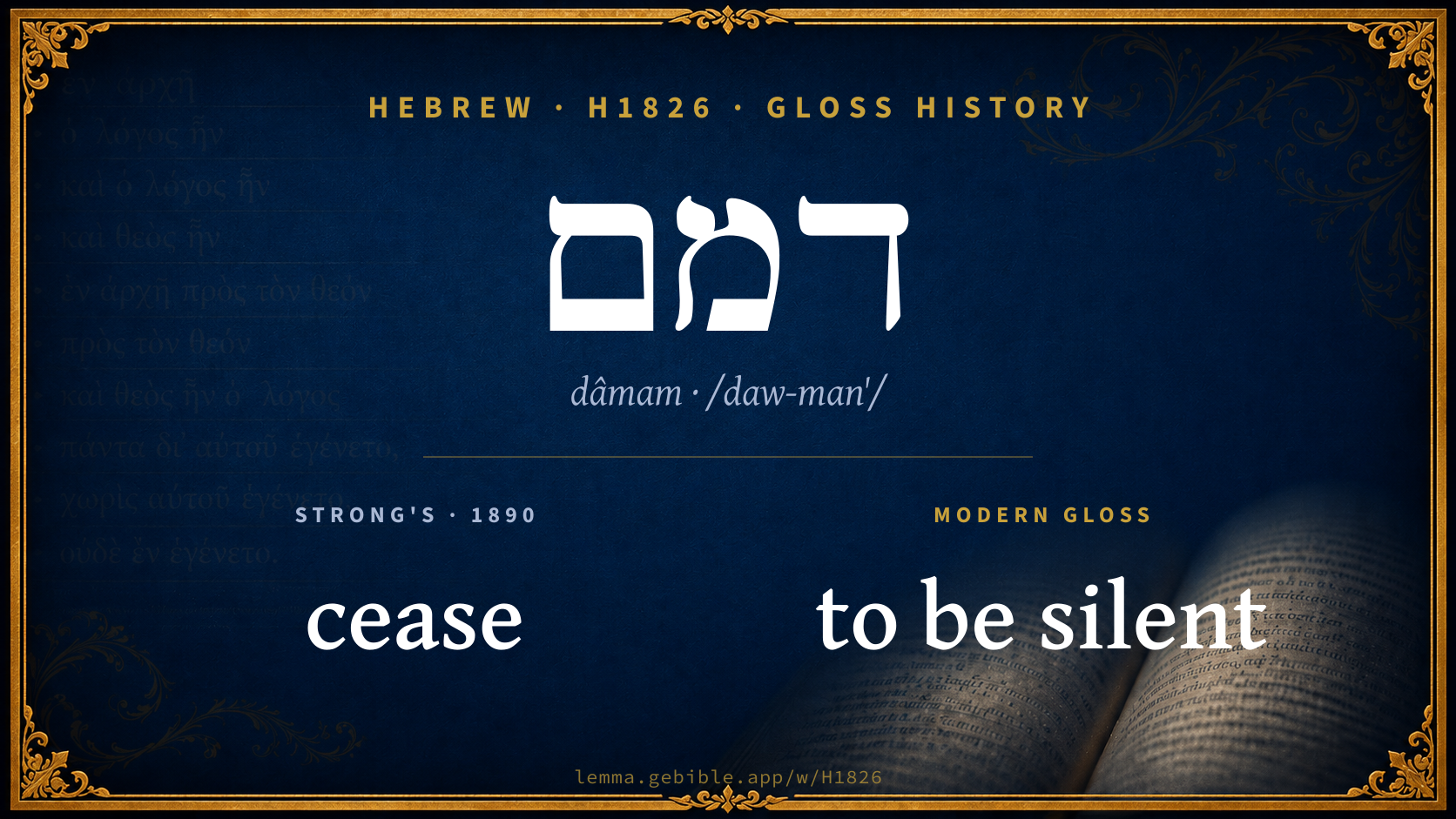
Gloss history
Strong's 1890 vs modern scholarship
About this word
Strong's H1826 catalogs a Hebrew word from the Hebrew Old Testament.
These counts are not copied from any lexicon or concordance. They are computed here, from the morphology-tagged Hebrew Old Testament. What Lemma adds →
- 29
- distinct verses
- The word appears in 29 distinct verses.
- 11 / 39
- OT books
- The word appears in 11 of 39 Old Testament books.
- #1,139
- by frequency
- Top 2500 most frequent Hebrew words (rank 1,139 of 8,640 Hebrew words by occurrence).
View all 29 occurrences in the concordance →
By section of the Old Testament
By traditional corpus
Conventional, traditional groupings — biblical authorship is debated, so this is a traditional corpus grouping, not an authorship claim. Each share is this word’s portion of its verses in that division of the Hebrew canon. Each figure is a share of the word’s 29 distinct verses.
- Prophets (Nevi'im) 14 verses · 48%
- Writings (Ketuvim) 13 verses · 45%
- Torah (Pentateuch) 2 verses · 7%
How translations render this word
Counts come from each version’s own published word-to-Strong’s tagging or interlinear alignment — an approximate guide to how each version renders this word, not a word-level alignment the data otherwise carries. Because each total is that version’s own tagged count, the per-version totals vary from one another and need not match the appearance or distinct-verse counts above. These counts may also differ from a printed concordance because Lemma counts each distinctly tagged rendering and does not collapse phrase taggings into a single head-word total. This is a fixed set of word-tagged versions (KJV, ASV, BSB, ULT) and does not change with the reading translation you choose elsewhere. Each version’s license is shown beside its name below (and on Sources).
BDB lists this Strong’s number as 2 distinct words (homographs). Each count above pools all of them and is not split by sense — see the Senses section below. A low-frequency rendering may belong to a different one of those words, not the primary meaning.
- King James Version†: Be still 3×, Shall be cut off 2×
- American Standard Version†: Be still 3×, Shall be brought to silence 2×
- Berean Standard Bible†: Be still 3×, Rest 3×, Will be silenced 3×
- unfoldingWord Literal Text†: Be silent 6×, And 2×, Rest 2×
King James Version Public Domain
Renders H1826 across 30† tagged occurrences — most commonly:
Plus 25 renderings that appear only once — usually multi-word phrases or single function words the recovered tagging swept in, not distinct renderings.
American Standard Version Public Domain
Renders H1826 across 30† tagged occurrences — most commonly:
Plus 25 renderings that appear only once — usually multi-word phrases or single function words the recovered tagging swept in, not distinct renderings.
Berean Standard Bible Public Domain
Renders H1826 across 30† tagged occurrences — most commonly:
Plus 15 renderings that appear only once — usually multi-word phrases or single function words the recovered tagging swept in, not distinct renderings.
unfoldingWord Literal Text CC BY-SA 4.0
Renders H1826 across 30† tagged occurrences — most commonly:
Plus 20 renderings that appear only once — usually multi-word phrases or single function words the recovered tagging swept in, not distinct renderings.
8 senses and sub-senses in the full BDB
Hebrew verbs can shift meaning by stem (binyan): Qal is the basic action, Niphal is often passive or reflexive, Piel often intensifies or makes it factitive, and Hiphil is typically causative. The senses below are grouped under the stem BDB assigns to each. This entry also uses one or more reduplicated stems (the Pōlēl/Pilpēl type), which for hollow or geminate roots behave much like Piel — often intensive or iterative.
What do BDB’s symbols mean?
BDB uses these scholarly abbreviations:
| Symbol | Meaning |
|---|---|
| 𝔊 | the Septuagint (the ancient Greek translation, LXX) |
| 𝔙 | the Vulgate (the Latin translation) |
| 𝔖 | the Syriac version (the Peshitta) |
| 𝔗 | the Targum (the Aramaic translation) |
| ψ | the Psalms |
| √ | root (the underlying root or stem) |
| ‖ | parallel passage (a synonymous or contrasted parallel) |
| † | the dagger: every passage where the word occurs is cited |
The 8 senses and sub-senses the full Brown-Driver-Briggs lexicon distinguishes for this word, in lexicon order (not ranked by frequency), with BDB’s own verbatim wording and sub-sense lettering. Shown in Hebrew script with BDB’s own scholarly abbreviations. The condensed entry is in the Lexicon Entry tab. See also the Forms in the corpus table below.
דמם I be or grow dumb, silent, still (NH id.
Qal
- Pf. דָּ֑מּוּ ψ 35:15 Jb 30:27; Impf. יִדֹּם Am 5:13 + 2 times, וַיִּדֹּם Lv 10:3; Jos 10:13; 3 fs. תִּדֹּם La 2:18; 2 fs. תִּדֹּמִּי Je 48:2 (so Ki Ol & Kö327 q.v.; others Niph.); וָאֶדֹּם Jb 31:14; יִדְּמוּ Ex 15:16 + 3 times; 1 pl. cohort. נִדְּמָה Je 8:14 (Thes; or Niph.); imv. דּוֹם Jos 10:12 דֹּמּוּ ψ 4:5;— e.g. Psalms 35:15
- 1. be silent ψ 4:5; 30:13; 35:15 (prob., cf. De Che), Ez 24:17; Lv 10:3 (P); Am 5:13; in grief La 2:10; 3:28. e.g. Psalms 4:5
- 2. be still (opp. to both speech and motion) Jb 31:34; = perish Je 8:14; 48:2 ψ 31:18; (ד׳ לשׁאול); c. לְ be silent to i.e. be resigned to ψ 37:7; 62:6, sq. לְמוֹ עֲצָתִי Jb 29:21 (‖ לִי שָֽׁמְעוּ); be still, motionless, stand still Jos 10:12, 13 (of sun ‖ עמד); 1 S 14:9 (men); Je 47:6 (of sword ‖ הֵרָֽגְעִי); so also of bowels, as seat of mental excitement Jb 30:27; La 2:18 אַל־תִּדֹּם בַּת־עֵינֵךְ, i.e. cease not to weep (‖ הוֹרִידִי כַנַּחַל דִּמְעָה). e.g. Job 31:34
- 3. be struck dumb, astounded, in amazement and fear Ex 15:16 (כאבן) Is 23:2 (but cf. II. דמם). e.g. Exodus 15:16
Niphal
- Pf. 3 pl. וְנָדַמּוּ consec. Je 25:37; Impf. יִדַּמּוּ Je 49:26; 50:30, יִדָּ֑מּוּ 1 S 2:9; 2 mpl. תִּדַּמּוּ Je 51:6—be made silent, i.e. destroyed; the wicked 1 S 2:9 (בַּחשֶׁךְ), cf. Je 51:6; men of war Je 49:26; 50:30; dwellings Je 25:37. e.g. Jeremiah 25:37
Po
- Pf. 1 s. שִׁוִּיתִי וְדוֹמַ֫מְתִּי נַפְשִׁי ψ 131:2 ‘composed and quieted my soul’ Che (as a weaned child). e.g. Psalms 131:2
Hiphil
- Pf. 3 ms. sf. הֲדִמָּנוּ he (God) hath silenced us (= caused to perish) Je 8:14. e.g. Jeremiah 8:14
דמם II wail (? cf. Assyrian damâmu, groan, wail, lament, DlBaer’s Ezech xi
Qal
- Imv. דֹּ֫מּוּ ישְׁבֵי אִי Is 23:2 wail, ye coast dwellers (cf. Dll.c.), ‖ הֵילִילוּ v 1, & הֵילִילוּ ישְׁבֵי אִי v 6; most, however, assign this to I. דמם q.v. (3). e.g. Isaiah 23:2
Senses from the full Brown-Driver-Briggs lexicon (Brown, Driver, Briggs; Oxford 1906 — public domain), digitized via Sefaria, supplemented by the OpenScriptures HebrewLexicon (CC BY 4.0). Full attribution on Sources.
Word origin
I. vb. be or grow dumb, silent, still (NH id.; Ethiopic in ii. 1 አድመመ stupefy; iii., 1 & 2 ተደመ, ተደመመ be astounded, stupefied)—
II. vb. wail (? cf. Assyrian damâmu, groan, wail, lament, DlBaer’s Ezech xi; Pr 64)—only
— Brown-Driver-Briggs (Oxford 1906, public domain), digitized via Sefaria, supplemented by the OpenScriptures HebrewLexicon (CC BY 4.0). See Sources.
Derived from דהם (dâham) (H1724) — to astonish.
Jastrow Dictionary
A second Hebrew/Aramaic lexicon for comparison, covering Aramaic and post-biblical (Talmudic, Targumic, Midrashic) usage that the biblical-Hebrew BDB does not. Matched by lemma rather than by Strong’s number, so a lemma may carry more than one Jastrow headword (shown separately below), and the entries cover usage well beyond the Bible.
דָּמַם
- v. דּוּם,
- 1. to be silent, dumb, at rest; to be stricken dumb. Pesik. R. s. 33 (ref. to Is. VI, 5) היאך היה לי שדָּמַמְתִּי how did it happen to me that I was silent (did not join in the praises of the angels)? Taan. 20ᵃ דָּמְמוּ הרוחות when the winds subside. Snh. 91ᵃ כאבן דּוּמָם like a dumb stone. Ber. 19ᵃ יושב ודוֹמֵם sits in silence; a. fr.—Part. pass. דָּמוּם, f. דְּמוּמָה. Lam. R. to I, 17 (ref. to אֶדַּדֵּם, Ps. XLII, 5) ועכשיו ד׳ סלקא וכ׳ and now in silence does she (Israel) go up (to the ruins of Jerusalem), and in silence &c.—V. דִּמְדֵּם. e.g. Isaiah 6:5
- 2. to leave off. Midr. Till. to Ps. IV, 5 (ref. to ודמו ib.) [read:] ובלבד שתִּדֹּום וכ׳ provided that thou leavest off from the sin &c.; Yalk. ib. 627.
- to silence, bring to a stand-still. Ex. R. s. 29 end ה׳ כל העולם He made the world stand still. Gen. R. s. 97 שהוא מַדְמִים וכ׳ who will bring to a standstill sun and moon.
A Dictionary of the Targumim, the Talmud Babli and Yerushalmi, and the Midrashic Literature (Marcus Jastrow; London, Luzac, 1903) — Public Domain. Digitized via Sefaria. Digitized via Sefaria. Full attribution on Sources.
Forms in the corpus
The 29 distinct written forms H1826 takes in the Hebrew Bible, most frequent first — each parse links to that stem’s occurrences in the concordance. Hebrew forms include their vowel points and cantillation, so a single lemma takes many written forms.
Same root — word family
Other BDB entries built from the same root as H1826, grouped by Strong’s listed origin. These share a root / origin per the lexicon — not necessarily a shared meaning. Each links to that word’s own entry.
Derives from
Derived from this word
Compare all same-root words → Showing 4 of 5 — not the complete family. They share a root, not necessarily a meaning.
Septuagint verse parallels
This word appears in 24 verses that also exist in the Greek Old Testament (Septuagint), out of the 29 Hebrew verses it occurs in. You can read those verses in Greek by switching the Old Testament edition to the Septuagint.
Read these verses in the Septuagint
- Exodus 15:16
- Leviticus 10:3
- Joshua 10:12
- 1 Samuel 2:9
- Job 29:21
- Psalms 4:4
- Isaiah 23:2
- Jeremiah 8:14
- Lamentations 2:10
- Ezekiel 24:17
- Amos 5:13
This is a verse-level parallel only — the same verses exist in both the Hebrew and Greek Old Testaments. No word-level Hebrew↔Greek correspondence is claimed: the data carries no such alignment, so no Greek word is shown as this Hebrew word’s translation. Coverage is not total — the Septuagint omits the deuterocanon and renumbers the Psalms, so some Hebrew verses have no direct Greek parallel.