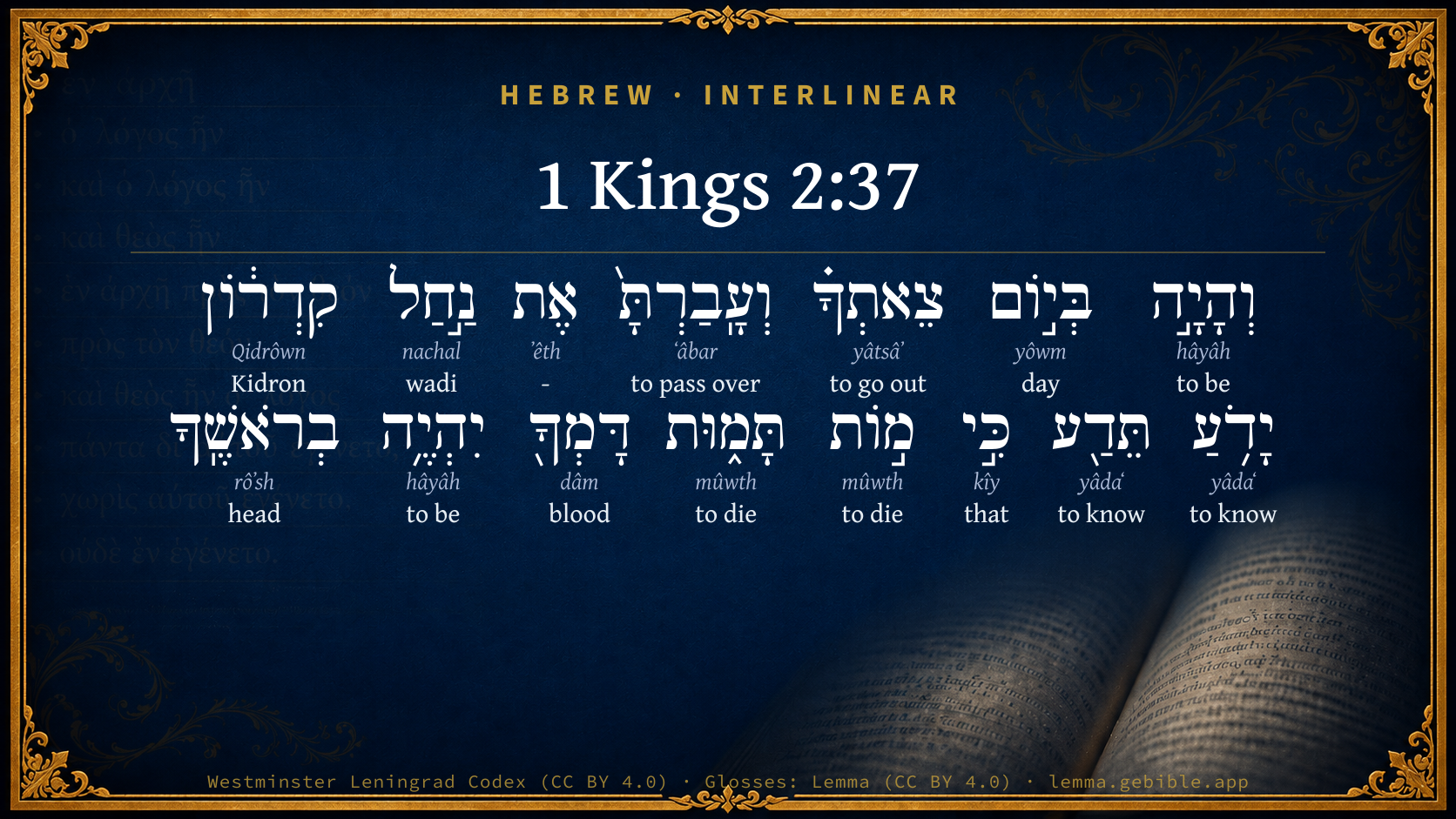
1 Kings 2:37

Hebrew (Westminster Leningrad Codex) 1 Kings 2:37 appears in the Hebrew Old Testament. The text above is from the Westminster Leningrad Codex. Each word links to its Strong’s number, a concise gloss, and parsing drawn from the Open Scriptures Hebrew Bible morphology. Click any word for its full Brown-Driver-Briggs (BDB) entry.
Download image
Cite this verse

1 Kings 2:37 (World English Bible). Public Domain. Lemma interlinear Bible study tool, https://lemma.gebible.app/v/1-kings/2/37.

Show BibTeX & RIS
BibTeX
RIS
English Translation
For on the day you go out, and pass over the brook Kidron, know you for certain that you shall surely die: your blood shall be on your own head.
World English Bible · Public Domain
Download a study sheet

One document with this verse’s original text, its word-by-word gloss line, the meaning frame, cross-references with their text, attributed commentary, and full source and license credits — printable, and it pastes into notes with its structure intact.

This verse Autodidact and up

Study sheet (.html) Plain text (.txt)

A passage Seminary Student

Up to 50 verses in one chapter. A passage sheet keeps up to 6 commentary sources and 12 cross-references per verse, in the order this page ranks them, and says so on the sheet whenever that leaves anything out. Ask for a single verse and you get the Autodidact verse sheet above.

Everything on this page stays free to read, with no account — the sheet is a download of what is already on screen, not access to it.

Want to remove ads? Support Godless Engineer
Compare translations 3

The same verse in 3 English versions, stacked beneath the original-language interlinear above. Click any original word for its lexicon entry.

Each is an independent rendering of the whole verse — the interlinear is not word-aligned to these translations.

Highlighted words mark where these versions differ — a whole-verse word diff, not a word-by-word alignment.

  • World English Bible Public Domain
    For on the day you go out, and pass over the brook Kidron, know you for certain that you shall surely die: your blood shall be on your own head.
  • King James Version Public Domain
    For it shall be, that on the day thou goest out, and passest over the brook Kidron, thou shalt know for certain that thou shalt surely die: thy blood shall be upon thine own head.
  • unfoldingWord Literal Text CC BY-SA 4.0
    And it will happen on the day of your going out and you pass over the wadi of Kidron, knowing, you shall know that dying, you shall die. Your blood will be on your head.”

unfoldingWord Literal Text — © unfoldingWord, licensed CC BY-SA 4.0. Word-aligned USFM3 via Door43 (git.door43.org/unfoldingWord/en_ult).

Versions to compare (up to 4)

3 of 4 selected

Show all 18 translations

Every available English version of this verse, each an independent rendering of the whole verse.

  • World English Bible Public Domain
    For on the day you go out, and pass over the brook Kidron, know you for certain that you shall surely die: your blood shall be on your own head.
  • Berean Standard Bible Public Domain
    On the day you go out and cross the Kidron Valley, know for sure that you will die; your blood will be on your own head.”
  • Majority Standard Bible Public Domain
    On the day you go out and cross the Kidron Valley, know for sure that you will die; your blood will be on your own head.”
  • King James Version Public Domain
    For it shall be, that on the day thou goest out, and passest over the brook Kidron, thou shalt know for certain that thou shalt surely die: thy blood shall be upon thine own head.
  • American Standard Version (1901) Public Domain
    For on the day thou goest out, and passest over the brook Kidron, know thou for certain that thou shalt surely die: thy blood shall be upon thine own head.
  • Revised Version (1885) Public Domain
    For on the day thou goest out, and passest over the brook Kidron, know thou for certain that thou shalt surely die: thy blood shall be upon thine own head.
  • Geneva Bible (1599) Public Domain
    For that day that thou goest out, and passest ouer the riuer of Kidron, knowe assuredly, that thou shalt dye the death: thy blood shall be vpon thine owne head.
  • Douay-Rheims (1899) Public Domain
    For on what day soever thou shalt go out, and shalt pass over the brook Cedron, know that thou shalt be put to death: thy blood shall be upon thy own head:
  • Young's Literal Translation Public Domain
    and it hath been, in the day of thy going out, and thou hast passed over the brook Kidron, thou dost certainly know that thou dost surely die -- thy blood is on thy head.'
  • Literal Standard Version CC BY-SA 4.0
    and it has been, in the day of your going out, and you have passed over the Brook of Kidron, you certainly know that you surely die—your blood is on your head.”
  • Unlocked Literal Bible CC BY-SA 4.0
    For on the day you go out, and pass over the Kidron Valley, know you for certain that you will surely die. Your blood will be on your own head.”
  • unfoldingWord Literal Text CC BY-SA 4.0
    And it will happen on the day of your going out and you pass over the wadi of Kidron, knowing, you shall know that dying, you shall die. Your blood will be on your head.”
  • Darby Bible Public Domain
    And it shall be that on the day thou goest forth, and passest over the torrent of Kidron,... know for certain that thou shalt surely die: thy blood shall be upon thine own head.
  • World Messianic Bible Public Domain
    For on the day you go out and pass over the brook Kidron, know for certain that you will surely die. Your blood will be on your own head.”
  • Webster's Bible Public Domain
    For it shall be, that on the day thou shalt go out, and pass over the brook Kidron, thou shalt know for certain that thou shalt surely die: thy blood shall be upon thy own head.
  • Free Bible Version CC BY-SA 4.0
    You should know for certain that the day you leave and cross the Kidron Valley you will die. Your death will be your own responsibility.”
  • Bible in Basic English Public Domain
    For be certain that on the day when you go out and go over the stream Kidron, death will overtake you: and your blood will be on your head.
  • JPS Tanakh (1917) Public Domain
    For on the day thou goest out, and passest over the brook Kidron, know thou for certain that thou shalt surely die; thy blood shall be upon thine own head.'

Literal Standard Version (2020), Covenant Press — licensed CC BY-SA 4.0. Text via the HelloAO Bible API (eBible.org). Unlocked Literal Bible (unfoldingWord) — licensed CC BY-SA 4.0. Text via the HelloAO Bible API (eBible.org). unfoldingWord Literal Text — © unfoldingWord, licensed CC BY-SA 4.0. Word-aligned USFM3 via Door43 (git.door43.org/unfoldingWord/en_ult). Free Bible Version, Dr. Jonathan Gallagher — licensed CC BY-SA 4.0. Text via the HelloAO Bible API (eBible.org).

Word by word

More ways to search: Search by grammar → Find every occurrence → Compare this word →

Practice this passage: Drill this verse → Learn its vocabulary →

קִדְר֔וֹן
Qidrôwn
H6939
“Kidron”
Noun, Proper
Part of Speech
Noun
Type
Proper
Full BDB Definition

Origin: from H6937

TWOT: None

Kidron = "dark" - a stream east of Jerusalem
  1. וְהָיָ֣ה hâyâh H1961 “and · to be” Conjunction + Verb, Qal, Sequential Perfect, 3rd Person, Masculine, Singular
  2. בְּי֣וֹם yôwm H3117 “in/at · day of” Preposition + Noun, Common, Masculine, Singular, Construct
  3. צֵאתְךָ֗ yâtsâʼ H3318 “to go out · you” Verb, Qal, Infinitive Construct + Suffix, Personal, 2nd Person, Masculine, Singular
  4. וְעָֽבַרְתָּ֙ ʻâbar H5674 “and · to pass over” Conjunction + Verb, Qal, Sequential Perfect, 2nd Person, Masculine, Singular
  5. אֶת ʼêth H853 “-” Particle, Direct Object
  6. נַ֣חַל nachal H5158 “wadi of” Noun, Common, Masculine, Singular, Construct
  7. יָדֹ֥עַ yâdaʻ H3045 “to know” Verb, Qal, Infinitive Absolute
  8. תֵּדַ֖ע yâdaʻ H3045 “to know” Verb, Qal, Imperfect, 2nd Person, Masculine, Singular
  9. כִּ֣י kîy H3588 “that” Conjunction
  10. מ֣וֹת mûwth H4191 “to die” Verb, Qal, Infinitive Absolute
  11. תָּמ֑וּת mûwth H4191 “to die” Verb, Qal, Imperfect, 2nd Person, Masculine, Singular
  12. דָּמְךָ֖ dâm H1818 “blood · your” Noun, Common, Masculine, Singular, Construct + Suffix, Personal, 2nd Person, Masculine, Singular
  13. יִהְיֶ֥ה hâyâh H1961 “to be” Verb, Qal, Imperfect, 3rd Person, Masculine, Singular
  14. בְרֹאשֶֽׁךָ rôʼsh H7218 “in/at · head · your” Preposition + Noun, Common, Masculine, Singular, Construct + Suffix, Personal, 2nd Person, Masculine, Singular

About this verse

These counts appear in no published source. They are computed here, from the morphology-tagged text and Lemma’s own curated glosses. What Lemma adds →

15
words
12
distinct lemmas
Historical
section

Notable vocabulary

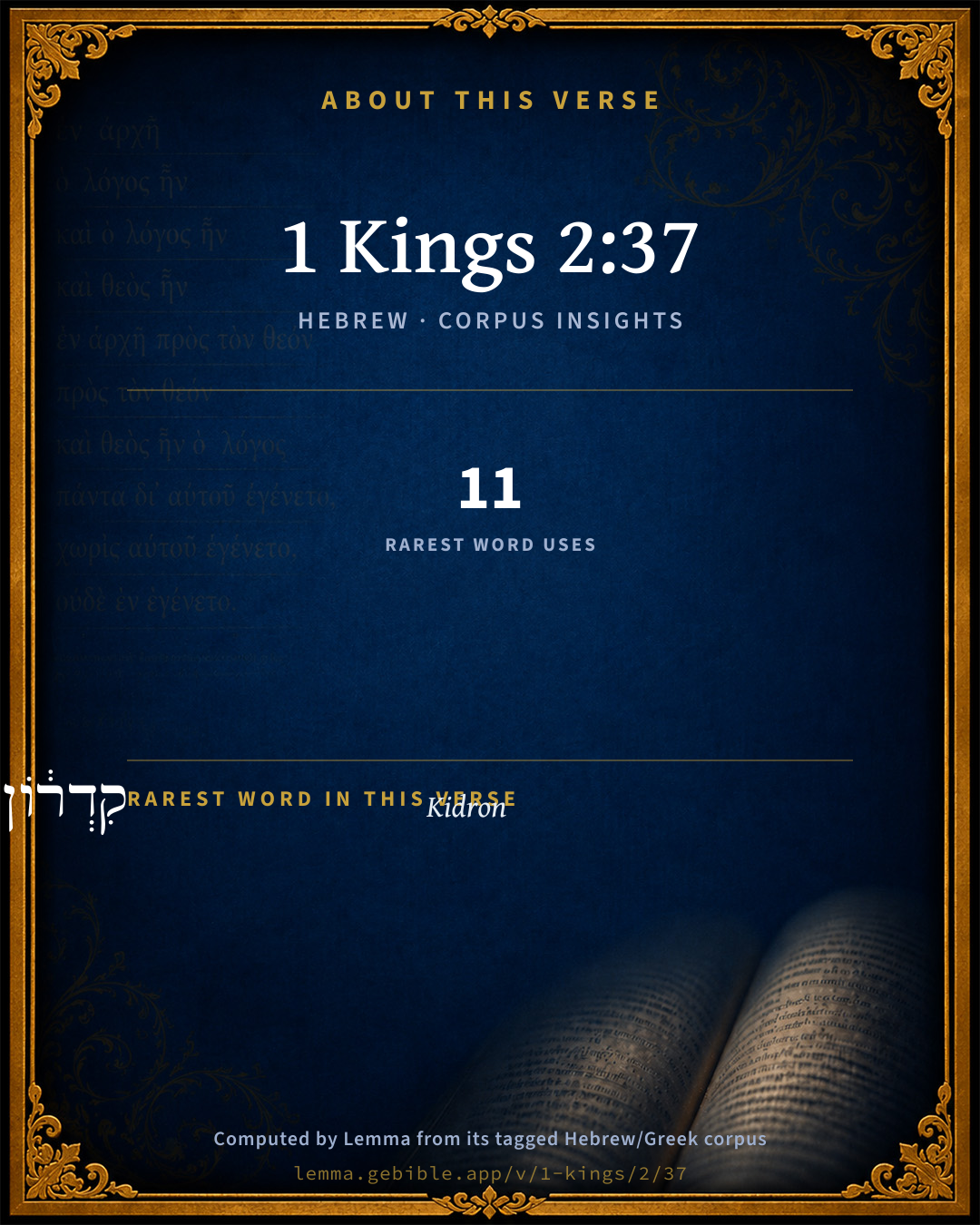
The rarest word here is קִדְר֔וֹן Kidron H6939 — appearing just 11 times in the whole Hebrew Bible.

Shared distinctive vocabulary

קִדְר֔וֹן Kidron H6939 occurs in 10 verses of the Hebrew Bible. Also found in:

Grammatical profile

  • 8 verbs
  • 5 nouns
  • 1 conjunction
  • 1 particle

Verb forms

  • וְהָיָ֣ה Qal · Sequential Perfect
  • צֵאתְךָ֗ Qal · Infinitive Construct
  • וְעָֽבַרְתָּ֙ Qal · Sequential Perfect
  • יָדֹ֥עַ Qal · Infinitive Absolute
  • תֵּדַ֖ע Qal · Imperfect
  • מ֣וֹת Qal · Infinitive Absolute
  • תָּמ֑וּת Qal · Imperfect
  • יִהְיֶ֥ה Qal · Imperfect

Repetition

Words recur within this verse — often emphatic in Hebrew:

  • וְהָיָ֣ה to be H1961 ×2
  • יָדֹ֥עַ to know H3045 ×2
  • מ֣וֹת to die H4191 ×2

Cross-references

12

Topical passages linked to 1 Kings 2:37 in the Treasury of Scripture Knowledge — connected by theme and wording, ordered by reader-vote popularity; previews shown in the World English Bible.

  • 2 Samuel 1:16 David said to him, Your blood be on your head; for your mouth has testified against you, saying, I have slain Yahweh's anointed.
  • 2 Samuel 15:23 All the country wept with a loud voice, and all the people passed over: the king also himself passed over the brook Kidron, and all the people passed over, toward the way of the wilderness.
  • Joshua 2:19 It shall be, that whoever shall go out of the doors of your house into the street, his blood shall be on his head, and we shall be guiltless: and whoever shall be with you in the house, his blood shall be on our head, if any hand be on him.
  • Leviticus 20:9 "'For everyone who curses his father or his mother shall surely be put to death: he has cursed his father or his mother; his blood shall be upon him.
  • 2 Kings 23:6 He brought out the Asherah from the house of Yahweh, outside of Jerusalem, to the brook Kidron, and burned it at the brook Kidron, and beat it to dust, and cast the dust of it on the graves of the common people.
  • Ezekiel 18:13 has given forth on interest, and has taken increase; shall he then live? he shall not live: he has done all these abominations; he shall surely die; his blood shall be on him.
  • John 18:1 When Jesus had spoken these words, he went out with his disciples over the brook Kidron, where was a garden, into which he and his disciples entered.
  • 1 Kings 2:31 The king said to him, Do as he has said, and fall on him, and bury him; that you may take away the blood, which Joab shed without cause, from me and from my father's house.
  • 1 Kings 2:33 So shall their blood return on the head of Joab, and on the head of his seed forever: but to David, and to his seed, and to his house, and to his throne, shall there be peace for ever from Yahweh.
  • 1 Kings 15:13 Also Maacah his mother he removed from being queen, because she had made an abominable image for an Asherah; and Asa cut down her image, and burnt it at the brook Kidron.
  • 2 Chronicles 29:16 The priests went in to the inner part of the house of Yahweh, to cleanse it, and brought out all the uncleanness that they found in the temple of Yahweh into the court of the house of Yahweh. The Levites took it, to carry it out abroad to the brook Kidron.
  • Jeremiah 31:40 The whole valley of the dead bodies and of the ashes, and all the fields to the brook Kidron, to the corner of the horse gate toward the east, shall be holy to Yahweh; it shall not be plucked up, nor thrown down any more forever.

Cross-references courtesy of OpenBible.info (CC BY 4.0).

Hebrew and Greek witnesses Masoretic Hebrew ↔ Greek Septuagint

The same verse in the two great witnesses to the Old Testament, shown verse-for-verse.

These are two independent witnesses, not word-aligned to each other, and the Septuagint is shown in lemma (dictionary) form.

Hebrew 1 Kings 2:37 Masoretic · Westminster Leningrad Codex

וְהָיָ֣ה בְּי֣וֹם צֵאתְךָ֗ וְעָֽבַרְתָּ֙ אֶת נַ֣חַל קִדְר֔וֹן יָדֹ֥עַ תֵּדַ֖ע כִּ֣י מ֣וֹת תָּמ֑וּת דָּמְךָ֖ יִהְיֶ֥ה בְרֹאשֶֽׁךָ

For on the day you go out, and pass over the brook Kidron, know you for certain that you shall surely die: your blood shall be on your own head.

World English Bible · Public Domain

Greek LXX 1 Kings 2:37 Septuagint · lemma form

καί εἰμί ἐν ὁ ἡμέρα ὁ ἔξοδος σύ καί διαβαίνω ὁ χειμάρρους κεδρων γιγνώσκω γιγνώσκω ὅτι θάνατος ἀποθνήσκω ὁ αἷμα σύ εἰμί ἐπί ὁ κεφαλή σύ καί ὁρκίζω αὐτός ὁ βασιλεύς ἐν ὁ ἡμέρα ἐκεῖνος

No English rendering of this Greek verse — the small residue in the structurally divergent books.

Hebrew: Westminster Leningrad Codex (CC BY 4.0). Greek: Septuagint (public domain); English from a public-domain English Septuagint. How the Septuagint differs from the Hebrew →

Targum (Aramaic paraphrase)

1

The Targum is the ancient Jewish Aramaic paraphrase of the Hebrew Scriptures — an interpretive translation, not the Hebrew text itself. Onkelos (literal) and Pseudo-Jonathan (expansive) render the Torah, and Jonathan the Prophets. Coverage is partial: where no permissively-licensed English translation exists for a verse, only the Aramaic is shown. This is verse-level text, not a word-by-word alignment to the Hebrew.

  1. Targum Jonathan Prophets (Joshua–Malachi)
    וִיהֵי בְּיוֹם מִפְקָךְ וְתֶעְבַּר יַת נַחֲלָא דְקִדְרוֹן מִידַע תִּידַע אֲרֵי מֵימַת תְּמוּת חוֹבַת קְטוֹלָךְ תְּהֵא בְרֵישָׁךְ:

    (no public-domain English translation for this verse)

    Targum Jonathan — Aramaic: “Mikraot Gedolot” (public domain). English: “Sefaria Community Translation” (CC0 1.0 (public-domain dedication)); “London "Chaldee Paraphrase," 1871” (public domain). Text via Sefaria.

Commentary

Notes on 1 Kings 2:37 from classic Christian and Jewish commentators (each source and its license shown beneath its notes). The classic Christian expositions comment on the surrounding passage and are grouped to its opening verse, so a note may address several verses; the Jewish commentaries on the Tanakh (Rashi and others) are per-verse, so they appear only where the commentator wrote on this verse.

Lemma curates 59 commentaries, every one of them public domain or Creative Commons licensed, each selected and text-cleaned for this edition rather than reprinted as found. About our sources →

Trapp's Complete Commentary

John Trapp

1Ki 2:37 For it shall be, [that] on the day thou goest out, and passest over the brook Kidron, thou shalt know for certain that thou shalt surely die: thy blood shall be upon thine own head.

Ver. 37. And passest over the brook Kidron.] The black brook, the town ditch: this was between Jerusalem and Bahurim, Shimei’s inheritance. He might do much hurt among his Benjamites; and is therefore kept from them. We must also set bounds to our affections, and threaten them if extravagant.

John Trapp, A Commentary or Exposition upon All the Books of the Old and New Testament (1647–1656) — public domain. Text from a community e-Sword module.

Joseph Benson's Commentary

1Ki 2:37. In the day thou passest over the brook Kidron, &c. — Which Solomon mentions, because it was in the way to Bahurim, where Shimei’s former and settled habitation was, as appears by comparing 2Sa 15:23, with 1Ki 16:5. But Solomon’s meaning was, and so, no doubt, was understood by Shimei, that if he went out of Jerusalem any way, to a greater distance than Kidron was from thence, he should die for it; for when he went to Gath, after his servants, he went not over Kidron, but the direct contrary way, that city lying westward of Jerusalem, as Kidron did eastward. Thy blood shall be upon thine own head — The blame and guilt of thy blood shall lie upon thyself only. In other words, his death should be owing to himself only, as the condition of his holding his life was known to him and accepted by him, as appears from the next verse.

Joseph Benson's Commentary on the Old and New Testaments (1811–1818) — public domain. Text from a community e-Sword module.

Adam Clarke's Commentary

Verse 37. Thy blood shall be upon thine own head.] Thou knowest what to expect; if thou disobey my orders thou shalt certainly be slain, and then thou shalt be considered as a self-murderer; thou alone shalt be answerable for thy own death. Solomon knew that Shimei was a seditious man, and he chose to keep him under his own eye; for such a man at large, in favourable circumstances, might do much evil. His bitter revilings of David were a sufficient proof.

Adam Clarke's Commentary on the Bible (1810–1826) — public domain. Text from a community e-Sword/MySword module.

The Cambridge Bible for Schools and Colleges

gen. ed. J. J. S. Perowne

37. passest over the brook Kidron] This brook, being between Jerusalem and the Mount of Olives, on that side of Jerusalem where Shimei would go if he wanted to return to Bahurim. Solomon takes the distance in this direction as a measure of bounds within which he must keep himself on every side. For in going afterwards to Gath he of course did not cross the brook Kidron.

thou shalt know] The Hebrew often uses a future for an imperative. Here it is better to render ‘Know for certain’ &c. It is so rendered in 1Ki_2:42.

The Cambridge Bible for Schools and Colleges (gen. ed. J. J. S. Perowne; Cambridge University Press, 1878–1918) — public domain. Text from a community e-Sword module.

John Gill's Exposition

And Shimei said unto the king, the saying is good,.... It was an act of goodness in the king, and what was good, grateful, and acceptable to him; for being sent for by him, and knowing how he had used his father, and hearing of several traitors being put to death, he expected this would have been his case; and wherefore, instead of being put to death, was only obliged to leave his habitation in the country, and come and live at Jerusalem, a pleasant and delightful city, and the metropolis of the nation, it was very agreeable to him:

as my lord the king hath said, so will thy servant do; and he not only promised, but swore to it, which Solomon obliged him to, Kg1 2:42;

and Shimei dwelt in Jerusalem many days; he accordingly built or purchased a house in Jerusalem, and removed from Bahurim to it, where he lived for the space of three years, as follows.

John Gill's Exposition of the Whole Bible (1746–1763) — public domain (CC PDM 1.0). Text via the HelloAO Bible API.

Haydock's Catholic Bible Commentary

Cedron, which led towards Bahurim. He was equally forbidden to go out by any other road; and was put to death for going to Geth. --- Head. Thou canst blame only thyself. Solomon might have put this man to death before: but he chose to pay so much deference to the oath of his father, as not to bring him to execution without a fresh offence.

George Leo Haydock (1774–1849), Haydock's Catholic Family Bible and Commentary, 1859 edition — public domain. Excludes Psalms (Douay-Rheims chapter numbering differs from Protestant) and Deuterocanonical books (Catholic canon only).

Matthew Poole's English Annotations

The brook Kidron; a brook nigh unto Jerusalem, of which see 2Sa 15:23; 2Ki 23:4; which he particularly names, because that was the way to Bahurim, his former and settled habitation: but this is not to be understood exclusively to other ways and places; for the restraint was general, that he should

not go forth thence any whither, 1Ki 2:36, to wit, as far any other way as Cedron was: which also appears from the following history; for when he went to Gath, he went not over Cedron, (which lay eastward from the city,) but westward, as Gath lay.

Thy blood shall be upon thine own head; the blame and guilt of thy blood shall lie upon thyself only.

Matthew Poole's English Annotations on the Holy Bible (1683–1685) — public domain. Text from a community e-Sword/MySword module.

Whedon's Commentary on the Bible

Daniel D. Whedon

37. The brook Kidron — This way was probably specified because any attempt of Shimei to escape would be quite likely to lead him first in the direction of his home, which lay beyond the Kidron.

Thy blood… upon thine own head — A common expression to denote the punishment of death. Compare marginal reference.

Daniel D. Whedon (gen. ed.), Commentary on the Old and New Testaments (1874–1909) — public domain. Text from a community e-Sword module.

The Pulpit Commentary

For it shall be, on the day thou goest out and passest over the brook lit., watercourse, wady. The Kidron is quite dry, except during and for a short time after the winter rains Kidron The Kidron is mentioned specially because that was the direction which, it might be presumed, Shimei would take, his old home being at Bahurim, thou shalt know for certain that thou shalt surely die The Hebrew is, if possible, still more striking and emphatic, "To know thou shalt know that to die thou shalt die." Shimei could not say that he had not been plainly warned: thy blood shall be upon thine own head. Cf. Lev_20:9, and especially Jos_2:19; also ver. 31 of this chapter.

The Pulpit Commentary (1880–1919), ed. H.D.M. Spence-Jones & Joseph S. Exell — public domain. Text from a community e-Sword module.

John Wesley's Explanatory Notes

Kidron - A brook nigh Jerusalem, which he particularly names, because that was the way to Bahurim, his former habitation: but this is not all, for the restraint was general, that he should not go forth thence any whither. Thy blood - The blame and guilt of thy blood shall lie upon thyself only.

John Wesley, Explanatory Notes Upon the Whole Bible (1754–1765) — public domain. Text via the GEBible commentary corpus.

Lesson kit

Teaching starters — assembled from the data on this page, not authored interpretation. Every prompt links to the verse data it draws on. Edit before teaching.

1 Kings, in the Historical, opens this verse with 15 words (12 distinct Hebrew lemmas). Its most distinctive word is Qidrôwn (“Kidron”). A historical commentator’s framing appears above. Read the whole chapter for the surrounding context.

Discussion questions

  1. What does “Kidron” (Qidrôwn) contribute to the verse as a whole?
  2. How does 2 Samuel 15:23, which shares the word «Kidron», read alongside this verse?
  3. What does the repetition of “to be” (2× in this one verse) do in this verse?
  4. The translations on this page render this verse differently — a whole-verse word diff, not a word-by-word alignment. What might account for the different wordings?
  5. «וְהָיָ֣ה» is a Qal Sequential Perfect verb. How does that grammatical form shape the action described?
  6. Compare how Trapp's Complete Commentary and Joseph Benson's Commentary read this verse. Where do they agree or differ?

Things to notice

Reading settings

Reading text

Shown beneath each verse's original-language words.

Old Testament
Old Testament edition

Read the OT as the Masoretic Hebrew (MT) or the Greek Septuagint (LXX).

English shown for the Greek Septuagint (in the Hebrew ↔ Greek comparison).

Comparing translations? Open the Compare panel on any verse page to stack up to four side by side.