2 Samuel 1:16

Hebrew (Westminster Leningrad Codex) 2 Samuel 1:16 appears in the Hebrew Old Testament. The text above is from the Westminster Leningrad Codex. Each word links to its Strong’s number, a concise gloss, and parsing drawn from the Open Scriptures Hebrew Bible morphology. Click any word for its full Brown-Driver-Briggs (BDB) entry.
Download image
Cite this verse

2 Samuel 1:16 (World English Bible). Public Domain. Lemma interlinear Bible study tool, https://lemma.gebible.app/v/2-samuel/1/16.

Show BibTeX & RIS
BibTeX
RIS
English Translation
David said to him, Your blood be on your head; for your mouth has testified against you, saying, I have slain Yahweh's anointed.
World English Bible · Public Domain
Download a study sheet

One document with this verse’s original text, its word-by-word gloss line, the meaning frame, cross-references with their text, attributed commentary, and full source and license credits — printable, and it pastes into notes with its structure intact.

This verse Autodidact and up

Study sheet (.html) Plain text (.txt)

A passage Seminary Student

Up to 50 verses in one chapter. A passage sheet keeps up to 6 commentary sources and 12 cross-references per verse, in the order this page ranks them, and says so on the sheet whenever that leaves anything out. Ask for a single verse and you get the Autodidact verse sheet above.

Everything on this page stays free to read, with no account — the sheet is a download of what is already on screen, not access to it.

Want to remove ads? Support Godless Engineer
Compare translations 3

The same verse in 3 English versions, stacked beneath the original-language interlinear above. Click any original word for its lexicon entry.

Each is an independent rendering of the whole verse — the interlinear is not word-aligned to these translations.

Highlighted words mark where these versions differ — a whole-verse word diff, not a word-by-word alignment.

  • World English Bible Public Domain
    David said to him, Your blood be on your head; for your mouth has testified against you, saying, I have slain Yahweh's anointed.
  • King James Version Public Domain
    And David said unto him, Thy blood be upon thy head; for thy mouth hath testified against thee, saying, I have slain the LORD's anointed.
  • unfoldingWord Literal Text CC BY-SA 4.0
    And David said to him, “Your blood on your head, for your mouth answered against you, saying, ‘I myself killed the anointed of Yahweh.’”

unfoldingWord Literal Text — © unfoldingWord, licensed CC BY-SA 4.0. Word-aligned USFM3 via Door43 (git.door43.org/unfoldingWord/en_ult).

Versions to compare (up to 4)

3 of 4 selected

Show all 18 translations

Every available English version of this verse, each an independent rendering of the whole verse.

  • World English Bible Public Domain
    David said to him, Your blood be on your head; for your mouth has testified against you, saying, I have slain Yahweh's anointed.
  • Berean Standard Bible Public Domain
    For David had said to the Amalekite, “Your blood be on your own head because your own mouth has testified against you, saying, ‘I killed the LORD’s anointed.’”
  • Majority Standard Bible Public Domain
    For David had said to the Amalekite, “Your blood be on your own head because your own mouth has testified against you, saying, ‘I killed the LORD’s anointed.’”
  • King James Version Public Domain
    And David said unto him, Thy blood be upon thy head; for thy mouth hath testified against thee, saying, I have slain the LORD's anointed.
  • American Standard Version (1901) Public Domain
    And David said unto him, Thy blood be upon thy head; for thy mouth hath testified against thee, saying, I have slain Jehovah's anointed.
  • Revised Version (1885) Public Domain
    And David said unto him, Thy blood be upon thy head; for thy mouth hath testified against thee, saying, I have slain the LORD’S anointed.
  • Geneva Bible (1599) Public Domain
    Then said Dauid vnto him, Thy blood be vpon thine owne head: for thine owne mouth hath testified against thee, saying, I haue slaine the Lords Anoynted.
  • Douay-Rheims (1899) Public Domain
    And David said to him: Thy blood be upon thy own head: for thy own mouth hath spoken against thee, saying: I have slain the Lord's anointed.
  • Young's Literal Translation Public Domain
    and David saith unto him, `Thy blood `is' on thine own head, for thy mouth hath testified against thee, saying, I -- I put to death the anointed of Jehovah.'
  • Literal Standard Version CC BY-SA 4.0
    and David says to him, “Your blood [is] on your own head, for your mouth has testified against you, saying, I put to death the anointed of YHWH.”
  • Unlocked Literal Bible CC BY-SA 4.0
    Then David said to the dead Amalekite, “Your blood is on your head because your own mouth has testified against you and said, 'I have killed Yahweh's anointed king.'”
  • unfoldingWord Literal Text CC BY-SA 4.0
    And David said to him, “Your blood on your head, for your mouth answered against you, saying, ‘I myself killed the anointed of Yahweh.’”
  • Darby Bible Public Domain
    And David said to him, Thy blood be upon thy head; for thy mouth has testified against thee, saying, I have slain Jehovah's anointed.
  • World Messianic Bible Public Domain
    David said to him, “Your blood be on your head, for your mouth has testified against you, saying, ‘I have slain the LORD’s anointed.’”
  • Webster's Bible Public Domain
    And David said to him, Thy blood be upon thy head; for thy mouth hath testified against thee, saying, I have slain the LORD'S anointed.
  • Free Bible Version CC BY-SA 4.0
    David had told the Amalekite, “Your death is your own fault because you testified against yourself when you said, ‘I killed the Lord's anointed one.’”
  • Bible in Basic English Public Domain
    And David said to him, May your blood be on your head; for your mouth has given witness against you, saying, I have put to death the man marked with the holy oil.
  • JPS Tanakh (1917) Public Domain
    And David said unto him: 'Thy blood be upon thy head; for thy mouth hath testified against thee, saying: I have slain the LORD'S anointed.'

Literal Standard Version (2020), Covenant Press — licensed CC BY-SA 4.0. Text via the HelloAO Bible API (eBible.org). Unlocked Literal Bible (unfoldingWord) — licensed CC BY-SA 4.0. Text via the HelloAO Bible API (eBible.org). unfoldingWord Literal Text — © unfoldingWord, licensed CC BY-SA 4.0. Word-aligned USFM3 via Door43 (git.door43.org/unfoldingWord/en_ult). Free Bible Version, Dr. Jonathan Gallagher — licensed CC BY-SA 4.0. Text via the HelloAO Bible API (eBible.org).

Word by word

More ways to search: Search by grammar → Find every occurrence → Compare this word →

Practice this passage: Drill this verse → Learn its vocabulary →

מְשִׁ֥יחַ
mâshîyach
H4899
“anointed one of”
Noun, Common, Masculine, Singular, Construct
Part of Speech
Noun
Type
Common
Gender
Masculine
Number
Singular
State
Construct
Full BDB Definition

Origin: from H4886

TWOT: 1255c

anointed, anointed one - of the Messiah, Messianic prince - of the king of Israel - of the high priest of Israel - of Cyrus - of the patriarchs as anointed kings
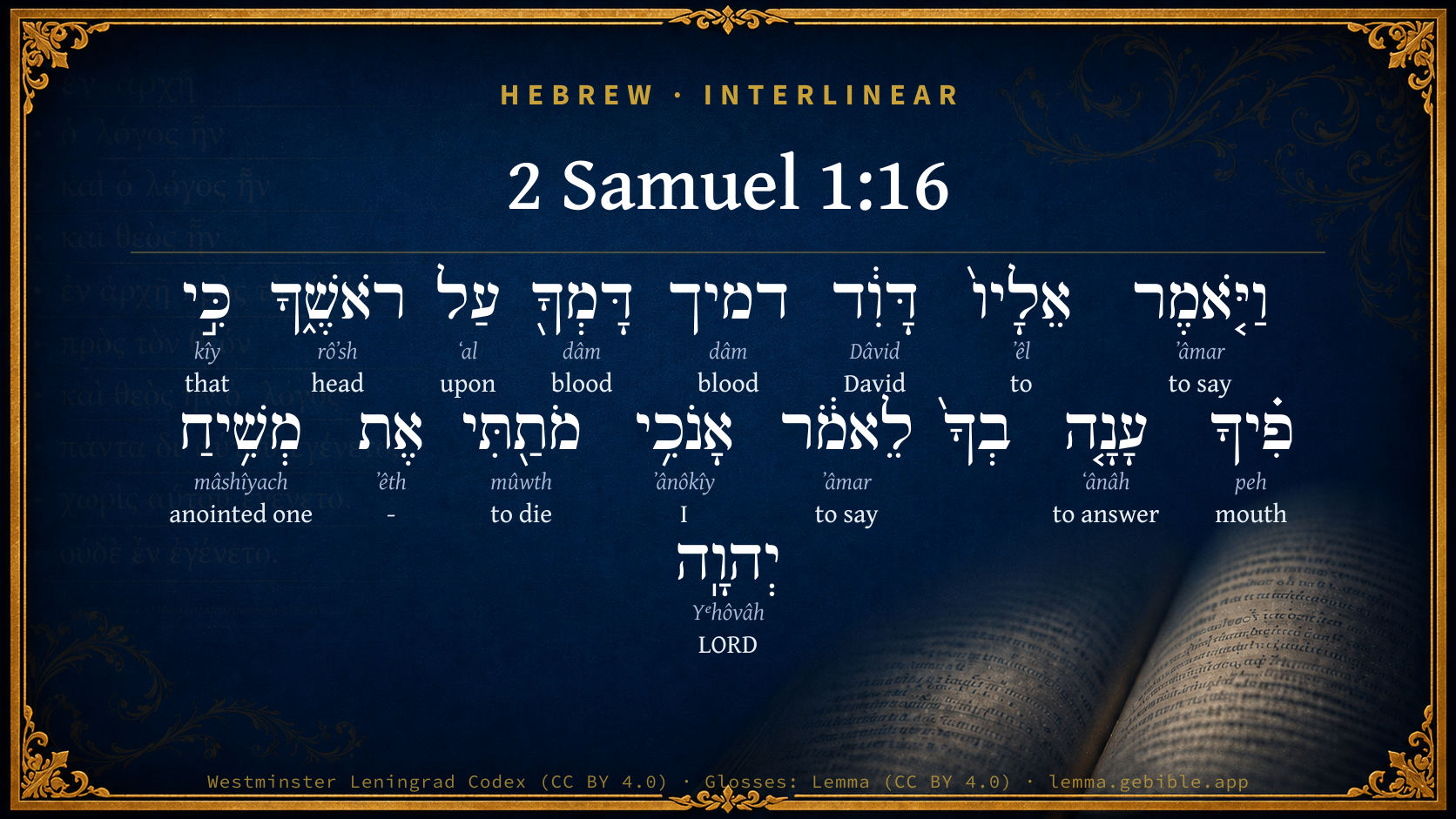
  1. וַיֹּ֤אמֶר ʼâmar H559 “and · to say” Conjunction + Verb, Qal, Sequential Imperfect, 3rd Person, Masculine, Singular
  2. אֵלָיו֙ ʼêl H413 “to · him” Preposition + Suffix, Personal, 3rd Person, Masculine, Singular
  3. דָּוִ֔ד Dâvid H1732 “David” Noun, Proper
  4. דמיך dâm H1818 “blood · your” Noun, Common, Masculine, Plural, Construct + Suffix, Personal, 2nd Person, Masculine, Singular
  5. דָּמְךָ֖ dâm H1818 “blood · your” Noun, Common, Masculine, Singular, Construct + Suffix, Personal, 2nd Person, Masculine, Singular
  6. עַל ʻal H5921 “upon” Preposition
  7. רֹאשֶׁ֑ךָ rôʼsh H7218 “head · your” Noun, Common, Masculine, Singular, Construct + Suffix, Personal, 2nd Person, Masculine, Singular
  8. כִּ֣י kîy H3588 “that” Conjunction
  9. פִ֗יךָ peh H6310 “mouth · your” Noun, Common, Masculine, Singular, Construct + Suffix, Personal, 2nd Person, Masculine, Singular
  10. עָנָ֤ה ʻânâh H6030 “to answer” Verb, Qal, Perfect, 3rd Person, Masculine, Singular
  11. לֵאמֹ֔ר ʼâmar H559 “to say” Preposition + Verb, Qal, Infinitive Construct
  12. אָנֹכִ֥י ʼânôkîy H595 “I” Pronoun, Personal, 1st Person, Common, Singular
  13. מֹתַ֖תִּי mûwth H4191 “to die” Verb, Polel, Perfect, 1st Person, Common, Singular
  14. אֶת ʼêth H853 “-” Particle, Direct Object
  15. יְהוָֽה Yᵉhôvâh H3068 “LORD” Noun, Proper

About this verse

These counts appear in no published source. They are computed here, from the morphology-tagged text and Lemma’s own curated glosses. What Lemma adds →

17
words
14
distinct lemmas
Historical
section

Shared distinctive vocabulary

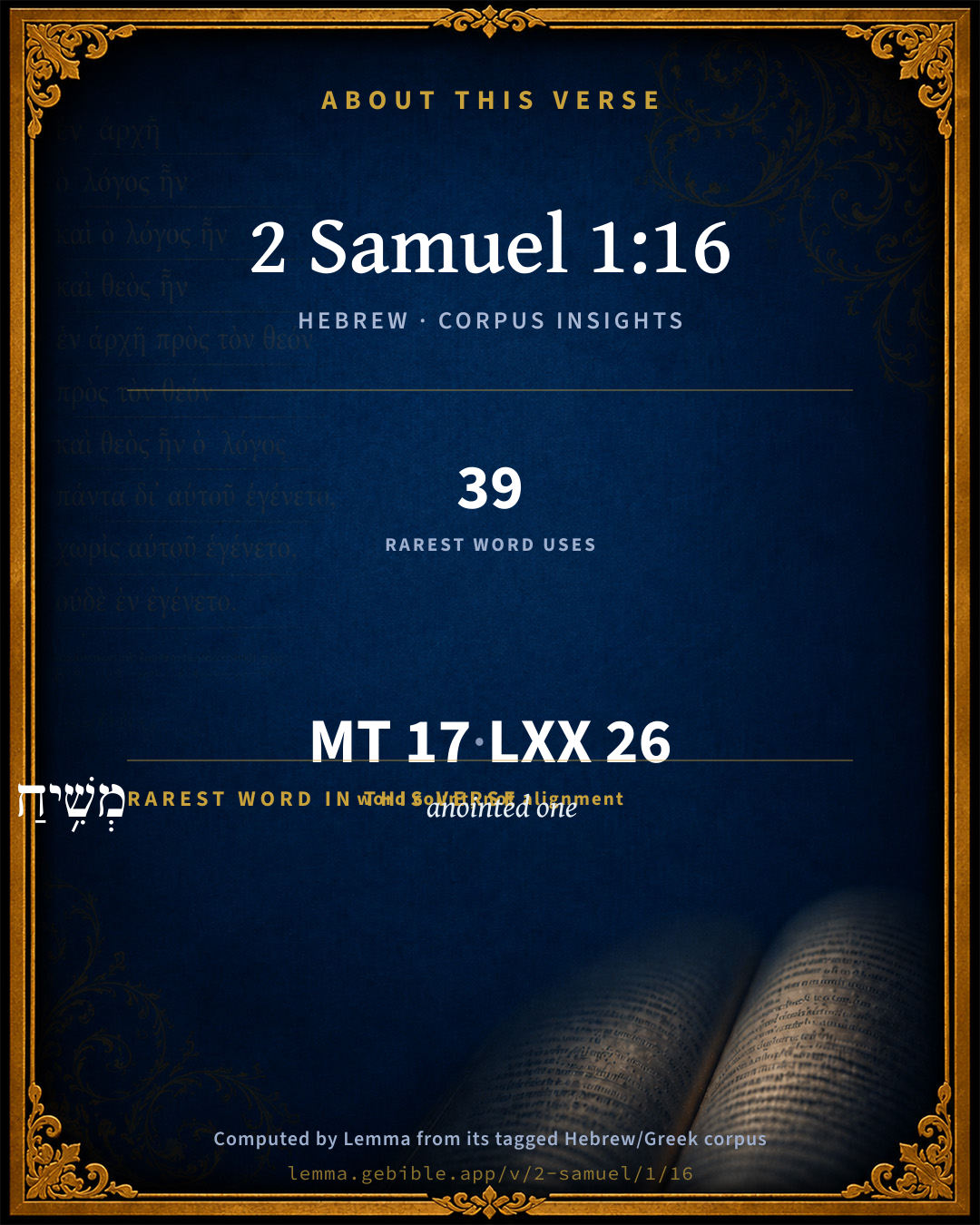
מְשִׁ֥יחַ anointed one H4899 occurs in 38 verses of the Hebrew Bible. Also found in:

Grammatical profile

  • 4 verbs
  • 7 nouns
  • 1 pronoun
  • 3 prepositions
  • 1 conjunction
  • 1 particle

Verb forms

  • וַיֹּ֤אמֶר Qal · Sequential Imperfect
  • עָנָ֤ה Qal · Perfect
  • לֵאמֹ֔ר Qal · Infinitive Construct
  • מֹתַ֖תִּי Polel · Perfect

Repetition

Words recur within this verse — often emphatic in Hebrew:

  • וַיֹּ֤אמֶר to say H559 ×2
  • דמיך blood H1818 ×2

Hebrew & Septuagint length

In English translation the verse runs 23 words from the Hebrew and 28 from the Septuagint (LXX English) — closely comparable.

A rough comparison of the two English renderings, which tokenize alike — not a word-level alignment.

Word counts can differ between the Hebrew and the Greek without any difference in meaning — e.g. the Hebrew direct-object marker אֵת has no separate Greek word, and Greek often adds the article ὁ.

In the original languages it is 17 Hebrew tokens and 26 Greek tokens — but the two are counted differently (Hebrew bundles its prefixes and suffixes into one token; the Greek is in lemma form), so that isn’t a like-for-like length.

Cross-references

21

Topical passages linked to 2 Samuel 1:16 in the Treasury of Scripture Knowledge — connected by theme and wording, ordered by reader-vote popularity; previews shown in the World English Bible.

  • Matthew 27:25 All the people answered, "May his blood be on us, and on our children!"
  • Luke 19:22 "He said to him, 'Out of your own mouth will I judge you, you wicked servant! You knew that I am an exacting man, taking up that which I didn't lay down, and reaping that which I didn't sow.
  • Leviticus 20:9 "'For everyone who curses his father or his mother shall surely be put to death: he has cursed his father or his mother; his blood shall be upon him.
  • 1 Samuel 26:9 David said to Abishai, Don't destroy him; for who can put forth his hand against Yahweh's anointed, and be guiltless?
  • Romans 3:19 Now we know that whatever things the law says, it speaks to those who are under the law, that every mouth may be closed, and all the world may be brought under the judgment of God.
  • Joshua 2:19 It shall be, that whoever shall go out of the doors of your house into the street, his blood shall be on his head, and we shall be guiltless: and whoever shall be with you in the house, his blood shall be on our head, if any hand be on him.
  • 2 Samuel 1:10 So I stood beside him, and killed him, because I was sure that he could not live after that he was fallen: and I took the crown that was on his head, and the bracelet that was on his arm, and have brought them here to my lord.
  • 1 Kings 2:37 For on the day you go out, and pass over the brook Kidron, know you for certain that you shall surely die: your blood shall be on your own head.
  • Proverbs 6:2 You are trapped by the words of your mouth. You are ensnared with the words of your mouth.
  • Genesis 9:5–6 I will surely require your blood of your lives. At the hand of every animal I will require it. At the hand of man, even at the hand of every man's brother, I will require the life of man.
  • Leviticus 20:11–13 The man who lies with his father's wife has uncovered his father's nakedness: both of them shall surely be put to death; their blood shall be upon them.
  • Leviticus 20:16 "'If a woman approaches any animal, and lies down with it, you shall kill the woman, and the animal: they shall surely be put to death; their blood shall be upon them.
  • Leviticus 20:27 "'A man or a woman that is a medium, or is a wizard, shall surely be put to death: they shall stone them with stones; their blood shall be upon them.'"
  • Deuteronomy 19:10 that innocent blood not be shed in the midst of your land, which Yahweh your God gives you for an inheritance, and so blood be on you.
  • Judges 9:24 that the violence done to the seventy sons of Jerubbaal might come, and that their blood might be laid on Abimelech their brother, who killed them, and on the men of Shechem, who strengthened his hands to kill his brothers.
  • 2 Samuel 3:28–29 Afterward, when David heard it, he said, I and my kingdom are guiltless before Yahweh forever of the blood of Abner the son of Ner:
  • 1 Kings 2:32–33 Yahweh will return his blood on his own head, because he fell on two men more righteous and better than he, and killed them with the sword, and my father David didn't know it, [to wit], Abner the son of Ner, captain of the host of Israel, and Amasa the son of Jether, captain of the host of Judah.
  • Job 15:6 Your own mouth condemns you, and not I; Yes, your own lips testify against you.
  • Ezekiel 18:13 has given forth on interest, and has taken increase; shall he then live? he shall not live: he has done all these abominations; he shall surely die; his blood shall be on him.
  • Ezekiel 33:5 He heard the sound of the trumpet, and didn't take warning; his blood shall be on him; whereas if he had taken warning, he would have delivered his soul.
  • Acts 20:26 Therefore I testify to you this day that I am clean from the blood of all men,

Cross-references courtesy of OpenBible.info (CC BY 4.0).

Hebrew and Greek witnesses Masoretic Hebrew ↔ Greek Septuagint

The same verse in the two great witnesses to the Old Testament, shown verse-for-verse.

These are two independent witnesses, not word-aligned to each other, and the Septuagint is shown in lemma (dictionary) form.

Hebrew 2 Samuel 1:16 Masoretic · Westminster Leningrad Codex

וַיֹּ֤אמֶר אֵלָיו֙ דָּוִ֔ד דמיך דָּמְךָ֖ עַל רֹאשֶׁ֑ךָ כִּ֣י פִ֗יךָ עָנָ֤ה בְךָ֙ לֵאמֹ֔ר אָנֹכִ֥י מֹתַ֖תִּי אֶת מְשִׁ֥יחַ יְהוָֽה

David said to him, Your blood be on your head; for your mouth has testified against you, saying, I have slain Yahweh's anointed.

World English Bible · Public Domain

Greek LXX 2 Samuel 1:16 Septuagint · lemma form

καί εἶπον δαυίδ πρός αὐτός τό αἷμα σύ ἐπί ὁ κεφαλή σύ ὅτι ὁ στόμα σύ ἀποκρίνω κατά σύ λέγω ὅτι ἐγώ θανατόω ὁ χριστός κύριος

And David said to him, Your blood be upon your own head; for your mouth has testified against you, saying, I have slain the anointed of the Lord.

LXX2012 (modern English Septuagint) · Public Domain

Hebrew: Westminster Leningrad Codex (CC BY 4.0). Greek: Septuagint (public domain); English from LXX2012 (modern English Septuagint) (Public Domain). How the Septuagint differs from the Hebrew →

Targum (Aramaic paraphrase)

1

The Targum is the ancient Jewish Aramaic paraphrase of the Hebrew Scriptures — an interpretive translation, not the Hebrew text itself. Onkelos (literal) and Pseudo-Jonathan (expansive) render the Torah, and Jonathan the Prophets. Coverage is partial: where no permissively-licensed English translation exists for a verse, only the Aramaic is shown. This is verse-level text, not a word-by-word alignment to the Hebrew.

  1. Targum Jonathan Prophets (Joshua–Malachi)
    וַאֲמַר לֵיהּ דָוִד חוֹבַת קְטוֹלָךְ תְּהֵי בְּרֵישָׁךְ אֲרֵי פּוּמָךְ אַסְהִיד בָּךְ לְמֵימַר אֲנָא קַטְלֵית יַת מְשִׁיחָא דַיָי:

    (no public-domain English translation for this verse)

    Targum Jonathan — Aramaic: “Mikraot Gedolot” (public domain). English: “Sefaria Community Translation” (CC0 1.0 (public-domain dedication)); “London "Chaldee Paraphrase," 1871” (public domain). Text via Sefaria.

Commentary

Notes on 2 Samuel 1:16 from classic Christian and Jewish commentators (each source and its license shown beneath its notes). The classic Christian expositions comment on the surrounding passage and are grouped to its opening verse, so a note may address several verses; the Jewish commentaries on the Tanakh (Rashi and others) are per-verse, so they appear only where the commentator wrote on this verse.

Lemma curates 59 commentaries, every one of them public domain or Creative Commons licensed, each selected and text-cleaned for this edition rather than reprinted as found. About our sources →

Trapp's Complete Commentary

John Trapp

2Sa 1:16 And David said unto him, Thy blood [be] upon thy head; for thy mouth hath testified against thee, saying, I have slain the LORD’S anointed.

Ver. 16. Thy blood be upon thy head.] For though Saul desired thee to despatch him, as thou hast said, and volenti non fit iniuria: yet because he was felo de se, as lawyers now speak, a suicide, it was not lawful for thee to help him out of the world, although the enemy had given him his death wound, and he therefore desired it of thee. Say that there was no wrong hereby done to Saul’s self, yet wrong was done to God the Lord of Saul’s life, as also to the commonwealth whereof Saul was the head; so saith Aquinas. {a}

Saying, I have slain the Lord’s anointed.] A just hand of God upon this Amalekite, for his lying.

{a} Tho. iii. p. 9, 47, ar. vi. ad. 3.

John Trapp, A Commentary or Exposition upon All the Books of the Old and New Testament (1647–1656) — public domain. Text from a community e-Sword module.

Geneva Bible (1599)

Geneva Bible translators

Thou art justly punished for thy fault.

Geneva Bible (1599) marginal notes — public domain. Text via Bolls.life.

Adam Clarke's Commentary

Verse 16. Thy blood be upon thy head] If he killed Saul, as he said he did, then he deserved death; at that time it was not known to the contrary, and this man was executed on his own confession.

Adam Clarke's Commentary on the Bible (1810–1826) — public domain. Text from a community e-Sword/MySword module.

The Cambridge Bible for Schools and Colleges

gen. ed. J. J. S. Perowne

16. for thy mouth, &c.] For the expression cp. Job_15:6; Luk_19:22. He had accused himself of a capital crime, for which he deserved to die. Righteous indignation, and not merely political prudence, dictated his immediate execution.

This account of Saul’s death is obviously inconsistent with that given in 1 Samuel 31. It is useless to attempt to harmonize them, but it is quite unnecessary to assume that we have two different traditions of the manner of Saul’s death. The Amalekite’s story was clearly a fabrication. In wandering over the field of battle he had found the corpse of Saul and stripped it of its ornaments. With these he hastened to David, and invented his fictitious story in the hope of securing an additional reward for having with his own hand rid David of his bitterest enemy and removed the obstacle which stood between him and the throne. But he had formed a wrong estimate of the man he had to deal with. Whether David believed him or not, he summarily inflicted the penalty which the Amalekite deserved according to his own avowal, and proved to all Israel his abhorrence of such an impious act.

David’s chivalrous loyalty and generous unselfishness in mourning for the death of his unrelenting persecutor, whose removal opened the way for him to the throne, are striking evidences of the nobility of his character.

The Cambridge Bible for Schools and Colleges (gen. ed. J. J. S. Perowne; Cambridge University Press, 1878–1918) — public domain. Text from a community e-Sword module.

John Gill's Exposition

And David said unto him, thy blood be upon thy head,.... The blood that he had shed, let him suffer for it; for as he had shed blood, his blood ought to be shed, according to the law of God; and for proof of this, that he had so done, he appeals to his own confession:

for thy mouth hath testified against thee, saying, I have slain the Lord's anointed; and what might serve to confirm the truth of what he had said were the crown and bracelet which he brought along with him; and besides he was an Amalekite, of a nation that was devoted to destruction; and, as Abarbinel thinks, David might suppose that he killed Saul to take vengeance on him for what he had done to their nation; but, after all, both he and Maimonides (n) allow the punishment of him was not strictly according to law, but was a temporary decree, an extraordinary case, and an act of royal authority; for in common cases a man was not to be condemned and put to death upon his own confession, since it is possible he may not be in his right mind (o); but David chose to exercise severity in this case, partly to show his respect to Saul, and to ingratiate himself into the favour of his friends, and partly to deter men from attempting to assassinate princes, who himself was now about to ascend the throne.

(n) Hilchot Sanhedrin, c. 18. sect. 6. (o) T. Bab. Yehamot, fol. 25. 2. Maimon. ibid.

John Gill's Exposition of the Whole Bible (1746–1763) — public domain (CC PDM 1.0). Text via the HelloAO Bible API.

Albert Barnes' Notes on the Bible

David might well think his sentence just though severe, for he had more than once expressed the deliberate opinion that none could lift up his hand against the Lord’s anointed, and be guiltless (see 1Sa 24:6; 1Sa 26:9, 1Sa 26:11, 1Sa 26:16).

Albert Barnes' Notes on the Bible (1834–1885) — public domain. Text from a community e-Sword/MySword module.

Haydock's Catholic Bible Commentary

Head. None but thyself can be answerable for thy death. See Matthew xxvii. 25. David was already supreme magistrate, and he wished that all should be convinced that he rejoiced not at the death of the king, and that none might imitate the example of this wretch. (Calmet) --- Thus Vitellius punished the murderers of Galba, "not out of respect to Galba; but, according to the custom of princes, as a protection for the present, and a threat of vengeance for the future," in case any should dare to treat him in like manner. (Tacitus i.) Tradito principibus more, munimentum in præsens, in posterum ultionem.

George Leo Haydock (1774–1849), Haydock's Catholic Family Bible and Commentary, 1859 edition — public domain. Excludes Psalms (Douay-Rheims chapter numbering differs from Protestant) and Deuterocanonical books (Catholic canon only).

Matthew Poole's English Annotations

Thy blood be upon thy head; the guilt of thy bloodshed or death lies upon thyself, not upon me, for thy free and voluntary confession is sufficient proof of thy guilt in killing the king.

Matthew Poole's English Annotations on the Holy Bible (1683–1685) — public domain. Text from a community e-Sword/MySword module.

Whedon's Commentary on the Bible

Daniel D. Whedon

16. Thy blood be upon thy head — Thy infamous deed of slaying the king can be atoned for only by the immediate shedding of thine own blood.

Thy mouth hath testified against thee — David regarded an offence against the person of the king as most execrable sacrilege, and therefore, to his mind, a man who gloried in slaying the Lord’s anointed deserved death.

Daniel D. Whedon (gen. ed.), Commentary on the Old and New Testaments (1874–1909) — public domain. Text from a community e-Sword module.

Rashi

Rabbi Shlomo Yitzchaki (Rashi)

Your blood is on your own head. The responsibility for your death rests on your own head. There is no one to punish for your death but yourself.

Rashi on the Tanakh — English translations: “The Judaica Press complete Tanach with Rashi, translated by A. J. Rosenberg” (CC BY 4.0); “Pentateuch with Rashi's commentary by M. Rosenbaum and A.M. Silbermann, 1929-1934” (public domain); “The Metsudah Tanach series, Lakewood, N.J” (CC BY 4.0); and “The Book of Joshua, Metsudah Publications, 1997” (CC BY 4.0). Text via Sefaria.

Lesson kit

Teaching starters — assembled from the data on this page, not authored interpretation. Every prompt links to the verse data it draws on. Edit before teaching.

2 Samuel, in the Historical, opens this verse with 17 words (14 distinct Hebrew lemmas). Its most distinctive word is mâshîyach (“anointed one”). A historical commentator’s framing appears above. Read the whole chapter for the surrounding context.

Discussion questions

  1. The word mâshîyach carries the sense “anointed one.” How does it shape the verse?
  2. How does Leviticus 4:3, which shares the word «anointed one», read alongside this verse?
  3. What does the repetition of “to say” (2× in this one verse) do in this verse?
  4. These translations render this verse differently; the difference is in the English rendering, not the original. What questions does that raise?
  5. «וַיֹּ֤אמֶר» is a Qal Sequential Imperfect verb. How does that grammatical form shape the action described?
  6. Compare how Trapp's Complete Commentary and Geneva Bible (1599) read this verse. Where do they agree or differ?

Things to notice

Reading settings

Reading text

Shown beneath each verse's original-language words.

Old Testament
Old Testament edition

Read the OT as the Masoretic Hebrew (MT) or the Greek Septuagint (LXX).

English shown for the Greek Septuagint (in the Hebrew ↔ Greek comparison).

Comparing translations? Open the Compare panel on any verse page to stack up to four side by side.