
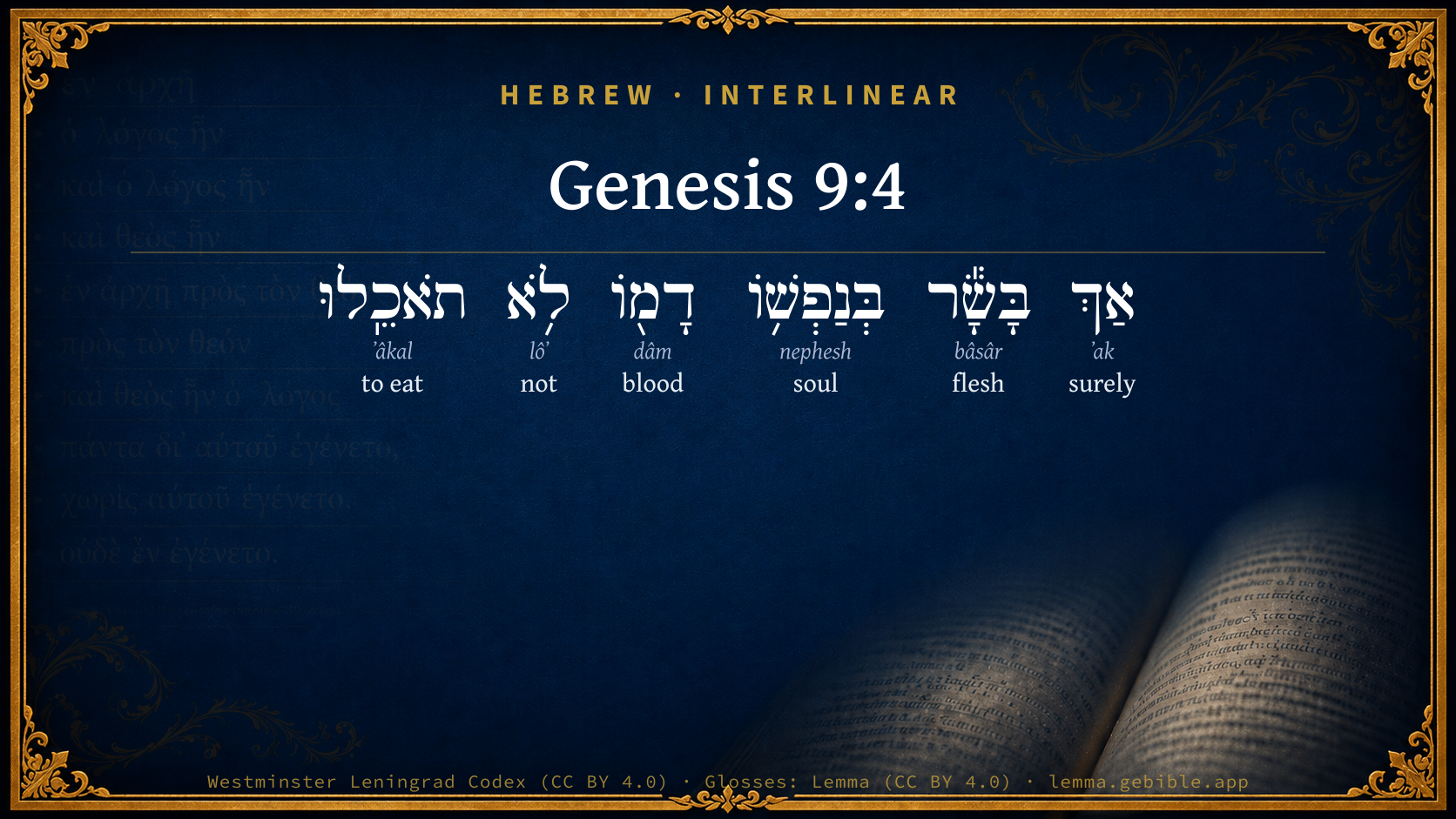
Genesis 9:4

Hebrew (Westminster Leningrad Codex) Genesis 9:4 appears in the Hebrew Old Testament. The text above is from the Westminster Leningrad Codex. Each word links to its Strong’s number, a concise gloss, and parsing drawn from the Open Scriptures Hebrew Bible morphology. Click any word for its full Brown-Driver-Briggs (BDB) entry.
Download image
Cite this verse

Genesis 9:4 (World English Bible). Public Domain. Lemma interlinear Bible study tool, https://lemma.gebible.app/v/genesis/9/4.

Show BibTeX & RIS
BibTeX
RIS
English Translation
But flesh with the life of it, the blood of it, you shall not eat.
World English Bible · Public Domain
Download a study sheet

One document with this verse’s original text, its word-by-word gloss line, the meaning frame, cross-references with their text, attributed commentary, and full source and license credits — printable, and it pastes into notes with its structure intact.

This verse Autodidact and up

Study sheet (.html) Plain text (.txt)

A passage Seminary Student

Up to 50 verses in one chapter. A passage sheet keeps up to 6 commentary sources and 12 cross-references per verse, in the order this page ranks them, and says so on the sheet whenever that leaves anything out. Ask for a single verse and you get the Autodidact verse sheet above.

Everything on this page stays free to read, with no account — the sheet is a download of what is already on screen, not access to it.

Want to remove ads? Support Godless Engineer
Compare translations 3

The same verse in 3 English versions, stacked beneath the original-language interlinear above. Click any original word for its lexicon entry.

Each is an independent rendering of the whole verse — the interlinear is not word-aligned to these translations.

Highlighted words mark where these versions differ — a whole-verse word diff, not a word-by-word alignment.

  • World English Bible Public Domain
    But flesh with the life of it, the blood of it, you shall not eat.
  • King James Version Public Domain
    But flesh with the life thereof, which is the blood thereof, shall ye not eat.
  • unfoldingWord Literal Text CC BY-SA 4.0
    But you must not eat flesh with its life, its blood.

unfoldingWord Literal Text — © unfoldingWord, licensed CC BY-SA 4.0. Word-aligned USFM3 via Door43 (git.door43.org/unfoldingWord/en_ult).

Versions to compare (up to 4)

3 of 4 selected

Show all 18 translations

Every available English version of this verse, each an independent rendering of the whole verse.

  • World English Bible Public Domain
    But flesh with the life of it, the blood of it, you shall not eat.
  • Berean Standard Bible Public Domain
    But you must not eat meat with its lifeblood still in it.
  • Majority Standard Bible Public Domain
    But you must not eat meat with its lifeblood still in it.
  • King James Version Public Domain
    But flesh with the life thereof, which is the blood thereof, shall ye not eat.
  • American Standard Version (1901) Public Domain
    But flesh with the life thereof, `which is' the blood thereof, shall ye not eat.
  • Revised Version (1885) Public Domain
    But flesh with the life thereof, which is the blood thereof, shall ye not eat.
  • Geneva Bible (1599) Public Domain
    But flesh with the life thereof, I meane, with the blood thereof, shall ye not eate.
  • Douay-Rheims (1899) Public Domain
    Saving that flesh with blood you shall not eat.
  • Young's Literal Translation Public Domain
    only flesh in its life -- its blood -- ye do not eat.
  • Literal Standard Version CC BY-SA 4.0
    only flesh in its life—its blood—you do not eat.
  • Unlocked Literal Bible CC BY-SA 4.0
    But you must not eat meat with its life—that is its blood—in it.
  • unfoldingWord Literal Text CC BY-SA 4.0
    But you must not eat flesh with its life, its blood.
  • Darby Bible Public Domain
    Only, the flesh with its life, its blood, ye shall not eat.
  • World Messianic Bible Public Domain
    But flesh with its life, that is, its blood, you shall not eat.
  • Webster's Bible Public Domain
    But flesh with the life of it, which is its blood, shall ye not eat.
  • Free Bible Version CC BY-SA 4.0
    But do not eat meat with the lifeblood still in it.
  • Bible in Basic English Public Domain
    But flesh with the life-blood in it you may not take for food.
  • JPS Tanakh (1917) Public Domain
    Only flesh with the life thereof, which is the blood thereof, shall ye not eat.

Literal Standard Version (2020), Covenant Press — licensed CC BY-SA 4.0. Text via the HelloAO Bible API (eBible.org). Unlocked Literal Bible (unfoldingWord) — licensed CC BY-SA 4.0. Text via the HelloAO Bible API (eBible.org). unfoldingWord Literal Text — © unfoldingWord, licensed CC BY-SA 4.0. Word-aligned USFM3 via Door43 (git.door43.org/unfoldingWord/en_ult). Free Bible Version, Dr. Jonathan Gallagher — licensed CC BY-SA 4.0. Text via the HelloAO Bible API (eBible.org).

Word by word

More ways to search: Search by grammar → Find every occurrence → Compare this word →

Practice this passage: Drill this verse → Learn its vocabulary →

About this verse

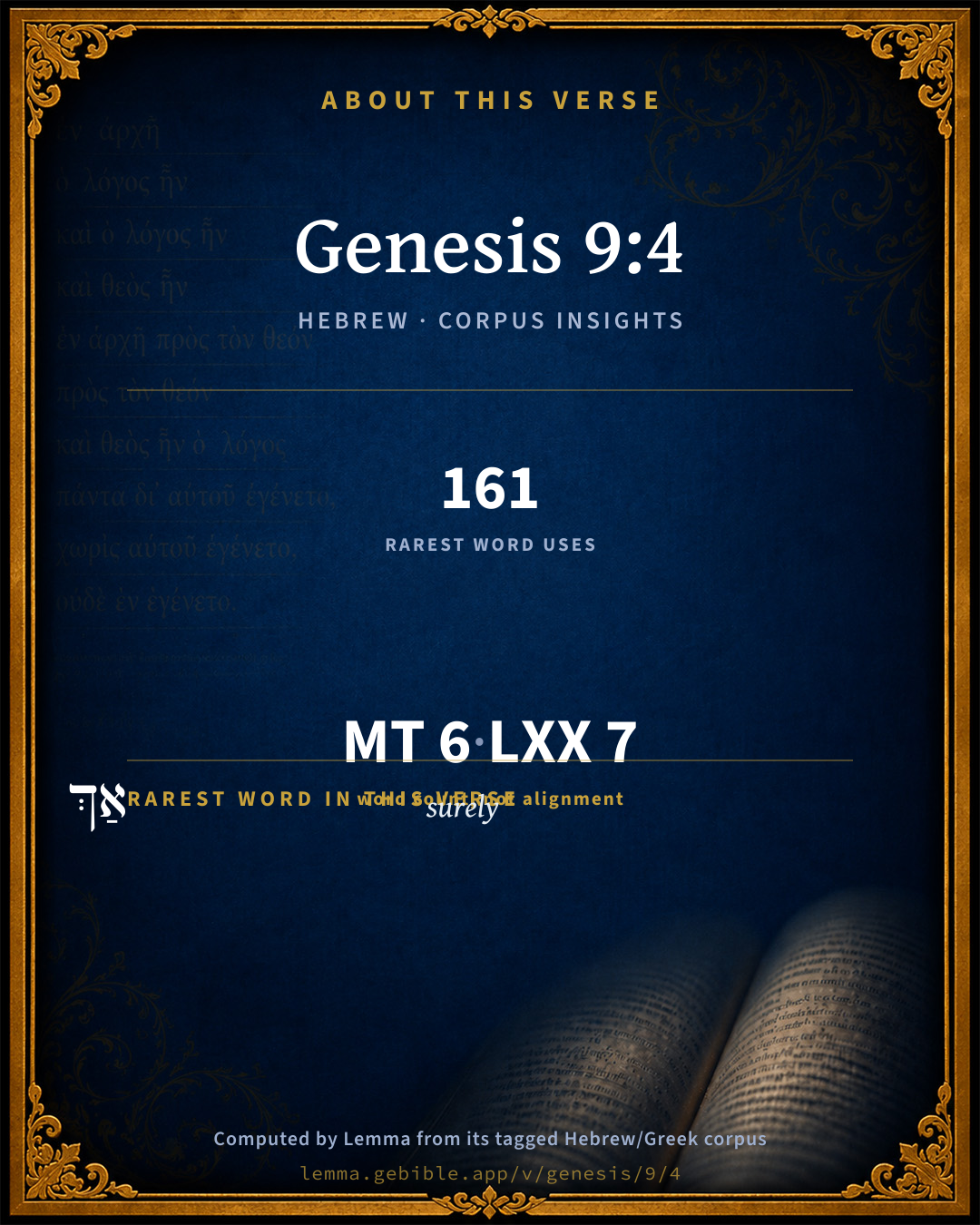
These counts appear in no published source. They are computed here, from the morphology-tagged text and Lemma’s own curated glosses. What Lemma adds →

6
words
6
distinct lemmas
Pentateuch
section

Grammatical profile

  • 1 verb
  • 3 nouns
  • 2 particles

Verb forms

  • תֹאכֵֽלוּ Qal · Imperfect

Hebrew & Septuagint length

In English translation the verse runs 15 words from the Hebrew and 10 from the Septuagint (LXX English) — the Septuagint runs noticeably shorter here. See the side-by-side →

A rough comparison of the two English renderings, which tokenize alike — not a word-level alignment.

Word counts can differ between the Hebrew and the Greek without any difference in meaning — e.g. the Hebrew direct-object marker אֵת has no separate Greek word, and Greek often adds the article ὁ.

In the original languages it is 6 Hebrew tokens and 7 Greek tokens — but the two are counted differently (Hebrew bundles its prefixes and suffixes into one token; the Greek is in lemma form), so that isn’t a like-for-like length.

Cross-references

11

Topical passages linked to Genesis 9:4 in the Treasury of Scripture Knowledge — connected by theme and wording, ordered by reader-vote popularity; previews shown in the World English Bible.

  • Deuteronomy 12:23 Only be sure that you don't eat the blood: for the blood is the life; and you shall not eat the life with the flesh.
  • Deuteronomy 12:16 Only you shall not eat the blood; you shall pour it out on the earth as water.
  • Deuteronomy 15:23 Only you shall not eat its blood; you shall pour it out on the ground as water.
  • Acts 15:20 but that we write to them that they abstain from the pollution of idols, from sexual immorality, from what is strangled, and from blood.
  • Leviticus 7:26 You shall not eat any blood, whether it is of bird or of animal, in any of your dwellings.
  • Leviticus 17:10–14 "'Any man of the house of Israel, or of the strangers who live as foreigners among them, who eats any kind of blood, I will set my face against that soul who eats blood, and will cut him off from among his people.
  • Acts 15:29 that you abstain from things sacrificed to idols, from blood, from things strangled, and from sexual immorality, from which if you keep yourselves, it will be well with you. Farewell."
  • Leviticus 3:17 "'It shall be a perpetual statute throughout your generations in all your dwellings, that you shall eat neither fat nor blood.'"
  • Leviticus 19:26 "'You shall not eat any meat with the blood still in it; neither shall you use enchantments, nor practice sorcery.
  • 1 Samuel 14:33–34 Then they told Saul, saying, Behold, the people sin against Yahweh, in that they eat with the blood. He said, you have dealt treacherously: roll a great stone to me this day.
  • 1 Timothy 4:4 For every creature of God is good, and nothing is to be rejected, if it is received with thanksgiving.

Cross-references courtesy of OpenBible.info (CC BY 4.0).

Hebrew and Greek witnesses Masoretic Hebrew ↔ Greek Septuagint

The same verse in the two great witnesses to the Old Testament, shown verse-for-verse.

Here the Septuagint runs noticeably shorter than the Hebrew — LXX2012 (modern English Septuagint) 10 words vs World English Bible 15. A rough length comparison of the two English translations, not a word-level alignment — read both below.

These are two independent witnesses, not word-aligned to each other, and the Septuagint is shown in lemma (dictionary) form.

Hebrew Genesis 9:4 Masoretic · Westminster Leningrad Codex

אַךְ בָּשָׂ֕ר בְּנַפְשׁ֥וֹ דָמ֖וֹ לֹ֥א תֹאכֵֽלוּ

But flesh with the life of it, the blood of it, you shall not eat.

World English Bible · Public Domain

Greek LXX Genesis 9:4 Septuagint · lemma form

πλήν κρέας ἐν αἷμα ψυχή οὐ ἐσθίω

But flesh with blood of life you⌃ shall not eat.

LXX2012 (modern English Septuagint) · Public Domain

Hebrew: Westminster Leningrad Codex (CC BY 4.0). Greek: Septuagint (public domain); English from LXX2012 (modern English Septuagint) (Public Domain). How the Septuagint differs from the Hebrew →

Targum (Aramaic paraphrase)

2

The Targum is the ancient Jewish Aramaic paraphrase of the Hebrew Scriptures — an interpretive translation, not the Hebrew text itself. Onkelos (literal) and Pseudo-Jonathan (expansive) render the Torah, and Jonathan the Prophets. Coverage is partial: where no permissively-licensed English translation exists for a verse, only the Aramaic is shown. This is verse-level text, not a word-by-word alignment to the Hebrew.

  1. Targum Onkelos Torah (Genesis–Deuteronomy)
    בְּרַם בִּשְׂרָא בְּנַפְשֵׁהּ דְּמֵהּ לָא תֵכְלוּן

    But the flesh with its life‑blood you shall not eat.

    Targum Onkelos — Aramaic: “Onkelos Genesis” (public domain); “Onkelos Exodus” (public domain); “Onkelos Leviticus” (public domain); “Onkelos Numbers” (public domain); “Onkelos Deuteronomy” (public domain). English: “Sefaria Community Translation” (CC0 1.0 (public-domain dedication)); “J.W. Etheridge. The Targums of Onkelos and Jonathan Ben Uzziel on the Pentateuch. London: Longmans, Green, 1862” (public domain). Text via Sefaria.

  2. Targum Pseudo-Jonathan Torah (Genesis–Deuteronomy)
    בְּרַם בִּשְרָא דְתָלִישׁ מִן חַיוּתָא חַיָא בִּזְמַן דִבְנַפְשֵׁיהּ בֵּיהּ אוֹ דְתָלִישׁ מִן חַיוּתָא נְכִיסְתָּא וְעַד דְלָא נַפְקָא כּוֹלָא נִשְׁמָתָא לָא תֵיכְלוּן

    But flesh which is torn of the living beast, what time the life is in it, or that torn from a slaughtered animal before all the breath has gone forth, you shall not eat.

    Targum Pseudo-Jonathan — Aramaic: “Targum Jonathan on Genesis” (public domain); “Targum Jonathan on Exodus” (public domain); “Targum Jonathan on Leviticus” (public domain); “Targum Jonathan on Numbers” (public domain); “Targum Jonathan on Deuteronomy” (public domain). English: “The Targum of Jonathan ben Uzziel, trans. J. W. Etheridge, London, 1862” (public domain). Text via Sefaria.

Commentary

Notes on Genesis 9:4 from classic Christian and Jewish commentators (each source and its license shown beneath its notes). The classic Christian expositions comment on the surrounding passage and are grouped to its opening verse, so a note may address several verses; the Jewish commentaries on the Tanakh (Rashi and others) are per-verse, so they appear only where the commentator wrote on this verse.

Lemma curates 59 commentaries, every one of them public domain or Creative Commons licensed, each selected and text-cleaned for this edition rather than reprinted as found. About our sources →

Trapp's Complete Commentary

John Trapp

Gen 9:4 But flesh with the life thereof, [which is] the blood thereof, shall ye not eat.

Ver. 4. But flesh with the life thereof, the blood.] Blood was forbidden: First, as not so wholesome food: Secondly, lest by being fleshed in blood, they should become bloody-minded: Thirdly, blood, the organ of life, is holy to God the author of life (who was also to be pacified by the blood of his Son), and therefore they should not pollute or profane it, by devouring thereof.

John Trapp, A Commentary or Exposition upon All the Books of the Old and New Testament (1647–1656) — public domain. Text from a community e-Sword module.

Joseph Benson's Commentary

Gen 9:4. But flesh with the blood thereof shall ye not eat — One meaning of this may be, Ye shall not cut off, tear away, or take any member or part of any creature for your food, while it is yet alive; but ye shall first spill its blood, and thereby put it to death in the way most easy to it. This is the sense which the Jews give the words, and, thus understood, they contain a prohibition of all cruelty toward those animals which are killed for food. And the prohibition, in this point of view, was not unnecessary, the practice here condemned being not unusual in ancient nor even in modern times, in many parts of the East. The principal meaning, however, of the passage, is to prohibit the eating of blood in any way, the eating of which seems to have been forbidden especially for two reasons: 1st, To be a token to mankind in all ages, that they would have had no right to take the life of any animal for food, if God had not given them that right, and who, therefore, to remind them of it, and impress it on their minds in all generations, denied them the use of blood, and required it to be spilled upon the ground: 2d: In honour of the blood of atonement, Lev 17:11-12. The life of the sacrifice was accepted for the life of the sinner, and blood made atonement for the soul, and therefore must not be looked upon as a common thing, but must be poured out before the Lord, 2Sa 23:16. And it ought to be observed, that this prohibition of eating blood, given to Noah and all his posterity, and repeated to the Israelites, in a most solemn manner, under the Mosaic dispensation, has never been revoked, but, on the contrary, has been confirmed under the New Testament, Acts 15.; and thereby made of perpetual obligation.

Joseph Benson's Commentary on the Old and New Testaments (1811–1818) — public domain. Text from a community e-Sword module.

Tyndale Open Study Notes

Tyndale Open Resources

9:4 A key restriction is imposed. Since blood was identified with life, it had to be drained from a slain animal before its meat could be eaten (see Lev 3:17; 7:26-27; 17:10-14; Deut 12:16, 23). The law of Moses prohibited eating animals that died naturally, since their blood had not been drained (Deut 14:21). God provided animal blood to atone for human sin (Lev 17:11; Heb 9:22).

Tyndale Open Study Notes — © Tyndale Open Resources, licensed CC BY-SA 4.0. Text via the HelloAO Bible API.

Geneva Bible (1599)

Geneva Bible translators

That is, living creatures, and the flesh of beasts that are strangled: and hereby all cruelty is forbidden.

Geneva Bible (1599) marginal notes — public domain. Text via Bolls.life.

Jamieson, Fausset & Brown

Robert Jamieson, A. R. Fausset & David Brown

But flesh . . . the blood . . . shall ye not eat--The sole intention of this prohibition was to prevent these excesses of cannibal ferocity in eating flesh of living animals, to which men in the earlier ages of the world were liable.

Jamieson, Fausset & Brown — Commentary Critical and Explanatory on the Whole Bible (1871) — public domain (CC PDM 1.0). Text via the HelloAO Bible API.

Adam Clarke's Commentary

Verse 4. But flesh with the life thereof, which is the blood] Though animal food was granted, yet the blood was most solemnly forbidden, because it was the life of the beast, and this life was to be offered to God as an atonement for sin. Hence the blood was ever held sacred, because it was the grand instrument of expiation, and because it was typical of that blood by which we enter into the holiest.

1. Before the deluge it was not eaten, because animal food was not in use.

2. After the deluge it was prohibited, as we find above; and, being one of the seven Noahic precepts, it was not eaten previously to the publication of the Mosaic law.

3. At the giving of the law, and at several times during the ministry of Moses, the prohibition was most solemnly, and with awful penalties renewed. Hence we may rest assured that no blood was eaten previously to the Christian era, nor indeed ever since by the Jewish people.

4. That the prohibition has been renewed under the Christian dispensation, can admit of little doubt by any man who dispassionately reads Ac 15:20; Ac 15:29; Ac 21:25, where even the Gentile converts are charged to abstain from it on the authority, not only of the apostles, but of the Holy Ghost, who gave them there and then especial direction concerning this point; see Ac 15:28; not for fear of stumbling the converted Jews, the gloss of theologians, but because it was one των επαναγκες τουτων, of those necessary points, from the burden (βαρος) of obedience to which they could not be excused.

5. This command is still scrupulously obeyed by the oriental Christians, and by the whole Greek Church; and why? because the reasons still subsist. No blood was eaten under the law, because it pointed out the blood that was to be shed for the sin of the world; and under the Gospel it should not be eaten, because it should ever be considered as representing the blood which has been shed for the remission of sins. If the eaters of blood in general knew that it affords a very crude, almost indigestible, and unwholesome ailment, they certainly would not on these physical reasons, leaving moral considerations out of the question, be so much attached to the consumption of that from which they could expect no wholesome nutriment, and which, to render it even pleasing to the palate, requires all the skill of the cook. See Le 17:10.

Adam Clarke's Commentary on the Bible (1810–1826) — public domain. Text from a community e-Sword/MySword module.

John Calvin's Commentaries

4. But flesh with the life thereof, which is the blood thereof Some thus explain this passages ‘Ye may not eat a member cut off from a living animal,’ which is too trifling. However, since there is no copulative conjunction between the two words, blood and life, I do not doubt that Moses, speaking of the life, added the word blood exegetically, as if he would say, that flesh is in some sense devoured with its life, when it is eaten imbued with its own blood. Wherefore, the life and the blood are not put for different things, but for the same; not because blood is in itself the life, but inasmuch as the vital spirits chiefly reside in the blood, it is, as far as our feeling is concerned, a token which represents life. And this is expressly declared, in order that men may have the greater horror of eating blood For if it be a savage and barbarous thing to devour lives, or to swallow down living flesh, men betray their brutality by eating blood. Moreover, the tendency of this prohibition is by no means obscure, namely, that God intends to accustom men to gentleness, by abstinence from the blood of animals; but, if they should become unrestrained, and daring in eating wild animals they would at length not be sparing of even human blood. Yet we must remember, that this restriction was part of the old law. Wherefore, what Tertullian relates, that in his time it was unlawful among Christians to taste the blood of cattle, savours of superstition. For the apostles, in commanding the Gentiles to observe this rite, for a short time, did not intend to inject a scruple into their consciences, but only to prevent the liberty which was otherwise sacred, from proving an occasion of offense to the ignorant and the weak.

John Calvin's Commentaries (1540-1563) — public domain. Text from the Calvin Translation Society English edition (1840s-50s) via the Christian Classics Ethereal Library (ccel.org). Calvin's coverage is partial (roughly two-thirds of the Bible); uncommented books and verses are honest gaps, never fabricated. The 19th-century editor's footnotes and remarks are omitted so the notes are faithfully Calvin's own voice.

Ellicott's Commentary for English Readers

(4) But flesh. . . . —The words are remarkable. “Only flesh in its soul, its blood, ye shall not eat.” The Authorised Version is probably right in taking blood as in apposition to soul, which word means here the principle of animation, or that which causes an animal to live. This is God’s especial gift; for He alone can bestow upon that aggregation of solids and fluids which we call a body the secret principle of life. Of this hidden life the blood is the representative, and while man is permitted to have the body for his food, as being the mere vessel which contains this life, the gift itself must go back to God, and the blood as its symbol be treated with reverence.

A Bible Commentary for English Readers, edited by Charles John Ellicott (1878–1897) — public domain. Text from a community e-Sword module.

The Cambridge Bible for Schools and Colleges

gen. ed. J. J. S. Perowne

4. But flesh with the life thereof, which is the blood thereof] Man’s privilege is attended, first, with a strict ritual prohibition. The words might be more literally rendered thus, “nevertheless flesh with its vital principle (or ‘soul’), which is its blood, ye shall not eat.” The Israelites regarded the blood as in a mysterious way the vehicle of the soul, or vital principle (nephesh), of the flesh (Lev_17:11). The blood was always offered in sacrifice to God as the most sacred part of the victim, the symbol of its life. The prohibition to eat flesh, with the blood in it, formed one of the strictest rules of Israelite and Jewish life. As the institution of the Sabbath was associated with the age of the Creation, so the prohibition of blood-eating was associated with the age of Noah. In other words, its primitive character was shewn by its traditional origin, being regarded as antecedent even to the Call of Abraham. The infringement of the regulation betokens savage impiety (1Sa_14:32-34), or contamination with idolatrous abominations (Eze_33:25). In Act_15:29 to abstain from blood and from things strangled was absolutely necessary for the purpose of holding together the Jewish and Gentile members of the new Christian community1[13]. In our own time the Jews observe this regulation with strictness, and the Jewish butcher follows special rules in order that the meat may be entirely freed from blood (“Kosher Meat”).

[13] But καὶ πνικτῶν is possibly here a gloss; and, if so, the gloss is a tribute to the usage. See Kirsopp Lake, The Earlier Epp. of St Paul.

The passages in the Law bearing upon this important regulation are Lev_17:10-14, Deu_12:16; Deu_12:23.

The Cambridge Bible for Schools and Colleges (gen. ed. J. J. S. Perowne; Cambridge University Press, 1878–1918) — public domain. Text from a community e-Sword module.

John Gill's Exposition

But flesh with the life thereof, which is the blood thereof, shall you not eat. This is the only exception to the eating of flesh; it was not to be eaten with the blood in it, which is said to be its life; not that the blood is of itself the life, but because it is a means of life, and that being exhausted, the creature must die, and because the animal and vital spirits appear to us most vigorous in it; yea, it is the ailment and support of them, and which furnishes out the greatest quantity of them: or rather it may be rendered, "the flesh with its life in its blood" (m); while there is life in the blood, or while the creature is living; the meaning is, that a creature designed for food should be properly killed, and its blood let out; that it should not be devoured alive, as by a beast of prey; that raw flesh should not be eaten, as since by cannibals, and might be by riotous flesh eaters, before the flood; for notwithstanding this law, as flesh without the blood might be eaten, so blood properly let out, and dressed, or mixed with other things, might be eaten, for aught this says to the contrary; but was not to be eaten with the flesh, though it might separately, which was afterwards forbid by another law. The design of this was to restrain cruelty in men, and particularly to prevent the shedding of human blood, which men might be led into, were they suffered to tear living creatures in pieces, and feed upon their raw flesh, and the blood in it. The Targum of Jonathan is,"but the flesh which is torn from a living beast at the time that its life is in it, or which is torn from a beast while it is slain, before all its breath is gone out, ye shall not eat.''And the Jewish writers generally interpret this of the flesh of a creature taken from it alive, which, they say, is the seventh precept given to the sons of Noah, over and above the six which the sons of Adam were bound to observe, and they are these;1. Idolatry is forbidden. 2. Blasphemy is forbidden. 3. The shedding of blood, or murder is forbidden. 4. Uncleanness, or unjust carnal copulations is forbidden. 5. Rapine or robbery is forbidden. 6. The administration of justice to malefactors is required. 7. The eating of any member or flesh of a creature while alive (n) is forbidden.Such of the Heathens who conformed to those precepts were admitted to dwell among the Israelites, and were called proselytes of the gate.

(m) "carnem cum anima, "seu" vita ejus, sanguine ejus", Cartwright. (n) Maimon. Hilchot Melachim, c. 9. sect. 1.

John Gill's Exposition of the Whole Bible (1746–1763) — public domain (CC PDM 1.0). Text via the HelloAO Bible API.

Haydock's Catholic Bible Commentary

With blood. This was a matter of indifference in itself, like the forbidden fruit. But God gave the prohibition, to keep people at a greater distance from imbruing their hands in the blood of others, which nevertheless we know some have drunk! He would also assert his dominion over all things; the blood or life of animals being reserved to be offered in sacrifice to him, instead of the life of man, Leviticus xvii. 11. Blood of brutes is gross and unwholesome. (Menochius) --- The apostles required this law to be observed by the first Christians, that the Jews might not be disgusted: but, after a competent time had been allowed them, the Church thought proper to alter this discipline. (St. Augustine, contra Faust. xxxii. 13.)

George Leo Haydock (1774–1849), Haydock's Catholic Family Bible and Commentary, 1859 edition — public domain. Excludes Psalms (Douay-Rheims chapter numbering differs from Protestant) and Deuterocanonical books (Catholic canon only).

Matthew Poole's English Annotations

With the life thereof, i.e. whilst it lives, or taken from the creature before it be quite dead; which was an ancient practice, and an effect either of luxury or cruelty.

Which is the blood thereof, i.e. which life or soul hath its seat in and its support from the blood, and the spirits contained in it. It is certain blood is the thing which is here principally minded and forbidden, and so the words may be thus translated and understood:

But flesh, i.e. the flesh of living creatures hereby allowed you,

with the life thereof, that is to say, with the blood thereof, wherein its life consists; or, flesh whilst it hath in it its life or soul, or, which is all one, its blood, shall you not eat. God thought fit to forbid this, partly that by this respect shown to the blood of beasts it might appear how sacred a thing the blood of man was, and how much God abhorred the sin of murder; and principally because the blood was reserved and consecrated to God, and was the means of atonement for man, (which reason God himself gives, Lev 17:11-12), and did in a special manner represent the blood of Christ, which was to be shed for the redemption of mankind.

Matthew Poole's English Annotations on the Holy Bible (1683–1685) — public domain. Text from a community e-Sword/MySword module.

Whedon's Commentary on the Bible

Daniel D. Whedon

4. Flesh with the life thereof — Literally, Only flesh in its life, its blood, ye shall not eat — a humane restriction, the necessity of which is seen in the barbarous and gluttonous cruelty of some heathen nations. The animal is not to be used for food until life has become wholly extinct. The restriction forbidding the eating or cooking of an animal while capable of suffering pain is in that benevolent spirit which pervades all the Bible, and has a care for the sparrow that falls. Another reason for this prohibition is, that blood is considered as typical of expiation and atonement. This is assigned in the Mosaic law, (Lev_17:10-11,) “for the life of the flesh is in the blood; and I have given it to you upon the altar to make an atonement for your souls.” By this legislation the way was prepared for the reception of the great gospel doctrine that without the shedding of blood there is no remission of sins, and that Christ is the propitiation for our sins.

Daniel D. Whedon (gen. ed.), Commentary on the Old and New Testaments (1874–1909) — public domain. Text from a community e-Sword module.

The Pulpit Commentary

But an adverb of limitation or exception, as in Lev_11:4, introducing a restriction on the foregoing preceptflesh with the life thereof, which is the blood thereof. Literally, with its soul, its blood ; the blood being regarded as the seat of the soul, or life principle, (Lev_17:11) and even as the soul itself. (Lev_17:14) The idea of the unity of the soul and the blood, on which the prohibition of blood is based, comes to light everywhere in Scripture. In the blood of one mortally wounded his soul flows forth, (Lam_2:12) and he who voluntarily sacrifices himself pours out his soul unto. (Isa_53:12) The murderer of the innocent slays the soul of theblood of the innocent (yuchou), (Deu_27:25) which also cleaves to his (the murderer"s) skirts (Jer_2:34; cf. Pro_28:17, blood of a soul; cf. Gen_4:10 with Job_24:12 with Rev_6:9; vide also Psa_94:21; Mat_23:35) Nor can it be said to be exclusively peculiar to Holy Scripture. In ancient Egyptian hieroglyphics the hawk, which feeds on bloods, represents the soul. Virgil says of a dying person, "purpuream vomit ille animam" ("AEneid," 9:349). The Greek philosophers taught that the blood was either the soul (Critias), or the soul s food (Pythagoras), or the soul"s seat (Empedocles), or the soul"s producing cause (the Stoics); but only Scripture reveals the true relation between them both when it declares the blood to be not the soul absolutely, but the means of its self-attestation (vide Delitzsch s " Bib. Psychology," div. 4. sec. 11.). Shall ye not eat. Not referring to, although certainly forbidding, the eating of flesh taken from a living animal (Raschi, Cajetan, Delitzsch, Luther, Peele, Jamieson) a fiendish custom which may have been practiced among the antediluvians, as, according to travelers, it is, or was, among modern Abyssinians; rather interdicting the flesh of slaughtered animals from which the blood has not been properly drained (Calvin, Keil, Kalisch, Murphy, Wordsworth). The same prohibition (commonly regarded by the Hebrew doctors as the seventh of the Noachic precepts which were enjoined upon all nations; vide infra, ver. 6) was afterwards incorporated in the Mosaic legislation (cf. Lev_3:17 Lev_7:26, 27 17:10-14 19:26; Deu_12:16, Deu_12:23, 24 15:23) and subsequently imposed upon the Gentile converts in the Christian Church by the authority of the Holy Ghost and the apostles. (Act_15:28, Act_15:29) Among other reasons, doubtless, for the original promulgation of this law were these:

1. A desire to guard against the practice of cruelty to animals (Chrysostom, Calvin, "Speaker"s Commentary").

2. A design to hedge about human life by showing the inviolability which in God s eye attached to even the lives of the lower creatures (Calvin, Willet, Peele, Kalisch, Murphy).

3. The intimate connection which even in the animal creation subsisted between the blood and the life (Kurtz, "Sacr. Worship," I A.V).

4. Its symbolic use as an atonement for sin (Peele, Delitzsch, " Bib. Psy." 4:11; Keil, Wordsworth, Murphy). That the restriction continues to the present day may perhaps be argued from its having been given to Noah, but cannot legitimately be inferred from having been imposed on the Gentile converts to Christianity as one twn ejpanagkev toutwn, from the burden of which they could not be excused (Clarke), as then, by parity of reasoning, meat offered to idols would be equally forbidden, which it is not, except when the consciences of the weak and ignorant are endangered (Calvin).

The Pulpit Commentary (1880–1919), ed. H.D.M. Spence-Jones & Joseph S. Exell — public domain. Text from a community e-Sword module.

John Wesley's Explanatory Notes

But flesh with the life thereof, which is the blood thereof, shall ye not eat - Blood made atonement for the soul, Lev. xvii, 11. The life of the sacrifice was accepted for the life of the sinner. Blood must not be looked upon as a common thing, but must be poured out before the Lord, 2 Sam. xxiii, 16. Mark Henry indeed has a strange conceit, That this is only a prohibition to eat flesh. This does such apparent violence to the text, that to mention it, is sufficient.

John Wesley, Explanatory Notes Upon the Whole Bible (1754–1765) — public domain. Text via the GEBible commentary corpus.

Rashi

Rabbi Shlomo Yitzchaki (Rashi)

בשר בנפשו FLESH WITH THE SOUL THEREOF [SHALL YE NOT EAT] — He here prohibited to them אבר מן החי the eating of a limb cut from a living animal, that is to say that בשר בנפשו (literally, flesh together with its life) means so long as its life is in it you shall not eat the flesh.

בנפשו דמו (literally, its blood together with its life) means whilst its (the animal’s) life is still in it (the blood).

Consequently בשר בנפשו לא תאכלו FLESH SO LONG AS THERE IS LIFE IN IT SHALL YE NOT EAT forms the prohibition of אבר מן החי the eating of a limb cut from a living animal. And connecting בנפשו with דמו we obtain the reading also בנפשו דמו לא תאכלו ITS BLOOD TOGETHER WITH ITS LIFE SHALL YE NOT EAT which forms the prohibition of partaking of blood of a living animal (Sanhedrin 59a)

Rashi on the Tanakh — English translations: “The Judaica Press complete Tanach with Rashi, translated by A. J. Rosenberg” (CC BY 4.0); “Pentateuch with Rashi's commentary by M. Rosenbaum and A.M. Silbermann, 1929-1934” (public domain); “The Metsudah Tanach series, Lakewood, N.J” (CC BY 4.0); and “The Book of Joshua, Metsudah Publications, 1997” (CC BY 4.0). Text via Sefaria.

Ramban (Nachmanides)

Rabbi Moshe ben Nachman (Ramban / Nachmanides)

ONLY FLESH WITH THE LIFE THEREOF, THE BLOOD THEREOF, SHALL YE NOT EAT. Rashi wrote: “This prohibition applies while the animal’s life is still in the blood. Thus, you should not eat flesh as long as there is life in it, meaning a limb cut from a living animal, nor shall you eat its blood together with its life, meaning the blood of a living animal.” (with its life) with the preceding word, basar, and also with the succeeding word, damo (its blood), although the text reads, basar b’naphsho damo. Ramban objects that if so the text should have said, v’damo (and its blood), instead of damo. But if this be so Scripture should have said, “flesh, so long as there is life in it, and also its blood ye shall not eat.” But according to the simple meaning of Scripture, this interpretation is incorrect, and according to the Midrash it is not true, for the sons of Noah, Note 222. have been admonished against eating a limb cut from a living animal, as is the opinion of the Sages, but not the blood of a living animal, as is the opinion of Rabbi Chanina ben Gamliel. Rather, the interpretation of the verse is as follows: “only flesh with the life thereof, which is the blood thereof, shall you not eat,” for the life of all flesh is the blood thereof.

Ramban (Nachmanides) on the Tanakh — English translation: “Commentary on the Torah by Ramban (Nachmanides). Translated and annotated by Charles B. Chavel. New York, Shilo Pub. House, 1971-1976” (CC BY 4.0). Text via Sefaria.

Radak

Rabbi David Kimhi (Radak)

אך בשר, even though I have permitted you all moving (living) creatures as food, you must not eat those animals while they are still alive, i.e. as long as the flesh and the blood are part of one whole you must not eat such tissue. First you have to slaughter the animal. It would be too cruel to simply cut living tissue from an animal and consume it while the animal it has been taken from is suffering pain. It appears reasonable to assume that Noach was permitted to use the animals as his food, seeing that but for his feeding these animals for a whole year in the ark they would have long since died, so that in effect they owed their lives to him. Basically, all the animals had been created to serve man’s needs, whether as beasts of burden, etc., or as food.

Radak on the Tanakh — English translations: “Sefaria Community Translation” (CC0 1.0 (public-domain dedication)); “Eliyahu Munk, HaChut Hameshulash” (CC BY 4.0); “Rabbi Mike Feuer, Jerusalem Anthology” (CC BY 4.0); and “R. David Kimhi on the first book of Psalms, Translated by R.G. Finch, London, 1919” (public domain). Text via Sefaria.

Lesson kit

Teaching starters — assembled from the data on this page, not authored interpretation. Every prompt links to the verse data it draws on. Edit before teaching.

Genesis, in the Pentateuch, opens this verse with 6 words (6 distinct Hebrew lemmas). Its most distinctive word is ʼak (“surely”). The Greek Septuagint runs shorter here. A historical commentator’s framing appears above. Read the whole chapter for the surrounding context.

Discussion questions

  1. What does “surely” (ʼak) contribute to the verse as a whole?
  2. How does Deuteronomy 12:23, which shares this passage’s theme, read alongside this verse?
  3. The Septuagint runs shorter here than the Hebrew. What might account for the difference?
  4. These translations render this verse differently. What is at stake in choosing one wording over another?
  5. «תֹאכֵֽלוּ» is a Qal Imperfect verb. How does that grammatical form shape the action described?
  6. Compare how Trapp's Complete Commentary and Joseph Benson's Commentary read this verse. Where do they agree or differ?

Things to notice

Reading settings

Reading text

Shown beneath each verse's original-language words.

Old Testament
Old Testament edition

Read the OT as the Masoretic Hebrew (MT) or the Greek Septuagint (LXX).

English shown for the Greek Septuagint (in the Hebrew ↔ Greek comparison).

Comparing translations? Open the Compare panel on any verse page to stack up to four side by side.