Exodus 23:18

Hebrew (Westminster Leningrad Codex) Exodus 23:18 appears in the Hebrew Old Testament. The text above is from the Westminster Leningrad Codex. Each word links to its Strong’s number, a concise gloss, and parsing drawn from the Open Scriptures Hebrew Bible morphology. Click any word for its full Brown-Driver-Briggs (BDB) entry.
Download image
Cite this verse

Exodus 23:18 (World English Bible). Public Domain. Lemma interlinear Bible study tool, https://lemma.gebible.app/v/exodus/23/18.

Show BibTeX & RIS
BibTeX
RIS
English Translation
"You shall not offer the blood of my sacrifice with leavened bread, neither shall the fat of my feast remain all night until the morning.
World English Bible · Public Domain
Download a study sheet

One document with this verse’s original text, its word-by-word gloss line, the meaning frame, cross-references with their text, attributed commentary, and full source and license credits — printable, and it pastes into notes with its structure intact.

This verse Autodidact and up

Study sheet (.html) Plain text (.txt)

A passage Seminary Student

Up to 50 verses in one chapter. A passage sheet keeps up to 6 commentary sources and 12 cross-references per verse, in the order this page ranks them, and says so on the sheet whenever that leaves anything out. Ask for a single verse and you get the Autodidact verse sheet above.

Everything on this page stays free to read, with no account — the sheet is a download of what is already on screen, not access to it.

Want to remove ads? Support Godless Engineer
Compare translations 3

The same verse in 3 English versions, stacked beneath the original-language interlinear above. Click any original word for its lexicon entry.

Each is an independent rendering of the whole verse — the interlinear is not word-aligned to these translations.

Highlighted words mark where these versions differ — a whole-verse word diff, not a word-by-word alignment.

  • World English Bible Public Domain
    "You shall not offer the blood of my sacrifice with leavened bread, neither shall the fat of my feast remain all night until the morning.
  • King James Version Public Domain
    Thou shalt not offer the blood of my sacrifice with leavened bread; neither shall the fat of my sacrifice remain until the morning.
  • unfoldingWord Literal Text CC BY-SA 4.0
    You shall not sacrifice the blood of my sacrifice with leavened bread, and the fat of my festival shall not remain all night until morning.

unfoldingWord Literal Text — © unfoldingWord, licensed CC BY-SA 4.0. Word-aligned USFM3 via Door43 (git.door43.org/unfoldingWord/en_ult).

Versions to compare (up to 4)

3 of 4 selected

Show all 18 translations

Every available English version of this verse, each an independent rendering of the whole verse.

  • World English Bible Public Domain
    "You shall not offer the blood of my sacrifice with leavened bread, neither shall the fat of my feast remain all night until the morning.
  • Berean Standard Bible Public Domain
    You must not offer the blood of My sacrifices with anything leavened, nor may the fat of My feast remain until morning.
  • Majority Standard Bible Public Domain
    You must not offer the blood of My sacrifices with anything leavened, nor may the fat of My feast remain until morning.
  • King James Version Public Domain
    Thou shalt not offer the blood of my sacrifice with leavened bread; neither shall the fat of my sacrifice remain until the morning.
  • American Standard Version (1901) Public Domain
    Thou shalt not offer the blood of my sacrifice with leavened bread; neither shall the fat of my feast remain all night until the morning.
  • Revised Version (1885) Public Domain
    Thou shalt not offer the blood of my sacrifice with leavened bread; neither shall the fat of my feast remain all night until the morning.
  • Geneva Bible (1599) Public Domain
    Thou shalt not offer the blood of my sacrifice with leauened bread: neyther shall the fatte of my sacrifice remayne vntill the morning.
  • Douay-Rheims (1899) Public Domain
    Thou shalt not sacrifice the blood of my victim upon leaven, neither shall the fat of my solemnity remain until the morning.
  • Young's Literal Translation Public Domain
    `Thou dost not sacrifice on a fermented thing the blood of My sacrifice, and the fat of My festival doth not remain till morning;
  • Literal Standard Version CC BY-SA 4.0
    You do not sacrifice the blood of My sacrifice on a fermented thing, and the fat of My festival does not remain until morning;
  • Unlocked Literal Bible CC BY-SA 4.0
    You must not offer the blood from sacrifices made to me with bread containing yeast. The fat from the sacrifices at my festivals must not remain all night until the morning.
  • unfoldingWord Literal Text CC BY-SA 4.0
    You shall not sacrifice the blood of my sacrifice with leavened bread, and the fat of my festival shall not remain all night until morning.
  • Darby Bible Public Domain
    Thou shalt not offer the blood of my sacrifice with leavened bread; neither shall the fat of my feast remain all night until the morning.
  • World Messianic Bible Public Domain
    “You shall not offer the blood of my sacrifice with leavened bread. The fat of my feast shall not remain all night until the morning.
  • Webster's Bible Public Domain
    Thou shalt not offer the blood of my sacrifice with leavened bread; neither shall the fat of my sacrifice remain until the morning.
  • Free Bible Version CC BY-SA 4.0
    You must not offer the blood of my sacrifices together with anything that contains yeast, and the fat from the offerings presented at my festival must not be left until morning.
  • Bible in Basic English Public Domain
    Do not give the blood of my offering with leavened bread; and do not let the fat of my feast be kept all night till the morning.
  • JPS Tanakh (1917) Public Domain
    Thou shalt not offer the blood of My sacrifice with leavened bread; neither shall the fat of My feast remain all night until the morning.

Literal Standard Version (2020), Covenant Press — licensed CC BY-SA 4.0. Text via the HelloAO Bible API (eBible.org). Unlocked Literal Bible (unfoldingWord) — licensed CC BY-SA 4.0. Text via the HelloAO Bible API (eBible.org). unfoldingWord Literal Text — © unfoldingWord, licensed CC BY-SA 4.0. Word-aligned USFM3 via Door43 (git.door43.org/unfoldingWord/en_ult). Free Bible Version, Dr. Jonathan Gallagher — licensed CC BY-SA 4.0. Text via the HelloAO Bible API (eBible.org).

Word by word

More ways to search: Search by grammar → Find every occurrence → Compare this word →

Practice this passage: Drill this verse → Learn its vocabulary →

חָמֵ֖ץ
châmêts
H2557
“leaven”
Noun, Common, Masculine, Singular, Absolute
Part of Speech
Noun
Type
Common
Gender
Masculine
Number
Singular
State
Absolute
Full BDB Definition

Origin: from H2556

TWOT: TWOT- 679a

the thing leavened, leaven
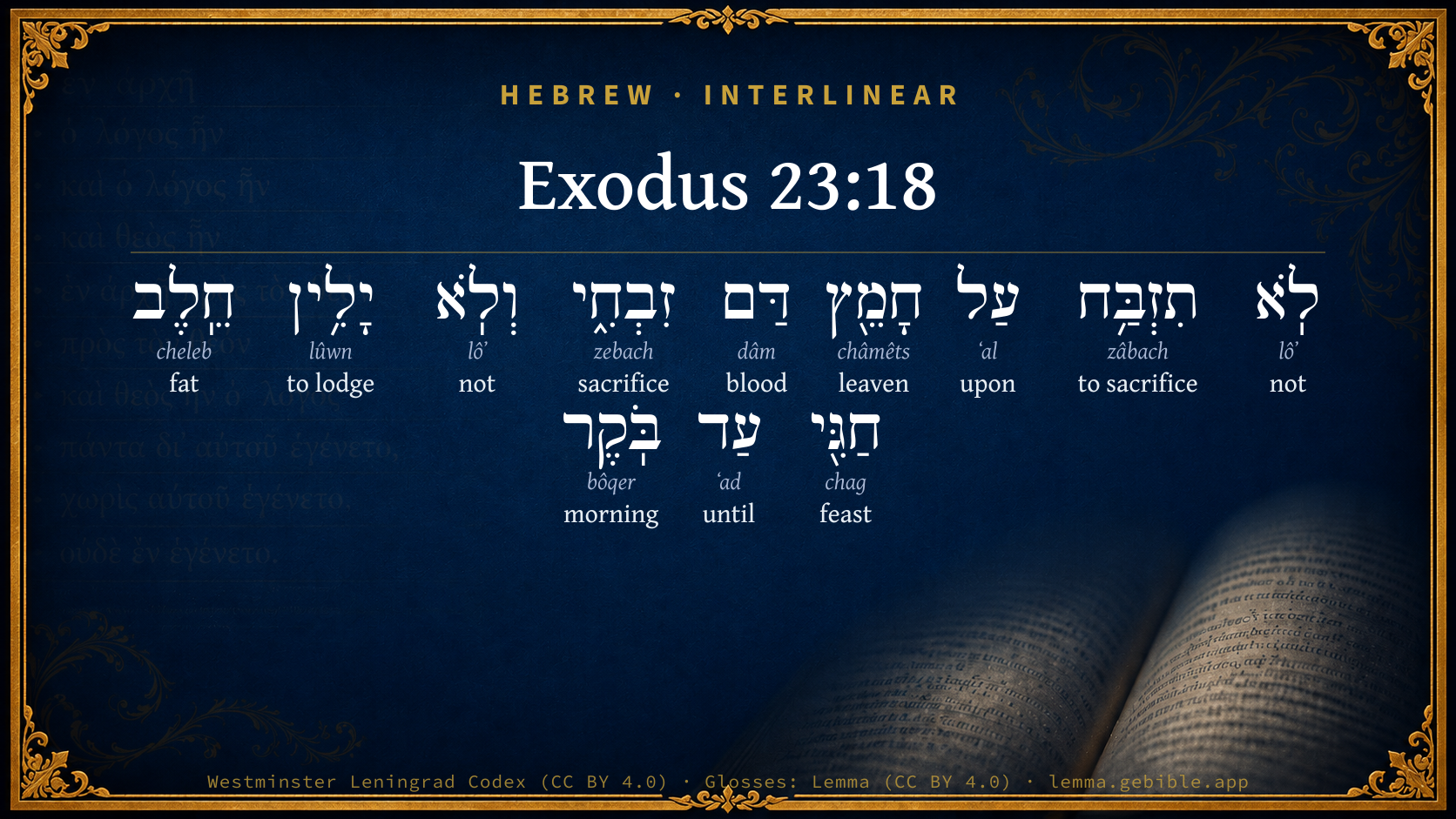
  1. לֹֽא lôʼ H3808 “not” Particle, Negative
  2. תִזְבַּ֥ח zâbach H2076 “to sacrifice” Verb, Qal, Imperfect, 2nd Person, Masculine, Singular
  3. עַל ʻal H5921 “upon” Preposition
  4. דַּם dâm H1818 “blood of” Noun, Common, Masculine, Singular, Construct
  5. זִבְחִ֑י zebach H2077 “sacrifice · my” Noun, Common, Masculine, Singular, Construct + Suffix, Personal, 1st Person, Common, Singular
  6. וְלֹֽא lôʼ H3808 “and · not” Conjunction + Particle, Negative
  7. יָלִ֥ין lûwn H3885 “to lodge” Verb, Qal, Imperfect, 3rd Person, Masculine, Singular
  8. חֵֽלֶב cheleb H2459 “fat of” Noun, Common, Masculine, Singular, Construct
  9. חַגִּ֖י chag H2282 “feast · my” Noun, Common, Masculine, Singular, Construct + Suffix, Personal, 1st Person, Common, Singular
  10. עַד ʻad H5704 “until” Preposition
  11. בֹּֽקֶר bôqer H1242 “morning” Noun, Common, Masculine, Singular, Absolute

About this verse

These counts appear in no published source. They are computed here, from the morphology-tagged text and Lemma’s own curated glosses. What Lemma adds →

12
words
11
distinct lemmas
Pentateuch
section

Notable vocabulary

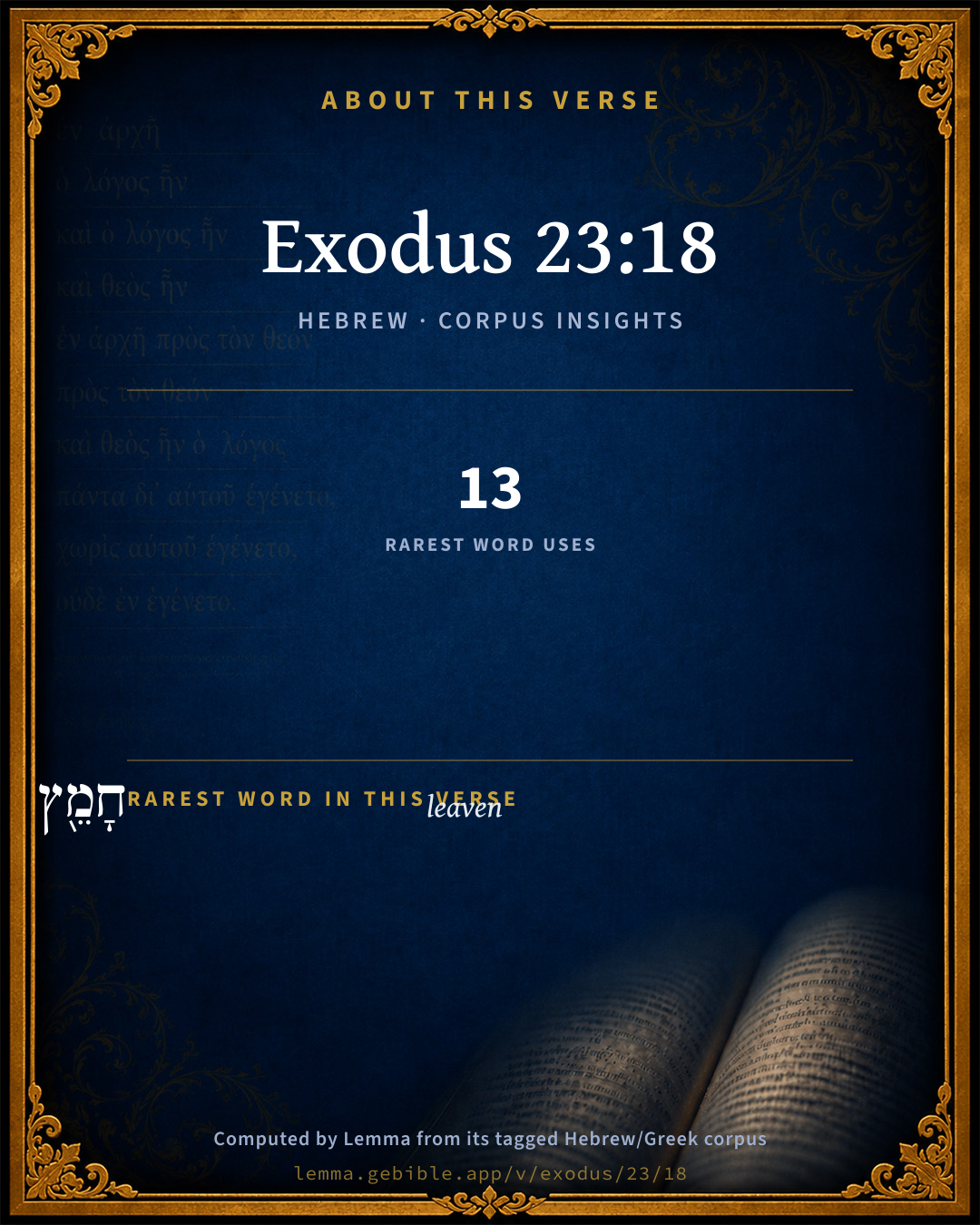
The rarest word here is חָמֵ֖ץ leaven H2557 — appearing just 13 times in the whole Hebrew Bible.

Shared distinctive vocabulary

חָמֵ֖ץ leaven H2557 occurs in 13 verses of the Hebrew Bible. Also found in:

Grammatical profile

  • 2 verbs
  • 6 nouns
  • 2 prepositions
  • 2 particles

Verb forms

  • תִזְבַּ֥ח Qal · Imperfect
  • יָלִ֥ין Qal · Imperfect

Repetition

A word recurs within this verse — often emphatic in Hebrew:

Hebrew & Septuagint length

In English translation the verse runs 25 words from the Hebrew and 40 from the Septuagint (LXX English) — the Septuagint runs noticeably longer here. See the side-by-side →

A rough comparison of the two English renderings, which tokenize alike — not a word-level alignment.

Word counts can differ between the Hebrew and the Greek without any difference in meaning — e.g. the Hebrew direct-object marker אֵת has no separate Greek word, and Greek often adds the article ὁ.

Cross-references

8

Topical passages linked to Exodus 23:18 in the Treasury of Scripture Knowledge — connected by theme and wording, ordered by reader-vote popularity; previews shown in the World English Bible.

  • Exodus 34:25 "You shall not offer the blood of my sacrifice with leavened bread; neither shall the sacrifice of the feast of the Passover be left to the morning.
  • Leviticus 2:11 "'No meal offering, which you shall offer to Yahweh, shall be made with yeast; for you shall burn no yeast, nor any honey, as an offering made by fire to Yahweh.
  • Exodus 12:10 You shall let nothing of it remain until the morning; but that which remains of it until the morning you shall burn with fire.
  • Deuteronomy 16:4 There shall be no yeast seen with you in all your borders seven days; neither shall any of the flesh, which you sacrifice the first day at even, remain all night until the morning.
  • Exodus 12:8 They shall eat the flesh in that night, roasted with fire, and unleavened bread. They shall eat it with bitter herbs.
  • Leviticus 7:15 The flesh of the sacrifice of his peace offerings for thanksgiving shall be eaten on the day of his offering. He shall not leave any of it until the morning.
  • Exodus 12:15 Seven days shall you eat unleavened bread; even the first day you shall put away yeast out of your houses, for whoever eats leavened bread from the first day until the seventh day, that soul shall be cut off from Israel.
  • Leviticus 7:12 If he offers it for a thanksgiving, then he shall offer with the sacrifice of thanksgiving unleavened cakes mixed with oil, and unleavened wafers anointed with oil, and cakes mixed with oil.

Cross-references courtesy of OpenBible.info (CC BY 4.0).

Hebrew and Greek witnesses Masoretic Hebrew ↔ Greek Septuagint

The same verse in the two great witnesses to the Old Testament, shown verse-for-verse.

Here the Septuagint runs noticeably longer than the Hebrew — LXX2012 (modern English Septuagint) 40 words vs World English Bible 25. A rough length comparison of the two English translations, not a word-level alignment — read both below.

These are two independent witnesses, not word-aligned to each other, and the Septuagint is shown in lemma (dictionary) form.

Hebrew Exodus 23:18 Masoretic · Westminster Leningrad Codex

לֹֽא תִזְבַּ֥ח עַל חָמֵ֖ץ דַּם זִבְחִ֑י וְלֹֽא יָלִ֥ין חֵֽלֶב חַגִּ֖י עַד בֹּֽקֶר

"You shall not offer the blood of my sacrifice with leavened bread, neither shall the fat of my feast remain all night until the morning.

World English Bible · Public Domain

Greek LXX Exodus 23:18 Septuagint · lemma form

ὅταν γάρ ἐκβάλλω ἔθνος ἀπό πρόσωπον σύ καί ἐνπλατύνω ὁ ὅριον σύ οὐ θύω ἐπί ζυμή αἷμα θυσίασμα ἐγώ οὐδέ μή κοιμάω στέαρ ὁ ἑορτή ἐγώ ἕως πρωΐ

For when I shall have cast out the nations from before you, and shall have widened your borders, you shall not offer the blood of my sacrifice with leaven, neither must the fat of my feast abide till the morning.

LXX2012 (modern English Septuagint) · Public Domain

On this verse, Keil & Delitzsch discusses the Septuagint’s reading. Read the note in Commentary ↓

Hebrew: Westminster Leningrad Codex (CC BY 4.0). Greek: Septuagint (public domain); English from LXX2012 (modern English Septuagint) (Public Domain). How the Septuagint differs from the Hebrew →

Targum (Aramaic paraphrase)

2

The Targum is the ancient Jewish Aramaic paraphrase of the Hebrew Scriptures — an interpretive translation, not the Hebrew text itself. Onkelos (literal) and Pseudo-Jonathan (expansive) render the Torah, and Jonathan the Prophets. Coverage is partial: where no permissively-licensed English translation exists for a verse, only the Aramaic is shown. This is verse-level text, not a word-by-word alignment to the Hebrew.

  1. Targum Onkelos Torah (Genesis–Deuteronomy)
    לָא תִכּוֹס עַל חֲמִיעַ דַם פִּסְחִי וְלָא יְבִיתוּן בַּר מִן מַדְבְּחָא תַּרְבֵּי נִכְסַת חַגָא עַד צַפְרָא:

    (no public-domain English translation for this verse)

    Targum Onkelos — Aramaic: “Onkelos Genesis” (public domain); “Onkelos Exodus” (public domain); “Onkelos Leviticus” (public domain); “Onkelos Numbers” (public domain); “Onkelos Deuteronomy” (public domain). English: “Sefaria Community Translation” (CC0 1.0 (public-domain dedication)); “J.W. Etheridge. The Targums of Onkelos and Jonathan Ben Uzziel on the Pentateuch. London: Longmans, Green, 1862” (public domain). Text via Sefaria.

  2. Targum Pseudo-Jonathan Torah (Genesis–Deuteronomy)
    עַמִּי בְנֵי יִשְרָאֵל לָא תֵכְסוּן כַּד דְּחָמִיעַ בְּבָתֵּיכוֹן דָּם נִכְסַת פִּיסְחִי וְלָא יְבִית בַּר מִן מַדְבְּחָא תַּרְבֵּי נִכְסַת פִּסְחִי עַד צַפְרָא לָא מִן בִּשְרָא דְתֵיכְלוּן בְּרַמְשָׁא

    Sons of Israel My people, while there is leaven in your houses you may not immolate the bloody sacrifice of My Pascha; nor shall the fat of the sacrifice of My Pascha remain without the altar until morning, nor of the flesh that you eat in the evening.

    Targum Pseudo-Jonathan — Aramaic: “Targum Jonathan on Genesis” (public domain); “Targum Jonathan on Exodus” (public domain); “Targum Jonathan on Leviticus” (public domain); “Targum Jonathan on Numbers” (public domain); “Targum Jonathan on Deuteronomy” (public domain). English: “The Targum of Jonathan ben Uzziel, trans. J. W. Etheridge, London, 1862” (public domain). Text via Sefaria.

Commentary

Notes on Exodus 23:18 from classic Christian and Jewish commentators (each source and its license shown beneath its notes). The classic Christian expositions comment on the surrounding passage and are grouped to its opening verse, so a note may address several verses; the Jewish commentaries on the Tanakh (Rashi and others) are per-verse, so they appear only where the commentator wrote on this verse.

Lemma curates 59 commentaries, every one of them public domain or Creative Commons licensed, each selected and text-cleaned for this edition rather than reprinted as found. About our sources →

Trapp's Complete Commentary

John Trapp

Exo 23:18 Thou shalt not offer the blood of my sacrifice with leavened bread; neither shall the fat of my sacrifice remain until the morning.

Ver. 18. Of my sacrifice.] Especially of the passover. See Exo 34:25 Lev 2:1-3.

John Trapp, A Commentary or Exposition upon All the Books of the Old and New Testament (1647–1656) — public domain. Text from a community e-Sword module.

Keil & Delitzsch

C. F. Keil & F. Delitzsch

The blessing attending their appearing before the Lord was dependent upon the feasts being kept in the proper way, by the observance of the three rules laid down in Exo 23:18 and Exo 23:19. "Thou shalt not offer the blood of My sacrifice upon leavened bread." על upon, as in Exo 12:8, denoting the basis upon which the sacrifice was offered. The meaning has been correctly given by the early commentators, viz., "as long as there is any leavened bread in your houses," or "until the leaven has been entirely removed from your houses." The reference made here to the removal of leaven, and the expression "blood of My sacrifice," both point to the paschal lamb, which was regarded as the sacrifice of Jehovah κατ̓ ἐξοχήν, on account of its great importance. Onkelos gives this explanation: "My Passover" for "My sacrifice." - "Neither shall the fat of My feast remain (ילין to pass the night) until the morning." "The fat of My feast" does not mean the fat of My festal sacrifice, for חג, a feast, is not used for the sacrifice offered at the feast; it signifies rather the best of My feast, i.e., the paschal sacrifice, as we may see from Exo 34:25, where "the sacrifice of the feast of the Passover" is given as the explanation of "the fat of My feast." As the paschal sacrifice was the sacrifice of Jehovah par excellence, so the feast of the Passover was the feast of Jehovah par excellence. The expression "fat of My feast" is not to be understood as referring at all to the fat of the lamb, which was burned upon the altar in the case of the expiatory and whole offerings; for there could have been no necessity for the injunction not to keep this till the morning, inasmuch as those parts of every sacrifice which were set apart for the altar were burned immediately after the sprinkling of the blood. The allusion is to the flesh of the paschal lamb, which was eaten in the night before daybreak, after which anything that remained was to be burned. עד־בּקר (without the article) till morning, has the same meaning as לבּקר "for the (following) morning" in Exo 34:25.

Exo 23:19

The next command in Exo 23:19 has reference to the feast of Harvest, or feast of Weeks. In "the first-fruits of thy land" there is an unmistakeable allusion to "the first-fruits of thy labours" in Exo 23:16. It is true the words, "the first of the first-fruits of thy land thou shalt bring into the house of the Lord thy God," are so general in their character, that we can hardly restrict them to the wave-loaves to be offered as first-fruits at the feast of Weeks, but must interpret them as referring to all the first-fruits, which they had already been commanded not to delay to offer (Exo 22:29), and the presentation of which is minutely prescribed in Num 18:12-13, and Deu 26:2-11, - including therefore the sheaf of barley to be offered in the second day of the feast of unleavened bread (Lev 23:9.). At the same time the reference to the feast of Weeks is certainly to be retained, inasmuch as this feast was an express admonition to Israel, to offer the first of the fruits of the Lord. In the expression בּכּוּרי ראשׁית, the latter might be understood as explanatory of the former and in apposition to it, since they are both of them applied to the first-fruits of the soil (vid., Deu 26:2, Deu 26:10, and Num 18:13). But as ראשׁית could hardly need any explanation in this connection, the partitive sense is to be preferred; though it is difficult to decide whether "the first of the first-fruits" signifies the first selection from the fruits that had grown, ripened, and been gathered first-that is to say, not merely of the entire harvest, but of every separate production of the field and soil, according to the rendering of the lxx ἀπαρχηὰς τῶν πρωτογεννημάτων τῆς γῆς, - or whether the word ראשׁית is used figuratively, and signifies the best of the first-fruits. There is no force in the objection offered to the former view, that "in no other case in which the offering of first-fruits generally is spoken of, is one particular portion represented as holy to Jehovah, but the first-fruits themselves are that portion of the entire harvest which was holy to Jehovah." For, apart from Num 18:12, where a different rendering is sometimes given to ראשׁית, the expression מראשׁית in Deu 26:2 shows unmistakeably that only a portion of the first of all the fruit of the ground had to be offered to the Lord. On the other hand, this view is considerably strengthened by the fact, that whilst בּכּוּר, בּכּוּרים signify those fruits which ripened first, i.e., earliest, ראשׁית is used to denote the ἀπαρχή, the first portion or first selection from the whole, not only in Deu 26:2, Deu 26:10, but also in Lev 23:10, and most probably in Num 18:12 as well. - Now if these directions do not refer either exclusively or specially to the loaves of first-fruits of the feast of Weeks, the opinion which has prevailed from the time of Abarbanel to that of Knobel, that the following command, "Thou shalt not seethe a kid in his mother's milk," refers to the feast of Ingathering, is deprived of its principal support. And any such allusion is rendered very questionable by the fact, that in Deu 14:21, where this command is repeated, it is appended to the prohibition against eating the flesh of an animal that had been torn to pieces. Very different explanations have been given to the command. In the Targum, Mishnah, etc., it is regarded as a general prohibition against eating flesh prepared with milk. Luther and others suppose it to refer to the cooking of the kid, before it has been weaned from its mother's milk. But the actual reference is to the cooking of a kid in the milk of its own mother, as indicating a contempt of the relation which God has established and sanctified between parent and young, and thus subverting the divine ordinances. As kids were a very favourite food (Gen 27:9, Gen 27:14; Jdg 6:19; Jdg 13:15; Sa1 16:20), it is very likely that by way of improving the flavour they were sometimes cooked in milk. According to Aben Ezra and Abarbanel, this was a custom adopted by the Ishmaelites; and at the present day the Arabs are in the habit of cooking lamb in sour milk. A restriction is placed upon this custom in the prohibition before us, but there is no intention to prevent the introduction of a superstitious usage customary at the sacrificial meals of other nations, which Spencer and Knobel have sought to establish as at all events probable, though without any definite historical proofs, and for the most part on the strength of far-fetched analogies.

Keil & Delitzsch — Biblical Commentary on the Old Testament (1861–1891) — public domain (CC PDM 1.0). Text via the HelloAO Bible API. (Old Testament only.)

Tyndale Open Study Notes

Tyndale Open Resources

23:18 Blood symbolized life (Lev 17:11-14; Deut 12:23), so blood must not be mixed with yeast, which was not normally included in offerings (see study note on Lev 2:11). • The fat, considered the best part of the offering, was to be burned at once (see Lev 3:3-5).

Tyndale Open Study Notes — © Tyndale Open Resources, licensed CC BY-SA 4.0. Text via the HelloAO Bible API.

Geneva Bible (1599)

Geneva Bible translators

No leavened bread shall be there in thine house.

Geneva Bible (1599) marginal notes — public domain. Text via Bolls.life.

Adam Clarke's Commentary

Verse 18. The blood of my sacrifice with leavened bread] The sacrifice here mentioned is undoubtedly the Passover; (see Ex 34:25); this is called by way of eminence MY sacrifice, because God had instituted it for that especial purpose, the redemption of Israel from the Egyptian bondage, and because it typified THE LAMB of GOD, who taketh away the sin of the world. We have already seen how strict the prohibition against leaven was during this festival, and what was signified by it. See on chap. xii. See Clarke on Ex 12:19.

Adam Clarke's Commentary on the Bible (1810–1826) — public domain. Text from a community e-Sword/MySword module.

Ellicott's Commentary for English Readers

(18) Thou shalt not offer the blood of my sacrifice with leavened bread.—Some regard this prohibition as extending to all sacrifices; but the majority of commentators limit it to the sacrifice of the Paschal lamb, which was the only sacrifice as yet expressly instituted by Jehovah. According to modern Jewish notions, leavened bread is permissible at the other feasts; at Pentecost it was commanded (Lev_23:17).

The fat of my sacrifice.—Rather (as in the Margin), the fat of my feast. The fat of the Paschal lambs was burnt on the altar with incense the same evening. Thus the whole lamb was consumed before the morning. As the Paschal lamb is καὶ ἐξοχήν, “my sacrifice,” so the Passover is “my feast.”

A Bible Commentary for English Readers, edited by Charles John Ellicott (1878–1897) — public domain. Text from a community e-Sword module.

The Cambridge Bible for Schools and Colleges

gen. ed. J. J. S. Perowne

18. Two regulations respecting sacrifice, designed to guard a sacrifice against contamination by anything corrupt or tainted.

18a. Jehovah’s sacrifices not to be offered with leavened bread. Cf. the || Exo_34:25; Lev_2:11; Lev_6:17; and the note on ch. Exo_12:8. ‘In the earliest times bread was entirely unleavened. Flour or barley was mixed with water and kneaded in a “kneading-bowl” (Exo Exo_8:3), and then baked into “unleavened cakes” (see on Exo_12:8), such as are still the usual food of the Bedawin. In a more advanced stage of society the bread was made in this way only in cases of emergency (Gen_19:3), or for purposes of ritual. The ordinary bread of the Hebrews was made lighter by fermentation’ (Kennedy, in EB. i. 604). The reason why leavened bread was prohibited for ritual purposes was, probably, partly because unleavened bread had the sanction of antiquity (Kennedy, ib. iii. 2753), partly because leaven, being produced by fermentation, was regarded as tainted with a species of corruption (ib. p. 2754; OTJC.2[194] p. 345; Rel. Sem. p. 203 f., ed. 2, p. 220 f.). Leavened bread was permitted only when the offering was not to be placed upon the altar, but eaten by the priests, Lev_7:13; Lev_23:17; Lev_23:20 end.

[194] W. R. Smith, Old Testament in the Jewish Church, ed. 2, 1892.

offer] lit. kill or slay (Deu_12:15), but the word (zâbaḥ) is nearly always used of slaying for sacrifice (cf. on Exo_20:24). It occurs only here with ‘blood’ as its object. In the ||, Exo_34:25 a, slaughter (shâḥaṭ) is used: this is often said of the slaughter of an animal for sacrifice Exo_29:11, Lev_1:5, &c.), but, like zâbaḥ, is not found elsewhere with blood’ as its object. The use of both words in this law is peculiar.

18b. The fat of a festal sacrifice,—which, like the fat of other sacrifices, as the most esteemed part of the animal, was regularly consumed in sweet smoke (see on Exo_29:13) upon the altar (Lev_1:8; Lev_3:3 f. &c.), as an offering to the Deity,—is not to remain unburnt till the next morning (when it would in any case be stale, and in a hot climate might even be tainted). The fat meant is not all fat found in an animal, but specifically that about the kidneys and other intestines (Lev_3:3 f.: Rel. Sem.2[195] 379 f.; EB. ii. 1545; Driver and White, Leviticus in Haupt’s Sacred Books of the OT., illustr. opp. to p. 4).

[195] W. R. Smith, The Religion of the Semites, ed. 2, 1894.

the fat of my feast] Lit. of my pilgrimage (Heb. ḥag), i.e. of the animals sacrificed at my pilgrimages (cf. Mal_2:3, Psa_118:27 Heb.).

The ||, Exo_34:25 b, has ‘the sacrifice of the pilgrimage of the passover’; hence it is commonly thought that the reference (in both clauses) is to the passover (so already Onk., expressly in cl.a, and by implication cl.b). No doubt these two regulations might have been formulated at a time when the Passover was the principal Heb. sacrifice: on the other hand, this is nowhere else (except in Exo_34:25) called a ḥag; and (Di.) the terms being perfectly general, the limitation seems hardly legitimate: the fat pieces of a sacrifice offered at any pilgrimage are to be burnt upon the altar the same day. Why the regulation is limited to these sacrifices does not appear: was it because greater strictness and formality were expected on these occasions than when the sacrifice was an ordinary private one? There are similar regulations in P for the flesh, not only of the Passover (ch. Exo_12:10), but also of the ram of installation (Exo_29:34), and of the thanksgiving-offering (Lev_7:15; Lev_22:30). The fat of the Passover is not elsewhere specified.

The Cambridge Bible for Schools and Colleges (gen. ed. J. J. S. Perowne; Cambridge University Press, 1878–1918) — public domain. Text from a community e-Sword module.

John Gill's Exposition

Behold, I send an angel before thee,.... Not a created angel, but the uncreated one, the Angel of God's presence, that was with the Israelites at Sinai, and in the wilderness; who saved, redeemed, bore, and carried them all the days of old, whom they rebelled against and tempted in the wilderness; as appears by all the characters after given of him, which by no means agree with a created angel: Aben Ezra observes, that some say this is the book of the law, because it is said, "my name is in him", or "in the midst of it"; others say, the ark of the covenant; but he says this angel is Michael; and if indeed by Michael is intended the uncreated angel, as he always is in Scripture, he is right: Jarchi remarks, that their Rabbins say, this is Metatron, whose name is as the name of his master; Metatron, by gematry, is Shaddai, which signifies almighty or all-sufficient, and is an epithet of the divine Being; and Metatron seems to be a corruption of the word "mediator": some of the ancient Jewish writers say (k), this is the Angel that is the Redeemer of the world, and the keeper of the children of men: and Philo the Jew (l) applies the word unto the divine Logos, and says,"he (God) uses the divine Word as the guide of the way; for the oracle is, "behold, I send my Angel", &c.''which agrees with what follows:

to keep thee in the way, and to bring thee into the place which I have prepared; to preserve the Israelites in their journey through the wilderness, from all their enemies that should set upon them, and to bring them safe at last to the land of Canaan, which he had appointed for them, and promised to them, and had prepared both in his purpose and gift for them, and would make way for their settlement in it by driving out the nations before them.

(k) In Zohar in Gen. fol. 124. 4. (l) "De migratione" Abraham, p. 415.

John Gill's Exposition of the Whole Bible (1746–1763) — public domain (CC PDM 1.0). Text via the HelloAO Bible API.

Albert Barnes' Notes on the Bible

The blood of my sacrifice - It is generally considered that this must refer to the Paschal Lamb. See Exo 12:7, Exo 12:11, Exo 12:13, Exo 12:22-23, Exo 12:27.

The fat of my sacrifice - Strictly, the fat of my feast; the “best part” of the feast, that is, the Paschal lamb itself. Compare Exo 34:25.

Albert Barnes' Notes on the Bible (1834–1885) — public domain. Text from a community e-Sword/MySword module.

Haydock's Catholic Bible Commentary

Thou, &c. This has a reference to the feast of the Passover, ver. 15, (Onkelos) as well as the following verse. (Calmet)

George Leo Haydock (1774–1849), Haydock's Catholic Family Bible and Commentary, 1859 edition — public domain. Excludes Psalms (Douay-Rheims chapter numbering differs from Protestant) and Deuterocanonical books (Catholic canon only).

Matthew Poole's English Annotations

These clauses most understand of the passover, by comparing this place with its parallel, Exo 34:25, where the passover is mentioned. But the words being here universal, by the laws of interpretation they ought to be universally understood, if they can bear that sense; which here they may, for both these clauses agree to other sacrifices. For as every sacrifice had a minchah, or a meat-offering of flour, attending upon it, and offered with it; so it was expressly cautioned, that no leaven should be in that minchah, Lev 2:11. And the fat of every sacrifice was consecrated to God, Lev 3:16; 2Ch 35:14, &c., and was presently to be burnt upon the altar, Lev 7:2,3. And for Exo 34:25, what hinders but what is here more generally prescribed, may be there particularly applied to the passover? and that seems more reasonable, than to make him an idle repetition of the same tiring. And

my sacrifice may be here put for my sacrifices, by the common enallage. Moreover, the two principal things which were offered to God in every sacrifice were blood and fat, Lev 17:6,11, &c.

Neither shall the fat of my sacrifice remain until the morning: this, if understood of the passover, may seem superfluous, because nothing of it, neither fat nor lean, was to remain until the morning, Exo 12:10, but all of it was to be eaten, even the purtenance thereof, Exo 23:9, and that, for aught I see, without any exception of the fat, as there was in other sacrifices, Le 16. And therefore in that parallel place, Exo 34:25, where the passover is mentioned, there is not a word of the fat, but only it is said in the general, neither shall the sacrifice of the feast of the passover be left until the morning. And in that 2Ch 35:14, where there is mention of the fat, it is manifestly restrained to the burnt-offerings, which are there distinguished from the passover, Exo 23:11,12.

Matthew Poole's English Annotations on the Holy Bible (1683–1685) — public domain. Text from a community e-Sword/MySword module.

Whedon's Commentary on the Bible

Daniel D. Whedon

18. Not offer the blood of my sacrifice with leavened bread — Literally, upon leavened bread. This refers especially to the sacrifice of the passover, as is seen by comparison of Exo_12:15; Exo_12:18-20. So also the fat of my sacrifice is best understood as the fat and choice portions of the paschal lamb, nothing of which was allowed to remain until the morning. Comp. Exo_12:10, and Exo_34:25.

Daniel D. Whedon (gen. ed.), Commentary on the Old and New Testaments (1874–1909) — public domain. Text from a community e-Sword module.

The Pulpit Commentary

Law of the Paschal sacrifice. That the Paschal lamb is here intended by "my sacrifice," seems to be certain, since the two injunctions to put away leavened bread, and to allow none of the victim"s flesh to remain till the morning, (see Exo_12:10) are combined in the Paschal sacrifice only. Of all the offerings commanded in the law the Paschal lamb was the most important, since it typified Christ. It may therefore well be termed, in an especial way, "God"s sacrifice." By the fat of my feast some understand the fat of the lamb, others the best part of the feast (Keil)i.e. , the lamb itself. in Exo_34:25, which is closely parallel to the present place, we read, for "the fat of my feast," "the sacrifice of the feast of the passover."

The Pulpit Commentary (1880–1919), ed. H.D.M. Spence-Jones & Joseph S. Exell — public domain. Text from a community e-Sword module.

unfoldingWord translationNotes

Door43 World Missions Community

General Information:

Yahweh continues telling Moses his laws for the people of Israel.

fat from the sacrifices

The fat was burned as an offering to Yahweh and was never eaten.

the choicest firstfruits

"the best and first produce of the harvest"

You must not boil a young goat in its mother's milk

This was a magical fertility practice among the Canaanites, which the Israelites were not permitted to participate in.

translationWords

sacrifice

festival

firstfruits

house of God

unfoldingWord translationNotes — © Distant Shores Media and the Door43 World Missions Community, licensed CC BY-SA 4.0. Source: git.door43.org/Door43/en_tn.

Rashi

Rabbi Shlomo Yitzchaki (Rashi)

לא תזבח על חמץ וגו׳ means, you shall not sacrifice the Passover-lamb on the fourteenth day of Nisan before you have removed the leavened bread from your house (Mekhilta). (This verse is to be connected with v. 15).

ולא ילין חלב חגי NEITHER SHALL THE FAT OF MY SACRIFICE REMAIN away from the altar (cf. the Targum).

UNTIL MORNING. One might think, however, that the meaning is, that it shall not remain overnight on the altar and that the sacrifice would therefore become invalid even through the fat remaining overnight on the “wood-pile” of the altar! Scripture, however, states, (Leviticus 6:2) “[This is the law of the burnt-offering; it is that which may go up] on the fire-place of the altar all the night, [any time until the morning]”(Mekhilta), —

Therefore the statement ולא ילין means, that this law of leaving the fat away from the altar overnight is infringed only if it has not been placed on the altar by the dawn of the morning, for it says, “[neither shall the fat remain] until morning”, but any time during the whole night one may lift it up from the pavement on to the altar (cf. Megillah 20b).

Rashi on the Tanakh — English translations: “The Judaica Press complete Tanach with Rashi, translated by A. J. Rosenberg” (CC BY 4.0); “Pentateuch with Rashi's commentary by M. Rosenbaum and A.M. Silbermann, 1929-1934” (public domain); “The Metsudah Tanach series, Lakewood, N.J” (CC BY 4.0); and “The Book of Joshua, Metsudah Publications, 1997” (CC BY 4.0). Text via Sefaria.

Ramban (Nachmanides)

Rabbi Moshe ben Nachman (Ramban / Nachmanides)

THOU SHALT NOT OFFER THE BLOOD OF MY SACRIFICE WITH LEAVENED BREAD. “You shall not slaughter the Passover-offering on the fourteenth day of Nisan before you have removed the leavened bread [from your possession].” This is Rashi’s language.Do not interpret the meaning of this statement of Rashi to refer to the removal of unleavened bread, [and that the verse tells us] that this must take place before the time of slaughtering the Passover-offering, just as is mentioned in the first chapter of Tractate Pesachim: (further 34:25), which means: “do not slaughter the Paschal-lamb while the leavened bread is still there.” And since the time for the slaughtering of the Paschal-lamb begins after the sixth hour, we therefore deduce that unleavened bread is forbidden from that time on. When the Gemara further asked: “Perhaps the Torah meant a separate time for each individual, [so that if he slaughtered it on the ninth hour of the day, he would not be in violation of the law against keeping unleavened bread till such time]? To this the answer is given: “The Merciful One has declared a time for the slaughtering of the Passover-offering [for all alike, and He did not distinguish between one person and another]. — Ramban is now writing that Rashi’s explanation was not prompted by this text of the Gemara, for reasons explained further on. “The Merciful One has declared a time for the slaughtering of the Passover-offering for all alike” — for this interpretation is not the real point of the verse in accordance with the final decision of the law mentioned there. For there is no prohibition commandment, thus one who failed to remove it from his possession after the sixth hour of that day, has thereby violated a positive commandment. But there is no negative commandment to cover this matter. Hence the verse before us which is a negative commandment cannot be establishing the time for the removal of unleavened bread, since that is covered only by a positive commandment. This is the intention of Ramban’s words. according to the law of the Torah requiring the removal of unleavened bread on the day before Passover, not even is there a prohibition against eating it [but the violation of a positive commandment]. commandment of the Torah covering it, but one who eats it violates thereby a positive commandment, since he had failed to destroy the unleavened bread beforehand. See, however, “the Commandments,” Vol. II, p. 196, where Rambam differs on this point and counts a specific negative commandment, wherein we are forbidden to eat unleavened bread after the middle of the fourteenth of Nisan. But the subject of the verse as established according to the final decision of the law, is an admonition against slaughtering the Passover-offering with leavened bread, meaning that none of the company who have been counted to eat of this Passover-offering, may have leavened bread remaining in their possession at the time it is slaughtered. And so Rashi explained it in the section of Ki Thisa. Now the verse should have read, “Thou shalt not slaughter with unleavened bread My sacrifice” [omitting the word: dam — blood], for the blood is not “slaughtered.” But in the opinion of our Rabbis this comes to include the sprinkling, so that the priest who sprinkles the blood of the offering is also forbidden to have leavened bread in his possession. The verse thus states: “Do not slaughter the Passover-offering with unleavened bread, and neither [sprinkle] the blood of My sacrifice,” That is, and neither let the blood of My sacrifice be with unleavened bread. It is an elliptical verse.

Ramban (Nachmanides) on the Tanakh — English translation: “Commentary on the Torah by Ramban (Nachmanides). Translated and annotated by Charles B. Chavel. New York, Shilo Pub. House, 1971-1976” (CC BY 4.0). Text via Sefaria.

Lesson kit

Teaching starters — assembled from the data on this page, not authored interpretation. Every prompt links to the verse data it draws on. Edit before teaching.

Exodus, in the Pentateuch, opens this verse with 12 words (11 distinct Hebrew lemmas). Its most distinctive word is châmêts (“leaven”). The Greek Septuagint runs longer here. A historical commentator’s framing appears above. Read the whole chapter for the surrounding context.

Discussion questions

  1. The word châmêts carries the sense “leaven.” How does it shape the verse?
  2. Exodus 12:15 shares the word «leaven» with this verse. How do the two illuminate each other?
  3. “not” occurs 2× in this one verse. What is the effect of the repetition?
  4. Compared with the Hebrew, the Septuagint runs longer here. What questions does that raise?
  5. These translations render this verse differently. What is at stake in choosing one wording over another?
  6. The verb «תִזְבַּ֥ח» is Qal Imperfect. How does its form color the action?
  7. Reading how Trapp's Complete Commentary and Keil & Delitzsch read this verse, where do the two commentators agree and where do they part?

Things to notice

Reading settings

Reading text

Shown beneath each verse's original-language words.

Old Testament
Old Testament edition

Read the OT as the Masoretic Hebrew (MT) or the Greek Septuagint (LXX).

English shown for the Greek Septuagint (in the Hebrew ↔ Greek comparison).

Comparing translations? Open the Compare panel on any verse page to stack up to four side by side.