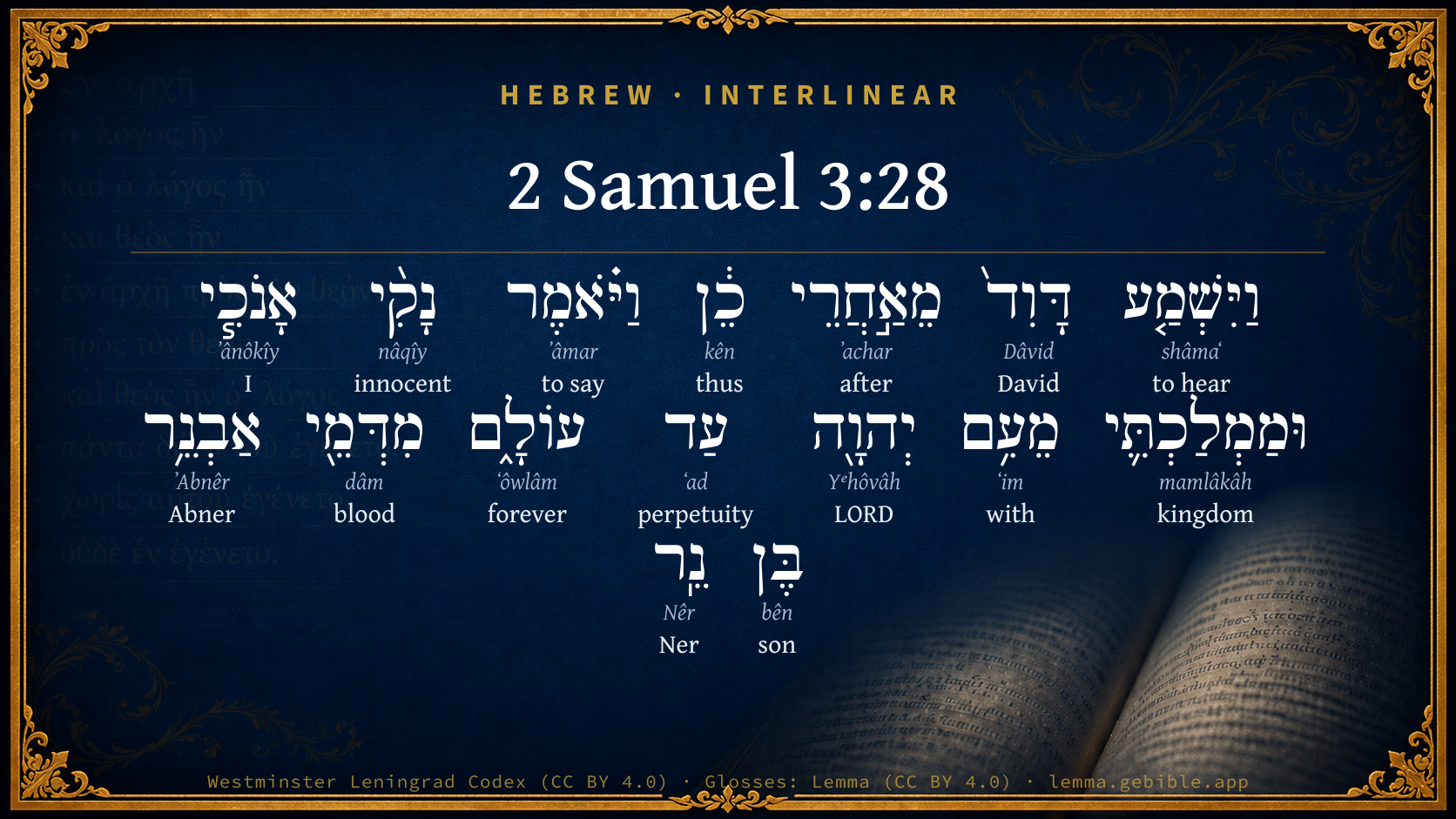
2 Samuel 3:28

Hebrew (Westminster Leningrad Codex) 2 Samuel 3:28 appears in the Hebrew Old Testament. The text above is from the Westminster Leningrad Codex. Each word links to its Strong’s number, a concise gloss, and parsing drawn from the Open Scriptures Hebrew Bible morphology. Click any word for its full Brown-Driver-Briggs (BDB) entry.
Download image
Cite this verse

2 Samuel 3:28 (World English Bible). Public Domain. Lemma interlinear Bible study tool, https://lemma.gebible.app/v/2-samuel/3/28.

Show BibTeX & RIS
BibTeX
RIS
English Translation
Afterward, when David heard it, he said, I and my kingdom are guiltless before Yahweh forever of the blood of Abner the son of Ner:
World English Bible · Public Domain
Download a study sheet

One document with this verse’s original text, its word-by-word gloss line, the meaning frame, cross-references with their text, attributed commentary, and full source and license credits — printable, and it pastes into notes with its structure intact.

This verse Autodidact and up

Study sheet (.html) Plain text (.txt)

A passage Seminary Student

Up to 50 verses in one chapter. A passage sheet keeps up to 6 commentary sources and 12 cross-references per verse, in the order this page ranks them, and says so on the sheet whenever that leaves anything out. Ask for a single verse and you get the Autodidact verse sheet above.

Everything on this page stays free to read, with no account — the sheet is a download of what is already on screen, not access to it.

Want to remove ads? Support Godless Engineer
Compare translations 3

The same verse in 3 English versions, stacked beneath the original-language interlinear above. Click any original word for its lexicon entry.

Each is an independent rendering of the whole verse — the interlinear is not word-aligned to these translations.

Highlighted words mark where these versions differ — a whole-verse word diff, not a word-by-word alignment.

  • World English Bible Public Domain
    Afterward, when David heard it, he said, I and my kingdom are guiltless before Yahweh forever of the blood of Abner the son of Ner:
  • King James Version Public Domain
    And afterward when David heard it, he said, I and my kingdom are guiltless before the LORD for ever from the blood of Abner the son of Ner:
  • unfoldingWord Literal Text CC BY-SA 4.0
    And David heard after this, and he said, “I and my kingdom innocent from with Yahweh forever from the blood of Abner, the son of Ner.

unfoldingWord Literal Text — © unfoldingWord, licensed CC BY-SA 4.0. Word-aligned USFM3 via Door43 (git.door43.org/unfoldingWord/en_ult).

Versions to compare (up to 4)

3 of 4 selected

Show all 18 translations

Every available English version of this verse, each an independent rendering of the whole verse.

  • World English Bible Public Domain
    Afterward, when David heard it, he said, I and my kingdom are guiltless before Yahweh forever of the blood of Abner the son of Ner:
  • Berean Standard Bible Public Domain
    Afterward, David heard about this and said, “I and my kingdom are forever guiltless before the LORD concerning the blood of Abner son of Ner.
  • Majority Standard Bible Public Domain
    Afterward, David heard about this and said, “I and my kingdom are forever guiltless before the LORD concerning the blood of Abner son of Ner.
  • King James Version Public Domain
    And afterward when David heard it, he said, I and my kingdom are guiltless before the LORD for ever from the blood of Abner the son of Ner:
  • American Standard Version (1901) Public Domain
    And afterward, when David heard it, he said, I and my kingdom are guiltless before Jehovah for ever of the blood of Abner the son of Ner:
  • Revised Version (1885) Public Domain
    And afterward when David heard it, he said, I and my kingdom are guiltless before the LORD for ever from the blood of Abner the son of Ner:
  • Geneva Bible (1599) Public Domain
    And when afterwarde it came to Dauids eare, he saide, I and my kingdome are giltlesse before the Lord for euer, concerning the blood of Abner the sonne of Ner.
  • Douay-Rheims (1899) Public Domain
    And when David heard of it, after the thing was now done, he said: I, and my kingdom are innocent before the Lord for ever of the blood of Abner the son of Ner:
  • Young's Literal Translation Public Domain
    And David heareth afterwards and saith, `Acquitted `am' I, and my kingdom, by Jehovah, unto the age, from the blood of Abner son of Ner;
  • Literal Standard Version CC BY-SA 4.0
    And David hears afterward and says, “My kingdom and I [are] acquitted by YHWH for all time, from the blood of Abner son of Ner;
  • Unlocked Literal Bible CC BY-SA 4.0
    When David heard about this he said, “I and my kingdom are innocent before Yahweh forever regarding the blood of Abner son of Ner.
  • unfoldingWord Literal Text CC BY-SA 4.0
    And David heard after this, and he said, “I and my kingdom innocent from with Yahweh forever from the blood of Abner, the son of Ner.
  • Darby Bible Public Domain
    And afterwards David heard [it], and he said, I and my kingdom are guiltless before Jehovah for ever from the blood of Abner the son of Ner:
  • World Messianic Bible Public Domain
    Afterward, when David heard it, he said, “I and my kingdom are guiltless before the LORD forever of the blood of Abner the son of Ner.
  • Webster's Bible Public Domain
    And afterward when David heard it, he said, I and my kingdom are guiltless before the LORD for ever from the blood of Abner the son of Ner:
  • Free Bible Version CC BY-SA 4.0
    When David heard about this later he said, “I and my kingdom are totally innocent before the Lord regarding the death of Abner, son of Ner!
  • Bible in Basic English Public Domain
    And when David had word of it he said, May I and my kingdom be clear for ever in the eyes of the Lord from the blood of Abner, the son of Ner:
  • JPS Tanakh (1917) Public Domain
    And afterward when David heard it, he said: 'I and my kingdom are guiltless before the LORD for ever from the blood of Abner the son of Ner;

Literal Standard Version (2020), Covenant Press — licensed CC BY-SA 4.0. Text via the HelloAO Bible API (eBible.org). Unlocked Literal Bible (unfoldingWord) — licensed CC BY-SA 4.0. Text via the HelloAO Bible API (eBible.org). unfoldingWord Literal Text — © unfoldingWord, licensed CC BY-SA 4.0. Word-aligned USFM3 via Door43 (git.door43.org/unfoldingWord/en_ult). Free Bible Version, Dr. Jonathan Gallagher — licensed CC BY-SA 4.0. Text via the HelloAO Bible API (eBible.org).

Word by word

More ways to search: Search by grammar → Find every occurrence → Compare this word →

Practice this passage: Drill this verse → Learn its vocabulary →

נֵֽר
Nêr
H5369
“Ner”
Noun, Proper
Part of Speech
Noun
Type
Proper
Full BDB Definition

Origin: the same as H5216

TWOT: 1333a

Ner = "lamp" - son of Jehiel, father of Kish, and grandfather of king Saul - father of Abner, the uncle of Saul - perhaps the same as 1
  1. וַיִּשְׁמַ֤ע shâmaʻ H8085 “and · to hear” Conjunction + Verb, Qal, Sequential Imperfect, 3rd Person, Masculine, Singular
  2. דָּוִד֙ Dâvid H1732 “David” Noun, Proper
  3. מֵאַ֣חֲרֵי ʼachar H310 “from · after” Preposition + Preposition
  4. כֵ֔ן kên H3651 “thus” Adverb
  5. וַיֹּ֗אמֶר ʼâmar H559 “and · to say” Conjunction + Verb, Qal, Sequential Imperfect, 3rd Person, Masculine, Singular
  6. נָקִ֨י nâqîy H5355 “innocent” Adjective, Adjective, Masculine, Singular, Absolute
  7. אָנֹכִ֧י ʼânôkîy H595 “I” Pronoun, Personal, 1st Person, Common, Singular
  8. וּמַמְלַכְתִּ֛י mamlâkâh H4467 “and · kingdom · my” Conjunction + Noun, Common, Feminine, Singular, Construct + Suffix, Personal, 1st Person, Common, Singular
  9. מֵעִ֥ם ʻim H5973 “from · with” Preposition + Preposition
  10. יְהוָ֖ה Yᵉhôvâh H3068 “LORD” Noun, Proper
  11. עַד ʻad H5703 “perpetuity” Preposition
  12. עוֹלָ֑ם ʻôwlâm H5769 “forever” Noun, Common, Masculine, Singular, Absolute
  13. מִדְּמֵ֖י dâm H1818 “from · blood of” Preposition + Noun, Common, Masculine, Plural, Construct
  14. אַבְנֵ֥ר ʼAbnêr H74 “Abner” Noun, Proper
  15. בֶּן bên H1121 “son of” Noun, Common, Masculine, Singular, Construct

About this verse

These counts appear in no published source. They are computed here, from the morphology-tagged text and Lemma’s own curated glosses. What Lemma adds →

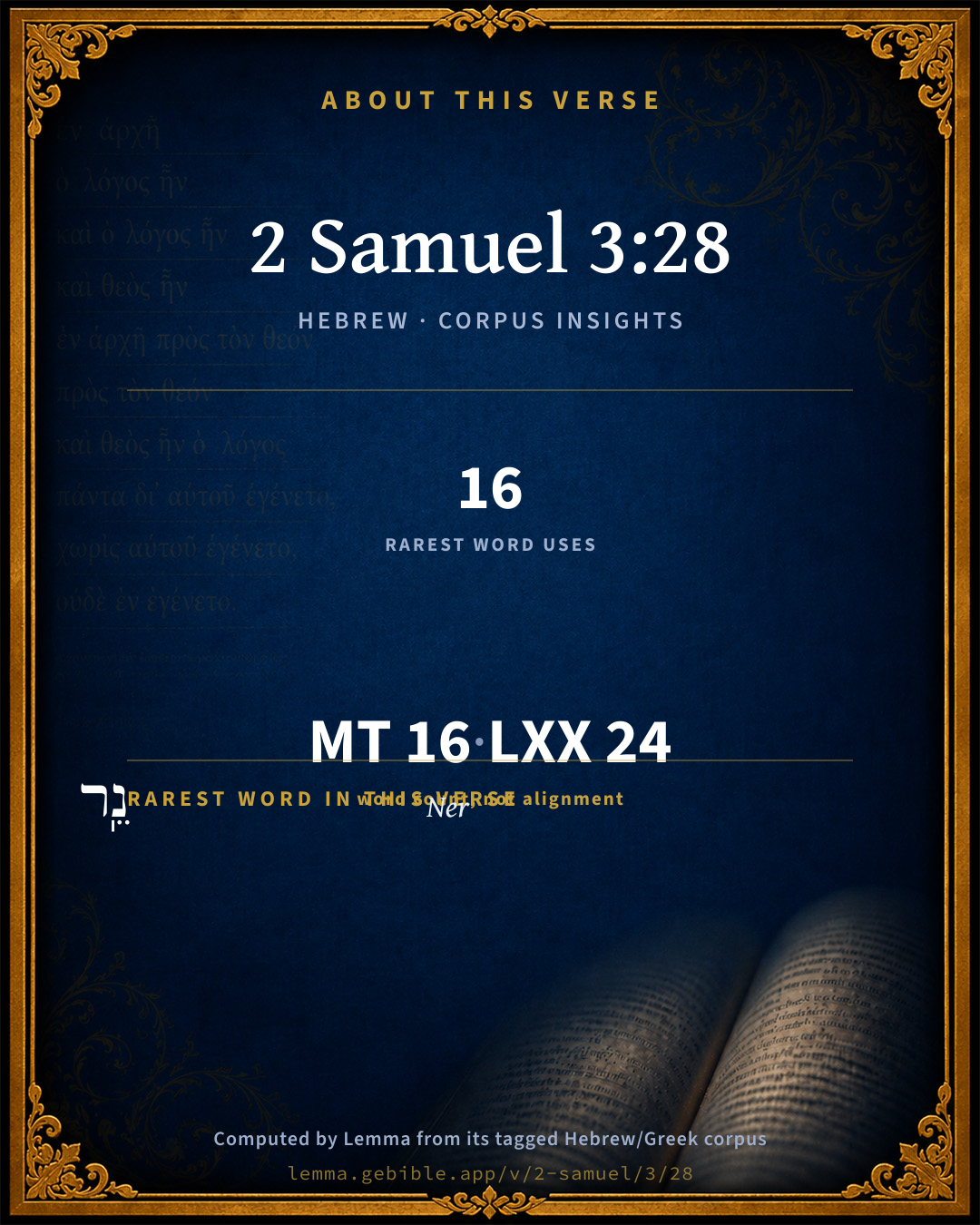
16
words
16
distinct lemmas
Historical
section

Notable vocabulary

The rarest word here is נֵֽר Ner H5369 — appearing just 16 times in the whole Hebrew Bible.

Shared distinctive vocabulary

נֵֽר Ner H5369 occurs in 16 verses of the Hebrew Bible. Also found in:

Grammatical profile

  • 2 verbs
  • 8 nouns
  • 1 adjective
  • 1 pronoun
  • 3 prepositions
  • 1 adverb

Verb forms

  • וַיִּשְׁמַ֤ע Qal · Sequential Imperfect
  • וַיֹּ֗אמֶר Qal · Sequential Imperfect

Hebrew & Septuagint length

In English translation the verse runs 25 words from the Hebrew and 29 from the Septuagint (LXX English) — closely comparable.

A rough comparison of the two English renderings, which tokenize alike — not a word-level alignment.

Word counts can differ between the Hebrew and the Greek without any difference in meaning — e.g. the Hebrew direct-object marker אֵת has no separate Greek word, and Greek often adds the article ὁ.

In the original languages it is 16 Hebrew tokens and 24 Greek tokens — but the two are counted differently (Hebrew bundles its prefixes and suffixes into one token; the Greek is in lemma form), so that isn’t a like-for-like length.

Cross-references

6

Topical passages linked to 2 Samuel 3:28 in the Treasury of Scripture Knowledge — connected by theme and wording, ordered by reader-vote popularity; previews shown in the World English Bible.

  • Numbers 35:33 So you shall not pollute the land in which you are: for blood, it pollutes the land; and no expiation can be made for the land for the blood that is shed therein, but by the blood of him who shed it.
  • Genesis 4:10 Yahweh said, "What have you done? The voice of your brother's blood cries to me from the ground.
  • Genesis 9:6 Whoever sheds man's blood, by man will his blood be shed, for in the image of God made he man.
  • Exodus 21:12 "One who strikes a man so that he dies shall surely be put to death,
  • Deuteronomy 21:1–9 If one be found slain in the land which Yahweh your God gives you to possess it, lying in the field, and it isn't known who has struck him;
  • Matthew 27:24 So when Pilate saw that nothing was being gained, but rather that a disturbance was starting, he took water, and washed his hands before the multitude, saying, "I am innocent of the blood of this righteous person. You see to it."

Cross-references courtesy of OpenBible.info (CC BY 4.0).

Hebrew and Greek witnesses Masoretic Hebrew ↔ Greek Septuagint

The same verse in the two great witnesses to the Old Testament, shown verse-for-verse.

These are two independent witnesses, not word-aligned to each other, and the Septuagint is shown in lemma (dictionary) form.

Hebrew 2 Samuel 3:28 Masoretic · Westminster Leningrad Codex

וַיִּשְׁמַ֤ע דָּוִד֙ מֵאַ֣חֲרֵי כֵ֔ן וַיֹּ֗אמֶר נָקִ֨י אָנֹכִ֧י וּמַמְלַכְתִּ֛י מֵעִ֥ם יְהוָ֖ה עַד עוֹלָ֑ם מִדְּמֵ֖י אַבְנֵ֥ר בֶּן נֵֽר

Afterward, when David heard it, he said, I and my kingdom are guiltless before Yahweh forever of the blood of Abner the son of Ner:

World English Bible · Public Domain

Greek LXX 2 Samuel 3:28 Septuagint · lemma form

καί ἀκούω δαυίδ μετά οὗτος καί εἶπον ἀθῷος εἰμί ἐγώ καί ὁ βασιλεία ἐγώ ἀπό κύριος ἕως αἰών ἀπό ὁ αἷμα αβεννηρ υἱός νηρ

And David heard of it afterwards, and said, I and my kingdom are guiltless before the Lord even for ever of the blood of Abenner the son of Ner.

LXX2012 (modern English Septuagint) · Public Domain

Hebrew: Westminster Leningrad Codex (CC BY 4.0). Greek: Septuagint (public domain); English from LXX2012 (modern English Septuagint) (Public Domain). How the Septuagint differs from the Hebrew →

Targum (Aramaic paraphrase)

1

The Targum is the ancient Jewish Aramaic paraphrase of the Hebrew Scriptures — an interpretive translation, not the Hebrew text itself. Onkelos (literal) and Pseudo-Jonathan (expansive) render the Torah, and Jonathan the Prophets. Coverage is partial: where no permissively-licensed English translation exists for a verse, only the Aramaic is shown. This is verse-level text, not a word-by-word alignment to the Hebrew.

  1. Targum Jonathan Prophets (Joshua–Malachi)
    וּשְׁמַע דָוִד מִבָּתַר כֵּן וַאֲמַר זַכַּאי אֲנָא וּמַלְכוּתִי מִן קֳדָם יְיָ עַד עַלְמָא מִדְמָא דְאַבְנֵר בַּר נֵר:

    (no public-domain English translation for this verse)

    Targum Jonathan — Aramaic: “Mikraot Gedolot” (public domain). English: “Sefaria Community Translation” (CC0 1.0 (public-domain dedication)); “London "Chaldee Paraphrase," 1871” (public domain). Text via Sefaria.

Commentary

Notes on 2 Samuel 3:28 from classic Christian and Jewish commentators (each source and its license shown beneath its notes). The classic Christian expositions comment on the surrounding passage and are grouped to its opening verse, so a note may address several verses; the Jewish commentaries on the Tanakh (Rashi and others) are per-verse, so they appear only where the commentator wrote on this verse.

Lemma curates 59 commentaries, every one of them public domain or Creative Commons licensed, each selected and text-cleaned for this edition rather than reprinted as found. About our sources →

Trapp's Complete Commentary

John Trapp

2Sa 3:28 And afterward when David heard [it], he said, I and my kingdom [are] guiltless before the LORD for ever from the blood of Abner the son of Ner:

Ver. 28. From the blood of Abner.] Heb., Bloods: from every drop of his blood shed when he was slain. David cleareth himself and his kingdom of this crying crime. But what a deal hath France to answer for the Parisian massacre, whereby a hundred thousand, some say more, innocents perished in one year in various parts of the realm! besides the many civil dissensions there, to the effusion of much Christian blood, and six thousand gentlemen slain in private quarrels within the space of ten years! as it appears by the king’s pardons. {a}

{a} See "Les Ombres des Defunts Seiures de Vilemor et de Fountains," p. 46.

John Trapp, A Commentary or Exposition upon All the Books of the Old and New Testament (1647–1656) — public domain. Text from a community e-Sword module.

Joseph Benson's Commentary

2Sa 3:28-29. When David heard it, he said, I and my kingdom are guiltless — Josephus says, he lifted up his hands to God, and, with a loud voice, cried out publicly that God knew he was innocent in this matter; and therefore he trusted God would not let him and his kingdom suffer for it. And on all his father’s house — David’s indignation at the fact transported him much too far in making him wish that all Joab’s family might suffer for it, which was contrary to the law of God. See Deu 24:16. “Methinks,” says Henry, “a resolute punishment of the murderer himself would better have become David than this passionate imprecation of God’s judgments upon his posterity.” But, perhaps, the words are to be considered as a prediction rather than as an imprecation. Accordingly, Houbigant renders them, but it shall or will rest upon the head of Joab, and on all his father’s house, and there will not fail, &c.

Joseph Benson's Commentary on the Old and New Testaments (1811–1818) — public domain. Text from a community e-Sword module.

Tyndale Open Study Notes

Tyndale Open Resources

3:28 David made it clear that he had nothing to do with Abner’s death, labeling it as a crime. David knew that because his second-in-command had killed Abner, rumors would circulate among those loyal to Saul’s dynasty that David had ordered the killing. • I vow by the Lord: David called on the Lord to hold him accountable if he were lying.

Tyndale Open Study Notes — © Tyndale Open Resources, licensed CC BY-SA 4.0. Text via the HelloAO Bible API.

Geneva Bible (1599)

Geneva Bible translators

The Lord knoweth that I did not consent to his death.

Geneva Bible (1599) marginal notes — public domain. Text via Bolls.life.

Ellicott's Commentary for English Readers

(28) I and my kingdom are guiltless.—This was true. Joab’s act was entirely without David’s knowledge, and was not only against his will on moral grounds, but was in danger of proving disastrous to him politically; hence he takes the strongest means of showing his abhorrence of the deed.

A Bible Commentary for English Readers, edited by Charles John Ellicott (1878–1897) — public domain. Text from a community e-Sword module.

The Cambridge Bible for Schools and Colleges

gen. ed. J. J. S. Perowne

28–30. The Curse of Blood-guiltiness

28. I and my kingdom are guiltless] With a strong asseveration David asserts his entire innocence of any complicity in this murder. Neither upon himself personally nor upon “his kingdom,” i.e. the royal house, his descendants and successors, could punishment for shedding this innocent blood justly fall. Cp. 1Ki_2:31-33. For the doctrine of a divine judgment which was certain to fall upon the murderer and his posterity, “visiting the sins of the fathers upon the children,” see Gen_4:11; Deu_21:6-9; Mat_23:35. Compare the Greek belief in the avenging Furies who dogged the murderer’s steps.

The Cambridge Bible for Schools and Colleges (gen. ed. J. J. S. Perowne; Cambridge University Press, 1878–1918) — public domain. Text from a community e-Sword module.

John Gill's Exposition

And afterward, when David heard it,.... That Joab had sent to fetch Abner back, and that he had stabbed him in the gate of the city, and he was dead; it was some time after it was done that the news of it was brought to David; this circumstance is observed, the more to clear the king from any concern in this affair:

he said; in a public manner, in open court, before all his princes; he called God to witness, and, as Josephus (i) says, stretching out his right hand to God, he cried aloud:

I and my kingdom are guiltless before the Lord for ever from the blood of Abner the son of Ner; he was sensible it would be known that Abner had been with him, and that Joab his general had killed him; and therefore it might be suspected that he had an hand in it, and that it was done by his order, with his privy council; and therefore, to purge him and them from it, he made this public declaration, that neither he nor his council knew anything of it; and that it was not done with their knowledge and consent, and by their order, but through the resentment of a single person; and therefore hoped that no man would impute the shedding of this blood unto them, or that God would punish them for it; and he was the rather led to make this public declaration, because he knew that the death of Abner in this way would be resented by the friends of Saul's family, and be an obstruction to the union of the two kingdoms, which it was known Abner was endeavouring to bring about.

(i) Antiqu. l. 7. c. 1. sect. 6.

John Gill's Exposition of the Whole Bible (1746–1763) — public domain (CC PDM 1.0). Text via the HelloAO Bible API.

Haydock's Catholic Bible Commentary

Innocent. I would not purchase a kingdom at such a price. (Calmet) --- I beg that the crime may not be imputed to us, who are innocent. (Haydock) --- God sometimes punishes a whole kingdom for the sins of the rulers. (Menochius) --- Yet not without some fault of the subjects. (Haydock)

George Leo Haydock (1774–1849), Haydock's Catholic Family Bible and Commentary, 1859 edition — public domain. Excludes Psalms (Douay-Rheims chapter numbering differs from Protestant) and Deuterocanonical books (Catholic canon only).

Matthew Poole's English Annotations

David said publicly, before his courtiers and people; and seriously, as in God’s presence; I call the Lord to witness, that this was not done by my instigation or authority, or by any public counsel, but only by Joab’s malice; and therefore I trust that God will not punish me nor my kingdom, but Joab only.

Matthew Poole's English Annotations on the Holy Bible (1683–1685) — public domain. Text from a community e-Sword/MySword module.

The Pulpit Commentary

I and my kingdom are guiltless. By this David means, not his royal house, but the people generally, who too often have to pay the penalty for the sins of their rulers. (see 2Sa_21:1) Necessarily this is the case, wherever the crime is a state crime; but David protests that Abner"s murder was a private crime, for which Joab and Abishai alone ought to suffer.

The Pulpit Commentary (1880–1919), ed. H.D.M. Spence-Jones & Joseph S. Exell — public domain. Text from a community e-Sword module.

unfoldingWord translationNotes

Door43 World Missions Community

Ner ... Abishai ... Asahel

These are the names of men. (See: How to Translate Names)

the blood of Abner

Here "blood" refers to the death of Abner. See how you translated a similar phrase in 2 Samuel 3:27. AT: "the death of Abner" or "the murder of Abner" (See: Metonymy)

fall on the head of Joab and on all his father's house

This phrase means the results of the guilt will happen to Joab and his family as if something heavy had collapsed on them. AT: "always cause suffering for Joab and for all his father's house" (See: Metaphor)

all his father's house

Here "house" refers to descendants. AT: "all the descendants of Joab's father" (See: Metonymy)

May there never fail to be

This double negative emphasizes that there will always be someone with the problems listed. AT: "May there always be" (See: Metonymy)

is killed by the sword

Here "sword" refers to violent death. AT: "dies violently" (See: Metonymy)

goes without food

"is hungry"

translationWords

David

kingdom

innocent

Yahweh

eternity

blood

Abner

guilt

die

head

Joab

house

staff

sword

Gibeon

unfoldingWord translationNotes — © Distant Shores Media and the Door43 World Missions Community, licensed CC BY-SA 4.0. Source: git.door43.org/Door43/en_tn.

Lesson kit

Teaching starters — assembled from the data on this page, not authored interpretation. Every prompt links to the verse data it draws on. Edit before teaching.

2 Samuel, in the Historical, opens this verse with 16 words (16 distinct Hebrew lemmas). Its most distinctive word is Nêr (“Ner”). A historical commentator’s framing appears above. Read the whole chapter for the surrounding context.

Discussion questions

  1. The word Nêr carries the sense “Ner.” How does it shape the verse?
  2. 1 Samuel 14:50 shares the word «Ner» with this verse. How do the two illuminate each other?
  3. The translations on this page render this verse differently — a whole-verse word diff, not a word-by-word alignment. What might account for the different wordings?
  4. The verb «וַיִּשְׁמַ֤ע» is Qal Sequential Imperfect. How does its form color the action?
  5. Reading how Trapp's Complete Commentary and Joseph Benson's Commentary read this verse, where do the two commentators agree and where do they part?

Things to notice

Reading settings

Reading text

Shown beneath each verse's original-language words.

Old Testament
Old Testament edition

Read the OT as the Masoretic Hebrew (MT) or the Greek Septuagint (LXX).

English shown for the Greek Septuagint (in the Hebrew ↔ Greek comparison).

Comparing translations? Open the Compare panel on any verse page to stack up to four side by side.