Genesis 49:11

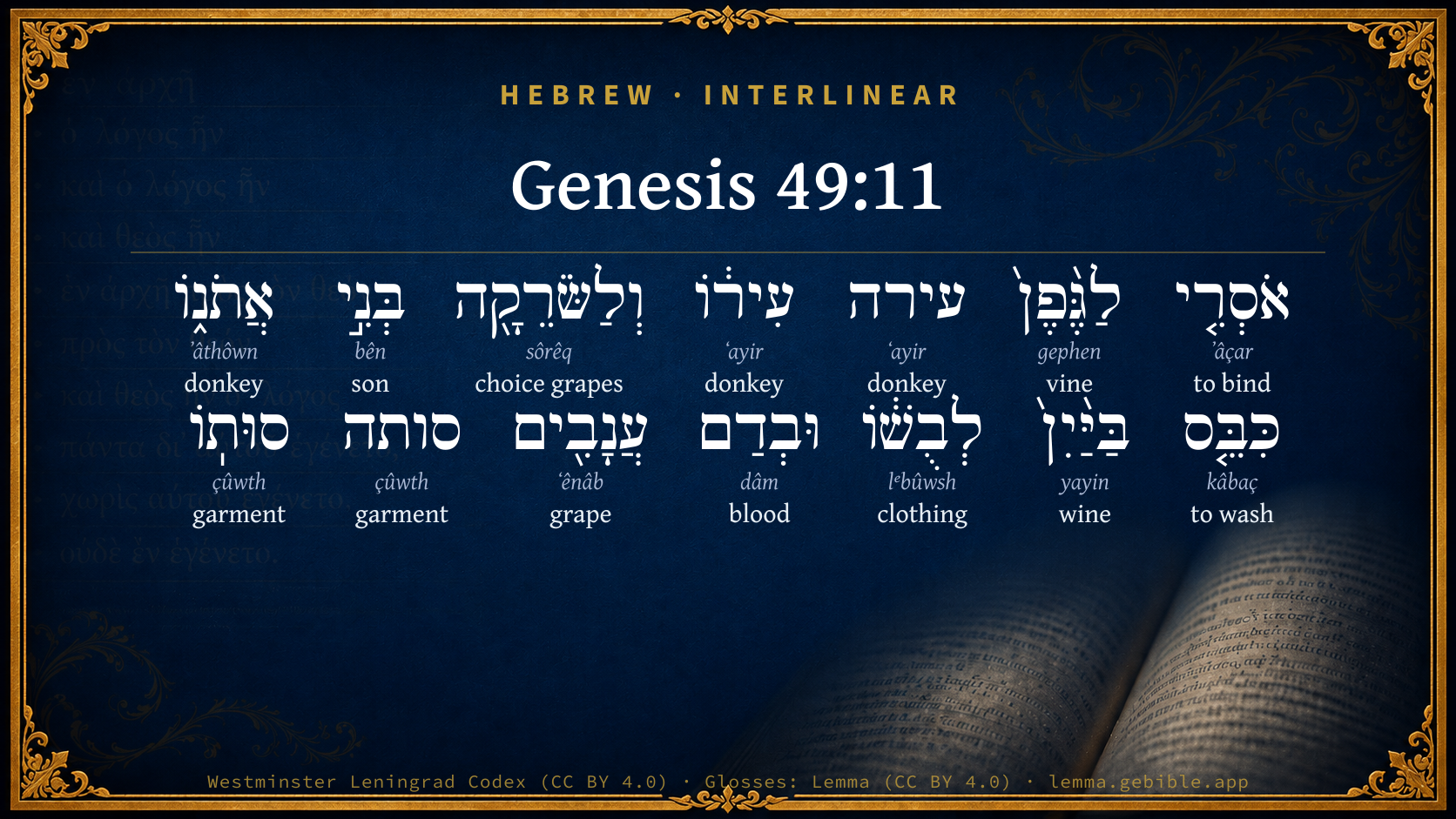
Hebrew (Westminster Leningrad Codex) Genesis 49:11 appears in the Hebrew Old Testament. The text above is from the Westminster Leningrad Codex. Each word links to its Strong’s number, a concise gloss, and parsing drawn from the Open Scriptures Hebrew Bible morphology. Click any word for its full Brown-Driver-Briggs (BDB) entry.
Download image
Cite this verse

Genesis 49:11 (World English Bible). Public Domain. Lemma interlinear Bible study tool, https://lemma.gebible.app/v/genesis/49/11.

Show BibTeX & RIS
BibTeX
RIS
English Translation
Binding his foal to the vine, His donkey's colt to the choice vine; He has washed his garments in wine, His robes in the blood of grapes:
World English Bible · Public Domain
Highlights
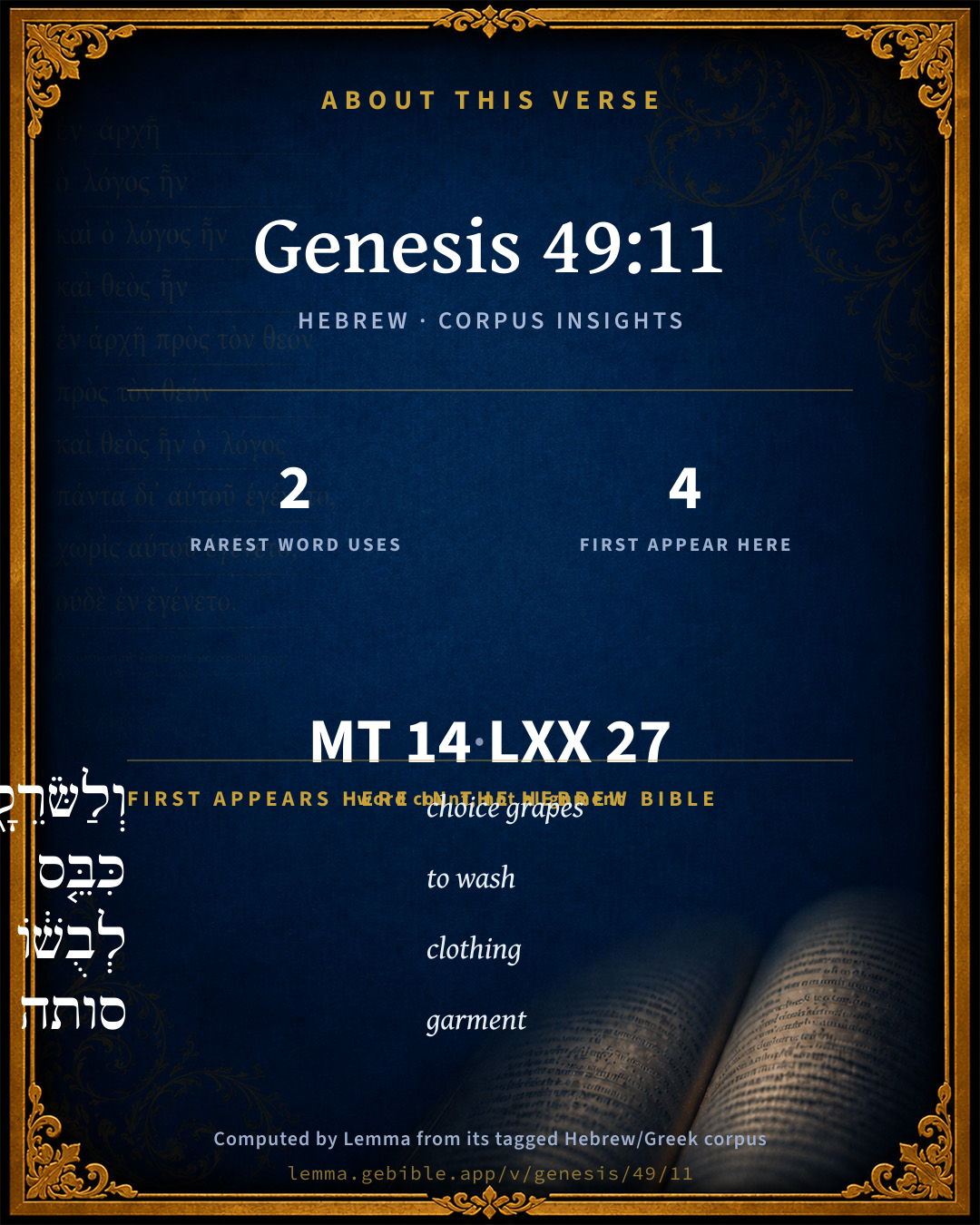
  • 4 first appearances in the Hebrew Bible
Full analysis ↓
Download a study sheet

One document with this verse’s original text, its word-by-word gloss line, the meaning frame, cross-references with their text, attributed commentary, and full source and license credits — printable, and it pastes into notes with its structure intact.

This verse Autodidact and up

Study sheet (.html) Plain text (.txt)

A passage Seminary Student

Up to 50 verses in one chapter. A passage sheet keeps up to 6 commentary sources and 12 cross-references per verse, in the order this page ranks them, and says so on the sheet whenever that leaves anything out. Ask for a single verse and you get the Autodidact verse sheet above.

Everything on this page stays free to read, with no account — the sheet is a download of what is already on screen, not access to it.

Want to remove ads? Support Godless Engineer
Compare translations 3

The same verse in 3 English versions, stacked beneath the original-language interlinear above. Click any original word for its lexicon entry.

Each is an independent rendering of the whole verse — the interlinear is not word-aligned to these translations.

Highlighted words mark where these versions differ — a whole-verse word diff, not a word-by-word alignment.

  • World English Bible Public Domain
    Binding his foal to the vine, His donkey's colt to the choice vine; He has washed his garments in wine, His robes in the blood of grapes:
  • King James Version Public Domain
    Binding his foal unto the vine, and his ass's colt unto the choice vine; he washed his garments in wine, and his clothes in the blood of grapes:
  • unfoldingWord Literal Text CC BY-SA 4.0
    He will tether his donkey to the vine, and the son of his donkey to the choice branch. He will wash his garment in wine and his robe in the blood of grapes.

unfoldingWord Literal Text — © unfoldingWord, licensed CC BY-SA 4.0. Word-aligned USFM3 via Door43 (git.door43.org/unfoldingWord/en_ult).

Versions to compare (up to 4)

3 of 4 selected

Show all 18 translations

Every available English version of this verse, each an independent rendering of the whole verse.

  • World English Bible Public Domain
    Binding his foal to the vine, His donkey's colt to the choice vine; He has washed his garments in wine, His robes in the blood of grapes:
  • Berean Standard Bible Public Domain
    He ties his donkey to the vine, his colt to the choicest branch. He washes his garments in wine, his robes in the blood of grapes.
  • Majority Standard Bible Public Domain
    He ties his donkey to the vine, his colt to the choicest branch. He washes his garments in wine, his robes in the blood of grapes.
  • King James Version Public Domain
    Binding his foal unto the vine, and his ass's colt unto the choice vine; he washed his garments in wine, and his clothes in the blood of grapes:
  • American Standard Version (1901) Public Domain
    Binding his foal unto the vine, And his ass's colt unto the choice vine; He hath washed his garments in wine, And his vesture in the blood of grapes:
  • Revised Version (1885) Public Domain
    Binding his foal unto the vine, And his ass’s colt unto the choice vine; He hath washed his garments in wine, And his vesture in the blood of grapes:
  • Geneva Bible (1599) Public Domain
    He shall binde his Asse foale vnto ye vine, and his Asses colte vnto the best vine. hee shall wash his garment in wine, and his cloke in the blood of grapes.
  • Douay-Rheims (1899) Public Domain
    Tying his foal to the vineyard, and his ass, 0 my son, to the vine. He shall wash his robe in wine, and his garment in the blood of the grape.
  • Young's Literal Translation Public Domain
    Binding to the vine his ass, And to the choice vine the colt of his ass, He hath washed in wine his clothing, And in the blood of grapes his covering;
  • Literal Standard Version CC BY-SA 4.0
    Binding to the vine his donkey, || And to the choice vine the colt of his donkey, || He has washed in wine his clothing, || And in the blood of grapes his covering;
  • Unlocked Literal Bible CC BY-SA 4.0
    Binding his donkey to the vine, and his donkey's colt to the choice vine, he has washed his garments in wine, and his robe in the blood of grapes.
  • unfoldingWord Literal Text CC BY-SA 4.0
    He will tether his donkey to the vine, and the son of his donkey to the choice branch. He will wash his garment in wine and his robe in the blood of grapes.
  • Darby Bible Public Domain
    He bindeth his foal to the vine, And his ass's colt to the choice vine; He washeth his dress in wine, And his garment in the blood of grapes.
  • World Messianic Bible Public Domain
    Binding his foal to the vine, his donkey’s colt to the choice vine, he has washed his garments in wine, his robes in the blood of grapes.
  • Webster's Bible Public Domain
    Binding his foal to the vine, and his ass's colt to the choice vine; he washed his garments in wine, and his clothes in the blood of grapes:
  • Free Bible Version CC BY-SA 4.0
    He ties his donkey to the vine, his donkey's colt to the best vine. He washes his clothes in wine, his robes in the red juice of grapes.
  • Bible in Basic English Public Domain
    Knotting his ass's cord to the vine, and his young ass to the best vine; washing his robe in wine, and his clothing in the blood of grapes:
  • JPS Tanakh (1917) Public Domain
    Binding his foal unto the vine, and his ass's colt unto the choice vine; he washeth his garments in wine, and his vesture in the blood of grapes;

Literal Standard Version (2020), Covenant Press — licensed CC BY-SA 4.0. Text via the HelloAO Bible API (eBible.org). Unlocked Literal Bible (unfoldingWord) — licensed CC BY-SA 4.0. Text via the HelloAO Bible API (eBible.org). unfoldingWord Literal Text — © unfoldingWord, licensed CC BY-SA 4.0. Word-aligned USFM3 via Door43 (git.door43.org/unfoldingWord/en_ult). Free Bible Version, Dr. Jonathan Gallagher — licensed CC BY-SA 4.0. Text via the HelloAO Bible API (eBible.org).

Word by word

More ways to search: Search by grammar → Find every occurrence → Compare this word →

Practice this passage: Drill this verse → Learn its vocabulary →

סותה
çûwth
H5497
“garment · his”
Noun, Common, Masculine, Singular, Construct + Suffix, Personal, 3rd Person, Masculine, Singular
Part of Speech
Noun
Type
Common
Gender
Masculine
Number
Singular
State
Construct
Full BDB Definition

Origin: probably from the same root as H4533

TWOT: 1472a

garment, vesture
  1. אֹסְרִ֤י ʼâçar H631 “binding” Verb, Qal, Participle Active, Masculine, Singular, Construct
  2. לַגֶּ֨פֶן֙ gephen H1612 “to/for the · vine” Preposition, Determined + Noun, Common, Both, Singular, Absolute
  3. עירה ʻayir H5895 “donkey · his” Noun, Common, Masculine, Singular, Construct + Suffix, Personal, 3rd Person, Masculine, Singular
  4. עִיר֔וֹ ʻayir H5895 “donkey · his” Noun, Common, Masculine, Singular, Construct + Suffix, Personal, 3rd Person, Masculine, Singular
  5. וְלַשֹּׂרֵקָ֖ה sôrêq H8321 “and · to/for the · choice grapes” Conjunction + Preposition, Determined + Noun, Common, Feminine, Singular, Absolute
  6. בְּנִ֣י bên H1121 “son of” Noun, Common, Masculine, Singular, Construct
  7. אֲתֹנ֑וֹ ʼâthôwn H860 “donkey · his” Noun, Common, Feminine, Singular, Construct + Suffix, Personal, 3rd Person, Masculine, Singular
  8. כִּבֵּ֤ס kâbaç H3526 “to wash” Verb, Piel, Perfect, 3rd Person, Masculine, Singular
  9. בַּיַּ֨יִן֙ yayin H3196 “in/at the · wine” Preposition, Determined + Noun, Common, Masculine, Singular, Absolute
  10. לְבֻשׁ֔וֹ lᵉbûwsh H3830 “clothing · his” Noun, Common, Masculine, Singular, Construct + Suffix, Personal, 3rd Person, Masculine, Singular
  11. וּבְדַם dâm H1818 “and · in/at · blood of” Conjunction + Preposition + Noun, Common, Masculine, Singular, Construct
  12. עֲנָבִ֖ים ʻênâb H6025 “grapes” Noun, Common, Masculine, Plural, Absolute
  13. סוּתֽוֹ çûwth H5497 “garment · his” Noun, Common, Masculine, Singular, Construct + Suffix, Personal, 3rd Person, Masculine, Singular

About this verse

These counts appear in no published source. They are computed here, from the morphology-tagged text and Lemma’s own curated glosses. What Lemma adds →

14
words
12
distinct lemmas
Pentateuch
section

Notable vocabulary

The rarest word here is סותה garment H5497 — appearing just 2 times in the whole Hebrew Bible.

First appearance in Scripture

These words make their first canonical appearance in the Hebrew Bible here:

  • וְלַשֹּׂרֵקָ֖ה choice grapes H8321
  • כִּבֵּ֤ס to wash H3526
  • לְבֻשׁ֔וֹ clothing H3830
  • סותה garment H5497

Grammatical profile

  • 2 verbs
  • 12 nouns

Verb forms

  • אֹסְרִ֤י Qal · Participle Active
  • כִּבֵּ֤ס Piel · Perfect

Repetition

Words recur within this verse — often emphatic in Hebrew:

  • עירה donkey H5895 ×2
  • סותה garment H5497 ×2

Hebrew & Septuagint length

In English translation the verse runs 27 words from the Hebrew and 33 from the Septuagint (LXX English) — closely comparable.

A rough comparison of the two English renderings, which tokenize alike — not a word-level alignment.

Word counts can differ between the Hebrew and the Greek without any difference in meaning — e.g. the Hebrew direct-object marker אֵת has no separate Greek word, and Greek often adds the article ὁ.

In the original languages it is 14 Hebrew tokens and 27 Greek tokens — but the two are counted differently (Hebrew bundles its prefixes and suffixes into one token; the Greek is in lemma form), so that isn’t a like-for-like length.

Cross-references

8

Topical passages linked to Genesis 49:11 in the Treasury of Scripture Knowledge — connected by theme and wording, ordered by reader-vote popularity; previews shown in the World English Bible.

  • Isaiah 63:1–3 Who is this who comes from Edom, with dyed garments from Bozrah? this who is glorious in his clothing, marching in the greatness of his strength? I who speak in righteousness, mighty to save.
  • Joel 3:18 It will happen in that day, That the mountains will drop down sweet wine, The hills will flow with milk, All the brooks of Judah will flow with waters; And a fountain will come forth from the house of Yahweh, And will water the valley of Shittim.
  • Revelation 7:14 I told him, "My lord, you know." He said to me, "These are those who came out of the great tribulation. They washed their robes, and made them white in the Lamb's blood.
  • 1 Kings 4:20 Judah and Israel were many as the sand which is by the sea in multitude, eating and drinking and making merry.
  • 1 Kings 4:25 Judah and Israel lived safely, every man under his vine and under his fig tree, from Dan even to Beersheba, all the days of Solomon.
  • Micah 4:4 But they will sit every man under his vine and under his fig tree; And no one will make them afraid: For the mouth of Yahweh of Hosts has spoken.
  • Revelation 19:18 that you may eat the flesh of kings, the flesh of captains, the flesh of mighty men, and the flesh of horses and of those who sit on them, and the flesh of all men, both free and slave, and small and great."
  • 2 Kings 18:32 Until I come and take you away to a land like your own land, a land of grain and new wine, a land of bread and vineyards, a land of olive trees and of honey, that you may live, and not die: and don't listen to Hezekiah, when he persuades you, saying, Yahweh will deliver us.

Cross-references courtesy of OpenBible.info (CC BY 4.0).

Hebrew and Greek witnesses Masoretic Hebrew ↔ Greek Septuagint

The same verse in the two great witnesses to the Old Testament, shown verse-for-verse.

These are two independent witnesses, not word-aligned to each other, and the Septuagint is shown in lemma (dictionary) form.

Hebrew Genesis 49:11 Masoretic · Westminster Leningrad Codex

אֹסְרִ֤י לַגֶּ֨פֶן֙ עירה עִיר֔וֹ וְלַשֹּׂרֵקָ֖ה בְּנִ֣י אֲתֹנ֑וֹ כִּבֵּ֤ס בַּיַּ֨יִן֙ לְבֻשׁ֔וֹ וּבְדַם עֲנָבִ֖ים סותה סוּתֽוֹ

Binding his foal to the vine, His donkey's colt to the choice vine; He has washed his garments in wine, His robes in the blood of grapes:

World English Bible · Public Domain

Greek LXX Genesis 49:11 Septuagint · lemma form

δεσμεύω πρός ἄμπελος ὁ πῶλος αὐτός καί ὁ ἕλιξ ὁ πῶλος ὁ ὄνος αὐτός πλύνω ἐν οἶνος ὁ στολή αὐτός καί ἐν αἷμα σταφυλή ὁ περιβολή αὐτός

Binding his foal to the vine, and the foal of his ass to the branch of it, he shall wash his robe in wine, and his garment in the blood of the grape.

LXX2012 (modern English Septuagint) · Public Domain

Hebrew: Westminster Leningrad Codex (CC BY 4.0). Greek: Septuagint (public domain); English from LXX2012 (modern English Septuagint) (Public Domain). How the Septuagint differs from the Hebrew →

Targum (Aramaic paraphrase)

2

The Targum is the ancient Jewish Aramaic paraphrase of the Hebrew Scriptures — an interpretive translation, not the Hebrew text itself. Onkelos (literal) and Pseudo-Jonathan (expansive) render the Torah, and Jonathan the Prophets. Coverage is partial: where no permissively-licensed English translation exists for a verse, only the Aramaic is shown. This is verse-level text, not a word-by-word alignment to the Hebrew.

  1. Targum Onkelos Torah (Genesis–Deuteronomy)
    יַסְחַר יִשְׂרָאֵל לְקַרְתֵּהּ עַמָּא יִבְנוּן הֵיכְלֵהּ יְהוֹן צַדִּיקַיָּא סְחוֹר סְחוֹר לֵהּ וְעָבְדֵי אוֹרַיְתָא בְּאוּלְפַן עִמֵּהּ יְהֵי אַרְגְוָן טַב לְבוּשׁוֹהִי כְּסוּתֵהּ מֵילָא מֵילָא צְבַע זְהוֹרִי וְצִבְעוֹנִין

    (no public-domain English translation for this verse)

    Targum Onkelos — Aramaic: “Onkelos Genesis” (public domain); “Onkelos Exodus” (public domain); “Onkelos Leviticus” (public domain); “Onkelos Numbers” (public domain); “Onkelos Deuteronomy” (public domain). English: “Sefaria Community Translation” (CC0 1.0 (public-domain dedication)); “J.W. Etheridge. The Targums of Onkelos and Jonathan Ben Uzziel on the Pentateuch. London: Longmans, Green, 1862” (public domain). Text via Sefaria.

  2. Targum Pseudo-Jonathan Torah (Genesis–Deuteronomy)
    מַה יָאִי מַלְכָּא מְשִׁיחָא דְעָתִיד לְמֵיקוּם מִדְבֵית יְהוּדָה אָסַר חַרְצוֹי וְנָחִית וּמְסַדֵר סִדְרֵי קְרָבָא בַּעֲלֵי דְבָבוֹי וּמִקְטַל מַלְכִין עִם שׁוּלְטָנֵיהוֹן וְלֵית מְלִיךְ וְשׁוּלְטַן דִיקוּם קֳדָמוֹי מְסַמֵק טַוְורַיָא מִן אֲדַם קְטִילֵיהוֹן לְבוּשׁוֹי מְעַגְעָגִין בְּאַדְמָא מְדַמָא לְעַצוּר דְעִנְבִין

    How beauteous is the King, the Meshiha who will arise from the house of Jehuda! He hath girded his loins, and descended, and arrayed the battle against his adversaries, Slaying kings with their rulers; neither is there any king or ruler who shall stand before him. The mountains become red with the blood of their slain; his garments, dipped in blood, are like the outpressed juice of grapes.

    Targum Pseudo-Jonathan — Aramaic: “Targum Jonathan on Genesis” (public domain); “Targum Jonathan on Exodus” (public domain); “Targum Jonathan on Leviticus” (public domain); “Targum Jonathan on Numbers” (public domain); “Targum Jonathan on Deuteronomy” (public domain). English: “The Targum of Jonathan ben Uzziel, trans. J. W. Etheridge, London, 1862” (public domain). Text via Sefaria.

Commentary

Notes on Genesis 49:11 from classic Christian and Jewish commentators (each source and its license shown beneath its notes). The classic Christian expositions comment on the surrounding passage and are grouped to its opening verse, so a note may address several verses; the Jewish commentaries on the Tanakh (Rashi and others) are per-verse, so they appear only where the commentator wrote on this verse.

Lemma curates 59 commentaries, every one of them public domain or Creative Commons licensed, each selected and text-cleaned for this edition rather than reprinted as found. About our sources →

Trapp's Complete Commentary

John Trapp

Gen 49:11 Binding his foal unto the vine, and his ass’s colt unto the choice vine; he washed his garments in wine, and his clothes in the blood of grapes:

Ver. 11. Binding his foal unto the vine.] Vines shall be so plentiful, that as countrymen tie their asses to briers and shrubs, so shall Judah to the vines, that shall grow thick everywhere. Where Christ is set up in the power and purity of his ordinances, there is usually a confluence of all inward and outward comforts and contentments. He is the Cornucopia of both to his Church and chosen.

John Trapp, A Commentary or Exposition upon All the Books of the Old and New Testament (1647–1656) — public domain. Text from a community e-Sword module.

Joseph Benson's Commentary

Gen 49:11. Binding his foal unto the vine — It is here foretold that the tribe of Judah should inhabit a fruitful land, and especially that it should abound with milk and wine: that vines should be so common and so strong that they should tie their asses to them, and so fruitful that they should load their asses from them, wine being as plentiful as water, so that the men of that tribe should be very healthful and lively, their eyes brisk and sparkling, and their teeth white. In Christ there is plenty of all that which is nourishing and refreshing to the soul, and which maintains and cheers the divine life in it: in him we may have wine and milk, the riches of Judah’s tribe without money and without price, Isa 55:1.

Joseph Benson's Commentary on the Old and New Testaments (1811–1818) — public domain. Text from a community e-Sword module.

Tyndale Open Study Notes

Tyndale Open Resources

49:11-12 These descriptions envision the abundance of the Messiah’s kingdom (see Isa 61:6-7; 65:21-25; Zech 3:10). When the Messiah comes, there will be paradise-like splendor and abundance on the earth. • He ties his foal to a grapevine: Grapevines will be so abundant that they will be used for hitching posts, and wine will be as abundant as fresh water (see Amos 9:13-14; Zech 3:10). • The coming one will have eyes . . . darker than wine and teeth . . . whiter than milk: He will be vigorous and healthy, as will be the era of his rule. Jesus’ miracle of changing water into wine (John 2:1-12), his first sign, was an announcement that the Messiah had come; it was a foretaste of even better things to come.

Tyndale Open Study Notes — © Tyndale Open Resources, licensed CC BY-SA 4.0. Text via the HelloAO Bible API.

Geneva Bible (1599)

Geneva Bible translators

A country most abundant with vines and pastures is promised him.

Geneva Bible (1599) marginal notes — public domain. Text via Bolls.life.

John Calvin's Commentaries

11. Binding his fole unto the vine, and his ass’s colt, etc He now speaks of the situation of the territory which fell by lot to the sons of Judah; and intimates, that so great would be the abundance of vines there, that they would everywhere present themselves as readily as brambles, or unfruitful shrubs, in other places. For since asses are wont to be bound to the hedges, he here reduces vines to this contemptible use. The hyperbolical forms of speech which follow are to be applied to the same purpose; namely, that Judah shall wash his garments in wine, and his eyes be red there-with. He means that the abundance of wine shall be so great, that it may be poured out to wash with, like water, at no great expense; but that, by constant copious drinking, the eyes would contract redness. But it seems by no means proper, that a profuse intemperance or extravagance should be accounted a blessing. I answer, although fertility and affluence are here described, still the abuse of them is not sanctioned. If the Lord deals very bountifully with us, yet he frequently prescribes the rule of using his gifts with purity and frugality, lest they should stimulate the incontinence of the flesh. But in this place Jacob, omitting to state what is lawful, extols that abundance which would suffice for luxury, and even for vicious and perverse excesses, unless the sons of Judah should voluntarily use self-government. I abstain from those allegories which to some appear plausible; because, as I said at the beginning of the chapter, I do not choose to sport with such great mysteries of God. To these lofty speculators the partition of the land which God prescribed, for the purpose of accrediting his servant Moses, seems a mean and abject thing. But unless our ingratitude has attained a senseless stupor, we ought to be wholly transported with admiration at the thought, that Moses, who had never seen the land of Canaan, should treat of its separate parts as correctly as he could have done, of a few acres cultivated by his own hand. Now, supposing he had heard a general report of the existence of vines in the land; yet he could not have assigned to Judah abundant vineyards, nor could he have assigned to him rich pastures, by saying that his teeth should be white with drinking milk, unless he had been guided by the Spirit.

John Calvin's Commentaries (1540-1563) — public domain. Text from the Calvin Translation Society English edition (1840s-50s) via the Christian Classics Ethereal Library (ccel.org). Calvin's coverage is partial (roughly two-thirds of the Bible); uncommented books and verses are honest gaps, never fabricated. The 19th-century editor's footnotes and remarks are omitted so the notes are faithfully Calvin's own voice.

Ellicott's Commentary for English Readers

(11) Binding his foal . . . —Having declared the spiritual prerogative of Judah, the patriarch now foretells that his land would be so rich in vineyards that the traveller would tie his ass to the vine, as the tree abundant everywhere.

Choice vine is, literally, the vine of Sorek, a kind much valued, as bearing a purple berry, small but luscious, and destitute of stones. The abundance of grapes is next hyperbolically described as so great that their juice would be used like water for the commonest purposes.

Blood of grapes especially refers to the juice of the red kinds, which were more valued in the East than white.

A Bible Commentary for English Readers, edited by Charles John Ellicott (1878–1897) — public domain. Text from a community e-Sword module.

The Cambridge Bible for Schools and Colleges

gen. ed. J. J. S. Perowne

11. Binding … vine] Judah is represented as having so fruitful a soil that the vines grew richly by the wayside. The vine stem which would usually be protected from animals is used by Judah for fastening up the animal on which he rides.

The “ass” is the universal beast of burden in the East for all classes. See Jdg_5:10; Jdg_10:4; 2Sa_16:1-2; Zec_9:9.

washed] The same hyperbolical description is maintained in this and the following couplet. Grapes in the land of Judah are to be so plentiful that he will wash garments in their juice.

The Cambridge Bible for Schools and Colleges (gen. ed. J. J. S. Perowne; Cambridge University Press, 1878–1918) — public domain. Text from a community e-Sword module.

John Gill's Exposition

Binding his foal unto the vine, and his ass's colt unto the choice vine,.... Which may be understood either of the tribe of Judah, and signify that vines should grow in such plenty, and so large and strong, that a man might fasten his ass to one of them, and if it ate and destroyed it, it would give no great concern, since the country abounded with them; or they would be so full of clusters that a man might load an ass from one of them. Some parts of the tribe of Judah were famous for vines, especially Engedi; hence we read of the vineyards of Engedi, Sol 1:14 or else of Shiloh the Messiah, which some interpret literally of him, when the prophecy in Zac 9:9 was fulfilled, as is recorded in Mat 21:2 but others better, figuratively, of Christ's causing the Gentiles, comparable to an ass's colt, for their impurity, ignorance of, and sluggishness in spiritual things, to cleave to him the true vine, Joh 15:1 in the exercise of faith, hope, and love, or to join themselves to his church and people, sometimes compared to a vine or vineyard, Isa 5:1.

and he washed his garments in wine, and his clothes in the blood of grapes: an hyperbolical expression, setting forth the great abundance of wine in this tribe, of which there was such plenty, that if they would, they might have used it instead of water to wash their clothes in, but not that they did do so, only might if they would; and may denote the great quantity of spiritual blessings flowing from the love of God, which come by Christ; and of his word and ordinances, which are comparable to wine and milk, and are a feast of fat things, of wine on the lees, well refined, Isa 26:6 and may be applied to Christ, to the garment of his human nature, which, through his sufferings and death, was like a vesture dipped in blood, and he became red in his apparel, Isa 63:1 or to his church and people, which cleave to him as a garment, and whose garments are washed and made white in the blood of the Lamb, Rev 1:5 these words are interpreted of the Messiah in the Targums of Jonathan and Jerusalem, and are applied to him and his times in the Talmud (y), and in other Jewish writings (z): so wine is called the blood of the grape by the son of Sirach in the Apocrypha:"The principal things for the whole use of man's life are water, fire, iron, and salt, flour of wheat, honey, milk, and the blood of the grape, and oil, and clothing.'' (Sirach 39:26)"He stretched out his hand to the cup, and poured of the blood of the grape, he poured out at the foot of the altar a sweetsmelling savour unto the most high King of all.'' (Sirach 50:15)

(y) T. Bab. Berac. fol. 57. 1. (z) Zohar in Gen. fol. 127. 3. & 128. 2, 3.

John Gill's Exposition of the Whole Bible (1746–1763) — public domain (CC PDM 1.0). Text via the HelloAO Bible API.

Haydock's Catholic Bible Commentary

Foal. The nations, which had not been subjected to the yoke of the old law. --- Vineyard; the house of Israel, the vineyard of the Lord of hosts, Isaias v. 7. Christ broke down the wall of separation, and made both one, Ephesians ii. 14. --- His ass, or the Jews. --- O my son; Juda, the Saviour king, who shall be born of thee, shall tie both Jews and Gentiles to the vine, which is himself, John xv. To the Jews he shall preach in person; but the Gentiles he shall call by his apostles, chosen out of the vineyard of the Jewish church. (Menochius) --- He shall wash his robe, his flesh, and his garment, or all his disciples, in his own blood; adorning them with all graces by means of his death, which must be applied to their souls, in the holy sacraments devoutly received, and in the Mass, where his blood is offered under the appearance of wine. (Haydock) See St. Ambrose, &c. Tertullian, (against Marc. iv.) shewing that Christ fulfilled the figures of the old law, interprets the stole to mean his body, and wine his blood. (Worthington) --- Jacob alludes also to fertility and abundance of vines, which should enrich the portion of Juda, particularly about Engaddi, Canticle of Canticles i. 13. (Calmet)

George Leo Haydock (1774–1849), Haydock's Catholic Family Bible and Commentary, 1859 edition — public domain. Excludes Psalms (Douay-Rheims chapter numbering differs from Protestant) and Deuterocanonical books (Catholic canon only).

Matthew Poole's English Annotations

He signifies the plenty of vines in Judah’s portion, that they shall be planted every where, even in the commons and highways where men travel, and where upon occasion they use to tie the beasts on which they ride to any tree which is near them. Such shall be the plenty of it, that if it were convenient, men might use wine instead of water to wash their garments.

The blood of grapes; so the wine is called also in Deu 32:14; 1Ma 6:34; and by Pliny, Hesiod, and others. As oil is called the blood of the olive.

Matthew Poole's English Annotations on the Holy Bible (1683–1685) — public domain. Text from a community e-Sword/MySword module.

Whedon's Commentary on the Bible

Daniel D. Whedon

11. Binding to the vine his young ass — This verse contains a composite picture of princely wealth and peaceful industry. Judah will be rich in vineyards and wine and milk. In the more ancient times the ass, like the camel, served for carrying the rich and noble; (Jdg_5:10; Jdg_10:4; Jdg_12:14;) and the thought here is, that Judah will have possessions of this costly kind. The picture of abundance and luxury is enhanced by the thought that the vines of his soil will grow to such strength that the asses may be tied to them without harm. The territory allotted to Judah was noted for its vineyards and pastures. Here grew the grapes of Eshcol and En-gedi; (Num_13:23-24; Son_1:14;) here were Maon and Carmel and Tekoa, famous for pastures and numerous flocks. 1Sa_25:2; Amo_1:7; 2Ch_26:10. It is not improbable that this picture of abundance and repose was added to that of Judah’s conquests and power in order to denote the plentiful peace and quiet which he should enjoy after his great victories. But to adduce, as parallel to this Scripture, the ass and foal of Zec_9:9, and Mat_21:5, and the wine-press and blood-stained garments of Isa_63:1-6, and explain all alike as a special prophecy of Christ, would be extravagant — a reading into the language of this poem the ideas of a later time.

Daniel D. Whedon (gen. ed.), Commentary on the Old and New Testaments (1874–1909) — public domain. Text from a community e-Sword module.

unfoldingWord translationNotes

Door43 World Missions Community

Binding his donkey ... to the choice vine

Both statements mean the same thing. It is implied that the vines are so full of grapes that the master does not mind that his donkey eats some of them. (See: Parallelism and Assumed Knowledge and Implicit Information)

his ... he

Possible meanings for all occurrences of "his" or "he" are 1) they refer to Judah's descendants. AT: "their ... they" or 2) they refer to the ruler in Genesis 49:10, which may refer to the Messiah.

he has washed ... in the blood of grapes

Both statements mean the same thing. It implies that there are so many grapes that they can wash their clothes in the juice. (See: Parallelism and Assumed Knowledge and Implicit Information)

he has washed

Often in prophecy events that will happen in the future are described as something that has already happened in the past. This emphasizes that this event will certainly happen. AT: "they will wash" or "he will wash" (See: Predictive Past)

the blood of grapes

This speaks about the grape juice as if it were blood. This emphasizes how red the juice is. (See: Metaphor)

His eyes will be as dark as wine

This refers to the color of a person's eyes to the red color of wine. Possible meanings are 1) dark eyes imply healthy eyes or 2) people eyes will be red from drinking too much of wine. (See: Simile and Assumed Knowledge and Implicit Information)

his teeth as white as milk

This compare the color of the person's teeth to the white color of milk. This implies that there will be so many healthy cows they will have much milk to drink. (See: Simile and Assumed Knowledge and Implicit Information)

translationWords

bind

horse

vine

donkey

wine

robe

grape

unfoldingWord translationNotes — © Distant Shores Media and the Door43 World Missions Community, licensed CC BY-SA 4.0. Source: git.door43.org/Door43/en_tn.

Rashi

Rabbi Shlomo Yitzchaki (Rashi)

אסרי לגפן עירה BINDING UNTO THE VINE HIS FOAL — He (Jacob) prophesied of the land of Judah that it would run with wine like a fountain: the vines will be so productive that a man of Judah will bind to a vine one foal and he will fully load it with the grapes of only one vine, and from the produce of only one branch he would load one ass’s colt.

שרקה means a long branch; corière in old French

כבס ביין HE WASHED IN WINE — all these phrases indicate abundance of wine.

סותה denotes a kind of vesture, but there is no other example of the word in Scripture.

אסרי is the same as אוסר (i.e. the yod is redundant). Similar forms are: (Psalms 113:7) “who raiseth (מקימי instead of מקים) the poor out of the dust”, (Psalms 5:1) “that art enthroned” (היושבי instead of היושב) in the heavens”. In the same way is בני אתנו (instead of בן אתנו) to be explained. Onkelos translates v.11 as having reference to King Messiah: גפן “the vine” symbolizes “Israel” (cf. Psalms 80:9): “Thou didst pluck up a vine out of Egypt”); עירה (taken as עיר city with the ה suffix instead of ו, like סותה instead of סותו in thin verse) means Jerusalem; שורקה alludes to Israel as the prophet exclaims (Jeremiah 2:21) “Yet, I had planted thee a noble vine (שורק)".

בני אתנו Onkelos translates by: they will build His Temple (איתנו), connecting this word with the expression שער האיתן “The gate of the entrance” of the Temple mentioned in the book of Ezekiel (Ezekiel 40:15). He further renders it in another manner, namely: גפן the vine represents the righteous; בני אתנו he paraphrases by: who occupy themselves with the Torah by teaching it” — with an allusion to the idea expressed in (Judges 5:10) “Ye that ride on white asses (אתונות)” (cf. Eruvin 54b, where this is referred to the scholars who ride from city to city and from district to district to teach the Law, thus making the explanation of the Torah shining-white as is the light at noon-day; cf. also the Targum on this verse).

The words כבס ביין he renders by “their garments will be of fine purple” — resembling wine in colour. The word צבעונין “coloured garments” in the Targum is the rendering of סותה — for a woman attires herself in these to entice men to take notice of her (so that the word denotes a garment that attracts notice to its wearer, being a noun formed from the root סות, to entice or allure). Our Rabbis, too, explained this word (סותה) in the Talmud (Ketubot 111b) in the sense of allurement — the allurement of intoxication: they say, “And as for the wine in question, perhaps you will say that it cannot intoxicate — remember that Scripture says of it סותה “its allurement” (i.e. it has an allurement so that people drink more and more of it).

Rashi on the Tanakh — English translations: “The Judaica Press complete Tanach with Rashi, translated by A. J. Rosenberg” (CC BY 4.0); “Pentateuch with Rashi's commentary by M. Rosenbaum and A.M. Silbermann, 1929-1934” (public domain); “The Metsudah Tanach series, Lakewood, N.J” (CC BY 4.0); and “The Book of Joshua, Metsudah Publications, 1997” (CC BY 4.0). Text via Sefaria.

Radak

Rabbi David Kimhi (Radak)

אסרי לגפן. The letter י in the word אסרי is an addition, similar to the letter י in Deuteronomy 33,15 שכני סנה, and other examples of a similar construction. Also the letter י in בני אתונו, is an addition. The entire expression ולשרקה בני אתונו is a duplication, seeing that the word שרקה means the same as גפן, perhaps a superior type of vine. The entire verse is a praise of the quality of the land apportioned to the tribe of Yehudah which yields such bountiful harvests that the farmer can tie his ass to the vine after having eaten from its grapes, without any worry. There are so many grapes on a single vine that they suffice to make up a full load for his ass. Similarly, there is so much wine that even if he were to launder his garments in wine instead of in water, he would not run short of wine. Yaakov repeats the theme once more in different words, saying: ובדם ענבים סותה, the expression דם ענבים refers to wine, the word סותה to garments. Naturally, this is an exaggeration permissible to poets.

Radak on the Tanakh — English translations: “Sefaria Community Translation” (CC0 1.0 (public-domain dedication)); “Eliyahu Munk, HaChut Hameshulash” (CC BY 4.0); “Rabbi Mike Feuer, Jerusalem Anthology” (CC BY 4.0); and “R. David Kimhi on the first book of Psalms, Translated by R.G. Finch, London, 1919” (public domain). Text via Sefaria.

Lesson kit

Teaching starters — assembled from the data on this page, not authored interpretation. Every prompt links to the verse data it draws on. Edit before teaching.

Genesis, in the Pentateuch, opens this verse with 14 words (12 distinct Hebrew lemmas). Its most distinctive word is çûwth (“garment”). A historical commentator’s framing appears above. Read the whole chapter for the surrounding context.

Discussion questions

  1. How does “garment” (çûwth) shape what this verse is saying?
  2. 4 words make their first appearance in Scripture here. What does this debut establish?
  3. How does Isaiah 63:1–3, which shares this passage’s theme, read alongside this verse?
  4. What does the repetition of “donkey” (2× in this one verse) do in this verse?
  5. These translations render this verse differently. What is at stake in choosing one wording over another?
  6. «אֹסְרִ֤י» is a Qal Participle Active verb. How does that grammatical form shape the action described?
  7. Compare how Trapp's Complete Commentary and Joseph Benson's Commentary read this verse. Where do they agree or differ?

Things to notice

Reading settings

Reading text

Shown beneath each verse's original-language words.

Old Testament
Old Testament edition

Read the OT as the Masoretic Hebrew (MT) or the Greek Septuagint (LXX).

English shown for the Greek Septuagint (in the Hebrew ↔ Greek comparison).

Comparing translations? Open the Compare panel on any verse page to stack up to four side by side.