
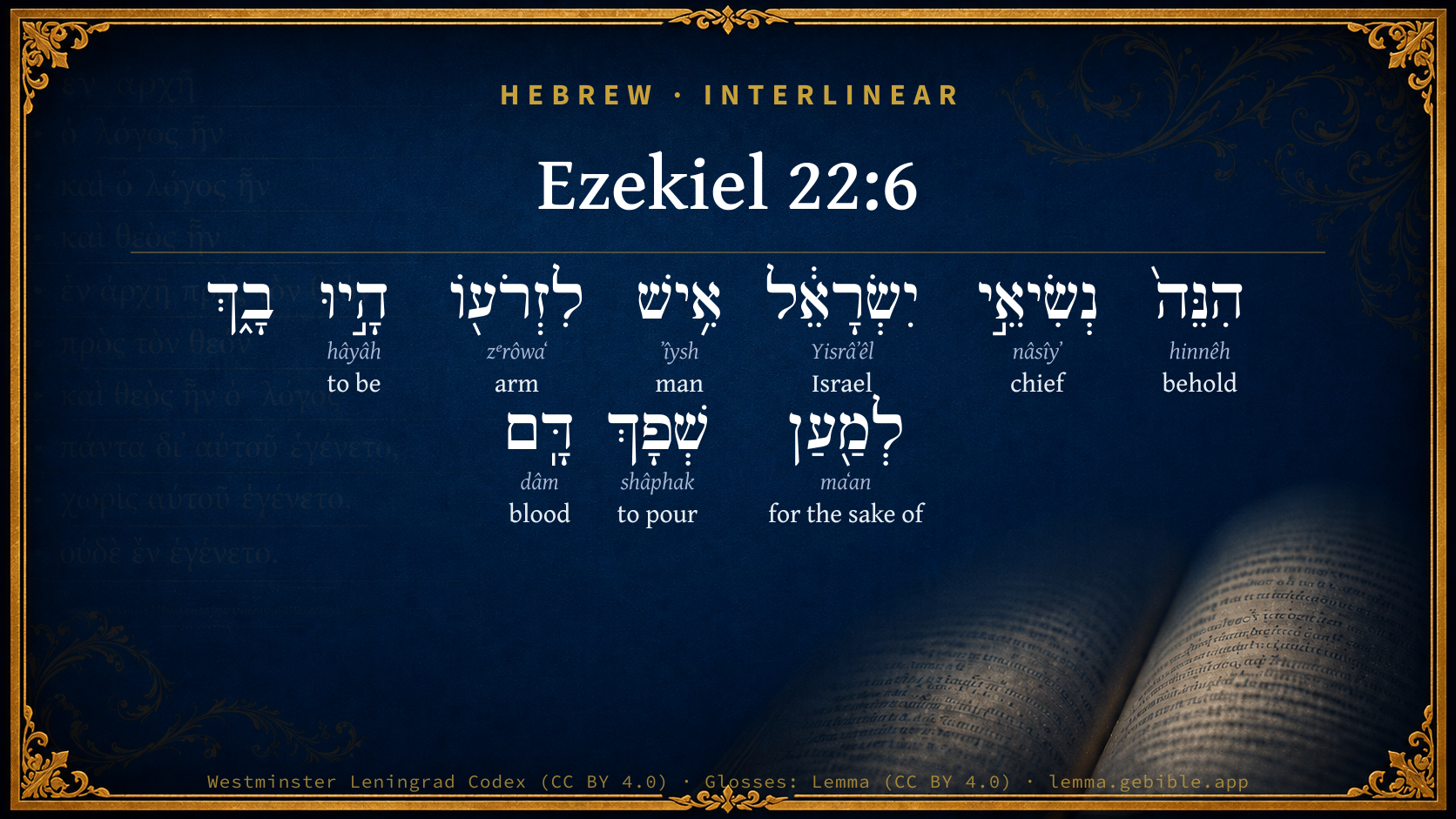
Ezekiel 22:6

Hebrew (Westminster Leningrad Codex) Ezekiel 22:6 appears in the Hebrew Old Testament. The text above is from the Westminster Leningrad Codex. Each word links to its Strong’s number, a concise gloss, and parsing drawn from the Open Scriptures Hebrew Bible morphology. Click any word for its full Brown-Driver-Briggs (BDB) entry.
Download image
Cite this verse

Ezekiel 22:6 (World English Bible). Public Domain. Lemma interlinear Bible study tool, https://lemma.gebible.app/v/ezekiel/22/6.

Show BibTeX & RIS
BibTeX
RIS
English Translation
Behold, the princes of Israel, everyone according to his power, have been in you to shed blood.
World English Bible · Public Domain
Download a study sheet

One document with this verse’s original text, its word-by-word gloss line, the meaning frame, cross-references with their text, attributed commentary, and full source and license credits — printable, and it pastes into notes with its structure intact.

This verse Autodidact and up

Study sheet (.html) Plain text (.txt)

A passage Seminary Student

Up to 50 verses in one chapter. A passage sheet keeps up to 6 commentary sources and 12 cross-references per verse, in the order this page ranks them, and says so on the sheet whenever that leaves anything out. Ask for a single verse and you get the Autodidact verse sheet above.

Everything on this page stays free to read, with no account — the sheet is a download of what is already on screen, not access to it.

Want to remove ads? Support Godless Engineer
Compare translations 3

The same verse in 3 English versions, stacked beneath the original-language interlinear above. Click any original word for its lexicon entry.

Each is an independent rendering of the whole verse — the interlinear is not word-aligned to these translations.

Highlighted words mark where these versions differ — a whole-verse word diff, not a word-by-word alignment.

  • World English Bible Public Domain
    Behold, the princes of Israel, everyone according to his power, have been in you to shed blood.
  • King James Version Public Domain
    Behold, the princes of Israel, every one were in thee to their power to shed blood.
  • unfoldingWord Literal Text CC BY-SA 4.0
    Behold! The rulers of Israel, each one by his own power, have come to you to pour out blood.

unfoldingWord Literal Text — © unfoldingWord, licensed CC BY-SA 4.0. Word-aligned USFM3 via Door43 (git.door43.org/unfoldingWord/en_ult).

Versions to compare (up to 4)

3 of 4 selected

Show all 18 translations

Every available English version of this verse, each an independent rendering of the whole verse.

  • World English Bible Public Domain
    Behold, the princes of Israel, everyone according to his power, have been in you to shed blood.
  • Berean Standard Bible Public Domain
    See how every prince of Israel within you has used his power to shed blood.
  • Majority Standard Bible Public Domain
    See how every prince of Israel within you has used his power to shed blood.
  • King James Version Public Domain
    Behold, the princes of Israel, every one were in thee to their power to shed blood.
  • American Standard Version (1901) Public Domain
    Behold, the princes of Israel, every one according to his power, have been in thee to shed blood.
  • Revised Version (1885) Public Domain
    Behold, the princes of Israel, every one according to his power, have been in thee to shed blood.
  • Geneva Bible (1599) Public Domain
    Beholde, the princes of Israel euery one in thee was ready to his power, to shed blood.
  • Douay-Rheims (1899) Public Domain
    Behold the princes of Israel, every one hath employed his arm in thee to shed blood.
  • Young's Literal Translation Public Domain
    Lo, princes of Israel -- each according to his arm Have been in thee to shed blood.
  • Literal Standard Version CC BY-SA 4.0
    Behold, princes of Israel—each according to his arm || Have been in you to shed blood.
  • Unlocked Literal Bible CC BY-SA 4.0
    Behold! The rulers of Israel, each one by his own power, have come to you to pour out blood.
  • unfoldingWord Literal Text CC BY-SA 4.0
    Behold! The rulers of Israel, each one by his own power, have come to you to pour out blood.
  • Darby Bible Public Domain
    Behold, the princes of Israel have been in thee to shed blood, each according to his power.
  • World Messianic Bible Public Domain
    “‘“Behold, the princes of Israel, everyone according to his power, have been in you to shed blood.
  • Webster's Bible Public Domain
    Behold, the princes of Israel, every one were in thee to their power to shed blood.
  • Free Bible Version CC BY-SA 4.0
    Look at how all of your leaders in Israel use their power to murder.
  • Bible in Basic English Public Domain
    See, the rulers of Israel, every one in his family, have been causing death in you.
  • JPS Tanakh (1917) Public Domain
    Behold, the princes of Israel, every one according to his might, have been in thee to shed blood.

Literal Standard Version (2020), Covenant Press — licensed CC BY-SA 4.0. Text via the HelloAO Bible API (eBible.org). Unlocked Literal Bible (unfoldingWord) — licensed CC BY-SA 4.0. Text via the HelloAO Bible API (eBible.org). unfoldingWord Literal Text — © unfoldingWord, licensed CC BY-SA 4.0. Word-aligned USFM3 via Door43 (git.door43.org/unfoldingWord/en_ult). Free Bible Version, Dr. Jonathan Gallagher — licensed CC BY-SA 4.0. Text via the HelloAO Bible API (eBible.org).

Word by word

More ways to search: Search by grammar → Find every occurrence → Compare this word →

Practice this passage: Drill this verse → Learn its vocabulary →

לִזְרֹע֖וֹ
zᵉrôwaʻ
H2220
“to/for · arm · his”
Preposition + Noun, Common, Both, Singular, Construct + Suffix, Personal, 3rd Person, Masculine, Singular
Part of Speech
Preposition + Noun
Type
Common
Gender
Both
Number
Singular
State
Construct
Full BDB Definition

Origin: from H2232

TWOT: 583a

arm, forearm, shoulder, strength - arm - arm (as symbol of strength) - forces (political and military) - shoulder (of animal sacrificed)
  1. הִנֵּה֙ hinnêh H2009 “behold” Particle, Demonstrative
  2. נְשִׂיאֵ֣י nâsîyʼ H5387 “chiefs of” Noun, Common, Masculine, Plural, Construct
  3. יִשְׂרָאֵ֔ל Yisrâʼêl H3478 “Israel” Noun, Proper
  4. אִ֥ישׁ ʼîysh H376 “man” Noun, Common, Masculine, Singular, Absolute
  5. הָ֣יוּ hâyâh H1961 “to be” Verb, Qal, Perfect, 3rd Person, Common, Plural
  6. לְמַ֖עַן maʻan H4616 “for the sake of” Preposition
  7. שְׁפָךְ shâphak H8210 “to pour” Verb, Qal, Infinitive Construct
  8. דָּֽם dâm H1818 “blood” Noun, Common, Masculine, Singular, Absolute

About this verse

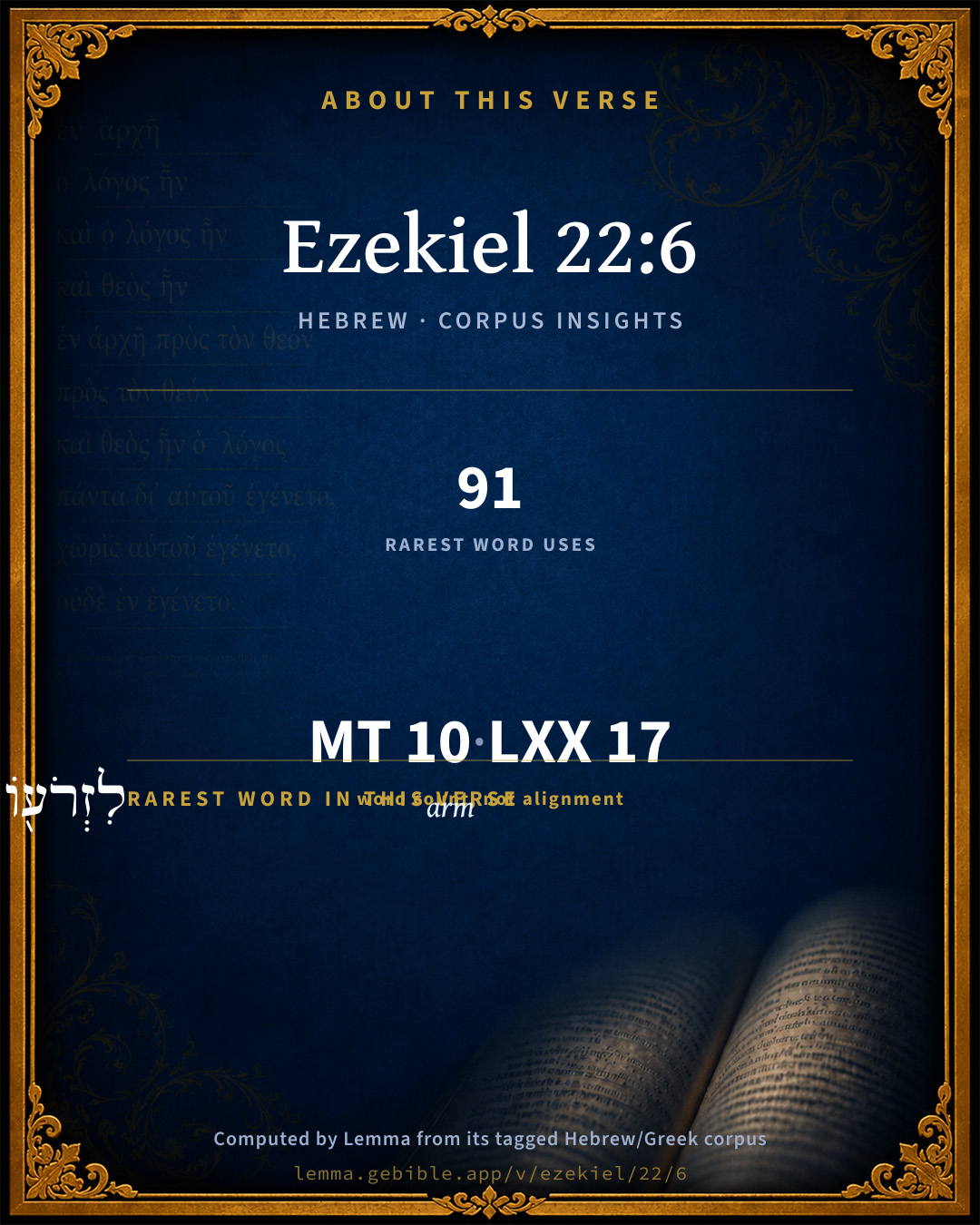
These counts appear in no published source. They are computed here, from the morphology-tagged text and Lemma’s own curated glosses. What Lemma adds →

10
words
9
distinct lemmas
Prophets
section

Grammatical profile

  • 2 verbs
  • 5 nouns
  • 2 prepositions
  • 1 particle

Verb forms

  • הָ֣יוּ Qal · Perfect
  • שְׁפָךְ Qal · Infinitive Construct

Hebrew & Septuagint length

In English translation the verse runs 17 words from the Hebrew and 22 from the Septuagint (LXX English) — closely comparable.

A rough comparison of the two English renderings, which tokenize alike — not a word-level alignment.

Word counts can differ between the Hebrew and the Greek without any difference in meaning — e.g. the Hebrew direct-object marker אֵת has no separate Greek word, and Greek often adds the article ὁ.

In the original languages it is 10 Hebrew tokens and 17 Greek tokens — but the two are counted differently (Hebrew bundles its prefixes and suffixes into one token; the Greek is in lemma form), so that isn’t a like-for-like length.

Cross-references

11

Topical passages linked to Ezekiel 22:6 in the Treasury of Scripture Knowledge — connected by theme and wording, ordered by reader-vote popularity; previews shown in the World English Bible.

  • Isaiah 1:23 Your princes are rebellious, and companions of thieves. Everyone loves bribes, and follows after rewards. They don't judge the fatherless, Neither does the cause of the widow come to them.
  • Ezekiel 22:27 Her princes in the midst of it are like wolves ravening the prey, to shed blood, [and] to destroy souls, that they may get dishonest gain.
  • Nehemiah 9:34 neither have our kings, our princes, our priests, nor our fathers, kept your law, nor listened to your commandments and your testimonies with which you did testify against them.
  • Jeremiah 2:26–27 As the thief is ashamed when he is found, so is the house of Israel ashamed; they, their kings, their princes, and their priests, and their prophets;
  • Jeremiah 5:5 I will get me to the great men, and will speak to them; for they know the way of Yahweh, and the law of their God. But these with one accord have broken the yoke, and burst the bonds.
  • Jeremiah 32:32 because of all the evil of the children of Israel and of the children of Judah, which they have done to provoke me to anger, they, their kings, their princes, their priests, and their prophets, and the men of Judah, and the inhabitants of Jerusalem.
  • Daniel 9:8 Lord, to us belongs confusion of face, to our kings, to our princes, and to our fathers, because we have sinned against you.
  • Micah 2:1 Woe to those who devise iniquity And work evil on their beds! When the morning is light, they practice it, Because it is in the power of their hand.
  • Micah 3:1–3 I said, "Please listen, you heads of Jacob, And rulers of the house of Israel: Isn't it for you to know justice?
  • Micah 3:9–11 Please listen to this, you heads of the house of Jacob, And rulers of the house of Israel, Who abhor justice, And pervert all equity.
  • Zechariah 3:3 Now Joshua was clothed with filthy garments, and was standing before the angel.

Cross-references courtesy of OpenBible.info (CC BY 4.0).

Hebrew and Greek witnesses Masoretic Hebrew ↔ Greek Septuagint

The same verse in the two great witnesses to the Old Testament, shown verse-for-verse.

These are two independent witnesses, not word-aligned to each other, and the Septuagint is shown in lemma (dictionary) form.

Hebrew Ezekiel 22:6 Masoretic · Westminster Leningrad Codex

הִנֵּה֙ נְשִׂיאֵ֣י יִשְׂרָאֵ֔ל אִ֥ישׁ לִזְרֹע֖וֹ הָ֣יוּ בָ֑ךְ לְמַ֖עַן שְׁפָךְ דָּֽם

Behold, the princes of Israel, everyone according to his power, have been in you to shed blood.

World English Bible · Public Domain

Greek LXX Ezekiel 22:6 Septuagint · lemma form

ἰδού ὁ ἀποἡγέομαι οἶκος ἰσραήλ ἕκαστος πρός ὁ συγγενής αὐτός συν ἀναφύρω ἐν σύ ὅπως ἐκχέω αἷμα

Behold, the princes of the house of Israel have conspired in you each one with his kindred, that they might shed blood.

LXX2012 (modern English Septuagint) · Public Domain

On this verse, Haydock's Catholic Bible Commentary discusses the Septuagint’s reading. Read the note in Commentary ↓

Hebrew: Westminster Leningrad Codex (CC BY 4.0). Greek: Septuagint (public domain); English from LXX2012 (modern English Septuagint) (Public Domain). How the Septuagint differs from the Hebrew →

Targum (Aramaic paraphrase)

1

The Targum is the ancient Jewish Aramaic paraphrase of the Hebrew Scriptures — an interpretive translation, not the Hebrew text itself. Onkelos (literal) and Pseudo-Jonathan (expansive) render the Torah, and Jonathan the Prophets. Coverage is partial: where no permissively-licensed English translation exists for a verse, only the Aramaic is shown. This is verse-level text, not a word-by-word alignment to the Hebrew.

  1. Targum Jonathan Prophets (Joshua–Malachi)
    הָא רַבְרְבֵי יִשְׂרָאֵל גְבַר לְתוּקְפֵיהּ הֲווֹ בִיךְ בְּדִיל לְמִשְׁפַּךְ דַם זַכַּאי:

    (no public-domain English translation for this verse)

    Targum Jonathan — Aramaic: “Mikraot Gedolot” (public domain). English: “Sefaria Community Translation” (CC0 1.0 (public-domain dedication)); “London "Chaldee Paraphrase," 1871” (public domain). Text via Sefaria.

Commentary

Notes on Ezekiel 22:6 from classic Christian and Jewish commentators (each source and its license shown beneath its notes). The classic Christian expositions comment on the surrounding passage and are grouped to its opening verse, so a note may address several verses; the Jewish commentaries on the Tanakh (Rashi and others) are per-verse, so they appear only where the commentator wrote on this verse.

Lemma curates 59 commentaries, every one of them public domain or Creative Commons licensed, each selected and text-cleaned for this edition rather than reprinted as found. About our sources →

Trapp's Complete Commentary

John Trapp

Eze 22:6 Behold, the princes of Israel, every one were in thee to their power to shed blood.

Ver. 6. Behold the princes of Israel.] Here beginneth the black bill or bed roll. And as in a fish corruption beginneth at the head, so in a nation at the rulers.

John Trapp, A Commentary or Exposition upon All the Books of the Old and New Testament (1647–1656) — public domain. Text from a community e-Sword module.

Joseph Benson's Commentary

Eze 22:6-12. Behold, the princes of Israel, &c. — Probably the members of the great sanhedrim, or the king’s counsellors and chief officers, are here intended; every one in thee — Not one to be found of a more merciful temper; to their power — According to their ability; to shed blood — Every one of the princes committed acts of violence, and shed blood, as far as he had it in his power to do it. In thee have they set light by father and mother — Disobedience to, or slighting of parents, is unnatural and brutish in itself, and had, in particular, a curse denounced against it by God’s law, Deu 27:16; so that it is here placed next to murder in the catalogue of their sins. Thou hast despised my holy things, &c. — Thou hast paid no proper regard to my holy temple, mine altars, sacrifices, feasts, and other things consecrated to my service, nor to the pure worship I appointed; but hast defiled and profaned them all by worshipping of idols together with me, and mingling heathen rites with the forms of worship which I ordered. The sabbaths, which I appointed to be set apart for my honour, thou hast, in great measure, employed in the worship and to the honour of false gods. In thee are men that carry tales to shed blood —

Who raise calumnies and depose falsehoods even so far as to take away the lives of innocent persons. In thee they eat upon the mountains — Thy inhabitants sacrifice, and feast upon the sacrifices, in the mountains, in honour of idols or false gods. In the midst of thee they commit lewdness — And that in the most scandalous instances. In thee have they discovered their fathers’ nakedness — Have defiled their fathers’ beds, or taken their mothers-in-law for wives, called by St. Paul, such fornication as is not named among the Gentiles. In thee have they taken gifts to shed blood — Thy judges have taken bribes, not only to pervert justice, but even to take away the lives of the innocent.

Joseph Benson's Commentary on the Old and New Testaments (1811–1818) — public domain. Text from a community e-Sword module.

Tyndale Open Study Notes

Tyndale Open Resources

22:6-12 These charges against the people of Judah and their leaders were all drawn from God’s law, especially from Lev 18–20; 25:1-55. Israel’s many sins represented a wider failure to honor and trust the Lord and his commands. Such unfaithfulness to their covenant with the Lord could have only one result: The people of Israel would experience the covenant curses (Deut 8:19-20; 28:15-68).

Tyndale Open Study Notes — © Tyndale Open Resources, licensed CC BY-SA 4.0. Text via the HelloAO Bible API.

Jamieson, Fausset & Brown

Robert Jamieson, A. R. Fausset & David Brown

Rather, "The princes . . . each according to his power, were in thee, to shed blood" (as if this was the only object of their existence). "Power," literally, "arm"; they, who ought to have been patterns of justice, made their own arm of might their only law.

Jamieson, Fausset & Brown — Commentary Critical and Explanatory on the Whole Bible (1871) — public domain (CC PDM 1.0). Text via the HelloAO Bible API.

Adam Clarke's Commentary

Verse 6. Behold, the princes] Ye are a vile and murderous people, and your princes have been of the same character. Like people, like prince.

Adam Clarke's Commentary on the Bible (1810–1826) — public domain. Text from a community e-Sword/MySword module.

Ellicott's Commentary for English Readers

(6) Were in thee to their power.—The tense is the same with that of the verbs in Eze_22:7, and both should be translated alike; the order of the words should also be changed: “The princes of Israel, every one according to his power, have been in thee to shed blood.” The rulers, who should have preserved order and administered justice, were foremost in deeds of violence. (See the instances of Manasseh, 2Ki_21:16, and of Jehoiakim, 2Ki_24:4.)

A Bible Commentary for English Readers, edited by Charles John Ellicott (1878–1897) — public domain. Text from a community e-Sword module.

The Cambridge Bible for Schools and Colleges

gen. ed. J. J. S. Perowne

6–12. Particular enumeration of Jerusalem’s sins

6. The “princes” are those of the royal house.

were … to their power] have been high-handed in thee, to shed. The meaning is not that they shed blood to the utmost of their power, but that they were arbitrary; their power, lit. arm, was the only law.

The Cambridge Bible for Schools and Colleges (gen. ed. J. J. S. Perowne; Cambridge University Press, 1878–1918) — public domain. Text from a community e-Sword module.

John Gill's Exposition

Behold, the princes of Israel,.... Those that belonged to the royal family, or the nobles of the land, or the members of the grand sanhedrim of the nation:

everyone were in thee to their power to shed blood; everyone exerted himself to the uttermost, according to his ability, to shed blood, or cause it to be shed; everyone strove, as it were, who should shed most, to exceed each other in this abominable sin.

John Gill's Exposition of the Whole Bible (1746–1763) — public domain (CC PDM 1.0). Text via the HelloAO Bible API.

Albert Barnes' Notes on the Bible

Render it: Behold the princes of Israel, each according to his might (literally “arm”) have been in thee in order to shed blood. They looked to might not right.

Albert Barnes' Notes on the Bible (1834–1885) — public domain. Text from a community e-Sword/MySword module.

Haydock's Catholic Bible Commentary

Hath. Septuagint, "was mixed with his relations," ver. 10., &c., (Haydock) fighting against them. (Theodoret)

George Leo Haydock (1774–1849), Haydock's Catholic Family Bible and Commentary, 1859 edition — public domain. Excludes Psalms (Douay-Rheims chapter numbering differs from Protestant) and Deuterocanonical books (Catholic canon only).

Matthew Poole's English Annotations

He was in Eze 23:2 commanded to show the Jews all their abominations. Now he is directed to begin with the greatest first, either those of the royal family, or else such as adhered close to the interest of them, and were advanced to places of great trust; or, who were heads of families.

Every one; not one to be found of a juster or more merciful temper.

To their power; according to their ability and opportunity.

To shed blood; for murdering all they hated, or that stood in their way.

Matthew Poole's English Annotations on the Holy Bible (1683–1685) — public domain. Text from a community e-Sword/MySword module.

Whedon's Commentary on the Bible

Daniel D. Whedon

6. To their power — Literally, each according to his arm.

Daniel D. Whedon (gen. ed.), Commentary on the Old and New Testaments (1874–1909) — public domain. Text from a community e-Sword module.

The Pulpit Commentary

Behold, the princes of Judah, etc. For the "bloodshed," which was conspicuous among the sins, comp. Eze_9:9 Eze_16:38 Eze_23:37, Eze_23:45; and for special instances of that sin among its princes, those of Manasseh (2Ki_21:16) and Jehoiakim. (2Ki_24:4) To their power; Hebrew, each man according to his arm, i.e. his strength. There was no restraint upon the doer of evil other than the limitation of his capacity.

The Pulpit Commentary (1880–1919), ed. H.D.M. Spence-Jones & Joseph S. Exell — public domain. Text from a community e-Sword module.

John Wesley's Explanatory Notes

Everyone - Not one to be found of a more merciful temper. To their power - According to their ability.

John Wesley, Explanatory Notes Upon the Whole Bible (1754–1765) — public domain. Text via the GEBible commentary corpus.

unfoldingWord translationNotes

Door43 World Missions Community

General Information:

Yahweh speaking about the ruler of Israel in Jerusalem.

Behold

"Look" or "Listen" or "Pay attention to what I am about to tell you"

each one by his own power, have come

"have each used their authority to come to you."

come to you ... in your midst

"come to your city ... within your city." The words "you" and "your" refer to Jerusalem.

to pour out blood

This speaks of murdering people as pouring out blood. AT: "to murder people" (See: Metaphor)

They have dishonored fathers and mothers within you

"The people of Jerusalem have dishonored their fathers and mothers." The word "they" refers to the people in Jerusalem.

performed oppression

"oppressed"

they eat on the mountains

Here "the mountains" refer to the altars on the mountains that are dedicated to idols. They men eat meat that has been sacrificed to the idols in order to be have the blessing of false gods. AT: "they eat the meat that has been sacrificed to idols" (See: Assumed Knowledge and Implicit Information)

perform wickedness in your midst

"do evil things among you"

translationWords

rule

Israel

power

dishonor

oppress

alien

holy

profane

Sabbath

slander

evil

unfoldingWord translationNotes — © Distant Shores Media and the Door43 World Missions Community, licensed CC BY-SA 4.0. Source: git.door43.org/Door43/en_tn.

Rashi

Rabbi Shlomo Yitzchaki (Rashi)

each one by his own arm Whoever was stronger overpowered [the other].

Rashi on the Tanakh — English translations: “The Judaica Press complete Tanach with Rashi, translated by A. J. Rosenberg” (CC BY 4.0); “Pentateuch with Rashi's commentary by M. Rosenbaum and A.M. Silbermann, 1929-1934” (public domain); “The Metsudah Tanach series, Lakewood, N.J” (CC BY 4.0); and “The Book of Joshua, Metsudah Publications, 1997” (CC BY 4.0). Text via Sefaria.

Lesson kit

Teaching starters — assembled from the data on this page, not authored interpretation. Every prompt links to the verse data it draws on. Edit before teaching.

Ezekiel, in the Prophets, opens this verse with 10 words (9 distinct Hebrew lemmas). Its most distinctive word is zᵉrôwaʻ (“arm”). A historical commentator’s framing appears above. Read the whole chapter for the surrounding context.

Discussion questions

  1. How does “arm” (zᵉrôwaʻ) shape what this verse is saying?
  2. How does Isaiah 1:23, which shares this passage’s theme, read alongside this verse?
  3. These translations render this verse differently. What is at stake in choosing one wording over another?
  4. «הָ֣יוּ» is a Qal Perfect verb. How does that grammatical form shape the action described?
  5. Compare how Trapp's Complete Commentary and Joseph Benson's Commentary read this verse. Where do they agree or differ?

Things to notice

Reading settings

Reading text

Shown beneath each verse's original-language words.

Old Testament
Old Testament edition

Read the OT as the Masoretic Hebrew (MT) or the Greek Septuagint (LXX).

English shown for the Greek Septuagint (in the Hebrew ↔ Greek comparison).

Comparing translations? Open the Compare panel on any verse page to stack up to four side by side.