
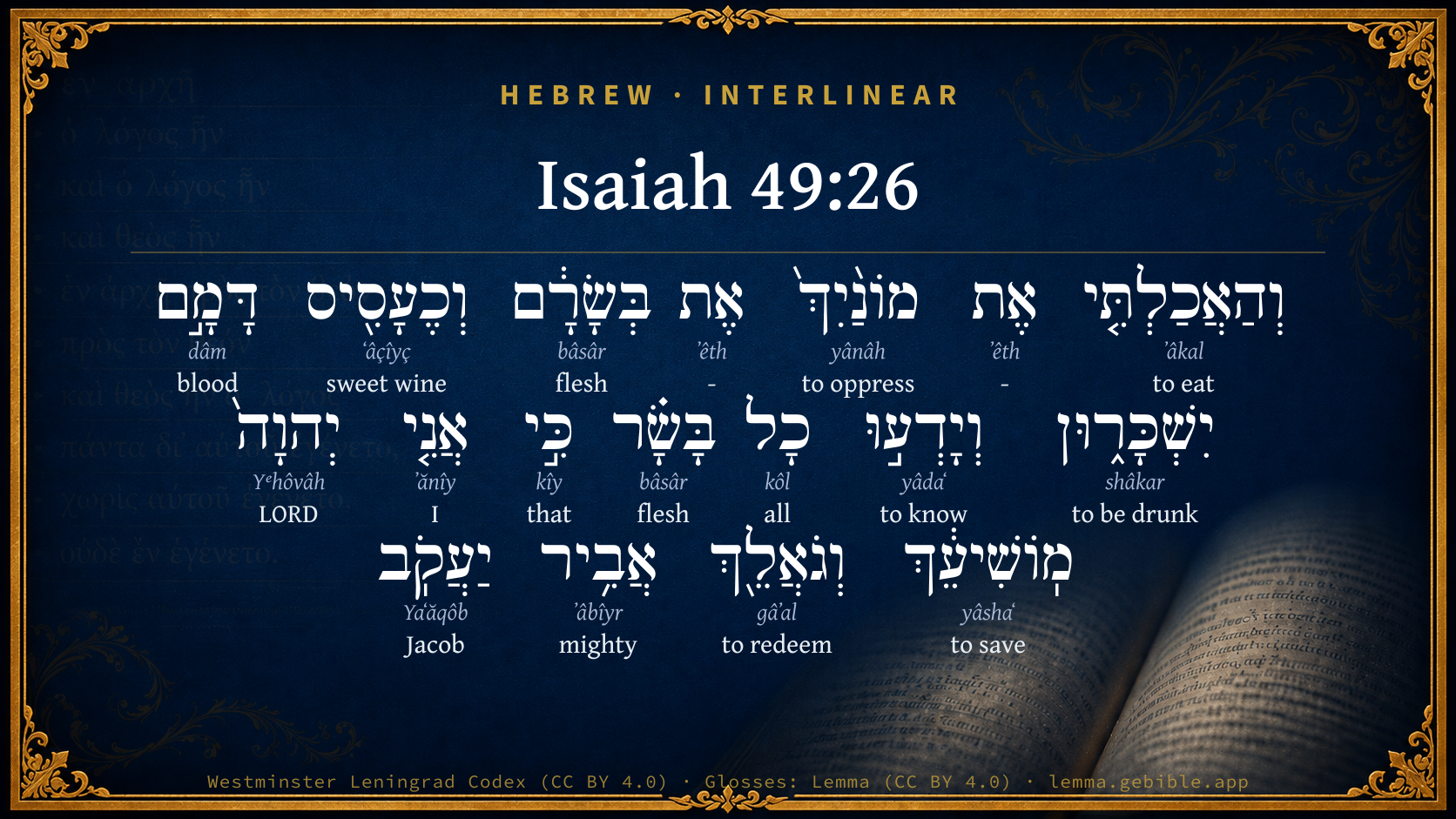
Isaiah 49:26

Hebrew (Westminster Leningrad Codex) Isaiah 49:26 appears in the Hebrew Old Testament. The text above is from the Westminster Leningrad Codex. Each word links to its Strong’s number, a concise gloss, and parsing drawn from the Open Scriptures Hebrew Bible morphology. Click any word for its full Brown-Driver-Briggs (BDB) entry.
Download image
Cite this verse

Isaiah 49:26 (World English Bible). Public Domain. Lemma interlinear Bible study tool, https://lemma.gebible.app/v/isaiah/49/26.

Show BibTeX & RIS
BibTeX
RIS
English Translation
I will feed those who oppress you with their own flesh; and they shall be drunken with their own blood, as with sweet wine: and all flesh shall know that I, Yahweh, am your Savior, and your Redeemer, the Mighty One of Jacob.
World English Bible · Public Domain
Download a study sheet

One document with this verse’s original text, its word-by-word gloss line, the meaning frame, cross-references with their text, attributed commentary, and full source and license credits — printable, and it pastes into notes with its structure intact.

This verse Autodidact and up

Study sheet (.html) Plain text (.txt)

A passage Seminary Student

Up to 50 verses in one chapter. A passage sheet keeps up to 6 commentary sources and 12 cross-references per verse, in the order this page ranks them, and says so on the sheet whenever that leaves anything out. Ask for a single verse and you get the Autodidact verse sheet above.

Everything on this page stays free to read, with no account — the sheet is a download of what is already on screen, not access to it.

Want to remove ads? Support Godless Engineer
Compare translations 3

The same verse in 3 English versions, stacked beneath the original-language interlinear above. Click any original word for its lexicon entry.

Each is an independent rendering of the whole verse — the interlinear is not word-aligned to these translations.

Highlighted words mark where these versions differ — a whole-verse word diff, not a word-by-word alignment.

  • World English Bible Public Domain
    I will feed those who oppress you with their own flesh; and they shall be drunken with their own blood, as with sweet wine: and all flesh shall know that I, Yahweh, am your Savior, and your Redeemer, the Mighty One of Jacob.
  • King James Version Public Domain
    And I will feed them that oppress thee with their own flesh; and they shall be drunken with their own blood, as with sweet wine: and all flesh shall know that I the LORD am thy Saviour and thy Redeemer, the mighty One of Jacob.
  • unfoldingWord Literal Text CC BY-SA 4.0
    And I will make your oppressors eat their flesh, and they will become drunk their blood as new wine. And all flesh will know that I, Yahweh, your Savior and your Redeemer, the Mighty One of Jacob.”

unfoldingWord Literal Text — © unfoldingWord, licensed CC BY-SA 4.0. Word-aligned USFM3 via Door43 (git.door43.org/unfoldingWord/en_ult).

Versions to compare (up to 4)

3 of 4 selected

Show all 18 translations

Every available English version of this verse, each an independent rendering of the whole verse.

  • World English Bible Public Domain
    I will feed those who oppress you with their own flesh; and they shall be drunken with their own blood, as with sweet wine: and all flesh shall know that I, Yahweh, am your Savior, and your Redeemer, the Mighty One of Jacob.
  • Berean Standard Bible Public Domain
    I will make your oppressors eat their own flesh; they will be drunk on their own blood, as with wine. Then all mankind will know that I, the LORD, am your Savior and your Redeemer, the Mighty One of Jacob.”
  • Majority Standard Bible Public Domain
    I will make your oppressors eat their own flesh; they will be drunk on their own blood, as with wine. Then all mankind will know that I, the LORD, am your Savior and your Redeemer, the Mighty One of Jacob.”
  • King James Version Public Domain
    And I will feed them that oppress thee with their own flesh; and they shall be drunken with their own blood, as with sweet wine: and all flesh shall know that I the LORD am thy Saviour and thy Redeemer, the mighty One of Jacob.
  • American Standard Version (1901) Public Domain
    And I will feed them that oppress thee with their own flesh; and they shall be drunken with their own blood, as with sweet wine: and all flesh shall know that I, Jehovah, am thy Saviour, and thy Redeemer, the Mighty One of Jacob.
  • Revised Version (1885) Public Domain
    And I will feed them that oppress thee with their own flesh; and they shall be drunken with their own blood, as with sweet wine: and all flesh shall know that I the LORD am thy saviour, and thy redeemer, the Mighty One of Jacob.
  • Geneva Bible (1599) Public Domain
    And will feede them that spoile thee, with their owne flesh, and they shall be drunken with their owne bloode, as with sweete wine: and all flesh shall know that I the Lord am thy sauiour and thy redeemer, the mighty one of Iaakob.
  • Douay-Rheims (1899) Public Domain
    And I will feed thy enemies with their own flesh: and they shall be made drunk with their own blood, as with new wine: and all flesh shall know, that I am the Lord that save thee, and thy Redeemer the Mighty One of Jacob.
  • Young's Literal Translation Public Domain
    And I have caused thine oppressors to eat their own flesh, And as new wine they drink their own blood, And known have all flesh that I, Jehovah, Thy saviour, and thy redeemer, `Am' the Mighty One of Jacob!'
  • Literal Standard Version CC BY-SA 4.0
    And I have caused your oppressors to eat their own flesh, || And they drink their own blood as new wine, || And all flesh has known that I, YHWH, || Your Savior, and your Redeemer, || [Am] the Mighty One of Jacob!”
  • Unlocked Literal Bible CC BY-SA 4.0
    I will feed your oppressors with their own flesh; and they will get drunk on their own blood, as if it were wine. Then all mankind will know that I, Yahweh, am your Savior and your Redeemer, the Mighty One of Jacob.”
  • unfoldingWord Literal Text CC BY-SA 4.0
    And I will make your oppressors eat their flesh, and they will become drunk their blood as new wine. And all flesh will know that I, Yahweh, your Savior and your Redeemer, the Mighty One of Jacob.”
  • Darby Bible Public Domain
    And I will feed them that oppress thee with their own flesh; and they shall be drunken with their own blood, as with new wine. And all flesh shall know that I, Jehovah, [am] thy Saviour and thy Redeemer, the Mighty One of Jacob.
  • World Messianic Bible Public Domain
    I will feed those who oppress you with their own flesh; and they will be drunk on their own blood, as with sweet wine. Then all flesh shall know that I, the LORD, am your Savior and your Redeemer, the Mighty One of Jacob.”
  • Webster's Bible Public Domain
    And I will feed them that oppress thee with their own flesh; and they shall be drunken with their own blood, as with sweet wine: and all flesh shall know that I the LORD am thy Savior and thy Redeemer, the mighty One of Jacob.
  • Free Bible Version CC BY-SA 4.0
    I will make your oppressors eat their own flesh and drink their own blood like wine. Then everyone will know that I, the Lord, am your Savior and Redeemer, the Mighty One of Israel.
  • Bible in Basic English Public Domain
    And the flesh of your attackers will be taken by themselves for food; and they will take their blood for drink, as if it was sweet wine: and all men will see that I the Lord am your saviour, even he who takes up your cause, the Strong One of Jacob.
  • JPS Tanakh (1917) Public Domain
    And I will feed them that oppress thee with their own flesh; and they shall be drunken with their own blood, as with sweet wine; and all flesh shall know that I the LORD am thy Saviour, and thy Redeemer, the Mighty One of Jacob.

Literal Standard Version (2020), Covenant Press — licensed CC BY-SA 4.0. Text via the HelloAO Bible API (eBible.org). Unlocked Literal Bible (unfoldingWord) — licensed CC BY-SA 4.0. Text via the HelloAO Bible API (eBible.org). unfoldingWord Literal Text — © unfoldingWord, licensed CC BY-SA 4.0. Word-aligned USFM3 via Door43 (git.door43.org/unfoldingWord/en_ult). Free Bible Version, Dr. Jonathan Gallagher — licensed CC BY-SA 4.0. Text via the HelloAO Bible API (eBible.org).

Word by word

More ways to search: Search by grammar → Find every occurrence → Compare this word →

Practice this passage: Drill this verse → Learn its vocabulary →

וְכֶעָסִ֖יס
ʻâçîyç
H6071
“and · like/as the · sweet wine”
Conjunction + Preposition, Determined + Noun, Common, Masculine, Singular, Absolute
Part of Speech
Conjunction + Preposition + Noun
Type
Common
Gender
Masculine
Number
Singular
State
Absolute
Full BDB Definition

Origin: from H6072

TWOT: 1660a

sweet wine, wine, pressed out juice
  1. וְהַאֲכַלְתִּ֤י ʼâkal H398 “and · to eat” Conjunction + Verb, Hiphil, Sequential Perfect, 1st Person, Common, Singular
  2. אֶת ʼêth H853 “-” Particle, Direct Object
  3. מוֹנַ֨יִךְ֙ yânâh H3238 “oppressing · you” Verb, Hiphil, Participle Active, Masculine, Plural, Construct + Suffix, Personal, 2nd Person, Feminine, Singular
  4. אֶת ʼêth H853 “-” Particle, Direct Object
  5. בְּשָׂרָ֔ם bâsâr H1320 “flesh · their” Noun, Common, Masculine, Singular, Construct + Suffix, Personal, 3rd Person, Masculine, Plural
  6. דָּמָ֣ם dâm H1818 “blood · their” Noun, Common, Masculine, Singular, Construct + Suffix, Personal, 3rd Person, Masculine, Plural
  7. יִשְׁכָּר֑וּן shâkar H7937 “to be drunk” Verb, Qal, Imperfect, 3rd Person, Masculine, Plural + Suffix, n
  8. וְיָדְע֣וּ yâdaʻ H3045 “and · to know” Conjunction + Verb, Qal, Sequential Perfect, 3rd Person, Common, Plural
  9. כָל kôl H3605 “all of” Noun, Common, Masculine, Singular, Construct
  10. בָּשָׂ֗ר bâsâr H1320 “flesh” Noun, Common, Masculine, Singular, Absolute
  11. כִּ֣י kîy H3588 “that” Conjunction
  12. אֲנִ֤י ʼănîy H589 “I” Pronoun, Personal, 1st Person, Common, Singular
  13. יְהוָה֙ Yᵉhôvâh H3068 “LORD” Noun, Proper
  14. מֽוֹשִׁיעֵ֔ךְ yâshaʻ H3467 “saving · you” Verb, Hiphil, Participle Active, Masculine, Singular, Construct + Suffix, Personal, 2nd Person, Feminine, Singular
  15. וְגֹאֲלֵ֖ךְ gâʼal H1350 “and · redeeming · you” Conjunction + Verb, Qal, Participle Active, Masculine, Singular, Construct + Suffix, Personal, 2nd Person, Feminine, Singular
  16. אֲבִ֥יר ʼâbîyr H46 “mighty of” Adjective, Adjective, Masculine, Singular, Construct
  17. יַעֲקֹֽב Yaʻăqôb H3290 “Jacob” Noun, Proper

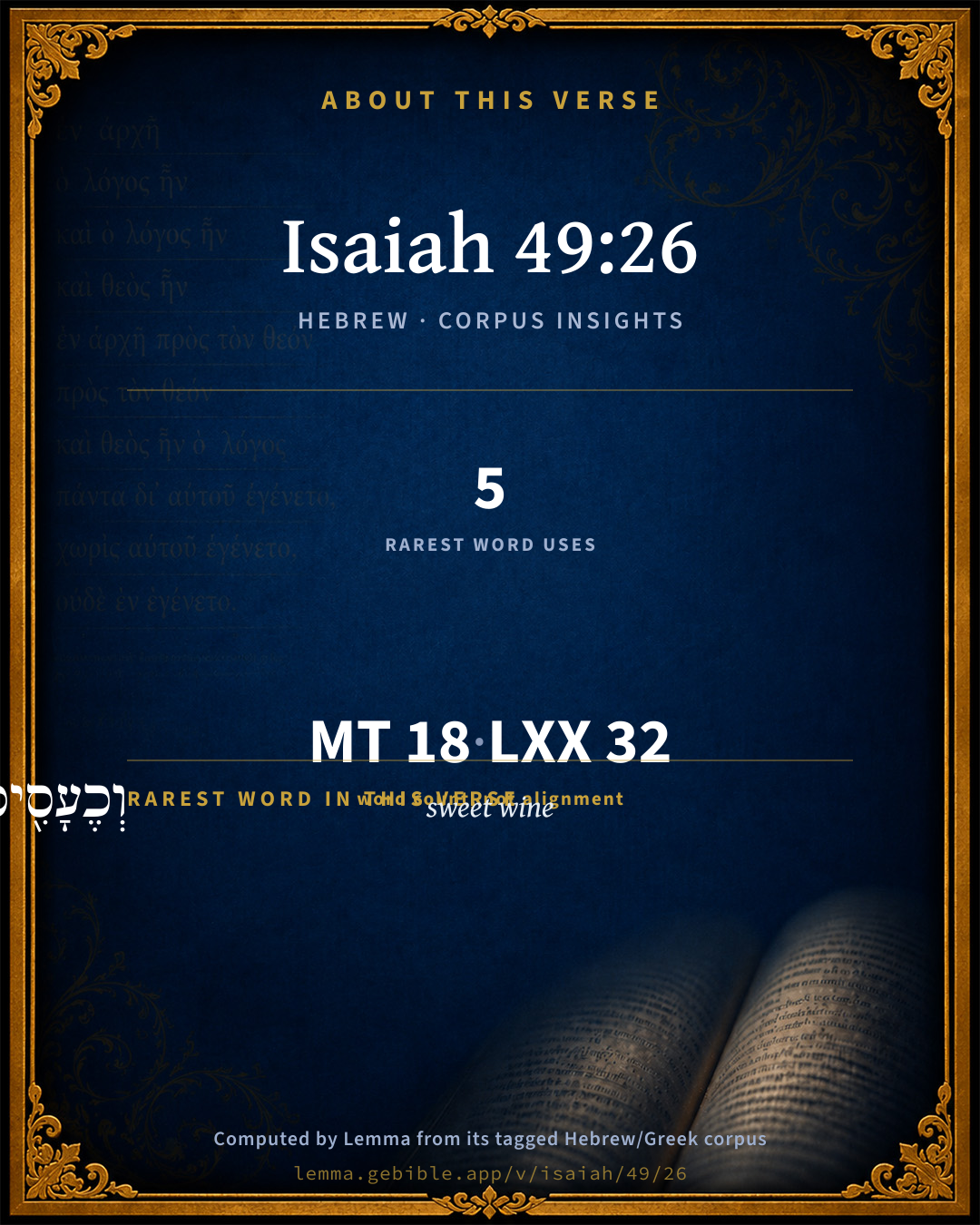
About this verse

These counts appear in no published source. They are computed here, from the morphology-tagged text and Lemma’s own curated glosses. What Lemma adds →

18
words
16
distinct lemmas
Prophets
section

Notable vocabulary

The rarest word here is וְכֶעָסִ֖יס sweet wine H6071 — appearing just 5 times in the whole Hebrew Bible.

Shared distinctive vocabulary

וְכֶעָסִ֖יס sweet wine H6071 occurs in 5 verses of the Hebrew Bible. Also found in:

Grammatical profile

  • 6 verbs
  • 7 nouns
  • 1 adjective
  • 1 pronoun
  • 1 conjunction
  • 2 particles

Verb forms

  • וְהַאֲכַלְתִּ֤י Hiphil · Sequential Perfect
  • מוֹנַ֨יִךְ֙ Hiphil · Participle Active
  • יִשְׁכָּר֑וּן Qal · Imperfect
  • וְיָדְע֣וּ Qal · Sequential Perfect
  • מֽוֹשִׁיעֵ֔ךְ Hiphil · Participle Active
  • וְגֹאֲלֵ֖ךְ Qal · Participle Active

Repetition

A word recurs within this verse — often emphatic in Hebrew:

  • בְּשָׂרָ֔ם flesh H1320 ×2

Hebrew & Septuagint length

In English translation the verse runs 43 words from the Hebrew and 44 from the Septuagint (LXX English) — closely comparable.

A rough comparison of the two English renderings, which tokenize alike — not a word-level alignment.

Word counts can differ between the Hebrew and the Greek without any difference in meaning — e.g. the Hebrew direct-object marker אֵת has no separate Greek word, and Greek often adds the article ὁ.

In the original languages it is 18 Hebrew tokens and 32 Greek tokens — but the two are counted differently (Hebrew bundles its prefixes and suffixes into one token; the Greek is in lemma form), so that isn’t a like-for-like length.

Cross-references

15

Topical passages linked to Isaiah 49:26 in the Treasury of Scripture Knowledge — connected by theme and wording, ordered by reader-vote popularity; previews shown in the World English Bible.

  • Isaiah 9:20 One shall snatch on the right hand, and be hungry; and he shall eat on the left hand, and they shall not be satisfied: they shall eat every man the flesh of his own arm:
  • Isaiah 41:14–20 Don't be afraid, you worm Jacob, and you men of Israel; I will help you, says Yahweh, and your Redeemer is the Holy One of Israel.
  • Isaiah 9:4 For the yoke of his burden, and the staff of his shoulder, the rod of his oppressor, you have broken as in the day of Midian.
  • Revelation 16:6 For they poured out the blood of the saints and the prophets, and you have given them blood to drink. They deserve this."
  • Psalms 9:16 Yahweh has made himself known. He has executed judgment. The wicked is snared by the work of his own hands. Meditation. Selah.
  • Isaiah 43:3 For I am Yahweh your God, the Holy One of Israel, your Savior; I have given Egypt as your ransom, Ethiopia and Seba in your place.
  • Isaiah 60:16 You shall also suck the milk of the nations, and shall suck the breast of kings; and you shall know that I, Yahweh, am your Savior, and your Redeemer, the Mighty One of Jacob.
  • Ezekiel 39:7 My holy name will I make known in the midst of my people Israel; neither will I allow my holy name to be profaned any more: and the nations shall know that I am Yahweh, the Holy One in Israel.
  • Psalms 58:10–11 The righteous shall rejoice when he sees the vengeance. He shall wash his feet in the blood of the wicked;
  • Judges 7:22 They blew the three hundred trumpets, and Yahweh set every man's sword against his fellow, and against all the host; and the host fled as far as Beth-shittah toward Zererah, as far as the border of Abel Meholah, by Tabbath.
  • Psalms 83:18 That they may know that you alone, whose name is Yahweh, Are the Most High over all the earth.
  • Isaiah 45:6 that they may know from the rising of the sun, and from the west, that there is none besides me: I am Yahweh, and there is no one else.
  • Revelation 14:20 The winepress was trodden outside of the city, and blood came out from the winepress, even to the bridles of the horses, as far as one thousand six hundred stadia.
  • Revelation 17:6 I saw the woman drunken with the blood of the saints, and with the blood of the martyrs of Jesus. When I saw her, I wondered with great amazement.
  • Revelation 15:3–4 They sang the song of Moses, the servant of God, and the song of the Lamb, saying, "Great and marvelous are your works, Lord God, the Almighty; Righteous and true are your ways, you King of the nations.

Cross-references courtesy of OpenBible.info (CC BY 4.0).

Hebrew and Greek witnesses Masoretic Hebrew ↔ Greek Septuagint

The same verse in the two great witnesses to the Old Testament, shown verse-for-verse.

These are two independent witnesses, not word-aligned to each other, and the Septuagint is shown in lemma (dictionary) form.

Hebrew Isaiah 49:26 Masoretic · Westminster Leningrad Codex

וְהַאֲכַלְתִּ֤י אֶת מוֹנַ֨יִךְ֙ אֶת בְּשָׂרָ֔ם וְכֶעָסִ֖יס דָּמָ֣ם יִשְׁכָּר֑וּן וְיָדְע֣וּ כָל בָּשָׂ֗ר כִּ֣י אֲנִ֤י יְהוָה֙ מֽוֹשִׁיעֵ֔ךְ וְגֹאֲלֵ֖ךְ אֲבִ֥יר יַעֲקֹֽב

I will feed those who oppress you with their own flesh; and they shall be drunken with their own blood, as with sweet wine: and all flesh shall know that I, Yahweh, am your Savior, and your Redeemer, the Mighty One of Jacob.

World English Bible · Public Domain

Greek LXX Isaiah 49:26 Septuagint · lemma form

καί ἐσθίω ὁ θλίβω σύ ὁ σάρξ αὐτός καί πίνω ὡς οἶνος νέος ὁ αἷμα αὐτός καί μεθύω καί αἰσθάνομαι πᾶς σάρξ ὅτι ἐγώ κύριος ὁ ῥύομαι σύ καί ἀντιλαμβάνω ἰσχύς ἰακώβ

And they that afflicted you shall eat their own flesh; and they shall drink their own blood as new wine, and shall be drunken: and all flesh shall perceive that I am the Lord that delivers you, and that upholds the strength of Jacob.

LXX2012 (modern English Septuagint) · Public Domain

On this verse, Albert Barnes' Notes on the Bible discusses the Septuagint’s reading. Read the note in Commentary ↓

Hebrew: Westminster Leningrad Codex (CC BY 4.0). Greek: Septuagint (public domain); English from LXX2012 (modern English Septuagint) (Public Domain). How the Septuagint differs from the Hebrew →

Targum (Aramaic paraphrase)

1

The Targum is the ancient Jewish Aramaic paraphrase of the Hebrew Scriptures — an interpretive translation, not the Hebrew text itself. Onkelos (literal) and Pseudo-Jonathan (expansive) render the Torah, and Jonathan the Prophets. Coverage is partial: where no permissively-licensed English translation exists for a verse, only the Aramaic is shown. This is verse-level text, not a word-by-word alignment to the Hebrew.

  1. Targum Jonathan Prophets (Joshua–Malachi)
    וְאֶתֵּן יַת בְּסַר דַהֲווֹ מוֹנָן לִיךְ מֵיכַל לְכָל עוֹפָא דִשְׁמַיָא וּכְמָא דְמִתְרַוָן מֵחֲמַר מְרֵית כֵּן חַיַת בְּרָא מִדִמְהוֹן תִּתְרַוֵי וְיֵדְעוּן כָּל בִּסְרָא אֲרֵי אֲנָא יְיָ פָּרְקִיךְ וּמְשֵׁיזְבִיךְ תַּקִיפָא דְיַעֲקֹב:

    And I will give the flesh of them who oppress thee for food to every fowl of the heavens, and as they are drunken with new wine, so the beasts of the field shall be drunk with their blood, and all flesh shall know, that I, the Lord, am thy Saviour and thy Redeemer, the mighty One of Jacob.

    Targum Jonathan — Aramaic: “Mikraot Gedolot” (public domain). English: “Sefaria Community Translation” (CC0 1.0 (public-domain dedication)); “London "Chaldee Paraphrase," 1871” (public domain). Text via Sefaria.

Commentary

Notes on Isaiah 49:26 from classic Christian and Jewish commentators (each source and its license shown beneath its notes). The classic Christian expositions comment on the surrounding passage and are grouped to its opening verse, so a note may address several verses; the Jewish commentaries on the Tanakh (Rashi and others) are per-verse, so they appear only where the commentator wrote on this verse.

Lemma curates 59 commentaries, every one of them public domain or Creative Commons licensed, each selected and text-cleaned for this edition rather than reprinted as found. About our sources →

Trapp's Complete Commentary

John Trapp

Isa 49:26 And I will feed them that oppress thee with their own flesh; and they shall be drunken with their own blood, as with sweet wine: and all flesh shall know that I the LORD [am] thy Saviour and thy Redeemer, the mighty One of Jacob.

Ver. 26. And I will feed them that oppress thee with their own flesh.] Which yet "no man ever hated, but nourisheth and cherisheth it." {Eph 5:29} But Zion’s enemies should one destroy another, and be put to such straits as the Jews were in the siege of their city by Titus, that they fed upon their own flesh, and the flesh of their children. {a} So hard a thing it is "to kick against the pricks"; quae in coelum expuunt, in faciem ipsorum recidunt.

And they shall be drunk with their own blood.] Yea, drowned in it, as was Attila king of Huns, {b} Felix, Count of Wartenburg, a great warrior and bloody persecutor of the Lutherans, who was choked in his own blood, and Charles IX of France, to whom a certain poet thus rightly speaketh,

“ Naribus, ore, oculis, atque auribus undique, et ano,

Et pene, erumpit qui tibi, Carle, cruor,

Non tuus iste cruor, sanctorum at caede cruorem

Quem ferns hausisti, concoquere haud poteras. ”

{a} Alterum ut alterius mactatum sanguine cernas.

{b} Flac. Illyr.

John Trapp, A Commentary or Exposition upon All the Books of the Old and New Testament (1647–1656) — public domain. Text from a community e-Sword module.

The Biblical Illustrator

Joseph S. Exell

Isa_49:26

And I will feed them that oppress thee with their own flesh.

Self-destruction

Here is a terrible picture of retributive justice. But the words represent a general principle, which is universal, in the punishment of sin. The sinner is his own avenger.

I. TAKE THE DRUNKARD. He is drinking the poison, but is he not at the same time drinking his own life, and consuming his own happiness and peace?

II. TAKE THE SPENDTHRIFT. He spends his money, but at the same time eats and drinks his existence, his fortune, his home, his happiness.

III. TAKE THE TYRANT. He who wins his throne with blood shall lose it in blood. No one who fights can be without foes, and if he has conquered them at first they will only await their opportunity and in turn conquer him. How few who have raised themselves by the sword have not died by the sword!

IV. TAKE THE OPPRESSORS OF THE CHRISTIAN. They think they injure God's people. How does God avenge His elect? By causing them to feed on their own selves--the bitterness of conscience, the remorse of evil doing. These are the portion of the oppressors. (Homilist.)

All flesh shall know that I, the Lord, am thy Saviour

An all-sufficient Deliverer

I. A WORLD-WIDE NEED.

II. AN ALL-SUFFICIENT DELIVERER. (J. Smith, D.D.)

The safety of the Church

1. God is the Protector of the Church, and no weapon formed against her shall prosper.

2. The Churchs enemies shall be distracted in their counsels, and left to anarchy and overthrow.

3. The Church shall rise resplendent from all her persecutions, and shall prosper ultimately, just in proportion to their efforts to destroy it. (A. Barnes, D.D)

.

The Biblical Illustrator, edited by Joseph S. Exell (c. 1880s–1900s) — public domain. Text from a community e-Sword module.

Geneva Bible (1599)

Geneva Bible translators

I will cause them to destroy one another, as Judg. 7:22; 2 Chron. 20:22; Isa. 19:2.

Geneva Bible (1599) marginal notes — public domain. Text via Bolls.life.

Jamieson, Fausset & Brown

Robert Jamieson, A. R. Fausset & David Brown

feed . . . own flesh--a phrase for internal strifes (Isa 9:20).

own blood--a just retribution for their having shed the blood of God's servants (Rev 16:6).

sweet wine--that is must, or new wine, the pure juice which flows from the heap of grapes before they are pressed; the ancients could preserve it for a long time, so as to retain its flavor. It was so mild that it required a large quantity to intoxicate; thus the idea here is that very much blood would be shed (Rev 14:10, Rev 14:20).

all flesh shall, &c.--the effect on the world of God's judgments (Isa 66:15-16, Isa 66:18-19; Rev 15:3-4).

Next: Isaiah Chapter 50

Jamieson, Fausset & Brown — Commentary Critical and Explanatory on the Whole Bible (1871) — public domain (CC PDM 1.0). Text via the HelloAO Bible API.

Ellicott's Commentary for English Readers

(26) I will feed them that oppress thee . . .—The words are, of course, symbolical of the utter collapse, the self-destructive struggles of the enemies of Zion, i.e., of the company, or Ecclesia, of the redeemed.

The mighty One of Jacob.—Same word, and that a rare one, as in Isa_1:24.

A Bible Commentary for English Readers, edited by Charles John Ellicott (1878–1897) — public domain. Text from a community e-Sword module.

The Cambridge Bible for Schools and Colleges

gen. ed. J. J. S. Perowne

26. I will feed them that? &c.] Better: I will cause thine oppressors (the Chaldæans) to eat their own flesh (cf. ch. Isa_9:20; Zec_11:9). The enemies of Zion shall be consumed by internecine war—a common eschatological representation (Eze_38:21; Hag_2:22; Zec_14:13).

and all flesh shall know] Comp. “And thou shalt know” at the end of the previous oracle (Isa_49:23).

the mighty One of Jacob] See on ch. Isa_1:24, and cf. Isa_60:16.

The Cambridge Bible for Schools and Colleges (gen. ed. J. J. S. Perowne; Cambridge University Press, 1878–1918) — public domain. Text from a community e-Sword module.

John Gill's Exposition

And I will feed them that oppress thee with their own flesh,.... Not that they should feed upon their own flesh, because of famine, for this was not the case of Babylon when taken; but that they should destroy one another, as the Midianites did; and which was true of some of the Babylonians, who assisted Cyrus in taking the city, and destroying the inhabitants of it; and will be verified in the Popish party killing one another:

and they shall be drunken with their own blood as with sweet wine; which denotes the abundance of blood that shall be shed, and the pleasure in shedding of it. It will be a righteous thing with God to give the whore of Rome her own blood to drink, even so as to be made drunk with it as with wine, who has been drunk already with the blood of the saints, Rev 16:6. The Targum is,

"I will give the flesh of them that oppress thee for food to every fowl of the heavens; and as they are drunken with wine, so the beasts of the field shall be drunken with their blood;''

see Rev 19:17,

and all flesh shall know that I the Lord am thy Saviour and thy Redeemer, the mighty One of Jacob; it shall be notorious to all the world, that Jehovah, the "Lord" of lords, the Lord of the whole earth, is the "Saviour and Redeemer" of his church and people out of all their afflictions, oppressions, and persecutions, by the Romish antichrist; this will be apparently seen, and publicly owned and acknowledged, when antichrist shall be destroyed, and the church saved; by which it will be manifest, it being the Lord's work, and wondrous in the eyes of men, that he is "the mighty One of Jacob", able to help and save them.

Next: Isaiah Chapter 50

John Gill's Exposition of the Whole Bible (1746–1763) — public domain (CC PDM 1.0). Text via the HelloAO Bible API.

Albert Barnes' Notes on the Bible

And I will feed them that oppress thee with their own flesh - The language used here is that which appropriately describes the distresses resuiting from discord and internal strifes. Similar language occurs in Isa 9:20 (see the note on that verse). Their rage shall be excited against each other; and there shall be anarchy, internal discord, and the desire of mutual revenge. They shall destroy themselves by mutual conflicts, until they are gorged with slaughter, and drunk with blood.

And they shall be drunken with their own blood - A similar expression occurs in Rev 16:6 : ‘For they have shed the blood of the prophets, and thou hast given them blood to drink.’ This expression describes a state of internal strife, where blood would be profusely shed, and where it would be, as it were, the drink of those who were contending with each other. Grotius supposes that it refers to the conflicts between the Persians and the Medes, and those of the Medes and Persians with the Babylonians. Vitringa supposes it received its fulfillment in the contests which took place in the Roman empire, particularly during the reign of Diocletian, when so many rivals contended for the sovereignty. Perhaps, however, it is in vain to attempt to refer this to any single conflict, or state of anarchy. The language is general; and it may mean in general that God would guard and protect his people; and that in doing this, he would fill the ranks of his foes with confusion, and suffer them to be torn and distracted with internal strifes; and amidst those strifes, and by means of them, would secure the deliverance and safety of his own people. It has not unfrequently happened that he has suffered or caused discord to spring up among the enemies of his people, and distracted their counsels, and thus secured the safety and welfare of those whom they were opposing and persecuting.

As with sweet wine - Margin, ‘New.’ The Hebrew word (עסיס ‛âsiys) means ‘must,’ or new wine Joe 1:5; Joe 3:18; Amo 9:13. The Septuagint renders it, Οῖνον νέον Oinon neon - ‘New wine.’ The ‘must,’ or new wine, was the pure juice which ran first after the grapes had been laid in a heap preparatory to pressure. The ancients had the art of preserving this for a long time, so as to retain its special flavor, and were in the habit of drinking it in the morning (see Hor. Sat. ii. 4). This had the intoxicating property very slightly, if at all; and Harmer (Obs. vol. ii. p. 151) supposes that the kind here meant was rather such as was used in ‘royal palaces for its gratefulness,’ which was capable of being kept to a great age. It is possible, I think, that there may be an allusion here to the fact that it required a ‘large quantity of the must’ or new wine to produce intoxication, and that the idea here is that a large quantity of blood would be shed.

And all flesh - The effect of all this shall be to diffuse the true religion throughout the world. The result of the contentions that shall be excited among the enemies of the people of God; of their civil wars and mutual slaughter; and of the consequent protection and defense of the people whom they were endeavoring to destroy, shall be to diffuse the true religion among the nations, and to bring all people to acknowledge that he who thus protects his church is the true and only God. It would be easy to show the fulfillment of this prediction from the records of the past, and from the efforts which have been made to destroy the church of God. But that would be foreign to the design of these notes. A very slight acquaintance with the repeated efforts to destroy the ancient people of God in Egypt, in the wilderness, in Babylon, and under Antiochus Epiphanes; with the early persecution of the Christians in Judea; with the successive persecutions in the Roman empire from the time of Nero to Diocletian; with the persecution of the Waldenses in Switserland; of the Huguenots in France; and of the Reformers in England, will be sufficient to convince anyone that God is the protector of the church, and that no weapons formed against her shall prosper. Her enemies shall be distracted in their counsels, and left to anarchy and overthrow; and the church shall rise resplendent from all their persecutions, and shall prosper ultimately just in proportion to their efforts to destroy it.

Albert Barnes' Notes on the Bible (1834–1885) — public domain. Text from a community e-Sword/MySword module.

Haydock's Catholic Bible Commentary

Flesh. They shall attack one another. (Calmet) --- Neriglissor slew Evil-merodac. (Berosus, apud Josephus, contra Apion i.) --- Gobrias and Gadatas betrayed and killed Baltassar. (Xenophon iv. 5, 7.) (Calmet) --- In their fury they shall tear their own flesh. (Menochius)

George Leo Haydock (1774–1849), Haydock's Catholic Family Bible and Commentary, 1859 edition — public domain. Excludes Psalms (Douay-Rheims chapter numbering differs from Protestant) and Deuterocanonical books (Catholic canon only).

Matthew Poole's English Annotations

I will feed them that oppress thee with their own flesh; I will make them eat their own flesh, either through hunger, as Lev 26:29; Isa 9:20, or through rage and madness. Or, I will make thine enemies to destroy one another, and that greedily and with delight, as the next clause implies. All their enemies are here represented as one body; and so when one part of them devoured another, it was their

own flesh that was destroyed.

Matthew Poole's English Annotations on the Holy Bible (1683–1685) — public domain. Text from a community e-Sword/MySword module.

The Pulpit Commentary

I will feed them that oppress thee with their own flesh. (Isa_9:20) Civil disunion is intended, which will break the power of Babylon, and render her an easy prey to the Persians. The recently discovered inscriptions clearly show that this was the case. Nabonidus had alienated the affections of his subjects by changes in the religion of the country, and during the course of the war with Cyrus, many Babylonian tribes went over to the invaders, and fought against their own countrymen (see the "Cylinder of Nabonidus;" and comp. Sayce, "Ancient Empires of the East," p. 357). The mighty One of Jacob. (see the comment on Isa_1:24)

The Pulpit Commentary (1880–1919), ed. H.D.M. Spence-Jones & Joseph S. Exell — public domain. Text from a community e-Sword module.

J. A. Alexander on Isaiah

Joseph Addison Alexander

“And I will make thy oppressors eat their (own) flesh, and as with new wine, with their blood shall they be drunken; and all flesh shall know, that I, Jehovah, am thy Savior, and (that) thy Redeemer is the Mighty One of Jacob.” The first, clause is commonly explained as a strong metaphorical description of intestine wars and mutual destruction, similar to that in Zec 11:9. In this case, however, as in Isa 9:19, the image is perhaps rather that of a person devouring his own flesh in impotent and desperate rage. The last clause winds up this part of the prophecy by the usual return to the great theme of the whole book, the relation of Jehovah to his people, as their Savior, Redeemer, and Protector, self-existent, eternal, and almighty in Himself, yet condescending to be called the Mighty One of Jacob. The last words may be construed as a single proposition, ‘that I am Jehovah thy Savior and thy Redeemer the Mighty One of Jacob.’ This will be found upon comparison, however, to express much less than the construction above given, which asserts not only that the speaker is Jehovah etc. but that the Being who possesses these attributes is the peculiar covenanted God of Israel or Jacob. For the different epithets of this clause, see above, Isa 1:24; Isa 41:14; Isa 43:3. For a similar statement of the purpose of God’s providential dealings with his people, see Isa 45:3, and v. 23 of this same chapter.

Joseph Addison Alexander, The Prophecies of Isaiah (1846–1847; New York: Scribner, 1870–1878) — public domain. Text from a community e-Sword module.

Scofield Reference Notes

C. I. Scofield

redeemer

Heb. goel, Redemp. (Kinsman type). (See Scofield "Isa 59:20").

The Scofield Reference Bible (1917 edition), notes by C. I. Scofield — public domain. Text from a community e-Sword module.

unfoldingWord translationNotes

Door43 World Missions Community

General Information:

Yahweh continues speaking to Zion as if it were a person.

I will feed your oppressors with their own flesh

Possible meanings are 1) the oppressors will be so hungry that they will eat the flesh of their friends who have died. AT: "I will cause your oppressors to eat their own flesh" or 2) Yahweh speaks of the oppressors fighting against and destroying themselves as if they were eating themselves. AT: "I will cause your oppressors to destroy themselves, as if they were eating their own flesh" (See: Metaphor)

they will get drunk on their own blood, as if it were wine

Possible meanings are 1) the oppressors will be so thirsty that they drink the blood of their friends who have died. AT: "they will drink their friends' blood and be like weak people who are drunk on wine" or 2) Yahweh speaks of the oppressors fighting against and destroying themselves as if they were drinking their own blood. AT: "they will shed so much of their friends' blood that it will be as though they were getting drunk with wine" (See: Metaphor)

translationWords

oppress

flesh

blood

wine

Yahweh

Savior

redeem

might

Jacob

unfoldingWord translationNotes — © Distant Shores Media and the Door43 World Missions Community, licensed CC BY-SA 4.0. Source: git.door43.org/Door43/en_tn.

Rashi

Rabbi Shlomo Yitzchaki (Rashi)

And those who taunt you I will feed their flesh to the beasts of the field. The word מוֹנַיִךְ is an expression akin to (Lev. 25:14) “You shall not taunt (אַל תּוֹנוּ).” This denotes taunting with words, those who anger you with their revilings.

and as with sweet wine Heb. וְכֶעָסִיס. The sweetness of wine.

they shall become drunk [from] their blood So shall those accustomed to drink blood become drunk from their blood. Now who are they? These are the fowl of the heavens. So did Jonathan render this.

Rashi on the Tanakh — English translations: “The Judaica Press complete Tanach with Rashi, translated by A. J. Rosenberg” (CC BY 4.0); “Pentateuch with Rashi's commentary by M. Rosenbaum and A.M. Silbermann, 1929-1934” (public domain); “The Metsudah Tanach series, Lakewood, N.J” (CC BY 4.0); and “The Book of Joshua, Metsudah Publications, 1997” (CC BY 4.0). Text via Sefaria.

Ibn Ezra

Rabbi Abraham ibn Ezra

מוניך That oppress thee. Comp. ולא תגו ye shall not oppress (Lev. 25:17). Others say that it means: thy numberers, comparing it with מונה that telleth (Jer. 33:13), because Israel is compared to a flock of sheep.

מדמם = דמם With their own blood. An ellipsis is as frequently found in poetry.

Ibn Ezra on the Tanakh — English translations: “Sefaria Community Translation” (CC0 1.0 (public-domain dedication)); “Yalkut, Sifsei Chachomim Chumash, Metsudah Publications, 2009” (CC BY 4.0); and “Commentary of Ibn Ezra on Isaiah - trans. by M. Friedlander, 1873” (public domain). Text via Sefaria.

Lesson kit

Teaching starters — assembled from the data on this page, not authored interpretation. Every prompt links to the verse data it draws on. Edit before teaching.

Isaiah, in the Prophets, opens this verse with 18 words (16 distinct Hebrew lemmas). Its most distinctive word is ʻâçîyç (“sweet wine”). A historical commentator’s framing appears above. Read the whole chapter for the surrounding context.

Discussion questions

  1. What does “sweet wine” (ʻâçîyç) contribute to the verse as a whole?
  2. Song of Solomon 8:2 shares the word «sweet wine» with this verse. How do the two illuminate each other?
  3. “flesh” occurs 2× in this one verse. What is the effect of the repetition?
  4. The translations on this page render this verse differently — a whole-verse word diff, not a word-by-word alignment. What might account for the different wordings?
  5. The verb «וְהַאֲכַלְתִּ֤י» is Hiphil Sequential Perfect. How does its form color the action?
  6. Reading how Trapp's Complete Commentary and The Biblical Illustrator read this verse, where do the two commentators agree and where do they part?

Things to notice

Reading settings

Reading text

Shown beneath each verse's original-language words.

Old Testament
Old Testament edition

Read the OT as the Masoretic Hebrew (MT) or the Greek Septuagint (LXX).

English shown for the Greek Septuagint (in the Hebrew ↔ Greek comparison).

Comparing translations? Open the Compare panel on any verse page to stack up to four side by side.